
Menu
Get Expert Legal Support Today
TL;DR:
- Civil dispute resolution includes court procedures and alternative methods like mediation and arbitration. Mediation offers confidentiality and speed, while litigation provides binding, enforceable decisions when necessary. Early preparation and understanding your options can significantly improve your chances of a favorable outcome.
Civil dispute resolution is the use of legal and alternative procedures to settle personal or commercial disagreements without necessarily going to trial. In England and Wales, the Civil Procedure Rules 1998 (CPR) govern formal court proceedings, while alternative dispute resolution (ADR) frameworks offer faster, less costly routes. The two systems are not rivals. They work alongside each other, and understanding both gives you real choices when a dispute arises. Whether you face a contract disagreement, a property conflict, or a personal injury claim, knowing which route fits your situation is the first decision that shapes everything else.
Dispute resolution methods fall into two broad categories: litigation through the courts, and ADR outside them. Each serves a different purpose, and neither is universally superior.
Litigation is the formal court process governed by the CPR. You issue a claim, serve the defendant, exchange statements of case, and proceed through disclosure, evidence, and trial. Courts can impose binding decisions on unwilling parties. That is their defining advantage over ADR.
Alternative dispute resolution covers several distinct processes:
The Digital Markets, Competition and Consumers Act 2024 formally defines ADR as any non-court method including mediation, arbitration, expert determination, adjudication, ombudsman schemes, and early neutral evaluation. That legislative clarity matters because it shapes which processes qualify for government-backed ADR schemes.
| Method | Binding on parties? | Private? | Typical use |
|---|---|---|---|
| Litigation | Yes | No | All civil claims |
| Mediation | Only if settled | Yes | Most civil disputes |
| Arbitration | Yes | Yes | Commercial, construction |
| Expert determination | Yes | Yes | Technical valuations |
| Ombudsman | On business only | Partly | Consumer complaints |
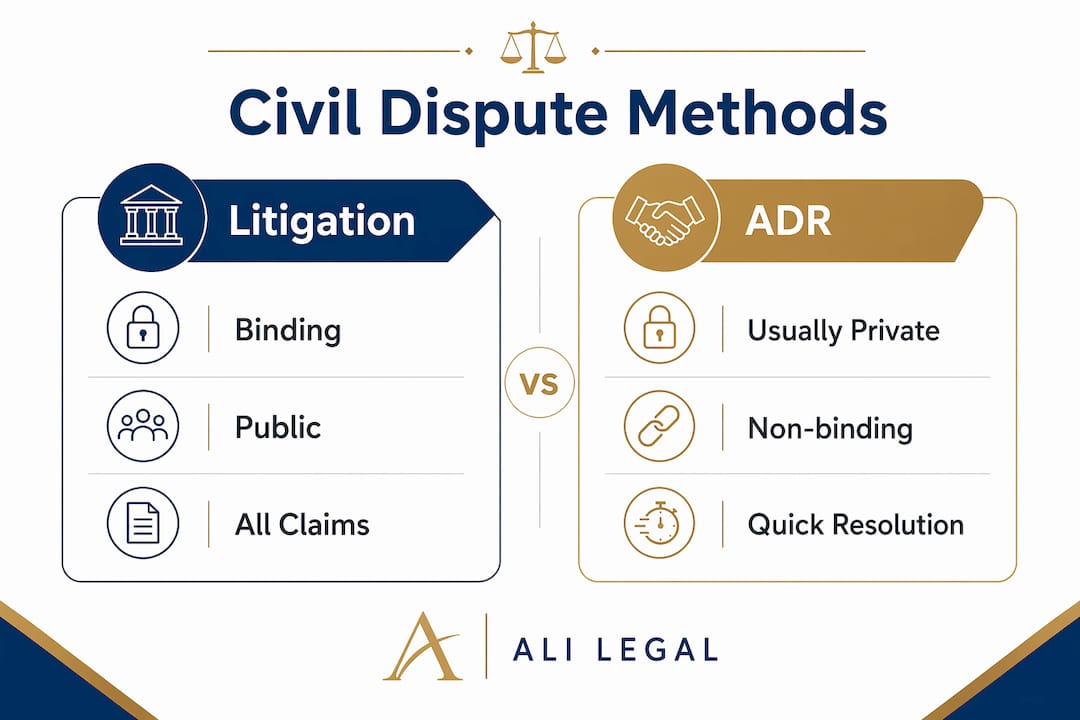
Pro Tip: If you want confidentiality and speed, mediation is usually the first route to consider. If you need a binding decision and the other party refuses to cooperate, litigation or arbitration are your realistic options.
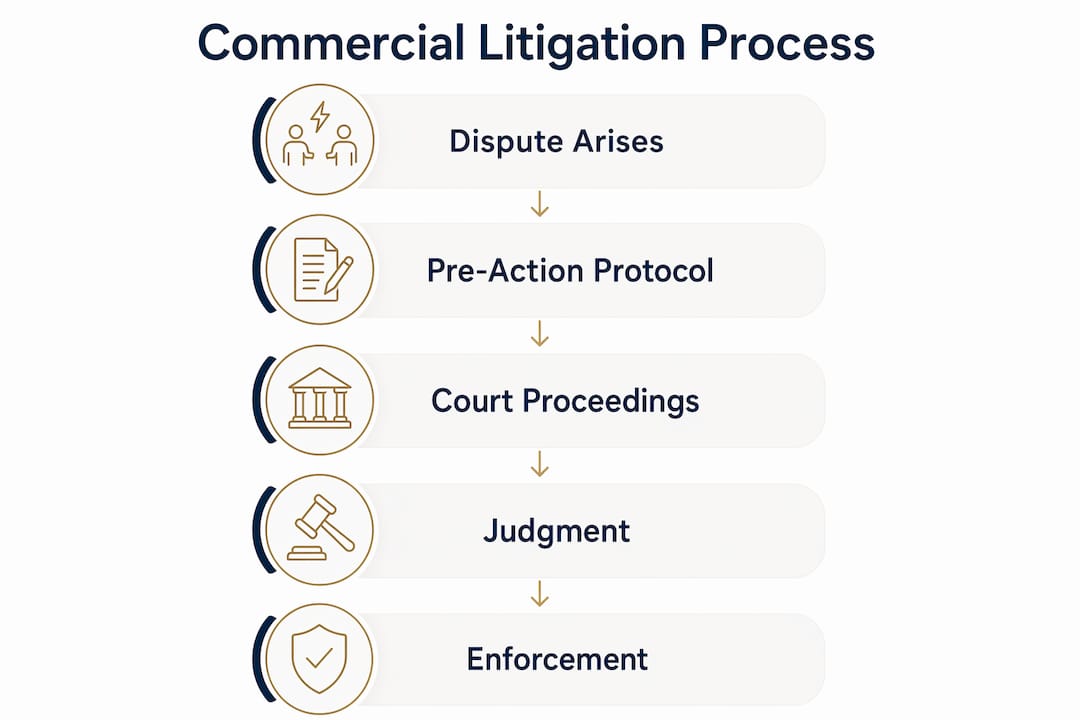
The CPR sets out every procedural step from the moment a claim is issued to the delivery of a judgment. Civil proceedings in England and Wales follow these rules without exception. Understanding the stages removes much of the uncertainty that makes litigation feel daunting.
The three main tracks are the small claims track (claims up to £10,000), the fast track (£10,000 to £25,000), and the multi-track (above £25,000 or complex cases). The Supreme Court sits as the final court of appeal for the most significant legal questions.
| Track | Claim value | Typical timeline | Cost recovery |
|---|---|---|---|
| Small claims | Up to £10,000 | Months | Limited |
| Fast track | £10,000–£25,000 | 6–12 months | Standard |
| Multi-track | Above £25,000 | 12–36 months | Full (discretionary) |

Pre-action protocols require both parties to exchange information and attempt resolution before issuing proceedings. Courts take compliance seriously. Ignoring a protocol can result in cost penalties even if you win your case.
ADR is not simply a cheaper version of litigation. It is a fundamentally different approach to resolving conflict, with its own strengths and limits.
Advantages of ADR:
Limitations of ADR:
The UK government promotes integrated ADR as a faster, cost-effective alternative to litigation, particularly for consumer and business disputes. The legal system increasingly encourages ADR before and during proceedings. Refusing ADR without good reason can attract cost sanctions from the court.
Pro Tip: Even if you intend to litigate, attending a mediation session costs relatively little and can produce a settlement that saves months of proceedings. Courts expect you to have tried it.
The outcome of a civil dispute is often shaped long before any hearing takes place. Early preparation is the single most important factor in your bargaining position.
Preserve all relevant documents immediately. Emails, contracts, invoices, photographs, and text messages all constitute evidence. Pre-action document preservation directly affects your negotiating leverage and the reliability of your evidence at trial. Do not delete anything, even if it appears unhelpful.
Review any pre-action protocol that applies to your dispute. Protocols exist for personal injury, professional negligence, construction, and many other claim types. Following the correct protocol demonstrates good faith and avoids cost penalties.
Communicate clearly and in writing with the other party. A well-drafted letter before action sets out your claim, the evidence you rely on, and a reasonable deadline for response. Courts expect this step. It also creates a paper trail that supports your position.
Choose the right resolution method for your specific situation. A boundary dispute with a neighbour calls for a different approach than a £200,000 contract claim against a supplier. Consider the value of the claim, the relationship with the other party, the need for confidentiality, and whether you need a binding decision. Guidance on how to resolve contract disputes can help you match the method to the facts.
Obtain specialist legal advice early. A solicitor can assess the strength of your claim, advise on the most appropriate resolution route, and identify risks you may not have considered. Early advice is almost always cheaper than late advice.
Understand the costs and time frames before committing. Litigation is expensive. Even a successful claimant rarely recovers all their legal costs. Factor in the realistic cost of proceedings against the value of what you are claiming. For cross-border disputes, international legal consultancy adds another layer of complexity that specialist advice can help manage.
Consider expert evidence where the dispute involves technical matters. Valuations, medical causation, and construction defects all benefit from independent expert opinion. Courts give significant weight to properly instructed experts who comply with CPR requirements.
After working with clients across a wide range of civil disputes, the pattern I see most often is this: people wait too long before taking the situation seriously. They hope the other side will back down, or they assume the strength of their position speaks for itself. It rarely does.
The disputes that resolve most efficiently share one characteristic. Both parties have a clear-eyed understanding of their own weaknesses, not just their strengths. Mediation works best when each side has already stress-tested its case with a solicitor. Walking into a mediation session without that preparation is like negotiating a contract without reading it first.
I also think the legal system’s push towards ADR is genuinely good for most individuals. Litigation is slow, expensive, and emotionally draining. A mediated settlement that gives you 80% of what you wanted in three months is almost always better than a court judgment for 100% in three years. The exception is when you need a public ruling or the other party is acting in bad faith. In those cases, the court is the right place to be, and you should commit to it fully.
The most common mistake I see is treating ADR and litigation as mutually exclusive. They are not. You can attempt mediation, fail to settle, and then proceed to court with your position strengthened by the process. The civil litigation steps do not disappear because you tried mediation first. They simply begin from a more informed starting point.
— Panagiotis
Facing a civil dispute without specialist support puts you at a real disadvantage. Alilegal’s team handles the full range of civil litigation and dispute resolution matters, from early pre-action advice through to trial, covering contract disputes, property conflicts, personal injury claims, and more.

Alilegal offers fixed fees and straightforward advice so you know exactly where you stand from the first conversation. Whether you need help choosing between mediation and litigation, preparing your evidence, or representing you in court, the team brings the same clarity and commitment to every case. You can learn more about Alilegal’s civil litigation services or contact the team directly for a case evaluation tailored to your situation.
Civil dispute resolution is the process of settling legal disagreements between individuals or organisations using court proceedings or alternative methods such as mediation and arbitration. In England and Wales, the Civil Procedure Rules 1998 govern formal litigation, while ADR frameworks operate alongside the court system.
Mediation itself is not binding, but any settlement agreement reached through mediation is enforceable as a contract. If one party later refuses to honour the agreement, the other can apply to court to enforce it.
Choose litigation when the other party refuses to engage in ADR, when you need a public judgment, or when the dispute involves a legal point that requires a definitive court ruling. Courts remain the only forum for binding decisions without the other party’s consent.
The small claims track handles civil claims up to £10,000. It is designed to be accessible without legal representation, with limited cost recovery and a simplified procedure compared to the fast track or multi-track.
Preserving documents and evidence before formal proceedings begin directly strengthens your negotiating position and the reliability of your case at trial. Courts also expect compliance with pre-action protocols, and failure to follow them can result in cost penalties regardless of the outcome.
Did you know that over 80 percent of cross-border commercial contracts now include arbitration clauses? As business dealings grow more complex, finding swift and confidential ways to resolve disputes is more important than ever. Arbitration delivers flexible solutions, giving companies the power to select expert decision-makers and protect sensitive information while avoiding lengthy court battles. Understanding how arbitration works can give your business a clear advantage in navigating challenging legal situations.
Arbitration represents a strategic alternative dispute resolution mechanism within commercial law, allowing parties to resolve legal conflicts outside traditional courtroom litigation. According to research from international legal sources, this approach provides businesses with a more flexible, confidential, and efficient method of settling complex commercial disputes.
At its core, arbitration involves a neutral third-party arbitrator or panel who reviews evidence and renders a binding decision that resolves the conflict between commercial entities. Unlike court proceedings, arbitration offers significant advantages: parties can select arbitrators with specific industry expertise, maintain confidentiality, and often achieve faster resolution timelines. International Disputes & Arbitration | Ali Legal provides comprehensive insights into these nuanced processes.
The arbitration process typically follows structured steps that distinguish it from traditional litigation:
Mutual agreement to arbitrate
Selection of neutral arbitrator(s)
Presentation of evidence by both parties
Confidential hearing and deliberation
Binding decision issued by arbitrator(s)
Commercial entities increasingly prefer arbitration because it offers greater control over dispute resolution, reduces public exposure, and can be significantly more cost-effective than prolonged court battles. The flexibility of choosing jurisdiction, procedural rules, and expert decision-makers makes arbitration an attractive option for businesses navigating complex legal landscapes.
Commercial arbitration is fundamentally categorized into two primary models: ad hoc and institutional arbitration. According to research from global arbitration studies, these models represent distinct approaches to resolving commercial disputes, each with unique characteristics and strategic implications for businesses.
In ad hoc arbitration, parties independently design their arbitration process without institutional administration. As research indicates, this approach offers maximum flexibility, allowing parties to customize procedural rules, select arbitrators, and define precise parameters for dispute resolution. However, this flexibility requires significant coordination and mutual agreement between parties. International Arbitration Solicitors London | Cross-Border Dispute Lawyers | Ali Legal highlights the nuanced considerations in selecting appropriate arbitration models.
Conversely, institutional arbitration provides a structured framework managed by established arbitration institutions. These organizations offer:
Pre-defined procedural rules
Administrative support
Standardized selection processes for arbitrators
Established mechanisms for managing complex international disputes
The choice between ad hoc and institutional arbitration depends on multiple factors, including the complexity of the dispute, international jurisdictional considerations, and the specific needs of the commercial entities involved. While ad hoc arbitration offers unparalleled customization, institutional arbitration provides reliability and established professional infrastructure, making it particularly attractive for complex cross-border commercial conflicts.
International arbitration operates within a complex network of legal frameworks designed to facilitate consistent, fair, and enforceable dispute resolution across global jurisdictions. The UNCITRAL Model Law stands as a pivotal cornerstone in this landscape, providing a standardized template that nations can adapt to harmonize their arbitration regulations.
According to research, the UNCITRAL Model Law, adopted by the United Nations Commission on International Trade Law in 1985 and subsequently amended in 2006, serves as a crucial blueprint for countries developing their arbitration legislation. While not legally binding, this model offers a comprehensive framework that encourages international consistency in arbitration practices. Nations can voluntarily incorporate these guidelines, creating a more predictable environment for cross-border commercial disputes. International Disputes & Arbitration | Ali Legal provides deeper insights into these international legal mechanisms.
Key international legal frameworks include:
UNCITRAL Model Law on International Commercial Arbitration
New York Convention on the Recognition and Enforcement of Foreign Arbitral Awards
World Bank Guidelines on Investment Arbitration
International Chamber of Commerce (ICC) Arbitration Rules
National jurisdictions also play a critical role in arbitration governance. For instance, the United States Federal Arbitration Act (FAA), enacted in 1925, demonstrates how individual countries develop specific legal mechanisms to support and regulate arbitration processes. This legislation applies to commerce-related contracts and reflects the ongoing evolution of legal frameworks designed to provide robust, efficient dispute resolution mechanisms for commercial entities.
The arbitration process is fundamentally a consensual mechanism where commercial parties voluntarily agree to resolve their disputes outside traditional court systems. According to research, this process begins with a critical prerequisite: a formal arbitration agreement that explicitly outlines the terms, scope, and procedural expectations for dispute resolution.
Initiation of arbitration typically follows a structured sequence. International Arbitration Solicitors London | Cross-Border Dispute Lawyers | Ali Legal explains that parties must first formally submit their dispute through written notice, triggering the arbitration proceedings. The subsequent steps usually involve:
Selection of neutral arbitrator(s)
Exchange of written statements and evidence
Pre-hearing conferences
Formal arbitration hearing
Deliberation and award issuance
Unlike litigation, arbitration offers remarkable procedural flexibility. Parties can mutually determine critical aspects such as the number of arbitrators, language of proceedings, applicable substantive laws, and venue. This customization allows businesses to create a dispute resolution mechanism tailored to their specific commercial relationship and industry context. The final arbitration award is legally binding and typically enforceable across international jurisdictions, providing a conclusive resolution that minimizes prolonged legal uncertainties.
Commercial dispute resolution encompasses three primary mechanisms: arbitration, litigation, and mediation, each with distinct characteristics and strategic implications for resolving conflicts. While these approaches share the fundamental goal of conflict resolution, they differ significantly in process, formality, and outcomes.
International Disputes & Arbitration | Ali Legal highlights the critical distinctions between these methods. Litigation represents the traditional court-based approach, characterised by public proceedings, rigid procedural rules, and decisions made by judges. In contrast, arbitration offers a more flexible, private alternative where parties select their decision-makers and can customize procedural rules.
Key comparative features include:
Litigation: Public proceedings, government-appointed judges, strict procedural rules
Arbitration: Private hearings, party-selected arbitrators, flexible procedural framework
Mediation: Collaborative negotiation, non-binding recommendations, focus on mutual compromise
Mediation stands apart as a non-binding process where a neutral third party facilitates negotiation, unlike arbitration’s binding decision model. Businesses often prefer arbitration for its confidentiality, expertise-based selection of decision-makers, and ability to resolve complex commercial disputes efficiently. The choice between these methods depends on the specific nature of the conflict, desired outcomes, and strategic considerations of the involved parties.
Here’s a comparison of the main dispute resolution methods in commercial law:
| Feature | Arbitration | Litigation | Mediation |
| Decision Maker | Arbitrator(s) chosen by parties | Judge appointed by court | Mediator (neutral facilitator) |
| Binding Outcome | Yes | Yes | No |
| Confidentiality | High | Low | High |
| Procedural Flexibility | High | Low | Very High |
| Speed of Resolution | Generally faster | Often slow | Fastest |
| Appeal Possibility | Very limited | Broad scope | Not applicable |
Arbitration presents a nuanced dispute resolution mechanism with multifaceted advantages and potential drawbacks for commercial entities. The primary benefits include unprecedented confidentiality, procedural flexibility, and the ability to select industry-specific expertise for resolving complex commercial conflicts.
International Arbitration Solicitors London | Cross-Border Dispute Lawyers | Ali Legal highlights the strategic considerations in arbitration selection. The process offers significant advantages, but also introduces unique challenges that businesses must carefully evaluate:
Key Benefits:
Confidential proceedings
Faster resolution compared to traditional litigation
Ability to select specialized arbitrators
International enforceability of awards
Reduced public exposure of commercial disputes
Potential Challenges:
Higher upfront costs compared to standard litigation
Limited grounds for appeal
Potential complexity in selecting appropriate arbitration mechanisms
Coordination requirements in ad-hoc arbitration models
Cost considerations are particularly critical. While arbitration can be more expensive initially, it often proves more economical long-term by reducing prolonged legal battles and providing swifter, more targeted dispute resolution. The precise financial implications depend on the chosen arbitration model, complexity of the dispute, and specific institutional framework selected.
Understanding the complexities of arbitration in commercial law can feel overwhelming. The challenge lies in selecting the right arbitration model, ensuring your dispute is handled efficiently, and protecting your business interests with confidentiality and expertise. Terms like ad hoc arbitration, institutional frameworks, and binding arbitration awards are central to making informed decisions but can be difficult to navigate without professional guidance.
At Ali Legal, we appreciate that your goal is a swift, transparent, and effective resolution to commercial disputes backed by clear communication and fixed fees. With our extensive experience across civil litigation and international disputes, we help you manage these challenges while maximising the benefits of arbitration. Explore how our client-focused approach aligns with the principles discussed in this article through our Uncategorized | Ali Legal resources.

Take control of your commercial dispute resolution today. Visit Ali Legal to consult with solicitors who prioritise your business needs and deliver strategic, fast arbitration solutions. Learn more about how we protect your interests across borders by reviewing our insights on International Arbitration and get started on securing your commercial success.
Arbitration in commercial law is an alternative dispute resolution mechanism where parties resolve disputes outside of traditional court litigation. A neutral third party, known as an arbitrator, reviews evidence and makes a binding decision to resolve the conflict.
Arbitration offers several advantages over litigation, including greater confidentiality, faster resolution times, and the ability for parties to choose arbitrators with industry-specific expertise. It also allows for a more flexible procedural framework.
The arbitration process typically involves a formal arbitration agreement, the selection of neutral arbitrators, the exchange of evidence, a hearing, and finally, the issuance of a binding decision or award. The process is designed to be more flexible than traditional court procedures.
The two main types of arbitration for commercial disputes are ad hoc arbitration, where parties independently design the process, and institutional arbitration, which is governed by established organizations that provide structured frameworks and rules for dispute resolution.
International Arbitration Solicitors London | Cross-Border Dispute Lawyers | Ali Legal
Commercial Litigation Solicitors London | Business Dispute Lawyers | Ali Legal
TL;DR:
- Alternative dispute resolution (ADR) helps parties resolve disputes outside court through methods like mediation, arbitration, and negotiation. It offers faster, more cost-effective, and confidential solutions that preserve relationships better than litigation. Choosing the right ADR method is crucial for effective resolution and minimizing risks.
Alternative dispute resolution (ADR) is defined as any method of resolving a legal dispute outside of court, including mediation, arbitration, and negotiation. The advantages of alternative dispute resolution are substantial: settlement rates reach as high as 85% through mediation, compared to just 3–5% of civil cases that ever reach a final court hearing. That gap tells you everything about where disputes actually get resolved. For individuals and businesses alike, ADR offers faster timelines, lower costs, greater procedural control, and the ability to protect relationships that litigation would almost certainly destroy. This guide covers each benefit in detail so you can make an informed choice before committing to any dispute resolution process.
ADR consistently outperforms litigation on the metrics that matter most: speed, cost, privacy, and outcome quality. The three principal methods are mediation, arbitration, and negotiation, and each serves a different type of dispute.
Understanding which method fits your dispute is the starting point for using ADR effectively. Choosing the wrong method wastes time and money just as surely as going straight to court.
Speed is one of the clearest dispute resolution advantages ADR holds over the courts. Court cases routinely take years from issue to final hearing, particularly in the Commercial Court or the High Court in England and Wales. ADR compresses that timeline dramatically.

Mediation sessions can be scheduled within days or weeks, and many disputes settle in a single session or after a small number of meetings. Arbitration takes longer than mediation but still moves far faster than litigation, particularly for commercial disputes where the parties can agree on a timetable. That speed has a direct effect on business operations: a dispute resolved in six weeks causes far less disruption than one dragging through the courts for three years.
Key time-related benefits of ADR include:
Pro Tip: If speed is your primary goal, choose mediation over arbitration. Mediation can be arranged and concluded within weeks, whereas arbitration, though faster than court, still involves formal procedural steps that add time.
ADR is generally less expensive than litigation, but the cost advantage is not unconditional. Understanding the financial picture clearly helps you plan properly.
The direct costs of mediation are typically a mediator’s daily rate split between the parties, plus legal representation if you choose to use it. Arbitration costs more than mediation but still falls well below the total cost of a contested High Court trial, which can run to tens of thousands of pounds once you account for solicitor fees, barrister fees, court fees, and expert witnesses. For small businesses in particular, cost-effective alternatives to litigation can be the difference between resolving a dispute and abandoning a legitimate claim because the economics do not stack up.
The important caveat is this: if ADR fails and the parties proceed to litigation, the fees paid for mediation or arbitration become sunk costs. That increases total financial exposure. It does not make ADR a bad choice, but it does mean you should enter the process with a realistic assessment of whether the other party is genuinely willing to settle.
Cost-related benefits of ADR include:
Pro Tip: Before committing to ADR, ask your solicitor to give you a realistic estimate of the total cost if ADR fails and you proceed to court. That figure helps you decide whether to attempt mediation first or go straight to litigation for high-value disputes where the other party has shown no willingness to negotiate.
Flexibility is one of the most underrated benefits of dispute resolution through ADR. Courts operate within fixed procedural rules. ADR does not.
Parties in ADR control the procedural rules, the evidentiary standards, and how they present their case. In mediation, you can tell your story in your own words rather than having it filtered through formal pleadings. In arbitration, the parties can agree on the scope of disclosure, the number of witnesses, and the hearing format. That control produces better outcomes because the process fits the dispute rather than forcing the dispute into a process designed for something else.
The remedies available through ADR also go beyond what a court can order. A court can award damages or issue an injunction. A mediator can help parties reach agreements that include apologies, changes to working practices, ongoing commercial arrangements, or phased payment plans. ADR allows customised remedies that address the root cause of a conflict, not just its legal symptoms.
| Feature | Mediation | Arbitration | Court litigation |
|---|---|---|---|
| Binding outcome | No (unless settlement deed signed) | Yes | Yes |
| Party control over procedure | High | Moderate | Low |
| Custom remedies | Yes | Limited | No |
| Privacy | Yes | Yes | No |
| Appeal rights | Not applicable | Very limited | Yes |
Choosing the right ADR method depends on what you need from the outcome. Mediation suits disputes where the relationship matters and creative solutions are possible. Arbitration suits disputes where you need a binding, confidential decision without going to court.
ADR protects two things that litigation almost always destroys: the relationship between the parties, and the privacy of the dispute itself.
ADR fosters cooperation and focuses on creative solutions rather than producing a winner and a loser. That matters enormously in disputes between business partners, employer and employee, landlord and tenant, or family members. A court judgment ends the legal dispute but rarely ends the hostility. Mediation, by contrast, gives both parties a voice and a stake in the outcome, which makes the resolution more durable.
Confidentiality is equally significant. ADR sessions are private, and the discussions that take place in mediation are protected by without-prejudice privilege. Court proceedings, by contrast, are public record. For businesses, a public dispute can damage reputation, unsettle clients, and alert competitors. For individuals, particularly in family or employment matters, public proceedings can cause lasting personal harm.
Key relationship and privacy benefits include:
Pro Tip: In family disputes or long-term commercial relationships, always attempt mediation before issuing proceedings. The role of a mediator is to create a safe space for both parties to speak honestly. That conversation alone often resolves disputes that would otherwise cost tens of thousands of pounds in legal fees.
Most people approach ADR as a single concept. In practice, the method you choose shapes the outcome as much as the merits of your case.
I have seen clients enter mediation with a dispute that genuinely needed a binding decision. The other party used the process to delay, gather information, and then proceed to litigation anyway. The mediation cost both parties time and money and achieved nothing. That outcome was not inevitable. It was the result of choosing the wrong process for the dispute characteristics.
Arbitration is frequently misunderstood. Many clients assume it is a softer, cheaper version of court. It is not. Arbitration produces binding decisions that are rarely appealable. If you lose an arbitration, you are in almost the same position as if you had lost at trial, but without the same appeal rights. That is not a reason to avoid arbitration. It is a reason to prepare for it with the same rigour you would bring to litigation.
The most common misconception I encounter is that ADR is always the right first step. It is the right first step when the other party is genuinely willing to engage, when the dispute has a negotiable solution, and when the relationship has some value worth preserving. When none of those conditions apply, ADR delays the inevitable and increases total costs. A good solicitor will tell you which category your dispute falls into before you spend a penny on mediation.
The ADR landscape for UK businesses has matured considerably. Courts now actively encourage parties to attempt ADR before issuing proceedings, and unreasonable refusal to engage can result in adverse costs orders. That changes the calculus. ADR is no longer just a sensible option. In many cases, it is a procedural expectation.
— Panagiotis
Resolving a dispute well requires knowing when ADR is the right tool and when litigation is unavoidable. Alilegal advises individuals and businesses on both, with particular strength in civil and commercial disputes where the stakes are high and the choice of process matters.
Whether you are facing a contractual dispute, a commercial disagreement, or a complex multi-party conflict, Alilegal’s team assesses your position and recommends the most effective path forward. The firm’s civil dispute resolution service covers the full spectrum from early-stage negotiation through to High Court litigation, so you are never locked into one approach. For high-value commercial matters, Alilegal’s commercial litigation team brings the same strategic clarity to ADR as it does to contested proceedings.
The primary advantage is speed and cost. Mediation achieves settlement rates as high as 85%, often resolving disputes in weeks rather than the years a court case can take.
ADR is generally less expensive, but costs depend on the method and outcome. If ADR fails and litigation follows, the fees paid for mediation or arbitration become sunk costs that increase total expenditure.
Mediation is a voluntary, non-binding process where a neutral facilitates agreement between the parties. Arbitration produces a binding decision that functions similarly to a court ruling and is rarely appealable.
Choose arbitration when you need a binding, confidential decision and the dispute is too complex or adversarial for voluntary settlement. Arbitration suits disputes where one party is unlikely to comply with a non-binding outcome.
Yes. ADR sessions are confidential and protected by without-prejudice privilege. Court proceedings are public record, which makes ADR the preferred option for businesses and individuals who need to protect sensitive information.
TL;DR:
- Commercial litigation in England and Wales involves resolving disputes related to business relationships, mainly through specialized courts and procedural rules. Parties are advised to prepare thoroughly, use alternative dispute resolution methods like mediation, and act promptly to preserve their legal rights. Effective management of litigation requires early legal advice, strategic court selection, and disciplined case organization.
Commercial litigation law is the body of law governing legal disputes that arise from business relationships, commercial transactions, and contractual obligations between parties. It covers everything from a supplier suing for unpaid invoices to a shareholder challenging a boardroom decision. In England and Wales, commercial litigation operates within a specialist procedural framework built around the Civil Procedure Rules (CPR) and dedicated courts such as the Commercial Court and the Business and Property Courts. Understanding this area of law helps businesses and individuals protect their rights, manage risk, and make informed decisions when disputes arise.
Commercial litigation law is defined as the legal process by which parties resolve disputes connected to commercial activity through the courts. The term “commercial litigation” is widely used, but the recognised industry term is “commercial dispute resolution,” which encompasses both court proceedings and alternative methods. The disputes themselves, known as commercial disputes, typically involve businesses, sole traders, partnerships, or individuals acting in a commercial capacity.
Common commercial litigation examples include breach of contract claims, debt recovery actions, shareholder disputes, professional negligence claims, and disputes over intellectual property rights. A technology company pursuing a former partner for misuse of confidential information is a commercial dispute. So is a construction firm seeking damages after a client refuses to pay for completed works. The range is broad, but the common thread is that the dispute stems from a commercial relationship or transaction.
Commercial litigators, also called commercial litigation solicitors or commercial litigation attorneys in some jurisdictions, manage these cases from initial investigation through to trial or settlement. What a commercial litigator does includes assessing the legal merits of a claim, advising on procedural strategy, drafting court documents, managing disclosure, and representing clients at hearings. Their role demands both legal precision and commercial awareness, because the cost of litigation must always be weighed against the value of the outcome.

The Business and Property Courts, launched in july 2017, form a network of specialist jurisdictions within the High Court designed to handle complex commercial disputes. They include the Commercial Court, the Technology and Construction Court (TCC), the Intellectual Property Enterprise Court (IPEC), and the Financial List, among others. Each court has specific expertise suited to the nature of the dispute.
The choice of court matters considerably. Selecting the appropriate forum is a strategic decision affecting procedure, enforcement options, and the overall cost of resolving a dispute. A case heard in the Commercial Court benefits from judges with deep expertise in banking, shipping, and international trade. A construction dispute is better suited to the TCC, where judges understand technical evidence and complex project contracts.
Key courts and their focus areas include:
Regional courts provide genuine access to specialist justice without requiring parties to litigate in London. This matters for smaller businesses where travel and accommodation costs can distort the economics of a claim.
The Civil Procedure Rules govern all civil litigation in England and Wales, including commercial disputes. The CPR’s overriding objective requires courts to deal with cases justly and at proportionate cost. That single principle reshapes how litigation is conducted from the moment a dispute arises.
Before the CPR, litigation was largely party-driven. Solicitors set their own pace, and cases could drift for years. The CPR replaced that approach with court-controlled litigation conduct, requiring parties to act reasonably and comply with strict timetables. Courts now actively manage cases, set deadlines, and penalise parties who behave unreasonably through adverse costs orders. This is a fundamental shift in litigation culture, not just a procedural update.
What commercial litigation involves under the CPR includes pre-action protocols, which require parties to exchange information and attempt resolution before issuing proceedings. Case management conferences allow judges to set the litigation timetable, limit disclosure, and identify the real issues in dispute. Witness statements and expert reports are exchanged in advance of trial, reducing surprises and focusing the hearing on genuinely contested matters.
Pro Tip: Begin your case preparation before you instruct solicitors. Gather contracts, correspondence, invoices, and any relevant communications as soon as a dispute becomes apparent. Courts expect parties to be ready to engage quickly, and early organisation reduces costs significantly.
Limitation periods are the legal deadlines within which a claim must be brought. Miss the deadline and the claim is almost certainly lost, regardless of its merits. The Limitation Act 1980 sets a six-year limitation period for most contract and tort claims in England and Wales. That period runs from the date the cause of action accrued, which is usually when the breach occurred or the loss was suffered.
Jurisdiction and limitation issues are gateway questions that determine whether a claim can proceed at all. Courts consider them before examining the merits. A technically strong claim becomes worthless if it is time-barred.
Practical steps for managing limitation risk:
Alternative dispute resolution (ADR) covers methods of resolving disputes outside formal court proceedings. The two most common forms in commercial contexts are mediation and arbitration. They are frequently confused, but they operate very differently.
Arbitration involves adjudication with a binding outcome decided by an arbitrator or panel. It closely resembles court litigation in structure but takes place privately. Mediation, by contrast, involves a neutral facilitator helping parties reach a negotiated settlement. The mediator has no power to impose a decision. The parties retain control of the outcome.
| Feature | Court litigation | Mediation | Arbitration |
|---|---|---|---|
| Decision maker | Judge | Parties themselves | Arbitrator |
| Outcome binding | Yes | Only if settled | Yes |
| Confidential | No | Yes | Yes |
| Costs | High | Lower | Variable |
| Speed | Slower | Faster | Variable |
| Suitable for | Complex, high-value disputes | Relationship-sensitive disputes | International or specialist disputes |
ADR is increasingly compulsory as a step within commercial dispute resolution. Courts regularly encourage or require parties to attempt ADR before proceeding to trial. Refusing ADR without good reason can result in cost penalties even for a winning party. This reflects a broader policy shift: courts want ADR to filter disputes before they consume judicial resources.
Pro Tip: Mediation works best when both parties have something to lose from continued litigation. If the relationship between the parties has commercial value, or if the costs of trial outweigh the sum in dispute, mediation is almost always worth attempting before issuing proceedings.
For businesses weighing their options, Alilegal’s guide to dispute resolution methods sets out the practical differences between each approach in plain terms.
Commercial litigation rewards preparation and penalises delay. The CPR’s emphasis on proactive case management means that parties who engage early and organise their evidence thoroughly are better placed than those who react slowly. The following steps apply whether you are a claimant or a defendant.
Preserve all relevant documents immediately. Once a dispute is foreseeable, stop deleting emails, messages, or files. Courts take document destruction seriously, and adverse inferences can be drawn against a party that fails to preserve evidence.
Seek specialist legal advice early. A commercial litigation solicitor can assess the strength of your position, identify limitation risks, and advise on the most cost-effective route to resolution. Early advice prevents costly procedural errors later.
Review the relevant contracts. Most commercial disputes turn on the precise wording of a contract. Identify the governing law clause, jurisdiction clause, and any dispute resolution provisions before taking any steps.
Consider ADR before issuing proceedings. Courts expect parties to have explored settlement options. A letter before action, followed by a genuine attempt at negotiation or mediation, demonstrates good faith and can reduce costs exposure.
Assess proportionality honestly. The CPR requires litigation to be proportionate to the value and complexity of the dispute. A £15,000 debt claim does not justify the same litigation budget as a £5 million contract dispute. Discuss costs budgets with your solicitor at the outset.
Choose the right forum. The forum selection decision affects procedure, cost, and enforcement. Specialist courts offer expertise but come with higher procedural demands. Discuss the options with your legal team before issuing.
After years of working with businesses and individuals through commercial disputes, one pattern stands out above all others. The parties who fare best are not always those with the strongest legal case. They are the ones who treat litigation as a managed process rather than a reactive event.
The CPR changed litigation culture permanently. Courts no longer tolerate the old approach of issuing proceedings and then waiting to see what happens. Judges expect parties to know their case, comply with timetables, and engage constructively with the other side. Businesses that understand this from day one spend less, resolve disputes faster, and avoid the procedural penalties that erode even winning positions.
The specialist courts, particularly the Commercial Court and the TCC, are genuinely efficient when used correctly. The judges are expert, the procedures are tailored to complex disputes, and the outcomes are predictable. The mistake many businesses make is treating these courts as a last resort rather than a first-choice forum for serious disputes.
My honest view on ADR is this: mediation is underused and misunderstood. Businesses often see it as a sign of weakness. It is the opposite. A well-timed mediation, conducted after disclosure but before trial, resolves the majority of commercial disputes that reach it. The cost saving compared to a full trial is substantial, and the outcome is within the parties’ control. That combination is rare in litigation.
— Panagiotis
Commercial disputes carry real financial and reputational risk. Getting the strategy right from the start makes a measurable difference to the outcome.
Alilegal’s commercial litigation solicitors bring specialist expertise to high-stakes business disputes, from contract claims and shareholder conflicts to professional negligence and international commercial matters. The team works across the Business and Property Courts and advises on ADR strategy, forum selection, and procedural compliance under the CPR. Alilegal offers fixed-fee arrangements and clear, direct advice at every stage. If you are facing a commercial dispute or want to understand your legal position before one arises, contact Alilegal to speak with a specialist solicitor.
Commercial litigation is the legal process of resolving disputes arising from business relationships or commercial transactions through the courts. It covers contract claims, debt recovery, shareholder disputes, and professional negligence, among other matters.
A commercial litigator assesses the legal merits of a dispute, advises on procedural strategy, drafts court documents, manages disclosure, and represents clients at hearings. Their role combines legal expertise with commercial judgement about costs and outcomes.
The main types include breach of contract claims, debt recovery actions, shareholder and partnership disputes, professional negligence claims, and intellectual property disputes. Each type may be heard in a different specialist court depending on its subject matter and value.
The Limitation Act 1980 sets a six-year deadline for most contract and tort claims. Missing this deadline bars the claim from being heard, regardless of its underlying merits.
ADR, particularly mediation, is preferable when the cost of litigation outweighs the sum in dispute, when the parties have an ongoing commercial relationship worth preserving, or when confidentiality is a priority. Courts also increasingly require parties to attempt ADR before proceeding to trial.
TL;DR:
- Litigation, arbitration, and mediation are the main dispute resolution methods used by individuals and organizations facing legal conflicts. Litigation involves a public court process with a binding verdict, while arbitration is a private, enforceable decision made by neutral arbitrators, often used for international disputes. Mediation is a confidential way for parties to negotiate and reach their own agreement, often suitable for preserving relationships and reducing costs.
Litigation, arbitration, and mediation are the three primary dispute resolution methods available to individuals and organisations facing legal conflict. Litigation is the formal court process in which a judge or jury delivers a binding verdict. Arbitration is private adjudication by a neutral arbitrator, typically mandated by contract, with awards enforceable in over 170 countries under the 1958 New York Convention. Mediation is a voluntary, confidential process in which a neutral facilitator helps parties reach their own agreement. Choosing correctly between these three paths determines cost, speed, confidentiality, and the durability of the outcome.

Litigation is a formal, public court process in which a judge or jury resolves a dispute by applying the law. The outcome is a binding court judgement, enforceable by state power. Litigation records are public, which means the facts of your dispute, the evidence, and the final decision can all be accessed by third parties.
The typical litigation process follows these stages:
Litigation’s strengths are significant. Broad discovery rights mean you can compel the other side to produce documents they would prefer to hide. Appeal rights provide a safety net if the first decision is wrong. Courts can also grant injunctions and other interim remedies that private forums cannot always match.
The drawbacks are equally real. Litigation is expensive, slow, and public. A contested commercial dispute in the English courts can take two to four years from issue to trial. The public record creates reputational risk for businesses. For disputes where confidentiality or speed matters, litigation is often the least suitable option.
Arbitration is private adjudication by one or more neutral arbitrators, usually triggered by a clause in a commercial contract. The process is adversarial and legally sophisticated, not a simplified version of litigation. The arbitrator’s decision, called an award, is binding and final, with very limited grounds for appeal.
The key advantages of arbitration include:
Pro Tip: Parties in arbitration can tailor procedural rules to reduce costs and focus on the core issues. Most parties never use this right. Agreeing tight document production rules and a single arbitrator rather than a panel can cut costs substantially.
Arbitration has real limitations. The enforceability of the arbitration agreement itself can be contested, requiring a preliminary legal battle before the merits are even heard. More critically, complex arbitrations can exceed litigation costs, particularly when professional arbitrators charge daily rates and institutional fees are added. Limited appeal rights, while efficient, also mean a wrong decision is very difficult to correct. Alilegal’s guide to arbitration clauses in UK contracts explains how to draft these provisions to avoid common pitfalls.
Mediation is a voluntary, confidential process in which a neutral mediator facilitates negotiation between disputing parties. The mediator does not decide the outcome. The parties decide it themselves, with the mediator guiding communication, identifying common ground, and proposing options. This makes mediation fundamentally different from both litigation and arbitration.
The process typically works as follows:
Pro Tip: Mediation suits disputes where parties need to express emotions or reach creative trade-offs. A commercial landlord and tenant dispute, for example, might resolve through a rent deferral arrangement that no court could impose. Bring a decision-maker with full settlement authority to the mediation, not just a lawyer.
Mediation is preferred when preserving a long-term relationship is important. Business partners, joint venture parties, and family members in commercial disputes often find that an adversarial process destroys the relationship permanently. Mediation allows both sides to reach a solution they can live with. For a detailed breakdown of how mediators work in practice, Alilegal’s guide to the role of a mediator is a useful starting point.
The limitation is clear: mediation produces no outcome unless both parties agree. If one party refuses to engage genuinely, the process fails. The mediation session itself is non-binding until a written agreement is signed.
The table below summarises the key differences across five practical factors.
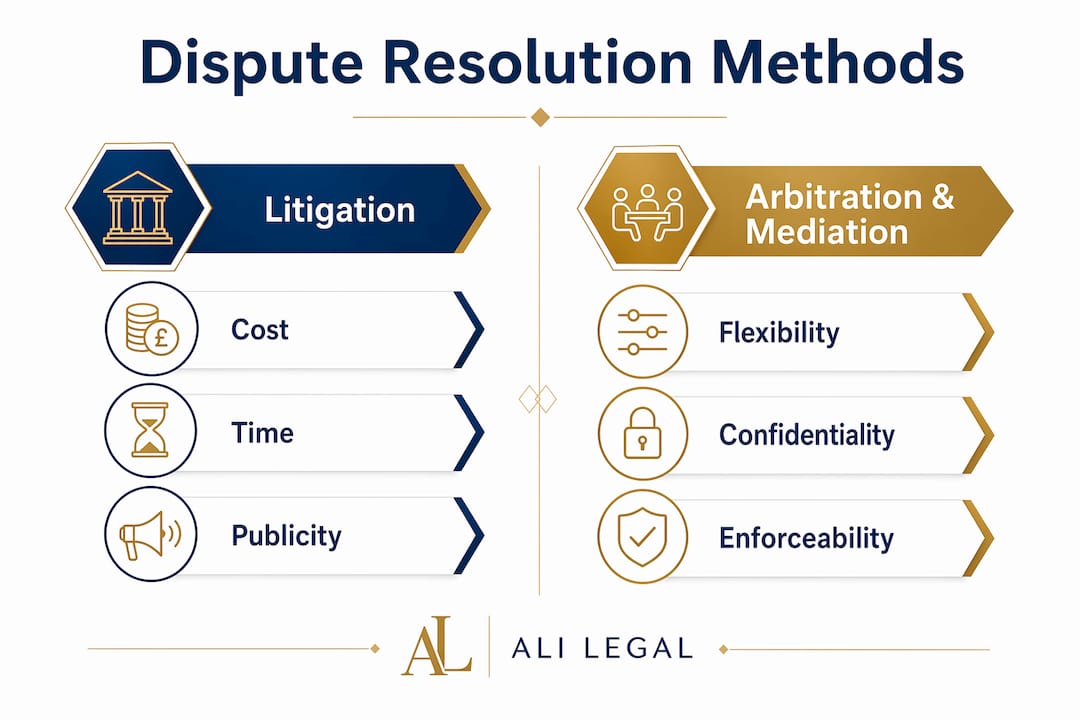
| Factor | Litigation | Arbitration | Mediation |
|---|---|---|---|
| Cost | High; court fees, lawyers, and potential appeals | Variable; can exceed litigation in complex cases | Generally lowest; mediator fees and one day’s preparation |
| Speed | Slow; years in contested cases | Moderate; faster than litigation but not always quick | Fast; often resolved in one to two days |
| Confidentiality | Public record | Private proceedings and award | Fully confidential |
| Enforceability | Court judgement; enforceable domestically | New York Convention; 170+ countries | Binding contract once signed; court order if registered |
| Finality | Appealable | Very limited appeal rights | No outcome unless parties agree |
| Formality | High; strict procedural rules | Moderate; rules can be adapted | Low; party-led process |
Confidentiality is the factor most organisations underestimate. Litigation records are public, which means a competitor, journalist, or regulator can read the details of your dispute. Arbitration and mediation both protect that information. For businesses in regulated sectors, this distinction alone can determine the choice of forum.
Cost comparisons require care. Mediation is almost always the cheapest option when it succeeds. Arbitration is often cheaper than litigation for straightforward disputes, but costs can surpass litigation in highly complex cases with multiple arbitrators and institutional administration fees. Litigation’s costs are high but predictable in structure, with court fee scales set by statute.
The right method depends on four factors: the nature of the dispute, the relationship between the parties, the need for enforceability, and the cost you can justify.
Choose mediation when preserving the relationship matters, when the dispute involves multiple issues that could be traded off creatively, or when speed and cost are the primary constraints. Mediation is also the right first step before committing to a more expensive process. Alilegal’s guide to business dispute mediation sets out a practical framework for executives.
Choose arbitration when the dispute arises from a contract with an arbitration clause, when cross-border enforcement is needed, or when confidentiality is non-negotiable. Arbitration is also appropriate when the parties want a legally binding decision but prefer a private forum to court.
Choose litigation when you need broad discovery rights, when you require a public ruling to set a precedent, when interim remedies such as injunctions are needed urgently, or when the other party has no arbitration agreement and refuses mediation.
Consider a hybrid approach. Many contracts now include tiered dispute resolution clauses: negotiation first, then mediation, then arbitration or litigation. This sequence gives parties the chance to resolve matters cheaply before escalating. Alilegal’s overview of alternatives to litigation covers this approach in detail for smaller organisations.
Pro Tip: Review your contracts now, before a dispute arises. If your commercial agreements contain arbitration clauses, understand what rules apply and which institution administers them. Discovering that you are bound by an unfamiliar set of procedural rules mid-dispute is a costly surprise.
Legal advice at the outset is not optional. The choice of forum affects your rights, your costs, and the enforceability of any outcome. A solicitor can assess the specific facts and recommend the most effective path.
The most persistent misconception I encounter is that arbitration is simply a quieter, friendlier version of going to court. It is not. Arbitration is a sophisticated, adversarial process that requires the same quality of legal preparation as litigation, sometimes more. Parties who enter arbitration expecting informality are consistently surprised by the cost and rigour involved.
The second misconception is that mediation is a soft option for disputes that are not serious enough for court. The opposite is true. Mediation produces durable outcomes precisely because the parties own the solution. A court judgement tells you who won. A mediated settlement tells you what both sides can actually live with. In commercial relationships that need to continue after the dispute, that distinction is decisive.
My practical advice is this: use mediation earlier than feels comfortable. Most parties wait until litigation or arbitration is already underway, at which point costs and entrenched positions make settlement harder. A well-timed mediation, before proceedings are issued, resolves disputes faster and at a fraction of the cost. The mediation process stages are worth understanding before you need them, not after.
— Panagiotis
Choosing the wrong dispute resolution method costs time, money, and sometimes the outcome itself. Alilegal works with individuals and businesses to assess each dispute on its facts and recommend the most effective path forward.
Alilegal’s team has deep experience in civil litigation, commercial disputes, arbitration, and mediation across domestic and international matters. Whether you are facing a contract dispute, a cross-border commercial claim, or a relationship-sensitive business conflict, Alilegal provides clear advice on your options from the outset. Fixed fees and transparent communication mean you know what you are committing to before proceedings begin. Contact Alilegal to discuss your dispute and identify the resolution method that fits your situation.
Arbitration produces a binding decision made by a neutral arbitrator, similar to a court judgement. Mediation is a facilitated negotiation in which the parties themselves reach a voluntary agreement, which becomes binding only once signed.
Yes. A settlement agreement from mediation is a binding contract once signed by both parties, and in many jurisdictions it can be registered as a court order for direct enforcement.
Arbitration awards are enforceable in 170+ countries under the 1958 New York Convention, making arbitration the preferred method for cross-border commercial disputes where enforcement across jurisdictions is required.
Not always. While arbitration is often faster than litigation, complex arbitrations can exceed litigation costs when multiple professional arbitrators, institutional fees, and extensive procedural steps are involved.
Litigation is the right choice when you need broad discovery rights, urgent interim remedies such as injunctions, a public ruling, or when the other party has no arbitration agreement and refuses to engage in mediation.
TL;DR:
- Personal injury cases involve legal claims for harm caused by negligence or wrongful conduct, covering physical, psychological, and reputational damage. The process requires prompt medical attention, evidence preservation, and professional legal support to ensure proper valuation and avoid missed deadlines. Compensation aims to restore losses, with factors like injury severity and evidence quality influencing the final award.
Personal injury cases are legal actions brought by individuals who suffer harm due to another party’s negligence or wrongful conduct, seeking financial compensation through tort law. The term “personal injury” covers a broader legal umbrella than most people realise. Physical, psychological, and reputational harm all fall within its scope, meaning you do not need a broken bone to have a valid claim. The legal foundation rests on four elements: duty of care, breach of that duty, causation, and provable damages. Miss any one of these, and the claim fails. Understanding how these elements interact is the first step toward protecting your rights after an accident or injury.
Personal injury law does not describe a single course of study or statute. Tort law principles and legal precedents form the backbone of every claim, which means the category of your injury directly shapes the evidence you need and the compensation you can recover.
The most common categories include:
The distinction between negligence, strict liability, and intentional torts matters practically. Negligence requires proof of fault. Strict liability does not. Intentional torts, such as assault, carry different limitation periods and may attract additional remedies. Knowing which category applies to your situation determines the legal strategy from day one.
The claims process follows a clear sequence, though the timeline varies considerably depending on complexity and whether the other party disputes liability.
The limitation period in England and Wales is generally three years from the date of the accident or from the date you became aware of the injury. Missing this deadline extinguishes your right to claim in almost every circumstance.
Pro Tip: Keep a daily diary of your symptoms, medical appointments, and how the injury affects your daily life. Courts and insurers place significant weight on contemporaneous records when assessing non-economic damages such as pain and suffering.

Compensation in personal injury claims aims to restore you, as far as money can, to the position you were in before the injury occurred. Damages awarded cover both financial losses and emotional harm. The two main categories are economic and non-economic damages.
| Damage type | What it covers | Examples |
|---|---|---|
| Economic (special damages) | Quantifiable financial losses | Medical bills, rehabilitation costs, lost earnings, future care costs |
| Non-economic (general damages) | Subjective, non-financial harm | Pain and suffering, loss of amenity, psychological distress, reputational harm |
| Punitive damages | Punishment for egregious conduct | Rarely awarded in English courts; more common in other jurisdictions |
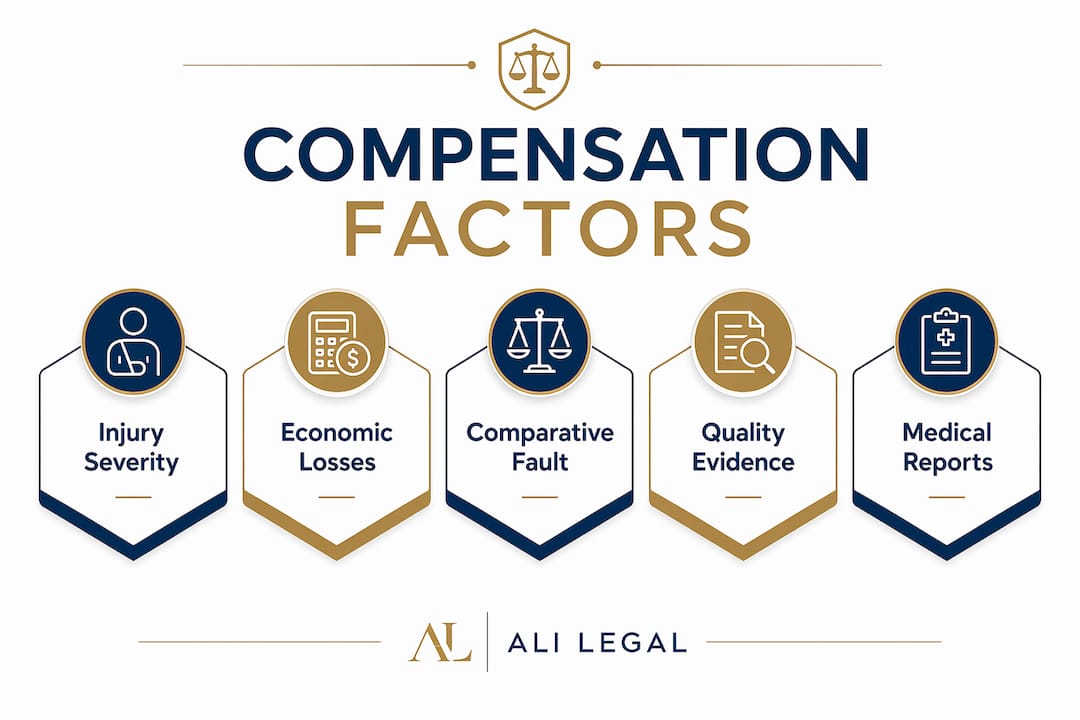
Several factors influence the final figure:
Injury severity and prognosis. A permanent disability commands significantly higher general damages than a soft tissue injury that resolves within months. Medical expert evidence is essential to establish long-term impact.
Comparative fault. English law applies contributory negligence under the Law Reform (Contributory Negligence) Act 1945. If you are found partly responsible for your own injury, your damages are reduced proportionally. In some jurisdictions, a plaintiff 50% or more at fault is barred entirely from recovery. English law takes a more proportionate approach, but a finding of contributory negligence still reduces your award materially.
Quality of evidence. A well-constructed claim supported by medical records, expert reports, and contemporaneous witness evidence achieves better outcomes than one relying on memory alone.
Pro Tip: Obtain a medical report from an independent expert, not just your treating clinician. Courts give greater weight to independent evidence, and insurers are less likely to dispute a well-supported prognosis.
Self-representation in personal injury litigation is rarely advisable. Proving causation requires bridging law with medicine, engineering, and physics, a combination that is genuinely difficult for anyone without legal training to manage effectively.
Experienced solicitors bring several advantages that directly affect your outcome:
The complexity of personal injury litigation means that even straightforward-looking cases can become contested disputes over causation or contributory negligence. Professional guidance from the start reduces that risk considerably.
The most common mistake I see is delay. People wait weeks before seeing a solicitor, sometimes because they hope the matter will resolve itself, sometimes because they underestimate the seriousness of their injuries. By the time they seek advice, evidence has been lost, witnesses have forgotten details, and the insurer has already formed a view of the claim.
The second mistake is accepting the first offer. Insurers make early offers precisely because they know claimants are often in financial difficulty and unfamiliar with the true value of their losses. An early offer rarely reflects future medical costs, long-term loss of earnings, or the full extent of psychological harm.
What actually works is simple: act quickly, document everything, and take professional advice before speaking to any insurer. The UK legal essentials around limitation periods and pre-action protocols are unforgiving. Missing a deadline is not a technicality. It is the end of your claim.
The legal landscape for claimants in 2026 is more claimant-aware than it was a decade ago, but insurers have also become more sophisticated in their defence strategies. The claimants who achieve fair outcomes are those who treat their claim as seriously as the other side does. Seek qualified legal support early, maintain realistic expectations, and trust the process.
— Panagiotis
Alilegal handles personal injury and civil litigation matters for individuals across the UK, offering clear advice, fixed fees where possible, and direct access to experienced solicitors from the first consultation.
Whether your case involves a road traffic accident, a workplace injury, or a medical negligence claim, Alilegal’s team builds the evidence-led approach that gives your claim the best chance of a fair outcome. The 2026 compensation guide on the Alilegal website covers the latest guidelines on damages in detail. For clients who need to pursue a disputed claim through the courts, Alilegal’s civil litigation service provides the full range of litigation support. Contact Alilegal today to discuss your situation with a solicitor who will give you a straight answer.
Personal injury covers physical harm, psychological suffering, emotional distress, and reputational damage caused by another party’s negligence or wrongful act. It is not limited to bodily injuries.
A claim is a formal demand for compensation submitted to the responsible party’s insurer. A lawsuit is court action taken when the insurer disputes liability or the settlement offer is inadequate.
The standard limitation period in England and Wales is three years from the date of the accident or from the date you became aware of the injury. Missing this deadline typically ends your right to claim.
Compensation covers economic losses such as medical costs and lost earnings, plus non-economic losses such as pain, suffering, and loss of amenity. Contributory negligence reduces the award proportionally if you are found partly at fault.
Most claims settle before trial through negotiation with the insurer. Court proceedings are issued when settlement fails, but the majority of cases resolve before a judge makes a final ruling.
TL;DR:
- A corporate lawyer advises businesses on transactions, governance, and compliance to prevent legal issues proactively. They handle contract drafting, mergers, governance advice, and risk management, focusing on enabling business growth. Building sector knowledge and commercial awareness is key to long-term success in this demanding legal role.
A corporate lawyer is defined as a legal professional who advises businesses on transactional matters, governance, and regulatory compliance rather than representing clients in court. The corporate lawyer role sits at the heart of commercial life, covering everything from drafting contracts and structuring mergers to guiding boards on their legal obligations. Unlike litigators, who resolve disputes after they arise, corporate lawyers work proactively to keep businesses on the right side of the law. If you are considering this career, understanding the full scope of corporate law duties will help you decide whether it is the right path for you.
Corporate lawyers focus primarily on transactional work: drafting and negotiating contracts, managing mergers and acquisitions, and advising on governance and securities compliance. That description covers a wide range of daily tasks, and the variety is one of the role’s defining features.
The core responsibilities of a corporate lawyer include:
The distinction between transactional and litigation work is worth understanding early. A corporate lawyer’s job is to prevent disputes from arising. A litigation lawyer steps in when they do. You can read more about how corporate and litigation roles differ to see where the two disciplines meet and diverge.
Pro Tip: When you shadow or intern at a law firm, ask to sit in on a contract negotiation as well as a client governance meeting. Seeing both contexts early will sharpen your understanding of what the role actually demands.

The path into corporate law follows a clear sequence, though the timeline varies by country and firm size.
Specialisation adds significant value at the mid-career stage. Lawyers who develop expertise in a specific sector, such as technology M&A, energy regulation, or financial services compliance, become considerably more marketable. Certifications in areas like competition law or data protection also strengthen a corporate law job description on a CV.
Pro Tip: Clerkships and vacation schemes at commercial firms are not just CV lines. They are your chance to demonstrate commercial awareness, which hiring partners consistently rank above raw academic grades.
Technical legal knowledge is the foundation, but the lawyers who advance fastest combine legal expertise with genuine business judgement. The key skills for corporate lawyers include contract drafting, M&A execution, corporate governance, negotiation, and due diligence. Practical experience in each of these areas directly improves employability.
The full skill set breaks down as follows:
Adaptability also matters. Corporate law moves quickly. Regulatory frameworks change, new deal structures emerge, and clients expect lawyers to keep pace. The lawyers who thrive are those who treat continuous learning as part of the job, not an occasional obligation.
Pro Tip: Read the financial press regularly. The Financial Times and The Economist will build your commercial awareness faster than any textbook, and partners will notice when you can discuss a client’s sector with genuine understanding.
Corporate lawyers are described as “handmaidens of the deal,” focusing on cooperative transactions that support mutual business growth rather than adversarial disputes. That framing captures something important: the corporate legal advisor role is fundamentally about enabling commerce, not obstructing it.
The table below contrasts the corporate lawyer’s transactional focus with the litigation lawyer’s dispute-resolution focus.
| Area | Corporate lawyer | Litigation lawyer |
|---|---|---|
| Primary focus | Transactions and compliance | Disputes and court proceedings |
| Timing | Proactive, before problems arise | Reactive, after a dispute emerges |
| Key tasks | Drafting contracts, M&A, governance | Pleadings, evidence, advocacy |
| Client interaction | Ongoing advisory relationship | Case-by-case instruction |
| Outcome goal | Deal completion, legal compliance | Winning or settling a dispute |
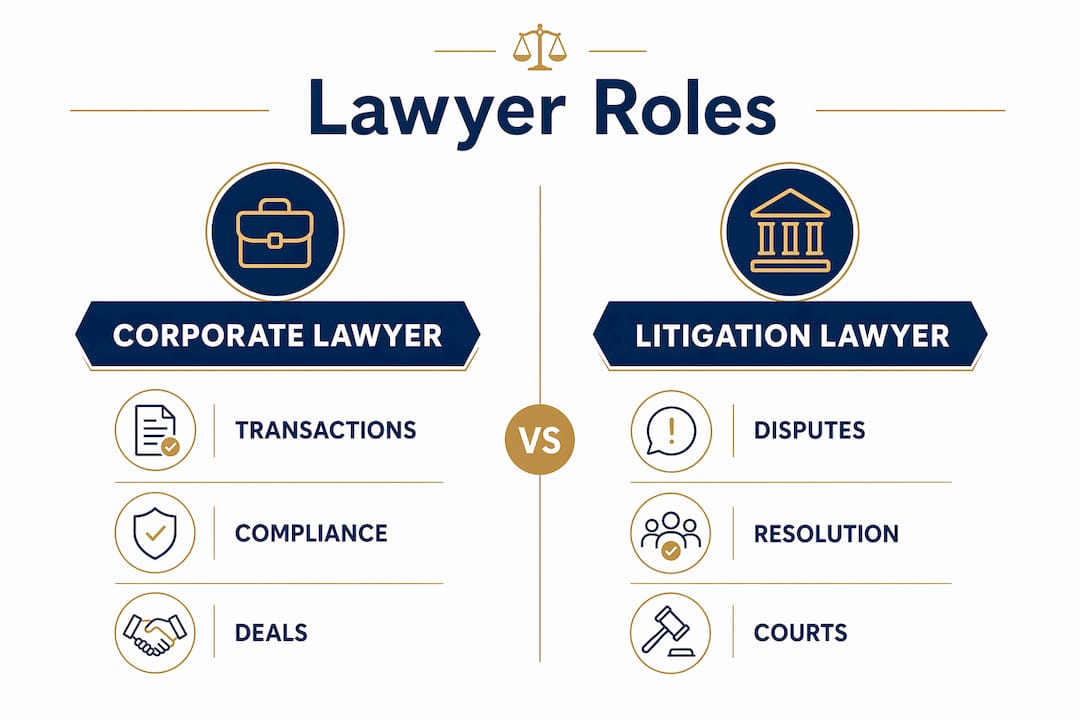
In practice, a corporate lawyer supports business growth in several concrete ways. When a company pursues an acquisition, the lawyer structures the deal to protect the buyer’s interests and manage post-completion risk. When a business expands internationally, the lawyer advises on cross-border regulatory requirements and contract enforceability across jurisdictions. When a company prepares for an IPO, the lawyer coordinates the prospectus, manages regulatory submissions, and advises the board on its new obligations as a listed entity.
Corporate lawyers also help businesses with compliance, risk management, and strategic deals, and this transactional focus is what separates them from litigation-focused colleagues. The goal is always to structure arrangements so that disputes never reach a courtroom. When they do, a separate team takes over.
Understanding corporate governance principles is central to this advisory work. Boards rely on their corporate lawyers to flag governance failures before regulators or shareholders do. That early warning function is one of the most valuable things a corporate legal advisor provides.
The most common misconception I encounter among aspiring lawyers is that corporate law is purely about technical mastery. It is not. The lawyers who reach partnership are the ones who understand their clients’ businesses well enough to anticipate problems before they are asked.
Early in a corporate law career, the temptation is to focus entirely on getting the legal analysis right. That matters, but it is the baseline expectation, not the differentiator. What separates a good associate from a great one is the ability to walk into a room with a chief executive and speak in terms of commercial consequence rather than legal theory.
Networking and mentorship are underrated at the student stage. The relationships you build during a vacation scheme or training contract will shape your career for years. Ask senior lawyers how they developed their sector knowledge. Ask them what they wish they had known at your stage. Most will tell you that business acumen took longer to develop than legal skill, and that they wish they had started earlier.
The corporate lawyer role is also more varied than outsiders expect. One week you might be reviewing a joint venture agreement for a technology company; the next you are advising a client on the governance implications of a board restructure. That variety is demanding, but it is also what makes the work genuinely engaging over a long career.
My honest advice: build your legal skills rigorously, but invest equal effort in understanding how businesses actually work. Read deal announcements. Follow regulatory changes in the sectors you want to work in. The lawyers who combine both will always be in demand.
— Panagiotis
When corporate disputes do arise despite the best preventive work, having experienced legal support makes a material difference to the outcome.
Alilegal advises businesses on a wide range of corporate and commercial legal matters, from governance questions to complex disputes requiring commercial litigation expertise. The team combines clear, direct advice with transparent fixed fees, so clients understand their position and their costs from the outset. Whether you are a business facing a contractual dispute or a professional seeking guidance on corporate legal responsibilities, Alilegal offers straightforward support without unnecessary delay. Contact Alilegal to discuss your situation with a solicitor who understands the commercial context behind every legal question.
A corporate lawyer is a legal professional who advises businesses on transactional matters, including contracts, mergers, governance, and regulatory compliance. The role is proactive rather than court-focused, aiming to prevent legal problems before they arise.
You need an undergraduate degree, a postgraduate legal qualification such as the SQE in England and Wales, and two years of qualifying work experience before admission as a solicitor. Strong commercial awareness and sector knowledge significantly improve career prospects.
A corporate lawyer focuses on transactions and compliance, working proactively to structure deals and advise on governance. A litigation lawyer resolves disputes after they arise, typically through court proceedings or negotiated settlements.
Key skills include contract drafting, M&A execution, corporate governance, negotiation, and due diligence. The ability to explain legal risk clearly to non-lawyer executives is equally critical at senior levels.
Entry-level corporate lawyers in North American markets earn between $100,000 and $200,000 annually. UK City firm salaries for newly qualified solicitors are broadly comparable, reflecting the technical demands of the role from the outset.
TL;DR:
- Getting legal advice after a car accident is essential to protect your right to compensation.
- Police reports, witness statements, and medical evidence are crucial within the first 48 hours to build a strong claim.
Getting the right legal advice after a car accident is the single most effective step you can take to protect your compensation rights. In UK personal injury law, the formal term for this process is a personal injury claim, and the quality of legal guidance you receive shapes every outcome that follows. Police reports, insurance companies, and personal injury solicitors are the three key entities you will deal with from the moment a collision occurs. The first 48 hours after an accident are the most critical window for evidence gathering and medical evaluation. Acting quickly and with proper legal support is not optional. It is the difference between a fair settlement and a denied claim.
The actions you take in the hours after a collision directly determine the strength of your claim. Most people focus on the physical shock of the event and overlook the legal groundwork that needs to happen simultaneously.
Report the accident to the police. In the UK, you must report a road traffic accident to the police within 24 hours if anyone is injured or if you did not exchange details at the scene. Failing to do so can complicate your insurance position and weaken your claim.
Document everything at the scene. Time-stamped photos and videos of vehicle damage, road conditions, skid marks, and traffic signs carry significant weight with insurers and courts. Take images from multiple angles before any vehicles are moved.
Here is a checklist of the most important immediate steps:
That last point matters more than most people realise. Soft-tissue injuries such as whiplash often emerge 24–72 hours after impact. If you delay seeking treatment, insurers will argue the injury is exaggerated or unrelated to the accident.
Pro Tip: Never give a recorded statement to an insurer before speaking to a solicitor. Recorded statements taken early are the primary tool insurers use to deny or devalue claims. Politely decline and say you will respond once you have taken legal advice.
Liability is the legal term for who is responsible for causing the accident. Establishing it clearly is the foundation of any successful personal injury claim, and it is rarely as straightforward as it appears.
UK road traffic law uses the concept of negligence to assign fault. A driver is negligent if they failed to meet the standard of care expected of a reasonable driver. Contributory negligence applies when both parties share some degree of fault. This is common in junction collisions, lane-change disputes, and rear-end shunts where speed is contested.

Police reports and witness statements are the two most influential pieces of evidence in any liability dispute. Insurers rely heavily on official police records when making initial liability decisions. Witness accounts from neutral third parties carry particular weight because they have no financial interest in the outcome.
The following evidence types are ranked by their typical impact on liability decisions:
| Evidence type | Typical impact on liability |
|---|---|
| Official police report | Very high |
| Neutral witness statement | Very high |
| Time-stamped scene photographs | High |
| Dashcam footage | High |
| Driver statements | Moderate |
| Vehicle damage assessments | Moderate |
A solicitor’s role in liability disputes is to analyse this evidence and construct a coherent account of fault. Comparative negligence laws mean that even partial fault on your part can reduce your compensation. Experienced legal advice helps you understand exactly where you stand before you engage with an insurer.
A personal injury claim after a car accident covers far more than the visible damage to your vehicle. Understanding what you can claim for is one of the most valuable things proper legal help for car crashes provides.
The main categories of compensation in UK personal injury claims are:
Proof of causation is the legal requirement that links your injury directly to the accident. Medical records, GP notes, hospital discharge summaries, and expert medical reports all serve this purpose. Without clear causation evidence, insurers will dispute whether the accident caused your condition at all.
The UK personal injury claims process follows a structured pre-action protocol. This requires both parties to exchange information before proceedings are issued, which often leads to settlement without court involvement. Most straightforward road traffic accident claims resolve within 6–12 months.
Pro Tip: Keep a daily pain and symptom diary from the day of the accident. Courts and insurers give significant weight to contemporaneous records of how your injury affected your daily life. A solicitor can advise you on what to record and how to present it.
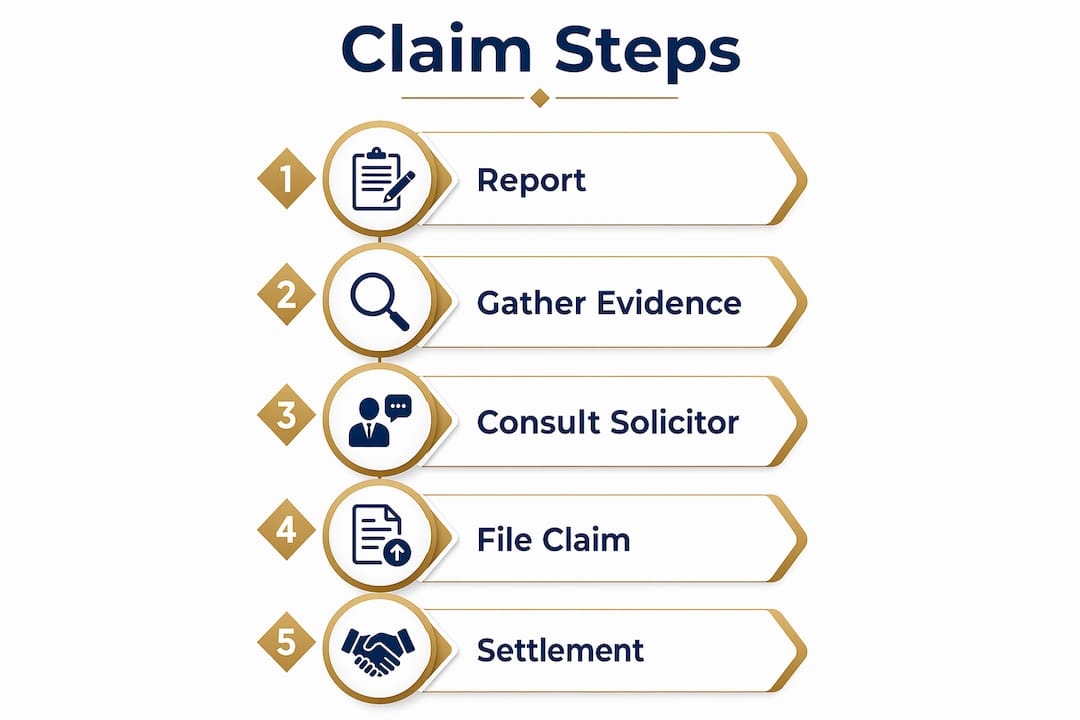
Self-representing a personal injury claim against an insurer is one of the most costly mistakes an accident victim can make. Insurers employ specialist claims handlers whose job is to minimise payouts. You need equivalent expertise on your side.
The numbers make the case clearly. Attorney-represented claims settle for an average of 3.5 times more than self-represented ones, according to Insurance Research Council data. That gap exists because solicitors understand how to value claims correctly, negotiate effectively, and avoid procedural errors that reduce settlements.
Key benefits of instructing a personal injury solicitor include:
Consulting a solicitor before signing any settlement or release document is non-negotiable. Once you sign, you waive your right to further compensation, even if your injuries worsen.
Most personal injury solicitors in the UK offer no win, no fee arrangements, formally known as Conditional Fee Agreements. Under this structure, you pay nothing if your claim fails, and the solicitor’s success fee is capped by law. This removes the financial barrier to accessing proper legal representation. When choosing a solicitor, look for specific experience in road traffic accident claims, transparent fee structures, and a clear communication commitment.
Being partially at fault does not end your right to compensation. UK law applies the principle of contributory negligence, which means your damages are reduced in proportion to your share of fault. If a court finds you 30% responsible for an accident, your compensation reduces by 30%. You still recover 70%.
The challenge is that insurers routinely overstate a claimant’s contributory negligence to reduce their liability. Without legal advice, many claimants accept inflated fault percentages that significantly undercut their entitlement. A solicitor challenges these assessments using the same evidence that establishes primary liability.
Uninsured drivers face a different set of barriers. The Motor Insurers’ Bureau (MIB) exists specifically to compensate victims of uninsured or untraced drivers in the UK. Claims through the MIB follow a separate process with specific procedural requirements, including strict reporting deadlines. Missing these deadlines can forfeit your right to compensation entirely.
Pro Tip: If the other driver was uninsured, report the accident to the police immediately and contact the Motor Insurers’ Bureau as soon as possible. A solicitor experienced in MIB claims can manage the procedural requirements and maximise your recovery in what is otherwise a complex process.
After years of working with clients who come to us following road traffic accidents, one pattern stands out above all others. The clients who act within the first 48 hours, document everything, and take legal advice before speaking to any insurer almost always achieve better outcomes than those who wait.
The most common mistake I see is people assuming the other driver’s insurer will treat them fairly. Insurers are not neutral parties. Their interest is in settling claims for as little as possible, and they are very good at it. Early recorded statements, quick settlement offers, and requests to access your medical records without restriction are all tactics designed to limit their exposure, not protect your rights.
The second mistake is undervaluing the claim. Most people think only about their immediate medical costs. They do not account for future treatment, lost earnings, or the psychological impact of the accident. A thorough personal injury claims guide will walk you through every head of loss you are entitled to pursue.
My honest advice is this: treat the legal side of a car accident with the same urgency as the medical side. The evidence you preserve in the first 48 hours cannot be recreated later. The statement you give before taking legal advice cannot be unsaid. Get proper representation early, and the process becomes far more manageable.
— Panagiotis
Car accident claims involve medical evidence, insurance negotiations, liability disputes, and court procedures. Alilegal handles all of it under one roof, with a client-focused approach built on fixed fees, clear communication, and no hidden costs.
Alilegal’s civil litigation team handles road traffic accident claims from initial evidence gathering through to settlement or trial. No win, no fee arrangements are available for qualifying personal injury cases, meaning you face no financial risk in pursuing your claim. For a straightforward assessment of your position, contact Alilegal directly. The earlier you seek advice, the stronger your claim will be. You can also review Alilegal’s 2026 compensation guide to understand what your injuries may be worth before your first consultation.
Report the accident to the police within 24 hours if anyone is injured, document the scene with photographs, collect witness details, and seek medical evaluation within 24 hours. Avoid admitting fault or giving a recorded statement to any insurer before consulting a solicitor.
The standard limitation period for personal injury claims in the UK is three years from the date of the accident. Acting well within this period preserves evidence and strengthens your position significantly.
Yes. UK law applies contributory negligence, which reduces your compensation by your percentage of fault rather than eliminating it entirely. A solicitor can challenge inflated fault assessments made by the other party’s insurer.
A no win, no fee arrangement, formally called a Conditional Fee Agreement, means you pay your solicitor nothing if your claim is unsuccessful. If you win, the solicitor’s success fee is capped by law and is typically recovered from the other party.
Compensation depends on injury severity, financial losses, and future impact on your life. UK courts use the Judicial College Guidelines to set general damages, while special damages cover documented financial losses such as lost earnings and medical costs.
TL;DR:
- Seeking medical treatment, documenting the scene, and collecting witness details are crucial within the first 72 hours after an injury. The three-year limitation period in the UK requires claimants to act promptly, as missing the deadline results in losing the right to compensation. Early legal advice strengthens claims, prevents common mistakes, and improves settlement outcomes.
Personal injury advice is the expert guidance that helps you secure fair compensation after an accident caused by someone else’s negligence. In the UK, a personal injury claim covers everything from road traffic accidents and workplace injuries to slips, trips, and medical negligence. Getting the right advice early determines whether your claim succeeds or fails. This guide covers the critical steps after an injury, legal deadlines, when to instruct a solicitor, and how to handle insurers. Follow this personal injury claims process from the start and you protect both your health and your legal rights.
The first 24 to 72 hours after an accident are critical for gathering evidence, obtaining medical records, and securing witness statements. What you do in that window shapes the entire claim. Most people focus on recovering and forget that evidence disappears fast.
Follow these steps in order:
Pro Tip: Start a daily pain journal from the day of the accident. Log your pain levels and limitations in plain language, including how the injury affects sleep, work, and daily activities. This journal adds persuasive subjective evidence that clinical notes alone cannot capture.
The instinct to wait and see how bad the injury is costs claimants dearly. Delayed medical visits create gaps that insurers exploit. Treat the first three days as your most productive window.

Legal deadlines are the single most common reason valid claims fail. Miss the filing window and you lose your right to compensation, regardless of how strong your evidence is.
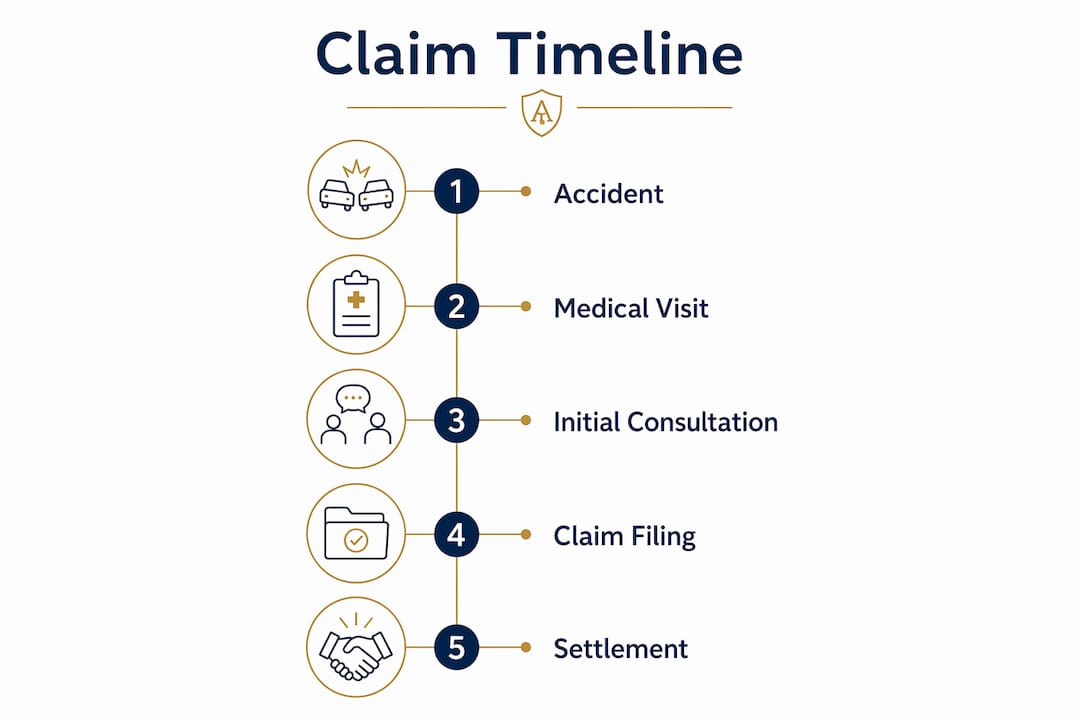
In the UK, the standard limitation period for personal injury claims is three years from the date of the accident or from the date you became aware of the injury. This is set out in the Limitation Act 1980. The three-year clock also applies to most clinical negligence claims. Children have until their 21st birthday to bring a claim, as the clock starts running on their 18th birthday.
| Claim type | Standard limitation period | Key exceptions |
|---|---|---|
| Road traffic accident | 3 years from accident date | Date of knowledge rule applies |
| Workplace injury | 3 years from accident date | Industrial disease: date of diagnosis |
| Clinical negligence | 3 years from date of knowledge | Court discretion to extend |
| Claim against a public body | 3 years, but notify early | Some bodies require earlier notice |
| Child claimant | 3 years from 18th birthday | Court-appointed litigation friend |
Claims against government bodies or public authorities carry additional notice requirements. In some cases, you must notify the relevant body within months of the incident, well before the three-year limitation period expires. Many US jurisdictions such as California and New York set a two-year standard limitation period, with government notice periods of just 90 to 180 days. The UK is more generous, but the principle of acting early applies equally.
Pro Tip: Set calendar reminders at nine months, six months, and one month before your limitation date. This gives you enough time to instruct a solicitor and gather evidence without rushing.
Missing a deadline is almost always fatal to a claim. Courts rarely exercise discretion to extend time, and insurers know this. Treat your limitation date as a hard deadline, not a guideline.
Waiting until a settlement offer arrives to contact a solicitor is a costly misconception. Early legal advice strengthens evidence capture and gives you far greater negotiation power. By the time an insurer makes an offer, a solicitor instructed late has far less room to manoeuvre.
Consult a solicitor as soon as possible if any of the following apply:
Most personal injury solicitors in the UK offer a free initial consultation. Use it. Bring your medical records, photos, witness details, and any correspondence with insurers. The solicitor will assess liability, quantum (the value of your claim), and the likely timeline. Understanding personal injury litigation before your first meeting helps you ask better questions and leave with a clearer picture.
Early involvement also prevents a specific and common error: making damaging statements to insurers before you understand the full extent of your injuries. A solicitor advises you on what to say and, more importantly, what not to say.
Insurance adjusters are trained to reduce settlements. Understanding their tactics is not paranoia. It is practical preparation.
The most common insurer tactics include:
Respond to all insurer communications in writing where possible. Keep copies of every letter, email, and note of every phone call. If an adjuster calls unexpectedly, it is entirely reasonable to say you will respond in writing. This is not obstruction. It is good practice.
Maintain your medical treatment schedule without gaps. Insurers scrutinise treatment records for missed appointments, which they use to argue the injury has resolved. Steady attendance tells a consistent story.
Personal injury claims often settle out of court. Knowing how to position your claim for settlement, rather than just for trial, is the practical skill most claimants lack.
Key injury settlement advice to follow throughout your claim:
The personal injury law essentials that govern UK claims are not complicated once you understand the framework. The claimant must prove the defendant owed a duty of care, breached it, and caused the injury as a result. Evidence at every stage supports each element of that test.
The claimants who achieve the best outcomes share one trait: they treat their claim as seriously as their recovery. They keep records, attend appointments, and instruct a solicitor early. The ones who struggle tend to assume the process will be straightforward and leave things too late.
The most damaging mistake I see is clients accepting the first offer from an insurer without taking legal advice. That offer is almost never the best available. Insurers make early offers precisely because claimants are still in shock, still recovering, and often grateful for any financial relief. A solicitor who reviews the offer can usually identify whether it reflects the true value of the claim.
The second mistake is underestimating how long claims take. A straightforward road traffic accident claim can take twelve to eighteen months. A complex clinical negligence case can take several years. Clients who understand this from the outset manage their expectations and their finances better. They do not accept a poor settlement simply because they are tired of waiting.
My honest view is that the legal process for personal injury claims in the UK is fairer than most claimants expect, provided they engage with it properly. The rules around evidence, limitation periods, and damages exist to protect claimants as much as defendants. Use them. Get advice early, document everything, and do not let an insurer’s speed or pressure dictate your timeline.
— Panagiotis
Alilegal’s personal injury team provides clear, fixed-fee advice from the first consultation. Whether your claim involves a road traffic accident, a workplace injury, or clinical negligence, Alilegal’s solicitors assess liability, gather evidence, and manage insurer communications on your behalf.
Alilegal’s civil litigation services cover the full range of personal injury disputes, from straightforward settlement negotiations to contested court proceedings. The team’s approach prioritises transparency and speed, so you always know where your claim stands. Contact Alilegal early to preserve your evidence, protect your limitation date, and give your claim the strongest possible foundation from day one.
The standard limitation period is three years from the date of the accident or the date you became aware of the injury, under the Limitation Act 1980. Children have until their 21st birthday to bring a claim.
No. Early settlement offers are almost always below the true value of a claim. Instruct a solicitor to review any offer before accepting, particularly if you have not yet reached maximum medical improvement.
Contact a solicitor as soon as possible after the accident, not after receiving a settlement offer. Early legal advice preserves evidence and prevents damaging early statements that reduce claim value.
No. You are not obliged to provide a recorded statement. Give only a brief factual summary until your medical picture is fully established, and take legal advice before any formal statement.
You can claim special damages (financial losses such as lost earnings and medical costs) and general damages (pain, suffering, and loss of amenity). Both require supporting evidence to recover effectively.
TL;DR:
- Solicitor fees for selling a house in the UK typically range from £800 to £1,500 plus VAT, with total costs often between £1,200 and £2,200 including disbursements. Factors such as property type, transaction complexity, regional location, and fee structure influence the final price, while additional costs like land registry and management packs should also be budgeted for. Sellers should request all-inclusive quotes, prepare documents early, and compare fixed-fee options to control expenses and avoid surprises.
Solicitor fees for selling a house in the UK are defined as the legal costs you pay a conveyancing solicitor to handle the transfer of property ownership to a buyer. Standard freehold fees range from £800 to £1,500 plus VAT, with total legal costs including disbursements typically falling between £1,200 and £2,200. Knowing what drives those numbers before you instruct a solicitor puts you in a far stronger position to budget accurately and avoid unwelcome surprises at completion.
Conveyancing is the formal term for the legal process of transferring property ownership, and it is what solicitors charge for when you sell. The fee covers drafting the contract of sale, responding to buyer enquiries, liaising with the Land Registry, and managing the transfer of funds on completion day.
Freehold sales typically cost £800–£1,500 plus VAT in solicitor fees alone. That figure does not include disbursements, which are third-party costs your solicitor pays on your behalf and then recharges to you. Once disbursements are added, the total legal bill for a standard sale usually lands between £1,200 and £2,200.

Leasehold properties cost more. Leasehold sales add £300–£800 to the base fee because of the extra legal work involved, including reviewing the lease and obtaining a management pack from the freeholder. The management pack alone typically costs around £275. If you own a leasehold flat, factor that in from the start.
Several variables move the final figure up or down, and understanding them helps you compare quotes on a like-for-like basis.
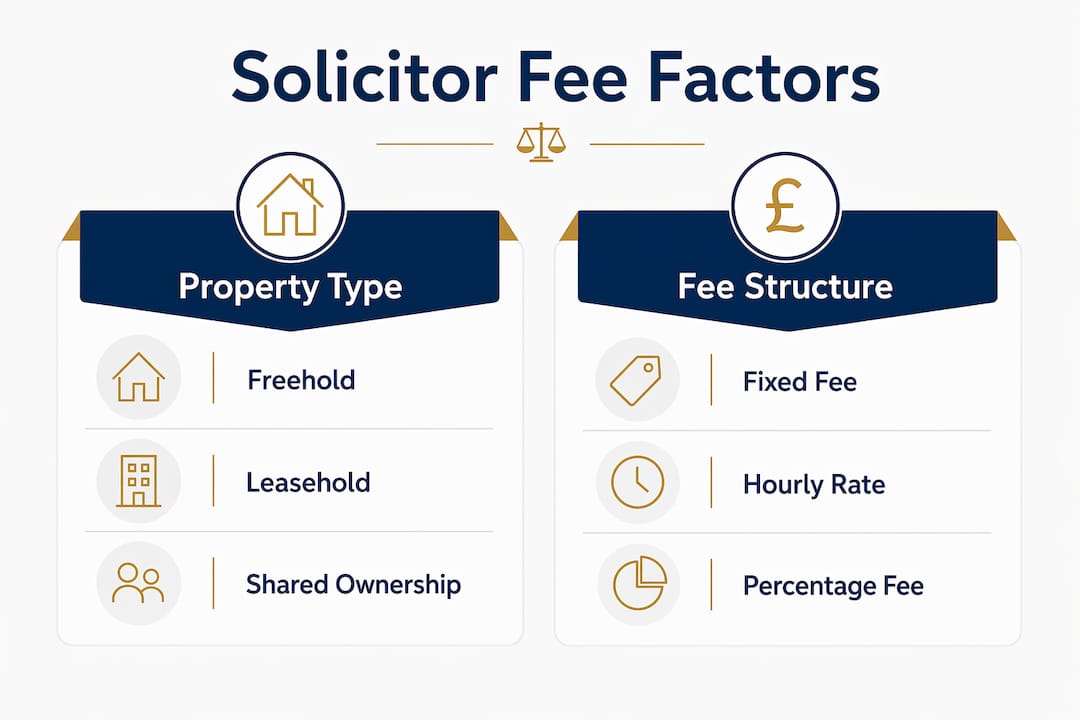
Freehold sales are the most straightforward and attract the lowest fees. Leasehold sales, shared ownership properties, and new builds all require additional legal work and push costs higher. A sale involving a Help to Buy equity loan, for example, requires the solicitor to liaise with Homes England, which adds time and cost.
Solicitors charge via three main structures: fixed fees, hourly rates of £150–£350, and percentage-based fees of 0.5%–1% of the sale price. Hourly rates carry the most risk for sellers because complexity or delays translate directly into a larger bill. Fixed fees give you certainty. Percentage-based fees can look attractive on lower-value properties but become expensive on higher-value sales.
London solicitors charge more than firms in the North of England or Wales, reflecting higher overheads. A sale in central London may attract fees at the top of the range, while a comparable property in Leeds or Cardiff is more likely to sit at the lower end.
Disbursements typically add £300–£800 on top of solicitor fees. Common items include Land Registry fees of £330, ID verification checks at £44, bank transfer charges of £33, and indemnity insurance averaging £108. These are not negotiable because they are set by third parties, not your solicitor.
Pro Tip: Ask every solicitor you approach to provide a full breakdown of disbursements alongside their headline fee. A quote that looks low often excludes routine charges that add up quickly.
Selling fees are generally lower than buying fees. Buying a property costs around £2,000 or more in solicitor fees, compared to £1,000–£1,500 for selling. The reason is workload. Buyers carry the heavier legal burden: their solicitor must commission local authority searches, investigate title, review mortgage conditions, and carry out environmental checks. Sellers primarily respond to enquiries and provide documentation.
The table below shows a typical cost comparison for a standard freehold transaction.
| Cost component | Selling | Buying |
|---|---|---|
| Solicitor base fee | £800–£1,500 | £1,000–£2,000 |
| Land Registry fee | £330 | £330 |
| ID checks | £44 | £44 |
| Bank transfer fee | £33 | £33 |
| Local authority searches | Not required | £250–£450 |
| Indemnity insurance | £108 (if needed) | £108 (if needed) |
| Estimated total | £1,200–£2,200 | £1,800–£3,000+ |
When you sell and buy simultaneously, many solicitors offer a combined fee that is lower than instructing two separate firms. If you are moving within the same area, ask your solicitor whether they can handle both transactions and what the combined cost would be. The saving can be meaningful.
The headline solicitor fee is rarely the full picture. Advertised fees frequently exclude routine administrative tasks, which can add £200–£500 to the final bill. Knowing the common extras in advance prevents them from catching you off guard.
Common additional costs include:
The risk of a sale falling through is also a cost most sellers overlook. If your sale collapses before completion, you remain liable for solicitor fees already incurred, including ID checks and document preparation. Those charges can amount to several hundred pounds even if no money changes hands at completion.
Pro Tip: Before you instruct a solicitor, ask specifically what you would owe if the sale fell through. Some firms offer “no completion, no fee” arrangements. Knowing your exposure upfront is worth the conversation.
Keeping costs under control starts before you even pick up the phone to a solicitor. These steps make a measurable difference.
Get all-inclusive quotes. All-inclusive quotes that explicitly cover VAT, bank transfers, and ID checks help you avoid surprise costs of £200–£500. Ask each firm to confirm in writing that their quote covers everything, including disbursements.
Prepare your documentation early. Preparing your legal pack before finding a buyer can reduce conveyancing time by several weeks. Gather your title deeds, property information forms (TA6), fittings and contents forms (TA10), and any guarantees or warranties for work done on the property. Sellers who have this ready before accepting an offer move significantly faster through the process.
Choose a fixed-fee solicitor. Fixed fees remove the risk of hourly charges escalating on a complex transaction. Compare at least three fixed-fee quotes before instructing. Use the checklist for hiring a solicitor to assess each firm on more than just price.
Ask about funding options upfront. Following a 2026 court ruling, solicitors must explore alternative funding options rather than defaulting to standard success fees. Ask your solicitor at the first meeting what funding arrangements are available and whether any insurance products apply to your transaction.
Understand what drives delays. Delays cost money when you are on an hourly rate and create friction even on fixed-fee arrangements. Respond to solicitor requests quickly, provide documents in one go rather than piecemeal, and chase your buyer’s solicitor if you have not heard anything for more than a week.
Use a comparison service. Platforms such as Compare My Move allow you to obtain multiple conveyancing quotes in one place. Comparing quotes side by side makes it easier to spot firms that are excluding disbursements from their headline price.
The pressure on solicitor fees is not coming only from property prices. Practising certificate fees have risen from £190 to £240, and the Law Society has raised serious concerns about the impact on smaller high-street firms. Those firms are the ones most sellers use. When their operating costs rise, those costs filter through to client bills.
I have watched this pattern play out over several years. The firms that absorb regulatory cost increases without passing them on are typically the ones cutting corners elsewhere, whether on response times, staff experience, or the thoroughness of their title checks. A slightly higher fee from a well-run firm is nearly always better value than the cheapest quote from a firm under financial pressure.
The 2026 court ruling on success fees is also worth understanding. Clients should clarify funding and insurance requirements upfront to avoid unnecessary charges. The ruling signals a broader shift: solicitors are now expected to have a genuine conversation about costs and alternatives at the outset, not after the bill arrives. If your solicitor does not raise this at your first meeting, raise it yourself. Knowing how to choose a solicitor with transparent billing practices is the single most effective thing you can do to protect your budget.
— Panagiotis
Alilegal’s property and conveyancing service is built around the principle that sellers should never be surprised by their legal bill. The team works on clear, fixed-fee structures with full disbursement disclosure from the first quote, so you know exactly what you are paying before you commit.
Alilegal handles UK property sales with experienced solicitors who prioritise speed and clear communication at every stage. Whether you are selling a straightforward freehold or a leasehold flat with a complex management pack, the team provides direct advice and transparent billing. Contact Alilegal for a personalised conveyancing quote and find out exactly what your sale will cost before you instruct.
The average solicitor fee for selling a freehold house ranges from £800 to £1,500 plus VAT. Total legal costs including disbursements typically fall between £1,200 and £2,200.
Selling fees are generally lower than buying fees. Buying costs around £2,000 or more because buyers require local searches, title investigations, and mortgage-related legal work that sellers do not.
Common disbursements include Land Registry fees of £330, ID checks at £44, bank transfer charges of £33, and indemnity insurance averaging £108. These third-party costs typically add £300–£800 to the total bill.
Yes. Sellers remain liable for fees already incurred up to the point of cancellation, including ID checks and document preparation. These charges can amount to several hundred pounds even without a completed sale.
Request all-inclusive quotes that cover VAT and all disbursements, prepare your legal documentation before accepting an offer, and choose a fixed-fee solicitor. Comparing at least three quotes side by side is the most reliable way to identify the best value.
TL;DR:
- Business dispute mediation is a confidential, voluntary process where a neutral mediator helps parties negotiate a settlement without imposing a decision. It preserves control for business owners and can resolve issues faster and more cost-effectively than arbitration or litigation, often maintaining ongoing relationships. Successful mediation requires thorough preparation, choosing experienced mediators, and having decision-makers present to ensure enforceable agreements.
Business dispute mediation is defined as a confidential, voluntary process in which a neutral mediator helps disputing parties negotiate a settlement without imposing a decision on either side. Unlike litigation or arbitration, mediation keeps control with the parties themselves. No judge decides the outcome. No arbitrator issues a binding award. The mediator facilitates communication, tests assumptions, and helps both sides move from entrenched positions toward a workable agreement. For business owners and executives, that distinction matters enormously, because it means you can resolve a dispute without surrendering control of the result.
Business dispute mediation is the recognised industry term for what practitioners also call commercial mediation or alternative dispute resolution (ADR). The process is confidential and voluntary by design. Nothing said in mediation can be used as evidence in court proceedings. That protection encourages candid conversation, which is precisely why it works in commercial contexts where reputations and ongoing relationships are at stake.

The mediator plays a specific role. They do not give legal advice, pass judgement, or decide who is right. Their job is to create conditions where both parties can communicate clearly and negotiate honestly. Sessions can take place in person, by video call, or through a combination of both. The Harvard Program on Negotiation describes the process as flexible, noting that formats range from joint conversations to shuttle diplomacy where the mediator moves between parties separately.
Mediation applies across a wide range of commercial disputes: contract disagreements, partnership breakdowns, supplier conflicts, employment matters, and property disputes. The types of dispute resolution available to UK businesses are broader than most executives realise, but mediation consistently stands out for its speed and cost efficiency.
The Harvard Program on Negotiation outlines a structured yet flexible sequence that most commercial mediations follow. Understanding each stage helps you arrive prepared rather than reactive.
Most commercial mediations last between a few hours and a full working day. Some complex disputes require multiple sessions. The Ninth Circuit Mediation Program in the United States uses confidential telephone assessments before scheduling sessions to confirm suitability and set realistic expectations. UK commercial mediators often follow a similar pre-mediation consultation approach.
Pro Tip: Brief your mediator thoroughly before the session. Share your key documents, your real interests, and your settlement range. A well-briefed mediator can test the other side’s assumptions far more effectively during private caucuses.
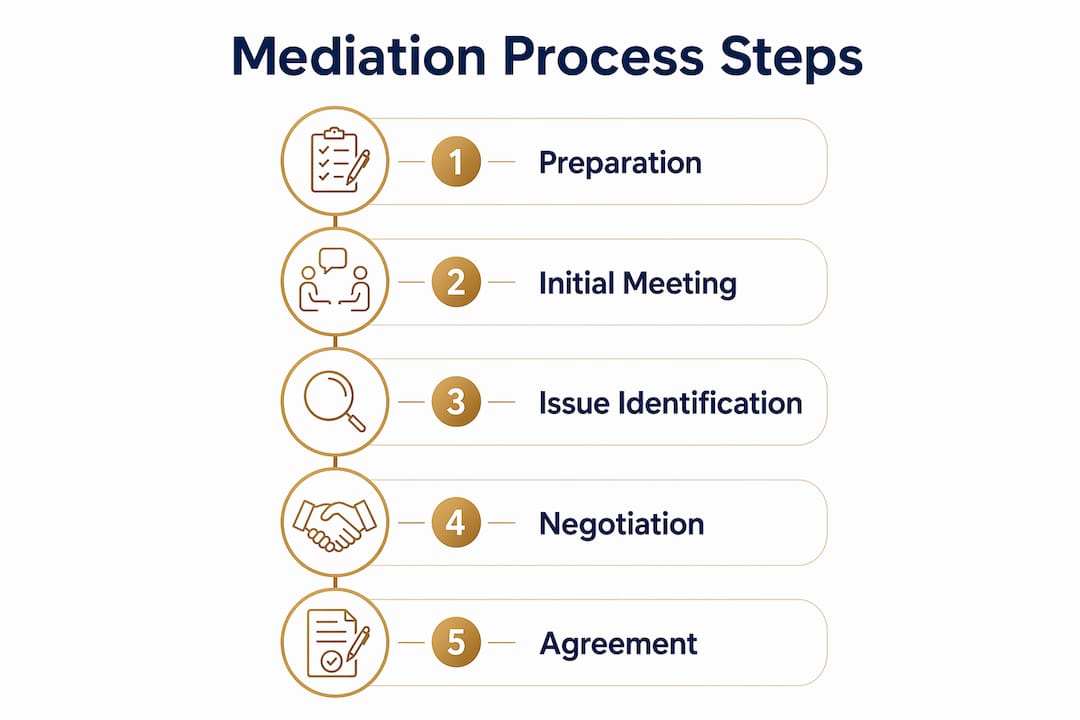
The three main paths for resolving a commercial dispute are mediation, arbitration, and litigation. Each serves a different purpose, and choosing the wrong one costs time, money, and sometimes the business relationship itself.
| Factor | Mediation | Arbitration | Litigation |
|---|---|---|---|
| Confidentiality | Full | Usually yes | Public record |
| Decision maker | The parties | Arbitrator | Judge |
| Binding outcome | Only if agreed | Yes | Yes |
| Typical speed | Weeks | Months | Years |
| Cost | Lowest | Moderate to high | Highest |
| Relationship impact | Preserves | Neutral | Often damages |
| Flexibility | High | Moderate | Low |
Mediation is typically faster and less expensive than either arbitration or court proceedings. Sessions are often scheduled within weeks of instruction, and costs are shared between the parties. That efficiency matters when a dispute is tying up management time and straining a commercial relationship.
Arbitration produces a binding decision, which makes it appropriate when parties need certainty and cannot reach voluntary agreement. Litigation is the right choice when a legal precedent is needed, when enforcement through the courts is required, or when one party refuses to engage in any voluntary process. Many businesses settle rather than fight because the cost and reputational exposure of litigation outweighs the potential gain.
Mediation works best when both parties broadly agree on the facts but disagree on how to respond. It also works well when preserving the commercial relationship matters. Arbitration and litigation, by contrast, tend to produce winners and losers. That adversarial dynamic can permanently damage partnerships, supplier relationships, and joint ventures.
For a detailed comparison of litigation alternatives for businesses, the range of options is wider than most executives consider at the outset of a dispute.
Preparation is the single biggest determinant of mediation success. Research from ADR.org confirms that thorough risk assessment before the session matters more than performance during it. Executives who arrive having genuinely analysed their legal position, their costs, and their best alternative to a negotiated agreement are far better placed to reach settlement.
Before the session:
Choosing the right mediator:
Mediator selection has a direct impact on outcomes. Harvard’s Program on Negotiation notes that mediator style influences results, with more assertive approaches sometimes producing better outcomes in hard-nosed commercial disputes. A mediator with sector experience understands the commercial realities behind the legal claims. Ask for a mediator who has handled disputes of similar value and complexity.
During the session:
Pro Tip: Prepare a written settlement range before you walk in. Know your ideal outcome, your realistic target, and your absolute floor. Executives who have not done this work often make poor decisions under the pressure of a live negotiation.
For structured guidance on preparing for legal consultation, the preparation principles apply equally to mediation sessions.
Mediation is the only dispute resolution method specifically designed to preserve the relationship between the parties. Litigation and arbitration produce a verdict. Mediation produces an agreement. That distinction shapes everything about how the process unfolds.
The mediator’s role in de-escalating tension is central to this. Commercial disputes often carry personal grievances alongside legal claims. A skilled mediator separates the interpersonal breakdown from the business issues, addressing both without letting either derail the negotiation. This separation allows executives to focus on what a workable future relationship looks like rather than who was right in the past.
Mediation settlements can include terms that go beyond financial compensation. Parties can agree on future communication protocols, revised contract terms, apologies, or joint statements. Courts cannot order these outcomes. They are only available through negotiated agreement, which is why mediation consistently produces more durable resolutions in ongoing commercial relationships.
The practical benefits for relationship preservation include:
ADR.org’s research confirms that navigating interpersonal and business issues separately within mediation allows teams to achieve settlement while keeping future relations intact. That outcome is simply not available through adversarial proceedings.
The most common mistake I see business leaders make in mediation is treating it like a court hearing. They arrive with a barrister’s brief, a list of legal arguments, and a determination to prove they are right. That approach wastes the process entirely.
Mediation is not about winning the argument. It is about finding the settlement that costs you less than continuing the fight. The executives who succeed are the ones who have done honest risk analysis before they walk in. They know what a bad outcome looks like. They know what they are willing to accept. They are not there to perform. They are there to resolve.
Mediator selection matters more than most clients expect. An experienced commercial mediator who understands your sector will challenge both sides in ways that move the negotiation forward. A mediator who is too passive simply reflects positions back and forth without breaking the deadlock. Ask your solicitor for a specific recommendation, not just a name from a panel list.
The other lesson I would offer is this: bring your decision-maker, not a representative. I have seen mediations collapse because the person in the room could not actually agree to anything without calling their board. That is not mediation. That is a preliminary meeting dressed up as one. Genuine authority to settle is not optional. It is the foundation on which the whole process rests.
— Panagiotis
Reaching a mediated settlement is only part of the challenge. The legal preparation before the session and the enforcement of any agreement afterwards require experienced commercial solicitors who understand both the law and the negotiation dynamics.
Alilegal’s commercial litigation team works with business owners and executives at every stage of a commercial dispute, from initial risk assessment through mediation preparation to settlement enforcement. The team provides fixed-fee advice, clear strategic guidance, and direct access to senior solicitors who have handled disputes across contract, property, partnership, and international commercial law. If mediation does not resolve the matter, Alilegal is positioned to take the case forward through arbitration or litigation without losing momentum. Contact Alilegal to discuss your dispute and get a clear view of your options before your next session.
Business dispute mediation is a confidential, voluntary process where a neutral mediator helps disputing parties negotiate a settlement. The mediator facilitates communication but does not impose a decision; any agreement requires the consent of both parties.
Most commercial mediations last between a few hours and a full working day. Complex disputes may require multiple sessions, but mediation is consistently faster than arbitration or court proceedings.
A signed settlement agreement reached through mediation is legally enforceable. Courts can give effect to the terms if they are incorporated into ongoing proceedings, making the outcome as binding as any court order.
Mediation is the better choice when preserving the commercial relationship matters, when both parties want a confidential process, or when the cost and time of arbitration would outweigh the benefit. Arbitration is more appropriate when a binding decision is needed and voluntary agreement is unlikely.
Research from the Harvard Program on Negotiation confirms that mediator style directly influences commercial mediation results. A more assertive mediator can produce better outcomes in hard-nosed disputes, which is why choosing the right mediator for your specific context is a strategic decision, not an administrative one.
TL;DR:
- Choosing the right lawyer depends on matching relevant expertise, clear communication, transparent fees, and verified regulation.
- Using official directories and verifying registration helps find qualified solicitors, while structured questions during consultations clarify their experience and approach.
Choosing a lawyer is defined by one decision above all others: matching the right expertise to your specific legal problem. The term “lawyer” covers solicitors, barristers, and legal executives in England and Wales, but for most people seeking representation, a solicitor is the first and most relevant point of contact. Getting that match right requires more than a Google search. You need to assess credentials, fee structures, and personal fit before signing anything. This guide walks you through every step, from finding regulated solicitors to asking the questions that separate a good lawyer from the right one for you.
The best way to select a lawyer starts with four non-negotiable criteria: relevant expertise, clear communication, transparent fees, and verified regulation. Each one carries equal weight. A brilliant specialist who cannot explain your options plainly is as problematic as a communicative generalist who lacks the depth your case demands.

Relevant expertise means the lawyer has handled cases genuinely similar to yours, not just within a broad practice area. Communication clarity and fee transparency matter as much as credentials when choosing a legal advisor. A lawyer who speaks in impenetrable jargon during your first call will not suddenly become clearer once you are a paying client.
Verified regulation is non-negotiable in England and Wales. Every practising solicitor must be authorised by the Solicitors Regulation Authority (SRA). Checking SRA registration before any consultation protects you from unregulated advisors who carry no professional accountability.
Pro Tip: Build a simple scoring sheet before you speak to any lawyer. Rate each candidate on expertise, communication, fees, and availability out of five. Comparing scores after each call removes the distortion of first impressions.
The Law Society’s Find a Solicitor directory is the most reliable starting point for finding regulated candidates in England and Wales. You can filter by postcode and specialism, which immediately narrows results to solicitors authorised for your case type. This matters because a solicitor listed under “family law” may have spent the last decade on conveyancing.
Personal referrals from trusted friends, colleagues, or your accountant carry real weight, but they require scrutiny. The person recommending a lawyer may have had a very different legal need. Always verify that the referred solicitor has direct experience with your specific issue before booking a consultation.
Search engine adverts and unregulated legal directories are the weakest sources. Paid listings reflect marketing budgets, not competence. A firm that ranks first on a sponsored result has paid for that position, not earned it through case outcomes.
Pro Tip: When you find a candidate through any source, verify their SRA registration number directly on the SRA website. Accreditation schemes such as the Law Society’s Family Law Accreditation or the Association of Personal Injury Lawyers (APIL) membership signal additional specialist credibility.
Treat the initial consultation as a job interview. Many lawyers offer free first consultations to assess fit, and you are under no obligation to hire them afterwards. That meeting is your opportunity to gather the information you need to make a fair comparison.
Prepare your questions in advance and ask every candidate the same ones in the same order. Structured evaluation using identical questions reduces the risk of being swayed by charisma rather than competence. A lawyer who is charming but vague about fees or case history is a warning sign, not a green light.
The questions that matter most are:
The third question is one most people forget to ask. The lawyer you meet may not be the one doing the daily work on your case. Knowing who handles your matter day to day affects both accountability and communication quality.
Pro Tip: Take written notes during every consultation using the same template. After three or four meetings, memory blurs and impressions merge. Your notes are the only reliable record for comparison.
| Fee model | How it works | Best suited to | Key risk |
|---|---|---|---|
| Hourly rate | Charged per hour of work | Complex, unpredictable cases | Costs can escalate without a cap |
| Fixed fee | Set price for a defined scope | Routine matters: wills, conveyancing | Scope creep if terms are vague |
| Retainer | Lump sum covering initial services | Ongoing commercial or advisory work | Unclear what is and is not covered |
| Contingency | Lawyer takes a percentage of any award | Personal injury claims | No fee if you lose, but percentage can be high |
Retainer fees cover a defined set of initial services, and the scope must be confirmed in writing before you pay. Written agreements detailing fees and progress updates prevent the most common source of client dissatisfaction: unexpected bills. If a retainer agreement is vague about what is included, ask for a revised version before signing.
Hourly rates vary significantly by the lawyer’s experience, the firm’s location, and the complexity of your case. London rates are typically higher than regional equivalents for equivalent work. Always ask for a cost estimate and a billing cap where possible.
Contingency arrangements are most common in personal injury claims and are governed by strict rules in England and Wales. The lawyer receives a percentage of your compensation only if you win. Confirm the exact percentage and any additional disbursements before agreeing.
Fee disputes are a leading cause of client dissatisfaction. Choosing a lawyer based on the lowest quoted cost alone is the single most reliable way to end up in one. Financial comfort with the fee arrangement matters as much as the fee level itself.
Pro Tip: Ask for a breakdown of likely disbursements, such as court fees and expert reports, separately from the lawyer’s own charges. These costs are often omitted from headline quotes and can add significantly to your total bill.
The final decision rests on three factors: trust in the lawyer’s competence, comfort with the fee arrangement, and clarity in the written terms. If any one of these is missing after your consultations, do not sign.
Review the retainer agreement carefully before committing. The written agreement should detail fees, services, and communication expectations. If the document is unclear or uses broad language that could be interpreted multiple ways, request amendments. A good solicitor will not object to clarifying their own terms.
Knowing your rights if things go wrong also strengthens your position. Service complaints about solicitors can be made to the Legal Ombudsman, which provides an independent resolution process. Understanding this before you hire removes the anxiety of feeling trapped if the relationship deteriorates.
Use this checklist before signing any agreement:
The last point is underrated. Legal matters often run for months. A lawyer you feel reluctant to call with questions will cost you more in the long run than one who charges a slightly higher hourly rate but communicates clearly.
Most people approach lawyer selection the wrong way. They focus almost entirely on credentials and cost, then feel blindsided when the relationship breaks down over communication failures or disputed invoices. I have seen this pattern repeatedly, and the cause is almost always the same: the client treated the first consultation as a formality rather than an interview.
The structured approach changes everything. Asking identical questions, scoring candidates consistently, and reading fee agreements before signing are not bureaucratic steps. They are the difference between a productive legal relationship and an expensive, stressful one. Credentials matter, but a lawyer with slightly less experience who communicates clearly and prices transparently will almost always serve you better than a highly credentialled one who keeps you in the dark.
The shift in client expectations around transparency is real and accelerating. Clients now expect fixed fees, written scopes, and regular updates as standard. Firms that resist this are not protecting their professional mystique. They are losing clients to those who have adapted. When you are selecting a legal advisor, treat transparency as a baseline requirement, not a bonus feature.
— Panagiotis
Alilegal is a regulated legal services firm with SRA-authorised solicitors covering civil litigation, family law, personal injury, immigration, property, and commercial disputes. Every client receives a clear fee structure from the first consultation, with no hidden costs and no vague retainer language.
If you are dealing with a civil or commercial dispute, Alilegal’s litigation team provides direct, transparent advice from the outset. For family matters, the firm’s solicitors combine legal expertise with a client-focused approach that keeps communication clear throughout. Alilegal also supports clients navigating immigration law and personal injury claims with the same commitment to fixed fees and straightforward guidance. Contact Alilegal directly to arrange a consultation with a solicitor who specialises in your specific legal need.
Use the Law Society’s Find a Solicitor directory, filtered by postcode and specialism, to identify SRA-regulated candidates. Verify each solicitor’s registration on the SRA website before making contact.
Ask about their experience with cases like yours, who will handle your matter day to day, and what the full fee arrangement is in writing. Confirm whether the initial consultation is free and request a written scope of services.
A fixed fee covers a defined scope of work for a set price, while an hourly rate charges for each hour of work completed. Fixed fees suit routine matters; hourly rates apply to complex cases where the scope is harder to predict.
Yes. Service complaints about solicitors in England and Wales can be submitted to the Legal Ombudsman, which provides an independent resolution process. Raise the issue with the firm first, then escalate to the Ombudsman if unresolved.
No. Initial consultations carry no obligation to proceed. Use the meeting as an interview to assess fit, and only sign a retainer agreement once you are satisfied with the lawyer’s expertise, fees, and communication style.