
Menu
Get Expert Legal Support Today

Contracts govern nearly every business relationship and major personal transaction, yet poor contract management leads to 8.6-9.2% average contract value erosion globally. That’s not just a theoretical risk. It represents real money, lost opportunities, and avoidable disputes. Whether you’re signing a commercial lease, entering a supplier agreement, or renewing a service contract, the terms you overlook today can become tomorrow’s legal headache. This article breaks down why contract reviews matter, what they should cover, and how to avoid the traps that catch even experienced professionals.
| Point | Details |
|---|---|
| Contract reviews stop losses | Failing to review contracts can lead to nearly 9% of contract value being lost. |
| Critical clauses demand focus | Key areas like indemnity, liability, and termination often hide costly risks if unchecked. |
| Hybrid review works best | Combining expert oversight with AI tools delivers the safest, most efficient contract analysis. |
| Structured process minimises risk | Following a standard review process or checklist dramatically cuts error rates and disputes. |
When contracts aren’t properly reviewed, value doesn’t just stagnate. It actively erodes. Research shows that organisations lose between 8.6% and 9.2% of their contract value through poor management practices, whilst top performers actually recover value through disciplined processes. The financial impact extends beyond direct losses. Disputes cost $870B globally per year, draining resources that could drive growth.
“Poor contract processes don’t just cost money. They cost time, relationships, and strategic opportunities that never return.”
The erosion happens through multiple channels: missed renewal deadlines, unfavourable payment terms that weren’t negotiated, liability exposures that weren’t capped, and compliance failures that trigger penalties. Each oversight compounds. A supplier contract with an auto-renewal clause you didn’t spot locks you into another year of unfavourable terms. An indemnity provision you didn’t challenge exposes you to unlimited liability for events outside your control.
Contract value impact comparison
| Metric | Poor processes | Industry average | Top performers |
|---|---|---|---|
| Value erosion | 9.2% loss | 8.6% loss | 5.4% recovery |
| Annual dispute costs | High exposure | $870B globally | Minimised risk |
| Revenue impact | 9% leakage | Variable loss | Positive gains |
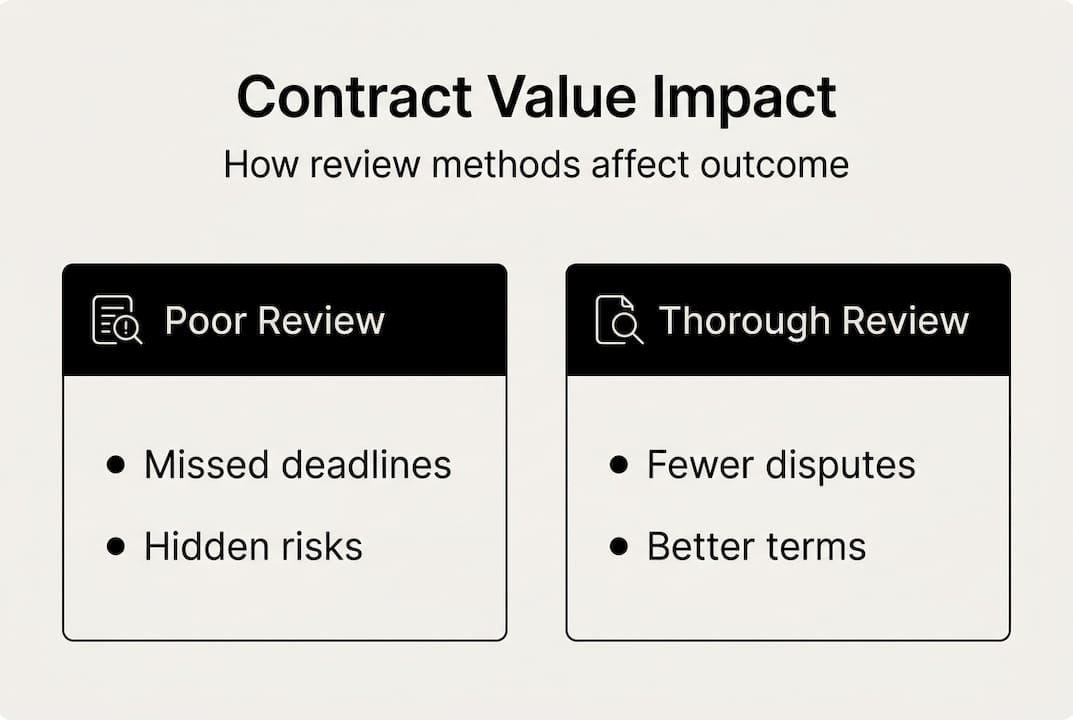
These aren’t abstract figures. They represent real consequences for businesses and individuals who sign without adequate review. The costs manifest as disputes requiring resolving contract disputes through litigation, wasted management time, damaged commercial relationships, and opportunities lost to competitors with better terms.
A thorough contract review examines structure, substance, and compliance across multiple dimensions. At its core, the process verifies that all parties are correctly identified, dates and deadlines are clear, the scope of work or services is precisely defined, payment terms are fair and enforceable, and regulatory requirements are met. Contract review checklists include basics, scope/financials, compliance, and exit terms to ensure nothing critical is missed.
Detailed review versus basic check
| Review element | Basic check | Detailed review |
|---|---|---|
| Party identification | Names present | Legal entities verified, authority confirmed |
| Financial terms | Amounts stated | Payment schedules, escalation clauses, penalties analysed |
| Liability provisions | Mentioned | Caps quantified, indemnities balanced, insurance requirements checked |
| Termination rights | Clause exists | Notice periods, grounds, consequences, and survival terms mapped |
| Compliance | Assumed | Regulatory requirements verified, licences confirmed |
Essential clauses that demand careful attention include:
Pro Tip: Match your review depth to the contract’s value and risk profile. A £50,000 supplier agreement with potential liability exposure deserves more scrutiny than a £500 software licence, but both need checking against your standard requirements.
The review process should also verify that navigating commercial contracts aligns with your business strategy, that property law compliance requirements are met for real estate transactions, and that employment contract risks are properly managed. External resources like the Lexology contract checklist provide additional frameworks for comprehensive review.

Even experienced reviewers overlook critical errors. Defined term inconsistencies occur at a 68% rate, whilst auto-renewal clauses and mismatched notice periods create frequent traps. These aren’t exotic edge cases. They’re everyday mistakes that cost real money.
Common errors that slip through include:
These errors persist because reviewers suffer from fatigue, work under time pressure, or rely on templates without checking how terms interact. A liability cap might look reasonable until you notice it excludes the exact risks your contract creates. An indemnity might seem standard until you realise it covers the other party’s negligence but not yours.
Pro Tip: Develop a standard checklist tailored to your common contract types, and always have a fresh pair of eyes review important agreements. The person who drafted or negotiated the contract often misses errors that a new reviewer spots immediately.
Digital tools can help, but they miss context. An AI system might flag a missing comma but overlook that your termination rights are practically unenforceable due to conflicting notice requirements. Understanding contract drafting pitfalls helps you spot these issues before they become problems. The red flag review guide offers additional warning signs to watch for.
Contract review methods range from purely manual processes to AI-assisted workflows, each with distinct advantages. Manual review offers deep contextual understanding and nuanced judgement but suffers from human limitations. Reviewers tire, miss details, and average 92 minutes per contract. AI reduces review time by up to 80% but requires human input for context and complex risk assessment.
Key insight: AI tools excel at speed and consistency but lack the judgement to assess whether a term is commercially sensible for your specific situation. A hybrid approach combines both strengths.
The hybrid review process works through these steps:
This approach delivers speed without sacrificing quality. The AI handles repetitive checks, freeing experts to focus on judgement calls that actually matter. For high-value or complex agreements, the hybrid model provides the best protection.
Expert consensus supports this balanced approach. Whilst technology accelerates routine tasks, important contracts still need human oversight to catch risks that algorithms miss. Your contract review strategies should reflect this reality, using tools to enhance rather than replace professional judgement. Industry data from contract review technology stats confirms that organisations combining automation with expert review achieve the best outcomes.
Implementing a reliable contract review process requires planning, structure, and discipline. Contract review checklists and process improvements directly reduce risk and value loss when applied consistently.
Follow these steps for comprehensive review:
This systematic approach ensures consistency whilst allowing flexibility for different contract types. A simple purchase order might skip steps four and five, whilst a major partnership agreement requires all nine steps plus additional due diligence.
Your legal consultation checklist should integrate with your contract review process, and understanding commercial law essentials helps you identify when specialist advice is needed. The contract review legal steps framework provides additional guidance for complex agreements.
Contract review protects your interests, but some terms demand experienced legal analysis that goes beyond checklists and technology. Professional support ensures full compliance, minimises risk, and positions you for efficient dispute resolution if conflicts arise.

When contracts involve significant value, complex liability structures, or unfamiliar legal territory, expert guidance makes the difference between a protected position and an exposed one. Ali Legal’s specialist team brings deep experience across commercial agreements, helping clients identify risks that standard reviews miss and negotiate terms that actually protect their interests. Whether you’re entering a major supplier relationship, reviewing property contracts, or managing international agreements, professional review ensures you understand exactly what you’re signing and why it matters.
Our commercial litigation expertise means we review contracts with an eye toward enforceability and dispute prevention, whilst our civil litigation support provides the backing you need if disagreements arise. For bespoke contract reviews and guidance tailored to your specific situation, contact Ali Legal’s team to discuss how we can help protect your interests.
The main reason is to catch errors and unfavourable terms that could lead to significant financial or legal loss, as poor contract management leads to 8.6-9.2% value erosion on average.
Look for complex terms like auto-renewals, mismatched notice periods, or vague indemnity clauses, and seek legal advice when unsure, as auto-renewal traps and defined term inconsistencies are common.
No. Whilst AI reduces review time by up to 80%, it still needs expert oversight because context and complex risk assessment require human judgement.
Focus on parties, payment terms, indemnity and liability caps, and termination provisions for greatest protection against common risks.


