
Menu
Get Expert Legal Support Today

More than 60 percent of British small and medium-sized businesses encounter contract disputes within their first three years of trading. Entering the world of commercial contracts can feel daunting if you are a new business owner, yet clarity at each stage is vital to build strong supplier and client relationships. This guide breaks down every contract management step, so you can approach agreements with confidence and protect your British business from unnecessary risks.
Successfully navigating commercial contracts begins with thoroughly understanding your business needs and aligning contract terms precisely with your strategic objectives. This critical first step ensures you protect your interests while creating a robust framework for your commercial relationships.
Start by conducting a comprehensive internal review of your business goals, operational constraints, and potential risks. Contract management principles outlined by the UK government emphasise the importance of strategic oversight and clear accountability. Your assessment should cover financial implications, performance expectations, delivery timelines, and potential contingencies that might impact your business operations.
During this process, scrutinise every contractual element through the lens of your specific business requirements. The UK Small Business Commissioner advises businesses to meticulously define roles, risks, and expected outcomes to prevent future misunderstandings. Pay particular attention to payment terms, dispute resolution mechanisms, and performance indicators that will objectively measure contract success.
Business Insight: Invest time upfront mapping your exact business requirements to prevent costly contract revisions later.
Here is a comparison of proactive versus reactive contract management approaches:
| Approach | Typical Actions | Long-Term Results |
|---|---|---|
| Proactive | Early review, risk analysis | Fewer disputes, cost savings |
| Reactive | Address issues as they arise | Increased risk, possible delays |
Gathering comprehensive documentation is a critical phase in preparing for commercial contract negotiations. This step involves systematically collecting and organizing all necessary materials that will support your contractual objectives and provide a robust foundation for your business agreement.

The Local Government Association emphasises the importance of defining and documenting business requirements by engaging with key stakeholders and thoroughly analyzing relevant data. Begin by compiling essential documents such as business plans, financial statements, previous contract records, operational guidelines, and performance metrics. Ensure you include detailed information about your company’s current capabilities, anticipated growth trajectories, and specific operational constraints that might impact contract terms.
Proceed methodically through your documentation gathering process. The UK Government Project Delivery guide recommends early identification and precise documentation of procurement needs to support effective contract management. Create a comprehensive checklist of required documents, which might include tax records, registration certificates, compliance documentation, intellectual property details, and any previous contractual agreements that could inform your current negotiations.
Strategic Recommendation: Create a dedicated digital folder with all relevant documentation to ensure quick and organised access during contract discussions.
Crafting precise and thorough contract terms forms the cornerstone of successful business agreements. This critical stage requires meticulous attention to detail to ensure your commercial interests are comprehensively protected and all potential scenarios are anticipated.
UK Business Advisors recommend a systematic approach to contract drafting that involves collaborative review and comprehensive risk assessment. Begin by clearly defining the scope of work, specifying exact deliverables, performance metrics, payment structures, and timelines. Each clause should be unambiguous, leaving no room for misinterpretation. Address potential contingencies such as breach scenarios, termination conditions, dispute resolution mechanisms, and intellectual property protections.
Ensure your contract language is both precise and adaptable. Use clear, straightforward terminology that avoids legal jargon while still maintaining legal rigour. Include specific performance indicators, key milestone definitions, and explicit expectations for both parties. Consider potential future scenarios and build in flexibility through carefully worded provisions that allow for reasonable adjustments without compromising the core agreement.
Strategic Insight: Have an independent legal professional review your draft to identify potential ambiguities or overlooked risks before finalising the contract.
Ensuring legal compliance and minimising potential risks represents a critical phase in contract management that demands meticulous attention and strategic thinking. Your comprehensive review will serve as a protective shield for your business interests and prevent potential future complications.
Regulatory compliance requires a systematic approach to identifying and addressing potential legal vulnerabilities across multiple dimensions of your commercial agreement. Begin by conducting a detailed line by line examination of your draft contract, scrutinising each clause for potential legal ambiguities, unintended consequences, or regulatory inconsistencies. Pay particular attention to areas such as intellectual property rights, liability limitations, confidentiality provisions, termination conditions, and dispute resolution mechanisms.
Focus on verifying that your contract aligns with current UK legal standards and industry specific regulations. Cross reference your draft against relevant legislation, sector specific guidelines, and best practice frameworks. Consider potential scenarios that might expose your business to financial or legal risks, and ensure your contract includes robust protective clauses that mitigate these potential challenges. Consulting with a legal professional can provide an additional layer of scrutiny and help identify nuanced risks that might not be immediately apparent.
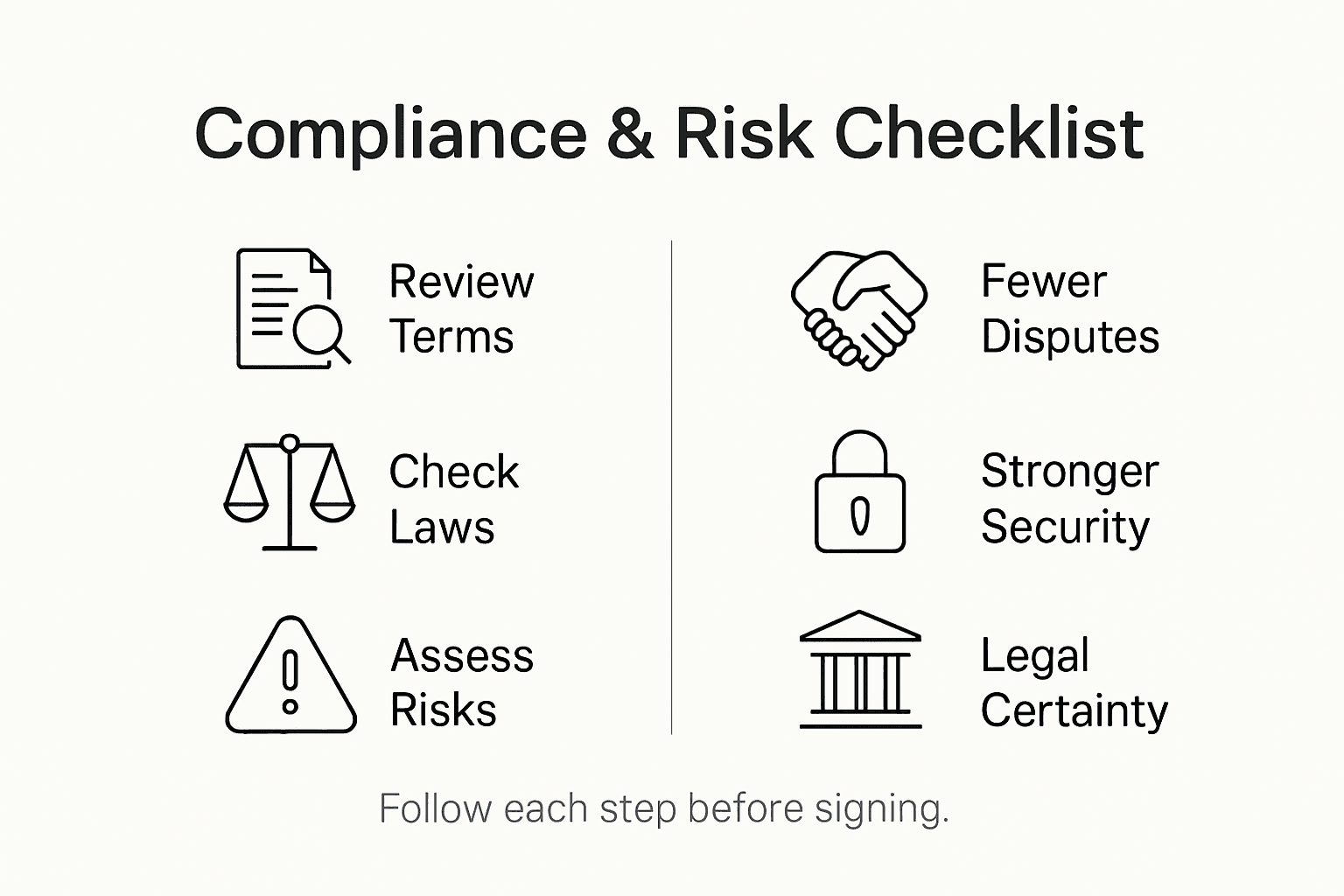
Strategic Safeguard: Create a comprehensive risk assessment checklist to systematically evaluate each contract clause against potential legal and operational vulnerabilities.
The final verification stage represents your ultimate opportunity to safeguard your business interests and ensure complete contractual precision. This critical review demands a methodical and comprehensive approach to eliminate any potential errors or misunderstandings that could compromise your agreement.
Audits and governance protocols demand meticulous examination of contractual documentation to prevent future legal complications. Initiate a systematic cross reference process by comparing the draft contract against your original business requirements, meeting notes, preliminary discussions, and negotiation outcomes. Verify that every agreed term is accurately reflected with precise language that leaves no room for misinterpretation. Check numerical details such as payment amounts, percentages, timelines, and quantifiable deliverables with extreme precision.
Adopt a forensic approach to your final review. Read each clause multiple times from different perspectives. Consider how each provision might be interpreted by a third party or potentially challenged in a legal setting. Confirm that all party names are spelled correctly, contact details are current, and legal entity information is accurate. Validate that all appendices, schedules, and supporting documents are included and consistent with the main contract text. Where complex technical or financial terms are involved, consider having specialist professionals review those specific sections to ensure absolute accuracy.
Strategic Verification: Create a systematic checklist with multiple review passes to catch subtle discrepancies that might escape initial scrutiny.
The following table summarises each stage of commercial contract management and its business impact:
| Stage | Main Focus | Key Business Impact |
|---|---|---|
| Assess Requirements | Align contract with strategy | Prevents future disputes |
| Gather Documentation | Compile essential records | Supports strong negotiation position |
| Draft Contract Terms | Specify deliverables and risks | Safeguards interests |
| Review Compliance & Risk | Ensure legal and regulatory fitness | Minimises liability exposure |
| Verify Before Signing | Check accuracy and completeness | Avoids costly errors |
Navigating the complex landscape of commercial contracts can feel overwhelming, especially when aligning detailed contract terms with your business objectives and managing risks. This article highlights key challenges such as drafting clear contract terms, ensuring legal compliance, and verifying accuracy before signing. At Ali Legal, we understand these pain points and are committed to offering transparent, fast, and strategic legal solutions to safeguard your business interests.
Discover practical advice and real case insights in our Uncategorized | Ali Legal articles that complement your contract management journey.
Ready to protect your business with expertly tailored contracts? Contact Ali Legal today for fixed fee, straightforward advice and build a lasting partnership with solicitors who prioritise your success. Begin your journey now by visiting our contact page or explore more essential legal insights in the All | Ali Legal section.
Before drafting a commercial contract, evaluate your business needs, operational constraints, and potential risks. Conduct an internal review of your goals and ensure the contract aligns with your strategic objectives, aiming to identify financial implications and performance expectations.
Gather all essential documents, including business plans, financial statements, and previous contracts, to support your negotiations. Create a checklist of necessary materials to ensure nothing is overlooked, allowing for a thorough assessment of your current capabilities.
Draft clear terms that define the scope of work, performance metrics, and payment structures. Use precise language, addressing contingencies such as breach scenarios and dispute resolution, ensuring that both parties have a mutual understanding of expectations.
Conduct a detailed review of your draft contract to identify any legal ambiguities or regulatory inconsistencies. Focus on areas such as liability limitations and confidentiality provisions, and consider consulting a legal professional for an expert opinion to safeguard your interests.
Conduct a comprehensive final review, cross-referencing the contract against your original requirements and negotiation notes. Validate all details, such as payment amounts and timelines, and create a checklist to systematically examine every clause for potential discrepancies.


