
Menu
Get Expert Legal Support Today
If you’re starting the process, find your original marriage certificate first, then decide whether you’re applying alone or jointly with your spouse. From there, the sequence runs: get advice, confirm eligibility, apply through GOV.UK, and wait at least 20 weeks for a conditional order, then 6 more weeks for the final order. A court fee applies, and money and children matters run on entirely separate tracks.
You don’t have to work this out alone, and trying to can cost you more than it saves. Relate offers counselling if the marriage itself needs exploring before you commit to ending it. Citizens Advice can talk you through your options for free. Mediators help separated couples agree on money and children without a solicitor’s hourly rate attached to every conversation.
If there’s any risk to your safety, skip mediation and speak to a solicitor immediately.
Pro Tip: Book a Mediation Information and Assessment Meeting (MIAM) even if you think mediation won’t work. It’s often required before you can apply to court for a financial order, so getting it done early saves a delay later.
You need to have been married for at least one year before you can apply, and the marriage must have irretrievably broken down under the no-fault system introduced in 2022. There’s no need to prove blame. If you’re under a year into the marriage, annulment or judicial separation are your only routes for now.
Before you touch the application form, gather:
Sole applications move faster when your spouse is unlikely to engage. Joint applications tend to feel less adversarial and can smooth the path if you’re both already broadly in agreement. Once you’ve picked, that choice shapes how service and response work later in the process, so it’s worth thinking through rather than defaulting to whichever feels easier now.
Here’s the part people consistently misunderstand: a divorce ends the marriage. It does nothing to sort out the house, the pension, or who has the children on weekends. Those are separate legal processes, and skipping them is the single most common reason people end up back in court years later, unravelling a “clean” divorce that left loose ends.
You have three practical routes:
One industry analysis makes a point worth sitting with: the divorce fee only pays to end the marriage. The real cost and the real delay almost always come from how finances and children get resolved, and mediation followed by a consent order is typically the cheapest way to reach a clean finish.
Before you negotiate anything, pull together bank statements, pension valuations, mortgage deeds, and a recent property valuation. Without these, you’re negotiating blind. If there’s a risk your spouse might sell assets or remove children from the country, seek urgent court protection rather than waiting for the standard timeline to catch up.
Most applicants now go through the online divorce service, which is quicker and cheaper to correct if you make an error.
Prefer paper? Complete Form D8, attach a certified copy of your certificate, and post it to the regional divorce centre. Solicitors have their own portal for lodging applications on a client’s behalf, which is worth knowing if you’d rather not manage the paperwork yourself.
Once submitted, you’ll get a case number. For sole applications, the respondent then has 14 days to acknowledge the application, which is where delays often start if they’re avoiding contact.
You can’t apply for the conditional order until at least 20 weeks have passed since the court issued your application. That reflection period exists deliberately, giving both parties time to settle finances and children arrangements rather than rushing straight through to a legal ending.
Delays at this stage are almost always administrative rather than legal. A blurry or cropped photo of the marriage certificate, a missing signature, or a mismatched name spelling will bounce your application back and cost you weeks. Once the court is satisfied, it will notify you that the conditional order has been granted, confirming you’re eligible to move to the final stage.
You can apply for the final order 6 weeks and 1 day after the conditional order, and you have up to 12 months to do so before needing to explain the delay to the court. The final order legally ends the marriage, which is exactly why many people deliberately hold off until a consent order covering finances is fully sealed. Once it’s final, update your will, notify pension providers and benefits agencies, and check any immigration or tax implications tied to your marital status.
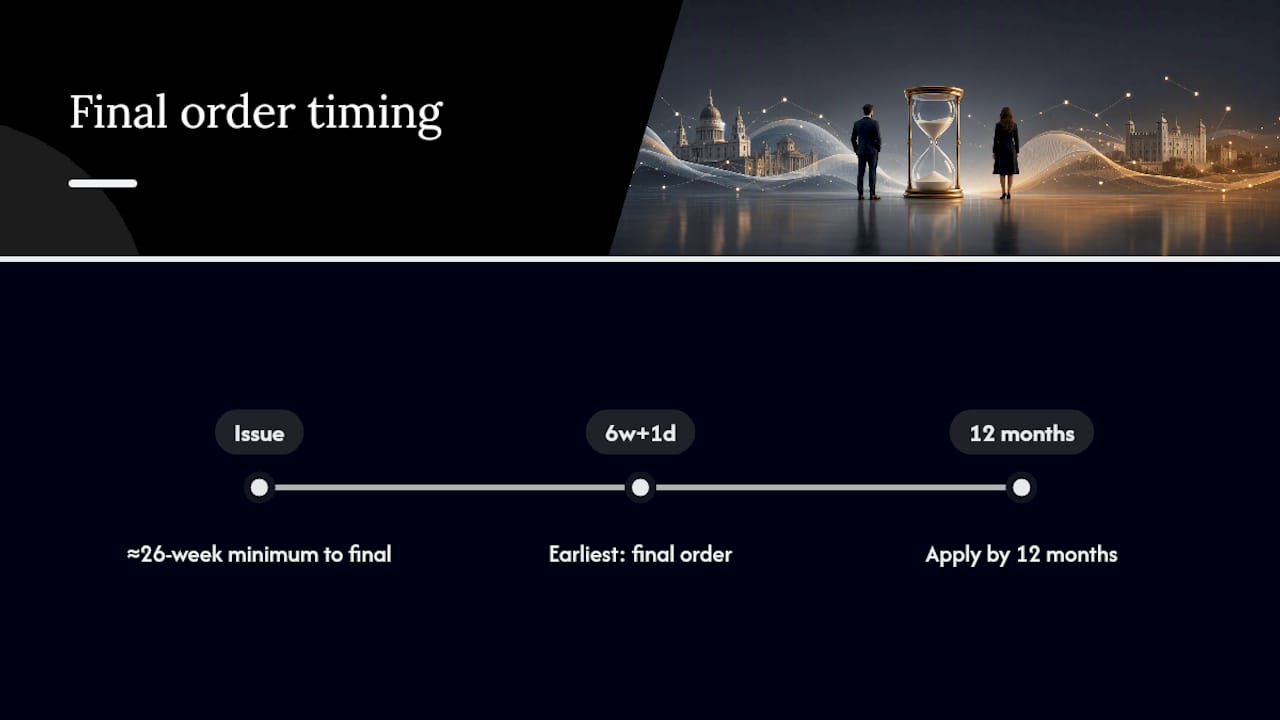
As of 13 July 2026, the court fee for a divorce application in England and Wales is £628, whether you apply online or by post. Help with Fees can reduce or waive this if your income and savings fall below the threshold.
The EX50 fee schedule confirms these figures for July 2026. A straightforward divorce takes a minimum of around 26 weeks from issue to final order, longer if finances or children arrangements remain unresolved.
Pro Tip: When photographing your marriage certificate, use natural daylight and capture all four corners in one shot. HMCTS staff report this as one of the most common reasons applications get kicked back for correction.
I’d push most people to speak to a solicitor earlier than they think they need to, particularly where pensions, property abroad, or a partner who isn’t being straightforward are involved. A solicitor’s real value isn’t paperwork, it’s catching the financial claim you didn’t know you had before the final order closes the door on it. Many firms now offer fixed fees for consent order drafting, so cost needn’t be the barrier people assume. Before a first consultation, bring your certificate, a rough asset list, and a clear idea of what you actually want from the settlement.
— Panagiotis
Ali Legal Ltd works alongside the process described above rather than replacing it. Where DIY applications tend to stall is exactly where a solicitor earns their fee: drafting a consent order that actually holds up, negotiating a financial settlement without months of back and forth, or handling representation if court proceedings become unavoidable.

Legal firms often offer fixed-fee consultations for divorce and financial matters, so you know the cost before you commit rather than watching an hourly rate creep upward. Bring your marriage certificate, a summary of assets including any property, and details of any pension arrangements to your first meeting. If property forms part of your settlement, our guidance on property law for UK owners is a useful companion read before that conversation. Get in touch through our contact page to arrange a consultation and find out exactly where you stand.
This article is general information, not a substitute for advice from a qualified lawyer. Consult a qualified legal professional about your own circumstances before acting on anything here.
Locate your original marriage certificate and decide whether to apply alone or jointly, since both decisions shape everything that follows, including how the application is served and answered.
Broadly: seeking advice, confirming eligibility, applying, the respondent’s 14-day acknowledgement, the 20-week reflection period, the conditional order, and finally the final order at least 6 weeks and 1 day later.
Financial settlement runs separately from the divorce itself, through negotiation and a consent order, mediation, or a court application using Form A, and it’s rarely resolved automatically just because the marriage has ended.
Applying for the final order before finances are settled is the costliest error, since it can close off most financial claims once the marriage has legally ended.
For most commercial agreements, the strongest option is a multi‑tier clause requiring negotiation, then mediation, then arbitration or court proceedings. This staged structure protects the relationship, narrows the real issues before anyone pays for a hearing, and keeps costs proportionate. The sample wording below covers the common scenarios contract drafters actually face, from a single arbitration clause to full escalation ladders.
Every clause below is a starting template, not finished drafting. Adapt the bracketed terms to your contract, jurisdiction and the parties’ appetite for delay.
Single arbitration clause (use when parties want a final, binding, confidential decision and no court involvement):
Multi-tier escalation clause (use when preserving the commercial relationship matters more than speed):
Mediation-only clause (use for ongoing supplier or partnership agreements where a binding outcome is not required):
Exclusive jurisdiction clause (use for simpler disputes, consumer‑facing terms, or where a regulator requires court oversight):
Interim relief carve‑out (add to any of the above so a party can still seek urgent protection):
Reviewing wording like this against your own risk profile is exactly where a lawyer earns their fee. For background on the mechanics of arbitration agreements and how they bind the parties, see what arbitration agreements mean for you.
Pro Tip: Never draft an escalation clause without a hard stop. If mediation has no fixed end date, one side can drag it out for months purely to delay the arbitration or litigation they know is coming.
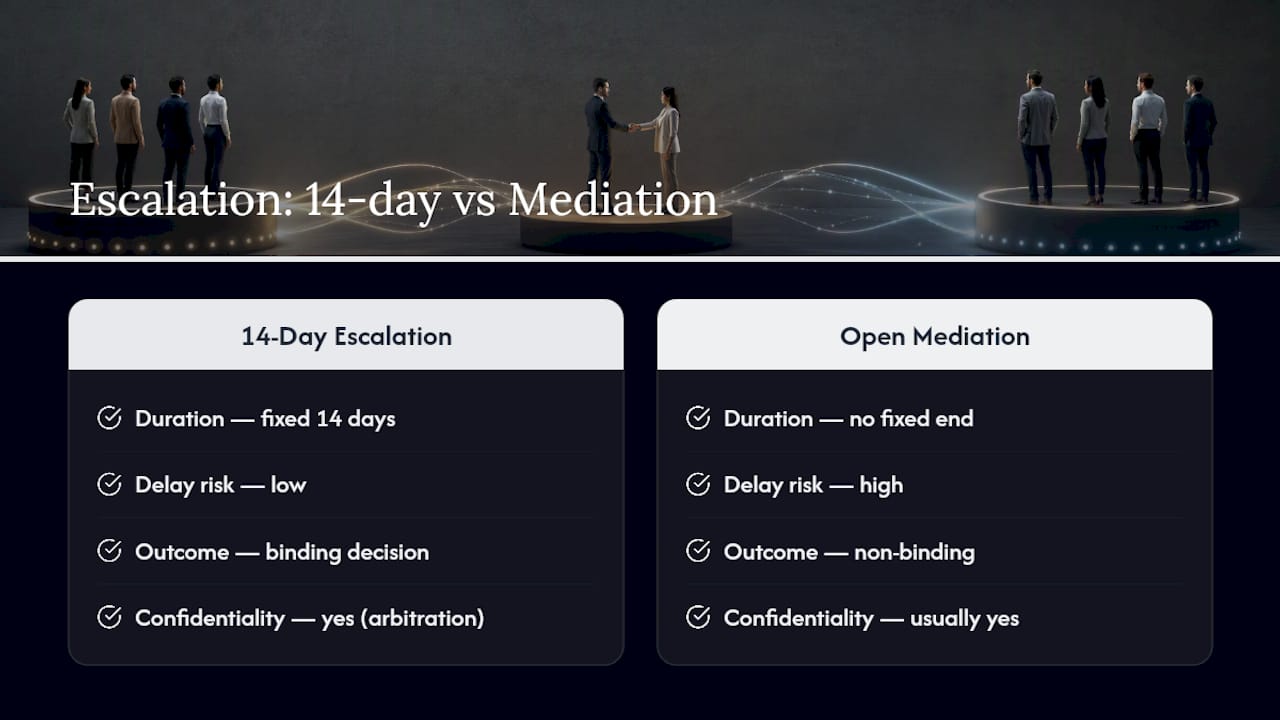
A clause that skips the mechanics invites argument about the mechanics themselves, which defeats the point of drafting one in the first place. Cover these elements every time:
A properly specified arbitration clause reduces the risk of a jurisdictional challenge later, because there is no ambiguity for either side to exploit over seat, rules or the arbitrator’s authority. Practical Law’s UK toolkits collate model wording practitioners rely on for exactly this level of detail.
English courts generally respect a properly drafted escalation clause and will stay proceedings brought in breach of it, but a vague “good faith negotiation” obligation on its own is weak. Courts are far more likely to enforce a negotiation obligation when it carries objective criteria, such as a fixed timeline or a named seniority of negotiators, rather than an open promise to “act reasonably.”
Common pitfalls that invite a procedural challenge include:
Wording that survives scrutiny usually reads something like “within 14 days of written notice, a director or equivalent senior officer of each party shall meet to attempt resolution,” rather than “the parties shall negotiate in good faith.” The former gives a court, or a tribunal, something concrete to test compliance against.
Before drafting anything, answer three questions: what outcome do the parties actually want, what features does the likely dispute have, and what form of enforcement will you need if you win? For a high-level overview of the differences and advantages, see arbitration vs litigation.
Our own primer on litigation, arbitration and mediation walks through this trade‑off in more depth if you want the fuller comparison before you draft.
Years of reviewing commercial contracts turn up the same avoidable mistakes repeatedly. Three shortcuts fix most of them:
Paste this into your own review workflow: seat named, governing law named, rules named, arbitrator count fixed, language fixed, escalation deadlines fixed, interim relief carved out, costs allocation stated.
Pro Tip: If a clause you’re reviewing has no deadline anywhere in it, that is the single fastest sign it was never tested against a real dispute.
Ali Legal Ltd’s international disputes and arbitration work regularly involves rebuilding clauses exactly like this before they cause a problem.
A construction contract, a shareholders’ agreement and a shipping charter each need a different clause shape, because the disputes they generate look nothing alike.
In construction and property, escalation clauses commonly reference PACT arrangements or adjudication under statute before arbitration, because speed matters more than finality at the first stage. RICS guidance on conflict avoidance recommends exactly this kind of tiered approach for lease and property disputes, reflecting the sector’s need to keep tenancies or projects running while a dispute is live.
In cross-border commercial contracts, a clause naming both the seat and an institutional rule set (LCIA, ICC or SIAC) is standard, because the parties are rarely from the same jurisdiction and need a neutral forum both sides will trust.
In shareholder and joint venture agreements, drafters often add a valuation or expert determination tier ahead of arbitration, since many shareholder disputes are really disagreements about a number rather than a legal question.
In maritime and shipping contracts, arbitration under specialist rules (often London-seated) remains the default, given the sector’s long history of arbitral practice and the international enforceability that comes with it. Ali Legal’s maritime law service reflects how entrenched that convention still is.
The lesson across all four: match the clause to how the dispute will actually surface, not to a generic template.
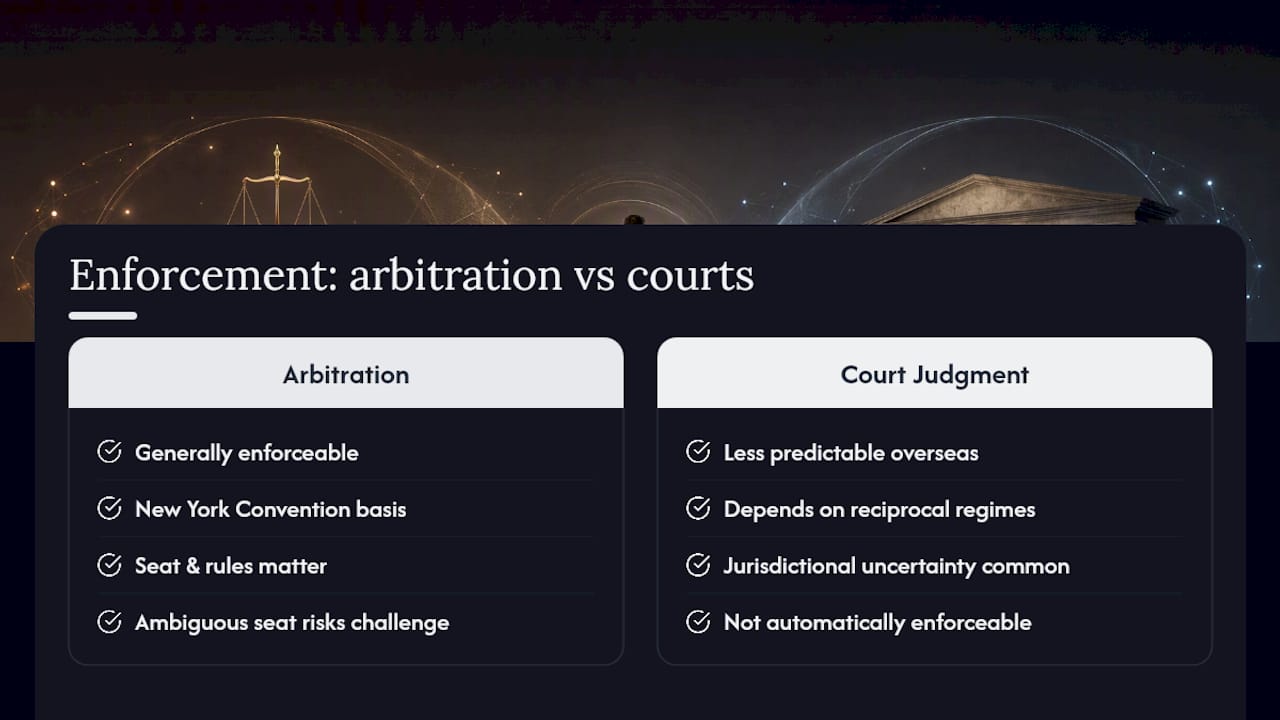
A clause that produces a binding decision is only useful if that decision can actually be enforced, and drafters too often stop at the arbitration or judgment stage without addressing what happens next.
For arbitration, enforceability across borders comes largely from the New York Convention, which is why specifying both the seat and the governing arbitration rules matters so much. If either is ambiguous, an award can face a jurisdictional challenge at the enforcement stage in a different country, long after the original dispute was resolved.
For court judgments, cross-border enforcement is far less predictable. A judgment from an English court is not automatically enforceable overseas in the way an arbitral award usually is, particularly outside reciprocal enforcement regimes. This is one of the strongest practical arguments for arbitration in any contract where the counterparty, or their assets, sit outside the jurisdiction where you might need to enforce.
A well-drafted clause can address this directly:
That last waiver is optional and worth discussing with your solicitor, since it removes a safety net as well as a delay tactic. For disputes with an international dimension, our page on international arbitration for cross-border interests covers enforcement considerations in more detail.
Disputes about who gets to decide the dispute are some of the most wasteful arguments a clause can generate, and they are entirely avoidable with three lines of drafting.
Specify the number of arbitrators upfront, typically one for lower-value or simpler disputes, three for higher-value or technically complex ones. Name an appointing authority to use if the parties cannot agree within a set period, commonly the institution running the arbitration itself under its own rules. And where technical expertise matters, such as a construction defect or a valuation dispute, consider requiring the arbitrator to hold a specific qualification or sector background.
Model wording might read:
Practitioners routinely build this level of specificity into commercial arbitration clauses precisely because a dispute over the tribunal’s composition can add months to a case before the actual substance is even addressed. It costs nothing to fix at the drafting stage and can cost a great deal to fix afterwards.
The legal seat and the physical venue for hearings are not the same thing, and conflating them causes real practical headaches for busy commercial parties spread across time zones.
The seat determines which courts have supervisory jurisdiction over the arbitration and which country’s arbitration law applies to the process. The venue is simply where hearings physically happen, and modern clauses increasingly allow flexibility here, particularly given how normal remote and hybrid hearings have become since the early 2020s.
Useful additional wording covers:
None of this replaces the seat clause. It supplements it, and it saves a genuinely tedious procedural argument early in a case when nobody wants to be arguing about video conferencing software.
Costs clauses are where a lot of otherwise well-drafted dispute resolution provisions fall apart, mostly because parties assume the default rule will simply apply and never say so explicitly.
Under most institutional rules, the tribunal has discretion over costs allocation unless the contract says otherwise, and English litigation generally follows the “loser pays” principle, subject to the court’s discretion. If you want something different, for example each party bearing its own costs regardless of outcome, or costs capped at a fixed amount, the contract needs to say so in plain terms.
Sample costs wording:
Fee arrangements for mediators and arbitrators are usually split equally between the parties pending the final outcome, and it is worth stating this explicitly rather than leaving it to be negotiated mid‑dispute, when neither side has much incentive to be generous. A clear costs clause also gives each party a realistic sense of exposure before they decide whether to escalate at all, which is often exactly the deterrent that keeps a dispute at the negotiation stage.
The clauses that quietly earn their keep are the ones nobody notices, because the dispute never reaches arbitration at all. A fixed 14-day negotiation deadline, with named job titles attending, resolves more disputes than any tribunal ever will. Tailor the tiers to the deal, not the template.
— Panagiotis
This service offers a practical alternative to drafting a dispute resolution clause from a generic online template and hoping it holds up when a real disagreement lands. Fixed‑fee reviews of existing clauses and bespoke drafting for contracts and international arbitration agreements are available, so clients get wording tested against how disputes actually unfold, not just how they read on paper.
Our international disputes and arbitration team handles exactly this kind of clause work daily, from single-jurisdiction supply agreements to cross-border joint ventures needing New York Convention enforceability. A typical fixed-fee review covers seat, rules, arbitrator appointment, escalation timing and costs allocation, with turnaround often quicker once the contract is received. If you are about to sign an agreement with a dispute clause you are not confident in, get in touch through our contact page and we will tell you plainly whether it needs work.
For model wording, the LCIA’s recommended clauses are a solid starting point, alongside RICS guidance for construction disputes. For UK practice notes, consult Practical Law, and for conceptual framing on choosing a mechanism, see Harvard’s PON programme.
This article is general information, not a substitute for advice from a qualified lawyer. Consult a qualified legal professional about your own circumstances before acting on anything here.
Conciliation is a voluntary, confidential process where an impartial conciliator helps two sides reach a settlement, often by suggesting terms, rather than just facilitating talk. The most common route in the UK is ACAS early conciliation, a pre-claim step for most employment tribunal disputes. It works well when both parties want a quick, private resolution without the cost of a hearing, but it depends on willingness to compromise on both sides.
A conciliator sits between mediator and arbitrator. Unlike a mediator, who stays strictly facilitative, a conciliator often takes a more evaluative role, actively proposing settlement terms based on how similar disputes have been resolved before. Unlike an arbitrator, though, a conciliator has no power to impose a decision. Both sides must agree before anything becomes binding.
Conciliation turns up across several sectors, each with its own flavour:
In the UK, the main providers are ACAS for workplace disputes, sector-specific ombudsmen and trade bodies for consumer and commercial matters, and independent conciliators engaged privately for commercial disagreements. CEDR, a well-known UK dispute resolution body, frames ADR generally around cost-effectiveness and flexibility rather than formal procedure, which is exactly why conciliation appeals to parties who want to avoid a drawn-out court process.
The mechanics differ slightly between individual and collective conciliation, but the shape is consistent.
Statistic callout: Early conciliation through ACAS can run for a limited period by law by law, and it issues a certificate you must quote on tribunal form ET1 if you go on to bring a claim. That 12 week window is often shorter in practice, but it sets the outer limit before a tribunal claim can proceed.
Fees vary by context. ACAS early conciliation for employment disputes is free. Commercial and consumer conciliation run through trade bodies or private providers can carry a fee, though generally far less than arbitration or court proceedings.
Choosing the right ADR route comes down to how much control you want to keep, and how much you want the neutral to steer the outcome.
Conciliation tends to suit disputes where the parties want guidance towards a workable number or arrangement but are not ready to hand over decision making power. Mediation suits parties who want full control over the outcome. Arbitration suits parties who want a final, enforceable answer and are prepared to give up the flexibility of negotiation. On cost and speed, conciliation and mediation usually beat arbitration, which can resemble a mini trial in its formality. For a deeper look at how these methods stack up, see this comparison of ADR options.
When conciliation succeeds, the agreement needs to be captured properly or it risks being unenforceable, or worse, misunderstood by one side later. In employment cases, ACAS records the deal as a COT3, and once that’s signed, the tribunal claim is cancelled or closed. Outside employment, a written settlement agreement serves the same purpose, provided it is properly drafted and signed by both parties.
Before signing anything, check:
Pro Tip: Get a solicitor to review the settlement wording before you sign, even if the conciliator drafted it. A COT3 or written agreement is very hard to unpick once signed, so it pays to check the waiver clause covers precisely what you agreed and nothing broader.
If conciliation fails, the case moves to its next natural stage, tribunal claim, arbitration or litigation, and normal time limits apply. For employment claims, the early conciliation certificate effectively pauses the tribunal clock, so check the exact deadline before assuming you have more time than you do.
Walking into conciliation unprepared wastes the opportunity. A short list of groundwork makes a real difference to how the session goes.
Pro Tip: If talks stall, ask the conciliator what typically happens next in similar cases. They won’t advise you to accept a specific offer, but they can often outline how comparable disputes have been resolved, which gives useful context for your decision.
Conciliation is often recommended when a dispute is contained, both sides are willing to negotiate, and a quick, private outcome serves better than a lengthy tribunal or court fight. That covers plenty of employment disputes, consumer and commercial disagreements, and smaller contractual conflicts where the relationship is worth preserving.
Preparation is where most settlements are won or lost. Legal advisers can help clients build their evidence file, set a realistic fallback position, and draft or review settlement wording so it holds up if challenged later. Where conciliation does not resolve matters, cases can move forward into tribunal proceedings or litigation without a change of adviser. Fixed fee options are available for straightforward matters, and the firm’s contract dispute guidance covers the wider decision of when to escalate beyond negotiation.
Most guidance on conciliation treats it as a formality, something you do before the “real” process starts. That undersells it. Early conciliation resolves a meaningful share of workplace disputes before they ever reach a tribunal, and the parties who benefit most are the ones who treat those weeks as genuine negotiation, not paperwork.
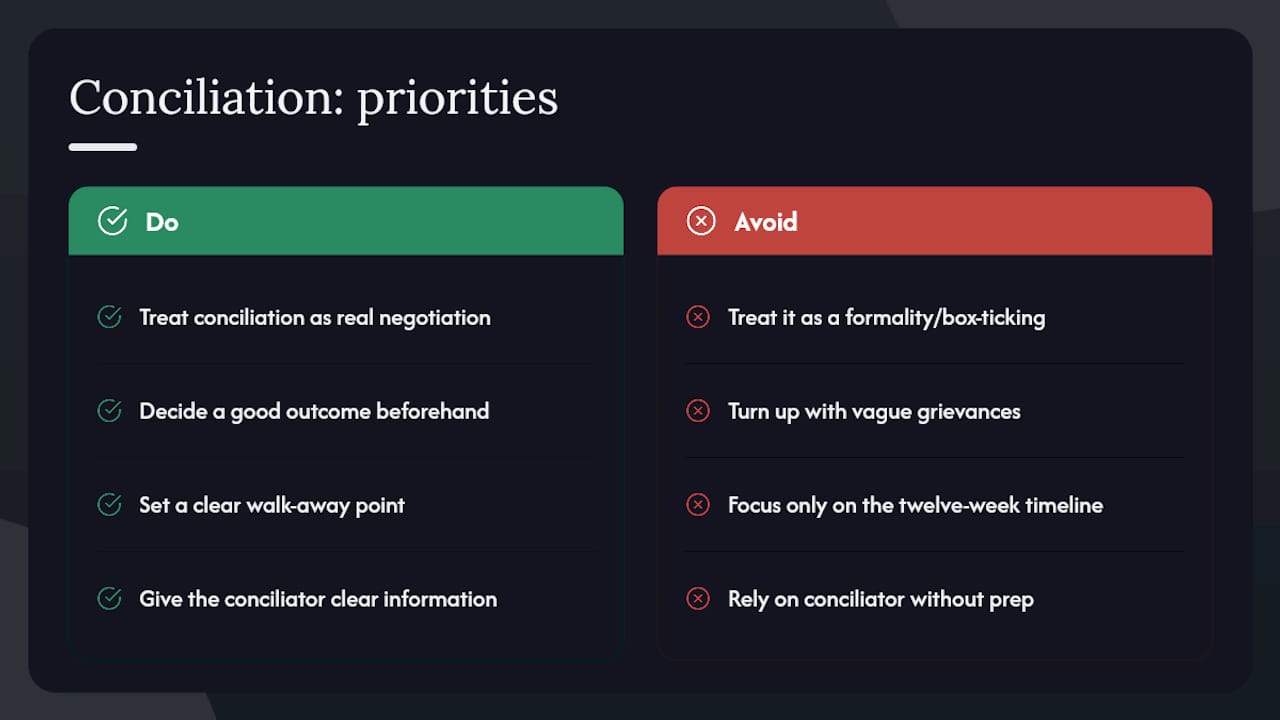
The conventional advice tends to focus heavily on process, what happens in what order, rather than on preparation quality. That’s backwards. The conciliator’s evaluative input is only as useful as the information you give them. Turn up with vague grievances and no fallback position, and you’ll get a vague, unsatisfying outcome, or no settlement at all.
What the reader should prioritise first is not learning the twelve-week timeline (worth knowing but easy to look up); it is deciding, before the conciliator ever calls, what a good outcome actually looks like and what the walk-away point is. Courts and tribunals increasingly expect parties to have engaged seriously with ADR before litigation, so treating conciliation as a box-ticking exercise carries its own risk further down the line.
— Panagiotis
Solicitor-led support is available if you’re heading into conciliation and want the settlement wording checked before you sign anything, not after.
Ali Legal Ltd advises on dispute resolution strategy, drafts and reviews settlement agreements, and represents clients when conciliation fails and a case moves to tribunal, arbitration or court. Fixed fee options are available for contained disputes where the scope of work is predictable. An initial consultation covers your position, the strength of your evidence, and a realistic view of what settlement range is achievable. Before that call, gather your key documents and set out, in your own words, what outcome you actually want. Get in touch through the international disputes and arbitration team to arrange a first consultation.
This article is general information, not a substitute for advice from a qualified lawyer. Consult a qualified legal professional about your own circumstances before acting on anything here.
Five legal forms cover almost every UK business: sole trader, partnership (including limited liability partnership), private limited company, public limited company, and social-purpose structures like the community interest company or co-operative. The right choice comes down to three things: how much personal liability you can accept, how you want profits taxed, and how much administrative work you’re prepared to take on. Everything else follows from those three decisions.
Before you weigh up the detail, here’s the shortlist.
The most common transition is sole trader to limited company once profits grow or personal risk becomes uncomfortable. It’s rarely the first choice, but it’s frequently the second.
A sole trader isn’t a separate legal entity. You and the business are the same thing in the eyes of the law, which is exactly why liability is unlimited. If the business owes money it can’t pay, creditors can pursue your personal assets, house included. Tax works through Income Tax and National Insurance on profits, filed via Self Assessment. There’s a persistent myth that opening a separate business bank account creates some kind of legal firewall. It does not. Separate accounts help with bookkeeping, not liability. This structure suits low-risk trades, early-stage freelancers, and anyone testing an idea before committing further.
A general partnership splits profits and management between two or more people, and each partner is taxed personally on their share. The catch is joint and several liability: if your partner signs a bad contract, you can be on the hook for it too. A limited partnership adds a category of partners whose liability is capped at their investment, though at least one general partner must still carry unlimited liability. This structure works best when partners have complementary skills and genuine trust, less well when the relationship is untested.
An LLP gives you limited liability protection while keeping partnership-style profit sharing and tax treatment, which is why it’s the structure of choice for law firms, architecture practices, and accountancy partnerships. Members pay tax personally on their share of profits rather than the business paying Corporation Tax. LLPs must register at Companies House and file annual accounts, so the administrative burden sits above a simple partnership but below a full company. The flexibility to divide profits however partners agree, rather than by fixed shareholding, is what draws professional firms to this structure specifically.
A limited company exists as its own legal entity, separate from the people who run it. That separation is the whole point: shareholders’ liability is limited to what they’ve invested, and the company itself pays Corporation Tax on profits, while directors and shareholders pay personal tax on salaries and dividends. Directors carry legal duties, including acting in the company’s best interests and filing accurate accounts. Companies House obligations include annual confirmation statements, filed accounts, and a public register of directors and shareholders. Read more on the duties that come with running a company. This form suits businesses with growth ambitions, external risk, or anyone planning to bring in investors or employees at scale.
A PLC is a limited company that can offer shares to the public, which brings a minimum share capital requirement and considerably stricter reporting and governance rules. Few small businesses need this structure. It’s relevant once you’re genuinely raising capital on public markets rather than through private investment rounds.
A Community Interest Company is a limited company variant built for social enterprises, complete with an asset lock and a community interest test enforced by the CIC Regulator. Co-operatives distribute control and profit among members rather than shareholders. Both trade some commercial flexibility for a structure that guarantees social purpose can’t be quietly abandoned later.
Five questions cut through most of the indecision.
Take these questions to an accountant or solicitor rather than guessing: ask specifically about your expected profit in year one and two, whether you’ll need investment, and what your personal asset exposure looks like right now.
Pro Tip: If you’re about to sign a contract with a supplier, take on your first investor, or hire your first employee, get advice on structure before you sign anything, not after. Unpicking the wrong structure later costs far more than choosing carefully now.
Certain situations are flashing red flags for immediate legal input: investor term sheets, contracts with unusual liability clauses, or any transfer of significant assets into a new company.
Most founders start as sole traders and incorporate once profits or risk grow past a comfortable point. The process is fairly mechanical once you know the sequence.
Registration at Companies House is usually quick, often same-day online, though the full transition including tax registration typically takes one to two weeks once contracts and accounts are properly moved across.
Sole traders register directly with HMRC for Self Assessment; anyone incorporating registers with Companies House first, then HMRC for Corporation Tax. From day one, open a dedicated business bank account, keep every invoice and receipt, and set up basic payroll records if you’re taking on staff. For anything beyond straightforward trading, a solicitor or accountant earns their fee quickly, and GOV.UK’s own guidance pages are the right starting point for the mechanics.
Investor term sheets, multi-party contracts, and asset transfers between entities are exactly where DIY structuring goes wrong. A solicitor drafts partnership agreements that survive disagreement, checks incorporation paperwork before Companies House rejects it, and structures ownership so it doesn’t cause problems at your next funding round. Ali Legal Ltd works across corporate law with fixed-fee options for exactly this kind of structuring work.
Raising money changes the calculation entirely, and this is where structure choice stops being theoretical.
A sole trader can’t sell equity, full stop. There’s no share structure to offer, which means funding options are limited to personal savings, loans, or grants. Investors have no mechanism to take a stake even if they wanted to.
Partnerships and LLPs can bring in new partners or members, but that route usually means renegotiating profit-sharing arrangements from scratch rather than issuing straightforward equity. It works for bringing in a working partner. It works far less well for a passive investor who just wants a financial stake.
A private limited company solves this cleanly. Shares can be issued, transferred, and valued, which is exactly the mechanism venture investors, angel networks, and even friends-and-family rounds expect to see. Standard investment structures, from convertible loan notes to SEIS and EIS tax relief schemes, are all built around companies limited by shares. Trying to attract serious investment as a sole trader or general partnership is, in practice, close to impossible.
A PLC opens the door to public markets and much larger capital raises, but that access comes with a genuinely heavier compliance load, and it’s not a realistic step for most early-stage businesses.
CICs face a structural constraint here too: the asset lock that protects their social mission also limits how attractive they are to profit-seeking investors, since returns and asset distribution are deliberately restricted.
Control follows ownership, and each structure distributes both very differently.
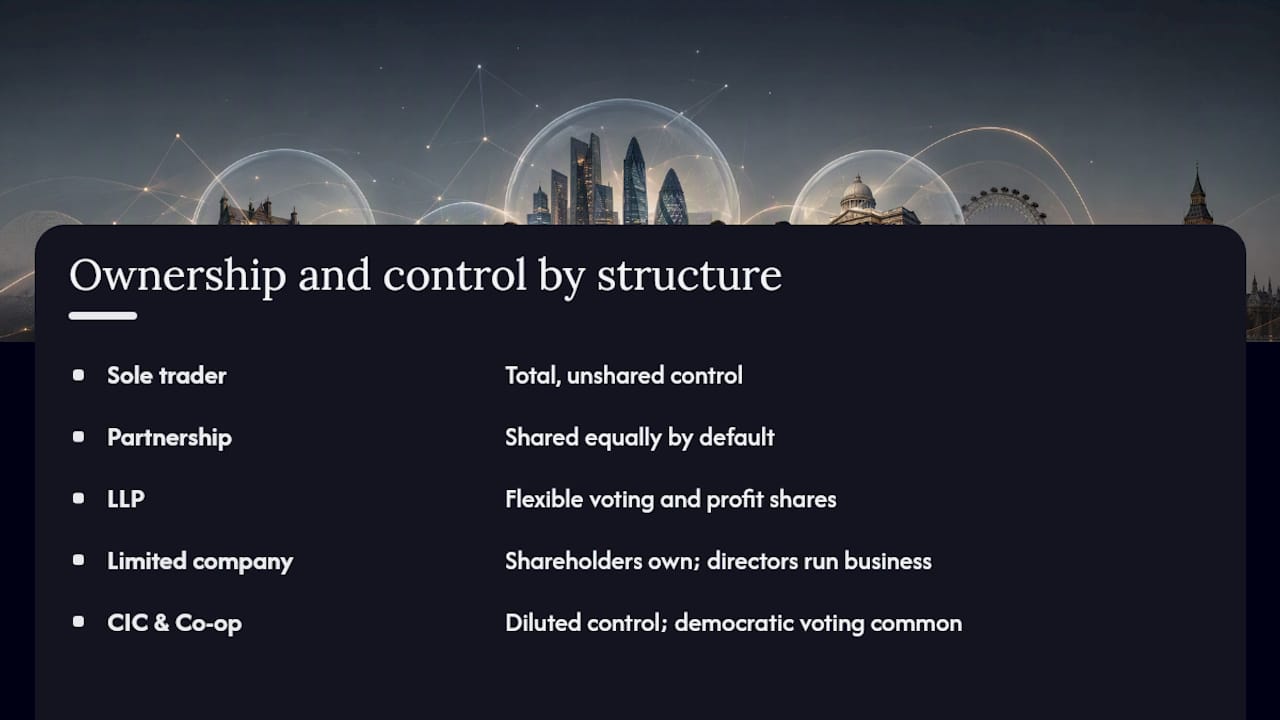
A sole trader has total, unshared control. Every decision is yours, which is either liberating or a liability depending on how much oversight the business actually needs. Partnerships split control between partners equally by default, unless the partnership agreement states otherwise, which means disagreements can genuinely deadlock the business if there’s no tie-breaking mechanism written in.
LLPs work similarly but with more flexibility. Members can agree bespoke voting rights and profit shares in the LLP agreement rather than defaulting to equal splits.
Limited companies introduce a formal split between ownership and management: shareholders own the business, but directors run it day to day. Shareholders hold voting rights proportional to their shareholding and can, in principle, remove directors who aren’t performing. That separation is precisely why companies are easier to invest in, since a shareholder doesn’t need to run the business to hold a stake in it. PLCs extend this further with statutory protections for minority shareholders and stricter disclosure rules, because public money demands public accountability.
CICs and co-operatives dilute individual control further still. Co-operatives typically follow one-member-one-vote regardless of investment size, prioritising democratic control over capital weight.
Employment obligations largely don’t change with legal structure. Once you take on staff, whether you’re a sole trader or a PLC, you must register as an employer with HMRC, operate PAYE, provide a written contract, and meet minimum wage and pension auto-enrolment duties.
Where structure does matter is liability and administrative capacity. A sole trader employing staff carries personal liability for employment claims, on top of the personal liability they already carry for the business generally, which stacks risk in a way that limited structures avoid. A limited company’s separate legal status means employment claims are generally brought against the company rather than the director personally, though directors can still face personal liability in cases of discrimination or health and safety breaches they’re directly responsible for.
Administrative capacity also tends to track structure. Companies usually have more established payroll and HR processes by the time they’re hiring, simply because incorporation itself demanded more formal recordkeeping from day one. A sole trader taking on their first employee is often building payroll infrastructure from nothing, at exactly the moment they can least afford the distraction.
Winding up looks different depending on where you started.
A sole trader simply stops trading, informs HMRC, and files a final Self Assessment return. There’s no formal deregistration process beyond that, because there was never a separate legal entity to dissolve.
Partnerships dissolve according to the terms of the partnership agreement, or under default rules if no agreement covers it, with remaining assets and debts settled between partners according to their shares.
An LLP or limited company requires formal dissolution through Companies House, typically by striking off the register once debts are settled and assets distributed, or through a formal liquidation process if the business is insolvent. Directors have a legal duty to act properly during this process, particularly around creditor treatment, and cutting corners here can expose directors to personal liability even though the company structure was supposed to prevent exactly that.
A CIC’s asset lock adds an extra layer: on dissolution, remaining assets can’t simply be distributed to members. They must go to another asset-locked body or a charity, which is the price paid for the social-purpose protection the structure offers throughout its life.
Most guidance on legal forms treats the decision as a one-time tax optimisation exercise: calculate the break-even profit point, pick whichever structure saves more money, done. That framing undersells the real question. The businesses that get into trouble aren’t usually the ones that picked the “wrong” structure on day one. They’re the ones that picked the right structure for year one and never revisited it as the business changed.
A sole trader taking on their first serious contract, or a partnership bringing in an outside investor, needs a fresh look at structure at that exact moment, not twelve months later when a dispute forces the question. The tax saving from incorporating too early can also be smaller than founders expect, once accountancy and filing costs are honestly totted up against genuinely modest early profits.
If there’s one thing worth prioritising above the spreadsheet, it’s this: treat structure as a decision you’ll revisit at every genuine inflection point in the business, not a box ticked once at the start. GOV.UK’s guidance is a solid, free starting point for the mechanics. Where it runs out is judgement, and that’s exactly where proper advice earns its cost.
— Panagiotis
Ali Legal Ltd offers something most founders working through this decision alone don’t have: a solicitor checking the structure before you sign anything, rather than untangling a problem after it’s already cost you money. Whether you’re incorporating for the first time, drafting a partnership agreement, or reviewing a contract that will follow your business for years, getting it right at formation stage is considerably cheaper than fixing it later.
Ali Legal Ltd’s services include support with company formation, corporate law guidance, and contract review, all offered with fixed-fee options so you know the cost before you commit. If you’re weighing up incorporation or need a partnership agreement drafted properly the first time, get in touch through Ali Legal’s contact page to discuss what your business actually needs.
This article is general information, not a substitute for advice from a qualified lawyer. Consult a qualified legal professional about your own circumstances before acting on anything here.
Transparency in legal services means a firm publishes clear price, service and regulatory information you can check and compare before you sign anything. The single most useful thing to do first is look for that firm’s SRA-required disclosures and its digital badge, usually sitting near the footer or a dedicated pricing page. If you cannot find either within a couple of minutes of browsing, treat that as a warning sign rather than an oversight.
Transparency isn’t one disclosure. It’s three separate categories, and firms that only get one right are still leaving you exposed on the other two.
Price transparency means you can see the total cost, a realistic range, or the basis for charging (hourly rate, fixed fee, or a percentage), plus whether VAT and disbursements sit inside or outside that figure. A quoted “£800 conveyancing fee” that turns out to exclude search fees and land registry costs isn’t transparent, it’s incomplete.
Service transparency covers what the work actually involves: the key stages of a transaction or case, roughly how long each takes, and who on the team will handle it. Regulatory and redress transparency tells you the firm’s regulated status, how to raise a complaint, and what happens if that complaint isn’t resolved internally.
None of this transparency requirement appeared out of goodwill. It came from a regulator concluding the market simply wasn’t working for consumers.
The Competition and Markets Authority’s legal services market study found that a lack of upfront pricing and quality information made it hard for people to shop around, and it pushed regulators to fix that gap. The Legal Services Board followed with a statement of policy on empowering consumers, asking frontline regulators to make provider information accessible, comparable, and ideally available from a single online location rather than scattered across dozens of formats.
The Solicitors Regulation Authority is the body that turned that pressure into an actual rulebook. Its Transparency Rules came into force in December 2018, requiring firms that publish certain services (conveyancing, probate, employment tribunal claims, and others) to display cost and service information prominently on their websites.
Not every case needs the same priorities. If you’re buying a house, cost certainty usually matters more than anything else, because the process is standardised and a fixed fee protects you from scope creep. If you’re facing a contested dispute or a complex immigration matter, specialist experience and a clear sense of the likely stages often matter more than the headline price, because the wrong strategy costs far more than a slightly higher hourly rate.
A few red flags are worth memorising:
Pro Tip: Compare three firms side by side using the same three questions: what’s included, what’s the realistic timescale, and what happens if you’re unhappy with the outcome. Firms that answer all three clearly, without you having to ask, are usually the ones that have thought about client experience beyond the minimum legal requirement.
Meeting the SRA Transparency Rules is the floor, not the ceiling, and the firms that stand out tend to publish more than they’re required to. That means FAQs addressing genuinely common client worries, sample client journeys showing what week one versus week six actually looks like, interactive cost calculators, and accessible formats such as plain English summaries and mobile-friendly pages for clients who need them.
Regulatory guidance on practical compliance notes that stating assumptions upfront, such as what counts as a “typical” file, reduces disputes later. Ali Legal Ltd builds its published guidance around this principle, setting out how legal fees typically work and what a consultation actually involves before a client commits to anything.
Confirming a firm’s regulated status takes a few minutes if you know where to look.
Publishing a price list is easy. Publishing one that a client can actually understand, act on, and trust six weeks into a matter is harder, and that gap is where most complaints in this sector actually originate.
Some firms build their approach around fixed fees and straightforward advice because vague pricing creates vague expectations, and vague expectations are what turn a routine transaction into a dispute. Clear disclosure at the outset does more than satisfy a regulator. It removes the single biggest source of friction between a solicitor and a client: not knowing what happens next, or what it costs. Readers who want to see how we set out our services and fee structures can look at our services brochure for a working example of what that looks like in practice.
— Panagiotis
Some legal firms set out fees, key stages, and realistic timescales upfront, so clients know what they are paying and why before committing to anything. That matters most in property transactions, where disbursements and unexpected costs are the usual source of client frustration.
If you’re weighing up a property matter and want clarity on cost and process before instructing anyone, our guide on property law for UK owners sets out what to expect at each stage. Get in touch through our contact page for a straightforward conversation about your situation and a fixed-fee quote where one applies.
An employment lawyer advises on workplace rights and represents clients in disputes, covering everything from drafting contracts to appearing at tribunal. The work splits into two strands: advisory (contracts, policies, restructures) and contentious (unfair dismissal, discrimination, tribunal claims). You typically need one when facing dismissal, a discrimination complaint, redundancy, or a settlement negotiation.
Most of the work is less dramatic than television courtroom scenes suggest. An employment lawyer’s job is largely about paperwork, timing, and getting the strategy right before anything reaches a hearing room.
The core duties include:
Solicitors take instructions from a client, advise on the realistic options, then draft the paperwork and either appear in tribunal themselves or instruct a barrister when the case needs specialist advocacy. A large chunk of tribunal preparation time actually goes into assembling witness statements in the right chronological order and drafting a tight schedule of loss, work that is unglamorous but decides outcomes.
Employment law splits neatly into two camps, and knowing which one applies to your situation shapes what kind of lawyer you need.
The distinction matters because a lawyer who is brilliant at drafting settlement agreements is not automatically the right person to cross-examine a witness at a full hearing, and vice versa.
Timing is where most people trip up, and it is unforgiving. Most claims must be lodged within three months minus one day of the incident, with narrower exceptions running to six months for some redundancy pay claims and as little as seven days for interim relief applications.
Before you can even file most claims, you need to go through Acas Early Conciliation, a free, impartial service that tries to settle the dispute before it reaches tribunal. You cannot usually start a claim without an Acas certificate number.
Pro Tip: Contact Acas the moment a dispute looks likely to escalate. Early conciliation has no cost and can resolve matters in weeks rather than the months a tribunal claim takes.
Once a claim is lodged, the sequence generally runs like this:
A lawyer’s job at each stage is to keep the paperwork on time, the evidence organised, and the client aware of what happens next.
Fees vary by charging model. Fixed fees suit straightforward advisory work such as contract review or a single settlement negotiation. Hourly rates apply to more unpredictable litigation, and some firms offer conditional fee arrangements for tribunal claims.
Costs climb with case complexity, the volume of evidence, whether a barrister needs instructing, and how many days a hearing runs. You should also budget for the risk of adverse costs orders and witness expenses in some claims.
Look for a solicitor or barrister qualified to practise in England and Wales, with genuine tribunal advocacy experience rather than purely advisory background.
A short first meeting tells you most of what you need to know, provided you ask the right questions.
Pro Tip: Treat vague costs estimates and a lack of a clear next step as warning signs. A lawyer who cannot outline your first three months in plain terms probably has not thought your case through yet.
We work with individuals facing dismissal, discrimination or redundancy, and with employers defending claims, building services around fixed fees and straightforward advice rather than open-ended billing.
At first contact, we will ask for your Acas certificate number where one applies, a timeline of events, and any relevant correspondence, then set out fees and next steps before any work begins.
Waiting rarely helps. The clients who come to us within weeks of a dismissal or grievance almost always have more options than those who wait until the tribunal deadline is close. Evidence is fresher, witnesses remember more, and there is still time to try Acas conciliation properly rather than as a box-ticking exercise before a rushed claim.
One pattern shows up repeatedly: someone treats a written warning or a difficult meeting as something to survive rather than something to document. By the time they seek advice, the paper trail is thin. A quick note taken at the time, a saved email, a date written down, that is often the difference between a strong case and a weak one.
If you think you have a claim, get your Acas Early Conciliation certificate sorted early. It costs nothing and buys you time to think clearly rather than react.
— Panagiotis
If you are facing dismissal, a discrimination complaint, or a redundancy process that feels rushed, waiting for the tribunal deadline to loom is the wrong strategy. We work on fixed fees for defined pieces of advice, so you know the cost before anything starts, without open-ended hourly billing creeping upward while your case sits unresolved.
Before you get in touch, gather your contract, any written warnings or dismissal letters, relevant emails, and your Acas Early Conciliation certificate number if you already have one. From there, the process is simple: an initial call to understand your situation, a clear fee quote, and a plan for what happens next, whether that is a settlement negotiation or a tribunal claim. Visit the employment claims service page to see what is covered, or head straight to the contact page to start the conversation.
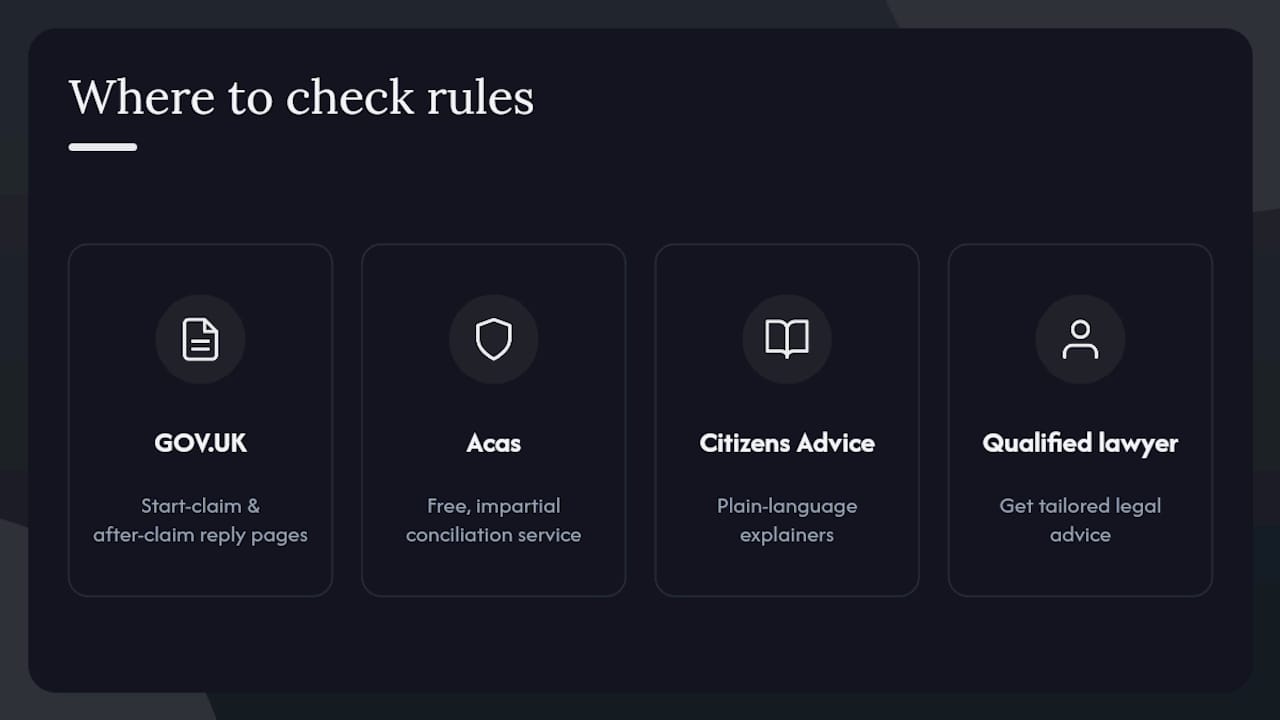
For the official process and deadlines, GOV.UK’s tribunal claim guidance covers how to start a claim, while its after-you-claim page explains the respondent’s reply period. Acas provides free, impartial conciliation, and Citizens Advice offers plain-language explainers for anyone weighing up their options before instructing a solicitor.
This article is general information, not a substitute for advice from a qualified lawyer. Consult a qualified legal professional about your own circumstances before acting on anything here.
The sequence is always the same, whichever route you take: confirm which visa applies to you, gather your passport and primary evidence, complete the online form and pay the fees, verify your identity, then wait for your eVisa. Start by checking your route and assembling your passport and financial evidence before touching the application form. Applicants applying from outside the UK usually receive a decision within three weeks of attending biometrics, though some cases stretch to 12 weeks.
Every UK visa route runs through the same basic mechanics before it branches off into route-specific detail. Work through this sequence first, then jump to the section for your particular visa.
Miss a step, or complete them out of order, and you risk delays that ripple through the rest of your plans, particularly if a course start date or job start date is fixed.
Student visa timing revolves around one document: the Confirmation of Acceptance for Studies (CAS), issued by your university or college. You can apply online up to six months before your course starts, and you must prove your identity either through the ID Check app or at a Visa Application Centre.
Pro Tip: Book your Visa Application Centre slot the moment your CAS lands. Peak months such as August and September see appointment slots vanish fast, and a missed slot can push your start date back a full term.
Work visa applications hinge on a document you don’t control directly: the Certificate of Sponsorship (CoS), issued by your employer’s licensed sponsor. Sponsor compliance and CoS accuracy affect your outcome as much as anything you submit yourself.
Pro Tip: Ask your employer to verify the occupation code against the current SOC 2020 classification before the CoS is issued. An outdated or mismatched code is one of the more frequent, and entirely avoidable, causes of a refused work visa. Businesses managing this regularly may find it worth reading about immigration compliance tips for UK companies to understand where sponsor obligations commonly go wrong.
Most short visits to the UK need either nothing beyond a passport, an Electronic Travel Authorisation (ETA), or a full Standard Visitor visa, depending on your nationality. If you do need the visa, you must apply online before travelling, with an earliest application window of three months.
Every route asks for a version of the same evidence pack, just weighted differently. Building it properly before you start the online form saves you from uploading in a panic at 11pm.
Biometrics work one of two ways. Eligible applicants complete identity verification through the UK Immigration: ID Check app using their phone camera, while others must book a VAC appointment where staff scan fingerprints and take a photograph. VACs generally return your original documents shortly after your appointment, retaining only scans, so keep a personal digital copy of everything you submit.
Fees have two components for most non-visitor routes: the application fee itself and the Immigration Health Surcharge, which covers NHS access for the length of your stay. Both change periodically, so check current fee amounts on GOV.UK rather than relying on a figure from an older guide.
Pro Tip: Save every document as a clearly labelled PDF, for example “Passport_Smith_John.pdf” rather than “IMG4521.pdf”. Caseworkers move through applications quickly, and a badly labelled document set slows down your own review far more than it slows theirs.
Once submitted, most applicants wait around three weeks for a decision if applying from outside the UK, though priority services can shorten that for an extra fee, and complex cases can run to 12 weeks. Applying with plenty of buffer around your travel or start date matters more than most people assume, since VAC availability and processing variability can extend the total timeline unpredictably.
Most refusals trace back to a handful of avoidable errors rather than genuinely borderline cases.
Mismatches between the online answers and the uploaded evidence, alongside insufficient consecutive fund holding periods, are consistently among the highest-impact checks worth running before you press submit.
Most straightforward visitor and student applications don’t need a solicitor. Complex immigration history, a previous refusal, sponsor licence problems, or inconsistent documentation are different matters, and that’s where a solicitor earns their fee. A solicitor reviews your evidence pack for the mismatches that trigger refusals, liaises directly with a sponsor over CoS or CAS accuracy, and, if things go wrong, handles the administrative review process on tighter deadlines than most applicants manage alone. Legal support is typically structured around fixed fees and a clear next step from the first conversation, which matters when you’re already juggling a course start date or job offer. You can read more on the role solicitors play in immigration matters for a fuller picture of what that involvement looks like.
— Panagiotis
A solicitor service can be a direct alternative to muddling through a sponsor dispute or a refusal letter alone. Where GOV.UK guidance tells you what to submit, a solicitor tells you whether what you have actually holds up, catching the mismatches and expired references that cause refusals before they cost you months.
Legal advisors provide support on business immigration, sponsor compliance, and cross-border relocation for investors and professionals, alongside wider work in corporate and property law. Before contacting the team, put together a basic dossier: your passport, your CoS or CAS reference if you have one, and a short summary of any previous refusal or complication. From there, book a consultation through the contact page to discuss your situation with a solicitor and get a clear proposal for what happens next.
This article is general information, not a substitute for advice from a qualified lawyer. Consult a qualified legal professional about your own circumstances before acting on anything here.
This checklist sets out the minimum baseline for legal compliance every organisation should verify now, covering governance, filings, employment, data protection, health and safety, and insurance. Use it to assign owners and set a date for an annual compliance review. Treat any gap you find as urgent, not optional, and document who closed it and when.
Work through this in order. Each line has a suggested owner and how often it needs revisiting.
The most common trap is treating these as one-off tasks rather than a compliance officer’s recurring brief. Late filing, missed auto-enrolment, and incorrect right-to-work checks are among the most frequent failures regulators flag, and all three are avoidable with a simple calendar.
Companies House expects a confirmation statement at least once every 12 months and annual accounts within statutory deadlines, alongside notification of any officer changes within 14 days. Directors remain personally responsible for these filings even when an accountant or company secretary handles the paperwork.
Beyond filings, directors owe statutory duties under the Companies Act 2006, sections 171 to 177, and these duties are personal and cannot be delegated. Boards should be able to show they exercised independent judgement, not simply rubber-stamped management proposals. Good minute-taking helps here: record that the board considered the relevant statutory factors, and note any dissent or concern in the members’ own words rather than smoothing it into a bland summary.
From 18 November 2025, identity verification for directors became mandatory under the Economic Crime and Corporate Transparency Act, with transitional reporting duties running until enforcement tightens by November 2026. Put verification status on the board agenda until that transition closes. Keep a folder of evidence: signed minutes, going-concern assessments, and a note of when directors’ and officers’ insurance was last reviewed. Our corporate governance checklist covers the documentary detail in more depth.
Register with HMRC for PAYE before your first employee is paid; this is a legal requirement, not a formality, and it needs to happen before the first payroll run, not after. First-time employers must also meet auto-enrolment duties and pay minimum pension contributions for eligible staff.
Right-to-work checks are non-negotiable for every hire, and DBS checks apply where the role involves vulnerable groups or regulated activity. Every employee also needs a written statement of particulars, covering pay, hours, and notice periods, from day one of employment.
Recordkeeping trips up more employers than the rules themselves. Payslips, P60s, and P11Ds for benefits in kind all have specific retention and issue deadlines, and HMRC penalties apply for missing them. Build a simple calendar: payroll registration at setup, right-to-work checks at hire, pension enrolment reviewed quarterly, and year-end documents issued on schedule. Auto-enrolment failures and incorrect right-to-work paperwork are two of the most common compliance gaps inspectors find, and both are simple to prevent with a checklist rather than memory.
Maintain a record of processing activities and a privacy notice that states your lawful basis for handling personal data. This is the single document the ICO asks for first in any enquiry, and it should list what data you hold, why, and how long you keep it.
Data processing agreements need to be in place with every third party that handles personal data on your behalf, and your breach response process should specify who decides whether a breach is reportable to the ICO within the 72-hour window. Staff training on data handling should happen at induction and refresh periodically, not once and never again.
Subject access requests have statutory response timelines, and your retention schedule should be written down, not just followed by habit. Keep a simple evidence log of when each of these was last checked; that log is what shows an inspector the system works, not just that it exists on paper.
Risk assessments need to be dated, specific to your actual work activities, and reviewed after any incident or major change. A written health and safety policy is a legal requirement once you employ five or more people, though maintaining one regardless of size is sound practice for demonstrating compliance.
First aid provision, fire safety checks, and an accident log all need to be current, and certain injuries or dangerous occurrences must be reported under RIDDOR. Remote and off-site staff still fall under your duty of care, so risk assessments should cover home working setups too. These records are what protect you if a regulator ever asks how an incident was handled.
Review your core supplier and customer contracts for renewal dates, termination notice periods, and any clauses that have quietly expired. A single missed notice period can lock you into another year of an unwanted agreement.
Keep a central register of every licence, permit, and regulatory permission your business holds, with renewal dates flagged well in advance. If your sector touches anti-money laundering rules, environmental permitting, or regulated professional services, flag those contracts for specialist review rather than treating them as standard paperwork. Assign one person to own the licence register; when ownership is shared across departments, renewals get missed. Our guide to essential legal documents sets out what a complete contract file should contain.
Check that employers’ liability, public liability, and (where relevant) professional indemnity and directors’ and officers’ cover all meet current limits, not the limits set when the policy was first taken out. Cover that made sense three years ago may be inadequate now if headcount or turnover has grown.
Internal controls matter as much as the policy documents. A conflict-of-interest register and a standard approval template for significant decisions create a paper trail regulators respect, because they show judgement was exercised consistently rather than case by case. Escalate any coverage gap to your broker or legal adviser rather than waiting for renewal.
A checklist only works if someone owns each line and a date forces the review. Structure it like this:
An annual full review combined with these trigger checks prevents the slow drift that catches most organisations out. Keep three living documents: an evidence log, a register of who owns what, and an incident response checklist ready before you need it.
Pro Tip: Add a standing “compliance status” line to every board pack, even when there is nothing to report. A regulator or auditor reads a consistent record far more favourably than a perfect one that only appears when there is a problem.
. This checklist draws on statutory duties under the Companies Act 2006, current ICO guidance, and ECCTA reporting requirements, translated into the evidence auditors and regulators actually ask to see.
Ali Legal Ltd helps boards and managers turn this checklist into working practice, through fixed-fee governance reviews and document packs covering the corporate law essentials most businesses need in place.
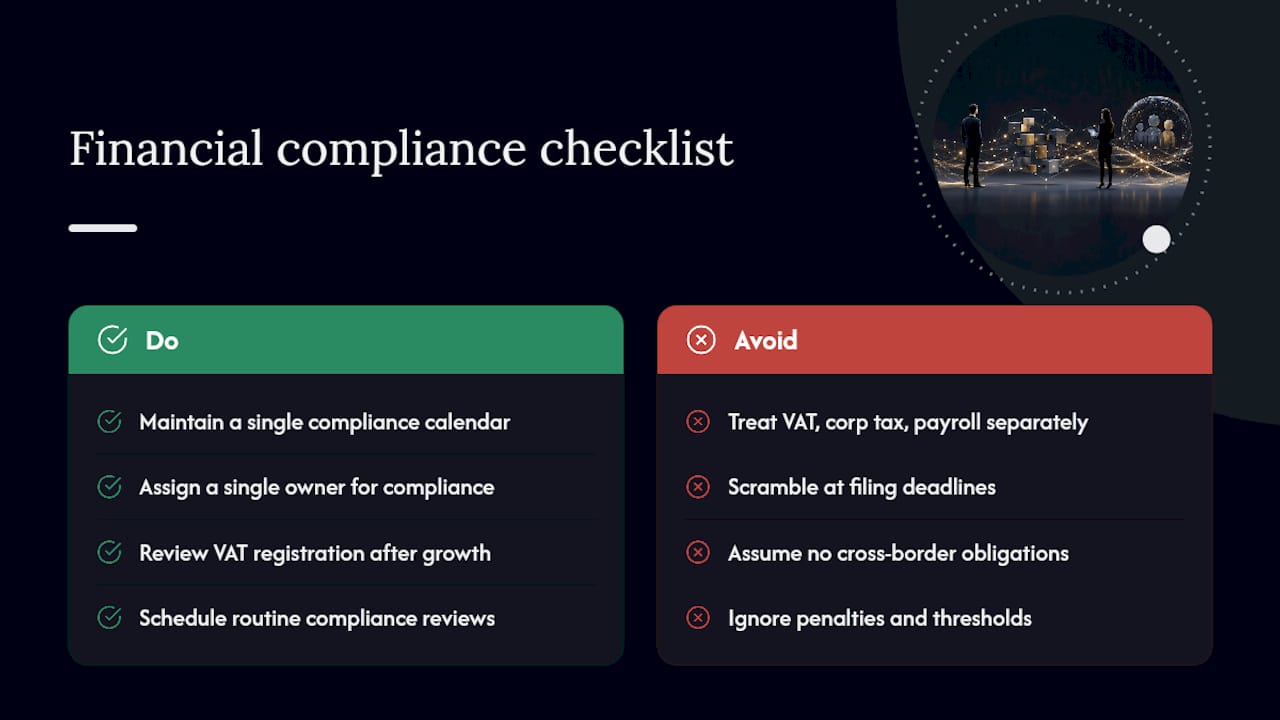
PAYE and pension duties cover only part of your financial compliance picture. VAT registration becomes mandatory once taxable turnover crosses the current threshold, and once registered, you need a system for quarterly returns, not a scramble at deadline.
Corporation tax filing runs on its own calendar, separate from VAT and payroll, and penalties for late filing compound the longer they run. If your organisation trades internationally, transfer pricing and withholding tax obligations may apply even to relatively modest cross-border arrangements, and these are easy to miss because they rarely appear on a standard compliance template.
Keep a single financial compliance calendar rather than treating VAT, corporation tax, and payroll as three separate systems run by three separate people with no shared visibility. When one deadline slips, it is usually because nobody owned the whole picture, only their slice of it. Regulatory penalties scale with the type of failure: HMRC late-filing penalties, Companies House fines, and in serious data cases, ICO fines running up to £17.5 million or 4% of turnover. That penalty range alone justifies a routine review rather than an annual scramble.
If your business has grown recently, or moved into new markets, revisit your VAT registration status specifically. Growth often pushes turnover across the threshold quietly, and the first sign of a problem is usually a penalty notice rather than an internal flag.
Advertising standards apply the moment you make a public claim about a product or service, and the rules are stricter than most non-specialists assume. Claims about pricing, availability, and product performance all need to be capable of substantiation, not just plausible-sounding.
Product safety regulations vary by sector, but the general principle holds across all of them: you are responsible for defects even when a third-party manufacturer produced the item, if you are the one selling it under your brand or through your platform. Keep records of safety testing, supplier certifications, and any recall procedures your sector requires, because these are the first documents a trading standards enquiry will ask to see.
Consumer contracts also carry specific requirements around cancellation rights, clear pricing, and pre-contract information, particularly for anything sold online or at a distance. A contract that reads well internally can still fail these requirements if it was drafted without consumer law specifically in mind.
Review consumer-facing terms and marketing claims together, not separately, because a claim in an advert that contradicts a term in the contract is exactly the kind of inconsistency regulators look for. Assign someone to check new marketing material against your actual contractual terms before it goes live, not after a complaint arrives.
Trademark registration protects your brand name, logo, and any distinctive product naming, but only in the jurisdictions where you register it. A registered mark in one country offers no protection elsewhere, which matters as soon as you trade across borders or expand into new markets.
Copyright exists automatically the moment original work is created, so a copyright notice is not what creates protection, it simply puts others on notice of your claim. What matters more in practice is having a system for tracking which works you own outright, which are licensed, and which were created by contractors under terms that may or may not have assigned rights to you.
Infringement monitoring is often the piece organisations skip entirely. Set a recurring check, at minimum quarterly, for unauthorised use of your trademarks online, and keep a record of any enforcement action taken, since a pattern of inaction can weaken your position if a dispute ever escalates. Where IP sits at the centre of your business value, whether that is a product design, a brand, or proprietary content, treat the monitoring and renewal calendar with the same seriousness as your insurance schedule.
Verify current rules directly at Gov, Companies House, the ICO, HMRC and HSE. Seek legal advice before acting on any grey area.
Most compliance checklists treat every line item as equally urgent, which is exactly backwards. The evidence here points to a smaller set of failure modes doing most of the damage: late Companies House filings, missed auto-enrolment, and incomplete data protection records. Get those three right and you have closed off the majority of realistic enforcement risk.
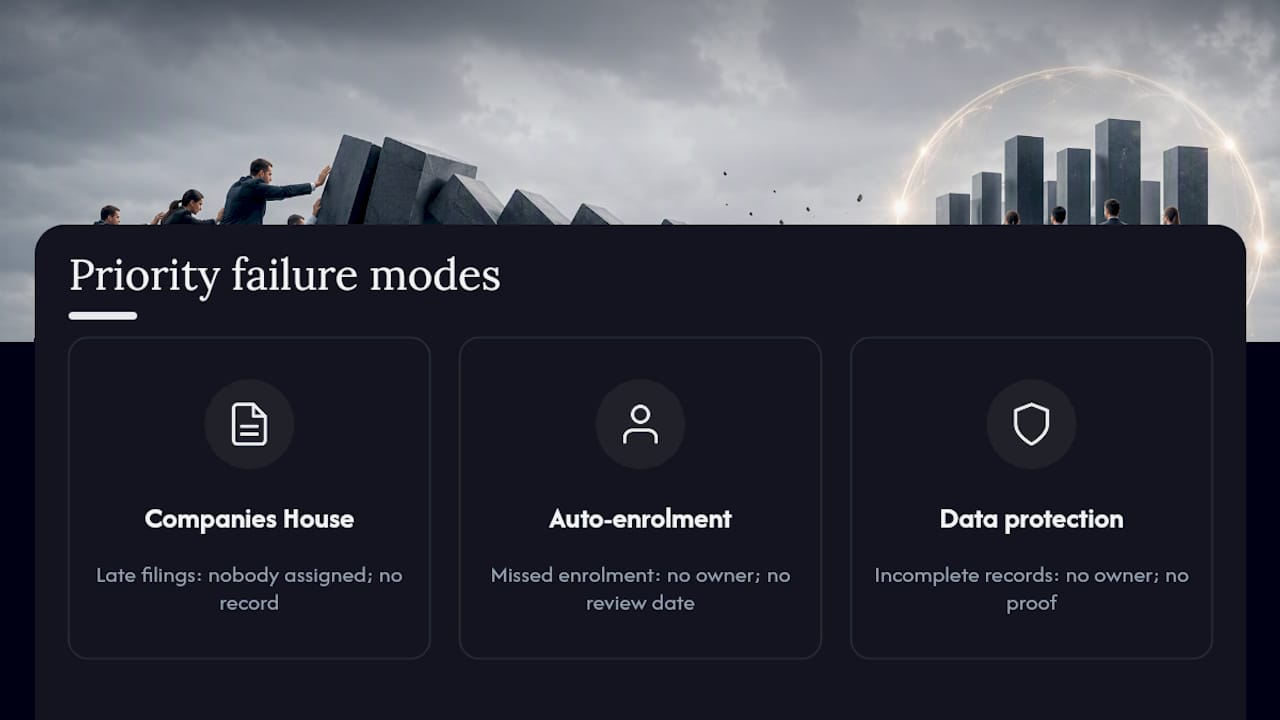
The conventional advice tends to stop at “know the rules.” That is not where organisations actually fail. They fail on ownership: nobody assigned to a task, no date forcing a review, no record proving the check happened. A risk assessment that exists but was never dated is barely different, in a regulator’s eyes, from no risk assessment at all.
If you take one thing from this checklist, make it this: assign a named owner to every line, set a review date now, and put compliance status on every board agenda even when there is nothing new to report. That single habit, more than any individual clause you get right, is what separates organisations that pass scrutiny from those that scramble after the fact.
— Panagiotis
Reading a checklist is the easy part. Turning it into signed policies, dated evidence, and a working review calendar is where most in-house teams run short on time, and that is exactly where Ali Legal Ltd steps in with fixed-fee governance reviews rather than open-ended hourly billing.
Ali Legal Ltd works with company directors, boards, and compliance officers to translate statutory duties into practical documentation, from board minute templates to director identity verification tracking under the current ECCTA transition. If your organisation has grown, taken on new directors, or simply never had its governance structure reviewed by a solicitor, our corporate law guidance sets out exactly what a properly documented compliance file should contain. Get in touch through our contact page to arrange a fixed-fee compliance review and put dates against every item on this checklist before your next board meeting.
This article is general information, not a substitute for advice from a qualified lawyer. Consult a qualified legal professional about your own circumstances before acting on anything here.
Most people need one of three things: a straightforward will, a will that creates a trust for specific beneficiaries, or a lifetime trust set up while you’re still alive. The right choice depends on who you’re providing for and what you’re protecting. The most common trusts are bare, discretionary, and interest-in-possession, each suited to different family circumstances, from minor children to blended households.
A single will is the standard document most adults need. It names your executors, sets out your beneficiaries, appoints guardians for children under 18, and covers what happens if a beneficiary dies before you. Gov recommends professional advice once your estate involves overseas property, a business, or anyone who might contest the will.
Mirror wills are near-identical wills made by two people, usually spouses or partners, each leaving their estate to the other and then to the same beneficiaries. They’re not legally binding on each other, so either party can change theirs after the first death, which surprises many couples who assumed the arrangement was fixed. Mutual wills solve that problem by including a binding agreement not to change the terms after one partner dies, though enforcing that agreement later can still mean a legal dispute. Joint wills, a single document for two people, are rarer today because they create real complications during probate and most solicitors steer clients toward mirror wills instead.
A trust will (or will containing a testamentary trust) doesn’t just distribute assets. It sets conditions on how and when beneficiaries receive them. This matters most for second marriages, where you might want your spouse to have income from the estate for life while the capital ultimately passes to your children, or for young beneficiaries who shouldn’t inherit a lump sum at 18.
Beyond these, a few other documents come up regularly:
Once you’ve decided a will needs a trust, or that a lifetime trust makes more sense, the next question is which structure fits. GOV.UK groups the main trust types by how much control beneficiaries have over the assets and how much discretion trustees hold.
Bare trusts give the beneficiary an absolute right to both capital and income once they turn 18 in England and Wales. Trustees hold the assets until then but have no say over how they’re eventually used. These suit simple gifts, a grandparent putting money aside for a grandchild, for example, where there’s no need for ongoing control.
Interest-in-possession trusts split the benefit: a life tenant receives income from the trust for life, or for a fixed period, while the capital passes to other beneficiaries later. This structure is common in second-marriage situations, where a surviving spouse gets the income from investments or a rental property, and the underlying capital eventually goes to children from an earlier relationship.
Discretionary trusts hand trustees complete control over who receives income or capital, and when. Nobody has an automatic entitlement. This flexibility makes discretionary trusts the go-to choice for blended families, where circumstances might change significantly over the years, or for protecting a beneficiary who isn’t good with money. Settlors usually leave a letter of wishes guiding trustees informally, without making it legally binding.
A handful of statutory and protective trusts serve narrower purposes:
Consider a widow with two stepchildren and two biological children. A discretionary trust lets trustees weigh each person’s circumstances year by year rather than locking in fixed shares that might no longer make sense a decade later. Compare that with a young couple leaving everything to children who are currently 8 and 11: an 18 to 25 trust, or a simple bare trust with staged access, addresses the real risk of handing over a large sum to a barely-adult beneficiary. Attwaters Solicitors’ comparison of these structures makes the same point: the right trust depends entirely on how much control you want beneficiaries to have, not on which sounds most sophisticated.
A will trust, also called a testamentary trust, only comes into existence when you die. It sits dormant inside your will until then. A lifetime trust, by contrast, takes effect the moment you create it, which means assets placed into it are typically outside your estate for probate purposes straight away.
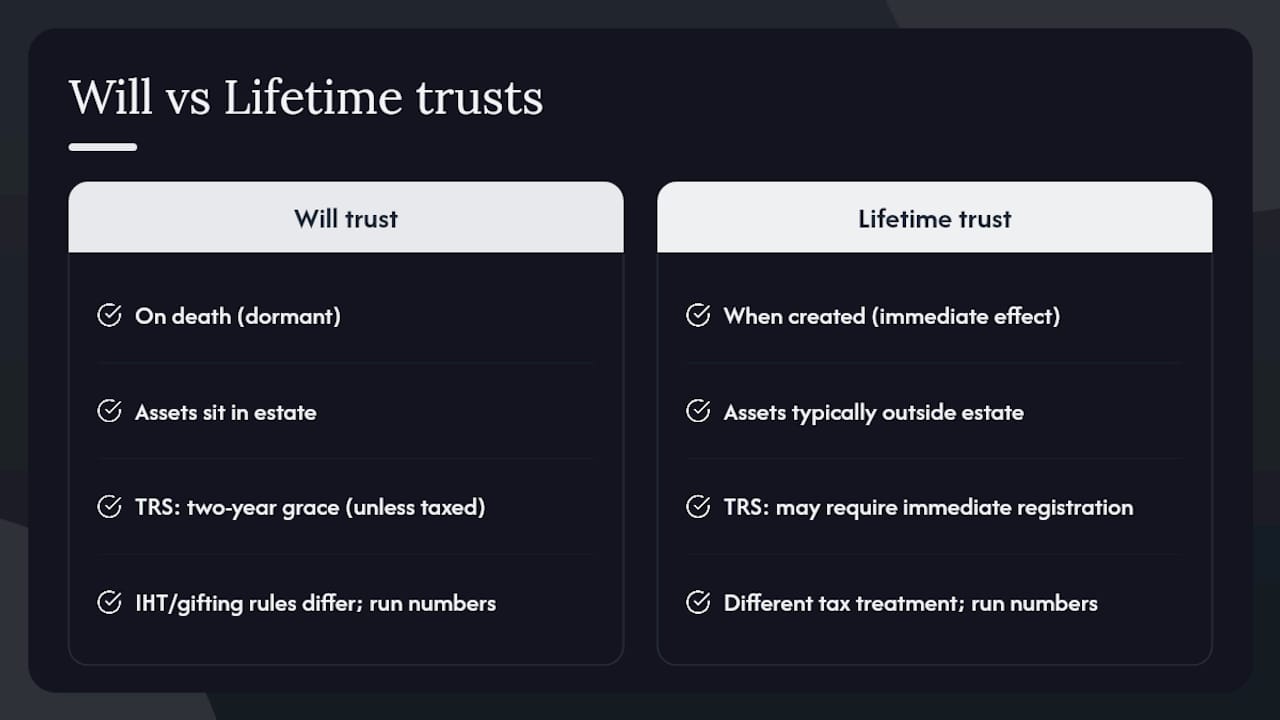
That timing difference drives most of the practical distinctions. Which?'s comparison of will trusts and lifetime trusts notes that lifetime trusts can sidestep some of the probate delay affecting will trusts, since the assets never sit in the estate awaiting a grant of probate.
Registration rules also diverge. Trusts created by a will generally get a two-year grace period on the Trust Registration Service before they must be registered, unless the trust picks up a UK tax liability sooner, in which case registration is required immediately. Tax treatment differs too, particularly around inheritance tax and lifetime gifting rules, so this is rarely a decision to make without running the numbers first.
Trustees are the legal owners of trust assets, but they hold them for someone else’s benefit, not their own. The Law Society’s guidance on trusts is blunt about the scope of that duty: trustees must follow the settlor’s wishes, manage the assets properly, and deal with any tax due.
In practice, that breaks down into a handful of recurring tasks:
Pro Tip: Set a calendar reminder for the two-year TRS deadline the day probate is granted. Trustees who wait until the deadline is looming often discover the required information, like full beneficiary details, takes longer to gather than expected.
The most common pitfall isn’t dishonesty, it’s simply underestimating the admin. Trustees often assume a trust “runs itself” once set up, then miss a registration trigger or fail to keep records tidy enough to satisfy HMRC on request.
Start by mapping your circumstances against the structures already covered, then narrow down using these steps:
Costs and timelines vary with complexity. A straightforward will can often be drafted quickly for a fixed fee, while a will containing multiple trusts, or a lifetime trust alongside it, takes longer and usually reflects that in the price.
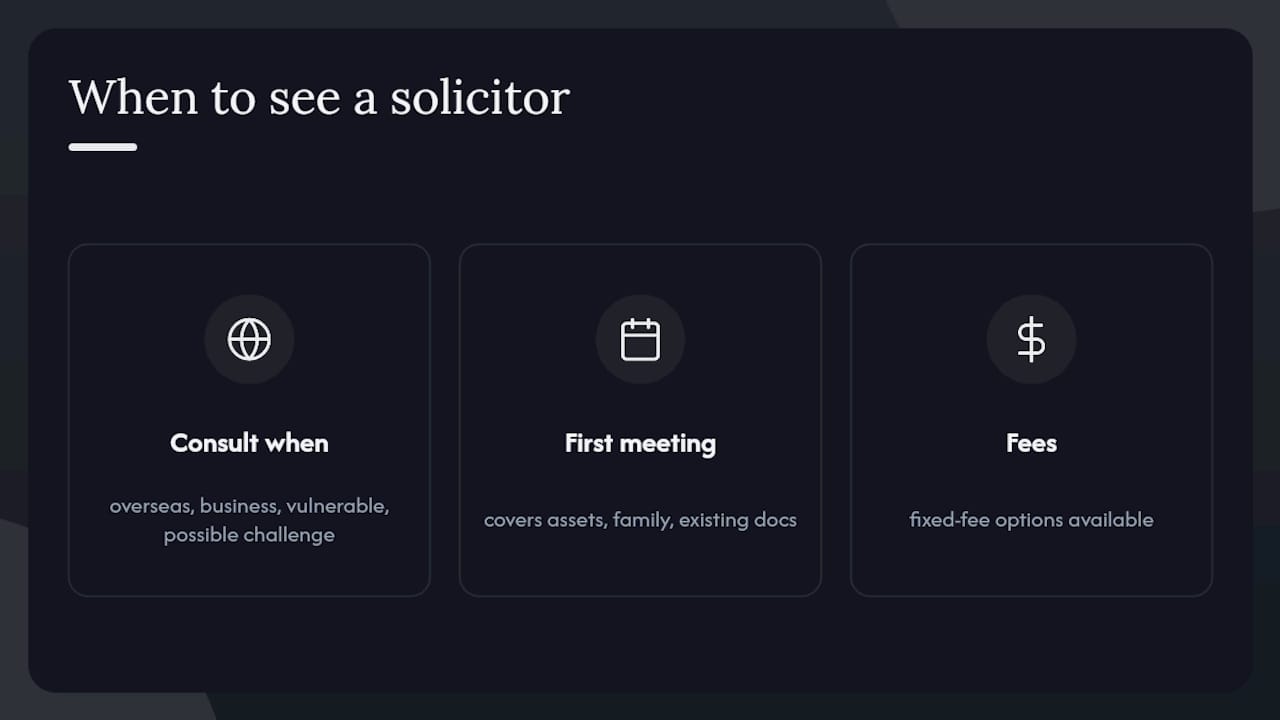
Overseas assets, a business interest, a vulnerable beneficiary, or any hint that someone might challenge your will are the clearest signals to get professional advice rather than a DIY template. Ali Legal Ltd’s wills, trusts and probate team, working alongside Panagiotis, advises on exactly these situations. A first appointment typically covers your assets, family circumstances, and existing documents, and fixed-fee options are available so costs are agreed upfront.
Most disputes trace back to unclear intentions, not the wrong trust structure. Protecting vulnerable beneficiaries and keeping capital intact for the people you actually meant to benefit matters more than picking the most sophisticated-sounding option. A well-drafted bare trust beats a poorly-managed discretionary one every time. Paperwork clarity, in the deed, the letter of wishes, the tax filings, is what prevents family disputes years later, and it’s worth getting tailored advice before you commit to a structure.
— Panagiotis
Ali Legal Ltd is the practical alternative to piecing together templates and guesswork: fixed-fee wills, testamentary trusts, lifetime trusts, and probate support, all handled with the same fixed-fee transparency the firm applies across its work.
Whether you need a simple will drafted quickly or a discretionary trust structured around a blended family, the team can scope the work and quote a fixed fee before anything is signed. Bring details of your assets, a list of intended beneficiaries, and any existing will or trust paperwork to your first appointment, and you’ll leave with a clear plan rather than more questions. Explore the full wills, trusts and probate service or get in touch directly through Ali Legal Ltd’s contact page to book an initial consultation.
For official detail beyond this guide, GOV.UK’s trust taxation pages and the Law Society’s trust explainer are reliable starting points. Ali Legal Ltd’s own guide to trusts in wills and this overview of trusts in legacy planning add further practical context.
This article is general information, not a substitute for advice from a qualified lawyer. Consult a qualified legal professional about your own circumstances before acting on anything here.
You can usually start trading right away. First, choose your structure, then register with HMRC if you’re a sole trader or Companies House if you’re forming a limited company. This week, prioritise two things: confirming your structure and separating your finances with a dedicated bank account or bookkeeping system. Expect HMRC and Companies House to be the two bodies you deal with most in your first month.
Most people register as a sole trader or a limited company, and the choice shapes your tax bill, your paperwork, and how exposed your personal assets are if things go wrong.
A sole trader is the simplest route. You keep all profits after tax, but you’re personally liable for business debts, and there’s no legal separation between you and the business. A limited company is its own legal entity, which protects your personal assets, but brings more filing obligations. A partnership splits liability and profit between two or more people under a shared agreement, while a limited liability partnership (LLP) gives partners the liability protection of a company while keeping the flexibility of a partnership structure, often used by professional firms.
Incorporation tends to make sense once profits grow, you want to bring in investors, or clients expect the credibility of a registered company. One thing that catches people out: since 18 November 2025, Companies House requires identity verification for all directors and people with significant control (PSCs). Skip this step and your filing gets rejected.
The registration path depends entirely on which structure you picked, and the deadlines aren’t flexible.
Registering online is faster and gives you a digital paper trail. Going through an agent, such as a solicitor or accountant, costs more but catches errors before Companies House does, which matters given how often flawed PSC records now cause rejected filings.
Mixing personal and business money is the fastest way to create a compliance headache later, and it makes bookkeeping far harder than it needs to be. For limited companies, opening a dedicated business bank account isn’t optional in practice, since most banks require it once you’ve incorporated.
Pro Tip: Gather your certificate of incorporation and verified director IDs before you approach a bank. Most business account delays happen because the paperwork wasn’t ready, not because the bank was slow.
Not every business needs a licence, but plenty do, and finding out late is expensive. Food businesses, transport operators, care providers, and financial services firms are among the sectors most commonly caught by licensing rules.
Hiring changes your legal obligations immediately, even for one part time employee.
Spreading the work across a month keeps each stage manageable and stops small mistakes compounding into rejected filings or missed deadlines.
| Phase | Key tasks | Typical timescale |
|---|---|---|
| Days 1–7 | Structure, name check, licence check, ID verification | 1 week |
| Days 8–14 | Companies House/HMRC registration, UTR, bank account | 1 week (online incorporation often within 24 hours) |
| Days 15–30 | Contracts, insurance, PAYE registration, first invoices | 2 weeks |
Building in a business incorporation review at the Day 1–7 stage catches structural mistakes before they’re baked into your filings.
Getting identity verification wrong is the single most common reason incorporations stall right now. Since ECCTA came into force, inaccurate PSC records have become a frequent cause of rejected filings, and re-filing costs both time and money you don’t need to lose in your first month of trading.
Shareholder agreements, contract transfers, complex VAT positions, and any cross-border trade are exactly where founders get into trouble without legal input. These aren’t areas where a template does the job.
Ali Legal Ltd supports founders through company formation with fixed-fee packages and document packs, so the legal groundwork is solid before you start trading.
Hire an accountant first if your needs are basic tax, VAT, and bookkeeping. Hire a solicitor first if you’re bringing in co-founders, transferring contracts, or need regulatory sign-off. Balance the fixed cost against the compliance risk you’re actually carrying.
— Panagiotis
Ali Legal Ltd gives you a fixed-fee route through incorporation that avoids the two mistakes that trip up most new companies: botched identity verification and PSC registers that don’t hold up under scrutiny. Rather than piecing together guidance from GOV.UK and hoping your paperwork survives Companies House review, you get a solicitor checking director and PSC details, drafting shareholder agreements, and building your articles of association correctly from the start.
That matters most in the first three months, when a rejected filing can delay your Corporation Tax registration and knock your whole timeline off course. Ali Legal Ltd’s corporate law services cover incorporation support, ongoing compliance packages, and the shareholder and governance documents that keep a growing company out of dispute later. If you’re weighing up structures or ready to incorporate, get in touch with Ali Legal Ltd to talk through fixed-fee options before you file.
A solicitor selling your house drafts the contract pack, answers the buyer’s legal enquiries, manages the searches and coordinates exchange and completion, including redeeming your mortgage and registering the transfer with HM Land Registry. Most sales run 8 to 16 weeks from instruction to completion, and instructing a solicitor before you even list the property is the single biggest lever you have over that timeline.
The work starts before your property even hits the market. Your solicitor takes formal instructions, runs anti-money-laundering identity checks on everyone named on the title, and requests the official title documents from HM Land Registry. From there, the file moves through a fairly fixed sequence of legal and administrative tasks.
Your input matters more than most sellers expect. The TA6 and TA10 forms rely entirely on what you tell your solicitor, and vague or inaccurate answers tend to generate follow-up enquiries that eat into your timeline, as the Law Society notes in its guidance on selling a home. Turnaround on your side is usually the rate-limiting step, not your solicitor’s desk. If you can locate your paperwork before you’re asked for it, you strip out days that would otherwise be lost to back-and-forth emails.
Most sellers wait until they have an accepted offer before contacting a solicitor. That’s the point where delays start compounding. Pre-sale conveyancing, meaning your solicitor prepares the TA6, TA10 and title documents before your property is even marketed, is one of the most effective ways to cut the time to exchange and lower the risk of the sale collapsing later.
Instruct a solicitor as soon as you decide to sell, ideally at the same time you appoint an estate agent. Late instruction commonly adds two to three weeks because title checks, ID verification and form completion all have to happen from a standing start, right when a buyer is expecting movement.
Have these ready when you instruct:
The draft contract pack is what your solicitor sends to the buyer’s solicitor to kick off their due diligence, and it’s the single most important document set in the sale. Every item in it exists to answer a question the buyer’s solicitor will otherwise ask separately, which is exactly why gaps in it cost you time later.
You supply most of the raw information; your solicitor turns it into the formal pack and requests the HM Land Registry copies directly. Missing a certificate isn’t usually fatal. Your solicitor can typically arrange indemnity insurance to cover an absent building regulations certificate, or push for retrospective regularisation with the local authority, though the latter takes considerably longer. Standard document requests to HM Land Registry are usually quick, but a management pack from a leasehold freeholder can take several weeks, so flag leasehold status to your solicitor on day one, not once a buyer has been found.
Once the buyer’s solicitor has your contract pack, they raise a list of pre-contract enquiries. This is your solicitor’s opportunity to close down anything that might cause a problem post-completion, and it’s also the stage where most avoidable delay creeps in.
Enquiries typically cover:
Alongside enquiries, the buyer’s solicitor commissions searches: local authority, drainage and water, and often an environmental search. Turnaround varies enormously by local authority, from a few days to several weeks in busier areas, which is one reason total conveyancing time swings so widely between transactions. Your solicitor chases and interprets the results, resolving anything ambiguous before it becomes a sticking point.
Slow replies to enquiries and missing paperwork are consistently cited as the main causes of delay in a sale, more than search turnaround itself. Aim to get every reply back to your solicitor within 48 to 72 hours of being asked.
Pro Tip: Keep a folder, digital or physical, with your TA6 and TA10 answers, certificates, and mortgage details from day one. When an enquiry lands asking you to confirm something you’ve already documented, a same-day reply is realistic rather than aspirational.
Exchange of contracts is the moment your sale becomes legally binding. Before that point, either side can walk away with limited consequence; after it, pulling out means breaching a contract and losing your deposit, or being sued for the buyer’s losses.
Completion day follows a set financial sequence:
On timing: conveyancing from instruction to completion typically runs 8 to 16 weeks, though a straightforward cash sale with no chain can complete faster. Registration of the transfer at HM Land Registry follows completion and usually takes a few weeks to be finalised, though the sale itself is legally done on completion day.
The main risk on completion day is timing. Funds move through the banking system, not instantly, and a late transfer from a buyer’s lender can push completion into the next working day. A competent solicitor builds in a buffer and stays on the phone with the other side’s firm rather than waiting for an email.
Solicitors selling houses typically charge either a fixed fee or an hourly rate, with fixed fees now the norm for standard residential sales because they give you cost certainty from day one. On top of the fee, expect disbursements: HM Land Registry copy documents, AML identity checks, a mortgage redemption statement fee, and, for leasehold properties, the cost of obtaining a management pack from the freeholder or managing agent.
Everything gets itemised in your completion statement before funds move. Read it properly before you sign anything authorising your solicitor to deduct fees from proceeds. If a figure looks unfamiliar, query it before completion day, not after. Ali Legal Ltd sets out example fixed-fee pricing for house sales if you want a sense of what’s typical before you get your own quote.
Leasehold sales carry an extra layer of work. Your solicitor requests a management pack from the freeholder or managing agent, covering ground rent, service charges and any consent needed for the sale. Short leases, under 80 years, can trigger lender concerns for the buyer and sometimes need a lease extension negotiated before the sale can proceed at all.
Other common issues include:
Most of these add cost and time rather than derailing a sale outright. A genuinely disputed boundary or a freeholder refusing consent, though, can require specialist litigation input beyond routine conveyancing, and a good solicitor will flag that early rather than letting it surface days before exchange.
Check that any firm you’re considering is regulated by the Solicitors Regulation Authority and, ideally, holds Conveyancing Quality Scheme accreditation. Beyond that, the questions you ask at first contact tell you more than any review score.
Red flags worth walking away from: no request for identity documents before starting work, vague answers about disbursements, or a client care letter that takes weeks to arrive. That letter, covering fees, timescales and who’s handling your file, should land early, and its absence tells you something about how the rest of the sale will run.
Pro Tip: Get quotes from at least three firms and compare total cost, fee plus disbursements, against turnaround promises. The cheapest quote is rarely the fastest one, and speed usually matters more to your bottom line than a modest fee difference.
Ali Legal Ltd structures seller conveyancing around fixed fees and a named point of contact from instruction to completion, set out in a client care letter issued at the start of the engagement rather than weeks in. That letter covers fees, expected timescales and who’s handling the file, a practical trust signal the Law Society Protocol treats as a baseline professional obligation, not an optional extra.
Clear communication from day one, and a fixed fee agreed before work starts, remove most of the uncertainty sellers dread about conveyancing.
Readers preparing to instruct can speed things up considerably by gathering ID documents, mortgage details and any certificates before the first call.
Most advice on selling a house treats the solicitor as something you sort out after you’ve found a buyer. That ordering is backwards, and it’s the single biggest mistake sellers make. The legal work, drafting the contract, pulling title documents, completing TA6 and TA10, doesn’t depend on having a buyer at all. It depends on you deciding to sell.
The conventional wisdom about conveyancing delays being someone else’s fault, the buyer’s lender, the local authority, a slow search, doesn’t hold up well against the evidence. Search turnaround genuinely varies, but the more consistent bottleneck is sellers themselves: slow to return forms, slow to find certificates, slow to reply to enquiries that could have been answered in a day.
If there’s one thing worth prioritising above everything else in this article, it’s timing your instruction to the decision to sell, not to the offer. A solicitor with your contract pack ready before viewings even start isn’t a luxury; it’s the difference between an 8-week sale and a 16-week one. Everything else, fixed fees, communication style, accreditation, matters, but it matters less than that one decision.
— Panagiotis
If you’ve read this far, you already know the pattern: sellers who wait to instruct a solicitor until they have a buyer routinely lose weeks they didn’t need to lose. Ali Legal Ltd works on fixed fees agreed upfront, with a client care letter issued at the start of your file so you know exactly what’s covered and what isn’t before any work begins.
Before you get in touch, have your identification documents, mortgage details, and any building regulation certificates or planning permissions to hand. If your property is leasehold, note the freeholder or managing agent’s contact details too. That preparation alone can shave real time off the early stages of your file. Visit Ali Legal Ltd’s property law guidance to see how a seller conveyancing engagement is structured, or get in touch directly to request a fixed-fee quote and set your sale in motion before you’ve even listed the property.
In-house legal counsel is a qualified solicitor or barrister employed directly by a company, rather than a law firm, to give legal advice and manage risk for that single employer. The role has moved well beyond drafting contracts and chasing signatures: today’s in-house lawyer sits close to the board, shapes commercial strategy, and still carries the same professional duties to the public interest that any solicitor owes, regardless of who signs their salary.
In-house counsel’s work splits roughly into two streams: reactive legal support and proactive business advice. On any given week, that might mean reviewing a supplier contract on Monday, advising HR on a disciplinary process on Tuesday, and briefing the finance director on a regulatory change by Friday.
The core duties tend to include:
Scope shifts sharply with company size. A sole in-house lawyer at a fifty-person business will touch everything from a lease renewal to a data breach in the same afternoon. At a listed company, the general counsel might run a team of specialists covering employment, competition, and disputes separately, with the generalist work pushed down to junior lawyers or paralegals. Around a quarter of practising solicitors in England and Wales now work in-house rather than in private practice, a shift that has changed how firms and clients relate to each other.
Being paid by the company you advise creates a structural tension that private practice lawyers rarely face in the same way. The regulator’s answer is blunt: your duties as a solicitor come before your duties as an employee.
The SRA Standards and Regulations require in-house solicitors to comply with the same mandatory principles as those in private practice, including acting with independence and in the public interest, even when that advice is unwelcome to the person paying the invoice. The Bar Standards Board applies a comparable framework to barristers working in-house, though the BSB’s guidance sets narrower limits on scope of practice than solicitors face, and flags particular care for barristers who sit on boards or in management, where mixing legal and commercial roles can blur the line the profession relies on.
Practical safeguards make the difference between a title and a genuine independent function:
Pro Tip: If you’re moving in-house, ask at interview stage who legal reports to and whether that person has ever overridden legal advice. The answer tells you more about the job than the salary line.
The Law Society frames the in-house solicitor as a critical friend to the organisation, someone trusted enough to be in the room but independent enough to say no. That framing only holds if the board actively protects it.
Ten years ago, plenty of in-house lawyers were called in after a decision had already been made, to paper over the risk retrospectively. That model is fading. Boards increasingly expect legal to be present when the decision is still being shaped, not just when it needs signing off.
Several forces are driving that shift:
The Law Society’s own ethics framework makes the point directly: in-house solicitors are increasingly expected to sit in decision-making forums as strategic partners, not simply respond to questions after the fact. Performance measurement has followed suit, with many legal teams now assessed on deal velocity, dispute avoidance, and cost saved against external counsel benchmarks, alongside the traditional metric of matters closed without incident.
Job titles in-house are inconsistent across sectors, which causes genuine confusion for anyone comparing roles between companies. A few conventions do hold reasonably firm.
General counsel (GC) typically sits as the most senior lawyer in the organisation, often reporting directly to the chief executive and sometimes holding a seat on the executive committee. Chief legal officer (CLO) is functionally similar but signals a broader remit that might include compliance, government affairs, or company secretarial functions folded into one role. Legal director and head of legal usually sit a tier below, managing day-to-day legal operations and a small team, and reporting up to the GC or directly to the board in smaller companies without a GC at all.
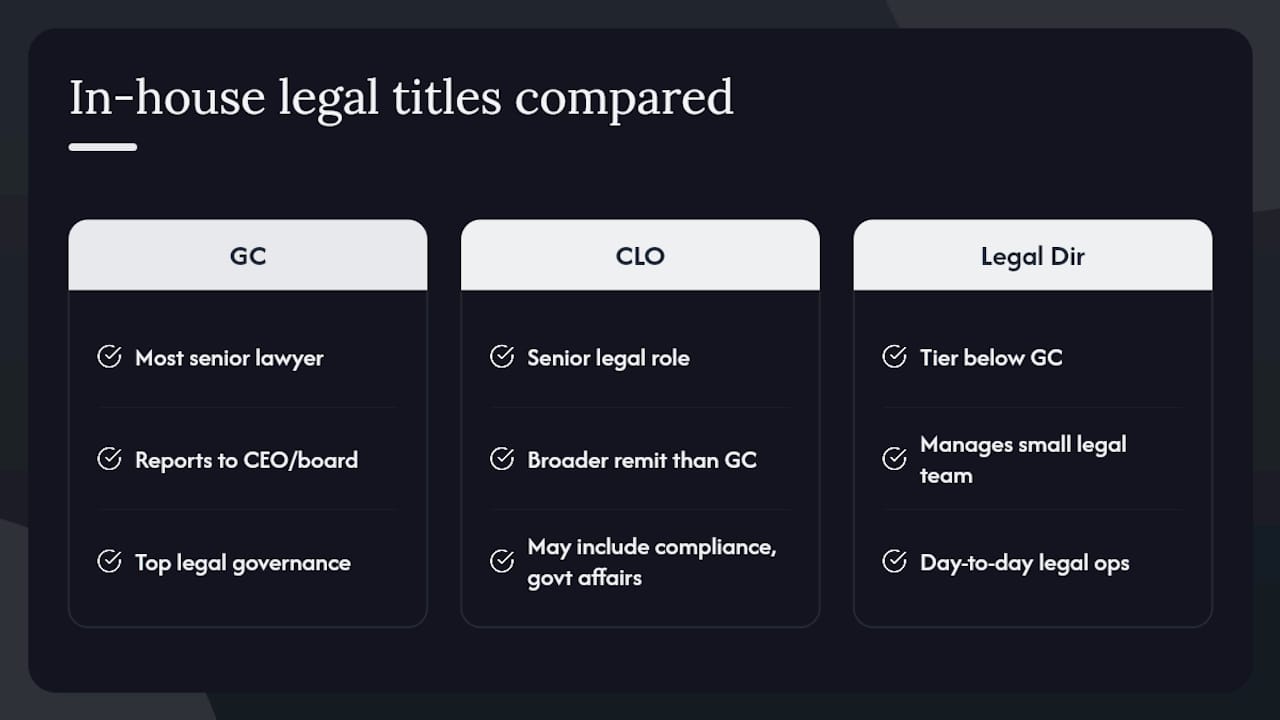
Board access matters for reasons beyond ego. A GC who reports into the CFO, rather than directly to the chief executive or board, can find legal risk framed purely as a cost line rather than a governance issue. The SRA’s guidance for governing boards makes clear that organisations employing in-house solicitors must give them clear reporting lines and enough support to meet their professional duties without fear of being sidelined for inconvenient advice.
In small teams, work usually splits by necessity rather than design: one generalist handles everything routine, while genuinely specialist matters (a complex cross-border dispute, a regulatory investigation, a large acquisition) get pushed to external counsel with the in-house lawyer managing the relationship and translating advice for the business.
Technical grounding still matters. Contract drafting, negotiation, and a working grasp of data protection law are baseline expectations, and most in-house roles now expect at least a passing familiarity with M&A structures, even for lawyers who will never lead a deal themselves. But the skill that separates a good in-house lawyer from a merely competent one is translation: turning a legal risk into three sentences a sales director will actually act on.
Soft skills carry disproportionate weight in-house compared with private practice. Influencing people who don’t have to listen to you, reading commercial priorities correctly, and communicating risk without either alarming the board or understating it, all matter more day to day than knowing an obscure point of contract law.
The market signal: Robert Half’s 2026 UK Legal, Risk and Compliance Salary Guide reports that hybrid working has become the norm across in-house legal teams, alongside strong demand for contract management, data privacy, and regulatory expertise. Retention data in the same guide suggests flexibility now ranks alongside pay as a factor keeping senior lawyers from moving on.
Salary bands vary enormously by sector and seniority, and any single figure quoted without that context is close to meaningless, so treat headline numbers in recruitment marketing with caution and check them against a named guide before relying on them.
Even a well-staffed in-house team cannot handle everything alone, and knowing when to instruct external counsel is itself a skill. Complex litigation, specialist regulatory investigations, and jurisdictions where the company has no local expertise are the classic triggers for going outside. Routine contract work, employment queries, and anything the in-house team has handled a dozen times before generally stays put.
Managing that external relationship well means more than picking a familiar firm name. The SRA notes that instructing and overseeing external counsel is a core part of the in-house function, not an occasional add-on.
Pro Tip: Keep a simple spreadsheet logging matter type, firm, fee arrangement, and outcome. After a year, it tells you exactly which firms earn their fees and which don’t.
Hiring managers look for three things above all else: relevant post-qualification experience, exposure to the sector the company operates in, and evidence you can operate commercially, not just legally.
For a fuller breakdown of typical legal counsel duties in UK businesses, it’s worth reading how responsibilities differ by sector before applying.
Corporate governance runs on documentation and accountability, and in-house counsel usually sits at the centre of both. Board minutes, delegated authority matrices, shareholder resolutions, and statutory filings all typically pass through the legal team before they become binding, which puts in-house counsel in a position to catch governance failures before they become expensive ones.

Decision-making at board level increasingly treats legal input as a standing agenda item rather than a final check. A well-run legal function flags regulatory exposure, contractual risk, and litigation history before a strategic decision is taken, not after the fact when options have narrowed. That means in-house counsel often draft board papers jointly with finance or strategy teams, rather than reviewing them once they’re already finished.
The tension is that legal counsel advising on governance must also operate within that same governance structure, reporting to the people whose decisions they’re sometimes required to challenge. The Law Society’s ethics framework addresses this directly, describing good practice as identifying the client clearly (the company as a legal entity, not any individual director) and keeping advice pitched at the right governance level so it reaches the people who actually need to act on it. In practice, that often means insisting a concern goes to the full board rather than being absorbed and quietly dropped by a single executive.
Regulatory compliance work has grown from a niche specialism into a core part of most in-house roles, driven by the sheer volume of sector-specific rules companies now face, from financial conduct regulation to environmental and product safety standards.
In-house counsel typically own the compliance calendar: tracking filing deadlines, monitoring changes to relevant regulation, and translating new rules into practical guidance for operational teams who have no legal training and no time to read a regulator’s consultation paper themselves. That translation function is often undervalued, but it’s frequently the difference between a rule being followed correctly and a rule being technically read but practically ignored.
When something goes wrong, whether a data breach, a health and safety incident, or a missed filing, in-house counsel usually lead the initial response: assessing whether the issue needs reporting to a regulator, managing communications with that regulator, and coordinating any internal investigation. Getting that sequencing right matters. Reporting too early without proper facts can mislead a regulator; reporting too late can turn a manageable issue into an enforcement action.
Smaller companies without a dedicated compliance function often lean on legal to fill that gap entirely, which stretches the in-house lawyer’s remit well beyond drafting and negotiation into something closer to a compliance officer role, frequently without additional resource to match.
Legal risk management in-house works best as a continuous process rather than a one-off exercise triggered only when something breaks. The most effective in-house lawyers build a rolling risk register covering contractual exposure, litigation history, regulatory change, and operational vulnerabilities, then revisit it quarterly rather than leaving it to gather dust after the first draft.
Mitigation typically takes one of a few forms. Contractual protections, such as indemnities, liability caps, and termination rights, get negotiated upfront rather than relied on after a dispute starts. Insurance cover gets checked against actual risk exposure rather than assumed adequate because a policy exists. And internal training, particularly for sales and procurement teams who sign agreements without legal sign-off, closes the gap between what legal drafts and what the business actually does day to day.
The harder judgement call is deciding which risks are worth escalating and which can be absorbed. Not every contractual gap needs a board discussion, and treating every risk as equally urgent trains stakeholders to tune out legal’s warnings altogether. Effective in-house counsel calibrate that signal carefully, reserving the loudest alarm for the risks that genuinely warrant it.
Conflicts of interest look different in-house than they do in private practice, where a conflicts check usually happens before a firm even takes on a new client. In-house counsel work for one client permanently, but that single client contains multiple internal interests that can pull in different directions: a subsidiary’s interests against the parent company’s, one department’s priorities against another’s, or an individual director’s personal exposure against the company’s.
The clearest example is when a director faces personal liability for a decision the company is also defending. In-house counsel acting for the company cannot simultaneously advise that director in a personal capacity, since the two interests can diverge sharply once liability is contested. The Law Society’s guidance is explicit that the client is the organisation itself, not any individual within it, which is the anchor point for resolving most of these situations.
Practical management usually means directing the individual to independent external advice at the company’s expense, documenting clearly who the legal advice was given to and on what basis, and being willing to say plainly when a matter has moved beyond what in-house counsel can properly advise on. Group structures add another layer: a lawyer employed by a parent company advising a subsidiary needs clarity on which entity is actually the client before the advice is even given, not after a dispute forces the question.
Data protection has become one of the fastest-growing areas of in-house legal work, and in most companies without a dedicated data protection officer, that responsibility lands on legal by default. It covers everything from reviewing data processing agreements with suppliers to advising on international data transfers and responding when a breach actually happens.
Cybersecurity incidents move fast, and in-house counsel are usually the ones deciding, often within hours, whether an incident triggers a regulatory notification obligation and what needs to be communicated to affected individuals. Getting the legal assessment wrong in either direction, over-reporting or under-reporting, carries real consequences, which makes this one of the higher-pressure parts of the modern role.
Beyond incident response, in-house counsel increasingly sit on the buying decision for data-related technology and vendor contracts, since a poorly negotiated data processing clause with a third-party supplier can create liability exposure long before any breach occurs. Robert Half’s 2026 salary guide lists data privacy expertise among the most sought-after skills for in-house hires, a demand driven directly by how much of this work now sits with legal rather than IT.
The hardest negotiations an in-house lawyer handles are frequently internal, not external. Persuading a sales director to walk away from a lucrative deal because of an unacceptable liability clause takes more skill than negotiating the clause itself, because the audience has no legal training and every commercial incentive to disagree.
Effective in-house counsel learn to frame legal risk in language the business actually uses: revenue impact, timeline delay, reputational exposure, rather than statute references and case citations that mean little outside a law degree. That reframing is often what separates a lawyer whose advice gets followed from one whose emails get skimmed and ignored.
Internal stakeholder management also means knowing when to push and when to let a decision go. Not every piece of advice needs to be a hill to die on, and in-house lawyers who treat every point as equally critical tend to lose credibility exactly when they need it most, on the issue that genuinely matters. Building that judgement usually takes real time in the seat, watching which battles were worth fighting and which weren’t.
Ali Legal Ltd works alongside in-house teams regularly, supporting corporate transactions, cross-border disputes, and fixed-fee document review when internal capacity runs short during a busy quarter. What stands out from that vantage point is how often in-house counsel are stretched thin across compliance, governance, and commercial advice simultaneously, with little slack for the specialist matters that genuinely need outside expertise. A well-run external relationship, built on clear scope and fixed fees rather than open-ended hourly billing, tends to free in-house teams to focus on the strategic work only they can do. Businesses weighing up support for corporate and M&A matters or cross-border complexity often find that the right external partner amplifies an in-house team’s judgement rather than replacing it, working alongside them for the long-term legal relationships that keep both cost and risk under control.
Most commentary on in-house counsel focuses on the strategic upside: sitting closer to the board, shaping decisions earlier, escaping the billable hour. That’s real, but it undersells the harder truth, which is that in-house lawyers carry the same professional duties as any solicitor while facing daily pressure from the one relationship where independence is genuinely difficult to hold: the employer who signs their pay cheque.
The regulatory frameworks from the SRA and BSB assume that independence, but they can’t manufacture it inside an organisation that hasn’t built the reporting structure to protect it. That’s the gap I’d flag to anyone considering the move in-house or sitting on a board that employs one: independence on paper means nothing if the lawyer’s line manager is also the person whose decision they’re meant to challenge. The good news is that this is a structural problem with a structural fix. Boards that build in clear escalation routes and genuinely welcome unwelcome advice get lawyers who catch problems early. Boards that don’t get lawyers who learn, quickly, which risks are worth mentioning and which aren’t worth the friction, and that’s a far more expensive lesson to teach a legal team than most executives realise.
— Panagiotis


