
Menu
Get Expert Legal Support Today

Facing a legal dispute can feel overwhelming for British business owners who must protect both their company’s reputation and finances. The complex nature of civil litigation often demands expertise beyond everyday legal advice. Choosing the right barrister brings strategic insight and robust advocacy, giving businesses critical support in resolving disputes and preparing cases with confidence. This article outlines the role of independent legal advocates in the United Kingdom, revealing how barristers influence success in commercial litigation and safeguard your interests.
Barristers are specialised legal professionals who play a pivotal role in the United Kingdom’s judicial system. Unlike solicitors, these independent legal advocates provide expert representation and strategic legal advice primarily within court environments. Specialist legal advisers who are highly trained in courtroom advocacy represent clients during complex legal proceedings.
The professional structure of barristers is unique within the legal landscape. Most barristers operate as self-employed practitioners working from dedicated chambers, though some are employed directly by government agencies or private organisations. Their primary responsibilities include:
Barristers typically receive instructions from solicitors, who initially engage with clients and prepare case materials. This collaborative approach ensures comprehensive legal representation. Independent court advocates are bound by strict professional conduct rules, maintaining impartiality while robustly defending their clients’ interests.
Professional specialisation is a hallmark of barristers’ practice. They often concentrate on specific legal domains such as criminal law, commercial litigation, family disputes, or intellectual property, developing deep expertise within their chosen fields.

Pro Tip: When seeking a barrister, verify their specific area of specialisation to ensure alignment with your legal requirements.
To clarify the major distinctions, here is a comparison of barristers and solicitors in the UK legal system:
| Aspect | Barrister | Solicitor |
|---|---|---|
| Main Role | Advocacy in court | Client-facing legal services |
| Typical Workplace | Chambers or court | Law firm or organisation |
| Client Contact | Indirect (via solicitors mostly) | Direct client engagement |
| Case Preparation Focus | Legal argument & strategy | Evidence, paperwork, liaison |
The barrister profession encompasses diverse specialisations and rigorous training pathways designed to produce highly skilled legal professionals. Specialist legal training involves a comprehensive three-stage process that ensures exceptional legal expertise and professional competence.
Traditionally, barristers are categorised into several key professional types:
The qualification journey for becoming a barrister is structured and demanding. Academic and vocational training typically involves multiple critical stages:
Professional development continues throughout a barrister’s career, with ongoing requirements for legal education, specialisation updates, and maintaining professional standards. Many barristers choose to develop expertise in niche areas, allowing them to provide highly specialised legal services to businesses and individuals.
Successful barristers combine academic excellence, analytical skills, and robust communication abilities to navigate complex legal landscapes.
Pro Tip: Research potential barristers’ specific areas of expertise to ensure optimal alignment with your legal requirements.
Civil litigation represents a complex legal landscape where barristers play a pivotal strategic role for businesses navigating legal disputes. Specialist legal advisers bring sophisticated expertise to resolving commercial conflicts through targeted legal representation and advocacy.
In civil litigation, barristers provide critical services across multiple dimensions:
The role of barristers in civil litigation extends beyond courtroom appearances. Independent legal advocacy involves intricate preparation, including thorough legal research, drafting complex legal documents, and providing nuanced strategic guidance to businesses facing potential or active legal challenges.
Businesses benefit significantly from barristers’ specialised approach, which combines deep legal knowledge with strategic thinking. Their ability to analyse complex legal scenarios, predict potential outcomes, and construct robust legal arguments makes them invaluable partners in managing commercial disputes.
Effective civil litigation representation requires more than legal knowledge—it demands strategic insight, analytical precision, and exceptional communication skills.
Pro Tip: Engage a barrister early in potential dispute scenarios to develop proactive legal strategies and mitigate potential litigation risks.
Barristers operate under a complex framework of professional responsibilities that demand exceptional ethical standards and meticulous legal preparation. Core professional duties require barristers to balance client advocacy with an overarching commitment to judicial integrity.
The primary legal duties of barristers encompass several critical dimensions:
Case preparation involves a systematic and rigorous approach. Legal brief management requires barristers to meticulously examine legal documentation, research precedents, assess evidence strength, and develop nuanced litigation strategies tailored to each unique case scenario.
Businesses benefit from barristers’ comprehensive approach to legal preparation, which extends far beyond courtroom representation. Their ability to critically analyse complex legal scenarios, interpret intricate legal frameworks, and construct compelling arguments makes them invaluable strategic partners in navigating challenging legal landscapes.
Effective legal representation demands more than technical knowledge—it requires strategic insight, ethical commitment, and a profound understanding of legal complexities.
Pro Tip: Select a barrister with demonstrated expertise in your specific legal domain to ensure targeted and strategic case preparation.
Navigating the financial landscape of barrister engagement requires careful consideration and strategic planning. Barrister fee structures vary significantly, with professionals offering multiple pricing models to accommodate diverse client needs.
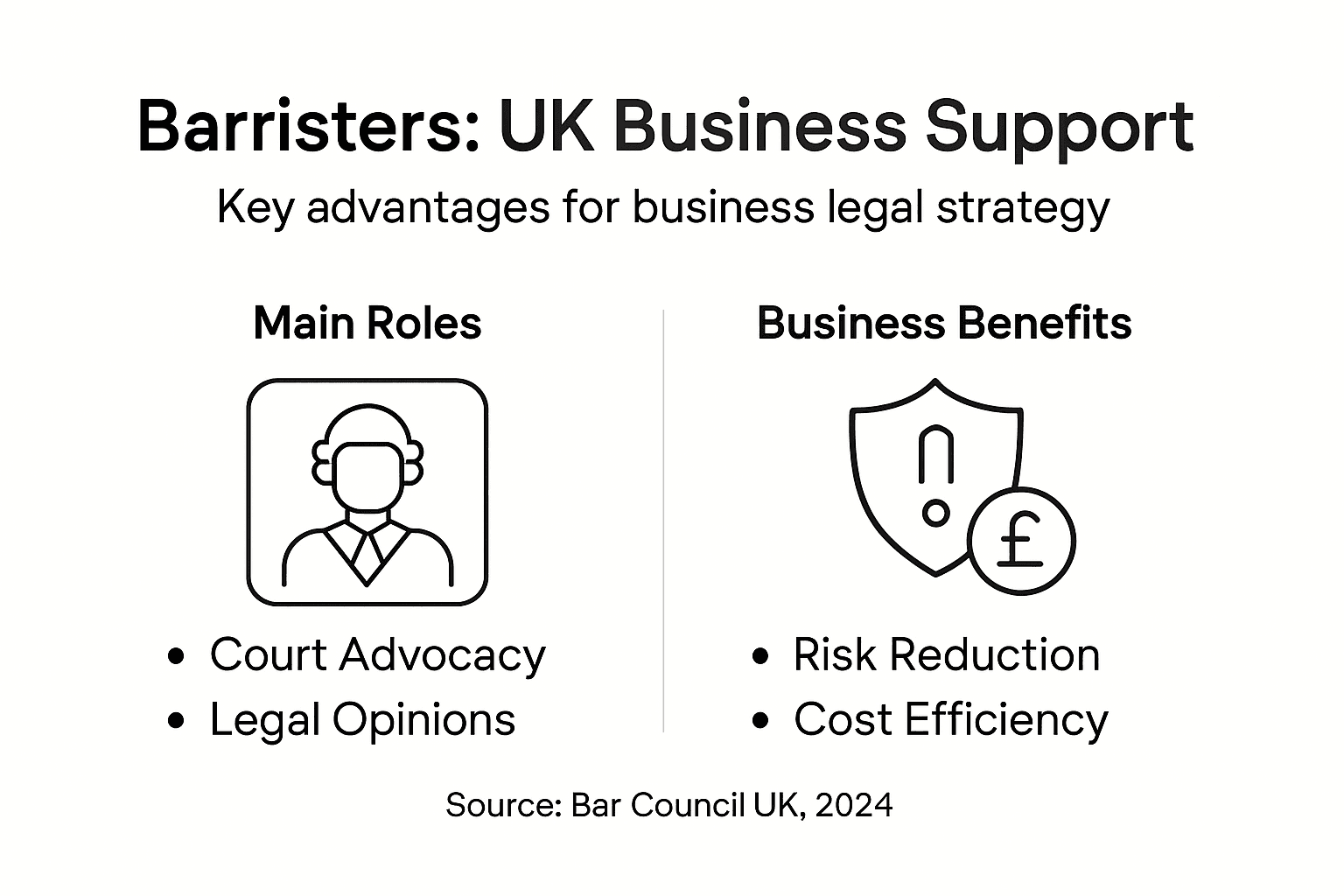
Typical fee arrangements for barristers include:
For quick reference, here is a summary of common barrister fee models and their business implications:
| Fee Model | Predictability | Typical Usage Scenario |
|---|---|---|
| Hourly Rate | Moderate | Complex, ongoing cases |
| Fixed Fee | High | Single hearings or document review |
| Conditional Fee | Variable | Claims with potential compensation |
| Retainer | High | Long-term, on-call legal support |
When selecting a barrister, businesses must conduct comprehensive due diligence. Professional selection criteria extend beyond cost considerations to include professional expertise, track record, and specialisation alignment with specific legal requirements.
Transparency is paramount in the hiring process. Reputable barristers will provide clear, upfront fee information, detailed engagement terms, and a comprehensive breakdown of potential legal costs. This approach helps businesses make informed decisions and budget effectively for legal representation.
Effective legal representation is an investment in strategic risk management, not merely an expense.
Pro Tip: Request comprehensive fee proposals from multiple barristers and compare not just cost, but expertise and potential value added to your specific legal challenge.
Navigating complex legal disputes requires more than knowledge it demands specialised advocacy and strategic insight as highlighted by the pivotal role barristers play in UK civil litigation. If your business faces challenges that require expert courtroom representation and meticulous case preparation Ali Legal offers transparent and efficient legal solutions tailored to your needs. Our client-centric approach means you get straightforward advice, fixed fees, and a partner committed to long-term success.

Discover how our experienced legal team combines the strategic value of barristers with practical business-focused legal services. Visit our Uncategorized | Ali Legal page to learn about the comprehensive support available. Don’t let legal complexities overwhelm you start resolving your business disputes with confidence today by contacting Ali Legal directly at https://alilegal.co.uk/contact-us. Reach out now to secure expert advice and clear pathways through your legal challenges.
Barristers act as independent legal advocates, specialising in representing clients during court hearings and providing expert legal advice, particularly in complex legal matters.
Barristers focus primarily on advocacy in court and typically receive instructions from solicitors, who handle client engagement and preliminary case preparations. Solicitors often provide direct legal services and client support.
To become a barrister, one must complete a law degree or conversion course, pass the Bar Professional Training Course (BPTC), secure a 12-month pupillage, and be called to the Bar by an Inn of Court.
Barrister fees can vary significantly and typically include hourly rates, fixed fees for specific services, conditional fees based on case outcomes, and retainer agreements for ongoing legal support.


