
Menu
Get Expert Legal Support Today

Nearly half of all British companies face significant legal hurdles when operating beyond United Kingdom borders. For corporate executives, staying compliant and protecting interests in global markets is no longer just a concern—it is a crucial necessity. This article highlights the expertise of international lawyers, explores key cross-border legal challenges, and offers clear guidance to help British businesses manage risks and strengthen their global position.
International lawyers play a pivotal role in guiding UK businesses through complex global legal landscapes. These legal professionals specialise in navigating intricate cross-border legal challenges by interpreting and applying laws that extend beyond national boundaries. International lawyers operate within sophisticated global legal frameworks that encompass both public and private international legal domains.
Their expertise covers multiple critical areas including international trade regulations, cross-border commercial disputes, treaty interpretations, and compliance with international legal standards. International lawyers help UK businesses understand and mitigate risks associated with operating in different jurisdictional environments. They provide strategic guidance on complex matters such as international contract negotiations, corporate structuring across jurisdictions, and resolving disputes that involve multiple legal systems.
Specifically, these legal professionals manage two primary domains of international law. Public international law governs relationships between states, handling diplomatic interactions, human rights issues, and international conflict resolution. Private international law focuses on commercial transactions, addressing cross-border trade agreements, arbitration processes, and corporate legal interactions. The legal profession in England and Wales supports business growth through extensive international legal expertise, making international lawyers critical assets for businesses expanding globally.
Professional Tip: When selecting an international lawyer, prioritise professionals with demonstrable experience in your specific target markets and proven track records of successfully navigating complex cross-border legal challenges.
Cross-border transactions present a complex web of legal challenges that require sophisticated understanding and strategic navigation. UK businesses engaging in international commerce must be acutely aware of the multifaceted legal considerations that can significantly impact their operational success. Cross-border dispute resolution strategies become critical when operating across different legal jurisdictions, as each country maintains unique regulatory frameworks and compliance requirements.
Key legal issues in international transactions encompass several critical domains. Contractual challenges top the list, with businesses needing to address potential discrepancies in contract interpretation across different legal systems. Intellectual property protection represents another complex arena, where regulations and enforcement mechanisms vary dramatically between countries. Additionally, businesses must navigate intricate tax implications, understanding how different jurisdictions assess and levy taxes on cross-border transactions, which can substantially affect financial outcomes.
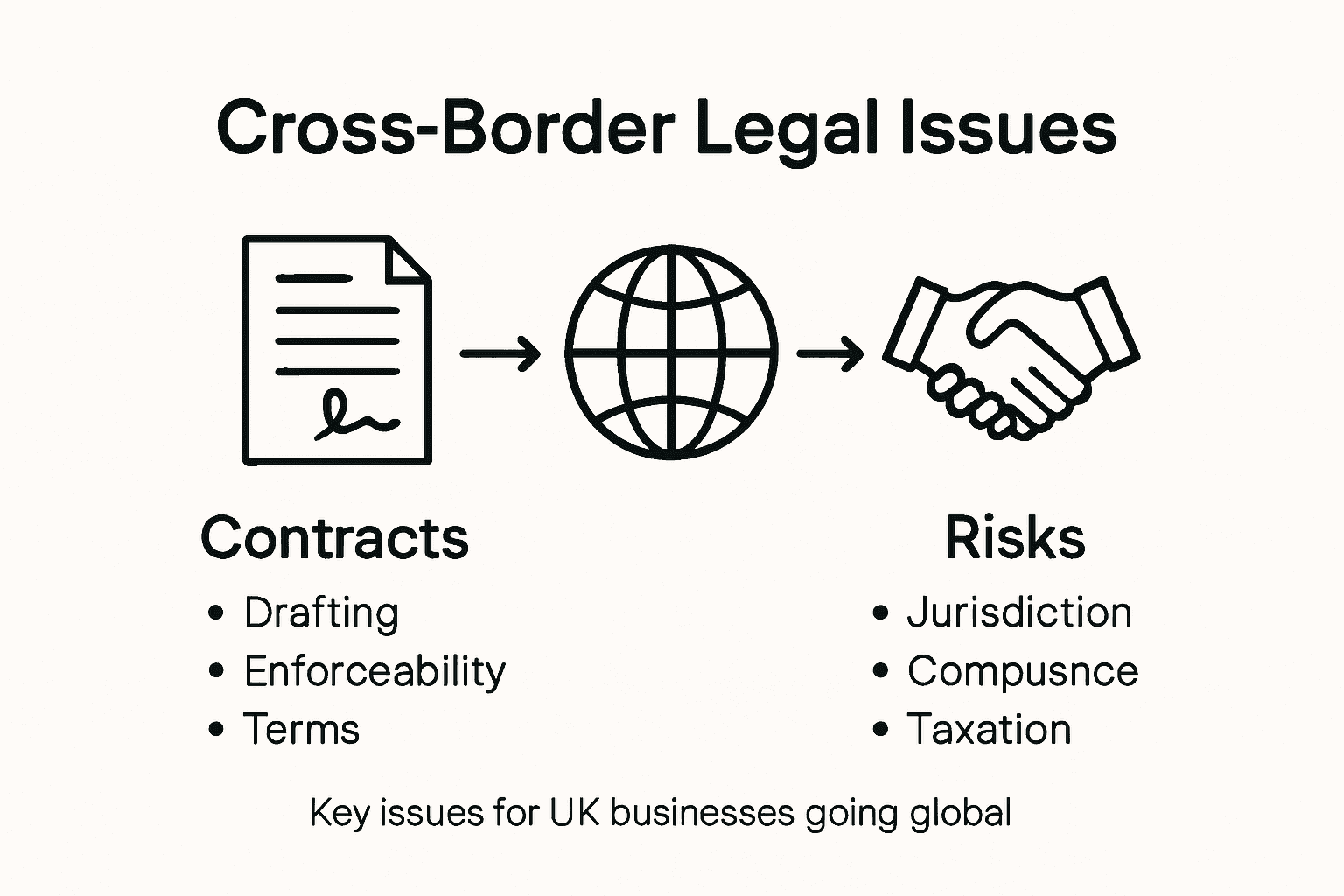
Understanding jurisdictional risks is paramount for UK enterprises expanding internationally. This involves comprehending potential legal conflicts, recognising differences in contract enforcement, and anticipating potential dispute resolution mechanisms. International business law guidance becomes essential in mitigating risks associated with regulatory compliance, employment laws, and potential litigation scenarios that could arise from cross-border business interactions.
Professional Tip: Invest in comprehensive legal due diligence and engage specialised international legal counsel who can provide nuanced insights into the specific regulatory landscape of your target markets.
International compliance represents a critical strategic capability for UK businesses operating across global markets. Navigating the intricate landscape of international regulations demands specialised legal expertise that goes far beyond basic legal understanding. Business regulation guidance highlights the complexity of maintaining legal conformity across different jurisdictional environments, encompassing areas such as product safety, border controls, and industry-specific regulatory requirements.

Comprehensive international compliance involves multiple sophisticated domains. Businesses must address critical areas including anti-money laundering protocols, data protection regulations, export control restrictions, and trade sanctions. Each of these domains requires deep understanding of both UK legal frameworks and international regulatory standards. Multinational corporations face particularly challenging compliance landscapes, where nuanced interpretations of legal requirements can mean the difference between successful international expansion and potentially devastating regulatory penalties.
Professional international lawyers bring transformative insights into regulatory compliance strategies. Professional compliance training programs underscore the complexity of managing international legal requirements, highlighting the need for specialised knowledge in risk management and regulatory adherence. These legal professionals help organisations develop robust compliance frameworks that not only meet current regulatory standards but also anticipate potential future regulatory shifts across different global jurisdictions.
Professional Tip: Conduct regular compliance audits with international legal experts to proactively identify and mitigate potential regulatory risks before they become significant operational challenges.
Resolving international legal disputes demands sophisticated strategic approaches that transcend traditional litigation methods. UK businesses engaging in global commerce must develop nuanced dispute resolution capabilities that address the complex challenges of cross-border legal interactions. Specialised cross-border dispute resolution training emphasises the critical importance of understanding substantive and procedural variations across different legal jurisdictions.
International dispute resolution encompasses multiple sophisticated mechanisms beyond conventional courtroom litigation. Arbitration emerges as a particularly effective strategy, offering businesses a neutral forum for resolving conflicts without being constrained by singular national legal systems. Mediation provides another strategic alternative, enabling parties to negotiate mutually acceptable resolutions with greater flexibility and potentially lower financial and reputational costs compared to protracted legal battles.
Successful cross-border dispute management requires comprehensive understanding of international legal frameworks. Professional international lawyers bring crucial expertise in navigating jurisdictional complexities, interpreting multinational legal standards, and developing strategic approaches tailored to specific cross-border contexts. These legal professionals help organisations anticipate potential disputes, design preemptive contractual protections, and implement robust mechanisms for efficient conflict resolution that minimise financial and operational disruptions.
Here is a summary of dispute resolution mechanisms available for cross-border legal matters:
| Mechanism | Key Benefit | Typical Use Case |
|---|---|---|
| Arbitration | Neutral and private process | International commercial disputes |
| Mediation | Flexible and collaborative | Preserving business relationships |
| Litigation | Enforceable national judgement | Where binding precedent is needed |
Professional Tip: Develop comprehensive international dispute resolution protocols that include clear jurisdiction clauses, alternative dispute resolution mechanisms, and predefined escalation procedures to mitigate potential legal uncertainties.
International legal expertise represents a complex strategic decision for UK businesses navigating global markets. The growing importance of in-house legal roles highlights the nuanced challenges organisations face when determining their legal support strategy. In-house teams offer immediate alignment with company objectives, providing consistent legal guidance closely integrated with internal business processes, while international experts bring specialised cross-jurisdictional knowledge that can transcend organisational boundaries.
In-house legal teams typically excel at understanding organisational culture and immediate business contexts. However, they frequently encounter significant limitations when addressing complex international legal challenges. Cross-border expansion introduces multifaceted regulatory complexities that may overwhelm internal legal resources, particularly when navigating diverse international legal frameworks, compliance requirements, and rapidly evolving regulatory environments.
International legal experts provide transformative capabilities that complement or extend in-house legal functions. These professionals bring deep, specialised knowledge of multiple legal systems, enabling businesses to develop sophisticated strategies for global market engagement. They offer flexible, scalable expertise that can be deployed precisely when needed, without the ongoing overhead associated with maintaining extensive in-house international legal capabilities. By providing nuanced insights into jurisdictional variations, international legal experts help organisations mitigate risks, ensure regulatory compliance, and develop robust cross-border legal strategies.
The following table contrasts in-house legal teams with international legal experts, outlining their strategic strengths and limitations for UK businesses:
| Attribute | In-House Legal Team | International Legal Experts |
|---|---|---|
| Organisational Alignment | Deep integration with business | External, objective perspective |
| Coverage of Legal Systems | Strong domestic expertise | Multi-jurisdictional expertise |
| Cost Model | Fixed overhead salary costs | Flexible, project-based fees |
| Response to Complex Global Issues | May lack specialisation | Advanced cross-border knowledge |
Professional Tip: Consider a hybrid approach that combines in-house legal knowledge with strategic international legal expertise to create a comprehensive, adaptable legal support framework.
Navigating the complexities of international law and cross-border transactions can feel overwhelming. UK businesses face critical challenges such as compliance risks, jurisdictional uncertainties and dispute resolution complications. Understanding terms like “public international law” and “cross-border dispute resolution” is essential to avoid costly setbacks and protect long-term growth. Ali Legal’s client-centred legal services provide clear advice and fixed fees to help you tackle these pain points with confidence and speed.

Explore our comprehensive insights in the Uncategorized | Ali Legal section and empower your business with strategic international legal expertise. Do not delay addressing these urgent legal challenges. Contact Ali Legal today through our dedicated page to receive straightforward, transparent counsel tailored to your global expansion needs. Trust Ali Legal to guide you through complex international legal frameworks and keep your business secure.
International lawyers provide expertise in navigating complex global legal landscapes, helping businesses address cross-border legal challenges, manage international compliance, and mitigate risks associated with operating in multiple jurisdictions.
International lawyers specialise in various critical areas such as international trade regulations, cross-border commercial disputes, treaty interpretations, and compliance with international legal standards, which are essential for businesses engaging in global commerce.
International lawyers employ sophisticated dispute resolution mechanisms such as arbitration and mediation, which allow businesses to address conflicts internationally without being limited by a single national legal system, thus minimising financial and operational disruptions.
In-house legal teams offer deep integration with a business’s operations, while international legal experts bring specialised knowledge of multiple legal systems, providing flexible, scalable expertise that can enhance a business’s ability to navigate complex international legal challenges.


