
Menu
Get Expert Legal Support Today

Over 80 percent of British technology firms rely on specialised legal counsel to navigate complex regulations and protect their growth. In a rapidly evolving sector, both corporate lawyers and business owners need clear guidance to safeguard intellectual property and manage risk. Understanding the strategic function of legal counsel is vital for staying competitive and compliant, especially when technological innovation introduces fast-changing legal challenges.
Legal counsel represents a strategic professional role within organisations, providing expert legal guidance and comprehensive risk management across multiple business domains. These specialised legal professionals serve as critical navigators through complex regulatory landscapes, ensuring businesses operate within legal boundaries while supporting strategic objectives.
In the context of technology firms, legal counsel play an increasingly sophisticated role beyond traditional compliance functions. They act as proactive strategic partners who understand technological innovation cycles and help organisations mitigate potential legal risks through informed decision making. Modern legal counsel must possess not only robust legal expertise but also deep technological literacy, enabling them to translate complex legal frameworks into actionable business strategies.
The core responsibilities of legal counsel encompass several critical dimensions. These include contract negotiation, intellectual property protection, regulatory compliance, dispute resolution, and strategic advisory services. Technology firms particularly require legal professionals who can navigate rapidly evolving digital regulatory environments, protect innovative intellectual assets, and provide nuanced guidance on emerging technological legal challenges.
Pro tip: When selecting legal counsel for a technology firm, prioritise professionals with demonstrable technological understanding and a proven track record of supporting innovative business models.
In the United Kingdom, legal counsel functions manifest in diverse professional configurations, each tailored to specific organisational and legal requirements. Legal professionals in England and Wales typically operate across several specialised roles, including in-house counsel, external counsel, and specialised legal advisors.
In-house legal counsel represent a critical category within corporate environments, particularly for technology firms. These professionals are directly employed by organisations to provide continuous legal strategic guidance. Their responsibilities encompass comprehensive risk management, contract negotiations, intellectual property protection, and ensuring regulatory compliance. Unlike external solicitors, in-house counsel develop deep understanding of their organisation’s specific operational nuances and strategic objectives.
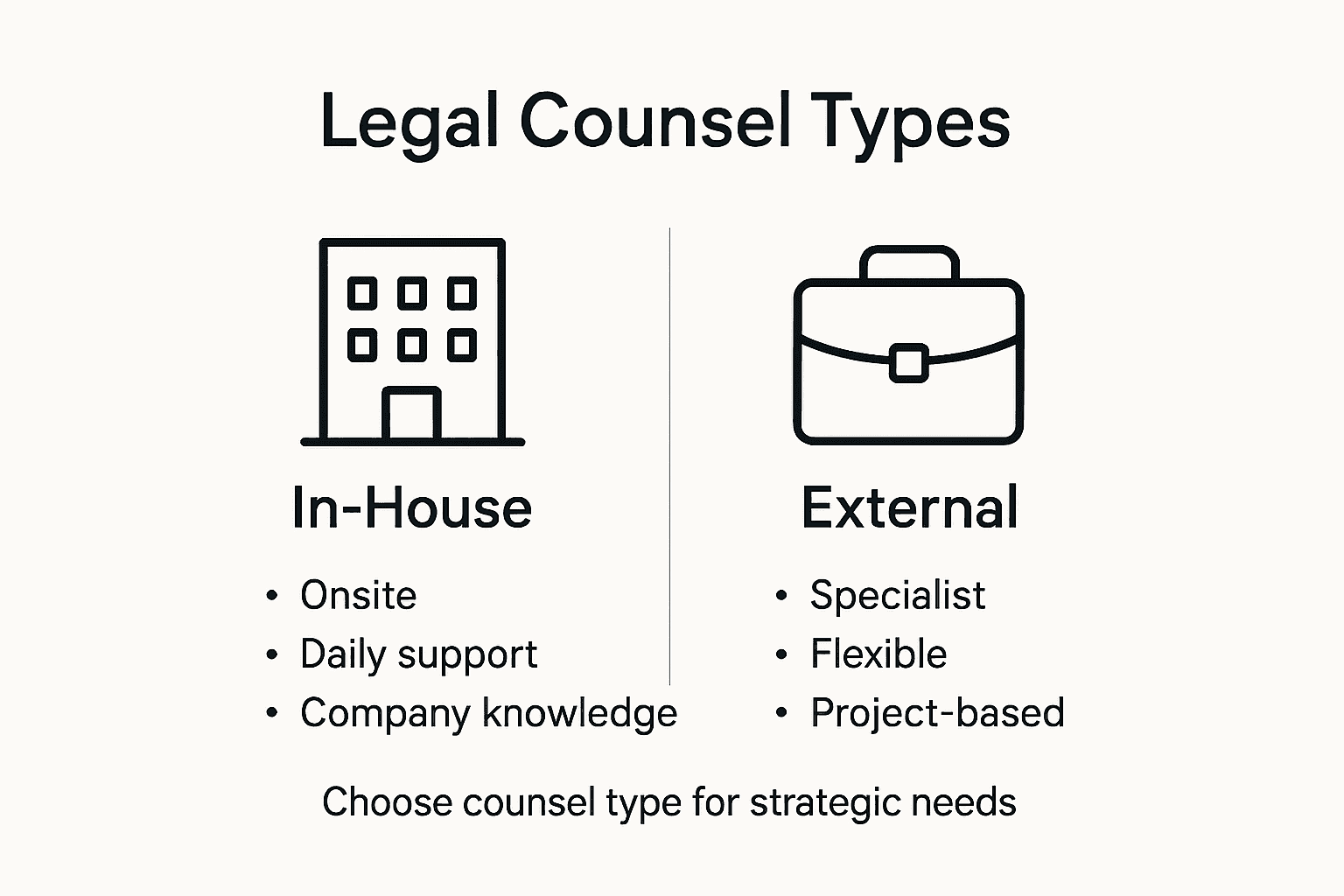
External legal counsel, alternatively, provide specialised services on a consultative or project-based arrangement. These professionals offer targeted expertise for complex legal challenges, such as mergers and acquisitions, litigation support, or specialised regulatory compliance. Technology firms often engage external counsel for specific technical legal domains requiring advanced specialisation that might exceed internal legal department capabilities.
Here’s a comparison of in-house and external legal counsel roles for technology firms:
| Aspect | In-house Legal Counsel | External Legal Counsel |
|---|---|---|
| Employment Status | Direct organisational employee | Independent legal specialist |
| Strategic Knowledge | Deep business operational insight | Advanced technical legal expertise |
| Engagement Duration | Continuous, ongoing | Project-based or consultative |
| Typical Responsibilities | Comprehensive legal risk management | Specialist advice for unique challenges |
Pro tip: When building a legal team for a technology organisation, create a balanced approach by combining in-house expertise with strategic external counsel partnerships to maximise legal coverage and operational flexibility.
Legal counsel in the UK technology sector occupy a multifaceted role that extends far beyond traditional legal boundaries. Technology legal professionals navigate complex regulatory landscapes by providing specialised advice on critical technological domains including software licensing, cloud services, and digital transformation initiatives.

The primary responsibilities encompass several strategic dimensions. These include drafting sophisticated technology contracts, managing intellectual property rights, ensuring comprehensive data protection compliance, and mitigating potential legal risks associated with emerging technologies. Technology legal counsel must possess deep understanding of both technological innovations and the intricate legal frameworks governing digital business operations.
In the context of technology startups and established firms, legal counsel play a pivotal role in supporting organisational growth and investment strategies. Their expertise extends to negotiating investment agreements, establishing robust contractual frameworks, and providing strategic guidance through complex regulatory environments. This involves maintaining a proactive approach to anticipating potential legal challenges while facilitating technological innovation and business expansion.
Pro tip: Develop a comprehensive understanding of both technological trends and legal regulations to become an indispensable strategic partner in technology organisations.
Legal counsel in technology firms must demonstrate exceptional expertise in understanding complex regulatory frameworks that govern digital business operations. This involves maintaining comprehensive knowledge of data privacy regulations, cybersecurity standards, and emerging legal requirements specific to technological innovations.
The regulatory landscape for technology businesses demands proactive compliance strategies. Legal professionals must develop robust mechanisms for monitoring regulatory changes, implementing appropriate policies, and ensuring organisational adherence to statutory requirements. This includes managing risks associated with data protection, intellectual property rights, and digital transaction frameworks that continually evolve alongside technological advancements.
UK regulated professions are subject to stringent professional standards which require continuous professional development and strict ethical compliance. For technology legal counsel, this means maintaining an ongoing commitment to understanding regulatory nuances, participating in professional training programmes, and developing adaptive compliance frameworks that can respond quickly to legislative changes.
Pro tip: Develop a systematic approach to tracking regulatory updates by creating dedicated monitoring processes and establishing direct communication channels with relevant regulatory bodies.
Technology firms face increasingly complex legal landscapes that demand sophisticated risk management strategies. Legal counsel must develop comprehensive frameworks for identifying and mitigating potential legal vulnerabilities through evidence-based decision-making and proactive risk assessment approaches.
The primary focus of risk mitigation involves systematic evaluation of potential legal exposures across multiple operational domains. This includes conducting thorough contract reviews, implementing robust intellectual property protection mechanisms, ensuring comprehensive data privacy compliance, and developing clear organisational policies that anticipate and address potential legal challenges. Technology firms require legal counsel who can translate complex regulatory requirements into practical, actionable strategies that protect organisational interests.
Effective risk mitigation demands a dynamic approach that combines preventative measures with responsive legal strategies. Legal counsel must continuously monitor emerging legal trends, technological developments, and regulatory shifts that could potentially impact the organisation’s risk profile. This involves maintaining close collaboration with internal stakeholders, developing adaptive compliance frameworks, and creating mechanisms for rapid legal response to potential vulnerabilities.
The following table summarises crucial legal risks faced by UK technology firms and their strategic business impacts:
| Legal Risk | Example in Tech Sector | Business Impact |
|---|---|---|
| Data Protection Breach | Cybersecurity incident | Fines, reputational damage |
| IP Infringement | Unauthorised software use | Loss of innovation value |
| Contract Dispute | Vendor disagreement | Project delays, added costs |
| Regulatory Non-Compliance | Failure to meet GDPR standards | Legal penalties, operational halt |
Pro tip: Develop a structured risk assessment matrix that categorises potential legal risks by probability and potential impact, enabling prioritised and strategic legal risk management.
Navigating the complex regulatory and legal landscape of the technology sector demands specialised legal counsel who understands both the rapid pace of innovation and intricate compliance requirements. Your business deserves a proactive legal partner that delivers transparent advice, manages risks like data protection breaches and intellectual property issues, and supports your strategic goals with clarity and speed. Ali Legal offers precisely that with a client-focused approach designed for businesses that value fixed fees, straightforward advice, and long-term relationships.

Discover how Ali Legal’s expert team can help you mitigate legal risks, negotiate contracts, and ensure regulatory compliance with confidence. Visit our All | Ali Legal page to explore our specialised services or connect directly via contact us for tailored guidance. Don’t wait until legal challenges slow your growth – take the strategic step today to secure your technology firm’s future with trusted legal counsel.
Legal counsel in technology firms are responsible for contract negotiation, intellectual property protection, regulatory compliance, dispute resolution, and offering strategic advisory services. They also help navigate complex regulatory environments specific to the tech industry.
In-house legal counsel are directly employed by an organisation, providing continuous and tailored legal support, while external legal counsel operate independently, offering specialised services based on project needs or consultative arrangements.
Technological literacy is crucial for legal counsel as it enables them to understand and interpret complex legal frameworks related to technological innovations, ensuring that businesses can mitigate legal risks effectively and operate within legal boundaries.
Technology firms can mitigate legal risks by developing comprehensive risk management frameworks that include systematic evaluations of legal exposures, thorough contract reviews, robust intellectual property protections, and ensuring compliance with data privacy and regulatory requirements.


