
Menu
Get Expert Legal Support Today

Facing a dispute can feel daunting for small to medium-sized businesses in the United Kingdom, especially when lengthy court battles threaten cash flow and resources. The reality is that courts now actively encourage Alternative Dispute Resolution, often imposing financial penalties on those who refuse it without good reason. With structured methods like mediation and arbitration now embedded in everyday business contracts, understanding ADR helps you avoid costly mistakes and unlock practical solutions tailored to your business needs.
Alternative Dispute Resolution, or ADR, refers to any structured process for resolving disputes outside of traditional court litigation. Yet calling it “alternative” feels misleading these days. These methods are increasingly mainstream in the UK business landscape. In fact, courts now actively encourage ADR participation, sometimes imposing financial penalties on businesses that unreasonably refuse to engage with these processes before heading to court.
The core ADR methods available to UK businesses include mediation, arbitration, early neutral evaluation, and expert determination. Mediation involves a neutral third party helping both sides communicate and find common ground without making binding decisions. Arbitration, by contrast, uses an independent arbitrator who hears evidence and issues a binding decision outside the court system. Early neutral evaluation brings in a neutral expert who provides an assessment of the dispute’s merits, helping parties understand their positions more clearly. Expert determination works similarly but relies on someone with specific technical or professional expertise to resolve narrow, defined issues. These aren’t exotic alternatives anymore. Thousands of UK businesses use them annually because they work.
Several myths surround ADR that discourage businesses from using these methods. The first misconception is that ADR is just “litigation lite” or a weak alternative when serious disputes arise. The opposite is true. Many commercial contracts now include arbitration clauses specifying mandatory ADR because organisations value the control, confidentiality, and efficiency these processes provide. Another myth suggests ADR only works for friendly disputes where both parties want to cooperate. Reality tells a different story. Mediation succeeds in highly contested disagreements regularly. A second false belief holds that choosing ADR means accepting lower compensation or weaker outcomes. In practice, many ADR settlements match or exceed what parties might win in court, without the extended timeframes and mounting legal bills. The most damaging myth? That ADR is cheaper only because you settle for less. Wrong. You save money through faster resolution, reduced solicitor time, lower expert witness costs, and elimination of court fees.
What changed the perception of ADR in the UK? The Woolf Reforms of 1999 shifted the entire civil justice system. Courts now embed a continuous duty for litigants to consider ADR throughout their dispute, not just at the outset. This represents a fundamental change in how justice works here. Judges actively support ADR proposals. Parties who refuse reasonable ADR attempts without solid justification face cost sanctions, meaning they pay extra legal fees as punishment. This legal framework transformed ADR from an obscure option into a standard expectation.
Understanding what ADR actually is matters because businesses often dismiss options they don’t fully comprehend. These aren’t inferior replacements for litigation. They’re purpose-built dispute resolution systems designed to serve different needs. Some disputes genuinely require court proceedings. Others resolve faster, cheaper, and better through ADR methods. Understanding which applies to your situation separates smart business decisions from expensive mistakes.
Pro tip: Before any dispute escalates, review your commercial contracts to identify existing ADR clauses, then familiarise yourself with how each method works so you can quickly select the most appropriate approach when disagreements arise.
When a business dispute lands on your desk, you need to know which ADR method fits your situation. Each approach works differently, costs differently, and produces different outcomes. The UK recognises several core types that have become standard in commercial practice.
Mediation remains the most flexible and accessible option for many UK businesses. A neutral mediator does not make decisions but instead helps both parties communicate more effectively and identify common ground. Think of a mediator as a skilled translator who bridges the gap between two positions. The beauty of mediation lies in its informality. You can structure it however you need. Sessions typically happen in a matter of weeks, not months. Costs are generally split between parties or paid by whoever initiates the process. Mediation works brilliantly when relationships matter. If you need to continue working with the other party after the dispute resolves, mediation preserves that relationship far better than adversarial litigation. Small to medium businesses often prefer mediation first because it keeps things manageable and relatively inexpensive.

Arbitration operates as a more formal court-like process, but outside the courtroom. An independent arbitrator (or sometimes a panel of three) hears evidence and arguments from both sides, then issues a binding decision called an award. Unlike mediation, arbitration produces a definitive outcome. You get a winner and a loser. The arbitrator’s decision is final and enforceable in court, which gives the process real teeth. Arbitration clauses in commercial contracts are increasingly common because businesses value the confidentiality and expertise arbitrators bring. Since arbitrators are typically specialists in their field, you get someone who actually understands your industry. Arbitration costs more than mediation but less than full litigation, especially for complex technical disputes where specialist knowledge matters.
Conciliation sits somewhere between mediation and arbitration. The conciliator takes a more active role than a mediator, sometimes offering suggestions and proposed solutions. This approach works particularly well in employment disputes where relationships have deteriorated significantly but parties still want some guidance toward resolution. Early neutral evaluation involves a neutral expert (often a retired judge or specialist lawyer) assessing the case and offering an opinion on its merits. This helps parties understand their actual position rather than relying on optimistic assessments. When both sides hear an objective third party say “your case is weak,” it often opens the door to settlement. Expert determination focuses on narrow technical questions. If two businesses disagree on whether equipment meets contractual specifications, an expert determination uses a qualified engineer to decide that specific point. It is faster and cheaper than any other method for technical-only disputes.
Ombudsman schemes exist primarily for consumer complaints within specific sectors, though some businesses use them too. These independent bodies investigate complaints and can require organisations to provide compensation or remedies.
Choosing the right method depends on several factors. Do you need a binding decision or just movement toward settlement? How much confidentiality matters? How quickly do you need resolution? Can the relationship survive the process? Are there technical questions requiring specialist knowledge? Mediation suits situations where flexibility and relationship preservation matter. Arbitration works when you need a definitive answer and confidentiality is crucial. Conciliation helps when emotions run high. Early neutral evaluation clarifies positions before full resolution attempts. Expert determination solves technical disagreements efficiently.
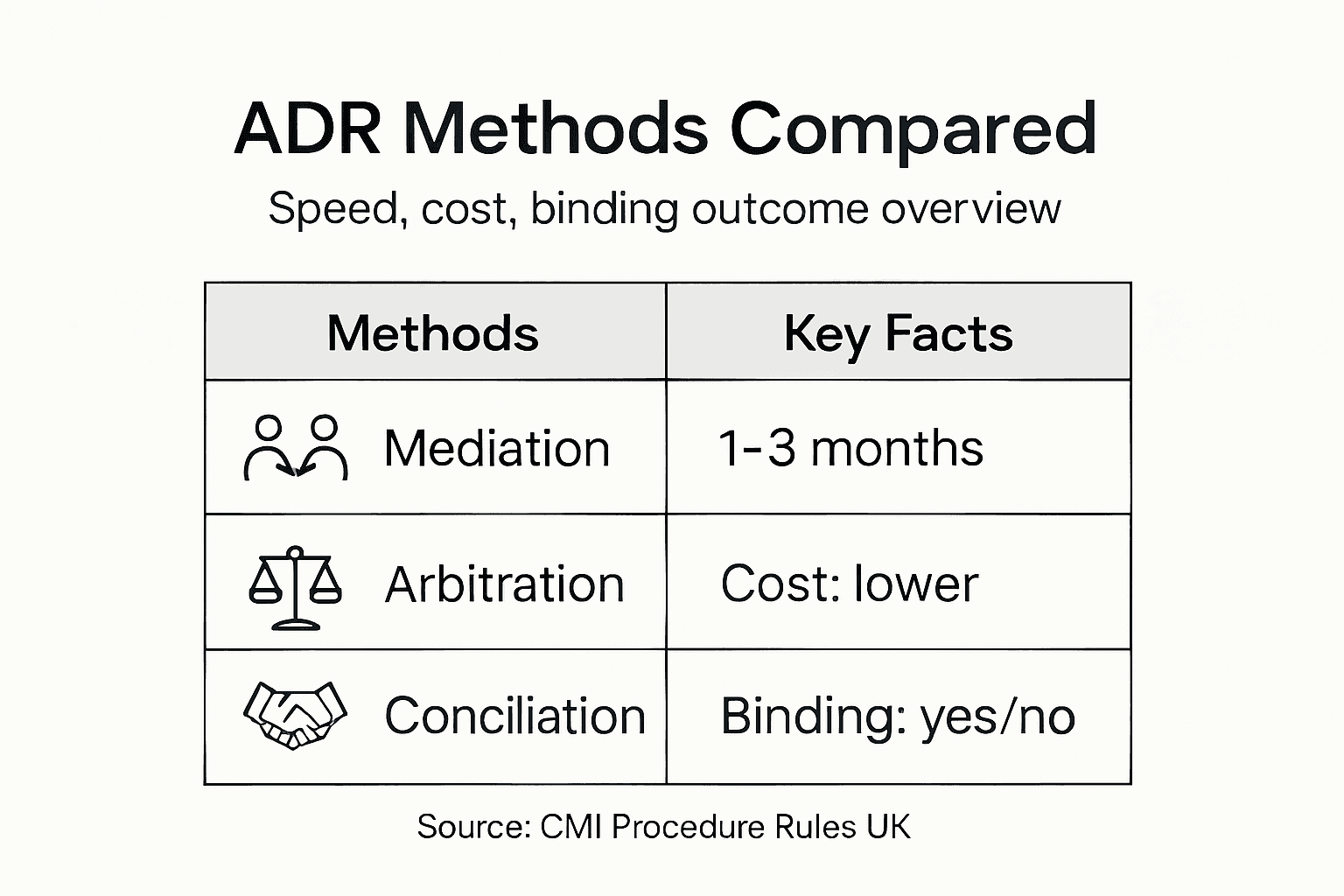
Here is a comparison of key ADR methods for business disputes:
| Method | Typical Timescale | Outcome Binding? | Best Used For |
|---|---|---|---|
| Mediation | 1-3 weeks or sessions | Only if settlement agreed | Preserving relationships |
| Arbitration | 4-8 months | Yes, legally enforceable | Technical, high-value, private disputes |
| Conciliation | Few weeks | If parties accept terms | Emotionally charged employment matters |
| Early Neutral Eval. | 2-4 weeks | No, advisory only | Assessing strengths/weaknesses early |
| Expert Determination | 2-4 weeks | Usually binding | Narrow technical issues |
| Ombudsman Scheme | Varies (weeks-months) | On businesses, not always on consumers | Sectoral consumer complaints |
Pro tip: When setting up commercial contracts, include an ADR clause specifying your preferred method and process requirements, as this prevents disputes about which resolution route to use when disagreements actually arise.
Understanding how each ADR process actually unfolds helps you prepare effectively and know what to expect when you enter one. The mechanics differ significantly between methods, and knowing these details separates businesses that handle ADR smoothly from those that stumble through it.
Mediation typically begins with a joint session where both parties meet with the mediator present. The mediator opens by explaining the process, confidentiality rules, and ground rules for respectful communication. Each side then presents their position without interruption. What happens next distinguishes skilled mediation from amateur attempts. The mediator meets separately with each party in private sessions called “caucuses.” These confidential conversations let each side speak honestly without the other party hearing. The mediator shares information between parties strategically, never revealing what was said in confidence without permission. This back and forth continues until parties find common ground or agree they cannot settle. The entire process typically takes between one and three sessions, sometimes stretched over several weeks. One critical point: mediation only succeeds if both parties genuinely want resolution. If one side is purely interested in delay or posturing, mediation stalls.
Arbitration follows a more structured pathway resembling court proceedings but with important differences. Both parties submit detailed written statements outlining their case. Discovery (exchanging relevant documents and information) happens but is usually limited compared to litigation. An arbitration hearing is scheduled where both sides present evidence and arguments. Witnesses may testify, experts submit reports, and lawyers cross examine claims. The arbitrator listens, takes notes, and asks clarifying questions. Unlike judges, arbitrators often have deep expertise in the specific industry or dispute type, meaning they grasp technical details quickly without lengthy explanation. After the hearing closes, the arbitrator reviews everything and issues a written award explaining their decision and reasoning. This award is binding and enforceable in court. The entire process typically takes four to eight months from start to award, considerably faster than litigation which often stretches beyond two years. Costs depend on the arbitrator’s fees, hearing venue, and lawyer representation, but usually run 40 to 60 percent less than court litigation.
Conciliation operates similarly to mediation but the conciliator takes a more directive role. Rather than simply facilitating communication, the conciliator actively suggests solutions and pushes parties toward compromise. This works particularly well when emotions have escalated and parties need firm guidance. The process follows a similar pattern to mediation with joint and private sessions, but the conciliator makes recommendations rather than remaining neutral. Early neutral evaluation works entirely differently. Both parties submit written summaries of their case and the key issues. A neutral evaluator (usually a senior lawyer or retired judge) reviews these submissions. Parties then attend a joint meeting where the evaluator gives their professional opinion on case strengths, weaknesses, and likely outcomes. This reality check often proves decisive. When respected third parties say your position is weak, settlement discussions suddenly become serious. The entire process takes just a few weeks and costs only a few thousand pounds.
Expert determination is the simplest process. The expert receives written submissions describing the disputed technical matter. They review relevant documents and may request clarification from either party. The expert then issues a determination deciding the technical question. This process is quick, typically concluded within two to four weeks. Ombudsman schemes work through complaint investigation. A complainant submits details of their complaint. The ombudsman service investigates independently, gathering information from both parties. They assess the complaint against relevant regulations and good practice standards. The ombudsman then issues a decision that can include compensation orders or mandatory remedies. This process is free for complainants but binding on the organisation complained against.
What ties all these together is structure. Each method creates a defined pathway with clear stages, roles, and outcomes. Knowing where you are in that pathway and what happens next removes uncertainty and helps your business prepare appropriately.
Pro tip: Request detailed procedural rules from your chosen ADR provider before engaging, as understanding timelines, evidence submission deadlines, and hearing formats lets you prepare documentation efficiently and avoid costly delays.
The legal system in the United Kingdom does not treat ADR as a soft option or a secondary choice. Instead, the framework actively pushes businesses toward ADR, sometimes mandating it. This shift reflects a deliberate policy decision that ADR serves justice better than overcrowded courts in many circumstances. Understanding this legal landscape matters because it affects your rights, obligations, and what happens if you ignore ADR opportunities.
The Civil Procedure Rules (CPR) form the backbone of this framework. These rules govern how civil disputes proceed through English courts, and they contain explicit requirements around ADR. Since the Woolf Reforms reshaped civil justice in 1999, courts have imposed a continuing duty on litigants to consider ADR throughout disputes, not just at the beginning. This is not merely encouragement. Courts now have explicit authority to compel parties to engage in ADR, following the Court of Appeal ruling in Churchill v Merthyr Tydfil Borough Council. Judges can order mediation directly and consider your refusal to attempt ADR when awarding costs at the end of a case. Refuse ADR without reasonable justification, and you may find yourself paying the other party’s legal fees as punishment, even if you win the underlying dispute. This creates real financial incentive to engage seriously with ADR rather than charging straight to court.
Certain regulated sectors face mandatory ADR participation requirements. Consumer disputes in financial services, energy, postal services, and telecommunications all require ADR attempts before court proceedings commence. These requirements exist because policymakers recognised that courts become unnecessarily clogged with disputes that ADR could resolve more efficiently. Professional regulators also build ADR expectations into their codes of conduct. Solicitors and barristers must encourage clients to consider ADR proportionate to the dispute value and complexity. Ignoring this advice exposes practitioners to complaints about failing to act in clients’ best interests.
The recent amendments to the Civil Procedure Rules in October 2024 formalised these powers further. Courts gained explicit authority to stay proceedings (pause litigation temporarily) to enable ADR attempts. This happens frequently now. A judge may look at your case and say, “This dispute would benefit from mediation. I am staying proceedings for eight weeks. Both of you attempt mediation in that time.” You cannot simply refuse. The stay remains in place until you genuinely attempt ADR or the court decides continuation is appropriate. This approach acknowledges reality. Many disputes that start adversarially settle through mediation once parties actually communicate with neutral facilitation.
What does this mean for your business practically? First, contracts matter. Include ADR clauses specifying your preferred dispute resolution method and process requirements. Courts respect contractual ADR provisions and will enforce them. Second, when disputes arise, engage with ADR requests seriously. Unreasonable refusal damages your position regardless of the merits. Third, timing is crucial. Initiating ADR early, before positions harden and legal costs escalate, produces better outcomes. The legal framework now institutionalises this expectation. Courts assume reasonable parties attempt ADR before spending six figures on litigation.
International disputes introduce additional complexity. The UK applies international arbitration principles when cross-border disputes require ADR, governed by the Arbitration Act 1996 and international conventions. This framework enables UK businesses to resolve disputes with international counterparts using arbitration recognised across multiple jurisdictions, a significant advantage when relationships span countries.
One misconception deserves correction. Some businesses think the legal framework making ADR mandatory means they lose control. Actually, the opposite occurs. ADR gives you more control than litigation. You choose the process, the decision-maker, the timescale, and often the confidentiality level. Courts impose timescales, rules, and publicity you cannot control. The legal framework pushes you toward ADR precisely because it offers more autonomy, not less.
Pro tip: Before litigation begins, request the other party engage in mediation in writing, keeping evidence of your proposal, since courts later consider who reasonably attempted ADR and who refused, potentially affecting cost awards in your favour.
ADR offers genuine advantages that explain why thousands of UK businesses use it annually. Yet it is not a magic solution. Understanding both the strengths and weaknesses helps you make realistic decisions about when ADR works and when it does not.
Cost savings represent the most tangible advantage. Litigation routinely costs £50,000 to £150,000 for straightforward commercial disputes, often climbing much higher for complex cases. ADR typically costs 30 to 50 percent less. You avoid court fees, reduce solicitor time dramatically, and eliminate expensive court appearances. A three day arbitration hearing with a specialist arbitrator still costs less than equivalent court litigation. Mediation costs even less, often just a few thousand pounds for the entire process. For small to medium businesses operating on tight margins, this difference is transformative.
Speed matters equally. Litigation stretches across two to three years routinely. ADR concludes in months or sometimes weeks. Mediation can happen within weeks. Arbitration typically takes four to eight months. Early neutral evaluation takes just weeks. This speed advantage compounds when you consider cash flow. Getting disputes resolved quickly means you stop tying up management time, resources, and mental energy on unresolved problems. Your business moves forward instead of remaining stuck in dispute mode.
Confidentiality is a third major benefit. Court proceedings are public. Everything said in court becomes part of the public record. Journalists can attend. Competitors can observe. Your commercial secrets, customer lists, pricing strategies, and negotiating positions become discoverable. ADR keeps disputes private. What is said in mediation stays confidential. Arbitration hearings are private. This matters enormously for businesses protecting sensitive information or reputation.
Flexibility rounds out the key benefits. You choose the process, the decision-maker, the timescale, the venue, and often the rules. Courts impose standard procedures you cannot change. ADR processes bend to your needs. Need resolution before Christmas? ADR can accommodate that. Need a decision-maker with specific industry expertise? You select them. Need flexible payment terms as part of the settlement? Mediation supports creative solutions.
Not every situation suits ADR. Unequal bargaining power between parties presents a genuine problem. If one party has vastly more resources, information, or sophistication, mediation may produce unfair outcomes. The stronger party can simply outlast the weaker party during negotiations. Arbitration helps somewhat because decision-making authority rests with the arbitrator, not bargaining strength. But mediation depends on genuine dialogue, which unequal power undermines.
Lack of binding outcomes (in mediation and early neutral evaluation) is another limitation. These processes produce agreements only if both parties consent. If one party refuses settlement, you are back to litigation. This uncertainty frustrates some businesses wanting definitive answers. Arbitration solves this by producing binding awards, but arbitration costs more.
Inadequate solutions emerge when parties refuse genuine cooperation. If one side attends ADR purely for show, pretending to engage whilst having no intention to settle, the process stalls. Similarly, if parties hold such unrealistic expectations about outcomes that compromise becomes impossible, ADR fails. Some disputes genuinely need court decisions because the legal question is novel or one party needs judicial determination of their rights regardless of costs.
Engaging in ADR without genuine intent to settle wastes time and money. If your business enters mediation planning to use it as a discovery tool or delay tactic, you undermine the process. Courts penalise this behaviour through cost awards.
Misleading expectations destroy ADR processes. If your solicitor promises you will walk away with 90 percent of your claim value, realistic settlement becomes impossible. Prepare realistic scenarios with your legal team before ADR begins.
Inadequate preparation is perhaps the most common pitfall. Some businesses send junior staff to mediation without decision making authority. You need someone present who can actually agree to settlement. Similarly, arriving without organised documents, clear objectives, and defined settlement parameters invites chaos. Spend time preparing your case, understanding your BATNA (best alternative to negotiated agreement), and identifying your realistic range of acceptable outcomes.
Failing to understand ADR processes before engaging creates avoidable problems. Each method works differently. Misunderstanding how arbitration differs from mediation leads to disappointed expectations.
These are typical pitfalls for businesses using ADR:
| Pitfall | Typical Impact on Outcome | How to Avoid |
|---|---|---|
| Inadequate preparation | Delays, weak negotiation position | Organise evidence, objectives |
| No decision-making authority | No settlement possible | Attend with senior executive |
| Using ADR as a stalling tactic | Risk of court penalties, lost time | Engage with genuine intent |
| Overestimating claim value | Stalemate, settlement failure | Set realistic expectation |
| Misunderstanding ADR procedure | Frustration, missed deadlines | Study process beforehand |
ADR works brilliantly for businesses that approach it realistically, prepare properly, and engage genuinely. It fails for businesses that treat it cynically or expect unrealistic outcomes. The key is matching the right process to your specific dispute, preparing thoroughly, and understanding what success actually looks like for your situation.
Pro tip: Before entering ADR, work with your solicitor to define your walk-away threshold and best alternative outcome, then brief everyone on your negotiation team so you maintain clear decision-making authority throughout the process.
Managing business disputes efficiently is critical to protecting your organisation’s resources and reputation. This article highlights the growing importance of Alternative Dispute Resolution (ADR) methods such as mediation and arbitration, emphasising how they offer faster, more confidential, and cost-effective outcomes compared to traditional litigation. If you want to avoid lengthy court battles and excessive legal fees while maintaining control over the process ADR provides, expert legal guidance is essential.

Ali Legal specialises in delivering transparent and strategic ADR solutions tailored to UK businesses of all sizes. Our fixed fees and clear communication mean no surprises while empowering you to select the most suitable dispute resolution path. Whether your commercial contracts already include arbitration clauses or you need support understanding mediation, our team is ready to help you navigate the options and secure the best possible outcome. Don’t wait until costs escalate or relationships deteriorate. Contact us today to explore how our expertise can turn your dispute into a strategic advantage at Get in Touch with Ali Legal. For resources and legal insight, visit our Contact Page and take the first step toward resolution.
Alternative Dispute Resolution (ADR) refers to various structured processes for resolving disputes outside of traditional court litigation, such as mediation, arbitration, and expert determination.
The main types of ADR include mediation, arbitration, conciliation, early neutral evaluation, expert determination, and ombudsman schemes, each suited for different scenarios and needs in resolving disputes.
Yes, ADR typically costs 30 to 50 percent less than court litigation because it avoids court fees, reduces solicitor time, and leads to faster resolutions, allowing businesses to save money.
Yes, some ADR methods, like arbitration, produce binding decisions that are enforceable in court, while others, like mediation, result in agreements only if both parties consent.


