
Menu
Get Expert Legal Support Today

Most british businesses now turn to arbitration instead of lengthy court battles, with studies showing that over 80 percent of major commercial disputes in the United Kingdom are handled this way. This growing trend reflects a wider shift in how legal conflicts are handled, prioritizing privacy, efficiency, and flexibility over traditional litigation. Understanding arbitration’s true nature and the misconceptions surrounding it helps parties protect their interests in a system where clear rules and expert decision-makers set the standard.
Arbitration represents a sophisticated alternative dispute resolution mechanism where conflicting parties agree to resolve legal disagreements outside traditional court systems. Unlike litigation, which follows rigid judicial processes, arbitration offers a more flexible, private approach to conflict resolution.

Many individuals misunderstand arbitration’s fundamental characteristics. Contrary to popular belief, arbitration is not simply an informal negotiation, but a structured legal process with specific procedural rules. Understanding arbitration’s nuanced framework requires recognising several key distinctions from standard court proceedings.
Arbitration typically involves three primary components: an impartial arbitrator, a mutually agreed legal framework, and a binding decision. Parties select a neutral third-party professional with expertise relevant to their specific dispute, who then evaluates evidence and renders a decision. This approach provides several strategic advantages:
Common misconceptions about arbitration often stem from limited understanding of its legal mechanics. Some individuals erroneously believe arbitration decisions lack enforceability or are merely suggestions. In reality, arbitration outcomes are legally binding and can be implemented through court systems, providing robust mechanisms for dispute resolution that protect both parties’ interests.
Arbitration in the United Kingdom encompasses several sophisticated dispute resolution approaches, each designed to address specific legal contexts and industry requirements. Specialist arbitration forms play a crucial role in providing targeted resolution mechanisms across diverse sectors.
Two primary classifications dominate the arbitration landscape: institutional arbitration and ad hoc arbitration. Institutional arbitration involves predefined procedural rules established by recognised bodies, such as the London Court of International Arbitration (LCIA). These structured frameworks provide comprehensive guidelines for dispute resolution, ensuring consistency and professional management.
Key types of arbitration in the UK include:
Ad hoc arbitration offers greater flexibility, allowing parties to design custom procedural rules tailored to their specific dispute. This approach enables more personalised resolution strategies, particularly useful in complex or unique legal scenarios where standard institutional frameworks might prove restrictive. Parties can negotiate every aspect of the arbitration process, from selecting arbitrators to determining procedural timelines, making it an attractive option for sophisticated legal practitioners seeking bespoke dispute resolution mechanisms.
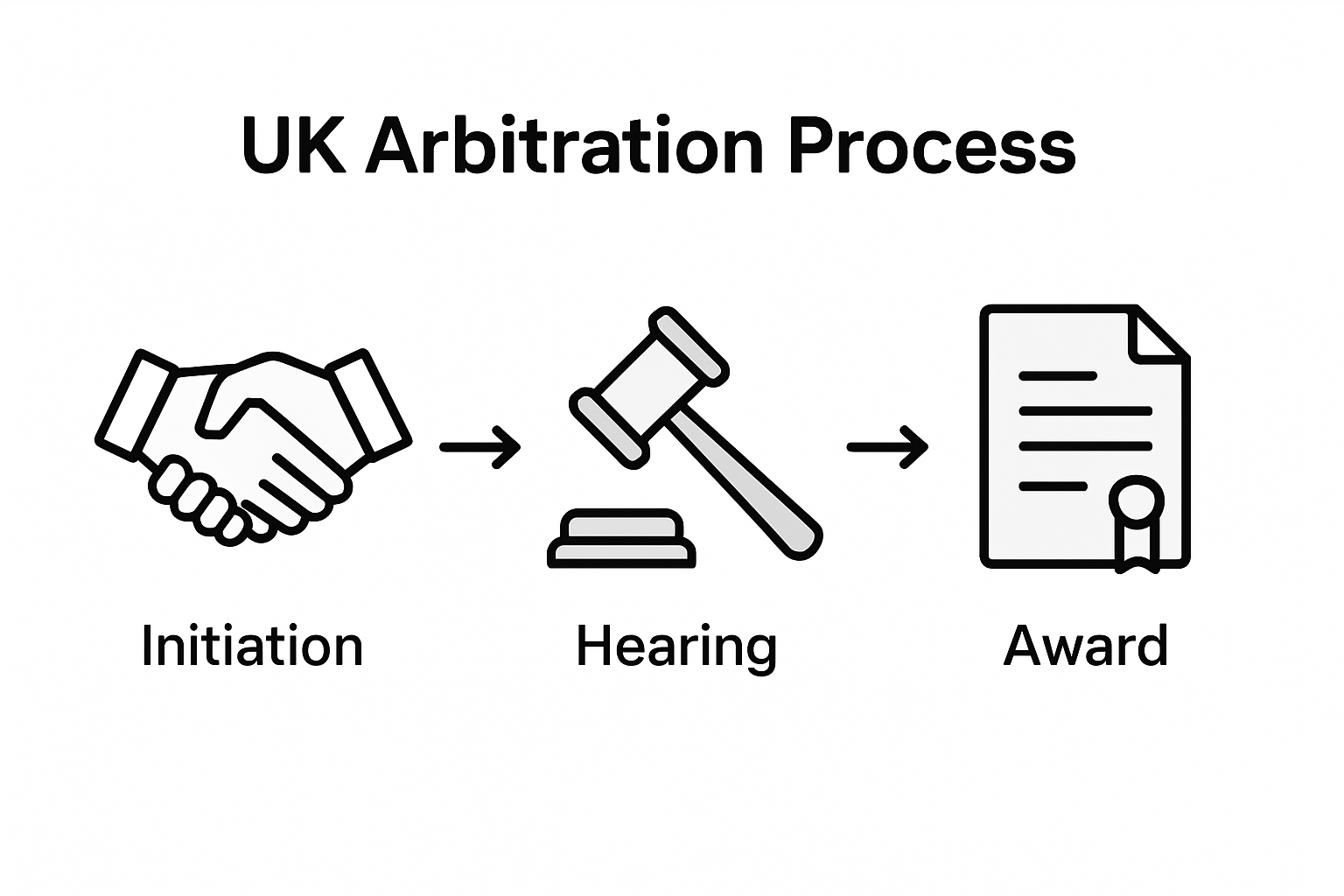
Comprehensive arbitration procedures follow a structured approach that transforms complex legal conflicts into manageable resolution pathways. The process begins with mutual agreement, where conflicting parties voluntarily commit to resolving their dispute through arbitration instead of traditional court litigation.
The initial stage involves critical preparatory steps. Parties must first draft a detailed arbitration agreement specifying the scope of their dispute, selecting an appropriate arbitrator with relevant expertise. Financial institutions and legal practitioners carefully navigate these procedural considerations to ensure a fair and efficient resolution mechanism.
The arbitration process typically unfolds through these sequential stages:
Initial Agreement Preparation
Preliminary Hearing
Evidence Presentation
Arbitration Hearing
Award Deliberation
The final arbitration award represents a legally binding resolution that can be enforced through court systems. This approach offers parties a confidential, efficient alternative to traditional litigation, providing a structured yet flexible mechanism for dispute resolution that preserves professional relationships and minimises unnecessary legal confrontations.
International commercial arbitration jurisdictional frameworks in the United Kingdom represent a sophisticated legal ecosystem designed to provide robust dispute resolution mechanisms. The primary legislative foundation is the Arbitration Act 1996, which establishes comprehensive guidelines for conducting arbitration proceedings and ensuring fair, efficient dispute resolution across various sectors.
The legal principles governing arbitration in the UK are built upon several fundamental pillars: party autonomy, procedural fairness, and judicial non-interference. Party autonomy allows disputants significant flexibility in designing their arbitration process, enabling them to select arbitrators, determine procedural rules, and choose applicable legal standards. This principle ensures that parties retain substantial control over their dispute resolution strategy.
Key governing principles of UK arbitration include:
The UK legal system supports arbitration through a supportive judicial framework that respects arbitral tribunal decisions while maintaining oversight to prevent potential procedural misconduct. Courts may intervene only in limited circumstances, such as addressing serious legal errors or protecting fundamental procedural rights. This balanced approach reinforces the UK’s reputation as a premier global destination for international dispute resolution, offering businesses a reliable, sophisticated mechanism for resolving complex legal challenges efficiently and professionally.
Financial institutions carefully analyse arbitration risks and benefits before engaging in dispute resolution processes. Understanding the intricate balance between potential rights, inherent risks, and financial implications is crucial for making informed decisions about pursuing arbitration.
Parties entering arbitration retain fundamental procedural rights that protect their interests throughout the resolution process. These rights include selecting impartial arbitrators, presenting comprehensive evidence, challenging potential conflicts of interest, and requesting reasoned decisions. The ability to choose specialised arbitrators with industry-specific expertise provides a significant advantage over traditional court proceedings, enabling more nuanced and technically informed dispute resolution.
Key financial and procedural considerations include:
Direct Cost Implications
Potential Financial Risks
Strategic Rights
While arbitration often proves more cost-effective than prolonged litigation, parties must carefully assess potential financial exposures. Comprehensive risk assessment involves evaluating potential award sizes, understanding potential enforcement limitations, and calculating comprehensive cost structures. Sophisticated parties typically conduct detailed cost-benefit analyses, considering not just immediate financial implications but also long-term strategic outcomes and potential reputational impacts of different dispute resolution approaches.
Understanding arbitration in the United Kingdom can feel complex, especially when faced with critical decisions about binding awards, procedural fairness, and selecting skilled arbitrators. The challenges include managing costs, ensuring confidentiality, and enforcing awards while protecting your legal rights. Whether you are involved in commercial, maritime, or international arbitration, having clear, straightforward legal advice is essential to protect your interests and achieve swift resolution.
Ali Legal specialises in guiding individuals and businesses through these nuanced arbitration processes. With expertise in corporate and commercial law and international dispute resolution, we provide transparent, fixed-fee services that clarify your options and reduce uncertainty.

Take control of your arbitration journey today. Contact Ali Legal to receive strategic, speedy, and transparent legal solutions tailored to your case. Don’t let arbitration risks or complexity hold you back. Start with a trusted partner by reaching out here Contact Us and secure expert guidance now.
Arbitration is a formal alternative dispute resolution process where parties agree to resolve legal disputes outside traditional court systems, often with the help of a neutral third-party arbitrator.
The arbitration process typically involves preparing an agreement, conducting a preliminary hearing, exchanging evidence, holding an arbitration hearing, and finally receiving a binding arbitration award from the arbitrator.
Arbitration offers several advantages, including faster resolution times, greater confidentiality, lower costs, flexibility in decision-making, and the ability to choose experts for specific disputes.
Yes, arbitration outcomes are legally binding and enforceable through court systems, ensuring that the decisions made by arbitrators have significant legal weight.


