
Menu
Get Expert Legal Support Today

Unclear or incomplete employment contracts can leave United Kingdom SMEs exposed to costly disputes and compliance headaches. For British HR managers, defining every detail of an employment contract—including verbal and implied agreements recognised by law—is more than just a formality. This guide unpacks the legal complexities, highlights mandatory clauses, and clarifies misconceptions about what truly constitutes a binding employment contract, giving you practical confidence in managing staff relationships and avoiding legal pitfalls.
An employment contract represents a legally binding agreement between an employer and employee that establishes the fundamental parameters of their professional relationship. Contrary to common misconceptions, such contracts are not exclusively written documents but can also be verbal agreements recognised by law.
The core purpose of an employment contract is to define critical aspects of the working relationship, including job responsibilities, compensation, working hours, and mutual expectations. These agreements can be comprehensive documents or simple verbal understandings that outline the essential terms of employment. Key elements typically include specific job roles, salary structures, performance expectations, and the rights and obligations of both parties.
Many professionals mistakenly believe that only formal, signed documents constitute employment contracts. However, employment law recognises that contracts can be established through actions, communications, and mutual understanding. A verbal offer accepted by an employee, followed by commencing work, can create a legally binding contract with implied terms and conditions. This flexibility means employers must be cautious about their communications and actions, as they could inadvertently establish contractual obligations.
Pro tip: Always obtain a written employment contract that clearly outlines all key terms to prevent potential misunderstandings and legal disputes.
The United Kingdom recognises several distinct employment contract types that provide varying levels of workplace flexibility and legal protection. Understanding these contract variations is crucial for both employers and employees to ensure appropriate rights, responsibilities, and working conditions are established from the outset.
Primary employment contract types include full-time contracts, which typically involve 35-40 hours per week with consistent schedules and comprehensive employment benefits. Part-time contracts offer similar protections but with reduced hours, allowing employees greater work-life balance. Fixed-term contracts are designed for specific project durations or temporary replacements, with predetermined start and end dates that provide clear employment boundaries.
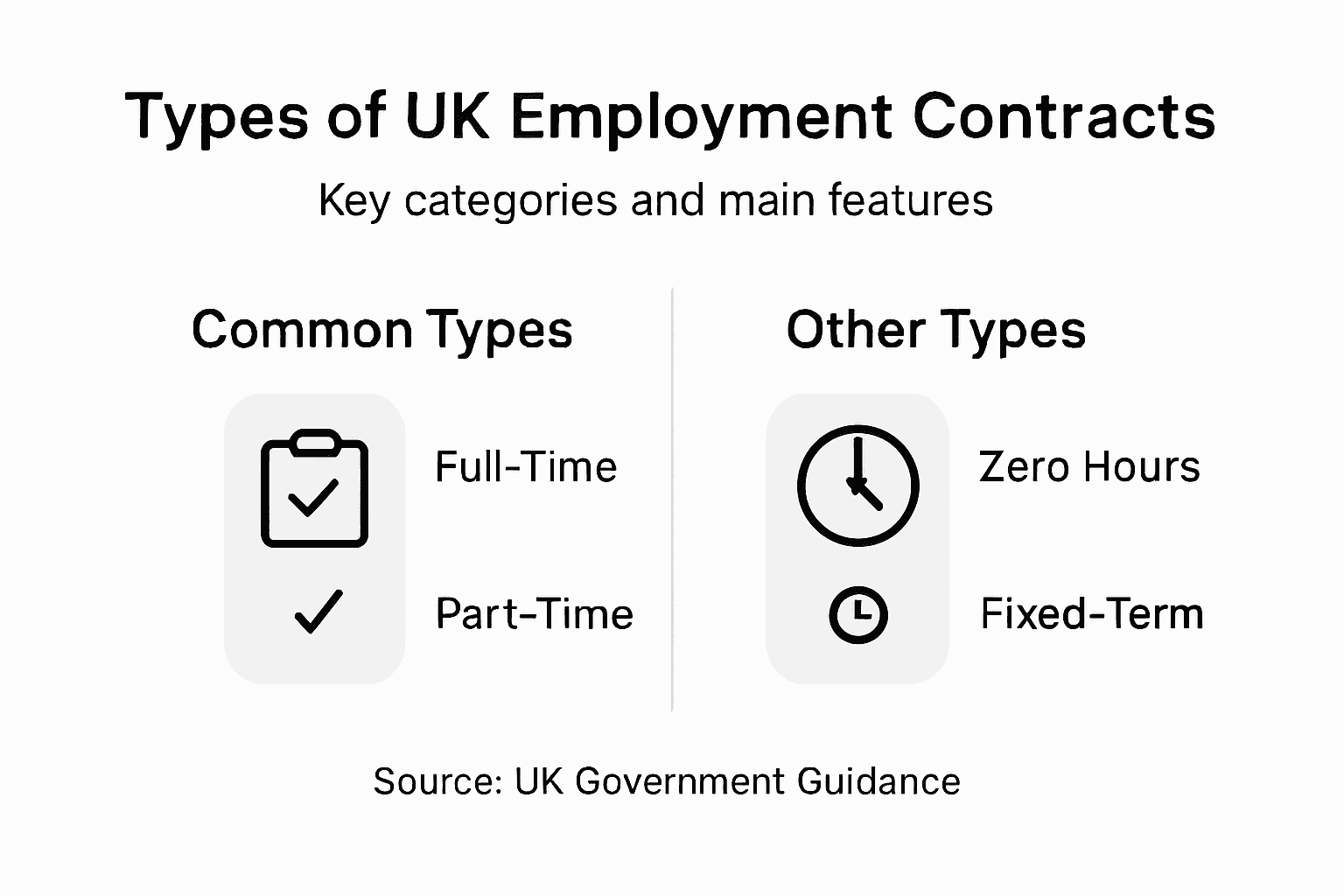
Moreover, the UK labour market includes more nuanced contract arrangements such as zero-hours contracts, which provide no guaranteed work hours, and agency worker contracts, where individuals are employed through recruitment agencies. Freelance and consultancy contracts offer maximum flexibility, allowing professionals to work independently with multiple clients while maintaining distinct legal status from traditional employment.
Pro tip: Always carefully review the specific terms and conditions of your employment contract, paying close attention to working hours, pay structure, and termination clauses to protect your professional interests.
The following table compares common UK employment contract types and their typical characteristics:
| Contract Type | Typical Hours | Job Security Level | Suitability |
|---|---|---|---|
| Full-time | 35-40 per week | High | Long-term, stable employment |
| Part-time | Under 35 per week | Medium | Work-life balance needs |
| Fixed-term | Varies, project-based | Medium | Temporary or specific projects |
| Zero-hours | No guaranteed hours | Low | Irregular or on-demand work |
| Agency worker | Varies by assignment | Variable | Short notice or sectoral flexibility |
| Freelance/Consultancy | Self-determined | None (self-employed) | Multiple clients or independent work |
Every employment contract must include specific mandatory elements that establish clear expectations and legal protections for both employers and employees. These fundamental clauses form the backbone of the working relationship, ensuring transparency and mutual understanding from the outset of employment.

The core mandatory clauses typically encompass critical information such as employee details, job title, start date, salary, and working hours. Additional essential components include holiday entitlement, notice periods, and explicit disciplinary procedures. Employers are legally required to provide a written statement of employment particulars within two months of an employee’s start date, which outlines these fundamental terms and conditions.
Beyond the standard mandatory elements, contracts often incorporate supplementary clauses that protect both parties’ interests. These may include confidentiality agreements, intellectual property provisions, flexibility clauses, and performance expectations. Some contracts also integrate implied terms that establish a fundamental duty of mutual trust and confidence between the employer and employee, which goes beyond the explicitly written provisions.
Pro tip: Request a comprehensive written contract that clearly articulates all terms, ensuring you thoroughly understand each clause before signing and seek legal advice if any provisions seem unclear or ambiguous.
The United Kingdom’s employment law landscape is set to undergo significant transformations, with substantial legal framework updates planned for 2026. These anticipated changes aim to strengthen worker protections, clarify employment status definitions, and provide more robust mechanisms for ensuring fair treatment across various contract types.
Key legislative modifications will primarily focus on refining the distinctions between employees, workers, and contractors. The upcoming regulations will introduce more comprehensive definitions that address the complexities of modern working arrangements, particularly in sectors with flexible and remote work models. Employers will be required to provide clearer contract terms, with enhanced scrutiny on zero-hours contracts and provisions that potentially exploit worker vulnerabilities.
The 2026 legal amendments represent a significant shift towards greater workplace transparency and employee rights. Employers will need to conduct thorough reviews of existing contract templates, ensuring compliance with new statutory requirements. This will likely involve more detailed written statements, expanded notice periods, and stricter guidelines around contract flexibility, redundancy processes, and worker classification.
Pro tip: Proactively review and update your employment contracts well before the 2026 legislative changes take effect, consulting with legal professionals to ensure full compliance and minimise potential legal risks.
Employment relationships in the United Kingdom are governed by a complex set of mutual legal responsibilities that define the expectations and conduct of both employers and employees. These obligations extend far beyond simple transactional interactions and represent a comprehensive framework of rights, duties, and ethical standards.
Employers bear significant statutory obligations, including providing safe working environments, paying agreed wages, respecting minimum wage regulations, and ensuring fair treatment. Key employer responsibilities encompass offering clear contract terms, maintaining workplace health and safety standards, providing statutory benefits like holiday entitlements, and implementing transparent disciplinary and grievance procedures. These obligations are not merely administrative requirements but fundamental commitments to worker welfare and professional dignity.
Conversely, employees have corresponding duties that include performing assigned tasks with diligence, maintaining professional conduct, protecting confidential company information, and adhering to workplace policies. Employees must act in good faith, follow reasonable instructions, and represent their organisation’s interests responsibly. The reciprocal nature of these obligations creates a balanced framework where both parties have clearly defined expectations and potential consequences for non-compliance.
Pro tip: Regularly review your employment contract and workplace policies to ensure you fully understand your rights and responsibilities, creating a proactive approach to maintaining a positive and legally compliant working relationship.
Here is a summary of key employer and employee obligations under UK law:
| Obligation Aspect | Employer Requirement | Employee Responsibility |
|---|---|---|
| Safe environment | Maintain health and safety standards | Follow safety procedures |
| Pay | Provide agreed and timely wages | Accurately record hours worked |
| Confidentiality | Protect company/private information | Do not disclose sensitive data |
| Conduct/Performance | Clearly state expectations | Meet performance expectations |
| Contract compliance | Honour agreed contract terms | Abide by contract and policies |
Employment contract risks are multifaceted challenges that can emerge at various stages of the working relationship, with potential legal implications requiring careful navigation. These risks span from initial contract drafting through to potential termination, encompassing areas of potential misunderstanding, disagreement, and potential litigation.
Common risk scenarios include unclear contract terms, non-compliance with statutory rights, and potential breaches of employment regulations. Disputes frequently arise around critical issues such as pay structures, working hours, performance expectations, and contractual obligations. Employers must be particularly vigilant about maintaining transparent communication, documenting performance concerns, and following precise legal procedures when addressing potential conflicts or considering employee termination.
Exit scenarios in UK employment law are complex and require meticulous attention to legal requirements. Termination pathways include resignation, dismissal with notice, redundancy, and termination for cause, each carrying distinct legal procedural requirements. Employers must ensure they follow proper protocols, provide appropriate notice periods, and comply with statutory redundancy provisions to mitigate potential legal challenges and financial penalties.
Pro tip: Maintain comprehensive documentation of all employment interactions and contract-related communications to protect yourself legally and provide clear evidence in potential dispute scenarios.
Understanding the complexities of UK employment contracts is essential to avoid costly compliance risks and workplace disputes. The article highlights key challenges such as unclear contract terms, varying contract types, and upcoming legal changes in 2026 that could affect your organisation’s obligations. Whether you are an employer seeking to draft watertight contracts or an employee wanting to fully understand your rights, recognising important concepts like notice periods, zero-hours contracts, and employer responsibilities is vital for peace of mind.
Do not wait for disputes or misunderstandings to arise. Ali Legal offers strategic, clear, and transparent legal support specifically tailored to employment contract issues in the United Kingdom. Our approach emphasises fast, practical advice with fixed fees to help you navigate mandatory clauses and new legislation confidently.
Need tailored guidance on contract compliance, risk management, or exit scenarios?

Act now to safeguard your professional relationships. Contact Ali Legal today to discuss your employment contract concerns with experienced solicitors who put your interests first. Visit contact us to get started and explore how our dedicated legal services in civil litigation and corporate law can support your employment matters. Partner with Ali Legal for clear communication and long-term peace of mind.
An employment contract is a legally binding agreement between an employer and employee that outlines the terms of their working relationship, including job responsibilities, compensation, and working hours.
Yes, employment contracts can be oral agreements recognised by law. A verbal offer accepted by an employee can create a legally binding contract, with implied terms and conditions.
Mandatory clauses typically include employee details, job title, start date, salary, working hours, holiday entitlement, notice periods, and disciplinary procedures.
Risks include unclear contract terms, non-compliance with statutory rights, and potential disputes over pay structures, working hours, or performance expectations. Proper communication and documentation can help mitigate these risks.


