
Menu
Get Expert Legal Support Today

Contract disputes test the patience of even the most diligent british business owners and professionals. With over one third of United Kingdom businesses reporting legal disagreements every year, a poorly managed contract issue can rapidly snowball into costly delays and reputational risks. Knowing how to assess the situation, gather your evidence and follow a clear step-by-step approach gives you a powerful advantage and helps protect your interests from the very start.
Understanding the nuances of a contract dispute requires methodical investigation and strategic evidence collection. When a disagreement emerges, your first objective is to comprehensively evaluate the situation and compile a robust documentation trail that supports your position.
Begin by meticulously reviewing the original contract, examining every clause and performance requirement with precision. The UK government’s guidance on contract management emphasises establishing clear key performance indicators, which become critical reference points during dispute assessment. Collect all relevant communication records, including emails, meeting minutes, correspondence, and formal notices that document the progression of events leading to the dispute. Systematically organise these documents chronologically and categorise them by topic to create a clear narrative.
Your evidence gathering should include both documentary proof and witness statements if applicable. Pay special attention to contractual performance metrics and procedural guidelines that might substantiate your position. Photograph physical evidence, preserve digital records, and ensure all documentation remains untampered and authentic.
Advanced tip: Compile a comprehensive evidence index that cross references each document with specific contractual clauses, making it easier for legal professionals to understand your documented dispute trajectory.
Navigating a contract dispute requires strategic communication and a measured approach to resolving differences. Your primary goal in this stage is to open constructive dialogue with the other party and explore potential resolution pathways before escalating to formal legal proceedings.
Solving problems out of court involves creating an environment of mutual understanding and collaborative problem solving. Begin by scheduling a meeting or requesting a formal discussion where both parties can openly address their concerns. During this initial dialogue, focus on articulating your perspective clearly and professionally, using specific examples from your evidence gathering to support your position. Dispute resolution techniques emphasise the importance of active listening and maintaining a cooperative tone throughout these conversations.
Approach the negotiation with specific objectives while remaining flexible. Prepare a list of potential compromise solutions and be ready to discuss reasonable alternatives that could satisfy both parties interests. Document all discussions and proposed solutions in writing, ensuring transparency and creating a clear record of attempted resolution efforts.
Advanced tip: Prepare a written summary of discussion points after each negotiation meeting, sending a copy to the other party to confirm mutual understanding and create an official record of your collaborative attempts to resolve the dispute.
When contract disputes escalate beyond initial negotiations, securing professional legal representation becomes a critical strategic decision. Your objective is to find a legal expert who can provide specialist guidance and potentially transform the trajectory of your dispute resolution process.
The UK government recommends seeking independent legal advice to navigate complex dispute scenarios effectively. When selecting a solicitor, prioritise professionals with specific expertise in contract law and dispute resolution. Look for legal practitioners who demonstrate a nuanced understanding of your specific industry and the contractual complexities involved. Prepare a comprehensive briefing document that outlines the dispute’s background, including all gathered evidence, communication records, and your desired outcomes.
During initial consultations, be prepared to discuss potential resolution strategies, associated legal costs, and realistic expectations. Ask detailed questions about their experience with similar cases, their proposed approach to your specific dispute, and potential alternative dispute resolution methods. Legal professional training programmes emphasise the importance of strategic problem solving, so seek a solicitor who can offer both legal expertise and pragmatic negotiation skills.
Advanced tip: Schedule initial consultations with multiple solicitors to compare their approaches, ensuring you select a legal representative who not only understands your case but also aligns with your communication style and strategic objectives.
Reaching this stage indicates that previous negotiation attempts have been unsuccessful, and you must now pursue more structured legal mechanisms to resolve your contract dispute. Your primary objective is to initiate a formal process that provides a legally binding resolution while minimising potential financial and reputational risks.
The UK government recommends civil mediation as a structured dispute resolution approach, which offers a more collaborative alternative to traditional court proceedings. Begin by preparing a comprehensive documentation package that includes all previous communication, evidence, and attempted resolution attempts. Your solicitor will help you select the most appropriate dispute resolution method based on your specific circumstances.
Dispute resolution strategies in professional sectors emphasise the importance of selecting the right procedural approach. This might involve statutory adjudication, arbitration, or mediation depending on your contract type and industry standards. Carefully review your original contract for any prescribed dispute resolution clauses that mandate specific procedures. During this process, maintain professional communication and be prepared to demonstrate your reasonable attempts to resolve the conflict constructively.
Here is a summary comparing common formal dispute resolution methods in contract disputes:
| Method | Typical Use Case | Advantages | Key Considerations |
|---|---|---|---|
| Mediation | Early dispute stages | Preserves business relations | Not legally binding unless agreed |
| Arbitration | Technical or complex contracts | Quicker than court, private | Can be costly; binding outcome |
| Statutory Adjudication | Construction disputes | Fast interim decisions | Only applies in certain sectors |
| Litigation | Unresolvable or severe disputes | Legally enforceable outcome | Slow and expensive process |
Advanced tip: Request a detailed timeline and potential cost breakdown from your legal representative before commencing formal procedures, ensuring you understand the financial and temporal implications of each potential resolution pathway.
After successfully navigating complex dispute resolution procedures, your focus shifts to meticulously reviewing and implementing the negotiated settlement. This critical stage demands careful attention to ensure that all agreed terms are precisely documented and systematically executed.
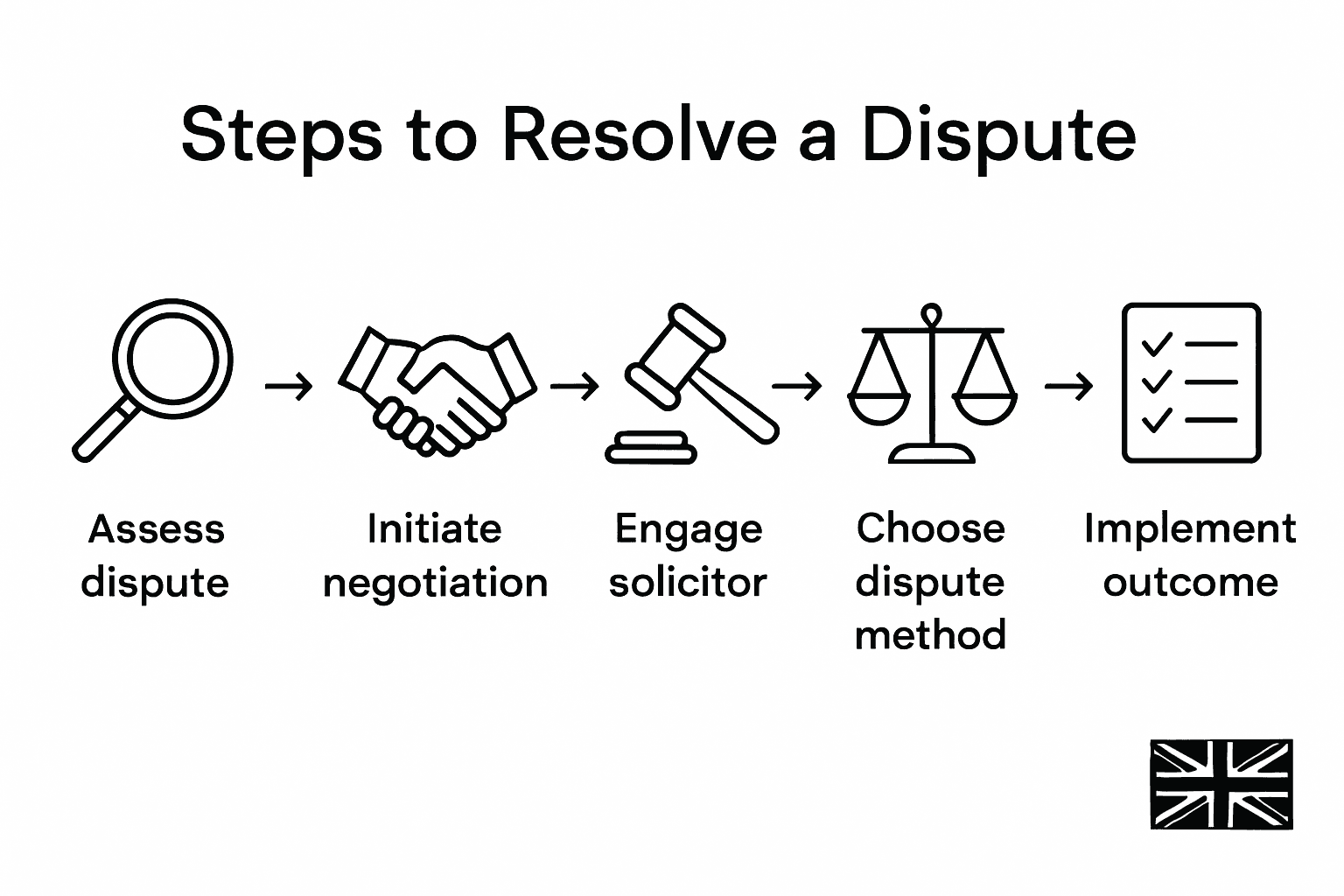
Managing contract dispute resolutions requires involving an independent third party to validate the settlement terms and confirm that both parties fully understand their respective obligations. Carefully review the settlement document line by line, verifying that every negotiated point accurately reflects the discussions and agreements reached during the dispute resolution process. Pay particular attention to specific performance requirements, financial settlements, timelines, and any remedial actions.
Contract dispute resolution guidance emphasises the importance of creating a clear implementation plan that outlines exactly how each settlement term will be executed. Work closely with your legal representative to develop a structured approach for fulfilling your obligations, establishing clear milestones and accountability mechanisms. Document every step of the implementation process and maintain open communication channels with the other party to ensure smooth execution.
To support a comprehensive settlement, consider these key implementation factors:
| Factor | Description | Impact if Mismanaged |
|---|---|---|
| Performance Deadlines | Specific dates for obligations | Delays could void agreement |
| Milestone Tracking | Monitoring progress checkpoints | Missed milestones may trigger penalties |
| Third-Party Verification | Independent oversight of compliance | Lack of oversight risks disputes recurring |
| Documentation | Written record of actions taken | Poor records can cause enforcement issues |
Advanced tip: Create a detailed compliance checklist that tracks each settlement term, including specific deadlines and responsible parties, to provide a systematic approach for verifying complete and accurate implementation of the negotiated resolution.
Contract disputes can bring uncertainty and stress, especially when facing challenges like evidence collection, negotiation deadlocks, and deciding on the right formal resolution path. This article highlights the critical steps from gathering detailed proof to verifying settlement terms, emphasising the importance of strategic legal support and clear communication.
At Ali Legal, we understand how complex contract disputes can impact your business or personal interests. Our expert solicitors specialise in providing fast, transparent, and tailored legal advice to guide you through every stage of the dispute resolution process. Whether you need help initiating negotiations or require professional representation for mediation or litigation, we prioritise your goals with fixed fees and straightforward guidance.
Explore how Ali Legal can support you today and benefit from:
Contact Ali Legal now to secure your peace of mind and take control of your contract dispute resolution process.
Start your trusted legal journey here

Begin by reviewing the original contract thoroughly, focusing on each clause and performance requirement. Gather and organise all relevant communication records and evidence to establish a clear narrative.
Initiate a dialogue by scheduling a meeting to discuss concerns openly. Clearly articulate your perspective, supported by evidence, and be prepared to propose potential compromise solutions that can satisfy both parties’ interests.
If initial negotiations fail, it’s advisable to seek professional legal representation. Look for a solicitor with expertise in contract law who can provide tailored guidance based on your specific dispute circumstances.
Common methods include mediation, arbitration, and statutory adjudication. Each method serves different situations, so assess your contract and industry standards to choose the most suitable process.
Carefully review the settlement document to ensure all terms are clearly outlined and understood by both parties. Create a structured implementation plan with specific deadlines and responsibilities to ensure compliance with the agreement.
Include performance deadlines, milestone tracking, third-party verification, and thorough documentation. These factors will help track obligations and prevent future disputes from arising.


