
Menu
Get Expert Legal Support Today

Most british businesses underestimate the complexity hidden in commercial contracts, yet a single overlooked clause can trigger severe legal and financial headaches. Understanding these agreements is crucial to protect your company’s interests and avoid costly disputes. This step-by-step guide lays out clear, practical actions that any british organisation can follow to improve contract quality, reduce risks, and build trust with partners.
Crafting successful commercial contracts begins with a comprehensive understanding of each party’s fundamental needs and strategic objectives. This crucial first stage requires meticulous communication and analytical thinking to establish a solid foundation for your legal agreement.
Start by scheduling comprehensive discovery meetings with all involved parties. During these discussions, aim to uncover not just surface level requirements but deeper strategic motivations. You’ll want to systematically document each party’s core business goals, performance expectations, potential constraints, and anticipated outcomes. Understanding business needs through pre-market engagement allows you to create more precise and mutually beneficial contractual frameworks.
To ensure clarity and precision, develop a structured approach to capturing objectives. Use the SMART framework (Specific, Measurable, Achievable, Relevant, Time-bound) to crystallise each party’s expectations. This methodology helps translate abstract aspirations into concrete contractual terms that provide legal certainty and operational clarity. Identifying objective-driven outcomes requires careful documentation and mutual agreement.
Warning: Rushing this initial assessment phase can lead to misunderstandings and potential disputes later. Take sufficient time to listen, probe, and validate each party’s perspectives before drafting any contractual language.
With a comprehensive understanding of needs and objectives established, you are now prepared to move into the next critical stage of contract drafting.
With an understanding of each party’s objectives, you now enter the critical phase of collecting comprehensive information and establishing precise contractual terminology. This stage transforms abstract discussions into concrete legal documentation that protects all parties’ interests.
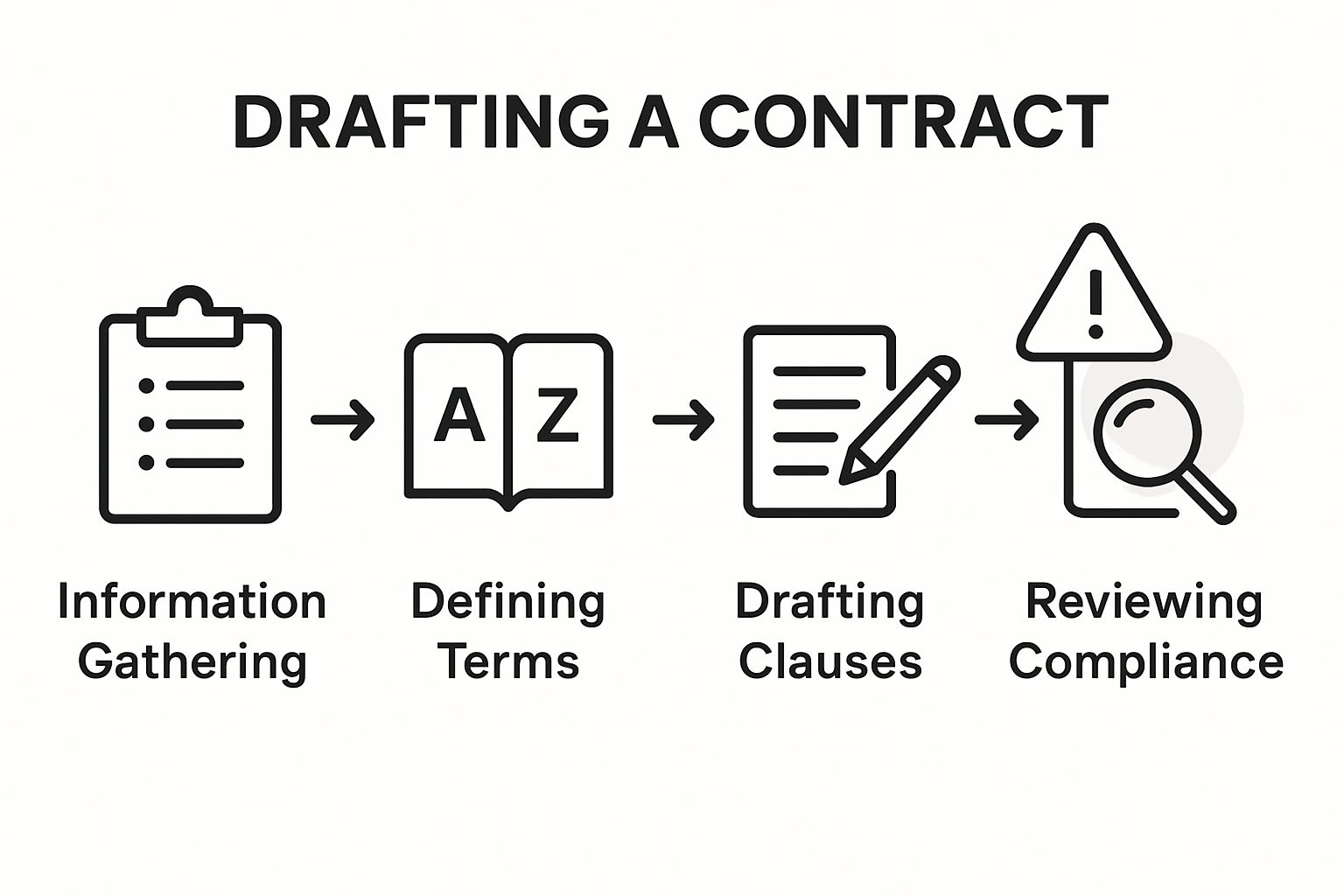
Commence by creating an exhaustive information gathering checklist that covers all potential contractual dimensions. Request detailed documentation such as company registration papers, financial statements, operational capabilities, and relevant historical performance data. Writing fair contract terms requires transparency and clear communication about each party’s capabilities and limitations. Pay special attention to capturing specifics like delivery timelines, payment structures, quality standards, and performance metrics.
Next, focus on defining key contractual terms with surgical precision. Each term must be unambiguous and leave no room for misinterpretation. Drafting contracts that clearly define agreed terms is fundamental to creating legally enforceable agreements. Consider creating a dedicated glossary section within the contract that provides explicit definitions for technical terminology, industry specific language, and any potentially complex phrases.
Warning: Ambiguity is the enemy of good contracts. If a term could be interpreted multiple ways, rewrite it until its meaning is crystal clear.
With essential information gathered and key terms meticulously defined, you are prepared to progress towards structuring the formal contract framework.
With foundational information collected, you are now ready to transform your contractual blueprint into a robust legal document. This critical stage involves constructing precise clauses that define each party’s rights, responsibilities, and potential consequences for non performance.

Begin by systematically addressing fundamental contractual elements. Drafting key legal clauses for commercial contracts requires meticulous attention to specific components like warranties, indemnities, and limitation of liability provisions. Your clauses must comprehensively outline expected performance standards, delivery mechanisms, payment terms, and remedial actions in case of potential breaches. Consider creating separate sections for core obligations, ensuring each party understands their exact commitments and potential risks.
Next, focus on crafting nuanced obligation specifications that leave no room for ambiguity. Understanding the anatomy of contractual terms involves distinguishing between absolute and conditional obligations. Clearly delineate which actions are mandatory, which are discretionary, and what specific performance metrics constitute satisfactory fulfilment. Pay particular attention to creating realistic yet stringent language that protects your interests without appearing unnecessarily restrictive.
Warning: Generic boilerplate language can create significant legal vulnerabilities. Every clause must be tailored to your specific contractual context and potential scenarios.
With core clauses and obligations precisely articulated, you are prepared to review and refine the emerging contractual framework.
With your core contractual framework established, you now enter the critical phase of comprehensive legal risk assessment. This stage involves forensically examining every clause to ensure regulatory compliance, potential liability exposure, and alignment with broader legal standards.
Interpreting commercial contract terms requires a systematic approach to identifying potential legal vulnerabilities. Conduct a meticulous line by line review focusing on potential ambiguities, jurisdictional considerations, and potential scenarios where contractual interpretations might create unexpected legal consequences. Scrutinise each clause for potential misalignments with current regulatory frameworks, paying special attention to industry specific legal requirements that might not be immediately apparent.
Ensure that your contract meets fair contract term standards by evaluating the clarity, transparency, and accessibility of all provisions. This means assessing whether an independent third party could reasonably understand the obligations, rights, and potential consequences outlined in the document. Consider potential power imbalances between parties and ensure that the language does not inadvertently create unfair contractual conditions that could be challenged in legal proceedings.
Warning: A single overlooked clause can potentially expose your organisation to significant legal and financial risks. Always involve legal professionals in your final review process.
With your comprehensive legal compliance review completed, you are now prepared to refine and finalise the contractual documentation.
You have now reached the culmination of your contractual drafting journey where precision and strategic implementation will transform your carefully crafted document into a legally binding agreement. This final stage requires methodical attention to execution details and long term contract management.
Preparing comprehensive contract management arrangements involves more than simply obtaining signatures. Schedule a formal contract review meeting where all parties can collaboratively validate the final document, ensuring mutual understanding of every clause and commitment. Confirm that authorised signatories with appropriate legal standing are present and prepared to execute the contract. Create a detailed signing protocol that includes witnessing procedures, date and location specifications, and a systematic approach to document authentication.
Establish a robust contract governance framework that includes clear mechanisms for ongoing monitoring, performance tracking, and potential amendment processes. Develop a comprehensive storage and retrieval system for the executed contract that ensures secure preservation of original documents and enables quick access for authorised personnel. Create digital and physical backup copies, implement strict access controls, and maintain a detailed version control log to track any future modifications.
Warning: Contracts are living documents. Treat them as dynamic instruments that require periodic review and potential refinement based on changing business circumstances.
With the contract successfully executed and safeguarded, you have completed a comprehensive process of commercial contract drafting designed to protect your organisation’s interests.
Drafting commercial contracts that protect your business while ensuring legal certainty requires detailed attention to every clause and obligation. If you have faced challenges in defining clear terms, assessing risks, or ensuring full compliance, you are not alone. Many organisations struggle with ambiguity and potential legal vulnerabilities that can have costly consequences. Ali Legal specialises in transforming complex contract needs into straightforward, transparent agreements tailored to your specific goals and risk profile.
Explore our resourceful Uncategorized | Ali Legal section for insights into legal best practices and how to avoid common pitfalls.

Take control of your commercial contracts today by consulting with our dedicated legal experts. Benefit from fixed fees, clear advice, and long-term support that prioritises your business interests at every step. Visit Ali Legal Contact Us to connect directly with solicitors who understand your need for precision and certainty in contract drafting. Secure your peace of mind with professional guidance now.
Start by scheduling comprehensive discovery meetings with each party to understand their core business goals and performance expectations. Document each party’s needs carefully to ensure clarity in contractual agreements.
The SMART framework helps you establish Specific, Measurable, Achievable, Relevant, and Time-bound objectives for each party’s expectations. Use this framework to translate abstract goals into precise contractual terms that can be easily understood and enforced.
Define crucial terms such as payment structures, delivery timelines, and quality standards to eliminate ambiguity. Consider creating a glossary section within the contract to clarify any technical or industry-specific terminology for all parties involved.
Reviewing legal compliance and potential risk factors ensures that your contract aligns with applicable regulations and protects against legal vulnerabilities. Conduct a line-by-line assessment to identify potential ambiguities and ensure clarity in every clause before finalisation.
To ensure proper execution, hold a formal contract review meeting with all parties to validate the document before obtaining signatures. Develop a comprehensive contract governance framework for ongoing monitoring and secure storage to facilitate quick access and future amendments.
Avoid misunderstandings by drafting terms with surgical precision and using simple, unambiguous language. Review every term to ensure it cannot be interpreted in multiple ways, revising as needed until its meaning is crystal clear.


