
Menu
Get Expert Legal Support Today

Operational challenges and shifting market demands often push mid-sized companies in the United Kingdom to rethink their structure. For executives and legal leaders, choosing the right approach means balancing business resilience with strict regulatory standards. This introduction breaks down the Corporate Insolvency and Governance Act 2020, key restructuring mechanisms, and strategic options to help British companies take confident, compliant steps toward renewed efficiency.
Corporate restructuring represents a strategic process through which businesses reorganise their operational, financial, and legal frameworks to enhance performance, mitigate risks, and adapt to changing market conditions. In the United Kingdom, this complex procedure involves multiple legal mechanisms designed to support corporate transformation and financial resilience.
The landscape of corporate restructuring in the UK has been significantly reshaped by recent legislative developments, particularly the Corporate Insolvency and Governance Act 2020. This legislation introduced several critical restructuring tools for businesses facing financial challenges:
Businesses typically pursue restructuring for several strategic reasons:
Corporate restructuring is not about survival, but strategic transformation.
The process involves comprehensive assessment of a company’s current state, identifying potential structural modifications, and implementing carefully planned changes across financial, operational, and organisational dimensions.
Pro tip: Engage experienced legal and financial professionals early in your restructuring journey to navigate complex regulatory requirements and minimise potential risks.
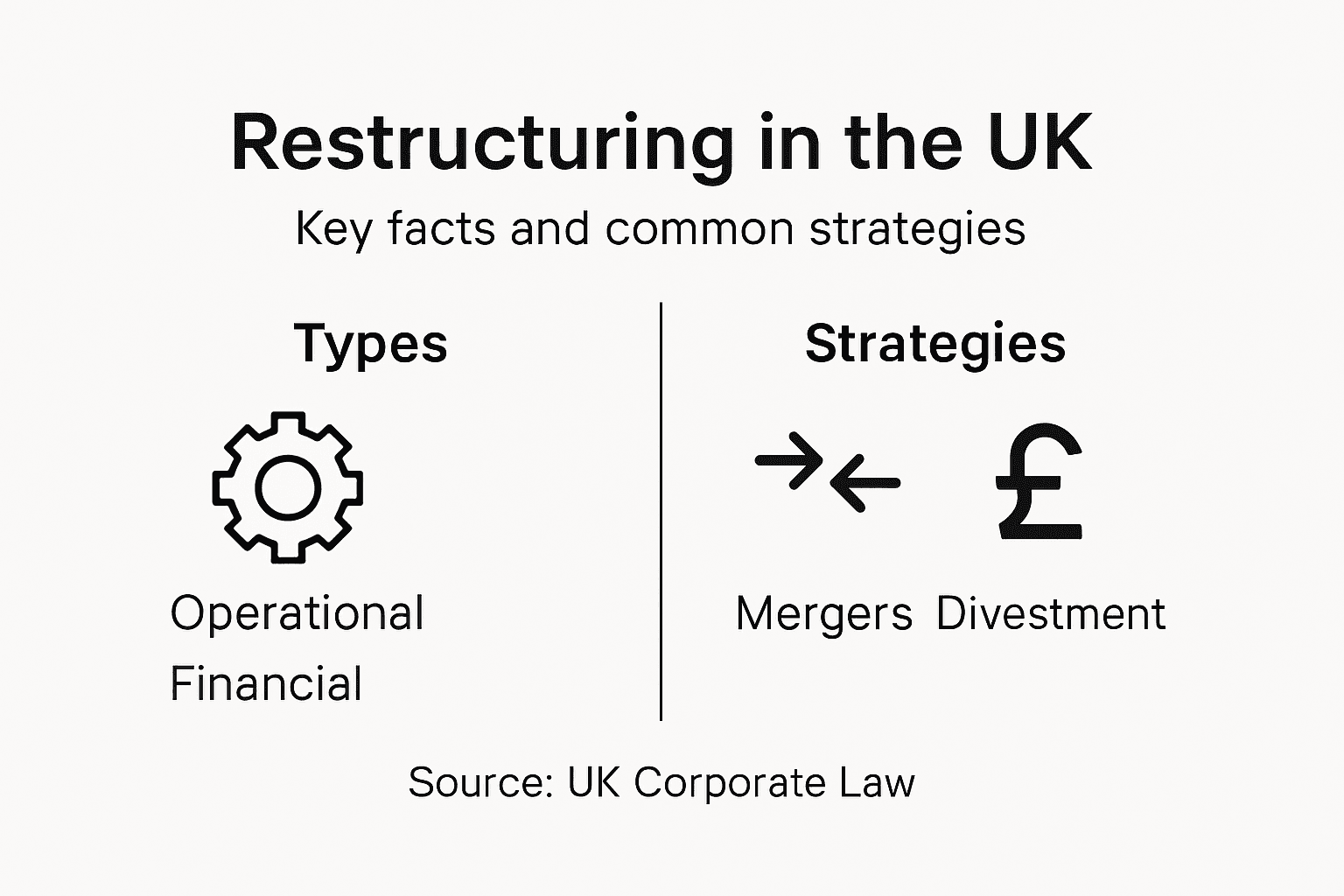
Corporate restructuring encompasses a diverse range of strategic approaches designed to transform and optimise business operations. Corporate restructuring strategies in the United Kingdom involve multifaceted processes that address financial, legal, and organisational dimensions of a company’s structure.
The primary types of corporate restructuring can be categorised into several key strategies:
Each restructuring strategy requires careful planning and precise execution. Financial restructuring often involves complex negotiations with creditors, shareholders, and financial institutions to realign the company’s monetary framework. Legal restructuring might include changing the business’s legal form, such as transitioning from a limited company to a limited liability partnership.
Strategic restructuring is not about drastic changes, but calculated and methodical transformation.
Operational restructuring focuses on enhancing efficiency by streamlining processes, eliminating redundant roles, and realigning departments to create a more agile and competitive organisational structure.

Pro tip: Conduct a comprehensive internal audit before initiating any restructuring to identify precise areas requiring strategic intervention.
The UK’s corporate restructuring landscape is governed by a complex legal framework of key legislative acts, primarily encompassing the Insolvency Act 1986, Companies Act 2006, and the Corporate Insolvency and Governance Act 2020. These statutes provide comprehensive guidelines for directors navigating financial challenges and corporate transformation.
Directors have critical legal responsibilities during restructuring processes, which include:
The legal mechanisms available for restructuring include various court-supervised procedures such as:
Directors must balance legal compliance with strategic business preservation.
Specifically, directors must exercise extreme caution when a company approaches financial difficulty, as their decision-making becomes critically scrutinised under legal frameworks. Failure to act responsibly can result in personal liability and potential disqualification.
The following table summarises how different restructuring procedures impact major stakeholder groups in UK companies:
| Procedure | Impact on Shareholders | Impact on Creditors | Role of Directors |
|---|---|---|---|
| Restructuring Plan | May dilute ownership, but can preserve future value | Must consider proposals; claims may be adjusted | Lead planning, ensure fair treatment and compliance |
| CVA | May affect dividend prospects | Negotiated settlements, possible losses | Facilitate negotiations, uphold legal duties |
| Administration | Shareholder control reduced | Rescue or repayment prioritised | Manage operations under administrator supervision |
| Scheme of Arrangement | Shareholder votes needed | Creditor consent critical | Coordinate court process, maintain transparency |
Pro tip: Maintain meticulous records of all decision-making processes and seek independent legal advice before implementing significant restructuring measures.
Corporate restructuring requires a systematic approach, beginning with comprehensive financial review and early intervention. The process demands meticulous planning, stakeholder engagement, and strategic decision-making to navigate complex financial challenges effectively.
The primary practical steps for corporate restructuring typically include:
The key procedural routes for UK corporate restructuring involve several critical stages:
Successful restructuring balances legal compliance with strategic business preservation.
Licensed insolvency practitioners play a crucial role in managing and overseeing restructuring proceedings, ensuring transparency and adherence to statutory requirements. They provide independent assessment and guidance throughout the complex transformation process.
Pro tip: Engage specialised legal and financial professionals early to develop a comprehensive restructuring strategy that minimises potential risks and maximises business continuity.
Corporate restructuring presents significant challenges, with numerous potential risks that demand careful navigation. Directors must approach the process with strategic precision, understanding the complex financial and legal landscape that could potentially compromise the entire restructuring effort.
The primary risks and potential pitfalls in corporate restructuring include:
Critical cost considerations for UK corporate restructuring involve multiple expense categories:
Strategic planning is the most effective risk mitigation strategy in corporate restructuring.
Common pitfalls that companies must carefully avoid include inadequate stakeholder communication, incomplete financial assessments, and failing to develop comprehensive restructuring proposals that address all potential contingencies.
The table below compares common risks and their mitigation strategies during corporate restructuring in the UK:
| Risk Type | Example Challenge | Mitigation Strategy |
|---|---|---|
| Financial Risk | Cash flow instability | Early budgeting and monitoring |
| Legal Risk | Directors’ liability exposure | Seek expert legal guidance |
| Operational Risk | Loss of staff morale | Regular stakeholder communication |
| Reputational Risk | Negative media coverage | Provide transparent updates |
Pro tip: Conduct a rigorous pre-restructuring risk assessment and maintain transparent communication with all key stakeholders to minimise potential complications.
Corporate restructuring presents complex legal challenges that demand precise strategy and expert guidance. Whether you need help understanding director duties, managing financial risks, evaluating restructuring plans or navigating legal frameworks in the United Kingdom, Ali Legal stands ready to support your business transformation with transparency and speed. Avoid costly pitfalls and ensure compliance by partnering with specialists who prioritise clear communication and tailored advice.

Take control of your company’s future with Ali Legal’s professional corporate and commercial law services. Act now to minimise risks and protect stakeholder interests through strategic legal support designed to deliver straightforward solutions. Contact us today to arrange a consultation and gain peace of mind through expert guidance tailored to your restructuring needs. Visit Ali Legal Contact Page for prompt assistance and explore how our dedicated team can help you achieve a successful restructuring outcome.
Corporate restructuring is a strategic process where businesses reorganise their operational, financial, and legal frameworks to improve performance, mitigate risks, and adapt to changing market conditions.
The key types of corporate restructuring include financial restructuring, legal restructuring, and operational restructuring, each focusing on different aspects such as debt management, legal entity changes, and operational efficiency.
Potential risks include financial risks like cash flow disruptions, legal risks such as non-compliance with regulations, operational risks affecting business continuity, and reputational risks from negative public perception.
Directors can ensure compliance by understanding their fiduciary duties, maintaining financial transparency, seeking expert legal guidance, and documenting all decision-making processes meticulously.


