
Menu
Get Expert Legal Support Today

TL;DR:
- Legal advocacy extends beyond courtroom appearances to negotiation, written submissions, and strategic planning.
- Quality legal advocacy provides significant economic and social returns, improving case outcomes and reducing harm.
- Trauma-informed, adaptable approaches combined with traditional advocacy skills are essential for effective client support.
Most people picture legal advocacy as a solicitor standing up in court, making arguments before a judge. That picture is incomplete. Effective legal advocacy spans negotiation rooms, written submissions, strategic planning sessions, and trauma-sensitive client interviews, long before a courtroom is ever entered. Research confirms that quality legal advocacy delivers measurable economic and social returns for individuals and organisations alike. This guide explains what genuine advocacy involves, who benefits most, and how the field is evolving to meet the demands of 2026 and beyond.
| Point | Details |
|---|---|
| Beyond the courtroom | Legal advocacy supports clients through strategy, negotiation, and relationship-building, not just in court. |
| Empirical benefits | Evidence shows high ROI, better outcomes, and increased satisfaction from quality advocacy. |
| Holistic approaches | Trauma-informed and client-centred advocacy models improve both wellbeing and case results. |
| Adaptability is crucial | Modern advocacy combines tradition, trauma awareness, and digital skills to handle complex cases. |
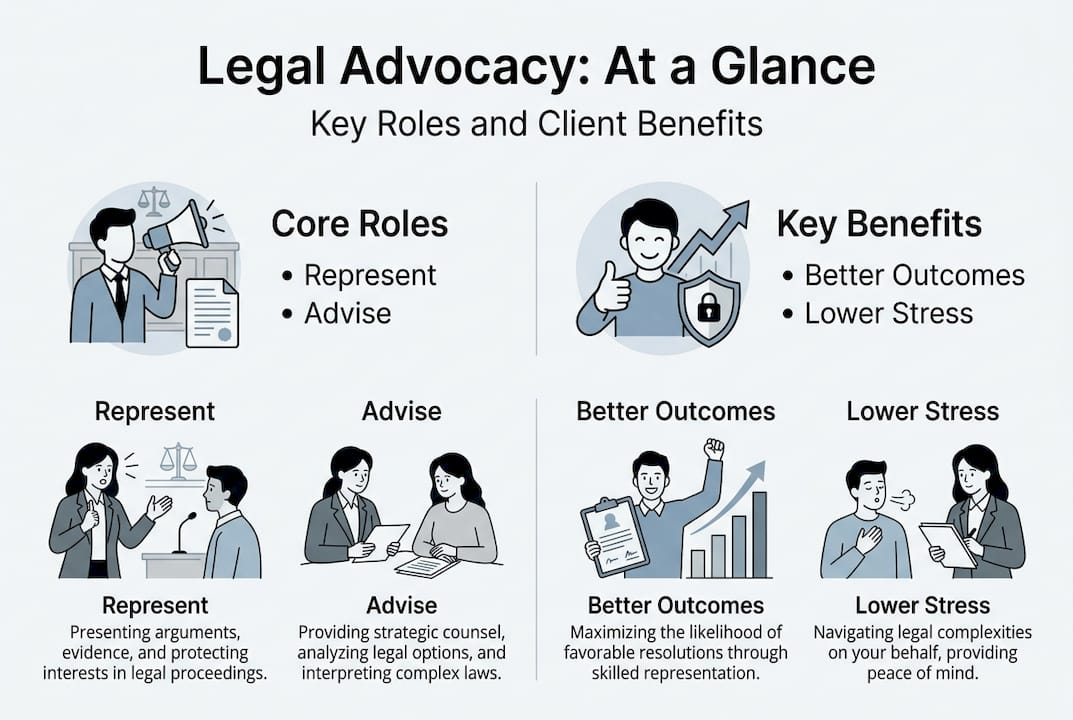
Legal advocacy is the professional practice of advancing a client’s interests through a combination of representation, strategic advice, negotiation, and sustained relationship management. It is not limited to appearing in court. A skilled advocate works across every stage of a legal matter, from initial fact-gathering to settlement discussions to, where necessary, contested hearings.
Legal advocacy involves representing clients’ interests through zealous representation, strategic counselling, and client-centred approaches across civil, criminal, family, and immigration law. Understanding the meaning of legal representation helps clarify why this breadth matters: representation is not a single act but an ongoing commitment to a client’s position.
The table below summarises how advocacy actions differ across common practice areas:
| Practice area | Key advocacy actions |
|---|---|
| Civil litigation | Evidence gathering, pleadings, negotiation, trial representation |
| Family law | Mediation support, financial disclosure, child arrangements |
| Immigration | Appeals, asylum submissions, removal challenges |
| Criminal law | Bail applications, plea negotiations, trial defence |
| Corporate and commercial | Contract disputes, regulatory advice, arbitration |
Across all of these areas, certain skills remain constant. Strong advocates share a recognisable set of core competencies:
These skills are not innate. They are developed through training, experience, and a genuine commitment to client outcomes rather than process for its own sake.
The case for investing in quality legal advocacy is not just intuitive. It is backed by data. Legal aid and advocacy yield a median return on investment of £6.77 for every £1 spent, improving representation and reducing harmful outcomes for clients across multiple legal areas.

The numbers are equally striking in immigration matters. Legal representation increases successful case representation by 4.6 percentage points and reduces wrongful immigration removals by 6.4 percentage points. These are not marginal gains. They represent real people keeping their homes, their families, and their futures intact.
The table below illustrates the contrast between cases handled with and without professional advocacy:
| Outcome measure | With advocacy | Without advocacy |
|---|---|---|
| Favourable resolution rate | Significantly higher | Markedly lower |
| Client understanding of process | High | Often poor |
| Financial cost over time | Lower (fewer appeals) | Higher (errors and delays) |
| Emotional impact on client | Managed and supported | Often severe |
| Risk of wrongful outcome | Reduced | Elevated |
For businesses, the return is equally compelling. Commercial disputes left unmanaged escalate quickly. Contracts misread or poorly negotiated lead to costly litigation. Proactive relationship-based legal services reduce that risk by keeping legal strategy aligned with business goals from the outset.
Advocacy delivers the most measurable value in these situations:
Understanding legal aid benefits is also important for individuals who may qualify for funded support, as access to advocacy should not be determined solely by financial means.
Data tells part of the story. How advocacy is delivered tells the rest. For many clients, particularly those involved in family proceedings, asylum claims, or domestic abuse cases, the legal process itself can be deeply distressing. A technically correct approach that ignores the human dimension often fails in practice.
Trauma-informed advocacy addresses trust, safety, somatic awareness, and restorative needs to avoid re-traumatisation and genuinely support vulnerable clients through the legal process. This is not a soft add-on. It is a core competency for any advocate working in sensitive areas.
The four foundational pillars of trauma-informed practice are:
Pro Tip: In sensitive interviews, avoid rapid-fire questioning. Pause after difficult disclosures, use open-ended questions, and never express surprise or disbelief at a client’s account. These habits protect the integrity of the evidence and the wellbeing of the client simultaneously.
The importance of clear communication in advocacy cannot be overstated in trauma-sensitive contexts. Clients who understand what is happening and why are far more likely to engage effectively with their own case. For family law matters in particular, holistic advocacy that accounts for emotional as well as legal needs consistently produces better outcomes for all parties involved.
Even experienced advocates encounter situations where the standard playbook does not apply. These edge cases reveal the true depth of legal skill required in modern practice.
“Try the case you have, not the one you wish you had.” This principle is central to effective advocacy. It means working honestly with the evidence available, however imperfect, rather than building a strategy around an idealised version of events that the facts cannot support.
Modern advocacy faces challenges from trauma-affected memory, doctrinal ambiguity, AI-era credibility questions, and structural power imbalances in court. Each of these demands a specific, nuanced response.
Key challenges in complex and edge-case advocacy include:
Choosing an advocate with modern, nuanced skills means asking the right questions. Do they understand digital evidence? Can they explain how they would approach a case where the facts are genuinely ambiguous? Understanding the role of mediators in resolving complex disputes is also valuable, as skilled advocates know when litigation is the right path and when alternative resolution serves the client better. Good preparation for consultation helps you assess this from your very first meeting.
There is a temptation in legal practice to treat tradition and innovation as opposites. We do not see it that way. The core of effective advocacy, zealous representation, rigorous preparation, and honest client communication, has not changed. What has changed is the environment in which those principles must operate.
Clients today face AI-generated evidence, cross-border disputes, and legal processes that move faster than ever. An advocate who relies solely on traditional courtroom instincts will miss critical details. Equally, an advocate who chases every technological trend without grounding it in sound legal principle will lack the credibility that courts and opposing parties respect.
The most effective advocates we see are those who combine both. They apply proactive legal strategies that anticipate problems before they escalate, while remaining genuinely responsive to the human realities their clients face. Assuming one style fits every client and every case is, in our view, the single biggest mistake an advocate can make. The law is not a formula. Neither are the people it affects.
Understanding what quality advocacy looks like is the first step. Finding a team that actually delivers it is the next.

At Ali Legal, we apply strategic, trauma-informed, and technology-aware advocacy across civil litigation, family and divorce matters, and immigration cases. Our clients benefit from transparent processes, evidence-based strategy, and empathetic support at every stage. We offer fixed fees and straightforward advice, so you always know where you stand. If you are ready to discuss your situation with a solicitor who will listen and act, contact Ali Legal today.
Legal advocates represent, advise, negotiate, and support clients across legal settings, working both in and out of court to secure the best possible outcomes for their clients.
Trauma-informed practice ensures clients feel safe and understood throughout proceedings, significantly reducing the risk of additional distress, particularly in sensitive family or immigration matters.
Studies confirm that legal advocacy delivers a strong return on investment, improves representation rates, and reduces harmful outcomes such as wrongful removals or failed claims.
AI and digital processes are reshaping how evidence is gathered and assessed, making credibility, technical literacy, and strategic expertise more important than ever for effective advocates.


