
Menu
Get Expert Legal Support Today

Surprisingly, 82% of companies faced at least one lawsuit in 2024, a figure that catches many businesses off guard. The financial toll extends beyond immediate legal fees, disrupting operations and draining resources that could fuel growth. Reactive legal approaches, where you address problems only after they arise, often cost substantially more over time than preventative strategies. This article explains why proactive legal advice matters, how it reduces risks and disputes before they escalate, and practical steps you can take to integrate forward-thinking legal guidance into your business or personal affairs. You’ll discover the financial impact of ignoring early intervention, common barriers to adoption, and actionable frameworks for embedding legal foresight into decision making.
| Point | Details |
|---|---|
| Proactive legal advice | Proactive legal advice reduces risk and avoids costly disputes by addressing issues before they escalate. |
| Strategy integration | Integrating legal foresight into planning and decision making aligns actions with obligations and minimises disruption. |
| Mindset barrier | The main barrier is viewing legal counsel as a cost rather than a strategic investment. |
| AI and legal design tools | Modern methods such as AI and legal design enhance foresight by analysing contracts and flagging risks. |
| Ongoing legal support | Ongoing guidance helps individuals and businesses navigate complexity and stay compliant. |
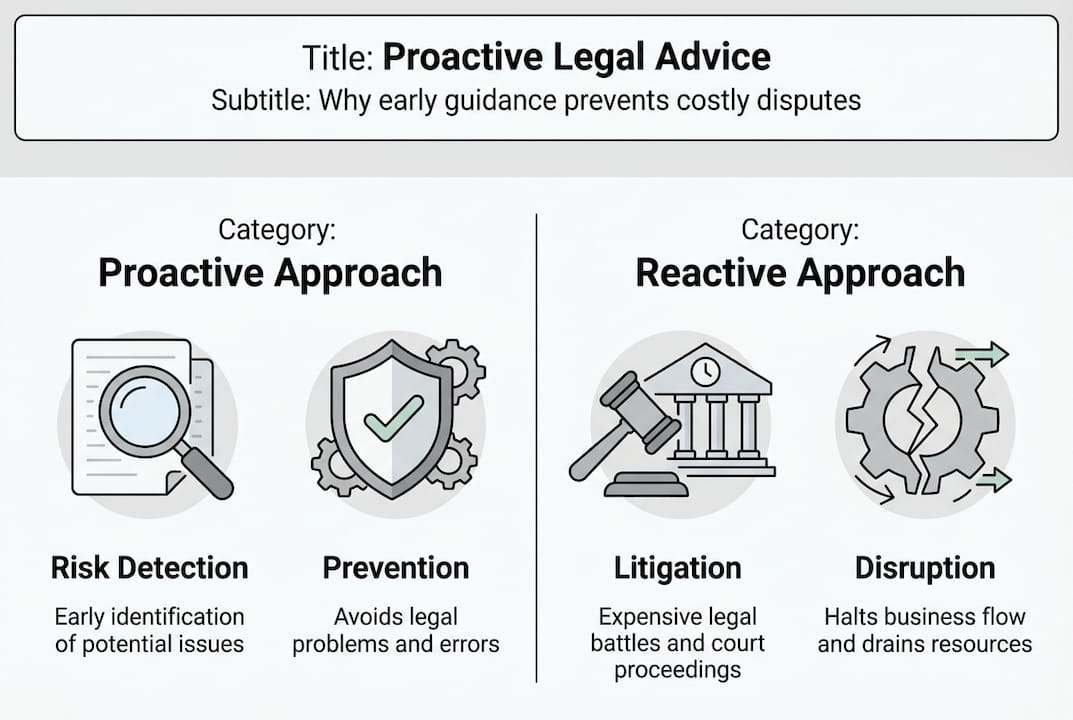
Proactive legal advice means seeking anticipatory legal guidance to prevent problems rather than reacting after disputes arise. Instead of calling a solicitor only when litigation threatens, you integrate legal counsel into planning, contracts, policies, and strategic decisions from the outset. This approach contrasts sharply with the traditional reactive model, where legal teams function primarily as problem solvers addressing crises after they occur.
Modern proactive law methodologies involve anticipatory approaches integrating legal foresight into business strategy using systems intelligence, legal design, and AI tools. Systems intelligence examines how legal risks interconnect with operational, financial, and reputational factors. Legal design simplifies complex regulations into user-friendly frameworks, making compliance intuitive rather than burdensome. AI tools analyse contracts, flag risks, and predict dispute patterns before they materialise.
The benefits of this shift are substantial. Early risk detection allows you to address vulnerabilities when solutions remain straightforward and affordable. Integrating legal advice with business strategy ensures decisions align with regulatory requirements and minimise exposure. Cost savings accumulate as you avoid expensive litigation, regulatory penalties, and operational disruptions. Your organisation gains confidence navigating complexity, knowing risks are managed systematically rather than reactively.
Pro Tip: The biggest barrier to proactive legal advice isn’t cost, it’s mindset. Shifting from viewing legal counsel as a reactive expense to recognising it as strategic investment unlocks the full value of anticipatory guidance.
Consider how legal risk management UK business frameworks embed legal foresight into governance structures. Companies that adopt proactive approaches report fewer disputes, smoother operations, and stronger stakeholder confidence. Whether you’re an individual planning estate arrangements or a business expanding into new markets, anticipatory legal guidance helps you move forward with clarity and reduced risk.
The financial stakes of reactive legal approaches become clear when examining litigation data. Average litigation spend for large companies reached $4.3M, up from $3.9M, reflecting rising costs across legal services, expert witnesses, and prolonged dispute resolution. For small and medium enterprises, even a single lawsuit can strain budgets and divert management attention from core business activities.
“82% of companies were involved in at least one lawsuit in 2024, with average litigation spend for large companies reaching $4.3M, up from $3.9M.”
Reactive legal action creates a cascade of expenses beyond direct legal fees. Emergency responses to disputes demand premium rates for urgent counsel. Prolonged litigation disrupts operations, consuming executive time and delaying strategic initiatives. Reputational damage from public disputes can erode customer trust and market position. Settlement costs often exceed what preventative measures would have required, particularly when disputes escalate due to delayed intervention.

Cybersecurity-related litigation illustrates the growing exposure businesses face. Empirical benchmarks show litigation risks elevated, with cybersecurity disputes up 38%, driven by data breaches, privacy violations, and regulatory enforcement. Companies without proactive cybersecurity policies and legal frameworks face higher liability when incidents occur. Early legal intervention to establish robust data protection measures, incident response plans, and compliance protocols significantly reduces this exposure.
The operational impact extends beyond immediate costs. Reactive legal crises distract leadership from strategic priorities, delay product launches, and create uncertainty that hampers decision making. Employee morale suffers when legal disputes dominate management attention. Supplier and partner relationships strain under the weight of unresolved legal uncertainties.
| Approach | Average Annual Cost | Dispute Frequency | Operational Disruption | Organisational Confidence |
|---|---|---|---|---|
| Reactive Legal | £150,000+ | High (multiple disputes) | Severe (weeks to months) | Low (uncertainty prevails) |
| Proactive Legal | £45,000-£75,000 | Low (early resolution) | Minimal (hours to days) | High (risks managed) |
The table above compares typical outcomes for businesses relying on reactive versus proactive legal strategies. Proactive approaches reduce both direct costs and indirect operational impacts, while increasing organisational confidence through systematic risk management.
Understanding the role legal counsel business UK plays in strategic planning helps you appreciate how early intervention prevents costly disputes. Legal counsel embedded in decision making identifies risks before they materialise, designs contracts that prevent misunderstandings, and ensures compliance with evolving regulations. This integration transforms legal advice from a reactive cost centre into a strategic asset that protects value and enables growth.
Adopting proactive legal advice faces several obstacles, even when the benefits are clear. Challenges include entrenched reactive mindsets, difficulty quantifying prevention benefits, budget constraints, and organisational silos that isolate legal input from operational decisions. Recognising these barriers helps you develop targeted solutions to embed forward-thinking legal guidance into your culture.
Educate leadership to shift mentality from reactive to proactive. Executives accustomed to calling solicitors only during crises need evidence that preventative legal advice delivers measurable value. Present case studies showing cost savings, reduced disputes, and smoother operations achieved through proactive approaches. Highlight how competitors gain advantages by integrating legal foresight into strategy. Leadership buy-in is essential for allocating resources and championing cultural change across the organisation.
Introduce metrics for prevention impact and early wins tracking. The difficulty quantifying prevention benefits stems from measuring what didn’t happen. Develop metrics tracking disputes avoided, compliance gaps closed before enforcement, and contract terms that prevented misunderstandings. Monitor time saved by addressing issues early versus managing full-blown crises. Track early wins where proactive advice delivered clear value, using these examples to build momentum and demonstrate return on investment.
Use flexible billing like legal retainers to manage costs. Budget constraints often prevent businesses from seeking legal advice until problems become urgent. Legal retainer UK business arrangements provide predictable monthly costs for ongoing access to legal counsel, making proactive advice affordable and accessible. Retainers eliminate the sticker shock of hourly billing, encouraging you to consult solicitors early when guidance is most effective and least expensive.
Promote interdepartmental collaboration to integrate legal input early. Organisational silos isolate legal teams from operational decisions where their input would prevent risks. Establish processes requiring legal review of contracts, policies, and strategic initiatives before implementation. Include legal representatives in planning meetings, product development discussions, and risk assessments. Cross-functional collaboration ensures legal foresight informs decisions at the point where it delivers maximum value.
Pro Tip: Small wins build momentum and prove proactive advice value. Start with one high-visibility project where early legal input prevents a known risk, then use that success to advocate for broader adoption of preventative approaches.
Cultural resistance often proves the most stubborn barrier. Teams accustomed to reactive firefighting may view proactive legal engagement as unnecessary bureaucracy. Address this by demonstrating how early legal input accelerates rather than delays projects, preventing the costly rework and disputes that truly bog down operations. Celebrate successes where proactive advice enabled smooth execution, reinforcing the value of anticipatory guidance.
Translating the concept of proactive legal advice into practice requires systematic steps tailored to your specific circumstances. Whether you’re an individual managing personal legal affairs or a business navigating commercial complexity, the following framework helps you embed legal foresight into decision making.
Step 1: Assess current legal risks and reactive tendencies objectively. Begin by identifying areas where you’ve faced legal problems or near-misses in the past. Review contracts that led to disputes, compliance gaps that attracted regulatory attention, and decisions made without legal input that created unexpected liabilities. This assessment reveals patterns showing where proactive advice would deliver the greatest impact. Be honest about reactive tendencies, recognising that acknowledging them is the first step toward change.
Step 2: Integrate AI tools and systems thinking for early risk detection. Proactive law requires interdisciplinary tools for value creation over mere compliance. AI-powered contract analysis platforms flag problematic clauses, inconsistencies, and missing protections before you sign agreements. Systems thinking examines how legal risks interconnect with operational, financial, and reputational factors, revealing vulnerabilities that isolated analysis misses. These tools enable you to identify and address risks early, when solutions remain straightforward and affordable.
Step 3: Establish ongoing legal retainer or proactive counsel relationship. Sporadic legal consultations during crises cost more and deliver less value than continuous access to legal guidance. Ongoing legal support UK SMEs arrangements provide regular touchpoints with solicitors who understand your business, enabling them to offer contextual advice tailored to your evolving needs. Retainers make proactive consultation affordable and accessible, removing the barrier of hourly billing that discourages early engagement.
Step 4: Prepare thoroughly for legal consultations for tailored advice. Maximise the value of every legal interaction by following a legal consultation preparation guide that ensures you provide complete information and ask focused questions. Preparation enables solicitors to deliver specific, actionable guidance rather than generic advice. Bring relevant documents, timelines, and clearly articulated objectives to each consultation, allowing legal counsel to address your unique circumstances efficiently.
| Service Model | Risk Detection | Cost Structure | Relationship Depth | Technology Integration |
|---|---|---|---|---|
| Traditional Reactive | After problems arise | Hourly billing (variable) | Transactional | Limited |
| AI-Enhanced Proactive | Continuous monitoring | Fixed retainer | Strategic partnership | Extensive (AI analysis, predictive tools) |
The table above compares traditional reactive legal services with AI-enhanced proactive approaches. Modern proactive models leverage technology for continuous risk monitoring, offer predictable costs through retainers, and build strategic partnerships rather than transactional relationships. Understanding these differences helps you select the right legal support model for your needs.
Best practices for embedding legal foresight into decision making include:
Exploring corporate legal solutions comparison resources helps you evaluate different service models and select the approach that aligns with your risk profile, budget, and strategic objectives. The right solution balances accessibility, expertise, and cost-effectiveness while supporting your shift toward proactive legal management.
Navigating the shift from reactive to proactive legal management becomes significantly easier with expert guidance tailored to your specific circumstances. Ali Legal offers comprehensive civil litigation services when disputes arise, but the firm’s real strength lies in preventing those disputes through anticipatory legal counsel. Our commercial litigation expertise informs proactive contract design, risk assessment, and compliance frameworks that protect your interests before conflicts emerge.

Clients benefit from legal retainers for businesses that provide ongoing access to experienced solicitors who understand your operations, industry challenges, and strategic objectives. This continuity enables early risk detection, contextual advice, and responsive support as your circumstances evolve. Our legal teams combine traditional expertise with modern tools, including AI-enhanced contract analysis and systems-based risk assessment, to deliver proactive guidance that prevents costly disputes and operational disruptions. Contact Ali Legal today to discuss how tailored proactive legal solutions can protect your interests and support your long-term success.
Proactive legal advice prevents expensive disputes, regulatory penalties, and operational disruptions that reactive approaches allow to develop. Early intervention addresses risks when solutions remain straightforward and affordable, avoiding the premium costs of emergency legal responses. Over time, the cumulative savings from prevented litigation and smoother operations substantially exceed the investment in ongoing legal counsel.
Businesses struggle with entrenched reactive mindsets that view legal advice as a crisis expense rather than strategic investment. Difficulty quantifying prevention benefits makes it hard to justify upfront costs, while budget constraints and organisational silos prevent early legal engagement. Cultural resistance from teams accustomed to reactive firefighting also slows adoption of anticipatory approaches.
AI-powered tools analyse contracts, policies, and communications to flag problematic clauses, inconsistencies, and compliance gaps before they create liability. Machine learning algorithms identify patterns predicting dispute risks based on historical data, enabling preventative action. These technologies process large volumes of information faster and more consistently than manual review, catching vulnerabilities that human analysis might miss.
Individuals gain substantial value from proactive legal advice in estate planning, property transactions, family arrangements, and immigration matters. Early consultation prevents costly mistakes, ensures documents reflect your intentions, and reduces the likelihood of disputes among beneficiaries or parties. Proactive guidance helps you navigate life transitions smoothly, protecting your interests and those of your loved ones.
Begin by assessing current legal risks and identifying areas where reactive approaches have created problems. Establish a legal retainer providing ongoing access to counsel, then create triggers requiring legal review before major decisions. Schedule regular risk assessments, promote cross-functional collaboration involving legal input early, and track metrics showing prevention impact to build momentum and demonstrate value.


