
Menu
Get Expert Legal Support Today

Over 60 percent of British small businesses report unexpected legal costs each year. For busy business owners, unpredictable legal issues disrupt growth and drain valuable resources. Understanding legal retainers helps British companies plan ahead, maintain financial control, and build a steady relationship with legal experts. This guide offers clarity on how legal retainers work, their core benefits, and practical strategies for choosing the right arrangement.
A legal retainer represents a strategic ongoing arrangement where businesses secure continuous legal support through predictable financial agreements. In the United Kingdom, these arrangements enable companies to access professional legal counsel proactively, transforming traditional reactive legal services into a more dynamic and efficient model.
Under a legal retainer, businesses typically pay a law firm a regular monthly fee for predetermined legal service access. This approach allows organisations to manage legal risks more effectively by having immediate access to expert advice without incurring substantial per-hour consultation charges. The most common retainer structures include fixed monthly payments, prepaid hour packages, and hybrid models that provide flexibility based on each business’s unique requirements.
The primary advantages of legal retainers for UK businesses centre around predictability, cost management, and strategic risk mitigation. Instead of waiting for legal issues to emerge, companies can proactively engage legal professionals who understand their specific operational context. This ongoing relationship means lawyers become familiar with the organisation’s challenges, enabling more nuanced and contextually appropriate legal guidance.
Pro tip: Before selecting a legal retainer, carefully review the specific services included and ensure they align precisely with your business’s anticipated legal requirements.
Legal retainers in the United Kingdom demonstrate remarkable flexibility, offering businesses multiple structured approaches to securing ongoing legal support. Distinct retainer models provide organisations with tailored strategies for managing their legal service requirements, each designed to address specific operational needs and budgetary constraints.
Three primary retainer types dominate the UK legal landscape. Access retainers prioritise immediate lawyer availability, ensuring businesses can rapidly obtain professional guidance during critical moments. Prepaid hourly retainers offer clients predetermined legal service blocks, allowing precise tracking and management of legal expenditure. Outcome-based retainers represent a more specialised model, focusing on delivering specific legal deliverables at a fixed price, which provides enhanced predictability for complex projects.
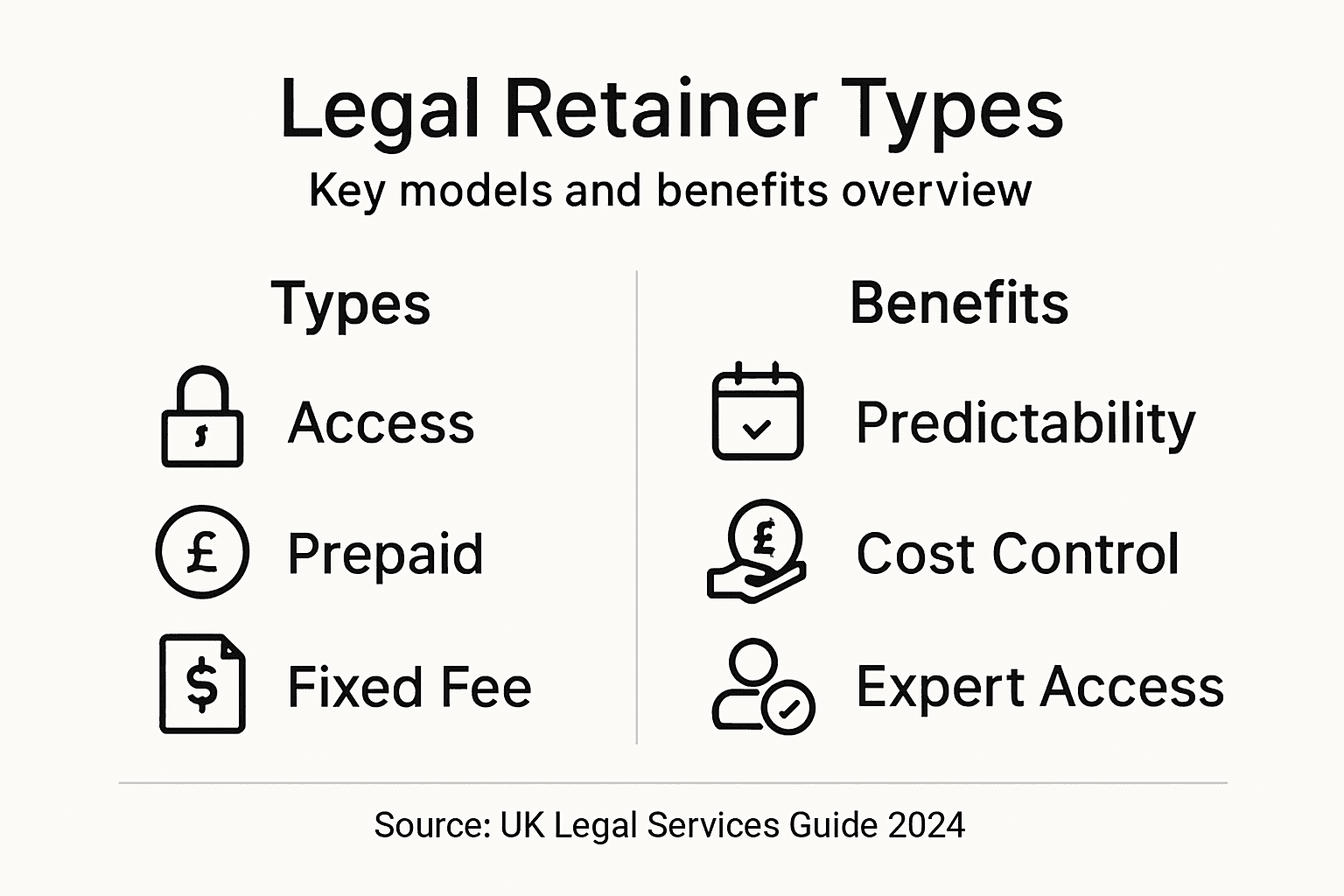
The nuanced differences between these retainer models extend beyond simple pricing structures. Access retainers emphasise responsiveness, prepaid retainers concentrate on usage tracking, and outcome-based retainers prioritise precise deliverable achievement. Organisations must carefully evaluate their specific legal support requirements, considering factors such as anticipated legal complexity, budget limitations, and the desired depth of ongoing legal counsel.
Here is a comparison of the main legal retainer types available to UK businesses:
| Retainer Type | Key Feature | Typical Use Case | Main Benefit |
|---|---|---|---|
| Access Retainer | Immediate legal access | Rapid guidance for urgent issues | Ensures fast response times |
| Prepaid Hourly | Fixed block of service hours | Organisations with fluctuating legal use | Accurate control of legal costs |
| Outcome-Based | Specific results for set fee | Project-based or complex legal matters | Clear deliverables, no surprises |
Pro tip: Conduct a comprehensive internal audit of your organisation’s legal needs before selecting a retainer model to ensure optimal alignment between service provision and operational requirements.
Legal retainer agreements represent sophisticated contractual frameworks designed to establish clear expectations between businesses and their legal service providers. Role of legal counsel becomes critically important in defining the precise parameters of these professional relationships, ensuring both parties understand their responsibilities and limitations.
A typical legal retainer agreement comprises several fundamental components. These include clearly defined service scope, specific fee structures, response time expectations, and comprehensive communication protocols. Businesses must negotiate detailed terms such as the number of consultation hours, types of legal services covered, hourly rates for additional work, and explicit boundaries of the retainer’s coverage. This meticulous approach prevents misunderstandings and provides businesses with predictable legal support mechanisms.

The practical implementation of retainer agreements involves ongoing collaboration and periodic review. Organisations should establish regular check-in meetings to assess the effectiveness of their legal support, evaluate emerging business needs, and adjust the retainer agreement accordingly. Successful retainer relationships depend on transparent communication, mutual understanding of business objectives, and the legal team’s ability to provide proactive, strategic guidance tailored to the specific industry and operational context of the client.
Pro tip: Document all interactions and maintain a comprehensive record of services rendered to ensure transparency and facilitate future contract negotiations.
Clients entering legal retainer agreements must understand their comprehensive set of obligations and responsibilities. Contract law principles dictate that businesses have critical duties beyond simply paying legal fees, encompassing transparent communication, timely information sharing, and active engagement with their legal representatives.
Under UK legal frameworks, clients bear specific responsibilities that extend throughout the retainer relationship. These include providing complete and accurate information, maintaining confidentiality, responding promptly to legal communication, and adhering to agreed payment terms. Businesses must proactively disclose all relevant details pertaining to potential legal matters, ensuring their solicitors have comprehensive context to provide effective strategic advice. Failure to meet these fundamental obligations can compromise the effectiveness of legal representation and potentially expose the organisation to additional legal risks.
The retainer agreement itself serves as a binding document that explicitly outlines mutual expectations and responsibilities. Clients should meticulously review the document, understanding key provisions such as fee structures, service scope, communication protocols, and potential additional charges. This careful approach helps prevent misunderstandings, establishes clear performance benchmarks, and creates a transparent framework for ongoing legal support. Professional solicitors will typically guide clients through these complex contractual nuances, ensuring both parties comprehend their respective roles and commitments.
Below is an at-a-glance summary of typical client obligations within a legal retainer arrangement:
| Obligation | Description | Business Impact |
|---|---|---|
| Provide Accurate Information | Share all relevant facts with legal counsel | Enables informed legal guidance |
| Respond Promptly | Timely replies to requests from law firm | Prevents delays in legal matters |
| Maintain Confidentiality | Protect both legal and business information | Reduces risk of data breaches |
| Adhere to Agreements | Follow fee and service terms faithfully | Avoids disputes and added charges |
Pro tip: Maintain a dedicated file containing all correspondence, agreements, and communications related to your legal retainer to facilitate smooth future interactions and potential dispute resolution.
Navigating legal retainer agreements requires a strategic approach to managing potential financial and operational risks. Retainer fee considerations demand meticulous attention to prevent unexpected financial burdens and ensure transparent legal partnerships.
Businesses frequently encounter several critical mistakes when establishing legal retainers. These include signing agreements without comprehensive understanding, overlooking refund policies for unused funds, and failing to clarify potential additional charges. Hidden costs can emerge through ambiguous service definitions, unexpected billable hours, or complex fee structures that were not thoroughly examined during initial negotiations. Organisations must scrutinise every clause, understanding precisely what services are included, the mechanisms for drawing down retained funds, and the exact circumstances under which supplementary charges might apply.
Risk mitigation in legal retainer agreements demands a proactive and comprehensive approach. Businesses should develop a systematic process for reviewing proposed agreements, which includes consulting with financial advisors, requesting detailed breakdowns of potential costs, and establishing clear communication channels with legal representatives. Implementing robust internal protocols for tracking legal expenses, maintaining detailed documentation, and regularly reassessing the retainer’s alignment with organisational needs can significantly reduce financial and operational vulnerabilities.
Pro tip: Create a comprehensive checklist of key financial and service terms to review systematically before signing any legal retainer agreement.
Managing ongoing legal needs can feel overwhelming without clear agreements or transparent costs. This article highlights how legal retainers empower UK businesses like yours with predictable fees, immediate access to expert advice, and strategic guidance tailored to your specific challenges. Avoid common pitfalls such as unclear service scopes or unexpected charges by partnering with legal professionals who prioritise transparency and a client-focused approach.
If you want to experience a streamlined legal retainer service that aligns perfectly with your business goals, explore our insights and client advice in the Uncategorized | Ali Legal section.

Take control of your company’s legal future today with Ali Legal’s fixed fee structures and straightforward advice. Contact our dedicated legal team now at https://alilegal.co.uk/contact-us to create a tailored retainer agreement that ensures swift, ongoing support and protects your business interests. Don’t wait for legal issues to arise—get proactive guidance designed for long-term success.
A legal retainer is a continuous arrangement between a business and a law firm that allows the business to access ongoing legal support for a regular predetermined fee. This proactive model helps companies manage legal risks effectively without incurring significant per-hour consultation charges.
There are three primary types of legal retainers: access retainers, which provide immediate lawyer availability; prepaid hourly retainers, which allow clients to purchase predetermined legal service blocks; and outcome-based retainers, which focus on delivering specific legal results at a fixed price.
To choose the right legal retainer, assess your business’s specific legal needs, considering the complexity of legal issues, budget constraints, and the desired level of ongoing counsel. Conducting an internal audit of legal requirements can significantly aid in this decision-making process.
Clients have key responsibilities, including providing accurate and complete information to their legal counsel, responding promptly to communications, maintaining confidentiality, and adhering to the terms of the retainer agreement to ensure effective legal representation.


