
Menu
Get Expert Legal Support Today

Many people wrongly believe mediators decide who wins or loses in legal disputes, when in reality their function is fundamentally different. This misconception can undermine the entire mediation process and lead to frustration for all parties involved. Misunderstanding the mediator’s role as a judge or decision-maker is a common pitfall that affects outcomes. This article clarifies the mediator’s true role as a neutral facilitator, explores how they influence dispute resolution, and provides practical guidance for engaging effectively with mediators to achieve the best possible results in your legal matter.
| Point | Details |
|---|---|
| Mediators facilitate, not decide | They guide dialogue and process without imposing judgements or rulings on parties. |
| Mediation styles are flexible | Most mediators blend evaluative and facilitative techniques rather than adhering to rigid categories. |
| Success depends on preparation | Parties who share information openly and manage expectations realistically achieve better outcomes. |
| Common mistakes harm results | Misusing the mediator, being overly cautious, or holding unrealistic expectations blocks resolution. |
| Statistical evidence supports effectiveness | Mediation yields substantial monetary benefits and resolution rates above 64% in documented cases. |
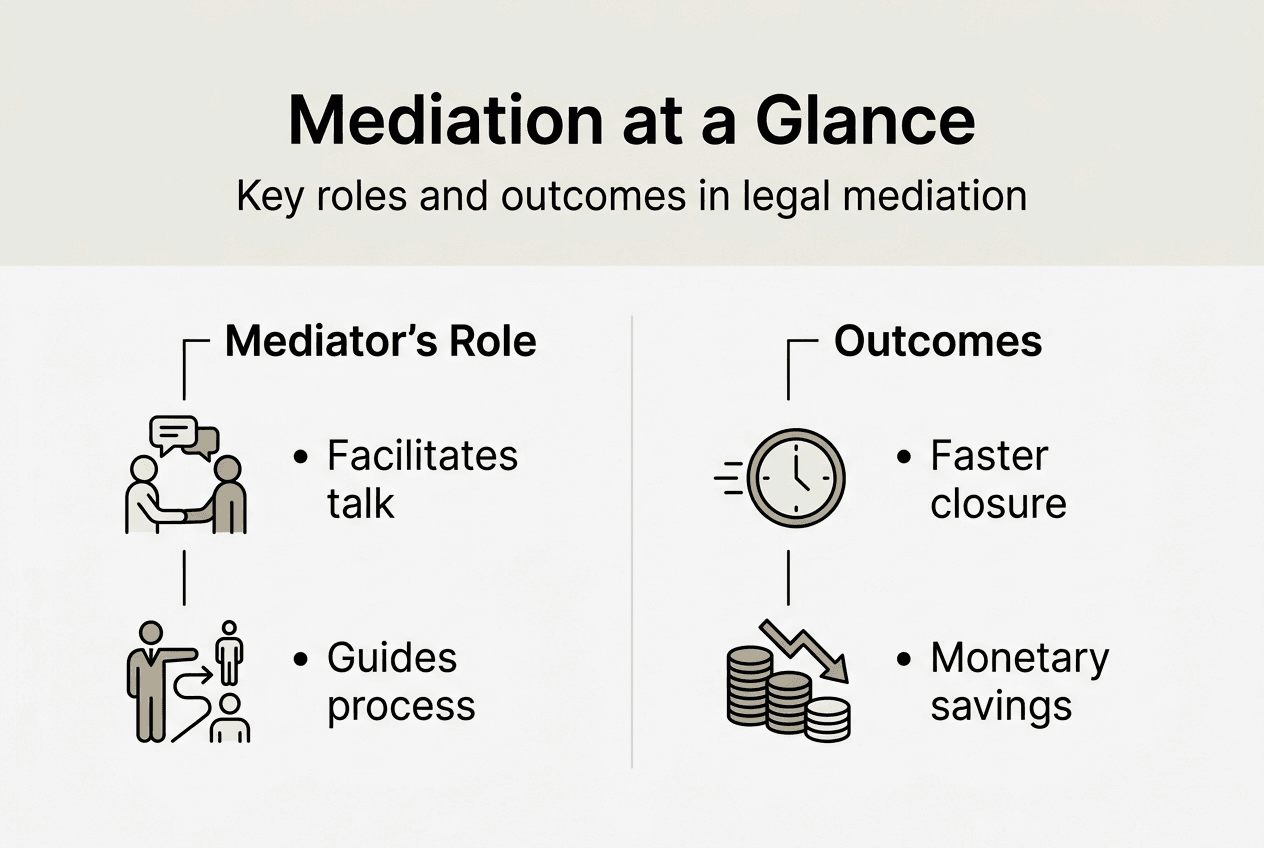
A mediator serves as a neutral facilitator who guides parties through structured dialogue without making decisions about the outcome. Unlike judges who impose rulings or arbitrators who deliver binding decisions, mediators create space for parties to explore solutions collaboratively. This distinction matters enormously because it places control firmly in the hands of the disputing parties themselves.
The traditional framing of mediation styles as purely evaluative versus facilitative is misleading. Most mediators use a range of evaluative techniques tailored to each situation rather than adhering rigidly to one approach. This flexibility allows them to respond dynamically to the unique characteristics of each dispute and the personalities involved.
Historically, early mediation models emphasised facilitative techniques, but the approach has shifted towards greater efficiency in complex litigation. Modern mediators blend methods strategically to improve settlement chances whilst respecting party autonomy. This evolution reflects practical lessons learned from thousands of mediations across diverse legal contexts.
Mediators assist parties to see issues clearly by reframing positions, identifying underlying interests, and highlighting areas of potential agreement. They manage the emotional temperature of discussions, prevent unproductive escalation, and ensure each party feels heard. This mediator impact in legal processes extends beyond simple communication management to strategic guidance that unlocks previously hidden settlement opportunities.
Core mediator functions include:
“The mediator’s role is to help parties navigate complexity and emotion to reach outcomes they can live with, not to judge who is right or wrong.”
This neutral stance allows mediators to build trust with all parties simultaneously. When parties believe the mediator understands their perspective without favouring the opposition, they become more willing to explore compromise and share sensitive information that might unlock resolution.
Mediation yields substantial monetary benefits across documented cases. EEOC mediation monetary benefits ranged from $58.6 million to $170 million between fiscal year 1999 and fiscal year 2020, demonstrating the tangible financial value mediation delivers to parties. These figures represent actual settlements achieved through mediated negotiations rather than protracted litigation.
Resolution rates fluctuated between 64.80% and 77.90% over the same period, indicating that roughly two thirds to three quarters of mediated disputes reach settlement. Whilst these rates vary based on case type, complexity, and party willingness, they consistently exceed the settlement rates achieved through traditional litigation pathways.
The average closure time varied from 81 to 147 days between fiscal year 1999 and fiscal year 2020, significantly faster than court proceedings. This speed advantage reduces legal costs, minimises business disruption, and allows parties to move forward more quickly. Time savings alone often justify choosing mediation over litigation.
| Fiscal Year Range | Monetary Benefits | Resolution Rate | Average Days to Close |
|---|---|---|---|
| FY1999-FY2005 | $58.6M-$95.2M | 69.1%-72.1% | 81-97 days |
| FY2006-FY2012 | $103.8M-$145.7M | 70.4%-72.6% | 89-102 days |
| FY2013-FY2020 | $144.6M-$170M | 64.8%-77.9% | 94-147 days |
Pro Tip: Resolution rates and timelines depend heavily on mediator skill, case complexity, and how well parties prepare. Investing time in thorough preparation and selecting an experienced mediator appropriate for your dispute type dramatically improves your chances of success.
Several variables affect mediation success beyond the mediator’s capabilities:
Understanding these dispute resolution methods for businesses helps parties approach mediation strategically. When parties recognise mediation as a distinct process requiring specific preparation and mindset, they position themselves to capitalise on the statistical advantages mediation offers.
The data reveals that mediation consistently delivers value across thousands of cases, but success is not automatic. Parties who understand how mediators work and engage constructively with the process achieve significantly better outcomes than those who treat mediation as a procedural formality.
Managing client expectations is central to effective mediation because unrealistic expectations cause entrenchment and stall resolution. When parties enter mediation believing they will achieve everything they want without compromise, they inevitably feel disappointed and resist reasonable settlement proposals. This psychological barrier often proves more difficult to overcome than the substantive legal issues.
Mediation requires parties to accept uncertainty and trade the possibility of a complete victory at trial for the certainty of a negotiated outcome. Parties who cannot make this mental shift struggle throughout the process. They interpret the mediator’s reality testing as bias, view reasonable compromise suggestions as weakness, and ultimately waste the opportunity mediation presents.
Common mistakes parties make include fundamentally misunderstanding the mediator’s role, being overly cautious about sharing information, or adopting an excessively assertive stance that alienates the other side. Ineffective use of mediator diminishes a party’s position and persuasiveness, turning a potential advantage into a missed opportunity.

Mediators employ specific strategies to counteract these pitfalls. Many conduct early calls with counsel to align expectations, understand party dynamics, and identify potential obstacles before the formal session. Some prefer starting in caucus rather than joint session to control emotional escalation and build trust individually with each party before bringing them together.
The five most damaging mistakes parties make:
Pro Tip: Use the mediator early and openly for best results. Share your concerns, constraints, and priorities candidly in private caucus. The mediator cannot help you effectively if they lack crucial information about your true interests and limitations.
Successful mediation preparation techniques involve more than assembling documents. Parties must psychologically prepare to compromise, identify their genuine interests beyond stated positions, and develop a realistic assessment of their alternatives to settlement. This mental preparation often determines success more than legal arguments.
When parties understand that mediators work differently from judges, they can leverage the mediator’s unique capabilities. Rather than presenting a case to be judged, parties should view mediation as collaborative problem solving with expert facilitation. This shift in perspective transforms how parties engage and dramatically improves outcomes.
Openness and trust with your mediator forms the foundation of effective engagement. Overly cautious parties fail to share crucial information, limiting mediator effectiveness and reducing settlement chances. Whilst maintaining appropriate confidentiality with the opposing party makes sense, withholding key facts from the mediator in private caucus undermines the entire process.
Mediator confidentiality protections mean you can share sensitive information without it being disclosed to the other side. This allows the mediator to understand the complete picture, identify creative solutions, and reality test proposals based on full knowledge of constraints and priorities. Sharing information empowers the mediator to assist better rather than weakening your position.
| Effective Behaviour | Ineffective Behaviour |
|---|---|
| Sharing interests and constraints openly with mediator | Withholding key information or treating mediator with suspicion |
| Listening actively to other party’s perspective | Interrupting, dismissing, or refusing to acknowledge valid points |
| Exploring creative options beyond initial positions | Rigidly adhering to opening demands without flexibility |
| Reality testing proposals against litigation alternatives | Maintaining unrealistic expectations despite evidence |
| Bringing decision-making authority to sessions | Requiring approval from absent parties for every move |
| Preparing thoroughly with legal advice beforehand | Arriving unprepared or without necessary documentation |
Practical tips for engaging constructively:
Pro Tip: Clarify your goals and be realistic about compromise from the outset. Mediation rewards parties who understand their priorities, recognise their alternatives, and approach settlement pragmatically rather than emotionally.
Effective engagement means viewing the mediator as a resource to be utilised fully rather than an obstacle to be managed. When parties ask the mediator for feedback, test settlement ideas confidentially, and genuinely consider the mediator’s observations, they position themselves to achieve optimal outcomes. This collaborative approach with the mediator, combined with appropriate assertiveness regarding your interests, creates the conditions for successful resolution.
Working with mediators and solicitors requires understanding how these professionals complement each other. Your solicitor advocates for your interests and provides legal advice, whilst the mediator facilitates dialogue and helps generate solutions. Using both effectively means being appropriately assertive with the opposing party whilst being open and collaborative with the mediator.
The parties who achieve the best mediation outcomes are those who prepare thoroughly, engage authentically, and maintain realistic expectations throughout. They use the mediator as a strategic resource, share information appropriately, and focus relentlessly on reaching workable solutions rather than winning arguments.
Navigating mediation effectively requires understanding both the process and how to leverage professional support strategically. Ali Legal provides comprehensive support in civil litigation and commercial disputes, helping clients prepare for mediation, understand mediator roles, and develop realistic settlement strategies. Our solicitors bring extensive experience to strengthen your negotiation position and improve settlement outcomes.

We recognise that effective dispute resolution requires more than legal knowledge. Our team helps you assess your alternatives, identify your genuine interests, and develop a pragmatic approach that maximises your chances of achieving a favourable resolution. Whether you face a commercial disagreement, civil claim, or complex multi-party dispute, our strategic guidance positions you to engage effectively with mediators and opposing parties.
Our transparent fee structures and client-focused approach mean you receive clear advice about your options, realistic assessments of likely outcomes, and practical support throughout the mediation process. We help you avoid common pitfalls, prepare thoroughly, and use mediation as a strategic tool rather than a procedural formality.
A mediator facilitates dialogue and guides the process without deciding the outcome or imposing judgements on parties. They help clarify issues, manage expectations, and create space for parties to explore solutions collaboratively whilst maintaining strict neutrality throughout.
Mediation is collaborative and confidential, unlike binding arbitration or court rulings where a third party imposes a decision. Parties control the outcome and can withdraw at any time, whereas arbitration and litigation result in binding decisions that parties must accept regardless of satisfaction.
Misusing the mediator or expecting them to decide the case undermines the process fundamentally. Being too cautious or aggressive, failing to share key information with the mediator, and holding unrealistic expectations that block reasonable compromise all damage settlement chances significantly.
Identify clear objectives and desired outcomes before the session begins. Engage legal advice to understand the process, your rights, and realistic settlement ranges. Prepare thoroughly by gathering documentation and share relevant information openly with the mediator to assist their facilitation effectively.


