
Menu
Get Expert Legal Support Today

TL;DR:
- Property law governs ownership, use, transfer, and disputes over real and personal property.
- Fixtures are items attached to property that may cause disputes depending on intent and attachment.
- Understanding rights, restrictions, and proper legal procedures helps prevent costly property transaction errors.
Property law is one of those subjects most people assume they’ll never need to understand until they suddenly do. Whether you’re buying your first home, signing a commercial lease, inheriting a family estate, or simply renting a flat, property law shapes every step of the process. Yet the terminology alone is enough to make most people’s eyes glaze over. This guide cuts through that confusion. We’ll explain the core concepts in plain language, show you how they apply to real situations, and help you spot the issues that catch people off guard. By the end, you’ll have a clear framework for making more confident, informed decisions.
| Point | Details |
|---|---|
| Property law basics | Understanding real and personal property avoids common transaction mistakes. |
| Fixtures impact disputes | Clarifying fixtures can prevent legal challenges during sales or divorces. |
| Rights can be split | Property rights may be divided, leased, or sold, complicating agreements. |
| Watch for encumbrances | Liens, easements, and covenants often limit your rights and should be checked early. |
| Expert advice matters | Complex scenarios benefit from specialist legal guidance for best outcomes. |
Property law is the body of rules that governs how people own, use, transfer, and dispute rights over property. As jurisdiction variations show, it operates primarily under local law, which means the rules can differ significantly depending on where you are. In England and Wales, for example, property law is shaped by a combination of statute and case law, covering everything from residential conveyancing to commercial leases and boundary disputes.
At its core, property law has three key objectives: to establish who owns what, to define what owners can and cannot do with their property, and to provide a framework for resolving disputes when things go wrong. Understanding property law fundamentals is not just useful for homeowners. Business owners leasing office space, landlords managing rental portfolios, and developers acquiring land all operate within this legal framework every single day.
One of the first distinctions you need to understand is the difference between real property and personal property.
| Type | Definition | Examples |
|---|---|---|
| Real property | Land and anything permanently attached to it | Houses, commercial buildings, farmland |
| Personal property | Movable assets not permanently fixed to land | Furniture, vehicles, equipment |
Real property is sometimes called “immovable property” in legal contexts. Personal property, by contrast, can be physically moved or transferred without altering the land itself.
Why does this distinction matter? Because the legal rules that apply to each category are quite different. Buying a house involves a formal conveyancing process, title registration, and stamp duty. Buying a car does not. Mixing up these categories, or failing to identify which applies, can lead to costly errors.
Here are some of the most common situations where property law affects individuals and businesses:
Following property law compliance steps from the outset of any transaction significantly reduces the risk of disputes arising later. The same applies to businesses: understanding commercial property basics before signing a commercial lease can save considerable time, money, and stress.
Once you’ve grasped property law’s purpose, it’s important to know what types of property it covers and where confusion often arises. The distinction between real and personal property seems straightforward until you encounter what lawyers call a fixture.
A fixture is an item that was once personal property but has become so attached to real property that it is now legally considered part of it. As fixture disputes illustrate, real property includes land and attached fixtures, while personal property covers movable assets, and fixtures transition based on the intent behind their annexation.

| Category | Legal status | Example |
|---|---|---|
| Real property | Immovable, transfers with land | Built-in kitchen units |
| Personal property | Movable, does not transfer automatically | Freestanding fridge |
| Fixture | Originally personal, now real | Fitted bathroom suite |
Fixtures cause a surprising number of disputes in property transactions. Consider a common scenario: a seller installs an expensive chandelier in the dining room. The buyer assumes it’s included in the sale. The seller removes it before completion. Who is right? The answer depends on how the item was attached and what the parties intended.
Courts typically consider several factors when classifying a fixture:
Fixture disputes also arise in divorce proceedings, where one party may argue that an item is personal property (and therefore theirs) while the other insists it forms part of the matrimonial home. The same logic applies to commercial tenants who install equipment or shopfitting in leased premises.
Pro Tip: Always ask your solicitor to include a specific fixtures and fittings list in any property sale contract. This removes ambiguity and prevents disputes before they start. You can also explore resolving contract disputes if you’re already facing a disagreement, or review examples of property disputes to understand how similar cases have been handled.
Understanding what counts as property sets up the next big issue: how rights are shared and passed on. Property law does not treat ownership as a single, indivisible thing. Instead, it recognises what is known as a bundle of rights, a collection of distinct legal entitlements that can be held, split, or transferred separately.
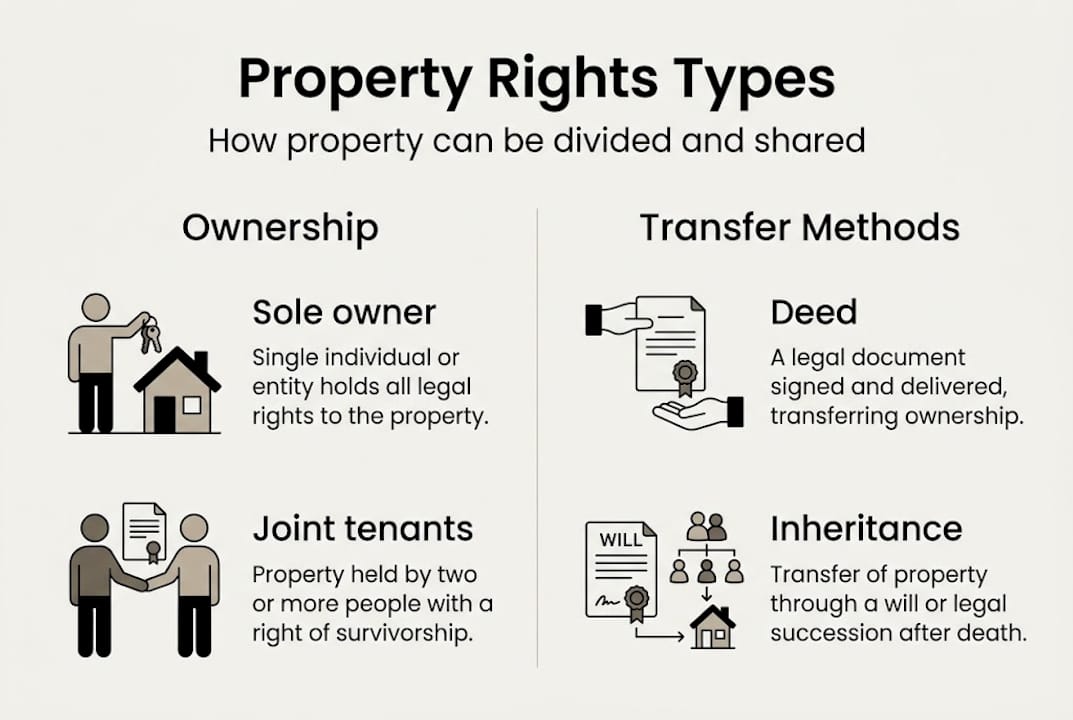
As the bundle of rights concept explains, this approach allows splitting, such as leasing possession while retaining ownership, or selling mineral rights while keeping the surface land. This flexibility enables complex transactions but also increases legal complexity.
The bundle typically includes the rights to:
A business owner, for instance, might lease a commercial unit from a landlord. The landlord retains ownership but transfers the right of possession to the tenant for the lease term. Meanwhile, the landlord may also grant a mortgage over the property to a bank, transferring certain security rights. Three parties, one property, multiple rights operating simultaneously.
When it comes to formally transferring ownership, the legal instrument used is a deed. As property deeds and transfers confirm, warranty deeds guarantee clear title to the buyer, while quitclaim deeds transfer whatever interest the seller holds with no guarantees whatsoever.
A warranty deed is the gold standard in property transfers. It tells the buyer: “I own this property, I have the right to sell it, and I will defend your title if anyone challenges it.”
Recording a deed in the appropriate land registry is equally important. In England and Wales, registration at HM Land Registry provides legal protection against third-party claims. Without registration, your ownership interest may be vulnerable.
Pro Tip: Before completing any property transaction, verify the type of deed being used and confirm that the title has been properly registered. Your solicitor should check for any unregistered interests that could affect your rights. If you’re a tenant, understanding tenant rights explained will help you know exactly where you stand.
Knowing how rights are transferred naturally leads to questions about limitations and hidden surprises that may come with property. These are known as encumbrances, legal burdens or restrictions that affect the use or transfer of a property without necessarily transferring ownership.
As encumbrance overviews confirm, encumbrances such as liens, easements, and covenants limit property rights, and easements in particular grant use without ownership, sometimes arising from long-standing use rather than any written agreement.
Here are the main types of encumbrance you may encounter:
| Type | What it means | Common example |
|---|---|---|
| Lien | A financial claim against the property | Unpaid mortgage or council tax debt |
| Easement | A right for others to use part of the property | Right of way across a neighbour’s land |
| Covenant | A binding obligation affecting use | Restriction on building extensions |
| Charge | Security interest held by a lender | Bank charge registered against title |
Encumbrances are discovered through a property search, which your solicitor carries out before exchange of contracts. This search reveals registered charges, local authority notices, and any rights of way or restrictions attached to the title.
Real-world scenarios where encumbrances cause problems include:
Encumbrances do not disappear when a property changes hands. Many bind the land itself, not just the current owner, meaning they transfer automatically to the new buyer.
This is why checking for encumbrances before committing to any purchase is not optional. It is one of the most important steps in the entire transaction.
Most people underestimate property law because it looks manageable on the surface. You read a template contract, sign it, and assume everything is covered. In our experience, that assumption is where things start to go wrong.
The cases that cause the most grief are rarely the obvious ones. They are the edge cases: a fixture that was never listed in the contract, an easement that was never disclosed, a deed that was never properly registered. These are not exotic legal problems. They are everyday oversights that carry serious financial consequences.
What we consistently observe is that people treat property transactions as administrative processes rather than legal ones. They focus on price, completion dates, and moving logistics. The legal substance gets delegated without proper oversight.
Our honest advice is this: do not rely on precedent documents or assumptions, especially in emotionally charged situations like divorce, inheritance, or business dissolution. These are precisely the contexts where property law becomes most contested and most consequential. Getting property law ownership insights from a qualified solicitor before you commit, not after a problem arises, is almost always the more cost-effective choice.
Understanding property law in theory is genuinely useful. But when you are facing a real transaction, a dispute, or an urgent deadline, theory is rarely enough.

At Ali Legal, we work with individuals and business owners who need clear, practical legal support on property matters. Whether you are dealing with a contested transaction, a boundary dispute, or a commercial lease negotiation, our team provides straightforward advice with fixed fees and no unnecessary delays. For those already in dispute, our civil litigation support and commercial litigation solutions are designed to protect your position effectively. If you want to talk through your situation, speak to our team today.
Real property covers land and any structures permanently attached to it, while personal property refers to movable items that are not fixed to the land. The distinction determines which legal rules and processes apply in a transaction.
Your solicitor will carry out a title search and property searches to uncover registered liens, easements, covenants or other restrictions before you exchange contracts. Never skip this step, even in straightforward transactions.
Fixture disputes arise when buyers and sellers disagree about whether an item is part of the real property or remains personal property, often because the sale contract did not include a clear fixtures and fittings list.
The two principal types are warranty deeds, which provide a guarantee of clear title, and quitclaim deeds, which transfer only whatever interest the seller actually holds with no title guarantee. Always confirm which type applies before proceeding.


