
Menu
Get Expert Legal Support Today

TL;DR:
- Strategic legal decisions, not just legal strength, determine dispute outcomes and business impact.
- Choosing between ADR and litigation depends on speed, cost, relationship, and enforceability considerations.
- Early evidence preservation, clear planning, and expert guidance are crucial for successful dispute resolution.
Most business owners enter a dispute believing the strongest case wins. It rarely works that way. The outcome of a legal dispute is shaped far more by the quality of your strategic decisions than by the raw merits of your position. Poor timing, the wrong resolution path, or a reactive negotiation stance can erode even the most compelling claim. Equally, a well-structured legal strategy can resolve a difficult dispute faster, cheaper, and with less damage to your business relationships. This guide explains how strategic legal thinking drives better dispute outcomes, and what you need to consider at every stage.
| Point | Details |
|---|---|
| Legal strategy shapes results | Outcomes rely on smart choices as much as facts and rights. |
| ADR often means speed and savings | Choosing mediation or arbitration can resolve disputes up to 10 times faster. |
| Evidence and timing are crucial | Preserving vital evidence and acting quickly can make or break a case. |
| Negotiation approach matters | Interest-based negotiation preserves relationships, while power-based may secure rights at a cost. |
| Legal and business goals align | Strategic legal planning should reflect broader business aims for true success. |
Legal strategy is not simply receiving advice about your rights. It is a structured plan that maps out your dispute from start to finish, accounting for risk, cost, timing, and the most likely paths to resolution. Many business owners confuse the two, assuming that once they understand their legal position, the rest will follow naturally. That assumption is costly.
A proper legal strategy includes several interconnected elements:
The role of a solicitor in this context goes well beyond drafting letters. An experienced solicitor helps you see the dispute as a whole, not just the immediate flashpoint.
One of the most important insights in dispute resolution is that over 90% of civil disputes settle before they reach trial. That statistic is not a coincidence. It reflects the fact that well-advised parties on both sides eventually recognise the cost and uncertainty of litigation and find common ground. The earlier your strategy anticipates this reality, the sooner you can reach a favourable settlement on your terms.
“The goal of legal strategy is not to win in court. It is to achieve your business objective at the lowest possible cost and risk.”
Setting the strategic tone early matters enormously. Parties who engage solicitors reactively, after the dispute has already escalated, often find themselves in a weaker position, having missed opportunities to preserve evidence, establish goodwill, or signal credible resolve.
With the concept of legal strategy clarified, it is vital to see how the pathway you choose can dictate outcomes. Alternative dispute resolution (ADR) and litigation are not simply different procedures. They represent fundamentally different philosophies about how disputes should be resolved.
| Factor | ADR (mediation/arbitration) | Litigation |
|---|---|---|
| Speed | Weeks to months | Months to years |
| Cost | Generally lower | Often substantial |
| Privacy | Confidential | Public record |
| Relationship impact | Preserves relationships | Often adversarial |
| Outcome control | Parties retain control | Judge or jury decides |
| Enforceability | Arbitration awards are binding | Court judgments enforceable |
ADR such as mediation and arbitration consistently resolves disputes faster and at lower cost than traditional litigation. AAA arbitration averages 2.3 months for large business-to-business claims, compared with two or more years for equivalent litigation. For most commercial disputes, that difference is decisive.
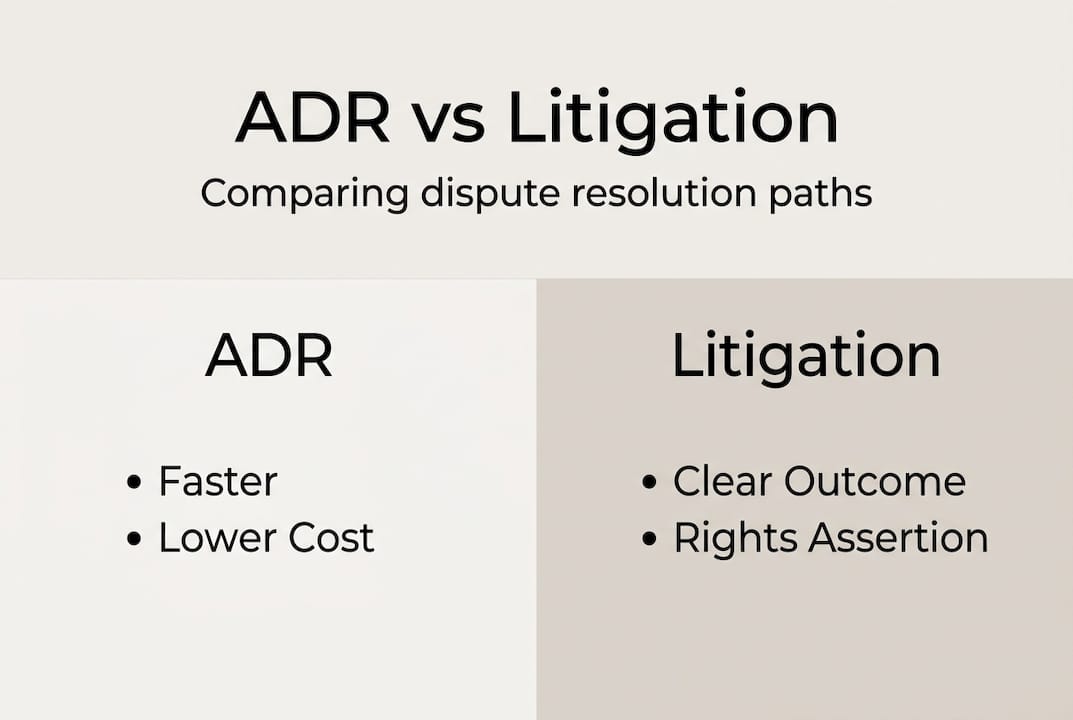
However, ADR is not always the right answer. Litigation for binary outcomes and rights assertion remains necessary when one party needs a clear, enforceable court order, when the other side is acting in bad faith, or when a public precedent matters to your business. Understanding alternatives to litigation is not about avoiding court at all costs. It is about choosing the right tool for the specific dispute.
The inclusion of arbitration clauses in contracts is one of the most powerful pre-dispute strategic decisions a business can make. These clauses lock in a faster, private resolution process before any dispute arises, removing uncertainty and protecting ongoing business relationships.
Pro Tip: Before any dispute escalates, review your existing contracts for dispute resolution clauses. If they are absent or vague, update them now. The best time to agree on a resolution process is before you need one.
Having considered the resolution path, the next step is ensuring your strategy is grounded in facts, not just legal interpretations. Evidence is the foundation of any dispute, and how you gather, preserve, and present it can determine whether your strategy succeeds or fails.

The legal profession is increasingly data-driven. Outcome-based models for evaluating law firm performance now outperform traditional prestige rankings in predicting dispute success, which means that choosing representation based on track record and data, rather than reputation alone, gives you a measurable advantage.
Here are the key steps to building an evidence-led strategy:
The steps for resolving commercial disputes always begin with fact-gathering. Skipping this stage in favour of immediate legal action is one of the most common and expensive mistakes businesses make.
The data and timing matter greatly, but ultimately, how you negotiate can tilt the dispute in your favour. Negotiation is not a single approach. It is a spectrum, and choosing where to position yourself requires careful strategic thinking.
Power-based negotiation relies on leverage. You assert your legal rights, signal your willingness to litigate, and use the cost and risk of proceedings to pressure the other party into settlement. This approach works well when your legal position is strong, when the relationship with the other party is not a priority, or when you need a clear, enforceable outcome.
Interest-based negotiation focuses on the underlying needs of both parties, not just their stated positions. Rather than asking “what do you want?”, it asks “why do you want it?”. This approach, which underpins most mediation processes, often produces creative solutions that neither party could achieve through litigation.
Power-based versus interest-based negotiation is not a binary choice. Many successful dispute resolutions blend both, using the credible threat of litigation to bring parties to the table, then shifting to interest-based dialogue once negotiations begin.
Key considerations when choosing your negotiation approach:
Understanding the types of dispute resolution available, and when each is appropriate, is essential before entering any negotiation. Whether you are resolving contract disputes or navigating a complex commercial breakdown, the role of a mediator in facilitating interest-based dialogue is frequently underestimated.
Pro Tip: Before entering negotiations, write down your best alternative to a negotiated agreement (BATNA). Knowing your walk-away point in advance prevents you from making concessions under pressure that you later regret.
Here is a perspective that most legal guides will not offer you: a dispute is not an interruption to your business. It is a moment that reveals your business’s priorities, risk tolerance, and long-term thinking.
The decisions you make during a dispute, whether to litigate or mediate, how aggressively to negotiate, when to settle, all carry consequences that extend well beyond the immediate outcome. They affect your reputation with suppliers, customers, and investors. They signal to future counterparties how you behave under pressure. And they shape your internal culture around risk and accountability.
We have seen businesses win disputes on paper and lose strategically, damaging key relationships, spending disproportionate management time, and creating precedents that invited further claims. We have also seen businesses achieve favourable settlements that strengthened partnerships and improved contract terms for years afterwards.
The civil litigation best practices that produce the best long-term results are those aligned with business objectives, not just legal ones. Risk tolerance, stakeholder relationships, and commercial priorities must shape your legal tactics from the outset. If your solicitor is not asking about your business goals, they are not giving you a strategy. They are giving you legal advice, and that is not the same thing.
Applying these strategic principles is straightforward in theory. In practice, disputes move quickly, emotions run high, and the pressure to react rather than plan is constant. That is where experienced legal guidance makes a measurable difference.

At Ali Legal, our commercial litigation strategy is built around your business objectives, not just the legal merits of your claim. We assess your dispute from every angle, identify the most cost-effective resolution path, and adapt your strategy as circumstances change. Whether you are at the earliest stage of a dispute or already in proceedings, our approach is grounded in the civil litigation best practices that consistently produce better outcomes. If you are ready to take a strategic approach to your dispute, contact Ali Legal today for a direct, transparent conversation about your options.
A legal strategy involves evaluating all dispute options, risks, and objectives in alignment with your business goals, while legal advice simply explains what is legally possible or permitted in a given situation.
Over 90% of civil disputes settle before trial because settlement is typically less costly and time-consuming than a full hearing, particularly when both parties receive effective early legal advice.
Litigation is preferable when a clear, enforceable outcome is essential or when rights assertion requires a court order, while ADR is better suited to disputes where preserving the business relationship matters.
Preserve critical evidence within the first 72 hours of escalation, seek specialist legal input without delay, and establish both your short-term response and your long-term resolution objective from the outset.


