

TL;DR:
- Client-centric law firms prioritize transparency, personalized advice, and long-term relationships.
- Technology enhances efficiency and communication but must be balanced with empathy and ongoing feedback.
- Key indicators of a client-centric firm include clear pricing, proactive updates, and tailored solutions.
Most people assume that hiring a solicitor is hiring a solicitor. The firm you choose, the fees you pay, the updates you receive — surely these are minor details? In reality, 52% of legal clients prefer flat fees and value transparency above almost everything else. The legal industry is changing fast, and the firms that put your goals at the centre of everything they do are producing measurably better outcomes. This guide explains exactly what a client-centric law firm looks like, why it matters for your case or business, and how to identify one before you sign anything.
| Point | Details |
|---|---|
| Transparency builds trust | Client-centric firms use open communication and clear fees to create lasting trust with clients. |
| Tech powers efficiency | Modern tools speed up processes and improve updates, saving you time and reducing stress. |
| Personalisation secures outcomes | Tailored legal strategies and real empathy deliver better long-term results for individuals and businesses. |
| Right selection avoids pitfalls | Knowing what to look for helps you choose a law firm that prioritises your real needs. |
The phrase “client-centric” gets used a great deal, but it deserves a precise definition. A client-centric law firm is one that organises its entire practice around your goals, your experience, and your outcomes — not around its own internal processes or billing targets. Every decision, from how a solicitor communicates to how invoices are structured, flows from the question: what serves this client best?
In practical terms, client-centric firms prioritise transparency in billing and processes, offering fixed fees and itemised invoices so you always know where your money is going. They provide regular, proactive updates rather than waiting for you to chase them. They adopt technology that makes your experience smoother. And they offer tailored legal solutions rather than recycling template advice.
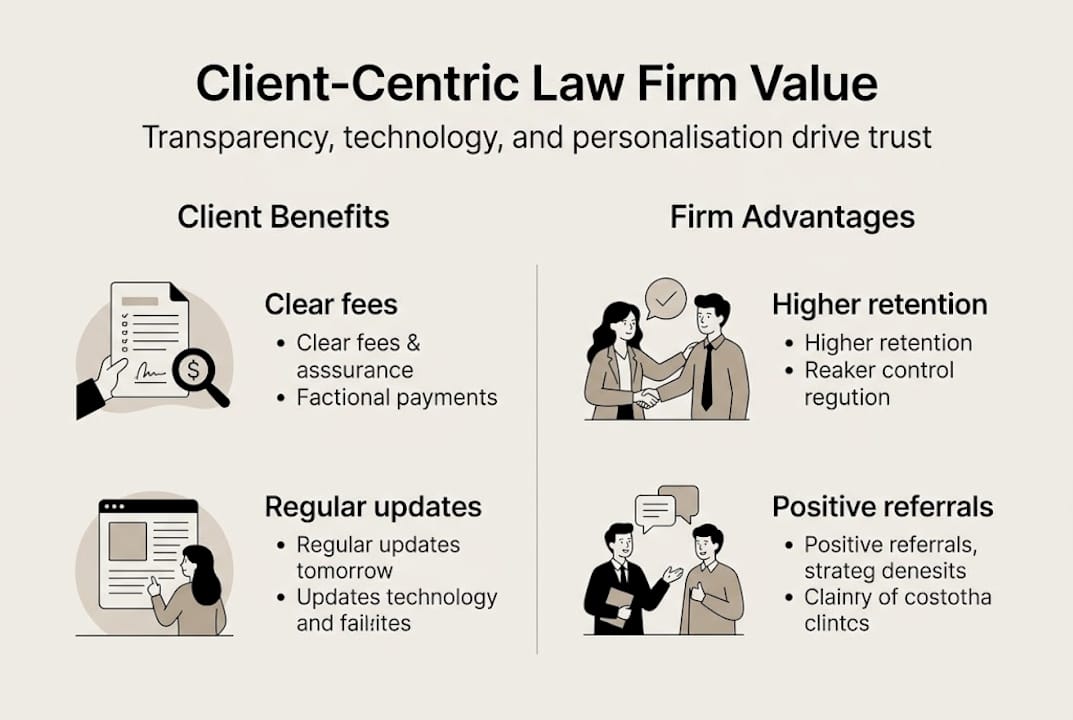
Contrast this with the traditional model. Many established firms remain process-driven, prioritising precedent and internal workflow over personalised service. Billing is often opaque, with hourly rates that can spiral unpredictably. Communication tends to be reactive. Client-centric firms are more responsive, innovative, and deliver better satisfaction than their traditional counterparts, and the gap is widening.
Here is a direct comparison:
| Feature | Client-centric firm | Traditional firm |
|---|---|---|
| Billing model | Fixed fees, itemised invoices | Hourly rates, variable costs |
| Communication | Proactive, regular updates | Reactive, client-initiated |
| Technology | Client portals, digital tools | Largely paper-based or email |
| Advice style | Personalised to your goals | Template-driven |
| Relationship | Long-term, ongoing | Transactional, case-by-case |
The key traits that define a genuinely client-centric firm include:
Firms built around relationship-based outcomes understand that a satisfied client is not just a closed case — it is a long-term partnership.
Trust is not given freely, especially when legal matters are involved. You are sharing sensitive information, making significant financial decisions, and relying on expert guidance at some of the most stressful moments in your life or business. Transparency is the foundation on which that trust is built.
Client-centric firms use fixed fees, itemised invoices, and real-time updates to eliminate the anxiety that comes with traditional billing. You know the cost upfront. You receive a clear breakdown of what work has been done. You are not left wondering whether a brief phone call will add another charge to your bill.
Beyond billing, transparency extends to process. The best firms keep you informed at every stage — not just when something significant happens, but with regular touchpoints that confirm your matter is progressing. Client portals allow you to log in, review documents, and send messages securely at any time.
“Transparency is not just a nice-to-have in legal services — it is the single most powerful driver of client loyalty and long-term value.”
The numbers support this firmly. A 5% increase in client retention boosts profit by 25 to 95%, which means that firms investing in transparent, trust-building practices are not just doing right by clients — they are building more sustainable businesses.
| Transparency practice | Client benefit | Business benefit |
|---|---|---|
| Fixed fees | Budget certainty | Fewer billing disputes |
| Real-time updates | Reduced anxiety | Higher satisfaction scores |
| Itemised invoices | Full visibility | Increased trust and referrals |
| Client portals | 24/7 access | Reduced admin queries |
Pro Tip: Before instructing any firm, ask for a written fee estimate and a clear explanation of what triggers additional costs. A firm that hesitates to provide this is worth reconsidering. Clear legal advice from the outset sets the tone for the entire relationship.
Beyond transparency, efficiency powered by modern tools is transforming the legal landscape. The stereotype of law firms buried in paper files and slow correspondence is, thankfully, becoming outdated. Client-centric firms are embracing technology not as a gimmick, but as a genuine service improvement.
Efficiency is achieved through client portals, AI for routine tasks, and automation, which frees solicitors to focus on the complex, human-centred work that actually requires their expertise. Routine document review, appointment scheduling, and standard correspondence can all be handled faster and more accurately with the right tools.
For you as a client, this translates into:
Technology also enables firms to serve a broader range of clients more effectively. International clients, businesses with complex multi-jurisdictional needs, and individuals with busy schedules all benefit from firms that can operate efficiently across digital channels. Understanding the value for clients and businesses that technology-enabled legal services deliver is increasingly important in 2026.
Pro Tip: When evaluating a firm, ask for a demonstration of their client portal or digital communication tools. A firm that cannot show you how it manages your case digitally may struggle to keep pace with your expectations.
For businesses in particular, having access to legal counsel for business that operates efficiently and digitally can make a genuine difference to how quickly commercial decisions are made and risks are managed.
With process and technology covered, it is time to address the human factor. Personalisation is what separates a genuinely client-centric firm from one that has simply updated its website and installed a portal.

Long-term relationships are fostered by personalisation, empathy, ongoing feedback, and proactive needs anticipation. This means your solicitor understands your business model, your risk appetite, your family circumstances, or your commercial ambitions — and shapes their advice accordingly. It is not about sending a birthday card. It is about knowing that a change in your industry might affect your contracts before you even realise it.
Consider what genuine personalisation looks like in practice:
“The most valuable legal relationships are built over years, not cases. A solicitor who knows your business is worth far more than one who simply knows the law.”
Personalisation also drives referrals. Clients who feel genuinely understood and well-served become advocates. They recommend their solicitor to colleagues, family members, and business partners. Firms that boost outcomes with lasting relationships consistently outperform those focused solely on case volume.
After exploring the advantages, let’s turn theory into actionable steps for your law firm search. Knowing what a client-centric firm looks like in principle is one thing. Identifying one in practice requires a sharper eye.
Here is what to look for:
And here are the red flags to watch for:
Client-centric firms attract talent, improve efficiency, and enable premium pricing, while traditional firms that ignore client expectations face growing obsolescence. The market is rewarding firms that invest in client experience, and that investment ultimately benefits you.
Pro Tip: Use your first consultation as a test. Ask about their fee structure, how they communicate progress, and what happens if your matter becomes more complex. Their answers will tell you everything. Good legal consultation preparation makes this process far more productive.
Here is something the legal industry rarely admits openly: most firms want to be client-centric but find the transition genuinely difficult. The barrier is not always willingness. It is legacy infrastructure, entrenched billing habits, and a professional culture that historically rewarded technical expertise over client experience.
Technology helps, but it is not the whole answer. Tech must be balanced with empathy, ongoing training, and client consent for data use — and many firms invest in the former while neglecting the latter. A slick portal means nothing if the solicitor on the other end does not listen.
Feedback loops are another overlooked element. Annual client surveys are not enough. Genuine client-centricity requires ongoing, informal feedback — conversations that happen mid-matter, not just at the end. This is where most firms fall short, and it is exactly where the best ones pull ahead.
We believe the firms that will lead in the next decade are those that treat tailored solutions not as a marketing message but as an operational commitment. That means training, culture, and measurement — not just technology.
If you have read this far, you understand what genuinely client-centric legal service looks like. At Ali Legal, this is not an aspiration — it is how we operate every day across commercial, civil, and personal matters.
From commercial litigation to civil litigation, we bring fixed fees, proactive communication, and strategies shaped around your specific goals. We do not recycle template advice or leave you guessing about costs. We build relationships that last beyond the immediate matter, because we know that is where real value lies. If you are ready to work with a firm that puts your needs first, speak to our team today and take the first step towards legal support that actually works for you.
Key markers are transparency, proactive updates, and tailored advice. Look for clear upfront pricing, regular communication without you having to chase, and personalised solutions shaped around your specific goals.
It leads to more efficient outcomes, stronger ongoing relationships, and better protection for evolving business needs. Long-term relationships and client-centricity boost retention and profitability in ways that transactional legal service simply cannot match.
Used well, technology improves access and speeds up communication considerably. Tech must be balanced with empathy and ongoing feedback to ensure the human element is never lost in the process.
Not necessarily. 52% of clients prefer flat fees, and client-centric firms often use fixed-fee structures that deliver more clarity and value than unpredictable hourly billing.
Failing to assess the firm’s transparency and communication style early on. Opaque billing and slow responses are reliable warning signs that a firm’s priorities do not align with yours.


