
Menu
Get Expert Legal Support Today

Many UK entrepreneurs find themselves hesitating when facing franchise law for the first time. Misconceptions around complexity and control often cloud judgement, making it harder to see the real opportunities. Understanding franchise agreements and the legal frameworks is the first step toward developing a thriving franchise operation that protects your interests. This guide offers clear explanations of common myths, real legal requirements, and how to make informed decisions about launching or joining a franchise in the United Kingdom.
Franchising is often misunderstood by entrepreneurs considering this business route. At its core, a franchise is a legal agreement where one business grants another the right to operate under its established brand and business model.
The franchisor owns the original brand and business system. The franchisee pays for the right to use these assets and receives ongoing support from the franchisor.
Franchising involves replicating a successful business model across different locations whilst maintaining consistency and quality. The franchisor provides:
In return, the franchisee invests capital, operates the business locally, and pays ongoing fees to the franchisor.
Franchising requires clear legal documentation, particularly Franchise Disclosure Documents and Agreements, to protect both parties and ensure transparency throughout the relationship.
Many entrepreneurs believe franchising is overly complicated or high-risk. This is misleading. With proper planning and clear legal structures, franchising follows a straightforward path.
Another myth suggests that franchising means losing all control over your business. In reality, franchisees maintain significant operational independence within agreed parameters. The franchisor sets standards; the franchisee executes the business day-to-day.
Some believe franchises guarantee success. They do not. Franchises can fail just like any business. Success depends on market conditions, franchisee commitment, and effective execution.
UK franchise law does not have a single dedicated statute. Instead, franchises are governed by:
Understanding these legal layers ensures both franchisor and franchisee meet their obligations clearly.
Regulatory frameworks exist to protect franchisees from exploitation, not to restrict legitimate franchising opportunities.
Misconceptions lead to poor decisions. Entrepreneurs might avoid franchising altogether or enter agreements without understanding their responsibilities. Both scenarios create problems.
Proper legal guidance prevents disputes later. A well-drafted franchise agreement protects both parties and sets expectations from day one.
Pro tip: Consult with a solicitor specialising in commercial law before signing any franchise agreement to ensure you understand your legal obligations and rights fully.
Franchise arrangements in the UK come in several distinct forms. Each type operates differently, with its own contractual structure and operational framework. Understanding which type suits your business expansion strategy is essential before committing to a franchise model.

The most common arrangements fall into three main categories. Each has unique characteristics that affect how the franchisor and franchisee work together.
Business format franchises are the most popular type in the UK. The franchisor grants the franchisee rights to operate a complete business system, not just sell products.
This includes:
The franchisee pays initial and continuing fees under established agreements, then operates the business using the franchisor’s proven methods. Fast food chains and professional services often use this model.
Business format franchises provide the most comprehensive support but also require the franchisee to follow strict operational guidelines.
In product distribution franchises, the franchisor grants rights to distribute specific products under the franchisor’s brand. The franchisee purchases products at wholesale prices and sells them at retail.
This model works well for:
The franchisee has less operational control than in business format franchises. Product sourcing and pricing typically come from the franchisor. The relationship focuses primarily on distribution rights rather than replicating a complete business system.
Management franchises grant the franchisee the right to manage a business on behalf of the franchisor. The franchisor retains ownership of assets and bears significant financial risk.
This arrangement is less common but appears in hotel management and property operations. The franchisee handles day-to-day operations whilst the franchisor maintains ownership and strategic control.
Each franchise type carries different levels of autonomy, investment, and support:
Your business goals and capital availability should guide which model fits best.
Here is a comparison of the main franchise types used in the UK:
| Franchise Type | Level of Support | Franchisee Autonomy | Typical Investment |
|---|---|---|---|
| Business Format | Extensive guidance | Operational—but within set rules | Highest |
| Product Distribution | Moderate assistance | Some independence with products | Moderate |
| Management | Limited involvement | Management only, franchisor owns assets | Lowest |
Effective commercial contracts clearly define which franchise type applies and what obligations each party assumes.
Pro tip: Identify your business expansion goals first, then match them to the franchise type that provides the right balance of support, control, and investment for your situation.
UK franchise law does not exist as a single statute. Instead, it draws from multiple legal sources that work together to regulate franchisor and franchisee relationships. Understanding this framework prevents disputes and protects your interests.
The legal foundation combines contract law, intellectual property law, and consumer protection legislation. Each element plays a distinct role in shaping franchise arrangements.
Every franchise relationship hinges on two essential legal documents. These provide clarity and protection for both parties from day one.
The Franchise Disclosure Document (FDD) outlines critical information about the franchise opportunity. It covers:
The Franchise Agreement legally binds both parties. This contract typically addresses fees, trademarks, territory rights, training obligations, support services, and termination clauses, creating enforceable obligations on both sides.
A well-drafted franchise agreement prevents misunderstandings and provides clear remedies if either party fails to meet obligations.
Key sections protect both franchisor and franchisee interests. Missing clauses create vulnerability later.
Essential elements include:
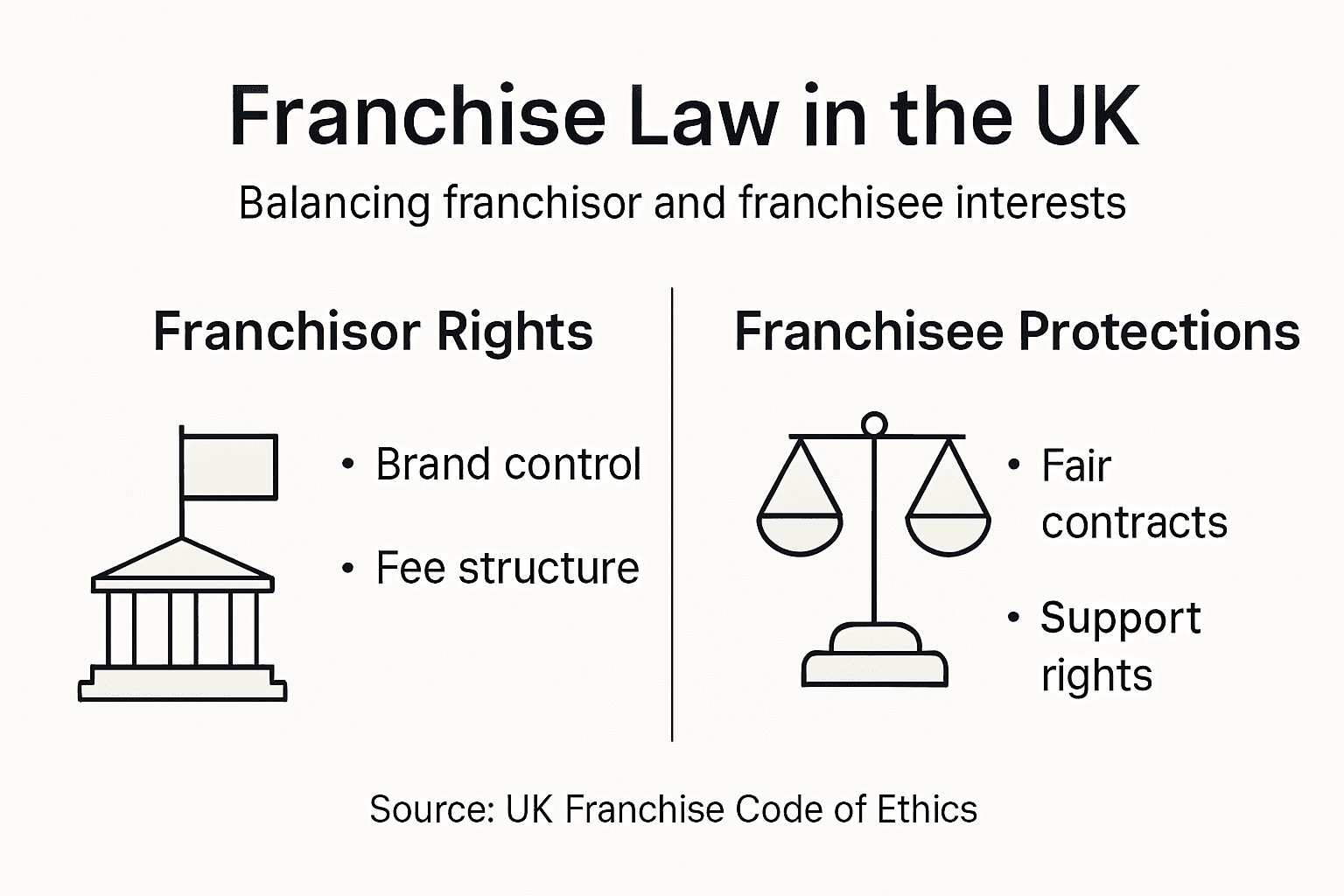
Whilst not legally binding, the Franchise Code of Ethics sets industry standards for best practice. Many established franchisors follow this code voluntarily.
It encourages transparency, fair dealing, and honest disclosure. Following the code strengthens franchisee relationships and reduces legal risk, though compliance remains voluntary.
Franchise agreements rely heavily on intellectual property law to protect brand identity. The franchisor retains ownership of:
The franchisee receives a licence to use these assets within agreed parameters. Breaching intellectual property terms can trigger termination.
Clear intellectual property definitions in your franchise agreement prevent costly disputes over brand usage and proprietary systems.
Franchisees benefit from consumer protection laws that regulate unfair contract terms. Employment law also applies if the franchisee hires staff.
These laws prevent franchisors from imposing unreasonable restrictions or one-sided obligations. They provide franchisees with additional legal protection beyond the franchise agreement itself.
Pro tip: Have a solicitor experienced in franchise law review any franchise agreement before signing, ensuring all clauses protect your interests and comply with UK legal requirements.
Franchise agreements create a delicate balance of rights and responsibilities for both parties. Understanding what you gain and what you must give up determines whether franchising works for your business.
Both franchisors and franchisees face distinct advantages and challenges. Misunderstanding these leads to conflict and financial loss.
The franchisor controls the brand and business system. Their primary rights include:
In return, the franchisor must provide:
Franchisors bear significant liability if they fail to deliver promised support or if franchisees cause harm whilst operating under their brand.
The franchisee gains the right to operate under an established brand with proven systems. Key rights include:
However, franchisees must comply with strict obligations. They must:
Franchisees often underestimate the ongoing financial burden of fees, royalties, and mandatory purchases, which can significantly impact profitability.
Money is the most obvious risk area. Franchisees invest substantial capital upfront and face ongoing costs throughout the relationship.
Common financial risks include:
If the business underperforms, these fixed costs continue regardless. Poor location selection or market conditions can lead to failure whilst the franchisor still collects fees.
Franchisees must maintain brand standards or face termination. The franchisor sets rules about:
Failure to comply gives the franchisor grounds for termination. This creates operational inflexibility compared to independent businesses.
The franchisor also faces risks. If a franchisee damages the brand reputation through poor service or unethical practices, it affects the entire franchise system and other franchisees’ businesses.
Both parties face contractual risks if either fails to meet obligations. Key legal risks include:
Unclarity in the franchise agreement magnifies these risks significantly.
Typical risks for both franchisor and franchisee are outlined below:
| Party | Main Legal Risk | Main Financial Risk | Key Prevention Step |
|---|---|---|---|
| Franchisor | Contract disputes | Liability for support failures | Clear, robust agreements |
| Franchisee | Restrictive clauses | Ongoing royalties and fixed costs | Early legal due diligence |
Inadequate due diligence before signing costs far more than legal advice beforehand.
Pro tip: Request references from existing franchisees and conduct thorough due diligence on the franchisor’s track record, financial stability, and support quality before committing to any franchise agreement.
Compliance mistakes in franchising drain money and create legal headaches. Most errors occur because franchisors or franchisees rush documentation or ignore professional advice. Proper planning prevents both.
The key is approaching franchise compliance systematically. Start early and build checks into every stage of your franchise relationship.
Before launching a franchise, both parties must understand what they are entering. This means more than reading the agreement once.
Franchisors should:
Franchisees must:
Due diligence takes time. It feels slow initially but prevents costly failures later.
Skipping due diligence to save time costs significantly more when disputes arise or the business fails.
The franchise agreement is your primary legal protection. Weak documentation creates disputes that drain resources.
Key documentation steps:
Poor drafting leaves gaps. Robust legal documentation prevents misunderstandings before they become disputes.
Always engage a solicitor experienced in franchise law. The cost of proper documentation is minimal compared to litigation costs later.
Confusion about money creates immediate conflict. Fees must be transparent and reasonable.
Define precisely:
Written fee schedules prevent disputes. If fees change, update agreements in writing and notify franchisees in advance.
Compliance does not end when the franchisee starts operating. Continuous monitoring prevents problems escalating.
Set up systems for:
Address compliance issues immediately. Small problems become expensive quickly if ignored.
Trademarks and systems are your franchise value. Inadequate protection destroys competitive advantage.
Action items:
Clear IP protection prevents franchisees from using your systems after termination.
Failing to protect intellectual property properly allows departing franchisees to compete directly against you using your own systems.
Solicitors, accountants, and franchise specialists prevent costly errors. Their fees are insurance against expensive mistakes.
Engage professionals for:
Cheap documentation creates expensive problems. Professional advice is an investment, not a cost.
Pro tip: Build compliance into your systems from the start by creating checklists, templates, and regular review schedules, then have a solicitor audit your processes annually to catch issues early.
Understanding the complexities of Franchise Law in the UK is critical to protecting your investment and achieving success. The article highlights the challenges of navigating legal frameworks, managing ongoing fees, and safeguarding intellectual property. If you are considering franchising or need clarity on your rights and obligations, expert legal guidance can make all the difference. Ali Legal offers fast, transparent advice designed to give you confidence when negotiating Franchise Agreements and Franchise Disclosure Documents.

Do not risk costly misunderstandings or financial exposure. Take control today by consulting with our experienced commercial law solicitors. Benefit from our fixed fees, straightforward advice, and long-term client commitment all tailored to your franchise needs. Reach out now via our contact page and explore more about how we protect your business through commercial contract expertise and detailed legal review. Let Ali Legal help you build a strong foundation for your franchise journey.
Franchise law refers to the legal framework governing the relationship between franchisors and franchisees. It shapes business ownership by ensuring clear obligations are defined, protecting both parties’ interests, and enforcing compliance with regulations.
The main types of franchise agreements include business format franchises, product distribution franchises, and management franchises. Each type varies in the level of support provided, franchisee autonomy, and investment required.
The two critical documents in a franchise relationship are the Franchise Disclosure Document (FDD), which outlines important details about the franchise opportunity, and the Franchise Agreement, which legally binds both parties and sets the terms of the relationship.
Franchisees can protect their rights by thoroughly reviewing the franchise agreement, seeking professional legal advice, ensuring clear communication with the franchisor, and staying compliant with all franchise terms to avoid potential disputes.


