
Menu
Get Expert Legal Support Today

TL;DR:
- Power of attorney is a legal tool to appoint someone to act on your behalf in important matters.
- Choosing the right type and updating it regularly ensures your plans remain effective and comprehensive.
- Establishing a POA proactively can prevent legal delays, disputes, and stress during incapacity.
A power of attorney is one of those legal tools that most people think they’ll sort out “eventually,” yet never quite get around to. It is not reserved for the elderly or seriously ill. Anyone can find themselves in a situation where another person needs to act on their behalf, whether during a long hospital stay, an extended trip abroad, or a sudden accident. A POA is a legal document granting one person authority to make decisions for another. Without one, even the closest family members may be legally powerless to help you when it matters most.
| Point | Details |
|---|---|
| Essential legal tool | A power of attorney ensures your affairs are managed by someone you trust if you cannot act yourself. |
| Multiple POA types | You can tailor a POA to cover financial, medical, or specific decisions depending on your needs. |
| Avoids court intervention | With a POA, families can avoid costly and time-consuming court battles if incapacity strikes. |
| Planning is crucial | Setting up a power of attorney before there’s a problem saves stress and offers peace of mind. |
At its core, a power of attorney (POA) is a formal legal arrangement. It creates a relationship between two parties: the principal (the person granting the authority) and the agent or attorney-in-fact (the person receiving that authority). The principal decides exactly what powers to grant, and the agent must act in the principal’s best interests at all times.
A POA is a legal document that gives the agent authority to act in specified matters on the principal’s behalf. That could be as narrow as selling a single property while the principal is overseas, or as wide as managing every financial and medical decision during a period of incapacity. The scope depends entirely on how the document is drafted.
The types of authority a POA can cover include:
Common triggers for creating a POA are more varied than most people expect. Yes, declining health is one reason, but consider these scenarios too. You are relocating internationally for work and need someone to handle property matters back home. You are about to undergo a planned surgical procedure with a long recovery. You are managing a family member’s affairs remotely. None of these require age or illness. They simply require foresight.
The legal importance of setting up a POA proactively cannot be overstated. Once a person loses mental capacity, it is too late to grant a POA. At that point, families must apply to the Court of Protection for a deputyship order, a process that is considerably slower, more expensive, and more stressful than simply having had a document prepared in advance. Understanding legal representation explained in broader terms helps you see where a POA fits into your overall legal preparedness.
Pro Tip: Do not wait until a health scare to think about a POA. The best time to set one up is when you are in full health and under no pressure, because that is when you will make the clearest, most considered decisions.
With the basics understood, let’s compare the main types of power of attorney available.
Not all POAs are created equal. Choosing the wrong type, or worse, having no type at all, can leave critical gaps in your planning. Here are the most important distinctions:
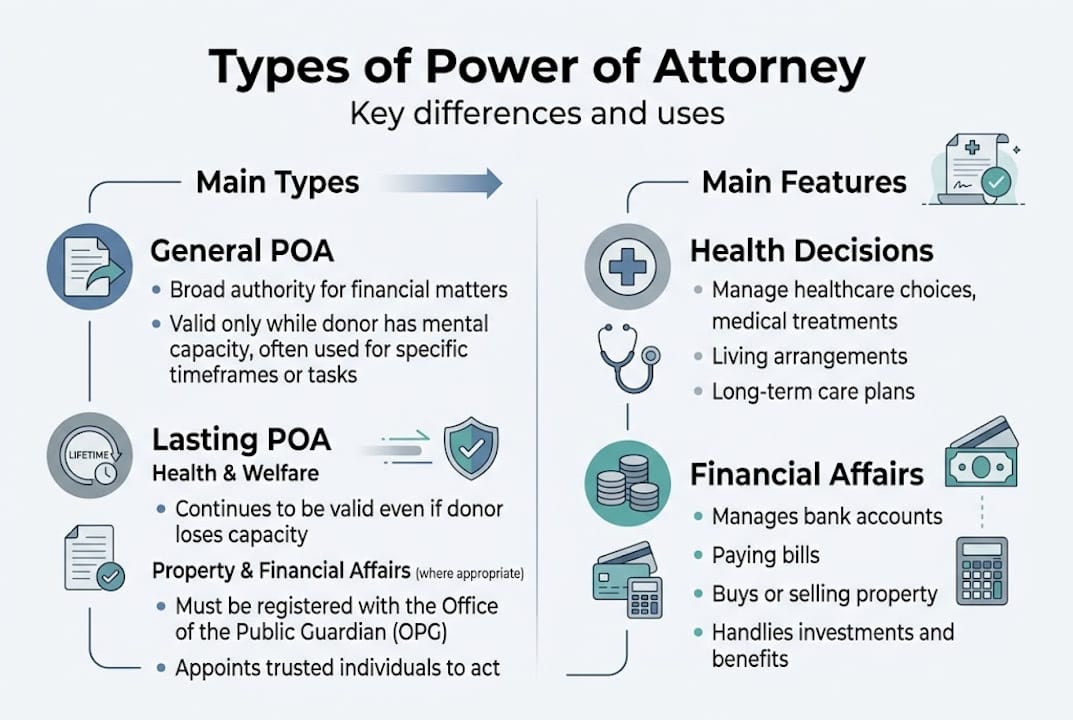
General power of attorney is designed for a specific period or purpose. It is useful when you need someone to handle affairs temporarily, such as during travel or a short-term medical procedure. Crucially, a general POA automatically ceases if the principal loses mental capacity. This makes it unsuitable for long-term incapacity planning.
Lasting power of attorney (LPA) is the most robust option for long-term planning in England and Wales. There are two types: one for property and financial affairs and one for health and welfare. An LPA must be registered with the Office of the Public Guardian before it can be used, and it continues to operate even if the principal loses mental capacity. This is the gold standard for protecting yourself and your family’s interests.
Enduring power of attorney (EPA) was the predecessor to the LPA in England and Wales. EPAs created before October 2007 can still be valid, but no new ones can be made. If you have an old EPA, you may want to review whether it still meets your needs or whether creating an LPA would offer better coverage.
Ordinary power of attorney works similarly to a general POA. It is time-limited and capacity-dependent, making it appropriate only for short-term, specific tasks.
A POA is often used as part of contingency planning for incapacity or medical and financial decision needs, helping families avoid court intervention. This is exactly why selecting the right type from the outset is so important.
Here is a quick comparison to help you choose:
| POA type | Continues after incapacity? | Covers health decisions? | Covers financial decisions? | Registration required? |
|---|---|---|---|---|
| General / ordinary | No | No | Yes (limited) | No |
| LPA (property and financial) | Yes | No | Yes | Yes |
| LPA (health and welfare) | Yes | Yes | No | Yes |
| Enduring (EPA, pre-2007) | Yes | No | Yes | Yes (on incapacity) |
When planning your estate, the interplay between a POA and your will is equally important. Exploring probate and estate planning alongside your POA ensures your wishes are covered both during your lifetime and after. Similarly, UK estate planning frameworks can help you see the full picture of protecting your assets and your family’s future.
Now that you know the types, let us look at why a POA is so valuable in real life.
A power of attorney is not just paperwork. It is a practical safeguard that can prevent an enormous amount of distress for the people you love most. Consider what happens without one.
“Without properly set up authority, many adults may be unprepared to manage affairs for themselves or others in incapacity situations.”
Real-life examples of this are sobering. Families have had to watch property sales collapse because no one had authority to sign on behalf of an incapacitated relative. Elderly individuals have had their care dictated by hospital policy rather than their own documented wishes. Adult children have spent months navigating courts while their parent’s affairs deteriorated.

Making your POA futureproof involves a few deliberate steps. Review it every three to five years. Update it after major life events such as marriage, divorce, or significant changes to your financial situation. Choose a replacement agent in case your primary choice becomes unable to act. Consider whether your agent fully understands your values and priorities, not just your practical affairs.
Proactive legal advice consistently demonstrates that clients who plan ahead spend far less time and money resolving legal complications than those who act only in a crisis. A POA is the clearest example of that principle in action.
Pro Tip: Appoint a professional solicitor as a backup attorney if your personal choices are limited. This removes the risk of your POA failing simply because your chosen agent is no longer available or willing to act.
To help you apply all this, here is how to set up your own POA and avoid the common traps.
Creating a valid POA in the UK follows a structured process. Rushing it or cutting corners is one of the most common and costly mistakes people make.
A POA authorises an agent to make decisions or sign documents for the principal, typically when the principal is unavailable or unable to act. That authority is only fully enforceable once the document is properly completed and registered.
| Common mistake | Consequence | How to avoid it |
|---|---|---|
| Choosing an unreliable agent | Misuse of authority or agent unwilling to act | Select someone tested by time and circumstance |
| Signing out of correct order | Document is invalid | Follow the prescribed sequence precisely |
| Not registering the LPA | Cannot be used when needed | Register as soon as it is signed |
| Using a general POA for long-term planning | Ceases on incapacity | Use an LPA instead |
| Failing to update after life changes | Outdated or contradictory terms | Review every three to five years |
Understanding trust law protection alongside your POA can add an additional layer of security for complex assets. If you are uncertain at any stage, hiring a solicitor to guide the process is almost always the most cost-effective decision in the long run.
Here is an honest perspective on why POA is often avoided and the real cost of waiting.
People delay setting up a POA for reasons that, when examined closely, do not hold up. Some feel it is morbid, as though preparing for incapacity invites it. Others assume it is something they will “sort out with a will” later, not realising that a will only operates after death. Many simply do not think it applies to them yet, particularly those in their thirties and forties who feel healthy and in control.
The data tells a different story. 56% of adults have no estate planning documents such as a medical POA or financial POA, leaving the majority of families exposed to exactly the court processes and delays we have described.
The disruption caused by a missing POA is not theoretical. We have seen families spend months in uncertainty, unable to access funds to pay for care, unable to make time-sensitive medical decisions, and caught in disputes that a clear document would have prevented entirely.
Here is a different way to think about it. Setting up a POA is not a task you do for yourself. It is something you do for the people who care about you. It removes the burden from your family at the worst possible moment. It is, in the truest sense, a practical expression of love and consideration. Why making a will also matters is equally true of a POA: both are gifts of clarity that you leave for others.
The right moment to act is not when crisis arrives. It is right now, while you have the capacity, the calm, and the time to do it properly.
As you think about safeguarding your affairs, here is how Ali Legal can help you move forward with confidence.
Planning a power of attorney involves more nuance than most people expect. Getting the type wrong, the wording imprecise, or the registration process incomplete can render the whole document unenforceable. At Ali Legal, we work with individuals and families to put the right legal protections in place, clearly and efficiently.

Our team has extensive experience in family law and divorce experts matters, including POA arrangements that intersect with family dynamics, separation, or estate planning. Whether you are exploring this for the first time or reviewing an existing arrangement, our family law tips and resources can help you understand your position. When you are ready to take the next step, speak to a solicitor at Ali Legal for a straightforward, confidential conversation.
A power of attorney lets the appointed person act on your behalf in specified legal, financial, or medical matters. A POA authorises an agent to make decisions or sign documents for the principal, typically when the principal is unavailable or unable to act.
No, a power of attorney only operates while the principal is alive; once the principal passes away, the will takes effect and the POA ceases entirely.
Yes, you can appoint multiple attorneys and specify whether they must act jointly, separately, or jointly for some decisions and separately for others.
If you lose capacity without a POA in place, your family may need to apply to the Court of Protection for a deputyship order. A POA helps avoid this court intervention entirely by establishing authority in advance.
You can revoke a POA at any time while you have mental capacity by providing written notice to your agent and, if the document was registered, notifying the Office of the Public Guardian.


