
Menu
Get Expert Legal Support Today

TL;DR:
- A shareholder agreement is a private contract addressing shareholder rights, responsibilities, and dispute resolution.
- It complements public articles, offering confidentiality and tailored provisions like share restrictions and deadlock resolution.
- Early drafting with legal expertise helps prevent costly disputes and facilitates business growth and investment.
Many business owners assume that once they have filed their company’s articles of incorporation, they are fully protected. That assumption can be expensive. Articles set out the legal structure of your company, but they leave a great deal unsaid, particularly when it comes to the relationship between shareholders. A shareholder agreement fills those gaps. It governs how owners interact, how shares can be transferred, how disputes are resolved, and what happens when someone wants to leave. If you own a business with one or more partners, understanding what a shareholder agreement is and what it does could be the most valuable investment you make.
| Point | Details |
|---|---|
| Defines ownership rights | A shareholder agreement sets clear rights and responsibilities for all owners, reducing disputes. |
| Protects minority interests | Special clauses safeguard minority shareholders and offer fair exit routes. |
| Prevents costly disputes | Well-drafted agreements clarify decision-making and dispute resolution, saving time and expense. |
| Addresses scenarios articles miss | It covers buy-sell arrangements and share transfers beyond general company law. |
A shareholder agreement is not a replacement for your company’s articles of incorporation or by-laws. Think of it as a private contract that sits alongside those documents, addressing the specific rights and responsibilities of the people who own shares in your business. While articles tell the world how your company is structured, a shareholder agreement governs what happens between the owners behind closed doors.
“A shareholder agreement is a private, legally binding contract among shareholders” outlining their rights, responsibilities, obligations, and rules for company operation, governance, and share transfers.
This distinction matters enormously in practice. Articles of incorporation are filed with Companies House and are available for public inspection. A shareholder agreement, by contrast, remains private. It does not need to be disclosed to competitors, creditors, or the general public. That confidentiality is one of its most underappreciated advantages, particularly for family businesses and closely held companies that want to keep their internal arrangements out of the public domain.
Under corporate law in the UK, shareholders have certain default rights, but those rights are often too broad or too narrow for specific business situations. A shareholder agreement allows owners to customise those arrangements. You might want to give minority shareholders additional protections that company law does not automatically provide. Or you may want to restrict a shareholder’s ability to sell their shares to a third party without first offering them to existing owners. None of this is achievable through articles alone.
Understanding who qualifies as a meaning of shareholders matters here, because the agreement applies specifically to those individuals and their relationship with the company and each other.
The types of businesses that benefit most from shareholder agreements include:
Without a shareholder agreement, disputes between owners often default to the minimal protections offered by company law, which rarely reflect the actual intentions of the parties involved. That gap between intention and legal default is exactly where shareholder agreements earn their value.
Now that you understand what a shareholder agreement is, it is worth examining its essential components. A well-drafted agreement does not just state that shareholders must behave fairly. It spells out precisely what fairness means in specific, foreseeable situations.
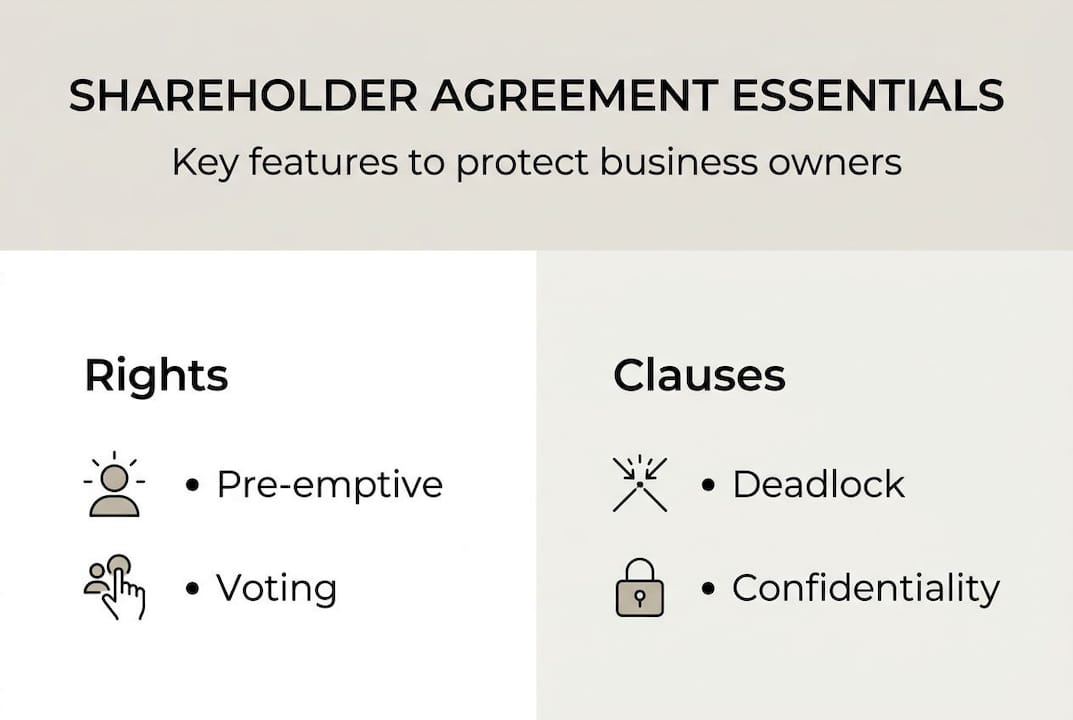
The core mechanics of share agreements typically include capitalisation tables, pre-emptive rights, share transfer restrictions, management and voting rights, reserved matters, buy-sell provisions, deadlock resolution, dividend policies, and confidentiality clauses.
Here is how those provisions break down in practice:
| Provision | What it does | Why it matters |
|---|---|---|
| Pre-emptive rights | Existing shareholders get first refusal on new shares | Prevents dilution of ownership |
| Right of first refusal (ROFR) | Shareholders must offer shares to existing owners before third parties | Protects owner relationships |
| Tag-along rights | Minority shareholders can join a majority sale | Protects minority from being left behind |
| Drag-along rights | Majority can compel minority to sell | Enables clean exit for all parties |
| Deadlock resolution | Sets process when shareholders cannot agree | Keeps the company operational |
| Buy-sell provisions | Defines how shares are valued and sold on exit | Prevents costly valuation disputes |
| Confidentiality clause | Restricts disclosure of business information | Safeguards intellectual property |
| Non-compete clause | Prevents departing shareholders from setting up rival businesses | Protects business continuity |
Two provisions deserve particular attention: deadlock resolution and pre-emptive rights. Deadlocks occur when shareholders hold equal power and cannot agree on a critical decision. A shotgun clause, sometimes called a buy-sell clause, is one solution. It allows one shareholder to name a price at which they will either buy out the other or sell their own shares at the same price. This forces realistic pricing and breaks the deadlock efficiently.
Pre-emptive rights protect existing shareholders from having their ownership diluted when new share capital explained is issued. Without this clause, a majority shareholder could issue new shares to a friendly third party, reducing minority owners to an insignificant stake.
Non-compete and confidentiality clauses are frequently overlooked during initial drafting, yet they are often the provisions that matter most when a shareholder exits. A departing co-founder who immediately joins a competitor or launches a rival business can do serious damage if there is no contractual barrier in place.
Solid corporate governance principles underpin every well-structured shareholder agreement. Governance covers not just who makes decisions, but how those decisions are made, recorded, and enforced.
Pro Tip: Review your shareholder agreement at every significant business milestone, such as a new funding round, a change in ownership, or a shift in business direction. Agreements that are not updated regularly can quickly become unfit for purpose.
With the main provisions outlined, it is essential to distinguish shareholder agreements from other foundational company documents. Business owners often conflate these documents, and that confusion can lead to gaps in protection.
The key distinction is this: shareholder agreements are optional, private and focus on shareholder-specific rights and obligations, while by-laws and articles of incorporation provide the legal backbone for company operations and are publicly filed documents.
Here is a direct comparison:
| Feature | Articles of incorporation | By-laws | Shareholder agreement |
|---|---|---|---|
| Publicly filed? | Yes | Often yes | No |
| Legally required? | Yes | Yes | No |
| Who it governs | The company | Directors and operations | Shareholders specifically |
| Who can access it | Anyone | Often anyone | Only the parties |
| Flexibility | Limited | Moderate | High |
| Covers share transfers? | Minimally | Rarely | In detail |
Understanding the Companies Act explained helps clarify why certain matters are reserved for statute and cannot be altered by private agreement. For example, minority shareholders retain specific rights under UK law regardless of what any private agreement says.
When setting up a business with multiple owners, the correct sequence for legal documentation is:
Following this sequence when handling business incorporation in the UK ensures that each document serves its intended purpose without overlap or contradiction. Many businesses rush the third step or skip it entirely, assuming the first two documents are sufficient. They rarely are.
After distinguishing among core legal documents, focus turns to practical guidance and the common pitfalls of drafting shareholder agreements. A poorly drafted agreement can be worse than no agreement at all, because it creates a false sense of security while leaving real risks unaddressed.
One of the most common and costly errors involves valuation. When a shareholder exits, the company needs a clear method for calculating what their shares are worth. Valuation methods must be explicit to avoid litigation. The three standard approaches are fixed price (a set figure agreed in advance), formula-based (a calculation linked to revenues or profits), and independent appraisal (a third-party professional valuation). If the agreement does not specify which method applies, disputes are almost inevitable.

The shotgun clause mentioned earlier also carries risks. It works well between two shareholders with similar resources, but becomes unfair when one party has significantly more capital than the other. That wealthier shareholder can effectively force a buyout at a price the other cannot match. In situations involving multiple shareholders, shotgun clauses become even more complicated and may not function as intended.
For startup legal contracts, tailoring minority protections and exit triggers from the very beginning is essential. Early-stage businesses often focus on growth and overlook the mechanisms that govern what happens when co-founders part ways.
Key red flags that indicate a poorly drafted shareholder agreement include:
Pro Tip: Before finalising any shareholder agreement, run a scenario planning exercise with your solicitor. Ask what happens if one founder dies, becomes incapacitated, or simply wants to leave in two years. Testing the agreement against real-world scenarios reveals gaps you might not otherwise notice.
In our experience advising businesses across industries, the conversations we dread most are the ones that start with, “We never got around to drafting the agreement.” By that point, someone is already upset, and the options available are limited, expensive, and time-consuming.
Most founder disputes do not arise because people are dishonest. They arise because expectations were never written down. Two co-founders can have entirely different ideas about how profits should be distributed, whether one of them can bring in outside investors, or what happens to the company if one of them receives a job offer abroad. Without a shareholder agreement, every one of those disagreements becomes a crisis.
The uncomfortable truth is that waiting until a dispute emerges before drafting an agreement is like buying insurance after your house has already flooded. The value of a shareholder agreement lies almost entirely in its existence before anything goes wrong. We have seen businesses structured using corporate law dos and don’ts that avoided costly litigation simply because their agreements anticipated the specific dispute that eventually arose.
Early agreements also make fundraising smoother. Investors routinely request to review shareholder agreements before committing capital. A well-drafted agreement signals that the founding team is professional, has thought through its governance, and will not be paralysed by internal disagreements.
A shareholder agreement is only as strong as the drafting behind it. Generic templates downloaded from the internet are rarely sufficient for anything beyond the simplest ownership arrangements, and even then, the risks of a mismatch with your specific situation are substantial.

At Ali Legal, our corporate and commercial law team works with business owners to draft, review, and update shareholder agreements that genuinely reflect your ownership structure, goals, and risk profile. Whether you are establishing a new company or dealing with a dispute that highlights gaps in an existing agreement, we provide straightforward, fixed-fee legal advice that helps you move forward with confidence. Our approach to commercial litigation strategy means we also understand what happens when agreements are tested in court, which is precisely the knowledge that makes our drafting sharper. We have also outlined civil litigation best practices that reflect the real risks businesses face when disputes escalate.
No, shareholder agreements are optional in the UK, but they are highly recommended to protect shareholder-specific rights and prevent disputes before they arise.
Without a shareholder agreement, disputes default to company articles and UK company law, which often lack the personalised solutions that closely held firms need to resolve internal conflicts efficiently.
A shareholder agreement can supplement company documents, but must align with statutory requirements and cannot override provisions mandated by UK company law.
An experienced solicitor specialising in business law should draft and review the agreement, since valuation methods and provisions must be precise and legally enforceable to protect all parties involved.


