
Menu
Get Expert Legal Support Today

Joint ventures promise growth and innovation, yet 50% fail within five years-The-strategic-edge-for-transformative-transactions.html). The difference between success and failure often lies in a single document: the joint venture agreement. Without clear terms governing roles, finances, and decision making, even well intentioned partnerships crumble under misaligned expectations. This guide clarifies what a joint venture agreement is, its essential components, and how to structure one that protects your interests whilst maximising collaborative value. You will discover practical strategies to reduce risk and build partnerships that deliver results.
| Point | Details |
|---|---|
| Foundational contract | A joint venture agreement defines scope, governance, capital contributions, and profit sharing for collaborative projects |
| Risk management | Clear exit strategies, dispute resolution clauses, and fiduciary duties prevent conflicts and reduce the 50% failure rate |
| Structural flexibility | Joint ventures retain separate legal identities with limited liability, unlike partnerships or mergers |
| Strategic alignment | Success requires complementary partners, detailed customised agreements, and open communication beyond legal clauses |
A joint venture agreement is the foundational legal contract governing a JV, where two or more parties collaborate on a specific project by pooling resources whilst retaining separate identities. This distinction separates joint ventures from partnerships, where parties merge operations completely, or mergers, which integrate businesses permanently. The JV structure allows companies to pursue opportunities requiring complementary expertise or capital without surrendering independence.
Joint ventures typically focus on defined projects with clear timelines. One party might contribute technology whilst another provides market access or manufacturing capacity. The agreement establishes how decisions get made, profits get distributed, and disputes get resolved. Without this contractual foundation, partners risk misunderstandings about authority, financial obligations, and exit rights.
The project specific nature of joint ventures offers strategic advantages. Companies can test new markets, share development costs, or access restricted sectors without full commitment. Limited liability protects each party’s broader business interests if the venture underperforms. However, this flexibility demands precise contractual terms.
“The joint venture agreement transforms vague intentions into enforceable obligations, creating accountability and clarity that verbal agreements cannot provide.”
Key differences from other structures include:
These distinctions matter when structuring deals. A poorly drafted agreement that blurs these boundaries can create unintended tax consequences, liability exposure, or governance conflicts. Business leaders must understand these fundamentals before negotiating terms.
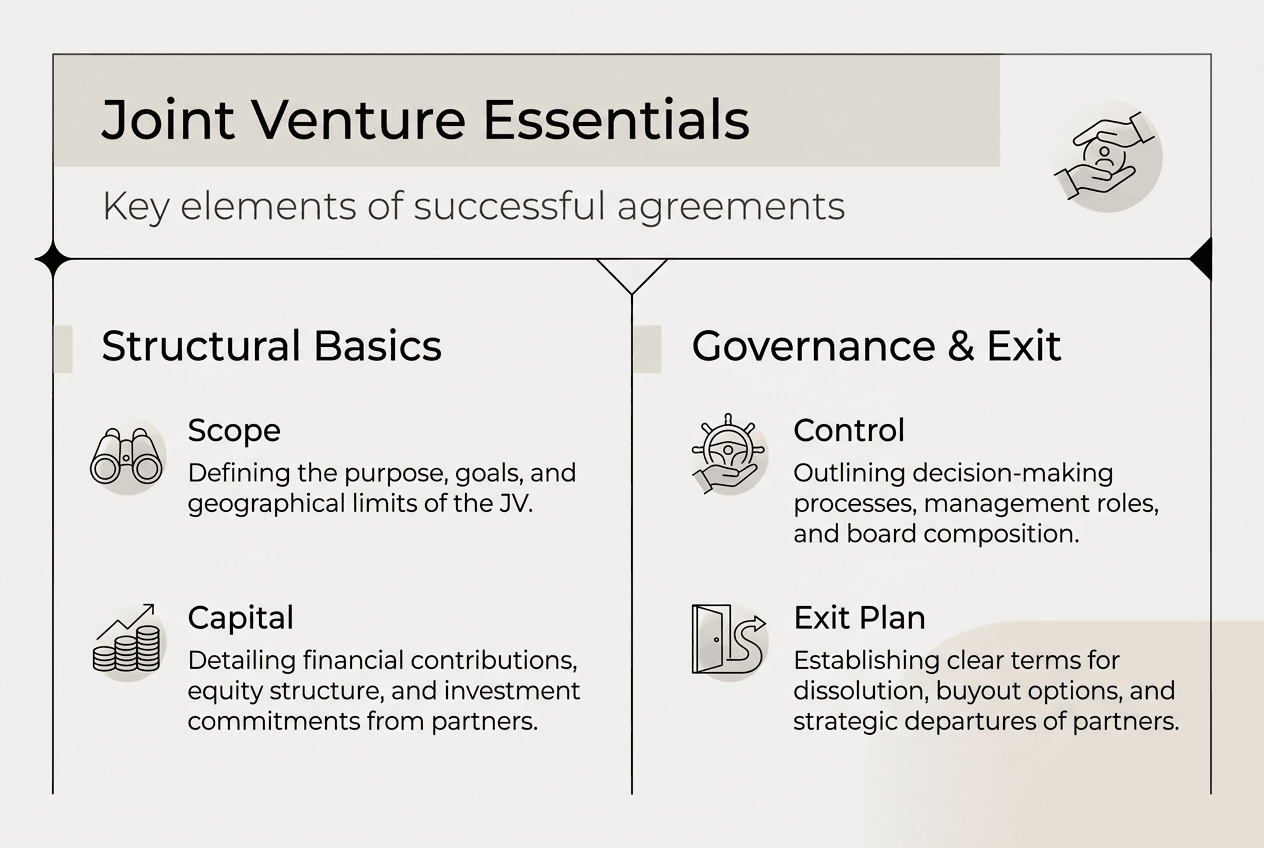
Every effective joint venture agreement addresses core structural elements that define how the partnership operates. Key mechanics include scope and purpose, capital contributions dictating ownership, governance structures, profit and loss allocation, and exit strategies like deadlock or buy-sell agreements. These components work together to create a functional framework that anticipates challenges and allocates risk fairly.
The scope and purpose clause defines exactly what the joint venture will accomplish. Vague objectives invite disputes about whether specific activities fall within the partnership’s remit. Precise language about deliverables, timelines, and territorial boundaries prevents mission creep and keeps partners aligned.
Capital contributions determine ownership stakes and influence. Partners may contribute cash, physical assets, intellectual property, or expertise. The agreement must specify:
Governance mechanisms establish decision making authority. Most joint ventures create management committees with representatives from each partner. The agreement should define voting thresholds for routine decisions versus major actions like asset sales or additional borrowing. Quorum requirements prevent one party from acting unilaterally.

Profit and loss sharing follows ownership percentages or negotiated ratios. Some agreements link distributions to performance milestones rather than fixed percentages. Tax implications vary significantly based on structure, so legal and accounting advice proves essential during drafting.
Exit strategies protect partners when relationships deteriorate or objectives change. Buy sell clauses allow one party to trigger a purchase at fair value. Deadlock resolution mechanisms like the Texas Shootout method force decisive action when partners cannot agree. One party names a price, and the other chooses whether to buy or sell at that price.
| Component | Purpose | Key considerations |
|---|---|---|
| Scope definition | Limits venture activities | Specificity prevents disputes |
| Capital terms | Establishes ownership stakes | Include valuation methods |
| Governance rules | Defines decision authority | Set clear voting thresholds |
| Profit sharing | Allocates financial returns | Align with contributions or milestones |
| Exit provisions | Enables partnership dissolution | Include deadlock resolution |
Pro Tip: Draft exit clauses when relationships are strong. Partners negotiate more fairly before conflicts arise, creating mechanisms both sides trust.
These structural elements interact dynamically. Governance rights often correlate with capital contributions, whilst profit sharing might reward operational performance differently than financial investment. Understanding how corporate governance in joint ventures balances these interests helps you negotiate terms that protect your position whilst maintaining partnership viability.
Joint ventures create inherent tension between loyalty to the partnership and loyalty to parent companies. Fiduciary duties require loyalty and care to the JV itself, often codified in the agreement with conflict disclosure and non compete covenants to manage inherent conflicts. These duties prevent partners from exploiting the venture for individual gain at the partnership’s expense.
The duty of loyalty prohibits partners from competing with the joint venture or diverting corporate opportunities that belong to the partnership. The duty of care requires partners to act with reasonable diligence in managing venture affairs. Many agreements explicitly define these duties to avoid ambiguity about acceptable conduct.
Conflict of interest provisions address dual loyalties. Partners naturally prioritise their parent companies’ interests, which may diverge from optimal JV strategy. Non compete clauses restrict partners from pursuing similar projects independently during the venture’s term. Disclosure requirements force partners to reveal potential conflicts before they cause harm.
Disputes often arise from deadlocks, unilateral actions, or differing interpretations of authority, which require clear procedures within the JVA to address. Common triggers include:
Effective agreements establish tiered dispute resolution processes. Initial disputes go to senior executives for negotiation. If negotiation fails, mediation provides a structured forum with a neutral facilitator. Arbitration offers binding resolution without public court proceedings. This progression reduces costs and preserves relationships by resolving issues at the lowest effective level.
Clear conflict resolution clauses reduce litigation risks significantly. Specify timelines for each escalation stage, selection processes for mediators or arbitrators, and governing law. Some agreements require parties to continue performing obligations during disputes to prevent operational paralysis.
Pro Tip: Include a mandatory cooling off period before arbitration. Requiring 30 days of good faith negotiation often resolves disputes without formal proceedings.
Understanding contract dispute resolution methods and dispute resolution methods in joint ventures helps you structure clauses that match your risk tolerance and relationship dynamics. International ventures face additional complexity from differing legal systems and cultural approaches to conflict.
Business leaders often confuse joint ventures with partnerships or mergers, yet these structures differ fundamentally in liability, permanence, and control. Joint ventures are project specific with limited liability and retained independence compared to ongoing partnerships or full mergers that integrate operations completely.
Joint ventures create separate legal entities for specific projects whilst parent companies maintain independence. Each partner contributes defined resources and shares specified risks. The venture exists for a predetermined purpose or duration, after which it dissolves or transitions.
Partnerships establish ongoing business relationships where partners share profits, losses, and unlimited personal liability. Partners typically participate in day to day management and bear joint responsibility for partnership debts. This structure suits professional services or long term operational collaboration.
Mergers combine two entities into one, eliminating separate identities. Shareholders of acquired companies receive shares or cash, and operations integrate fully. Mergers suit situations requiring complete alignment and unified control.
| Feature | Joint venture | Partnership | Merger |
|---|---|---|---|
| Legal identity | Separate entities maintained | Shared partnership entity | Single combined entity |
| Liability | Limited to venture assets | Unlimited personal liability | Assumed by surviving entity |
| Duration | Project specific term | Ongoing indefinitely | Permanent integration |
| Independence | Partners retain autonomy | Shared management control | Complete operational merger |
| Exit flexibility | Defined exit mechanisms | Partner buyout or dissolution | Requires sale or liquidation |
Equity joint ventures prove preferable when:
Partnerships work better for ongoing professional collaboration where partners contribute similar expertise and share management equally. Mergers suit situations where synergies require full integration and separate operations create inefficiency.
These distinctions influence contract drafting significantly. Joint venture agreements focus on project deliverables and exit strategies. Partnership agreements emphasise profit sharing and management authority. Merger agreements address valuation, integration timelines, and employee transitions.
Understanding these differences helps you select appropriate structures and negotiate terms that match your strategic objectives. Misclassifying arrangements creates legal and tax complications that undermine partnership value.
Successful joint ventures require more than solid legal agreements. Executives should prioritise defining a clear business strategy and success criteria before legal structure; use detailed JVAs with tailored governance and exit clauses to mitigate failure risks-The-strategic-edge-for-transformative-transactions.html). These strategic considerations separate thriving partnerships from expensive failures.
Assess partner complementarity rigorously before committing. Successful ventures combine partners with different strengths that create value neither could achieve alone. Evaluate cultural fit, risk tolerance, and strategic alignment beyond financial projections.
Draft customised detailed agreements avoiding generic templates. Every joint venture faces unique challenges based on industry, geography, and partner dynamics. Template agreements miss crucial protections and create ambiguity about critical terms.
Build comprehensive governance frameworks with clear authority limits. Define which decisions require unanimous consent versus majority vote. Specify approval thresholds for capital expenditures, hiring, and strategic pivots.
Include tiered dispute resolution to reduce costly litigation. Structure escalation from negotiation through mediation to arbitration. Most disputes resolve at early stages when procedures encourage dialogue.
Plan for institutional and cultural differences in international ventures. Social mechanisms like trust and communication outperform purely structural clauses for improving international joint venture performance. Regular face to face meetings, transparent reporting, and relationship building complement legal protections.
Establish clear performance metrics and review cycles. Define success criteria beyond financial returns. Regular strategic reviews allow partners to adjust course before problems escalate.
Address intellectual property ownership explicitly. Specify who owns developments created during the venture and usage rights after dissolution. Ambiguity about IP creates costly disputes.
Pro Tip: Create a partnership charter separate from the legal agreement. This document captures shared vision, operating principles, and cultural commitments that legal contracts cannot enforce but relationships require.
Open communication proves as important as contractual protections. Partners who share information freely, acknowledge challenges early, and collaborate on solutions outperform those who rely solely on legal remedies. Trust develops through consistent behaviour over time, not contract clauses.
Understanding corporate law duties in joint ventures helps you balance legal obligations with practical relationship management. The most successful ventures combine rigorous contracts with genuine partnership spirit.
Navigating joint venture agreements requires expertise that protects your interests whilst preserving partnership potential. Poorly drafted terms create expensive disputes, whilst overly aggressive positions poison relationships before ventures launch. You need legal advisers who understand both commercial realities and contractual protections.

Ali Legal offers specialised support for joint venture contract drafting, review, and dispute resolution. Our commercial litigation strategy and dispute resolution services protect your business interests when partnerships face challenges. We provide civil litigation dispute support tailored to your specific circumstances, whether you need aggressive advocacy or collaborative resolution.
Our approach combines technical legal excellence with commercial awareness. We help you structure agreements that reduce risk whilst maintaining flexibility for partnership evolution. Contact us for professional legal advice that safeguards your venture from conception through completion.
A comprehensive joint venture agreement includes the venture’s purpose and scope, capital contribution requirements, governance structures with voting mechanisms, profit and loss allocation formulas, intellectual property ownership terms, dispute resolution procedures, and exit strategies including buy sell provisions. These clauses work together to define partner responsibilities, manage conflicts, and provide clear paths for dissolution when objectives change or relationships deteriorate.
Joint venture agreements govern project specific collaborations with defined timelines whilst maintaining separate legal identities for each partner, creating limited liability exposure. Partnership agreements establish ongoing business relationships with shared unlimited liability where partners typically participate in day to day management. JVAs focus on discrete objectives and exit mechanisms, whereas partnership agreements emphasise long term profit sharing and management authority without predetermined end dates.
Effective dispute resolution clauses establish tiered approaches starting with direct negotiation between senior executives, escalating to mediation with neutral facilitators, and finally binding arbitration if earlier stages fail. Include specific timelines for each stage, selection processes for mediators or arbitrators, and governing law provisions. Clear authority limits and escalation procedures reduce deadlock risks by defining which decisions require unanimous consent versus majority approval. Consider dispute resolution options that match your partnership dynamics and risk tolerance.
Yes, well drafted agreements include multiple exit mechanisms to protect partner interests when circumstances change. Buy sell clauses allow one party to purchase the other’s interest at fair market value determined through agreed valuation methods. Deadlock resolution provisions like the Texas Shootout method force decisive action when partners cannot agree on major decisions. Change of control provisions, material breach clauses, and predetermined dissolution dates provide additional exit triggers that prevent partners from remaining trapped in unproductive relationships.


