
Menu
Get Expert Legal Support Today

TL;DR:
- Global compliance costs reached 271 billion dollars in 2022, with rising fines and breach costs.
- Legal frameworks underpin international trade, requiring structured compliance strategies across multiple laws.
- Embedding proactive legal risk management and partnering with specialists enhances business resilience and value.
Global financial compliance costs hit $271B in 2022 alone, and that figure does not capture the full picture. GDPR fines exceeded €2.9 billion by 2023, and the average data breach now costs businesses $4.45 million to resolve. For corporate executives operating across borders, legal frameworks are not administrative inconveniences. They are the architecture upon which sustainable, profitable international business is built. Ignore them and the financial, reputational, and operational consequences can be existential. Understand them, and they become a source of genuine competitive advantage. This guide breaks down how law shapes strategy and risk in global markets, and how the most effective organisations turn compliance into a business asset.
| Point | Details |
|---|---|
| Legal frameworks de-risk business | International laws anchor compliance, reducing exposure to fines and disruptions. |
| Integrated compliance is essential | Networked compliance programmes and regular audits help manage global obligations efficiently. |
| Grey areas require agility | When laws or sanctions conflict, proactive monitoring and specialist advice are critical. |
| Compliance boosts long-term value | Proactive legal strategy enhances credibility, investment, and economic resilience. |
Legal frameworks are the invisible infrastructure of international commerce. Without them, contracts cannot be enforced, capital cannot flow safely, and markets cannot function. With the scale of financial risk established, the next step is understanding how legal frameworks create structure in global markets.
For multinational enterprises, the regulatory environment spans dozens of overlapping and sometimes conflicting obligations. Anti-corruption, data protection, sanctions, and tax laws such as FCPA, the UK Bribery Act, GDPR, and OECD GloBE rules each demand distinct compliance strategies. Environmental standards, trade controls, and labour law add further layers. Navigating this landscape requires more than good intentions. It requires structured legal programmes.
The key regulatory areas most businesses must address include:
‘Financial compliance failure cost companies $271 billion globally in 2022, a figure that continues to rise as regulatory enforcement intensifies.’
The consequences of non-compliance extend well beyond fines. Criminal liability for executives is increasingly common. Reputational damage, particularly in the age of social media, can destroy supplier and investor relationships overnight. Licence revocations can halt operations entirely.
Here is a snapshot of how regulatory exposure varies by domain:
| Regulatory area | Key law or body | Potential penalty |
|---|---|---|
| Data protection | GDPR | Up to 4% global annual turnover |
| Anti-corruption | FCPA / UK Bribery Act | Unlimited fines, custodial sentences |
| Global minimum tax | OECD GloBE | Tax top-ups plus penalties |
| Sanctions | OFAC / EU | Transaction bans, criminal liability |
| Environmental | EU CSDD Directive | Fines, civil liability |
The counterintuitive truth is this: businesses that invest in legal frameworks as a strategic tool, not merely a compliance tick-box, outperform peers over time. You can explore this further in Ali Legal’s international business law guide and their analysis of the role of international law in UK commercial strategy.
Once the role of law is clear, focus turns to how effective companies operationalise compliance in practice. The difference between businesses that absorb regulatory risk well and those that are blindsided by it comes down to programme design.
Core risk methodologies used by leading multinationals include risk assessments, gap analyses, policy development, staff training, third-party due diligence, audits, monitoring, and structured investigations. These are not discrete tasks. They form a continuous cycle.
The most effective approach follows a prevent, detect, respond model:
The comparison below shows why programme design matters:
| Feature | Ad hoc compliance | Integrated programme |
|---|---|---|
| Risk identification | Reactive, event-driven | Proactive, continuous |
| Third-party due diligence | Occasional, inconsistent | Standardised, risk-tiered |
| Staff training | Annual box-tick | Role-specific, ongoing |
| Cost profile | Unpredictable, crisis-driven | Planned, cost-efficient |
| Regulatory outcomes | Higher enforcement risk | Demonstrably lower exposure |
The compliance cost data makes a compelling case for integration: businesses with mature compliance programmes consistently spend less on enforcement, litigation, and remediation than those managing risk reactively.
Pro Tip: For high-risk markets, include jurisdiction-specific contract clauses and local law adaptation addenda in every commercial agreement. These simple additions can be the difference between a manageable dispute and protracted cross-border litigation.
Strong compliance programmes face true tests under legal ambiguity, which requires further insight. Not every legal question has a clear answer, and some of the most damaging compliance failures occur not through ignorance of the law, but through underestimating its complexity.
Sanctions, jurisdictional conflicts, and extraterritorial laws create situations where no option is obviously compliant. Consider the following scenarios:
‘Extraterritorial enforcement is the silent multiplier of legal risk. What is permissible locally may be a criminal act under another jurisdiction’s law.’
The contractual implications of sanctions are particularly acute. When sanctions make performance illegal, parties face hard choices between breach, renegotiation, or formal frustration claims. Each path carries legal and commercial risk.
For executives managing cross-border disputes, having pre-agreed dispute resolution mechanisms is not optional. It is the clearest competitive advantage available. The advantages of international arbitration over litigation are significant: enforceability across 170 jurisdictions under the New York Convention, confidentiality, and the ability to choose neutral arbitrators.
Pro Tip: Establish a real-time geopolitical monitoring protocol covering your key markets. Regulatory change and sanctions designations rarely give businesses advance warning, and the companies that respond fastest avoid the largest exposure.
Having surveyed areas of complexity, it is worth stepping back to measure compliance’s bigger-picture impact. The evidence is clear: legal stability and compliance are not costs to be minimised. They are foundations for growth.

Rule of law correlates directly with long-term economic performance. Countries with strong, predictable legal frameworks attract more foreign direct investment, generate more innovation, and sustain higher productivity growth. Businesses operating within those frameworks inherit those advantages.
The key rules for UK trade and cross-border business make clear that compliance is also a trust signal. Investors, institutional partners, and sophisticated corporate clients assess a company’s legal and compliance posture before committing capital. A clean compliance record is a genuine commercial asset.
However, the picture is not entirely straightforward. Due diligence legislation such as the EU’s Corporate Sustainability Due Diligence Directive may reduce trade and investment flows despite its human rights objectives, by raising costs for businesses operating in developing markets.
The key trade-offs for global executives include:
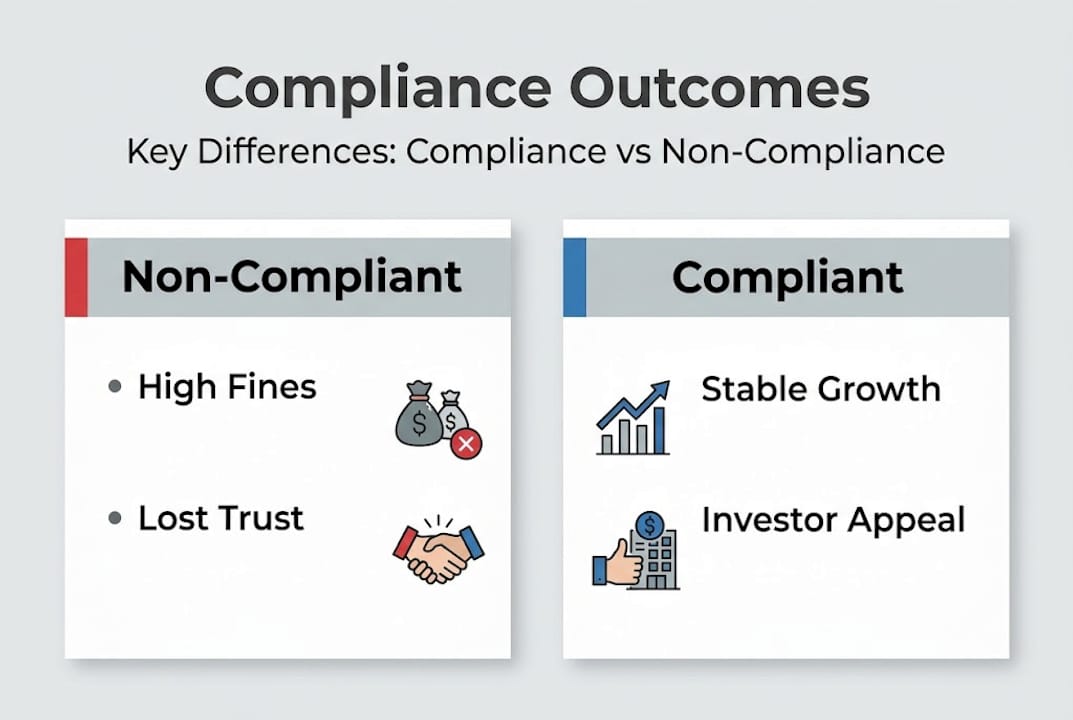
| Outcome | Non-compliant business | Compliant business |
|---|---|---|
| Regulatory fine exposure | High, unpredictable | Managed, insurable |
| Investor confidence | Lower, risk-discounted | Higher, premium valuation |
| Market access | Restricted post-enforcement | Preserved and expandable |
| Long-term growth | Constrained by legal liability | Supported by legal stability |
Most executives treat compliance as a legal department problem. That is the first and most costly mistake. In our experience, the organisations that manage cross-border legal risk most effectively have done something structurally different: they have embedded legal intelligence into commercial decision-making at the outset, not after a problem has surfaced.
Reactive compliance is expensive. It almost always involves external counsel hired at crisis rates, reputational repair, and regulatory settlement negotiations. Proactive compliance, by contrast, is largely a design and investment challenge. Build the right programme once, and it scales.
The second mistake leaders make is treating legal risk as uniform. It is not. Risk in Germany is materially different from risk in Vietnam, and a single global policy cannot serve both. The most effective programmes use a cross-border dispute checklist approach: standardised principles, locally adapted execution.
Pre-negotiated dispute resolution mechanisms, jurisdiction clauses, and real-time geopolitical monitoring consistently outperform rigid rule-following in volatile markets. The companies that navigate sanctions, trade wars, and conflicting laws with the least damage are not those with the largest legal teams. They are those with the sharpest processes.
The frameworks outlined here require more than internal capability. They require specialist legal partners who understand how regulation, commercial risk, and strategic opportunity intersect across jurisdictions.

At Ali Legal, we support corporate clients with commercial litigation strategy and commercial contracts guidance that are built around your specific markets, risk profile, and business objectives. Whether you are structuring an international agreement, responding to regulatory scrutiny, or managing a cross-border dispute, our team provides transparent, fixed-fee advice without the delays. If you are ready to strengthen your compliance position, speak to Ali Legal today.
Data protection (GDPR), anti-corruption (FCPA, UK Bribery Act), and sanctions laws are most critical for cross-border compliance, as they carry extraterritorial reach and significant penalties.
Conduct regular risk assessments, build an integrated compliance programme, adapt policies for local laws, and monitor enforcement trends continuously rather than reactively.
Seek specialist legal advice immediately, document all steps taken, consider arbitration over litigation, and ensure protective jurisdiction and governing law clauses are inserted in all commercial contracts.
Yes. Strong compliance programmes improve investor confidence, preserve market access, and build long-term economic resilience, all of which translate directly into higher business valuations.


