
Menu
Get Expert Legal Support Today

Many people mistakenly believe residency by investment and citizenship by investment are interchangeable terms, but they represent fundamentally different legal statuses with distinct rights and obligations. Residency by investment grants you the right to live in a foreign country through a qualifying financial contribution, without conferring citizenship or passport privileges. This guide clarifies the legal framework, application process, and strategic considerations for individuals exploring residency by investment programmes in 2026, helping you navigate this increasingly regulated landscape with confidence and avoid costly missteps.
| Point | Details |
|---|---|
| Investment pathways | Residency by investment typically requires contributions through real estate purchases, government bonds, or business investments in the host country. |
| Programme diversity | Requirements vary dramatically across 44 countries offering schemes, from €150,000 to over €2 million minimum investments. |
| Due diligence matters | Background checks and source of funds verification are mandatory steps that determine application success or rejection. |
| Family inclusion | Most programmes allow spouses and dependent children to gain residency status alongside the primary applicant. |
| Legal complexity | Professional guidance minimises risks around compliance, tax implications, and documentation requirements that commonly derail applications. |
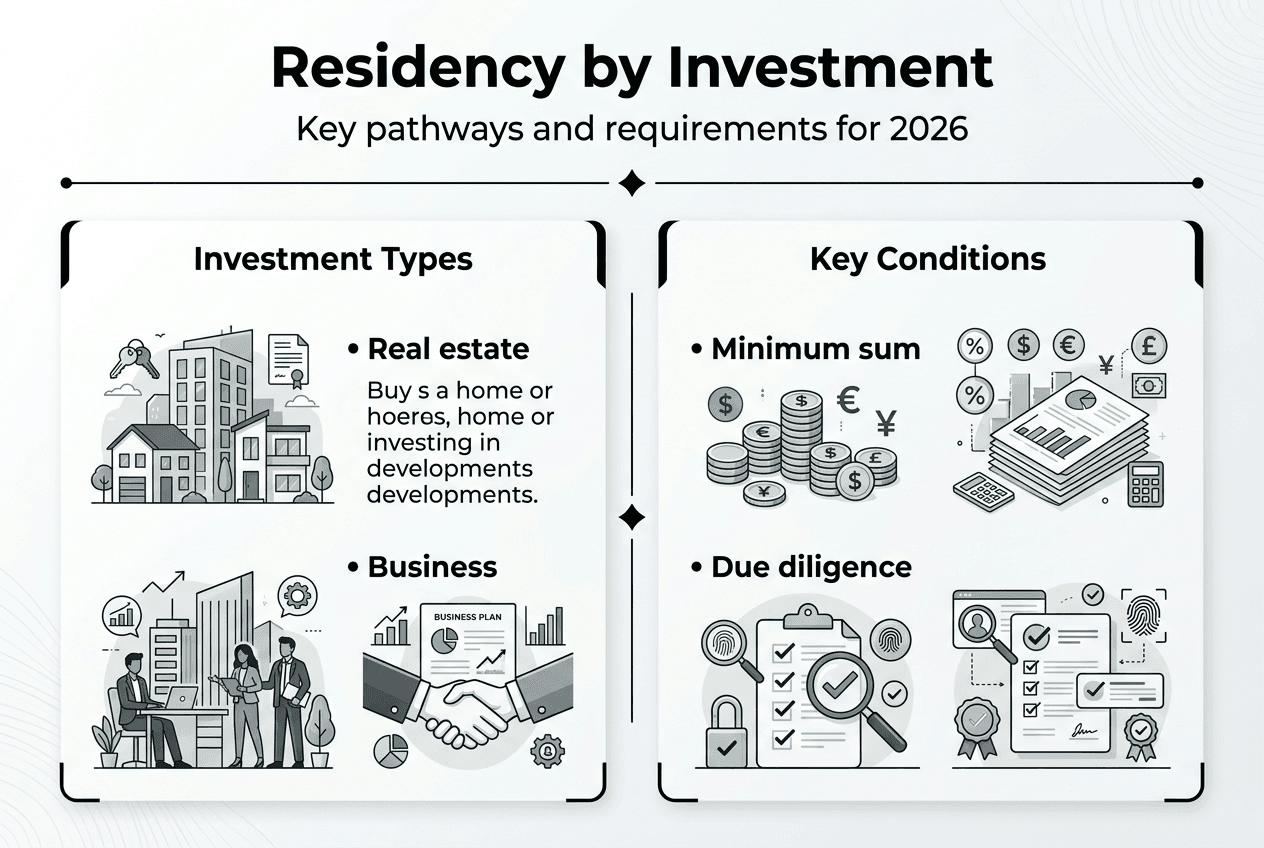
Residency by investment programmes offer a pathway to residency in a foreign country through a significant financial contribution, typically in the form of investment in real estate, government bonds, or a local business. Unlike citizenship schemes, RBI does not grant you a passport or voting rights. You receive a residence permit that allows you to live, work, and often travel within certain regions whilst maintaining your original nationality.
The qualifying investment types vary by jurisdiction but generally fall into several categories. Real estate purchases remain the most popular route, requiring you to buy property meeting minimum value thresholds set by the host country. Government bonds or approved funds represent another common pathway, where you commit capital for a fixed period. Business investments involving job creation or economic contribution also qualify in many schemes. Each investment type carries different liquidity profiles, risk levels, and potential returns beyond the residency benefit itself.
Residency programmes differ fundamentally from citizenship by investment in several critical ways. Residency grants you legal permission to reside but not full citizenship rights. You cannot vote, hold certain public offices, or automatically pass nationality to children born after obtaining residency. However, residency often serves as a stepping stone, with many countries offering pathways to naturalisation after maintaining residence for specified periods, typically five to ten years.
The landscape of RBI programmes has evolved considerably since the 2000s, becoming more regulated and diverse. Countries now impose stricter due diligence requirements, enhanced compliance frameworks, and clearer investment criteria. This professionalisation protects both host nations and legitimate investors whilst weeding out questionable applications. The basic process involves selecting a qualifying investment, completing due diligence checks, submitting your application with supporting documents, and awaiting approval before receiving your residence permit.
Understanding these fundamentals helps you evaluate whether residency by investment aligns with your relocation and immigration objectives before committing substantial capital. The right programme depends on your specific circumstances, family situation, tax considerations, and long-term goals rather than simply choosing the cheapest option available.
The application journey for residency by investment follows a structured multi-stage process that demands meticulous preparation and patience. Understanding each phase helps you anticipate requirements, avoid common pitfalls, and maintain realistic timeline expectations throughout your application.
Due diligence represents a critical gatekeeping step where authorities assess your background and source of funds to prevent money laundering, security risks, and fraudulent applications. You must demonstrate that your investment capital originates from legitimate sources through comprehensive financial documentation spanning several years. Tax returns, business ownership records, employment history, and asset sale documentation all contribute to building a credible financial profile.
Timelines for residency approval vary dramatically by country and programme complexity. Fast-track schemes in some jurisdictions deliver residence permits within three to six months, whilst others require twelve to eighteen months for complete processing. Complex cases involving multiple family members, intricate financial structures, or additional scrutiny can extend timelines further. Processing speeds also fluctuate based on application volumes, government efficiency, and seasonal backlogs.
Common rejection reasons include incomplete documentation, unexplained gaps in financial history, minor criminal records not disclosed upfront, and investments that fail to meet precise programme criteria. Non-compliance with ongoing residency conditions after initial approval can also jeopardise your status. Some applicants underestimate the documentation burden, submitting applications before gathering all required certificates, translations, and verifications.
Pro Tip: Prepare complete, verified paperwork upfront to avoid delays or refusals. Engage professional legal support early to audit your documentation, identify potential red flags, and address compliance gaps before submission rather than responding to deficiency notices that extend timelines and raise examiner scrutiny.
Several countries offer RBI programs with widely varying requirements and benefits, making systematic comparison essential before committing capital. The global landscape includes European schemes offering Schengen access, Caribbean programmes emphasising tax efficiency, and Asian options providing business connectivity. Each jurisdiction designs programmes around distinct economic objectives, whether attracting real estate investment, boosting development funds, or importing entrepreneurial talent.
Evaluating programmes requires examining multiple criteria beyond headline investment amounts. Minimum investment thresholds represent just one factor in a complex decision matrix. Consider these critical comparison dimensions:
Investment thresholds demonstrate the wide spectrum of options available. Portugal’s golden visa historically required €500,000 for real estate investments, though recent reforms have shifted focus toward funds and business investments in less developed regions. Greece offers residency for €250,000 property purchases in certain areas. Costa Rica provides options around $150,000 USD for approved investments. Malta’s programme demands over €600,000 in combined contributions and real estate commitments. These figures exclude additional costs like legal fees, due diligence charges, and government processing fees that typically add 10-20% to total outlay.

The growth of RBI programmes from about a dozen in the 2000s to 44 countries in 2022 reflects increasing global competition for investment capital and mobile talent. This expansion gives you more choices but also demands more careful evaluation to match programme characteristics with your specific needs.
Family coverage represents a crucial differentiator between schemes. Most programmes include spouses and dependent children under 18 or 21 automatically. Some extend coverage to dependent parents, adult children pursuing education, or siblings with disabilities. Generous family provisions deliver significantly more value when you need to relocate entire households rather than just the primary applicant.
Long-term residency rights vary considerably in how they convert temporary permits into permanent status. Some countries grant immediate permanent residency upon investment, whilst others issue renewable temporary permits requiring periodic renewal and compliance verification. Understanding the pathway to permanent residency or eventual citizenship helps you assess whether a programme offers genuine long-term security or merely temporary access requiring ongoing investment maintenance.
Pro Tip: Assess residency rights and family benefits carefully, not just investment cost. A programme with higher upfront investment but superior residency privileges, family inclusion, and tax efficiency may deliver better value than cheaper options with restrictive conditions and limited long-term prospects.
Your immigration strategy should align programme selection with your broader relocation objectives, considering where you want to establish business operations, educate children, and eventually retire rather than simply acquiring a residence permit as a status symbol.
Navigating the legal complexities of RBI programmes requires understanding requirements that extend far beyond writing a cheque for the minimum investment. Each jurisdiction imposes specific compliance obligations, documentation standards, and ongoing conditions that successful applicants must maintain throughout their residency period.
Legal complexities around meeting all programme requirements often surprise applicants accustomed to straightforward transactions. You must satisfy eligibility criteria covering age, health, criminal records, and financial standing simultaneously. Missing any single requirement, even seemingly minor documentation deficiencies, can trigger rejection or lengthy requests for additional information. Some programmes impose restrictions on applicants from certain countries, whilst others exclude individuals with specific criminal convictions regardless of how minor or dated.
Thorough due diligence on both your investment vehicle and personal documents prevents costly mistakes. For real estate investments, you must verify that properties qualify under programme rules, confirm clear title, and ensure purchase prices meet minimum thresholds including all fees. Government bond investments require using approved financial institutions and maintaining funds for specified holding periods. Business investments demand detailed business plans, job creation commitments, and ongoing operational reporting. Your personal documentation must prove identity, financial history, and clean background through original certificates, notarised translations, and official verifications that meet host country standards.
Tax implications represent a critical financial consideration that many applicants underestimate during initial programme evaluation. Residency status can trigger tax obligations in your new country of residence, potentially creating dual tax exposure if your home country also taxes worldwide income. Some jurisdictions offer low or zero income tax, capital gains tax, or inheritance tax, enabling more efficient wealth preservation and growth. However, you must understand how tax treaties between countries prevent double taxation and whether your residency triggers reporting obligations even if actual tax liability remains minimal.
Common tax considerations include:
Risks of programme non-compliance extend beyond initial application rejection to include revocation of granted residency status. Most programmes impose ongoing conditions such as maintaining your qualifying investment for minimum periods, typically five to seven years. Selling real estate prematurely, withdrawing bond investments early, or failing to sustain business operations can void your residency permit. Some schemes require minimum physical presence, whilst others demand you avoid extended absences that suggest you are not genuinely residing in the country.
Expert legal consultation proves invaluable for navigating these complexities successfully. Immigration lawyers specialising in investment migration understand programme nuances, common pitfalls, and strategies for structuring investments tax efficiently. They audit your documentation before submission, coordinate with local advisers in the host country, and manage communications with immigration authorities. Professional guidance becomes especially critical when programmes change rules mid-process, requiring rapid strategic adjustments to protect your application.
Property law compliance matters significantly for real estate based RBI programmes, where you must satisfy both immigration requirements and local property regulations simultaneously. Conveyancing procedures, title verification, and registration formalities vary by jurisdiction, creating additional complexity beyond the residency application itself.
The investment required for residency by investment programmes represents substantial capital commitment, making thorough legal and financial planning essential rather than optional. Cutting corners on professional advice to save modest fees risks far larger losses through rejected applications, tax inefficiencies, or compliance failures that jeopardise your residency status after approval.
Navigating residency by investment requires specialised expertise that bridges immigration law, international tax planning, and cross-border compliance. The stakes are high, with substantial capital at risk and your family’s future mobility depending on getting every detail right. Ali Legal offers expert guidance on residency by investment and immigration pathways tailored for high net worth individuals and investor clients seeking global relocation solutions.

Professional legal advice minimises risks throughout the due diligence and compliance process, from initial programme selection through final approval and beyond. Our immigration law services help you evaluate programme options against your specific circumstances, structure investments tax efficiently, and prepare bulletproof applications that withstand scrutiny. We coordinate with local counsel in host jurisdictions, manage complex documentation requirements, and provide ongoing compliance support to protect your residency status long term. Understanding the role lawyers play in immigration matters helps you appreciate how expert guidance transforms a daunting process into a manageable strategic initiative with clear milestones and realistic expectations.
Residency grants you legal permission to live in a country whilst maintaining your original nationality, without conferring voting rights or a passport. Citizenship provides full national status including a passport, voting privileges, and the ability to pass nationality to children, representing a fundamentally different legal status with broader rights and obligations.
Processing timelines range from three months for fast track programmes to eighteen months for complex applications requiring extensive due diligence. Variables affecting duration include application completeness, background check complexity, government processing capacity, and whether you need to address deficiency notices during review.
Most programmes automatically include spouses and dependent children under age limits ranging from 18 to 26 years. Many schemes extend coverage to dependent parents, adult children pursuing education, or disabled siblings, though specific family inclusion provisions vary significantly by jurisdiction and require careful evaluation during programme selection.
Yes, virtually all programmes impose maintenance requirements such as retaining your qualifying investment for minimum periods of five to seven years, meeting annual physical presence thresholds, and avoiding criminal convictions. Violating these conditions can result in residency revocation even after initial approval, making ongoing compliance essential.
Frequent errors include submitting incomplete documentation, failing to properly verify source of funds, choosing investments that do not precisely meet programme criteria, and underestimating processing timelines. Many applicants also neglect tax planning implications or assume residency automatically leads to citizenship, creating unrealistic expectations that lead to disappointment.
Obtaining residency can trigger tax obligations in your new country of residence, potentially creating dual exposure if your home country also taxes worldwide income. Tax implications vary dramatically by jurisdiction, with some offering territorial taxation or low rates whilst others impose comprehensive tax on global earnings, making professional business immigration and tax advice essential before committing to any programme.


