
Menu
Get Expert Legal Support Today

TL;DR:
- Tailored legal advice considers individual circumstances, risks, and objectives, unlike generic templates.
- Using generic legal documents can lead to ambiguous language, disputes, and costly legal battles.
- Choosing the right legal support involves evaluating outcome-based track records, clarity, and specialization over reputation.
When a simple online will triggers a decade-long court battle, the cost of generic legal documents becomes painfully clear. The Sean Hughes case illustrates precisely this: DIY wills led to ambiguous wording, failed gifts, partial intestacy, and disputes that drained the estate significantly. For individuals and businesses alike, the difference between generic guidance and genuinely tailored legal advice is not merely academic. It can mean the difference between a resolved matter and years of costly litigation. This article explains what personalised legal counsel actually involves, why the risks of skipping it are real, and how to make smarter choices when selecting legal support.
| Point | Details |
|---|---|
| Personalisation prevents costly errors | Bespoke legal advice helps you avoid costly misunderstandings and disputes that generic solutions often miss. |
| Expert selection matters | Choosing a legal adviser based on outcomes and experience yields better results than relying on firm prestige alone. |
| Technology needs human oversight | AI and online tools can assist but require tailored human input to ensure accuracy, ethics, and effective protection. |
| Preparation enhances results | Bringing the right documents and questions to your legal consultation enables truly tailored, effective support. |
Tailored legal advice is guidance built around your specific circumstances, objectives, and risks. It is not a template or a checklist applied uniformly to every client. Instead, it involves a solicitor taking the time to understand your situation in depth before recommending any course of action.
Personalisation in legal practice works across several dimensions. A solicitor assessing your needs will consider your goals, the assets or relationships involved, your risk tolerance, and the wider context of your matter. This is fundamentally different from downloading a contract template or relying on a general guide found online.
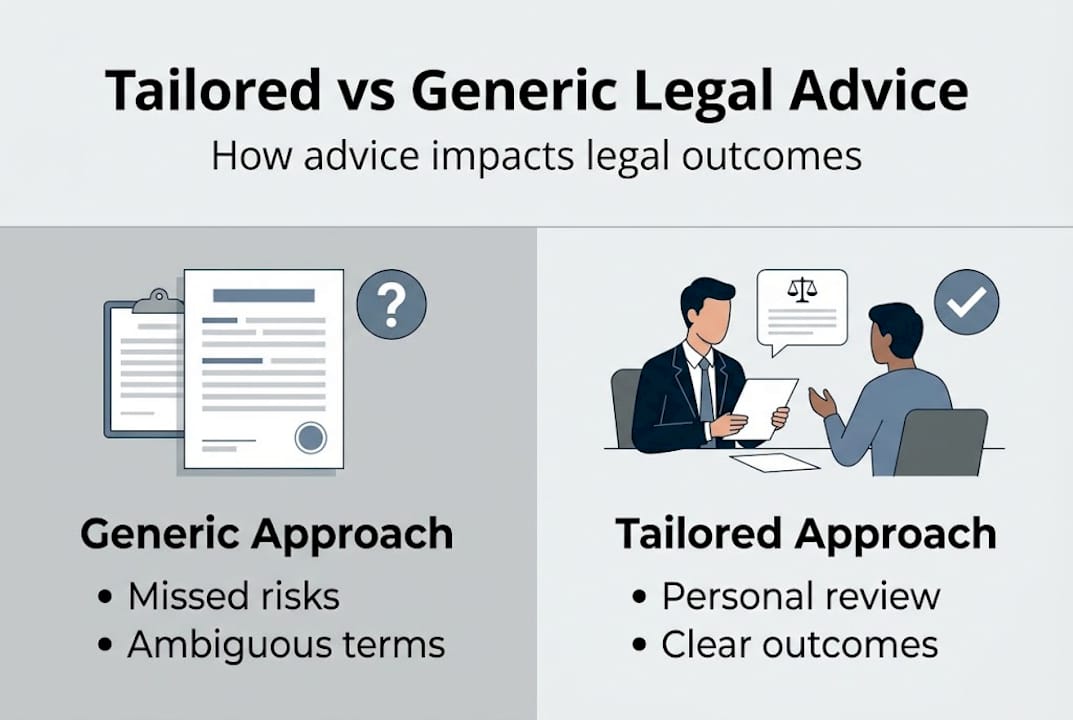
The importance of clear legal advice becomes most apparent when you compare what each approach actually delivers:
| Feature | Generic advice | Tailored advice |
|---|---|---|
| Accounts for your circumstances | No | Yes |
| Addresses specific risks | Rarely | Always |
| Drafted for your objectives | No | Yes |
| Adapts to changing facts | No | Yes |
| Builds long-term client relationship | No | Yes |
The pitfalls of a one-size-fits-all approach are not theoretical. Generic documents routinely fail to address edge cases, overlook jurisdiction-specific rules, or use language that courts later find ambiguous. The consequences range from voided agreements to unintended tax liabilities.
Tailored advice also builds client confidence. When you understand your options and their implications, you make decisions with clarity rather than anxiety. As one analysis of client-centric approaches found, tailored advice empowers clients with a clear understanding of options and implications, enabling confident decisions, unlike generic advice which fails to address specific risks.
Key benefits of personalised legal counsel include:
The distinction matters enormously in practice. A business entering a commercial contract and an individual writing a will face entirely different legal landscapes. Treating them with the same template is not just unhelpful. It is potentially harmful.
Now that we have defined tailored advice, it is crucial to see what happens when personalisation is missing.
The Sean Hughes estate case is a stark example. Generic DIY wills produced ambiguous wording, failed gifts due to ownership misunderstandings, and partial intestacy that triggered disputes lasting well over a decade. The estate bore significant costs that proper, tailored drafting would almost certainly have avoided.

In commercial settings, the consequences can be equally severe. A vendor lock-in contract cost Bridgewater Bank £1.1 million in excess expenditure. The contract lacked the specificity needed to protect the bank’s interests. This is a direct consequence of relying on standard terms rather than bespoke drafting.
Courts have also addressed this in financial agreements. Generic advice in financial agreements fails to address specific risks such as voiding for uncertainty, leading to negligence claims years later, with courts emphasising the need for detailed, tailored guidance.
The most common mistakes in generic or DIY legal documents include:
| Risk area | Generic approach | Tailored approach |
|---|---|---|
| Wills and estates | Partial intestacy, disputes | Clear distribution, no ambiguity |
| Commercial contracts | Excess costs, lock-in | Protected terms, exit clauses |
| Financial agreements | Voided for uncertainty | Enforceable, court-tested |
| Property transactions | Missed obligations | Full due diligence |
Pro Tip: Avoid using any template document for matters involving jointly owned assets, trusts, or cross-border elements. These scenarios require bespoke drafting from the outset, not adaptation of a standard form.
The benefits of tailored solutions extend well beyond avoiding disputes. They include predictable outcomes, lower long-term costs, and documents that actually do what you intend them to do.
With the risks of generic advice clear, let us examine how tailored strategies are actually crafted.
Personalisation in legal practice is not a single step. It is a structured process. Tailored advice involves assessing client needs, values, risk tolerance, asset structures, and context-specific strategies, with methodologies including client interviews, scenario analysis, and customised clauses.
Here is how a solicitor typically builds a personalised strategy:
During the client assessment phase, a good solicitor will typically ask:
These questions are not bureaucratic formalities. They shape every decision that follows. A client with a low risk tolerance and a tight timeline needs a very different strategy from one who is prepared to litigate aggressively over years.
Pro Tip: Before your first consultation, gather all relevant documents, correspondence, and any prior agreements. A guide on preparing for a consultation and a practical consultation checklist can help you arrive ready to make the most of your time with a solicitor. If you are signing a document under pressure from another party, you may also benefit from independent legal advice to ensure your interests are fully protected.
After seeing how bespoke legal strategies are built, the next step is choosing the right expert.
Many people default to choosing a law firm based on name recognition or perceived prestige. This is understandable but often misguided. Reputation-based firm rankings correlate near zero with litigation success, while outcome-based rankings derived from 60,540 cases predict wins approximately 60% accurately.
This matters because the instinct to choose the most well-known firm can actively work against you. Prestige does not equal specialisation. A firm celebrated for corporate transactions may be poorly equipped for a contested family matter or an international maritime dispute.
Further, 37% of contentious issues lack expert help, leading to measurably worse outcomes. The gap between seeking generic information and obtaining genuine expert advice is significant and consequential.
When vetting a legal adviser, focus on:
| Selection method | Traditional approach | Evidence-based approach |
|---|---|---|
| Primary criterion | Firm reputation | Outcome data in your area |
| Fee structure | Often opaque | Fixed or clearly defined |
| Communication | Formal, infrequent | Regular, plain English |
| Specialisation | General practice | Area-specific expertise |
The value of communicating legal advice clearly cannot be overstated. If your solicitor cannot explain your position in plain English, that is a warning sign. Clarity is not just a courtesy. It is a professional obligation and a marker of genuine expertise. Choosing advisers who offer tailored solutions for better outcomes ensures your matter receives the focused attention it deserves.
Finally, let us look ahead at how technology and its limits shape the next generation of tailored legal solutions.
AI tools are increasingly used to draft documents, summarise case law, and flag risks. But AI legal tools risk hallucinations, confidentiality breaches, and embedded biases, making tailored human oversight essential for accuracy and ethics.
Scenarios that always require human judgement include:
Technology can support personalised legal support, but it cannot replace the ethical judgement and contextual understanding that a skilled solicitor brings to a complex matter.
Here is something most legal guides will not tell you directly: the cheapest advice almost always becomes the most expensive advice eventually.
The hidden costs of generic counsel are rarely visible at the outset. You save a few hundred pounds on a template will or a standard contract, and the problem does not surface for years. By then, the cost of untangling the mess far exceeds what proper advice would have cost. 37% of contentious issues receive no expert help, and the outcomes are measurably worse.
There is also an emotional cost that rarely appears in any financial analysis. Protracted disputes, uncertainty, and the feeling of having been poorly advised take a real toll on individuals and businesses alike. The cost of being proactive is almost always lower than the cost of being reactive.
We have seen clients arrive having spent years in disputes that a single well-drafted agreement would have prevented. The lesson is consistent: investing in tailored advice at the beginning of a matter is not a luxury. It is the most rational financial and strategic decision you can make.
If you are ready to secure your legal future, here is how we can help.
At Ali Legal, we do not treat clients as case numbers. Every matter receives focused, personalised attention from solicitors who understand that your situation is unique.

Whether you need civil litigation expertise to resolve a dispute or commercial litigation support for high-stakes business conflicts, we bring strategic clarity and transparent communication to every case. Our fixed-fee approach means you always know where you stand. If you are facing a legal challenge or want to protect your position before one arises, speak to a specialist today for a confidential discussion tailored to your needs.
Tailored legal advice is guidance built around your specific circumstances, risks, and objectives rather than generic information. It ensures your legal strategy reflects your actual situation rather than a one-size-fits-all template.
Generic advice becomes risky whenever your matter involves complexity, unique assets, or relationships with third parties. DIY legal documents regularly produce ambiguous wording, failed gifts, and disputes that cost far more to resolve than proper advice would have.
Gather all relevant documents and correspondence, clarify your goals, and prepare a list of questions before you meet your solicitor. Personalised consultations include client interviews and scenario analysis, so arriving prepared helps your adviser give you the most accurate guidance from the outset.
No. Reputation-based rankings correlate near zero with litigation success. Selecting a solicitor based on specialisation, track record, and communication quality is a far more reliable approach than choosing by name recognition alone.


