
Menu
Get Expert Legal Support Today

TL;DR:
- Legal guidance ensures joint ventures are properly structured to avoid costly disputes.
- Solicitors handle all aspects from due diligence to drafting key agreements and compliance.
- Strategic legal advice is essential for long-term success and risk management in joint ventures.
Joint ventures can unlock remarkable commercial opportunities, but they carry legal complexities that catch many businesses off guard. A handshake agreement or a template contract downloaded from the internet is rarely sufficient to protect your interests when significant capital, intellectual property, and reputations are on the line. UK solicitors emphasise the critical importance of English law jurisdiction and arbitration in London for resolving joint venture disputes. Without specialist legal guidance from the outset, even well-intentioned partnerships can unravel into costly litigation. This article demystifies what solicitors actually do in joint ventures and why their involvement is one of the smartest investments you can make.
| Point | Details |
|---|---|
| Early legal involvement | Bringing a solicitor in at the start reduces risk and prevents future conflicts. |
| Compliance matters | Solicitors ensure all regulatory and jurisdictional requirements are properly addressed. |
| Strategic advice | Solicitors add value through strategic foresight, guiding deals beyond simple legal documentation. |
| Clear agreements | Robust, tailored contracts are essential for protecting interests in a joint venture. |
Many businesses treat legal advice as a formality, something to tick off before signing. In joint ventures, that mindset is genuinely dangerous. The moment two or more parties combine resources, share liabilities, and pursue a common commercial goal, the legal stakes rise sharply. Disputes over profit sharing, intellectual property ownership, and decision-making authority are extraordinarily common, and they are far easier to prevent than to resolve.
Solicitors provide strategic risk assessment long before a single clause is drafted. They examine the financial health and legal standing of all parties, identify potential conflicts of interest, and flag regulatory hurdles that could derail the venture entirely. This early-stage due diligence is not bureaucratic box-ticking. It is the foundation on which a resilient partnership is built.
Understanding the joint venture agreement basics helps you appreciate what is at stake. A poorly drafted agreement can leave critical questions unanswered, such as who controls day-to-day operations, what happens when one partner underperforms, and how profits are distributed during a dispute. These gaps become expensive when relationships sour.
“Solicitors ensure joint ventures adhere to regulatory and compliance standards, reducing the likelihood of costly disputes.”
Here is what a solicitor protects you from in the early stages:
Pro Tip: Instruct your solicitor before you begin negotiations, not after. The earlier they are involved, the more leverage you retain and the fewer concessions you are forced to make under pressure.
The financial and reputational cost of litigation dwarfs the cost of proper legal structuring upfront. Experienced solicitors do not just draft documents. They anticipate the scenarios where things go wrong and design the agreement to handle them cleanly.
Understanding why you need a solicitor, the next question becomes: what exactly do they do throughout the process? Their role spans the entire lifecycle of the joint venture, from initial discussions through to exit.
Solicitors take an active role in drafting, negotiating, and reviewing core documents that define a joint venture’s structure and obligations. This is far more involved than simply producing paperwork.
Here is a breakdown of the key stages and corresponding solicitor duties:
The table below summarises the core documents a solicitor typically handles:
| Document | Purpose | Critical clauses |
|---|---|---|
| Memorandum of understanding | Establishes agreed commercial intent | Exclusivity, confidentiality, timeline |
| Shareholders’ agreement | Governs ownership and decision-making | Voting rights, profit share, deadlock |
| IP assignment or licence | Protects intellectual property | Ownership, permitted use, termination |
| Service agreement | Defines operational contributions | Deliverables, fees, liability limits |
| Exit provisions | Manages partner departure | Buy-out mechanisms, drag-along rights |
Proper incorporation and structuring decisions made early can also determine tax efficiency and liability exposure for years to come. Similarly, understanding company formation requirements is essential when the joint venture operates as a newly incorporated entity.

Pro Tip: Ask your solicitor to walk you through every defined term in the shareholders’ agreement. Vague definitions around “material breach” or “reserved matters” are among the most common triggers for disputes.
Solicitors also advise on which business contract types are most appropriate for your venture’s structure. Not every joint venture needs a full incorporated entity. Some operate effectively as contractual joint ventures, and your solicitor will help you choose the right vehicle.
Beyond transactional tasks, solicitors are instrumental in navigating compliance and legal frameworks that shape joint ventures. The UK regulatory environment is layered, and the obligations on a joint venture depend heavily on its sector, structure, and the nationalities of the parties involved.
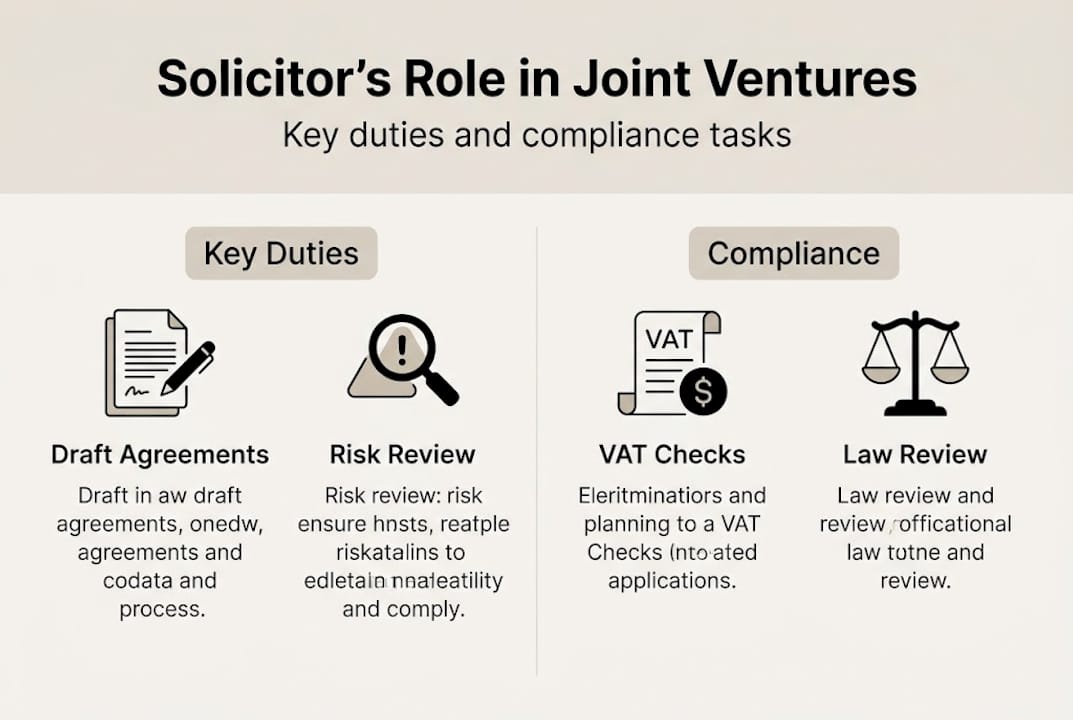
UK solicitors assess VAT registration obligations, competition law implications under the Competition Act 1998, and any industry-specific licensing requirements. In sectors such as financial services, healthcare, or construction, regulatory approvals can take months and must be planned for in advance. Missing a filing deadline or overlooking a licence requirement can expose the entire venture to penalties or even forced dissolution.
One area where UK solicitors offer a genuinely distinct advantage is dispute resolution. UK solicitors uniquely focus on English law jurisdiction and arbitration in London, as compared to their US counterparts. English law is widely regarded as commercially neutral and predictable, which is why it is the governing law of choice for international joint ventures worldwide.
| Feature | UK solicitor approach | US solicitor approach |
|---|---|---|
| Governing law | English law preferred | State law varies |
| Dispute resolution | London arbitration (LCIA, ICC) | US courts or AAA arbitration |
| Regulatory focus | FCA, CMA, Companies House | SEC, FTC, Delaware courts |
| Contract style | Concise, principle-based | Detailed, rule-based |
Key compliance areas your solicitor will address include:
“Choosing the right governing law and dispute resolution mechanism at the outset is one of the most consequential decisions in any joint venture.”
Understanding arbitration in UK contracts is particularly valuable when international parties are involved. Arbitration awards are enforceable in over 160 countries under the New York Convention, making London arbitration a powerful tool. Your solicitor will also help you stay ahead of the UK compliance landscape as regulations evolve.
Now that you know the compliance essentials, let’s review the major traps and how to get the most value from your legal team. Even well-resourced businesses make avoidable mistakes in joint ventures, usually because they underestimate complexity or rush the legal process.
Joint ventures falter most frequently where agreements lack legal clarity or misallocate risk. The consequences range from protracted litigation to the complete collapse of the venture, often at the worst possible commercial moment.
The most common pitfalls include:
Best practices for working effectively with your solicitor on a joint venture include scheduling regular legal reviews, at least annually, to ensure the agreement still reflects the commercial reality. Clear documentation of all decisions made by the joint venture’s governing body protects all parties if disputes arise later.
Pro Tip: When navigating commercial contracts, insist on a plain-English summary of every key obligation and right. If you cannot explain the contract to a colleague without legal training, it needs clearer drafting.
Transparent communication between your legal team and your commercial team is equally important. Solicitors can only protect what they know about. Keep them informed of operational changes, new commercial arrangements, and any early signs of tension between partners.
Here is a perspective that many businesses only appreciate after something goes wrong. Solicitors are not simply document producers. The most valuable thing an experienced joint venture solicitor brings is foresight.
Checklists and standard clauses are useful starting points, but they cannot replicate the judgement of a solicitor who has seen dozens of joint ventures succeed and fail. They know which commercial arrangements tend to generate disputes three years in. They know which governance structures create deadlocks under pressure. They have seen the exit provisions that looked sensible on paper but proved unworkable in practice.
The solicitor’s strategic role is to help you see around corners. That means asking uncomfortable questions early: What if your partner’s financial position deteriorates? What if a key individual leaves? What if the market shifts and one party wants to pivot?
A trusted solicitor does not just respond to problems. They help you design a structure robust enough to withstand them. That is the difference between a joint venture that thrives under pressure and one that collapses precisely when you need it most. The investment in strategic legal counsel is not a cost. It is commercial insurance with a measurable return.
If you are planning or managing a joint venture, professional legal advice is not a luxury. It is the single most effective way to prevent expensive litigation and protect everything you are building.

At Ali Legal, our commercial litigation experts and civil litigation specialists work alongside our corporate team to give you complete legal coverage at every stage of your joint venture. We offer fixed fees, straightforward advice, and a commitment to long-term client relationships. Whether you are structuring a new venture or resolving a dispute in an existing one, we are ready to help. Speak to a solicitor today and take the first step towards a legally robust partnership.
A joint venture solicitor manages legal due diligence, drafts agreements, and ensures compliance to protect all parties’ interests. They also play a central role in negotiating key documents that define the venture’s structure.
While not mandatory by law, formal agreements are vital for clarity and protecting each partner from disputes. Comprehensive agreements help allocate risk and significantly reduce the chances of costly conflict.
UK solicitors typically recommend arbitration in London and specify English law as the governing framework for resolving most disputes efficiently and predictably.
Yes, solicitors design exit strategies within the contract to ensure clear procedures if a partner wishes to leave. They ensure clear exit mechanisms to prevent conflict when partners change plans.


