
Menu
Get Expert Legal Support Today
When a commercial vehicle incident occurs, the first call should be to a specialist commercial solicitor, not your insurer. Preserve all telematics and dashcam data immediately, and notify your insurer within the contractual notice period. Regulatory exposure from the DVSA and Traffic Commissioners can compound civil liability fast, particularly where operator licences or ECMT and bilateral permit compliance is in question. Ali Legal Ltd advises businesses on exactly this intersection of commercial liability and regulatory risk.
Pro Tip: Instruct your solicitor before forwarding evidence to insurers. Correspondence sent under legal privilege cannot be disclosed in subsequent proceedings; evidence sent directly to insurers generally cannot attract that protection.
For a corporate fleet operator, legal advice after a motor vehicle incident is not the same as a consumer road traffic accident claim. The relevant issues are fleet liability, insurer disputes, subrogation recovery, contractual exposure, and cross-border permit compliance — not personal injury compensation.
Escalate to specialist counsel when any of the following arise:
Under the Goods Vehicles (Licensing of Operators) Act 1995, Traffic Commissioners hold powers to revoke, suspend, or curtail operator licences. A single serious incident can trigger a public inquiry, which makes early legal involvement a commercial necessity rather than a precaution.
Speed matters here. Evidence degrades, telematics data overwrites, and contractual notice windows close. The timeline below sets out who does what and when.
0–2 hours
2–24 hours
24–72 hours
Pro Tip: Log every item of evidence with a chain-of-custody record: who collected it, when, and where it is stored. Courts and arbitral tribunals give significantly more weight to evidence with a clear, documented provenance.
Getting the right people in the room early prevents costly gaps in your response.

Internal stakeholders
Your fleet manager leads the operational response: vehicle recovery, driver welfare, and maintenance record retrieval. The compliance officer assesses operator licence and permit status. HR becomes relevant if the driver’s employment status, hours compliance, or conduct is in question. The operations director should be briefed within hours if the incident affects service continuity or a major client contract.
External advisers
A specialist commercial solicitor takes the lead on legal strategy, privilege, and insurer communications. Your claims handler and loss adjuster manage the insurance process, but their instructions should be coordinated with legal counsel to avoid inadvertent admissions. For incidents involving telematics disputes or vehicle reconstruction, a forensic telematics expert can be decisive. Where the incident occurred abroad or involves a foreign operator, overseas counsel familiar with the relevant jurisdiction should be instructed promptly. The DVSA and the International Road Haulage Permits Office are the primary regulatory contacts for permit and licence compliance queries.
The right route depends on the value of the claim, the relationship between the parties, and whether regulatory enforcement is also in play. Transport dispute resolution typically begins with contract review and direct negotiation before escalating.
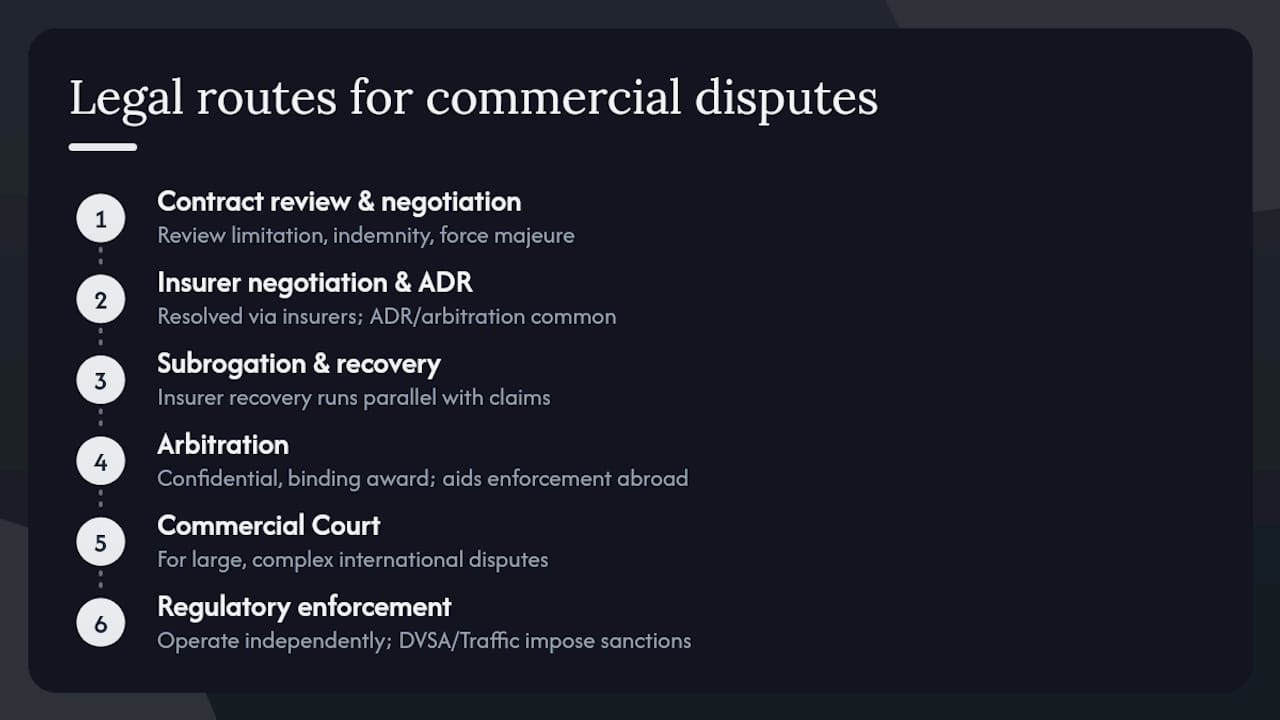
Insurer negotiation and ADR. Most commercial vehicle claims are resolved through insurer channels. Where coverage is disputed, insurance disputes frequently involve ADR or arbitration clauses, and complex or multi-policy cases often proceed to the Commercial Court. Reviewing the policy’s forum clause before any dispute crystallises is worth doing early.
Subrogation and third-party recovery. Where your insurer pays out and seeks to recover from a negligent third party, subrogation proceedings can run in parallel with your own contractual claims. Coordinating these avoids duplication and conflicting positions.
Contractual claims. Delivery failures, cargo damage, and liability cap disputes are governed by the contract. Early review of limitation, indemnity, and force majeure clauses is the foundation of any commercial dispute strategy.
Arbitration. Chosen frequently for commercial confidentiality and specialist expertise, arbitration produces a binding award enforceable across most jurisdictions. It suits cross-border incidents where enforcement abroad is a real concern.
Commercial Court. The Commercial Court handles large, complex, and international business disputes, including arbitration award challenges and international trade matters. Parties require solicitor or barrister representation and must follow CPR Part 58 where applicable. It is the appropriate forum for high-value or legally complex fleet and insurer disputes.
Regulatory enforcement. DVSA and Traffic Commissioners operate independently of civil proceedings. Operator licence sanctions, fines, and public inquiries run on their own track and can affect your business regardless of how the civil claim resolves.
Pro Tip: Arbitration clauses in transport contracts often specify the seat and governing law. If your contract is silent on this, a court may decide the forum for you, which can be expensive and unpredictable in cross-border cases.
Corporate legal buyers should treat this as a procurement decision, not a referral. The criteria that matter most are sector depth, jurisdictional reach, and fee transparency.
Selection criteria
Questions to ask a prospective firm
Red flags to watch for
A firm with no forensic or technical partners, no transport litigation track record, or an inability to explain its escalation plan for cross-border matters should prompt you to look elsewhere. Vague fee structures are a separate warning sign: cost uncertainty in commercial litigation is itself a risk.
Cost is driven by claim value, the need for expert evidence, the dispute route chosen, and whether cross-border enforcement is involved.
Mediation and ADR can resolve disputes in weeks to a few months at relatively contained cost. Arbitration typically runs over several months, with costs scaling to the complexity of the evidence and the seniority of the tribunal. Commercial Court litigation for complex or high-value matters commonly takes a substantial period from issue to judgment, often more than a year, with costs generally reflecting the complexity involved. The Commercial Court’s own guidance makes clear that parties should expect to engage experienced legal representation throughout.
The single largest cost driver in fleet disputes is expert evidence. Telematics reconstruction, vehicle inspection reports, and forensic analysis of driver data can each add materially to the overall spend. Instructing a solicitor who can coordinate these experts efficiently, rather than managing them separately, tends to reduce duplication.
For cross-border disputes and international arbitration, budget for overseas counsel fees and the possibility of parallel regulatory proceedings in the foreign jurisdiction.
Licence and permit status at the time of an incident can determine whether your insurer pays, whether you face prosecution abroad, and whether a Traffic Commissioner opens a public inquiry.
Operator licence types
ECMT and bilateral permits
ECMT permits remain relevant for triangular traffic and certain non-EU routes. The 2024 amendments to operator licensing and permit rules adjusted Norway bilateral permit requirements, clarified Northern Ireland own-account operator rules, and formalised exemptions for vehicles temporarily in Great Britain. Bilateral permits for some routes are obtainable at around £8 each, though the administrative implications for smaller operators are worth planning for.
| Licence or permit type | When required | Enforcement consequences |
|---|---|---|
| Restricted operator licence | Own-account goods, Great Britain only | Traffic Commissioner sanction if used for hire or reward |
| Standard national licence | Hire or reward, Great Britain only | Revocation, suspension, or fine for international use |
| Standard international licence | Hire or reward to EU/EEA and specified countries, vehicles over 2.5 tonnes MAM | DVSA fines, prosecution abroad, Traffic Commissioner inquiry |
| ECMT permit | Triangular traffic and certain non-EU routes where bilateral permits unavailable | Permit withdrawal, cross-border prosecution risk |
| Bilateral permit | Specific non-EU country routes as agreed | Permit cancellation, enforcement in destination country |
The decision is rarely about who is right. It is about cost, time, evidence strength, and what a judgment or award actually achieves.
Work through these factors before committing to full proceedings:
For commercial litigation decisions, the escalation path most transport disputes follow is negotiation, then mediation, then arbitration or court proceedings as the contract or commercial situation requires.
Pro Tip: Before committing to litigation, calculate your subrogation recovery potential and any set-off risks. A third-party recovery that partially offsets your costs can change the economics of the decision entirely.
Fleet incidents and cross-border transport disputes move fast. Ali Legal Ltd works with UK businesses and corporate clients who need decisive legal support from the moment an incident occurs, not weeks later when evidence has degraded and insurer positions have hardened.

Ali Legal Ltd’s practice covers commercial litigation, international disputes, and arbitration, with fixed-fee options and transparent communication at every stage. For businesses managing fleet liability, insurer disputes, or cross-border claims, that combination of speed and cost clarity is what makes the difference between a contained incident and a protracted dispute. The firm coordinates forensic evidence, instructs overseas counsel where needed, and handles the full range of resolution routes from ADR through to international arbitration and Commercial Court proceedings.
To instruct Ali Legal Ltd or arrange an initial review of your position, contact the team directly at Alilegal.
The businesses that handle fleet incidents well share one habit: they treat the first hour as a legal matter, not just an operational one. Evidence that is preserved under privilege in that first hour is worth more than any amount of reconstruction later. What I see most often is the opposite: insurers notified, statements given, and telematics data shared before a solicitor has been briefed. By that point, the legal options have already narrowed.
Fixed fees and a clear action plan from day one are not just commercial conveniences. They let your operations team focus on continuity while legal strategy runs in parallel, rather than the two functions pulling in different directions. That separation of roles, with clear communication between them, is what keeps a serious incident from becoming a prolonged dispute.
This article is general information, not a substitute for advice from a qualified lawyer. Consult a qualified legal professional about your own circumstances before acting on anything here.
This article provides representative UK personal injury case examples grouped by injury type, with typical settlement outcomes and the evidence that determined them. Whether you are trying to understand what a road traffic claim looks like in practice, what clinical negligence cases involve, or how a workplace injury is valued, the summaries below give you a realistic picture.
The injury categories covered are:
Two dates matter immediately. The standard limitation period for personal injury claims in the UK is three years from the date you first knew you had suffered an injury. For minor road traffic injuries, the Official Injury Claim service has applied to accidents on or after 31 May 2021. Miss either deadline and your claim is almost certainly lost.
The case summaries below are representative of the types of personal injury claims pursued in England and Wales. Settlement figures are drawn from publicly available solicitor guidance and published case data; where no specific figure is in the public domain, a typical range is given instead. None of the figures below should be read as a guarantee of outcome in any individual case.
Case 1: Rear-end collision, soft-tissue neck and back injury (driver)
A driver was stationary at traffic lights when struck from behind. She suffered whiplash-associated disorder affecting the neck and upper back, with symptoms persisting for approximately eight months. The decisive evidence was a police report confirming the other driver’s fault, dashcam footage from a following vehicle, and GP records documenting the injury within 48 hours of the accident. Settlement: £3,500–£5,000 (typical range for moderate whiplash under the Official Injury Claim tariff for accidents post-31 May 2021). Timeline: approximately six to nine months from accident to settlement.
Case 2: Cycling collision with disputed liability
A cyclist was struck at a junction where both parties claimed right of way. Liability was contested. The claimant’s solicitor obtained witness statements from two pedestrians and CCTV from a nearby business. Despite the defendant arguing contributory negligence, robust witness evidence and negotiation secured a settlement of £12,500. Timeline: approximately 14 months from accident to settlement.
Case 3: Pedestrian struck on a zebra crossing
A pedestrian suffered a fractured tibia and soft-tissue knee damage after being struck by a car that failed to yield. Police attended the scene and filed a report confirming the driver’s failure to stop. Photographs of the crossing, vehicle damage, and A&E records were central to the claim. Settlement was within a typical range for a fracture with moderate ongoing symptoms. Timeline: 10–14 months.
Case 4: Motorcyclist injured in a lane-change collision
A motorcyclist suffered a fractured clavicle and road rash injuries when a car changed lanes without signalling. Police reports, dashcam footage, and vehicle damage photographs were decisive. The motorcyclist’s speed was queried by the defendant, but independent accident reconstruction evidence supported the claimant’s account. Settlement was within a typical range for similar injuries involving fracture and road rash. Timeline: 12–18 months.
Case 5: Warehouse operative, manual handling back injury
A warehouse worker developed a prolapsed disc after repeatedly lifting loads that exceeded safe manual handling guidelines. His employer had no documented risk assessment for the task. The decisive evidence was the absence of a RIDDOR report (which the claimant’s solicitor obtained through a Subject Access Request), the employer’s own training records showing no manual handling instruction, and an orthopaedic expert report confirming causation. Settlement was within a common range for moderate to severe back injuries with partial disability. Timeline: 18–24 months.

Case 6: Factory worker, machinery crush injury to hand
A factory operative suffered crush injuries to three fingers, resulting in permanent partial loss of grip. The employer’s accident book entry was contemporaneous and consistent with the claimant’s account. CCTV from the factory floor showed the machine guard had been removed. An engineering expert confirmed the guard’s removal was the proximate cause. Settlement was within a typical range for permanent disability affecting hand function and earnings. Timeline: 20–28 months.
Case 7: Supermarket slip on a wet floor
A shopper slipped on a wet floor near a refrigeration unit, fracturing her wrist. The store had no cleaning log for the relevant period and no wet floor sign had been placed. CCTV from the store showed the spillage had been present for over 20 minutes before the fall. Medical records confirmed the fracture and a six-month recovery period. Settlement was within a typical range for a fracture caused by slipping on a wet floor. Timeline: 12–15 months.

Case 8: Pavement trip, local authority liability
A pedestrian tripped on a raised paving slab and fractured her ankle. The local authority’s own inspection records showed the defect had been reported three months earlier but not repaired. Photographs taken immediately after the incident, alongside the council’s maintenance logs, established liability. Settlement was within a typical range for fractures requiring surgical treatment due to a pavement trip. Timeline: 15–20 months.
Case 9: Delayed diagnosis of appendicitis
A patient attended A&E twice with abdominal pain and was discharged on both occasions. On the third visit, a perforated appendix was diagnosed and emergency surgery performed, resulting in complications and a prolonged hospital stay. The claimant’s solicitor obtained the full medical records and instructed an independent consultant surgeon, whose expert report confirmed the diagnosis should have been made on the first visit. Settlement was within a typical range for delayed diagnosis leading to additional surgery and recovery time. Timeline: 24–36 months (clinical negligence cases typically take longer due to expert evidence requirements).
Case 10: Surgical error causing nerve damage
A patient undergoing routine knee surgery suffered permanent nerve damage due to a positioning error during the procedure. The hospital’s own incident report acknowledged the error. An independent neurological expert confirmed the damage was permanent and would affect the claimant’s ability to work in her previous role. Settlement was within a typical range for permanent nerve damage resulting from surgical error. Timeline: 30–42 months.
Case 11: Spinal cord injury, incomplete paraplegia
A construction worker fell from scaffolding due to an unsecured platform, sustaining an incomplete spinal cord injury. He retained some lower limb function but required significant ongoing rehabilitation and home adaptations. Evidence included the site’s own scaffold inspection records (which showed the platform had not been checked for 11 days), witness statements from co-workers, and a comprehensive care needs assessment. Settlement was within a typical range for severe spinal cord injuries requiring lifelong care and adaptations. Timeline: 3–5 years.
Case 12: PTSD following a serious road traffic accident
A passenger in a vehicle involved in a high-speed collision developed post-traumatic stress disorder, confirmed by a consultant psychiatrist. Physical injuries were minor, but the psychiatric diagnosis was supported by GP records, a detailed psychiatric report, and evidence of the claimant’s inability to return to work for 14 months. Settlement was within a typical range for moderate to severe PTSD resulting from a serious accident. Timeline: 18–24 months.
Pro Tip: Psychiatric injury claims live or die on the medical narrative. A GP referral made within weeks of the incident, followed by a formal psychiatric assessment, creates the contemporaneous record that makes causation hard to dispute. Waiting months before seeking help gives defendants room to argue the condition is unrelated.
Two people can suffer what looks like the same injury and receive very different settlements. The gap is almost always explained by a handful of valuation drivers.
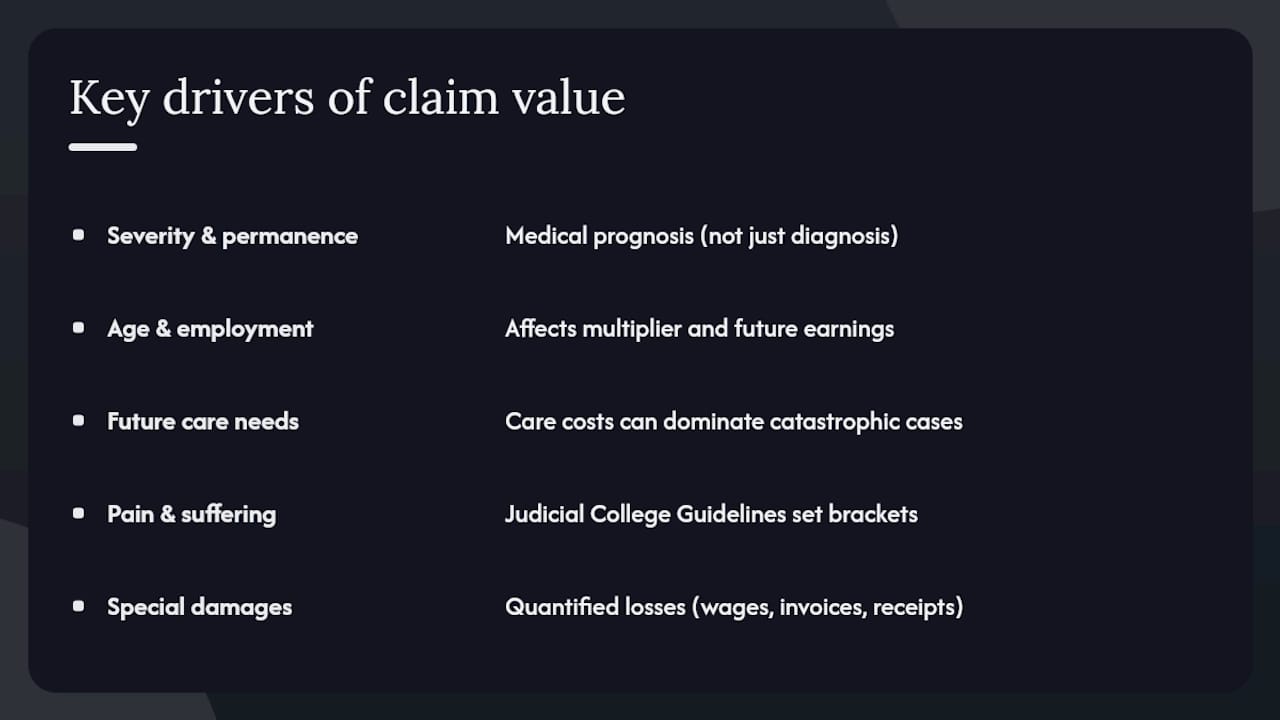
Severity and permanence. A fracture that heals fully in three months is valued very differently from one that leaves permanent stiffness or chronic pain. Courts and insurers look at the medical prognosis, not just the diagnosis.
Age and employment. A 35-year-old manual worker who can no longer perform their job faces a future loss of earnings claim that a retired claimant does not. Age affects both the multiplier applied to future losses and the weight given to career impact.
Future care needs. Catastrophic injury cases often turn almost entirely on the cost of future care. A care needs assessment by an independent expert can add hundreds of thousands of pounds to a settlement.
Pain, suffering, and loss of amenity (PSLA). This is the general damages component. Courts use the Judicial College Guidelines to set a bracket for the injury type and severity, then adjust within that bracket based on the individual claimant’s circumstances.
Special damages. These are the quantifiable financial losses: past and future loss of earnings, private treatment costs, travel to appointments, care provided by family members, and equipment or property damaged in the accident. Wage slips, P60s, invoices, receipts, and contemporaneous care logs are the documents that build this part of the claim.
The evidential levers that increase value are straightforward in principle but often neglected in practice. Contemporaneous medical records, objective imaging (MRI, X-ray), an independent expert prognosis, and employer records showing pre-accident earnings all strengthen the claim. CCTV and witness statements settle liability disputes before they become expensive.
Pro Tip: Two documents claimants routinely overlook: a pre-accident medical baseline (your GP records before the incident, which establish that the injury was not pre-existing) and a contemporaneous care log kept by a family member who helps with daily tasks. The latter can be worth thousands in special damages and is almost impossible to reconstruct after the fact.
Every personal injury claim rests on three evidence categories: liability evidence (who caused the accident and how), injury evidence (medical records and prognosis), and loss evidence (financial impact). The Pre-Action Protocol for Personal Injury Claims sets out what is expected from both parties before proceedings are issued, including early disclosure and medical reporting.
Road traffic accident: police report, dashcam or CCTV footage, photographs of the scene and vehicle damage, witness contact details, A&E or GP records taken promptly after the incident.
Workplace accident: accident book entry (request a copy immediately), RIDDOR report if one was filed, risk assessment documents, training records, CCTV from the workplace, witness statements from colleagues.
Slip, trip, or public liability: photographs of the defect taken on the day, CCTV from the premises or nearby businesses, the premises’ cleaning or inspection logs, witness details, and medical records.
Clinical negligence: full medical records from the treating hospital or GP practice (obtainable via a Subject Access Request), any incident reports filed by the provider, and an independent expert report from a specialist in the relevant field.
Industrial disease: occupational health records, employment history, exposure records, and a specialist medical report linking the condition to workplace exposure.
| Milestone | Timing | Source |
|---|---|---|
| Limitation period (general) | 3 years from date of knowledge | Citizens Advice |
| Official Injury Claim (minor RTA) | Accidents on or after 31 May 2021 | Citizens Advice |
| Defendant acknowledgement of Letter of Claim | 14 days | Uklegalguides |
| Defendant investigation and response window | Up to 3 months (commonly cited) | Uklegalguides |
| CCTV retention (typical) | 28 days | Claims Bible |
The CCTV retention window is the most dangerous deadline most claimants do not know about. Footage is routinely overwritten within 28 days. A solicitor can issue a preservation letter within days of instruction; waiting even a few weeks can mean the most decisive evidence is gone permanently.
For a full procedural walkthrough, the Ali Legal personal injury claims process guide sets out each stage from notification to settlement.
Fatal accidents attract the largest awards when dependants can claim for financial dependency and bereavement. The Judicial College Guidelines set bereavement awards at a statutory figure, but dependency claims can run to millions where the deceased was a high earner.
Severe brain injury generates the highest individual awards in practice, driven by lifelong care costs, loss of all future earnings, and the need for specialist accommodation. Seven-figure settlements are not unusual.
Spinal cord injury (complete or incomplete paraplegia or tetraplegia) follows a similar pattern: care needs, home adaptations, and loss of earnings combine to produce very large awards.
Amputation claims attract high general damages for the injury itself, plus substantial special damages for prosthetics, adaptations, and occupational impact.
Severe orthopaedic injuries with permanent disability, particularly where the claimant is young and employed in a physical role, can produce settlements well above what the injury type alone might suggest once future earnings are factored in.
Concussion and mild traumatic brain injury are frequently contested because symptoms are subjective, imaging is often normal, and defendants argue the condition is exaggerated or unrelated. Neuropsychological testing and a detailed symptom diary are the most practical evidential tools.
Soft-tissue and whiplash injuries are the most commonly disputed claim type in the UK. The Official Injury Claim tariff system now applies to minor whiplash from road accidents post-May 2021, which limits recovery for low-value claims and reduces the scope for dispute, but moderate and severe soft-tissue injuries outside the tariff remain contested.
Chronic pain conditions (including fibromyalgia and complex regional pain syndrome) require a robust medical narrative linking the condition causally to the accident. Without a clear contemporaneous record and specialist expert evidence, defendants will argue the condition is pre-existing or functional.
PTSD and psychological injury without physical injury are harder to value and easier to contest. The psychiatric diagnosis must be formal, the causation link must be clear, and the impact on daily life and work must be documented.
Contributory negligence applies where the claimant’s own conduct contributed to the injury. A pedestrian who stepped into the road without looking, or a worker who bypassed a safety procedure, may have their award reduced proportionately.
For a deeper look at how injury types are categorised under UK law, the Ali Legal personal injury law guide covers the legal framework in detail.
A personal injury settlement is built from two components: general damages and special damages. Understanding both helps you see why the case examples above carry the figures they do.
General damages cover pain, suffering, and loss of amenity. These are non-financial losses, valued by reference to the Judicial College Guidelines, which set brackets for injury types and severities. A solicitor or court will place the injury within the appropriate bracket and adjust for the individual’s circumstances, age, and prognosis.
Special damages are the quantifiable financial losses. The main heads are:
Consider a 40-year-old office worker who suffers a moderate knee injury in a workplace accident, requiring surgery and six months off work, with a prognosis of ongoing symptoms but no permanent disability.
| Head of loss | Basis |
|---|---|
| General damages (PSLA) | Judicial College Guidelines bracket for moderate knee injury |
| Past loss of earnings | Six months’ net salary, supported by wage slips and P60 |
| Future loss of earnings | Partial, if return to work is at reduced capacity |
| Treatment costs | Physiotherapy invoices, surgical costs if private |
| Care (family-provided) | Hours logged by family member, valued at commercial care rate |
| Travel | Mileage receipts to appointments |
The total is the sum of each head, not a single figure plucked from a bracket. Citizens Advice recommends seeking a solicitor on the Law Society’s accreditation list for personal injury matters, and notes that conditional fee arrangements and legal expenses insurance may be available to fund a claim.
Where injuries are serious and the long-term prognosis is uncertain, provisional damages orders allow a claimant to return to court if the condition deteriorates in a defined way. This matters most in cases involving brain injury, spinal injury, or conditions with a risk of future deterioration.
The Ali Legal compensation guide explains how general and special damages are assembled in practice.
Pro Tip: Future care is the most commonly undervalued head of loss in moderate-to-serious injury cases. A care needs assessment by an independent occupational therapist, instructed early, often produces a figure that surprises claimants. Do not leave it to the defendant’s expert to set the agenda.
When Ali Legal Ltd receives a new personal injury enquiry, the first assessment focuses on three questions: is there a viable liability argument, how serious is the injury, and is the limitation period at risk? Those three factors determine how urgently the case needs to move and what the realistic settlement range looks like.
Liability is assessed against the available evidence. If CCTV exists, a preservation letter goes out within days. If there is an accident book entry, a copy is requested immediately. If the incident involved a public authority, inspection records are sought under the Freedom of Information Act or through pre-action disclosure. Early evidence preservation is not a procedural nicety; it is often the difference between a settled claim and a failed one.
Medical reporting is instructed early, both to establish the injury and to satisfy the Pre-Action Protocol’s expectations for disclosure. Where rehabilitation is appropriate, Ali Legal Ltd will identify that early, because claimants who engage with rehabilitation tend to present stronger claims and sometimes receive earlier settlement offers.
Negotiation strategy is built around the strength of the liability evidence and the medical prognosis. Where liability is clear and the medical picture is well-documented, most claims settle without court proceedings. Where liability is disputed, the solicitor’s role is to convert the evidential record into a position that makes litigation more expensive for the defendant than settlement.
Pro Tip: Act on CCTV within 48 hours of an incident. Retention periods of 28 days are common in retail and commercial premises; some systems overwrite in as little as 14 days. A solicitor can issue a formal preservation letter that creates a legal obligation to retain the footage. Waiting for a medical appointment first is one of the most common and costly mistakes claimants make.
Ali Legal Ltd offers personal injury claimants a clear, direct route to legal representation without the uncertainty of open-ended costs. The firm can assess your case, identify the strongest evidence, and pursue compensation on conditional fee terms where appropriate, meaning you do not pay solicitor fees if the claim is unsuccessful.
Practically, Ali Legal Ltd’s involvement covers: initial case assessment (liability, injury severity, and limitation risk), evidence preservation requests (CCTV, accident book, RIDDOR), instruction of independent medical and expert witnesses, pre-action negotiation with defendants and insurers, and litigation where settlement cannot be reached.
The firm’s approach is built on fixed fees and transparent communication. You will know what is happening at each stage and why. For claimants who have read the case examples above and want to understand where their own situation sits, the starting point is a direct conversation with a solicitor.
Contact Ali Legal Ltd through the enquiry page to arrange an initial assessment of your claim.
The case summaries in this article are useful, but they carry a risk: readers tend to find the example closest to their own situation and anchor on that settlement figure. That instinct is understandable and almost always misleading.
The cycling case that settled for £12,500 despite split liability is a good illustration. The settlement was not driven by the injury value alone. It was driven by the quality of the witness evidence, the solicitor’s willingness to push through a contested liability argument, and the defendant’s calculation that litigation would cost more than settlement. Change any one of those variables and the outcome changes. A claimant who handled the same claim without legal representation, or who failed to obtain the witness statements, would likely have received considerably less or nothing at all.
The same logic applies to the catastrophic injury cases. The difference between a £1.2 million and a £2.5 million settlement for a spinal cord injury is almost entirely in the care needs assessment and the future earnings calculation. Those figures are built by experts, challenged by defendants, and negotiated over months. The injury is the starting point, not the answer.
What the examples genuinely tell you is which categories of evidence are decisive across claim types: contemporaneous medical records, CCTV and witness statements for liability, and independent expert evidence for prognosis and care needs. Those three things appear in every successful claim regardless of injury type. The settlement figure follows from how well those three things are assembled and presented.
The other thing the examples reveal, less comfortably, is how much the outcome depends on acting quickly. The CCTV that was preserved in the supermarket slip case, the accident book entry in the warehouse case, the psychiatric referral in the PTSD case: all of them were obtained within days or weeks of the incident. None of them would have been available six months later.
The following UK sources are the most reliable starting points for claimants who want to verify the key points in this article or dig deeper into the process.
This article provides general information about personal injury claims in the UK and is not a substitute for legal advice. Limitation periods, procedural rules, and compensation values depend on the specific facts of each case. You should confirm current rules with Citizens Advice, the relevant primary sources, or a qualified solicitor before taking action.
Mediation is the right first step for most property disputes in the UK. Boundary rows, landlord and tenant disagreements, leasehold service charge arguments, co-ownership conflicts and many commercial property matters are all well suited to it. The process is confidential, voluntary, and typically far cheaper and faster than litigation. Where it is less appropriate: situations requiring an urgent injunction, matters involving criminal conduct, or cases where one party genuinely cannot negotiate.
Your immediate next step depends on the dispute type. For boundary or construction matters, contact RICS Dispute Resolution Service for a mediator nomination. For most other civil property disputes in England and Wales, search the Civil Mediation Council register for an accredited mediator. In Scotland, the Scottish Mediation Network is the primary route. Costs are almost always split equally between the parties, and many disputes resolve in a single day.
Pro Tip: If court proceedings are already active, you can ask the court for a stay to allow ADR. If mediation succeeds, record the outcome as a consent order or Tomlin order to make it immediately enforceable.
Mediation is a structured negotiation facilitated by an independent, neutral third party. The mediator does not decide the outcome; the parties do. That distinction matters because it keeps control of the result with the people who actually have to live or work with it afterwards.
Gov confirms that mediation is confidential, voluntary, and generally quicker and cheaper than court proceedings. Parties are not bound by legal rules of evidence, which means the conversation can cover practical concerns, relationships, and future arrangements, not just the strict legal position.
The core benefits in practice:
RICS highlights that for property and construction disputes specifically, mediators with technical expertise can help parties understand the practical implications of different outcomes, something a generalist court process rarely provides.
For family-related property matters, note that a Mediation Information and Assessment Meeting (MIAM) is a mandatory gateway before most family court applications. For purely civil property disputes, no such compulsion applies, though courts increasingly expect parties to have considered ADR before issuing proceedings.
Pro Tip: Mediation does not prevent you from litigating if it fails. Attempting it first often strengthens your position in court and can reduce adverse costs orders.
Most property conflicts between private individuals or businesses can go to mediation. The RICS boundary disputes mediation service notes that property disputes cover land, buildings and associated rights, and that mediation suits parties who want to preserve relationships and avoid court costs.
Disputes that typically suit mediation:
When mediation is not the right route:
GOV.UK recommends mediation specifically for neighbour disputes and points to the Civil Mediation Council and Scottish Mediation Network as the primary routes to find a mediator.
The process is more structured than most people expect, and understanding each stage helps you prepare properly.
Stage 1: Application and mediator appointment
Either one party or both parties jointly contact a mediation provider. A joint application signals willingness to cooperate and can set a constructive tone. The provider checks for conflicts of interest before appointing a mediator. RICS, for example, conducts due diligence on nominated mediators and enforces conflict-of-interest procedures as a condition of panel membership.
Stage 2: Preparation
Each party submits a position statement, typically two to four pages, setting out their case and what they want. Practical documents to gather before this stage:
Stage 3: The mediation session
Most property mediations run as a single day, though complex matters may need a second session. The typical structure:
Stage 4: Outcome
Possible results include a full settlement, a partial agreement with a timetable for remaining issues, an agreement to reconvene, or a decision by one or both parties to proceed to litigation. Most property mediations that reach the session stage do result in at least partial resolution.
Typical timeline: From first contact to a completed mediation day, expect two to six weeks for most civil property disputes. Urgent matters can sometimes be arranged faster.
Pro Tip: Agree the position statement format with the mediator in advance. A clear, focused statement is more persuasive than a lengthy legal submission, and it signals that you are there to resolve, not to posture.
Fees vary by dispute complexity, mediator seniority, and whether you use a fixed-fee scheme or an hourly model. The Dispute Resolution Agency’s mediation charging guide sets out typical UK charging structures: hourly rates of approximately £120–£250 per party, with half-day and full-day per-party session rates widely used. Specialist mediators for commercial property matters charge higher rates.
The Civil Mediation Council’s Fixed Fee Mediation Scheme offers capped fees for disputes under specified values, making mediation accessible for lower-value property conflicts. For small claims and rental disputes, GOV.UK also lists free or subsidised government schemes.
Costs are almost always split equally between the parties, though this is negotiable. Additional costs to budget for include room hire (if face-to-face), VAT, and any expert reports commissioned before the session.
Some providers publish fixed per-party prices by claim value, with lower rates for disputes under £10,000 and stepped increases above that. Mediate Property publishes its fee schedule as an example of this model.
Pro Tip: Ask for a full written fee schedule before instructing any mediator. A reputable provider will include preparation time, the session itself, and any post-session summary in one clear document. Vague invoices or unspecified preparation fees are a warning sign.
The register you use should match your dispute type.
Primary registers:
Selection criteria that actually matter:
Questions to ask a prospective mediator at first contact:
For technical boundary matters, contact RICS first. For most other civil property disputes in England and Wales, start with the CMC. For Scotland, go directly to the Scottish Mediation Network.
Pro Tip: Request written confirmation of the mediator’s conflict-of-interest procedure before the session. Reputable panels such as RICS and CMC have formal procedures; a mediator who cannot explain theirs clearly is worth reconsidering.
Mediation and litigation are not mutually exclusive. You can mediate before issuing proceedings, after a claim has been filed, or at the court’s direction as part of an ADR order. Attempting mediation does not waive your right to litigate if it fails.
Key points on the relationship between mediation and court:
Making mediated agreements enforceable:
A signed settlement agreement is a contract and is enforceable as such. However, relying on an informal memorandum or a verbal agreement reached in the room carries real risk: if one party later refuses to perform, enforcement requires a separate court action.
Where proceedings are already on foot, the cleanest solution is to record the settlement as a consent order or Tomlin order. A Tomlin order stays the proceedings and schedules the agreed terms, so breach triggers enforcement without a fresh claim. RICS confirms that mediated agreements should be formalised into a contract or court order to be practically enforceable.
Involving a solicitor to draft or review the settlement document is strongly recommended, particularly where the agreement involves land registration changes, lease variations, or staged payments.
The choice of format affects both cost and scheduling, and for most straightforward property disputes, online mediation works well.
Online mediation:
Face-to-face mediation:
Realistic timelines:
Half-day sessions (three to four hours) suit lower-value or less complex disputes. Full-day sessions are standard for most property mediations. Multiple sessions are uncommon but do occur in multi-party or technically complex cases.
To speed the process: exchange documents early, agree realistic objectives before the session, and arrange a short virtual pre-meeting with the mediator to clarify the agenda.
A mediated settlement can take several forms depending on what the parties agree.
Typical settlement formats:
Legal status:
A signed settlement agreement is a contract. It is binding on both parties and enforceable through the courts if one party fails to perform. The risk lies in informality: a verbal agreement or an unsigned note from the session has no practical enforcement value.
Where court proceedings exist, convert the agreement into a consent order or Tomlin order on the same day if possible. This removes the need for a fresh claim if the other party defaults.
Where no proceedings exist, a carefully drafted written agreement signed by both parties is sufficient for most property matters. For anything involving a change to registered title, a lease variation, or a significant payment, legal drafting is worth the cost.
Pro Tip: Do not leave the mediation room without a signed written record of what was agreed, even if a full formal document will follow. A signed heads of terms or settlement note, however brief, is far stronger than a verbal understanding. If payments are staged, ask your solicitor about escrow arrangements or a guarantee.
RICS and the Civil Mediation Council both endorse mediation for property disputes, and not just as a cost-saving measure. RICS’s mediation brochure emphasises the process’s ability to deliver flexible, technical solutions and to restore working relationships between parties who may need to continue dealing with each other, as neighbours or landlords and tenants often do.
The practical strengths that professional bodies consistently highlight:
Government schemes reinforce access. The CMC Fixed Fee Scheme, the small claims mediation service, and rental dispute programmes all reduce the cost barrier for lower-value property conflicts. GOV.UK’s civil mediation guidance sets out these schemes and directs users to the CMC and Scottish Mediation Network as primary access points.
Published fee schedules from providers are themselves a trust indicator. Established providers bundle preparation time and post-session summaries into their day rates, making the total cost predictable from the outset.
Pro Tip: When evaluating a mediation provider, check whether their published fees include preparation time and a post-session summary. Providers who bundle these costs are generally more transparent and experienced than those who charge separately for every hour of ancillary work.
Ali Legal Ltd recommends mediation as the first port of call for most neighbour, boundary, co-ownership, commercial landlord and tenant, and TOLATA disputes. In these cases, the combination of confidentiality, speed, and the ability to reach creative outcomes almost always serves clients better than immediate litigation. Where mediation is less likely to work, such as where an urgent injunction is needed or where one party is acting in bad faith, Ali Legal Ltd will say so clearly and advise on the appropriate court route instead.
The firm’s involvement in mediation is practical rather than passive. Ali Legal Ltd helps clients prepare position statements, gathers and organises the documentary evidence that mediators and opposing parties need to see, attends sessions to advise on legal implications in real time, and drafts settlement agreements that are enforceable from the moment they are signed. Where proceedings are already active, the firm handles the conversion of mediated terms into consent or Tomlin orders.
For clients who want to understand the broader range of dispute resolution services available before committing to a route, Ali Legal Ltd provides clear, fixed-fee advice on whether mediation, negotiation, arbitration, or litigation best fits their circumstances. The firm’s property law guidance covers the legal framework that underpins most property disputes, which is useful context before any mediation session.
Property dispute mediation handled without proper legal support often produces agreements that are harder to enforce than they should be. Ali Legal Ltd offers fixed-fee mediation support for individuals and businesses across the UK: preparation and strategy before the session, legal representation during it, and professionally drafted settlement agreements or consent orders afterwards.
The difference from going it alone is straightforward. A solicitor in the room can identify terms that look reasonable but create legal problems later, whether that is an ambiguous boundary description, an unenforceable lease variation, or a payment schedule with no security. Ali Legal Ltd’s fixed-fee approach means you know the cost before you commit, with no hourly billing surprises.
To get started, visit Ali Legal Ltd’s property law services page or contact the firm directly with a brief description of your dispute. Bring your title deeds, any relevant correspondence, and a note of what outcome you are hoping to achieve. The initial consultation will confirm whether mediation is the right route and what preparation is needed.
This article provides general information about property dispute mediation in the UK. It is not legal advice. For guidance specific to your situation, consult a qualified solicitor.
The conventional wisdom is that mediation is always worth trying. The reality is more nuanced.
Mediation works best when both parties have something to lose from continued conflict and something to gain from a negotiated outcome. In most property disputes, that condition is met: neighbours who share a boundary will still share it after any court judgment; landlords and tenants who litigate rarely end up with a functional relationship afterwards; co-owners who fight through the courts often spend more on legal fees than the disputed asset is worth.
Where mediation tends to disappoint is when one party enters the process without genuine intent to settle, using the session as a discovery exercise or a delay tactic. This is not a reason to avoid mediation; it is a reason to prepare properly and to set a clear internal threshold for what constitutes an acceptable outcome before you walk into the room. A solicitor who has seen enough mediations can usually tell within the first hour whether the other side is negotiating in good faith, and that read is worth having.
The other underappreciated point is that the quality of the mediator matters more than most people realise. A technically experienced mediator for a boundary dispute, someone who understands OS mapping, Land Registry practice, and survey methodology, will move the conversation forward in ways that a generalist cannot. The CMC register and RICS panel both allow you to filter by specialism. Use that filter.
The following authoritative sources are worth checking directly for current registers, fee schedules, and procedural guidance:
When reviewing any provider, check three things before instructing: their published fee schedule (including preparation time), their accreditation status (CMC or RICS panel), and their written conflict-of-interest procedure. These three details separate established providers from those with less rigorous standards.
Assign a named Senior Client Manager, build a structured communication cadence, centralise everything in a CRM, and set clear review triggers from day one. That is the one-line playbook. Here is how to put it into practice this week:
When a relationship reaches the point where remediation has failed and the client remains non-compliant or abusive, exit cleanly: issue a final invoice for all completed work, transfer files, and close the matter in writing.
Retaining a client costs a fraction of acquiring a new one. That is not a platitude; it is the commercial logic that separates firms that grow steadily from those that chase new business to replace the clients they quietly lose. Insight6’s Professional Service Client Journey research identifies slow response times and poor follow-up as primary drivers of client dissatisfaction, and the revenue consequence is direct: firms that fix those two basics see measurable improvements in both satisfaction scores and retention.
Expansion revenue, meaning additional work from existing clients, is typically higher-margin than new business because the trust infrastructure is already built. A client who trusts your firm will instruct you on a second matter without a competitive pitch. One who feels neglected will not, even if your technical work was excellent.
The shift that matters most is moving from “managing to the contract” to thinking about the full client lifecycle. CGA’s B2B client relationship research shows that firms adopting a Contract Lifecycle Management approach make renewal conversations about strategic value rather than price, which reduces churn and increases the average contract value over time.
Key commercial benefits of structured client relationship management:
The processes and tools discussed later in this guide only work if the underlying principles are sound. These are the non-negotiables.
On segmentation specifically: a useful rule of thumb is to divide your client base into three tiers. Tier one clients get a dedicated Senior Client Manager, quarterly face-to-face reviews, and proactive strategic input. Tier two clients get scheduled calls, structured email updates, and an annual review. Tier three clients get a self-service portal, templated communications, and a check-in when triggered by a specific event. The criteria for each tier should be written down and reviewed annually.
Pro Tip: When building rapport with a new client, replace at least one email exchange per week with a phone call during the first 90 days. Ask directly: “Is there anyone else in your business we should be speaking to?” That single question, recommended by ICAEW, deepens the relationship and surfaces new instructions faster than any formal cross-selling process.
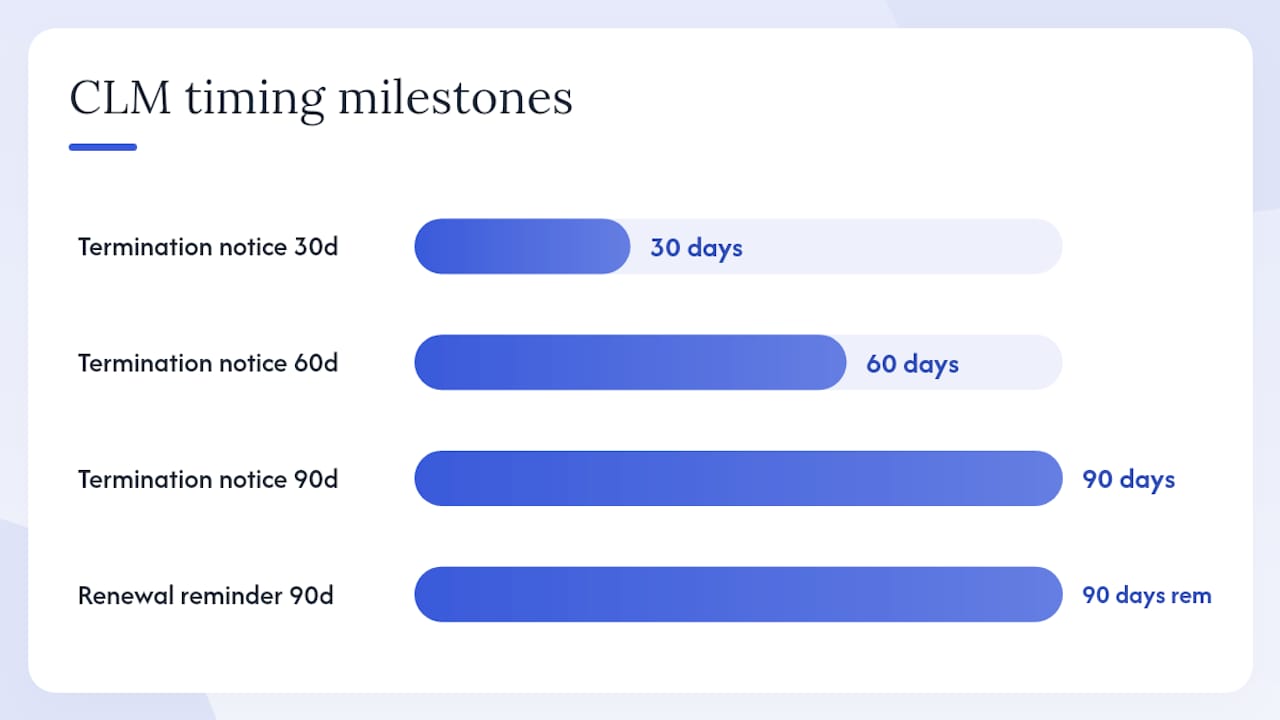
Progress updates should be sent on a fixed schedule, not only when there is news. For active matters, a weekly or fortnightly written update keeps the client informed and reduces inbound queries. All client communications, decisions, and commitments must be logged in the CRM immediately after the interaction, not at the end of the week. Scheduled checkpoints at 30, 60, and 90 days in the first quarter give both sides a structured opportunity to recalibrate.
When a relationship ends, whether by mutual agreement, non-renewal, or termination, the process matters as much as the outcome. Issue a final invoice for all completed work before closing the matter. Transfer all client files and data in the format agreed in the engagement letter. Archive the CRM record with a closing note. A professional exit preserves your reputation and, in many cases, leads to a future re-instruction.
First 90-day meeting agenda template:
Confusion about who owns a client relationship is one of the most common and most avoidable causes of client dissatisfaction. Mondaq’s guidance on efficient client management is clear: assign a Senior Client Manager who is accountable for the relationship while other team members focus on technical delivery. The client should know who to call for what.
Recommended role definitions:
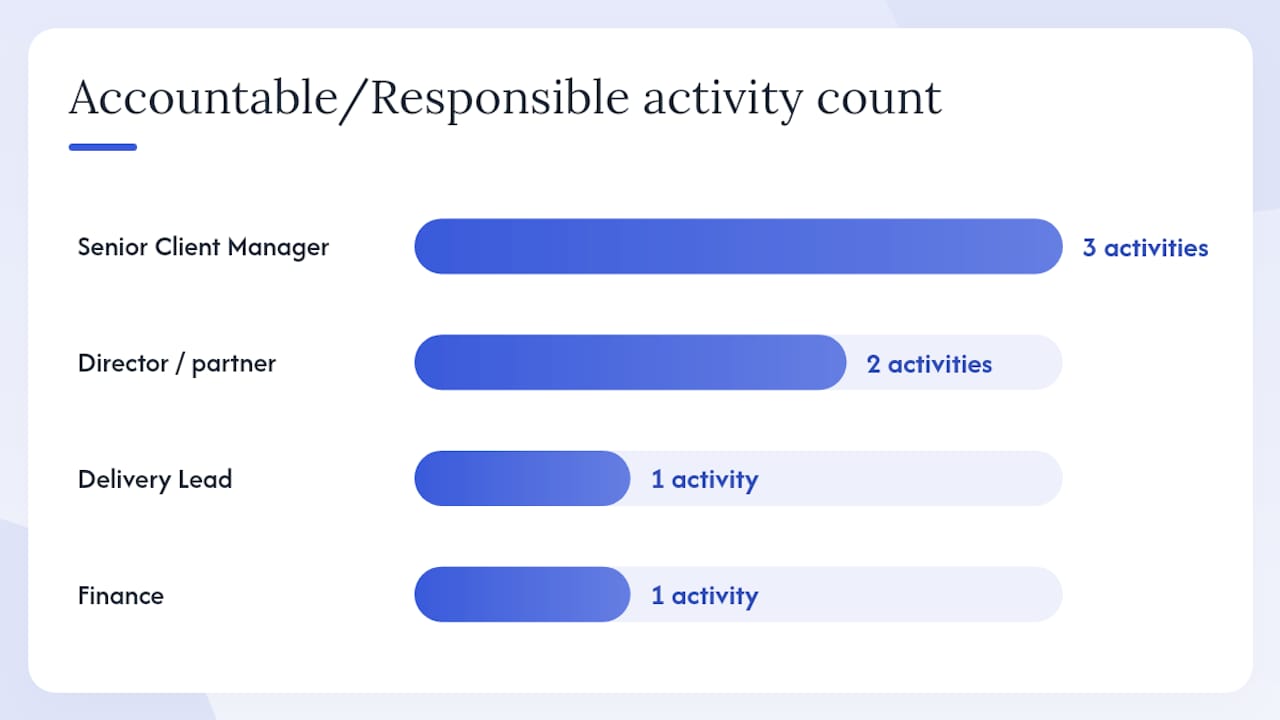
RACI summary:
| Activity | Senior Client Manager | Delivery Lead | Finance | Director |
|---|---|---|---|---|
| Relationship ownership | Accountable | Consulted | Informed | Informed |
| Escalation (first response) | Responsible | Informed | Informed | Consulted |
| Escalation (senior review) | Consulted | Informed | Informed | Accountable |
| Renewal negotiation | Responsible | Consulted | Consulted | Accountable |
| Billing and invoicing | Informed | Informed | Accountable | Informed |
| Delivery quality | Consulted | Accountable | Informed | Informed |
When handing over a client to a new Senior Client Manager, introduce the incoming person on a call or in person before the outgoing manager leaves. Never communicate a handover by email alone. The client should feel the transition is managed, not dumped.
The right tool stack for most UK professional services firms is smaller than vendors would have you believe. The goal is one source of truth for client data, a reliable way to communicate, and a feedback mechanism. That is it.
Tool categories and what to look for:
CRM adoption checklist:
Pro Tip: The biggest CRM failure mode is not choosing the wrong system; it is running three communication channels simultaneously. Pick one primary channel for each client (usually email, confirmed at onboarding) and use everything else as a supplement. A client who receives updates via WhatsApp, Teams, and email simultaneously will miss things and blame you for it.
Gut feel is not a measurement. These six metrics, tracked consistently, tell you whether your client relationships are healthy or deteriorating.
| Metric | What it measures | Healthy signal | Warning signal |
|---|---|---|---|
| Retention rate | % of clients who renew or continue | — | — |
| Expansion revenue | Additional revenue from existing clients | Growing quarter-on-quarter | Flat or declining |
| NPS / CSAT | Client satisfaction and likelihood to recommend | — | — |
| Time-to-value | How quickly clients see the outcome they came for | Shortening over time | Lengthening or variable |
| SLAs met | % of response and delivery commitments hit | — | Below 90% |
| Escalation frequency | Number of formal complaints or escalations per quarter | Declining | Stable or rising |
A simple dashboard for senior leaders does not need to be sophisticated. A monthly one-page report showing these six figures, with a traffic-light status and a brief narrative on any metric that has moved, is enough to drive the right conversations. Review it in your monthly leadership meeting and assign an owner to any metric in the amber or red.
Insight6’s research makes a specific point worth noting: defining a small set of measurable SLAs for response times and follow-up, and making them visible internally, yields disproportionate improvements in client satisfaction. The discipline of tracking them is as important as the targets themselves.
Speed matters more than perfection in the first response to a complaint. A client who receives an acknowledgement within two hours feels heard; one who waits two days feels dismissed, regardless of the eventual outcome.
Escalation flow:
Template responses for common scenarios:
Exit criteria. A relationship should be exited when: the client is persistently non-compliant with agreed processes; the work has become loss-making with no prospect of recovery; the client’s conduct is abusive or creates legal or reputational risk for your firm. Per Mondaq’s guidance, always issue a final invoice for completed work before terminating, and document the decision internally.
Pro Tip: Before deciding to exit, offer one structured remediation conversation at director level. Frame it as a reset, not a warning. Many relationships that appear irretrievable are actually suffering from a single unresolved misunderstanding that was never escalated properly.
Contract Lifecycle Management (CLM) is the practice of treating a contract not as a static document signed at the start of an engagement, but as a living framework that governs the relationship through delivery, review, renewal, and renegotiation. The distinction matters commercially: firms that manage contracts as lifecycle documents make renewal conversations about strategic impact rather than line-item cost.
CGA’s research identifies this shift as one of the most effective levers for reducing churn in B2B professional services. When a client’s renewal conversation opens with “here is the value we have delivered against your objectives this year,” price becomes one factor among several rather than the only one on the table.
Policy checklist for embedding CLM into client governance:
Engagement letter and contract clauses that support value conversations:
For further background on how contracts support commercial relationships, the structure of the engagement document matters as much as the relationship behaviours around it.
Pro Tip: Start the value conversation at the mid-contract review, not at renewal. By the time a client is weighing up whether to renew, their perception of value is already formed. A mid-contract conversation gives you time to address any gaps and reframe the relationship before the commercial negotiation begins.
Subject: Welcome to [Firm Name] — next steps for [Matter/Project Name]
Dear [Client Name],
Thank you for instructing us. This email confirms the key details for your matter and sets out what happens next.
Your matter: [Brief description]
Your Senior Client Manager: [Name, direct line, email]
Scope of work: As set out in the attached engagement letter/statement of work
Key dates: [First milestone / 90-day review date]
What we need from you: [List any documents, access, or decisions required]
Please review the attached engagement letter and return a signed copy by [date]. If you have any questions before then, call [Name] directly on [number].
We look forward to working with you.
Questions to ask clients in the review:
For practical guidance on how to communicate legal problems clearly before and during meetings, that resource is worth sharing with clients ahead of review conversations.
“Thank you for raising this with me directly. I want to make sure we resolve this properly. Can you walk me through what happened from your perspective? I am going to take notes and come back to you with a clear response by [specific time]. I want to be transparent: I may not have all the answers on this call, but I will not leave you waiting.”
The principles in this guide are not abstract. In a legal practice, the stakes of poor client relationship management are particularly high: a missed update on a property transaction or a billing dispute that was never escalated properly can end a relationship that took years to build, and in some cases, generate a professional negligence claim.
At Ali Legal Ltd, the Senior Client Manager model is central to how the firm operates. Each client has a named point of contact who is responsible for the relationship, not just the matter. That person is accountable for the 90-day review, the renewal conversation, and the escalation call when something goes wrong. The delivery team handles the legal work; the Senior Client Manager handles the relationship. Keeping those two roles distinct prevents the most common failure mode in professional services: a technically excellent lawyer who is too busy to return calls.
One anonymised example illustrates the difference this structure makes. A commercial client instructed the firm on a series of contracts over 18 months. Midway through the second engagement, the client’s internal team changed and the new contact was unfamiliar with the scope agreed at the outset. Rather than waiting for a dispute to arise, the Senior Client Manager requested a face-to-face meeting, walked the new contact through the engagement letter, and used the meeting to identify two additional matters the client had not yet instructed anyone on. The relationship deepened rather than stalled.
The warning signs to watch for in any professional services firm: a client who stops responding to updates, a matter where the scope has drifted without a written change order, and a renewal that is being discussed for the first time in the final month of the contract. Any one of those is a signal to act immediately, not to wait for the next scheduled review.
The single most useful immediate action: pull your current client list, identify every relationship without a named Senior Client Manager, and assign one today. Everything else in this guide depends on that one decision being made first. For a deeper look at how relationship-based legal services translate into better client outcomes, that resource covers the practical mechanics in a legal context.
The processes in this guide work best when the legal documents underpinning your client relationships are sound. A poorly drafted engagement letter, a retainer with no change-control clause, or a contract that is silent on termination can undermine even the most disciplined relationship management process.
Ali Legal Ltd advises UK businesses on the legal architecture of client relationships: engagement letters, retainer structures, contract clauses that protect cashflow and scope, and exit provisions that close relationships cleanly. The firm’s business legal services cover the full range of commercial relationship documents, from initial instruction terms to dispute resolution clauses. If you would like a review of your current engagement letter or retainer, or advice on how to structure a new client relationship legally, contact Ali Legal Ltd for a short advisory call.
This article provides general information, not legal advice. Confirm the terms of any engagement document with a qualified solicitor before use.
The following sources informed this guide and are worth bookmarking for teams implementing or reviewing their client relationship processes.
Primary research and industry guidance:
Ali Legal Ltd resources:
These sources are suitable for use in internal training sessions, governance reviews, or as reference material when building or auditing your client relationship management process.
A conveyancer handles the legal work that transfers property ownership, from contract checks and searches through to exchange of contracts and registration at HM Land Registry. Whether you are buying or selling, you will need one, and the law requires them to be regulated.
Your conveyancer’s core tasks cover:
Both solicitors and licensed conveyancers can carry out this work in England and Wales. Solicitors are regulated by the Solicitors Regulation Authority (SRA); licensed conveyancers are regulated by the Council for Licensed Conveyancers (CLC). Check either register before you instruct anyone.
A solicitor’s broader legal training is worth the premium when your transaction involves a dispute, an estate, a divorce, or any legal complexity that sits outside pure property law. For a straightforward purchase or sale, a licensed conveyancer is normally sufficient.
A conveyancer is the specialist who manages the legal transfer of property ownership. The term covers two distinct professionals: a solicitor who handles conveyancing as part of a wider legal practice, and a licensed conveyancer whose entire practice is built around property transactions, including residential sales, mortgages, and lease matters.
The practical difference is scope rather than authority. Both are fully qualified to handle residential conveyancing. The distinction shows up when something goes wrong or when a transaction touches another area of law. A solicitor can advise on the inheritance implications of a joint purchase, handle a boundary dispute that turns litigious, or deal with a divorce that affects the property. A licensed conveyancer cannot, and will refer you elsewhere if those issues arise.
Regulation at a glance:
Pro Tip: If your transaction involves a short lease, a shared ownership scheme, a probate sale, or any dispute about boundaries or rights of way, instruct a solicitor rather than a licensed conveyancer. The extra cost is modest compared with the risk of needing to switch mid-transaction.
The buyer’s conveyancer carries the heaviest workload in a transaction. Here is the sequence from instruction to registration.
Documents and confirmations to expect at each stage:
Pro Tip: Instruct your conveyancer as soon as your offer is accepted, not after the mortgage application. Collecting your identity documents, proof of funds, and source-of-funds evidence early removes one of the most common early-stage delays.
The seller’s conveyancer has a different but equally demanding set of tasks, most of which begin before the buyer’s solicitor has even seen the contract.
Preparing the contract pack:
Managing enquiries and identity checks:
Your conveyancer will verify your identity, check for outstanding charges or restrictions on the title, and reply formally to any enquiries the buyer’s solicitor raises. Inaccurate or incomplete property information forms can lead to post-completion disputes or cause the buyer to withdraw, so your conveyancer will press you to answer every question fully and honestly.

Co-ordinating completion:
On completion day the seller’s conveyancer receives the purchase funds, settles any outstanding mortgage on the property, handles financial apportionments (ground rent, service charges, council tax), and transfers the net proceeds to your account.
Seller’s documents checklist — have these ready before you instruct:
Getting these together early compresses the time between instruction and the contract pack reaching the buyer.
Searches are not optional extras. They reveal legal and physical risks that a visual inspection of the property cannot show, and most mortgage lenders require them as a condition of the loan.

| Search type | What it checks | Why it matters |
|---|---|---|
| Local authority search | Planning permissions, enforcement notices, road adoption, tree preservation orders | Reveals whether the property has unauthorised works or sits near a proposed development |
| Water and drainage search | Whether the property is connected to mains water and sewerage; location of public drains | A drain running under the garden can restrict building works |
| Environmental search | Contaminated land, flood risk, ground stability, radon | Affects insurability, mortgageability, and long-term value |
| Title investigation | Registered ownership, restrictive covenants, easements, rights of way | Confirms the seller can legally sell and flags restrictions on use |
| Chancel repair search | Liability to contribute to church repairs | Rare but can result in an unexpected financial liability |
| Bankruptcy search | Buyer’s and seller’s insolvency status | Required by most mortgage lenders before funds are released |
For title and ownership research, understanding how to verify property ownership is a useful background skill, particularly for unregistered land where the title deeds rather than a Land Registry entry establish ownership.
Pro Tip: Searches cover legal and administrative risk, not physical condition. Order a full structural survey separately. If the environmental search flags contaminated land, commission a specialist ground investigation report before exchanging contracts — remediation costs can run to tens of thousands of pounds.
Buying or selling a leasehold property adds a layer of complexity that freehold transactions simply do not have. Your conveyancer must review the lease itself and obtain a management pack from the freeholder or management company before the contract can proceed.
What the lease review covers:
Common leasehold risks your conveyancer will flag:
A lease with fewer than 70 years remaining at the point of completion will be refused by most high-street lenders. If the lease is short, your conveyancer should advise you on the lease extension process under the Leasehold Reform, Housing and Urban Development Act 1993 before you proceed. Factor in the cost and time of an extension when assessing the purchase price.
The management pack itself, which includes service charge accounts, building insurance details, and any notices served on the property, can take several weeks to arrive. Your conveyancer should request it as early as possible in the transaction.
The honest answer is that timescales vary considerably, and the biggest variable is rarely the conveyancer. Chain length, search turnaround times, and mortgage offer timing all affect the total duration.
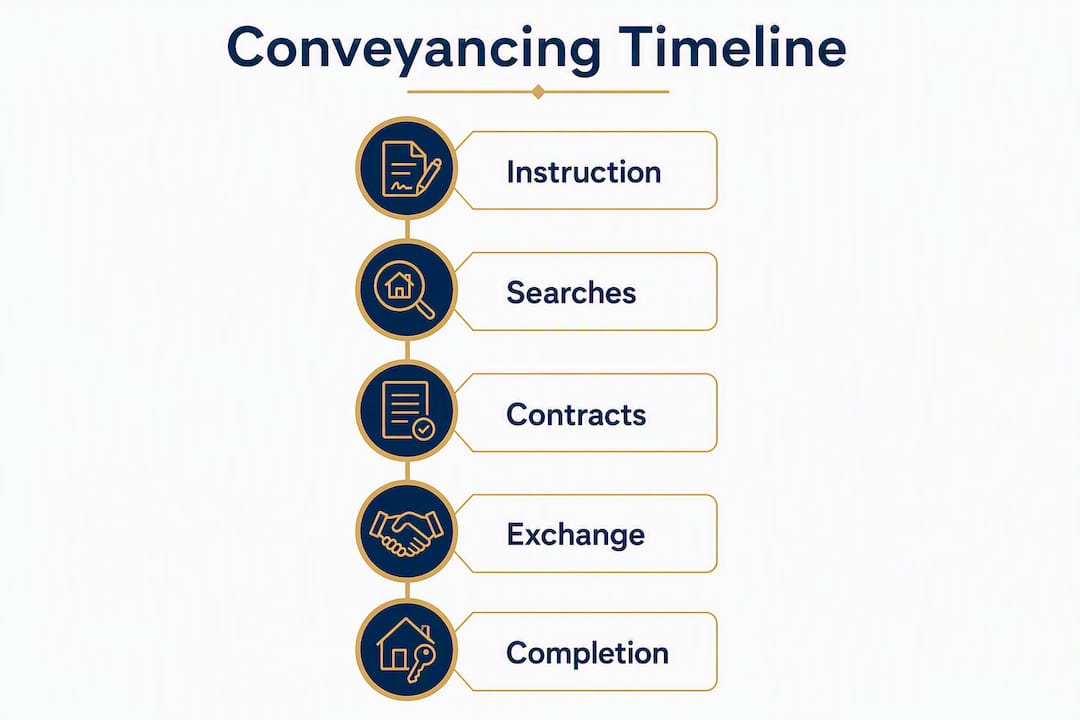
| Stage | Typical duration | What to check with your conveyancer |
|---|---|---|
| Instruction to searches returned | 3–6 weeks | Has the local authority search been submitted? |
| Enquiries raised and resolved | 2–6 weeks | Are all replies received and satisfactory? |
| Mortgage offer confirmed | 2–8 weeks from application | Has the lender received the title report? |
| Exchange of contracts | Once all above are complete | Is the deposit ready? Is the chain exchanged simultaneously? |
| Exchange to completion | 1–4 weeks (by agreement) | Are removal dates confirmed? |
| Post-completion registration | 2–6 weeks | Has the Land Registry application been submitted? |
A straightforward freehold transaction with no chain typically completes in 8–12 weeks from instruction. Add a chain, a leasehold property, or a complex title, and 16–20 weeks is realistic. Searches and unresolved enquiries account for the majority of delays between offer acceptance and exchange.
Pro Tip: If you are in a chain, ask your conveyancer to confirm the position of every party in the chain before you set a target completion date. A completion date that one party cannot meet unravels the whole chain. Weekly progress calls with your conveyancer during the enquiry stage cost nothing and save weeks.
Conveyancing fees have two components: the professional fee charged by the conveyancer, and disbursements, which are third-party costs the conveyancer pays on your behalf and recharges to you.
| Fee type | What it covers | Who typically pays |
|---|---|---|
| Professional fee | Legal work, contract review, correspondence, completion | Buyer and seller (separate firms) |
| Land Registry fee | Registering the transfer and any new mortgage | Buyer |
| Search fees | Local authority, water, environmental, and other searches | Buyer |
| Electronic ID check | Anti-money-laundering identity verification | Buyer and seller |
| Bank transfer (CHAPS) fee | Same-day transfer of completion funds | Buyer and seller |
| Stamp Duty Land Tax (SDLT) handling | Submitting the SDLT return to HMRC | Buyer |
| Leasehold supplement | Management pack, notice of transfer, deed of covenant | Buyer (and sometimes seller) |
Professional fees for a standard residential purchase typically range from £800 to £1,800 plus VAT, depending on property value, complexity, and whether the property is leasehold. Disbursements add a further £300–£600 for a freehold purchase; leasehold transactions carry additional costs for the management pack and notice fees.
Online conveyancing may quote lower professional fees, but practitioners warn that for complex transactions a solicitor’s broader expertise is worth the premium, and low-cost services can lack a single, dedicated contact.
Checklist for comparing quotes:
A quote that bundles everything into one headline figure without an itemised breakdown is a red flag. Ask for a full written estimate before you instruct.
The cheapest quote rarely delivers the fastest or most reliable service. The criteria below will help you make a decision you will not regret six weeks into a stalled transaction.
Selection criteria:
Questions to ask at first contact:
For a fuller framework on selecting a solicitor step by step, Ali Legal Ltd has published a practical guide covering the key questions and criteria.
Red flags to avoid:
Consumers have the right to choose any regulated conveyancer or solicitor. Estate agent recommendations are a reasonable starting point, but always ask whether the agent receives a referral fee and compare at least two or three quotes independently.
Use this checklist at the point of instruction and again before exchange to confirm nothing has been missed. It reflects the practical steps Ali Legal Ltd applies across residential transactions.
At instruction:
During the transaction:
Before exchange:
Before completion:
Every transaction is different. This checklist covers the standard steps, but a leasehold purchase, a probate sale, or a property with a complex title will require additional checks. Contact Ali Legal Ltd for a tailored review of your transaction before you commit.
For a downloadable version with additional compliance steps, see Ali Legal’s property due diligence checklist.
The question clients ask most often is not “what does a conveyancer do?” but “why is this taking so long?” The answer, almost every time, is that someone in the chain has not responded to an enquiry, a search is sitting in a local authority queue, or a mortgage lender is waiting for a document that nobody chased.
The single most effective habit I can recommend is this: respond to your conveyancer within 24 hours, every time. When a conveyancer raises an enquiry or requests a document, the clock stops until they hear back. A week’s delay in returning a signed form can push the entire chain’s completion date back by a fortnight if it misses a lender’s processing window.
The second habit is to read the report on title before you exchange, not after. It is a dense document, but it contains every material fact about what you are buying, including restrictions on use, rights of way, and any conditions the seller has disclosed. Questions raised after exchange are almost always too late to change the outcome.
For complex transactions, particularly those involving leasehold properties, shared ownership, or a title with historic defects, the value of a solicitor over a basic online service is not the price difference. It is the ability to advise on the legal risk, not just process the paperwork.
Ali Legal Ltd offers regulated conveyancing support for buyers and sellers across the UK, with fixed-fee transparency from the first quote and a named solicitor handling your file throughout.
Where many services route your matter through a team of case handlers, Ali Legal Ltd assigns a dedicated solicitor who knows your transaction from instruction to completion. Fixed fees mean the cost you are quoted is the cost you pay, with disbursements itemised separately so there are no surprises on completion day. The firm’s property team handles freehold and leasehold transactions, new builds, shared ownership, and complex titles, with the broader legal expertise to manage any non-conveyancing issues that arise during the process.
For a clear picture of what your transaction involves, start with Ali Legal’s property law compliance checklist, or visit the property and conveyancing service page to speak with a solicitor directly.
When choosing a conveyancer or checking your rights, go to primary sources rather than relying on third-party summaries.
Always verify a conveyancer’s registration number directly on the SRA or CLC register before you instruct. Keep your conveyancer’s name, firm address, and case reference number on file throughout the transaction and for at least six years after completion, in case a title query arises later.
This article provides general information about conveyancing in England and Wales and does not constitute legal advice. Rules, fees, and procedures can change. Confirm current requirements with HM Land Registry, the SRA, the CLC, or a qualified solicitor before making decisions about your transaction.
TL;DR:
- You can create a simple, legally valid will yourself if you follow the formalities set out in the Wills Act 1837.
- For complex situations involving property, dependants, or overseas assets, seeking professional legal advice is safer.
You can draft a legally valid will yourself if your estate is straightforward, but you must follow the precise formalities set out in the Wills Act 1837 or the document is worthless. For anything involving property shared with an unmarried partner, overseas assets, a business, or dependants who need special provision, a solicitor is the safer choice. The GOV.UK guidance on making a will is clear: get professional advice when the situation is not straightforward.
Three formalities that make a will valid in England and Wales:
Immediate next steps to get started today:
Read on for the complete drafting checklist, example clause summaries, and clear guidance on when to instruct a solicitor such as Ali Legal Ltd.
The route you choose affects cost, legal protection, and the risk of errors. Here is a direct comparison.
| Option | Typical cost range | Pros | Cons | When to choose it |
|---|---|---|---|---|
| DIY template | — | Free or very low cost; fast | High risk of imprecise wording or invalid execution; no professional check | Simple estate: one property, married, no business or overseas assets |
| Online or paid will-writing service | — | Guided process; often quicker than a solicitor | Will writers are not regulated by law; protection varies by membership body | Moderately simple estate; check membership of the Institute of Professional Willwriters or Society of Will Writers |
| Solicitor | — | Fully regulated; mandatory professional indemnity insurance; legally binding advice | Higher cost; appointment needed | Blended families, business assets, overseas property, vulnerable dependants, or any doubt about capacity |
The regulatory gap between solicitors and will writers matters more than most people realise. Solicitors are regulated by the Solicitors Regulation Authority and carry mandatory professional indemnity insurance. Will writers who belong to self-regulatory bodies such as the Institute of Professional Willwriters or the Society of Will Writers have some consumer protection, but membership is voluntary and the bodies have no statutory enforcement powers. GOV.UK’s guidance on will-writing services sets out exactly what to check before instructing anyone outside a regulated law firm.
Costs rise sharply when the estate includes trusts for minor beneficiaries, overseas property, or business interests. A solicitor who needs to draft a discretionary trust alongside a will may charge considerably more than the simple-will rate above.
Pro Tip: Match your household complexity to the right option before you spend anything. One property, married, adult children, no business? A guided online service with a reputable membership body may be adequate. Unmarried partner, shared mortgage, or a child with a disability? Go straight to a solicitor.
Three things determine whether a will is valid: testamentary capacity, intention, and correct execution. Get any one of them wrong and the document fails, leaving your estate to pass under intestacy rules that almost certainly do not reflect your wishes.
Capacity and intention mean you must be aged 18 or over, acting voluntarily, and of sound mind when you sign. “Sound mind” in legal terms means you understand the nature of making a will, the extent of your estate, who might expect to benefit, and the effect of the document. If there is any doubt — because of dementia, serious illness, or recent cognitive decline — Age UK recommends obtaining a contemporaneous medical statement from the treating clinician confirming the testator understood the document at signing. That single step can prevent a successful challenge years later.
Formal execution is governed by section 9 of the Wills Act 1837. The will must be in writing, signed by the testator (or by someone else in their presence and at their direction), and that signature must be made or acknowledged in the presence of two witnesses who are both present at the same time. Each witness then signs in the testator’s presence. The GOV.UK formalities page adds that witnesses and their spouses or civil partners cannot benefit under the will — if they are named as beneficiaries, the gift to them is void, though the rest of the will stands.
Common execution mistakes include: signing only the last page while leaving earlier pages unsigned, using a beneficiary or their spouse as a witness, witnesses signing at different times or in different rooms, and leaving blank pages that could later be disputed. LexisNexis UK’s practitioner guidance notes that validity checks after death also cover revocation: marriage or civil partnership automatically revokes an earlier will in England and Wales, so a will made before a wedding needs to be remade afterwards.
Signing procedure checklist:
Scotland and Northern Ireland: Scotland operates under different rules. The Requirements of Writing (Scotland) Act 1995 governs execution, and a will is valid with just one witness (or none, if the testator signs each page). Northern Ireland follows broadly similar rules to England and Wales but under its own legislation. If you are domiciled in Scotland, the Scotland Claims inheritance guidance is a useful starting point for understanding how claims work under Scots law.
A will that cannot be found when needed is almost as bad as no will at all. Storage is not an afterthought.
The most common mistake is keeping the only signed original in a bank safe-deposit box. The Law Society warns that a sealed box often cannot be opened until probate is granted — which requires the will to be produced first. That circular problem can delay the entire estate administration. Safer options are: your solicitor’s strongroom, a specialist will-storage company, or formal deposit with the Probate Service.
Depositing with the Probate Service is a formal option that costs a small fee and creates an official record. GOV.UK explains the deposit process in detail: you send the original will to the Principal Registry of the Family Division, which issues a certificate of deposit. Executors can then search the national will register to locate it after death, which removes the risk of the document being lost or destroyed.
Codicils versus making a new will: a codicil is a separate signed and witnessed document that amends a specific clause without replacing the whole will. Use one for minor changes — updating an executor’s address, adding a small gift. For anything more substantial (a new beneficiary, a change to the residuary estate, a new guardian), make a fresh will and expressly revoke all previous ones. Executing a codicil follows the same formalities as the original will: in writing, signed, two witnesses present simultaneously.
Steps for executors after the testator’s death:
Tell your executor where the original is kept, and give them a copy for reference. That single conversation prevents weeks of searching at an already difficult time.
Not all will-writing services are equal, and the difference between a well-drafted will and a poorly drafted one only becomes apparent at probate — when it is too late to fix.
Questions to ask any prospective will writer or solicitor:
Red flags to watch for:
What drives fees higher:
For a genuinely simple estate — one property, married, adult children, no overseas assets — a guided online service may be adequate. For everything else, the risk of getting it wrong outweighs the cost of professional advice.
The Law Society is direct: professional legal advice is strongly recommended when you have overseas property, business ownership, shared property with an unmarried partner, dependants who cannot look after themselves, or complex family structures. These are not edge cases. They describe a large proportion of UK adults.
Situations where a solicitor is strongly advisable:
Unmarried cohabiting partners have no automatic right to inherit under intestacy rules. If you live with a partner but are not married or in a civil partnership, a will is not optional — it is the only way to ensure they inherit anything. Property held as joint tenants passes automatically to the survivor, but everything else does not.
Blended families — where one or both partners have children from previous relationships — create competing claims that a poorly worded will can inflame. A solicitor can draft a life interest trust that protects a surviving spouse while preserving the children’s eventual inheritance.
Business owners need to consider business property relief, succession planning, and whether the will coordinates with any shareholders’ agreement or partnership deed. A will that ignores those documents can trigger a forced sale of the business.
Where capacity may be in doubt, Age UK’s guidance recommends a contemporaneous medical statement from the treating clinician. A solicitor experienced in this area will know how to obtain and record that evidence properly.
Pro Tip: Ask for a written, fixed-fee estimate before instructing anyone. A reputable solicitor will give you one. If the answer is “it depends” with no further detail, keep looking.
Ali Legal Ltd’s practice in wills, trusts and probate sits alongside its work in property, corporate law, and cross-border matters — which means the firm regularly handles estates where those areas overlap. A client with a buy-to-let portfolio, a shareholding in a private company, and a property abroad needs a will that accounts for all three, and that requires a solicitor who understands each asset class.
The firm’s approach centres on fixed fees where the scope is clear, plain-language advice, and drafting that anticipates practical problems rather than just recording wishes. For clients with cross-border assets, Ali Legal Ltd’s international practice means the will can be considered alongside any foreign succession rules that may apply.
What to bring to an initial appointment:
Readers who want a document review of an existing will, or who need a will drafted from scratch, can contact Ali Legal Ltd to discuss the scope and obtain a fee estimate.
Drafting a will that actually works — one that passes probate without dispute, distributes assets as intended, and accounts for tax — is harder than filling in a template. Ali Legal Ltd offers a fixed-fee will drafting service for individuals and families, covering straightforward wills through to complex estates with trusts, overseas property, and business interests.
The service covers initial drafting, trust advice where needed, inheritance tax considerations, and ongoing probate support for executors. Clients with property, business assets, or family situations that go beyond the simple are the ones who benefit most from instructing a regulated solicitor rather than relying on a generic template.
For a clear, written fee estimate with no obligation, contact Ali Legal Ltd directly or visit the wills, trusts and probate service page to start the conversation.
This article provides general information about making a will in the UK and does not constitute legal advice. Confirm current rules and your personal position with a qualified solicitor before acting.
For Scotland: the Requirements of Writing (Scotland) Act 1995 governs execution, and succession rights differ materially from English law. Scottish readers should consult a Scottish solicitor and may find the Scotland Claims inheritance guidance a useful orientation. For Northern Ireland: the rules broadly follow England and Wales but under separate legislation; check with a Northern Ireland solicitor for jurisdiction-specific advice.
Most people who draft their own will get the formalities right. The problem is rarely the signature or the witnesses. It is the wording.
A will that says “I leave my house to my children equally” sounds clear. It is not. What if one child has died? What if the property is in negative equity? What if one child has already received a substantial gift during your lifetime — does that count? A solicitor does not just write down what you say. They ask the questions you did not know to ask, and they draft clauses that hold up when the answers to those questions become disputed.
The other thing people underestimate is the interaction between a will and other legal documents. A shareholders’ agreement can override a will for business assets. A pension nomination form operates entirely outside the will. Joint tenancy means property passes by survivorship, not by the will at all. None of these are obscure technicalities. They affect a significant proportion of UK adults, and a template will does not address any of them.
The conventional wisdom is that a simple will is fine for a simple estate. That is true. The difficulty is that most people overestimate how simple their estate actually is.
Identify what you own, keep anything patentable confidential, then register or document rights with the Intellectual Property Office as needed. That is the core of how to protect intellectual property in the UK, and the sequence matters. Act out of order and you risk losing rights before you have even filed. Here is the practical checklist to start with:
Your immediate next step: run a short IP audit of your business assets. If an invention is involved, protect confidentiality with an NDA before speaking to anyone outside the business, then contact the IPO or an IP solicitor before any public disclosure.
The term “intellectual property” covers several distinct legal rights, each with different rules about registration, duration, and what it actually protects. Knowing which type applies to your asset determines your entire protection strategy.
Copyright arises automatically the moment an original work is created and fixed in some form: written content, software code, music, photographs, architectural drawings. There is no UK registration system for copyright; instead, you rely on dated records, version histories, and provenance evidence to prove you created it first. For a software business, that means keeping timestamped commits and signed development agreements. For a designer, it means retaining original layered files with metadata intact.

A trade mark protects a brand name, logo, slogan, or shape that distinguishes your goods or services from others. Unlike copyright, trade mark protection in the UK requires registration with the IPO to get the strongest rights. An unregistered mark gives you some common-law passing-off protection, but it is harder and more expensive to enforce. The typical SME example: your business name and logo, registered in the classes of goods or services you actually trade in.
Patents protect novel, inventive technical solutions. A new manufacturing process, a mechanical device, a chemical compound. The bar is high: the invention must be new, involve an inventive step, and be capable of industrial application. Patents also require registration and typically take several years to grant. The commercial payoff is a 20-year monopoly, which is why early confidentiality is so critical.
A registered design protects the visual appearance of a product: its shape, configuration, pattern, or ornamentation. Think of a distinctive bottle shape or a piece of furniture. Registration lasts up to 25 years in five-year renewal periods and gives you the right to stop others copying the look of your product.
Unregistered design right arises automatically for original three-dimensional designs and lasts up to 15 years. Database right protects the substantial investment in compiling a database, even if the individual data items are not original. Both are automatic, but both are narrower and harder to enforce than their registered equivalents.
Trade secrets cover confidential business information: formulas, customer lists, pricing models, manufacturing processes. There is no registration. Protection depends entirely on keeping the information secret and having the right contractual and procedural safeguards in place.
Which rights are automatic and which require registration:
Multiple types of protection can apply to a single product. A consumer product might carry a registered trade mark on the brand name, a registered design on its shape, a patent on its internal mechanism, and copyright in its instruction manual. Layering rights gives you more enforcement options and a stronger commercial position.
Pro Tip: If you think you might have a patentable invention, the question to ask is whether it solves a technical problem in a new and non-obvious way. If the answer is yes, stop talking about it outside the business until you have either filed or signed NDAs with everyone who needs to know.
Registration is a process, not a single event. Each IP type has its own stages, and understanding the sequence helps you plan time and budget realistically.
Trade marks are examined within roughly two weeks of filing, published for opposition, and can be registered approximately three months after application if no opposition is filed. That three-month timeline assumes a clean application with no objections and no third-party oppositions. In practice, objections on relative or absolute grounds can extend the process considerably.
Step-by-step trade mark checklist:
The patent process involves filing, a formal search, and substantive examination; publication typically occurs 18 months after the filing date. The full grant process often takes three to five years. That is not a reason to delay filing: your priority date is established on the day you file, which is what counts for novelty purposes.
Step-by-step patent checklist:
Registered designs are generally the fastest and most affordable registration route. Applications are examined and, if accepted, registered within a few weeks. Protection lasts for periods renewable up to a total of 25 years.
| IP type | Key stages | Typical timeline |
|---|---|---|
| Trade mark | Search, file, examine, publish, oppose, register, renew | ~3 months if unopposed; longer if opposed |
| Patent | File, search, publish (18 months), examine, grant, renew | 3–5 years to grant |
| Registered design | File, examine, register, renew | Weeks to a few months |
The IPO introduced new fees for designs, trade marks, and patents effective 1 April 2026. Applications or payments made on or after that date will generally attract the new fee schedule, with transitional provisions for applications already in progress. Always check the IPO’s current fee pages before filing rather than relying on figures quoted elsewhere.
IP rights are territorial: a UK trade mark or patent does not protect you overseas. For international protection, you have two main routes. The World Intellectual Property Organization (WIPO) Madrid System lets you file a single international trade mark application covering multiple countries from one application. The Patent Cooperation Treaty (PCT), also administered by WIPO, provides a similar single-filing route for patents, giving you up to 30 months from your priority date before you must enter national phases in individual countries.
For complex inventions or high-value brand portfolios, a patent attorney or trade mark attorney is worth engaging from the outset. For straightforward applications, the British Library Business & IP Centre and IPO clinics offer free or low-cost initial guidance and search support.
Confidentiality is your first line of defence, particularly before any registration is in place. An NDA does not replace registration, but it buys you the time to file without losing your rights.
The situations where confidentiality is the right strategy include: early-stage inventions not yet filed, business plans and financial models, proprietary manufacturing processes, customer and supplier lists, and any know-how that gives you a competitive edge but would not qualify for patent protection.
Key terms every NDA should include:
Pro Tip: When meeting a potential investor or manufacturer for the first time, use a purpose-limited NDA that covers only the specific information you intend to share in that meeting. A broad NDA covering “all information exchanged” can inadvertently capture things you did not mean to disclose and create ambiguity about what is actually protected.
Confidentiality agreements are only as strong as the practices behind them. Practical steps for protecting trade secrets day-to-day:
Disclosing an invention publicly or to investors before filing can prevent patentability. That is not a theoretical risk. It is a practical one that catches founders out regularly, particularly when pitching at early-stage events or posting about a product on social media before a patent application is filed.
Ownership of IP is one of the most common sources of commercial disputes, and the default legal position is not always what business owners expect.
Under UK law, IP created by an employee in the course of their employment generally belongs to the employer. That rule applies to copyright, patents, and designs. The key phrase is “in the course of employment”: work done on a personal project outside working hours, using personal equipment, and unrelated to the employee’s role may well belong to the employee, not the business.
Contractors are different. A freelancer or independent contractor who creates work for your business retains ownership of the IP in that work unless there is a written assignment. A contract that says “all work product belongs to the client” is not enough on its own in every case; the assignment needs to be properly drafted, signed, and ideally cover future works as well as current deliverables.
Essential contract clauses for IP ownership:
For practical guidance on drafting these clauses, the contract law principles that govern assignment and confidentiality are worth understanding before you sign anything.
Red flags in standard freelancer or vendor agreements:
The commercial law essentials every UK SME should know include getting IP ownership right in contracts from day one. Retrofitting an assignment after the relationship has ended is possible but expensive and sometimes impossible if the contractor refuses to cooperate.
Registration alone does not protect you. IP owners are responsible for monitoring and enforcing their own rights; the IPO does not police infringement on your behalf. That means building a monitoring habit and knowing what to do when you find something.
Before you take any action, gather and preserve evidence:
The enforcement path runs from informal to formal, and cost-awareness matters at every stage.
For cross-border infringement, the picture is more complex. International debt recovery for IP losses abroad involves navigating different jurisdictions, and the international arbitration route is often faster and more enforceable than foreign court proceedings.
Cost-aware decision framework: before issuing proceedings, weigh the likely damages against the cost of enforcement and the reputational risk of doing nothing. A cease-and-desist letter costs a fraction of litigation and resolves the majority of straightforward infringement cases.
The IPO encourages businesses to perform an IP audit to identify assets and avoid missing commercially valuable creations. Many owners discover rights they did not know they had. A short audit, done once a year, is one of the highest-return activities an SME can undertake.
Use this to decide where to invest your protection budget:
| Commercial value | Enforceability likelihood | Recommended action |
|---|---|---|
| High | High | Register immediately; monitor actively |
| High | Low | Rely on trade secrets and NDAs; consider whether registration is feasible |
| Low | High | Register if cost is low (e.g., single-class trade mark); document carefully |
| Low | Low | Rely on copyright or unregistered rights; document creation date |
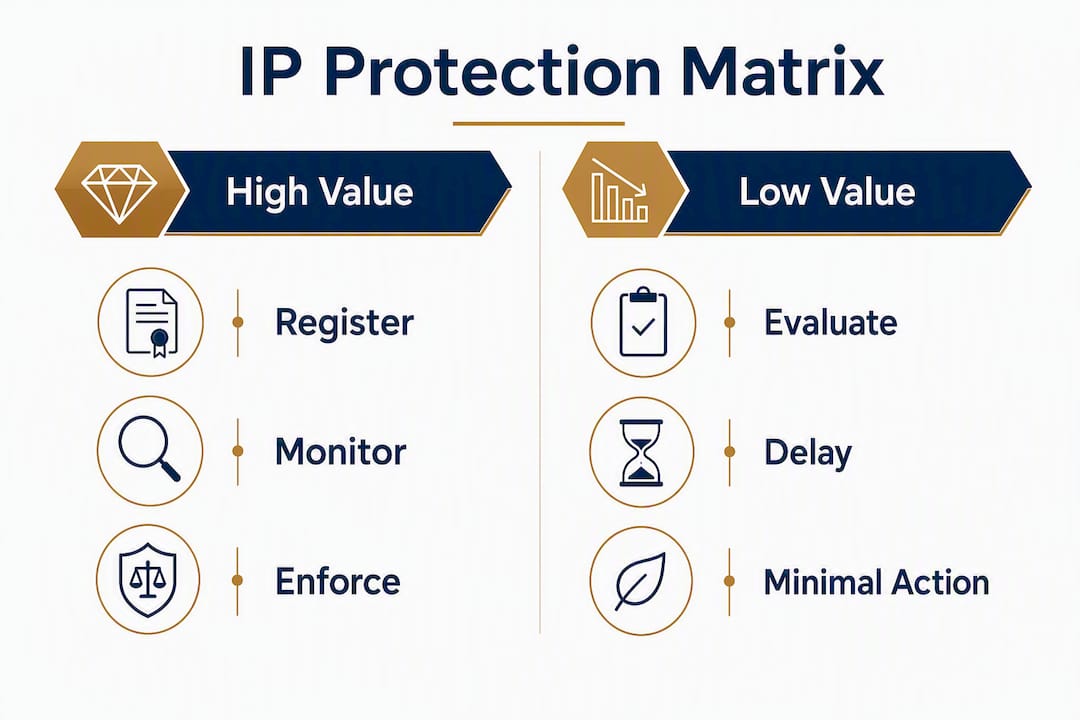
Pro Tip: Maintain a single IP register for the business: a spreadsheet listing each asset, its type, registration number (if any), renewal dates, ownership status, and any licences granted. This document becomes your evidence base in a dispute and your starting point for any due diligence in a funding round or acquisition.
Well-managed IP is a commercial asset that can be licensed, sold, or used as security. Treating it as such, rather than as a legal formality, changes how you prioritise protection decisions.
A DIY approach works for straightforward cases: a single trade mark in one class, a clear copyright ownership situation, or a basic NDA between two parties who both understand the terms. Beyond that, the cost of getting it wrong usually exceeds the cost of professional advice.
Situations that typically merit professional help:
Questions to ask an IP solicitor or attorney at a first meeting:
For straightforward issues, free resources are genuinely useful. The IPO’s step-by-step guide covers the basics clearly. The British Library Business & IP Centre offers free workshops and one-to-one advice sessions. IPO clinics, run in partnership with local enterprise partnerships, provide short advisory sessions at no cost.
For anything involving enforcement, cross-border rights, or significant commercial value, professional advice from an IP solicitor pays for itself. The protect and benefit from your intellectual property rights guidance from Ali Legal Ltd sets out where specialist legal input makes the clearest difference.
Most small businesses do the obvious things: they register a trade mark, maybe file a patent, and assume the job is done. The gap they leave open is the space between registration and enforcement, and it is where most IP value gets quietly eroded.
Registration is a starting point, not a shield. A trade mark you never monitor is a trade mark that gets diluted. A patent you cannot afford to enforce is a patent your competitors can study and design around. Copyright you have never documented is copyright you cannot prove in court. The practical reality for UK SMEs is that IP protection is an ongoing commercial discipline, not a one-time legal transaction.
There is also a Brexit dimension that many UK rights holders underestimate. Before 2021, a single EU trade mark covered the UK. Now, UK and EU trade marks are separate registrations with separate fees and renewal obligations. UK rights holders who relied on EU trade marks before Brexit should have received comparable UK rights automatically, but ongoing protection in both markets now requires active management of two separate portfolios. For businesses with European customers or suppliers, that means budgeting for territorial filings as a routine cost of doing business internationally, not an optional extra.
The owners who protect IP most effectively treat it the way they treat their financial accounts: catalogued, valued, reviewed annually, and defended when necessary. The ones who lose value are those who register once and then stop paying attention.
Protecting IP in the UK involves more moving parts than most business owners expect: clearance searches, registration filings, contract drafting, monitoring, and enforcement, each with its own timescales and legal risks. Ali Legal Ltd works with individuals and SMEs across all of these stages, offering practical, commercially grounded advice rather than theoretical legal commentary.
Ali Legal Ltd’s relevant services for IP protection include IP strategy advice tailored to your business model, drafting and reviewing IP assignment clauses and NDAs, enforcement support from cease-and-desist letters through to court proceedings, and cross-border dispute resolution for rights holders with international exposure. For businesses involved in acquisitions or investment rounds, the team also advises on IP due diligence and clean transfer of ownership.
Fixed-fee options are available for initial consultations and standard filings, so you know the cost before you commit. For complex matters, the scope of work is agreed upfront. If you are ready to get your IP properly protected, contact Ali Legal Ltd to arrange an initial consultation and find out exactly where your rights stand.
This article provides general information about UK intellectual property law and is not legal advice. IP law is complex and fact-specific; you should confirm your position with a qualified IP solicitor or the IPO before taking action.
TL;DR:
- Mediation is a voluntary, confidential process where an impartial third party helps parties negotiate their own settlement without imposing a decision.
- It is suitable for disputes where both sides can negotiate freely and the relationship, cost, and time favor resolution outside court.
Mediation is a voluntary, confidential process in which an independent, neutral third party helps two or more parties negotiate their own settlement. The mediator cannot impose a decision. That single fact separates mediation from arbitration and from court, and it is the reason many people prefer it.
Key things to know before you read further:
Ali Legal Ltd supports clients through every stage of this process, from pre-mediation legal advice to drafting enforceable settlement documents. The Family Mediation Council maintains a register of accredited family mediators across the UK.
Alternative dispute resolution (ADR) covers several distinct methods. Choosing the right one depends on how much control you want over the outcome and how quickly you need a decision.
| Method | Who decides | Binding? | Typical use |
|---|---|---|---|
| Mediation | The parties themselves | Only if agreed and documented | Family, commercial, neighbour, workplace |
| Arbitration | The arbitrator | Yes, by agreement | Commercial contracts, international disputes |
| Conciliation | The conciliator (more active than a mediator) | Depends on scheme | Employment, consumer complaints |
| Ombudsman | The ombudsman | Binding on the business if accepted | Financial services, energy, telecoms |
The critical distinction between mediation and arbitration is authority. A mediator or conciliator has no power to impose a decision; an arbitrator issues a binding award where the parties have agreed to arbitration in advance. For a deeper comparison of all three routes, Ali Legal Ltd’s guide to arbitration, negotiation, and mediation sets out the procedural trade-offs clearly.
Conciliation deserves a specific mention. It is closely related to mediation but the conciliator takes a more active role in proposing solutions. ACAS provides free early conciliation for employment tribunal claims, and most claimants must go through that process before lodging a tribunal claim. Consumer ADR has also changed recently: the Digital Markets, Competition and Consumers Act 2024 replaced the voluntary ADR accreditation framework with a mandatory one for consumer contract disputes, raising the baseline quality of schemes available to ordinary consumers.
“You can use mediation or conciliation to ask an impartial professional to help you reach an agreement. They’ll help you and the other side consider different options to resolve the dispute.” — GOV.UK, Solve problems out of court
Civil mediation is flexible, confidential, and often quicker and cheaper than court proceedings. Most civil mediations settle on the day or shortly after. That speed matters when a commercial relationship is at stake and a six-month litigation timetable would cause more damage than the original dispute.

The core sequence is: preparation, MIAM or pre-mediation meeting, joint opening session, private caucuses, options generation, and either a written agreement or a clear next step. Here is how each stage works in practice.
Virtual mediation follows the same structure, with private caucuses conducted in separate video breakout rooms. Platforms such as Zoom or Microsoft Teams work well for straightforward disputes; more complex matters benefit from a dedicated virtual mediation platform where the mediator can move between rooms without either party seeing the other’s screen.
Pro Tip: Before the session, write down your three most important outcomes and your realistic bottom line. Mediators consistently report that parties who arrive with clear priorities settle faster and with less regret than those who come hoping the mediator will “sort it out.”
Mediation works well where both parties can negotiate freely and where the relationship, cost, or time involved in litigation makes a negotiated outcome preferable. Common suitable scenarios include:
There are situations where mediation is usually the wrong choice. Proceeding in those circumstances can cause real harm.
Safety and power imbalance: where there is substantiated domestic abuse, a significant power imbalance, or an urgent need for a court injunction, mediation is generally inappropriate. The Family Procedure Rules Part 3 recognise this: MIAM exemptions exist precisely for these cases. Cafcass, the Children and Family Court Advisory and Support Service, can provide guidance where a child’s welfare is at risk.
Other situations where mediation is typically unsuitable:
The risks of mediation are real even in suitable cases. There is no guaranteed outcome. Costs are incurred whether or not settlement is reached. And confidentiality, while protective, means a party cannot later use a concession made in mediation as evidence of liability if the case proceeds to court. That protection cuts both ways.
For family disputes, understanding the court procedure for child arrangement orders is useful background before deciding whether mediation or a court application is the right first step.
Many civil mediations conclude in a single day. Family mediations involving MIAMs, financial disclosure, and multiple sessions can take several weeks from start to finish, though the actual mediation time is usually measured in hours rather than months.
Typical cost structures:
The Family Mediation Voucher Scheme provides eligible families with a contribution of up to £500 towards the cost of family mediation where child arrangements are in dispute. The scheme is administered through accredited mediators registered with the Family Mediation Council. Not every family dispute qualifies, so check eligibility with your chosen mediator before booking.
A straightforward civil mediation timeline might look like this: instruction of mediator (week 1), exchange of position statements (week 2), mediation day (week 3), settlement agreement drafted and signed (week 3 or 4). A family mediation involving a MIAM, financial disclosure, and two joint sessions might run over six to eight weeks, though this varies considerably.
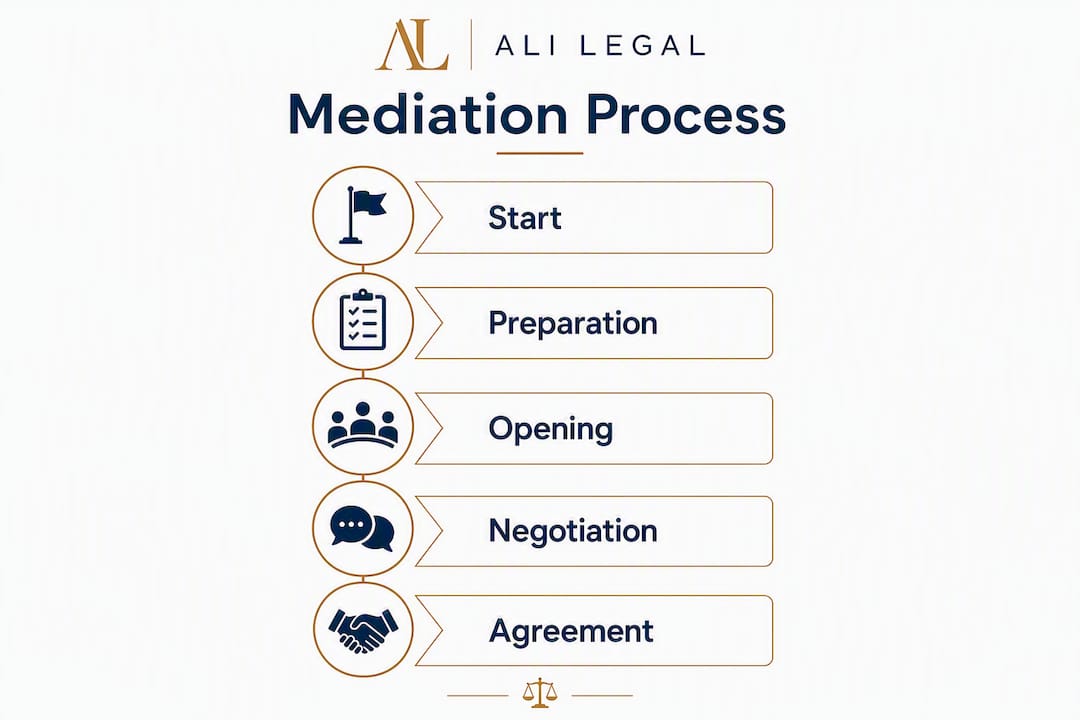
Pro Tip: Ask your mediator at the outset whether their fee includes preparation time, travel, and any post-mediation drafting. Some charge separately for each element; others bundle them. Knowing this upfront prevents disputes about the mediator’s own invoice.
Use an accredited register and verify credentials before instructing anyone. The two main registers for England and Wales are the Family Mediation Council (family disputes) and the Civil Mediation Council (civil and commercial disputes). Both maintain searchable directories.
A practical checklist before instructing a mediator:
Questions worth asking a prospective mediator before you instruct them: What is your fee structure and what does it include? How do you handle a situation where one party discloses something in a private caucus that the other party needs to know? What happens if we reach agreement but one party later refuses to sign? How many mediations of this type have you conducted in the past year?
The engagement letter should set out fees, cancellation terms, confidentiality obligations, and the mediator’s withdrawal rights. Read it carefully before signing.
Mediators are neutral. They do not give legal advice to either party, and they cannot tell you whether the agreement you are about to sign is a good one for your circumstances. The judiciary’s family mediation guidance is explicit on this point: independent legal advice is recommended before finalising agreements, particularly for property and long-term financial commitments.
How mediated agreements become enforceable:
If a party breaches a consent order or Tomlin order, the route back to court is enforcement, not a fresh claim. For a settlement agreement, you issue a new contract claim. Either way, the costs of enforcement are real, so clarity in the original document matters enormously.
Pro Tip: Before the mediation session ends, agree in writing on the exact wording of any key terms, particularly payment dates, property transfer timelines, and any conditions. Vague language in a settlement agreement is the most common cause of post-mediation disputes.
Failed mediation is not the end of the road. The main options, in rough order of escalation:
The without-prejudice protection is important here. ADR discussions conducted on a without-prejudice basis generally cannot be referred to in subsequent court proceedings. What you said in the mediation room stays there. The exception is where both parties agree to waive the protection, or where a statement was made to misrepresent facts.
Preserve all evidence gathered before and during mediation. The mediator’s notes are confidential and cannot be subpoenaed, but your own documents, correspondence, and expert reports remain available for court.
Focused preparation and realistic objectives materially increase the likelihood of settlement. Five steps that make a measurable difference:
Commercial dispute example: a supplier and a retailer in a contract dispute over defective goods. The supplier prepares a schedule of delivery records and quality certificates. The retailer brings evidence of customer complaints and lost sales. In the private caucus, the mediator discovers the retailer’s real priority is a continued supply relationship, not the damages figure. The supplier’s real concern is reputational. A revised supply agreement with a partial credit resolves both interests, something a court judgment could never have delivered.
Child arrangements example: two parents disagree about school holiday contact. One parent prepares a proposed schedule with specific dates. The other arrives without documentation. The mediation takes twice as long as it should because basic factual questions (school term dates, existing commitments) have to be established from memory. Preparation is not a formality.
Pro Tip: Cultural differences in communication style, directness, and attitudes to authority can affect how parties engage in joint sessions. If you know cultural dynamics are a factor, raise it with the mediator before the session. A good mediator will adjust their approach accordingly.
Mediation tends to get treated as a last resort before court, which is exactly backwards. The parties who get the most from it are those who arrive before positions have hardened, legal costs have mounted, and the relationship has been destroyed by correspondence. By the time most disputes reach a solicitor’s desk, the window for a genuinely creative settlement has often narrowed considerably.
What the evidence from UK civil practice consistently shows is that mediation preserves something court cannot: party control. Legal guidance on civil mediation notes that parties who control their own outcome tend to preserve commercial and family relationships far better than those who hand the decision to a judge. That matters in a commercial context where the counterparty is also a supplier, a landlord, or a co-parent.

The other thing practitioners underestimate is the value of the private caucus. Most people imagine mediation as a round-table negotiation. In practice, the most productive work happens in the separate rooms, where a mediator can reality-test a position without either side losing face. That dynamic is genuinely difficult to replicate in direct negotiation or in court.
Ali Legal Ltd treats mediation as a practical first-line route for many family and civil disputes, not a consolation prize. The firm advises clients before sessions on their realistic range of outcomes, attends mediations where legal representation adds value, and drafts the settlement documents that convert a verbal agreement into something enforceable. For cross-border disputes where mediation intersects with international arbitration, Ali Legal Ltd’s international disputes practice handles the full spectrum.
The one honest caveat: mediation is not always appropriate, and recommending it when safety or power imbalance is a real factor does harm. The MIAM exemptions exist for a reason. A solicitor’s job at the outset is to assess whether mediation is genuinely suitable, not to push it because it is cheaper.
Ali Legal Ltd offers fixed-fee legal support at every stage of the mediation process, from the first assessment of whether mediation is right for your dispute through to drafting and enforcing the final agreement.
Specific services relevant to mediation clients include: pre-mediation legal advice on your realistic range of outcomes and BATNA; attendance at mediation sessions where legal representation adds value; drafting settlement agreements, Tomlin orders, and consent order applications; enforcement advice if a settlement is later breached; and cross-border ADR support for disputes with an international dimension. For disputes touching on property law, commercial contracts, or corporate matters, Ali Legal Ltd’s solicitors can advise on the legal framework before you enter the mediation room, so you negotiate from a position of clarity rather than uncertainty.
To discuss your dispute and whether mediation is the right route, contact Ali Legal Ltd directly through the website for a straightforward initial consultation.
These are the primary official sources. Use them to verify current rules, find accredited mediators, and check scheme eligibility.
Official pages carry authoritative detail on deadlines, eligibility, and provider accreditation. This article summarises the framework; always verify current rules directly with the relevant source before taking action.
This article provides general information about mediation and dispute resolution in the UK. It is not legal advice. Rules, eligibility criteria, and fees change; confirm current requirements with the relevant official source or a qualified solicitor before making decisions about your dispute.
TL;DR:
- The Association of Personal Injury Lawyers is a UK non-profit organization that independently assesses solicitors for claimant injury work. Holding APIL accreditation signals demonstrated expertise and a commitment to claimant interests, especially at Senior Litigator or Fellow levels. Verifying credentials through APIL and the SRA ensures you choose a qualified, specialist personal injury lawyer.
The Association of Personal Injury Lawyers (APIL) is a UK not-for-profit organisation representing solicitors and barristers who act exclusively for injured claimants. Founded in 1990 and headquartered in Nottingham, APIL has a membership of approximately 3,000 across England, Wales, Scotland and Northern Ireland. Its individual accreditation scheme is a recognised quality mark that signals assessed competence, not just membership of a professional body.
When you are choosing a personal injury lawyer, the APIL accreditation badge is one of the clearest signals that the solicitor in front of you has been independently assessed, not simply signed up to a mailing list. The Law Society of England and Wales runs a separate Personal Injury Accreditation alongside it. Both are worth understanding before you instruct anyone.
Quick action checklist:
APIL describes itself as a not-for-profit campaign body working to secure access to justice for victims of negligence. That framing, confirmed in parliamentary written evidence, matters because it tells you whose side the organisation is on. Every member, by joining, commits to acting for claimants, not insurers or defendants.

APIL has a substantial membership, making it the UK’s largest claimant injury lawyer association.
Day to day, APIL does three things: it lobbies Parliament on legislation that affects injured people, it delivers training and conferences for member solicitors, and it publishes the Consumer Charter that sets out what claimants can expect from any member firm.
Membership is open to solicitors, barristers, legal academics and law students. That breadth is deliberate. The organisation wants to shape the next generation of claimant lawyers, not just credential the existing ones. For you as a claimant, the practical implication is a national network of practitioners who share a common standard of conduct and a shared commitment to your interests rather than to an insurer’s bottom line.
Membership and accreditation are not the same thing. Joining APIL requires subscribing to its code of conduct; individual accreditation requires passing an assessed competence test. The distinction matters enormously when you are picking a solicitor.
APIL’s accreditation scheme was established in September 1999. It awards quality marks at four levels: Litigator, Senior Litigator, Fellow and Senior Fellow. Only those who reach Senior Litigator or above are promoted to injured people as specialists. Reaching those tiers requires demonstrated experience in personal injury litigation, not just years of practice. Accredited members must also complete dedicated personal injury CPD annually to maintain their status.
What accreditation signals to you as a claimant:
Pro Tip: When you first speak to a solicitor, ask directly: “What is your APIL accreditation level?” A Senior Litigator or Fellow will say so immediately. If the answer is vague, treat that as a signal to keep looking.
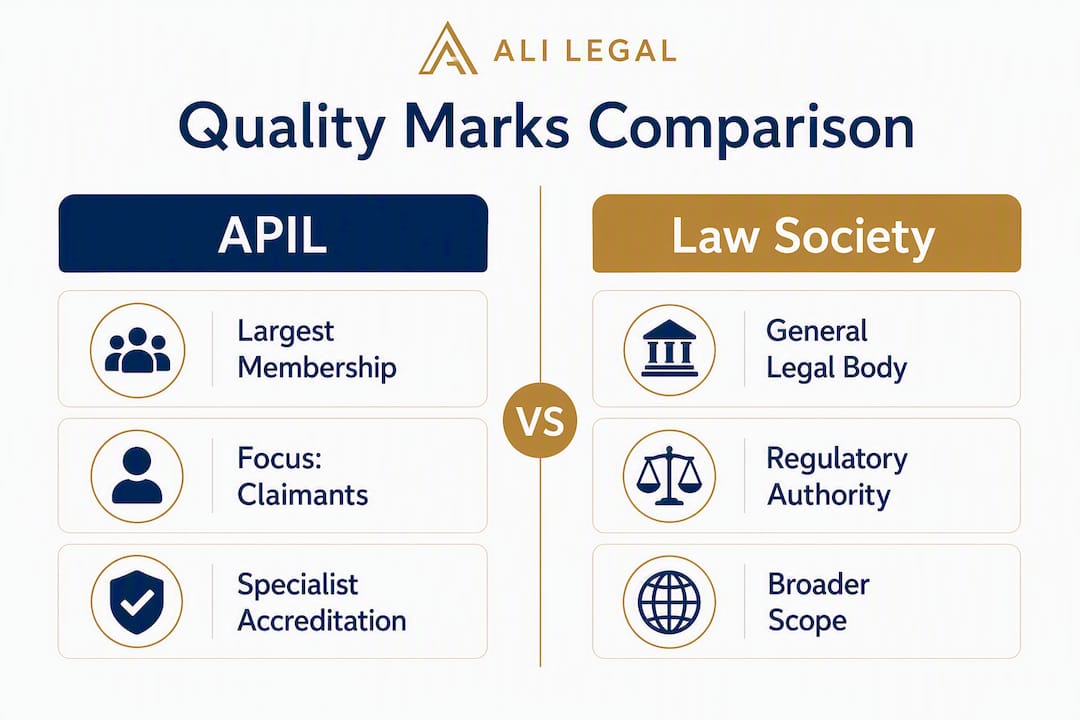
Three bodies dominate the quality-mark landscape for personal injury in the UK. They are not interchangeable.
| Dimension | APIL accreditation | Law Society PI Accreditation | MASS |
|---|---|---|---|
| Who runs it | APIL (not-for-profit, claimant body) | The Law Society of England and Wales | Motor Accident Solicitors Society |
| Scope | Broad personal injury (all types) | Broad personal injury | Road traffic accidents only |
| Claimant types served | All injury claimants | All injury claimants | Motor accident victims |
| Experience requirement | Assessed tiers; Senior Litigator+ for specialist promotion | Minimum three years and specific case-handling evidence | Membership criteria focused on motor claims |
| How to verify | APIL member directory + SRA register | Law Society Find a Solicitor + SRA register | MASS member directory |
| Best suited when | Choosing any PI specialist; broadest coverage | Formal Law Society mark matters to you | Your claim arises from a road traffic accident |
Practical takeaways:
Pro Tip: Before signing anything, ask for a written scope of services and a clear fee explanation. A solicitor who hesitates to put fees in writing is a red flag. Legitimate firms, including those working on a no-win no-fee basis, will always confirm the financial arrangement in a client care letter.
The APIL Consumer Charter sets out the standards every member commits to when handling a claimant’s case. It is not marketing copy; it is a binding commitment tied to membership.
Service standards claimants can use as benchmarks:
If a member falls short of these standards, you can raise a complaint with the firm’s internal complaints procedure first. If that fails, the Legal Ombudsman handles complaints about solicitors in England and Wales. The SRA can investigate conduct issues separately. You do not need to accept poor service simply because a solicitor holds an accreditation badge.
Most personal injury claims in the UK are funded through a conditional fee agreement (CFA), commonly called no-win no-fee. Under a CFA, you pay nothing if the claim fails; if it succeeds, the solicitor’s success fee is capped by statute. For a detailed breakdown of how legal fees work in accident cases, independent consumer guides are a useful starting point.
Common funding routes:
Timescales vary considerably. A straightforward road traffic accident claim with clear liability can resolve in six to twelve months. A catastrophic injury claim involving disputed liability, multiple experts and rehabilitation needs can run for several years. Factors that extend timetables include disputed liability, the need for specialist medical evidence, and court listing delays.
Watch out for claims farmers and upfront-fee demands. Any organisation that asks for payment before your claim is assessed, or that promises guaranteed compensation, is not operating within the regulated legal framework. Instruct only SRA-regulated solicitors.
Pro Tip: Ask your solicitor for a written fees estimate at the outset, and ask them to update it whenever the scope of work changes. This is your right under the SRA’s transparency rules, and any regulated firm will comply.
Contact a solicitor promptly. The general limitation period for personal injury claims in England and Wales is three years from the date of injury, or from the date you became aware of it. Miss that deadline and the court will almost certainly refuse to hear your claim.
Limitation periods are strict. Three years sounds like a long time, but gathering medical evidence, tracing witnesses and building a case takes longer than most claimants expect. Starting early protects your options.
First 72 hours: what to do
For a full breakdown of personal injury claim stages and compensation, Ali Legal Ltd’s consumer guides cover the process in detail.
The gap between an accredited specialist and a generalist solicitor handling personal injury as a sideline is wider than the badge suggests. APIL accreditation, particularly at Fellow or Senior Fellow level, means the solicitor has been assessed, not just approved. They have demonstrated competence in the specific area where your claim sits, whether that is road traffic, workplace injury, or clinical negligence.
What often gets overlooked is the difference between a solicitor who understands the law and one who understands how insurers behave. Insurers have specialist teams whose job is to minimise payouts. A Senior Litigator or Fellow who has handled hundreds of similar claims knows the tactics, the pressure points, and when a settlement offer is genuinely fair versus when it is a low opening bid. That experience is not visible on a firm’s website. The accreditation tier is the closest proxy you have.
Ali Legal Ltd’s approach to personal injury advice prioritises transparency from the first conversation: clear fee structures, honest case assessments, and experienced solicitors who tell you what your claim is actually worth rather than what you want to hear. If you are unsure whether you have a viable claim, or you want to understand your options before committing to a firm, contact Ali Legal Ltd for an initial discussion.
Use these official sources to check credentials and verify claims independently:
Trust signal: APIL’s approximately 3,000-strong membership represents the UK’s largest network of claimant injury lawyers. Cross-checking a solicitor’s name against both the APIL directory and the SRA register takes under five minutes and gives you two independent confirmations of their credentials.
If you want professional guidance rather than a directory search, contact Ali Legal Ltd directly. The team can advise on whether your circumstances warrant a personal injury claim and point you towards the right specialist for your case.
This article provides general information about UK personal injury law and professional accreditation. It is not legal advice. Confirm current rules and your specific position with a qualified solicitor or the relevant regulatory body.
TL;DR:
- An arbitration lawyer advises clients on dispute resolution outside courts, including drafting clauses and representing parties. Early instruction, especially at contract signing, reduces procedural costs, delays, and enforcement challenges in international arbitration. Their expertise spans drafting, case management, advocacy, enforcement, and proactively shaping dispute strategies.
An arbitration lawyer is a specialist in private dispute resolution who advises clients, drafts enforceable arbitration clauses, and represents parties in binding hearings outside the court system. If you are signing a high-value commercial contract, facing a cross-border dispute, or dealing with a matter where confidentiality matters, instructing one early can determine whether you end up in a costly procedural fight or a well-managed process. The governing statute in England and Wales is the Arbitration Act 1996, and the principal accreditation body for practitioners is the Chartered Institute of Arbitrators (CIArb). Ali Legal Ltd handles both contract-stage drafting and active dispute representation for UK individuals and businesses.
You need an arbitration lawyer in three broad situations:
Arbitration lawyers handle drafting arbitration clauses, advising on jurisdictional strategy, selecting arbitrators, managing evidence, preparing written submissions, and representing clients at hearings. That list spans the entire lifecycle of a dispute, and the value of good counsel shows at every stage.
| Stage | Core duties | What goes wrong without specialist advice |
|---|---|---|
| Pre-dispute | Drafting arbitration clauses; advising on seat, rules, and governing law | Poorly worded clauses trigger jurisdictional fights before the merits are even reached |
| Case management | Arbitrator selection; preliminary challenges; disclosure strategy; witness statements | Wrong arbitrator choice or weak disclosure strategy undermines the case from the start |
| Advocacy | Written submissions; skeleton arguments; oral advocacy; interim relief applications | Unstructured submissions lose credibility with the tribunal |
| Post-award | Explaining the award; advising on set-aside grounds; enforcement strategy | Missed deadlines or wrong enforcement route can render a valid award worthless |
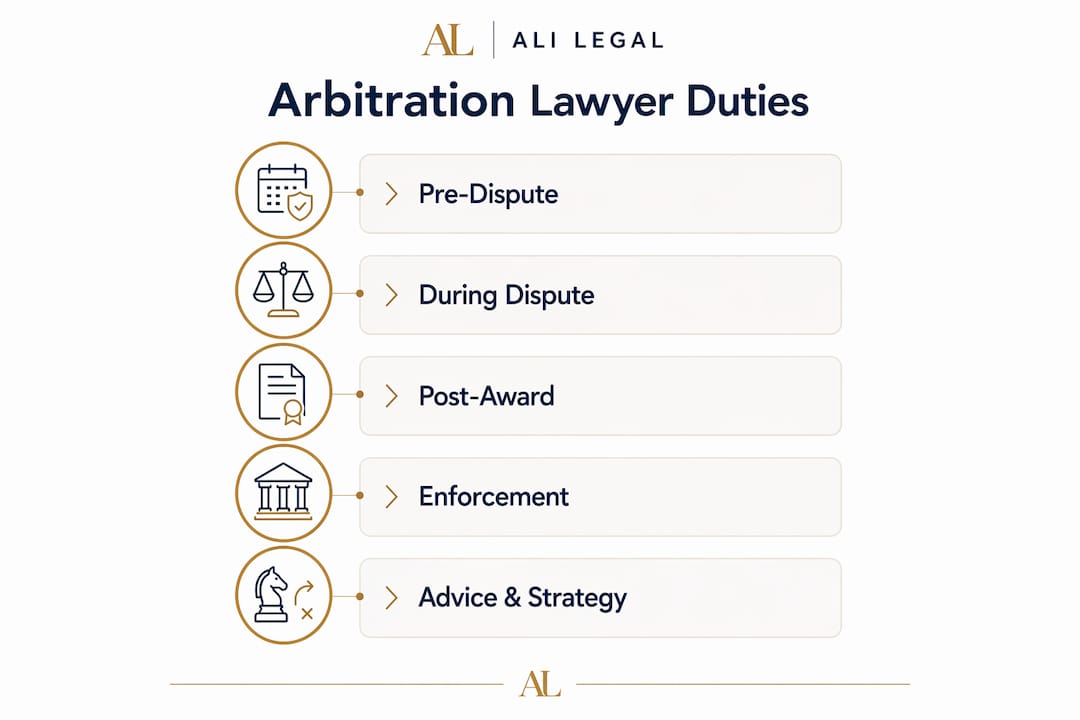
The pre-dispute stage is where most clients underestimate the value of specialist input. A poorly drafted arbitration clause is one of the most common causes of early procedural disputes that inflate cost and delay resolution. Bespoke drafting, tailored to the deal and the likely dispute profile, prevents that friction entirely.
Post-award work is equally specialist. Enforcement under the New York Convention requires understanding which assets are reachable, which courts in which jurisdictions will recognise the award, and whether any challenge grounds exist. An arbitration lawyer who has only ever run hearings but never enforced an award is only half the picture.
The honest answer is: earlier than most clients do. Instructing at contract stage costs a fraction of what procedural skirmishes cost once a dispute is live.

At the contracting stage, the lawyer’s job is to draft the arbitration clause as a bespoke commercial negotiation point. That means setting the seat explicitly (London is the most common choice for international contracts), agreeing the institutional rules (ICC, LCIA, or UNCITRAL are the main options), fixing the number of arbitrators, and specifying the language. It also means deciding whether to include an express confidentiality provision, since UK law does not guarantee privacy by statute. Getting this right at signing costs far less than litigating it later.
After a dispute arises, the priority shifts. The first questions are jurisdictional: does the clause actually cover this dispute? Is there a valid agreement to arbitrate? Can the other party challenge the tribunal’s jurisdiction? These are not academic points. A weak clause can allow a party to run to court instead, destroying the confidentiality and enforcement advantages you chose arbitration for in the first place.
The typical stages of an arbitration, once proceedings begin, run broadly as follows:
Timelines vary considerably. A straightforward two-party commercial dispute with a sole arbitrator and agreed procedures can conclude in under a year. Complex multi-party disputes with extensive disclosure, expert witnesses, and preliminary hearings regularly run to 18–24 months. Procedural skirmishes, particularly over jurisdiction or disclosure scope, are the single biggest driver of delay.
Pro Tip: Involve legal counsel at the contract stage, not just when a dispute arises. Decisions made at signing, such as the seat, the rules, and the number of arbitrators, directly control the cost and duration of any future proceedings.
The roles in arbitration are distinct, and conflating them leads to confusion when instructing.
Solicitors manage the overall conduct of proceedings: they advise the client, handle correspondence, coordinate evidence, and instruct barristers for advocacy where needed. Most arbitration teams at UK law firms are solicitor-led.

Barristers specialise in advocacy and written submissions. Under the Bar Council’s direct access rules, clients in the UK can instruct a barrister directly for hearing advocacy in some cases without a separate solicitor, which can reduce cost for specific, well-defined advocacy needs.
Arbitrators are a different role entirely. They are the decision-makers, not the advocates. Senior barristers, retired judges, and specialist solicitors frequently sit as arbitrators. CIArb accreditation is the principal qualification signal: membership grades range from Associate to Fellow, with Fellow (FCIArb) indicating the highest level of recognised expertise.
Beyond CIArb, the practical signals of genuine expertise are track record with specific institutional rules (ICC, LCIA, UNCITRAL), multi-jurisdictional experience, and sector knowledge. An arbitration lawyer who has handled ten construction disputes is a different proposition from one whose experience is entirely in financial services, even if both hold the same formal qualifications.
Arbitration is not automatically cheaper than litigation. Whether it is depends almost entirely on the procedural choices made at the contracting stage and the conduct of the parties once a dispute arises.
The primary cost drivers are:
Funding options available in England and Wales include conditional fee arrangements (CFAs), damages-based agreements (DBAs), and third-party litigation funding. Cost-shifting is possible: tribunals can award costs against the losing party, but the outcome is not guaranteed and depends on the rules chosen and the conduct of the proceedings.
Pro Tip: The seat, the number of arbitrators, and the chosen rules are the three variables that most directly control future costs. Negotiate them at contract stage, not after a dispute has started.
This is where a common assumption causes real problems. Many clients choose arbitration specifically because they believe it is private. It often is, in practice. But it is not guaranteed by statute.
The Arbitration Act 2025 introduced enhanced arbitrator disclosure duties and other discrete reforms, but it did not codify a universal confidentiality rule. Confidentiality in English-seated arbitration rests on common-law principles and, critically, on whatever the parties have agreed in their contract.
The practical implications are significant:
To strengthen confidentiality, the arbitration agreement should expressly prohibit disclosure of the proceedings, the award, and any documents produced in the process, subject to agreed exceptions for enforcement and regulatory obligations. The seat matters too: some jurisdictions provide statutory confidentiality that English law does not, which is a legitimate reason to choose a non-London seat for certain disputes.
Selection criteria matter more than most clients realise. Arbitration is a specialist field within a specialist field: a general commercial litigator with occasional arbitration experience is not the same as a practitioner whose practice is built around it.
What to look for:
Questions to ask in a first meeting:
Red flags to watch for:
For international matters, also check whether the lawyer has experience with international arbitration strategy across multiple jurisdictions, not just English-seated proceedings. The ICC accounted for a significant share of international arbitration filings in recent years, and familiarity with its specific procedural requirements is a practical differentiator.
An award is not automatically self-executing. What happens next depends on whether the losing party complies voluntarily, and if not, where their assets are.
Enforcement in the UK and abroad:
Arbitral awards are often easier to enforce across borders than foreign court judgments, because the New York Convention provides a recognised framework in over 170 signatory states. Enforcement in a Convention state involves applying to the local court for recognition; the grounds for refusal are narrow and defined.
Practical steps after an award:
Challenge and set-aside:
Under English law, the grounds for challenging an award are deliberately narrow. A party can apply to the court under the Arbitration Act 1996 on grounds of serious irregularity or on a point of law (the latter only where the parties have not excluded it). The seat determines which court has supervisory jurisdiction, which is one reason seat selection matters so much at the contracting stage.
Cross-border enforcement is where the choice of seat and governing law has its most direct commercial consequence. An award from a London-seated arbitration carries strong international recognition, which is a practical reason why London remains one of the world’s most frequently chosen arbitration seats.
Arbitration is often presented as a gentler alternative to litigation. In practice, it is a different kind of fight, with its own procedural culture, its own cost dynamics, and its own enforcement machinery. The clients who get the best outcomes are the ones who treat it strategically from the moment they sign a contract, not from the moment a dispute lands.
What I see repeatedly is that the procedural decisions made at contracting stage, the seat, the rules, the number of arbitrators, are treated as boilerplate. They are not. They are the architecture of any future dispute. A clause that looks standard can lock a client into a three-member ICC tribunal for a dispute that a sole arbitrator could have resolved in six months at a third of the cost. Conversely, a well-drafted clause with the right institutional rules can give a claimant genuine leverage before a hearing even begins.
The other underestimated point is enforcement. Winning an award means nothing if you cannot collect on it. The New York Convention framework is powerful, but it requires knowing where assets are, which courts will cooperate, and how to move quickly before a losing party reorganises. That is not a task for a lawyer who has only ever run hearings.
Ali Legal Ltd combines contract-stage drafting with active dispute management and post-award enforcement, which means clients get consistent advice across the full lifecycle rather than handing off between teams at the worst possible moment.
Ali Legal Ltd acts for UK individuals and businesses on international disputes and arbitration, from contract-stage clause drafting through to cross-border enforcement. The firm offers fixed fees and clear advice, with no unnecessary complexity in how it structures its services.
If you are reviewing a contract that includes an arbitration clause, or if a dispute has already arisen and you need to understand your position, Ali Legal Ltd can provide a focused case assessment. The team is familiar with ICC, LCIA, and UNCITRAL rules, and has experience enforcing awards across multiple jurisdictions. For corporate disputes, the firm’s corporate litigation guidance covers the full range of commercial dispute options. Contact Ali Legal Ltd to request a contract review or initial case assessment.
The following primary and secondary sources underpin the claims in this article and provide further reading for those who want to go deeper.
| Source | Type | Focus |
|---|---|---|
| Arbitration Act 1996 | UK statute | Governing framework for arbitration in England and Wales |
| Arbitration Act 2025 | UK statute / Mondaq analysis | Recent reforms including arbitrator disclosure duties |
| Chartered Institute of Arbitrators (CIArb) | Accreditation body | Membership grades, training, and practitioner standards |
| Chambers and Partners: Arbitration solicitors and agreements | Practice guide | Role definition, clause drafting, and cost drivers |
| ICLG: International Arbitration 2025, England & Wales | Comparative law guide | Legislative framework, rights of audience, funding options |
| Bar Council: International Arbitration brochure | Professional guidance | Direct access to barristers; advocacy cost optimisation |
| Mondaq: Should you arbitrate your disputes? | Practice commentary | Clause drafting pitfalls and New York Convention enforcement |
| Ali Legal: Role of arbitration clauses in UK contracts | Firm resource | Practical clause drafting guidance for UK contracts |
| Ali Legal: International arbitration strategies | Firm resource | Institutional strategy and ICC/LCIA considerations |
| ICC Cost Calculator | Tool | Estimate ICC administrative fees and arbitrator costs by dispute value |
This article provides general information about arbitration law in the UK and does not constitute legal advice. For advice specific to your situation, consult a qualified solicitor or contact Ali Legal Ltd directly.
TL;DR:
- Most commercial disputes in England and Wales are resolved through negotiations, arbitration, or courts, without reaching a trial.
- Choosing the appropriate route depends on factors like dispute value, speed, confidentiality, and enforceability, with early action and settlement often being the best strategy.
A commercial dispute is a civil disagreement arising from business activity where one party alleges that another has failed to perform, pay, or govern as agreed. The immediate outcomes available are a negotiated settlement, a mediated agreement, an arbitration award, or a court judgment. Most commercial disputes never reach a courtroom at all.
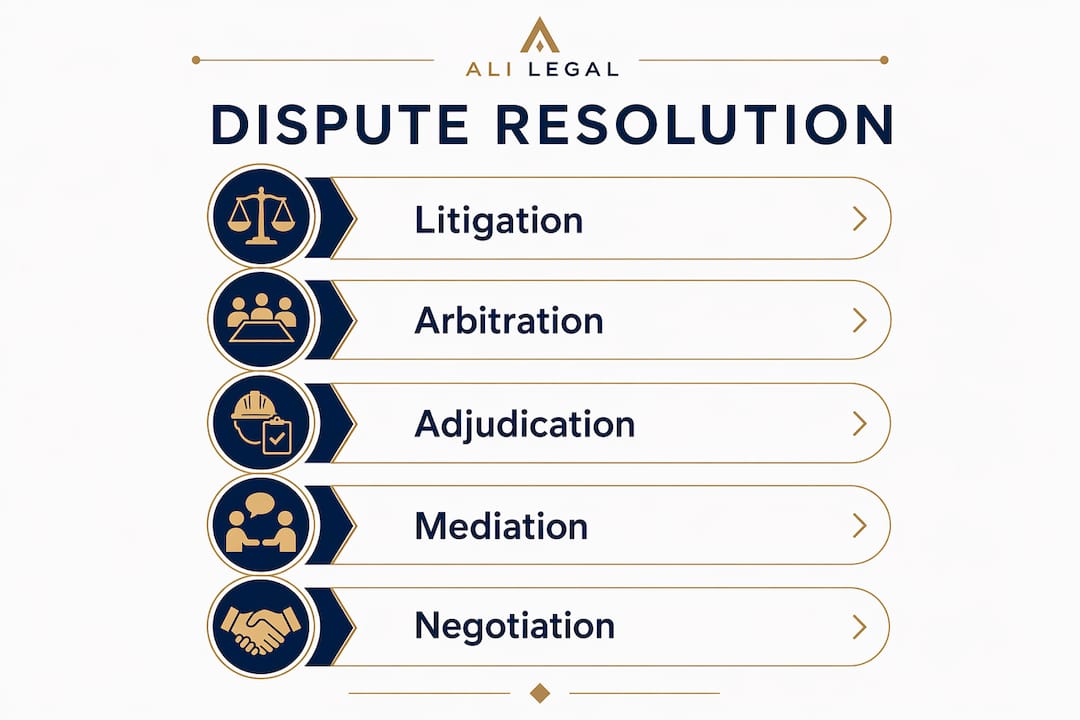
In England and Wales, these disputes are governed by the Civil Procedure Rules (CPR), with specialist tracks including the Commercial Court and dedicated arbitration procedures under the Arbitration Act 1996. Knowing which track applies to your situation shapes every decision that follows.
Likely outcomes at a glance:
The term covers any civil claim arising from business activity: a breach of contract, a tortious wrong in a commercial context, a company law dispute, or a failure of governance. What distinguishes a commercial dispute from a personal civil claim is the commercial context, not the size of the sum involved.

Under CPR Parts 58, 61 and 62, the courts treat commercial, admiralty and arbitration matters as distinct procedural categories. CPR Part 58 governs the Commercial Court list specifically, setting out how claims are issued, managed and tried. The Commercial Court Guide reflects the practical experience of Commercial Judges and gives them flexibility to adapt procedure to the needs of each case, including how they exercise discretion on costs.
The Commercial Court itself is reserved for complex, high-value or international disputes: international trade, banking and financial services, commodities, insurance, and arbitration-related matters. Smaller or less complex cases are transferred to the Circuit Commercial Courts, which sit at key commercial centres across England and Wales and follow the same specialist-judge model. Not every business dispute belongs in the Commercial Court, and judges will transfer cases that lack the necessary complexity or value.
Where a contract contains an arbitration clause, the Arbitration Act 1996 governs how the dispute is referred and conducted. Awards made under institutional rules such as those of the London Court of International Arbitration (LCIA) are enforceable internationally under the New York Convention, which is why arbitration clauses are common in cross-border contracts.
Limitation periods matter. Most contract claims must be brought within six years of the breach; some specialist claims have shorter windows. Pre-action protocols under the CPR require parties to exchange information and explore settlement before issuing proceedings. Missing either deadline can extinguish a claim or attract cost penalties.
Recognising the category of your dispute helps you identify the legal issues and the most appropriate resolution route.
The five main routes are litigation, arbitration, adjudication, mediation, and negotiation. They differ on every dimension that matters to a business: cost, speed, privacy, and what happens if the other side ignores the outcome.
| Resolution route | Binding? | Private? | Typical speed | Relative cost | Enforceability | Best suited to |
|---|---|---|---|---|---|---|
| Litigation | Yes | No (public) | Months to years | High | Court judgment enforceable in England and Wales; reciprocal enforcement abroad varies | High-value, complex, or precedent-setting disputes |
| Arbitration | Yes | Yes | Months to years | Medium–high | New York Convention: enforceable in 170+ countries | Cross-border, specialist or contractually mandated disputes |
| Adjudication | Yes (temporarily) | Yes | Weeks | Low–medium | Enforceable as a court judgment; subject to final determination later | Construction and infrastructure disputes |
| Mediation | No (unless settled) | Yes | Days to weeks | Low | Settlement agreement is contractually binding if reached | Any dispute where relationship or confidentiality matters |
| Negotiation | No (unless settled) | Yes | Days to months | Lowest | Settlement agreement is contractually binding if reached | Lower-value or early-stage disputes |
Litigation through the Commercial Court is public, comprehensive, and backed by the full coercive power of the state. Judges can award damages, grant injunctions, make freezing orders, and order specific performance. The Commercial Court Guide sets out how judges manage cases proactively and how compliance with procedural obligations affects costs. The trade-off is time and expense: disclosure, expert evidence, and multi-day hearings add up.
Arbitration is private and produces a binding award. The Arbitration Act 1996 provides the statutory framework in England and Wales, and institutional rules such as those of the LCIA govern procedure where parties have chosen them. The New York Convention means an LCIA award can be enforced in over 170 countries, which is a decisive advantage for cross-border disputes. Ali Legal Ltd’s guide to arbitration in commercial law explains the mechanics in detail.
Adjudication is fast-track and designed primarily for construction contract disputes. A decision typically arrives within a few weeks of referral. The decision is binding and enforceable immediately, though either party can seek a final determination through arbitration or litigation afterwards.
Mediation is the most widely used ADR route in the UK. The Centre for Effective Dispute Resolution (CEDR) provides institutional mediation services and practitioner training. A mediator does not decide the case; they help parties reach their own agreement, which, once signed, is a binding contract. Negotiation operates similarly but without a neutral. Both are confidential, which matters when reputational or commercial sensitivity is high.
Pros and cons at a glance:
The right route depends on six factors: the value at stake, how quickly you need a result, whether confidentiality matters, where enforcement will happen, whether technical expertise is needed, and how much the relationship is worth preserving.
Questions to ask before committing to a route:
When ADR and litigation run in parallel, the mounting cost and timetable pressure of court proceedings often push parties towards settlement. ADR alongside litigation is a recognised strategy, not a fallback. The Chambers Dispute Resolution guide notes that ADR is increasingly embedded into litigation strategy rather than treated as a separate track.
Refusing to engage in ADR carries a real cost risk. Courts and practitioners increasingly expect early consideration of mediation or other processes, and unreasonable refusal can be reflected in adverse costs orders even if you win on the merits.
Pro Tip: Early neutral evaluation, where an independent expert gives a rapid, non-binding view of the merits, can break a negotiation deadlock without the cost of a full hearing. It gives both sides a reality check and often triggers settlement within weeks.
Speed matters. The steps you take in the first days determine what evidence you can use, what remedies remain available, and whether you preserve your limitation period.
Timeline template:
Winning a judgment or award is only half the task. Enforcement is where many disputes stall.
For disputes involving cross-border document preparation or notarisation requirements, the formalities vary by jurisdiction and are worth confirming with a specialist before enforcement proceedings begin, such as outlined in Court Affidavit Requirements: What Brampton Businesses Need.
There is no honest single answer, but the ranges below reflect typical UK experience.
Time ranges by route:
Cost drivers include legal fees (the largest element), expert witness reports, disclosure and document review, hearing length, and the risk of an appeal extending the process. Costs in Commercial Court litigation can run to hundreds of thousands of pounds for complex cases; mediation can often be concluded for a fraction of that.
The practical lesson is to plan costs in stages: initial advice, pre-action steps, ADR, and only then full proceedings if necessary. Fixed-fee scoping at the outset gives you a clear picture before committing to a route.
These steps reflect the approach Ali Legal Ltd takes when a client first brings a commercial dispute to the firm.
Most businesses instinctively reach for the phone to call a solicitor only when a dispute has already escalated. By that point, documents have been deleted, positions have hardened, and the cost of resolution has multiplied. The firms that consistently achieve better outcomes are those that treat a dispute as a project management problem from day one: evidence, budget, strategy, and a clear view of what a good result actually looks like.
The conventional wisdom is that litigation is the serious option and ADR is what you try when you cannot afford court. That framing is wrong. Mediation, used early and with proper preparation, often produces outcomes that litigation cannot: a preserved trading relationship, a confidential settlement, a result in weeks rather than years. The question is not whether to use ADR but when and how to use it alongside, not instead of, a credible litigation threat.
Confidentiality is undervalued. A public judgment that sets out the details of a failed contract or a governance breakdown can do lasting reputational damage even when you win. Arbitration and mediation keep those details private. For businesses in sectors where reputation is a commercial asset, that alone can justify the choice of route.
The other thing businesses consistently underestimate is the cost of doing nothing. A disputed invoice left unresolved for six months is not just a cash-flow problem; it is a signal to the other party that you will not enforce your rights. Early, clear action, even a well-drafted letter before action, changes the commercial dynamic.
A commercial dispute becomes a solicitor’s matter the moment it involves a contract clause you are unsure about, a cross-border counterparty, a claim above a value your business cannot absorb, or a risk that the other side will dissipate assets before you can enforce. Waiting for certainty before instructing a solicitor is one of the most common and costly mistakes businesses make.
Ali Legal Ltd offers fixed-fee scoping calls so you can understand your position, your options, and a realistic cost range before committing to any route. The firm handles the full spectrum of commercial dispute work: strategy and pre-action advice, ADR facilitation, Commercial Court litigation, and international arbitration for cross-border matters. For disputes touching on property or corporate governance, Ali Legal Ltd’s corporate litigation team can advise on the full range of remedies available.

Contact Ali Legal Ltd to arrange a fixed-fee initial consultation and get a clear picture of where your dispute stands.
This article provides general information about commercial disputes in England and Wales and does not constitute legal advice. For advice on your specific situation, consult a qualified solicitor or contact Ali Legal Ltd directly.
Getting your estate in order is one of the most practical things you can do for the people you leave behind. Here is the core estate planning checklist for England and Wales, covering every step you need to take:
The notes below explain each element in depth, including costs, legal requirements, and the traps that catch people out.
Estate planning is the process of deciding in advance what happens to your money, property, and personal affairs, both during your lifetime and after your death. It covers wills, trusts, powers of attorney, and increasingly, your digital legacy. Done properly, it keeps control in your hands rather than handing it to a court or the intestacy rules.
The consequences of having no plan are more disruptive than most people expect. If you die without a will in England and Wales, the intestacy rules determine who inherits, and those rules do not recognise unmarried partners, no matter how long the relationship. Your estate could pass entirely to relatives you would not have chosen. Beyond that, without a Lasting Power of Attorney in place, a family member who needs to manage your finances during a period of incapacity must apply to the Court of Protection, a process that is slow, expensive, and public.
Estate planning also protects your autonomy. LPAs and Advance Decisions allow you to specify who makes decisions on your behalf and what medical treatment you do or do not want, preventing state or court intervention at the most vulnerable moments of your life.
The key benefits of having a formal estate plan in place include:
Understanding what each document does, and when it takes effect, is the foundation of any sound estate plan. The table below gives a quick reference.
| Document | Purpose | When it takes effect |
|---|---|---|
| Will | Directs distribution of your estate after death | On death |
| Property and Financial Affairs LPA | Authorises attorneys to manage finances | On registration (or loss of capacity, if specified) |
| Health and Welfare LPA | Authorises attorneys to make medical decisions | Only on loss of mental capacity |
| Trust | Holds and manages assets for beneficiaries | On creation or death, depending on type |
| Advance Decision | Records refusal of specific medical treatments | On loss of capacity |
| Letter of Wishes | Guides trustees and executors non-bindingly | Persuasive from creation; not legally binding |
A will is the cornerstone of any estate plan. For it to be legally valid in England and Wales, you must be at least 18 years old and of sound mind when you sign it. Two witnesses must be present at the signing, both must also sign the document, and neither can be a beneficiary or the spouse of a beneficiary. If a witness is also a beneficiary, the will remains valid but that beneficiary loses their gift.

Your will should name your executor, identify your beneficiaries, specify what each person receives, and appoint a guardian for any children under 18. If you share a property with someone who is not your spouse or civil partner, have overseas assets, run a business, or have children from a previous relationship, you should take professional legal advice rather than relying on a template.
A trust separates legal ownership of assets from the benefit of those assets. The trustees hold and manage the assets; the beneficiaries receive the benefit. Trusts are particularly useful for protecting assets for minor children, for managing inheritance for a beneficiary who cannot manage money independently, or for reducing the value of your taxable estate. A discretionary trust gives trustees flexibility over how and when to distribute assets, which can be valuable in complex family situations.
There are two types of LPA. The Property and Financial Affairs LPA covers bank accounts, investments, property, and bill payments. The Health and Welfare LPA covers decisions about medical treatment, care home placement, and daily routine. Both must be registered with the Office of the Public Guardian before they can be used. An unregistered LPA has no legal force.
The legal requirements for creating an LPA include:
An LPA can be cancelled or replaced at any time while you retain mental capacity.
An Advance Decision (sometimes called a living will) is a legally binding document that records your refusal of specific medical treatments in specified circumstances. It must be in writing and signed if it relates to life-sustaining treatment. A Letter of Wishes, by contrast, is not legally binding but gives trustees and executors guidance on matters your will cannot formally address, such as who should receive personal items of sentimental value.
Working through this checklist in order gives you a complete, legally sound estate plan. Each step builds on the last.
Step 1: Draft your will. Decide who your executors and beneficiaries are, and whether you need to appoint a guardian for children. If your affairs are straightforward, a solicitor-drafted will typically costs a few hundred pounds. For complex estates involving business interests, overseas property, or blended families, professional advice is not optional.
Step 2: Register both LPAs. Registering each LPA costs £92 and takes 8–10 weeks if the application is error-free. Register them now, while you have capacity. Waiting until a health crisis is too late.
Step 3: Build your asset inventory. Executors typically manage between 10 and 50 financial relationships on behalf of an estate, covering bank accounts, pensions, life insurance, investments, and property. Consolidating these into a single accessible document cuts administration time significantly and reduces the risk of assets being overlooked.
Step 4: List your digital assets. Email accounts, cloud storage, domain names, and cryptocurrency wallets all form part of your estate. Without explicit instructions and recovery information, they can become permanently inaccessible. Note login credentials, recovery codes, and the location of hardware wallets in a secure document separate from your will.
Step 5: Review beneficiary designations. Pensions and life insurance policies written in trust pass outside your will entirely. If your designated beneficiary is an ex-spouse, the policy will pay out to them regardless of what your will says. Check and update these regularly.
Step 6: Plan for Inheritance Tax. The current nil-rate band is £325,000, with an additional residence nil-rate band of up to £175,000 when a main home passes to direct descendants. Gifts made more than seven years before death are generally exempt. Executors must pay any Inheritance Tax due within six months of death to avoid interest charges, and must report the estate value using form IHT400 within one year.
Step 7: Gather essential reference numbers. Your executor will need your National Insurance number, NHS number, passport number, driving licence number, Council Tax reference, and tax UTR to administer your estate. Store these alongside your asset inventory.
Step 8: Document funeral wishes. Your will may not be read until after the funeral. A separate document or a note to your executor stating your preferences avoids family disagreements at an already difficult time.
Step 9: Store documents securely. Keep your original will with your solicitor, your bank, or the national probate registry in Newcastle. Store copies of LPAs and your asset inventory in a fireproof location at home or with a trusted person. Tell your executor exactly where everything is.
Step 10: Inform your executor. Your executor needs to know they have been appointed, where your documents are, and who your professional advisers are. A conversation now saves considerable confusion later.
Statistic callout: An executor typically manages between 10 and 50 financial relationships on behalf of an estate. A single consolidated asset list can cut the administration period by weeks.
LPA registration costs £92 per LPA, so registering both types costs £184 in total. Solicitor fees for drafting a will vary considerably depending on complexity, but a straightforward single will typically costs between £150 and £300; a mirror will for couples costs more. For estates with trusts, overseas assets, or business interests, legal fees will be higher, and the cost of getting it wrong is higher still.
Probate itself carries a court fee of £300 for estates over £5,000 (as of the current fee schedule). Factor in these costs when planning, and consider whether a trust structure might reduce the overall burden on your estate.
Your executor carries legal responsibility for administering your estate from the date of death until all assets are distributed. Choose someone who is organised, trustworthy, and willing to take on the role. A professional executor, such as a solicitor, can be appointed if your estate is complex or if family relationships make a neutral party preferable. You can appoint up to four executors, and it is sensible to name at least two in case one predeceases you or is unable to act.

Trustees for any ongoing trust need similar qualities, plus the ability to make financial decisions over a potentially long period. For a trust holding assets for minor children, the trustees may be in post for 18 years or more.
Standard will templates rarely account for the realities of blended families. If you have children from a previous relationship and remarry, your new spouse inherits under the intestacy rules ahead of those children. Even with a will, leaving everything to a surviving spouse risks your children from a first marriage receiving nothing if the spouse later remarries or changes their own will. A life interest trust, which gives the surviving spouse use of assets during their lifetime while preserving the capital for your children, is a common solution. It requires careful drafting and should not be attempted without professional advice.
Clear communication within the family about your intentions, while not a legal requirement, reduces the risk of disputes after your death. Contested wills are expensive and distressing for everyone involved.
Pro Tip: Store your original will with a solicitor or the national probate registry rather than at home. A will destroyed in a house fire is treated as revoked, even if you can prove its contents.
An estate plan is not a document you sign once and forget. Life changes, and your plan needs to keep pace. Estate planning documents should be reviewed every 3–5 years or after any significant life event to avoid administration delays and unintended outcomes.
The triggers that should prompt an immediate review include:
Outdated documents create real problems. A will that names a deceased executor causes delays at probate. An LPA that names an attorney who has since lost capacity or died may leave you without cover at a critical moment. An asset inventory that has not been updated for a decade will send your executor on a lengthy and frustrating search.
The consequences of neglecting reviews extend beyond inconvenience. An outdated will may result in assets passing to unintended beneficiaries, trigger avoidable Inheritance Tax liabilities, or generate disputes among family members that end up in court. Reviewing your plan costs far less than resolving those disputes.
The consistent message from solicitors who work in wills, trusts, and probate is that the combination of a professionally drafted will and registered LPAs is the minimum a responsible adult should have in place. Neither document alone is sufficient. A will without LPAs leaves you unprotected during any period of incapacity before death. LPAs without a will leave your estate distribution to the intestacy rules.
The risks of DIY wills for complex estates are well documented. Standard templates frequently miss necessary clauses for business interests, overseas properties, or complex family structures, increasing the risk of disputes and unintended tax liabilities. A will that appears valid on its face can still be challenged if the circumstances of its execution are questionable, or if it fails to make reasonable provision for dependants under the Inheritance (Provision for Family and Dependants) Act 1975.
Digital legacy is an area where even recently drafted wills often fall short. Cryptocurrency held in a hardware wallet is worthless to your estate if no one knows the wallet exists or has the recovery phrase. The UK has recognised cryptocurrency as personal property, which means it forms part of your taxable estate, but it requires explicit planning to ensure it can actually be accessed and transferred. The same applies to domain names, online businesses, and subscription services with monetary value.
The practical advice from professionals is consistent: start with the basics, get them done properly, and review them regularly. The cost of professional legal advice at the drafting stage is a fraction of the cost of rectifying a defective document after death, when the person who signed it is no longer available to clarify their intentions.
Putting together a sound estate plan means getting several moving parts right at once: a valid will, registered LPAs, a clear asset inventory, and a tax position that does not leave your family with an avoidable bill. Ali Legal Ltd works with individuals and families across the UK to get each of those elements in place correctly, with fixed fees and plain-language advice rather than hourly billing that escalates as questions arise.
Where estates involve property, the picture gets more complicated. Jointly owned property, buy-to-let portfolios, and overseas real estate all affect how your estate is structured and taxed. Ali Legal Ltd’s wills, trusts and probate service covers the full range, from straightforward single wills to trust structures for blended families and business owners. For property-specific questions, the team’s UK property law guidance addresses the ownership and transfer issues that affect estate planning directly.
To get a clear picture of what your estate plan needs and what it will cost, speak to a solicitor at Ali Legal Ltd today.
This article provides general information about estate planning in England and Wales and does not constitute legal advice. Tax rules, fees, and legal requirements change, and you should confirm the current position with a qualified solicitor or the relevant government authority for your specific circumstances.


