
Menu
Get Expert Legal Support Today
Legal counsel in a UK business sits at the intersection of law and commercial decision-making. The role covers far more than reviewing contracts: it spans regulatory compliance, risk identification, corporate governance, dispute management, and acting as a trusted adviser to senior leadership. Whether the title is General Counsel, Legal Director, or simply Legal Counsel, the core responsibilities follow a consistent pattern across sectors.
The primary legal counsel duties in a UK corporate context include:
The SRA guidance on in-house solicitors makes clear that these duties carry personal accountability: a solicitor employed in-house remains bound by the SRA’s Code of Conduct regardless of their employer’s instructions.
Legal counsel must translate complex regulatory requirements into practical guidance the business can act on. This means monitoring obligations under the Companies Act 2006, FCA rules, the UK GDPR, and sector-specific legislation, then communicating what those obligations mean for day-to-day operations. The role of legal representation here is not passive: counsel is expected to flag risks proactively, before a problem reaches the board.

Contract work sits at the heart of most in-house legal roles. Counsel drafts, reviews, and negotiates agreements ranging from supplier terms and licensing arrangements to joint ventures and service contracts. The goal is not just legal accuracy but commercial clarity. A well-drafted contract reduces the likelihood of disputes and protects the organisation’s position if one arises. For guidance on structuring these documents effectively, drafting commercial contracts requires both technical precision and an understanding of what the business actually needs from the deal.
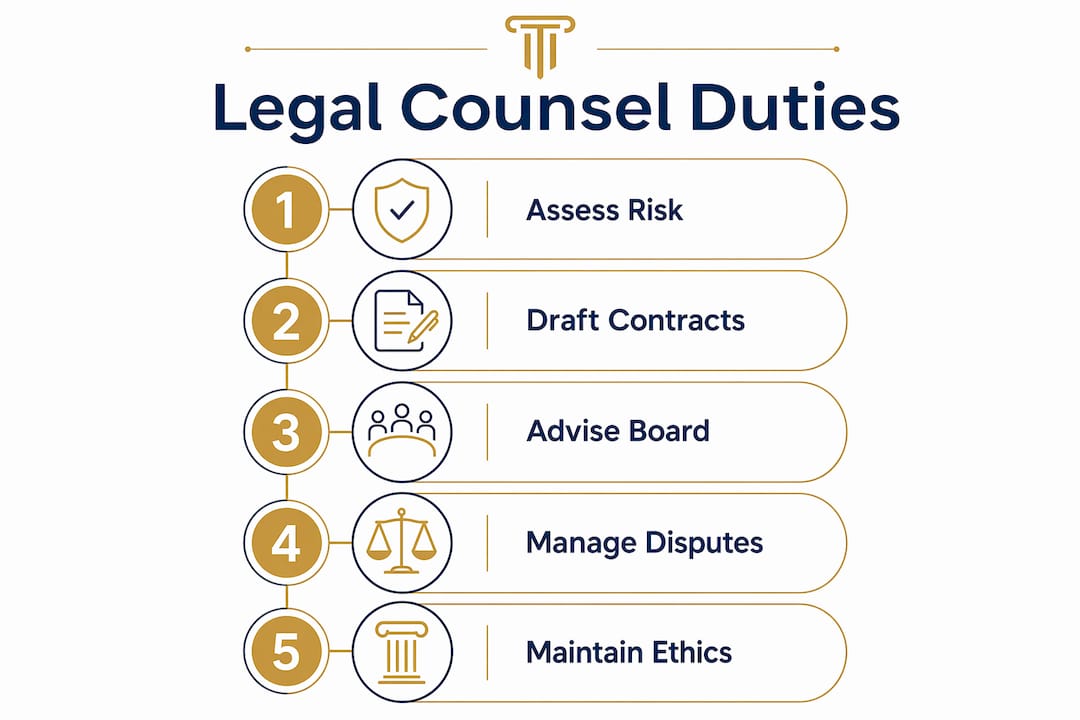
General Counsel and senior legal counsel often sit on, or report directly to, the board. Their function is to help leadership make decisions that are legally sound and ethically defensible. This goes beyond answering specific legal questions: it involves shaping governance frameworks, advising on director duties under the Companies Act, and contributing to risk appetite discussions. The Law Society’s in-house ethics framework describes this as requiring “influence and independence” in equal measure.

In-house solicitors must recognise the limits of their own expertise and instruct external counsel for complex or specialist matters. When litigation arises, the in-house team typically manages the relationship with external solicitors, coordinates disclosure, and ensures the organisation’s position is properly presented. For matters reaching the High Court or Court of Appeal, a barrister acting as counsel will usually be instructed to advocate.
Solicitors’ professional obligations to act with integrity take precedence over employer instructions where the two conflict. Counsel must maintain legal professional privilege, avoid misleading courts or regulators, and refuse to participate in dishonest or unlawful activity even under commercial pressure. These are not aspirational standards: breaching them can result in the solicitor being struck off the roll.
Pro Tip: Maintain a clear paper trail when giving formal legal advice internally. Document the basis and limitations of your advice explicitly. This protects both the organisation and your own professional standing if the matter is later scrutinised.
Not every person carrying a legal counsel job title is a qualified solicitor. Some roles, such as contracts manager or legal adviser, may be filled by individuals without formal legal qualification, provided they do not mislead anyone about their status. However, the most senior and regulated roles, including General Counsel, typically require full solicitor qualification via the Solicitors Qualifying Examination (SQE), which replaced the Legal Practice Course (LPC) as the primary route and will be the sole pathway by 2032.
To qualify as a solicitor, candidates must pass SQE1 and SQE2, complete two years of Qualifying Work Experience, and be admitted to the roll of solicitors regulated by the Solicitors Regulation Authority (SRA).
Common in-house roles range from junior legal counsel through to General Counsel, with several distinct levels in between. The table below sets out the typical progression alongside approximate salary ranges.
| Role | Typical seniority | Approximate UK salary range |
|---|---|---|
| Junior Legal Counsel / Legal Adviser | Entry level | A typical salary for entry-level legal advisers |
| Legal Counsel | Mid-level | A typical salary for mid-level legal counsel |
| Senior Legal Counsel | Senior | A typical salary for senior legal counsel |
| Deputy General Counsel / Head of Legal | Senior leadership | A typical salary for senior leadership legal roles |
| General Counsel / Legal Director | Board or near-board | A typical salary for board-level legal leadership |
London roles attract a significant premium. Salary data from Glassdoor places the average annual salary for legal counsel in London at around £91,848, with wide variation depending on sector, seniority, and the size of the employing organisation. Financial services and technology firms tend to pay at the upper end; public sector and charity roles typically sit lower.
The Legal Contracts Manager role deserves a specific mention. It focuses on high-volume contract management and is often, though not always, performed by a qualified lawyer. It sits outside the traditional General Counsel hierarchy but forms a critical part of many large organisations’ legal functions.
The tension between being an employee and being an officer of the court is the defining challenge of in-house practice. In-house solicitors balance employment as company staff with regulatory duties that cannot be overridden by a line manager or a commercial deadline. The SRA is explicit: solicitors must act with integrity and independence, and those duties safeguard the wider public interest above any individual employer’s interests.
This is not abstract. A solicitor asked to backdate a document, suppress relevant evidence, or change legal advice to achieve a preferred commercial outcome must refuse. Doing otherwise risks enforcement action and, in serious cases, removal from the roll.
The Law Society and SRA advise that the most effective in-house legal teams are those empowered as trusted advisers who can raise concerns without fear of reprisal. This means having direct access to the board, clear reporting lines, and an organisational culture that treats legal challenge as an asset rather than an obstacle. Counsel who can say “no” credibly, and explain why, adds more value than one who simply validates decisions already made.
Legal counsel must alert the organisation if asked to act in a way that creates a conflict between their professional obligations and their employment duties. The SRA’s Code of Conduct requires solicitors to refrain from acting where such a conflict exists or is likely to arise. Practically, this means counsel should not simultaneously hold a commercial role, such as directing a subsidiary or leading a sales initiative, where incentives would pull against their professional judgement.
Pro Tip: Set mutual expectations about professional obligations at the start of the employment relationship, not after a conflict has arisen. Including relevant terms in the employment contract gives both parties a clear framework and reduces the risk of misunderstanding under pressure.
Solicitors working in-house in unregulated entities may not require Professional Indemnity Insurance, but they remain personally accountable to the SRA for their conduct. The regulatory obligation travels with the individual, not the employer.
The responsibilities of legal advisors extend well beyond legal knowledge. Emotional intelligence, the ability to deliver unwelcome advice diplomatically, and the courage to maintain independence under commercial pressure are what separate effective in-house counsel from technically competent ones.
The legal counsel role does not exist in a static regulatory environment. Several developments in UK law are directly reshaping what in-house teams are expected to manage.
The Economic Crime and Corporate Transparency Act 2023 introduced new corporate criminal liability provisions, including a “failure to prevent fraud” offence for large organisations. Legal counsel now carries responsibility for advising on the adequate procedures defence and ensuring compliance frameworks are fit for purpose before the offence is triggered.
The UK GDPR and Data Protection Act 2018 continue to generate significant in-house workload, particularly around data sharing agreements, subject access requests, and breach notification obligations to the Information Commissioner’s Office. Counsel working in technology, financial services, or healthcare sectors will spend a disproportionate share of their time here.
The Companies Act 2006 remains the backbone of corporate governance obligations. Directors’ duties under sections 171 to 177, including the duty to promote the success of the company and avoid conflicts of interest, require ongoing legal input. Counsel advising boards on governance matters must keep these provisions current in their practice. For a broader view of how these duties interact with corporate structure, corporate law in the UK covers the key frameworks in detail.
The FCA’s Consumer Duty, which came into full force in July 2023 for open products and extended to closed products in July 2024, has added a new layer of compliance obligation for financial services firms. In-house counsel at regulated firms must understand how the Duty applies to their products and services and advise on whether customer outcomes meet the required standard.
Employment law is also in flux. The Employment Rights Bill, progressing through Parliament in 2025 and 2026, proposes significant changes to unfair dismissal rights, flexible working entitlements, and trade union recognition. Legal counsel with employment responsibilities will need to track these changes and update internal policies accordingly.
The conventional picture of in-house legal counsel is someone who makes life easier for the business by keeping it out of trouble. That framing undersells both the difficulty and the importance of the role.
The real pressure is not legal complexity. Most experienced solicitors can handle the technical side. The pressure is relational: delivering advice that the business does not want to hear, to people who have the authority to ignore it, without losing the credibility needed to be heard next time. That requires a combination of legal judgement, political awareness, and genuine courage that no qualification exam tests for.
There is also a structural tension that organisations rarely acknowledge openly. An in-house solicitor is simultaneously an employee subject to performance reviews, salary decisions, and organisational hierarchy, and a regulated professional whose obligations to the public interest override their employer’s instructions. Those two positions are compatible most of the time. When they are not, the solicitor’s professional obligations win. Understanding this from the outset, rather than discovering it mid-crisis, is what separates organisations that get real value from their legal teams from those that end up with expensive compliance failures.
The types of legal professionals involved in any given matter vary considerably, and knowing when to bring in external expertise, whether a specialist solicitor or a barrister acting as counsel, is itself a core skill of effective in-house practice.
The organisations that handle this best are not necessarily those with the largest legal teams. They are the ones where the General Counsel has a direct line to the board, where raising a concern is treated as professional diligence rather than obstruction, and where the legal function is involved in decisions early enough to shape them rather than just review them after the fact.
Arbitration is a private, binding process where an impartial arbitrator hears evidence from both sides and delivers a legally enforceable decision. You do not go to court. Instead, the hearing takes place in a private venue, and the arbitration process runs under the framework of the Arbitration Act 1996, which governs proceedings in England, Wales, and Northern Ireland.
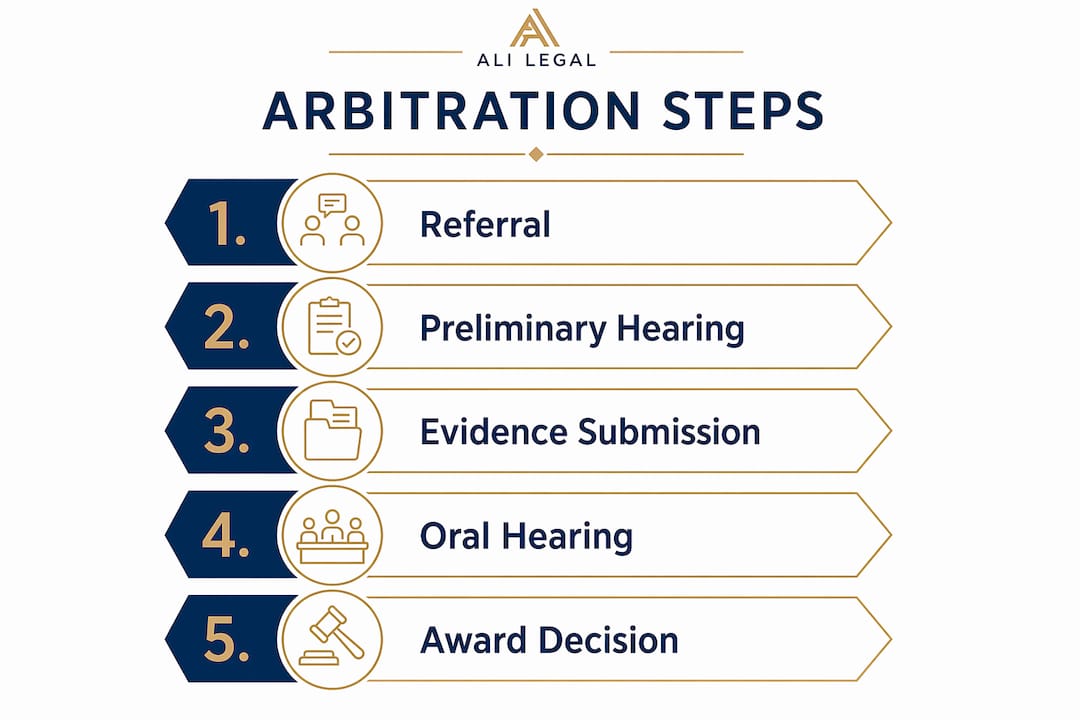
Here is what typically happens across the process:
The process begins well before anyone enters the hearing room. Once a dispute is referred to arbitration, usually under a clause in a contract or a separate agreement, the parties appoint an arbitrator. They may agree on one person jointly, or each appoint their own with those two then selecting a third.
Pre-hearing directions follow. The arbitrator issues orders covering document disclosure, the exchange of witness statements, and the hearing timetable. Under Section 34 of the Arbitration Act 1996, the tribunal decides all procedural and evidential matters unless the parties have agreed otherwise. That includes whether strict rules of evidence apply, whether oral or written submissions are used, and how documents are exchanged.
At the hearing itself, the arbitrator opens by confirming the issues in dispute. Each party then presents its case uninterrupted, calling witnesses and producing documents. Cross-examination follows, and the arbitrator may ask questions directly. Closing summaries give each side a final opportunity to draw together the key arguments before the arbitrator retires to deliberate.
Pro Tip: If your arbitration agreement references institutional rules such as those of the London Court of International Arbitration, read those rules carefully alongside the Arbitration Act 1996. Institutional rules often add procedural requirements that sit on top of the statutory framework.
One point that surprises many parties: oral hearings are not always mandatory. The arbitral tribunal may resolve disputes on written submissions alone unless the parties’ agreement or the applicable rules require a live hearing. In practice, most commercial disputes of any complexity do proceed to an oral hearing, but document-only arbitrations are common in lower-value or straightforward cases.
The arbitrator acts as a private judge, not a mediator. Unlike mediation, where a neutral helps parties negotiate, the arbitrator makes a binding decision based solely on the evidence and submissions presented. There is no negotiation, no facilitation, and no compromise unless the parties themselves reach one.
After the hearing, the arbitrator reviews all the evidence, applies the relevant law, and weighs the credibility of witnesses. The Arbitration Act 1996 requires the tribunal to act fairly and impartially, giving each party a reasonable opportunity to be heard. The written award sets out the findings of fact, the legal conclusions, and the remedy granted.
Timeline benchmarks under ACAS guidance: individual dispute hearings typically conclude with a written award within 14 days; collective dispute awards follow within 21 days; and hearings themselves last around half a day on average.
The procedural style of the hearing can vary depending on the legal backgrounds of the arbitrator and the parties’ representatives. English barristers and King’s Counsel tend to favour live cross-examination and oral advocacy more than practitioners from civil law traditions, who may prefer written submissions. That cultural difference can shape how the hearing feels in practice.
Speed is one of arbitration’s genuine advantages over litigation. ACAS guidance puts the average hearing at around half a day, with individual dispute awards issued within 14 days and collective dispute awards within 21 days. Court proceedings for equivalent disputes routinely take months or years to reach a final judgment.
Costs, however, require careful thought. Parties bear the arbitrator’s fees, any institutional administration fees, the cost of the hearing venue, and their own legal expenses. The Arbitration Act 1996 allows the tribunal to allocate costs in the award, so the losing party may be ordered to pay the winner’s reasonable costs. Whether that actually happens depends on the award and any costs agreement the parties have made.
| Cost element | Who pays initially | Recoverability |
|---|---|---|
| Arbitrator’s fees | Both parties jointly | Tribunal may order loser to pay |
| Legal representation | Each party | Tribunal may award reasonable costs |
| Hearing venue | Typically split | Included in costs order |
| Institutional fees | Both parties | Recoverable by award |
Compared with High Court litigation, arbitration tends to be faster and more predictable in cost, particularly for disputes where the parties have agreed on a sole arbitrator and a tight timetable. For guidance on how settlement claims interact with arbitration timelines, the practical benchmarks are worth reviewing before committing to a full hearing.
The Arbitration Act 1996 is the cornerstone of UK arbitration law. Its stated object is the fair resolution of disputes by an impartial tribunal without unnecessary delay or expense, and it gives parties wide freedom to agree their own procedures. The tribunal’s broad discretion under the Act covers everything from the language of proceedings to whether strict rules of evidence apply.
“The object of arbitration is to obtain the fair resolution of disputes by an impartial tribunal without unnecessary delay or expense.” — Arbitration Act 1996, Section 1
That principle of party autonomy is what makes arbitration genuinely flexible. Parties can tailor the process to their dispute rather than fitting it into a court’s fixed procedural rules. For cross-border disputes, that flexibility is particularly valuable, and the Act’s framework is recognised internationally as one of the most sophisticated arbitration statutes in the world.
Ali Legal Ltd advises and represents clients across the full range of arbitration matters, from commercial contract disputes to international arbitration proceedings. The firm’s practice spans commercial law, international disputes, and maritime law, giving clients practical support whether the arbitration is domestic or cross-border.
Pro Tip: Review any arbitration clause in your contract before a dispute arises. The clause determines the seat of arbitration, the governing rules, and the number of arbitrators. Getting legal advice at that stage is far cheaper than untangling a poorly drafted clause mid-dispute.
Each party to an arbitration has a defined role, and understanding it before the hearing prevents costly missteps. The claimant presents its case first, setting out the facts, the legal basis for the claim, and the remedy sought. The respondent then answers, challenging the claimant’s evidence and advancing any counterclaim.

Legal representatives, whether solicitors, barristers, or both, manage the procedural steps, draft submissions, prepare witnesses, and conduct cross-examination. Parties are not required to have legal representation, but in any dispute of real complexity, appearing without a lawyer carries significant risk. The arbitrator cannot assist an unrepresented party beyond basic procedural guidance.
Witnesses of fact give evidence about what happened. Expert witnesses, where the parties agree or the arbitrator directs, give opinion evidence on technical matters such as valuation, engineering standards, or industry practice. Each expert owes a duty to the tribunal, not to the party that instructed them, and the arbitrator weighs their evidence accordingly.
Yes, and it happens more often than people expect. Parties frequently reach a negotiated settlement after arbitration begins but before the hearing concludes. Once settled, the arbitrator can record the agreement as a consent award, giving it the same legal force as a contested award. That matters because a consent award is enforceable through the courts just as a judgment would be.
A party may also withdraw its claim entirely, which brings the arbitration to an end without a decision on the merits. Withdrawal does not necessarily avoid a costs order; the arbitrator retains jurisdiction to deal with costs even after the substantive claim is dropped. Settling a dispute before a final award gives both parties more control over the outcome and avoids the uncertainty of adjudication, but it requires both sides to be willing to negotiate.
The arbitration can also be stayed or adjourned if new evidence emerges or if the parties need more time to explore settlement. The arbitrator controls the timetable and can accommodate those situations within the procedural framework.
Enforcement is straightforward by design. Under the Arbitration Act 1996, an award made by the tribunal may be enforced by leave of the court in the same manner as a judgment or order of the High Court. In practice, the winning party applies to the court for permission to enforce, and the court grants it unless one of the very narrow grounds for refusal applies.
Those grounds are limited. A party can challenge an award under Section 67 (lack of substantive jurisdiction), Section 68 (serious irregularity), or Section 69 (a point of law, with permission). Courts uphold awards rigorously because finality is central to the purpose of arbitration. A losing party cannot simply relitigate the merits by bringing a court challenge.
For awards made in countries that have signed the New York Convention on the Recognition and Enforcement of Foreign Arbitral Awards, enforcement across borders follows a similarly streamlined path. England and Wales are signatories, so a UK award can be enforced in over 170 countries, and foreign awards can be enforced here on the same basis. That international reach is one reason commercial arbitration is the preferred dispute resolution method for cross-border contracts.
If you are facing an arbitration or need advice on enforcing an award, Ali Legal Ltd’s team handles international disputes and arbitration across multiple jurisdictions. Contact the firm directly for a consultation tailored to your situation.

A legal dispute is a formal disagreement between two or more parties where at least one side asserts a legal right, claim, or obligation that the other contests. The disagreement must have legal consequences — meaning it involves rights or remedies that can be enforced through the courts or another recognised process. Not every argument qualifies. A neighbour complaining about noise is a grievance; a neighbour seeking damages for a statutory nuisance is a legal dispute.
Civil justice spans a wide range, from simple debt recovery to complex multinational litigation, and most disputes are resolved outside court through negotiation or mediation. The parties involved can be individuals, businesses, public bodies, or any combination of these. What binds them together is that one party believes the other has breached a legal duty, violated a right, or caused a harm for which the law provides a remedy.
The basic elements that constitute a legal dispute are:
Legal disputes in the UK fall into several broad categories, each governed by distinct rules, courts, and remedies. Understanding which category a dispute belongs to shapes every decision that follows, from where to file a claim to what evidence you need.
Civil disputes involve private parties, whether individuals or organisations, seeking redress from one another. Civil cases aim primarily for compensation or specific performance rather than punishment, and are decided on the balance of probabilities. Personal injury claims, debt recovery, and property boundary disagreements all fall here.
Criminal disputes are initiated by the state against an individual or organisation accused of conduct harmful to society. The Crown Prosecution Service brings the case, and the standard of proof is much higher: guilt must be established beyond reasonable doubt. Outcomes include fines, community service, or imprisonment.
Commercial disputes arise between businesses over contracts, partnerships, intellectual property, or financial arrangements. These tend to involve higher sums and greater complexity, often landing in the High Court’s Business and Property Courts.
Employment disputes cover disagreements between employers and employees over dismissal, discrimination, unpaid wages, or breach of contract. The Employment Tribunal is the primary forum, with its own procedural rules and time limits.
Family disputes involve matters such as divorce, financial settlements on separation, child arrangements, and inheritance. These proceedings are heard in the Family Court and often carry a strong emphasis on mediation before any hearing.
Property disputes concern ownership, boundaries, landlord and tenant obligations, and conveyancing failures. They can be civil in nature but are sometimes governed by specialist legislation such as the Landlord and Tenant Act 1985.
Tort claims arise from civil wrongs that cause harm, including negligence, defamation, and nuisance. These sit within civil law but have their own body of case law and limitation periods.
Each category carries different triggers. Commercial disputes often stem from ambiguous contract terms or non-payment. Employment disputes frequently arise from procedural failures during redundancy or disciplinary processes. Family disputes are driven by relationship breakdown and disagreements over assets or children.

Litigation is one specific method of resolving a legal dispute, not a synonym for it. A dispute is the underlying disagreement; litigation is the formal court procedure used to adjudicate it. Many disputes are resolved long before a claim is ever issued.
The distinction matters practically. Litigation involves issuing court proceedings, usually in the High Court Business and Property Courts or County Court, and leads to a binding judgment. It is the most comprehensive mechanism available, but also the most costly and time-consuming. A dispute, by contrast, may be resolved through a letter before action, a negotiated settlement, or a mediation session, none of which require a court to be involved at all.
Key differences between a dispute and litigation:
One further complexity: the same factual situation can give rise to both civil and criminal proceedings simultaneously. A fraud case, for example, may result in criminal prosecution by the state and a separate civil claim for damages by the individuals affected. The two tracks run independently, with different courts, different standards of proof, and different outcomes.
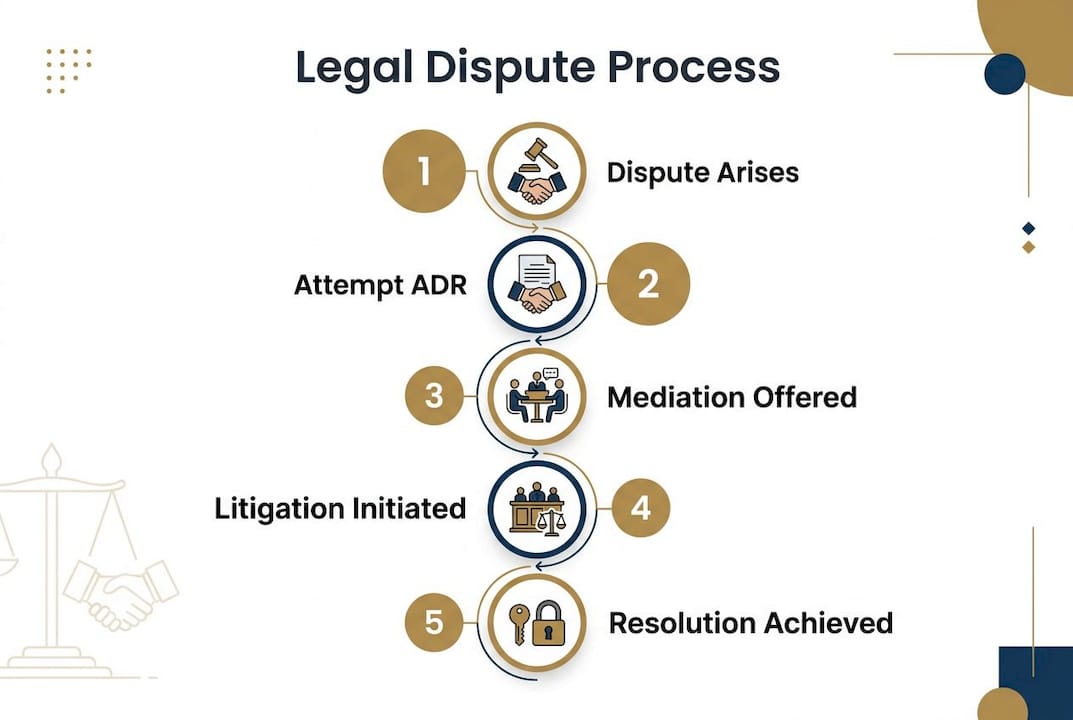
The legal dispute resolution process in the UK offers several routes, and the right choice depends on the nature of the dispute, the relationship between the parties, and the urgency of the outcome.
Litigation remains the default for disputes that cannot be settled. It produces a binding judgment and is backed by the full enforcement machinery of the courts. The downside is cost and delay; complex High Court cases can take years to resolve.
Mediation is the most widely used form of alternative dispute resolution in England and Wales. A neutral mediator helps the parties reach a voluntary agreement. The process is confidential, flexible, and can be used at any stage of a dispute, including after proceedings have been issued.
Arbitration is a binding private process where an arbitrator decides the outcome. It is particularly common in international commercial contracts and construction disputes, where privacy and enforceability across jurisdictions matter.
Expert determination suits highly technical disputes, such as rent reviews or construction valuations. An independent expert delivers a binding decision, often without the extensive legal reasoning required in arbitration or litigation. This makes it faster and cheaper for the right type of dispute.
Ombudsman schemes apply in specific sectors, including financial services, energy, and housing. Ombudsmen investigate complaints and can recommend remedies, though their decisions are generally not legally binding, leaving parties free to pursue other routes if dissatisfied.
Negotiation is the simplest form of resolution: direct exchanges between the parties or their solicitors, either openly or on a without-prejudice basis. Most disputes that settle do so through negotiation, often prompted by the prospect of litigation rather than by litigation itself.
Courts now expect parties to have attempted ADR before issuing proceedings. Failing to do so can result in adverse costs orders, even against a party that ultimately wins the case. ADR is no longer a soft recommendation; it carries real procedural weight.
Pro Tip: Before instructing solicitors to issue a claim, consider whether a without-prejudice letter proposing mediation might resolve the dispute faster and at a fraction of the cost. Courts look favourably on parties who make genuine efforts to settle.
For a detailed comparison of these options, Ali Legal’s ADR guide covers costs, enforceability, and practical considerations for UK businesses and individuals.
Concrete examples make the abstract definition of a legal dispute far easier to grasp, and they also illustrate why evidence gathering is so critical from the outset.
Contract disputes arise when one party fails to perform their obligations under an agreement, whether by non-payment, late delivery, or defective work. Evidence required includes the written contract, correspondence, invoices, delivery records, and any communications acknowledging the breach. For guidance on resolving contract disputes in the UK, the key is establishing what was agreed and what was not delivered.
Employment claims cover unfair dismissal, discrimination, and unpaid wages. Relevant evidence includes employment contracts, payslips, disciplinary records, HR correspondence, and witness statements from colleagues.
Tort claims, particularly personal injury and negligence, require medical records, accident reports, photographs of the scene, expert medical opinion, and evidence of financial loss such as lost earnings.
Property disputes often turn on title documents, Land Registry records, planning permissions, surveyor reports, and correspondence between the parties or their solicitors.
Debt recovery is among the most straightforward civil disputes. Evidence is typically a signed agreement, invoices, and proof that payment was demanded and not made.
The standard of proof differs between civil and criminal proceedings, and this shapes what evidence is sufficient. Civil disputes require proof on the balance of probabilities: it is more likely than not that the events occurred as alleged. Criminal proceedings demand proof beyond reasonable doubt, a considerably higher bar. Evidence that is compelling in a civil claim may fall short in a criminal prosecution of the same facts.
Admissibility matters too. Evidence obtained improperly, or disclosed too late in proceedings, can be excluded or attract cost penalties. Gathering appropriate evidence early, and preserving it carefully, is one of the most consequential decisions in any dispute.
The UK operates a structured court system that routes disputes according to their value and complexity. The County Court handles lower-value and less complex civil claims, including the small claims track for straightforward matters up to £10,000. The High Court’s Business and Property Courts handle high-value and complex commercial disputes, with specialist lists for areas such as technology, construction, and financial services.
Civil procedure in England and Wales is governed by the Civil Procedure Rules 1998, updated regularly to reflect evolving practice. Pre-action protocols are a central feature: they require parties to exchange information, set out their positions clearly, and attempt resolution before issuing proceedings. Failure to follow a protocol does not automatically invalidate a claim, but courts take non-compliance seriously when awarding costs.
The 2026 picture: Courts in England and Wales have strengthened their expectation that parties attempt mediation or another form of ADR before litigation. A party that refuses ADR without good reason risks a costs penalty regardless of the outcome on the merits.
The cultural shift is real. Legal professionals increasingly treat ADR as the first step rather than a last resort, reflecting both the procedural expectations of the courts and the practical reality that litigation costs can quickly outweigh the value of the dispute itself.
The impact of a legal dispute extends well beyond the legal costs. For individuals, a dispute can mean months or years of stress, uncertainty, and financial pressure, particularly where the matter involves employment, family breakdown, or a property transaction gone wrong. The time spent gathering documents, attending hearings, and instructing solicitors is time taken from work and personal life.

For businesses, the consequences are often more acute. A commercial dispute can disrupt cash flow, damage supplier or customer relationships, and consume management time that would otherwise go towards running the company. Reputational damage is harder to quantify but can outlast the dispute itself, particularly where proceedings become public record. Smaller businesses are especially vulnerable: a protracted High Court claim can cost more than the amount in dispute.
There are less obvious effects too. Employees caught up in employment tribunal proceedings, even as witnesses rather than parties, face disruption and anxiety. Directors involved in shareholder disputes may find their authority within the business undermined while the matter remains unresolved. For individuals facing criminal proceedings alongside civil claims, the dual pressure of two separate legal processes running concurrently can be overwhelming.
Early resolution, whether through negotiation or mediation, limits these wider costs. A dispute settled in weeks rather than years preserves relationships, protects cash flow, and allows both parties to move forward.
Every legal dispute is, at its core, a contest about rights and obligations. Without a clear legal basis, a grievance remains just that: a grievance. The law gives certain rights enforceable status, and it is that enforceability that transforms a disagreement into a dispute capable of resolution through legal process.
Understanding your rights before a dispute escalates changes the decisions you make. A tenant who knows their rights under the Landlord and Tenant Act 1985 is better placed to respond to an unlawful eviction than one who does not. A business that understands its contractual obligations is less likely to inadvertently breach them, and better prepared to defend a claim if one arises. Rights also carry corresponding obligations: the right to enforce a contract comes with the obligation to have performed your own side of it.
Legal obligations shape the dispute resolution process itself. Pre-action protocols impose obligations on both claimants and defendants. The duty of disclosure in civil proceedings requires parties to produce relevant documents even when those documents are unhelpful to their own case. Breaching these obligations carries costs consequences and can undermine an otherwise strong position.
Knowing your legal position early, ideally before a dispute crystallises, is the single most effective way to protect your interests. A solicitor can identify whether you have a viable claim or a credible defence, advise on the strength of your evidence, and help you avoid the procedural missteps that can turn a winnable case into an expensive lesson.
Most articles on this subject treat legal disputes as a linear process: disagreement arises, parties attempt resolution, court decides. The reality is messier, and the gap between theory and practice is where disputes become expensive.
The biggest mistake individuals and businesses make is treating a legal dispute as something to manage reactively. By the time a claim is issued, the window for the most cost-effective decisions has often already closed. Evidence has been lost, without-prejudice communications have been mishandled, and pre-action protocol obligations have been ignored. Courts notice all of this, and they factor it into costs decisions.
ADR is genuinely underused, not because parties are unaware of it, but because they underestimate how seriously courts take a refusal to engage with it. Winning on the merits but losing on costs because you declined a reasonable mediation offer is a scenario that plays out regularly in the County Court and High Court alike. The procedural shift in 2026 makes this risk more pronounced, not less.
The other underappreciated reality is that legal rights are only as useful as your ability to evidence them. A clear contractual right means little if you cannot produce the contract, the correspondence that preceded it, or the records that demonstrate the breach. Early legal advice, before a dispute becomes entrenched, is where the real value of a solicitor lies. Not in the courtroom, but in the weeks before anyone considers going there.
If you are facing a legal dispute or want to understand your position before one arises, Ali Legal Ltd offers clear, fixed-fee advice across civil litigation, commercial disputes, employment claims, and property matters. Whether you need guidance on corporate litigation or a practical overview of your rights and obligations, the team at Ali Legal Ltd provides straightforward advice without unnecessary delay.

Contact Ali Legal Ltd to speak with a solicitor about your dispute today.
TL;DR:
- The legal aid helpline in England and Wales offers initial advice and eligibility checks for civil matters. It does not provide legal aid applications or find solicitors, which are handled separately through contracted legal professionals. Accessing funded legal support often requires contacting multiple solicitors or organizations due to limited capacity and market contraction.
The number to legal aid civil advice in England and Wales is 0345 345 4345, operated by the Civil Legal Advice (CLA) helpline. This free service covers housing, debt, and family law matters for eligible callers. Calling this number does not apply for legal aid. It is the first step: an initial advice call and eligibility check, managed by the Legal Aid Agency. Understanding the difference between this helpline and the formal application process saves you time and prevents the most common mistake people make when seeking funded legal representation.
The CLA helpline number is 0345 345 4345, open Monday to Friday, 9am to 8pm, and Saturday, 9am to 12:30pm. Calls from BT landlines cost 4p per minute. Calls from mobiles may cost more, depending on your network tariff.

The helpline covers civil matters only. Housing disputes, debt problems, and family law issues all fall within its scope. Criminal law cases are outside its remit entirely, so if your matter involves a criminal charge, you need to contact a solicitor directly rather than calling this number.
Accessibility options are available for callers who cannot use a standard phone. Textphone numbers 0345 609 6677 and 0345 435 4345 serve callers with hearing or speech difficulties. A text callback service also exists: text ‘legalaid’ and your name to 80010, and the helpline will respond within one working day.
Before you call, gather the following information:
Pro Tip: If phone lines are busy, use the text callback service by texting ‘legalaid’ and your name to 80010. This reduces wait times and still connects you to a qualified adviser, usually within one working day.
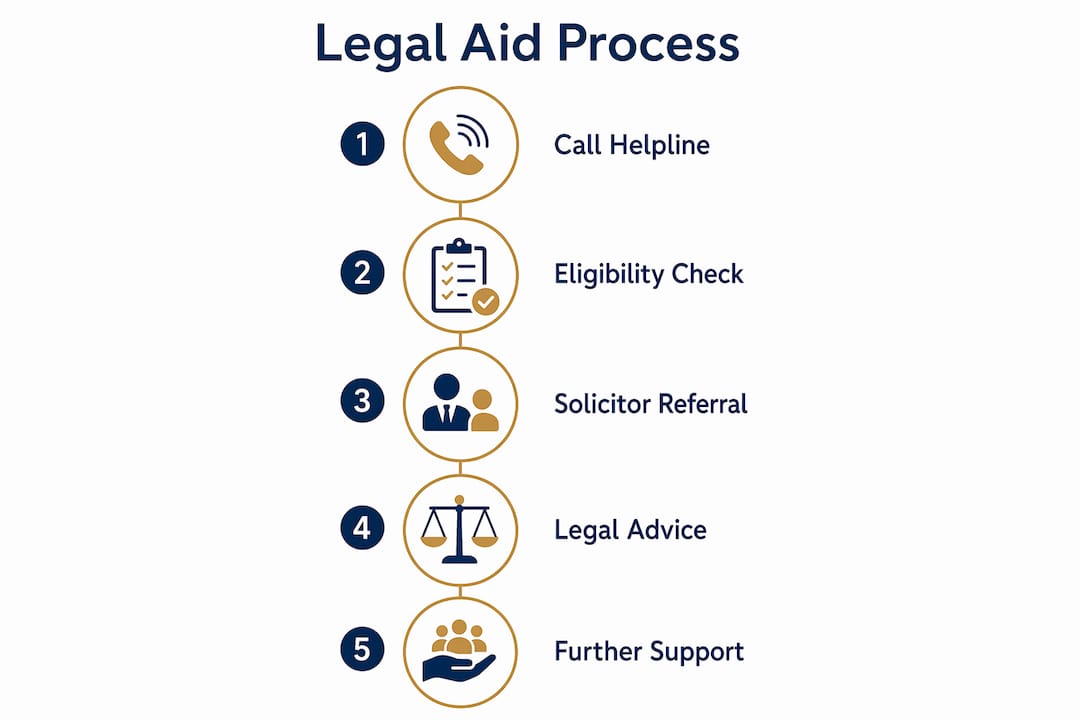
Legal aid is government funding for legal representation, administered by the Legal Aid Agency. You cannot apply for it by calling a helpline. A solicitor or mediator who holds a Legal Aid Agency contract must assess your case, confirm your eligibility, and submit the application on your behalf.
The formal process follows these steps:
Financial eligibility in 2026 follows specific thresholds. The table below summarises the current limits:
| Financial measure | 2026 threshold |
|---|---|
| Gross monthly income | Under £2,657 |
| Disposable monthly income | Under £733 |
| Capital (savings and assets) | Under £8,000 |
These 2026 eligibility thresholds apply to most civil legal aid cases. Emergency legislation introduced from june 2025 onwards waives contributions for new applications, which means qualifying applicants pay nothing upfront during this period.
Solicitors act as gatekeepers to the system. Without a practitioner who holds a Legal Aid Agency contract, you cannot access funded representation, regardless of how clearly you qualify on financial grounds. This is why the CLA helpline is a starting point, not an application route.
For urgent cases, do not wait for the helpline to refer you. Contact solicitors and Law Centres directly, as delays in urgent matters can affect the outcome of your case significantly.
Solicitor capacity for legal aid cases is restricted by contract limits, and many firms operate waiting lists. This contraction in the market means that even eligible individuals sometimes struggle to find representation quickly. Contacting multiple firms and local Law Centres is not a last resort. It is standard practice in 2026.
A common misunderstanding is that statutory legal aid and free legal advice are the same thing. They are not. Statutory legal aid is government-funded representation through the Legal Aid Agency. Free legal advice from charities and pro bono organisations is separate, with different eligibility rules and a different scope of service.
If you do not qualify for statutory legal aid, or cannot find a solicitor with capacity, the following organisations provide free or low-cost legal help:
Citizens Advice and LawWorks complement statutory legal aid but operate independently. Their scope and eligibility criteria differ, so do not assume that qualifying for one means you qualify for the other.
Pro Tip: Law Centres often have shorter waiting times than private solicitors for legal aid cases. Search for your nearest Law Centre through the Law Centres Network website before assuming no funded help is available in your area.
Legal professionals note that public confusion between statutory legal aid and charity-based advice is one of the most common barriers to people getting the right help. Knowing which system you are dealing with puts you ahead of most callers.
Getting the right outcome from the legal aid system depends on preparation and persistence. The steps below reflect what experienced advisers recommend to callers in 2026.
Pro Tip: If your case is urgent, state that clearly when you first contact a solicitor or Law Centre. Many firms prioritise urgent matters even when their general legal aid caseload is full. A personalised legal approach can make a significant difference in time-sensitive situations.
Understanding how to choose a solicitor with the right Legal Aid Agency contract is as important as knowing the eligibility rules. A solicitor who does not hold the relevant contract cannot help you, regardless of their expertise.
The CLA helpline at 0345 345 4345 is genuinely useful as a first call. Advisers are knowledgeable, and the eligibility check saves people from pursuing applications that will not succeed. What the helpline cannot do is find you a solicitor, manage your case, or substitute for proper legal representation.
The part that frustrates me is the gap between eligibility and access. You can meet every financial threshold and still spend weeks finding a solicitor with capacity. The contracting market for legal aid solicitors has shrunk considerably, and that reality does not show up in the official guidance. Callers who assume the helpline will connect them to a solicitor are often disappointed.
My recommendation is to treat the helpline as one tool among several, not the whole solution. Use it to confirm your case type qualifies and to get initial advice. Then contact solicitors and Law Centres directly and in parallel. The GOV.UK eligibility checker is worth completing before you call, because it gives you a clearer picture of where you stand and makes the helpline conversation more productive.
The people who navigate this system well are the ones who act quickly, contact multiple sources simultaneously, and do not wait for one route to fail before trying another.
— Panagiotis
Legal aid covers a defined range of civil matters, and not every legal problem falls within its scope. Property disputes, commercial agreements, and corporate matters often sit outside what the Legal Aid Agency funds, which is where professional legal representation becomes the practical route forward.
Ali Legal Ltd provides clear, fixed-fee legal advice across property law, corporate and commercial law, and international disputes. Whether you are a property owner navigating a complex transaction or a business facing a contractual dispute, Ali Legal Ltd offers direct access to qualified solicitors without the waiting lists associated with legal aid. Explore Ali Legal’s UK property law guidance or review the firm’s corporate law services to find the right support for your situation. Transparent fees and straightforward advice are the standard, not the exception.
The legal aid assistance phone number is 0345 345 4345, operated by Civil Legal Advice. It is open Monday to Friday, 9am to 8pm, and Saturday, 9am to 12:30pm.
No. Calling the CLA helpline provides initial advice and an eligibility check only. A solicitor with a Legal Aid Agency contract must submit the formal application on your behalf.
Eligibility requires gross monthly income under £2,657, disposable monthly income under £733, and capital under £8,000. Emergency legislation from june 2025 waives contributions for new applicants.
Contact multiple solicitors and local Law Centres simultaneously, as capacity is limited across the market. Organisations such as Citizens Advice and LawWorks also provide free legal advice for those who do not qualify or cannot find funded representation.
Yes. Text ‘legalaid’ and your name to 80010 for a callback, usually within one working day. Textphone users can call 0345 609 6677 or 0345 435 4345 for accessibility support.
TL;DR:
- Choosing the right dispute resolution method is crucial for saving time, money, and protecting relationships.
- Arbitration produces a legally binding and enforceable decision, while mediation and negotiation aim for voluntary agreements.
Arbitration, negotiation, and mediation are the three principal methods of alternative dispute resolution (ADR), each offering a distinct path to settling disagreements without going to court. Businesses and individuals across the UK use these processes to resolve everything from commercial contract disputes to workplace grievances. Understanding the differences between them is not merely academic. Choosing the wrong method can cost you time, money, and the working relationship you are trying to protect. This guide sets out how each process works, what the UK’s ACAS protocols require, and how to select the right approach for your specific situation.
Arbitration, negotiation, and mediation each sit within the broader framework of alternative dispute resolution, but they operate very differently. Arbitration is a private, formal process in which an independent arbitrator hears both sides and issues a legally binding decision. Mediation involves a neutral third party who facilitates dialogue but cannot impose an outcome. Negotiation requires no third party at all: the disputing parties communicate directly to reach a voluntary agreement.
The binding nature of each method is the sharpest distinction. Arbitration is legally binding and enforceable upon the parties’ consent, whereas mediation and negotiation produce agreements only if both sides choose to accept them. That difference shapes everything: the cost, the formality, the speed, and the risk each party carries into the process.
ACAS (the Advisory, Conciliation and Arbitration Service) plays a central role in UK dispute resolution. It provides arbitration schemes for trade disputes, runs a mediation service for workplace conflicts, and operates a mandatory early conciliation process that prospective Employment Tribunal claimants must complete before filing a claim. Knowing where ACAS fits helps businesses and individuals plan their dispute resolution strategy from the outset.
Arbitration is a private adjudication process. The parties agree to submit their dispute to an arbitrator, whose decision (called an award) is final and legally binding. ACAS arranges arbitration for trade disputes when requested, acting as an authorised body that organises the process under agreed terms.
Arbitration suits disputes where the parties need a definitive outcome but want to avoid the expense and publicity of litigation. Common examples include:
The process can be informal or highly structured, depending on the arbitration scheme chosen. Submission to arbitration is usually voluntary, but once both parties agree to participate, the arbitrator’s award binds them. That point matters: you cannot simply walk away from an arbitration award because you dislike the outcome.
Arbitration is generally faster than court proceedings and keeps sensitive commercial information private. The trade-off is cost. Arbitrators charge professional fees, and the process can become expensive in complex disputes. For businesses with high-value or technically complex claims, that cost is usually justified by the certainty of a binding resolution.
Pro Tip: Before agreeing to any arbitration clause in a commercial contract, check whether it specifies the arbitration rules (such as those of the London Court of International Arbitration) and the seat of arbitration. These details determine the procedural framework and the enforceability of any award.
Negotiation is the most direct form of dispute resolution. Parties communicate directly to reach a mutually acceptable agreement without any third-party decision-maker. There is no formal procedure, no arbitrator, and no mediator. The outcome depends entirely on what both sides are willing to accept.
Effective negotiation techniques make the difference between a productive conversation and a deadlock. The most reliable approaches follow a clear sequence:
Effective negotiation techniques including preparation, active listening, and collaborative option-finding improve the chances of a voluntary agreement and protect the business relationship. That relationship benefit is negotiation’s greatest advantage over arbitration. A negotiated settlement leaves both parties feeling heard, which matters enormously when they need to work together afterwards.
Negotiation has clear limits, however. If one party refuses to engage in good faith, or if the power imbalance between the parties is significant, direct bargaining rarely produces a fair result. In those situations, bringing in a neutral third party through mediation or arbitration is the more appropriate step.

Mediation is a structured, non-binding process in which a neutral mediator helps disputing parties communicate and find their own solution. The mediator does not decide who is right. ACAS mediation includes separate meetings followed by joint sessions, with the mediator facilitating dialogue throughout. The process is voluntary and, unlike ACAS early conciliation, is usually charged.
The mediator’s role is facilitative, not adjudicative. A skilled mediator encourages parties to focus on future solutions rather than relitigating past grievances. That forward focus is what makes mediation particularly effective for workplace disputes, neighbour conflicts, and commercial relationships where the parties need to continue dealing with each other after the dispute is resolved.
Many people confuse mediation with ACAS conciliation. They are distinct services. ACAS conciliation is free and mandatory before Employment Tribunal claims, focuses on resolving the legal claim itself, and typically involves the conciliator speaking to each party separately rather than bringing them face to face. Mediation, by contrast, aims to repair the underlying relationship and usually involves joint sessions.
| Feature | Mediation | ACAS conciliation |
|---|---|---|
| Cost | Usually charged | Free |
| Mandatory | No | Yes (pre-tribunal) |
| Format | Joint and separate sessions | Separate communications |
| Outcome focus | Relationship repair | Legal claim resolution |
| Binding outcome | No | No |
Pro Tip: If you are facing an Employment Tribunal claim, ACAS early conciliation is a legal requirement before you can proceed. Use that period actively. Early conciliation reduces tribunal caseload and encourages faster resolution with real cost savings for both sides.
Selecting the right dispute resolution method depends on five factors: the binding authority you need, the cost you can absorb, the speed required, the formality appropriate to the relationship, and the nature of the dispute itself.
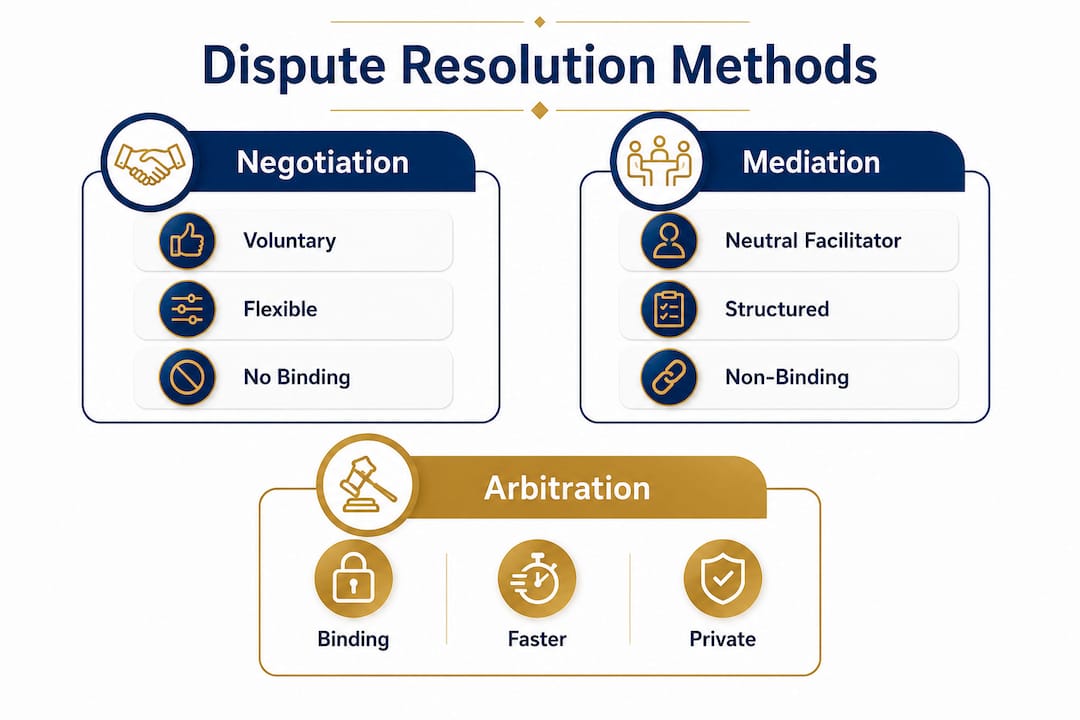
The table below summarises the key differences:
| Factor | Negotiation | Mediation | Arbitration |
|---|---|---|---|
| Binding outcome | No | No | Yes |
| Third-party involvement | None | Neutral facilitator | Arbitrator with authority |
| Cost | Lowest | Moderate | Higher |
| Speed | Fastest | Moderate | Slower than negotiation |
| Formality | Informal | Semi-formal | Formal |
| Best for | Ongoing relationships, low-stakes disputes | Workplace and commercial relationship repair | High-value, complex, or cross-border disputes |
Practical decision-making follows a straightforward logic. Start with negotiation. If direct dialogue fails or is not viable, move to mediation. If a binding outcome is required, or if the dispute is too complex or high-value for facilitated dialogue, arbitration is the appropriate choice.
ACAS early conciliation has a standard period of one calendar month, extendable by two weeks if both parties agree, giving a maximum of six weeks. That statutory timetable means employment disputes have a built-in window for resolution before tribunal proceedings begin. Businesses should treat that window as an opportunity, not a formality.
Key decision factors to weigh include:
For disputes involving resolving contract disagreements in a UK commercial context, the choice between these methods often comes down to whether the parties can still talk to each other. If they can, start with negotiation or mediation. If they cannot, arbitration provides the structure and authority to reach a definitive outcome. For international disputes, the advantages of international arbitration are particularly pronounced, given the cross-border enforceability of awards under the New York Convention.
For injury-related disputes, the dispute resolution options in serious claims follow a similar hierarchy, with negotiation and mediation preferred before formal proceedings.
After working across commercial, employment, and international disputes, the pattern I see most often is this: parties choose their dispute resolution method based on emotion rather than strategy. They go straight to arbitration because it feels decisive, or they avoid it entirely because it sounds expensive. Both instincts are usually wrong.
The most effective approach treats arbitration, negotiation, and mediation as a sequence rather than alternatives. Start with direct negotiation. If that fails, bring in a mediator. Reserve arbitration for situations where a binding outcome is genuinely necessary. That sequence is not just cheaper. It is more likely to produce a result both parties can live with.
The other mistake I see regularly is underestimating the ACAS early conciliation period. Businesses treat it as a procedural hurdle to clear on the way to tribunal. In practice, it is the most cost-effective six weeks available to resolve an employment dispute. The conciliator’s role is to facilitate a settlement, and the majority of cases that reach conciliation do settle. Ignoring that opportunity is a costly error.
Mediation, in particular, is underused in commercial disputes. The mediator’s role in legal disputes is often misunderstood as passive. A skilled mediator actively reframes positions, identifies hidden interests, and creates the conditions for agreement that neither party could reach alone. That is not a soft option. It is a sophisticated process that frequently resolves disputes that seemed intractable.
— Panagiotis
Dispute resolution works best when you have clear legal advice before you choose your method, not after the process has already gone wrong.
Ali Legal Ltd advises businesses and individuals across arbitration proceedings, negotiation strategy, and mediation preparation. Whether you are facing a commercial contract dispute, an employment claim, or a cross-border disagreement, Ali Legal Ltd provides fixed-fee, transparent guidance tailored to your situation. The team’s experience in international disputes and arbitration means you receive advice grounded in both UK procedural standards and international frameworks. If you are unsure which method suits your dispute, contact Ali Legal Ltd for a direct, no-obligation consultation.
Mediation is a non-binding process where a neutral facilitator helps parties reach their own agreement. Arbitration produces a legally binding award that the parties must comply with, regardless of whether they are satisfied with the outcome.
Yes. ACAS early conciliation is a legal requirement for prospective Employment Tribunal claimants, with a standard period of one calendar month that can be extended by two weeks if both parties agree.
Negotiation is best when the parties have an ongoing relationship they want to preserve, the dispute is relatively straightforward, and both sides are willing to engage in good faith dialogue without a third party.
A mediated settlement is not automatically binding. To become enforceable, the agreed terms must be recorded in a written contract signed by both parties, or in the case of employment disputes, in a COT3 agreement through ACAS.
Arbitration suits high-value commercial disputes, cross-border disagreements, construction and engineering claims, and situations where the parties need a definitive, enforceable outcome but want to avoid the publicity of court proceedings.
TL;DR:
- A commercial lawyer advises businesses on transactions, contracts, disputes, and compliance with laws and regulations. They draft agreements, manage risk, and support dispute resolution, often preventing costly issues through proactive guidance. Their expertise covers multiple specializations, emphasizing early legal advice to achieve better business outcomes.
A commercial lawyer is a legal professional who specialises in advising businesses on their transactions, contracts, disputes, and compliance with relevant laws and regulations. In UK practice, the term “commercial solicitor” is the recognised professional title, though “commercial lawyer” is widely used and understood. What do commercial lawyers do in practical terms? They draft and negotiate agreements, manage regulatory risk, and act as a buffer between your business and costly legal disputes. Commercial law governs business trade involving contracts, supply agreements, intellectual property, data processing, and debt recovery. That scope makes commercial solicitors one of the most consequential advisers a business can retain.
Ali Legal Ltd operates across all of these areas, offering fixed-fee commercial legal services to businesses and individuals in the UK and internationally. The Law Society sets the professional standards that all practising solicitors must meet, and commercial solicitors are no exception. Understanding what these professionals actually do helps you decide when to call one, and how to get the most from the relationship.

Commercial solicitors perform a wide range of tasks that sit at the intersection of law and business operations. Their core function is to protect your commercial interests at every stage of a transaction.
The most frequent tasks include:
Professional legal advice is highly cost-effective for high-value or high-risk contracts, particularly those involving intellectual property or sensitive data. The cost of a solicitor reviewing a contract is almost always lower than the cost of litigating a poorly drafted one.
Pro Tip: Ask your solicitor to flag the top three risk clauses in any contract before you sign. That single conversation can save months of dispute later.
The role also extends to structuring contracts so that payment terms, confidentiality obligations, and exit clauses work together as a coherent whole, not as isolated provisions bolted together.
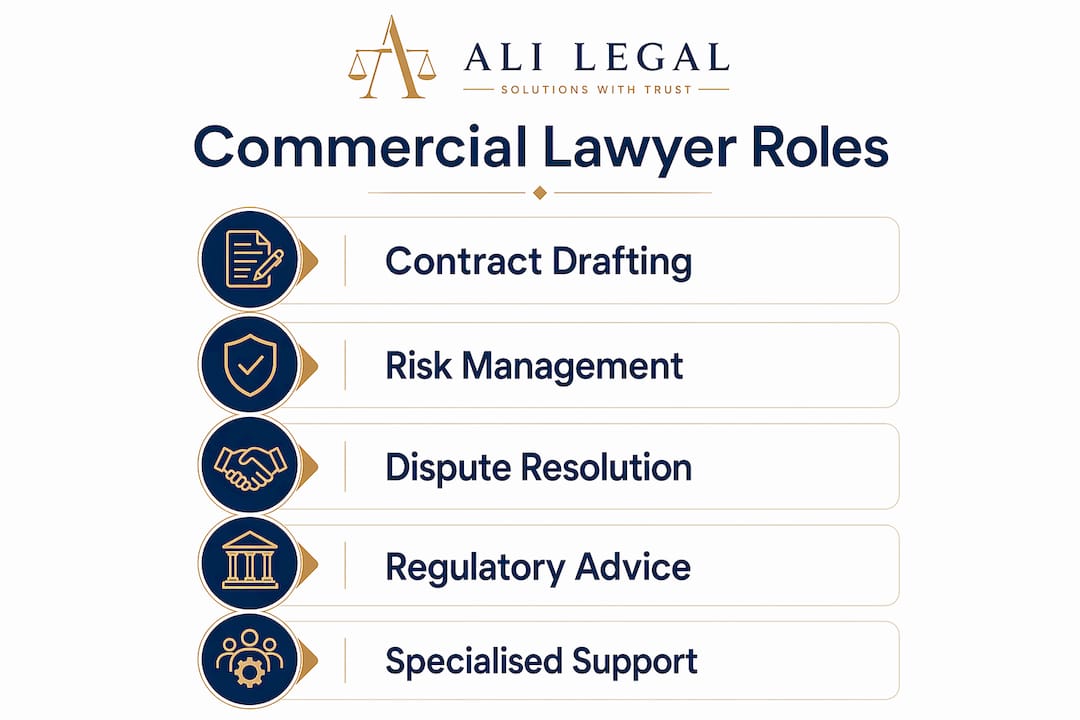
Business disputes are inevitable. What separates a manageable dispute from a damaging one is how quickly and effectively it is handled.
Commercial solicitors deal with a broad range of conflicts:
English courts actively encourage the use of Alternative Dispute Resolution (ADR) methods such as mediation and arbitration before litigation begins. That means your solicitor’s first move is rarely to issue proceedings. The advantages of ADR include lower costs, faster resolution, and the preservation of commercial relationships that litigation tends to destroy.
A commercial litigation solicitor spends significant time resolving disputes early, guiding clients through pre-action protocols, formal correspondence, evidence gathering, and negotiation. Court proceedings are the last resort, not the first response. Early intervention consistently produces better outcomes for businesses than waiting until a dispute has fully escalated.
When litigation does become necessary, commercial solicitors guide clients through every stage: issuing claims, managing disclosure, preparing witness evidence, and enforcing judgments. The role of a solicitor in this process is to manage both the legal strategy and the commercial reality, keeping disruption to your business to a minimum.
Delaying legal consultation reduces your leverage and risks locking you into unfavourable positions. Early advice allows stronger negotiation and often resolves issues without any court involvement at all.
Commercial law is not a single discipline. It draws on contract law, company law, property law, intellectual property, and regulatory compliance, often simultaneously.
The Law Society provides specialist training programmes that reflect this complexity. Courses covering commercial leases and cross-border compliance typically require a 70% pass mark for proficiency, with modules lasting 40–60 minutes focused on landlord and tenant law, business dynamics, and commercial awareness. That standard exists because the consequences of getting it wrong, such as a poorly drafted break clause or an unenforceable guarantee, fall directly on the client.
The key competencies a well-trained commercial solicitor brings to the table are:
In-house lawyers must shift from purely legal analysis to business advisory, understanding company needs and external industry factors. That shift reflects a broader truth: the best commercial solicitors think like business people who happen to have legal training, not the other way around.
Legal risk management is therefore a core skill, not an optional extra. A solicitor who cannot connect legal exposure to business consequence is only doing half the job.
“Commercial lawyer” is an umbrella term. The role varies considerably depending on the area of practice.
| Specialisation | Core focus | Typical tasks |
|---|---|---|
| Commercial contracts | Trading relationships and agreements | Drafting, reviewing, and negotiating supply, service, and licensing contracts |
| Commercial real estate | Property transactions and tenancies | Leases, licences, acquisitions, and disposals of business premises |
| Corporate law | Company structure and governance | Mergers, acquisitions, shareholder agreements, and board-level compliance |
| Intellectual property | Ownership and exploitation of ideas | Trade mark registration, licensing, and infringement claims |
| International trade | Cross-border transactions | Export contracts, jurisdiction clauses, and cross-border compliance |
| Mergers and acquisitions | Business sales and purchases | Due diligence, deal structuring, and transaction management |
Commercial real estate lawyers occupy a distinct niche. What do commercial real estate lawyers do that differs from general commercial solicitors? They focus specifically on the legal aspects of business property: negotiating leases, advising on break options, managing licences to alter, and handling the purchase or sale of commercial premises. Accuracy when drafting commercial leases mitigates future risks, particularly around break options and tenancy variations. A poorly negotiated lease can bind a business to unfavourable terms for a decade or more.
Corporate lawyers, by contrast, focus on company structure rather than trading relationships. They handle mergers and acquisitions, shareholder disputes, and the legal framework within which a business operates. The corporate law guide from Ali Legal Ltd covers the full range of duties and risks that businesses face in this area.
Pro Tip: When selecting a solicitor, match their specialisation to your specific need. A corporate lawyer is not the right choice for a commercial lease negotiation, and vice versa.
Ali Legal Ltd covers multiple specialisations under one roof, including commercial property law, corporate and M&A work, and international disputes, which means clients do not need to manage multiple firms for related matters.
The conventional view of lawyers is reactive: something goes wrong, you call a solicitor. That model is expensive and often avoidable.
My experience working across commercial transactions is that the businesses which get the best legal outcomes are those that bring their solicitor in before a contract is signed, not after a dispute has started. A commercial lawyer acts as a strategic partner by spotting risks early, defining clear deliverables, and protecting cash flow through contract terms. That is a fundamentally different proposition from fixing a problem after it has already cost you money.
The distinction matters practically. A solicitor reviewing a contract before signature can renegotiate a liability cap, tighten a payment clause, or remove an ambiguous termination provision in a single conversation. The same solicitor, brought in after a dispute has arisen from that clause, faces months of correspondence, potential litigation, and a client who has already suffered financial harm.
Engaging a commercial lawyer early in negotiations builds leverage and helps avoid unfavourable terms that may otherwise become binding. That is not a sales pitch for legal services. It is a straightforward observation about where legal advice delivers the most value. The businesses I have seen struggle most with legal costs are those that treated solicitors as a last resort rather than a first call.
— Panagiotis
Ali Legal Ltd provides commercial legal services to businesses and individuals across the UK and internationally, covering contracts, disputes, real estate, and corporate transactions.
Whether you need a commercial contract reviewed before signing, advice on a lease negotiation, or representation in a dispute, Ali Legal Ltd offers clear, fixed-fee guidance without the uncertainty of open-ended billing. The firm’s practice covers commercial property law in full, from lease drafting to property acquisitions, as well as corporate and M&A matters for businesses at every stage of growth. Clients receive direct access to experienced solicitors who combine legal precision with an understanding of commercial reality. Contact Ali Legal Ltd to discuss your specific legal needs and get advice that protects your business interests from the outset.
A commercial solicitor drafts and reviews contracts, advises on regulatory compliance, negotiates commercial terms, and manages disputes. Day-to-day work ranges from reviewing supply agreements to advising on intellectual property licensing and debt recovery.
Fees vary by firm, complexity, and location. Some firms offer fixed fees for defined tasks such as contract reviews, while others charge hourly rates. Ali Legal Ltd offers fixed-fee commercial legal services, which provides cost certainty from the outset.
Commercial real estate lawyers advise on the acquisition, disposal, and leasing of business premises. Their work includes negotiating lease terms, advising on break options, managing licences, and handling property transactions for businesses.
A business should consult a commercial solicitor before signing any significant contract, when entering a new trading relationship, or at the first sign of a dispute. Early advice consistently produces better outcomes and lower costs than waiting until a problem has escalated.
Commercial law governs trading relationships, including contracts, supply agreements, and intellectual property. Corporate law focuses on company structure, governance, shareholder rights, and transactions such as mergers and acquisitions. Many businesses need both, depending on the matter at hand.
TL;DR:
- A personal injury lawyer represents individuals injured due to negligence and helps them claim compensation. They handle all stages of the process, from assessment and evidence gathering to negotiations and court representation. Early legal advice is crucial to preserve evidence and ensure a strong claim within the three-year limit.
A personal injury lawyer is a legal professional who specialises in representing individuals injured through another person’s or organisation’s negligence, helping them claim rightful compensation. Known formally as a personal injury solicitor in England and Wales, this type of lawyer handles everything from road traffic accidents to workplace injuries and public liability claims. The Limitation Act 1980 imposes a three-year deadline on most claims, making early legal advice critical. Understanding what personal injury lawyers do gives you the clearest possible picture of your rights and your realistic options after an accident.
A personal injury solicitor manages every stage of a claim on your behalf, from the first conversation through to final settlement or court judgment. The process is more structured than most people expect, and each stage requires specific legal knowledge to execute correctly.
The initial consultation is a critical fact-finding stage where a solicitor assesses whether your claim is viable and advises on the evidence you will need. Many clients first understand their full legal position at this meeting. A solicitor will ask about the circumstances of the accident, your injuries, any witnesses, and whether you have sought medical attention. This meeting sets the direction for everything that follows.

Solicitors handle evidence gathering including medical reports, witness statements, and accident documentation. Comprehensive evidence is necessary to establish liability and assess damages accurately. Your solicitor will request GP and hospital records, commission independent medical examinations, and obtain police or accident reports where relevant. Without this foundation, a claim is unlikely to succeed.
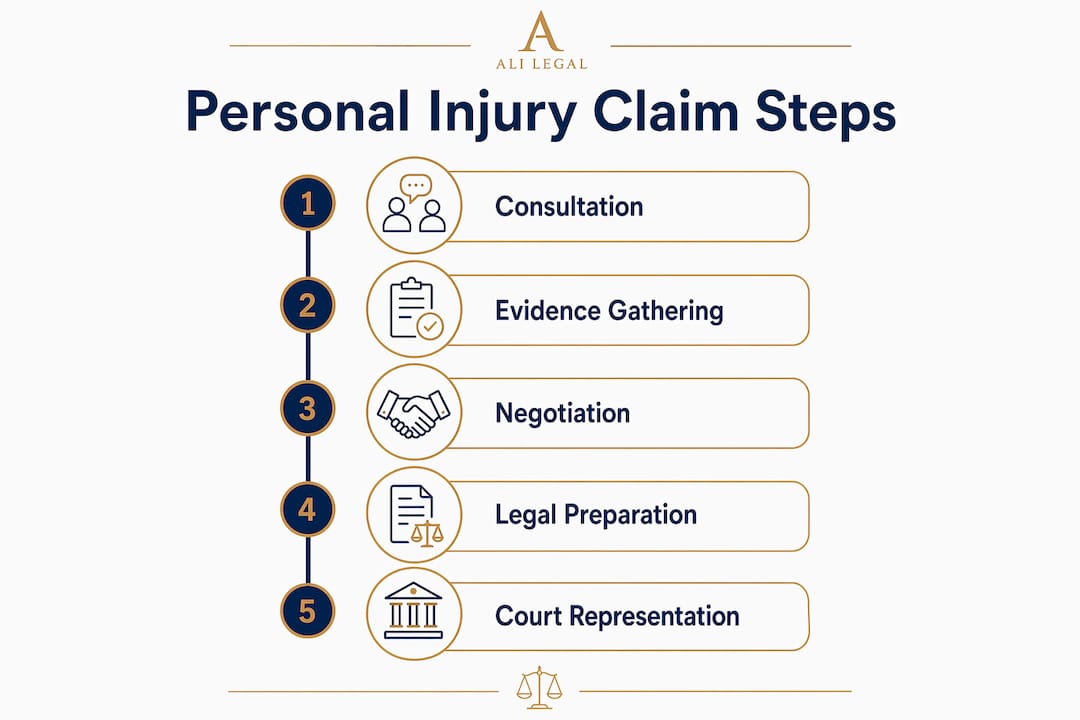
A personal injury solicitor manages communication with insurers to protect you from making premature statements that could harm your claim. Insurers commonly request statements early, and without proper guidance you may inadvertently undermine your case. Your solicitor handles all correspondence, challenges low settlement offers, and negotiates a figure that reflects your actual losses. This negotiation stage resolves the majority of claims without the need for a court hearing.
If negotiations fail, your solicitor prepares and files the formal legal documents needed to issue proceedings. They present your case to the court, cross-examine witnesses, and argue on your behalf. Court representation requires detailed procedural knowledge that goes well beyond general legal awareness.
Here is a summary of the core tasks a personal injury solicitor performs:
Pro Tip: Ask your solicitor at the first meeting whether your claim qualifies for a no win no fee arrangement. Under these agreements, solicitors bear the financial risk of the case, meaning you face no upfront costs to pursue your claim.
Specialist solicitors possess detailed knowledge of judicial guidelines and case law that is essential for accurately valuing claims for pain, suffering, and loss of amenity. An individual without that specialist knowledge is unlikely to calculate compensation correctly. Claim valuation is one of the most technically demanding parts of the process, and errors in either direction carry real consequences.
Personal injury compensation divides into two broad categories. General damages cover non-financial losses such as pain, suffering, and loss of amenity. Special damages cover financial losses including lost earnings, medical expenses, care costs, and travel to appointments. Solicitors apply the Judicial College Guidelines, a published framework used by courts across England and Wales, to calculate general damages. They then document every quantifiable financial loss to build the special damages figure.
The factors that determine claim value include:
“Specialist solicitors’ deep legal knowledge maximises claim success and appropriate compensation compared to self-representation. The gap between what an unrepresented claimant accepts and what a specialist negotiates can be substantial.”
Solicitors also commission independent expert reports, such as orthopaedic or neurological assessments, to support the valuation. These reports carry significant weight in negotiations and at trial. Settling without expert evidence often means accepting less than the claim is worth.
The three-year limitation period to bring a personal injury claim in England and Wales begins from the later of the accident date or the claimant’s date of knowledge. Missing that deadline usually means the claim cannot be heard in court. The Limitation Act 1980 governs these rules, and the courts apply them strictly.
The key steps and deadlines to understand are:
The three-year window sounds generous. In practice, it disappears quickly. CCTV footage and witness recollections can disappear fast, making immediate legal advice essential despite the stated time limits. Experts recommend seeking advice immediately after the accident, not months later. Early instruction gives your solicitor the best possible chance of building a strong case.
Statistic callout: Solicitors advise instructing them 6–9 months before the limitation deadline to allow adequate time for evidence gathering and procedural compliance.
A personal injury solicitor does more than manage paperwork. The support role extends into practical, financial, and emotional areas that significantly affect your recovery and your experience of the claims process.
The broader support a solicitor provides includes:
Pro Tip: If your injuries are serious and your claim is likely to take more than a year to resolve, ask your solicitor early about interim payment options. These can cover rehabilitation costs and lost income while the full claim progresses.
The coordination role is often underestimated. Solicitors regularly work alongside medical experts, occupational therapists, and financial advisers to build a picture of your needs. That joined-up approach produces better outcomes than legal representation alone. For further reading on your rights after an accident, the personal injury advice guide at Ali Legal Ltd covers the full claims landscape in detail.
From my experience working with clients who have been through the personal injury process, the single biggest mistake I see is people waiting too long to seek advice. They assume the three-year window is comfortable. It rarely is. Evidence degrades, witnesses move on, and medical records become harder to obtain. By the time some clients come to a solicitor, the strongest parts of their case have already weakened.
The second mistake is underestimating how much specialist knowledge affects the outcome. Claim valuation is not intuitive. The Judicial College Guidelines run to hundreds of pages. Case law shifts the acceptable range for specific injury types regularly. A client who negotiates directly with an insurer is almost always negotiating from a position of significant disadvantage. Insurers employ experienced claims handlers whose job is to settle cases for as little as possible.
I also think the legal profession has not always done enough to explain fee structures clearly. No win no fee arrangements exist precisely to remove the financial barrier to justice, yet many injured people still assume they cannot afford a solicitor. That assumption costs them. The personal injury claims process is designed to be accessible, and a specialist solicitor is the most effective way to navigate it. Choose a solicitor accredited by the Law Society’s Personal Injury Panel or a member of the Association of Personal Injury Lawyers. Accreditation signals genuine specialism, not just a general practice that occasionally handles injury claims.
— Panagiotis
Suffering an injury through no fault of your own is disorienting. Knowing where to turn for legal support should not add to that difficulty.
Ali Legal Ltd provides specialist legal advice to individuals pursuing personal injury claims, with a commitment to clear communication and transparent guidance at every stage. The team advises on claim viability, evidence requirements, and compensation valuation, working to secure the outcome you deserve. Ali Legal Ltd operates on a straightforward, client-first basis, explaining your options in plain language rather than legal jargon. Whether your claim involves a road traffic accident, a workplace injury, or a public liability matter, the team is ready to advise. Contact Ali Legal Ltd today for a consultation, and take the first step towards understanding your legal position. For related legal matters, the corporate law guide at Ali Legal Ltd offers further specialist insight.
A personal injury lawyer assesses your claim, gathers evidence, negotiates with insurers, and represents you in court if necessary. Their role covers every stage of the claims process from initial consultation to final settlement.
The three-year limitation period begins from the date of the accident or the date you gained knowledge that your injury was caused by negligence. Missing this deadline typically means the claim cannot proceed in court.
A solicitor calculates both general damages for pain and suffering and special damages for financial losses such as lost earnings and medical costs. They can also pursue interim payments to cover immediate needs before the final settlement is reached.
No win no fee agreements mean there are no upfront costs for most claimants. The solicitor bears the financial risk of the case and is paid only if the claim succeeds.
Contact a solicitor as soon as possible after the accident. Evidence such as CCTV footage and witness accounts can disappear quickly, and solicitors recommend instructing them well before the three-year deadline to allow adequate time for case preparation.
TL;DR:
- Contract dispute mediation is a voluntary, confidential process that helps parties reach settlement without court involvement. It outperforms litigation in cost, time, privacy, and preserving relationships, with a high success rate of over 89%. Preparation, genuine willingness, and skilled mediators increase the chances of successful resolution.
Contract dispute mediation is a voluntary, confidential process in which a neutral third party facilitates a mutually acceptable settlement between parties in disagreement over a contract. Unlike litigation, mediation gives both sides control over the outcome rather than leaving a decision to a judge. Commercial mediations settle at a rate exceeding 89%, making it the most reliable form of alternative dispute resolution available to businesses and individuals in England and Wales. Under the Civil Procedure Rules, parties are expected to consider mediation before or alongside litigation to reduce costs and delays. The result is a process that resolves disputes faster, at a fraction of the cost, and without the reputational exposure of a public court hearing.
Mediation follows a structured process, though it remains far more flexible than court proceedings. Understanding each stage helps parties prepare properly and participate with confidence.
Before the session, each party submits a position paper to the mediator. This document outlines the key facts, the issues in dispute, and the outcome the party seeks. The mediator reviews both papers privately, identifies areas of potential agreement, and plans the session accordingly. Parties also agree on a mediator at this stage, either through a recognised body such as CEDR (Centre for Effective Dispute Resolution) or through mutual selection.
Most commercial mediations conclude within a half or full day session, with preparation completed in the weeks prior. The session typically opens with a joint meeting where both parties and their legal advisers present their positions. The mediator then moves between private rooms in a process known as shuttle negotiation, or caucus. In these private sessions, the mediator explores each party’s real interests, tests the strength of their positions, and identifies where movement is possible.
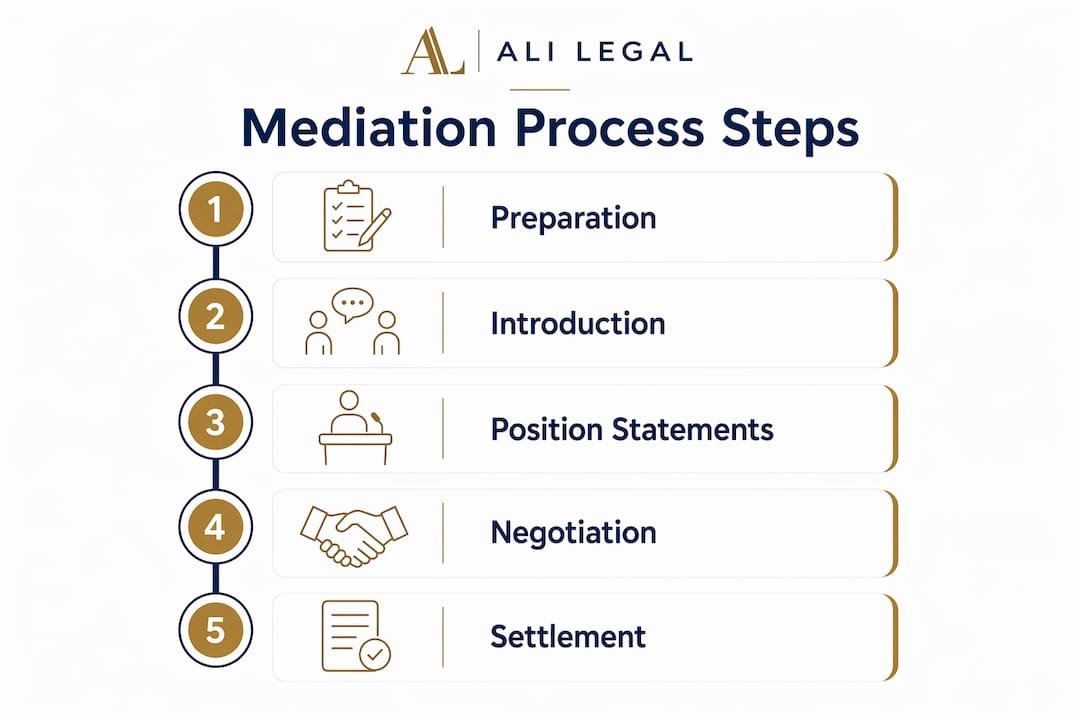
The mediator does not impose a decision. Mediation is confidential, voluntary, and facilitated by a neutral who guides negotiation without binding either party. This distinction matters enormously. Parties retain full authority over whether to settle and on what terms.
Pro Tip: Bring a draft settlement agreement to the mediation session. Having a template ready removes a common reason for delay when parties reach agreement late in the day.
Mediation outperforms litigation on every practical measure that matters to businesses and individuals: cost, time, privacy, and outcome flexibility.
Typical commercial mediation costs range between £1,500 and £3,500 per party. Court litigation for a comparable commercial dispute routinely runs into tens of thousands of pounds once you account for solicitor fees, barrister fees, court fees, and the cost of management time. The financial case for mediation is clear before any other factor is considered.

Commercial mediation resolves disputes within 2–6 weeks, compared to 18 months to 3 years for court litigation. For a business with a live contract dispute, that difference is not merely convenient. It is often the difference between preserving a commercial relationship and watching it collapse under the weight of prolonged legal conflict.
Court proceedings are public. Mediation is entirely private. Sensitive commercial terms, pricing structures, and internal communications never enter the public record. Beyond confidentiality, mediation preserves business relationships and facilitates creative commercial solutions that courts simply cannot order. A judge can award damages. A mediator can help parties agree a revised contract, a phased payment schedule, or a joint statement that protects both reputations.
| Factor | Mediation | Litigation |
|---|---|---|
| Typical cost per party | £1,500–£3,500 | Tens of thousands of pounds |
| Typical timeframe | 2–6 weeks | 18 months to 3 years |
| Outcome control | Parties decide | Judge decides |
| Confidentiality | Yes, fully private | No, public record |
| Relationship preservation | High | Low |
| Creative solutions | Yes | Limited to legal remedies |
Pro Tip: If your dispute involves an ongoing supplier or client relationship, choose mediation before issuing proceedings. A court win that destroys a valuable commercial relationship is rarely a true win.
For a broader view of dispute resolution options available to UK businesses, the range of methods extends well beyond mediation and litigation alone.
Preparation is the single greatest factor within a party’s control. Parties who arrive at mediation without clear objectives, authority to settle, or organised documentation consistently achieve worse outcomes.
Ali Legal Ltd works with clients ahead of mediation sessions to prepare position papers, identify settlement parameters, and ensure the right people attend with the right authority. That preparation work frequently determines whether a mediation ends in agreement.
Pro Tip: Draft a Heads of Terms document before the session. If full settlement drafting runs late in the day, signing Heads of Terms preserves the agreement reached and prevents overnight reconsideration from unravelling progress.
Settlement is not guaranteed, but specific factors consistently separate mediations that succeed from those that stall.
“The parties who succeed in mediation are rarely those with the strongest legal case. They are the ones who arrive prepared, stay focused on outcomes, and treat the mediator as an asset rather than an obstacle.”
Understanding the role of a solicitor in dispute resolution helps parties get the most from both their legal adviser and the mediation process itself.
My experience with commercial contract disputes has taught me one consistent lesson: parties almost always underestimate how much mediation can achieve, and they almost always overestimate how well they would fare in court.
The 89% settlement rate is not a marketing figure. It reflects a structural reality. Mediation creates conditions that litigation destroys. Both parties speak directly, often for the first time since the dispute escalated. A skilled mediator surfaces the commercial interests beneath the legal positions. And because the process is confidential, parties can make concessions without fear of those concessions being used against them in subsequent proceedings.
The most common misconception I encounter is that attending mediation signals weakness. The opposite is true. Courts in England and Wales now look unfavourably on parties who refuse reasonable mediation proposals. Refusing mediation can result in adverse cost orders even for a winning party. That is not a theoretical risk. It is a documented consequence under current Civil Procedure Rules guidance.
My advice to any business or individual facing a contract dispute is straightforward. Engage a solicitor who understands mediation, not just litigation. Prepare your position with the same rigour you would apply to a court hearing. And attend with genuine authority and genuine willingness to resolve. Those three steps account for the vast majority of successful outcomes I have seen.
— Panagiotis
Ali Legal Ltd supports businesses and individuals at every stage of the mediation process, from preparing position papers and advising on settlement parameters to attending sessions and drafting binding agreements.
The firm’s solicitors bring direct experience in commercial dispute resolution and understand how to prepare clients for mediation in a way that maximises the chance of settlement. Ali Legal Ltd offers clear, fixed-fee advice with no hidden costs, so you know exactly what you are committing to before the process begins. Whether your dispute involves a supplier contract, a service agreement, or a complex commercial arrangement, the team provides practical guidance focused on protecting your interests and reaching resolution efficiently. Contact Ali Legal Ltd to discuss your situation and take the first step towards resolving your dispute.
Contract dispute mediation is a confidential, voluntary process in which a neutral mediator helps disputing parties reach a mutually acceptable settlement without going to court. The mediator facilitates negotiation but does not impose a decision on either party.
Most commercial mediations conclude within a half or full day session, with the overall process from instruction to resolution typically taking 2–6 weeks. This compares to 18 months to 3 years for court litigation.
Typical commercial mediation costs between £1,500 and £3,500 per party, which is substantially lower than the tens of thousands of pounds that litigation routinely costs when solicitor fees, barrister fees, and court fees are combined.
If no settlement is reached on the day, the mediator summarises progress without prejudice and helps parties plan further negotiations. Parties may also sign Heads of Terms to formalise the progress made and maintain momentum towards a final agreement.
Mediation is not currently mandatory, but under the Civil Procedure Rules parties are expected to consider it before or alongside litigation. Courts can impose adverse cost orders on parties who unreasonably refuse to engage with mediation, even if those parties ultimately win their case.
TL;DR:
- Commercial arbitration is a private process where parties appoint an independent arbitrator to resolve disputes with a legally binding award. It offers confidentiality, expertise, flexibility, and enforceability in over 170 countries, making it a powerful cross-border dispute resolution tool. Proper drafting of arbitration clauses and careful preparation are essential to maximize its advantages and avoid procedural pitfalls.
Commercial arbitration is defined as a private, consensual dispute resolution process in which parties appoint an independent arbitrator or panel to deliver a legally binding decision, known as an arbitral award, outside of court. That award is enforceable in over 170 countries under the New York Convention, making it one of the most powerful tools available for resolving cross-border commercial disputes. Businesses choose arbitration because it combines the finality of a court judgment with the privacy, flexibility, and expertise that court litigation cannot offer. For anyone entering a commercial contract, understanding how arbitration works is not optional. It is a practical necessity.
Commercial arbitration is a structured alternative to court litigation. Parties agree, usually through a clause in their contract, to submit any future disputes to one or more arbitrators rather than a judge. The arbitration process typically follows these stages:
Arbitration can be administered by an institution, such as the London Court of International Arbitration or the International Chamber of Commerce, or conducted on an ad hoc basis under rules the parties agree themselves. Institutional arbitration provides administrative support and established procedural frameworks. Ad hoc arbitration offers greater flexibility but demands more from the parties in managing the process.
The seat of arbitration is a critical concept that businesses frequently overlook. The seat determines procedural law and the extent to which national courts can intervene or support the proceedings. It is a legal designation, not simply the physical location of hearings. Choosing London as the seat, for example, brings the proceedings under the Arbitration Act 1996, which sets out the legal framework for arbitration in England and Wales.

Pro Tip: Specify the seat of arbitration explicitly in your contract clause. Leaving it undefined creates a procedural vacuum that opposing parties can exploit to delay or complicate proceedings.
Commercial arbitration offers several advantages that court litigation cannot match. The most significant are confidentiality, expertise, flexibility, finality, and international enforceability.
“Arbitration uniquely allows businesses to resolve disputes confidentially, protecting commercial interests better than court litigation. For businesses where reputation and commercial sensitivity matter, this is not a secondary benefit. It is often the primary reason arbitration is chosen over litigation.”
Arbitration is not without its difficulties. Businesses that enter arbitration without preparation often encounter problems that could have been avoided at the contract drafting stage.
Pro Tip: Treat the arbitration clause as seriously as the commercial terms of the contract. A well-drafted clause prevents procedural disputes and keeps the focus on the substantive issue when a disagreement arises.
You can compare arbitration against other resolution methods in Ali Legal Ltd’s guide to types of dispute resolution for UK businesses.
The arbitration agreement is the foundation of the entire process. A poorly constructed clause does not just create inconvenience. It can render the arbitration unenforceable or trigger years of procedural wrangling before the real dispute is resolved.
The table below summarises the key decisions in drafting an arbitration clause and their practical implications.
| Decision | Institutional arbitration | Ad hoc arbitration |
|---|---|---|
| Administrative support | Provided by the institution | Parties manage themselves |
| Procedural rules | Pre-established by institution | Agreed by parties |
| Cost | Higher institutional fees | Lower fees, higher management burden |
| Suitable for | Most commercial disputes | Experienced parties, simpler disputes |
| Flexibility | Moderate | High |
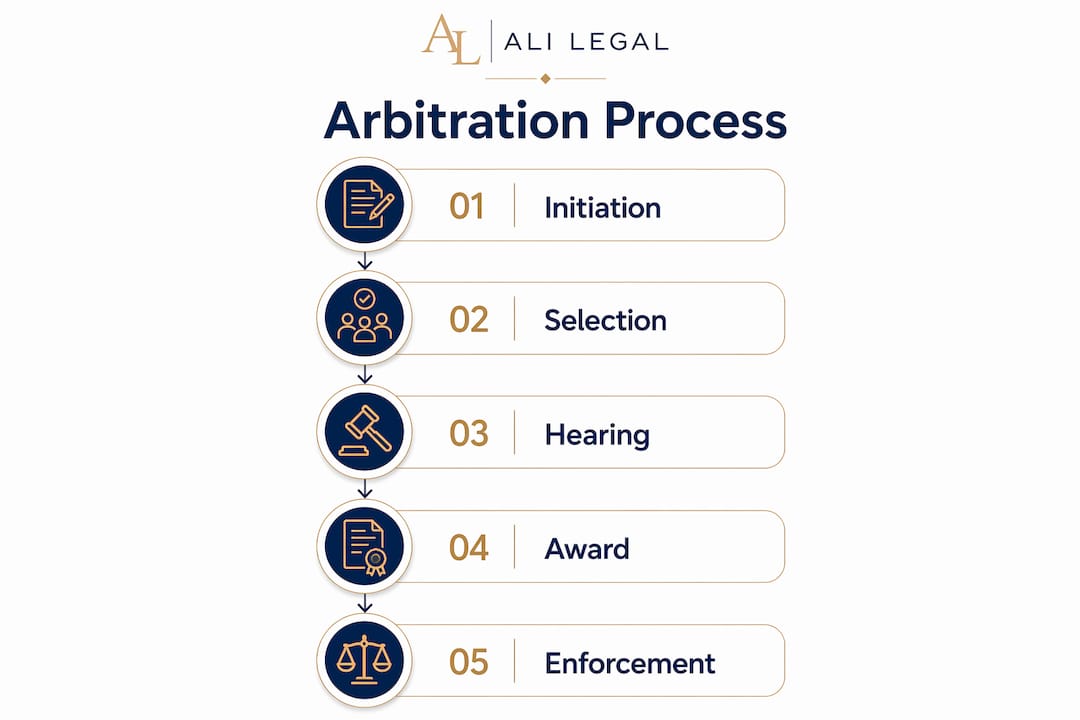
Early legal advice on clause drafting pays for itself many times over. Ali Legal Ltd’s analysis of arbitration clauses in UK contracts sets out the practical considerations in detail.
After working across a range of commercial disputes, the pattern I see most often is not a failure of arbitration itself. It is a failure of preparation. Businesses spend months negotiating the commercial terms of a contract and then accept a boilerplate arbitration clause without reading it carefully. That clause then becomes the most consequential paragraph in the entire document the moment a dispute arises.
The flexibility that makes arbitration attractive is also what makes it dangerous without proper drafting. I have seen disputes where the parties spent more time arguing about the arbitration procedure than about the underlying commercial disagreement. That outcome is entirely avoidable. Selecting arbitrators with genuine expertise in the relevant field, specifying the seat, and agreeing on procedural rules at the outset transforms arbitration from a theoretical advantage into a practical one.
Arbitration’s growing international significance is real. The New York Convention’s reach across 172 countries means that a well-obtained arbitral award travels further and faster than any court judgment. For businesses operating across borders, that enforceability is not a minor benefit. It is the difference between a recoverable debt and an unenforceable paper judgment. The businesses that use arbitration most effectively treat it as a system to be designed, not a default to be accepted.
— Panagiotis
Commercial arbitration works best when the legal groundwork is laid before a dispute arises. Ali Legal Ltd advises businesses on drafting arbitration agreements, selecting appropriate procedural rules, and navigating the arbitration process when disputes occur.
Ali Legal Ltd’s team has experience across international disputes and arbitration, including cross-border enforcement and multi-jurisdictional proceedings. Whether you are entering a new commercial contract or facing an existing dispute, Ali Legal Ltd provides clear, fixed-fee advice without unnecessary complexity. For businesses that need broader corporate and dispute resolution guidance, the corporate law guide covers the full legal framework. Contact Ali Legal Ltd to discuss your arbitration needs directly.
Commercial arbitration is a private, consensual process in which parties appoint an independent arbitrator or panel to resolve a dispute through a legally binding arbitral award, as an alternative to court litigation.
Arbitration is private, flexible, and produces awards enforceable in 172 countries under the New York Convention. Court litigation is public, procedurally rigid, and cross-border enforcement of judgments is significantly more complex.
The Arbitration Act 1996 governs commercial arbitration in England and Wales, setting out the legal framework for arbitration agreements, arbitrator appointments, and the supervisory role of the courts.
Grounds for appeal are narrow and vary by jurisdiction. Some jurisdictions allow parties to contract out of appeals entirely, which increases certainty but also the risk of accepting an erroneous decision.
A good arbitration agreement specifies the seat, governing law, number and expertise of arbitrators, procedural rules, and the scope of disputes covered. Incomplete clauses frequently lead to costly procedural disputes before the substantive issue is addressed.
TL;DR:
- A maritime lawyer advises clients on shipping, marine commerce, and navigation matters, handling disputes, contracts, and environmental compliance. They serve a diverse client base, including shipowners, insurers, and port operators, using court litigation or arbitration for dispute resolution. Their expertise combines legal, technical, and regulatory knowledge to prevent and manage maritime risks effectively.
A maritime lawyer is a legal specialist who advises and represents clients on all matters relating to shipping, marine commerce, and navigation. Known formally as an admiralty lawyer, this professional handles everything from shipping contracts and disputes to marine insurance claims, vessel finance, and environmental compliance. What does a maritime lawyer do in practice? The answer spans a wide range of legal work governed by UK statutes such as the Merchant Shipping Act, international conventions including MARPOL, and the jurisdiction of the UK Admiralty Court. Whether you are a shipowner, insurer, port operator, or cargo trader, understanding this role is the first step to protecting your interests at sea.

Maritime lawyers handle a wide range of shipping and marine commerce matters, from small cargo claims to complex, multi-jurisdictional disputes. The breadth of work divides neatly into two categories: “wet” work and “dry” work.
Wet work covers incidents at sea. These are urgent, high-stakes matters where speed and technical knowledge are critical.
Dry work covers the commercial and contractual side of maritime business. This is where most day-to-day advisory work sits.
The main legal issues maritime lawyers handle include:
Pro Tip: If you operate vessels commercially, retain a maritime lawyer before a dispute arises. Reviewing your charterparty and insurance arrangements in advance costs far less than resolving a contested claim after the fact.
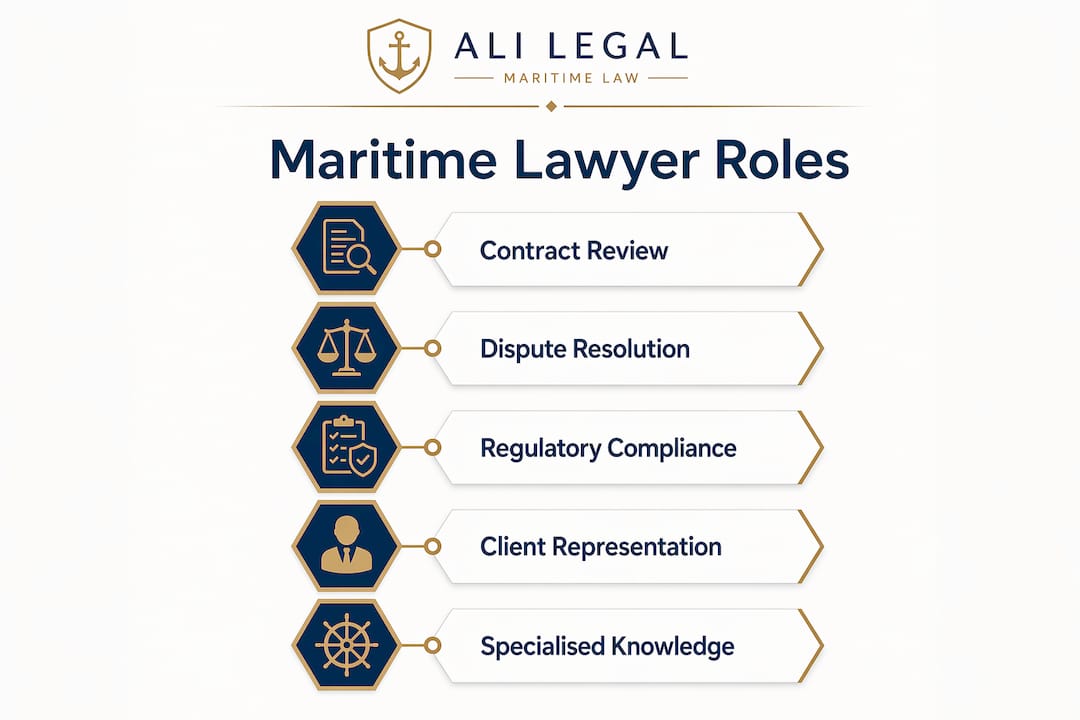
Maritime lawyers represent a broad and diverse client base. Clients range from global shipowners and Protection & Indemnity (P&I) Clubs to commercial insurers, port operators, offshore service providers, and private individuals involved in yachting or fishing. Major P&I Clubs such as Gard, Britannia, and NorthStandard manage the liabilities of thousands of vessels worldwide. That scale illustrates why specialist legal support is not optional for these organisations.
The typical client groups maritime lawyers serve include:
The diversity of this client base reflects the fact that maritime law sits at the intersection of international trade and regulation. Any business that moves goods by sea, operates vessels, or provides marine services will encounter maritime legal issues at some point.
Maritime dispute resolution is a specialist field with its own procedures, forums, and rules. Maritime lawyers use several methods depending on the nature and value of the dispute.
Pro Tip: In a maritime casualty, instruct a lawyer within hours, not days. Evidence degrades fast at sea, and early legal involvement protects your position before investigators arrive.
For clients involved in international maritime disputes, understanding the available forums and applicable rules before a dispute arises gives a significant tactical advantage.
Maritime law operates at the intersection of international trade, environmental regulation, and insurance. This creates high barriers to entry but strong opportunities for lawyers who develop genuine depth. The knowledge base required goes well beyond standard legal training.
| Knowledge area | Examples |
|---|---|
| International conventions | MARPOL, Hague Rules, Athens Convention, STCW |
| UK statutes | Merchant Shipping Act, Carriage of Goods by Sea Act |
| Standard contract forms | BIMCO clauses, GENCON, NYPE, SHELLVOY, ASBATANKVOY |
| Technical nautical knowledge | Voyage data recorders, stability calculations, cargo stowage |
| Insurance frameworks | P&I Club rules, hull and machinery policies, war risks |
| Cross-border legal issues | Conflict of laws, foreign jurisdiction clauses, flag state rules |
Maritime lawyers negotiate contracts using standard forms such as GENCON, NYPE, and BIMCO clauses. These documents govern hire terms, delay liabilities, and safe port warranties. A lawyer who does not understand what a “WIBON” or “WIPON” clause means in a charterparty cannot properly advise a shipowner on their exposure.
The technical dimension is equally demanding. Maritime lawyers must interpret nautical charts, understand vessel stability, and read engineering reports. They work alongside marine surveyors and engineers to translate technical facts into legal arguments. This cross-disciplinary skill set is what separates a competent maritime lawyer from a general commercial litigator attempting to handle a shipping case.
The Merchant Shipping Act and MARPOL Convention together regulate a wide range of maritime activities. Enforcement actions under these frameworks can lead to fines, vessel detentions, or criminal liability. Advising clients on compliance requires a lawyer who understands both the legal text and the operational realities of running a vessel.
Maritime lawyers add value well beyond resolving disputes after they arise. Their most significant contribution is often preventive. Strategic commercial advice on shipbuilding, fleet financing, and environmental compliance protects clients from costly problems before they develop.
The practical benefits maritime lawyers provide include:
The range of this work reflects a broader truth: maritime law is not just for when things go wrong. Businesses that engage maritime lawyers proactively spend less on disputes and manage their commercial risks more effectively.
Maritime law has changed more in the past decade than in the previous fifty years. Environmental regulation, driven by IMO targets and MARPOL amendments, has pushed compliance work to the front of most shipping lawyers’ practices. Clients who once thought of their maritime lawyer as someone to call after a collision now need ongoing regulatory advice as a matter of course.
What strikes me most, having worked across shipping, commercial, and international disputes, is how much the role demands genuine cross-disciplinary thinking. A maritime lawyer who cannot read a stability report or understand how a P&I Club subrogation works is operating at a disadvantage. The lawyers who serve their clients best are those who invest time in understanding the industry, not just the law.
The growth of LMAA arbitration as the preferred forum for high-value disputes has also changed the practice. Arbitration under London Maritime Arbitrators Association rules rewards lawyers who can present technical evidence clearly and manage proceedings efficiently. Courtroom advocacy skills matter, but so does the ability to work with marine surveyors and engineers to build a coherent factual case.
My view is that the most important shift is cultural. Clients now expect their maritime lawyer to be a commercial partner, not just a litigator. That means understanding the client’s business, anticipating problems, and giving clear advice quickly. Fixed-fee arrangements and transparent communication are no longer differentiators. They are the baseline expectation.
— Panagiotis
Ali Legal Ltd advises individuals and businesses on UK and international maritime law, covering the full range of legal issues that arise in shipping and marine commerce.
Whether you need a charterparty reviewed, a cargo claim pursued, or advice on MARPOL compliance, Ali Legal Ltd provides clear, direct legal support without unnecessary delay. The firm’s maritime law services cover dispute resolution, contract review, vessel finance, and regulatory compliance, serving shipowners, insurers, port operators, and businesses of all sizes. For clients facing cross-border disputes or international arbitration, Ali Legal Ltd also handles international disputes and arbitration across multiple jurisdictions. Contact Ali Legal Ltd directly to discuss your maritime legal matter with a specialist.
A maritime lawyer advises clients on shipping contracts, marine insurance, vessel finance, and regulatory compliance, and represents them in court or arbitration when disputes arise. Day-to-day work ranges from reviewing charterparties and bills of lading to managing casualty responses and instructing marine surveyors.
Wet work covers sea incidents such as collisions, salvage, and cargo loss, while dry work covers contracts, insurance, and compliance matters. Both types of work require specialist knowledge of international conventions and UK statutes.
A ship accident attorney is a maritime lawyer who specialises in personal injury and casualty claims arising from incidents at sea. They advise injured seafarers, vessel owners, and insurers on liability, compensation, and the applicable legal frameworks including the Merchant Shipping Act.
Most high-value UK maritime disputes resolve through LMAA arbitration under London Maritime Arbitrators Association rules, with arbitrators who are often experienced practitioners or master mariners. The UK Admiralty Court and Commercial Court handle cases requiring judicial intervention, including vessel arrest applications.
A maritime lawyer is advisable for any cargo claim involving significant loss, disputed liability, or complex insurance issues. They identify which convention applies, manage the claims process with insurers, and pursue or defend proceedings efficiently.
TL;DR:
- Property due diligence ensures buyers verify legal, physical, and financial aspects before purchasing a property. It includes title verification, planning compliance, structural surveys, financial assessments, lease checks, and legal sign-off. Running these checks concurrently prevents costly mistakes and protects your investment.
A property due diligence checklist is the systematic process buyers and investors use to verify the legal, physical, and financial condition of a property before committing to purchase. Known formally as pre-acquisition due diligence, it covers everything from title verification at HM Land Registry to planning compliance, structural surveys, and financial stress-testing. Skipping any part of this process exposes you to ownership defects, planning delays, and hidden liabilities that can destroy the value of your investment. The checklist is not optional. It is the difference between an informed purchase and an expensive mistake.

Title verification is the first and most critical step in any property due diligence checklist. A property can look perfect on the surface and still carry legal defects that block a future sale or reduce its value significantly.
Your solicitor obtains official copies of the title register and title plan from HM Land Registry. These documents confirm who legally owns the property and reveal any burdens attached to it. The title plan shows the registered boundary, which your solicitor then compares against the sales particulars and physical boundaries on site.
Common issues discovered at this stage include:
Legal defects in title are invisible to a structural survey. A building can be physically sound and legally defective at the same time. That is why solicitor-grade title review must happen in parallel with, not after, physical inspections.
Pro Tip: Instruct your solicitor to raise title enquiries immediately after offer acceptance. Waiting until surveys are complete wastes weeks and compresses the time available to resolve defects before exchange.
Planning compliance is the area where buyers most often underestimate the time required. Local planning authorities must determine non-major applications within 8 weeks and major applications within 13 weeks. That statutory clock means planning checks must begin the moment your offer is accepted, not once legal enquiries are underway.
Your solicitor or planning consultant should review the following:
Environmental and drainage searches identify contaminated land and hidden drainage issues that affect both usability and future compliance costs. These searches are ordered through your solicitor as part of the standard local authority and environmental search bundle. For commercial acquisitions, an Environmental Impact Assessment may be required before any development can proceed.
Never assume that because a seller has occupied a property for years, all works are lawful. Unauthorised extensions and conversions are common, and the liability transfers to you on completion.
Physical surveys reveal what legal documents cannot: the actual condition of the building and the land it sits on. A full structural survey, known as a Level 3 Building Survey under the Royal Institution of Chartered Surveyors (RICS) classification, is the most thorough option for older or non-standard properties.
The survey should cover:
For commercial property, a geotechnical investigation may be necessary where ground conditions are uncertain or where development is planned. This is a separate commission from the building survey and adds time to the process.
Pro Tip: Do not rely on the seller’s Property Information Form as your primary source of disclosure. Treat it as a starting point for enquiries, not a substitute for independent inspection.
Physical surveys and legal due diligence must run concurrently. Waiting for one to finish before starting the other adds weeks to a transaction and increases the risk of mortgage offer expiry.
Financial due diligence is a distinct discipline from legal checks. Legal due diligence confirms clean title while commercial due diligence tests whether the financial assumptions behind the purchase actually hold up.
For investment buyers, the financial assessment must cover four areas:
Mortgage offers typically expire after 3–6 months. A transaction that runs long due to planning delays or unresolved enquiries can leave you contractually bound to complete without available funding. Track your mortgage expiry date from day one and flag it to your solicitor.
Leasehold properties carry a separate layer of due diligence that freehold purchases do not require. The lease itself is a legal document that governs your rights as an owner, and its terms can significantly affect both your use of the property and its future saleability.
Key leasehold checks include:
Restrictive covenants discovered in title deeds can limit property use and resale in ways that are not immediately obvious. A covenant preventing commercial use, for example, can make a mixed-use investment unviable. Identifying these early gives you the option to negotiate indemnity insurance or withdraw before exchange.
Understanding the role of a solicitor in acquisitions is particularly important at this stage. A solicitor who specialises in property transactions will raise enquiries with the freeholder’s solicitor and review the lease replies before advising you to proceed.
Exchanging contracts with outstanding enquiries is one of the most common and costly mistakes buyers make. Once contracts are exchanged, you are legally bound to complete. Any risk that was unresolved at exchange becomes your risk entirely.
Before your solicitor advises exchange, every item on the following list must be confirmed:
Open enquiries at exchange are red flags, not minor administrative matters. They often conceal significant liabilities that sellers are reluctant to disclose. Your solicitor’s job is to close every enquiry before advising you to sign. If they cannot, you need to understand exactly what risk you are accepting and why.
The conveyancing process formally concludes at completion, but the legal risk is crystallised at exchange. That is the moment that demands the most rigorous attention.
Most buyers treat due diligence as a paperwork exercise. They wait for their solicitor to report back, sign where indicated, and assume that if nothing alarming was mentioned, nothing alarming exists. That approach is wrong, and it is expensive.
Due diligence is about understanding risk independently, not just receiving a report. The estate agent works for the seller. The seller’s solicitor works for the seller. Your solicitor works for you, but they can only advise on what they are asked to investigate. If you do not ask the right questions, the right questions do not get asked.
The most dangerous traps I see buyers fall into are: relying on seller assurances about planning history, ignoring mortgage expiry dates until it is too late, and treating open enquiries as routine delays rather than warning signs. Each of these has caused buyers to either lose their deposit or complete on a property with serious undisclosed liabilities.
My practical recommendation is to treat legal and commercial due diligence as one integrated process, not two separate workstreams. The financial viability of a deal depends on the legal position, and the legal position affects the financial assumptions. Run them together, track every deadline, and never exchange until every question has a satisfactory written answer.
— Panagiotis
Property transactions carry legal risks that surface long after completion if due diligence is incomplete. Alilegal works with buyers and investors to review legal positions, advise on title defects, and act when disputes arise from undisclosed liabilities or planning breaches.
Whether you need a solicitor to conduct a thorough legal review before exchange or representation in a civil litigation dispute arising from a property transaction, Alilegal provides fixed-fee advice with clear timelines. The team handles property-related commercial litigation for buyers, investors, and businesses who need experienced legal support when a deal goes wrong. Contact Alilegal to arrange a consultation before your next acquisition.
A property due diligence checklist covers title verification, planning and regulatory compliance, physical surveys, financial viability, leasehold checks, and pre-exchange legal sign-off. Each area addresses a distinct category of risk that can affect the value or usability of the property.
Property due diligence typically takes 8–12 weeks for a straightforward residential transaction and longer for commercial acquisitions involving planning or environmental complexity. Running legal and physical checks concurrently reduces the overall timeline.
Exchanging with open enquiries means you accept all outstanding risks as your own. Any liability that was unresolved at exchange becomes your legal and financial responsibility after completion.
A structural survey assesses physical condition; title verification confirms legal ownership and reveals burdens such as covenants and easements. A property can be physically sound but legally defective, which is why both checks are required independently.
Track your mortgage offer expiry from the day it is issued. Mortgage offers typically expire after 3–6 months, and a delayed transaction can leave you bound to complete without valid funding.
TL;DR:
- A corporate governance checklist helps boards verify compliance, reporting, and controls systematically.
- In 2026, adherence to new UK governance standards demands clear documentation, transparency, and ongoing evaluation.
A corporate governance checklist is a structured tool that helps boards and executives systematically verify that governance practices, regulatory compliance, and transparent reporting are consistently achieved. In 2026, that definition carries real weight. The 2024 UK Corporate Governance Code demands greater transparency, clearer disclosure, and enhanced board oversight across leadership, risk, audit, remuneration, and culture. For corporate executives and compliance officers, working without a structured checklist is no longer a calculated risk. It is an avoidable liability.

A well-constructed corporate governance checklist covers six core areas: board leadership, internal controls, culture, risk management, reporting, and stakeholder accountability. Each area maps directly to provisions within the UK Corporate Governance Code and the Financial Reporting Council’s updated guidance.
Board leadership and roles
Internal controls
Culture and values
Risk management
Reporting and transparency
Pro Tip: Run a pre-reporting dry run at least two months before your annual report deadline. Boards that test declarations early uncover control gaps before they become public weaknesses.
Evaluating internal controls requires more than confirming they exist. The board must assess both design effectiveness and operating effectiveness across all material control categories.
Risk experts warn that boards must not limit internal control focus to financial risks only. Coverage must include operational, compliance, and reporting areas. That is a common gap in practice, and one that Provision 29 declarations will expose from 2027 onwards for companies with calendar year-ends.
Step-by-step evaluation process
Pro Tip: Use a simple RAG (Red, Amber, Green) status against each control in your assurance map. It gives the board an immediate visual of where attention is needed without requiring them to read lengthy reports.
| Control category | Design tested | Operating tested | Assurance map included | Declaration ready |
|---|---|---|---|---|
| Financial | Yes / No | Yes / No | Yes / No | Yes / No |
| Operational | Yes / No | Yes / No | Yes / No | Yes / No |
| Reporting | Yes / No | Yes / No | Yes / No | Yes / No |
| Compliance | Yes / No | Yes / No | Yes / No | Yes / No |
This table functions as a working tracker. Each “No” is a gap that needs closing before the board signs the declaration.
The FRC’s 2026 guidance treats comply-or-explain as a transparency tool, not a loophole. Boards that treat it as a loophole produce boilerplate disclosures that damage investor confidence rather than build it.
Meaningful explanations contain five elements. Use this as a checklist for every departure from the Code:
The checklist should also verify that audit committee disclosures meet the minimum standards now required under the updated Code. That includes the committee’s approach to significant judgements, its relationship with the external auditor, and its assessment of audit quality.
Governance decisions must demonstrate their impact on strategy, culture, and risk. A disclosure that describes a policy without explaining its effect on the business falls short of what the FRC now expects. Compliance officers should review every narrative section of the annual report against these five elements before it goes to the board for approval.
Governance best practices only work when they move from the annual report into daily operations. A checklist that lives in a filing cabinet between reporting seasons is not a governance tool. It is a document.
The Three Lines of Defence model provides the operational framework. The first line, operational management, owns and manages controls day to day. The second line, risk and compliance functions, provides oversight and challenge. The third line, internal audit, provides independent assurance. Large private companies should maintain all three lines as a matter of course, not just listed companies.
Embedding governance into operations requires specific actions:
Good governance practice requires regular testing, dry runs, and continuous improvement of governance arrangements. Checklists facilitate this by turning abstract principles into concrete, verifiable actions that boards can evidence and report on with confidence.
No single checklist fits every company. The right governance framework for a FTSE 100 financial services group differs significantly from the right framework for a mid-market manufacturing business. Executives must adapt the checklist to their company’s size, sector, and regulatory environment.
| Company profile | Materiality threshold focus | Control emphasis | Reporting priority |
|---|---|---|---|
| Large listed company | Investor-grade, FRC-scrutinised | All four Provision 29 categories | Full comply-or-explain narrative |
| Mid-market private company | Board-defined, proportionate | Financial and operational primary | Section 172 stakeholder statement |
| Regulated sector (e.g. financial services) | Regulator-aligned | Compliance and reporting primary | Dual regulatory and Code reporting |
| Growth-stage business | Simplified, scalable | Financial controls primary | Basic governance disclosure |
The checklist itself should be treated as a living document. When the FRC updates guidance, the checklist updates too. When the business enters a new market or acquires a subsidiary, the control perimeter expands. Boards that review their governance framework only at year-end miss the changes that happen in between.
Sector-specific risks deserve particular attention. A company operating in financial services faces conduct risk and FCA oversight that a property business does not. The checklist must reflect those differences explicitly, not rely on generic provisions to cover them.
Pro Tip: Use the checklist as a board training tool. Walking new non-executive directors through each item in their first month gives them a structured understanding of the company’s governance posture faster than any induction document.
For a practical starting point, Alilegal’s corporate law checklist guide sets out the legal requirements that underpin each governance area.
The most common mistake I see boards make is treating the checklist as the destination rather than the starting point. They complete every item, tick every box, and then assume governance is done for another year. That is not governance. That is administration.
The boards that get this right use the checklist to surface questions, not to close them. When a control is marked “operating effectively,” the right response is to ask who tested it, what evidence exists, and whether the same person who owns the control also assessed it. Self-certification without independent challenge is a structural weakness that no checklist can fix on its own.
The shift from process-based to outcomes-based reporting is the most significant change the 2024 Code introduced. Boards must now evidence that their governance decisions actually affected strategy, culture, and risk. That requires board minutes that capture reasoning, not just resolutions. It requires culture data that goes beyond engagement survey scores. And it requires a willingness to disclose weaknesses, not just strengths.
Defining materiality is harder than it sounds. The FRC deliberately left the term broad, which means boards cannot hide behind a regulator-prescribed threshold. They must make a judgement, document it, and defend it to investors. That is uncomfortable for boards accustomed to following rules rather than setting them.
My recommendation is to run a full dry run of your Provision 29 declaration at least six months before your reporting deadline. Use it to find the gaps, not to confirm everything is fine. The boards that will struggle in 2027 are the ones that assume their existing control frameworks are sufficient without testing that assumption.
— Panagiotis
Corporate governance compliance is not purely a board exercise. It carries legal obligations that require specialist advice, particularly when it comes to documenting control frameworks, preparing Provision 29 declarations, and ensuring your comply-or-explain reporting meets FRC standards.
Alilegal’s corporate and commercial law team works with executives and compliance officers to review governance documentation, identify legal risk exposure, and provide clear advice on regulatory obligations. Whether you need support structuring your internal controls framework or guidance on commercial dispute resolution when governance failures lead to disputes, Alilegal provides fixed-fee, straightforward advice without the delays. Contact Alilegal to arrange a consultation and get the legal clarity your board needs before the next reporting cycle.
A corporate governance checklist is a structured tool that boards and compliance officers use to verify that governance practices, internal controls, and regulatory reporting obligations are consistently met. It covers areas including board leadership, risk management, culture monitoring, and comply-or-explain disclosures.
Provision 29 requires boards to make an annual declaration on the effectiveness of their material internal controls across four categories: financial, operational, reporting, and compliance. Companies with calendar year-ends will publish their first declarations in 2027.
Comply-or-explain allows boards to depart from Code provisions if they provide a clear explanation covering context, rationale, risks, mitigating actions, and future timelines. The FRC’s updated 2026 guidance discourages boilerplate responses and expects explanations that demonstrate genuine governance reasoning.
The checklist should be reviewed at least annually, and whenever a significant regulatory change, acquisition, or structural change occurs. Treating it as a living governance document rather than a static annual exercise is the standard that the 2024 Code expects.
The Code formally applies to UK premium-listed companies, but large private companies are expected to follow its principles in spirit. The Three Lines of Defence model and Section 172 stakeholder duties apply regardless of listing status.


