
Menu
Get Expert Legal Support Today
TL;DR:
- Residency status affects legal rights, obligations, and benefits in a country, but definitions vary across domains. It is possible to be a resident in multiple jurisdictions simultaneously, creating complex tax, legal, and compliance considerations. Proper legal analysis and proactive structuring are essential to avoid costly mistakes and leverage residency benefits effectively.
Residency status is one of the most misunderstood concepts in law and finance, and that misunderstanding carries real consequences. Many people assume their citizenship or visa determines how they are treated in every legal context, but that is rarely the whole picture. Your residency status for tax purposes may be completely different from your status for immigration or banking purposes, sometimes within the very same country. Whether you are an individual relocating abroad, a business expanding across borders, or someone managing assets in multiple jurisdictions, knowing precisely where you stand is not optional. It is foundational.
| Point | Details |
|---|---|
| Residency differs by context | Tax, legal, and immigration authorities can all treat you as a resident under different rules. |
| Multiple residencies possible | It’s common and sometimes required to have more than one residency at the same time. |
| Check legal criteria | Always confirm residency rules before moving, investing, or filing taxes to avoid costly errors. |
| Strategic planning pays off | Planning your residency properly can protect assets, reduce risk, and maximise compliance. |
At its core, residency status is a legal concept that determines your rights, obligations, and the benefits you are entitled to in a given country. But the term does not mean the same thing across every legal domain. Tax authorities define it one way, immigration agencies define it another, and civil courts may apply a third interpretation entirely.
Residency status usually refers to whether an individual or business is treated as a resident under a country’s rules, particularly for tax and jurisdictional purposes, and this can differ substantially from immigration or visa status. That distinction is not a technicality. It is the difference between owing taxes in one country or three, between qualifying for banking services or being rejected, and between operating a business legally or unknowingly triggering foreign compliance obligations.
The OECD makes this especially clear in its guidance on tax residency. Tax residency is determined under each jurisdiction’s domestic tax laws, and a person may be a tax resident in more than one jurisdiction simultaneously. Holding citizenship or having the right to reside in a country does not automatically make you a tax resident there.
Here is why that matters in practice:
It is also worth understanding the difference between residency and citizenship law. Citizenship is typically permanent and tied to nationality; residency is transactional and contingent on specific legal tests that can change year to year.
No two countries determine residency using exactly the same framework, though several common tests apply across major jurisdictions. Understanding these frameworks is essential if you operate, live, or hold assets in more than one country.
For individuals, US tax residency is established if a person meets either the Green Card Test or the Substantial Presence Test for the calendar year. The Green Card Test is straightforward: if you hold a lawful permanent resident card, you are a US tax resident regardless of where you actually live. The Substantial Presence Test is more nuanced.
Under the Substantial Presence Test, you are treated as a US resident if you meet a day-count formula of at least 183 days during a three-year period, calculated using all current-year days, one-third of the prior year’s days, and one-sixth of the year before that. Exceptions apply for exempt individuals (such as students and diplomats), but most long-term visitors are caught by this rule without realising it.

For companies, the picture is equally complex. Canadian corporate residency can be “deemed” (for example, if the company was incorporated in Canada after April 1965) or determined through the common-law test of central management and control. Crucially, treaty rules can override these deeming provisions entirely, which is why corporate residency demands specific legal analysis rather than assumptions.
The table below summarises how several major jurisdictions approach residency determination:
| Country | Individual test | Corporate test | Treaty override? |
|---|---|---|---|
| United States | Green Card Test or Substantial Presence Test | Place of incorporation or management | Yes |
| United Kingdom | Statutory Residence Test (days and ties) | Central management and control | Yes |
| Canada | Common-law ties or deemed | Incorporation or central management | Yes |
| Australia | Domicile or 183-day rule | Place of incorporation or central management | Yes |
| Germany | Habitual abode or domicile | Registered seat or management | Yes |
To assess your own residency status, walk through this process:
Pro Tip: Never assume a tax treaty automatically resolves your dual residency. Treaty tie-breakers are assessed in a specific order and require factual analysis. Claiming the wrong status on a self-certification form can constitute a false declaration, which carries serious legal penalties in many jurisdictions. The UK extradition law framework is one example of how far cross-border legal consequences can reach when individuals misrepresent their status.
Many people are surprised to learn that having residency status in more than one country at the same time is not just possible; it is relatively common. This happens for individuals who relocate mid-year, for businesses that operate across borders, and for anyone who triggers residency tests in multiple countries simultaneously.
The US IRS explicitly acknowledges this: you can be both a nonresident and a resident for US tax purposes during the same calendar year, typically in the year you arrive or depart. This is called dual-status filing, and it triggers specific reporting requirements that differ from standard resident or nonresident returns.
For global banking and CRS-style reporting, financial institutions are required to collect self-certifications that disclose all tax residences, not just one. This confirms that multiple tax residencies are a real and documented scenario, not a legal anomaly.
“A person may be a tax resident in more than one jurisdiction simultaneously, and financial institutions under the Common Reporting Standard must collect and report all relevant tax residences.” — OECD CRS guidance
The following table illustrates how dual residency can arise in practice:
| Scenario | Tax consequence | Immigration consequence |
|---|---|---|
| Moving to the US mid-year | Dual-status tax return required | Visa or Green Card status separate |
| UK national working in Germany | May be tax resident in both | Separate immigration rules apply |
| Canadian company with UK board | Possible dual corporate residency | Corporate registration rules differ |
| Retired expat splitting time | Day-count triggers multiple residencies | Immigration permissions may be limited |
The risks of misunderstanding your status in these situations are significant:
Matters related to international law for businesses and conflict of laws become directly relevant here, particularly when businesses are structured across multiple legal systems and assume their incorporation jurisdiction is their only residency.
Knowing the theory is one thing. Applying it to your specific circumstances is another. Here is a structured approach to establishing your residency status across the most common frameworks.
Step-by-step checklist:
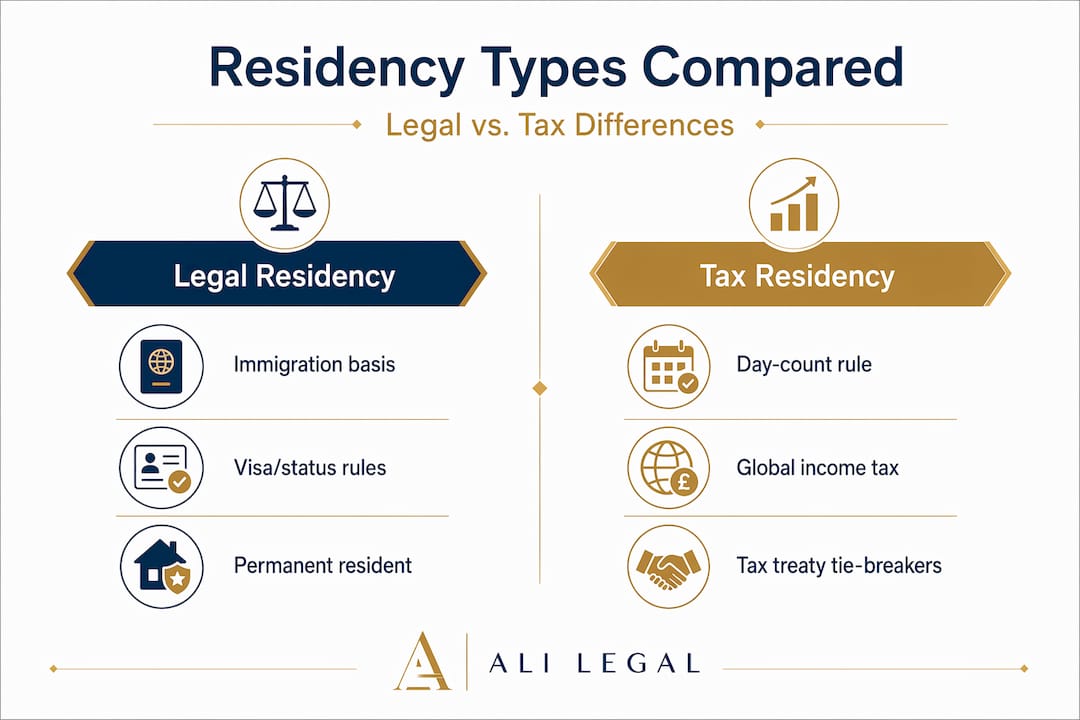
Tax residency determinations often hinge on days and factual ties, but countries can also use treaty tie-breakers or domestic deeming rules. Residency status for tax treaties and for immigration programmes are not automatically the same, which is why they must always be assessed separately.
For immigration-specific contexts such as US naturalisation, the USCIS definition of continuous residence is tied to maintaining a permanent dwelling place as a lawful permanent resident, with specific thresholds for absences that can interrupt continuity. This is entirely separate from the Substantial Presence Test used by the IRS.
State-level rules add another layer of complexity. In New York State, for example, the resident concept is linked to domicile rather than physical presence alone. New York differentiates between domicile and statutory residence, and residents are taxed on all income regardless of where it is earned. This means a person could be a nonresident for federal purposes but a resident for state purposes.
Pro Tip: Businesses expanding cross-border frequently underestimate how quickly they can become tax-resident in a new jurisdiction. A single director signing contracts or making decisions from a foreign country can trigger corporate residency under the central management and control test. Structure your board activities carefully with legal guidance, as explored further in UK trust law and asset protection planning.
Documents typically required to prove residency status to banks, tax authorities, and immigration agencies include:
Most articles on residency status treat it as a purely administrative matter. Check the boxes, count the days, file the right form. But in our experience working with individuals and businesses across multiple jurisdictions, the most serious problems arise not from ignorance of the basic rules but from overconfidence in simplified answers.
Dual-status tax years are a perfect example. Many people receive advice that they “left” or “arrived” in a country and assume their residency changed neatly on that date. In reality, the IRS, HMRC, and equivalent bodies analyse the entire year holistically. A single miscalculated day, one overlooked tie, or one assumption about a treaty can result in a surprise tax liability that dwarfs any professional fee that proper advice would have cost.
We also see businesses make avoidable errors when expanding internationally. A UK company that appoints a director in Singapore, holds board meetings there, and delegates strategic decisions to that director may find itself treated as a Singapore tax resident under the central management and control test, entirely contrary to what was intended. This creates corporate residency in two jurisdictions simultaneously, with all the compliance costs that entails.
The strategic opportunity that most guides ignore is that residency status, when planned proactively, can offer genuine advantages. Structuring where you are resident, and in which legal sense, can influence how assets are protected, where disputes are resolved, and how efficiently income is taxed. The key word is proactive. Reactive compliance after a tax authority raises an enquiry is expensive and stressful. Structuring your residency deliberately and legally, before you move or expand, is the approach that sophisticated individuals and businesses take.
Our strongest advice: never rely on verbal reassurances, simplified online tools, or generic country guides. Your specific facts determine your status, and those facts must be assessed by someone qualified to apply the relevant legal tests. The consequences of getting it wrong, whether double taxation, penalties, or legal disputes, are too significant to treat as an afterthought.
Navigating residency status across multiple countries requires more than a checklist. It requires precise legal analysis of your specific circumstances, applied against the relevant domestic laws, treaty provisions, and reporting obligations.

At Ali Legal, we work with individuals, businesses, and international clients on exactly these challenges. Our team has direct experience with immigration law, multi-jurisdictional disputes, cross-border corporate compliance, and international law services that span civil, commercial, and regulatory matters. Whether you are planning a move, restructuring a business, or responding to a compliance query from a tax authority, we can provide the specific, documented advice you need to act with confidence. To discuss your situation with a qualified solicitor, speak to our team today.
Yes, countries apply different legal definitions to each domain, so you may be a resident for tax but not for immigration purposes, or vice versa. The OECD confirms that the right to reside or hold citizenship does not automatically confer tax residency.
You will typically need proof of address, records of time spent in each country, and local tax filings or identification numbers. CRS reporting requirements mean financial institutions are also obliged to collect self-certifications disclosing all tax residences.
It applies a three-year day-count formula where you qualify as a US resident if the total reaches at least 183 days, calculated as all current-year days plus one-third of the prior year and one-sixth of the year before that.
Yes, if a company meets the legal residency tests in multiple jurisdictions simultaneously, it can hold dual residency unless a tax treaty resolves the conflict. Canadian corporate tax rules illustrate this clearly, as residency can arise through both incorporation and central management, with treaty overrides available in some cases.
TL;DR:
- Proper vessel registration is vital for legal operation, ownership verification, and insurance validity on public waterways.
- Understanding the appropriate registration regime—state, federal, or flag state—is essential before applying to avoid costly errors.
Many boat owners treat registration as a simple box-ticking exercise, something to sort once and forget. That assumption can be costly. Registration is not just paperwork; it determines your vessel’s legal identity, your right to operate on public waterways, and your standing when things go wrong. Get it wrong, and you risk fines, impounded vessels, or an insurance company refusing a claim at the worst possible moment. This guide cuts through the confusion, explains what vessel registration actually means, and sets out exactly what you need to do to stay on the right side of the law.
| Point | Details |
|---|---|
| Registration defines legality | Official vessel registration is essential for lawful operation and identification. |
| Different regimes exist | State, national, and flag State registrations each have specific rules and legal impacts. |
| Compliance avoids risks | Accurate registration and proper display of proof prevent penalties and protect ownership. |
| Documentation renews regularly | Most vessel registrations require timely renewal to stay valid and avoid fines. |
| Professional help simplifies process | Legal experts can guide you through complex registration and compliance challenges efficiently. |
At its core, vessel registration is the act of officially recording a vessel with an authority so it can be legally operated and identified. Think of it as the equivalent of registering a car with the DVLA. Without it, your vessel has no recognised legal identity on public water.
Most powered vessels and larger boats must be registered. The exact threshold varies by jurisdiction, but in most countries any motorised boat operating on public waterways needs to be on record with the relevant authority. Registration results in the issuance of a unique identification number and, in many cases, decals or markings that must be displayed on the hull.
“Vessel registration is the act of officially recording a vessel with an authority so it can be legally operated and identified.”
Registration serves several practical and legal functions at once. It enables law enforcement and coastguard services to identify any vessel quickly. It also confirms ownership, which matters enormously if your boat is stolen, involved in a collision, or becomes the subject of a legal dispute. Understanding navigating maritime law from the outset helps owners appreciate why registration is foundational, not optional.
Key reasons why registration matters:
Neglecting or misunderstanding registration is not a minor oversight. It exposes you to enforcement action, civil liability, and the very real possibility that your insurer will walk away from a claim. You can learn more about vessel documentation basics to build a solid foundation before you start the process.
One of the most common sources of confusion for boat owners is that there is not one single registration system. Different regimes apply depending on vessel type, size, and how and where the boat is used. Understanding which regime governs your situation is the first and most critical step.
State or local registration covers most leisure boats and smaller craft operating on inland or coastal waters. In the United States, for example, state-level authorities register vessels used primarily on state waters. In the UK, the relevant framework for inland waterways is overseen by the Canal & River Trust, while coastal and offshore vessels sit under different provisions. Most recreational day-boats and small motorised vessels fall into this category.
Federal or national documentation applies to larger or commercially operated vessels. In the US, the NVDC uses specific terms for registration and documentation actions based on vessel type and intended use. A vessel with a net tonnage of five or more, for instance, may qualify for or require US Coast Guard documentation rather than, or in addition to, state registration. Federally documented vessels receive a Certificate of Documentation, which carries a higher degree of legal recognition and is often preferred by lenders for marine mortgages.

Flag State registration operates at an entirely different level. For merchant ships and ocean-going craft, Flag State registration and a Certificate of Registry tie the vessel to a country’s legal authority under international maritime law. The flag the vessel flies determines which country’s laws govern it on the high seas, who has enforcement jurisdiction, and what international conventions apply. This is the regime relevant to commercial shipping operators and owners of larger yachts operating across international waters. You can read a useful registration steps comparison to see how these distinctions translate into practical steps.
| Registration type | Typical vessel | Governing authority | Key document issued |
|---|---|---|---|
| State/local | Small recreational boats | State or local authority | Registration certificate and number |
| Federal/national | Vessels 5+ net tons, commercial use | National body (e.g. NVDC, MCA) | Certificate of Documentation |
| Flag State | Merchant/ocean-going vessels | Flag State government | Certificate of Registry |
To identify which regime applies to you:
Pro Tip: If your vessel qualifies under both state and federal regimes, you may be required to hold both forms of documentation. Do not assume one automatically replaces the other. Consulting a specialist in maritime law and vessel status will prevent costly errors.
Knowing which regime governs your vessel is essential before starting the registration process. Next, let’s see what the process looks like and what documents you’ll need.
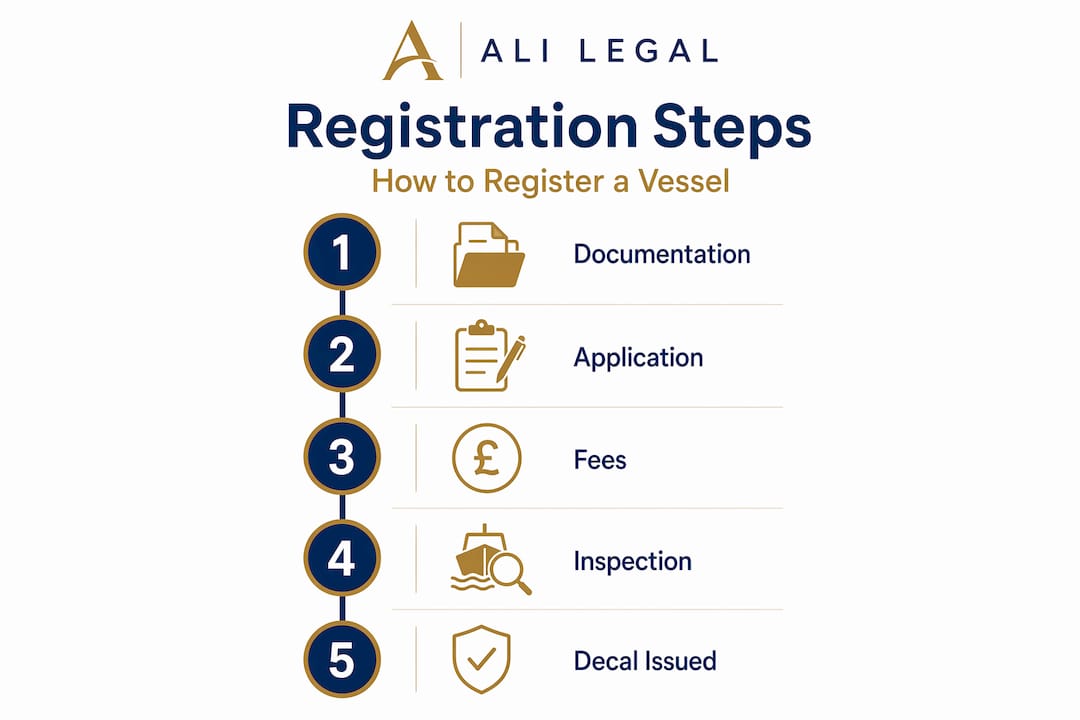
Registration is not a one-step process. It involves several distinct actions, and missing any one of them can leave you technically non-compliant even if you think you have done everything correctly. Registration involves applying, paying fees, providing ownership proof, and following display rules such as displaying decals, carrying certificates on board, and keeping registrations up to date.
Here is a typical sequence for most vessel owners:
For commercial and international vessels, the Netherlands ILT requires property registration (teboekstelling) and a Certificate of Registry for merchant ships, illustrating just how specific and layered these requirements can become.
| Requirement | Recreational vessel | Commercial vessel | Ocean-going/merchant vessel |
|---|---|---|---|
| Application form | Standard state/local form | National body form | Flag State application |
| Proof of ownership | Bill of sale/builder’s cert | Full ownership documentation | Chain of title documents |
| Fees | Modest annual/biennial fee | Higher national fees | Varies by flag state |
| Identification display | Hull number and decals | Certificate of Documentation number | IMO number and flag |
| Certificate on board | Required | Required | Required (Certificate of Registry) |
| Renewal period | 1 to 3 years | Varies | Annual survey linked |
Proper attention to marine insurance considerations alongside registration ensures that your coverage is watertight from the start. Many insurers check registration status before accepting or renewing a policy.
Pro Tip: Take dated photographs of your hull numbers and decals each time you renew. If you are ever challenged about compliance, photographic evidence can resolve the matter far faster than hunting through paperwork.
For a clearer overview of safety and compliance obligations, boating safety compliance resources provide practical checklists that complement the legal documentation process.
Even owners who believe they are fully compliant regularly fall foul of vessel registration rules. The consequences range from embarrassing to financially devastating, and most are entirely avoidable.
The most common mistakes include:
The consequences of non-compliance are serious. Fines can range from modest fixed penalties to substantial sums for repeat offences or commercial violations. Your insurer may void your policy if the vessel is unregistered or improperly registered at the time of an incident. In extreme cases, authorities have the power to impound the vessel until registration is regularised.
Pro Tip: Set a calendar reminder at least 90 days before your registration renewal date. This gives you time to gather documents, pay fees, and resolve any complications without rushing into the renewal window.
For a broader picture of your obligations, boating certification requirements cover the wider range of compliance topics that sit alongside registration. Understanding maritime law for ship owners in greater depth is particularly valuable if you operate commercially or across multiple jurisdictions.
Many owners and operators come to us treating registration as a regulatory inconvenience, something to be dealt with quickly and filed away. After working with vessel owners across recreational, commercial, and international contexts, we hold a different view entirely.
Registration is an asset protection tool. The moment your vessel is correctly registered, you have created a documented legal identity for it. That identity becomes the foundation for everything that follows: insurance claims, financing applications, ownership disputes, and resale transactions. Without it, you are operating in a legal grey area that exposes you to risks you may not even know exist until it is too late.
There is also a tendency among owners to treat registration as a one-time event rather than an ongoing process. Vessels change. Ownership changes. Operations change. Each change can have registration implications, and failing to keep pace with those changes can unravel protections you thought you had in place.
The owners we see navigating disputes most successfully are those who treat their vessel’s documentation as a living record, not a dusty file in a drawer. They update promptly, renew early, and seek advice when they are uncertain which regime applies. Deeper maritime law insights can help you understand not just what the rules require, but why they exist and how to use them to your advantage.
Vessel registration is not just about avoiding penalties. It is about building a legal foundation strong enough to protect your investment, support your claims, and give you confidence on the water.
Vessel registration affects far more than whether you can legally leave the marina. It shapes your ownership rights, determines how disputes are resolved, and underpins the validity of your marine insurance. Getting it right from the outset is significantly easier than correcting problems after the fact.
At Ali Legal, our solicitors work with boat owners, operators, and commercial vessel clients on the full range of maritime legal matters. Whether you need guidance on which registration regime applies to your vessel, help resolving a dispute that has arisen from a documentation gap, or support with a complex international registration matter, we bring clarity and practical advice to every situation. Our maritime legal services are designed to protect your interests with straightforward advice and transparent fixed fees. Contact us today to speak with a solicitor who understands maritime law from the hull up.
Anyone operating on public waterways with a powered or sizeable boat is typically required to register their vessel with the relevant authority. Unpowered craft below certain size thresholds may be exempt, but this varies by jurisdiction.
You will need proof of ownership, an application form, and payment of applicable fees. Some authorities also require a builder’s certificate for new vessels or evidence of any previous registration.
State registration covers most recreational and small boats at a local level, while federal documentation applies to vessels that qualify by size or use for national registration, often preferred for commercial operations and marine financing.
Most registrations are valid for one to three years and must be renewed before expiry. For example, Iowa renewals are required every three years, though other jurisdictions may impose shorter renewal cycles.
Failure to display required numbers and carry your certificate on board can result in fines, your insurer refusing a claim, or enforcement authorities impounding your vessel until compliance is established.
TL;DR:
- Business continuity planning (BCP) is a comprehensive, organization-wide strategy aimed at ensuring ongoing operations during disruptions beyond just IT systems. Proper BCP involves analyzing critical processes, setting clear recovery metrics, and regularly testing plans, leadership, and dependencies to maintain resilience. Effective BCP integrates legal compliance, stakeholder communication, and adaptability to evolving threats like cyber attacks and supply chain failures.
Most business owners assume business continuity planning (BCP) is a concern for the IT department. A server goes down, and the recovery team steps in. But BCP is far broader than that. It is the process of creating prevention and recovery systems so that your organisation can keep delivering products and services at acceptable levels through any disruptive incident, whether that is a flood, a key supplier collapse, a pandemic, or a cyber attack. This guide walks you through what BCP really involves, how to structure an effective plan, and what separates businesses that survive disruptions from those that do not.
| Point | Details |
|---|---|
| BCP is holistic | It safeguards all critical operations, not just IT, keeping your business running in any crisis. |
| Start with BIA | A business impact analysis helps prioritise what matters most and sets clear recovery targets. |
| Ongoing testing is vital | Plans quickly become outdated; maintain relevance with regular reviews and updates. |
| Adapt for new threats | Prepare for cyber attacks, operational compromises, and align BCP directly with disaster recovery. |
| Ownership ensures success | Leadership buy-in and clear responsibility turn theory into real continuity and resilience. |
Business continuity planning is not simply an IT policy or an emergency contact list. It is a strategic, organisation-wide framework that prepares every function of your business to keep operating when something goes wrong. Think of it as the difference between patching a leak and building a waterproof structure from the start.
Many decision-makers conflate BCP with disaster recovery, but they serve distinct purposes. BCP is broader than IT disaster recovery: it plans for continuity of the entire business process and includes non-IT resources such as workspaces, communications, and other operational resources. Disaster recovery is typically focused on restoring systems after a failure. BCP asks the bigger question: how does the whole business keep functioning during and after a disruption?
| Feature | Business continuity planning | Disaster recovery |
|---|---|---|
| Focus | All business operations | IT systems and data |
| Scope | Organisation-wide | Technical infrastructure |
| Ownership | Senior leadership | IT department |
| Outcome | Operational resilience | System restoration |
A well-designed BCP covers the following key areas:
“Operational continuity is not about having the perfect plan. It is about having thought through the right questions before the crisis begins, so that your people know what to do even when the situation does not match the script.”
Understanding BCP as a legal and operational matter also means recognising how it intersects with legal risk management for your business. Contractual obligations, data protection duties, and regulatory requirements do not pause during a disruption. Your BCP must account for them.
With the definition clear, it is time to unpack what actually composes an effective BCP. The structure is not arbitrary. Each component serves a specific purpose, and gaps between them are where plans fail in real-world situations.
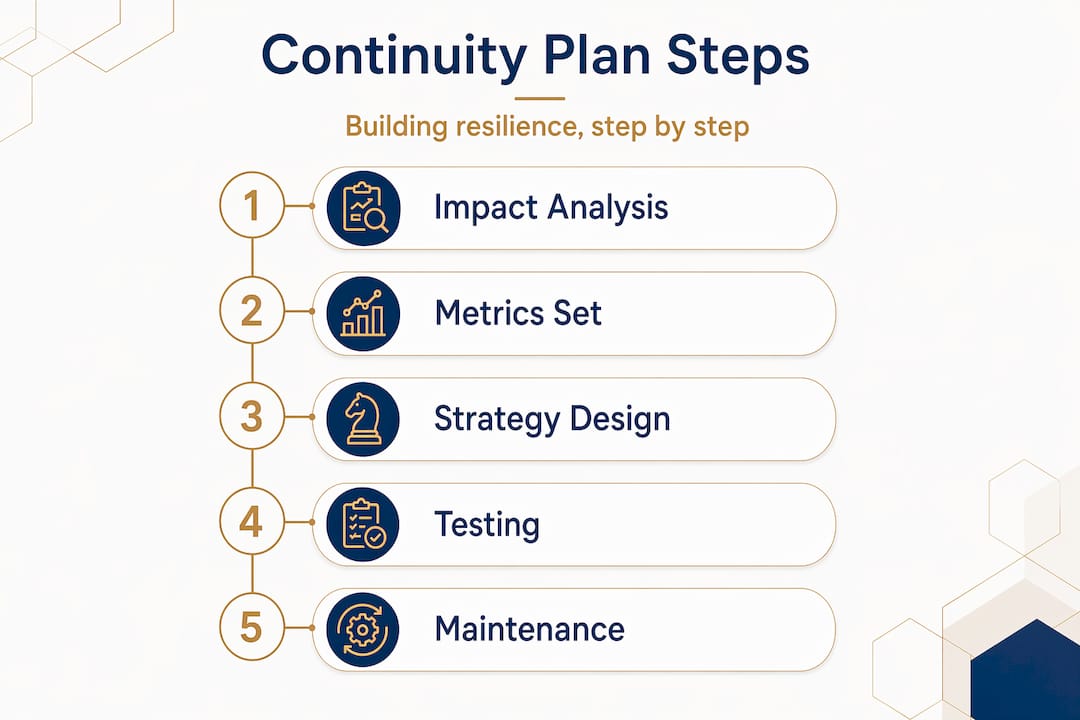
A common methodology is to start with a business impact analysis (BIA), use it to set continuity and recovery metrics such as RTO and MTD, and then design strategies that align people, process, technology, and supply-chain dependencies to keep operating through disruption.
| Component | What it does |
|---|---|
| Business impact analysis (BIA) | Identifies critical processes and quantifies the cost of downtime |
| Recovery time objective (RTO) | Defines the maximum acceptable time to restore a process |
| Maximum tolerable downtime (MTD) | Sets the absolute limit before the disruption causes irreparable harm |
| Roles and responsibilities | Assigns ownership of each recovery action to a named individual |
| Supply chain mapping | Identifies dependencies and alternative sourcing options |
| Communication plan | Outlines how internal teams, clients, and stakeholders are informed |
Without defined RTOs and MTDs, your plan is a collection of good intentions. These metrics force clarity. They compel you to answer the question: how long can we actually survive without this process? For most businesses, that answer is shorter than they expect.
Here is what your BCP should address in practical terms:
Pro Tip: When conducting your BIA, do not just ask department heads what they do. Ask what would break first if their team disappeared for a week. That conversation often surfaces dependencies that never appear on an organisational chart.
Aligning your BCP with recognised frameworks such as ISO 22301 standards gives your plan structural credibility and is increasingly expected by insurers, investors, and enterprise clients. The compliance officer’s role within BCP is significant here, as they can ensure that the plan meets legal and regulatory requirements from the outset. Understanding business liability essentials is also critical, since a failure to maintain continuity can expose your organisation to contractual claims and regulatory sanctions.
Building your plan is only half the job. Ensuring it works and stays relevant demands ongoing action. A plan that sits in a drawer and is never tested is not a plan. It is a liability.

Testing and maintaining BCPs is essential because plans can go stale and become unusable when needed. Business leadership ownership and ongoing review and testing are what separate organisations with genuine resilience from those with the appearance of it.
Here are the key maintenance activities every organisation should build into its annual calendar:
Pro Tip: Assign a named individual, not just a job title, as BCP owner. When ownership is tied to a role rather than a person, accountability evaporates during staff changes.
“Plans that belong to everyone belong to no one. Genuine resilience requires a named senior leader who is accountable for the plan, its testing, and its outcomes.”
Maintaining robust law and compliance for business standards should be woven into your maintenance cycle. A BCP that was compliant when written can quickly fall out of alignment with evolving regulation. Review your website security checklist as part of your technology continuity review, particularly if your business handles client data online.
Even with good plans, rapidly evolving threats create new continuity challenges. The threat landscape has changed significantly. A decade ago, BCP focused primarily on physical disruptions. Today, the picture is considerably more complex.
Severe cyber threats require operational continuity planning even when IT and operational technology systems are degraded. Organisations must make difficult trade-offs between security controls and operational continuity. For example, isolating compromised systems may disrupt core services, but leaving them connected may worsen the breach. Your BCP must anticipate these scenarios and give leaders a framework for making those calls quickly.
Consider the following risks and trade-offs for critical processes during severe disruptions:
BCP defines what must continue and at what level, while disaster recovery focuses on restoring supporting systems and data. If either is misaligned, operational resilience can fail in real incidents. Many businesses treat these as separate workstreams owned by different teams. That approach creates gaps. The team responsible for keeping the business running and the team responsible for restoring its systems must operate from the same playbook, with shared assumptions about recovery timelines and minimum service levels.
Pro Tip: Use your BIA to define the minimum essential processes your business must maintain even under severe degradation. That list should drive both your BCP strategy and your disaster recovery priorities simultaneously, not independently.
Business advocacy in continuity matters more than many leaders realise. When disruptions affect contractual performance, having legal counsel involved in your BCP ensures you understand your obligations and your options before the crisis hits, not during it. Review your approach to website security as part of your cyber continuity planning, particularly if client-facing digital services form part of your core offering.
From working with businesses navigating operational crises and legal disputes, one pattern emerges repeatedly. The organisations that struggle most during disruptions are not the ones without a plan. They are the ones with a plan that nobody truly owns or believes in.
The document exists. The policy is signed. The folder is filed. And then a real disruption occurs, and the plan is found to be two years out of date, referencing staff who have left, suppliers who no longer exist, and systems that have since been replaced.
The first overlooked reality is that a checklist is not the same as readiness. Many businesses complete their BCP as a compliance exercise, ticking boxes to satisfy an insurer or a client due diligence request. The intent is correct, but the execution stops too soon. Real readiness comes from rehearsal, from genuinely testing whether your people can execute the plan under pressure, not just whether the plan looks thorough on paper.
The second reality is that complacency grows fastest after a period of stability. The longer a business operates without a serious disruption, the more likely the BCP is to decay quietly. Key staff change. Processes evolve. Technology changes. But the plan remains static because “nothing has gone wrong yet.” By the time something does go wrong, the gap between the plan and reality can be significant.
The third and perhaps most important lesson is this: real crises rarely match the scenarios you planned for. A flood is not just a flood. It may also coincide with a key member of staff being on leave, a supplier struggling with their own disruption, and a regulatory deadline that cannot be moved. Agility and a culture of clear-headed decision-making matter as much as the written plan itself.
Embedding continuity thinking into your executive culture means treating BCP as a living conversation, not a periodic document review. Leaders who understand legal risk management from a strategic perspective are better positioned to recognise emerging threats and respond in ways that protect both operations and legal standing.
The businesses that come through disruptions best are those where leaders have genuinely thought through the hard questions in advance, understand the trade-offs, and have empowered their teams to act decisively without waiting for instructions that may never come.
Understanding BCP is one thing. Embedding it into your legal and commercial strategy is another, and that is where experienced legal support makes a measurable difference.
At Ali Legal, we work with businesses to identify legal vulnerabilities that sit inside continuity risk, from contractual exposure during supply chain disruption to regulatory obligations that persist through an operational crisis. Our commercial litigation help is available when disruptions lead to disputes, and our broader risk management insights help you take a proactive approach before a crisis demands it. Fixed fees, straightforward advice, and long-term relationships mean you get genuine support without surprises. If you are ready to build a more resilient business, speak to our experts today.
Business continuity planning keeps critical business processes running during disruptions, whereas disaster recovery focuses on restoring IT systems and data after an incident. BCP covers far more than IT, including workspaces, communications, and non-technical operations.
A BIA identifies the key processes and dependencies your business cannot afford to lose, setting recovery priorities and metrics. It is the foundation of effective BCP because it forces you to quantify the actual cost of downtime before a disruption occurs.
Your BCP should be reviewed, tested, and updated at least annually or whenever significant changes occur in your organisation. Plans that go untested quickly become unreliable because business conditions, staff, and systems change continuously.
Senior leadership must own the BCP process, with clear delegated responsibility for creation, testing, and maintenance assigned to named individuals. Leadership ownership is essential because without executive accountability, plans are rarely kept current or properly tested.
No. All organisations benefit from BCP because disruptions can affect businesses of any size or sector. BCP creates prevention and recovery systems that allow any organisation to continue delivering products and services at acceptable levels when something goes wrong.
TL;DR:
- Fiduciary duty is a legally binding obligation that requires acting in the best interests of the beneficiary, not oneself. Breaches can lead to personal liability, penalties, or unwinding transactions, emphasizing the importance of process, disclosures, and proper governance. Understanding and carefully managing fiduciary relationships across roles and regulations is essential to avoid costly disputes and ensure lawful conduct.
Most people assume that fiduciary duty is simply about being honest or “doing the right thing.” That assumption can be costly. Fiduciary duty is a legally binding obligation with real-world consequences, including personal liability, civil penalties, and the unwinding of business transactions. Whether you are a company director, a trustee managing a family estate, or a professional handling client funds, understanding the full scope of fiduciary duty is not optional. This guide clarifies the legal principles, practical applications, regulatory standards, and contractual dimensions of fiduciary duty so you can make informed decisions.
| Point | Details |
|---|---|
| Fiduciary duty defined | A fiduciary must act in the best interests of another, guided by loyalty and care. |
| Impacts on business | Everyday decisions by company officers and professionals can trigger legal obligations and liability. |
| Compliance matters | Failure to observe fiduciary duty can lead to personal and financial penalties, especially in regulated fields. |
| Modification by contract | Certain agreements can shape or limit fiduciary duties, but boundaries are policed by courts. |
| Process over result | Courts judge fiduciaries mostly on process, disclosure, and intent, not purely on business outcomes. |
At its core, fiduciary duty is a legal relationship where the fiduciary must act in the best interests of the beneficiary or principal rather than in the fiduciary’s own interests. The word “fiduciary” comes from the Latin fiducia, meaning trust. Courts take that trust seriously, treating breaches not merely as mistakes but as wrongs that can justify significant remedies.
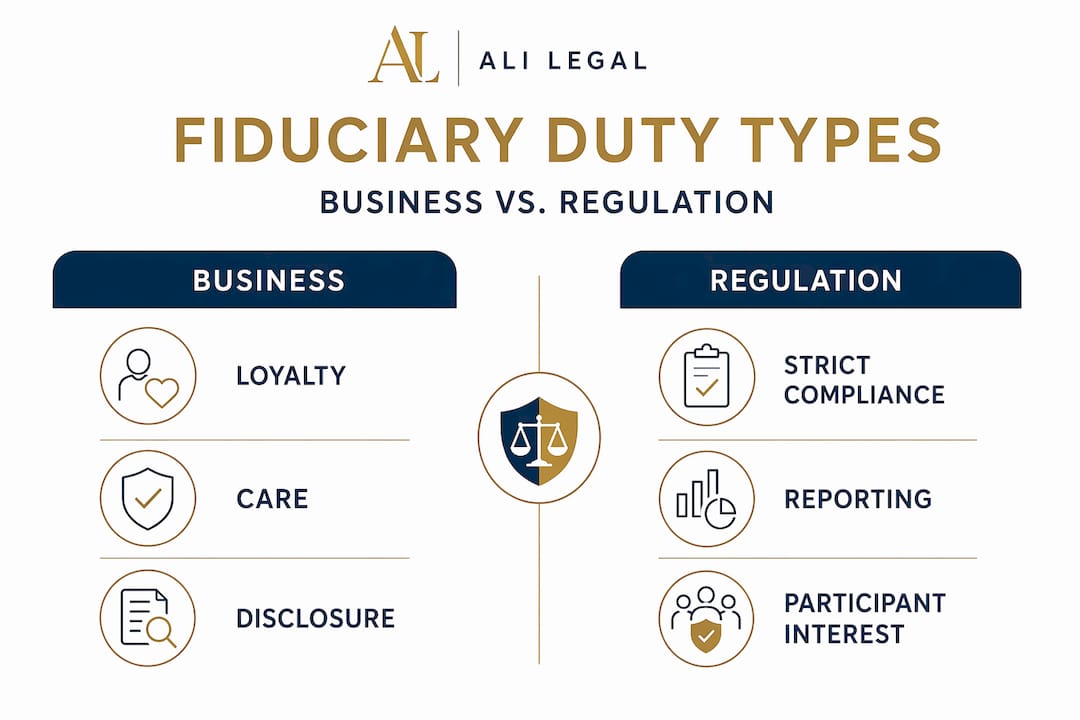
The obligations that make up fiduciary duty are often grouped into four core duties:
These duties are not abstract ideals. They show up in everyday business situations. A company director who approves a contract with a supplier they secretly part-own has breached the duty of loyalty. A pension trustee who fails to diversify fund investments without good reason may breach the duty of care. A solicitor who withholds material information from a client may breach the duty of disclosure. The consequences in each case can range from personal financial liability to disqualification from office.
Who can be a fiduciary? The list is broader than most people expect:
| Fiduciary role | Relationship to beneficiary | Common context |
|---|---|---|
| Company director | Owes duties to the company | Business governance |
| Trustee | Owes duties to trust beneficiaries | Wills, estates, family trusts |
| Solicitor/lawyer | Owes duties to client | Legal representation |
| Financial adviser | Owes duties to client | Investment and pension advice |
| Corporate officer | Owes duties to the company | Day-to-day management |
| Agent | Owes duties to principal | Real estate, commercial agents |
Understanding which category applies to your situation is the first step. The legal obligations differ in depth and scope depending on the role, but they all share the same foundational principle: someone else’s interests come first.
“A fiduciary relationship is one of the most significant legally recognised relationships precisely because it demands that self-interest yield entirely to the interests of another.” This is why courts scrutinise fiduciary conduct with such particular care.
Pro Tip: If you are uncertain whether a relationship in your business creates fiduciary obligations, look at whether one party places significant trust and confidence in another to act on their behalf. That is usually the clearest indicator. You can learn more about how these principles apply to corporate law duties in a business setting.
With a working definition in mind, let us see how fiduciary duties play out in vital business and professional relationships. The duty of loyalty and care are not theoretical concepts in a textbook. They directly shape how directors vote at board meetings, how compliance officers report misconduct, and how fund managers allocate capital.
In a business context, the most commonly scrutinised fiduciary roles include:
Comparing the duties of a company director with those of a trust trustee illustrates how fiduciary standards adapt to context:
| Aspect | Company director | Trust trustee |
|---|---|---|
| Whom duty is owed to | The company as a whole | Individual beneficiaries |
| Standard of care | Reasonable, skilled director | Prudent person managing others’ affairs |
| Conflicts of interest | Must disclose; board may authorise | Generally must avoid entirely |
| Profit rule | May profit with proper authorisation | Must not profit from position |
| Flexibility | Greater latitude via articles | Strict controls in trust deed and statute |
The consequences of breaching fiduciary duty in business are significant and often personal. They include:
Good corporate governance structures exist precisely to minimise these risks. Governance frameworks, board committees, and clear escalation policies help ensure that fiduciaries operate within their obligations, even under commercial pressure. When these frameworks fail, understanding the scope of business liability becomes critically important.
Pro Tip: Board minutes are among the most powerful tools a director has. They evidence that decisions were made with proper deliberation, full information, and in the company’s interests. Keep them detailed and accurate at every meeting.

Understanding fiduciary duty in everyday business is crucial, but regulatory frameworks add another layer of strict compliance. The United States’ Employee Retirement Income Security Act (ERISA) is one of the most instructive examples globally, including for UK business owners thinking about pension governance.
ERISA mandates that fiduciaries act solely in the interest of participants and beneficiaries. The statute goes further, requiring adherence to specific prudence and diversification standards, and it leaves little room for interpretation. The obligations are precise, and the enforcement mechanisms are robust.
The risks of failing to comply are not abstract. Fiduciaries under ERISA can be held personally accountable for breaches, including personal liability, civil penalties, and excise taxes. This means that where a trustee or plan administrator makes a careless decision, even without dishonest intent, they may be personally required to make good the loss from their own pocket.
Key compliance obligations that regulated fiduciaries must address include:
The lessons from ERISA translate directly to UK pension governance, where The Pensions Regulator expects trustees to demonstrate that their decisions are documented, considered, and made in the exclusive interest of members. Organisations that build disciplined compliance processes see dramatically fewer disputes and enforcement actions.
Effective legal risk management in this space means treating fiduciary compliance as a business process, not a legal formality. That means regular training, independent review, and a genuine culture of accountability at trustee and board level.
Pro Tip: If your business sponsors a pension or retirement plan, treat the trustee role as a distinct function with its own governance structure. Mixing it informally with other management responsibilities is one of the most common routes to inadvertent breach.
While laws set many standards, documents and contracts can sometimes modify a fiduciary’s obligations in ways that are not always obvious. Limited liability company agreements, partnership deeds, and trust documents can all affect the scope of fiduciary duties, but the latitude available is more restricted than many business owners assume.
Courts do not simply read contract terms at face value when fiduciary duties are at stake. Governing documents can influence how fiduciary duties are modified or limited, but disputes often turn on the precise details of interpretation. In a notable 2026 decision from the Delaware Court of Chancery, the court concluded that an LLC agreement had not successfully eliminated fiduciary duties, even where the drafting appeared to attempt it. The lesson: poorly worded exculpatory clauses are frequently ineffective.
There are important considerations when reviewing fiduciary provisions in business documents:
Swiss corporate governance rules offer an interesting parallel. Swiss company law imposes strict duties on directors and managers, and while board regulations can define responsibilities in detail, they cannot remove the fundamental obligations owed to the company. International business owners operating across jurisdictions often discover that local governance requirements are more demanding than their home jurisdiction’s framework.
Understanding contractual liability in this context is essential. Contractual modifications to fiduciary duty can be legitimate and commercially sensible, but only when drafted with legal precision and with full awareness of what the law permits. Similarly, trust law and fiduciary duties interact closely when family wealth is structured through trusts, and the terms of the trust deed will be examined closely in any dispute.
“Courts interpret fiduciary duty clauses strictly. What the parties intended and what the document actually achieves can be very different things—and that gap is where disputes are born.”
Here is the insight that often catches business owners off guard: a bad outcome is not the same as a breach. Courts assess fiduciary conduct based on the quality of the process, not solely the result. Fiduciary claims often focus on process, disclosures, and conflicts of interest rather than results alone. An investment that loses value does not automatically mean a trustee breached their duty. A business decision that proves commercially disastrous does not automatically expose a director to liability.
What courts actually examine is whether the fiduciary asked the right questions before deciding, whether they obtained appropriate advice, whether they disclosed relevant interests, and whether they genuinely placed the beneficiary’s interests first. This is both reassuring and demanding. Reassuring, because honest mistakes made with proper care are defensible. Demanding, because it places a high premium on documentation, transparency, and disciplined process.
The most common pitfalls we see in practice follow a familiar pattern. Conflicts of interest go undisclosed because they seem minor or obvious. Decisions are made without adequate information because time pressure feels like a valid excuse. Board minutes record conclusions without capturing the deliberative process. These gaps, individually small, collectively create the conditions for a successful breach claim.
Business owners sometimes focus on negligence law as the primary risk in commercial decisions, overlooking that a fiduciary claim can be more powerful: it does not require proving that the outcome was unreasonable, only that the process was tainted by self-interest or inadequate care.
The practical implication is straightforward. Invest in process. Record your reasoning. Disclose early and openly. Obtain independent advice on significant decisions. These habits do not just protect you legally. They make for better governance and stronger business outcomes over time.
Fiduciary obligations can arise in contexts you may not have anticipated, from a directorship taken on as a favour to a trustee role inherited through family circumstances. Anyone worried about their fiduciary obligations or facing possible breach scenarios can benefit from expert legal guidance before matters escalate.
At Ali Legal, we advise directors, trustees, business owners, and individuals on the full range of fiduciary issues, from pre-emptive compliance reviews to active dispute resolution. Our commercial litigation expertise means we understand both the legal theory and the commercial realities at stake. Whether you need to understand your obligations before signing a governance document, or you are already facing a claim, we offer clear, strategic advice built around your situation. You can also explore our civil litigation best practices resources to understand how disputes of this kind are most effectively managed. Fixed fees, direct access to experienced solicitors, and straightforward advice from day one.
Fiduciaries including directors, trustees, and plan administrators can be held personally liable for breaches, and liability can arise even where the fiduciary acted without any dishonest intent.
Certain agreements can limit or clarify fiduciary duties, but courts scrutinise such clauses closely, and duties relating to fraud or wilful misconduct are generally not waivable regardless of the contract’s terms.
A fiduciary must act with loyalty, avoid conflicts of interest, exercise due care and skill, and fully disclose all relevant information to the beneficiary or principal throughout the relationship.
Yes, fiduciary duties extend well beyond business settings and arise in personal trusts, estate administration, professional relationships such as solicitor and client, and certain medical and counselling contexts.
Courts typically focus on whether the decision-making process was sound rather than the outcome alone, so a poor result does not automatically constitute breach if the fiduciary acted with proper care, full information, and genuine good faith.
TL;DR:
- A notary public does much more than witness signatures; they verify identity, confirm voluntariness, and authenticate legal documents to prevent fraud. Proper notarisation involves careful procedural adherence, correct certificate wording, and thorough preparation to avoid rejection, liability, or legal risks. Early professional guidance and meticulous review are essential for reliable document authentication, especially in complex or cross-border transactions.
Most people assume a notary public simply watches you sign a document and stamps it. That assumption is wrong, and acting on it can cost you dearly. A notary public is a publicly commissioned official who serves as an impartial witness to the identity and voluntary signing of legal documents, helping prevent fraud and ensuring proper authentication. When notarisation goes wrong, documents get rejected, transactions collapse, and legal disputes follow. This guide cuts through the confusion so you can protect your interests, whether you are an individual managing a personal legal matter or a business handling high-stakes documentation.
| Point | Details |
|---|---|
| Identity protection | A notary public’s core task is to verify identity and confirm volitional signing, reducing fraud risk. |
| Compliance is crucial | Proper completion of the notarial certificate is vital—sloppy paperwork leads to rejections and potential liability. |
| Jurisdiction matters | Notary authority, procedures, and alternatives differ by region, so it’s essential to check local rules. |
| Digital change—with limits | Remote and digital notarisation continue but still require identity checks and compliance with notarial duties. |
| Preparation prevents problems | Check all certificates, require full documents, and engage notaries early for smooth, valid transactions. |
The role of a notary public is far more active than simply watching somebody write their name. A notary is an impartial, state-appointed official whose core responsibility is to verify identity, confirm that signing is voluntary and informed, and authenticate legal documents in a way courts and institutions can rely on.
According to the six main notarial acts recognised under the Revised Uniform Law on Notarial Acts (RULONA), notaries are authorised to perform acknowledgements, administer oaths and affirmations, execute verifications on oath, witness or attest signatures, certify copies of documents, and note protests of negotiable instruments. Each of these acts carries its own procedural requirements and legal effect.
Here is what typically happens during a proper notarisation:
The distinction between an acknowledgement and a jurat (a sworn statement) is worth noting here. In an acknowledgement, you confirm you signed the document freely. In a jurat, you swear under oath that the document’s contents are true. Using the wrong certificate type is one of the most common errors notaries and their clients make.
“Notarial acts can affect the legal rights of others. A notary must act with care, impartiality, and strict adherence to the required procedures.”
Pro Tip: Always bring valid photo identification and ensure every signer is present. Sending someone on your behalf will not work. The notary must personally verify each signer’s identity before proceeding.
Comparison of common notarial acts
| Act | What it confirms | Typical use |
|---|---|---|
| Acknowledgement | Signer freely executed the document | Deeds, powers of attorney |
| Jurat | Signer swears contents are true | Affidavits, sworn statements |
| Copy certification | Document is a true copy of the original | Passports, qualifications |
| Signature witnessing | Identity verified at time of signing | Wills, contracts |
Understanding contract law in the UK becomes much more straightforward once you appreciate how notarisation supports the enforceability of signed agreements. For more complex arrangements such as trusts, understanding asset protection for UK trusts often begins with properly notarised documentation.
Getting notarisation wrong is not a minor inconvenience. The consequences range from rejected applications and delayed transactions to fraud exposure and civil litigation. Improperly completed certificates are one of the most common reasons notarised documents are rejected, and missing, incorrect, or blank certificates create immediate practical problems and longer-term legal risk.
The specific risks fall into several categories:
Consider a practical example. A business owner preparing articles of incorporation for an overseas subsidiary needs notarised signatures on several company documents. If the notarial certificate omits the date or uses incorrect jurisdiction wording, the receiving authority abroad may refuse the entire package. Weeks of preparation collapse overnight, and the business faces resubmission costs, delays, and potential loss of the commercial opportunity.
Pro Tip: After every notarisation, review the completed certificate before leaving. Check the date, your name as it appears on your identification, the certificate type, and the notary’s seal. Spotting an error in the room takes seconds. Correcting it after the fact takes weeks.

For businesses, maintaining essential legal documents in good order and staying on top of a solid business incorporation process both depend heavily on reliable, accurate notarisation at the outset.
Notarial practice is not uniform. The authority a notary holds, the acts they can perform, and the legal effect those acts carry vary significantly by jurisdiction). A notarisation valid in England and Wales may need apostille certification to be accepted in another country. A notarial act performed in one US state may carry different weight in another. Assuming your notarisation is automatically portable is a costly mistake.
Comparison of notarisation approaches
| Approach | Who appears | Verification method | Key limitations |
|---|---|---|---|
| Standard in-person | Signer and notary | Government ID, direct questioning | Signer must be physically present |
| Subscribing witness | Witness appears, not signer | ID of witness, oath administered | Only permitted in specific jurisdictions |
| Remote/online notarisation | Signer via video link | Identity proofing technology | Core duties remain; rules vary widely |
When a signer genuinely cannot appear in person, some jurisdictions permit a subscribing witness procedure. In this arrangement, the witness (not the signer) appears before the notary, confirms they witnessed the signer execute the document, and swears to this under oath. The notary then notarises based on the witness’s sworn statement rather than direct contact with the signer. This is a strict, limited alternative. Most jurisdictions do not allow it, and misapplying it can render the entire document invalid.
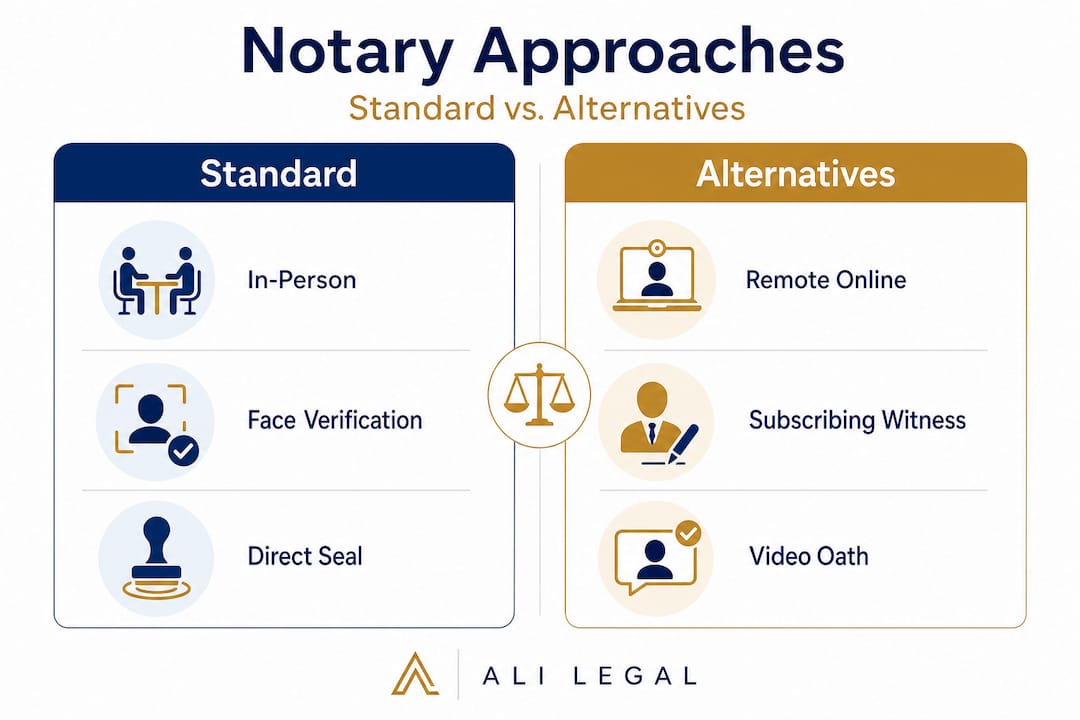
Remote and digital notarisation is expanding rapidly. Video-based platforms allow notaries to perform identity checks and witness signatures across distances. However, remote notarisation does not remove core duties. The notary must still carry out thorough identity verification, confirm voluntary consent, and complete the notarial certificate correctly. Where AI tools assist with scheduling or document preparation, the notary remains personally responsible for every act performed under their seal.
Steps for remote notarisation:
“Failing to confirm personal appearance, whether in person or via approved remote means, is one of the most common causes of notarisation-related lawsuits.”
Businesses managing multiple cross-border agreements should refer to a clear corporate law checklist to ensure that notarisation requirements are embedded into their compliance processes from the start, rather than addressed as an afterthought.
Preparation is the single most effective tool for avoiding notarisation problems. Whether you are handling a personal document or managing a high-volume business transaction, the following practices will reduce your risk significantly.
Before attending the notary:
During the notarisation:
After the notarisation:
Pro Tip: Never sign before seeing the notary, and always review the certificate wording before you leave the room. Certificate errors discovered later often require the entire process to restart. Reviewing everything at the point of signing costs nothing.
Having solid contracts in your business is inseparable from reliable notarisation. Applying contract drafting best practices from the outset means your documents arrive at the notary complete, clearly worded, and ready to withstand scrutiny.
Here is something we see regularly in practice: individuals and businesses treat notarisation as a box-ticking exercise. They assume the notary will catch every problem and manage every risk. They arrive underprepared, hand over a document they have not fully read, and walk away confident the stamp makes everything official. That confidence is misplaced.
The reality is that a notary’s duty is procedural. They confirm identity and verify voluntariness. They do not review the legal effectiveness of the underlying document, advise on whether you need a different type of notarisation, or guarantee the receiving institution will accept what they have certified. The preparation and strategic thinking must happen before you walk through the notary’s door.
The most avoidable mistakes we see:
Over-reliance on the notary’s role. Many clients believe the notary’s seal solves all problems. It does not. A correctly notarised but legally defective document is still legally defective. The notarisation authenticates the signing, not the substance.
Ignoring certificate wording. Certificate language is prescribed by law in most jurisdictions. Using generic or downloaded template wording without checking current local requirements is a persistent source of rejections. This matters especially in cross-border matters where receiving jurisdictions may have highly specific requirements.
Failing to plan for absent signers. Discovering that a key signatory is unavailable on the day of notarisation, without having made proper alternative arrangements, is an entirely preventable crisis. Explore subscribing witness options or remote notarisation routes well in advance, confirm they apply in your jurisdiction, and document your decision.
Treating digital tools as a shortcut. Automation can and does reduce coordination time and administrative burden. But digital tools working without strong human oversight create new risks, particularly around identity verification and certificate completion. The technology shifts the mechanics, not the responsibility.
What consistently works is engaging legal professionals early, particularly for complex or cross-border matters. Using a corporate law checklist to build notarisation into your compliance process from the outset, rather than retrofitting it, saves time and money over the long term. Notarisation done well is quiet and unremarkable. Notarisation done badly tends to announce itself at the worst possible moment.
When disputes arise over notarised documents, or when you need rigorous compliance support for complex transactions, you need more than a stamp on a page.
Ali Legal’s civil litigation team regularly handles disputes where documentation errors, including notarisation failures, have escalated into serious legal conflicts. Our commercial litigation specialists work with businesses facing high-stakes disputes over contracts and corporate documents where authenticity is challenged. And for personal matters where notarised documents underpin sensitive proceedings, our family and divorce legal team brings the same level of care and strategic thinking. Contact Ali Legal for straightforward guidance tailored to your situation.
Commonly notarised documents include powers of attorney, company resolutions, property transfers, affidavits, and international business documents. Requirements vary depending on the receiving institution and jurisdiction.
The document is likely to be rejected by the receiving authority, causing delay and potential legal risk, and missing certificates are one of the most common reasons notarised documents fail. The notary may also face professional liability if their error caused loss.
Many notarial acts can now be performed remotely, but core duties remain including identity verification, informed consent, and proper certificate completion. Remote notarisation is not permitted for all document types in all jurisdictions.
In some jurisdictions, a subscribing witness procedure permits a witness to appear before the notary and swear an oath confirming they saw the document signed. Rules are strict and vary considerably by location, so always confirm local requirements in advance.
Improperly completed or missing notarial certificates increase fraud risk and compliance failure and can invalidate entire transactions. Businesses should build notarisation checks into their standard compliance processes rather than treating them as an administrative afterthought.
TL;DR:
- Data protection regulation governs how organizations handle personal data to protect individual rights and ensure lawful processing. Almost any business collecting personal information must comply, applying core principles like transparency, data minimization, and accountability to maintain trust and avoid hefty fines. Embedding a culture of ongoing compliance and understanding lawful bases, especially in AI and cross-jurisdictional operations, is essential for sustainable data management.
Data protection regulation sits at the heart of almost every modern business operation, yet most organisations treat it as an afterthought reserved for tech giants and multinational corporations. That assumption is wrong and, increasingly, costly. Whether you run an independent dental practice, a small e-commerce shop, or a medium-sized recruitment agency, the moment you collect a customer’s name and email address, you are processing personal data under the law. This guide breaks down what data protection regulation genuinely means, explains the principles that drive it, and shows you what real compliance looks like in practice.
| Point | Details |
|---|---|
| Applies to everyone | Data protection rules are relevant to nearly all businesses and individuals, not just large companies. |
| Principles guide action | Core principles like minimisation and accountability guide real-world compliance decisions. |
| Practical compliance steps | Meeting requirements means understanding data flows and choosing a lawful basis for every use. |
| New challenges with AI | AI and analytics introduce unique compliance risks demanding careful mapping of purposes and legal bases. |
| Legal support is valuable | Expert advice helps avoid costly mistakes and strengthens compliance frameworks. |
Data protection regulation refers to the body of rules and laws that govern how organisations collect, store, use, share, and delete personal data. These rules exist to protect individuals from misuse of their private information. The underlying idea is straightforward: people should have control over data that relates to them.
The urgency around this topic is not arbitrary. The rapid growth of digital commerce, cloud storage, and online communication has created an environment where vast quantities of personal data flow between systems every second. High-profile breaches at major organisations have repeatedly shown what happens when that data is poorly managed. Millions of people’s financial details, health records, and private communications have been exposed, often causing genuine, lasting harm.
GDPR compliance steps became a significant focus for businesses from 2018 onwards, when the General Data Protection Regulation came into force across the European Union. As the GDPR establishes, this regulation created a unified framework for processing personal data and strengthening individuals’ control and rights. But GDPR is not the only framework that matters. Similar legislation exists across the globe, including the UK GDPR (adopted post-Brexit), Canada’s PIPEDA, Australia’s Privacy Act, and California’s CCPA in the United States. The regulatory landscape is genuinely global.
“The GDPR aims to give individuals control over their personal data and to simplify the regulatory environment for international business by unifying the regulation within the EU.” The regulation came into full effect on 25 May 2018.
Who actually needs to comply? The answer might surprise you. Almost any organisation that handles personal data falls within scope. Here are some practical examples:
The common thread is personal data. If you handle it, regulation applies to you.
Most major data protection frameworks share a common foundation of principles. Understanding these principles is far more useful than memorising individual rules, because the principles are what regulators look at when something goes wrong. GDPR-style compliance is built around seven core principles that shape every data-related decision an organisation makes.
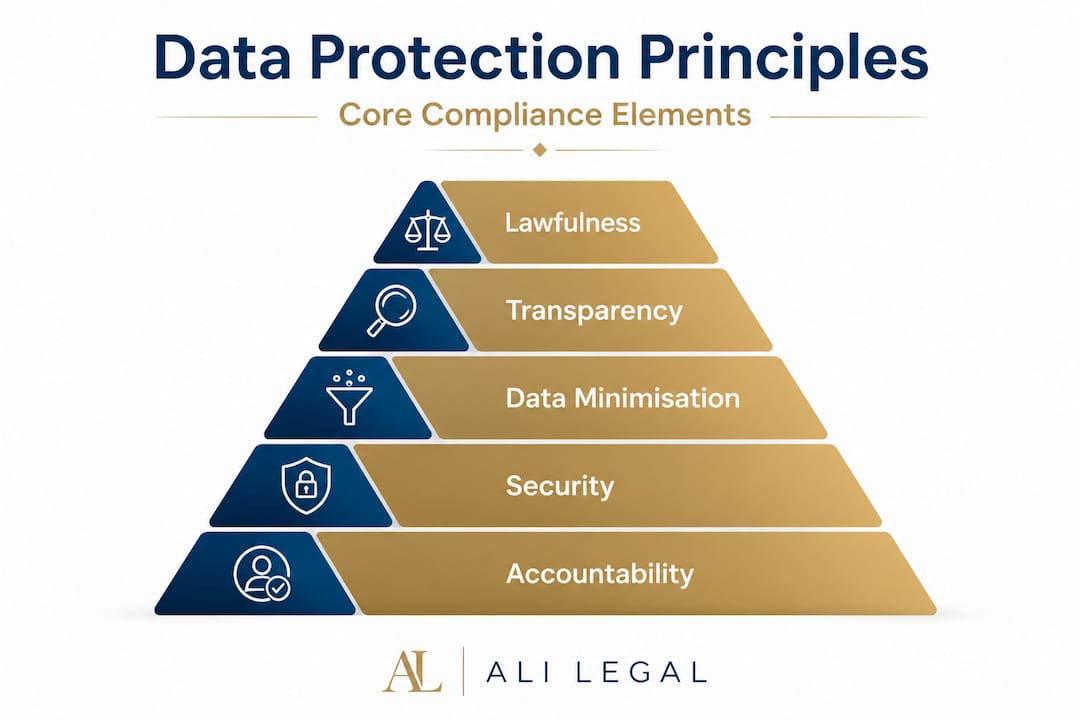
| Principle | What it means in plain English |
|---|---|
| Lawfulness, fairness and transparency | You must have a legal reason to process data and be open about how you use it |
| Purpose limitation | Collect data for a specific reason and do not use it for anything else |
| Data minimisation | Only collect what you genuinely need |
| Accuracy | Keep data correct and up to date |
| Storage limitation | Do not keep data longer than necessary |
| Integrity and confidentiality | Protect data from unauthorised access or loss |
| Accountability | Demonstrate that you follow the rules, not just claim that you do |
These principles are not abstract ideals. They translate into very specific daily obligations. Here is how they might look in a real business context:
The data minimisation principle deserves particular attention. It is one of the most frequently breached requirements, and it is deceptively simple. The ICO data minimisation requirement states that personal data must be adequate, relevant, and limited to what is necessary. Many businesses collect far more information than they need, often because it feels useful to have it available “just in case.” That instinct is legally risky.
Understanding the role of compliance officer within your organisation is also essential. Accountability requires someone to own these decisions, track obligations, and lead on responses when things go wrong.
Pro Tip: Treat accountability as an ongoing operational responsibility rather than a box-ticking exercise done once a year. Accountability means being able to show, at any point, that you understand what data you hold, why you hold it, and how you protect it.
Knowing the principles is one thing. Putting them into practice is another matter entirely. Here is a straightforward comparison of compliant versus non-compliant behaviours that illustrates the difference clearly:
| Scenario | Compliant behaviour | Non-compliant behaviour |
|---|---|---|
| Collecting customer data online | Providing a clear privacy notice and requesting only necessary information | Gathering extensive personal details without explanation |
| Email marketing | Sending campaigns only to those who opted in | Adding all past customers to a mailing list without consent |
| Employee records | Retaining only current, relevant HR data | Keeping ex-employee records indefinitely with no review |
| Data breach | Notifying the ICO within 72 hours and affected individuals promptly | Concealing or delaying notification of a significant breach |
| Third-party suppliers | Signing data processing agreements with all vendors | Sharing data with suppliers informally without contracts |
Getting this wrong carries serious consequences. The Information Commissioner’s Office (ICO) in the UK has authority to issue fines of up to £17.5 million or 4% of global annual turnover, whichever is higher. Beyond fines, reputational damage can be devastating. A single publicised breach can erode years of trust built with customers and partners.

The statutory limitations guide is equally relevant here, because organisations sometimes fail to appreciate that individuals have time-limited rights to bring complaints, and how limitation periods interact with data retention decisions.
Here are the key steps most organisations need to take to implement genuine compliance:
One of the most common mistakes we see is over-collection. Businesses gather data because storage is cheap and “it might be useful one day.” UK ICO guidance is direct on this point: personal data must be adequate, relevant, and limited to what is necessary. The comfort of having data available does not override the legal requirement to only hold what you need.
Knowing how to avoid legal pitfalls in this context means building compliance into your standard operating procedures from the start rather than retrofitting it after a problem occurs.
Beyond the general principles, every processing activity must have a specific legal justification. This is called the lawful basis for processing. Without identifying and documenting a lawful basis, processing personal data is unlawful, regardless of how responsibly you handle it otherwise.
The six lawful bases under UK GDPR are:
Choosing the wrong lawful basis is a common error. For instance, many organisations default to consent when legitimate interests would actually be more appropriate and more sustainable. Consent can be withdrawn at any time, which creates operational difficulties if it is relied upon unnecessarily.
The growing use of artificial intelligence and large-scale data analytics introduces an entirely new layer of complexity. AI systems typically process enormous volumes of personal data to identify patterns, make predictions, or automate decisions. Regulators expect organisations to map each processing purpose to an appropriate lawful basis and consider impacts on individuals’ rights and freedoms, rather than treating AI use as a single activity.
This matters enormously for businesses deploying automated hiring tools, credit scoring systems, or personalisation engines. Each distinct use of data within those systems may require its own lawful basis. A blanket consent form does not cover all of it.
Employment contracts compliance is a closely related area where lawful basis questions arise frequently, particularly when employers use monitoring tools or analytics systems that process employee data.
Pro Tip: For every AI-driven or analytics-based use of personal data, document the specific purpose, the lawful basis selected, and a brief explanation of why that basis is appropriate. If you cannot articulate the rationale clearly, the processing should be paused and reviewed.
Most articles on this subject focus on checklists. Update your privacy policy. Sign your data processing agreements. Register with the ICO. These steps matter, but they miss the deeper point entirely.
Lasting compliance does not come from a checklist. It comes from embedding data protection thinking into the culture of your organisation. When a sales manager instinctively asks “do we actually need this field?” before adding it to a CRM, that is culture at work. When a customer service team automatically follows the subject access request process without needing to be reminded, that is culture at work.
The tendency to treat compliance as a project with a start and end date is one of the most persistent mistakes we see. Regulation changes. Technology changes. Your data processing activities change. Each of these shifts can open new compliance gaps. A privacy notice that was accurate two years ago may be completely inaccurate today if you have added new services or changed your supplier relationships.
“The biggest risk is not always what’s listed in regulation. It is what happens when accountability does not shape every decision made about personal data.”
There is also a genuine competitive advantage available to organisations that take this seriously. When customers trust that you handle their data with care and transparency, they are more willing to share it, engage with your services, and stay loyal. That trust is not built by a cookie banner. It is built by consistent, honest behaviour over time.
Reviewing GDPR compliance steps periodically, as part of a regular business review cycle rather than in response to a crisis, is one of the most practical habits an organisation can develop.
The organisations that struggle most with data protection regulation are those that see it exclusively as a burden. The organisations that handle it well tend to recognise that respecting individuals’ rights over their own data is simply good business practice.
Navigating data protection obligations can be genuinely complex, particularly when your business is growing, adopting new technology, or operating across multiple jurisdictions. Understanding the principles is a strong foundation, but applying them accurately to your specific situation often requires tailored legal advice.
At Ali Legal, we support businesses and individuals in interpreting their data protection obligations clearly and practically. Whether you need to review your compliance framework, respond to a regulatory inquiry, or understand your GDPR compliance guidance requirements in detail, our team provides straightforward, expert support without unnecessary complexity. We offer fixed fees and transparent communication from the first consultation, so you always know where you stand. If data protection concerns are keeping you or your business from operating with confidence, speak to one of our solicitors today.
Any entity handling personal data, from small sole traders to large enterprises, falls under these regulations. The GDPR applies to all organisations processing personal data of individuals within the EU or UK, regardless of the organisation’s size or location.
Protected data includes any information linked to an identified or identifiable individual, such as names, emails, IP addresses, or location data. GDPR establishes broad definitions of personal data, meaning that even indirect identifiers can bring information within the law’s scope.
Check whether your business follows core principles consistently, including minimising data collected, being transparent with individuals, and responding to rights requests on time. GDPR-style compliance relies on clear principles applied consistently across all processing activities, not just a completed registration form.
A lawful basis is the legal justification that permits you to process personal data, such as consent, a contractual necessity, or a legitimate interest. Mapping each processing purpose to an appropriate lawful basis is essential for compliance and must be documented clearly in your records of processing activities.
TL;DR:
- Buying your first home involves navigating strict deadlines, legal terms, and compliance steps that can threaten the deal if missed. Understanding contingency timelines and engaging professional legal support helps you control the process, protect your finances, and avoid costly mistakes. Precise tracking, negotiation strategies, and early legal involvement are essential for a confident and successful property purchase.
Buying your first home sounds exciting until you realise just how many deadlines, legal terms, and compliance steps stand between you and the keys. One missed contingency window or misread contract clause can cost you your deposit, delay the purchase by weeks, or collapse the deal entirely. The good news is that most of these pitfalls follow a predictable pattern, and understanding them in advance puts you firmly in control. This guide walks you through the contract essentials, negotiation strategies, and legal compliance steps that every first-time buyer needs to navigate the process with confidence in 2026.
| Point | Details |
|---|---|
| Never miss a deadline | Missing contract deadlines can cost you both leverage and your deposit, so track dates diligently. |
| Understand contingencies | Set the right contingencies to protect your rights and avoid risky waivers in your contract. |
| Negotiate beyond price | You can often improve your deal by negotiating terms such as concessions or timelines, not just the price. |
| Get legal support early | Legal advice from a solicitor helps you avoid common errors, clarify contract language, and stay compliant. |
| Stay proactive with compliance | A system for deadlines, legal reviews, and timely actions reduces your risk and gives peace of mind during your purchase. |
Now that you appreciate the gravity of the process, your first task is to understand the core deadlines and terms at play when you buy a property. A property purchase agreement is not just a handshake commitment. It is a legal document that operates on a strict timeline, and every day counts.
Contingencies in real estate are conditions that must be satisfied or formally waived by set deadlines before the contract becomes fully binding. Until those conditions are met, either party may have the right to exit. But here is the catch: if you miss a deadline accidentally, you may lose your contractual protections and be treated as having waived your rights, even if that was never your intention.
The most common contingency periods buyers encounter include:
| Contingency | Typical deadline | Risk if missed |
|---|---|---|
| Inspection | 7 to 14 days | Lose right to raise defects |
| Financing | 21 to 30 days | Bound to buy without mortgage |
| Appraisal | 17 to 21 days | Stuck with price above value |
| Title | 10 to 21 days | Cannot exit for title defects |
Missing any of these windows is not just inconvenient. It can eliminate your ability to exit without financial penalty, putting your earnest money (the deposit you put down to show serious intent) directly at risk.
Pro Tip: Build a contingency calendar within 24 hours of your offer being accepted. List every deadline, set digital reminders two days in advance, and confirm dates in writing with your solicitor or conveyancer. This one habit prevents the majority of accidental waivers that cost buyers thousands.
A solid property law compliance checklist can also help you map out each obligation so nothing slips through the cracks.
With deadlines mapped, you are ready to look closer at the contingencies themselves, what each does and how to steer clear of common pitfalls. Common contingencies used by buyers include inspection, financing, appraisal, and title protections, each of which has a defined period and specific consequences if it lapses.
Here is how each one functions in practice:
| Contingency | What it protects | Key risk |
|---|---|---|
| Inspection | Defects, structural issues | Waiving it means buying blind |
| Financing | Mortgage approval failure | No exit if lender declines |
| Appraisal | Overpaying above market value | Must cover gap with cash |
| Title | Disputed ownership or charges | Legal disputes after purchase |
Inspection is your first real look inside the deal. A professional inspection can reveal roof damage, damp, faulty wiring, or structural movement that the listing photos never showed. If issues arise, you can negotiate repairs, request a price reduction, or exit the contract entirely within the contingency period.

Financing protects you if your lender changes terms or refuses approval. Even with a strong pre-approval letter in hand, lenders can and do decline final applications due to changes in your financial situation or property-specific issues.
Appraisal becomes critical in competitive markets. If a surveyor values the property at £280,000 but you agreed to pay £310,000, your lender will only lend against the lower figure. Planning for an appraisal gap means either renegotiating the price with the seller, paying the difference in cash, or walking away if your contingency allows it. Consider setting aside a small buffer for this scenario before you make any offer.
Managing an appraisal gap step by step:
Title contingencies are easy to overlook but critically important. A title search checks for ownership disputes, unpaid taxes, rights of way, or historic legal claims on the property. Problems found here can make a property legally unsellable or burden you with someone else’s debt if you proceed without addressing them.
Pro Tip: Never waive the inspection contingency simply to make your offer look more attractive, unless you are genuinely prepared to accept the property in whatever condition it turns out to be. Understanding conveyancing for UK buyers will also help you see how these protections translate into the UK buying process specifically.
Sorting out the ‘what’ and ‘when’ leads directly to negotiation, the step where flexibility can have the biggest pay-off. Most first-time buyers assume negotiation is purely about price. It is not.
A practical negotiation approach treats every discussion as price plus terms combined. This means using contingencies strategically rather than waiving them as a bargaining chip, and adjusting non-price elements such as closing timeline, earnest money strength, and seller concessions to create an offer that appeals to the seller’s specific priorities.
Terms you can negotiate beyond the headline price include:
“In negotiations, concessions and timeline certainty can sometimes matter more to a seller than a marginally higher offer price. Understand what the seller values most, and use that as your real leverage.”
This matters enormously for first-time buyers who cannot compete purely on price with cash buyers or those without a chain. Seller concessions can sometimes cover thousands of pounds in closing costs, making your net position significantly better even if the headline price stays the same.
One strategic error many buyers make is treating the inspection contingency as a throw-away waiver during negotiations. Waiving protections to appear competitive is a calculated risk, not a cost-free gesture. If you waive inspection and discover a £25,000 roof problem after exchange, you own that problem entirely. Understand what you are giving up before you agree to it.
For further reading on how property law for owners shapes your rights post-purchase, it is worth exploring these protections before you sign anything.
Good negotiation can still go awry if you miss legal details, so the next issue is knowing when to bring in professional legal help. In England and Wales, you are required to have a solicitor or licensed conveyancer to handle the legal transfer of property ownership. This is not optional. But beyond the legal requirement, involving a solicitor early gives you a significant strategic advantage.
Solicitors and attorneys can review and negotiate contract terms, handle title issues, and protect buyer rights throughout the process, not just at the final stage. Getting them involved after you have already signed and agreed terms limits what they can actually change on your behalf.
Here is what a solicitor typically handles during your purchase:
Problems that timely legal involvement helps you avoid include:
Attorney review periods can change when a contract becomes binding. Use them to clarify ambiguous terms and modify anything that does not reflect what was agreed. Once exchange happens, your options narrow dramatically.
Whether you want clear legal guidance on decisions before you sign or need property and conveyancing support throughout, having a solicitor in your corner from the outset is one of the most practical investments you can make in the buying process.
In our experience working with first-time buyers, the problems that cause the most damage are rarely the result of bad negotiation. They come from untracked deadlines and terms that buyers did not fully understand when they signed. That is worth sitting with for a moment.
Most buyers feel prepared once they have a mortgage offer and a list of questions for the estate agent. Pre-approval and a good feeling about the property can create a false sense of security. But feeling ready and being legally protected are two entirely different things.
Treating the contract as a deadline-driven legal document means setting up systems to ensure deposits are delivered safely, inspections are scheduled immediately after acceptance, and every contingency deadline is tracked visibly. Most accidental waivers happen not because buyers decided to waive their rights, but because they simply forgot a deadline existed.
Pre-approval is another area where false confidence creates real risk. Even a strong pre-approval letter does not guarantee final mortgage approval. Financing contingency language and your lender’s actual processing timelines matter enormously. Underwriting decisions can change if your financial situation shifts even slightly between application and completion. Structure your contingency deadlines to match realistic lender timelines, not optimistic ones.
The buyers who complete smoothly are not always the ones who negotiated the best price. They are the ones who treated compliance as a discipline from day one. Use technology, a shared calendar, or legal support to keep every deadline visible and documented. Your essential compliance checklist is your safety net, not an afterthought.
Understanding the legal mechanics of buying a property is one thing. Navigating your own specific purchase, with its unique contract terms, deadlines, and potential complications, is another matter entirely.
At Ali Legal, we support first-time buyers through every stage of the property buying process, from reviewing your initial contract to managing compliance, title checks, and dispute resolution if things do not go to plan. Our solicitors provide straightforward, fixed-fee advice with no hidden surprises, so you know exactly what you are getting and what it costs.
Whether you need guidance on the compliance steps for property law relevant to your situation or are facing a disagreement that may require civil litigation steps to resolve, our team is ready to help. Contact us today to speak with a property solicitor and take the guesswork out of your purchase.
A contingency is a condition written into your purchase contract that must be met by a specific deadline, protecting your right to exit or renegotiate if problems arise. Missing these deadlines can make the contract fully binding even when serious issues exist.
Missing a contingency deadline can strip you of your right to withdraw from the purchase without financial penalty, putting your earnest money directly at risk and potentially binding you to complete the purchase regardless of what has been discovered.
Waiving contingencies may appeal to sellers in competitive markets, but it removes key legal protections that could otherwise allow you to exit safely. Multiple sources warn that this significantly increases your financial and legal exposure if problems surface after exchange.
A solicitor can review contract terms, conduct title searches, raise enquiries with the seller, and ensure every legal deadline is met correctly. Solicitors can negotiate and modify terms during review periods before the contract becomes legally binding, protecting your rights throughout.
Start a dedicated deadline calendar the moment your offer is accepted, listing every contingency date with reminders set at least two days in advance. Building this calendar early is the single most effective way to prevent accidental waivers and keep your purchase on track.
TL;DR:
- Most organizations recognize the importance of succession planning but often fail to implement it effectively, making them vulnerable to leadership gaps. Effective succession planning involves continuous development of internal talent across all critical roles, aligned with business strategy and overseen by the board to ensure organizational resilience. Regular review, diversity, strategic alignment, and legal safeguards are essential to building a sustainable leadership pipeline that supports growth and stability.
Most boards say CEO succession planning is critical, yet many executives have not fully implemented plans or are actively working on them. That gap between intention and action is precisely where businesses become vulnerable. Leadership transitions are inevitable, whether through retirement, resignation, illness, or rapid growth. The organisations that navigate them well are not lucky. They are prepared. This article cuts through the confusion surrounding succession planning and gives you a clear, practical framework for building leadership continuity that protects your business, your people, and your stakeholders.
| Point | Details |
|---|---|
| Succession planning defined | It is a structured process for developing future leaders to fill key business roles when needed. |
| Strategic business value | Effective succession planning reduces disruption and protects long-term growth. |
| Step-by-step framework | Follow practical phases: identify roles, assess talent and gaps, then build targeted development plans. |
| Avoid common pitfalls | Update succession plans regularly and balance structured processes with people-centred judgement. |
Succession planning is widely misunderstood. Many business owners treat it as a list of names kept in a drawer or a conversation saved for when someone announces their departure. Both approaches miss the point entirely.
“Succession planning is the process of identifying and developing internal talent to fill critical roles when they become vacant.” — University of Washington’s Professional and Organisational Development
That definition carries real weight. Notice it says developing talent, not just identifying it. Succession planning is a continuous, methodical investment in people, not a one-off administrative exercise.
Common misconceptions are worth addressing directly:
A truly client-centric succession planning approach also considers how leadership transitions affect the people your organisation serves. Clients and customers notice when trusted contacts disappear without a smooth handover. Succession planning protects those relationships too.
Now that the concept is clear, it is vital to understand why succession planning is a critical strategy rather than an administrative task. The business case is compelling and the risks of inaction are significant.
Reduces business disruption. When a key person leaves without a ready successor, organisations typically lose momentum. Teams look for direction. Projects stall. Clients grow nervous. A well-prepared succession pipeline keeps operations steady even when change is unavoidable.
Builds bench strength. A proactive leadership pipeline rather than a one-time event is what separates resilient businesses from fragile ones. Building bench strength means having two or three credible candidates ready for each critical role, not scrambling to hire externally under pressure.
Supports long-term growth. Organisations that invest in internal talent signal to employees that careers can grow within the company. That reduces turnover, improves morale, and keeps institutional knowledge inside the business.
| Business impact | Without succession planning | With succession planning |
|---|---|---|
| Leadership transition speed | Months to years | Weeks to months |
| Talent retention during change | Often drops sharply | Typically remains stable |
| Client/stakeholder confidence | Frequently disrupted | Well-maintained |
| External hiring costs | High and unpredictable | Reduced significantly |
| Organisational knowledge loss | Substantial | Minimised through development |
Statistic to note: Research consistently shows that internal successors outperform external hires in the first two years of a new role, primarily because they already understand the culture, the people, and the strategy.
A practical methodology commonly starts with identifying critical roles and then assessing talent readiness and development needs. That structured approach is what transforms succession planning from a vague aspiration into something measurable and actionable.
Pro Tip: Do not wait for a crisis to trigger your succession planning. Treat it the same way you treat your financial planning: a regular, non-negotiable business discipline. Quarterly check-ins are far more effective than annual fire drills.
Strong corporate governance and succession oversight reinforces the credibility of your process. When boards and leadership teams treat succession planning as a governance priority rather than an HR task, the whole organisation takes it more seriously.
Understanding the value of succession planning, business leaders need a clear blueprint for moving from theory to practice. Here is a straightforward framework you can apply regardless of your organisation’s size.
Identify your critical roles. Start with the positions that would cause the most disruption if they became vacant tomorrow. These are not always the most senior roles. Think about the roles that carry unique client relationships, technical expertise, or institutional memory.
Define the competencies required. For each critical role, map out what skills, behaviours, and experience a successor would need. Do not just describe the current job holder. Think about what the role will require in three to five years as the business evolves.
Assess your current talent pool. Evaluate your existing team honestly against those competencies. Tools like nine-box talent grids (which plot performance against potential) can help structure this assessment without letting bias dominate the conversation.
Identify readiness gaps. Once you know where your people stand, you can see clearly where the gaps lie. Some candidates may be ready within twelve months with targeted development. Others may need two to three years. Some gaps may require external recruitment.
Build individual development plans. Pair each high-potential candidate with a tailored plan: mentoring, stretch assignments, cross-functional exposure, formal training, or external coaching. Development must be deliberate and monitored.
Review and update regularly. A practical methodology includes ongoing assessment of talent readiness against future requirements. Circumstances change. People move, retire, or surprise you. Your plan must move with them.
| Approach | Best suited for | Key advantage | Main risk |
|---|---|---|---|
| Phased long-term development | Planned retirements and known transitions | Deep preparation and alignment | Slow to respond to sudden changes |
| Emergency succession protocol | Unexpected departures | Speed and continuity | May lack depth without preparation |
| Hybrid ongoing pipeline | Most businesses | Flexibility and resilience | Requires consistent management attention |
For organisations with international operations or complex structures, succession strategy in global firms introduces additional layers of complexity around jurisdiction, governance, and culture. Getting external input at that stage is wise.

Pro Tip: Use a corporate succession planning checklist to ensure your process covers legal, governance, and operational requirements. Missing a single step in a cross-border succession can have significant consequences.
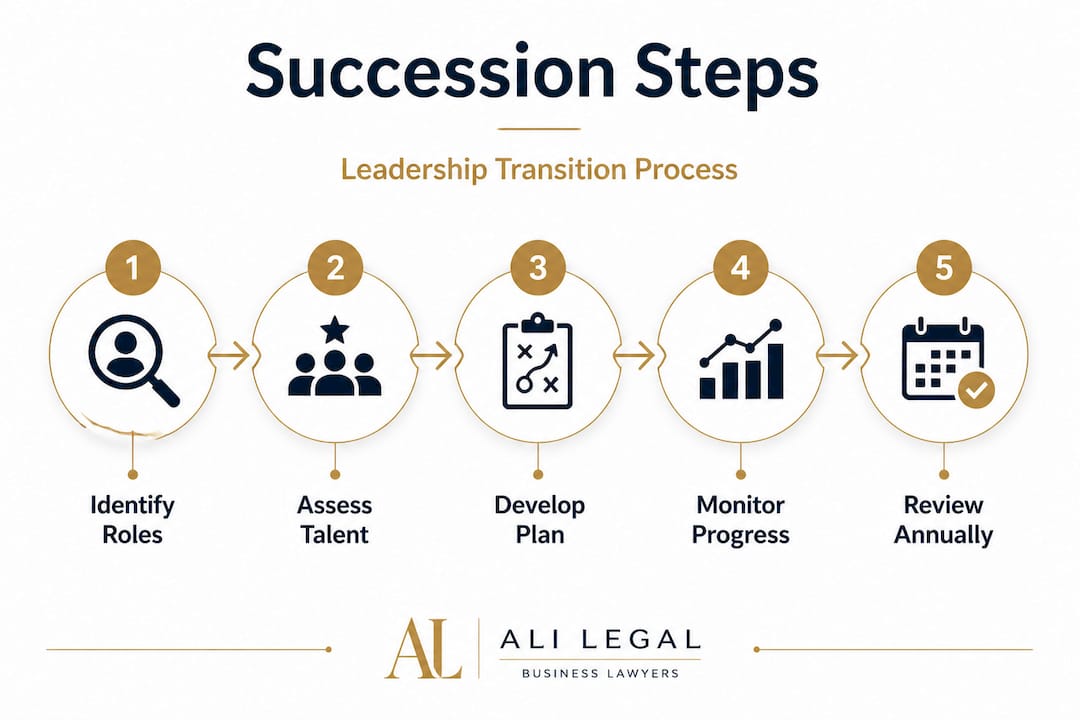
Even with a process in place, pitfalls abound. Understanding these helps leaders design more resilient succession plans.
The most common mistake is building a plan and then leaving it untouched. Business strategies change, roles evolve, and people develop in unexpected directions. A succession plan written in 2022 may be largely irrelevant by 2026 if it has not been revisited.
Succession planning must handle edge cases like unexpected departures and must stay current as business needs change. That means your plan needs two tracks: a long-term development track and a short-term emergency protocol.
Other frequent pitfalls include:
“Where traditional succession planning falls short is in its tendency to focus on replacement rather than readiness, overlooking the evolving demands of roles and the genuine potential of individuals.”
Modern approaches bring greater emphasis on psychological safety in assessment conversations, stronger links between succession and business strategy, and the use of external benchmarking to calibrate internal assessments honestly. Understanding your legal duties in succession also matters, particularly when governance obligations, shareholder agreements, or employment contracts are involved.
The final piece is ensuring strong oversight. Governance structures, especially boards of directors, fundamentally shape succession outcomes.
Boards and governance groups should treat CEO succession as an ongoing process with appropriate structure, timelines, and sufficient preparation of internal candidates. That means the board is not simply informed of a succession plan. It actively participates in shaping and monitoring it.
| Governance benchmark | Recommended practice |
|---|---|
| Board review frequency | At least twice per year for CEO succession |
| Formal succession policy | Documented and board-approved |
| Emergency successor identified | At all times for the CEO role |
| Readiness horizon for internal candidates | Two to three years of active preparation |
| HR and board alignment meetings | Quarterly minimum |
Key principles for effective board oversight include:
Strong board oversight in succession is not just about internal continuity. It reassures investors, lenders, and clients that the organisation can withstand change without losing strategic direction.
All of these frameworks and benchmarks point to one uncomfortable truth: succession planning is rarely failed at the technical level. It is failed at the human level.
In our experience working with business owners and executives, the most common reason succession plans fail is that they are treated as documents rather than dialogues. Leaders write a plan, feel satisfied, and move on. The plan then sits in a folder while the business, the people, and the environment all change around it.
The deeper issue is that many leaders conflate replacement with continuity. They are looking for someone to fill a seat rather than someone to carry forward a purpose. That distinction matters enormously. A business built around a charismatic founder does not need a replica of that founder. It needs a leader who understands the founding values and can evolve them for a new chapter.
We also see a consistent pattern of succession planning being treated as separate from business strategy. The two are inseparable. If your business plans to expand internationally in the next five years, your succession pipeline needs leaders who can operate across borders, manage diverse teams, and navigate different regulatory environments. A plan that ignores your strategic direction is not a succession plan. It is a list of names.
The most resilient organisations we work with treat succession planning as a form of institutional self-awareness. They know who they are, where they are going, and which human capabilities they need to get there. They build client trust through succession by ensuring that the relationships, values, and service standards clients depend on survive every leadership change.
Finally, stress-test your plan. Run scenarios. What happens if your top two candidates both leave? What if a critical role needs to be filled in four weeks rather than four months? Plans that have never been tested are plans that will fail under pressure.
Organisations that get succession planning right rarely do it alone. Legal expertise can safeguard your process and your future.
Succession planning touches employment law, shareholder agreements, corporate governance, and sometimes international structures. A poorly drafted plan can create disputes, challenge ownership arrangements, or leave key roles legally unprotected during transitions. Ali Legal provides strategic support across commercial litigation and leadership disputes as well as building board trust and governance frameworks. Whether you are formalising your first succession plan or restructuring an existing one for a growing business, our team offers clear, fixed-fee advice that aligns your succession strategy with your legal and organisational obligations.
Begin by identifying critical roles and mapping out internal talent against future needs, then create action plans to close the gaps. A practical methodology starts with role identification and talent readiness assessment before anything else.
Review succession plans at least annually and after any major business or leadership change. Because succession planning must handle unexpected departures, building in a formal mid-year review is also strongly advisable.
Boards, CEOs, and executive leadership are typically responsible for oversight, but HR leads the day-to-day planning. Effective governance means boards treat succession as a standing agenda item rather than an occasional conversation.
Key leadership or knowledge gaps can lead to costly disruption and lost stakeholder trust if transitions are not anticipated. A proactive leadership pipeline prevents the reactive, expensive hiring that typically follows unplanned departures.
TL;DR:
- Many business owners mistakenly believe restrictive covenants provide broad legal protection against competition. These clauses must protect legitimate interests like trade secrets and client relationships, or they risk being unenforceable in court. Properly drafted, role-specific covenants with clear scope and consideration can effectively safeguard a business’s valuable assets.
Many business owners insert restrictive covenants into their contracts believing they act as a broad legal shield against any form of competition. They don’t. Restrictive covenants are contractual clauses in employment, commercial, shareholder, partnership, or M&A agreements that limit post-termination activities to protect legitimate business interests such as goodwill, trade secrets, client relationships, and workforce stability. The key word here is legitimate. Poorly drafted covenants get struck down in court every year, leaving businesses exposed at the very moment they need protection most. This guide clarifies what these clauses are, what types exist, how enforceability is tested, and how to draft them properly.
| Point | Details |
|---|---|
| Covenants protect business interests | Restrictive covenants are not blanket bans; they defend goodwill, trade secrets, and client relationships. |
| Enforceability demands precision | Courts require covenants to be tightly linked to legitimate interests with reasonable scope and duration. |
| Tailored drafting is essential | Bespoke, role-appropriate wording avoids legal pitfalls and increases enforceability. |
| Global variations impact contracts | Laws governing restrictive covenants differ across jurisdictions, affecting cross-border business strategy. |
| Expert advice maximises protection | Legal guidance ensures covenants serve your business and withstand scrutiny. |
A restrictive covenant is, at its core, a contractual promise to refrain from doing something. In a commercial context, that “something” is usually competing, soliciting clients or employees, or disclosing sensitive information after a contract ends or a business changes hands. These clauses appear across a wide range of agreements, including employment contracts, shareholder agreements, partnership deeds, franchise arrangements, and merger and acquisition (M&A) deals.
The purpose is not to punish a departing employee or freeze a competitor out of the market. Courts in England and Wales are firm on this point. A covenant must protect a proprietary interest, which means something specific and valuable that your business has built up over time. As defined by the ICAEW, these clauses exist to safeguard goodwill, trade secrets, client relationships, and workforce stability. They are not a tool for preventing general competition.
The types of proprietary interests worth protecting typically include:
Understanding defining commercial contracts helps set the wider context for how these clauses sit within a business’s legal framework. A restrictive covenant is only one mechanism within the broader contractual architecture, but it is often the one most heavily contested.
“A court will not enforce a restrictive covenant simply because it exists in a signed contract. It will look beneath the surface to ask: what legitimate interest is this clause actually protecting, and is the restriction proportionate to that interest?”
One common misconception is that the length or complexity of a covenant determines its strength. In reality, a brief, precisely worded non-solicitation clause tied explicitly to a specific client relationship can outperform a sweeping five-page non-compete that covers every sector imaginable. Substance beats scale in this area of law every time.
With the foundation in place, it is worth examining the specific categories of restrictive covenants used in business contracts, because each serves a different protective function and carries different enforceability implications.
The four most common types are:
Each type has a distinct role. Non-competes are the most contentious and frequently litigated. Non-solicitation clauses, by contrast, are generally viewed more favourably by courts because they target specific relationships rather than whole market sectors. NDAs are typically the most robust because they protect objectively definable information rather than activities.

The prevalence of these clauses globally illustrates how seriously businesses take post-termination risk. OECD data shows up to 25% of workers in some OECD countries are subject to non-competes, while 80% of S&P 1500 CEO contracts include non-competes of one to two years. Perhaps most surprisingly, these clauses appear even in low-wage roles, a trend that is now attracting significant legal scrutiny.
| Covenant type | Typical scope | Enforceability | Common context |
|---|---|---|---|
| Non-compete | Industry, geography, duration | Moderate, role-dependent | Employment, M&A |
| Non-solicitation | Named clients or staff | Generally stronger | Commercial, employment |
| Non-disclosure | Specific information categories | Strong if well-defined | All contract types |
| Garden leave | Notice period duration | Strong if paid in full | Senior employment |
Pro Tip: In a business sale, covenants tied to the purchase price are often more enforceable than equivalent employment covenants. The arms-length nature of the deal and the substantial consideration exchanged gives courts more reason to uphold them. Review the approach to UK contract law explained to understand how consideration principles apply more broadly.
For commercial and M&A transactions, the bargaining dynamic changes significantly. Both parties are typically advised, the risks are understood, and the consideration is explicit. This matters because commercial law essentials for businesses remind us that enforceability often depends as much on context as on wording.
Enforceability is where many businesses get a rude awakening. A signed covenant is not automatically enforceable. UK courts apply a clear test: is the restriction reasonable in protecting a legitimate business interest, and is it reasonable with reference to the interests of the parties and the public?
There are four core factors courts examine:
Courts will not save a poorly drafted covenant by rewriting it. They may apply the “blue pencil” rule to sever an unenforceable part if the remainder still makes sense, but this is not guaranteed, and relying on it is a risky strategy.
When a breach occurs, the two primary remedies are injunctions and damages. LexisNexis guidance confirms that businesses should seek injunctions urgently, as courts favour prompt action. Waiting months to respond to a breach signals that the harm was not serious, weakening the case. Damages are available where financial loss can be proven, but quantifying lost business is notoriously difficult.
The international picture adds another layer of complexity, particularly for businesses with cross-border operations or employees working remotely across jurisdictions. 2025 data shows stark variation: California bans employment non-competes outright, Washington has introduced sweeping restrictions, Texas limits healthcare non-competes to one year within five miles, and at least 13 US states tightened their laws in 2025 with wage thresholds. Florida remains permissive for high-compensation roles.
Understanding statutory limitation for UK businesses is also relevant here, particularly where businesses consider the timing of legal action following a covenant breach.
“Courts do not enforce restraint of trade clauses as a matter of course. Public policy demands a balance between contractual freedom and the freedom to work and trade.”
Remote working has added genuine complexity to the geography question. A clause restricting competition within a 50-mile radius made perfect sense when an employee worked from a fixed office. When that same employee works from anywhere in the country, geography-based restrictions become harder to justify and easier to challenge.
Good drafting is where abstract legal principle meets real business protection. The most enforceable covenants are those written with a specific role, a specific interest, and a specific risk in mind. Here is how to approach it.
Tailor to the individual role and seniority. A covenant appropriate for a chief revenue officer with access to every client account and strategic plan is not appropriate for a junior sales assistant. ICAEW guidance is explicit: covenants must tie to proprietary interests, not serve as a general barrier. Blanket clauses applied uniformly across all staff invite challenge.
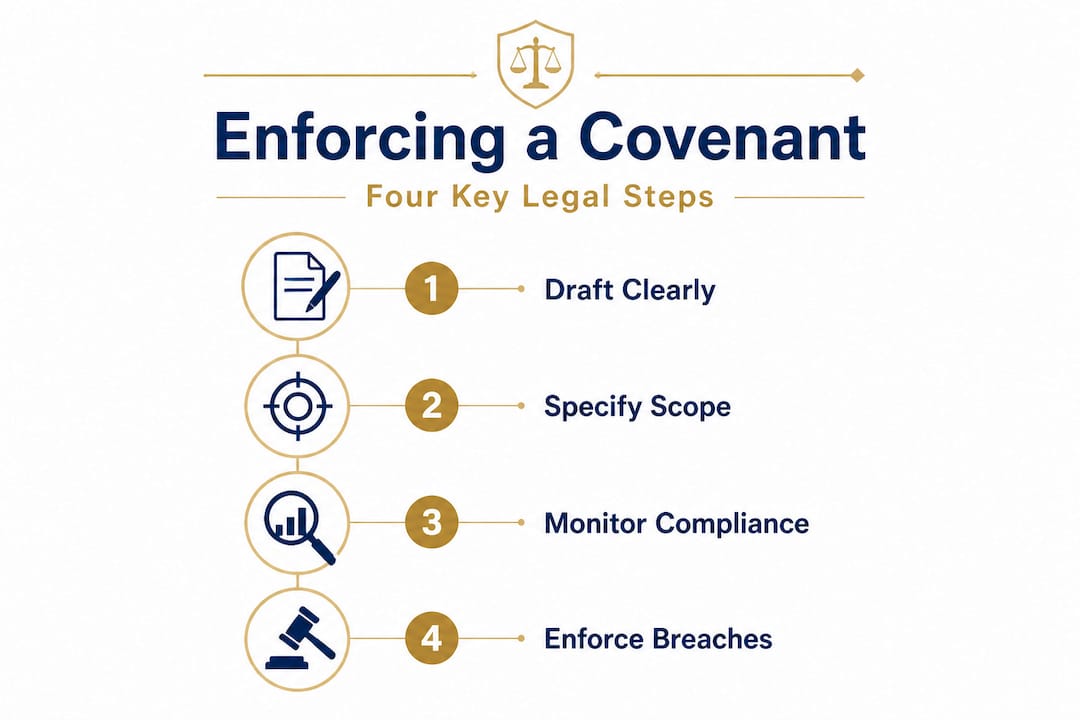
Name the interest explicitly. Rather than vague language about “competitive activities,” specify what is being protected. Is it the list of 50 named enterprise clients that the employee managed personally? Is it the pricing algorithm developed over four years? Name it, because courts respond to specificity.
Document the rationale and consideration. Particularly in business sale agreements, courts look more favourably on covenants where goodwill protection and purchase price are clearly linked. The more transparent the rationale, the harder it is to argue the covenant is unreasonable.
Practical drafting guidance worth following:
Pro Tip: Seek advice under legal privilege in UK business when reviewing your covenant strategy. Legal advice privilege protects the content of those discussions from disclosure in litigation, giving you a safer space to assess risk candidly.
For businesses operating under franchise models, understanding how franchise law for business ownership intersects with covenant obligations is particularly important, as franchise agreements often include their own specific restrictions that must align with your employment and commercial contracts.
The review cycle matters as much as the initial drafting. A covenant written five years ago may reference geographic territories that no longer reflect your business, or fail to account for remote working norms that courts now factor into enforceability assessments. Annual reviews, particularly after significant business changes, are a sound investment.
Here is the uncomfortable reality we see repeatedly: businesses spend money on contracts but not on thinking. They take a precedent covenant from a previous deal, adjust the names and dates, and consider the job done. Then, two years later, they sit in a solicitor’s office having just watched a departing director walk straight to a competitor, and wonder why the covenant is not holding up.
Generic, one-size-fits-all covenants fail because courts are sophisticated. They look past the clause as written to ask what it is actually doing. A non-compete covering every sector in every geography for three years is not protecting goodwill. It is attempting to suppress competition. Courts increasingly strike these down, and public policy considerations explicitly require a balance between contractual freedom and the freedom to trade.
Remote and hybrid work has fundamentally changed the geography of risk. An employee who never set foot in a physical office still has access to every client relationship, every pricing model, and every strategic plan. Yet many businesses still default to geographically-defined covenants that courts find increasingly difficult to apply meaningfully. The solution is not to abandon geography entirely but to supplement it with role-specific, interest-specific restrictions that do not depend on physical location to make sense.
The businesses that fare best in this area treat restrictive covenants as a living part of their commercial strategy, not a one-off legal box-tick. They invest in bespoke drafting tied to named roles and specific interests, build regular legal review into their contract management cycles, and maintain documentation that explains precisely why each restriction exists. When a dispute arises, that paper trail is often the difference between a successful injunction and an unenforceable clause. Consider your commercial lease law obligations as an analogy: the same rigour you apply to property obligations should apply to the covenants protecting your business’s most valuable commercial assets.
Protecting your business with well-drafted restrictive covenants requires more than downloading a template. The legal landscape is shifting, courts are scrutinising overbroad clauses more closely than ever, and the consequences of getting it wrong are significant.
At Ali Legal, we work with business owners and executives to draft, review, and enforce restrictive covenants that actually stand up. Our commercial litigation services cover disputes from injunction applications to damages claims, with strategic advice at every stage. Whether you are facing a potential breach or building covenants into a new shareholder or M&A agreement, our team provides clear, fixed-fee guidance. Read our civil litigation guide to understand the process, then contact us to discuss your specific position.
Restrictive covenants are legally binding if they protect legitimate business interests and are reasonable in scope, duration, and geography. A signed covenant alone does not guarantee enforceability.
No. Courts are clear that covenants cannot protect against mere competition itself; they must be tied explicitly to proprietary interests such as trade secrets, goodwill, or specific client relationships.
Courts typically grant injunctions urgently to prevent further breach, and can award damages where financial loss is proven. Acting promptly after a breach is critical to a successful application.
Yes, and M&A covenants are generally more enforceable than employment covenants because they involve arms-length negotiation, substantial consideration linked to the purchase price, and clear goodwill protection.
Significant differences exist across jurisdictions. For example, California bans employment non-competes entirely, while Florida remains permissive for high-compensation roles, and 13 US states tightened their restrictions in 2025 alone.
TL;DR:
- Effective contract drafting hinges on clear design that reflects business goals and precise language, avoiding reliance on generic templates.
- Thorough clause-by-clause checklists and critical analysis of boilerplate provisions are essential to prevent costly legal errors and disputes.
- Integrating technology can assist efficiency, but human judgment and tailored review remain vital to ensure contracts are enforceable and aligned with current law.
Every contract you sign or issue carries assumptions baked into its language, and those assumptions can either protect your position or quietly undermine it. Poor drafting is not simply an inconvenience; it generates disputes, triggers compliance failures, and leaves your business exposed to risks you never anticipated. A robust contract-drafting methodology starts with deliberately translating your business deal into clear legal structure, not just assembling borrowed clauses. This guide walks you through the best practices that experienced practitioners rely on to produce contracts that are precise, enforceable, and genuinely fit for purpose.
| Point | Details |
|---|---|
| Prioritise contract design | Begin with a clear mapping of your business deal into contract structure rather than relying on off-the-shelf templates. |
| Use a structured checklist | A clause-by-clause checklist helps ensure nothing is missed and every term is clear and effective. |
| Tailor all boilerplate | Never treat boilerplate as harmless—customise every standard clause to fit your agreement. |
| Regularly update templates | Continually update forms and precedents to reflect new laws and real-world experience. |
| Balance AI with legal judgement | Use technology for efficiency but rely on human expertise to safeguard against errors and misinterpretations. |
Before a single clause is written, you need to understand what the contract is actually trying to achieve. Contract design means capturing the commercial goals, obligations, and risk allocation of a deal in both structure and plain language. It is the foundation on which everything else rests, and skipping it is the single most common reason contracts fail to protect the parties involved.
Many businesses reach for a template the moment they need a contract. Templates are not inherently bad, but treating them as a finished product is a dangerous shortcut. Every transaction has unique commercial terms, bespoke risk profiles, and regulatory considerations that a generic form simply cannot address. The design process should happen before you even open a template, not after.
Here is a practical order for approaching contract design:
“A robust contract-drafting methodology starts with contract ‘design’ fundamentals: systematically translate the business deal into contract structure and language, not just assemble boilerplate.” — Contract Design: Principles and Practice, Stanford Law
When drafting commercial contracts, this design-first approach ensures that the legal document is a genuine reflection of the business deal rather than a patchwork of borrowed provisions. Well-designed contracts for business protection create a roadmap that both parties can follow and a safety net when things go wrong.
Pro Tip: Hold a short “deal design” meeting with all stakeholders before drafting begins. Even 30 minutes spent mapping obligations and risks will save hours of revision later and significantly reduce the chance of disputes.
With a clear design blueprint in place, the next step is turning that planning into disciplined, organised drafting. A clause-by-clause checklist is not a bureaucratic exercise. It is the mechanism that prevents important provisions from being omitted, ensures consistency throughout the document, and forces the drafter to think carefully about every element of the agreement.
Drafting best practices should include an explicit, clause-by-clause checklist for planning and organising the drafting process, selecting the proper form, allocating and mitigating risk, and drafting provisions concisely, precisely, and consistently. This is not optional advice for large transactions. It applies equally to a straightforward services agreement or a complex joint venture.
A practical clause-by-clause checklist should address the following:
| Checklist area | Common omission | Risk if overlooked |
|---|---|---|
| Definitions | Undefined key terms | Ambiguity leading to dispute |
| Payment terms | No interest on late payment | Financial loss |
| IP ownership | Vague assignment language | Loss of created assets |
| Termination | Missing notice period | Contractual breach |
| Governing law | No jurisdiction clause | Costly jurisdictional disputes |
When navigating commercial contracts, this checklist approach breaks a potentially overwhelming document into manageable, reviewable pieces. It also highlights interdependencies, for instance, where a termination clause references a definitions clause that has since been amended.
Pro Tip: Build your checklist into your firm’s standard workflow for commercial contract essentials. Review it at drafting stage, after negotiation, and immediately before signing. Treat it as a living document, not a one-time exercise.
Boilerplate clauses are the standard provisions that appear almost automatically in commercial contracts. Governing law, jurisdiction, entire agreement, severability, notices, force majeure and survival clauses are among the most common. The danger is that many drafters and their clients treat these as formalities, inserting them without genuine analysis.

This is a costly mistake. Standardised boilerplate clauses can be outcome-determinative, and best practice requires critically analysing and harmonising boilerplate with the rest of the agreement, particularly cross-clauses such as survival, notice, governing law, forum and waiver, and interpretation. In plain terms: these clauses can decide who wins a dispute.
Consider a few real-world examples of boilerplate going wrong:
Best practice is to critically analyse and harmonise boilerplate with the rest of the agreement, especially cross-clauses that are often assumed to be standard but are, in fact, highly transaction-specific.
When assessing certainty in contract drafting, the boilerplate section should receive the same forensic attention as the commercial terms. Never assume that a clause is harmless simply because it appears in every contract you have seen.
Templates and precedent documents serve a genuinely useful purpose. They reduce drafting time, provide structural guidance, and capture lessons from previous transactions. Used responsibly, they are valuable tools. Used carelessly, they are landmines waiting to detonate.
Edge-case best practices include proactively evaluating precedent and templates for legal and practical fit in the specific transaction and updating them to comply with current law and practice. This is particularly relevant in the UK, where legislation changes regularly and judicial decisions can shift the interpretation of familiar contractual language.
Here is how to manage templates responsibly:
For growing businesses, investing in bespoke startup contract packs rather than relying on downloaded templates is frequently the more cost-effective option in the long run. The cost of a poorly drafted agreement, when it generates a dispute or a compliance failure, almost always exceeds the cost of getting it right from the outset.
Pro Tip: Set a calendar reminder to review your most-used contract templates every six months. Legislation, industry regulations, and commercial practice all evolve. Your standard documents should evolve with them.
Every experienced contracts solicitor has a story about a seemingly minor drafting error that caused major damage. A missing word. A cross-reference to the wrong clause. A defined term used inconsistently. These are not hypothetical risks; there is empirical support for treating contract drafting mistakes as genuine “landmines” rather than harmless variations.
The most common sources of contractual landmines include:
Even a single word change in a standard clause can shift millions of pounds of risk from one party to another. This is not an exaggeration. Courts have decided cases on the presence or absence of the word “reasonable.”
Robust contract review processes are the most effective defence against landmines. This means independent review by a qualified solicitor, not just a re-read by the person who drafted it. For businesses handling high volumes of contracts, document review support provides structured oversight that scales with your needs.
Pro Tip: After any significant negotiation or revision, run a definitions audit: extract every defined term, locate every use of that term in the document, and confirm that the usage is consistent. This single check catches a surprising proportion of drafting errors.
Legal technology, including AI-assisted drafting and review tools, has become a genuine feature of modern contract practice. These tools can accelerate first-draft production, flag missing standard clauses, and identify inconsistencies that a tired human eye might miss. Used well, they add real value.
However, performance evaluation of legal AI in contract review reveals important limitations. Measuring “ground truth match” may not capture legal adequacy, and expert interpretation can be heterogeneous, meaning automated checks need human and legal judgement boundaries. In plain terms: AI tools can tell you whether a clause exists, but they often cannot tell you whether it is adequate for your specific transaction.
Practical principles for integrating legal AI responsibly:
The essential contract review practices that protect your business are still rooted in qualified human judgement. Technology is a powerful assistant, not a replacement.
Pro Tip: If you use AI drafting tools, always run the output through a structured checklist review conducted by a solicitor. The AI handles speed; the solicitor handles accuracy and legal adequacy.
There is a persistent misconception that contracts are administrative formalities, something to be processed quickly so the “real work” can begin. In our experience, this attitude is precisely where businesses get into serious trouble.
The contract is the deal. It defines what each party is actually agreeing to, what happens when things go wrong, and who bears the financial consequences of every foreseeable (and some unforeseeable) risk. Treating it as a formality means accepting that somebody else, quite possibly a court, will define those terms for you later.
What we have found, working across commercial, corporate, and international matters, is that the businesses which suffer the fewest contractual disputes are not necessarily the ones with the most complex agreements. They are the ones whose contracts are clear, specific, and genuinely reflective of the deal that was actually struck. Plain language, precise obligations, and tailored provisions consistently outperform dense legal boilerplate that nobody actually reads until something goes wrong.
The uncomfortable truth is that most contractual disputes are entirely avoidable. They arise not from bad faith but from ambiguity, from drafting that allowed two parties to read the same clause and reach different conclusions. Investing properly in contract design and review at the outset is not a legal expense. It is a business protection strategy with a demonstrably positive return.
Getting your contracts right from the start is one of the most cost-effective investments a business can make. At Ali Legal, we work with businesses and individuals to produce commercial agreements that genuinely reflect the deal, allocate risk appropriately, and stand up to scrutiny.
Whether you need support with a single high-value agreement or a suite of contracts for a growing operation, our team provides clear, fixed-fee advice without unnecessary complexity. We review, draft, and advise on contracts across commercial, corporate, property, and international matters. Our approach is straightforward: we understand your objectives, identify the risks, and produce documentation that protects your position. Contact Ali Legal today to discuss how we can support your contracting needs.
Neglecting to customise boilerplate clauses and failing to check cross-references often leads to confusion and costly legal disputes that could have been avoided with careful drafting.
Templates are useful as starting points but must always be tailored and updated for each transaction. Evaluating templates for legal and practical fit in the specific deal is considered essential best practice.
AI tools can support drafting but cannot fully replace expert human judgement. Legal AI evaluation shows that automated checks have real limitations, particularly around legal adequacy and contextual interpretation.
Follow a structured clause-by-clause checklist), critically analyse every provision including boilerplate, and ensure the final agreement aligns with current law and your specific commercial objectives.
TL;DR:
- Small businesses often overlook valuable intellectual property assets like trademarks, copyrights, and trade secrets.
- Proper registration, documentation, and legal agreements are essential to protect IP from infringement and disputes.
- Proactive IP management, including regular audits and expert advice, saves cost and secures business growth.
Your business name, your logo, that unique process you’ve spent years refining, even a song you wrote on a rainy afternoon. These are all legal assets. Most individuals and small business owners don’t realise they’re sitting on valuable intellectual property until someone copies it, steals it, or they accidentally give it away. IP refers to creations of the mind, including inventions, brand names, stories, and secret know-how, all of which can be protected under law. The problem isn’t a lack of IP. It’s a lack of awareness about what you own and what that ownership actually means.
| Point | Details |
|---|---|
| IP is valuable | Your inventions, brand, and ideas are protected assets that add real business value. |
| Protection varies | Some IP rights arise instantly, others need registration or secrecy—know the difference. |
| Risks of neglect | Failure to protect IP can lead to lost profits, copycats, and costly disputes. |
| Practical steps | Record your creations, use agreements, and seek expert help for lasting protection. |
Intellectual property is a legal term for creations that come from your mind and that the law treats as property you can own, protect, and even sell. Think of it this way: just as you own the chair you’re sitting on, you can own the idea behind a product, the name of your brand, or the words in a book you’ve written.
IP covers creations of the mind, from inventions and brand names to stories, songs, and secret business know-how. This is not just a concept for multinational corporations. A sole trader with a distinctive logo owns IP. A freelance copywriter owns IP in every piece they produce. A bakery with a secret recipe holds IP in that knowledge.
Understanding how property rights work in a broader legal sense helps put IP in context. Property law already governs what you own and how you can protect it. IP simply extends those principles to intangible assets.
Here are some everyday examples of intellectual property that individuals and small businesses often overlook:
“Intellectual property is not a privilege reserved for inventors in labs. It is the foundation of every brand, every creative business, and every innovation that sets a company apart from its competitors.”
Understanding ownership rights for UK creators is particularly important in a commercial context where disputes over who owns what can arise the moment you bring in a contractor, partner, or employee. The law may not automatically assign ownership to who you assume it belongs to.
There are four commonly discussed categories of IP rights: patents, trademarks, copyright, and trade secrets. Each protects something different, lasts for a different period, and requires a different set of actions from you.
| IP type | What it protects | How it’s obtained | Typical duration |
|---|---|---|---|
| Patent | Inventions and technical innovations | Registration required | Up to 20 years |
| Trademark | Brand names, logos, slogans | Registration (or use in commerce) | Indefinite if renewed |
| Copyright | Creative works: writing, art, music | Automatic on creation | Life of author plus 70 years |
| Trade secret | Confidential business information | Maintained through secrecy | Indefinite if protected |
Here is a closer look at each, along with some common misconceptions:
Patents. A patent grants the holder an exclusive right to prevent others from making, using, selling, or importing a patented invention for a limited period. Many small business owners assume a patent is only worth pursuing for complex technology. In reality, even a novel mechanical design, a new packaging method, or a unique tool qualifies. The application process is detailed and requires clear disclosure of the invention.
Trademarks. A trademark protects the identifiers of your brand, your name, logo, and strapline. One of the biggest misconceptions is that registering a company with Companies House gives you trademark protection. It does not. Your trading name could still be used or registered as a trademark by someone else unless you take separate steps to protect it.
Copyright. Copyright arises automatically the moment you create an original work. You do not need to register it or place a © symbol on it, though doing so strengthens your position in a dispute. Writers, graphic designers, photographers, and web developers all hold copyright in their output. The challenge is that many don’t realise their contracts may transfer that copyright to a client unless they specify otherwise.
Trade secrets. These cover anything confidential that gives you a commercial edge: a pricing formula, a client list, or a proprietary production method. Unlike other forms of IP, you cannot register a trade secret. Protection depends entirely on keeping the information genuinely secret and taking reasonable steps to do so. Refer to trade law compliance guidance for a better understanding of how confidentiality intersects with commercial law.
Some IP protection is automatic upon creation, while other rights depend on registration or ongoing vigilance to maintain. Knowing which category your IP falls into changes what you need to do right now.
For copyright, no action is required to create the right. The protection attaches the moment an original work is fixed in a tangible form, whether that’s written down, recorded, or saved to a file. However, if you need to enforce that right in court, you will need evidence of when you created it and that you are indeed the author.
For patents and trademarks, you must actively register your rights. In the UK, the Intellectual Property Office handles both. The process involves submitting applications, paying fees, and in the case of trademarks, clearing the proposed mark against existing registrations. Registration gives you a public record of ownership and much stronger grounds for legal action if someone infringes on your rights.
Here is a practical breakdown of the steps involved in securing each type of IP:
Pro Tip: Draft a simple IP log from day one. Record what you’ve created, when you created it, who was involved, and whether any agreements exist. This document alone can save you enormous time and money if a dispute ever arises.

Non-disclosure agreements (NDAs) are one of the most practical tools available to small businesses. Use them before sharing sensitive business information with potential partners, investors, or contractors. An NDA doesn’t prevent all risk, but it creates a legal obligation and a paper trail.
Your intellectual property may be your most valuable business asset, even if it doesn’t appear on your balance sheet. A strong brand name, an innovative process, or a loyal customer database has real commercial worth. Competitors, larger companies, and even former employees can exploit these assets if you haven’t taken steps to protect them.
The risks of not protecting your IP are concrete and costly. Consider these scenarios:
| Risk | Consequence | Example |
|---|---|---|
| Unregistered trademark | Loss of brand identity | A competitor registers your trading name |
| No NDA before pitch | Idea stolen without recourse | An investor copies your concept |
| Copyright not clarified | Dispute over content ownership | Freelancer claims ownership of your website |
| Trade secret disclosed | Loss of competitive advantage | An employee shares your recipe or formula |
Understanding that IP covers inventions, brand names, and secret know-how means you should be looking at your business through a new lens. What have you created? What makes you different? Those differentiators are the things worth protecting.
Practical steps small businesses should take now:
The stakes are especially high when you consider the cost of enforcement after the fact. Legal disputes over IP are expensive and time-consuming. Prevention, through proper registration and clear agreements, is always cheaper than litigation. Protecting your business interests from the outset is a strategy, not a luxury.
Pro Tip: Schedule an annual IP review. Business evolves. New products, new branding, and new processes emerge. What you created two years ago may now be unprotected because your original registration didn’t cover the current form of your product or service.
The most common IP mistakes aren’t deliberate. They happen because of assumption, oversight, or simply not knowing what to do next. These are the situations that leave businesses exposed.
Accidental disclosure. Discussing a product idea publicly before filing a patent application can destroy your right to protect it. Posting about an upcoming launch on social media, presenting at a networking event, or even chatting informally with a supplier all count as disclosure.
Poor documentation. Without clear records of who created what and when, ownership disputes become impossible to resolve simply. This is especially relevant when you’ve worked with freelancers or co-founders.
Confusing IP types. Many business owners believe that because they’ve registered a company name, their brand is protected. Or that because they’ve paid a designer, they own the copyright to the resulting artwork. Neither is automatically true.
Failing to enforce rights. Owning IP and enforcing it are two different things. If you don’t act when someone infringes on your trademark or copies your content, you risk weakening your position over time.
“If it’s worth creating, it’s worth protecting. Every asset you leave unguarded is an asset you’re offering to your competitors for free.”
Steps to take right now to reduce your exposure:
Trade secrets are only protected if you actively maintain their secrecy. Courts will not protect information that you’ve handled carelessly, regardless of how commercially valuable it is.
Pro Tip: Before engaging any external party with access to your processes, systems, or creative output, consult a solicitor about protecting trade secrets legally. A well-drafted NDA specific to your situation is far more effective than a template downloaded from the internet.
Most articles on intellectual property cover the basics well. What they rarely say is this: the biggest IP risk for small businesses is not infringement from outside. It is neglect from within.
We regularly see businesses that have built something genuinely valuable over years, only to discover that their IP is scattered, undocumented, and largely unprotected. A logo designed by a freelancer and never formally assigned. A trading name used for a decade but never trademarked. A process that employees know about but that has never been recorded or protected under a confidentiality framework.
The false belief that IP protection is only relevant for tech giants or major labels is costing small businesses real money every year. Infringement doesn’t always look like a copycat product. It can look like a former employee setting up a competing service using your client list, or a supplier selling your design to another customer.
There’s also the underestimated problem of digital forensics and IP protection in an age where work is shared digitally, stored in the cloud, and often created collaboratively across devices. Establishing who made what, and when, is increasingly complex without proper records.
Our view is straightforward: proactive IP management is one of the highest-return investments a small business can make. Registering a trademark costs a fraction of the legal fees involved in a brand dispute. Drafting a robust employment contract protects you from years of potential litigation. The legal services for protection you invest in early pay dividends many times over when your business faces commercial pressure or rapid growth.
The question is not whether your business has intellectual property worth protecting. It almost certainly does. The question is whether you’ve done enough to secure what you’ve built.
Protecting your IP effectively requires more than reading a guide. It requires clear, personalised advice from a solicitor who understands both the law and the commercial realities of your situation.
At Ali Legal, we support individuals and businesses in registering, maintaining, and enforcing their intellectual property rights. Whether you need help with a trademark application, a confidentiality agreement, or commercial litigation for IP protection when a dispute arises, our team provides straightforward, strategy-led advice at fixed fees. We also offer civil litigation help when you need to assert or defend your rights robustly. If you’re unsure what IP you own or how well it’s protected, contact us today for a consultation.
Intellectual property includes inventions, brand names, logos, written works, artistic creations, and confidential business information such as trade secrets. Essentially, anything original that you’ve created and that has commercial value may qualify.
No. Copyright is automatic upon creation, but patents and trademarks require formal registration, while trade secrets rely entirely on maintaining genuine confidentiality rather than any registration process.
It varies considerably. Patents typically last up to 20 years, copyright protects a work for the author’s lifetime plus 70 years, while trademarks and trade secrets can last indefinitely provided they are actively maintained and renewed.
Yes. Most forms of IP can be licenced, allowing others to use your rights under agreed terms, or sold outright. Licencing IP is a common and effective way to generate revenue from your creative assets without giving up ownership entirely.
Trade secrets are protected only when the information is genuinely secret, commercially valuable, and actively maintained through reasonable measures such as restricted access, confidentiality agreements, and staff training. Document who has access and review those controls regularly.
TL;DR:
- Civil litigation involves multiple stages, from pre-action to enforcement, requiring strategic preparation.
- Early settlement and alternative dispute resolution are highly encouraged to reduce high costs and uncertainty.
- Skilled legal support and careful case management increase the likelihood of cost-effective resolution and favorable outcomes.
Civil litigation can feel like stepping into a maze. Whether you are an individual pursuing a debt claim or a business facing a contractual dispute, the prospect of court proceedings is genuinely daunting. The stakes are high, the procedures are technical, and the costs can escalate quickly if you are not prepared. Understanding the importance of legal representation from the outset is one of the most effective ways to protect your position. This guide walks you through every key stage of the UK civil litigation process so you can approach any dispute with confidence and clarity.
| Point | Details |
|---|---|
| Structured steps matter | Following the civil litigation process helps protect your rights and manage disputes efficiently. |
| Settlement is encouraged | Courts and experts prioritise early settlement due to high costs and risks of full trials. |
| Disclosure is costly | The disclosure phase can represent up to 80% of overall litigation expenses, so preparation is key. |
| Expert support pays off | Professional advice can help you navigate complex steps and achieve better outcomes. |
Civil litigation is the legal process by which individuals or organisations resolve non-criminal disputes through the courts. It covers a wide range of matters including contract breaches, property disagreements, personal injury claims, professional negligence, and debt recovery. Unlike criminal proceedings, where the state prosecutes an individual, civil litigation is driven by one party (the claimant) pursuing a remedy against another (the defendant).
The standard stages of a UK civil claim follow a broadly consistent path:
The key actors in any civil case include the claimant, the defendant, their respective solicitors and barristers, and the presiding judge. Expert witnesses and court-appointed mediators may also play important roles depending on the complexity of the matter.
It is worth noting how UK procedures compare internationally. Federal courts follow uniform FRCP rules, such as 21 days to answer a claim and 90 days for service, while state courts vary considerably, with Texas TRCP, for example, operating tiered discovery levels. UK courts under the Civil Procedure Rules (CPR) operate with similar discipline but place a stronger emphasis on proportionality and active judicial case management.
| Stage | Typical timeframe (UK) | Key document |
|---|---|---|
| Pre-action | 4 to 12 weeks | Letter of claim |
| Claim issuance | Within 6 years (limitation) | Claim form (N1) |
| Defence | 14 to 28 days after service | Defence form |
| Disclosure | 4 to 12 weeks post-defence | List of documents |
| Trial | 6 to 18 months from issue | Trial bundle |
Understanding litigation funding explained is also essential at this stage, as the financial model you choose will shape how aggressively you can pursue or defend a claim.
The pre-action stage is where many disputes are resolved without ever reaching a courtroom. Before issuing a claim, parties are required under the CPR to follow pre-action protocols relevant to their type of dispute. These protocols set out the steps parties must take, including sending a formal letter of claim, allowing reasonable time for a response, and considering alternative dispute resolution (ADR).
Courts take pre-action conduct seriously. Failing to follow the correct protocol can result in cost sanctions, even if you ultimately win your case. The letter of claim should clearly set out the nature of the dispute, the remedy sought, and a reasonable deadline for response, typically 14 to 28 days depending on the protocol.
Settlement is prioritised due to high costs, where discovery alone accounts for around 80% of total litigation expenses, as well as the inherent uncertainty and time demands of court proceedings. Judges actively encourage parties to attempt mediation or ADR before and during proceedings.
ADR options available at this stage include:
Understanding the role of a mediator is particularly valuable here, as skilled mediators can unlock settlements that neither party would have reached through correspondence alone. You should also explore alternatives to litigation thoroughly before committing to court proceedings.
Pro Tip: Engaging with ADR early, even before the pre-action letter is sent, signals good faith to the court and can significantly reduce your overall costs. Courts have the power to penalise parties who unreasonably refuse mediation, regardless of the outcome at trial.
If a settlement is reached at this stage, a formal settlement agreement guidance document should be drafted to record the agreed terms and prevent future disputes about what was agreed.
Once early settlement has been explored without resolution, the next step is to formally issue a claim. In England and Wales, this is done by filing a claim form (Form N1) with the appropriate court, along with particulars of claim that set out the factual and legal basis for the case. Court fees are payable on issue and are calculated based on the value of the claim.
The process for issuing and responding to a claim typically follows these steps:
When a defendant receives a claim, they have several options. They can admit the claim in full or in part, file a full defence, or file a defence alongside a counterclaim. Ignoring the claim is not a viable option. Failure to respond within the deadline allows the claimant to apply for a default judgement, which can be enforced without further proceedings.
Federal courts follow uniform FRCP timelines, including 21 days to answer and 90 days for service, whereas UK courts under the CPR set slightly different but equally strict deadlines. Understanding these distinctions matters particularly in cross-border litigation scenarios where multiple jurisdictions may be involved.
| Action | UK deadline | US federal deadline |
|---|---|---|
| Acknowledge service | 14 days | N/A |
| File defence | 28 days from service | 21 days from service |
| Serve claim | 4 months from issue | 90 days from filing |
Pro Tip: Missing a service or reply deadline can seriously damage your case. Even a short delay can result in a default judgement or adverse cost orders. Seek legal advice as soon as you receive a claim form, not after the deadline has passed.
Good strategy in litigation at this stage means thinking several steps ahead. How you frame your defence or counterclaim will shape the entire trajectory of the case.
After a defence is filed, the case moves into one of the most intensive and expensive phases: disclosure and evidence gathering. Disclosure requires each party to identify and share all documents that are relevant to the issues in dispute, including those that may be unhelpful to their own case.

Discovery accounts for around 80% of total litigation costs in many cases, which is why careful planning at this stage is not optional. It is essential. The documents you disclose and how you manage the process can determine the outcome of the entire case.
| Disclosure type | Scope | Typical use |
|---|---|---|
| Standard disclosure | Documents relied on and adverse documents | Most civil claims |
| Limited disclosure | Specific categories only | Proportionality cases |
| Extended disclosure | Broader search obligations | Complex commercial disputes |
Typical evidence gathered during this stage includes:
The court actively manages cases through case management conferences (CMCs), where a judge sets procedural timetables, resolves disputes about disclosure, and ensures the case is progressing proportionately. Sanctions for non-compliance with procedural orders can be severe, including striking out a claim or defence entirely.
For businesses considering the financial implications, exploring cost-effective litigation alternatives at this stage can still be worthwhile, even after proceedings have been issued. Settlement remains possible and often preferable throughout this phase.
With disclosure complete, the case moves towards hearings and, if necessary, trial. Not every civil case reaches a full trial. In fact, the vast majority settle before that point. But understanding what happens at trial is important, both for preparation and for negotiating from a position of strength.
Civil proceedings typically involve several types of hearings before any trial:
At trial, both parties present their evidence, witnesses are examined and cross-examined, and legal arguments are made. The judge then delivers a judgement, which may include an award of damages, a declaration of rights, an injunction, or a costs order.
Settlement is prioritised by courts at every stage because of the high costs and uncertainty involved. Even during trial, parties can reach agreement and present a consent order to the judge for approval. Courts will almost always welcome a settlement, regardless of how late it arrives.
Possible outcomes at the end of a civil trial include:
Pro Tip: Thorough preparation for hearings, including well-drafted witness statements and a clear trial bundle, not only strengthens your position at trial but also increases the likelihood of a favourable settlement before you reach it. Opponents who see a well-prepared case are far more likely to negotiate seriously.
Understanding how to approach resolving contract disputes strategically can make the difference between a costly trial and a commercially sensible resolution.
After an initial judgement, the litigation process does not necessarily end. Parties must consider whether to appeal, how costs will be dealt with, and how to enforce any order obtained.
Appeals in civil cases are not automatic. A party must obtain permission to appeal, either from the trial judge or the appellate court. Appeals are generally limited to points of law or procedural irregularity. They are not a second chance to re-argue the facts. The appellate court will only interfere if the original decision was wrong in law or procedurally unfair.
Cost orders are a significant feature of UK civil litigation. The general rule is that the losing party pays the winning party’s reasonable costs. However, courts have wide discretion and will consider factors such as conduct during proceedings, offers to settle, and compliance with pre-action protocols.
Methods for enforcing a court judgement include:
Federal courts follow uniform FRCP enforcement procedures, while UK courts offer a similarly structured but distinct range of enforcement tools. Choosing the right enforcement method depends on the debtor’s assets and circumstances.
Pro Tip: Before deciding to appeal, carry out a frank cost-benefit analysis. Appeals are expensive, time-consuming, and rarely successful. Sometimes accepting a less-than-perfect outcome and moving forward commercially is the wiser decision.
For specialist guidance on enforcement and post-judgement strategy, UK civil litigation services can provide the targeted support you need at this critical stage.
Here is something that experienced litigators know but rarely say out loud: the real skill in civil litigation is not winning at trial. It is knowing when and how to settle.
The popular image of litigation is dramatic courtroom battles and decisive verdicts. The reality is far less cinematic. Most cases settle. Many of those that do not settle probably should have. Trials are expensive, unpredictable, and emotionally exhausting for everyone involved. Even a successful claimant who wins at trial may recover only a fraction of their actual costs, and enforcing a judgement against an unwilling or insolvent defendant can take years.
We have seen clients spend more on legal fees than the value of the claim itself, simply because neither party was willing to step back and assess the commercial reality. That is not strength. That is stubbornness dressed up as principle.
The truly strategic success in litigation comes from using the litigation process as a framework for negotiation, not as a gladiatorial contest. Filing a well-drafted claim, complying rigorously with pre-action protocols, and preparing thoroughly for disclosure sends a powerful signal to the other side. It says: we are serious, we are prepared, and we are not going away. That is often enough to bring the other party to the table.
The best outcome in most disputes is not the one the judge orders. It is the one the parties craft themselves, on terms that reflect commercial reality and allow both sides to move forward. Invest your energy in building the strongest possible case, and then use that strength to negotiate the best possible settlement.
Navigating civil litigation without experienced legal support is a significant risk. Every stage, from pre-action correspondence to post-judgement enforcement, carries procedural pitfalls that can undermine even the strongest case.
At Ali Legal, we provide tailored civil litigation services for individuals and businesses across all stages of dispute resolution. Whether you are facing a complex commercial claim or a straightforward debt recovery matter, our team brings strategic thinking and transparent advice to every case. We also offer specialist commercial litigation support for high-value business disputes where the stakes demand a focused, results-driven approach. To understand how we approach each stage, explore our civil litigation best practices resource. Contact us today for a confidential consultation and take the first step towards resolving your dispute with confidence.
The main steps are pre-action, claim issuance, defence, disclosure of evidence, hearings or trial, judgement, and enforcement. UK courts follow structured CPR timelines, similar in discipline to US federal FRCP rules, though the specific deadlines and procedures differ.
Mediation is not strictly mandatory, but courts strongly encourage parties to attempt it before filing a claim. Settlement is prioritised because discovery costs alone can account for around 80% of total litigation expenses, making early resolution far more cost-effective.
Disclosure can represent approximately 80% of total litigation costs, making it the single most expensive phase of any civil case and a key reason why early settlement is so commercially sensible.
Yes, settlement can occur at any point before final judgement, including mid-trial. Courts actively encourage late settlement and will readily approve a consent order recording agreed terms, even after proceedings are well under way.


