
Menu
Get Expert Legal Support Today
Damages in a personal injury claim are the money awarded to compensate for two things: your pain, suffering and loss of amenity, known as general damages, and your quantifiable financial losses, known as special damages. General damages cover the injury itself, everything from a fractured wrist to long-term psychiatric harm. Special damages cover the money the injury has cost you: lost wages, medical bills, care, travel, and equipment.
Two actions matter more than anything else at this stage. First, get medical evidence on record early, even if that means a GP visit you’d otherwise skip. Second, start collecting receipts, payslips and bank statements immediately rather than trying to reconstruct them months later.
The general damages versus special damages split isn’t just a legal technicality. It decides what evidence you need and how your solicitor builds your case.
General damages compensate for pain, suffering and loss of amenity, often shortened to PSLA. This is the harder figure to pin down because there’s no invoice for a shoulder that no longer moves properly. Courts and solicitors rely on the Judicial College Guidelines to place an injury within a valuation bracket, cross-referenced against medical evidence. Common subheads within general damages include:
Special damages are past pecuniary losses, meaning financial costs that have already been incurred and can be calculated with precision. They must be pleaded with particulars and backed by vouching evidence such as receipts, invoices and payslips. Typical heads include loss of earnings, care costs (whether paid or provided by a family member), medical expenses, equipment such as mobility aids, and travel to appointments. Future pecuniary loss, covering ongoing or anticipated costs, sits alongside past loss but is calculated differently, which the next section covers.
Where a claimant suffers multiple injuries, courts sometimes apply an overlap discount to avoid double counting pain and suffering that stems from the same underlying trauma.
Pro Tip: Don’t assume a minor injury means minimal general damages. Chronic pain conditions and psychological injuries frequently attract higher brackets than claimants expect, provided the medical evidence properly documents ongoing impact.
Valuation isn’t guesswork, though it can feel that way from the outside. It follows a fairly consistent method, even if the final figure still depends on individual circumstances.
The multiplier effect surprises most claimants. A care need costing £15,000 a year doesn’t just multiply by remaining life expectancy; the Ogden tables adjust for discount rate and risk, which can still produce a lump sum running into hundreds of thousands of pounds for a younger claimant with a long life expectancy. In catastrophic injury cases, special damages routinely dwarf general damages precisely because lifetime care and lost earning capacity compound over decades.
Statistic callout: The size of an Ogden multiplier depends heavily on the discount rate set by the Lord Chancellor. A change of even half a percentage point in that rate can shift a lifetime care lump sum by tens of thousands of pounds, which is why claimants shouldn’t rely on rough annual-cost estimates when planning for long-term losses.
A claim is only as strong as its paperwork. Courts and defendant insurers expect vouched, itemised evidence, not estimates.
Start collecting the following as early as possible: medical records and expert reports, invoices and receipts for treatment or equipment, prescriptions, payslips covering the period before and after the injury, bank statements showing income disruption, receipts for travel to appointments, and a written statement from your employer confirming absence and any reduced duties.

The schedule of loss is the document that ties all of this together. It’s a running, itemised account of every past and anticipated future loss, and it needs updating as the claim develops, not written once and forgotten. The Pre-Action Protocol for Personal Injury Claims requires the Letter of Claim to include a clear summary of facts, injuries and a schedule of past and future losses, with an expectation that claimants keep defendants informed of ongoing financial loss.
Vouching standards apply strictly to special damages: a receipt or invoice for every claimed cost. Unpaid care provided by a family member, sometimes called gratuitous care, is valued differently, usually at a commercial care rate reduced by a discount, rather than left unclaimed simply because no money changed hands. For a fuller breakdown of what solicitors typically request, Scotland Claims Injury Lawyers set out a useful checklist of the evidence types insurers scrutinise most closely.
Pro Tip: If your losses are ongoing, ask your solicitor about an interim payment early. You don’t need to wait until settlement to recover money for costs you’re already incurring, provided liability has been reasonably established.
Time limits catch out more claimants than weak evidence does, so it’s worth knowing the framework before anything else slips.
A methodical process protects the value of a claim far more than any single clever argument. Early medical evidence, careful schedule drafting, timely expert instruction and, where liability looks clear, an early interim payment application all shape the eventual figure. This mirrors the approach set out in Ali Legal’s guide to personal injury compensation, which walks through joint expert instruction, contemporaneous care logging and commercial-rate valuation of gratuitous care.
Claimants who keep a running record from day one, rather than reconstructing costs from memory months later, consistently end up with stronger, better-evidenced schedules of loss.
Fixed-fee and transparent pricing structures remove one layer of uncertainty from an already stressful process, letting claimants focus on gathering evidence rather than worrying about legal costs escalating unpredictably.
Author: Panagiotis. [Qualifications and experience placeholder.] [Case studies placeholder.]
Punitive damages, called exemplary damages in England and Wales, are rare in personal injury claims and shouldn’t be confused with compensation for the injury itself. Where general and special damages exist to put the claimant back in the position they’d have been in without the injury, exemplary damages exist purely to punish the defendant for outrageous conduct.
They’re reserved for a narrow set of circumstances: where a defendant’s conduct was calculated to make a profit exceeding any compensation likely to be paid, where a government servant acted in an oppressive, arbitrary or unconstitutional way, or where a statute expressly authorises them. A drunk driver who caused an accident, however reckless, typically wouldn’t attract exemplary damages on those grounds alone. But a company that knowingly continued selling a dangerous product because the profit outweighed likely compensation claims might.
In practice, most personal injury claims never involve exemplary damages at all. The overwhelming majority of cases, from workplace accidents to road traffic collisions, are settled purely on compensatory principles: general damages for the injury, special damages for the financial loss. If you believe a defendant’s conduct was so deliberate or reckless that punishment feels warranted, raise it with your solicitor early, since it changes how the claim is pleaded and what evidence needs gathering from the outset.
Contributory negligence reduces your compensation when you’re found partly responsible for your own injury, even where the defendant is primarily at fault. Courts apportion blame as a percentage, and your total award, both general and special damages, is reduced by that percentage.
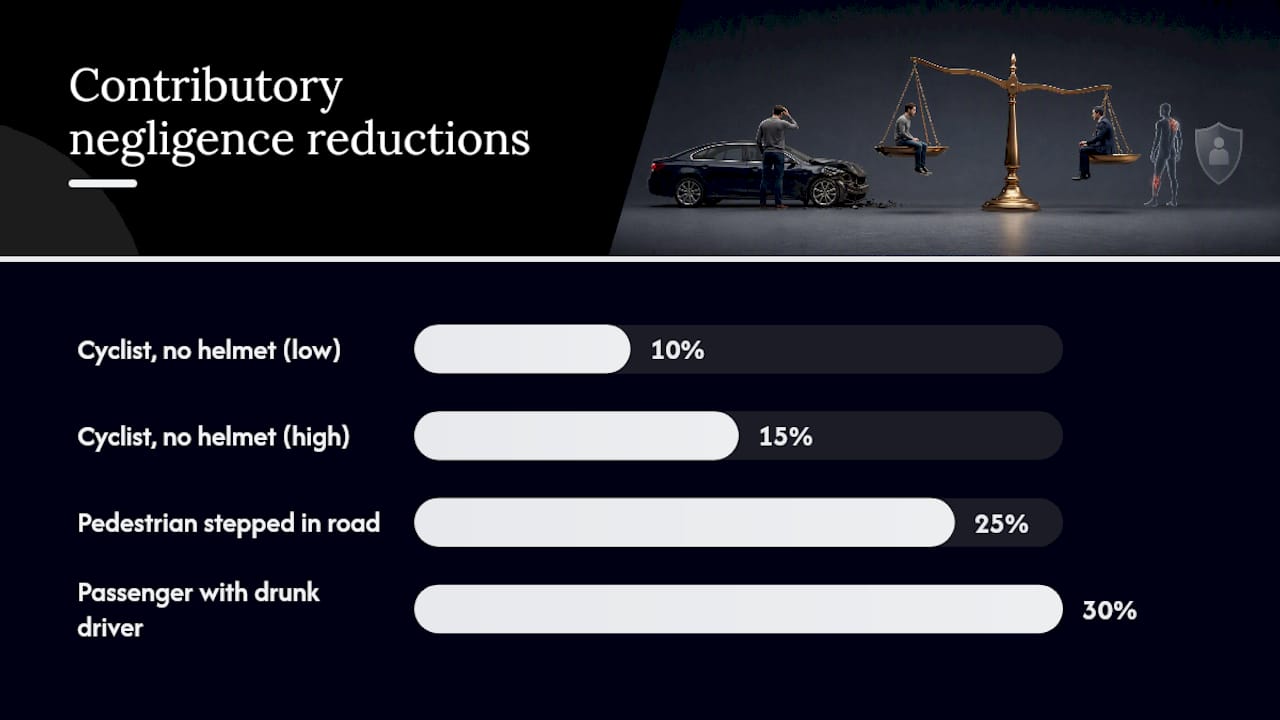
A cyclist injured by a careless driver but not wearing a helmet might see their award reduced by 10 to 15%, depending on how much the missing helmet contributed to the severity of the injury. A pedestrian who steps into the road without looking, hit by a speeding driver, might face a more substantial reduction, perhaps 25% or higher, because their own conduct materially contributed to the accident occurring at all. Passengers who knowingly travel with a drunk driver have historically faced meaningful reductions too.
The percentage isn’t fixed by any tariff. It comes from case-specific argument about causation and blameworthiness, which is exactly why insurers often push hard on contributory negligence early in negotiations.
This is where evidence quality becomes decisive again. Dashcam footage, witness statements and accident reconstruction reports can all shift the contributory negligence percentage substantially. If an insurer suggests you were partly at fault, don’t accept that framing without pushing back, since the difference between a 10% and 30% reduction on a serious injury claim can amount to tens of thousands of pounds.
Most personal injury claims settle long before they reach a courtroom. Negotiation typically begins once the defendant’s insurer has admitted liability, or at least accepted a reasonable prospect of it, and the claimant’s solicitor has produced a properly evidenced schedule of loss.

The process usually runs through rounds of offer and counter-offer. The insurer proposes a figure, often lower than the schedule suggests, and the claimant’s solicitor responds with supporting evidence for why the higher figure is justified, whether that’s a stronger medical prognosis, additional receipts, or updated care costs. Part 36 offers, a formal settlement mechanism under the Civil Procedure Rules, add cost consequences that push both sides toward realistic figures rather than opening positions.
Settling avoids the cost, delay and uncertainty of a trial, and the overwhelming majority of claims resolve this way. But settlement only works well when the schedule of loss is airtight. A poorly evidenced claim invites lowball offers, because the insurer knows a court might not award much more than what’s already vouched.
Court awards become necessary when liability is disputed, when the parties can’t agree on quantum despite strong evidence, or when the case involves complex future loss calculations that benefit from judicial scrutiny. A judge isn’t bound by either side’s opening position and will assess general damages against the Judicial College Guidelines and special damages against the evidence presented, which sometimes produces a figure higher, and sometimes lower, than either party expected.
Compensation for personal injury is not subject to income tax or capital gains tax in the vast majority of cases. Both general damages for pain and suffering and special damages for financial loss, including lost earnings, are paid to put you back in the position you’d have been in without the injury, and HMRC treats them as compensatory rather than as income.
This applies even to the loss of earnings element within special damages, which might seem counterintuitive since the wages themselves would have been taxed had you earned them normally. The compensation replaces a loss rather than generating new income, which is why it escapes tax.
There’s an important exception worth flagging. If damages are invested and generate interest or investment returns after they’re received, that subsequent income or gain can be taxable in the ordinary way. Periodical Payment Orders, used in the most serious long-term care cases, are also generally tax-free, reflecting their compensatory purpose even though they’re paid annually rather than as a lump sum.
If your award includes an interest element for the period between the incident and settlement, that interest can sometimes attract different tax treatment, so it’s worth raising with your solicitor or an accountant if your claim is substantial. For most claimants pursuing a straightforward injury claim, tax simply isn’t a factor that should affect how you approach negotiation or settlement.
Claimants consistently under-claim special damages by failing to log unpaid family care and small recurring costs like travel and prescriptions. A solicitor’s involvement tends to tighten evidence and protect the schedule’s credibility. Instruct one as soon as costs start accumulating, not once the claim feels complicated.
— Panagiotis
Building a strong schedule of loss under time pressure, while recovering from an injury, is exactly where most claims lose value. Ali Legal Ltd’s personal injury team handles the evidence-heavy groundwork directly: gathering medical reports, drafting and updating schedules of loss, instructing the right experts, and applying for interim payments once liability looks clear.

Fixed-fee options mean you know the cost of preparing your claim before you commit, rather than watching legal spend creep upward as the case develops. That transparency matters most in exactly the cases where special damages run highest, serious or long-term injuries where every receipt and care log genuinely affects the final figure. If you’re not sure whether your evidence is strong enough yet, or where to start with a schedule of loss, get in touch through Ali Legal’s contact page to arrange an initial conversation about your claim.
This article is general information, not a substitute for advice from a qualified lawyer. Consult a qualified legal professional about your own circumstances before acting on anything here.
M&A law is the branch of corporate law that governs how companies are bought, sold, and merged, providing the legal structure for transferring ownership, allocating risk between buyer and seller, and securing any regulatory approvals a deal needs before it can complete. In the UK, the Companies Act 2006 and the City Code on Takeovers and Mergers are the two anchors most transactions sit against.
What this actually covers, in practice:
A merger combines two companies into one, usually through a share exchange or a scheme of arrangement. An acquisition is one company buying another, which happens either as an asset purchase (buying specific assets and contracts, leaving the seller’s company shell behind) or a share purchase (buying the company itself, warts and all).
Public and private deals follow different rulebooks. Private acquisitions are negotiated privately between parties. Public company takeovers must follow the Takeover Code, and bidders choose between a contractual offer, accepted individually by shareholders, or a scheme of arrangement, which needs 75% shareholder approval by value and court sanction.
Why do companies actually do this? Usually one of three reasons:
Every transaction, however different the industries involved, tends to move through the same recognisable stages. Knowing which document belongs where saves you from being blindsided by your own lawyer’s invoice.
Pro Tip: Ask your solicitor for a one-page timeline at the start of the deal, showing which document unlocks which stage. It stops “when will this actually finish?” from becoming a weekly argument.
The lawyer’s job changes depending on which side of the table you sit on, and understanding that split explains a lot about why deals take the shape they do.
Fee structures vary. Fixed fees suit well-scoped transactions with predictable stages; hourly rates suit deals where the scope keeps shifting. Ask which model applies before instructing anyone.
Due diligence exists because the biggest risks in a deal are rarely visible on the surface. Litigation exposure, unpaid tax liabilities, environmental contamination, and underfunded pension schemes are the usual culprits, and they can resurface long after completion if nobody caught them beforehand.
Lawyers deal with this through a specific toolkit:
Price adjustment mechanisms, particularly completion accounts, let the final price move up or down based on the target’s actual financial position at closing rather than a guess made months earlier. On the regulatory side, CMA referrals and NSI Act screening have become routine checks even on mid-sized deals in sensitive sectors, which is why early screening now happens as standard rather than as an afterthought.
Most transactions touch at least one of four regulatory frameworks, and knowing which applies early avoids expensive delays later.
Schemes of arrangement require court sanction and 75% shareholder approval by value, according to Slaughter and May’s takeover guide, while a straightforward contractual offer is accepted or rejected by shareholders individually. Which route a bidder chooses depends heavily on target size, board cooperation, and how quickly they need to squeeze out minority shareholders.
Preparation before your first meeting saves real money, since much of a solicitor’s early time gets spent chasing documents you could have gathered yourself.
Pro Tip: If a seller resists giving you access to their due diligence data room promptly, treat that reluctance itself as information. It usually tells you more than what’s eventually in the folder.
Completion is not the finish line. Filings at Companies House need updating, and corporate registers must reflect the new ownership.
Tax treatment often decides deal structure before anything else gets negotiated. An asset purchase generally lets a buyer choose which liabilities to take on and can offer more favourable capital allowances, but it can trigger higher transfer costs and requires reassigning contracts individually. A share purchase transfers the company wholesale, including its tax history and any latent liabilities, which is exactly why tax warranties and indemnities feature so heavily in share purchase agreements.
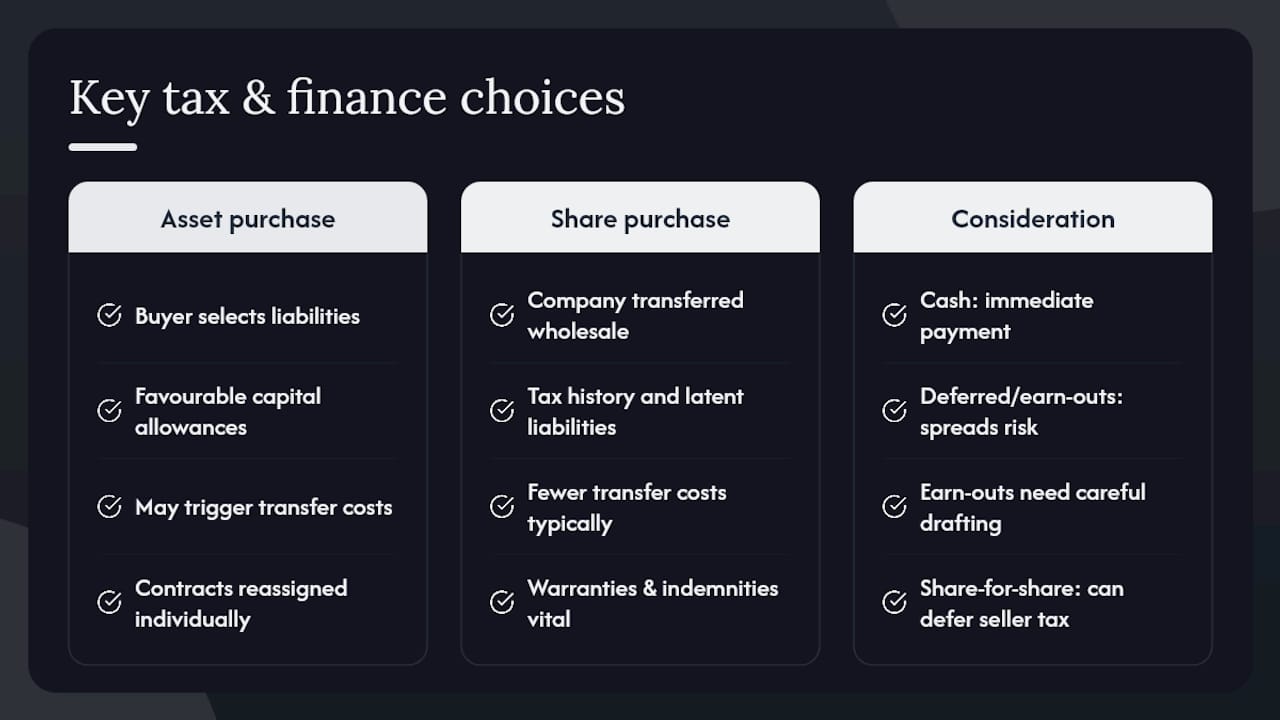
Consideration structure carries its own tax consequences. Cash consideration is straightforward but immediate; deferred consideration or earn-outs spread payment (and risk) over time and need careful drafting to avoid disputes over how the earn-out is calculated. Share-for-share exchanges can defer tax liability for sellers in some circumstances, which is part of why they remain popular in larger strategic mergers.
Working capital adjustments matter more than most first-time sellers expect. A completion accounts mechanism compares the target’s actual financial position at closing against an agreed benchmark, adjusting the final price accordingly. Get this wrong in drafting and you can end up disputing pounds owed months after everyone thought the deal was done.
Stamp duty, VAT treatment on asset transfers, and any relevant group relief provisions also need checking early, since they can materially change the economics of a deal that looked clean on a term sheet.
Valuation shapes every negotiation that follows, and lawyers need to understand roughly how a figure was reached even though the number itself comes from accountants and corporate finance advisers.
The most common approaches include:
No single method dominates; most serious valuations triangulate two or three approaches and negotiate from the overlap. Where valuation methods diverge sharply, that gap often becomes the starting point for price negotiation rather than a reason to abandon the deal. Lawyers translate the agreed figure into completion mechanics: how it’s paid, when, and what protects each side if post-completion figures don’t match what the valuation assumed.
Most SPAs specify a dispute mechanism well before anyone anticipates needing one, and the choice made at drafting stage matters enormously if a claim does arise.
Arbitration is common in cross-border and higher-value deals because it’s private, generally faster than litigation, and easier to enforce internationally under conventions most major jurisdictions have signed. Expert determination suits narrow, technical disagreements, particularly disputes over completion accounts or earn-out calculations, where a specialist accountant can resolve the figures faster than a court could. Court litigation remains the default for many UK domestic deals, particularly where the dispute concerns warranty breaches with substantial evidential complexity.
Escrow releases and warranty claims often carry their own contractual notice periods and procedural requirements, meaning a buyer who spots a problem must act within a defined window or risk losing the right to claim entirely. Getting the drafting right at signing, not scrambling for a remedy after the fact, is what actually protects a claim.
Cross-border transactions add layers that purely domestic deals never face. A UK buyer acquiring a target with overseas subsidiaries needs local counsel in each relevant jurisdiction, since UK warranties and indemnities don’t automatically translate into enforceable protection abroad.

Foreign direct investment screening is now a standing concern well beyond the UK’s own NSI Act. Many jurisdictions, including the EU and the US, run parallel national security or foreign investment reviews that can delay or block deals involving overseas parties, particularly in defence, technology, and critical infrastructure sectors. Currency risk also needs addressing contractually, especially where consideration or earn-outs are calculated in a currency different from the buyer’s reporting currency.
Choice of law and jurisdiction clauses deserve real attention rather than boilerplate treatment, since they determine which country’s courts (or which arbitral seat) would handle a dispute. Recent shareholder litigation across several major cross-border deals illustrates how quickly regulatory scrutiny and shareholder claims can complicate a transaction that looked settled at signing. Employment law also varies sharply by jurisdiction, so a TUPE-equivalent obligation in one country may look nothing like the UK version.
Speed and risk allocation are where specialist counsel earns its fee. A lawyer who has negotiated dozens of SPAs spots the warranty gap or the MAC clause loophole that a generalist would miss, and that difference often shows up months after completion, not at signing.
Ali Legal Ltd’s Corporate & M&A practice works on fixed fees where the deal scope allows it, precisely because clients deserve to know their legal cost before due diligence uncovers the first surprise.
— Panagiotis
This article is general information, not a substitute for advice from a qualified lawyer. Consult a qualified legal professional about your own circumstances before acting on anything here.
If another party’s negligence caused your injury, get medical attention first, then seek legal advice without delay. Most personal injury claims must start within three years of the accident, so acting quickly protects your position even if you’re not yet sure you want to proceed. Whether you go it alone through the Official Injury Claim service or instruct a solicitor depends on how serious the injury is and how complicated the circumstances are.
Do this now:
Every claim, regardless of size, moves through broadly the same stages. Understanding them removes most of the anxiety, because you know what’s meant to happen next and roughly when.
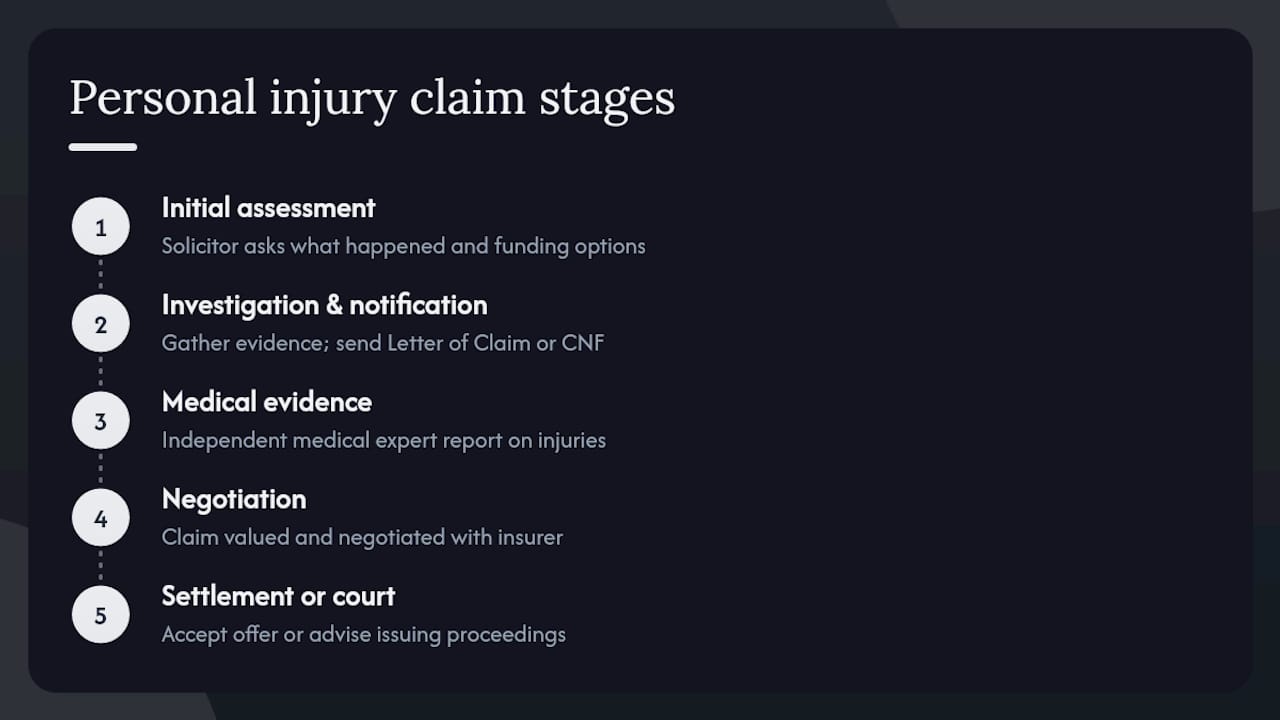
1. Initial assessment. A solicitor will ask what happened, when, and whether there’s a clear case of fault. This conversation usually happens free of charge and covers funding options at the same time, so you know the cost picture before committing to anything.
2. Investigation and notification. Your solicitor gathers evidence and sends a Letter of Claim, or in road traffic cases a Claim Notification Form (CNF), to the party you’re claiming against. That party (or their insurer) typically has a fixed window, often 21 days to acknowledge and longer to respond in full, to admit or deny liability.
3. Medical evidence. Once liability is accepted, or sometimes in parallel, an independent medical expert is instructed to assess your injuries and produce a report covering diagnosis, treatment, and prognosis. This report underpins the eventual valuation of your claim.
4. Negotiation. With medical evidence and financial losses documented, your solicitor puts a value on the claim and negotiates with the other side’s insurer. Most cases settle at this stage without ever reaching a courtroom, according to guidance on the typical personal injury claim process.
5. Settlement or court. If negotiation succeeds, you receive an offer to accept. If it doesn’t, your solicitor will advise on issuing court proceedings, though this remains a last resort rather than the norm.
Pro Tip: Ask your solicitor for a rough timeline at the outset and check in every few months rather than waiting for updates to arrive. Claims stall when nobody chases the medical report or the other side’s insurer.
For a fuller breakdown of how each stage affects your eventual compensation, Ali Legal Ltd’s personal injury claims guide sets out valuation and negotiation tactics in more depth.
The Limitation Act 1980 gives you three years from the date of the accident, or from the date you first realised you’d been injured, to issue court proceedings. Miss that date without a valid exception and your claim is almost certainly dead in the water.
Common exceptions include:
Roughly one in three years feels like a long runway until evidence starts disappearing, memories fade, and CCTV footage gets overwritten within weeks. Solicitors typically issue protective proceedings well before the deadline where a case is complex, precisely to avoid a last minute scramble.
Evidence wins or loses cases, and the strongest evidence is almost always the earliest evidence. Start collecting the moment you’re able to.
Once instructed, your solicitor takes over the heavier lifting: obtaining CCTV before it’s deleted, requesting employer records or HSE reports, and instructing the independent medical expert who produces the report both sides rely on for valuation, as outlined by Timms Solicitors on evidence preservation. Medical reports usually take a few weeks to a couple of months to prepare, and the cost is typically recovered from the defendant if the claim succeeds.
Pro Tip: Keep a simple diary of pain levels, missed work, and appointments from day one. It sounds tedious, but it becomes the backbone of your special damages claim later.
For a broader view of what solicitors ask for and why, Scotland Claims Injury Lawyers sets out the categories of evidence that carry the most weight in disputed cases.
Most personal injury solicitors work on a “no win, no fee” basis, formally called a conditional fee agreement. You pay nothing if the claim fails, and if it succeeds, the solicitor takes a success fee, capped by law, deducted from your compensation.
Before instructing anyone, ask:
Gov is worth reading before you sign anything, particularly because legal aid is rarely available for this type of claim.
Not every solicitor handles personal injury work well, so look for genuine specialism rather than a general practice that “also does” injury claims.
At first contact, ask these questions:
Red flags include vague answers on fees, reluctance to put funding terms in writing, and pressure to sign before you’ve had time to read anything. Citizens Advice also flags the distinction between claims management companies, which can introduce you to a solicitor but generally can’t represent you in court, and an actual solicitor who can see the case through end to end. Ali Legal Ltd’s guide on what personal injury lawyers do breaks down that distinction further.
Court proceedings are issued only when negotiation stalls, and trials remain rare. If issued, both sides exchange witness statements and expert evidence ahead of a hearing.
Ali Legal Ltd applies the same fixed-fee, client-centred model to personal injury work that underpins its wider practice: clear costs agreed upfront, no jargon, and a named solicitor managing your file from first contact to settlement.
Practical case examples and outcomes are set out in Ali Legal Ltd’s personal injury cases summaries, giving a sense of how different injury types have resolved in practice.
The three mistakes seen most often: delaying medical treatment because the injury “isn’t that bad”, losing evidence by not writing anything down for weeks, and signing a funding agreement without asking what happens if the claim loses. Each is avoidable. See a doctor the same day if you can, write down what happened before you sleep on it, and get funding terms in writing before you sign.
— Panagiotis
If you’re weighing up whether to handle a small whiplash claim yourself through Official Injury Claim or bring in a solicitor for something more serious, the safest move is a short conversation before you decide either way. Ali Legal Ltd offers fixed-fee initial advice, so you know exactly what a consultation costs before you book it, and there’s no obligation to proceed afterwards.
The firm’s personal injury team handles everything from evidence gathering and medical report instruction through to insurer negotiation and, where needed, court proceedings, always with a named solicitor running your file rather than a call centre. If property damage sits alongside your injury claim, Ali Legal Ltd’s property law guidance covers the related legal angles too. Get in touch through Ali Legal Ltd’s contact page to arrange your initial consultation and find out where you stand before the three-year clock becomes a concern.
This article is general information, not a substitute for advice from a qualified lawyer. Consult a qualified legal professional about your own circumstances before acting on anything here.
An arbitration agreement is a promise between two parties to send present or future disputes to a private arbitrator instead of a court. Sign one, and you have usually given up your right to sue in the ordinary courts for whatever falls within its scope. That single sentence explains most of the confusion people feel when a solicitor points to a clause buried in a contract and says “you’ll need to arbitrate this.”
What that means in practice:
Arbitration in law is a form of private dispute resolution created entirely by contract. There is no arbitration without an agreement, and that agreement can cover disputes that already exist or ones that have not happened yet. It doesn’t need to sit in a grand standalone document either. A single line referring to a separate set of rules, or even an email exchange confirming terms, can be enough to create a binding obligation to arbitrate.
You will find arbitration agreements in far more places than most people expect:
The common thread is that someone, at drafting stage, decided a private tribunal would serve the relationship better than open court. Our guide on the legal effect of arbitration clauses in UK contracts goes further into how these clauses interact with the rest of a contract’s terms.

Arbitration earns its popularity for reasons that hold up under scrutiny. Confidentiality is the big one: hearings and awards generally stay private, which matters enormously to businesses that don’t want a contract dispute splashed across a judgment database. Parties also get to pick a decision-maker with genuine subject expertise, a marine engineer for a shipping dispute, say, rather than a generalist judge working through a crowded list. Add procedural flexibility and easier cross-border enforcement of awards, and the appeal to commercial parties becomes obvious.
The criticisms are just as real, though. Legal commentary consistently flags arbitration’s trade-offs: limited grounds for appeal, cost that can spiral in a genuinely complex dispute, and a “repeat player” effect where large corporate parties who arbitrate often may have a procedural edge over a one-off consumer or small supplier.
Pro Tip: If confidentiality matters to your business, ask whether the arbitration rules you’re adopting actually guarantee it. Some institutional rules default to confidentiality; others leave it to the parties to agree separately.
Most arbitration clauses look deceptively short, four or five lines, but each phrase carries weight. Knowing what each element does lets you negotiate rather than simply sign.
Institutional model clauses exist precisely to stop parties reinventing this wheel badly. The ICC’s own clause and rules resources are a sensible starting point for anyone drafting from scratch, and our piece on what actually happens at arbitration walks through how these choices play out once a dispute actually starts.
UK arbitration law rests on the Arbitration Act 1996, and two provisions do most of the practical work.
First, the writing requirement. Section 5 of the Arbitration Act 1996 requires an arbitration agreement to be in writing before it takes effect under the Act. That threshold is broader than people assume: the agreement can be in writing, made through an exchange of written communications, or simply evidenced in writing by one party or an authorised third party, even where the underlying deal was agreed verbally.
Second, separability. Section 7 treats the arbitration clause as independent from the rest of the contract. If one party argues the whole contract is void, that argument doesn’t automatically kill the arbitration clause with it. The arbitrator can usually decide the validity question themselves, which is precisely the point of the doctrine.
Even where a party claims the contract itself was never validly formed, the arbitration clause typically survives that challenge and the arbitrator, not a court, gets to rule on it first.
Courts play a narrow, supporting role after that. They will generally enforce an arbitration agreement by staying court proceedings brought in breach of it, and they will enforce a valid award with only limited grounds for refusal. Judicial review of the merits is deliberately restricted; challenging an award is not a second bite at the argument you lost. Part I of the Act sets out this entire framework and is worth reading in full if you want the primary text rather than commentary.
You can challenge an arbitration agreement, but the grounds are narrower than most people hope, and none of them are “I changed my mind after signing.”
Raise a jurisdictional objection early and usually within the arbitration itself first; tribunals have the power to rule on their own jurisdiction, with court involvement typically reserved for a challenge after that ruling. Once you’ve signed, opting out unilaterally isn’t realistic. Your genuine leverage exists before signature, through negotiating a carve-out or amendment, not after.
Ask these questions before signing anything, not after a dispute has already started.
Pro Tip: If a clause designates a seat with unfamiliar or thin arbitration law, or gives the other party sole control over appointing the arbitrator, treat that as a red flag worth negotiating rather than accepting.
Reasonable amendments, narrowing scope, adding a carve-out for urgent injunctive relief, specifying a neutral seat, are common and rarely controversial to request. Seek legal advice before signing anything involving significant value, an unfamiliar jurisdiction, or a counterparty holding clearly superior bargaining power.
This explainer covers the statutory framework accurately, but every arbitration clause sits inside a specific commercial relationship with its own risks. Ali Legal Ltd advises on arbitration and international disputes, including clause drafting and fixed-fee review, and complex or high-value matters deserve tailored advice rather than a general guide.
Most guidance on arbitration agreements treats the decision to sign as binary: arbitration good, litigation bad, pick one. That framing misses the point. The real risk rarely sits in the choice between arbitration and court; it sits in vague scope wording and an unfamiliar seat slipped into a clause nobody negotiated.
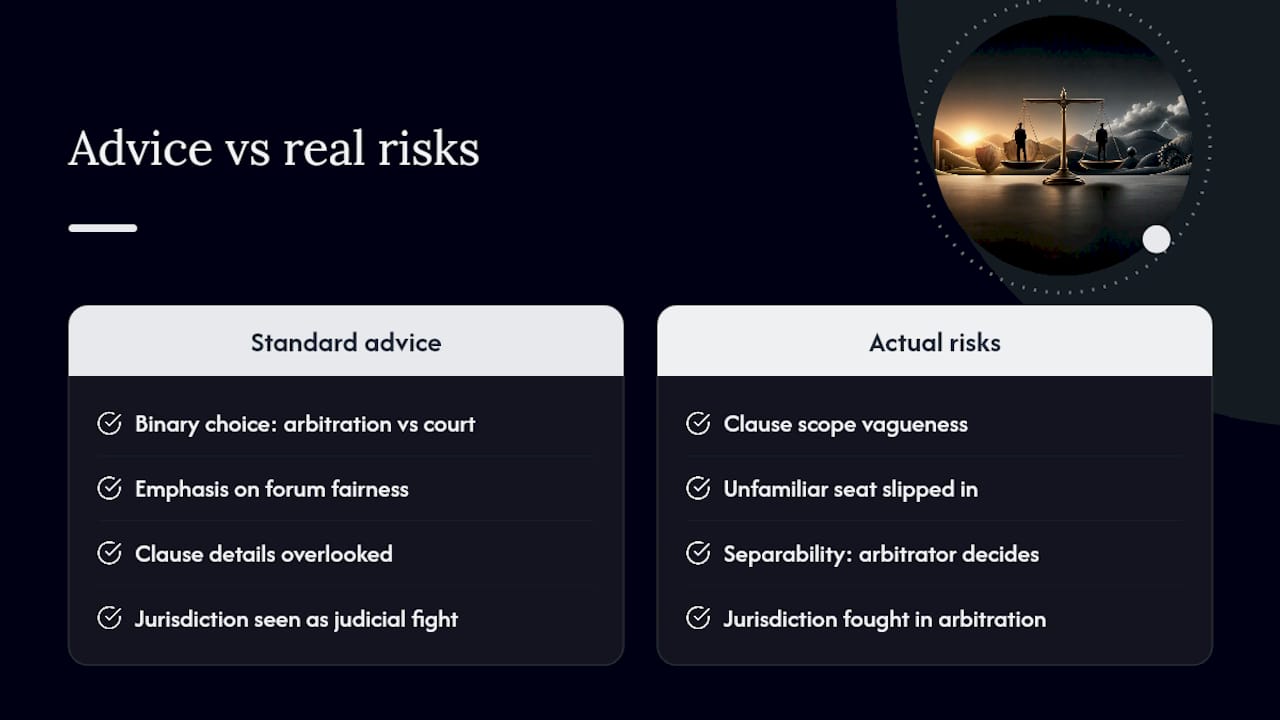
Separability, covered under section 7 of the Arbitration Act 1996, deserves more attention than it usually gets. It means a party cannot escape arbitration simply by arguing the underlying contract was invalid, which is exactly the argument a party in a weak position often reaches for first. Understanding that upfront changes how you negotiate, because it tells you the fight over jurisdiction will likely happen in front of the arbitrator, not a judge.
My honest view: readers should worry less about whether arbitration is “fair” in the abstract and more about whether the specific clause in front of them has a sensible seat, workable cost allocation, and scope wording tight enough to avoid a second dispute about the first one.
Reviewing a clause before you sign costs far less than disputing its consequences after a problem arises. Ali Legal Ltd drafts and reviews arbitration clauses, advises on seat and institutional rule choices, and represents clients through arbitration proceedings themselves, with fixed-fee options available for straightforward advisory work and bespoke arrangements for larger, cross-border matters.
If you’ve been handed a clause you don’t fully understand, or you’re heading into a dispute already covered by one, get in touch with details of the contract and a short summary of what’s at stake. Explore Ali Legal Ltd’s international disputes and arbitration services or read more on the key advantages of international arbitration before booking an initial consultation to get the clause looked at properly.
This article is general information, not a substitute for advice from a qualified lawyer. Consult a qualified legal professional about your own circumstances before acting on anything here.
The right family law solicitor is the one who matches your specific issue, holds a recognised accreditation such as Law Society Family Law Accreditation, works to a transparent fee structure, and takes an approach that fits your goals, whether that is a quick resolution or a hard-fought court process. Get those five things right and the rest of the process, communication style, timelines, cost management, largely takes care of itself.
Before you pick up the phone, run through this:
Start with the Law Society’s Find a Solicitor service and filter by postcode and specialism, then shortlist two or three firms to call this week.
| Quick check | Why it matters |
|---|---|
| Accreditation | Confirms verified experience, not just marketing |
| Written fee estimate | Prevents cost surprises mid-case |
| Approach fit | Aligns strategy with your goals (settle vs litigate) |
| Named case handler | Avoids junior staff running your matter unsupervised |
Family law covers several distinct specialisms, and matching your problem to the right one saves time and money. Divorce and separation, financial remedies (dividing assets, pensions, maintenance), children matters (arrangements, relocation, parental responsibility), cohabitation disputes, and cases with an international element, such as a spouse living abroad or assets held overseas, each call for a different skill set.
A rough decision flow helps:
Not every dispute needs a solicitor from day one. Straightforward disagreements over contact schedules often resolve faster with a family mediator, and complex financial cases sometimes benefit from bringing in specialist counsel early rather than later. The Divorce, Dissolution and Separation Act 2020 also changed the procedural landscape, so a solicitor who has practised since the no-fault reforms will know the current process better than one relying on older habits.
Ali Legal’s earlier guide on choosing a solicitor step by step covers the broader process, but for family matters specifically, four sources stand out. The Law Society’s Find a Solicitor tool lets you search by postcode and filter by family law specialism, and it only lists SRA-regulated firms. Resolution’s own directory does something similar but restricts results to members who follow its Code of Practice. The Family Mediation Council directory is worth checking if you suspect mediation might suit your situation better than litigation. Personal referrals from friends or other professionals (accountants, financial advisers) carry weight too, provided you still verify credentials independently rather than taking a recommendation at face value.
Online reviews deserve a sceptical read. A five-star average with three reviews tells you little; look for detail, mentions of specific case types, and whether the firm responds professionally to any negative feedback.
| Source | Best for | What to check first |
|---|---|---|
| Law Society Find a Solicitor | General search by postcode/specialism | SRA regulation, listed specialism |
| Resolution directory | Non-confrontational approach | Code of Practice membership |
| Family Mediation Council | Mediation-first cases | Accredited mediator status |
| Personal referral | Trusted starting point | Independent credential check |
Practitioner guidance consistently points to matching a solicitor’s niche to your exact issue rather than hiring a generalist, according to Lexology’s guidance on choosing a family solicitor. A few credentials do the heavy lifting when you are vetting a shortlist.

Law Society Family Law Accreditation is the clearest quality mark. To gain it, an applicant must show at least 1,000 chargeable hours of general litigation experience in the last three years and 350 chargeable hours of family law experience in the last five years. That threshold rules out anyone dabbling in family work on the side.
Resolution membership signals something different, an approach rather than a caseload figure, discussed further below. Chambers UK and Legal 500 rankings add a third layer, based on peer and client feedback rather than self-reported hours.
A few practical checks round this out:
Pro Tip: Ask directly which specific accreditation the solicitor holds and when they last renewed it. Accreditations lapse if hours drop, so “accredited” without a date is worth double-checking.
Roughly 1,350 combined chargeable hours sit behind the basic accreditation threshold, a figure worth remembering when a firm claims deep family law experience without naming any recognised credential.
The initial meeting or call tells you more than any website bio. Cover these points directly:
Watch behaviour as closely as answers. A solicitor who avoids discussing fees, promises a guaranteed result, or talks over you rather than listening to the facts is showing you how they will operate throughout the case. Resolution’s good practice guidance recommends that firms provide a clear written summary after the initial meeting and issue terms of business early. If that does not happen unprompted, ask for it.
Pro Tip: Book your consultations on the same day if you can. Fee structures and tone are far easier to compare when they are fresh, rather than a week apart.
Foley Family Law’s checklist of questions for a divorce initial consultation offers a useful second opinion on what to raise if you want to go further than the list above.
Three charging models dominate family law work: hourly rates, fixed fees for defined tasks (an uncontested divorce, for instance), and capped fees that set a ceiling on an hourly-rate matter. Some firms now offer unbundled services, paying only for specific tasks like document review, rather than full representation throughout.
A typical retainer breaks down into partner or senior solicitor time (charged at the highest rate), junior solicitor or paralegal time for routine drafting, court fees, and, in contested cases, barrister’s fees for hearings. Litigants in person are increasingly common on the other side of a case, and Resolution’s guidance notes this can affect both cost and pacing, so ask your solicitor how they would handle it.
Funding beyond your own savings includes legal aid (means and merits tested, and now limited mostly to cases involving domestic abuse or child protection), legal expenses insurance attached to a home policy, and litigation loans repayable once a financial settlement completes.
| Charging model | Typical use | What to ask about |
|---|---|---|
| Hourly rate | Contested or unpredictable cases | Rate per grade of fee earner |
| Fixed fee | Uncontested divorce, simple agreements | What triggers a switch to hourly billing |
| Capped fee | Hourly work with cost certainty | What happens if the cap is reached |
| Unbundled service | Specific tasks only | Exactly what is and isn’t included |
Ali Legal’s guide to handling legal fees in England and Wales breaks down cost management in more depth if budgeting is your main concern.
Cases involving business assets, trusts, multiple properties, or income spread across jurisdictions need more than a single family solicitor working alone. Ask whether the firm can draw on tax specialists, trust lawyers, or forensic accountants for business valuations, either in-house or through established referral relationships.
Confirm experience with the specific complexity you face:
Family disputes can run through court litigation, mediation, collaborative law (both parties and their solicitors agree not to litigate), or arbitration. Each suits a different temperament and case type. A Resolution member commits to a Code of Practice that favours a constructive, non-confrontational approach and puts children’s welfare first, useful to know if you want to avoid an unnecessarily bitter process.
| Case type | Suggested approach |
|---|---|
| Amicable separation, shared goals | Mediation or collaborative law |
| Disputed children arrangements | Resolution-style negotiation first |
| Hidden or disputed assets | Litigation, often necessary |
| High conflict, entrenched positions | Arbitration or court process |
A few signals should make you pause immediately: no written terms of business, vague or shifting answers about fees, poor responsiveness after you’ve signed up, or promises of a guaranteed outcome (no honest solicitor offers one).
If any of these appear, ask for written confirmation of everything discussed, get a second opinion from another firm, or check the solicitor’s standing directly with the SRA.
Two credentials carry real weight. Law Society Family Law Accreditation is the profession’s recognised quality mark for family practitioners, though it excludes public law Children Act work, so check scope against your specific issue. The advanced tier of this accreditation involves a detailed application with case reports, and the assessment process typically takes six to eight weeks, with a fee attached, so a solicitor holding it has been through genuine scrutiny.
Resolution membership is different in kind, a commitment to conduct, not caseload. It signals the solicitor prioritises constructive negotiation and children’s welfare over adversarial point-scoring.
Pro Tip: If a solicitor claims Resolution membership, ask how it has changed their approach on a recent case. A genuine answer will be specific, not a generic statement about “always trying to settle”.
Ali Legal’s family and divorce team works from the same principles this checklist sets out: match the right specialist to the issue, confirm the approach fits the client’s goals, and put fees in writing before any work begins. Our resource pages, including family law rights, reflect that same client-first grounding rather than generic content written to fill a website.
Initial consultations focus on realistic outcomes rather than optimistic promises, and fixed-fee options are available for well-defined pieces of work, such as an uncontested divorce or a straightforward financial consent order, so clients know costs before committing further. If you would rather talk through your specific situation than keep researching alone, that conversation is available whenever you are ready for it.

Ali Legal offers a genuine alternative to spending hours cross-checking directories, accreditation pages, and review sites yourself: one conversation with a solicitor who already meets the standards this checklist sets out, fixed fees where the work allows it, and a clear written scope before anything starts. Where many firms leave you guessing about cost until the first invoice lands, Ali Legal sets out charges upfront so you can budget with confidence from the first meeting.
For a productive first meeting, prepare a short written summary of your situation, relevant dates, key documents such as financial statements or existing court orders, and a clear sense of what outcome you are hoping for. That preparation lets your solicitor give you a realistic timeline and cost estimate on the first call rather than a vague holding answer. If property forms part of a wider financial settlement, our property law guidance for UK owners is worth reading alongside your family law consultation. To arrange a conversation, get in touch with Ali Legal and describe your situation briefly so the enquiry reaches the right person straight away.
Check any solicitor’s standing directly rather than relying on a firm’s own claims. The Law Society’s Find a Solicitor service confirms SRA regulation and listed specialisms by postcode. Resolution’s Code of Practice page explains exactly what membership commits a practitioner to. For the legal framework itself, the Children Act 1989 governs most disputes involving children, and the Matrimonial Causes Act 1973 underpins financial remedy law on divorce.
How do I choose a family law attorney if my case involves both children and finances?
Look for a solicitor with demonstrated experience in both areas rather than splitting the case between two firms unnecessarily. Ask directly how many combined children-and-money cases they have handled in the past two years.
What questions should I ask a family attorney before hiring them?
Ask about likely strategy, who handles day-to-day work, realistic timelines, fee structure, and what outcome they consider realistic given your facts. Vague answers on fees or timelines are a signal to keep looking.
Is Resolution membership necessary when choosing a divorce lawyer?
It’s not mandatory, but it does confirm a commitment to a non-confrontational approach and a focus on children’s welfare, useful if you want to avoid unnecessary conflict. Litigators without this membership can still be excellent, particularly where a contested court process is unavoidable.
How long does a typical family law case take?
An uncontested divorce with agreed finances can complete in a few months; contested financial remedies or children proceedings often run 12 to 18 months, sometimes longer if court timetables are congested. Your solicitor should give you a case-specific estimate at the first consultation, not a generic industry figure.
What’s the difference between Law Society accreditation and Resolution membership?
Accreditation measures verified experience through chargeable hours thresholds; Resolution membership measures commitment to an approach and code of conduct. The strongest candidates often hold both.
This article is general information, not a substitute for advice from a qualified lawyer. Consult a qualified legal professional about your own circumstances before acting on anything here.
Hire in-house when your annual external legal spend consistently runs at roughly twice what a fully loaded solicitor would cost you, or when regulatory, contract or transactional volume has become constant rather than occasional. If you’re not there yet, delay and use fractional or retained counsel instead. Everything else is timing detail.
Do this today:
The rule of thumb worth knowing: organisations often shift work in-house once external fees approach about twice the fully loaded cost of an in-house lawyer, with typical early-stage external spend sitting at a moderate level before increasing significantly once legal demand becomes constant.
“In-house legal roles” is the umbrella term, but the jobs underneath it vary sharply by seniority and remit. Get the terminology straight before you write a job spec.
Most first hires spend the bulk of their week on high-volume contract triage, building a standard playbook for NDAs, supplier terms and employment contracts, then routing anything specialist (litigation, complex M&A, cross-border disputes) to outside counsel. A compact structure for a growing company usually looks like: GC or senior counsel reporting to the CEO or COO, with a paralegal or legal ops hire added once contract volume exceeds what one lawyer can review without a backlog.
Pro Tip: Hire a generalist first. Specialists are cheaper and faster to bring in as outside counsel for the one or two matters a year that actually need them.
Run this checklist before you post a job advert:
Many advisers point to revenue as a rough proxy too: a first general counsel often makes sense once revenue reaches roughly £20 million to £50 million, though workload and deal complexity matter more than the number itself.
The cost-crossover formula is straightforward. Take your trailing 12-month external legal spend. Compare it against the fully loaded cost of a solicitor: base salary, employer’s National Insurance, benefits, legal software subscriptions, and professional indemnity insurance. If external spend sits near double that fully loaded figure, the maths tips toward hiring.
A one-week workload audit settles the ambiguous cases. Log every legal request that lands on your desk for five working days, categorise it (contract, employment, dispute, regulatory), and note how long outside counsel took and billed for equivalent work. Fundraising rounds, M&A activity, or international expansion typically pull the threshold forward by months, because these events concentrate legal risk into short, high-stakes windows that a retained solicitor cannot always turn around fast enough.
You don’t have to choose between “hire now” and “carry on paying a law firm by the hour.” There’s a spectrum in between.
Early-stage companies with sporadic legal needs usually get the best value from fractional counsel or a retainer, since flexible arrangements let founders monitor workload before committing to permanent headcount. Predictable, high-volume contracting, on the other hand, is exactly when an in-house hire starts paying for itself, because in-house counsel deliver faster turnaround and institutional knowledge that reduce the hours your team spends managing outside advisers. Fixed-fee providers tend to push spend down for standard work; law firm panels push it up but buy you specialist depth.
Pro Tip: The strongest setup for many mid-sized companies is hybrid: one in-house generalist handling the daily volume, with a specialist firm on call for the two or three matters a year that need deeper expertise.
Scoping the role properly before you advertise saves months of mismatch. Start with three questions: what seniority does the workload demand, what’s the reporting line, and what does success look like in month twelve?
Build the job spec around that.
Sample job-spec bullets to adapt:
Interview questions worth asking:
Robert Half’s research on corporate counsel notes that demand for legal hires who are fluent in AI governance and business strategy is rising sharply, so weight tech literacy accordingly. On terms, cover notice periods, IP assignment, and whether a secondment or escape clause makes sense if the role needs to flex back toward outsourcing.
Pro Tip: Negotiate the offer around outcomes, not just salary. A slightly lower base with a clear KPI-linked review at month six often attracts stronger candidates than a flat higher number.
Week one is admin: system access, contract templates, an outside counsel contact list, and a short brief on the three biggest legal risks the business currently carries.
Priority projects for most first hires: a contract playbook, an intake log, an outside counsel map, and a basic risk register.
Set clear communication rules early: what counts as a legal query versus a business decision, expected turnaround (24 to 48 hours for routine contracts is reasonable), and who gets escalated straight to leadership.
Pro Tip: Attorney-client privilege gets harder to claim once legal advice mixes with business commentary in the same email thread. Train the new hire to mark privileged documents clearly and keep legal analysis in separate records from operational notes.
Watch for these red flags before you sign an offer letter:
Mitigate with a trial period, a staged start (fractional before full-time), and written objectives for the first two quarters. To avoid duplication with outside counsel, agree explicit boundaries early: in-house owns triage and routine drafting, outside counsel or barristers handle litigation and specialist advocacy.
Pro Tip: Draw a simple RACI table for your top five matter types before the new hire starts. It prevents the awkward first month where nobody’s sure who owns what.
Founders who hire early often say the same thing: the value wasn’t the contracts reviewed, it was having someone in the room who could say “here’s the risk” before a decision got made, not after. Those who waited too long usually point to a fundraising round or a messy supplier dispute as the moment they wished they’d moved sooner.
HR teams measuring early success tend to focus on turnaround time on contracts and how quickly the hire becomes a trusted voice in leadership meetings, not just legal accuracy.
Having legal at the table during fundraising or expansion changes the tone of those conversations, because the role increasingly extends into structuring and diligence support rather than sitting on the sidelines waiting to be asked.
If the cost-crossover check above puts you in the grey zone, you don’t need to choose between a full-time hire and drowning in hourly rates. Ali Legal Ltd offers fractional counsel arrangements, fixed-fee retainers, and bespoke support that scale with your workload rather than locking you into a single headcount decision.
Ali Legal works well alongside an existing in-house lawyer too, taking on specialist matters such as corporate structuring, cross-border transactions or dispute resolution while your internal counsel handles the daily volume. That split keeps your fixed costs lean and your specialist cover strong exactly when a transaction or regulatory issue demands it. For companies weighing up governance and structuring ahead of a hire or a deal, our guide to corporate law structure, duties and risks is a practical starting point. Get in touch to discuss fractional cover or a fixed-fee arrangement that fits where your business is right now.
For advice tailored to your business, contact Ali Legal Ltd directly.
Most buyers pay between £1,312 and £2,236 in solicitor legal fees, with a 2026 national average of £1,624, according to Compare My Move. On top of that, expect roughly £709 in disbursements, the third-party costs your solicitor pays out on your behalf. Add the two together and a typical buyer is looking at somewhere close to £2,300 in total legal costs before Stamp Duty Land Tax.
Other surveys land in a similar ballpark. Property Solvers puts the average conveyancing fee (including VAT) at £1,316.52 for freehold purchases, while HomeOwners Alliance quotes a broader band of £400 to £1,500 for standard transactions. The gap between these figures isn’t a red flag. It reflects differences in sample size, whether VAT is included, and whether disbursements are counted alongside the legal fee.
Average solicitor fee (2026): £1,624 | Average disbursements: £709 | Typical total: £2,300+
Two things push these numbers around more than anything else:
The phrase “solicitors fees” actually covers two separate things, and mixing them up is the single most common reason buyers feel blindsided at completion. There’s the legal fee, which is what your solicitor charges for their own work, and there are disbursements, which are third-party costs your solicitor pays on your behalf and passes on to you.
The legal fee covers the actual conveyancing work. That typically includes:
What’s usually excluded from the legal fee and billed separately as disbursements includes search fees, Land Registry registration fees, bank transfer (telegraphic transfer) fees, and the administrative cost of submitting your Stamp Duty Land Tax return. Some firms also charge separately for leasehold management pack requests or indemnity insurance if a title issue crops up mid-transaction.
Pro Tip: When a solicitor quotes a “fixed fee,” ask exactly what it covers in writing before you instruct them. A genuinely fixed fee should list every included task and name every likely exclusion, such as extra charges for a lease extension, a defective title, or a transaction that falls through and restarts with a new buyer. If a firm won’t put this in writing before you sign anything, treat that as a warning sign rather than a technicality.
Understanding this split matters because a headline number like “£800 conveyancing” is meaningless on its own. It might be an unusually cheap legal fee with disbursements added separately, or it might be the full picture. Ask for a total figure, not just the legal fee, every time you compare quotes. If you want a fuller picture of what a conveyancer actually does day to day, our guide to the conveyancer’s role breaks the process down stage by stage.

Disbursements are the costs your solicitor has no control over, set by government bodies, search providers, and banks rather than by the firm itself. Reallymoving is clear that these sit on top of, not inside, the solicitor’s own fee.
| Disbursement | Typical cost | Who requires it |
|---|---|---|
| Local authority search | £250–£300 | Standard for almost all purchases |
| Land Registry registration fee | £20–£250 (scales with price) | Legally required to register ownership |
| Bankruptcy/land charges search | £2–£5 | Required by mortgage lenders |
| Electronic ID/AML check | £10–£20 per person | Required under money laundering regulations |
| Bank transfer (telegraphic transfer) fee | £30–£40 | Charged by the solicitor’s bank |
| Leasehold management pack | £400 | Required for flats and leasehold houses |
MoneyHelper puts local search costs at around £250 to £300, which tallies with most firms’ quotes. Each disbursement exists for a specific reason:
On VAT: most solicitors’ legal fees are quoted plus VAT at 20%, so always ask whether a headline figure is VAT-inclusive. Some disbursements, like the Land Registry fee, carry no VAT because they’re statutory charges, while others, like search fees and bank transfer charges, usually do. This is exactly why MoneyHelper recommends asking for a full, VAT-clear breakdown before you commit to a firm.
Property price is only one variable in a much longer list. FindSolicitor’s 2026 market data shows conveyancing costs ranging from £500 to £2,500, and the spread comes down to a handful of recurring factors:
Fixed-fee pricing now dominates the residential market because it gives buyers certainty on a standard purchase. The trade-off is that fixed fees usually exclude unforeseen complications, so a title defect or a collapsed chain can trigger additional charges that weren’t in the original quote.
Pro Tip: A quote that looks unusually low is worth scrutinising rather than celebrating. Ask what happens if the transaction becomes more complex, whether the fee assumes a straightforward freehold purchase, and whether there’s a cap on additional charges. For an unusually complicated purchase, a solicitor quoting on an hourly basis with a not-to-exceed estimate can sometimes work out fairer than a fixed fee loaded with exclusions.
Legal fees typically rise with property value, partly because Land Registry fees scale with price and partly because higher-value transactions often carry more complexity. Based on the price-banded averages reported by Compare My Move, the pattern looks roughly like this:
| Property price | Typical legal fee | Typical disbursements | Estimated total |
|---|---|---|---|
| Up to £220,000 | £800–£1,000 | £600–£700 | £1,300–£1,600 |
| £220,000–£450,000 | £1,200–£1,600 | £650–£700 | £1,624–£2,300 |
| £450,000–£900,000 | £1,600–£2,300 | £700 | £2,300+ |
| Over £900,000 | £2,300 and above | £900 and above | £2,300 and above |

A first-time buyer purchasing a £220,000 flat leasehold might pay towards the upper end of the first band once the leasehold management pack is added, closer to £1,700 all in. A buyer of a £450,000 freehold house with a straightforward chain often lands nearer the lower end of the second band. A buyer completing on a £900,000 property with a simultaneous sale, meanwhile, should expect the full weight of the third band and possibly beyond it.
These figures are illustrative, not guaranteed. Every firm prices differently, and Clearscore’s figures for standard freehold purchases (legal fees of £790 to £1,000, disbursements of £450 to £600) sit noticeably lower than the Compare My Move averages, which underlines why getting a written quote for your specific transaction matters more than any published table.
Getting three quotes that all quote different things isn’t a comparison, it’s a guessing game. Follow these steps to get quotes you can actually put side by side:
Beyond the numbers, a handful of direct questions separate a reliable firm from a risky one:
The cheapest quote on paper isn’t automatically the best deal. A firm with slow response times or poor communication can cost you far more in delay and stress than a slightly higher fee ever would. Reputation and responsiveness are worth weighing alongside price, particularly if your purchase has any complexity at all. Our checklist for hiring a solicitor covers this vetting process in more depth, and for buyers arranging a mortgage as a non-UK national, Prosper Home Loans’ guide to mortgage documentation explains the extra paperwork lenders may require, which can also affect your solicitor’s AML workload.
Conveyancing runs through a fairly predictable sequence, and knowing where the money leaves your account helps you plan cashflow properly.
If your solicitor’s actual disbursement costs turn out lower than originally estimated, the difference should be refunded or offset against your final bill. Always ask for a completion statement that itemises exactly what you paid and why, so you can check the numbers match what you were quoted at the outset.
The averages quoted throughout this guide draw on a mix of consumer-facing conveyancing surveys, industry pricing guides, and government-adjacent guidance rather than a single dataset. Property Solvers surveyed 100 conveyancing firms across England and Wales to reach its 2026 average, while other figures come from aggregated quote data collected by comparison platforms.
Ranges differ between sources for a few consistent reasons:
The clearest explanation for the spread comes down to methodology rather than market volatility: whether disbursements and VAT are counted inside or outside the headline average changes the number more than actual market pricing does, as Property Solvers’ 2026 analysis makes clear.
Treat any single average as a starting point for budgeting, not a promise. The only figure that matters for your transaction is the written quote from the firm you actually instruct.
Buyers rarely complain about the size of a legal fee. They complain about being told one figure and billed another. A written client care letter that spells out the legal fee, every disbursement, and the circumstances that could trigger an extra charge removes almost all of that friction before it starts.
At Ali Legal Ltd, that’s the standard we hold every property instruction to: a fixed fee set out in writing, disbursements estimated honestly rather than optimistically, and no surprises buried in the small print. Clear pricing isn’t a marketing line, it’s what stops a stressful process from becoming an expensive one.
Ali Legal Ltd prices property purchases as a genuine fixed fee, not a low headline figure with disbursements bolted on afterwards. You’ll see the legal fee, an honest estimate of every disbursement, and a realistic timeline before you instruct us, so there’s nothing to discover at completion that wasn’t already in writing.
A fixed-fee quote from Ali Legal Ltd covers the same ground this guide has walked through: identity and AML checks, contract review, liaison with the seller’s solicitor, and every disbursement itemised separately with VAT treatment made explicit. Our property law guidance sets out how we handle purchases of varying complexity, from straightforward freehold sales to leasehold flats with management pack complications. Initial enquiries carry no obligation, so if you’re weighing up quotes or simply want a second opinion on one you’ve already received, get in touch for a fixed-fee quote and find out exactly what your purchase will cost before you commit to anything.
This article is general information, not a substitute for advice from a qualified lawyer. Consult a qualified legal professional about your own circumstances before acting on anything here.
Your core family-law rights depend on your role and situation, but most people are dealing with one of four things: parental responsibility, child arrangements, money and property, or protection from harm. The first move is almost always the same: work out what applies to you before anything else.
Start here:
Pro Tip: Most court applications involving children now require proof you attended a Mediation Information and Assessment Meeting (MIAM) first. Book this early. It rarely delays things and can resolve the whole dispute before court is even necessary.
Family law splits broadly into three areas. Child law covers who a child lives with, who they see, and when the state steps in to protect them. Matrimonial and financial law covers divorce, dissolution of civil partnership, and how money and property get divided. Protection law covers domestic abuse injunctions and safeguarding.
You’ll run into specific terms fast. A child arrangements order sets out where a child lives and who they spend time with. A prohibited steps order stops a parent doing something specific, like taking a child abroad. A specific issue order resolves a single disagreement, such as which school a child attends. A care order gives a local authority parental responsibility alongside the parents.
Birth mothers hold parental responsibility automatically. Fathers and second parents get it through marriage or civil partnership to the mother at birth, joint registration on the birth certificate, a signed parental responsibility agreement, or a court order. GOV.UK’s guidance on parental rights sets out each route in detail.
Ways to acquire it if you don’t already have it:
Parental responsibility gives you a say in major decisions: schooling, medical treatment, religion, and where a child lives long-term. It does not automatically guarantee day-to-day contact or override the arrangements already in place. Having the legal status and getting practical time with your child are two separate questions, and conflating them is one of the most common mistakes fathers pursuing divorce rights for fathers make early on.
Pro Tip: If the other parent won’t sign a parental responsibility agreement, don’t wait months hoping they’ll change their mind. Apply to court promptly. Courts rarely refuse a father’s application unless there’s a welfare concern.
You can usually sort out where a child lives and who they see without a judge ever getting involved. GOV.UK confirms this is the expected default, not the exception.
Your main routes are:
Mediation typically starts with a MIAM. Vouchers are available to help cover the cost, and non-court dispute resolution is generally faster and cheaper than litigation. You’re exempt from the MIAM requirement if there’s evidence of domestic abuse. Once you’ve agreed terms, ask a solicitor to turn them into a consent order, so the arrangement becomes legally enforceable rather than a gentleman’s agreement that falls apart under pressure.
Pro Tip: Keep a written record of every proposal and response, even informal ones over text. If mediation stalls and you end up in court, that paper trail is often the difference between a smooth application and a drawn-out fight.
The court’s paramount consideration in any decision about a child’s upbringing is the child’s welfare, not either parent’s preference. That principle comes straight from statute.
Section 1 of the Children Act 1989 states that when a court determines any question concerning a child’s upbringing, the child’s welfare shall be the court’s paramount consideration.
In practice, that means judges lean towards not making an order at all unless doing so genuinely improves the child’s situation, a rule known as the “no order” principle. Public bodies only intervene when there’s a real welfare concern.
Typical triggers for intervention include:
The main public-law orders are the care order (local authority shares parental responsibility), the supervision order (local authority monitors without taking responsibility), and the emergency protection order (short-term removal to safety). None of these strip a parent of parental responsibility entirely, but they do limit how it’s exercised.
Pro Tip: If children’s services contact you, ask immediately what the specific concern is and request it in writing. You have a right to representation at any meeting where decisions about your child are discussed.
The three main private-law orders are the child arrangements order (living and contact arrangements), the prohibited steps order (stops a specific action), and the specific issue order (settles a single disputed decision). Each targets a different kind of disagreement.
The process generally runs like this:
First hearings are typically listed within several weeks of the application, though urgent safety matters can be heard far sooner. Fees apply for the C100 application, though you may qualify for a fee reduction or legal aid if you have evidence of domestic abuse or a low income.
Pro Tip: Bring proof you attempted mediation to your first hearing, such as your MIAM certificate. Courts expect it, and turning up without it can delay your case.
Contact the police straight away if a child faces immediate danger. For urgent but non-emergency concerns, a solicitor can apply for an emergency protection order through the court.
Gather this as soon as you safely can:
If social services contact you, you have the right to be told what the concern is, the right to bring a solicitor or supporter to meetings, and, in many cases, the right to see records held about your family.
Pro Tip: Stay factual and calm in every conversation with a social worker, and follow up verbal conversations with a short confirming email. It creates a clear record without escalating tension.
Before your first meeting, collect birth certificates, communication logs with the other parent, school and medical records, financial documents, and any relevant police or hospital reports.
Bring these questions:
Pro Tip: Organise your documents into a simple folder before you arrive. Solicitors often bill by the hour, so turning up prepared can shave a meaningful amount off your first invoice. Many firms also offer a free initial call, which is worth using to scope the problem before committing to paid advice.
Family law isn’t only about children. Married couples and civil partners have financial rights and obligations that exist independently of any parenting dispute, and these often carry more long-term consequence than people expect.
On divorce or dissolution, either party can apply for a financial remedy, covering the family home, pensions, savings, and income. Courts consider factors including the length of the marriage, each person’s needs, earning capacity, and contributions, both financial and non-financial. There’s no automatic 50/50 split; outcomes depend heavily on circumstances, which is why guesswork based on a friend’s settlement rarely holds up.
Spousal support, sometimes called maintenance, is separate from child maintenance. It’s awarded where one party has a genuine income need the other can meet, and it isn’t guaranteed just because a marriage ends. Property held in one person’s sole name isn’t automatically ring-fenced either; the family home is frequently treated as a matrimonial asset regardless of whose name is on the title.
Unmarried couples have far weaker protections. Without a marriage or civil partnership, there’s no automatic right to spousal maintenance and no automatic share of a partner’s property, however long the relationship lasted. This catches people out constantly, and it’s one of the sharpest gaps between assumed fairness and actual law. If you’re separating and property is involved, understanding your position early, particularly around jointly owned homes, is worth doing before emotions dictate decisions. Ali Legal Ltd’s guidance on property law covers ownership and title issues that often surface during separation.

Domestic abuse sits inside family law as both a safeguarding issue and grounds for urgent court intervention. If you’re at risk, you don’t need to wait for a mediation appointment or a MIAM exemption letter; you can apply directly to court.
The two main protective orders are the non molestation order, which stops an abuser from threatening, harassing, or contacting you, and the occupation order, which regulates who can live in or enter the family home. Breaching a non molestation order is a criminal offence, giving it real enforcement teeth beyond a civil warning.
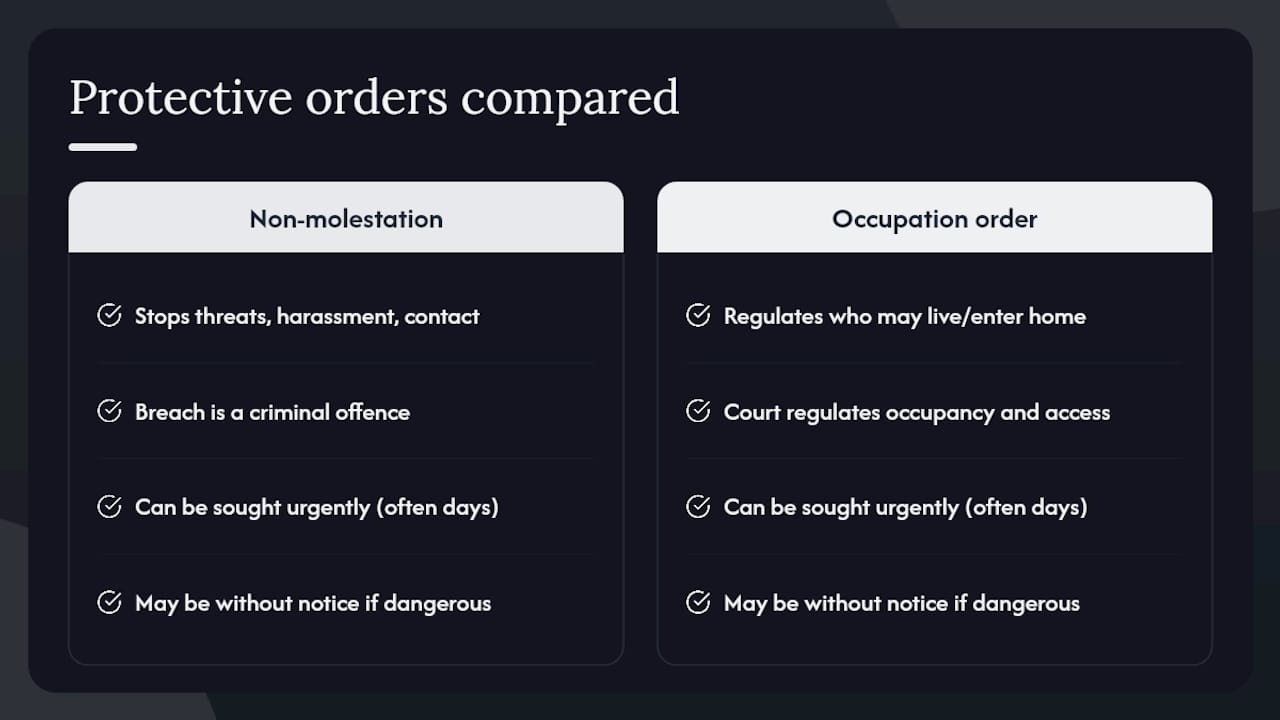
Evidence of domestic abuse also exempts you from the standard MIAM requirement before other family court applications, and it’s frequently the basis for legal aid eligibility that wouldn’t otherwise apply. Keep records: messages, photographs, medical notes, police reference numbers, and dates. A solicitor can apply for a protective order urgently, often within days where the risk is immediate, and applications can be made without notice to the other party in genuinely dangerous situations.
If you’re unsure whether what you’re experiencing counts as abuse in legal terms, coercive control, financial control, and threats all qualify, not just physical violence. Speaking to a solicitor early costs nothing to explore and can clarify what protection is actually available to you.
Adoption permanently transfers parental responsibility from birth parents to adoptive parents, extinguishing the birth parents’ legal status entirely. This makes it fundamentally different from a care order or fostering arrangement, where parental responsibility is shared rather than replaced.
Prospective adopters go through an assessment process run by an adoption agency or local authority, covering background checks, home visits, and preparation training. Once a match is made, there’s typically a placement period before an adoption order is finalised in court. Birth parents’ consent is normally required, though a court can dispense with it where the child’s welfare demands it, usually in cases involving significant harm or abandonment.
Step-parent adoption is a distinct route, allowing a step-parent to acquire full parental responsibility alongside a birth parent, though this legally removes the other birth parent’s status and isn’t granted lightly. Special guardianship orders offer a middle ground: they give a carer, often a grandparent or family friend, enhanced parental responsibility without severing the birth parents’ legal relationship entirely.
Adopted adults and birth parents both have rights around information access later in life, including routes to trace birth records once an adopted child reaches adulthood. If adoption is something you’re considering, whether as a prospective adopter or a birth parent facing a decision, get advice before signing anything, since the legal consequences are permanent in a way few other family law outcomes are.
People come to family law wanting certainty, and the honest answer is usually a range of outcomes shaped by evidence, not guarantees. Ali Legal Ltd’s approach is built around explaining that range clearly, with fixed fees where possible so cost never becomes a second crisis on top of the first. Practical advice matters more than clever advocacy in most family cases. A well-prepared parent with the right documents often gets further than one who arrives at court hoping the story alone will carry the day. That’s the basis for a fixed-fee initial conversation before committing to anything larger.
Consider instructing a solicitor when there’s urgent risk to a child, a contested court application on the horizon, or financial matters complex enough that a DIY agreement could leave you exposed later. Ali Legal Ltd offers fixed-fee initial advice so you know the cost before you commit, representation in negotiations or court where agreement breaks down, and hands-on help preparing evidence, MIAM documentation, and C100 applications.
If property is part of the picture, whether that’s a jointly owned home or a dispute over who stays where, Ali Legal Ltd’s property law guidance is a useful starting point before you speak to a solicitor directly. Where legal aid is a realistic option, given evidence of abuse or low income, we’ll flag that honestly rather than push paid representation you don’t need. Get in touch through the contact page to arrange an initial fixed-fee assessment and find out exactly where you stand.
Scotland and Northern Ireland operate under separate legislation, so check region-specific guidance, such as this Scottish inheritance and family rights overview, if you’re outside England and Wales.
This article is general information, not a substitute for advice from a qualified lawyer. Consult a qualified legal professional about your own circumstances before acting on anything here.
A will can create several distinct trusts, each doing a different job. The main types are bare trusts, interest-in-possession trusts (including the Immediate Post-Death Interest, or IPDI), discretionary trusts, accumulation and mixed trusts, and a group of statutory trusts built specifically for vulnerable beneficiaries and minors. A smaller category, settlor-interested and non-resident trusts, catches out estates with cross-border assets or unusual family arrangements.
Which one belongs in your will depends on who you’re providing for and what you’re trying to control: income now versus capital later, flexibility versus certainty, or protection from a beneficiary’s creditors, divorce, or simple bad luck with money. Gov sets out the main categories used in wills, and the Trustee Act 2000 provides the default powers trustees rely on unless your will says otherwise.
Here’s the shortlist, with the one-line purpose behind each:
A bare trust is the simplest structure a will can create. The trustee holds legal title to the asset, but the beneficiary has an immediate, absolute right to both the capital and the income. There’s no discretion involved and nothing to decide: once the beneficiary reaches the vesting age (18 in England and Wales, though this can differ elsewhere in the UK), they can demand the asset outright.
That immediacy is exactly why parents and grandparents use bare trusts for straightforward gifts to children. Leaving £20,000 to a grandchild “on trust until 18” is a textbook bare trust. The trustee manages the money in the meantime, perhaps paying school fees or releasing small sums, but the underlying entitlement never wavers.
Tax treatment follows that logic. Because the beneficiary is treated as the owner from day one, income and capital gains are usually assessed against them, not the trust, and gov.uk’s guidance on trusts and capital gains tax confirms bare trusts don’t attract the periodic Inheritance Tax charges that apply to discretionary structures. There’s no 10-year charge to worry about, because for IHT purposes the assets are already treated as belonging to the beneficiary.
| Feature | Bare trust position |
|---|---|
| Who owns the asset for tax | The beneficiary, from the outset |
| Vesting age | Usually 18 (England and Wales) |
| 10-year IHT charge | No |
| Trustee discretion | None, the entitlement is fixed |
| Typical use | Simple gifts to children or grandchildren |
An interest-in-possession trust gives someone the right to income from the trust fund, or to live in a trust-owned property, for a defined period, usually the rest of their life. That person is the “life tenant.” When they die, the capital passes to whoever the will names next, the “remaindermen.” Nobody has to decide anything year by year; the sequence is fixed at the outset.
The sequence runs like this: beneficiary receives the life interest → income or occupation continues for their lifetime → on their death, capital moves to the remaindermen. It’s a relay, not a discretionary handout.
An Immediate Post-Death Interest, or IPDI, is the version created directly by a will taking effect on death, most commonly for a surviving spouse or civil partner. A widow might be given the right to live in the family home for life, with the property passing to the couple’s children once she dies. Deloitte’s TaxScape guidance notes that testators favour IPDIs precisely because the spouse exemption can apply to the surviving partner’s interest, while the capital is still ultimately protected for children from an earlier relationship or future generations.
IPDIs get a tax exemption that discretionary trusts don’t. Rather than being treated as “relevant property” subject to the 10-year periodic charge regime, an IPDI is treated as part of the life tenant’s own estate for Inheritance Tax. That means no periodic charge every decade, though the trust assets will be counted in the life tenant’s estate when they eventually die. Income arising during the life interest is generally taxed on the life tenant, and Capital Gains Tax broadly follows ownership of the underlying asset, with reliefs sometimes available when the interest ends.
A discretionary trust names a class of potential beneficiaries, perhaps “my children and their issue,” rather than giving any one person a fixed entitlement. Trustees decide who receives income or capital, how much, and when. Nobody in the beneficiary class has an automatic right to anything until the trustees actually make a distribution.
That flexibility is the whole point. Testators use discretionary trusts when they genuinely don’t know what the future holds: a blended family where needs are unclear, a beneficiary who might develop a drinking problem or run into debt, or simply a wish to keep options open for grandchildren not yet born. Trustees typically follow a letter of wishes, a private document setting out the testator’s intentions. It’s worth being clear with clients and beneficiaries alike that this letter is not legally binding; trustees can depart from it if circumstances demand, though in practice most follow it closely.
Picture a testator with three adult children: one financially secure, one with a disabled child of their own, and one going through a difficult divorce. A discretionary trust lets trustees direct more support where it’s genuinely needed at the time, rather than locking in equal shares that might suit nobody by the time the estate is administered.
Pro Tip: Update the letter of wishes every few years, and definitely after any major family change such as a birth, divorce, or falling-out. An outdated letter is one of the most common causes of trustees making decisions that clash with what the testator actually wanted.
Tax-wise, most discretionary trusts fall into the “relevant property” regime. That means a charge of up to 6% can apply every 10 years on the value of trust assets, and an exit charge may apply when capital leaves the trust, as gov.uk’s guidance on trusts and Inheritance Tax sets out. Trustees are also responsible for income tax at trust rates and for Capital Gains Tax on any chargeable gains within the trust.
An accumulation trust allows trustees to retain income within the trust and reinvest it, rather than distributing it to beneficiaries as it arises. That’s the key operational distinction from a straightforward interest-in-possession trust, where income must go to the life tenant. A mixed trust blends features, perhaps discretionary powers over capital combined with an accumulation power over income, or a life interest for one beneficiary running alongside discretionary provisions for others.
These structures suit situations where beneficiaries are too young to receive income sensibly, or where a testator wants trustees to build up a capital fund for a specific future purpose, such as university fees arriving in ten years’ time rather than pocket money now.
| Feature | Discretionary trust | Life interest / IPDI trust | Accumulation trust | Mixed trust |
|---|---|---|---|---|
| Income treatment | Trustees decide who receives it | Paid to the life tenant | Retained and reinvested | Varies by component |
| Fixed entitlement | No | Yes, for the life tenant | No | Partial, depends on structure |
| 10-year IHT charge | Usually yes | No (IPDI) | Usually yes | Depends on which element applies |
| Typical use | Uncertain future needs | Spousal provision, family home | Building a fund for later years | Complex family situations needing both flexibility and certainty |
Tax treatment for accumulation and mixed trusts generally follows the relevant property rules where discretionary elements dominate, meaning the same 10-year charges and exit charges as standard discretionary trusts. Income that’s accumulated rather than distributed is still typically taxed at trust rates before it’s reinvested, and Capital Gains Tax applies to the trustees in the usual way when trust assets are sold.
Parliament has built specific trust structures into tax law for two groups: people who cannot manage money because of disability, and children who lose a parent. Both come with meaningful tax advantages precisely because the law recognises these beneficiaries need protection that ordinary discretionary trusts don’t guarantee.
A vulnerable person’s trust (sometimes called a disabled person’s trust) is available where the beneficiary meets specific statutory criteria, typically receiving certain disability benefits or being incapable of managing their own affairs. Gov.uk’s guidance on trusts for vulnerable people explains that these trusts can qualify for special tax treatment, effectively taxing income and gains as though they belonged to the vulnerable beneficiary rather than at the higher trust rates, provided strict conditions are met.
A bereaved minor’s trust arises where a parent leaves assets to their child, and the child will become absolutely entitled by 18. An 18-25 trust is similar but allows vesting anywhere up to age 25, giving families more flexibility over when a young adult actually takes control of significant assets. Both attract favourable Inheritance Tax treatment compared with an ordinary discretionary trust for the same purpose.
Statutory trusts can sidestep the periodic charge regime entirely where the conditions are met. HMRC’s guidance on trusts and Inheritance Tax confirms that bereaved minor’s trusts and qualifying disabled person’s trusts fall outside the standard 10-year charge and exit charge rules that apply to ordinary discretionary trusts, which is a meaningful saving over the life of a long-running trust.
Most will trusts are straightforward from a settlor’s perspective: the testator is dead, so they can’t benefit from the trust they’ve created, and the settlor-interested rules simply don’t bite. But complications arise in lifetime trust planning that later interacts with a will, or in second-marriage situations where a surviving spouse who is also a trustee has some retained benefit. HMRC scrutinises settlor-interested trusts closely because they can otherwise be used to keep assets nominally outside an estate while the settlor still enjoys the benefit of them.
Non-resident trusts raise a different set of problems. If a beneficiary, trustee, or asset sits outside the UK, or if the deceased was domiciled abroad, gov.uk’s guidance on non-resident trusts sets out reporting obligations and tax exposure that catch out estates without specialist advice. Foreign property, offshore accounts, and beneficiaries living overseas can all trigger additional filing requirements and, in some cases, double taxation risk if the interaction between UK and foreign tax rules isn’t managed properly.
Pro Tip: If your estate includes property abroad, overseas investments, or beneficiaries living outside the UK, raise this with your solicitor at the drafting stage, not after death. Untangling a non-resident trust problem retrospectively is far harder, and often far more expensive, than planning around it from the outset.
The baseline rule is simple even if the exceptions aren’t: trusts classed as “relevant property,” which covers most discretionary, accumulation, and mixed trusts, face a charge of up to 6% on their value every 10 years, plus an exit charge whenever capital leaves the trust. IPDIs, bereaved minor’s trusts, and qualifying disabled person’s trusts are carved out of that regime.
| Trust type | IHT position | 10-year / exit charge | Income tax | CGT |
|---|---|---|---|---|
| Bare trust | Treated as beneficiary’s own estate | No | Beneficiary’s own rates | Beneficiary’s own rates and allowance |
| IPDI / life interest | Part of life tenant’s estate | No | Life tenant taxed on income | Follows underlying asset ownership |
| Discretionary trust | Relevant property | Yes, up to 6% every 10 years | Trust rates apply | Trustees taxed on chargeable gains |
| Accumulation / mixed trust | Usually relevant property | Usually yes | Trust rates on retained income | Trustees taxed on chargeable gains |
| Bereaved minor’s / vulnerable person’s trust | Exempt from relevant property regime where conditions met | No | Often taxed as beneficiary’s own income | Often treated as beneficiary’s own gains |
A worked illustration helps make the periodic charge tangible. Say a discretionary trust holds £500,000 of assets at its 10-year anniversary, after the available nil-rate band has been applied against it. A charge of up to 6% on the value above that band could, in a simplified scenario, run to several thousand pounds payable from the trust. This is illustrative only. The actual calculation depends on the nil-rate band in force at the time, any previous chargeable transfers by the settlor, and reliefs that may apply, so it’s not a substitute for a proper calculation by your solicitor or accountant.
Trustees also carry ongoing reporting duties. Gov.uk’s guidance on trustees’ tax responsibilities covers registration with the Trust Registration Service, self-assessment filing, and the records trustees must keep, obligations that apply regardless of which type of trust the will has created.
Start with the people, not the tax rules. Tax treatment matters, but it should follow from what your family actually needs, not drive the decision on its own.
Work through these questions before your solicitor meeting:
Take these questions to your solicitor directly:
Watch for these red flags in a draft will:
As a rough decision sequence: if a beneficiary is an adult capable of managing money now, a bare trust or outright gift is usually simplest. If someone needs income or a home for life while capital is preserved for others, a life interest or IPDI fits. If the future is genuinely uncertain, whether that’s family circumstances, a beneficiary’s capability, or both, a discretionary trust buys the flexibility to respond as things unfold.
A common misconception deserves clearing up early: creating a trust in your will does not avoid probate. The LexisNexis practice guidance on will trusts makes clear that trusts offer flexibility outright gifts can’t match, but that flexibility only kicks in once the estate has actually been administered. The will still normally needs a grant of probate before assets can move anywhere, into a trust or otherwise.
Timelines vary considerably. A simple estate might complete probate within four to six months; a complex one involving a business, overseas property, or a disputed will can take a year or more before trustees are even in a position to act. Factors that commonly lengthen the process include multiple property valuations, tracing beneficiaries, and any dispute between family members over the will’s terms.
Cost drivers worth budgeting for include solicitor fees for the probate application itself, valuation fees for property or business interests, ongoing trustee fees where a professional trustee is appointed, and annual tax filing obligations for as long as the trust runs. It’s worth reviewing likely costs for wills, trusts and probate work before deciding how elaborate a trust structure your estate genuinely needs.
The Trustee Act 2000 gives trustees a sensible baseline: powers to invest, to obtain professional advice, and to delegate certain functions. For a straightforward cash legacy, those defaults are often perfectly adequate. They start to look thin the moment a trust holds something more complicated: a family business, a rental property portfolio, or overseas assets.
Common drafting mistakes tend to repeat themselves across estates of very different sizes:
Pro Tip: If your estate includes a family business, ask your solicitor to include an express power to retain and manage business interests, an express power to borrow, and a power to appoint professional investment managers. Relying on the Trustee Act 2000 defaults alone often leaves trustees under-equipped for anything beyond a simple portfolio of shares and cash.
Getting this drafting right is where the difference between a will that works smoothly and one that ends up in dispute usually lies. As WillSafe’s practitioner summary of will trust types notes, the range of structures on offer, from bare trusts through to nil-rate band discretionary trusts, only delivers real protection when the drafting matches the family’s actual circumstances rather than a generic template. A step-by-step guide to drafting a will covers the broader drafting process alongside these trust-specific considerations.
Every will trust starts with the same question at Ali Legal Ltd: what does this particular family actually need, not which trust looks most sophisticated on paper. That means proper factfinding before drafting begins, understanding beneficiary ages, family dynamics, business interests, and any cross-border complications, so the structure recommended fits the estate rather than the other way round.
Clarity in the drafting matters as much as choosing the right trust type. Vesting provisions get spelled out precisely, trustee powers are matched to the actual assets involved rather than left at the Trustee Act 2000 defaults by default, and tax planning is weighed against what the family genuinely wants to achieve, not just what minimises a bill on paper.
Ali Legal Ltd’s service scope in this area covers advice on which trust structure suits a given estate, the drafting itself, probate support once a testator has died, and ongoing advisory input on trustee appointments where families want guidance on who should hold that responsibility. For a fuller picture of what’s involved in tying a will and its trusts together properly, the wills, trusts and probate service overview sets out the detail.
Choosing between a discretionary trust, an IPDI, and a bereaved minor’s trust isn’t something to work out alone from a checklist, however good the checklist is. Ali Legal Ltd works through the practical questions above with clients directly: beneficiary ages, family complications, business assets, and what you’re actually trying to protect against, then drafts the trust to match, with fixed fees agreed upfront so there are no surprises once the paperwork starts.
That clarity extends beyond the will itself. Ali Legal Ltd also supports executors and trustees through probate once a trust needs to be put into effect, so the same team that drafted the structure can help administer it when the time comes, rather than handing you off to someone unfamiliar with the will’s intentions. If your estate includes a family business, overseas property, or a blended family situation that needs careful handling, that continuity from drafting through to administration is where a lot of avoidable disputes get headed off early.
If you’re ready to talk through which trust structure fits your circumstances, the wills, trusts and probate service page is the place to start, and you can arrange an initial conversation from there.
This article provides general information on the types of trusts commonly used in wills and is not a substitute for individual legal or tax advice. Trust and tax rules change, and how they apply depends on your specific circumstances, so confirm the current position with your solicitor or the relevant government guidance before making decisions about your estate.
For most personal injury claims in England and Wales, mediation is worth pursuing before trial. It resolves disputes faster, costs considerably less than a contested hearing, and lets you agree terms a judge simply cannot order. If your case is live or about to be issued, the single most useful thing you can do right now is ask your solicitor to write to the other side proposing mediation.
The core advantages in brief:
Once you have read this guide, contact your solicitor and ask them to send a formal ADR proposal to the defendant’s insurer or legal representative. Keep a copy. If the other side refuses without good reason, that refusal can count against them on costs later.
Mediation is a structured, confidential negotiation facilitated by a neutral third party. The mediator does not decide who wins. Their job is to help both sides understand each other’s positions, identify the real gap between them, and find a settlement both can accept. Gov, mediation is a flexible process that can be used before or during court proceedings, and a signed mediated agreement can be legally binding.
That last point matters. Once both parties sign a settlement agreement at the end of a mediation, it is a contract. Breach of it can be enforced through the courts without needing to restart the original claim.
At trial, a judge hears evidence and imposes a decision. At mediation, the parties retain control throughout. You can walk away at any point if the offers are not acceptable, and nothing said in the room can be used as evidence if the case does proceed to trial. That protection is called “without prejudice” privilege, and it is what gives both sides the freedom to speak candidly.
Timing is flexible. Mediation can take place:
A straightforward road traffic accident claim might be mediated in half a day. A clinical negligence dispute involving multiple experts can run to a full day or longer. LexisNexis practice notes record sessions running from a few hours to one or two days depending on complexity.
Mediation works best when both sides have a genuine interest in settling and the evidence is developed enough to have a realistic conversation about value. Before proposing it, run through this checklist.
Mediation is likely suitable when:
Mediation may be premature or counterproductive when:
Mediation is inappropriate when:
The government’s consultation response confirms that courts recognise these circumstances and will not penalise a party for declining mediation where a genuine safeguarding or power-imbalance concern exists.
The practical case for settling injury claims through mediation rests on four things: time, money, privacy, and the range of outcomes available.
Speed and cost are the most immediate advantages. A contested personal injury trial can take two to four years from incident to judgment. Mediation can resolve the same dispute in a single session once the evidence is ready. Legal costs at trial, including counsel fees, expert attendance, and court time, routinely dwarf the cost of a mediation day.
Confidentiality means the terms of your settlement stay private. Court judgments are public. If the defendant is a business or employer, that distinction can matter to both sides, and it often makes defendants more willing to offer terms they would resist if the outcome were on the public record.
Flexibility in outcomes is where mediation genuinely outperforms litigation. A court can only award damages. Mediation can produce:
Settlement rates in civil mediation are consistently high. The Civil Mediation Council and practitioners regularly cite settlement-on-the-day rates above 70% for civil and commercial mediations, with many personal injury cases resolving either on the day or shortly afterwards.
For a broader look at how alternative dispute resolution compares with other routes, Ali Legal Ltd’s guide covers the full range of options.
Good preparation is the single biggest factor in whether a mediation settles. Turning up without a finalised schedule of loss or without clear authority to settle is one of the most common reasons sessions fail.
The typical structure of a personal injury mediation day runs as follows:
| Phase | What happens |
|---|---|
| Opening joint session | Mediator introduces the process and ground rules; each side briefly states their position |
| Private sessions (caucuses) | Mediator meets each party separately to explore interests, test positions, and carry offers |
| Offer and movement | Mediator shuttles between rooms carrying offers; each side adjusts their position incrementally |
| Joint session (if needed) | Parties may meet together to resolve a specific sticking point or narrow the final gap |
| Closing and agreement | If settlement is reached, a written settlement agreement or memorandum of understanding is drafted and signed before anyone leaves |

The signed agreement is legally binding. If the defendant later fails to pay, you can enforce it as a contract without restarting the original personal injury claim. Where a claimant is a protected party (a child or someone lacking mental capacity), the settlement must still be approved by the court even if reached through mediation.
Mediation is not free for most personal injury claims, but it is almost always cheaper than proceeding to trial. LexisNexis guidance on mediation costs sets out the typical cost items:
The parties typically split the mediator’s fee and venue costs equally, though this is negotiable. Each side bears its own legal costs unless the court orders otherwise.
Recovering mediation costs in litigation. If a case does not settle at mediation and proceeds to trial, the costs of the mediation are generally recoverable as part of the overall costs order if the mediation was reasonably incurred. Courts look at whether the mediation was a genuine attempt to settle and whether the costs were proportionate.
Small claims exception. For claims under £10,000, the position is different. Advicenow’s guidance explains that the court’s small claims mediation scheme provides a free telephone session, so claimants in that band pay nothing for the mediation itself.
Fixed-fee mediation is available through providers registered with the Civil Mediation Council (CMC), and getting a quote before committing is straightforward. Many CMC-registered providers publish their rates online.
Choosing the wrong mediator for a personal injury case is a genuine risk. A mediator who is skilled in commercial contract disputes but has no experience of personal injury quantum, care costs, or clinical negligence may struggle to help the parties bridge the gap on a complex schedule of loss.
Questions worth asking a prospective mediator:
Your solicitor’s role during mediation is more active than many claimants expect. They should:
Pro Tip: Ask your solicitor to prepare a one-page “authority note” before the mediation day. It sets out the minimum you will accept, the maximum you expect to achieve, and the key non-monetary terms that matter to you. Having it in writing stops the pressure of the room from eroding your position.
For a broader comparison of how mediation sits alongside litigation and arbitration, Ali Legal Ltd’s guide covers all three routes in detail.
The mediation room rewards preparation and patience. It punishes impulsive statements and positional bargaining.
Frame your losses concretely. Presenting a schedule of loss with clear, evidenced figures gives the mediator something to work with. Vague claims about “significant suffering” are harder to negotiate around than a specific care cost calculation supported by an expert report.
Use experts to narrow quantum. If the parties are far apart on, say, future care needs, having both experts speak briefly (even by phone) can resolve a factual dispute that is blocking settlement far faster than the lawyers going back and forth.
Make calibrated concessions. Move in decreasing increments. An opening move of £30,000 followed by £20,000 followed by £5,000 signals that you are approaching your limit. Random large movements suggest you have room you are not showing.
Consider non-monetary terms. An apology, a change in procedure, or a structured payment plan can sometimes unlock a settlement where a pure cash negotiation has stalled. These are also the kinds of outcomes a court cannot order, as noted in the alternatives to standard compensation discussion.
Pro Tip: Personal injury claimants often find mediation emotionally draining because they are negotiating their own suffering. Brief your client before the day that the mediator’s job is to test every position, including theirs, and that a challenging question from the mediator is not a sign the case is weak. Clients who understand this stay calmer and negotiate better.
Courts in England and Wales do not merely encourage ADR. They expect it, and they have the tools to penalise parties who refuse it without good reason.
The Pre-Action Protocol for Personal Injury Claims requires parties to consider ADR before issuing proceedings. The Protocol is explicit: unreasonable refusal to consider ADR may be reflected in costs decisions, even where the refusing party ultimately wins at trial. That means a defendant insurer who refuses mediation without a credible reason could face a costs penalty regardless of the trial outcome.
The Civil Procedure Rules on ADR reinforce this. Courts can stay proceedings to allow mediation, and judges increasingly ask at case management hearings what steps the parties have taken to explore settlement.
As of January 2026, the position for smaller claims has hardened further. The government’s response to its mediation consultation confirms that mediation is now compulsory for small claims under £10,000 in England and Wales. The court automatically offers a free one-hour telephone mediation session for those claims. Parties cannot simply opt out.
For personal injury claims above the small claims threshold, mediation remains technically voluntary, but the costs consequences of unreasonable refusal make it effectively obligatory in practice.
If you have a legitimate reason for declining mediation at a particular stage (evidence is incomplete, there is a safeguarding concern, the other side has shown no genuine intention to engage), document it in writing at the time. A letter to the other side explaining your reasons, kept on file, gives the court something to consider if costs are argued later. A bare refusal with no explanation is the most vulnerable position to be in.
The conventional wisdom about mediation in personal injury claims tends to focus on whether to mediate at all. The more interesting question, and the one that actually determines outcomes, is when to mediate and how thoroughly to prepare.
Mediation that happens too early, before the medical picture is clear or before a realistic quantum range can be agreed, tends to harden positions rather than resolve them. Both sides leave feeling the process was a waste of time and money, and the case becomes harder to settle afterwards because the failed mediation has become part of the narrative. The right moment is usually when liability is sufficiently clear and the expert evidence is developed enough that both sides can have a genuine conversation about value, not before.
Preparation is where most mediations are won or lost before the day begins. A claimant who arrives without a clear sense of their minimum acceptable outcome, or whose solicitor has not briefed them on the emotional dynamics of the process, is at a structural disadvantage from the opening session. The mediator’s job is to help both sides move, and an unprepared claimant moves in the wrong direction.
There is also a tactical dimension that rarely gets discussed openly. Defendants and their insurers attend mediations regularly. Many claimants attend once in their lives. That asymmetry of experience matters. An experienced solicitor who has sat in dozens of mediation rooms knows when an insurer’s final offer is genuinely final and when it is a pressure tactic designed to exploit the end-of-day fatigue that affects claimants far more than it affects professional negotiators. Choosing a solicitor with real mediation experience, not just litigation experience, is one of the most consequential decisions a claimant makes.
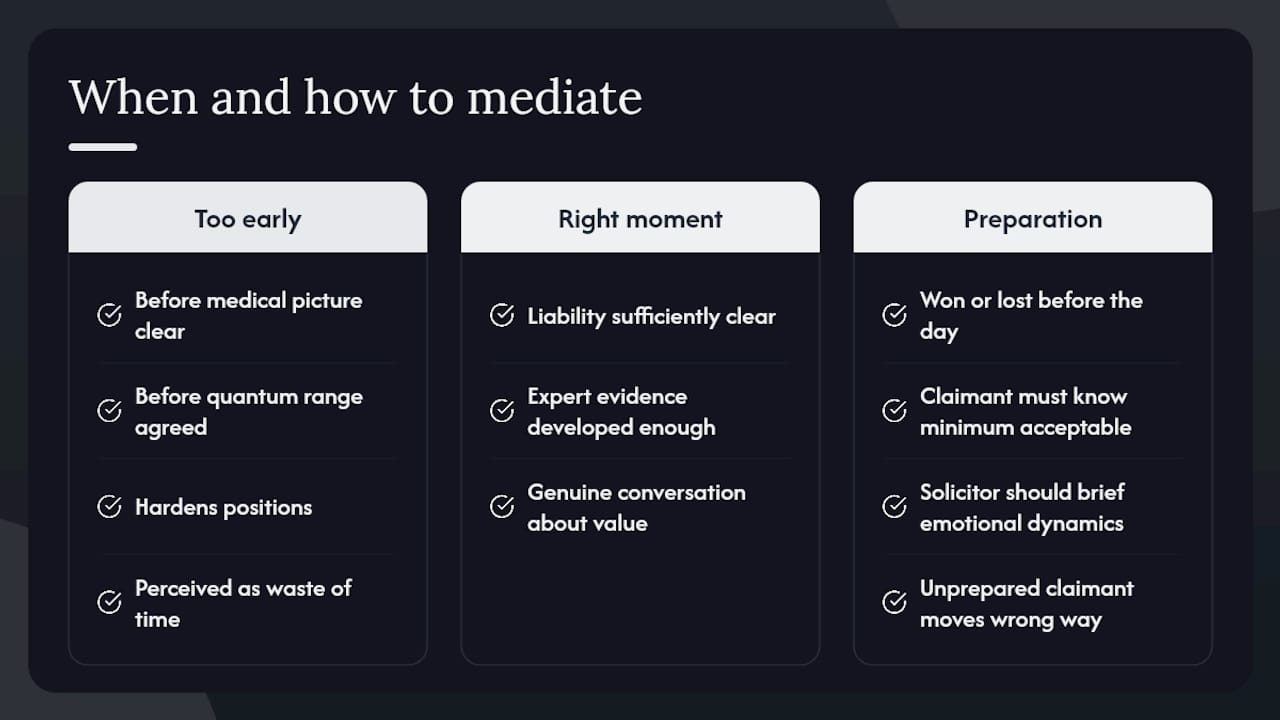
Ali Legal Ltd acts for claimants across a range of personal injury matters, from road traffic accidents and employer liability claims to more complex clinical negligence disputes. Where mediation offers a realistic route to settlement, the firm advises on timing, prepares position statements, attends the session, and drafts the binding settlement agreement.
The firm’s approach is direct: mediation is recommended when the evidence supports a genuine negotiation, not as a box-ticking exercise. Ali Legal Ltd’s solicitors prepare clients thoroughly before the day, manage authority carefully during the session, and advise on whether a late offer is worth accepting or whether the case is better taken further. Fixed-fee options are available for mediation preparation and attendance, so you know the cost before committing.
To discuss whether mediation is the right next step for your personal injury claim, contact Ali Legal Ltd for a consultation. The team can also advise on the full range of civil dispute resolution options if mediation is not yet the right fit.
This article provides general information about mediation in personal injury claims in England and Wales. It is not legal advice. You should confirm the current rules and your options with a qualified solicitor before making any decisions about your claim.
The sources below are the primary references for this guide. Each is freely accessible and carries significant weight with courts and practitioners.
This article is general information, not a substitute for advice from a qualified lawyer. Consult a qualified legal professional about your own circumstances before acting on anything here.
The single most useful thing you can do right now is ask your solicitor for a client care letter, set a written spending cap, and request interim bills at agreed intervals. Those three steps alone prevent the majority of fee disputes. If you are already in a dispute, the route is: internal complaint first, then the Legal Ombudsman, and if the bill itself is the problem, a detailed assessment application to the Senior Courts Costs Office within one month of receiving it.
Here is a quick-start checklist before you read further:
The priorities differ by matter type. A simple small claim for a faulty product rarely justifies a solicitor’s hourly rate; the online system and self-representation are often the better route. A contested civil matter over £25,000, by contrast, demands careful fee-arrangement negotiation from day one, because costs can exceed the value of the claim if left unmanaged.
A solicitor’s invoice is rarely just one number. The Law Society explains that a bill typically contains several distinct components, and understanding each one is the first step to checking whether you have been charged correctly.
Solicitor fees are the charges for the lawyer’s own time, either at an agreed hourly rate or as a fixed sum for a defined piece of work. Hourly rates vary considerably by seniority and location; a senior partner in central London charges far more per hour than a newly qualified solicitor in a regional firm.
Disbursements are out-of-pocket expenses the firm pays on your behalf and then recovers. Common examples include:
VAT at 20% is charged on solicitor fees and most disbursements, though some court fees are exempt. Always check whether a quoted figure is inclusive or exclusive of VAT.
Success fees apply under Conditional Fee Agreements (CFAs). They represent a percentage uplift on the base fee, payable only if you win, and are capped at 100% of the base fee in most cases (25% of damages in personal injury claims under the Legal Aid, Sentencing and Punishment of Offenders Act 2012 rules).
After-the-Event (ATE) insurance premiums cover the risk of paying the other side’s costs if you lose. In most cases since April 2013, ATE premiums are not recoverable from the losing party, so you bear that cost yourself.
A summary bill gives the total charge with a brief description of work done. A detailed bill itemises every attendance, letter, and task with the time spent and rate applied. You have the right to request a detailed breakdown in most circumstances, and doing so is the first practical step if a bill looks wrong. The Law Society’s guidance sets out the routes available, including the right to apply for a detailed assessment by the court.
The general rule in civil litigation in England and Wales is that the losing party pays the winning party’s costs. Civil Procedure Rules Part 44 governs this, and the court has wide discretion to depart from it based on conduct, offers to settle, and proportionality.
The small claims track is the significant exception. Advicenow’s guidance on legal costs confirms that in small claims, parties generally meet their own legal costs regardless of outcome. Winning a £3,000 dispute in the Small Claims Court does not mean the other side reimburses your solicitor’s bill.
| Track | Typical claim value | Cost recovery rule |
|---|---|---|
| Small Claims | Up to £10,000 | Each party pays own costs (with limited exceptions) |
| Fast Track | £10,000 to £25,000 | Recoverable costs apply, but fixed recoverable costs (FRC) cap what you can claim |
| Multi-Track | Claims exceeding the usual Fast Track range | Full costs shifting applies; court assesses reasonableness |

Fixed Recoverable Costs (FRC) apply to most Fast Track claims and, since October 2023, to a wider range of cases under the extended FRC regime. Practice Direction 45 sets out the tables of fixed amounts recoverable at each stage of a claim. The practical consequence: even if you win on the Fast Track, the amount you recover toward your solicitor’s fees is capped by those tables, not by what your solicitor actually charged you.
Key points to keep in mind:
Understanding the charging model before you sign anything is one of the most effective ways to manage legal costs. The SRA’s guidance on cost questions recommends asking about the arrangement type at the very first meeting.
| Arrangement | How it works | Who bears the risk |
|---|---|---|
| Hourly rate | You pay for time spent, billed at an agreed rate | You: costs rise if the matter takes longer than estimated |
| Fixed fee | A set price for a defined scope of work | Shared: firm absorbs overruns; you pay more if scope expands |
| Conditional Fee Agreement (CFA) | No win, no fee; success fee added if you win | Firm bears some risk; you may still pay disbursements and ATE premium |
| Damages-Based Agreement (DBA) | Firm takes a percentage of damages recovered | Firm bears most risk; percentage is capped by regulation |
| Private retainer (ongoing) | Regular monthly fee for access and defined work | You: ongoing commitment regardless of activity |
Conditional Fee Agreements are the most common “no win, no fee” arrangement in personal injury, employment, and some civil claims. The success fee is capped at 25% of the damages recovered in personal injury cases. In other civil matters the cap is 100% of the base fee, though in practice most firms charge far less.
Damages-Based Agreements are less common but available in employment tribunals and civil litigation. The DBA Regulations 2013 cap the percentage at 50% of damages in most civil claims (25% in employment cases).
After-the-Event insurance deserves a separate word. It protects you against paying the other side’s costs if you lose. Premiums vary widely depending on the risk profile of the case and the stage at which you take out cover. Because premiums are generally not recoverable from the other side, they add to your net outlay even on a CFA.
Pro Tip: Ask your solicitor to include a written approval step in the retainer: the firm must contact you before costs exceed a set threshold. Most firms will agree to this if asked, and it prevents the shock of a bill that has grown far beyond the original estimate.
The Solicitors Regulation Authority requires firms to give clients clear cost information at the outset and to keep them updated as the matter progresses. This is not a courtesy; it is a regulatory obligation.
The client care letter (sometimes called the retainer letter or terms of engagement) is the document that records the fee arrangement. It must include:
Keep this letter. It is your primary evidence if a bill later exceeds what was discussed.
The SRA’s price transparency rules require most firms to publish indicative costs for certain common services (conveyancing, probate, employment tribunals, motoring offences, and debt recovery) on their websites. This lets you compare before you instruct. If a firm refuses to give you a written estimate at all, that is itself a warning sign and potentially a breach of SRA conduct rules.
The SRA’s ten questions to ask your lawyer include asking whether the estimate is likely to change, what would cause it to change, and how you will be told if it does. Print that list and take it to your first meeting.
Checklist of minimum information to request at the outset:
Pro Tip: After any telephone conversation about costs, send a short email summarising what was agreed. “Following our call today, I understand the estimate is £X and you will contact me before costs exceed £Y.” That email creates a contemporaneous record that carries real weight in a complaint.
The SRA also requires that client money held on account is kept in a separate client account and used only for the purpose for which it was paid. If you are asked to pay money on account before work begins, you are entitled to ask how it will be held and what happens to any unused balance.
The most controllable variable in a legal bill is the amount of time your solicitor spends on your matter. Much of that time is driven by how efficiently you work with them.
Concrete steps that reduce billable hours:
Mediation typically costs a fraction of contested litigation and resolves a significant proportion of civil disputes before trial. Many courts now expect parties to have considered mediation before issuing proceedings, and refusing it without good reason can affect costs orders.

For claims under £10,000, the online Money Claims system lets you issue and manage a claim without a solicitor. Advicenow’s guidance encourages its use for lower-value disputes precisely because it reduces time and cost compared with instructing lawyers.
Representing yourself as a litigant in person is a realistic option for straightforward small claims. The court will explain the process, and resources such as Citizens Advice and Advicenow provide step-by-step guidance. The essential checklist for hiring a solicitor from Ali Legal Ltd can help you decide at which point professional representation genuinely adds value.
Pro Tip: Ask your solicitor to phase the work and quote each phase separately. You retain the option to handle later phases yourself or with a different firm if the first phase resolves the dispute or changes your assessment of the risk.
There are several realistic routes for people who cannot meet legal costs privately, and checking eligibility takes very little time.
Legal aid is means-tested and restricted to certain case types, primarily family matters involving domestic abuse or child protection, immigration, mental health, and some housing cases. Civil litigation for money claims is generally outside scope. Check eligibility and find a legal aid provider through GOV.UK. Ali Legal Ltd’s guide to legal aid eligibility and benefits explains the criteria and application process in plain terms.
Pro bono services are free legal advice provided by solicitors and barristers on a voluntary basis. The Law Society’s Pro Bono Protocol and organisations such as LawWorks connect eligible individuals with volunteer lawyers for civil matters outside legal aid scope.
Law Centres offer free legal advice and representation to people on low incomes, primarily in housing, employment, immigration, and welfare benefits. Find your nearest centre through the Law Centres Network.
Citizens Advice provides free, independent guidance on a wide range of legal problems and can help you understand your options before you decide whether to instruct a solicitor.
Payment plans are more available than many people realise. Most firms will discuss a payment schedule if you ask directly. Useful approaches:
For those facing court fee exemptions in family proceedings, fee remission (Help with Fees, form EX160) is available based on income and savings. This covers court issue fees, not solicitor fees, but it can make a meaningful difference to the total outlay.
Representing yourself is a genuine option for straightforward matters. The small claims process is designed to be accessible without legal representation, and the court staff can direct you to the right forms.
If a bill arrives and something looks wrong, the process is straightforward but time-sensitive.
Applying to the Senior Courts Costs Office for a detailed assessment within one month of receiving the bill gives you the strongest procedural position. Applications made between one month and 12 months are still possible but the court may require you to pay part of the bill upfront. After 12 months, the court’s discretion to allow an assessment narrows considerably. If the court reduces the bill, any overpayment is refunded.
Pro Tip: Before applying for a detailed assessment, write to the firm with a without-prejudice offer to settle the disputed amount. Many firms will negotiate rather than face the cost and time of a formal assessment, and a negotiated reduction is often faster and cheaper than the court process.
Key evidence to gather before challenging a bill:
The Legal Ombudsman’s complaints process sets its own time limits: generally, you must complain within one year of the act or omission, or within one year of when you reasonably should have known there was a problem. Failure to provide a bill at all can reset that awareness date.
Around one in ten complaints to the Legal Ombudsman involve legal costs, and the Ombudsman is clear that poor communication about costs, not the level of fees alone, is the leading cause of those disputes. A bill that significantly exceeds an estimate without prior warning is the most common trigger.
The Ombudsman applies three broad principles when investigating cost complaints:
What the Ombudsman typically expects to see from the firm:
Common outcomes when the Ombudsman upholds a complaint include requiring the firm to reduce the bill, issuing a refund of amounts already paid, and awarding modest compensation for distress or inconvenience. In one published case study, the Legal Ombudsman directed a fee reduction and awarded compensation after a client’s bill significantly exceeded the original estimate and the firm had failed to explain why.
The Ombudsman will generally not intervene where the client agreed to the fee arrangement in writing, received regular updates, and the final bill was proportionate to the work done. Time limits apply: complain within one year of the act or omission, or within one year of becoming aware of the problem.
Use this before you instruct a solicitor and at each billing stage.
Before you instruct:
Documents to get in writing before work starts:
Prompt templates you can email:
The SRA’s ten questions to ask your lawyer and Ali Legal Ltd’s legal consultation preparation guide both provide additional prompts worth reviewing before a first appointment.
The gap between what clients expect to pay and what they actually pay is almost never about the hourly rate. It is almost always about what was not said at the start.
At Ali Legal Ltd, the client care letter is treated as a working document, not a formality. Cost estimates are given in ranges, with a clear explanation of what would push the matter toward the higher end. Where a matter is suitable for a fixed fee, that is offered. Where it is not, a cost cap with a written approval step is the default approach. Clients receive interim bills at agreed intervals so that costs are visible throughout, not just at the end.
The SRA’s regulatory framework sets the floor for what firms must do. What distinguishes a good firm from a compliant one is whether those obligations are met in spirit as well as in letter. A client who understands their bill at every stage is a client who can make informed decisions about whether to continue, settle, or change course. That is not just good practice; it is the only way to run a matter fairly.
Fixed fees where the scope allows, cost caps where it does not, and a client care letter that actually explains what you are signing up for. That is the practical difference Ali Legal Ltd offers compared with firms that treat cost disclosure as a box-ticking exercise.
Ali Legal Ltd is a regulated firm covering civil litigation, property, employment, family, and corporate matters. Every instruction begins with a written fee estimate, a billing schedule, and a clear explanation of disbursements. For matters where costs are genuinely unpredictable, the firm agrees a written approval threshold so you are never presented with a bill you did not authorise.
If you are facing a dispute, a property transaction, or a corporate matter and want to understand the likely costs before committing, speak to the team. Ali Legal Ltd’s corporate litigation guide explains how costs work in commercial disputes specifically. To discuss your matter and get a clear fee estimate, contact Ali Legal Ltd directly.
These are the authoritative sources for forms, rules, and complaints in England and Wales. Use them in the order that matches your situation.
This article provides general information about legal costs in England and Wales. It is not legal advice. Rules, thresholds, and eligibility criteria change; confirm current requirements with GOV.UK, the relevant regulatory body, or a qualified solicitor before acting.
This article is general information, not a substitute for advice from a qualified lawyer. Consult a qualified legal professional about your own circumstances before acting on anything here.
Regulatory compliance in the UK means meeting the legal duties set by Parliament, statutory instruments, and sector regulators — and being able to prove it. The most common examples span eight areas that affect almost every UK business:
These are not abstract legal concepts. Each one carries real enforcement powers, financial penalties, and reputational risk for businesses that treat them as optional.
Regulatory compliance is the ongoing process of identifying, meeting, and evidencing the legal duties that apply to your organisation — drawn from Acts of Parliament, statutory instruments, regulator rulebooks, and recognised standards such as ISO 27001 or PCI DSS.
The UK system is layered. Primary legislation (an Act) sets the framework. Statutory instruments fill in the detail. Regulators then publish guidance, codes of practice, and rulebooks that translate those duties into operational expectations, and industry standards sit alongside all of this as a recognised way of demonstrating that controls are in place.
Compliance is not a one-time project. It is a continuous cycle of identifying obligations, implementing controls, keeping records, and reviewing whether those controls still work as law and risk evolve.
What distinguishes a genuine compliance programme from a tick-box exercise is evidence. Regulators do not simply take your word for it. The Government Security Profession career framework describes compliance as a blend of legal understanding and assurance capability — meaning organisations must both understand what the law requires and be able to demonstrate, through documented procedures and records, that they are meeting it.
The stakes are significant. Under the UK GDPR, the ICO can issue fines of up to £17.5 million or 4% of global annual turnover, whichever is higher, for the most serious breaches.
The Institute for Government describes the UK regulatory landscape as layered across government departments and sectoral regulators, with monitoring ranging from transparency requirements and reporting to direct inspections. Risk-based targeting is standard: regulators concentrate resources on higher-risk activities and organisations rather than treating every business identically.
Every organisation that processes personal data about UK residents must comply with the UK GDPR and the Data Protection Act 2018. In practice, this means appointing a Data Protection Officer where required, maintaining a Record of Processing Activities (ROPA), implementing a lawful basis for each processing activity, and publishing a privacy notice. Technical controls — encryption, access controls, breach detection — sit alongside the paperwork.
The ICO enforces these duties. A failure to report a notifiable data breach within 72 hours, or processing data without a lawful basis, can trigger an investigation and a formal enforcement notice. The ICO’s fines against organisations for inadequate security and unlawful marketing have run into the millions of pounds.
Under the Health and Safety at Work etc. Act 1974, employers must protect the health, safety, and welfare of their workers and others affected by their work. This means conducting and documenting risk assessments, providing adequate training, maintaining equipment, and reporting certain incidents to the HSE under RIDDOR (Reporting of Injuries, Diseases and Dangerous Occurrences Regulations 2013).

Where hazardous substances are involved, COSHH regulations require employers to assess and control those risks specifically, keep records of assessments, and train staff on the substances they handle; this aligns closely with employer immigration duties and compliance processes that businesses must manage to maintain regulatory compliance. HSE uses a risk-based enforcement approach: businesses in higher-hazard sectors such as construction, manufacturing, and chemicals face more frequent inspection.
Businesses that carry out activities with environmental impact — operating a waste facility, discharging to water, running a combustion plant — need an environmental permit from the Environment Agency under the Environmental Permitting (England and Wales) Regulations 2016. The Environment Act 2021 added extended producer responsibility (EPR) obligations for packaging, requiring producers above certain thresholds to register, report packaging data, and pay fees.
Operating without a permit, or breaching permit conditions, can result in enforcement notices, stop notices, and prosecution. The Environment Agency publishes its enforcement and sanctions policy, and its public register records permit holders and enforcement actions.
UK companies must file annual accounts and a confirmation statement with Companies House under the Companies Act 2006. Directors have statutory duties — to act within their powers, promote the success of the company, exercise reasonable care and skill — and breaching those duties can trigger personal liability. For corporate governance obligations and reporting requirements, the FCA’s Disclosure Guidance and Transparency Rules apply to listed companies, requiring timely disclosure of inside information and periodic financial reports.
Failure to file accounts on time results in automatic penalties from Companies House. More serious governance failures attract FCA investigation, public censure, and fines.
The Money Laundering, Terrorist Financing and Transfer of Funds (Information on the Payer) Regulations 2017 apply to a defined list of regulated sectors: banks, accountants, solicitors, estate agents, and others. Compliance requires a written AML policy, a nominated Money Laundering Reporting Officer (MLRO), customer due diligence (CDD) on clients, enhanced due diligence for higher-risk relationships, and a system for reporting suspicious activity to the National Crime Agency.
The FCA supervises financial services firms; HMRC supervises accountants, estate agents, and others outside the FCA’s remit. Both carry out thematic reviews and firm-level visits. Firms found to have inadequate AML controls face substantial fines and, in serious cases, withdrawal of authorisation.
MHRA regulates medicines, medical devices, and clinical trials. Manufacturers and importers must hold the appropriate licences, comply with Good Manufacturing Practice (GMP), and report adverse events through the Yellow Card scheme. Post-Brexit, the UK Conformity Assessed (UKCA) marking regime applies to medical devices placed on the Great Britain market.
FSA oversees food safety and hygiene. Food businesses must register with their local authority, comply with food hygiene regulations, implement Hazard Analysis and Critical Control Points (HACCP) procedures, and maintain temperature and traceability records. The FSA’s National Food Crime Unit investigates serious food fraud.
Ofcom now enforces the Online Safety Act 2023, which imposes duties of care on providers of user-to-user and search services. Platforms must conduct risk assessments for illegal content and, where services are likely to be accessed by children, carry out child-focused risk assessments and apply proportionate protective measures across their design and operation.
UK businesses exporting controlled goods, software, or technology need a licence from the Export Control Joint Unit (ECJU) under the Export Control Order 2008. The UK also operates autonomous sanctions regimes — financial, trade, and immigration — administered by the Office of Financial Sanctions Implementation (OFSI) and the Foreign, Commonwealth and Development Office. Businesses must screen customers and counterparties against sanctions lists and maintain records of that screening. For context on the broader international trade compliance framework, the obligations extend to re-exports and brokering arrangements.
Digital platform operators must apply due diligence on sellers and report to HMRC under the platform operator regulations, with penalties for failures. Separately, the Reporting Cryptoasset Service Providers (Due Diligence and Reporting Requirements) Regulations 2025 require UK cryptoasset service providers to apply due diligence procedures, retain records for five years, and submit an annual report to HMRC by 31 May each year.
| Regulator | Remit | Typical evidence to retain |
|---|---|---|
| ICO | Data protection, UK GDPR | ROPA, privacy notices, breach logs, DPIAs |
| HSE | Health and safety at work | Risk assessments, COSHH records, training logs, RIDDOR reports |
| Environment Agency | Environmental permitting, EPR | Permits, waste transfer notes, packaging data reports |
| FCA / Companies House | Financial reporting, market conduct | Annual accounts, board minutes, disclosure records |
| HMRC / FCA | Anti-money laundering | CDD files, MLRO reports, SAR records, training records |
| MHRA | Medicines and medical devices | Licences, GMP records, adverse event reports |
| FSA / Local authorities | Food safety | HACCP plans, temperature logs, supplier records |
| Ofcom | Online safety, broadcasting | Risk assessments, moderation records, codes of practice |
| ECJU / OFSI | Export controls, sanctions | Licence applications, screening records, transaction logs |
| HMRC | Platform and cryptoasset reporting | Due diligence files, five-year records, annual HMRC reports |
Proof of compliance lives in documentation, not intention. The Government Security Profession framework is explicit: organisations need to implement procedures, report non-compliance, and advise on regulatory application — all of which require a paper trail.
The core mechanisms are:
Compliance owners and DPOs/MLROs should hold: current policy versions with version history, risk assessment registers, training completion records, and logs of incidents or near-misses.

Board and senior management should hold: board-approved compliance policies, minutes recording compliance discussions, assurance reports from internal audit or external review, and evidence of oversight of third-party and supply chain risks.
Operational teams should hold: completed risk assessments for their specific activities, records of checks carried out (temperature logs, screening records, permit conditions met), and records of any incidents reported.
Pro Tip: Retain metadata and change history for key compliance records — not just the current version. Regulators investigating a past incident will want to know what your policy said at the time of the event, not what it says today. Version control in a document management system such as SharePoint or a dedicated GRC platform protects you in exactly that scenario.
Poor compliance rarely comes from deliberate wrongdoing. It usually comes from four recurring failures: not knowing which rules apply, keeping inadequate records, failing to manage third-party risk, and letting training lapse.
The top challenges:
The most expensive compliance failures are almost always preceded by a known gap that nobody was assigned to fix. Ownership without accountability is the same as no ownership at all.
Short case illustrations: a food manufacturer that skipped HACCP re-validation after a recipe change faced an FSA improvement notice and a temporary halt to production. A fintech firm that grew rapidly without updating its AML customer due diligence procedures received an FCA enforcement notice and a public fine. An e-commerce business that failed to register under EPR packaging rules faced Environment Agency investigation after a competitor complaint. In each case, the underlying issue was not ignorance of the law but a failure to operationalise it.
For a broader view of the business liability risks that flow from non-compliance, the consequences extend well beyond regulatory fines to civil claims, director disqualification, and loss of contracts.
UK regulators are moving towards proportionate, risk-based, and service-oriented supervision. The direction of travel is clear in government policy and regulator behaviour, even if the pace varies by sector.
The UK government’s Smarter Regulation agenda instructs regulators to adopt a targeted, proportionate approach that helps businesses meet obligations while limiting unnecessary burdens. The policy explicitly frames regulation as a tool to support innovation and growth, not just to constrain it.
In practice, this means:
ICO has operated a regulatory sandbox allowing organisations to test data-driven innovations with ICO input before full deployment — a direct application of the service-oriented stance. The ICO’s enforcement approach distinguishes between organisations that made genuine efforts to comply and those that showed wilful disregard.
HSE applies the Hampton principles: inspect and investigate only where there is a genuine risk, and support businesses in understanding their duties through published guidance, sector-specific toolkits, and a free advice line for small businesses.
FCA and PRA use a risk-based supervisory model that concentrates attention on firms posing the greatest potential harm to consumers or market integrity. Firms with strong governance and transparent reporting face less intrusive supervision.
Environment Agency publishes its enforcement and sanctions policy and uses a graduated response: advice and guidance first, then formal notices, then prosecution for the most serious or persistent breaches.
The Regulators’ Code, which applies to most UK regulators, requires them to carry out their activities in a way that supports those they regulate to comply and grow. This does not reduce the legal obligations on businesses, but it does mean that a firm that engages proactively with its regulator, discloses issues promptly, and demonstrates genuine remediation effort is likely to face a different outcome than one that ignores correspondence and disputes findings.
A small team can move from reactive to demonstrable compliance in 90 days by following a structured sequence. The key is to prioritise by risk rather than trying to fix everything at once.
Map your obligations (Days 1–10): list every regulatory regime that applies to your business by sector, activity, and geography. Use regulator websites, your trade association, and legal advice to confirm the list. Do not assume last year’s list is still complete.
Prioritise by risk (Days 11–15): rank obligations by the severity of potential harm and the likelihood of a gap. Data protection, AML, and health and safety typically sit at the top for most businesses. New obligations such as Online Safety Act duties or EPR packaging registration may have hard deadlines.
Assign owners (Days 16–20): every obligation needs a named individual responsible for it. Without a named owner, accountability dissolves. For smaller businesses, one person may own several areas, but the ownership must be explicit and recorded.
Document key policies (Days 21–40): draft or update written policies for each priority area. Policies should reference the specific legal duty they address, set out the organisation’s approach, and be approved by a director or equivalent. For corporate governance and board oversight, board approval of key compliance policies is itself a compliance requirement in some sectors.
Train staff (Days 41–55): deliver role-appropriate training on each priority area and record completion. For AML and data protection, training must be refreshed regularly — annual refreshers are standard. Keep attendance records and the training materials used.
Set monitoring and reporting cadences (Days 56–65): establish how often compliance status is reviewed (monthly for high-risk areas, quarterly for others) and who receives the report. A simple dashboard tracking open actions, upcoming deadlines, and recent incidents is sufficient for most SMEs.
Capture and organise evidence (Days 66–80): consolidate existing records into a structured filing system. Ensure permits, licences, risk assessments, training records, and audit logs are accessible and version-controlled. For new obligations such as cryptoasset reporting, set up the five-year retention process from day one.
Plan independent assurance (Days 81–90): schedule an internal audit or external review of your highest-risk areas. For regulated firms, this may be a requirement. For others, it is the fastest way to find gaps before a regulator does.
When to seek legal advice: if your obligation mapping reveals duties you do not fully understand, if you are facing a regulator investigation or enforcement notice, or if you are entering a new regulated activity, take legal advice before acting. The cost of early advice is almost always lower than the cost of remediation after a regulatory finding. For businesses with international trade exposure, export controls and sanctions compliance in particular warrant specialist input.
Compliance done well is one of the most undervalued commercial assets a business can hold. The conventional view treats it as overhead: a cost centre that consumes resource without generating revenue. That framing misses what actually happens in practice.
Businesses with documented, demonstrable compliance programmes move through due diligence faster. Buyers, investors, and lenders increasingly run compliance health checks as part of their standard process. A company that can produce its ROPA, its AML policy, its environmental permits, and its board-approved governance framework within 24 hours of a request shortens transaction timelines and signals lower risk. That translates directly into better deal terms.
Insurance underwriters price compliance risk. A business with documented health and safety records, a clean HSE history, and ISO 27001 certification will typically pay lower premiums than a comparable business with no evidence of controls. The saving compounds over time.
There is also the disruption argument. An enforcement notice, a production halt, or a public fine does not just cost the penalty amount. It costs management time, legal fees, reputational damage, and often a period of reduced commercial activity while the issue is resolved. Businesses that invest in compliance before enforcement are buying operational continuity, not just regulatory peace of mind.
Regulatory compliance touches every part of a business, and the consequences of getting it wrong are rarely limited to a single fine. Ali Legal Ltd works with businesses across the UK on compliance reviews, policy drafting, and regulator engagement — giving you clear, fixed-fee advice rather than open-ended retainers.
Whether you need a corporate governance review, support with a data protection framework, or legal guidance on export controls and sanctions, Ali Legal Ltd provides straightforward advice with no unnecessary complexity. For businesses with property-related compliance obligations, the property law compliance checklist covers the key statutory duties in one place. For corporate and governance matters, the corporate law guide sets out director duties, reporting obligations, and the practical steps to meet them.
Contact Ali Legal Ltd today to book a compliance consultation and get a clear picture of where your obligations stand.
This article is general information, not a substitute for advice from a qualified lawyer. Consult a qualified legal professional about your own circumstances before acting on anything here.


