
Menu
Get Expert Legal Support Today

Many people believe judicial review allows courts to overturn any government decision they dislike. This misunderstands a crucial legal principle that protects constitutional limits whilst respecting democratic processes. Judicial review empowers courts to examine whether government actions comply with the law, not to substitute their judgement for elected officials. Understanding this distinction matters for individuals and businesses navigating regulatory frameworks, challenging administrative decisions, or protecting their rights against unlawful government conduct.
| Point | Details |
|---|---|
| Definition | Judicial review allows courts to assess whether government actions comply with constitutional and statutory law |
| Court powers | Courts can set aside unlawful agency decisions and compel compliance with legal requirements |
| Legal limits | Standing, ripeness and mootness doctrines restrict which cases courts can hear |
| Business impact | Judicial review shapes regulatory compliance, contract enforcement and administrative obligations |
| Procedural requirements | Claimants must show direct harm, timely disputes and proper jurisdiction to obtain review |
Judicial review represents the power of courts to examine actions taken by other government branches and declare them invalid if they violate constitutional or statutory provisions. This fundamental principle emerged from Marbury v. Madison, an 1803 case establishing that courts could invalidate laws contradicting the U.S. Constitution. Whilst originating in American jurisprudence, similar principles operate in British law through different mechanisms.
Judicial review serves several critical functions in modern legal systems. Courts use this power to maintain constitutional limits on government authority, ensuring no branch exceeds its lawful powers. This creates accountability for administrative agencies and elected bodies whose decisions affect millions.
The practical significance extends beyond abstract constitutional theory:
“The Constitution is law, and courts must interpret it as such. When government actions conflict with constitutional provisions, courts have the duty to declare those actions void.”
This principle doesn’t grant courts unlimited power. They cannot review purely political decisions or substitute their policy preferences for those of elected officials. Judicial review focuses narrowly on legal compliance, asking whether government actors followed proper procedures and stayed within their lawful authority.
Federal agencies operate under statutory frameworks that authorise judicial review of their actions. The Administrative Procedure Act (APA) provides the foundation for challenging agency decisions in many jurisdictions. This statute establishes when and how courts can examine administrative actions.
Courts review final agency action not precluded by statute or committed to agency discretion. This means several conditions must exist before judicial intervention occurs. The agency must have completed its decision, the statute must permit review, and the matter cannot fall within the agency’s unreviewable discretion.
When reviewing agency actions, courts can:
The review process involves specific legal standards. Courts examine whether agencies followed proper procedures, considered relevant factors, and reached conclusions supported by evidence. They don’t substitute their judgement for the agency’s expertise but ensure decisions rest on rational foundations.

Several limitations constrain judicial review. Statutes may explicitly preclude review of certain agency actions. Standing requirements demand that claimants show direct injury. Ripeness doctrine prevents premature challenges before disputes fully develop. The role of compliance officer UK becomes crucial here, as businesses need expertise identifying when agency actions create reviewable harm.
| Review type | Standard applied | Court action available |
|---|---|---|
| Procedural | Did agency follow required steps? | Remand for proper procedure |
| Substantive | Is decision supported by evidence? | Set aside arbitrary action |
| Jurisdictional | Did agency exceed authority? | Invalidate ultra vires action |
| Constitutional | Does action violate rights? | Declare unconstitutional |
Pro Tip: Document all interactions with administrative agencies meticulously. Courts reviewing agency decisions examine the administrative record, making contemporaneous documentation essential for successful challenges.
The Administrative Procedure Act creates presumptions favouring reviewability whilst respecting agency expertise. This balance acknowledges that agencies possess technical knowledge courts lack whilst ensuring legal accountability.
Three justiciability doctrines determine whether courts can hear cases challenging government action. These principles prevent courts from deciding abstract disputes or issuing advisory opinions, maintaining proper separation of powers.
Standing requires plaintiffs to demonstrate a personal stake in the dispute. Courts demand concrete injury, causation linking that injury to the challenged action, and likelihood that a favourable decision would redress the harm. Generalised grievances shared by all citizens don’t suffice. You must show specific harm affecting you differently than the general public.
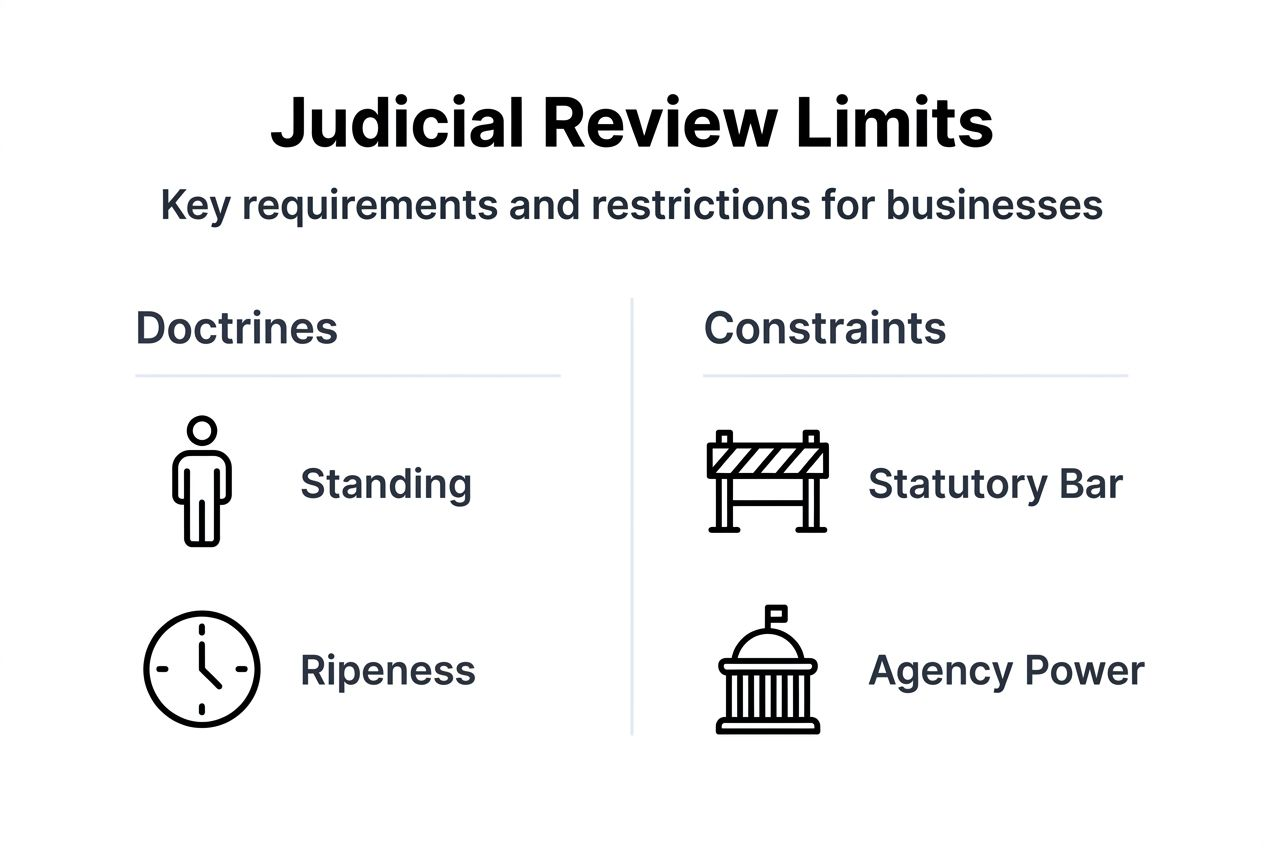
Ripeness addresses timing. Cases must be ready for judicial decision, balancing issue fitness for review against hardship from delayed consideration. Courts evaluate whether the dispute has crystallised sufficiently and whether withholding review would impose undue hardship. This doctrine prevents premature challenges whilst allowing intervention when administrative positions harden.
Mootness operates at the opposite end. Courts refuse hearing disputes where changed circumstances eliminate live controversy. If the challenged action ends or the plaintiff’s situation changes, making relief impossible or unnecessary, courts dismiss as moot. Exceptions exist for disputes capable of repetition yet evading review due to their brief duration.
These doctrines serve vital functions:
Businesses must understand statutory limitation UK principles when planning challenges. Timing matters enormously. File too early and courts dismiss for lack of ripeness. Wait too long and mootness or limitation periods bar review.
Pro Tip: Consult legal counsel immediately when government actions threaten your interests. Justiciability doctrines create narrow windows for effective challenges, and procedural missteps can permanently foreclose judicial review.
Some disputes escape these limits. Class actions allow individual plaintiffs to raise claims benefiting many. Voluntary cessation of challenged conduct doesn’t moot cases if defendants might resume. These nuances require expert legal analysis.
Judicial review profoundly affects regulatory compliance, shaping how businesses operate under administrative rules. When agencies promulgate regulations, affected parties can challenge those rules in court, potentially invalidating requirements imposing substantial costs. This creates both opportunities and uncertainties for commercial operations.
Businesses face several scenarios where judicial review matters:
Recent cases demonstrate judicial review’s tangible impact. Courts struck down agency merger notification rules, eliminating compliance burdens businesses faced. Such decisions can save millions in compliance costs whilst reshaping competitive landscapes. They also create uncertainty, as rules businesses relied upon may suddenly disappear.
For individuals, judicial review provides recourse against adverse administrative decisions. Immigration denials, benefit terminations, professional licensing disputes and tax assessments all potentially involve reviewable agency action. Success requires meeting jurisdictional requirements and demonstrating legal error.
| Stakeholder | Typical review scenario | Potential outcome |
|---|---|---|
| Businesses | Challenge to new regulation | Rule invalidated, compliance costs avoided |
| Individuals | Immigration decision appeal | Visa denial reversed, rights restored |
| Competitors | Licensing granted to rival | Competitor’s licence revoked |
| Public interest groups | Environmental permit challenge | Permit vacated, project halted |
Navigating these processes demands expertise. The regulatory & compliance landscape grows increasingly complex, with judicial review adding another layer. Businesses need strategies addressing both compliance with existing rules and potential challenges to those rules.
The role of legal counsel business UK becomes essential when government actions threaten commercial interests. Counsel can assess whether administrative decisions meet legal standards, identify grounds for challenge, and navigate procedural requirements. Early involvement maximises chances of successful judicial review.
Successful challenges require demonstrating that agencies acted arbitrarily, exceeded authority, or failed to follow proper procedures. Courts won’t overturn decisions merely because different policy choices might seem preferable. The focus remains on legal compliance, not policy wisdom.
Navigating judicial review requires specialised legal expertise combining administrative law knowledge with strategic litigation skills. Whether you’re challenging government decisions or defending against claims, professional guidance proves essential for protecting your interests.

Ali Legal brings extensive experience to commercial litigation involving regulatory disputes and administrative challenges. We understand how judicial review intersects with business operations, helping clients assess when government actions exceed lawful authority and how to mount effective challenges.
Our civil litigation services extend to judicial review proceedings, where we guide clients through complex procedural requirements whilst developing compelling legal arguments. We handle matters from initial assessment through final resolution, ensuring your rights receive vigorous protection.
For businesses facing regulatory challenges, our regulatory compliance services provide comprehensive support. We help you understand obligations, identify potential grounds for challenging unlawful requirements, and develop strategies minimising legal risk whilst protecting commercial interests.
Judicial review allows courts to examine whether government actions comply with legal requirements. Courts can invalidate decisions that exceed statutory authority, violate constitutional provisions, or fail to follow proper procedures. This creates accountability for administrative agencies and elected bodies.
Anyone suffering direct, concrete harm from government action can potentially request judicial review. You must demonstrate standing by showing the challenged action injured you specifically, not just the general public. Businesses, individuals and organisations can all seek review if they meet jurisdictional requirements.
Courts review final agency actions not precluded by statute or committed to agency discretion. This includes regulations, licensing decisions, benefit determinations and enforcement actions. Political decisions and matters within executive discretion typically escape review. The action must be complete and ripe for judicial consideration.
Standing requires showing you suffered concrete injury from the challenged action, that injury was caused by the defendant’s conduct, and a favourable court decision would likely redress your harm. Generalised grievances shared by everyone don’t create standing. You need personal, particularised injury distinguishing you from the general public.
Judicial review shapes regulatory compliance by allowing businesses to challenge unlawful rules. Courts can invalidate regulations imposing unjustified costs or exceeding agency authority. This creates opportunities to contest burdensome requirements whilst introducing uncertainty about rule stability. Businesses need legal counsel to navigate these dynamics effectively.


