
Many assume extradition between countries happens swiftly and automatically, but UK extradition law operates through a rigorous legal framework with multiple safeguards. Extradition proceedings can take 6 to 18 months or more, with judicial appeals and statutory bars potentially delaying surrender. This guide demystifies the UK extradition process, explaining the legal foundations, procedural stages, and protections that shape how individuals are transferred between jurisdictions for criminal justice purposes.
| Point | Details |
|---|---|
| Governing legislation | The Extradition Act 2003 establishes the legal framework for UK extradition processes. |
| Territory classification | Countries are categorised as Category 1 or Category 2, affecting procedural requirements. |
| Process stages | Extradition involves arrest, court hearings, appeals, and Home Secretary authorisation. |
| Human rights protections | Statutory bars prevent extradition where risks of torture, death penalty, or unfair trial exist. |
| Post-Brexit arrangements | The Trade and Cooperation Agreement replaced the European Arrest Warrant from 1 January 2021. |
Extradition is the formal legal process where one country requests the return of a person from another country to stand trial or serve a sentence for a criminal offence. The UK maintains extradition arrangements with over 100 territories globally, creating an extensive international cooperation network. This breadth demonstrates the UK’s commitment to addressing cross-border crime whilst protecting individual rights through rigorous legal standards.
The Extradition Act 2003 serves as the primary legislation governing these arrangements, consolidating and modernising previous fragmented frameworks. This statute centralises the legal requirements, procedures, and protections applicable to extradition cases. For those navigating international treaty compliance, understanding this foundation proves essential.
UK extradition law balances two competing priorities. First, it facilitates international cooperation in criminal justice matters, enabling authorities to pursue offenders across borders. Second, it safeguards fundamental rights by incorporating robust legal protections and judicial oversight at every stage. The system refuses to operate as a rubber stamp for foreign requests.
Key principles underpinning UK extradition include:
This UK extradition process overview demonstrates how legislation translates into practical procedures. The framework’s complexity reflects the gravity of removing someone from UK jurisdiction to face foreign criminal proceedings.
The Extradition Act 2003 divides territories into two distinct categories, each governed by different procedural requirements. Category 1 territories include 32 countries, mostly EU and EFTA states under the Trade and Cooperation Agreement, whilst Category 2 covers nations with bilateral extradition treaties outside this framework. This classification fundamentally shapes how cases proceed through the legal system.
Category 1 territories benefit from streamlined procedures resembling the former European Arrest Warrant system. These arrangements prioritise speed and efficiency within agreed legal safeguards. Category 2 extradition requires more extensive evidential proof and involves greater judicial discretion, reflecting differing treaty obligations.
The distinction affects several procedural elements:
| Aspect | Category 1 | Category 2 |
|---|---|---|
| Geographic scope | 32 EU and EFTA states under TCA | Countries with bilateral treaties |
| Evidence standard | Certified arrest warrant | Prima facie case required |
| Decision authority | Primarily judicial | Judicial plus Home Secretary |
| Treaty basis | Trade and Cooperation Agreement | Individual bilateral treaties |
| Processing speed | Generally faster | Typically longer timelines |
Understanding whether your case involves Category 1 or 2 territories significantly impacts legal strategy and expected timelines. Pro Tip: Early identification of territory classification enables solicitors to tailor arguments to specific procedural requirements and available defences.
Post-Brexit changes particularly affect categorisation effects on legal processes for EU-related cases. The Extradition Act 2003 details provide comprehensive guidance on these distinctions and their practical implications.

The extradition process includes arrest on a warrant, an extradition hearing before a magistrate, potential judicial appeals, and a final order by the Home Secretary, who must sign the extradition unless specific statutory bars apply. Each stage incorporates oversight mechanisms protecting individuals from wrongful surrender.
The typical extradition procedure follows these sequential steps:
Magistrates assess multiple factors including identity verification, dual criminality (whether conduct constitutes an offence in both jurisdictions), and potential bars to extradition. They cannot refuse extradition based on general fairness concerns outside defined statutory grounds.
Five primary statutory bars protect individuals from unjust extradition:
The Home Secretary’s role remains limited and statutory. They cannot refuse extradition based on general policy concerns or diplomatic considerations outside defined legal bars. This separation preserves judicial independence whilst acknowledging executive responsibility for international relations.
Pro Tip: Securing importance of legal counsel in extradition matters early maximises opportunities to identify applicable statutory bars and prepare comprehensive legal arguments before hearings. Understanding statutory bars in extradition proves critical for mounting effective defences.
After Brexit, the UK lost access to the European Arrest Warrant system but implemented a new extradition arrangement with the EU under the Trade and Cooperation Agreement effective from 1 January 2021. The European Arrest Warrant ceased operation on 31 December 2020, marking a significant shift in UK-EU judicial cooperation.
The Trade and Cooperation Agreement established replacement mechanisms covering 32 EU and EFTA states, now classified as Category 1 territories under UK law. Whilst designed to maintain efficient extradition processes, the new framework introduced notable changes compared to European Arrest Warrant provisions.
Key differences include:
Transitional provisions allowed pending European Arrest Warrant cases initiated before 31 December 2020 to conclude under previous rules. This avoided disrupting ongoing proceedings during the legal transition. Cases commenced after 1 January 2021 follow Trade and Cooperation Agreement procedures exclusively.
For businesses and individuals operating across UK-EU borders, these changes necessitate updated post-Brexit cross-border legal strategy. The practical impact remains relatively modest for most cases, as the new arrangements preserve core cooperation mechanisms. However, subtle procedural differences may affect case timelines and available legal arguments.
The post-Brexit extradition changes reflect broader shifts in UK-EU relations whilst maintaining essential criminal justice cooperation. Understanding these modifications helps legal advisers navigate current procedures effectively.
Extradition law ensures protection of human rights by the application of statutory bars preventing extradition in cases involving risk of torture, death penalty, political persecution, or unfair trial conditions. These safeguards embed European Convention on Human Rights principles into domestic extradition procedures.
The death penalty bar operates strictly. UK courts refuse extradition where capital punishment may apply unless requesting states provide binding assurances it will not be imposed or executed. This reflects the UK’s categorical opposition to capital punishment in all circumstances.
Specialty arrangements prevent requesting states from prosecuting extradited individuals for offences beyond those specified in extradition requests. This principle, embedded in most treaties, protects against bait-and-switch tactics where minor offences facilitate surrender for more serious unrelated charges. Courts rigorously enforce specialty provisions.
Double jeopardy protections prevent repeated prosecution for conduct already adjudicated. If you were previously tried and acquitted or convicted for the same conduct, extradition for those matters is barred. This principle upholds finality in criminal proceedings and prevents oppressive repeat prosecutions.
Extraneous considerations encompass political persecution, discrimination, and similar improper motivations. Courts refuse extradition where evidence suggests prosecution is really aimed at punishing protected characteristics rather than genuine criminal conduct. This bar protects refugees, political dissidents, and minority groups from disguised persecution.
Key human rights grounds for refusing extradition:
Courts apply rigorous evidential standards when assessing human rights bars. General country condition reports alone rarely suffice; you must demonstrate a real, individualised risk. However, where credible evidence establishes genuine dangers, UK courts refuse extradition regardless of diplomatic or political pressures.
Pro Tip: Building comprehensive evidence supporting human rights arguments requires early preparation. Expert reports, country-specific documentation, and individualised risk assessments strengthen these challenges significantly. Understanding statutory bars impact and human rights protections in extradition provides essential foundations for effective advocacy.
Public understanding of extradition often suffers from fundamental misconceptions that can lead to poor decisions or unrealistic expectations when facing potential extradition.
Extradition is not automatic or rapid. Whilst efficient compared to historical processes, cases routinely extend across many months. Appeals, human rights assessments, and evidential challenges frequently prolong proceedings beyond initial expectations. Treat extradition as a marathon requiring sustained legal strategy, not a sprint.
UK courts and the Home Secretary cannot refuse extradition simply because foreign proceedings seem unfair or conviction likely. Unless specific statutory bars apply, concerns about case merits or foreign legal systems generally do not prevent extradition. The UK system does not re-try foreign cases on their substantive merits.
British nationals enjoy no immunity from extradition. UK citizenship does not automatically protect against surrender to foreign jurisdictions. Treaty obligations typically require extradition of nationals where legal criteria are satisfied. Some treaties permit refusal for own nationals, but this represents discretion, not automatic protection.
Common misconceptions clarified:
Understanding these realities helps individuals and businesses approach extradition matters with appropriate expectations and strategies. Misconceptions often delay effective legal responses or create false hope undermining practical planning.
International treaties such as the bilateral UK-US Extradition Treaty 2003 provide the legal framework and specific obligations for extradition cooperation, including criteria for extraditable offences and procedural standards. These agreements establish reciprocal commitments binding participating states.
Treaties define core elements shaping extradition cooperation:
The UK-US treaty exemplifies modern extradition agreements. It removes political offence exceptions for serious crimes, establishes streamlined procedures, and incorporates human rights safeguards. Dual criminality requirements ensure conduct constitutes offences in both jurisdictions, preventing extradition for acts lawful in the UK.
For businesses operating internationally, understanding treaty-based obligations affects compliance programmes and risk management strategies. Companies with cross-border operations must recognise that UK international legal compliance extends to criminal justice cooperation. Employees facing potential foreign prosecution may trigger extradition processes affecting business operations.
Treaties also shape litigation strategy. Identifying specific treaty provisions applicable to your case reveals available defences and procedural requirements. Different treaties impose varying standards, creating opportunities for tailored legal arguments based on particular agreement terms.
Reviewing bilateral extradition treaties applicable to specific jurisdictions provides detailed insight into obligations and protections. These documents, whilst technical, contain critical provisions affecting case outcomes and available legal strategies.
The average timeline for extradition proceedings in the UK can vary, with some cases resolving in months whilst complex appeals or human rights challenges can extend the process to over a year or more. Initial court hearings typically occur within weeks of arrest, but comprehensive proceedings including appeals consume substantially longer periods.
Early and effective legal representation proves essential. Solicitors specialising in extradition law identify applicable statutory bars, prepare human rights evidence, and navigate complex procedural requirements. Delayed legal engagement often means missed opportunities to challenge arrests or prepare comprehensive defences before critical hearings.
Balancing compliance with protecting fundamental rights requires sophisticated legal strategy. Whilst respecting international obligations, you retain rights to challenge extradition through all available legal avenues. Effective advocacy leverages statutory protections without unnecessary delays or frivolous arguments undermining credibility.
Key practical steps for those facing extradition challenges:
Businesses with employees facing extradition should develop response protocols addressing operational continuity, reputational management, and legal support provision. These situations create significant disruption requiring coordinated organisational responses beyond individual legal defence.
Pro Tip: Maintaining thorough documentation throughout proceedings and consistently updating legal strategy as cases develop maximises flexibility to address procedural developments effectively. Understanding cross-border dispute resolution principles strengthens overall approach to international legal challenges.
Navigating extradition proceedings demands specialist knowledge of international law, procedural requirements, and human rights protections. Ali Legal’s commercial litigation services encompass sophisticated representation in extradition matters and related cross-border disputes.

Our team understands the strategic complexities inherent in international legal challenges. We provide comprehensive support from initial arrest through appeals and Home Secretary decisions, leveraging deep expertise in statutory bars, human rights arguments, and treaty obligations. Whether you face potential extradition or need advice on international compliance risks, we deliver transparent, strategic guidance tailored to your circumstances.
For businesses managing cross-border operations, our cross-border dispute guidance helps develop robust risk management frameworks. We assist with compliance programmes, employee support protocols, and reputational management strategies addressing international legal challenges.
Contact Ali Legal today for a consultation on your extradition or international law matters. Our client-focused approach ensures you receive clear, strategic advice when stakes are highest.
Extradition law governs the formal legal process facilitating transfer of individuals between countries for criminal prosecution or punishment. It establishes procedural requirements, statutory protections, and decision-making frameworks ensuring transfers occur lawfully whilst protecting fundamental rights. The UK’s framework primarily derives from the Extradition Act 2003 and bilateral treaties with partner nations.
Anyone present in UK territory, regardless of nationality, may face extradition if treaty obligations and statutory criteria are satisfied. British citizenship provides no automatic immunity from surrender. However, some treaties permit refusal for own nationals, and courts apply rigorous standards ensuring extradition is lawful, proportionate, and compliant with human rights protections before ordering surrender.
Courts refuse extradition when statutory bars apply, including double jeopardy, extraneous considerations, passage of time, hostage-taking risk, or death penalty concerns. Human rights protections prevent surrender where real risks of torture, unfair trial, or disproportionate interference with private life exist. These safeguards ensure extradition serves legitimate criminal justice purposes without violating fundamental rights or enabling oppressive prosecutions.
Brexit ended the European Arrest Warrant system on 31 December 2020, replacing it with the Trade and Cooperation Agreement effective 1 January 2021. The new framework maintains efficient extradition processes covering 32 EU and EFTA states, now classified as Category 1 territories. Whilst core cooperation continues, subtle procedural modifications affect timelines, nationality provisions, and available legal arguments compared to previous arrangements.
Westminster Magistrates’ Court conducts initial hearings assessing whether statutory requirements are met and identifying any bars to extradition. The High Court hears appeals on law or fact. The Home Secretary must authorise surrender unless specific statutory bars apply, though their discretion remains limited to defined legal grounds. This multi-layered process ensures independent judicial oversight with executive accountability for final decisions.
Choosing the right contract type can feel overwhelming when you’re running a UK business. Approximately 60% of UK small partnerships operate with written agreements to reduce disputes, yet many business owners remain uncertain about which contracts best suit their needs. This article clarifies the main contract types available under UK law, explains their legal requirements, and provides practical guidance to help you make informed, compliant choices that protect your commercial interests.
| Point | Details |
|---|---|
| Different contracts suit different transactions | Each contract type has distinct legal requirements and protections under UK law. |
| Sale of goods contracts provide statutory protection | These contracts include implied terms for quality and fitness under the Sale of Goods Act 1979. |
| Service contracts offer flexibility | They lack statutory implied terms but allow bespoke scope and deliverable definitions. |
| Partnership agreements reduce disputes | Written agreements clarify roles, profit shares, and liabilities among partners. |
| Employment contracts are legally mandatory | All UK employees must receive contracts from day one detailing pay, hours, and notice periods. |
Selecting the appropriate contract requires careful evaluation of several factors. Legal compliance with UK statutes forms the foundation of any enforceable agreement and helps you avoid penalties. Each contract type suits different sectors and transaction types, so understanding your business context matters significantly.
Contracts must contain clear, enforceable terms to minimise disputes down the line. Ambiguous language creates opportunities for disagreement and potential litigation. Risk allocation provisions determine how liabilities distribute between parties, protecting your business from unexpected costs. Flexibility varies considerably between contract types, with some offering extensive customisation whilst others follow rigid statutory frameworks.
Pro Tip: Before committing to any contract type, review the key criteria for selecting contract types relevant to your sector. Consider consulting legal experts early to ensure your chosen contract aligns with both your commercial objectives and UK legal requirements.
Understanding these criteria helps you evaluate contracts deliberately rather than reactively. Each decision should balance legal compliance against commercial practicality. Taking time to assess suitability upfront saves considerable expense and stress later. Many business owners benefit from documenting their assessment process, creating a reference point for future contract decisions. This systematic approach builds confidence and reduces the likelihood of costly mistakes.
Consider also how contract negotiation tips can strengthen your position when finalising terms. Effective negotiation skills complement contract selection, ensuring you secure favourable provisions whilst maintaining productive business relationships.
Sale of goods contracts govern transactions involving physical products, from retail sales to manufacturing supplies. These contracts fall under the Sale of Goods Act 1979 with mandatory implied terms including satisfactory quality and fitness for purpose. This statutory framework protects buyers by establishing minimum standards that cannot be excluded in consumer transactions.
Retailers and manufacturers rely heavily on these contracts for inventory purchases and customer sales. The implied terms reduce buyer risk significantly by guaranteeing product quality without requiring explicit contractual language. Common disputes arise over defective products, late deliveries, or goods failing to match their description. Understanding the Sale of Goods Act 1979 statutory terms helps you anticipate potential issues and structure transactions appropriately.
Key features include:
“The Sale of Goods Act creates a safety net for commercial transactions, ensuring businesses cannot escape fundamental quality obligations simply by omitting them from written terms.”
These statutory protections apply regardless of whether parties draft formal written contracts. However, written agreements provide clarity on additional terms like warranties, inspection periods, and dispute resolution procedures. Business owners selling goods should ensure their terms comply with the Act whilst addressing transaction specifics. Buyers benefit from understanding their statutory rights, which remain enforceable even when sellers attempt contractual exclusions.
Service contracts lack the fixed statutory implied terms that govern goods transactions, offering greater flexibility for bespoke arrangements. This flexibility proves particularly valuable in consultancy, IT development, and creative industries where deliverables vary significantly between projects. Without statutory defaults, you must define scope, deliverables, and performance standards explicitly to avoid disputes.
The majority of UK service providers prefer fixed fee payment structures for budget predictability. Clear deliverable definitions protect both parties by establishing measurable success criteria. Service contracts typically address intellectual property rights, confidentiality obligations, and termination provisions more extensively than goods contracts. Understanding service contract terms helps you structure agreements that balance flexibility with enforceability.
Essential elements include:
Pro Tip: When drafting service contracts, invest time defining what constitutes satisfactory completion. Vague language like “professional standards” creates interpretation disputes. Instead, specify measurable outcomes, review processes, and remedies for substandard performance.
Service contracts suit businesses requiring tailored solutions rather than standardised products. The absence of statutory protection means you bear greater responsibility for comprehensive drafting. Many service providers develop template contracts covering common scenarios, then customise specific clauses for individual clients. This approach balances efficiency with necessary flexibility. Always ensure payment terms align with cash flow needs and include provisions addressing scope changes, which frequently arise during service delivery.
Partnership agreements govern shared business ownership, defining how partners collaborate, share profits, and manage liabilities. Approximately 60% of UK small partnerships operate with written agreements to reduce disputes, highlighting their importance for business harmony. Without written agreements, the Partnership Act 1890 provides default rules that may not suit your specific circumstances.
Written agreements clarify roles, decision making authority, and profit distribution formulae. They prove legally enforceable in UK courts, providing certainty when disagreements arise. Key clauses should address capital contributions, profit sharing ratios, partner authority limits, and procedures for admitting new partners or handling departures. Understanding partnership agreement liability proves crucial since partners typically face unlimited personal liability for business debts.
Critical provisions include:
Partnerships without written agreements risk significant conflict when circumstances change. Default statutory rules may not reflect partners’ actual intentions or contributions. Early drafting prevents these issues by establishing clear expectations from the outset. Many partnerships review agreements periodically, updating terms as the business evolves. This proactive approach maintains alignment and prevents provisions becoming outdated.
Consider including deadlock provisions addressing situations where partners cannot agree on major decisions. These clauses might specify casting votes, mandatory mediation, or business valuation procedures. Exit provisions deserve particular attention, establishing fair valuation methods and payment terms when partners depart. Well drafted agreements balance protection for continuing partners against fair treatment of departing ones.
Employment contracts in the UK are legally required once an employee starts work, typically including terms covering employment, pay, working hours, and notice periods. This mandatory requirement applies from day one, though employers have two months to provide written particulars. Contracts must specify job title, start date, salary, working hours, holiday entitlement, sick pay, and notice periods at minimum.

Non compliance with employment contract requirements carries significant penalties. Tribunals can award up to £20,000 for failures to provide written particulars when employees succeed in other claims. Beyond financial penalties, poor contracts damage employee relations and increase turnover. Clear contracts protect against wrongful dismissal claims by establishing expectations explicitly.
Statutory requirements include:
Did you know? Employers failing to provide written employment particulars within two months face tribunal awards between £1,000 and £4,000 per employee when workers succeed in related claims. This financial risk makes compliance essential for UK businesses of all sizes.
Employment contracts serve dual purposes: they protect employee rights whilst clarifying employer expectations. Well drafted contracts address probationary periods, confidentiality obligations, and restrictive covenants limiting post employment activities. These provisions safeguard business interests when employees depart. Ensure your employment contracts comply with UK employment contract compliance standards to avoid penalties and maintain positive workplace relationships.
Regular contract reviews ensure ongoing compliance as employment law evolves. Changes to minimum wage, holiday entitlement, or pension contributions require corresponding contract updates. Many employers conduct annual audits, comparing contract terms against current statutory requirements. This systematic approach prevents compliance gaps that could prove costly in tribunal proceedings.
NDAs protect confidential business information and trade secrets by contractually restricting disclosure. These agreements prove crucial across sectors including technology, manufacturing, and professional services where proprietary information creates competitive advantage. NDAs typically last between two and five years, though duration should match the information’s commercial sensitivity and lifecycle.
Effective NDAs clearly define what constitutes confidential information, avoiding vague language that weakens enforceability. They should specify permitted uses, disclosure obligations, and return or destruction requirements when the agreement ends. Enforceability depends on reasonable scope and duration; overly broad restrictions may prove unenforceable in UK courts. Understanding how to protect confidential information with NDAs helps you structure agreements that courts will uphold.
Key components include:
NDAs suit various scenarios including partnership discussions, employee onboarding, and vendor relationships. They complement other contracts by adding confidentiality layers without requiring comprehensive commercial terms. Many businesses maintain template NDAs for routine situations, customising definitions and duration for specific contexts. This approach balances efficiency with necessary protection.
Consider whether mutual or unilateral NDAs suit your situation. Mutual agreements protect both parties’ information, appropriate for collaborative projects. Unilateral NDAs protect only one party’s confidential information, suitable for employee or vendor relationships. Include carve outs for information already public, independently developed, or legally required to be disclosed. These exceptions prevent unreasonable restrictions whilst maintaining core protections.
Understanding differences between contract types helps you select appropriate agreements for specific situations. This comparison of UK contract types clarifies which contracts suit various commercial contexts.
| Contract Type | Statutory Protection | Flexibility | Primary Use | Legal Enforceability |
|---|---|---|---|---|
| Sale of Goods | Strong implied terms under Sale of Goods Act 1979 | Limited due to statutory framework | Physical product transactions | High with automatic quality guarantees |
| Service Contracts | Minimal statutory terms | Extensive customisation possible | Consultancy, IT, creative services | Depends on clarity of drafted terms |
| Partnership Agreements | Partnership Act 1890 defaults apply | High customisation of profit sharing and roles | Shared business ownership | Strong if properly documented |
| Employment Contracts | Extensive statutory requirements | Limited by employment law | Employer employee relationships | Very high with statutory backing |
| NDAs | Contract law principles | Moderate tailoring of scope and duration | Confidentiality protection | Strong if reasonable in scope |
Sale of goods contracts offer robust buyer protection through implied statutory terms that cannot be excluded in consumer contexts. Service contracts provide maximum flexibility but require comprehensive drafting to ensure enforceability. Partnership agreements balance statutory defaults against customised provisions addressing specific partnership dynamics.
Employment contracts face extensive regulation, limiting flexibility but providing clear legal frameworks. NDAs operate primarily under general contract law principles, requiring careful drafting to ensure courts uphold restrictions. Each contract type serves distinct purposes, and selecting appropriate agreements depends on transaction nature, risk tolerance, and legal compliance requirements.
Consider how contract types might overlap in your business operations. You might use employment contracts with embedded NDA provisions, or service contracts referencing partnership agreement terms. Understanding these intersections helps you create coherent contractual frameworks rather than isolated agreements. Consistency across contracts strengthens your legal position and reduces administrative complexity.
Applying contract knowledge to real scenarios helps you make confident decisions. Consider these common situations when choosing the right business contract type:
Selling physical products to customers: Use sale of goods contracts with statutory protections. Ensure terms comply with the Sale of Goods Act 1979 whilst addressing transaction specifics like delivery timing and payment methods. Written contracts clarify additional provisions beyond statutory minimums.
Engaging consultants or IT developers: Choose flexible service contracts with detailed deliverable definitions. Specify acceptance criteria, payment milestones, and intellectual property ownership to prevent disputes. Include liability caps protecting against disproportionate claims.
Forming shared business ventures: Draft comprehensive partnership agreements early. Address capital contributions, profit sharing, decision making authority, and exit procedures before conflicts arise. Regular agreement reviews maintain alignment as circumstances evolve.
Hiring employees: Ensure employment contracts comply fully with UK law from day one. Include all statutory required terms plus provisions addressing probation, confidentiality, and restrictive covenants. Regular compliance audits prevent penalties and maintain positive relationships.
Sharing sensitive business information: Use NDAs before disclosing proprietary information to partners, employees, or vendors. Tailor duration and scope to match information sensitivity. Include return or destruction obligations protecting information after relationships end.
Complex commercial transactions: Consider hybrid approaches combining multiple contract types. For example, service contracts with embedded confidentiality provisions, or partnership agreements referencing employment contract terms for partner employees.
Each scenario requires careful assessment of legal requirements, commercial objectives, and risk tolerance. Standard templates provide starting points but rarely suit every situation perfectly. Customisation ensures contracts address your specific circumstances whilst maintaining legal validity. Document your contract selection rationale, creating institutional knowledge that aids future decisions.
Review contracts periodically as business circumstances and legal requirements evolve. What suited your startup phase may prove inadequate as you scale operations. Proactive contract management prevents problems before they arise, saving significant costs compared to reactive dispute resolution. Consider establishing contract review schedules, perhaps annually or when entering new market sectors.
Navigating contract selection and drafting requires both legal knowledge and commercial awareness. Understanding contract types forms an excellent foundation, but implementation demands expertise. Ali Legal offers specialist advice on business contracts and dispute resolution, helping you safeguard your commercial interests under UK law.
Our commercial litigation services provide strategic support when contract disputes arise, combining legal expertise with commercial pragmatism. We also offer comprehensive civil litigation expertise addressing broader business conflicts. Whether you need contract drafting guidance, compliance reviews, or dispute resolution support, our team delivers tailored solutions protecting your business interests. Contact Ali Legal today for expert legal support that combines transparency, speed, and strategic thinking.
Employment contracts are legally required from day one for all UK employees, including written particulars within two months. Sale of goods contracts automatically include mandatory implied terms under the Sale of Goods Act 1979, even without written agreements.
Use written contracts with clear, unambiguous terms defining each party’s obligations. Ensure contracts comply with relevant UK statutes like the Sale of Goods Act 1979 or employment law requirements. Specify rights and obligations precisely to reduce interpretation disputes.
Use NDAs before sharing sensitive or proprietary information with potential partners, employees, or vendors. They prove ideal for collaborations, partnership discussions, and employment contexts where confidential information will be disclosed. Tailor duration and scope to match the specific confidentiality needs.
Businesses face increased likelihood of disputes and costly litigation when contracts lack clarity. Non compliance with statutory contract requirements, particularly for employment, can result in tribunal penalties up to £20,000. Poor contracts also risk losing legal protections and suffering reputation damage that affects future commercial relationships.
Fraud represents a massive criminal threat in the UK today. Fraud accounts for approximately 41% of all crime against individuals in England and Wales, yet confusion persists about what legally constitutes fraud. This article demystifies fraud law under the Fraud Act 2006, explains practical implications for individuals and businesses, and offers actionable guidance to manage risks and strengthen compliance in 2026.
| Point | Details |
|---|---|
| Legal Definition | Fraud Act 2006 defines fraud through false representation, omission, and abuse of position. |
| Crime Prevalence | 41% of crimes against individuals are fraud related, with 67% cyber enabled. |
| Severe Penalties | Convictions can result in up to 10 years imprisonment and unlimited fines. |
| Common Confusion | Many believe fraud requires false statements only, but omission and abuse also qualify. |
| Low Reporting | Only 14% of fraud victims report to authorities, limiting enforcement effectiveness. |
Understanding fraud begins with knowing its legal definition. The Fraud Act 2006 legally defines fraud in three main ways: by false representation, failure to disclose information, and abuse of position. These categories cover a broad spectrum of dishonest conduct affecting individuals and businesses.
Each fraud offence shares core legal elements. The legal test for fraud requires proof of dishonesty, an intention to make a gain or cause loss, and that the dishonest act was effective in causing actual or potential harm. These elements form the foundation for assessing whether actions meet the legal threshold for fraud prosecution.
Knowing these criteria helps you recognise fraudulent behaviour and protect your interests. The three offence types work together to capture different forms of dishonest conduct:
These definitions connect to broader legal principles you might understand through contract law essentials, where honesty and disclosure duties underpin valid agreements. Grasping the Fraud Act 2006 legal framework empowers you to identify risks and take preventive action.
Pro Tip: Document all business communications and transactions carefully. Clear records help demonstrate honesty and provide evidence if fraud allegations arise.
Fraud takes many forms in the UK, impacting diverse victims across society. The scale is staggering: fraud accounts for approximately 41% of all crime against individuals in England and Wales as of the year ending September 2024. This statistic reveals fraud as the most common crime type affecting everyday people.
Technology amplifies fraud risks significantly. 67% of fraud reported in the UK is cyber enabled, indicating how criminals exploit digital channels to reach victims. Online platforms, email, and social media have become primary tools for fraudsters targeting unsuspecting individuals and businesses.
Common types of fraud affecting UK individuals and businesses include investment fraud, romance fraud, courier fraud, and payment diversion fraud. Each type targets different vulnerabilities:
Emerging trends in 2026 include AI enhanced fraud techniques. Criminals use artificial intelligence to create convincing deepfake videos, generate authentic sounding voice recordings, and automate phishing campaigns at scale. These sophisticated methods make fraud harder to detect and easier to execute.
| Fraud Type | Primary Target | Common Method |
|---|---|---|
| Investment Fraud | Individuals seeking returns | Fake investment schemes |
| Romance Fraud | Lonely individuals online | Dating platform exploitation |
| Courier Fraud | Elderly victims | Impersonation of authorities |
| Payment Diversion | Businesses | Invoice interception |
| Cyber Fraud | All demographics | Phishing and malware |
Understanding prevalence helps you assess your own risk profile. If you hold a compliance officer role in fraud prevention, staying informed about fraud trends is essential. Review UK fraud statistics and types regularly to adapt your prevention strategies.
Fraud carries serious legal penalties in the UK. Penalties for fraud may include imprisonment of up to 10 years, fines, and other financial penalties under UK law. These sanctions reflect the severity with which courts treat fraudulent conduct.

Sentencing depends on multiple factors. Courts consider the value of loss, the sophistication of the fraud scheme, the number of victims, and whether the offender held a position of trust. Higher value frauds and those targeting vulnerable victims typically receive harsher sentences.
Legal compliance with fraud prevention is critical as penalties can include criminal prosecution, fines, and damaged business reputation affecting long term operations. Beyond immediate legal consequences, fraud convictions destroy professional reputations and limit future business opportunities.
Key penalty considerations include:
Businesses face additional consequences beyond individual prosecutions. Corporate liability can arise when fraud occurs within an organisation, leading to regulatory sanctions, loss of licenses, and stakeholder trust erosion. Insurance premiums often increase following fraud incidents, adding ongoing financial burden.
Pro Tip: Implement robust internal controls and regular audits. Prevention is far less costly than dealing with fraud consequences and legal defence.
Effective risk management for fraud compliance reduces your exposure to prosecution and operational disruption. Understanding UK fraud penalties and enforcement trends helps you appreciate the stakes and prioritise prevention.
Many people hold inaccurate beliefs about fraud that create vulnerabilities. Clearing these misconceptions strengthens your legal awareness and risk management capabilities.
Misconception 1: Fraud only involves false statements. Reality: Fraud can include omission and abuse of position, not just false statements. Deliberately withholding information you should disclose, or exploiting a trusted position dishonestly, both constitute fraud under the Fraud Act 2006.
Misconception 2: Any dishonest act is fraud. Reality: Fraud requires proof of a dishonest act intended to cause gain or loss, not all dishonesty is fraud. The legal threshold demands specific intent and an effective dishonest act. Simple negligence or poor judgment without dishonest intent does not meet fraud criteria.
Misconception 3: Only large corporations are fraud targets. Reality: Individuals and small businesses are common fraud targets. Criminals often view smaller entities as easier targets with weaker controls. Your size does not protect you from fraud risk.
Misconception 4: Fraud must cause actual financial loss. Reality: UK law prosecutes fraud where there is potential for gain or loss, even if no actual loss materialises. The attempt and intent suffice for criminal liability.
Misconception 5: Victims share blame for falling for fraud. Reality: Sophisticated fraud schemes deceive intelligent, careful people. Blaming victims discourages reporting and helps criminals evade justice.
Understanding these distinctions helps you distinguish fraud from negligence in business contexts. Negligence involves failure to meet reasonable care standards without dishonest intent. Fraud requires deliberate dishonesty.
Clarity about fraud’s legal scope prevents two problems. First, it stops you from dismissing genuine fraud risks because they do not match stereotypical fraud images. Second, it prevents overreacting to honest mistakes or negligence as if they were fraud. Both extremes create legal and business problems.
Fraud inflicts widespread damage beyond immediate financial loss. Fraudulent activities significantly harm victims financially and psychologically, with losses leading to serious financial difficulties and emotional distress. Victims often experience anxiety, shame, and loss of trust that persists long after the fraud incident.
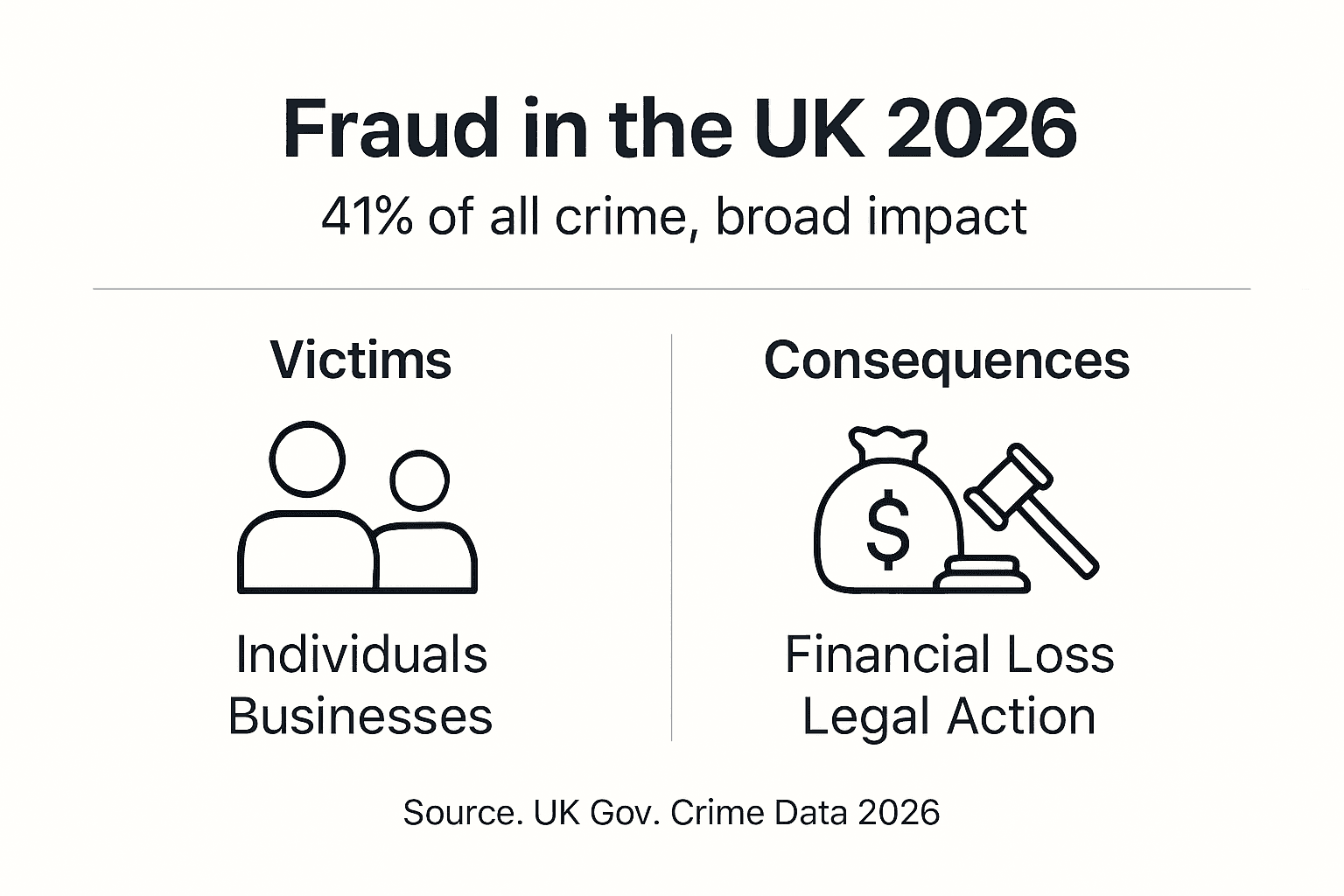
Financial impacts can be devastating. Individuals may lose life savings, retirement funds, or money earmarked for essential needs. Businesses suffer revenue loss, increased costs, and potential insolvency. The ripple effects extend to families, employees, and business partners.
The public sector faces enormous fraud costs. The Public Sector Fraud Authority estimates UK fraud losses including error cost the public sector between £55 billion and £81 billion annually. This massive sum diverts resources from essential public services like healthcare, education, and infrastructure.
Beyond financial harm, fraud creates operational disruption:
“Fraud is not a victimless crime. It destroys lives, undermines businesses, and erodes public confidence in institutions. Every pound lost to fraud is a pound not spent on vital services or business growth.”
Real cases illustrate severe consequences. Small businesses forced into liquidation after payment diversion fraud. Elderly individuals losing homes after romance fraud schemes. Employees facing redundancy when employers suffer major fraud losses. These human stories reveal fraud’s true cost.
Recognising fraud consequences motivates prevention. Understanding UK public sector fraud losses highlights the collective impact on society and economy. Your prevention efforts contribute to broader societal protection.
Taking action against fraud requires knowing how to report incidents and implement effective prevention measures. Despite fraud’s prevalence, only about 14% of fraud cases are reported to authorities, indicating significant underreporting. This gap limits law enforcement effectiveness and allows criminals to continue operating.
Government efforts show results. The Public Sector Fraud Authority recovered over £480 million in the financial year 2024-25, demonstrating government anti fraud efforts. These recoveries return stolen funds and deter future fraud attempts.
Reporting fraud properly involves several steps:
Legal compliance with fraud prevention is critical as penalties can include prosecution and fines. Businesses must implement robust compliance frameworks to reduce legal exposure and reputational risk.
Effective prevention strategies include:
Pro Tip: Create a fraud response plan before incidents occur. Knowing exactly who does what during a fraud emergency saves crucial time and limits damage.
Integrating fraud legal risk management tips into your business operations strengthens resilience. If you employ a compliance officer for fraud prevention, ensure they have authority and resources to implement effective controls.
Navigating fraud risks requires specialist legal expertise. Ali Legal offers tailored support for individuals and businesses facing fraud challenges in 2026. Whether you need guidance on fraud prevention, assistance with fraud litigation, or help strengthening compliance frameworks, our experienced team provides strategic solutions.
Our commercial litigation expertise helps businesses resolve fraud disputes effectively when commercial relationships break down. We bring strength to complex cases involving misrepresentation, breach of fiduciary duty, and financial misconduct. Our civil litigation support extends to individuals seeking justice after fraud victimisation.
We emphasise transparency, fixed fees, and clear communication throughout our engagement. Our approach combines legal rigour with practical business understanding to protect your assets and reputation. Contact Ali Legal for fraud guidance and secure professional support tailored to your specific circumstances.
Fraud requires three specific elements: dishonesty, intent to gain or cause loss, and an effective dishonest act. Not every dishonest behaviour meets this threshold. Simple negligence, poor judgment, or mistakes without dishonest intent do not constitute fraud even if they cause harm.
Report fraud to Action Fraud at actionfraud.police.uk or by calling 0300 123 2040. For tax related fraud, report directly to HMRC. Preserve all evidence including emails, messages, and transaction records before reporting to help investigators build a case.
Fraud convictions carry up to 10 years imprisonment, unlimited fines, and confiscation of assets obtained through criminal activity. Courts also impose director disqualifications and other sanctions depending on the fraud’s severity and impact.
Cyber enabled fraud represents 67% of all reported fraud in the UK. Criminals extensively use email, social media, and online platforms to target victims. This prevalence makes cybersecurity and digital awareness essential for fraud prevention.
Yes. Small businesses can implement strong internal controls, employee training, transaction monitoring, and verification procedures. Regular audits and clear policies create accountability. Professional legal guidance helps develop comprehensive fraud prevention frameworks appropriate for your business size and resources.
Many believe all UK court decisions bind every judge, but this is inaccurate. About 60% of precedents are persuasive rather than binding, creating flexibility within our legal system. Legal precedent balances consistency with adaptability, ensuring fairness while allowing law to evolve. This guide will explain what legal precedent is, how courts apply it, and how it impacts your personal legal matters. You’ll gain clarity on the UK court hierarchy, learn to identify relevant precedents, and understand how this knowledge strengthens your case strategy.
| Point | Details |
|---|---|
| Legal precedent ensures fairness | Courts follow higher court decisions to maintain consistency across similar cases. |
| Binding versus persuasive matters | Binding precedents must be followed; persuasive ones influence but don’t bind lower courts. |
| Court hierarchy determines application | UK court structure dictates which precedents apply in your case. |
| Higher courts can overturn precedent | Supreme Court can change precedent to keep law relevant and just. |
| Precedent guides legal strategies | Understanding precedent helps predict outcomes and shape your approach. |
Legal precedent means courts follow decisions from higher courts when facing cases with similar facts. This principle forms the backbone of UK common law, ensuring the legal system treats like cases alike. When a court makes a ruling, that decision becomes a reference point for future judges handling comparable disputes.
The doctrine of precedent creates predictability. Lower courts are generally bound to apply decisions of superior courts, preventing arbitrary outcomes. This consistency protects you from facing wildly different rulings simply because you appeared before a different judge. The system respects established legal principles while allowing careful evolution.
Courts can distinguish cases with different material facts, providing necessary flexibility. The doctrine of precedent allows courts to develop the law incrementally by distinguishing cases or using persuasive precedent. If the facts of your situation differ meaningfully from previous cases, judges can reach different conclusions. This mechanism prevents rigid application when justice demands a fresh approach.
How precedent works practically:
Barristers play a crucial role in presenting precedent effectively to support your position. Understanding the foundations of legal precedent helps you grasp why certain arguments carry more weight. This system balances respect for established law with the flexibility needed for individual justice.
The UK court system operates in a clear hierarchy, determining which precedents bind which courts. The Supreme Court sits at the apex, followed by the Court of Appeal, High Court, Crown Court, and lower tribunals. This structure directly affects how precedent influences your case outcome.

Decisions from the Supreme Court bind all lower courts in England and Wales. Court of Appeal rulings bind all courts below it. High Court decisions generally bind lower courts but carry less weight than appellate decisions. Understanding court hierarchy in conflict of laws clarifies which precedents matter most.
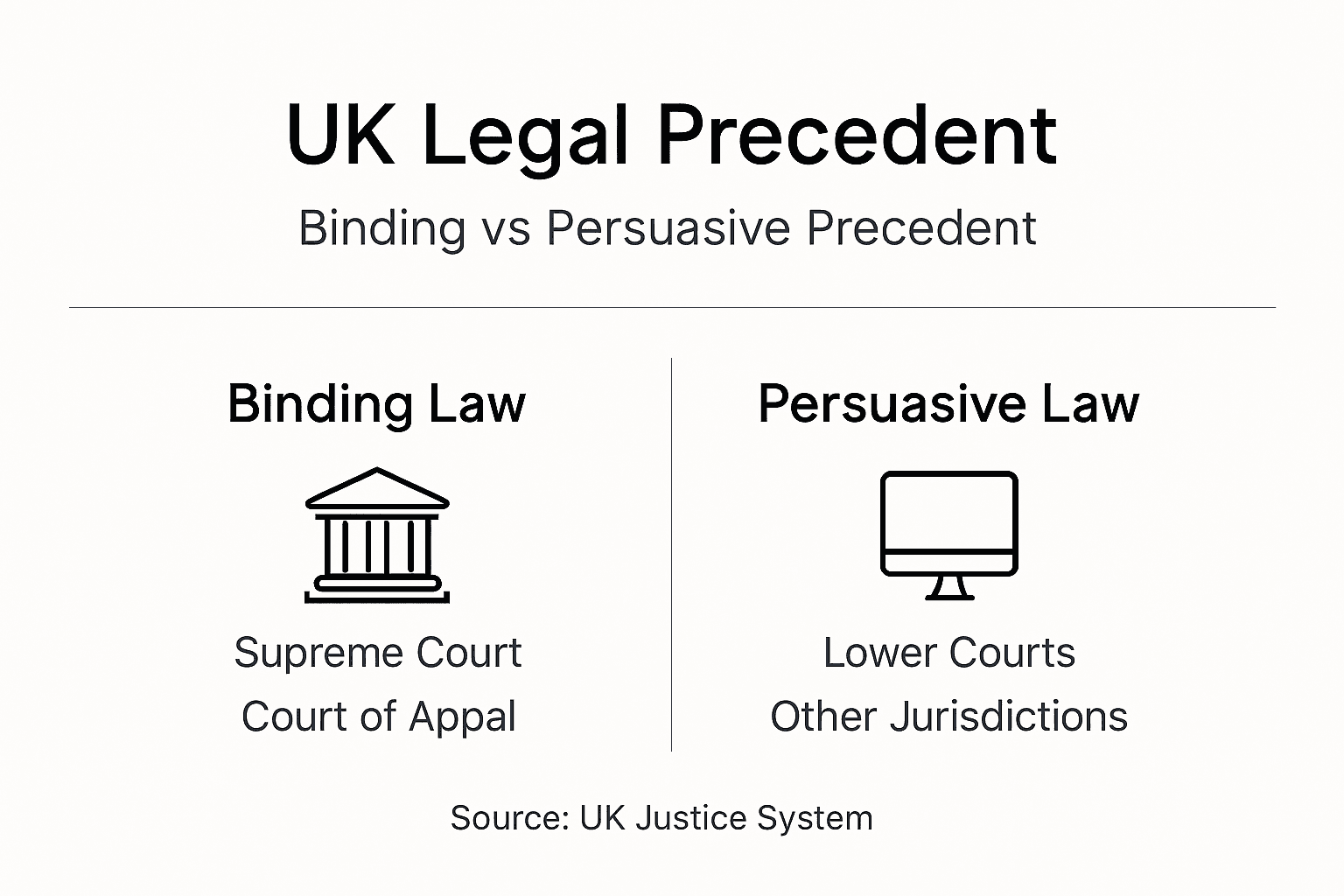
Pro Tip: Always ask your solicitor which court level created the precedent they’re citing. A Supreme Court decision carries far more authority than a County Court ruling, dramatically affecting your case strategy.
Here’s how different court levels create binding versus persuasive precedent:
| Court Level | Binding Authority | Persuasive Authority |
|---|---|---|
| Supreme Court | All UK courts | None needed |
| Court of Appeal | High Court and below | Supreme Court |
| High Court | Lower courts and tribunals | Appeal courts |
| Crown/County Courts | None | All higher courts |
Lower courts’ decisions or courts in other jurisdictions provide persuasive precedent. Approximately 60% of court decisions are persuasive, not binding, which impacts how precedent develops flexibly. A well-reasoned Scottish case might influence an English judge, but it won’t compel them to follow it. This distinction matters when building your legal strategy.
The hierarchy creates several practical effects:
This system balances legal certainty with adaptability. While you can predict outcomes based on binding precedent, persuasive authority allows courts to consider fresh perspectives. The structure ensures stability while preventing stagnation, keeping UK law responsive to society’s evolving needs.
Courts must follow binding precedent when material facts closely match. Judges examine the essential elements of previous cases, comparing them to the dispute before them. If the facts align sufficiently, the court applies the established legal principle. This process protects consistency and prevents arbitrary decisions.
Courts can distinguish cases on facts to avoid strict application when justice demands it. If your situation differs materially from the precedent case, the judge can reach a different conclusion. For example, a negligence case involving a manufacturer might not bind a case involving a professional service provider. The factual differences justify departing from precedent.
Persuasive precedent influences but doesn’t compel decisions. Judges consider well-reasoned lower court decisions, foreign judgments, or academic commentary. While not bound to follow these sources, they may adopt the reasoning if it’s convincing. This flexibility helps law adapt to new situations without waiting for higher court rulings.
How courts work through precedent:
Judges balance respect for precedent with justice and legal development. They recognize that rigid application can produce unfair results in unique situations. Applying and distinguishing precedent requires legal expertise to identify which differences matter.
Pro Tip: When discussing your case with a solicitor, ask them to explain how the facts of relevant precedents compare to yours. Understanding these distinctions helps you set realistic expectations and identify weaknesses in opposing arguments.
The distinguishing process protects you from inappropriate precedent application. If previous cases involved different circumstances, you shouldn’t face the same outcome simply because some facts overlap. This mechanism ensures the legal system considers your unique situation rather than mechanically applying past decisions.
The UK Supreme Court can overrule its previous decisions when necessary. This power ensures law evolves to meet modern realities rather than remaining frozen in outdated reasoning. The Court exercises this authority carefully, balancing legal certainty against the need for progress. Overturning precedent signals significant legal development.
Several factors justify overturning established precedent:
The Court of Appeal can also depart from its own previous decisions in limited circumstances. Generally, it will follow established Court of Appeal precedent unless convinced it was clearly wrong. This restraint maintains stability while allowing correction of obvious errors. Lower courts cannot overrule higher court decisions, only distinguish them.
Historic examples show how law evolves through precedent revision. The Supreme Court has overturned precedents in areas like human rights, contract law, and negligence. These changes reflect society’s changing values and improved understanding of justice. When courts overturn precedent, they often provide detailed reasoning explaining why change is necessary.
Overturning precedent balances legal certainty with necessary change. You need to predict how courts will decide cases, which requires stable precedent. However, rigid adherence to outdated principles would produce injustice. The Supreme Court’s power to overrule itself provides a safety valve, ensuring law remains just and relevant.
This power affects your case in several ways. If you’re challenging an established precedent, you face a high burden of proof. Courts won’t overturn precedent lightly. However, if societal understanding has genuinely shifted or the precedent creates clear injustice, higher courts may be willing to reconsider. Your solicitor can assess whether your case presents grounds for challenging existing precedent.
The ability to change precedent ensures the legal system stays relevant over time. Laws that made sense decades ago might not reflect current realities. This flexibility protects you from being bound by outdated reasoning while maintaining the predictability necessary for fair legal processes.
Many people misunderstand how precedent works, creating unrealistic expectations about their cases. Clearing up these misconceptions helps you navigate the legal system more effectively. Understanding what precedent actually does and doesn’t do prevents frustration and improves your decision-making.
Here are the most common misconceptions:
All past court decisions are binding on every court. Only higher court decisions bind lower courts. Lower court rulings may be persuasive but don’t compel other judges to follow them.
Legal precedent is completely rigid. Courts can distinguish cases on material facts or apply persuasive precedent, providing flexibility within the system.
Once set, precedent never changes. Higher courts can overturn precedent when necessary, ensuring law evolves with society.
Lower court decisions have no value. While not binding, well-reasoned lower court decisions often influence judges facing similar questions.
Precedent solely determines case outcomes. Judges consider precedent alongside statutory law, factual evidence, and legal arguments specific to your situation.
Foreign precedents have no relevance. Courts sometimes consider persuasive precedent from other common law jurisdictions when UK authority is unclear.
Every aspect of a precedent case binds future courts. Only the ratio decidendi binds future courts; obiter dicta comments are persuasive but not mandatory.
These misunderstandings can lead to poor strategic decisions. If you assume a lower court decision binds your judge, you might overestimate your chances. If you believe precedent is completely rigid, you might miss opportunities to distinguish your case. Understanding how precedent actually functions helps you work more effectively with your solicitor.
Legal precedent guides but does not solely determine case outcomes. Your specific facts, the quality of evidence, and your legal representation all matter significantly. Precedent provides a framework, but your case still requires careful preparation and skilled advocacy. Don’t assume precedent alone will win or lose your case.
Real cases demonstrate how precedent shapes UK law and influences decisions. Donoghue v Stevenson (1932) established modern negligence law, cited in over 500 UK court decisions. This landmark case created the neighbour principle, holding that you owe a duty of care to people who might reasonably be affected by your actions. Courts still apply this principle nearly a century later.
The Donoghue case involved a woman who found a decomposed snail in her ginger beer. She couldn’t sue for breach of contract because she didn’t purchase the drink herself. The House of Lords created a new duty of care in negligence, fundamentally changing UK law. This precedent now affects personal injury claims, product liability cases, and professional negligence disputes.
Family law relies heavily on precedent to fill legislative gaps. Precedent plays a key role resolving family law and personal injury disputes in UK courts. When statutes don’t provide clear answers, courts look to previous decisions. For example, precedents guide how judges divide assets in divorce, determine child custody arrangements, and calculate spousal maintenance.
Personal injury claims depend extensively on established precedent:
These precedents create predictability. When you suffer an injury, solicitors can estimate your claim’s value based on similar precedent cases. Insurance companies use the same precedents to assess settlement offers. This consistency helps resolve disputes without lengthy trials. Understanding how expert witnesses use precedent strengthens your case presentation.
Contract law also evolves through precedent. Cases establishing rules about contract formation, breach remedies, and frustration guide commercial disputes. When you enter a contract, established precedent determines your rights and obligations even if the contract doesn’t address every scenario. Courts apply precedent to fill gaps and resolve ambiguities.
You can see examples of precedent influence in specialized areas like property disputes. Precedents guide how courts handle boundary disputes, easements, and restrictive covenants. This body of case law provides clarity where statutes offer limited guidance.
Understanding precedent helps predict likely case outcomes. When your solicitor reviews similar cases, they can estimate your chances of success. This prediction isn’t guaranteed, but precedent provides reliable guidance. If binding precedent strongly supports your position, you can approach negotiations confidently. If precedent favors the opposition, you might consider settlement.
Precedent knowledge helps set realistic expectations:
You can use precedent knowledge to communicate effectively with your solicitor. Ask them to explain how precedent cases compare to yours. Discuss whether distinguishing features might lead to different outcomes. This dialogue ensures you understand your case’s strengths and weaknesses. Informed clients make better strategic decisions.
Precedent influences legal approaches in civil, family, and personal injury cases. In civil litigation, precedent determines liability standards and damage calculations. In family matters, precedent guides asset division and child arrangements. In personal injury claims, precedent establishes compensation ranges for specific injuries. Using precedent in legal strategies requires matching your facts to favorable cases.
Your solicitor will search for precedent supporting your position and anticipate precedent the opposition will cite. They’ll prepare arguments distinguishing unfavorable cases or emphasizing favorable ones. This precedent analysis forms the foundation of legal strategy. The better you understand this process, the more effectively you can participate in strategic decisions.
Precedent also affects timing decisions. If recent precedent strengthens your position, immediate action might be wise. If unfavorable precedent exists but higher court review is pending, waiting might improve your chances. These tactical considerations require balancing precedent analysis with practical factors like limitation periods and evidence availability.
Be aware that precedent doesn’t guarantee outcomes. Judges retain discretion in applying precedent to specific facts. Evidence quality, witness credibility, and legal representation all matter. Precedent provides a framework, but your case’s unique elements still require skilled presentation. Strong precedent improves your odds but doesn’t eliminate the need for thorough preparation.
You can research precedent using online legal databases and official court websites. BAILII provides free access to UK court decisions, making precedent research accessible. You can search by keyword, court level, or date to find relevant cases. Reading these decisions helps you understand how courts have handled similar disputes.
Follow these steps to find and assess precedent:
Compare the facts carefully to ensure precedents are relevant to your situation. A case might involve the same area of law but differ in material ways. For example, a negligence case involving a manufacturer differs from one involving a professional advisor. These distinctions matter when predicting how precedent applies to you. Assessing precedent relevance requires legal training and experience.
Discuss identified precedents with your solicitor to understand their impact. While you can research precedent yourself, interpretation requires legal expertise. Your solicitor can explain whether a case truly supports your position or whether distinguishing features limit its application. They’ll also know about recent developments that might affect precedent’s continued validity. Talking to your solicitor about precedent strengthens your collaborative approach.
Stay aware that legal advice is crucial when applying precedent to your case. Reading cases yourself provides valuable context, but don’t rely solely on your interpretation. Courts spend considerable time analyzing precedent’s nuances. Without legal training, you might miss important distinctions or misunderstand the binding principle. Professional guidance ensures you apply precedent correctly.
You can find legal resources for precedent research in specialized areas. Some databases focus on specific practice areas like family law or personal injury. These resources often include commentary explaining how precedent has developed. Using these tools alongside your solicitor’s expertise maximizes your understanding.
Keep notes on precedent cases you find relevant. Record the case name, court level, key facts, and legal principle. This documentation helps discussions with your solicitor and ensures you remember important details. Organized precedent research supports strategic decision-making throughout your case.
Understanding legal precedent is just the first step. Applying this knowledge effectively requires professional legal support. Ali Legal offers expert guidance to help you understand how precedent affects your specific situation and strengthen your case strategy.
Our specialized civil litigation services provide comprehensive support for disputes where precedent plays a crucial role. We analyze relevant case law, identify favorable precedent, and build arguments that leverage established legal principles. Our team distinguishes unfavorable precedent and presents your case in the strongest possible light.
For family matters, our family and divorce lawyers apply precedent to protect your interests in divorce, child arrangements, and financial settlements. We understand how courts have decided similar cases and use this knowledge to achieve fair outcomes. Professional legal advice improves your confidence and case outcomes by ensuring precedent works in your favor. Contact Ali Legal today to discuss how we can help you navigate your legal matter with clarity and strength.
Binding precedent comes from higher courts and must be followed by lower courts when facts align. For example, a Supreme Court decision binds all UK courts below it. Persuasive precedent comes from lower courts, foreign jurisdictions, or other sources that influence but don’t compel judges. Courts may adopt persuasive reasoning if they find it convincing, but they’re not required to do so.
Precedent helps predict your case outcome by showing how courts decided similar disputes. Your solicitor uses precedent to assess your claim’s strength, estimate potential damages, and develop legal strategy. If binding precedent supports your position, you have stronger grounds for success. If precedent favors the opposition, you might need to distinguish your facts or consider settlement. Understanding precedent helps you make informed decisions throughout your case.
Higher court rulings bind lower courts in the UK system. Supreme Court decisions bind all courts, Court of Appeal rulings bind High Court and below, and High Court decisions bind lower courts and tribunals. Lower court decisions are persuasive but not mandatory, meaning judges may consider them but aren’t required to follow them. This hierarchy ensures consistency while allowing flexibility through persuasive authority.
Yes, higher courts can modify or overturn precedent as law evolves. The Supreme Court can overrule its own previous decisions when necessary to correct errors or adapt to changing societal values. This power ensures the legal system adapts to new social needs rather than remaining locked in outdated reasoning. However, courts exercise this authority carefully to maintain legal certainty.
Search legal databases like BAILII and official court records online for cases involving similar facts and legal issues. Compare facts between cases carefully to ensure the precedent truly relates to your situation. Consult a solicitor for interpretation and application because professional guidance ensures you understand precedent’s nuances. You can also explore legal precedent resources for additional research support.
Selecting the right international arbitration strategy can mean the difference between a swift, cost-effective resolution and years of costly procedural disputes. Many businesses struggle to balance enforceability, procedural flexibility, and budgetary constraints when evaluating arbitration options. This guide provides clear selection criteria and compares major arbitration rules to help you choose strategies that minimize delays, control costs, and protect your commercial interests across borders.
| Point | Details |
|---|---|
| Balance cost, enforceability, and flexibility | Effective arbitration strategies must address all three factors to suit your dispute characteristics. |
| ICC rules dominate globally | ICC Arbitration Rules account for 33% of international disputes but carry higher costs than alternatives. |
| Clear clauses reduce delays | Well-drafted arbitration clauses specifying seat and governing law cut procedural delays by 40%. |
| Institutional arbitration prevails | Over 70% of cases use institutional administration for predictability and standardized procedures. |
| Interim measures protect assets | Tribunals grant interim relief in 60% of urgent cases to secure evidence and prevent dissipation. |
Before committing to any arbitration framework, you need a clear decision-making lens. The right strategy depends on your dispute’s complexity, budget, and enforcement needs. Understanding these core criteria helps you avoid mismatched rules that inflate costs or jeopardize award recognition.
Start with cost implications. Arbitration fees vary dramatically between institutional rules and ad hoc proceedings. ICC arbitration, for example, involves higher administrative costs but delivers robust case management. Budget early to avoid surprises. Transparent fee structures offered by institutions like LCIA give you predictable expense forecasts, which matters when stakeholders demand financial accountability.
Enforceability ranks equally high. An award means nothing if you cannot collect. The New York Convention provides enforcement mechanisms across 160+ jurisdictions, but only if your arbitration clause specifies a compliant seat and governing law. Vague clauses invite jurisdictional challenges that delay or block enforcement.
Procedural flexibility determines how much control you retain over timelines, evidence rules, and tribunal composition. Institutional arbitration sacrifices some flexibility for administrative support and standardized procedures. Over 70% of international commercial arbitration cases are administered by institutions rather than ad hoc processes, reflecting demand for predictability. Ad hoc arbitration offers maximum customization but requires parties to manage logistics themselves, increasing administrative burden.
Your choice between institutional and ad hoc formats also affects risk tolerance. Institutional rules provide fallback mechanisms when parties deadlock on arbitrator appointments or procedural issues. Ad hoc arbitration leaves these decisions entirely to the parties, which works well for cooperative counterparties but becomes problematic in contentious disputes.
Finally, seat and governing law selection shape procedural safeguards and judicial oversight. Arbitration-friendly seats like London or Singapore offer supportive courts that respect tribunal autonomy while providing interim relief when needed. Hostile jurisdictions may intervene excessively or refuse to enforce awards. Understanding international arbitration basics helps clarify how seat selection interacts with enforceability.
Key selection criteria:
Pro Tip: Align your arbitration strategy with your international dispute options early in contract negotiations to avoid retrofitting incompatible clauses later. Consider how you might minimize investment risk through strategic clause design.
Once you understand selection criteria, evaluate specific rule sets. The three dominant frameworks offer distinct strategic advantages depending on your priorities.
ICC Arbitration Rules lead the market. The ICC accounts for approximately 33% of arbitrations globally as of 2025, making it the most recognized choice for complex, high-value disputes. ICC provides comprehensive case management, multilingual support, and scrutiny of draft awards before issuance. This scrutiny enhances enforceability but extends timelines and raises costs. Expect administrative fees ranging from $5,000 to over $150,000 depending on dispute value, plus arbitrator fees.

LCIA Arbitration Rules offer a cost-effective alternative favored by UK and Commonwealth parties. LCIA emphasizes expedited procedures, with streamlined appointment processes and efficient case administration. Average costs run 20 to 30% lower than ICC for comparable disputes. LCIA’s London seat benefits from supportive English courts and a well-developed arbitration infrastructure. The rules suit mid-sized commercial disputes where speed and cost control matter more than extensive administrative oversight.
UNCITRAL Arbitration Rules provide flexibility for ad hoc arbitration. Parties control every procedural aspect, from appointing arbitrators to setting hearing schedules. This autonomy suits simple disputes or relationships where parties trust each other to cooperate. However, UNCITRAL proceedings may extend longer than institutional alternatives due to the absence of administrative case managers. You also bear full responsibility for logistical arrangements, which can complicate cross-border coordination.
Comparison of arbitration rules:
| Feature | ICC | LCIA | UNCITRAL |
|---|---|---|---|
| Cost | High | Moderate | Variable |
| Speed | Moderate | Fast | Slow to Moderate |
| Flexibility | Low | Moderate | High |
| Best For | Complex, high-value disputes | UK/Commonwealth parties, cost-conscious cases | Simple disputes, cooperative parties |
Choosing between these frameworks depends on your dispute profile. Complex multi-jurisdictional disputes benefit from ICC’s robust infrastructure. Cost-sensitive parties should explore LCIA’s fixed fee options. Highly customized disputes may justify UNCITRAL’s flexibility despite administrative challenges.
Pro Tip: Review your counterparty’s preferred dispute options overview before proposing arbitration rules. Mutual agreement on framework reduces early procedural friction. Check recent ICC dispute stats to benchmark costs and timelines against your budget.
Arbitration costs spiral when parties lack visibility into fee structures and procedural expenses. Strategic budgeting and transparent communication reduce financial surprises and keep disputes manageable.
Implement fixed fee arrangements wherever possible. Many institutions now offer fixed-fee arbitration for disputes below certain thresholds. LCIA, for example, provides predictable fee schedules that eliminate uncertainty around arbitrator hourly rates. Fixed fees let you budget accurately and avoid the cost overruns common in hourly billing models.
Early case budgeting cuts costs by up to 30%. Map out expected procedural phases, from document production through hearings and award drafting. Identify cost drivers like expert witnesses, translation services, and hearing venue rentals. Front-load discussions about cost-sharing and cost-capping agreements with opposing counsel. Parties who agree on cost controls before disputes escalate avoid wasteful procedural skirmishes.
Transparency between parties prevents budget blowouts. Share cost estimates and negotiate limits on document requests, witness numbers, and hearing days. Some arbitration agreements include cost-capping clauses that cap total legal fees at a predetermined amount or require tribunal approval before exceeding thresholds. These mechanisms align incentives and discourage scorched-earth tactics.
Choosing cost-effective institutions matters. LCIA’s streamlined procedures and lower administrative fees make it attractive for disputes where ICC’s comprehensive oversight is unnecessary. Evaluate whether your dispute truly requires ICC’s scrutiny or if LCIA’s expedited rules achieve comparable enforceability at lower cost.
Key cost management strategies:
Pro Tip: Integrate cost-effective dispute resolution principles into your arbitration strategy from the outset. Consider how operational efficiency techniques used to reduce operational costs in other business contexts apply to arbitration budgeting.
An unenforceable award wastes time and money. Enforceability depends on proper clause drafting and strategic use of the New York Convention’s framework.
Over 160 countries are signatories to the New York Convention, enabling enforcement of international arbitration awards across most commercial jurisdictions. This near-universal recognition makes arbitration far more enforceable than foreign court judgments. UK courts confirm approximately 95% of awards without set-aside challenges, reflecting judicial deference to arbitral decisions.
Clear clause drafting reduces jurisdictional conflicts. Specify the arbitration seat explicitly, as the seat determines which national courts have supervisory jurisdiction and which procedural law governs. Ambiguous seat provisions invite competing jurisdictions to assert authority, delaying enforcement. State the governing law for both the contract and the arbitration agreement separately to avoid interpretive disputes.
Draft clauses that align with Convention requirements. The Convention permits refusal of enforcement only on narrow grounds like lack of due process, non-arbitrability, or public policy violations. Ensure your clause addresses arbitrability by confirming disputes are commercial in nature and fall within the Convention’s scope. Avoid institutional rules or seats in non-signatory countries unless you have specific strategic reasons.
Best practices for enforceability:
Pro Tip: Assess legal risks in international disputes during contract drafting to identify enforceability vulnerabilities before they materialize. Review New York Convention enforcement precedents in your counterparty’s jurisdiction to anticipate potential challenges.
Arbitration clauses function as the foundation of your dispute resolution strategy. Poorly drafted clauses trigger years of procedural litigation before substantive issues are even heard.
Choose a clear, mutually agreed seat and governing law. Specifying both elements reduces delays by 40% compared to clauses that leave these decisions for later negotiation. The seat determines procedural law and supervisory court jurisdiction. Governing law controls interpretation of substantive contract rights. Misalignment between seat and governing law creates unnecessary complexity.
Specify procedural rules and interim relief explicitly. Incorporate institutional rules by reference or outline bespoke procedures if using ad hoc arbitration. Address arbitrator qualifications, language of proceedings, and document production protocols. Include provisions authorizing tribunals to grant interim measures to secure assets or preserve evidence. Silence on interim relief may limit your ability to obtain urgent protection.
Tailor clauses to dispute nature and party expectations. Multi-tiered clauses requiring negotiation or mediation before arbitration suit long-term commercial relationships. Single-tier clauses offering immediate access to arbitration work better for transactional disputes where speed matters. Match tribunal size and composition to dispute complexity; sole arbitrators suffice for straightforward cases while three-arbitrator panels suit technical or high-value matters.
Steps for drafting effective clauses:
Common pitfalls include vague seat provisions, failing to specify institutional rules editions, and omitting interim relief authorization. Fix these by reviewing arbitration clauses in contracts best practices and using model clauses published by arbitration institutions. Apply a cross-border dispute checklist to validate your clause against common jurisdictional challenges.
Choosing between institutional and ad hoc administration shapes your arbitration experience from appointment through award enforcement.
Institutional arbitration dominates the market. About 70% of global cases use institutional administration because institutions provide standardized procedures, administrative support, and fallback mechanisms when parties deadlock. Institutions appoint arbitrators if parties fail to agree, supervise procedural timelines, and scrutinize awards for formal compliance. This oversight reduces procedural risk but limits party control over logistics.
Ad hoc arbitration offers maximum procedural flexibility. Parties design every aspect of the process, from arbitrator selection criteria to hearing formats. This autonomy suits disputes where parties trust each other and want bespoke procedures. However, ad hoc arbitration provides no administrative safety net. If parties deadlock on arbitrator appointments or procedural issues, they must seek court intervention, which delays proceedings.
Institutional arbitration suits complex or high-value disputes. The administrative infrastructure justifies higher fees when disputes involve technical issues, multiple parties, or significant financial stakes. Institutions manage communications, scheduling, and cost deposits, freeing parties to focus on substantive arguments.
Ad hoc arbitration works for simpler cases or cooperative parties. When both sides want cost savings and can agree on procedures without institutional oversight, ad hoc formats deliver flexibility at lower administrative cost. But this approach backfires in contentious disputes where parties weaponize procedural disagreements.
Institutional vs ad hoc comparison:
| Feature | Institutional | Ad Hoc |
|---|---|---|
| Predictability | High | Low |
| Administrative Support | Comprehensive | None |
| Procedural Flexibility | Limited | Maximum |
| Cost | Higher fees | Lower fees |
| Risk of Deadlock | Low | High |
| Best For | Complex, high-value, contentious disputes | Simple, cooperative, cost-sensitive cases |
Pro Tip: Consult international arbitration solicitors when deciding between formats. Institutional arbitration reduces risk in most commercial contexts, but ad hoc may suit specific strategic needs.
Arbitration proceedings can span months or years. Interim measures protect your interests while the tribunal reaches a final award.
Interim measures granted by arbitration tribunals preserve assets and evidence, utilized in about 60% of cases involving urgent relief requests. Tribunals issue orders freezing assets, preventing asset dissipation, securing evidence, or maintaining status quo pending final resolution. These measures prevent counterparties from transferring property, destroying documents, or taking actions that render the final award meaningless.
Including interim relief provisions in your arbitration clause strengthens protection. Specify that tribunals have authority to grant interim measures and that parties will seek such relief from tribunals rather than national courts. Some institutional rules include emergency arbitrator procedures allowing parties to obtain interim relief before the full tribunal is constituted. ICC and LCIA both offer emergency arbitrator mechanisms that deliver decisions within days.
Interim measures provide critical leverage during proceedings. Freezing a counterparty’s assets encourages settlement by demonstrating your ability to enforce any eventual award. Securing evidence prevents spoliation that could undermine your case. Maintaining operational status quo prevents irreparable harm while disputes are resolved.
Common interim measures:
Pro Tip: Act quickly when seeking interim measures. Tribunals require credible evidence of urgency and irreparable harm. Prepare detailed applications demonstrating why relief cannot wait for the final award. Engage protecting interests during arbitration expertise to draft persuasive interim measure requests. Review interim measures usage guidance from your chosen institution.
Synthesizing the strategies discussed helps you evaluate options quickly based on your dispute profile.
| Strategy | Cost | Duration | Flexibility | Enforceability | Best Use Case |
|---|---|---|---|---|---|
| ICC Rules | High ($5k–$150k+) | 18–24 months | Low | Very High | Complex, high-value, multi-jurisdictional disputes |
| LCIA Rules | Moderate | 12–18 months | Moderate | High | UK/Commonwealth parties, cost-conscious cases |
| UNCITRAL Rules | Variable | 24+ months | High | High (if seat chosen well) | Simple disputes, highly customized procedures |
| Institutional Arbitration | Higher | Predictable | Limited | High | Contentious or complex cases needing oversight |
| Ad Hoc Arbitration | Lower | Variable | Maximum | Moderate (depends on execution) | Cooperative parties, simple disputes |
| Clear Arbitration Clauses | N/A | Reduces by 40% | N/A | Enhances significantly | All disputes |
| Interim Measures | Moderate (application costs) | Days to weeks | N/A | Strengthens enforcement | Cases with asset dissipation or evidence spoliation risk |
Cost ranges reflect administrative fees and typical arbitrator fees, excluding legal representation. Duration estimates assume standard procedural timelines without significant delays. Flexibility scores indicate party control over procedures. Enforceability ratings reflect likelihood of award recognition under the New York Convention.
Use this comparison to match strategies with your priorities. Cost-sensitive disputes favor LCIA or ad hoc formats. Complex cases justify ICC’s comprehensive framework. All disputes benefit from clear clauses and strategic use of interim measures.
Applying these insights to your specific context requires matching dispute characteristics with optimal strategies.
For cost-sensitive disputes, prioritize LCIA fixed fees and expedited rules. LCIA delivers enforceable awards at 20 to 30% lower cost than ICC, making it ideal when budgets constrain dispute resolution spending. Combine LCIA with clear arbitration clauses specifying London as the seat to leverage supportive English courts without excessive fees.
High-value or complex cases justify ICC’s comprehensive framework. When disputes involve technical issues, multiple parties, or significant financial stakes, ICC’s case management and award scrutiny reduce procedural risk. The higher cost is offset by enhanced enforceability and predictability. Specify ICC rules with a three-arbitrator tribunal for disputes exceeding £5 million.
When procedural flexibility matters most, UNCITRAL ad hoc arbitration suits customized approaches. Parties who want maximum control over timelines, evidence rules, and tribunal composition benefit from ad hoc formats. Ensure your clause appoints a reputable institution to administer arbitrator appointments if parties deadlock, avoiding court intervention delays.
Jurisdictional considerations guide seat and clause choices. Choose arbitration-friendly seats like London, Singapore, or Paris that offer supportive courts and well-developed arbitration infrastructure. Avoid seats in jurisdictions with interventionist courts or weak enforcement track records. Align governing law with the jurisdiction most familiar to both parties.
Tailored strategy recommendations:
Navigating arbitration strategies requires balancing legal precision with commercial pragmatism. Getting it right protects your business interests and delivers enforceable outcomes.
Ali Legal offers strategic commercial litigation services designed for businesses facing high-stakes disputes.
Our international arbitration expertise ensures you select optimal arbitration frameworks, draft enforceable clauses, and secure interim measures when needed. We provide transparent fixed fees, strategic advice, and long-term partnerships that minimize legal risk. Whether you need arbitration clause review, representation during proceedings, or enforcement support, our team delivers results tailored to your commercial objectives. Contact Ali Legal today to develop effective arbitration strategies that protect your interests across borders.
Key criteria include cost structures, enforceability under the New York Convention, procedural flexibility, choice between institutional and ad hoc administration, and alignment of seat and governing law. Balancing these factors based on your dispute characteristics ensures you select strategies that minimize delays, control expenses, and maximize the likelihood of enforceable awards. Businesses should evaluate each criterion against their priorities, whether cost sensitivity, speed, or comprehensive case management matters most.
Well-drafted arbitration clauses specifying the seat, governing law, and procedural rules reduce delays by up to 40% and prevent jurisdictional conflicts. Clauses that leave these elements ambiguous trigger procedural litigation before substantive disputes are heard. Tailoring clauses to the dispute context, including provisions for interim measures and arbitrator qualifications, ensures smoother proceedings and faster resolutions. Clear clauses also enhance enforceability by eliminating grounds for challenging awards.
Interim measures help secure assets and evidence pending final awards, used in 60% of urgent relief cases to prevent dissipation and strengthen enforcement positions. Tribunals grant orders freezing assets, preserving evidence, or maintaining status quo, which provides critical leverage during proceedings. Including interim measures support provisions in arbitration clauses ensures tribunals have clear authority to act quickly when urgent protection is needed. Emergency arbitrator procedures available under ICC and LCIA rules deliver relief within days.
Institutional arbitration suits complex, high-value disputes needing standardized administration and predictability. It offers comprehensive case management, fallback mechanisms when parties deadlock, and reduced procedural risk compared to ad hoc formats. Institutional arbitration advantages include administrative support for scheduling, communications, and cost management, justifying higher fees for contentious or technically complex cases. Ad hoc arbitration works best for simpler disputes involving cooperative parties who can agree on procedures without institutional oversight, delivering cost savings and maximum procedural flexibility.
Disputes can disrupt even the most organised retail businesses, damaging relationships and draining valuable time. When conflicts arise with suppliers, customers or partners, it’s easy to feel overwhelmed by the complexity and worry about the risk to your shop’s reputation and bottom line.
You need workable steps, not confusing jargon or endless back-and-forth. This guide is built to give you clear, effective ways to handle commercial disputes before they spiral. Early identification and honest communication are vital in protecting your business’s interests and stopping small issues turning into major headaches.
Get ready to discover practical strategies trusted by legal professionals and dispute resolution experts. The following insights are designed so you can face disputes confidently, knowing exactly what to do next.
You cannot resolve a dispute you don’t fully understand. The first step in swift resolution is identifying exactly what the dispute is and determining how significantly it affects your retail business.
Many disputes begin as small misunderstandings that snowball into major operational problems. A supplier payment disagreement, a contract interpretation clash, or a customer complaint can escalate quickly if left unaddressed. Understanding the root cause from the outset allows you to develop a targeted resolution strategy rather than scrambling reactively.
Why identification matters:
According to recent employment law data, complex individual cases linked to discrimination or whistleblowing are increasing, highlighting the importance of early, thorough assessment. Even in commercial settings, disputes often involve multiple layers that need unpacking.
Start by gathering all relevant documentation. Review contracts, emails, invoices, correspondence, and any written agreements between parties. This paper trail usually reveals the sequence of events and the precise point where things went wrong.
Key questions to ask yourself:
Next, calculate the impact on your business. This includes direct costs (legal fees, lost revenue) and indirect costs (staff time diverted, customer satisfaction effects, operational disruptions). Understanding the true cost of the dispute helps you decide how aggressively to pursue resolution and whether settlement might be preferable to prolonged conflict.
Early identification and thorough assessment of disputes allows you to manage their impact before they escalate into costly, time-consuming battles.
You may also need to consult colleagues or team members who witnessed the dispute or are affected by it. Their perspectives often reveal details you might have missed. However, keep these conversations confidential and focused on facts rather than emotions or blame.
Professional tip: Document everything in writing as you assess the dispute, including dates, amounts, and key facts. This written record becomes invaluable if you need legal advice or if the dispute escalates to formal proceedings.
Once you have identified the dispute, your next step is to conduct a thorough review of every contract and relevant document connected to it. This is where the evidence lives, and understanding it completely is essential to resolving the matter swiftly.
Your contracts form the foundation of any commercial dispute. They define obligations, specify payment terms, outline responsibilities, and establish what happens when things go wrong. Without reviewing them carefully, you are essentially fighting blind.
Begin by gathering all documents related to the dispute. This includes the primary contract, any amendments or variations, email correspondence, invoices, delivery notes, quality reports, and payment records. Even seemingly minor documents can contain critical information.
What to look for in your documentation:
Civil litigation solicitors conduct thorough reviews of contracts and correspondence to evaluate the strength of claims and develop effective strategies. This methodical approach helps you understand your position before proceeding further.
Read your contract clause by clause, paying particular attention to sections dealing with performance, liability, and dispute resolution. Many disputes arise from misunderstandings about what the contract actually says versus what parties thought it said.
Note any ambiguities or conflicting language. Look for gaps where the contract fails to address the current problem. Identify any clauses that limit your liability or provide you with leverage.
Thorough contract review reveals your legal position, identifies potential risks, and clarifies what remedies are available to you.
Organise your findings in a clear document. Create a timeline of events based on correspondence and records. Highlight relevant contract clauses and cross-reference them to specific incidents or disagreements.
If you are unsure about what a clause means, mark it for discussion with a solicitor. Many disputes involve contractual interpretation issues that require legal expertise.
Professional tip: Create a simple spreadsheet listing key documents with dates and what each one shows. This reference guide saves time when you need to brief a solicitor or prepare for negotiation discussions.
Most disputes worsen because people stop talking to each other. Opening transparent communication channels with the other party is often the fastest route to resolution and prevents misunderstandings from becoming irreversible conflicts.
When disputes arise, the natural instinct is sometimes to withdraw and communicate only through solicitors. However, direct, honest dialogue at the earliest stage frequently resolves disagreements before they escalate into formal proceedings.
Start by initiating contact with the other party in a professional, non-confrontational manner. A simple email or letter expressing your desire to resolve the matter can open doors that seemed closed. Keep the tone respectful and focused on solving the problem rather than assigning blame.
What transparent communication looks like:
Transparency in dispute resolution means being honest about your interests, concerns, and constraints. It means sharing relevant information rather than hoarding documents or evidence. Clear communication channels and prompt case handling are critical to resolving disputes efficiently and maintaining trust between parties.
Set a clear agenda for discussion. What specific issues need resolving? What information does each party need from the other? What timeline makes sense for both sides? Document these points so everyone is working from the same understanding.
Avoid emotional language or accusations in written communications. Stick to facts, dates, and specific contractual obligations. This keeps discussions professional and creates a record that will stand up if proceedings become necessary.
Transparent, honest communication demonstrates good faith, reduces misunderstandings, and often reveals solutions that formal processes might miss.
If direct communication feels too difficult, consider involving a neutral third party early. A mediator or solicitor can facilitate discussions without the emotional charge that sometimes makes direct conversation impossible.
Respond promptly to communications from the other party. Delayed responses create frustration and signal that you are not genuinely interested in resolution. Quick turnaround times show commitment to settling matters fairly.
Professional tip: Keep all communications in writing when possible so you have a clear record. If you have conversations by phone, follow up with a brief email summarising what was discussed and agreed, and ask the other party to confirm.
Before you even consider litigation, you should explore negotiation and mediation. These approaches cost significantly less than court proceedings, preserve business relationships, and often deliver faster outcomes than formal legal battles.
Negotiation is the most straightforward approach. Both parties discuss the dispute directly, with or without legal representation, and attempt to reach an agreement. It requires flexibility, patience, and genuine willingness from both sides to find common ground.
Mediation takes negotiation further by introducing a neutral third party. A qualified mediator does not make decisions for you but helps both parties communicate better, understand each other’s positions, and identify mutually acceptable solutions.
Key differences between negotiation and mediation:
Mediation is a voluntary, confidential process that improves communication and reduces stress, making it particularly effective for retail disputes involving ongoing supplier or customer relationships. The earlier you implement mediation, the better your chances of a swift and satisfactory resolution.
Negotiation works best when both parties still trust each other and communication channels remain open. It is faster than mediation because there is no mediator to schedule or brief. However, it can break down quickly if emotions run high or power imbalances exist.
Mediation excels when direct negotiation has stalled. A mediator can separate you from the other party, allow each side to explain their position without interruption, and explore creative solutions neither party might have considered alone.
Mediation and negotiation offer faster, cheaper, and less adversarial pathways to resolution than litigation, whilst preserving valuable business relationships.
Consider the nature of your dispute. Payment disputes often resolve through negotiation alone. Performance disagreements may benefit from mediation to clarify expectations and find acceptable remedies. Relationship breakdowns frequently require mediation to rebuild communication.
Both approaches share one critical advantage over litigation. You maintain control over the outcome instead of leaving decisions to a judge or tribunal. You also avoid the enormous costs and delays associated with formal proceedings.
Professional tip: Begin with negotiation, but propose mediation early if discussions stall. Most mediators can be arranged within days, and sessions often resolve disputes that seemed intractable through negotiation alone.
At some point in most disputes, you need expert legal guidance. A solicitor specialising in commercial disputes can evaluate your position objectively, identify risks you might have missed, and devise a strategy that protects your interests and resolves matters efficiently.
Many business owners delay seeking legal advice because they worry about costs. However, early intervention by a solicitor often saves money by preventing costly mistakes and identifying settlement opportunities before disputes spiral out of control.
A good solicitor brings several critical advantages to your dispute. They understand commercial law, know how courts and tribunals interpret contracts, and can advise you on realistic outcomes based on similar cases. They also help you avoid the emotional decision-making that often damages disputes.
What solicitors do in commercial disputes:
Solicitors provide strategic advice tailored to your business context, helping you evaluate claim strength and devise effective dispute resolution strategies whilst minimising risks. Specialists in commercial disputes understand the retail sector’s specific challenges and can advise on solutions that keep your business running smoothly.
When you first contact a solicitor, provide them with all relevant documents and a clear summary of events. The better informed they are, the more accurate and useful their advice will be. Many solicitors offer initial consultations at fixed fees so you can understand costs upfront.
Choose solicitors who specialise in commercial disputes rather than general practitioners. Specialisation means they have deep experience with disputes like yours and understand current best practice in resolution approaches.
Early legal advice often prevents expensive mistakes and reveals settlement pathways that negotiations alone might miss.
Solicitors also help you understand your options objectively. They might recommend mediation even when you feel like fighting, or they might advise that your position is strong enough to pursue formal proceedings. Their independence provides perspective that parties in dispute rarely have.
Professional tip: Interview multiple solicitors before engaging one. Ask about their experience with disputes similar to yours, their approach to costs, and their success rate with settlements versus formal proceedings.
Reaching an agreement is a major achievement, but the real work begins when you actually implement it. Monitoring compliance ensures both parties fulfil their obligations and prevents the dispute from resurfacing down the line.
When a resolution is agreed, whether through negotiation, mediation, or formal proceedings, put everything in writing. A written agreement eliminates ambiguity about what was decided and serves as your reference point for monitoring compliance.
The agreement should specify exactly what each party must do, by when, and how compliance will be verified. Vague terms like “shortly” or “as soon as possible” create room for dispute. Instead, use specific dates and measurable milestones.
Essential elements of a written agreement:
Monitoring compliance with agreements ensures they are durable and prevents recurrence of conflicts, maintaining the trust between parties after resolution. Early follow-up and ongoing oversight are critical to protecting your interests long-term.
Designate someone in your organisation to track compliance actively. This person should maintain records of actions taken, dates completed, and evidence that obligations have been met. Regular check-ins prevent small issues from snowballing into new disputes.
If the other party fails to comply, address it promptly. Send a formal letter requesting compliance and setting a reasonable deadline for remedial action. Document your request and any response carefully.
Written agreements with clear timelines and monitoring systems transform dispute resolutions into lasting settlements rather than temporary truces.
In retail, compliance monitoring is particularly important for supplier agreements or service contracts. Track deliveries against agreed schedules. Verify quality meets standards. Monitor payment terms strictly. These details matter enormously to your operations.
If compliance breaks down despite your efforts, you have evidence documenting the breach. This positions you well if you need to pursue additional legal action or return to mediation.
Consider building in regular review meetings with the other party during the compliance phase. These keep communication open and allow you to address emerging issues before they become problems.
Professional tip: Request that agreements include a specific review date, typically 30 or 60 days after resolution is agreed. At this point, both parties confirm that obligations are being met, reinforcing commitment to the settlement.
Below is a comprehensive table summarising the strategies for resolving disputes discussed throughout the article.
| Aspect | Description | Key Points |
|---|---|---|
| Identify the Dispute | Understand the conflict’s nature and impact. | Assess operational and financial effects; clarify root causes. |
| Review Documentation | Analyse contracts and related materials. | Locate clauses relevant to the dispute; create a timeline. |
| Communicate Openly | Maintain transparent communication channels. | Express concerns professionally; focus discussions on resolutions. |
| Explore Alternatives | Investigate negotiation and mediation. | Reduce costs and time through collaborative methods. |
| Seek Legal Advice | Consult solicitors specialising in commercial disputes. | Gain expert guidance to assess, strategise, and manage risks. |
| Ensure Compliance | Monitor adherence to the agreed resolution. | Draft clear agreements with measurable milestones. |
Navigating commercial disputes can be overwhelming with complex contracts, escalating tensions, and financial risks threatening your business stability. The key steps outlined in this article like clear dispute identification, thorough contract review, transparent communication, and exploring negotiation or mediation highlight just how critical expert advice is to avoid costly errors and prolonged conflict.
At Ali Legal, we understand these challenges and offer strategic, fast, and transparent legal solutions tailored to your commercial dispute needs. Our experienced solicitors specialise in civil litigation and commercial disputes and provide fixed fees and straightforward advice so you can focus on your business with confidence. Whether you need a clear evaluation of your claim, skilled mediation support, or robust representation, Ali Legal is here to guide you every step of the way.
Dont let unresolved disputes drain your resources and peace of mind. Take control now by consulting with our experts. Visit Contact Us to arrange your initial consultation. Learn more about how our Civil Litigation Services can protect your commercial interests. Act today to resolve your dispute swiftly and safeguard your business future.
Start by identifying the dispute and assessing its impact on your business. Gather all relevant documentation and ask key questions to clarify the details, which helps develop a targeted resolution strategy.
Open transparent communication channels by initiating contact in a professional manner. Be respectful and focus on solving the problem to foster a collaborative environment that can lead to a swift resolution.
Yes, exploring negotiation or mediation is advisable before proceeding to litigation. These methods are generally faster, cheaper, and can preserve business relationships while providing an opportunity to reach a mutually acceptable solution.
Engage legal experts when the dispute escalates or if you feel you need objective guidance. A solicitor can help evaluate your position and develop a strategy, potentially saving costs in the long run by preventing mistakes.
To ensure compliance, put the resolution in writing and specify each party’s obligations and deadlines. Designate someone in your organisation to monitor compliance and actively track actions taken to avoid future issues.
Signs that a dispute is worsening include a breakdown in communication or refusal to engage in meaningful dialogue. If positions become entrenched and respectable attempts at negotiation fail, it may indicate the need for formal proceedings.
Missing a legal deadline can mean losing your chance to protect your business, no matter how strong your case might be. Statutory limitation in the United Kingdom sets strict timeframes for bringing civil claims, making it crucial for small business owners to understand their rights and responsibilities. This article explains how these legal time limits work, why they exist, and what steps you can take to avoid common pitfalls that could put your business at risk.
Statutory limitation sets firm deadlines for when you can take legal action. Once that deadline passes, your right to sue disappears permanently. This isn’t a technicality you can negotiate around—it’s the law.
The Limitation Act 1980 is the key legislation governing these time limits across the UK. It defines exactly how long you have to pursue civil claims before they become statute-barred. These periods exist for good reason.
Think of statutory limitation as protecting both sides of a dispute. For defendants, it prevents old claims from appearing years or decades later when evidence has vanished and witnesses have moved away. For claimants, it creates a clear window to act before memories fade and proof becomes impossible to gather.
Statutory limitation periods set firm deadlines for civil claims, ensuring fairness in litigation. Without these boundaries, businesses could face threats of legal action indefinitely. That uncertainty damages commerce and makes planning impossible.
These time limits serve several practical purposes:
Time limits force claimants to act promptly, ensuring disputes are resolved while evidence is fresh and memories are clear.
As a small business owner, understanding these time limits protects you in two ways. First, you know when you can safely stop worrying about old disputes becoming suddenly actionable. Second, you understand when you must act if someone wrongs your business.
Miss the deadline as a claimant, and your claim vanishes. Courts won’t hear it, no matter how strong your case might be. The defendant can simply point to the statute of limitations and the case ends.
For different types of claims, different deadlines apply. Contract disputes, negligence claims, and breach of warranty each have their own timeframes. Your industry and the specific wrong determine which clock applies.

UK limitation laws balance access to justice with protection against indefinite litigation threats. This isn’t about helping defendants escape justice—it’s about creating a workable system where everyone knows where they stand.
Without these limits, defendants would face constant uncertainty. Historical claims could resurface years later when gathering evidence becomes nearly impossible. That instability would chill legitimate business activity and make insurance costs astronomical.
Statutory limitation achieves something crucial: it lets past disputes stay in the past once reasonable time has elapsed. Your business deserves that closure.
Pro tip: Mark key dates in your calendar when disputes occur—the moment something goes wrong, start counting towards the limitation deadline, as you typically have three to six years depending on the claim type.
Different types of civil claims have different time limits. The clock starts ticking from when the wrong occurs or when you discover it. Understanding which deadline applies to your situation is crucial for protecting your rights.
The UK operates a claim-type-specific system rather than one universal time limit. A contract dispute doesn’t follow the same rules as a personal injury claim. Get the timeline wrong, and your entire claim disappears.
Most civil claims fall into predictable categories with established time limits. Breach of contract claims typically allow six years from the date of breach, giving you a reasonable window to act.
Here are the main claim types and their deadlines:
Here is a quick reference table summarising common limitation periods for UK civil claims:
| Claim Type | Standard Limitation Period | When Period Usually Starts | Typical Business Impact |
|---|---|---|---|
| Breach of contract | 6 years (12 for mortgage) | Date of breach | Allows dispute resolution breathing space |
| Personal injury | 3 years | Injury or discovery date | Requires prompt action for claims |
| Fraud | 6 years | When fraud is discovered | Enables claims after concealed misconduct |
| Defamation | 1 year | Date of publication | Urges rapid response to reputation damage |
| Professional negligence | 6 years | Date of breach (with exceptions) | Ensures claims can progress once harm is clear |
The three-year limit for personal injury claims is why prompt medical documentation and legal advice matter so much—waiting costs you time and evidence.
You don’t always know immediately when harm has occurred. The law recognises this through the discovery principle. The clock might start when you reasonably should have known about the problem, not when it actually happened.
Imagine faulty building work that goes unnoticed for two years. The limitation period typically begins when you discover the defect, not when the builder completed the work. This protects claimants who couldn’t have known about hidden problems.
However, courts apply this carefully. You can’t simply claim ignorance if reasonable inspection would have revealed the issue.
Different claim types have different deadlines because they involve different considerations. Personal injury claims need swift action while medical evidence is fresh. Contract claims allow longer periods because business disputes are often more complex.
Mortgage-related claims get twelve years instead of six because secured lending involves longer-term obligations. Defamation gets only one year because reputational harm needs rapid response.
Each deadline reflects the nature of the claim and the public interest in resolving disputes promptly.
As a small business owner, you need systems for tracking when disputes arise. Document everything immediately when problems surface. Don’t assume you’ll remember the exact date later.
If you think you have a claim, consult a solicitor before the deadline approaches. The final months before expiration are no time to be gathering evidence and building a case.
Pro tip: Create a dispute log recording the date and nature of any business conflict; this single document prevents you from accidentally missing limitation deadlines and ensures you’re ready to act if legal action becomes necessary.
Statutory limitation doesn’t announce itself. It simply sits there, quietly, until the deadline passes. Then your right to sue evaporates. Understanding how this actually works in real disputes helps you protect your business.
The limitation clock starts ticking automatically. You don’t need to register anything or file paperwork. From the moment the breach occurs or you discover it, time begins counting down.
Once the deadline passes, the defendant can raise limitation as a legal defence. They simply tell the court the claim is out of time. The court must dismiss it, regardless of the claim’s merits.
The starting point matters enormously. For some claims, it’s straightforward. A breach of contract happens on a specific date, and that’s when counting begins.
Other claims involve discovery. A leaking roof might damage your stock gradually. You discover the problem six months later. The limitation period typically starts from discovery, not from when the leak first occurred.
This creates practical complexity:
Courts interpret “discovery” strictly: you must have genuine knowledge or strong reasons to suspect harm, not just vague suspicions.
When you pursue a claim, defendants will investigate your timeline immediately. If they spot that you’re approaching the deadline, they may simply wait. Defending becomes unnecessary if the claim expires naturally.
Solicitors defending businesses routinely check limitation dates. They mark calendars. They know that time works in their favour. This asymmetry means claimants must act decisively and early.
Defendants can raise limitation at any point. They don’t lose the defence by defending the claim on its merits first. Even if they’ve admitted liability, they can suddenly raise limitation as a bar to recovery.
In limited circumstances, the clock can pause. Acknowledgement of the debt by the defendant can restart the limitation period. If they admit the debt in writing, a new six-year period begins.
This matters practically. A debtor who admits owing money resets the clock. That’s why getting written acknowledgements from difficult debtors becomes valuable—it gives you another six years.
Part-payments also restart the clock for contract claims. However, mere negotiations or settlement discussions don’t pause it.
Your business needs systems to track when disputes arise. Without documentation, you can’t prove when you discovered problems. That costs you evidence and credibility.
Don’t rely on memory. Courts require proof. Written records showing the discovery date protect your position entirely.
Pro tip: When any business dispute emerges, immediately send the other party a written email or letter setting out what happened and when—this creates a contemporaneous record and, if they acknowledge it, may restart the limitation clock in your favour.
The standard limitation periods don’t apply everywhere. Courts recognise that rigid rules sometimes produce injustice. Special circumstances can extend your time to claim or restart the clock entirely.
These exceptions exist for vulnerable people and situations where normal rules would be unfair. Understanding them helps you recognise when standard deadlines might not apply to your case.
Limitation periods for fraud start from discovery of the fraudulent conduct, not from when it occurred. This protects claimants who couldn’t reasonably have known they were being deceived.
Imagine a supplier deliberately conceals product defects for three years before you discover them. The limitation clock doesn’t start running until discovery. You then get a full six-year period from that point.
Concealmentworks similarly. If someone actively hides wrongdoing, standard limitation periods may not apply. The law refuses to reward dishonesty by allowing fraudsters to hide behind time limits.
Children and mentally incapacitated adults get special protection. Limitation periods may be extended until the disability ends for these groups. A child injured through negligence doesn’t face time pressure whilst under age.
When they reach adulthood, the normal limitation period begins. This gives them time to understand their position and seek legal advice as adults.
For mentally incapacitated persons, the clock pauses entirely during their incapacity. Once they regain capacity or gain a legal guardian, time begins running.
This table compares common ways the statutory limitation period may be extended or varied, adding clarity for business planning:
| Exception or Extension | How It Alters the Limitation Period | Business Planning Consideration |
|---|---|---|
| Fraud or concealment | Period starts when problem is discovered | Monitor for late discovery of wrongdoing |
| Child claimants | Period starts at age 18 | Reassess exposure when employees turn adult |
| Mental incapacity (adults) | Clock pauses during incapacity | Review disputes if capacity is regained |
| Written debt acknowledgement | Restarts 6-year period | Secure admissions in writing to extend time |
| Judicial discretion | May extend period in rare cases | Seek legal advice if special circumstances |
Certain types of claims follow special rules:
These specialist areas often have shorter or longer periods than standard contract claims. Always verify the specific rules for your industry.
Courts retain discretionary power to extend limitation periods in exceptional circumstances. This doesn’t happen automatically—you must apply to court and prove exceptional circumstances exist.
Factors courts consider include deliberate concealment, plaintiff disability, or situations where applying the standard rule would produce manifest injustice. Simply being careless or forgetful won’t trigger this discretion.
Judicial discretion exists but isn’t guaranteed; don’t rely on courts extending limits unless your circumstances are genuinely exceptional and documented thoroughly.
If you’ve discovered fraud or deliberate concealment, limitation rules work in your favour. Document everything meticulously. Your discovery date becomes crucial evidence.
Don’t assume standard limits apply without checking. Specialist claims and vulnerable party situations need specific legal advice tailored to circumstances.
Pro tip: If you employ young workers or deal with potentially vulnerable customers, understand how limitation periods apply to them; seeking early legal advice about disability or youth status can unlock extended claim periods that would otherwise expire.
Missing a limitation deadline carries catastrophic consequences. Your claim vanishes. No court will hear it. The defendant walks away free, regardless of whether they genuinely wronged you.
This isn’t a technicality that solicitors can fix. It’s absolute. Once the deadline passes, it’s gone forever. Understanding the risks and building systems to prevent this is the most important step any small business can take.
Claims becoming statute-barred prevents legal recourse entirely no matter how strong your case is. Imagine discovering a supplier has breached a contract, but you wait too long to act. You gather evidence, prepare a claim, then realise you’re past the deadline.
At that point, the defendant’s solicitor will raise limitation as a defence. The court must dismiss your claim. Your evidence means nothing. The merits of your case are irrelevant.
This happens regularly to businesses that don’t track dates carefully. They assume they have time. They don’t. By the time they realise, it’s too late.
Defendants use limitation strategically. Solicitors defending businesses always check whether claims are approaching expiration. If they are, the defence becomes powerful and cheap.
Defendants don’t need to prove they’re right. They simply point to the calendar. If your claim is out of time, they win without addressing the substance. This creates perverse incentives for defendants to delay and hope time runs out.
Raising limitation costs almost nothing. Defending the claim on merits costs substantially more. Any defendant facing a borderline case will exploit this asymmetry.
Different claims have different starting points and durations. A three-year personal injury claim might start from injury date or discovery. A six-year contract claim starts from breach date.
Calculation errors are common. Business owners assume all civil claims have the same deadline. They don’t. Miscalculating costs you everything.
Key calculation steps:
Calculating limitation periods correctly requires precision; one date error can cost you a viable claim worth thousands of pounds.
Small businesses need systematic deadline tracking. This doesn’t require expensive software. A simple spreadsheet works if you maintain it religiously.
For each dispute, record:
Set calendar reminders at 12 months, 6 months, and 3 months before expiration. When you’re 6 months out, consult a solicitor if you haven’t already.
The practical solution is straightforward: act early and get legal advice promptly. Don’t wait until the final months. Evidence gathering, witness interviews, and legal analysis take time.
When disputes arise, document everything immediately. Send written confirmation of what happened. Consider consulting a solicitor within the first year, even if you’re uncertain about pursuing a claim.
Early consultation doesn’t commit you to litigation. It protects you by creating a clear timeline and ensuring you understand your options before deadlines approach.
Pro tip: Create a “disputes log” spreadsheet on your business computer; record every problem with dates immediately, calculate limitation deadlines for each, and set automatic calendar reminders 6 months before expiration—this single system prevents most missed deadline disasters.
The challenge of navigating statutory limitation deadlines can leave your business vulnerable to losing valuable claims forever. Missing a key limitation period means your legal rights vanish, no matter how strong your evidence is. Understanding your limitation periods and acting quickly is essential to safeguard your business’s future and avoid permanent legal losses.
Don’t wait until it is too late. At Ali Legal, we specialise in guiding small businesses through complex limitation rules with clear advice, fixed fees, and a client-focused approach. Whether you need help calculating timelines, documenting discovery dates, or acting on potential disputes, our expert solicitors are here to help you take control now. Contact our team and protect your rights with confidence by visiting contact Ali Legal. Explore how our civil litigation expertise can secure your business’s claims before deadlines expire by speaking to us today.
Statutory limitation periods set firm deadlines for when legal action can be taken. They protect small businesses by providing certainty, ensuring disputes are resolved promptly while evidence remains reliable and preventing old claims from resurfacing indefinitely.
For breach of contract claims, the standard limitation period is six years from the date of the breach. However, this can extend to twelve years for claims related to mortgaged property.
If you miss the statutory limitation deadline, your right to sue disappears permanently. The courts will not hear the claim, regardless of its merits, leaving you without legal recourse.
No, different types of claims have different statutory limitation periods. For instance, personal injury claims have a three-year limit, while defamation claims must be filed within one year of publication. Each claim type follows specific rules relating to its timeframe.
Launching a start-up in the UK brings excitement and tough decisions about structure and compliance. Many founders think incorporation is only for big players or worry the process is complicated, yet registering a limited company with Companies House is a common, straightforward step. Choosing business incorporation gives your company a separate legal identity and limited liability protection, but it also means new responsibilities. This guide clears up misconceptions and explains what incorporation really offers, helping you make confident choices for your business.
Business incorporation is the formal process of registering a business as a limited company with Companies House under the Companies Act 2006. When you incorporate, your business becomes a separate legal entity distinct from you as an individual. This separation is one of the most powerful reasons founders choose incorporation in the first place.
Here’s what happens when you incorporate:
Unfortunately, several misconceptions surround incorporation that can lead to poor decisions.
Many founders believe incorporation is only for large companies or multinational operations. The truth? Incorporation is a straightforward, common procedure that applies to limited companies of all sizes across the UK. Small start-ups use it regularly.
Another widespread myth is that incorporating automatically protects your personal assets no matter what. Limited liability is powerful, but it’s not a blanket shield. If you personally guarantee a loan, that guarantee still stands. If you commit fraud or breach duties as a director, protection can be pierced.
Some founders think the incorporation process itself is complicated and time-consuming. In reality, the registration process is relatively straightforward when you understand the steps involved.
A third misconception: incorporation is always the right choice. Not every business needs to incorporate. Some work better as sole traders or partnerships. Your business structure should match your specific situation, growth plans, and liability exposure.
Incorporation creates a separate legal entity with its own rights and responsibilities, but it doesn’t eliminate all personal liability or make business decisions automatically lawful.
Understanding what incorporation actually is—and what it isn’t—helps you make the right choice for your start-up. Limited liability protection under company law exists specifically to encourage business growth while managing risk.
When you incorporate, you’re accepting certain obligations: filing requirements, director responsibilities, and accounting standards. These aren’t burdens; they’re the trade-off for legal separation and liability protection.
The key takeaway? Incorporation is a powerful tool with real benefits, but it requires understanding both what it delivers and what it doesn’t. Before incorporating, evaluate whether the benefits match your business needs and whether you’re prepared for the ongoing compliance responsibilities.
Pro tip: Speak with a legal advisor before incorporating to confirm it’s the right structure for your specific circumstances, rather than assuming it’s necessary or assuming it solves all liability concerns.
The UK offers several business structures, each with different legal implications, tax treatments, and compliance requirements. Choosing the right one shapes how your company operates, how much liability you carry, and what paperwork you must complete each year.
Understanding your options prevents costly mistakes and ensures you select the structure that matches your business goals.
The most common choice for start-ups is a private company limited by shares. This structure separates your personal liability from the company’s debts. Shareholders own the company through shares, and their liability is limited to their investment amount.

A private company limited by guarantee works differently. Instead of shares, members guarantee to contribute a fixed amount if the company fails. This structure suits charities and not-for-profit organisations more than commercial start-ups.
Private unlimited companies offer no liability protection. Your personal assets remain at risk if the business fails. Few start-ups choose this route because the liability exposure is significant.
Public limited companies (PLCs) can sell shares to the public and trade on stock exchanges. They require substantial capital, stricter governance, and greater disclosure requirements. Most start-ups never reach this stage.
A sole trader structure means you and your business are legally identical. You keep all profits but bear unlimited personal liability. Setup is simple and cheap, but your personal assets are exposed to business debts.
A partnership splits ownership between two or more people. Partners share profits and decision-making. Each partner can be held personally liable for the entire partnership’s debts—even those created by other partners.
Limited liability partnerships (LLPs) combine elements of both structures. Members gain limited liability protection whilst maintaining partnership flexibility. Corporate structures and director responsibilities vary significantly across these entity types, affecting your personal exposure and compliance burden.
A branch is an extension of an overseas company without separate legal personality. It operates under the parent company’s legal umbrella. A subsidiary is a separate legal entity, usually a limited company, owned by a parent company.
Community interest companies are limited companies with a social purpose. They must prove their activities benefit the community and restrict profit distribution.
Key differences at a glance:
Here is a summary of the main UK business structures and how they compare:
| Structure Type | Liability Level | Compliance Burden | Most Suitable For |
|---|---|---|---|
| Sole Trader | Unlimited | Minimal | Solo operations, freelancers |
| Partnership | Unlimited (jointly) | Moderate | Co-owned small businesses |
| Limited Company (Ltd) | Limited | High | Growing start-ups, SMEs |
| Limited Liability Partnership | Limited | Moderate to high | Professional practices |
| Public Limited Company (PLC) | Limited (shareholder) | Very high | Large, capital-seeking firms |
| Company Limited by Guarantee | Limited (guarantee) | High | Charities, not-for-profits |
| Private Unlimited Company | Unlimited | High | Rare, complex arrangements |
| Branch (of overseas co.) | Dependent on parent | Moderate | Foreign company expansion |
| Community Interest Company | Limited | High | Social enterprises |
Your choice of structure affects taxation, liability, funding opportunities, and ongoing administration. There is no universal “best” structure—only the right one for your circumstances.
Each structure triggers different tax treatments, accounting requirements, and regulatory obligations. A limited company requires annual filings with Companies House, audit requirements above certain thresholds, and director formalities. A sole trader files a self-assessment tax return with minimal compliance overhead.
Start-ups typically choose between sole trader status (if you’re solo and want simplicity) or a private company limited by shares (if you want liability protection and growth potential).
Pro tip: Consult a legal advisor before deciding on your structure; switching structures later creates complications and additional costs that proper upfront planning avoids.
Registering your company with Companies House transforms your business idea into a legal entity. The process is straightforward when you know what information and documents you need. Missing steps or incorrect details delay approval and waste time you could spend building your business.
The registration process typically takes 2-4 weeks when you submit everything correctly.
Gather these essentials before contacting Companies House:
Your registered office address is where Companies House sends official documents. It doesn’t need to be your trading address, but it must be a real, physical location in the UK.
The process follows a clear sequence:
Registering your private company requires submitting an application form specifying company name, registered office address, director details, shareholder information, and articles of association. Companies House reviews your submission for completeness and compliance.
Once approved, you receive a Certificate of Incorporation. This official document confirms your company exists as a separate legal entity. It’s your proof of incorporation and you’ll need it for opening a business bank account, securing contracts, and other official matters.
Registration isn’t the end; it’s the beginning. Your company must now:
Registration creates legal separation between you and your company, but it also creates compliance responsibilities that continue throughout your company’s life.
Many founders overlook these ongoing duties. Missing filing deadlines triggers penalties, and repeated failures can result in strike-off (removal from the register) or director disqualification.
Pro tip: Set calendar reminders for your confirmation statement and accounts filing deadlines now, or assign a team member to track them; most penalties result from missed deadlines rather than incorrect filings.
Incorporation isn’t free, and it’s not always the right choice. Understanding both the advantages and costs helps you make an informed decision that matches your business ambitions and financial reality.
The benefits can be substantial, but they come with trade-offs worth carefully considering.
The primary advantage is limited liability protection. Your personal assets remain separate from business debts. If your company fails, creditors cannot pursue your home, savings, or personal belongings. Your loss is limited to your share investment amount.
Incorporation also builds credibility with customers and investors. A limited company appears more established and trustworthy than a sole trader. Banks and suppliers often view incorporated businesses more favourably when evaluating loan applications or credit terms.
Your incorporated company can own property, enter contracts, and hold assets in its own name. This separation creates flexibility for business growth and makes transferring ownership easier if you eventually sell the company.
There are potential tax efficiencies too. Corporations pay corporation tax on profits rather than income tax. Depending on your income level and business structure, this can result in tax savings. You also have more flexibility in managing dividends and reinvestment of profits.
Incorporation demands higher compliance and administration costs. You must file statutory accounts with Companies House annually, complete tax returns, keep detailed records, and file confirmation statements. These requirements consume time and often require professional accountancy support.
Setup costs are modest (£12-40 in Companies House fees), but ongoing costs accumulate. Accountancy fees typically range from £800 to £2,500 annually depending on business complexity. If you need professional legal advice on corporate matters, those costs compound.
Limited liability incorporation protections come alongside dividend taxation and increased financial reporting obligations. Dividends you withdraw from profits are taxable, creating a “double taxation” effect where profits are taxed as corporation tax and again as dividend tax.
For small, low-profit businesses, the compliance burden often outweighs the benefits. A sole trader operating from home with minimal staff rarely needs limited liability protection.
Consider these recurring expenses:
These costs directly impact your cash flow. A business earning £30,000 profit annually may find accountancy fees consume 3-8% of profit.
The table below highlights key financial considerations for a newly incorporated business:
| Expense Type | Typical Annual Cost | Impact on Small Firms |
|---|---|---|
| Accountancy Services | £800 – £2,500 | Reduces cash flow, may be significant |
| Companies House Fees | £0 – £40 per filing | Modest, but recurring |
| Legal Advice | £200 – £500 per hour | Costly if ongoing issues |
| Corporation Tax Prep | Often included in fees | Essential for compliance |
| Dividend Tax | Variable | Further reduces net profits |
However, larger or growth-focused businesses often benefit. If you’re seeking investment, operating in regulated sectors, or planning significant growth, incorporation’s advantages justify the costs.
Incorporation creates a legal shield and enhances credibility, but it transforms you from a sole operator into a company director with compliance responsibilities and costs that reduce net profit.
Calculate your specific situation. Project your anticipated profits, estimate accountancy costs for your business complexity, and assess whether liability protection matters in your industry. Some sectors (consulting, online retail) carry minimal liability risk. Others (construction, healthcare) demand protection.
Pro tip: Request quotes from 2-3 accountants before incorporating; costs vary significantly, and finding an affordable, reliable accountant makes the difference between incorporation being worthwhile and becoming a financial drain.
Incorporation creates legal obligations that, when ignored, trigger serious consequences. Fines, director disqualification, and company dissolution are real penalties for non-compliance. Understanding the risks and common pitfalls helps you protect your business and reputation.
The good news: most mistakes are entirely preventable with proper planning and ongoing attention.
Once incorporated, your company must meet strict filing deadlines:
Missing even one deadline triggers penalties. First breach: £150. Second breach within 5 years: £375. Further breaches: £750 or more. Repeated non-compliance can lead to strike-off, removing your company from the register entirely.
Non-compliance with director responsibilities creates personal liability. Directors who fail to file accounts or confirmation statements can face prosecution. In serious cases, directors face disqualification from running any UK company for up to 15 years.
Many founders make preventable errors that damage their business from day one:
Choosing an unsuitable company name that infringes regulations or misleads customers. Names cannot be identical to existing companies, cannot suggest unwarranted connection to the government, and cannot include prohibited words without permission.
Providing incomplete or inaccurate information on application forms. Errors regarding director names, addresses, or shareholdings complicate future transactions and create compliance problems.
Using an inappropriate registered office address. A valid physical UK address is mandatory. Virtual offices are acceptable, but a residential address belonging to a director who doesn’t genuinely work there raises red flags with Companies House.
Failing to understand director responsibilities. Directors must act within company powers, avoid conflicts of interest, and maintain accurate records. Personal liability attaches to directors who act recklessly or fraudulently.
Incorporation protects personal assets from business debts, but the protection isn’t absolute. Personal liability pierces when directors:
Directors face personal liability for unpaid employee wages and tax debts in certain circumstances. This means your personal assets can still be pursued even though your company is incorporated.
Compliance is not optional; it’s the foundation of legal incorporation benefits. Non-compliance transforms incorporation from protection into liability.
Keep detailed records of all company decisions. Document board meetings, approval of financial statements, and significant business decisions. When regulators investigate, good record-keeping proves you acted responsibly and in good faith.
Pro tip: Implement a compliance calendar on day one, assigning responsibility for each deadline to a specific person; automate reminders 6 weeks before each filing date to ensure nothing slips through.
Starting your business journey with the right incorporation structure can be confusing and stressful. From understanding limited liability protection to navigating ongoing compliance responsibilities, the legal landscape requires clear guidance and trusted advice. If you want to avoid costly mistakes and shield yourself from personal liability while setting your company up for growth success, expert assistance is essential.
Ali Legal specialises in supporting UK start-ups through every step of the incorporation process. We provide straightforward advice, fixed fees, and dedicated long-term relationships to ensure you meet registration requirements and avoid common pitfalls such as missed filings or incorrect documentation. Don’t let compliance worries hold back your ambitions. Reach out today to discuss how our corporate and commercial legal services can give you confidence to focus on growing your business. Start building your legally sound company now by contacting us via Ali Legal Contact. For ongoing support with director responsibilities and company law compliance visit Corporate Law UK Guide and understand the importance of Limited Liability Protection for your peace of mind.
Business incorporation is the process of registering a business as a separate legal entity. It is important for start-ups as it provides limited liability protection for personal assets, allowing for growth while managing risk.
Common misconceptions include the belief that incorporation is only for large businesses, that it automatically protects personal assets in all situations, and that the process is overly complicated. In reality, incorporation can benefit businesses of all sizes and requires ongoing compliance and management.
Limited liability protection means that the personal assets of shareholders or directors are generally protected from the debts and liabilities of the business. If the company fails, creditors can only pursue the assets of the company itself, not the individual’s personal possessions, unless personal guarantees are made.
Incorporated companies must file a confirmation statement annually, submit annual accounts to Companies House, pay corporation tax on profits, maintain statutory records, and notify Companies House of any changes to directors or shareholders.
Many UK entrepreneurs find themselves hesitating when facing franchise law for the first time. Misconceptions around complexity and control often cloud judgement, making it harder to see the real opportunities. Understanding franchise agreements and the legal frameworks is the first step toward developing a thriving franchise operation that protects your interests. This guide offers clear explanations of common myths, real legal requirements, and how to make informed decisions about launching or joining a franchise in the United Kingdom.
Franchising is often misunderstood by entrepreneurs considering this business route. At its core, a franchise is a legal agreement where one business grants another the right to operate under its established brand and business model.
The franchisor owns the original brand and business system. The franchisee pays for the right to use these assets and receives ongoing support from the franchisor.
Franchising involves replicating a successful business model across different locations whilst maintaining consistency and quality. The franchisor provides:
In return, the franchisee invests capital, operates the business locally, and pays ongoing fees to the franchisor.
Franchising requires clear legal documentation, particularly Franchise Disclosure Documents and Agreements, to protect both parties and ensure transparency throughout the relationship.
Many entrepreneurs believe franchising is overly complicated or high-risk. This is misleading. With proper planning and clear legal structures, franchising follows a straightforward path.
Another myth suggests that franchising means losing all control over your business. In reality, franchisees maintain significant operational independence within agreed parameters. The franchisor sets standards; the franchisee executes the business day-to-day.
Some believe franchises guarantee success. They do not. Franchises can fail just like any business. Success depends on market conditions, franchisee commitment, and effective execution.
UK franchise law does not have a single dedicated statute. Instead, franchises are governed by:
Understanding these legal layers ensures both franchisor and franchisee meet their obligations clearly.
Regulatory frameworks exist to protect franchisees from exploitation, not to restrict legitimate franchising opportunities.
Misconceptions lead to poor decisions. Entrepreneurs might avoid franchising altogether or enter agreements without understanding their responsibilities. Both scenarios create problems.
Proper legal guidance prevents disputes later. A well-drafted franchise agreement protects both parties and sets expectations from day one.
Pro tip: Consult with a solicitor specialising in commercial law before signing any franchise agreement to ensure you understand your legal obligations and rights fully.
Franchise arrangements in the UK come in several distinct forms. Each type operates differently, with its own contractual structure and operational framework. Understanding which type suits your business expansion strategy is essential before committing to a franchise model.

The most common arrangements fall into three main categories. Each has unique characteristics that affect how the franchisor and franchisee work together.
Business format franchises are the most popular type in the UK. The franchisor grants the franchisee rights to operate a complete business system, not just sell products.
This includes:
The franchisee pays initial and continuing fees under established agreements, then operates the business using the franchisor’s proven methods. Fast food chains and professional services often use this model.
Business format franchises provide the most comprehensive support but also require the franchisee to follow strict operational guidelines.
In product distribution franchises, the franchisor grants rights to distribute specific products under the franchisor’s brand. The franchisee purchases products at wholesale prices and sells them at retail.
This model works well for:
The franchisee has less operational control than in business format franchises. Product sourcing and pricing typically come from the franchisor. The relationship focuses primarily on distribution rights rather than replicating a complete business system.
Management franchises grant the franchisee the right to manage a business on behalf of the franchisor. The franchisor retains ownership of assets and bears significant financial risk.
This arrangement is less common but appears in hotel management and property operations. The franchisee handles day-to-day operations whilst the franchisor maintains ownership and strategic control.
Each franchise type carries different levels of autonomy, investment, and support:
Your business goals and capital availability should guide which model fits best.
Here is a comparison of the main franchise types used in the UK:
| Franchise Type | Level of Support | Franchisee Autonomy | Typical Investment |
|---|---|---|---|
| Business Format | Extensive guidance | Operational—but within set rules | Highest |
| Product Distribution | Moderate assistance | Some independence with products | Moderate |
| Management | Limited involvement | Management only, franchisor owns assets | Lowest |
Effective commercial contracts clearly define which franchise type applies and what obligations each party assumes.
Pro tip: Identify your business expansion goals first, then match them to the franchise type that provides the right balance of support, control, and investment for your situation.
UK franchise law does not exist as a single statute. Instead, it draws from multiple legal sources that work together to regulate franchisor and franchisee relationships. Understanding this framework prevents disputes and protects your interests.
The legal foundation combines contract law, intellectual property law, and consumer protection legislation. Each element plays a distinct role in shaping franchise arrangements.
Every franchise relationship hinges on two essential legal documents. These provide clarity and protection for both parties from day one.
The Franchise Disclosure Document (FDD) outlines critical information about the franchise opportunity. It covers:
The Franchise Agreement legally binds both parties. This contract typically addresses fees, trademarks, territory rights, training obligations, support services, and termination clauses, creating enforceable obligations on both sides.
A well-drafted franchise agreement prevents misunderstandings and provides clear remedies if either party fails to meet obligations.
Key sections protect both franchisor and franchisee interests. Missing clauses create vulnerability later.
Essential elements include:
Whilst not legally binding, the Franchise Code of Ethics sets industry standards for best practice. Many established franchisors follow this code voluntarily.
It encourages transparency, fair dealing, and honest disclosure. Following the code strengthens franchisee relationships and reduces legal risk, though compliance remains voluntary.
Franchise agreements rely heavily on intellectual property law to protect brand identity. The franchisor retains ownership of:
The franchisee receives a licence to use these assets within agreed parameters. Breaching intellectual property terms can trigger termination.
Clear intellectual property definitions in your franchise agreement prevent costly disputes over brand usage and proprietary systems.
Franchisees benefit from consumer protection laws that regulate unfair contract terms. Employment law also applies if the franchisee hires staff.
These laws prevent franchisors from imposing unreasonable restrictions or one-sided obligations. They provide franchisees with additional legal protection beyond the franchise agreement itself.
Pro tip: Have a solicitor experienced in franchise law review any franchise agreement before signing, ensuring all clauses protect your interests and comply with UK legal requirements.
Franchise agreements create a delicate balance of rights and responsibilities for both parties. Understanding what you gain and what you must give up determines whether franchising works for your business.
Both franchisors and franchisees face distinct advantages and challenges. Misunderstanding these leads to conflict and financial loss.
The franchisor controls the brand and business system. Their primary rights include:
In return, the franchisor must provide:
Franchisors bear significant liability if they fail to deliver promised support or if franchisees cause harm whilst operating under their brand.
The franchisee gains the right to operate under an established brand with proven systems. Key rights include:
However, franchisees must comply with strict obligations. They must:
Franchisees often underestimate the ongoing financial burden of fees, royalties, and mandatory purchases, which can significantly impact profitability.
Money is the most obvious risk area. Franchisees invest substantial capital upfront and face ongoing costs throughout the relationship.
Common financial risks include:
If the business underperforms, these fixed costs continue regardless. Poor location selection or market conditions can lead to failure whilst the franchisor still collects fees.
Franchisees must maintain brand standards or face termination. The franchisor sets rules about:
Failure to comply gives the franchisor grounds for termination. This creates operational inflexibility compared to independent businesses.
The franchisor also faces risks. If a franchisee damages the brand reputation through poor service or unethical practices, it affects the entire franchise system and other franchisees’ businesses.
Both parties face contractual risks if either fails to meet obligations. Key legal risks include:
Unclarity in the franchise agreement magnifies these risks significantly.
Typical risks for both franchisor and franchisee are outlined below:
| Party | Main Legal Risk | Main Financial Risk | Key Prevention Step |
|---|---|---|---|
| Franchisor | Contract disputes | Liability for support failures | Clear, robust agreements |
| Franchisee | Restrictive clauses | Ongoing royalties and fixed costs | Early legal due diligence |
Inadequate due diligence before signing costs far more than legal advice beforehand.
Pro tip: Request references from existing franchisees and conduct thorough due diligence on the franchisor’s track record, financial stability, and support quality before committing to any franchise agreement.
Compliance mistakes in franchising drain money and create legal headaches. Most errors occur because franchisors or franchisees rush documentation or ignore professional advice. Proper planning prevents both.
The key is approaching franchise compliance systematically. Start early and build checks into every stage of your franchise relationship.
Before launching a franchise, both parties must understand what they are entering. This means more than reading the agreement once.
Franchisors should:
Franchisees must:
Due diligence takes time. It feels slow initially but prevents costly failures later.
Skipping due diligence to save time costs significantly more when disputes arise or the business fails.
The franchise agreement is your primary legal protection. Weak documentation creates disputes that drain resources.
Key documentation steps:
Poor drafting leaves gaps. Robust legal documentation prevents misunderstandings before they become disputes.
Always engage a solicitor experienced in franchise law. The cost of proper documentation is minimal compared to litigation costs later.
Confusion about money creates immediate conflict. Fees must be transparent and reasonable.
Define precisely:
Written fee schedules prevent disputes. If fees change, update agreements in writing and notify franchisees in advance.
Compliance does not end when the franchisee starts operating. Continuous monitoring prevents problems escalating.
Set up systems for:
Address compliance issues immediately. Small problems become expensive quickly if ignored.
Trademarks and systems are your franchise value. Inadequate protection destroys competitive advantage.
Action items:
Clear IP protection prevents franchisees from using your systems after termination.
Failing to protect intellectual property properly allows departing franchisees to compete directly against you using your own systems.
Solicitors, accountants, and franchise specialists prevent costly errors. Their fees are insurance against expensive mistakes.
Engage professionals for:
Cheap documentation creates expensive problems. Professional advice is an investment, not a cost.
Pro tip: Build compliance into your systems from the start by creating checklists, templates, and regular review schedules, then have a solicitor audit your processes annually to catch issues early.
Understanding the complexities of Franchise Law in the UK is critical to protecting your investment and achieving success. The article highlights the challenges of navigating legal frameworks, managing ongoing fees, and safeguarding intellectual property. If you are considering franchising or need clarity on your rights and obligations, expert legal guidance can make all the difference. Ali Legal offers fast, transparent advice designed to give you confidence when negotiating Franchise Agreements and Franchise Disclosure Documents.
Do not risk costly misunderstandings or financial exposure. Take control today by consulting with our experienced commercial law solicitors. Benefit from our fixed fees, straightforward advice, and long-term client commitment all tailored to your franchise needs. Reach out now via our contact page and explore more about how we protect your business through commercial contract expertise and detailed legal review. Let Ali Legal help you build a strong foundation for your franchise journey.
Franchise law refers to the legal framework governing the relationship between franchisors and franchisees. It shapes business ownership by ensuring clear obligations are defined, protecting both parties’ interests, and enforcing compliance with regulations.
The main types of franchise agreements include business format franchises, product distribution franchises, and management franchises. Each type varies in the level of support provided, franchisee autonomy, and investment required.
The two critical documents in a franchise relationship are the Franchise Disclosure Document (FDD), which outlines important details about the franchise opportunity, and the Franchise Agreement, which legally binds both parties and sets the terms of the relationship.
Franchisees can protect their rights by thoroughly reviewing the franchise agreement, seeking professional legal advice, ensuring clear communication with the franchisor, and staying compliant with all franchise terms to avoid potential disputes.
Regulatory pressures do not pause for busy periods or resource gaps, and each sector demands a unique response from compliance teams. For British compliance officers in mid-sized companies, balancing daily operations with complex legal duties is a constant challenge. This article breaks down the core responsibilities across banking, healthcare, education, retail, and technology, revealing how tailored strategies help control risk, ensure regulatory alignment, and protect organisational reputation.
…
Compliance officers work across banking, healthcare, education, retail, and technology. Their core mission remains consistent: ensure organisations follow the law and internal policies. Yet the specific demands shift dramatically depending on the sector they serve.
The foundation of any compliance role involves several core responsibilities.
In banking and financial services, compliance officers face particularly stringent demands. They manage anti-money laundering (AML) controls, know-your-customer (KYC) verification, and conduct rigorous risk assessments. Financial regulators expect meticulous documentation and rapid response to suspicious activity. A single oversight can trigger substantial penalties.

Healthcare compliance officers address different pressures. They ensure patient data protection, manage confidentiality requirements, and oversee clinical governance. Data breaches carry reputational damage alongside financial consequences.
Technology sector compliance officers tackle evolving challenges. Data protection, cybersecurity standards, and international regulations like GDPR demand constant vigilance. They work closely with IT departments to implement systems that ensure regulatory compliance requirements are met throughout operations.
Retail and education sectors require different expertise. Retail compliance officers manage consumer protection laws and employment standards. Education compliance officers focus on student safeguarding, data protection, and institutional governance.
Despite sector differences, all compliance officers share a critical role: translating complex regulations into practical action. They bridge the gap between legal requirements and day-to-day business operations.
Here is a summary comparing compliance officer priorities by sector:
| Sector | Main Priority | Unique Challenge |
|---|---|---|
| Banking | Preventing financial crime | Stringent anti-money laundering checks |
| Healthcare | Protecting patient data | Sensitive information management |
| Technology | Ensuring cybersecurity | Adapting to fast-changing regulations |
| Retail | Safeguarding consumers | Navigating diverse product rules |
| Education | Safeguarding students | Complying with complex data regulations |
Compliance responsibilities vary by sector, but the core mission remains unchanged: protect the organisation through rigorous adherence to legal and regulatory standards.
Pro tip: Map your sector-specific regulatory landscape first. Identify which regulations have the greatest financial and reputational impact, then prioritise your compliance efforts accordingly.
Compliance officers in the UK operate within a complex web of statutory and regulatory requirements. Understanding these frameworks is essential to your role and your organisation’s survival. Ignorance of the law protects no one—not you, and certainly not your employer.
Several major regulatory frameworks shape compliance work across UK businesses.
Your responsibility involves staying current with these regulations and ensuring anti-money laundering compliance measures align with organisational practices. This isn’t a one-time exercise—regulations change constantly, and your vigilance must match that pace.
The FCA sets particularly stringent standards for financial services firms. They conduct unannounced inspections and expect meticulous documentation of compliance activities. A breach can result in six-figure fines, reputational damage, and criminal prosecution of senior management.
Data protection requirements have tightened significantly. UK GDPR applies whether your organisation is based in the UK or processes data of UK residents. Breaches trigger mandatory reporting to regulators and affected individuals within 72 hours.
Criminalisation of corporate failure extends beyond financial crime. Directors and senior managers face personal liability under various frameworks. This means your compliance work directly protects them from prosecution.
Organisations must also comply with industry-specific standards. These vary by sector but typically address governance, risk management, and ethical practices.
The following table outlines the impact of major UK regulatory frameworks on compliance objectives:
| Regulation | Compliance Objective | Organisations Affected |
|---|---|---|
| FCA Rules | Market integrity | Financial services firms |
| UK GDPR & Data Protection Act | Safeguard personal data | All handling UK resident data |
| Modern Slavery Act | Ethical supply chains | All with supply chains |
| Anti-Bribery Act | Prevent corruption | All sectors |
| Health and Safety at Work Act | Workplace safety | All employers |
UK regulatory frameworks exist to protect consumers, prevent financial crime, and maintain market integrity. Your role enforces these protections through rigorous internal controls.
Pro tip: Create a regulatory calendar that tracks all major compliance deadlines, regulatory consultation periods, and anticipated rule changes. Review it quarterly with your senior management team to anticipate compliance costs and resource needs.
Risk management defines modern compliance work. You cannot eliminate risk entirely, but you can identify it, measure it, and control it before it becomes a crisis. This proactive approach saves organisations millions in avoided penalties and litigation costs.
Your primary objective involves reducing exposure across three critical areas.
Effective risk management requires a systematic approach. Start by mapping your organisation’s regulatory obligations against current practices. Identify gaps where compliance falls short. Then prioritise these gaps based on likelihood and potential impact.
Audit programmes form the backbone of risk assessment. Conduct regular audits to verify that policies work in practice, not just on paper. Document everything. Audits reveal patterns that informal observations miss, and they create evidence of your due diligence efforts.
Compliance culture matters more than you might think. Employees who understand why rules exist, not just what the rules are, follow them more consistently. Your training programmes should emphasise business risk rather than bureaucratic burden. Show them how compliance protects both the organisation and their own employment.
Criminal liability for senior management has intensified. Directors face personal prosecution under corporate manslaughter, fraud, and financial crime statutes. Your compliance work directly protects them. When you document compliance failures and escalate them to leadership, you create a record that they took compliance seriously.
Implement a robust risk management framework that identifies emerging threats before they materialise. Monitor regulatory announcements, industry guidance, and enforcement trends. Stay ahead of changes rather than reacting after breaches occur.
Document your risk assessments thoroughly. If regulators investigate your organisation, this documentation proves you identified and managed risks responsibly. It distinguishes between negligence and genuine attempts at compliance.
Effective risk management transforms compliance from a box-ticking exercise into a strategic business function that protects profitability, reputation, and leadership from personal liability.
Pro tip: Develop a risk heat map that visualises your organisation’s compliance risks by likelihood and impact. Review it quarterly with the board or audit committee to ensure senior leadership understands which risks demand immediate attention.
A compliance strategy transforms regulatory requirements from abstract obligations into practical business processes. Without strategy, you respond to crises. With strategy, you prevent them. The difference between these approaches determines whether your organisation thrives or merely survives.
Effective compliance strategies rest on several foundational elements.
Start by understanding your regulatory landscape. Many mid-sized companies operate under multiple overlapping regimes. You cannot comply with rules you do not know exist. This requires continuous regulatory monitoring and employee education, not annual reviews.
Policies must address real situations, not theoretical ones. Generic compliance manuals fail because employees cannot see how they apply to their actual work. When developing policies, involve frontline staff who understand where compliance challenges actually occur.
Training requires regular repetition, not one-off inductions. Compliance knowledge decays quickly. Annual or bi-annual training refreshes memory and introduces regulatory changes. Vary your training formats—video, workshops, testing—to maintain engagement.
Monitoring systems should detect problems before regulators do. This means spot-checking transactions, reviewing decision-making, and testing whether controls actually work. Audits reveal gaps that policy documents hide.
Communication channels matter profoundly. Employees must know they can report concerns without fear of retaliation. Develop multiple reporting routes—direct to compliance, anonymous hotlines, or external advisers—so people choose what feels safe.
Regularly review your strategy against regulatory developments and enforcement trends. Regulators publish decisions and guidance that reveal their priorities. Adjust your strategy accordingly.
Effective compliance strategies balance regulatory adherence with practical business considerations, ensuring your organisation meets legal obligations whilst maintaining operational efficiency.
Pro tip: Embed compliance responsibilities into job descriptions and performance evaluations across all departments, not just the compliance function. When managers own compliance for their areas, accountability becomes systemic rather than siloed.
Navigating the complex role of a Compliance Officer in UK business requires not only detailed knowledge of regulations such as UK GDPR and the Anti-Bribery Act 2010 but also strategic risk management to protect your organisation and its leadership from financial and reputational harm. Key challenges like regulatory monitoring, risk assessment, and embedding a compliance culture demand clear policies and ongoing vigilance. When compliance gaps threaten your business, having trusted legal partners to guide you through these challenges becomes essential.
Ensure your compliance strategy aligns with current UK laws and mitigates regulatory risks by consulting with Ali Legal. Our team specialises in providing fast, transparent advice tailored to your sector-specific needs. Contact us today to safeguard your organisation’s future and uphold your leadership’s accountability. Begin your journey to robust compliance by reaching out via our Contact Us page now. Discover how our legal experts can help you turn compliance risks into competitive strengths.
Explore more about anti-money laundering compliance measures and risk management frameworks with Ali Legal to build lasting business resilience.
A compliance officer’s core responsibilities include monitoring regulations, conducting risk assessments, managing audits, training staff on compliance, overseeing investigations of breaches, and developing policies to ensure legal adherence.
Compliance officers identify, measure, and control risks by mapping regulatory obligations, conducting audits, implementing training programmes, and creating documentation to evidence compliance efforts.
Compliance officers face specific challenges tailored to their sectors, such as stringent anti-money laundering checks in banking, safeguarding patient data in healthcare, and adapting to fast-changing regulations in technology.
A compliance strategy transforms regulatory requirements into practical business processes, preventing crises and ensuring that the organisation adheres to legal obligations while maintaining operational efficiency.
Starting a new business in the United Kingdom often comes with doubts about legal requirements and company set-up costs. Many entrepreneurs believe that registering a company is expensive or complicated, yet the truth is that company formation can be completed online within 24 hours, sometimes costing less than £50. Understanding this process helps you unlock legal protection, boost your business credibility, and avoid unnecessary compliance headaches as you grow.
Company formation is the legal process of establishing a business entity with distinct legal status in the United Kingdom. Incorporation creates a separate legal structure that protects individual owners from personal liability while providing businesses with enhanced credibility and operational flexibility.
Contrary to popular misconceptions, company formation is relatively straightforward in the UK. Here are some key characteristics of the process:
Many entrepreneurs hesitate due to widespread myths about complexity and expense. Company formation myths often discourage potential business owners from taking this important step. However, the reality is that incorporating a company has become increasingly accessible and user-friendly.
Company formation transforms a business from a simple trading activity into a recognised legal entity with structured governance and potential tax advantages.
The primary types of company structures in the UK include:
Pro tip: Before registering, conduct thorough research on which company structure best suits your specific business needs and long-term objectives.
The United Kingdom offers several distinct business structures that cater to different entrepreneurial needs and organisational objectives. Business structures vary in liability, governance, and operational complexity across multiple legal frameworks.
The primary company structures in the United Kingdom include:
Public Limited Companies differ significantly from private limited companies. These organisations can offer shares to the general public and must meet more stringent regulatory requirements, including higher transparency standards and minimum capital requirements.
Selecting the appropriate company structure represents a critical decision that impacts taxation, legal obligations, and future business growth potential.
The choice of company structure depends on several key considerations:
Company structure selection impacts fundamental business operations and should align with strategic organisational goals.

To clarify the differences and business implications of UK company structures, see the comparison below:
| Company Structure | Liability Protection | Fundraising Potential | Typical Use Case |
|---|---|---|---|
| Private Limited (Ltd) | Owners protected from debts | Limited to private investment | Small and medium enterprises |
| Public Limited (PLC) | Shareholders liable only for shares held | Can sell shares to public markets | Large companies seeking capital |
| Limited Liability Partnership (LLP) | Partners have limited liability | Not designed for equity fundraising | Professional services firms |
| Unlimited Company | No liability protection for owners | Minimal fundraising options | Niche or specialist businesses |
| Guarantee Company | Protection similar to Ltd | No share capital, relies on guarantees | Clubs, charities, non-profits |
Pro tip: Consult a legal professional to thoroughly evaluate which company structure best matches your specific business model and future aspirations.
Company registration in the United Kingdom involves a structured legal process designed to establish a business as a formal legal entity. Registering a company creates a distinct legal structure that provides entrepreneurs with essential legal protections and business credibility.
The key steps for company registration include:
Companies House offers multiple registration methods, with online registration being the most popular and efficient approach. The digital platform allows entrepreneurs to complete the entire process within 24 hours, typically costing £100 for online submissions.
Accurate and comprehensive documentation represents the cornerstone of successful company registration in the United Kingdom.
Crucial documentation required for registration encompasses:
Business registration establishes a separate legal entity recognised under UK law, offering significant advantages for entrepreneurs.
Pro tip: Prepare all required documentation thoroughly and double-check information before submission to prevent potential delays in the registration process.
Company directors in the United Kingdom shoulder significant legal obligations that extend far beyond basic management responsibilities. Directors have comprehensive legal duties that require careful navigation of complex regulatory landscapes.
The core responsibilities of company directors encompass several critical areas:
Financial and administrative responsibilities are particularly demanding. Directors must ensure meticulous record-keeping, timely financial reporting, and strict compliance with regulatory requirements. This includes preparing annual accounts, submitting confirmation statements, and maintaining transparent financial documentation.
A company director’s primary duty is to act in the best interests of the organisation, balancing legal compliance with strategic business objectives.
Specific legal obligations for directors include:
Company directors bear ultimate legal responsibility for their organisation’s performance and regulatory compliance, even when administrative tasks are delegated.
Pro tip: Maintain a comprehensive compliance calendar and consider professional legal advice to navigate the complex landscape of directorial responsibilities.
Company compliance involves navigating a complex landscape of financial and legal responsibilities that extend well beyond initial registration. Limited companies face substantial ongoing regulatory requirements that demand consistent attention and strategic management.
The primary ongoing costs and compliance considerations include:
Financial risks emerge from potential non-compliance, which can result in significant penalties, legal challenges, and potential director disqualification. Businesses must allocate resources for maintaining accurate documentation, filing timely reports, and ensuring transparent financial operations.
Proactive compliance management represents a critical investment in your company’s long-term sustainability and legal protection.
Key ongoing compliance obligations encompass:
Hidden compliance costs can significantly impact business budgeting and require careful financial planning.
For reference, here is a summary of essential compliance tasks and their business impact:
| Compliance Task | Frequency | Business Impact |
|---|---|---|
| Annual accounts submission | Once per year | Ensures financial transparency |
| Corporation tax reporting | Annually | Obligatory for HMRC compliance |
| Confirmation statement filing | Yearly | Maintains accurate public records |
| Statutory records maintenance | Continuous | Helps prevent legal disputes |
| PSC tracking | As changes occur | Demonstrates ownership transparency |
Pro tip: Create a comprehensive compliance calendar and budget for potential administrative expenses to prevent unexpected financial strain.
Starting a company in the United Kingdom involves important legal steps and ongoing compliance that can feel overwhelming. From choosing the right structure to understanding director responsibilities and maintaining continuous regulatory obligations, every element is crucial to protect your business and personal interests. Navigating these complexities demands clear advice, transparency, and a tailored approach that aligns with your long-term goals.
Ali Legal specialises in comprehensive corporate and commercial law services designed to guide you through every phase of company formation and compliance. We understand the emotional weight behind these decisions and offer fixed fees, straightforward advice, and a client-centric experience. By partnering with us, you gain access to knowledgeable solicitors dedicated to securing your business’s success and legal integrity.
Ready to take confident steps towards establishing or managing your UK company with professional legal support? Contact us today for a clear consultation that prioritises your needs. Visit Ali Legal Contact Us now to start your journey or explore our guidance on legal responsibilities for company directors and compliance strategies. Don’t let uncertainty delay your business ambitions — trust Ali Legal to make company formation fast and transparent.
Company formation is the legal process of establishing a business entity with distinct legal status, allowing the business to operate separately from its owners while providing liability protection and operational flexibility.
The company formation process can be completed online within 24 hours, provided all the necessary documentation is prepared and submitted correctly.
Key requirements for registering a company include selecting a company name, preparing necessary documentation, identifying directors and shareholders, defining articles of association, and submitting these to Companies House.
Company directors must ensure timely filing of annual accounts, pay Corporation Tax, maintain accurate company records, and comply with various statutory reporting requirements to avoid penalties and legal issues.
Every family facing uncertainty about their residency in the United Kingdom knows how confusing citizenship rules can seem. Understanding British citizenship law is vital for securing your place and unlocking your legal rights. The law shapes who can belong, how membership is granted, and what protection or benefits you have as a resident. This article offers clear guidance on the official pathways and requirements, making complex legal concepts easier to grasp for those seeking certainty about their future in the United Kingdom.
Citizenship law in the United Kingdom represents a complex legal framework that determines an individual’s membership, rights, and obligations within the national community. At its core, British citizenship establishes a fundamental legal relationship between a person and the state, defining who belongs and under what conditions.
The legal definition of citizenship encompasses several critical dimensions:
British citizenship can be acquired through multiple pathways, including:
Each pathway involves distinct eligibility criteria and procedural requirements. For instance, citizenship by birth is not automatically granted and depends on complex factors such as parental status, immigration history, and the specific period of birth.
Citizenship represents more than a legal document - it embodies belonging, identity, and participation in the national community.
The legal framework surrounding citizenship balances individual rights with the state’s sovereign authority to define membership. This means that while individuals may qualify for citizenship, the final decision remains within governmental discretion.
Naturalisation represents a particularly intricate process where immigrants can transition to full citizenship status. This typically requires:
The evolving nature of citizenship law reflects broader social and political transformations, adapting to changing migration patterns, international obligations, and domestic policy priorities.
Pro tip: Always consult official government resources and consider professional legal advice when navigating complex citizenship applications to ensure accurate understanding of your specific circumstances.
The United Kingdom offers several distinct types of British nationality, each with unique characteristics and legal implications. Understanding these variations is crucial for individuals navigating their legal status and potential rights within the British immigration system.
British Citizenship represents the most comprehensive form of national membership, providing the broadest range of rights. The primary types of British nationality include:
Each category reflects different historical, territorial, and legal connections to the United Kingdom, with varying levels of rights and protections.

Here is a summary comparison of key types of British nationality and their core benefits:
| Nationality Type | Right to Live in UK | Voting Rights | British Passport |
|---|---|---|---|
| British Citizen | Unlimited, unrestricted | Full national and local | Entitled |
| British Overseas Territories Citizen | Restricted to territories | None in the UK | Entitled |
| British Overseas Citizen | No automatic right | None | Entitled |
| British Subject | Limited (if right of abode) | None in the UK | Entitled |
| British National (Overseas) | No automatic right | None | Entitled |
| British Protected Person | No automatic right | None | Entitled |
Not all forms of British nationality offer the same entitlements, making careful distinction essential.
British Citizens enjoy the most extensive privileges, including:
Other categories like British Overseas Citizens have more limited rights, often stemming from historical colonial relationships. These status types emerged from the complex process of decolonisation, preserving legal connections with individuals from former British territories.
The nuanced landscape of British nationality reflects the nation’s intricate historical and legal evolution. Each type of citizenship represents a unique legal pathway, shaped by geopolitical changes and specific immigration policies.
Pro tip: Consult an immigration specialist to understand precisely which type of British nationality applies to your specific personal and familial circumstances.
The cornerstone of British nationality law is the British Nationality Act 1981, which establishes the comprehensive legal framework governing citizenship acquisition and rights in the United Kingdom. This foundational legislation defines the intricate pathways through which individuals can become British citizens.
The primary application routes for British citizenship include:
Citizenship is not merely a legal status, but a complex negotiation between individual circumstances and national policy.
Naturalisation represents the most common pathway for adults seeking British citizenship. The process involves rigorous eligibility criteria:
Each application route carries unique requirements and documentation challenges. Citizenship by registration offers alternative pathways for individuals with specific connections to the United Kingdom, such as children of British parents or individuals with historical territorial links.
The application process typically involves comprehensive documentation and verification by UK immigration authorities. Applicants must provide extensive personal history, linguistic evidence, and meet stringent character assessment standards.
Pro tip: Carefully document every aspect of your personal and professional history, and consider seeking professional legal guidance to navigate the complex citizenship application process.
British citizenship encompasses a comprehensive set of legal entitlements and societal responsibilities that define an individual’s relationship with the United Kingdom. Core citizenship rights extend far beyond mere legal documentation, representing a fundamental connection to national identity and civic participation.
The primary rights of British citizens include:
Citizenship is a dynamic contract between the individual and the state, balancing privileges with collective responsibilities.
Civic Obligations represent the reciprocal commitments citizens make to their society:
Beyond legal frameworks, citizenship embodies a deeper sense of belonging. The right of abode allows British citizens complete freedom to enter, live, and work in the United Kingdom without immigration restrictions. This fundamental right distinguishes citizens from other residency statuses.
Citizens also bear significant responsibilities in maintaining the social fabric. Good character remains a crucial aspect of citizenship, particularly during naturalisation processes and ongoing civic engagement.
Pro tip: Maintain comprehensive documentation of your civic contributions and legal compliance to support your standing as a responsible British citizen.
Navigating the path to British citizenship involves confronting several significant financial and procedural challenges. The journey is complex, with multiple potential obstacles that can deter even the most determined applicants.
Key financial hurdles include:
The financial burden of citizenship applications can be substantial, often creating systemic barriers for vulnerable migrants.
The primary cost components of citizenship applications typically involve:
Citizenship requirements extend beyond mere financial considerations. Applicants must demonstrate:
Migrant communities face disproportionate challenges in navigating these complex requirements. Low-income individuals often find the cumulative costs and stringent criteria particularly prohibitive.
Additional hidden expenses can include professional document preparation, potential legal advice, and multiple test attempts. Some applicants might require multiple applications, further increasing the financial strain.
Here’s a concise overview of common citizenship application costs and practical strategies:
| Expense Category | Typical Amount | Suggested Mitigation |
|---|---|---|
| Application Fee | £1,330 (approximate) | Budget in advance |
| Language Test | £150–£200 | Prepare thoroughly to avoid retakes |
| Document Translation | £50–£200 per document | Use certified translators only |
| Legal Assistance | £500–£2,000 | Seek free legal clinics or advice |
| Biometric Registration | £20–£50 | Check if included in main fee |
Pro tip: Begin saving and preparing documentation early, and explore potential fee waivers or reduced-cost support programmes to manage citizenship application expenses.
Understanding British citizenship law involves complex terms like naturalisation, registration, and right of abode that can be overwhelming and daunting. If you are facing challenges such as meeting residency requirements, passing language tests, or managing the high costs linked to citizenship applications then you do not have to face these hurdles alone. Ali Legal specialises in providing clear and strategic legal solutions tailored to your personal circumstances. Our transparent approach emphasises fixed fees and straightforward advice ensuring you stay informed every step of the way.
Explore our comprehensive legal services on All | Ali Legal to find immigration support and more. Take control of your citizenship journey now and benefit from expert guidance designed to simplify application routes and protect your rights. Contact us today at https://alilegal.co.uk/contact-us and let Ali Legal help turn complex citizenship law into clear pathways forward.
Citizenship law in the UK is a complex legal framework that outlines the rights, obligations, and paths to legal membership in the national community, determining who can be classified as a British citizen.
British citizenship can be acquired through several pathways, including birth within the UK, descent from British parents, naturalisation, and registration under specific legal provisions.
British citizens enjoy various rights, including the unrestricted right to live and work in the UK, eligibility to vote in national elections, and access to public services and social welfare.
Common challenges include high application fees, costs for language tests and document translations, complex procedures, and stringent eligibility criteria that can create barriers for applicants.


