
Running a business in the United Kingdom often means grappling with changing regulations, complex contracts, and evolving legal obligations. The risks can lead not only to financial losses but also threaten your reputation and asset security. By understanding the essentials of legal risk management and implementing strategic frameworks for compliance and protection, you can build a resilient foundation that helps your organisation avoid costly mistakes and maintain integrity.
Legal risk management represents a strategic approach organisations use to identify, assess, and mitigate potential legal challenges before they escalate into significant problems. For UK businesses, this process involves systematically evaluating potential legal vulnerabilities across multiple operational domains.
At its core, legal risk management encompasses several critical components:
Understanding legal risk requires businesses to recognise that risks are not merely about avoiding litigation, but about protecting organisational integrity through structured approaches. These approaches involve carefully mapping potential legal challenges that could disrupt business operations, damage reputation, or result in financial penalties.
Companies must develop robust frameworks that anticipate potential legal complications. This involves creating systematic processes for ongoing legal assessment, which includes regular review of contracts, understanding current regulatory requirements, and maintaining comprehensive documentation of all potential risk areas.
Typical Legal Risk Categories Include:
Pro tip: Conduct a comprehensive legal risk audit annually to proactively identify and address potential vulnerabilities before they become significant challenges.
UK businesses face a complex landscape of potential legal risks that can significantly impact their operations and financial stability. Key legal risks span multiple operational domains, requiring strategic awareness and proactive management.

The primary categories of legal risks businesses must navigate include:
The following table compares the impact of key legal risk categories on UK businesses:
| Legal Risk Category | Typical Impact on Business | Example Scenario |
|---|---|---|
| Contractual | Financial losses, disputes | Unclear contract terms cause claims |
| Regulatory Compliance | Fines, operational restrictions | Missed legislative change leads to penalties |
| Employment Law | HR disputes, tribunal claims | Staff grievance mishandled |
| Intellectual Property | Loss of innovation, reputation | Patent infringement by competitor |
| Data Protection | Regulatory fines, data breaches | Customer information exposed |
Contractual risks represent one of the most prevalent challenges for organisations. These risks emerge from poorly drafted contracts, ambiguous terms, or failure to fully understand contractual obligations. Comprehensive contract management strategies can help mitigate potential disputes and financial exposure.
Moreover, regulatory compliance risks continue to evolve, with businesses facing increasing scrutiny across various sectors. This requires maintaining up-to-date knowledge of legislative changes, implementing robust internal compliance mechanisms, and regularly reviewing organisational practices to ensure alignment with current legal standards.
Legal risks are not static; they represent dynamic challenges that demand continuous monitoring and strategic adaptation.
Common Sources of Legal Vulnerability:
Pro tip: Develop a comprehensive legal risk register that systematically tracks and evaluates potential legal vulnerabilities across all operational domains.
Legal risk assessment represents a systematic approach that enables businesses to identify, evaluate, and proactively manage potential legal vulnerabilities. Comprehensive risk assessment frameworks provide organisations with strategic tools to understand and mitigate potential legal challenges.
The legal risk assessment process typically involves several critical stages:
Effective risk assessment requires a multi-dimensional approach. Businesses must consider various factors, including the specific nature of their industry, regulatory environment, operational complexities, and potential legal exposure. This involves conducting thorough internal audits, reviewing existing contracts, and analysing potential areas of legal vulnerability.
Key Components of Legal Risk Assessment:
Legal risk assessment is not a one-time event, but a continuous process of strategic evaluation and adaptation.
Mitigation strategies must be tailored to each organisation’s unique risk profile. This involves developing robust internal policies, implementing comprehensive training programmes, and creating clear protocols for managing potential legal challenges.
Pro tip: Conduct a quarterly legal risk assessment that involves cross-departmental collaboration to ensure a holistic approach to identifying and managing potential legal vulnerabilities.
Navigating the complex landscape of UK legal frameworks requires businesses to develop a comprehensive understanding of regulatory obligations. Comprehensive business regulation guidance provides critical insights into maintaining legal compliance across various operational domains.
The primary legal frameworks that UK businesses must understand include:
Compliance is not a static concept but a dynamic process requiring continuous adaptation. Businesses must remain vigilant about evolving legal requirements, implementing robust internal mechanisms to track and respond to regulatory changes. This involves establishing dedicated compliance teams, conducting regular training programmes, and maintaining meticulous documentation of organisational practices.
Key Compliance Strategy Components:
Effective compliance is about understanding the spirit of the law, not just its letter.
Organisations must develop a proactive approach to compliance, integrating legal requirements into their core operational strategies. This means going beyond mere technical adherence and cultivating a culture of ethical and responsible business practices.
Pro tip: Develop a dedicated compliance calendar that tracks upcoming regulatory changes and schedules regular internal reviews to ensure ongoing legal alignment.
Legal risk management demands a proactive approach to identifying and mitigating potential organisational vulnerabilities. Businesses frequently encounter several recurring challenges that can significantly impact their legal and operational stability.
The most prevalent legal risk management pitfalls include:
Small and medium-sized enterprises are particularly susceptible to legal vulnerabilities due to limited resources and complex regulatory landscapes. Many organisations struggle with developing robust risk management frameworks that can effectively anticipate and mitigate potential legal challenges.
Critical Prevention Strategies:
Here is a summary of prevention strategies and their benefits for legal risk management:
| Prevention Strategy | Benefit for Organisations | Example Outcome |
|---|---|---|
| Legal training programmes | Improved staff legal awareness | Fewer inadvertent policy breaches |
| Regular compliance audits | Early risk detection | Issues addressed before penalties arise |
| Systematic documentation processes | Evidence in disputes | Quick retrieval during investigations |
| Clear risk communication channels | Faster escalation of issues | Prompt action on legal concerns |
| Ongoing expert consultation | Updated compliance knowledge | Adaptation to new regulations |
Legal risk prevention is not about eliminating all risks, but about managing them intelligently and strategically.
Successful prevention requires a cultural shift within organisations, transforming legal compliance from a bureaucratic requirement to a strategic business priority. This involves creating an environment where every team member understands their role in maintaining legal integrity.
Pro tip: Develop a standardised risk reporting template that enables consistent, clear communication of potential legal vulnerabilities across all organisational levels.
Navigating the complexities of legal risk management is essential for safeguarding your UK business from costly disputes, compliance breaches, and reputational damage. This article highlights critical challenges such as contractual risks, regulatory compliance, and evolving data protection laws that demand your immediate attention. Key goals for any organisation include proactive legal assessment, strategic risk mitigation, and maintaining robust internal compliance.
At Ali Legal, we understand these pain points and offer tailored legal solutions designed to help you build a resilient framework. Whether you need assistance with contract drafting, compliance audits or ongoing risk evaluation, our team delivers straightforward advice with transparency and speed. Explore our comprehensive insights and resources in Uncategorized | Ali Legal to deepen your understanding.

Ready to take control of your legal risks before they escalate? Connect with our expert solicitors today for a clear, strategic approach that protects your business integrity. Visit Ali Legal Contact Us now and secure your business future with confidence.
Legal risk management is a strategic approach that organisations use to identify, assess, and mitigate potential legal challenges before they escalate into significant problems. It involves proactive legal assessments, compliance monitoring, risk mitigation planning, and regular legal audits.
Typical categories of legal risks include contractual risks, regulatory compliance risks, employment law risks, intellectual property risks, and data protection and privacy risks. Each category has its unique impact on business operations and financial stability.
Businesses can conduct an effective legal risk assessment by identifying potential risks, evaluating their likelihood and impact, developing targeted mitigation strategies, continuously monitoring risks, and maintaining comprehensive documentation of the assessment process.
Compliance is crucial in legal risk management as it ensures that businesses adhere to relevant laws and regulations. This proactive approach helps prevent legal disputes, financial penalties, and reputational damage, thus safeguarding the organisation’s integrity and sustainability.
A well-structured estate plan is one of the most powerful tools for protecting family wealth and passing on your legacy with confidence. Without thoughtful preparation, even sizeable assets can quickly become entangled in legal uncertainty and unnecessary disputes. This article cuts through misconceptions and highlights why comprehensive estate planning is vital for every high-net-worth family in the United Kingdom, providing clear, practical steps to secure your assets and support your loved ones.
Estate planning represents a strategic approach to managing and preserving family wealth after an individual’s death. At its core, estate planning involves making critical legal arrangements to ensure your assets are distributed according to your specific wishes, minimising potential tax liabilities and potential family conflicts.
Understanding estate planning requires dispelling several common myths. Many people mistakenly believe that estate planning is only for wealthy individuals, when in reality, comprehensive estate management is crucial for families across different financial backgrounds. The process involves more than simply drafting a will - it encompasses detailed considerations about asset distribution, potential inheritance tax implications, and protecting vulnerable family members.
Key components of effective estate planning include:
Contrary to popular belief, estate planning is not a one-time event but an ongoing process that requires periodic review and adjustment. Life changes such as marriage, divorce, birth of children, or significant financial shifts necessitate updating estate planning documents to ensure they remain current and reflective of your intentions.
Pro tip: Consult a legal professional annually to review and update your estate planning documents, ensuring they accurately represent your current financial situation and family circumstances.
Estate planning involves three critical legal instruments that provide comprehensive protection for individuals and their families: wills, trusts, and powers of attorney. Each plays a unique role in managing and protecting assets, ensuring that an individual’s wishes are respected and financial interests are safeguarded throughout different life stages.
Wills represent the foundational document in estate planning, legally dictating how personal assets will be distributed after death. These legal documents are crucial for preventing potential family disputes and ensuring that specific wishes are legally recognised. Without a properly drafted will, assets may be distributed according to standard inheritance laws, which might not align with an individual’s intentions.
Key considerations for effective estate planning include:
Trusts offer an additional layer of financial protection and flexibility. They enable individuals to set specific conditions for asset distribution, potentially reducing inheritance tax liabilities and providing structured financial support for beneficiaries. Different types of trusts can be established to address various family and financial scenarios, from protecting vulnerable family members to managing complex asset portfolios.
Lasting Powers of Attorney (LPA) are another essential component of comprehensive estate planning. These legal arrangements allow trusted individuals to make critical decisions on one’s behalf if mental capacity is compromised. There are two primary types of LPA in the UK: one for health and welfare decisions, and another for property and financial affairs.
Professional legal guidance is essential when establishing these complex legal instruments to ensure they accurately reflect your intentions and provide maximum protection.
Pro tip: Consult a qualified legal professional who specialises in estate planning to create a comprehensive strategy tailored to your unique family and financial circumstances.
To clarify the main legal tools, here is a comparison of wills, trusts, and lasting powers of attorney:
| Instrument | Primary Purpose | Typical Use Case |
|---|---|---|
| Will | Directs distribution of estate assets | Outlining beneficiaries and executors |
| Trust | Manages assets with set conditions | Protecting minors, reducing tax |
| Lasting Power of Attorney | Delegates decision-making authority | Managing affairs if incapacitated |
Estate planning in the United Kingdom is governed by a complex legal framework that significantly influences how individuals can manage and distribute their assets. These laws provide critical guidelines that determine inheritance rights, tax implications, and the overall process of asset transfer upon an individual’s death.
One of the most fundamental legal considerations is the intestacy rules governing estate distribution. When an individual dies without a valid will, these statutory regulations determine how assets are allocated among surviving family members. The hierarchy of inheritance follows a strict legal protocol, prioritising spouses, civil partners, and direct descendants.
Key legal aspects affecting estate planning include:
The Inheritance and Trustees’ Powers Act 2014 introduced significant changes to how estates are managed. This legislation modified previous inheritance laws, particularly regarding the rights of spouses and civil partners. For instance, the Act altered the distribution of assets when someone dies without a will, ensuring more equitable treatment of surviving partners and children.
Legal frameworks are dynamic, with periodic legislative updates significantly impacting estate planning strategies.
Understanding these legal intricacies requires careful navigation of complex statutory requirements. Different rules apply depending on whether an individual is domiciled in England, Wales, Scotland, or Northern Ireland, adding another layer of complexity to estate planning decisions.
Pro tip: Consult a specialised legal professional who can provide up-to-date guidance on the latest legislative changes affecting estate planning in your specific region.
Inheritance Tax (IHT) represents a critical financial consideration for individuals engaged in comprehensive estate planning across the United Kingdom. This complex taxation mechanism directly impacts how families preserve and transfer wealth, requiring strategic financial management and proactive planning.

The current UK tax framework establishes specific inheritance tax thresholds and regulations that significantly influence estate planning strategies. Typically, estates valued above £325,000 are subject to a 40% tax rate, though numerous exemptions and allowances can help mitigate this substantial financial burden.
Key financial considerations in inheritance tax planning include:
Nil-Rate Band and Residence Nil-Rate Band provide crucial mechanisms for reducing inheritance tax liability. The standard nil-rate band allows individuals to pass on £325,000 tax-free, with an additional residence nil-rate band of £175,000 when passing a primary residence to direct descendants. This means married couples can potentially shield up to £1 million from inheritance tax through careful planning.
Below is a summary of key inheritance tax thresholds and benefits available in the UK:
| Allowance Type | 2024/25 Value | Who Benefits |
|---|---|---|
| Nil-rate band | £325,000 | All UK estate owners |
| Residence nil-rate band | £175,000 | Passing home to descendants |
| Combined spouse benefit | Up to £1 million total | Married couples or civil partners |
Proactive estate planning can significantly reduce inheritance tax liabilities, preserving more wealth for future generations.
Complex estates require sophisticated financial strategies, including lifetime gifting, establishing trusts, and leveraging various tax relief mechanisms. Professional financial advice becomes essential in navigating these intricate regulations and developing a comprehensive wealth preservation approach.
Pro tip: Conduct a comprehensive estate valuation and consult a tax specialist annually to optimise your inheritance tax strategy and maximise potential exemptions.
Estate planning requires meticulous attention to detail, with numerous potential missteps that can significantly compromise the intended distribution of family wealth. Navigating these complex legal and financial landscapes demands strategic foresight and comprehensive understanding of potential risks.
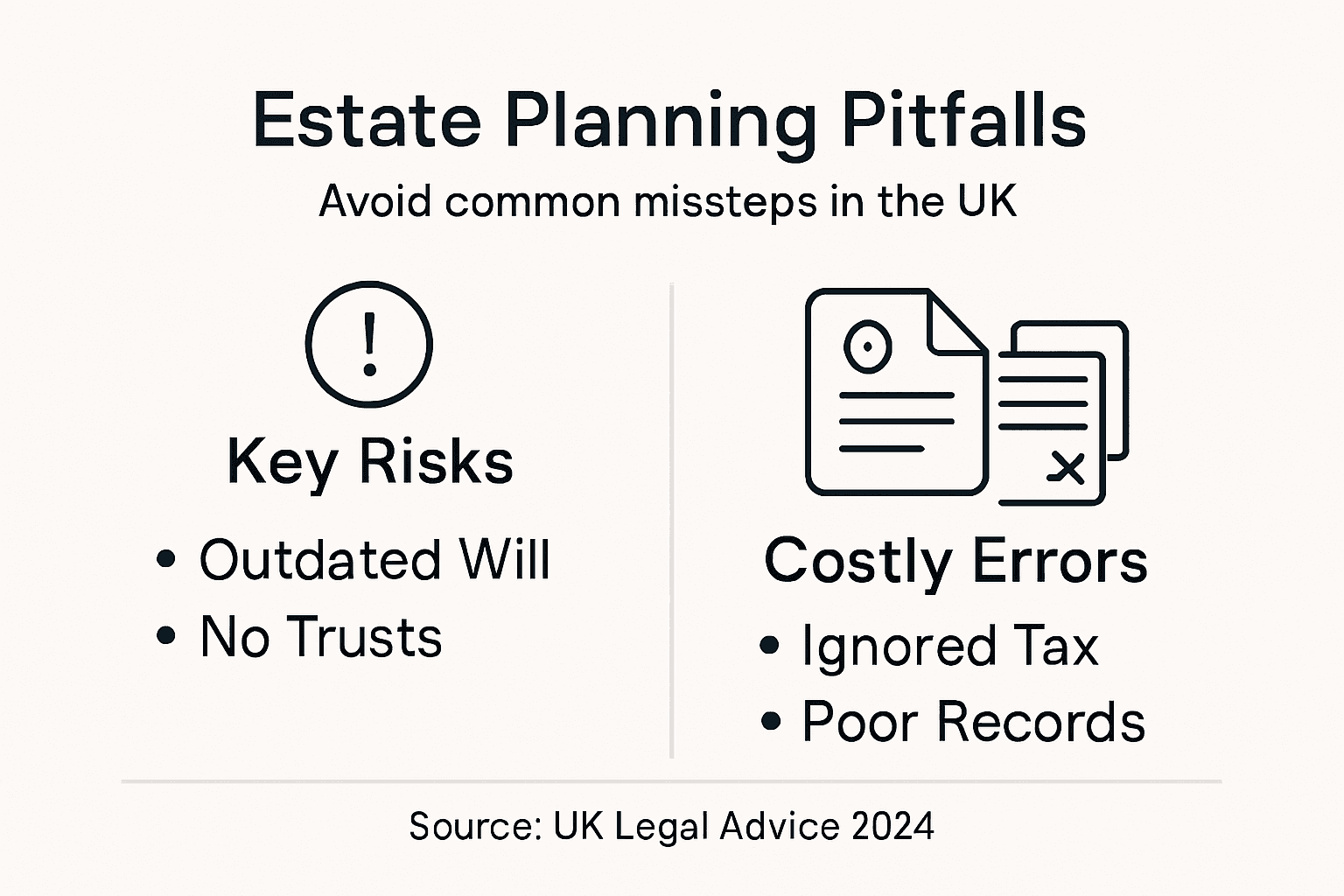
One of the most critical errors individuals make is failing to create a legally valid will. Without a properly constructed legal document, assets may be distributed according to standard intestacy rules, potentially contradicting an individual’s genuine wishes and causing unnecessary familial conflict.
Common estate planning pitfalls include:
Incomplete Documentation represents another significant risk in estate planning. Many individuals mistakenly believe that verbal agreements or informal arrangements will suffice, when in reality, legally binding documentation is crucial for ensuring precise asset transfer and minimising potential disputes among beneficiaries.
Professional legal guidance can help prevent costly mistakes and ensure comprehensive estate protection.
Complex family structures and changing life circumstances further complicate estate planning. Marriages, divorces, births, and significant financial changes necessitate regular document reviews and updates to maintain the relevance and effectiveness of estate planning strategies.
Pro tip: Schedule an annual comprehensive review of your estate planning documents with a legal professional to ensure they remain current and accurately reflect your intentions.
Estate planning can feel overwhelming especially with complex laws and tax implications that threaten your family’s financial future. Whether you are navigating wills, trusts, or inheritance tax strategies, Ali Legal understands the challenges you face in securing your assets and ensuring your intentions are respected. From drafting clear and legally binding documents to managing lasting powers of attorney, our client-centred approach provides transparent, straightforward advice with fixed fees and speedy solutions.
Take control of your estate with confidence today. Visit Ali Legal to access expert legal support tailored to your unique situation. Don’t leave your family’s wealth to chance – contact us now to start your personalised estate planning journey and safeguard your legacy with trusted professionals dedicated to clarity and long-term care.
Estate planning is a strategic approach to managing and preserving family wealth after an individual’s death. It ensures that assets are distributed according to your wishes, minimises tax liabilities, and helps prevent family conflicts.
Key components include drafting a legally binding will, identifying and valuing personal assets, considering inheritance tax strategies, establishing trusts for specific beneficiaries, and designating a power of attorney.
Estate planning is an ongoing process, so it’s advisable to review and update your documents annually or after significant life changes, such as marriage, divorce, or the birth of children, to ensure they reflect your current circumstances.
A will directs the distribution of estate assets after death, a trust manages assets under certain conditions possibly reducing tax liabilities, and a lasting power of attorney allows trusted individuals to make decisions on your behalf if you become incapacitated.
Running a UK SME can quickly become overwhelming when faced with legal responsibilities and tough regulatory choices. Every decision, from company structure to record-keeping and compliance, shapes your firm’s future and risk profile. Knowing what is required – and when – can help you avoid costly mistakes and safeguard your business in the long run.
This guide reveals the most important legal tips every UK SME needs to operate smoothly and meet government expectations. You will discover practical steps for tackling crucial tasks like statutory filings, record maintenance, and selecting the best structure for your goals.
Get ready to uncover clear, actionable advice that can help you protect your company and boost your confidence in handling legal duties. The strategies you find here will lay the groundwork for stronger compliance and long-term business success.
Selecting the right legal structure is a fundamental decision that can significantly impact your UK small or medium enterprise (SME). The structure you choose determines everything from tax obligations to personal liability and operational flexibility.
Understanding the key legal structures available in the United Kingdom is crucial for making an informed choice. The most common options include:
When selecting a legal structure, consider critical factors such as business complexity, growth potential, and financial risk. Comprehensive corporate governance guidelines from Companies House provide valuable insights into these considerations.
Your chosen legal structure will define how you operate, raise capital, and manage legal responsibilities.
Each structure offers unique advantages and challenges. A sole trader structure works well for small, low-risk businesses with minimal complexity. In contrast, a limited company provides stronger legal protection and potential tax efficiencies for growing enterprises.
Key considerations when choosing your legal structure include:
Pro tip: Consult a legal professional to assess your specific business needs and select the most appropriate legal structure for your SME’s unique circumstances.
Statutory filings are the backbone of legal compliance for UK SMEs. Maintaining accurate and timely records is not just a legal requirement but a critical aspect of professional business management.
Companies in the United Kingdom are legally obligated to submit various documents to Companies House within specific timeframes. Regulatory compliance requirements cover multiple essential submissions including:
The consequences of missing these statutory filing deadlines can be severe. Penalties may include:
Timely and accurate statutory filing is not optional it is a fundamental legal responsibility for UK businesses.
Proactive compliance requires establishing robust systems and processes. This means creating internal tracking mechanisms to monitor upcoming filing deadlines and ensuring all required documentation is prepared well in advance.
The recent changes to UK company law have further emphasised the importance of accurate company information submission, with enhanced monitoring and stricter penalties for non-compliance.
Pro tip: Invest in digital filing management tools or work with a professional accountant to streamline your statutory filing process and avoid potential compliance pitfalls.
Accurate company records and minutes are the foundation of good corporate governance for UK SMEs. These documents serve as a critical legal and historical record of your business’s key decisions and activities.
Official record-keeping guidelines require businesses to maintain comprehensive documentation that demonstrates transparency and accountability. The essential records every UK company must maintain include:
Maintaining these records is not just a legal requirement but a strategic practice that provides multiple benefits:
Accurate record-keeping is the backbone of corporate integrity and legal protection.
Digital record management has transformed how SMEs approach documentation. Modern businesses can leverage online platforms to update company information efficiently and maintain real-time compliance.
Key considerations for effective record management include implementing robust digital filing systems establishing clear document retention policies and training staff on proper record-keeping protocols.
Pro tip: Invest in a secure digital document management system that automatically timestamps and archives your company records ensuring easy retrieval and maintaining a comprehensive audit trail.
Contracts and agreements form the legal backbone of business relationships for UK SMEs. Properly drafted documents protect your company’s interests and provide clear guidelines for all business interactions.
Contract preparation guidelines emphasise the critical importance of comprehensive documentation that addresses potential scenarios and mitigates legal risks. Every SME should focus on creating robust agreements that cover key business relationships.
Essential types of contracts for UK SMEs include:
Key considerations when drafting business contracts:
A well-drafted contract is your best defence against potential legal disputes and misunderstandings.
The legal framework surrounding company agreements requires meticulous attention to detail. Each document should be tailored to your specific business needs while maintaining legal precision.
Understanding the nuanced requirements of commercial contract drafting can help SMEs protect their interests and establish clear operational boundaries.
Pro tip: Consider engaging a legal professional to review your contracts periodically and ensure they remain current with changing business regulations and company circumstances.
Directors of UK SMEs carry significant legal responsibilities that extend far beyond day-to-day business management. Understanding and monitoring these duties is crucial to protecting both the company and personal interests.
Director responsibilities under UK law encompass a comprehensive range of legal and ethical obligations that require careful navigation and proactive management.
Key statutory duties for company directors include:
Potential personal liabilities directors may face:
Directors are legally bound to act in the best interests of their company at all times.
The corporate governance framework requires directors to demonstrate transparency accountability and ethical decision making. UK Corporate Governance standards provide comprehensive guidance on managing these responsibilities effectively.
Strategic approaches to managing director duties include regular legal training ongoing compliance reviews and maintaining comprehensive documentation of key business decisions.
Pro tip: Conduct quarterly internal reviews of director activities and consider professional legal advice to ensure continuous compliance with evolving corporate governance requirements.
Data protection is no longer an optional extra for UK SMEs but a critical legal requirement that demands comprehensive and proactive management. Your organisation’s approach to personal data handling can significantly impact its reputation and legal standing.
Data protection guidance from the Information Commissioner’s Office highlights the essential elements of robust privacy policies.
Key components of effective data protection policies include:
Critical legal considerations for SMEs:
Privacy is not just a legal requirement it is a fundamental business trust mechanism.
The UK GDPR framework requires businesses to demonstrate active data protection management. This means going beyond simple compliance to creating a culture of privacy awareness.
Lawful basis interactive guidance provides SMEs with practical tools to navigate complex data protection requirements.
Effective implementation involves regular staff training comprehensive documentation and proactive risk management strategies.
Pro tip: Conduct an annual comprehensive privacy policy review and invest in staff data protection training to ensure ongoing compliance and reduce potential legal risks.
Making significant business decisions without professional legal guidance can expose your UK SME to substantial risks and potential financial consequences. Proactive legal consultation is an investment in your company’s future stability and strategic growth.
Critical business scenarios requiring legal consultation include:
Key reasons to seek professional legal advice:
Legal advice is not an expense it is a strategic safeguard for your business.
Understanding the nuanced legal landscape requires expertise that goes beyond general business knowledge. Legal consultation preparation involves comprehensive review of your specific business context and potential implications.
Effective legal consultation requires transparent communication detailed documentation and a willingness to explore multiple perspectives before making critical decisions.
Professional solicitors can provide:
Pro tip: Schedule legal consultations early in your decision making process and prepare comprehensive documentation to maximise the value of professional legal advice.
Below is a comprehensive table summarising the main points and strategies discussed throughout the article regarding legal considerations for UK SMEs.
| Topic | Key Details | Significance |
|---|---|---|
| Choosing a Legal Structure | Explore options: Sole Trader, Partnership, Limited Company, LLP. Assess factors like liability and tax implications. | Determines operations and compliance demands. |
| Ensuring Statutory Compliance | Submit accurate Company accounts and other filings timely as per Companies House requirements. | Avoid financial penalties and maintain legal standing. |
| Maintaining Company Records | Sustain detailed documentation such as financial statements and meeting minutes. | Encourages transparency and aligns with governance standards. |
| Drafting Contracts | Include precise terms in contracts (employment, suppliers, etc.) to safeguard interests. | Minimises disputes and clarifies obligations. |
| Director Responsibilities | Adhere to statutory duties and maintain integrity in decision-making. | Prevents legal repercussions and upholds corporate governance. |
| Data Protection Management | Implement secure, transparent data handling policies aligned with the GDPR. | Upholds trust and avoids legal penalties. |
| Seeking Legal Advice | Consult professionals during significant business changes for informed decisions. | Supports strategic planning and risk mitigation. |
Navigating the complex dos and don’ts of corporate law can feel daunting for any UK SME owner. From choosing the right legal structure to ensuring compliance with statutory filings and monitoring director duties, the challenges are many. If you want to avoid costly legal pitfalls and confidently secure your business’s future, understanding these key responsibilities is essential. Common pain points include managing contracts correctly, maintaining accurate company records, and implementing robust data protection policies—all critical for long-term success.
Do not leave your SME vulnerable. Visit Ali Legal to access straightforward advice tailored to your business needs. Explore our comprehensive legal services in Uncategorized | Ali Legal and our complete range at All | Ali Legal for expert guidance. Take the decisive step now and consult with an experienced solicitor who can help you implement effective corporate governance and compliance strategies immediately.
Choosing the right legal structure is crucial for your UK SME. Consider factors like personal liability, tax implications, and growth potential. Evaluate options such as Sole Trader, Partnership, Limited Company, and Limited Liability Partnership to find the best fit for your business goals.
To ensure compliance, maintain an organised filing system for all required documents, such as annual accounts and confirmation statements. Set up reminders for submission deadlines to complete filings on time and avoid penalties.
Your UK SME must maintain comprehensive records, including registers of members, accounting records, and minutes of board meetings. Establish a routine to regularly review and update these documents to ensure compliance and transparency.
Look to seek legal advice before making major changes, such as corporate restructuring or entering significant contracts. Engaging a legal professional early can help you identify potential risks and safeguard your company’s interests.
Directors must fulfil statutory duties, including promoting the company’s success and avoiding conflicts of interest. Regularly review director activities to ensure compliance with these responsibilities and maintain good corporate governance.
To implement effective data protection policies, establish clear consent mechanisms and secure data storage protocols. Conduct regular training sessions for staff on data handling to ensure everyone understands their responsibilities in protecting personal data.
Operational challenges and shifting market demands often push mid-sized companies in the United Kingdom to rethink their structure. For executives and legal leaders, choosing the right approach means balancing business resilience with strict regulatory standards. This introduction breaks down the Corporate Insolvency and Governance Act 2020, key restructuring mechanisms, and strategic options to help British companies take confident, compliant steps toward renewed efficiency.
Corporate restructuring represents a strategic process through which businesses reorganise their operational, financial, and legal frameworks to enhance performance, mitigate risks, and adapt to changing market conditions. In the United Kingdom, this complex procedure involves multiple legal mechanisms designed to support corporate transformation and financial resilience.
The landscape of corporate restructuring in the UK has been significantly reshaped by recent legislative developments, particularly the Corporate Insolvency and Governance Act 2020. This legislation introduced several critical restructuring tools for businesses facing financial challenges:
Businesses typically pursue restructuring for several strategic reasons:
Corporate restructuring is not about survival, but strategic transformation.
The process involves comprehensive assessment of a company’s current state, identifying potential structural modifications, and implementing carefully planned changes across financial, operational, and organisational dimensions.
Pro tip: Engage experienced legal and financial professionals early in your restructuring journey to navigate complex regulatory requirements and minimise potential risks.
Corporate restructuring encompasses a diverse range of strategic approaches designed to transform and optimise business operations. Corporate restructuring strategies in the United Kingdom involve multifaceted processes that address financial, legal, and organisational dimensions of a company’s structure.
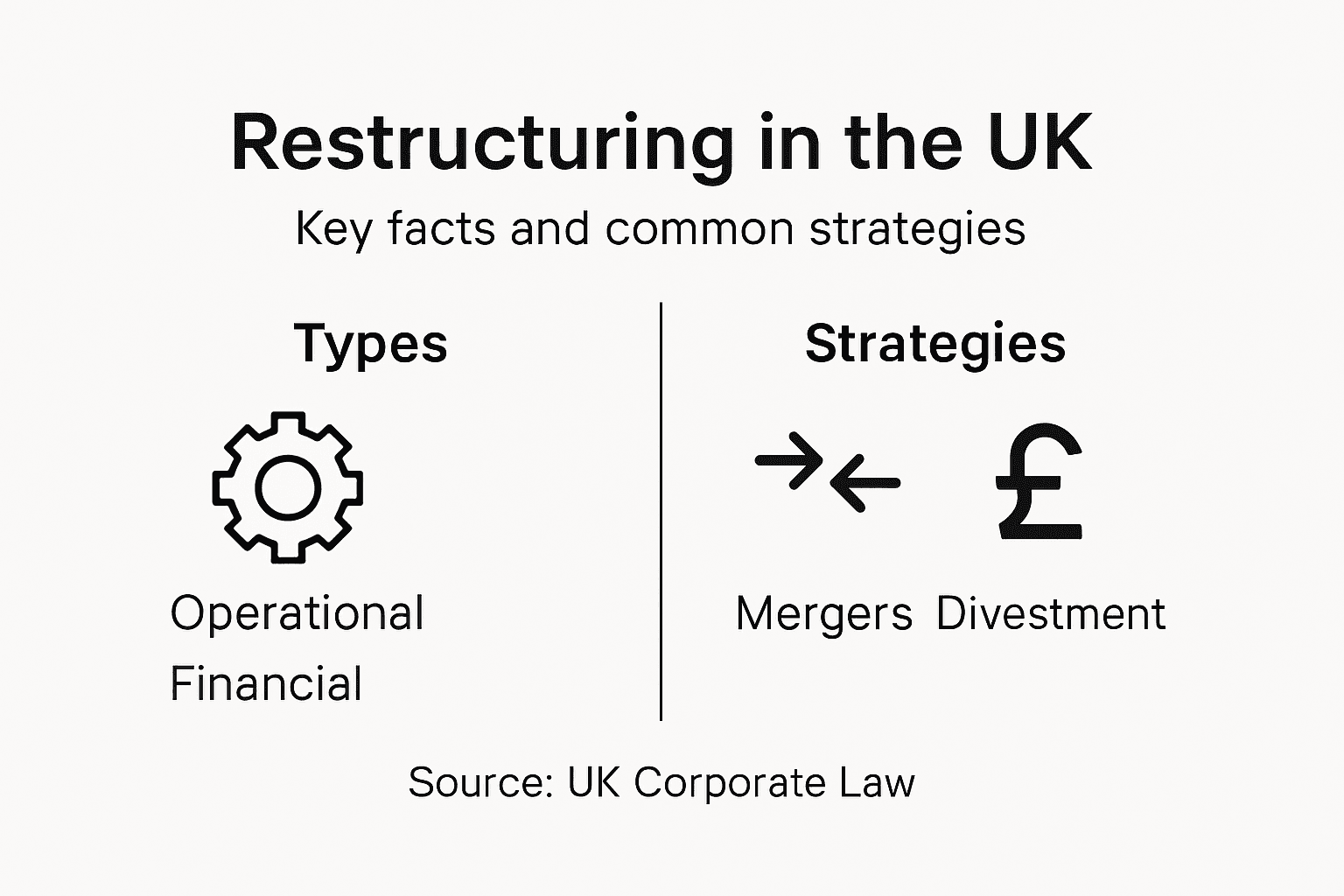
The primary types of corporate restructuring can be categorised into several key strategies:
Each restructuring strategy requires careful planning and precise execution. Financial restructuring often involves complex negotiations with creditors, shareholders, and financial institutions to realign the company’s monetary framework. Legal restructuring might include changing the business’s legal form, such as transitioning from a limited company to a limited liability partnership.
Strategic restructuring is not about drastic changes, but calculated and methodical transformation.
Operational restructuring focuses on enhancing efficiency by streamlining processes, eliminating redundant roles, and realigning departments to create a more agile and competitive organisational structure.

Pro tip: Conduct a comprehensive internal audit before initiating any restructuring to identify precise areas requiring strategic intervention.
The UK’s corporate restructuring landscape is governed by a complex legal framework of key legislative acts, primarily encompassing the Insolvency Act 1986, Companies Act 2006, and the Corporate Insolvency and Governance Act 2020. These statutes provide comprehensive guidelines for directors navigating financial challenges and corporate transformation.
Directors have critical legal responsibilities during restructuring processes, which include:
The legal mechanisms available for restructuring include various court-supervised procedures such as:
Directors must balance legal compliance with strategic business preservation.
Specifically, directors must exercise extreme caution when a company approaches financial difficulty, as their decision-making becomes critically scrutinised under legal frameworks. Failure to act responsibly can result in personal liability and potential disqualification.
The following table summarises how different restructuring procedures impact major stakeholder groups in UK companies:
| Procedure | Impact on Shareholders | Impact on Creditors | Role of Directors |
|---|---|---|---|
| Restructuring Plan | May dilute ownership, but can preserve future value | Must consider proposals; claims may be adjusted | Lead planning, ensure fair treatment and compliance |
| CVA | May affect dividend prospects | Negotiated settlements, possible losses | Facilitate negotiations, uphold legal duties |
| Administration | Shareholder control reduced | Rescue or repayment prioritised | Manage operations under administrator supervision |
| Scheme of Arrangement | Shareholder votes needed | Creditor consent critical | Coordinate court process, maintain transparency |
Pro tip: Maintain meticulous records of all decision-making processes and seek independent legal advice before implementing significant restructuring measures.
Corporate restructuring requires a systematic approach, beginning with comprehensive financial review and early intervention. The process demands meticulous planning, stakeholder engagement, and strategic decision-making to navigate complex financial challenges effectively.
The primary practical steps for corporate restructuring typically include:
The key procedural routes for UK corporate restructuring involve several critical stages:
Successful restructuring balances legal compliance with strategic business preservation.
Licensed insolvency practitioners play a crucial role in managing and overseeing restructuring proceedings, ensuring transparency and adherence to statutory requirements. They provide independent assessment and guidance throughout the complex transformation process.
Pro tip: Engage specialised legal and financial professionals early to develop a comprehensive restructuring strategy that minimises potential risks and maximises business continuity.
Corporate restructuring presents significant challenges, with numerous potential risks that demand careful navigation. Directors must approach the process with strategic precision, understanding the complex financial and legal landscape that could potentially compromise the entire restructuring effort.
The primary risks and potential pitfalls in corporate restructuring include:
Critical cost considerations for UK corporate restructuring involve multiple expense categories:
Strategic planning is the most effective risk mitigation strategy in corporate restructuring.
Common pitfalls that companies must carefully avoid include inadequate stakeholder communication, incomplete financial assessments, and failing to develop comprehensive restructuring proposals that address all potential contingencies.
The table below compares common risks and their mitigation strategies during corporate restructuring in the UK:
| Risk Type | Example Challenge | Mitigation Strategy |
|---|---|---|
| Financial Risk | Cash flow instability | Early budgeting and monitoring |
| Legal Risk | Directors’ liability exposure | Seek expert legal guidance |
| Operational Risk | Loss of staff morale | Regular stakeholder communication |
| Reputational Risk | Negative media coverage | Provide transparent updates |
Pro tip: Conduct a rigorous pre-restructuring risk assessment and maintain transparent communication with all key stakeholders to minimise potential complications.
Corporate restructuring presents complex legal challenges that demand precise strategy and expert guidance. Whether you need help understanding director duties, managing financial risks, evaluating restructuring plans or navigating legal frameworks in the United Kingdom, Ali Legal stands ready to support your business transformation with transparency and speed. Avoid costly pitfalls and ensure compliance by partnering with specialists who prioritise clear communication and tailored advice.
Take control of your company’s future with Ali Legal’s professional corporate and commercial law services. Act now to minimise risks and protect stakeholder interests through strategic legal support designed to deliver straightforward solutions. Contact us today to arrange a consultation and gain peace of mind through expert guidance tailored to your restructuring needs. Visit Ali Legal Contact Page for prompt assistance and explore how our dedicated team can help you achieve a successful restructuring outcome.
Corporate restructuring is a strategic process where businesses reorganise their operational, financial, and legal frameworks to improve performance, mitigate risks, and adapt to changing market conditions.
The key types of corporate restructuring include financial restructuring, legal restructuring, and operational restructuring, each focusing on different aspects such as debt management, legal entity changes, and operational efficiency.
Potential risks include financial risks like cash flow disruptions, legal risks such as non-compliance with regulations, operational risks affecting business continuity, and reputational risks from negative public perception.
Directors can ensure compliance by understanding their fiduciary duties, maintaining financial transparency, seeking expert legal guidance, and documenting all decision-making processes meticulously.
Mergers and acquisitions can reshape the future of any British company, but even seasoned corporate finance managers face uncertainty when the rules seem ever more technical and demanding. With the Competition and Markets Authority strictly enforcing competition law and the Companies Act 2006 guiding transaction structure, managing regulatory compliance is crucial. This article highlights the key legal frameworks, potential pitfalls, and practical steps every British finance manager should know before pursuing an ambitious merger or acquisition.
Mergers and acquisitions (M&A) represent complex legal transactions where companies combine or transfer ownership, fundamentally reshaping business structures and competitive landscapes. In the United Kingdom, these strategic manoeuvres are carefully regulated to protect market competition and consumer interests.
The legal framework for mergers and acquisitions in the UK is primarily governed by several key regulatory bodies and legislative mechanisms:
Under UK law, a merger occurs when two separate entities combine to create a single new organisation, while an acquisition involves one company purchasing another, typically absorbing its operations and assets. The CMA investigates potential market impacts to ensure these transactions do not substantially reduce market competition.
Specifically, the CMA evaluates M&A transactions based on several critical criteria:
Businesses contemplating mergers or acquisitions must navigate a complex regulatory environment that prioritises maintaining fair market conditions. The legal scrutiny ensures that corporate restructuring does not compromise consumer welfare or create monopolistic market conditions.
Pro tip: Always engage legal counsel specialising in corporate transactions before initiating any merger or acquisition to ensure comprehensive regulatory compliance and strategic alignment.
Mergers and acquisitions in the United Kingdom represent sophisticated legal strategies for corporate transformation, encompassing multiple complex transaction types designed to achieve strategic business objectives. UK legal frameworks recognise several distinctive M&A approaches that businesses can strategically employ.
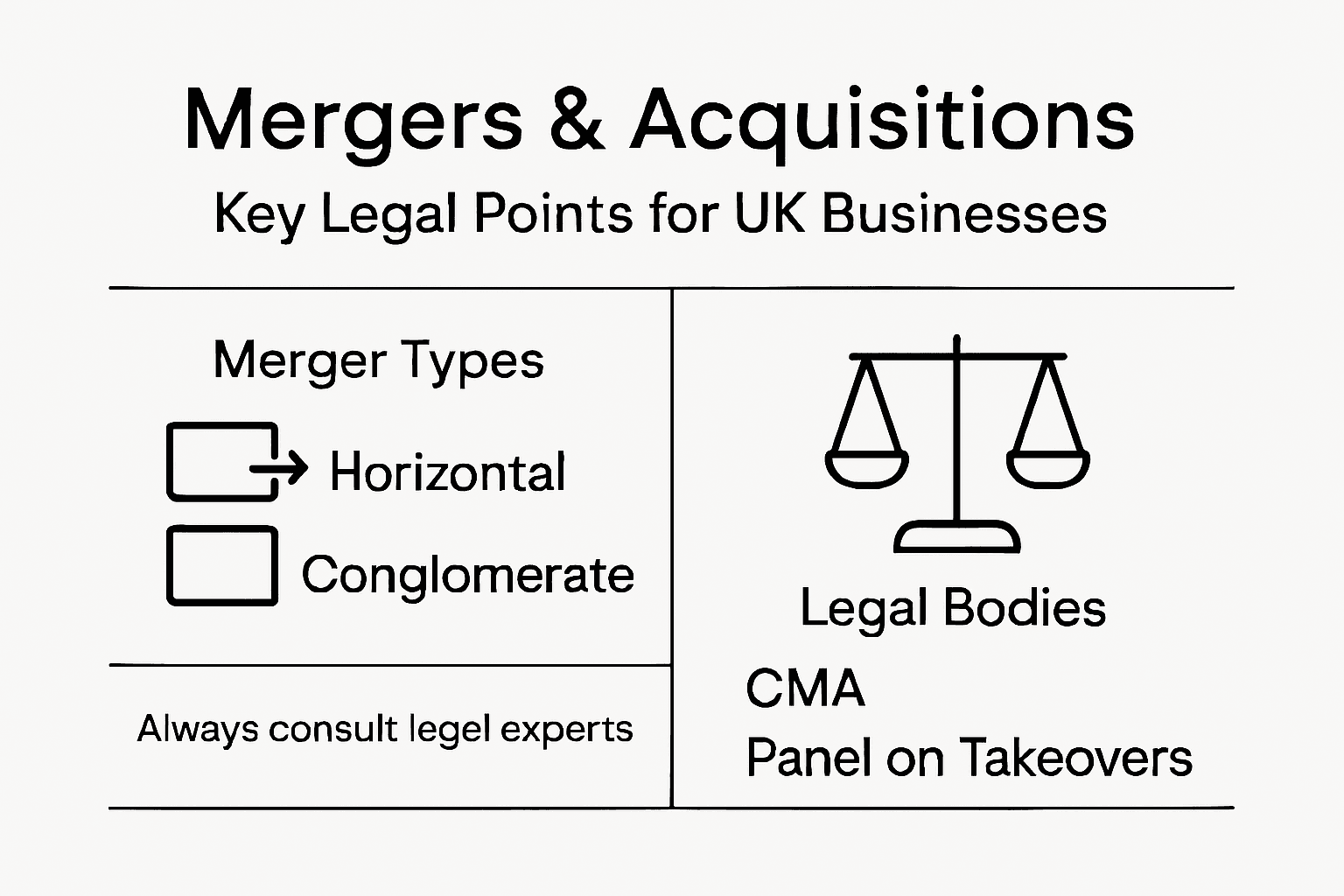
The primary categories of mergers and acquisitions include:
Each merger type carries unique legal and strategic implications. Horizontal mergers typically aim to consolidate market share, reduce competition, and achieve economies of scale. Vertical mergers focus on streamlining supply chain efficiencies and reducing operational costs by integrating different production stages.

Conglomerate mergers represent more complex transactions where businesses from entirely different sectors combine, often seeking portfolio diversification and risk mitigation. These transactions require meticulous legal scrutiny to ensure compliance with competition regulations.
The following table compares the main types of mergers and acquisitions and their strategic objectives:
| Merger Type | Typical Parties Involved | Primary Objective | Key Legal Consideration |
|---|---|---|---|
| Horizontal | Direct competitors | Increase market share | Competition law compliance |
| Vertical | Supply chain partners | Streamline operations | Regulatory approval of integration |
| Conglomerate | Unrelated industries | Diversify business | Detailed risk assessment required |
| Friendly Acquisition | Willing buyer and seller | Mutual business growth | Clear communication to shareholders |
| Hostile Takeover | Unwilling target company | Gain control quickly | Defence strategies by target |
In the United Kingdom, merger transactions must navigate intricate regulatory landscapes to protect market competition and shareholder interests.
The legal mechanisms for these transactions vary, with specific processes like schemes of arrangement providing court-sanctioned methods for corporate restructuring. Companies must carefully evaluate their strategic objectives, potential synergies, and regulatory constraints when considering any merger or acquisition strategy.
Pro tip: Consult specialised corporate legal experts who understand the nuanced differences between merger types to develop a comprehensive and legally robust transaction strategy.
The United Kingdom maintains a sophisticated legal infrastructure governing mergers and acquisitions, designed to protect market integrity, shareholder interests, and economic competition. UK merger control mechanisms represent a comprehensive system of regulatory oversight that ensures transparent and fair corporate transactions.
Key regulatory bodies responsible for overseeing M&A activities include:
Statutory legislation plays a crucial role in defining the legal landscape for corporate transactions. The Enterprise Act 2002 and Companies Act 2006 provide the foundational legal frameworks that govern merger and acquisition processes, establishing clear guidelines for corporate restructuring and shareholder protections.
The Competition and Markets Authority holds particular significance in M&A transactions. This regulatory body has the power to investigate and potentially block mergers that might substantially reduce market competition or harm consumer interests. Their assessment criteria include market concentration, potential price increases, and impacts on consumer choice.
Regulatory oversight ensures that corporate transactions balance commercial interests with broader economic and consumer welfare considerations.
Additional regulatory mechanisms include the City Code on Takeovers and Mergers, which provides detailed rules for public company acquisitions. This code ensures transparency, fairness, and equal treatment of shareholders during complex corporate transactions.
Below is a summary of key UK regulatory bodies and their principal functions in M&A processes:
| Regulator | Role in M&A | Business Impact |
|---|---|---|
| Competition and Markets Authority | Monopoly prevention | May block anti-competitive deals |
| Financial Conduct Authority | Ensures market fairness | Sets standards for financial disclosures |
| Panel on Takeovers and Mergers | Administers takeover code | Protects shareholder equality |
| Financial Reporting Council | Monitors governance standards | Ensures accurate financial reporting |
Pro tip: Engage specialised legal counsel with expertise in UK corporate law to navigate the intricate regulatory landscape and ensure full compliance with statutory requirements.
The merger and acquisition process in the United Kingdom involves a structured, multi-stage approach designed to ensure transparency, regulatory compliance, and strategic alignment. CMA’s transaction investigation process provides a comprehensive framework for navigating complex corporate transactions.
The typical M&A transaction process encompasses the following critical stages:
The preliminary assessment involves extensive financial and strategic evaluation. Companies must carefully analyse potential targets, examining financial performance, market positioning, and alignment with overall business strategy. This stage requires meticulous research and strategic thinking to identify opportunities that genuinely enhance corporate value.
Successful M&A transactions balance strategic vision with rigorous financial and legal scrutiny.
Regulatory investigations represent a crucial phase in the transaction process. The Competition and Markets Authority conducts detailed assessments to ensure that proposed mergers do not substantially reduce market competition or harm consumer interests. These investigations can involve multiple stages, with companies required to provide comprehensive evidence and potentially negotiate remedies.
Pro tip: Engage specialised legal and financial advisors early in the M&A process to anticipate potential regulatory challenges and develop proactive mitigation strategies.
Mergers and acquisitions represent complex transactions fraught with potential financial and legal risks that can significantly impact corporate strategies. Insurance due diligence reveals critical hidden exposures that companies must carefully evaluate before finalising any transaction.
Key potential risks in M&A transactions include:
Financial Risks
Undisclosed historical debts
Unexpected retrospective premium adjustments
Undervalued asset assessments
Unresolved legal claims
Regulatory Risks
Potential competition authority penalties
Non-compliance with national security regulations
Unexpected integration compliance costs
Post-completion regulatory investigations
The comprehensive risk assessment requires meticulous examination of multiple corporate dimensions. Companies must conduct thorough financial, legal, and operational investigations to uncover potential liabilities that might not be immediately apparent during initial negotiations.
Successful M&A transactions demand rigorous due diligence to mitigate potential financial and legal vulnerabilities.
Legal due diligence plays a crucial role in identifying and allocating potential risks. This process involves detailed investigations into historic insurance limits, ongoing claim reserves, and potential regulatory penalties. Sophisticated organisations develop sophisticated risk transfer strategies and comprehensive business continuity plans to manage potential exposure.
Pro tip: Engage specialised forensic accountants and legal experts to conduct exhaustive risk assessments before finalising any merger or acquisition transaction.
Mergers and acquisitions demand sophisticated legal strategies to mitigate potential risks and ensure successful corporate transactions. Legal safeguards protect businesses during complex negotiations by establishing comprehensive protective mechanisms throughout the transaction process.
Key legal safeguards and potential pitfalls include:
Fundamental Legal Safeguards:
Common Potential Pitfalls:
The contractual framework represents a critical element in managing potential legal vulnerabilities. Companies must develop meticulous documentation that clearly defines expectations, allocates risks, and establishes precise mechanisms for addressing potential disputes or unexpected challenges.
Successful M&A transactions require proactive legal strategies that anticipate and mitigate potential risks before they materialise.
Regulatory compliance demands exceptional attention, particularly regarding competition laws and shareholder disclosure requirements. Organisations must navigate complex legal landscapes, ensuring transparent communication and adherence to statutory requirements throughout the transaction process.
Pro tip: Engage specialised legal counsel with extensive M&A experience to conduct comprehensive risk assessments and develop robust contractual protections.
Navigating mergers and acquisitions in the United Kingdom demands expert legal guidance to manage complex regulatory frameworks and mitigate financial and operational risks. With challenges such as compliance with Competition and Markets Authority regulations, thorough due diligence, and crafting robust contractual safeguards, the process can quickly become overwhelming. If you are seeking clarity on key legal insights and want to ensure your corporate transactions proceed smoothly, Ali Legal offers strategic, transparent, and client-focused solutions tailored for your unique situation.
Take control of your M&A journey now by consulting with our experienced legal team. We prioritise clear communication, fixed fees, and long-term relationships to help you achieve your business goals without costly surprises. Ready to safeguard your merger or acquisition with professional advice? Contact us today at Ali Legal to start securing your transaction with confidence.
A merger occurs when two companies combine to form a new entity, while an acquisition involves one company purchasing another, integrating its operations and assets into its own.
The main regulatory bodies include the Competition and Markets Authority (CMA), Financial Conduct Authority (FCA), Panel on Takeovers and Mergers, and the Financial Reporting Council.
The M&A process typically includes strategic planning, due diligence, and regulatory assessment, ensuring thorough evaluation and compliance at each stage.
Common risks include undisclosed debts, regulatory penalties, integration compliance costs, and valuation errors, all of which can significantly impact the success of a transaction.
A supplier suddenly misses a key delivery, or a vendor disputes payment terms and your small business faces immediate uncertainty. For UK-based owners, these moments are not just stressful but can disrupt critical operations and threaten valuable relationships. Understanding the essentials of a breach of contract in British law helps you respond swiftly and protect your interests, ensuring every agreement works for—not against—your company.
In British legal practice, a breach of contract represents a significant legal event where one party fails to fulfil their contractual obligations as originally agreed. When considering employment contract terms, such breaches can emerge through multiple scenarios that fundamentally disrupt the established legal agreement between parties.
A breach occurs when specific contractual conditions are not met, which can manifest in several distinct ways:
Under UK law, breaches are typically categorised into three primary types:
Employment contracts specifically require both employers and employees to understand their legal obligations and responsibilities. A fundamental breach by an employer might enable an employee to claim constructive dismissal, while an employee’s significant breach could justify immediate termination.
A breach of contract is not just a technical legal term, but a potential turning point in business relationships.
The severity and nature of the breach determine potential legal remedies, which might include financial compensation, contract modification, or complete contract termination. Small businesses must carefully document all contractual interactions and maintain clear communication to minimise potential breach risks.
Pro tip: Regularly review and update your contractual agreements to ensure clarity and reduce potential misunderstandings that could lead to breach scenarios.
In British contract law, understanding the nuanced types of breach is crucial for small businesses navigating legal complexities. Fixed-term contract breaches represent a particularly sensitive area where precise legal distinctions can significantly impact business relationships and potential litigation outcomes.
The primary categories of contract breaches in UK law include:
Each breach type carries distinct legal implications and potential remedies. For instance, contract breach scenarios can range from minor technical infractions to substantial violations that justify immediate contract termination.
The following table summarises how different breach types typically impact small businesses:
| Breach Type | Common Example | Business Impact | Typical Legal Response |
|---|---|---|---|
| Minor breach | Slight delay in payment | Minimal disruption | Negotiation, small claim |
| Material breach | Reduced quality of service | Operational or financial loss | Compensation, contract change |
| Fundamental breach | Unlawful job termination | Relationship breakdown | Immediate termination, claim |
| Anticipatory breach | Notice of non-performance | Planning uncertainty | Early intervention |
Not all contract breaches are created equal - the severity and context determine the legal response.
In employment contexts, breaches can manifest through various actions. An employer reducing pay without agreement or an employee consistently refusing essential duties could constitute significant contractual violations. The legal system evaluates these breaches based on their materiality and impact on the overall contractual relationship.
Specific considerations for assessing breach severity include:
Legal remedies for contract breaches might include financial compensation, specific performance orders, or contract rescission. Small businesses must carefully document interactions and understand the potential consequences of different breach types.
Pro tip: Maintain detailed contract documentation and communicate proactively to mitigate potential breach risks before they escalate into formal legal disputes.
In the United Kingdom, employment contracts represent complex legal instruments that go far beyond simple written agreements. Employment contract requirements encompass a comprehensive framework of statutory and express terms that protect both employer and employee interests.
Typical contract terms can be categorised into several key components:
Under British law, employment contract details must comprehensively address multiple critical elements:
A well-constructed contract serves as both a legal shield and a roadmap for workplace expectations.
Contracts can exist in various forms - written, verbal, or implied through consistent workplace conduct. However, written contracts provide the most robust legal protection and clarity for small businesses, helping to prevent potential misunderstandings or disputes.
Employers must be particularly attentive to specific legal obligations, including providing a written statement of particulars by the first day of employment. This document should outline the fundamental aspects of the working relationship, ensuring transparency and legal compliance.
This table provides an at-a-glance guide to essential elements every employment contract should cover:
| Contract Element | Purpose | Typical Business Risk When Missing |
|---|---|---|
| Job description | Defines key duties | Disputes over role expectations |
| Payment terms | Outlines wages and frequency | Unpaid wages or payroll errors |
| Notice period | Sets termination notification | Sudden staffing or business disruption |
| Confidentiality | Protects sensitive information | Risk of data or IP leakage |
| Holiday entitlement | Ensures legal leave provision | Statutory claim for lost benefits |
Pro tip: Consult a legal professional to review your contract templates, ensuring they comprehensively cover all necessary terms and comply with current UK employment regulations.
Breaches of contract represent significant challenges for small businesses, with potential consequences that extend far beyond immediate financial implications. Contract breach consequences can fundamentally disrupt operational stability and workplace relationships.
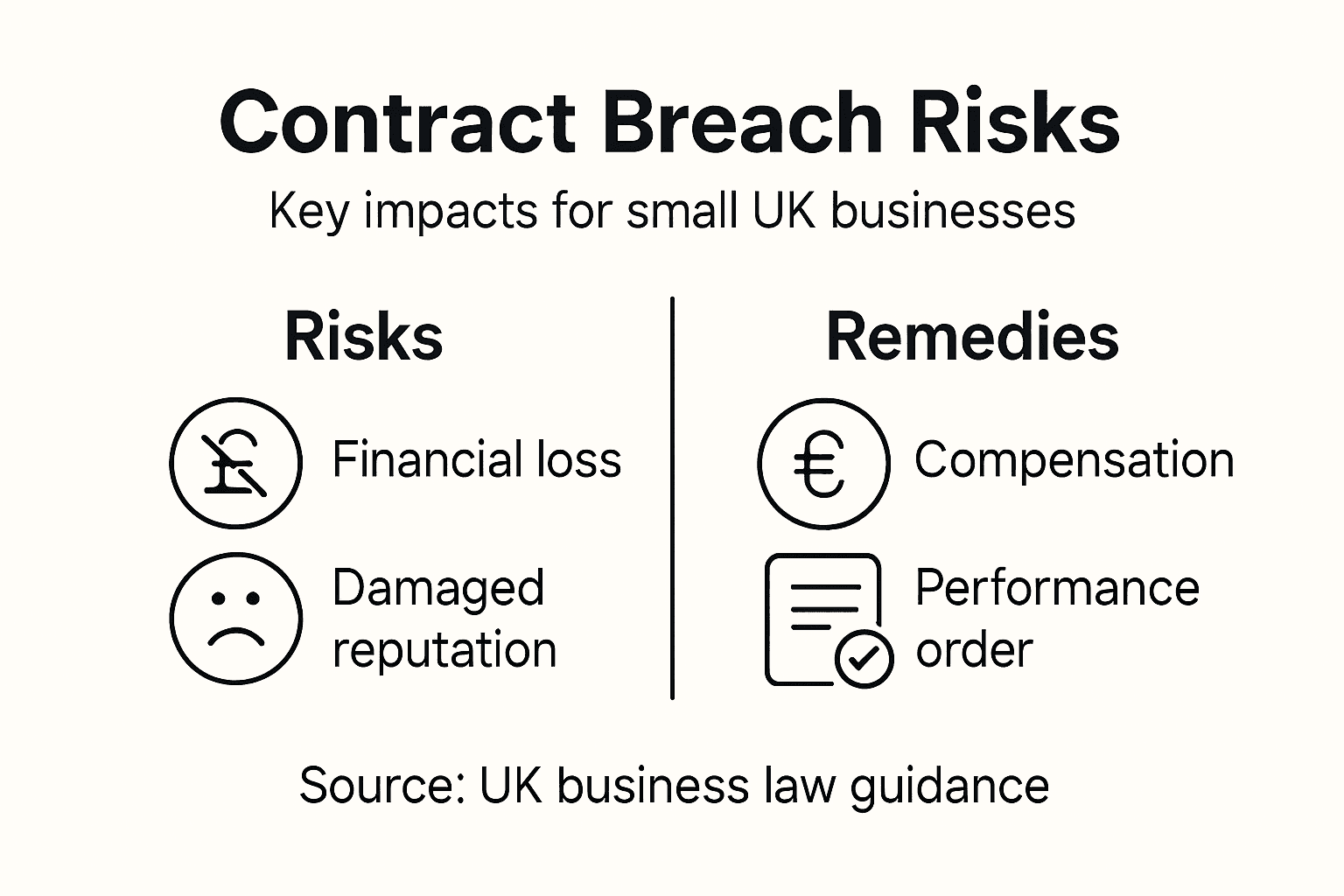
The primary risks associated with contract breaches include:
Potential remedies for contract breaches vary depending on the specific circumstances:
The true cost of a contract breach extends well beyond immediate monetary damages.
Business liability management requires proactive strategies to mitigate potential risks. Small businesses must develop robust contract frameworks, implement clear communication protocols, and maintain comprehensive documentation to minimise vulnerability.

Critical considerations for managing contract breach risks include understanding potential financial exposure, maintaining detailed records of all interactions, and being prepared to engage in constructive dispute resolution processes. Professional legal guidance can provide invaluable support in navigating these complex scenarios.
Pro tip: Develop a systematic approach to contract management, including regular reviews and clear escalation procedures to address potential breaches before they become significant legal challenges.
For small businesses, preventing contract disputes requires a proactive and strategic approach to contract management. Contract dispute prevention demands meticulous attention to detail and clear communication throughout the contractual relationship.
Key strategies for minimising potential contract conflicts include:
Effective contract protection involves several critical steps:
Proactive communication is the most effective prevention against potential contract disputes.
Contract term clarification requires businesses to ensure all parties fully understand their obligations. This involves creating precise job descriptions, explicitly stating payment terms, and outlining specific performance expectations with measurable criteria.
Small businesses should prioritise documentation, maintain open dialogue, and address potential issues promptly before they escalate into formal disputes. Keeping comprehensive records of all interactions, contract modifications, and performance assessments provides crucial protection in case of future disagreements.
Pro tip: Develop a standardised internal review process for all contracts, including mandatory legal consultation and clear escalation procedures for potential disputes.
Facing a breach of contract can place your small business in a difficult position, from unexpected financial losses to operational disruption. Understanding terms like fundamental breach and navigating sensitive issues such as fixed-term contract breaches requires more than just knowledge — it demands professional guidance focused on your unique challenges. Ali Legal specialises in delivering clear, strategic advice that helps you minimise risks, resolve disputes promptly, and protect your valuable business relationships.
Key benefits of working with us include:
If contract disputes threaten your operations take action now to safeguard your business. Reach out to Ali Legal for tailored support on contract management and breach resolution. Visit our Contact Us page and let us help you navigate these challenges with confidence. Explore our expert services designed for small businesses seeking stability and clarity in every contract.
A breach of contract occurs when one party fails to fulfil their contractual obligations, which can include failing to perform duties, delivering substandard work, or not making payments as agreed.
There are primarily three types of breaches: minor breaches, material breaches, and fundamental breaches. Each type carries different legal implications and potential remedies.
Legal remedies for breaches can include financial compensation, modification or rescission of the contract, and, in some cases, specific performance orders, depending on the severity of the breach.
Small businesses can minimise breach risks by drafting clear contracts, maintaining open communication, thoroughly documenting interactions, and regularly reviewing contract performance to address potential issues proactively.
Facing a legal dispute can feel overwhelming for British business owners who must protect both their company’s reputation and finances. The complex nature of civil litigation often demands expertise beyond everyday legal advice. Choosing the right barrister brings strategic insight and robust advocacy, giving businesses critical support in resolving disputes and preparing cases with confidence. This article outlines the role of independent legal advocates in the United Kingdom, revealing how barristers influence success in commercial litigation and safeguard your interests.
Barristers are specialised legal professionals who play a pivotal role in the United Kingdom’s judicial system. Unlike solicitors, these independent legal advocates provide expert representation and strategic legal advice primarily within court environments. Specialist legal advisers who are highly trained in courtroom advocacy represent clients during complex legal proceedings.
The professional structure of barristers is unique within the legal landscape. Most barristers operate as self-employed practitioners working from dedicated chambers, though some are employed directly by government agencies or private organisations. Their primary responsibilities include:
Barristers typically receive instructions from solicitors, who initially engage with clients and prepare case materials. This collaborative approach ensures comprehensive legal representation. Independent court advocates are bound by strict professional conduct rules, maintaining impartiality while robustly defending their clients’ interests.
Professional specialisation is a hallmark of barristers’ practice. They often concentrate on specific legal domains such as criminal law, commercial litigation, family disputes, or intellectual property, developing deep expertise within their chosen fields.

Pro Tip: When seeking a barrister, verify their specific area of specialisation to ensure alignment with your legal requirements.
To clarify the major distinctions, here is a comparison of barristers and solicitors in the UK legal system:
| Aspect | Barrister | Solicitor |
|---|---|---|
| Main Role | Advocacy in court | Client-facing legal services |
| Typical Workplace | Chambers or court | Law firm or organisation |
| Client Contact | Indirect (via solicitors mostly) | Direct client engagement |
| Case Preparation Focus | Legal argument & strategy | Evidence, paperwork, liaison |
The barrister profession encompasses diverse specialisations and rigorous training pathways designed to produce highly skilled legal professionals. Specialist legal training involves a comprehensive three-stage process that ensures exceptional legal expertise and professional competence.
Traditionally, barristers are categorised into several key professional types:
The qualification journey for becoming a barrister is structured and demanding. Academic and vocational training typically involves multiple critical stages:
Professional development continues throughout a barrister’s career, with ongoing requirements for legal education, specialisation updates, and maintaining professional standards. Many barristers choose to develop expertise in niche areas, allowing them to provide highly specialised legal services to businesses and individuals.
Successful barristers combine academic excellence, analytical skills, and robust communication abilities to navigate complex legal landscapes.
Pro Tip: Research potential barristers’ specific areas of expertise to ensure optimal alignment with your legal requirements.
Civil litigation represents a complex legal landscape where barristers play a pivotal strategic role for businesses navigating legal disputes. Specialist legal advisers bring sophisticated expertise to resolving commercial conflicts through targeted legal representation and advocacy.
In civil litigation, barristers provide critical services across multiple dimensions:
The role of barristers in civil litigation extends beyond courtroom appearances. Independent legal advocacy involves intricate preparation, including thorough legal research, drafting complex legal documents, and providing nuanced strategic guidance to businesses facing potential or active legal challenges.
Businesses benefit significantly from barristers’ specialised approach, which combines deep legal knowledge with strategic thinking. Their ability to analyse complex legal scenarios, predict potential outcomes, and construct robust legal arguments makes them invaluable partners in managing commercial disputes.
Effective civil litigation representation requires more than legal knowledge—it demands strategic insight, analytical precision, and exceptional communication skills.
Pro Tip: Engage a barrister early in potential dispute scenarios to develop proactive legal strategies and mitigate potential litigation risks.
Barristers operate under a complex framework of professional responsibilities that demand exceptional ethical standards and meticulous legal preparation. Core professional duties require barristers to balance client advocacy with an overarching commitment to judicial integrity.
The primary legal duties of barristers encompass several critical dimensions:
Case preparation involves a systematic and rigorous approach. Legal brief management requires barristers to meticulously examine legal documentation, research precedents, assess evidence strength, and develop nuanced litigation strategies tailored to each unique case scenario.
Businesses benefit from barristers’ comprehensive approach to legal preparation, which extends far beyond courtroom representation. Their ability to critically analyse complex legal scenarios, interpret intricate legal frameworks, and construct compelling arguments makes them invaluable strategic partners in navigating challenging legal landscapes.
Effective legal representation demands more than technical knowledge—it requires strategic insight, ethical commitment, and a profound understanding of legal complexities.
Pro Tip: Select a barrister with demonstrated expertise in your specific legal domain to ensure targeted and strategic case preparation.
Navigating the financial landscape of barrister engagement requires careful consideration and strategic planning. Barrister fee structures vary significantly, with professionals offering multiple pricing models to accommodate diverse client needs.
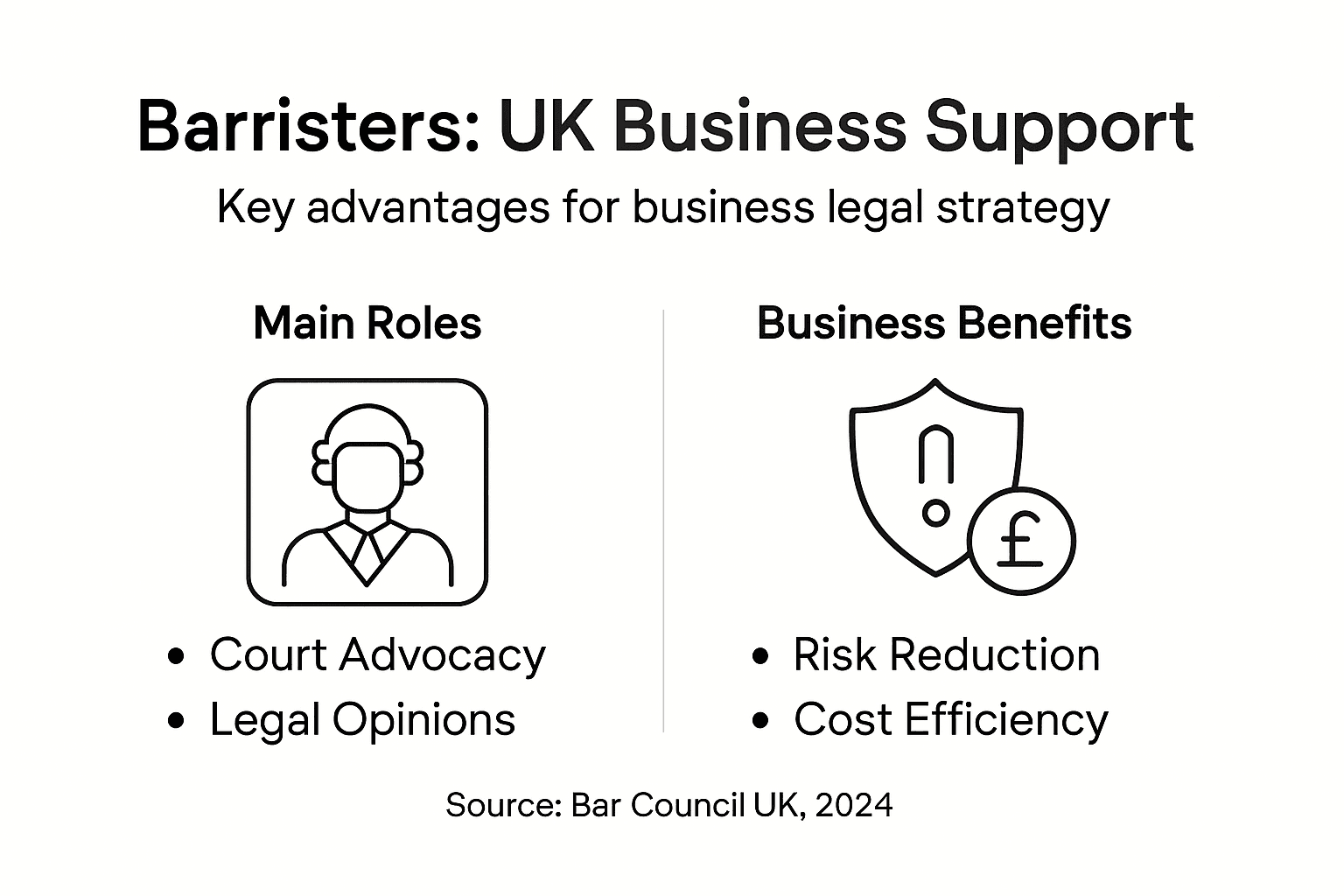
Typical fee arrangements for barristers include:
For quick reference, here is a summary of common barrister fee models and their business implications:
| Fee Model | Predictability | Typical Usage Scenario |
|---|---|---|
| Hourly Rate | Moderate | Complex, ongoing cases |
| Fixed Fee | High | Single hearings or document review |
| Conditional Fee | Variable | Claims with potential compensation |
| Retainer | High | Long-term, on-call legal support |
When selecting a barrister, businesses must conduct comprehensive due diligence. Professional selection criteria extend beyond cost considerations to include professional expertise, track record, and specialisation alignment with specific legal requirements.
Transparency is paramount in the hiring process. Reputable barristers will provide clear, upfront fee information, detailed engagement terms, and a comprehensive breakdown of potential legal costs. This approach helps businesses make informed decisions and budget effectively for legal representation.
Effective legal representation is an investment in strategic risk management, not merely an expense.
Pro Tip: Request comprehensive fee proposals from multiple barristers and compare not just cost, but expertise and potential value added to your specific legal challenge.
Navigating complex legal disputes requires more than knowledge it demands specialised advocacy and strategic insight as highlighted by the pivotal role barristers play in UK civil litigation. If your business faces challenges that require expert courtroom representation and meticulous case preparation Ali Legal offers transparent and efficient legal solutions tailored to your needs. Our client-centric approach means you get straightforward advice, fixed fees, and a partner committed to long-term success.
Discover how our experienced legal team combines the strategic value of barristers with practical business-focused legal services. Visit our Uncategorized | Ali Legal page to learn about the comprehensive support available. Don’t let legal complexities overwhelm you start resolving your business disputes with confidence today by contacting Ali Legal directly at https://alilegal.co.uk/contact-us. Reach out now to secure expert advice and clear pathways through your legal challenges.
Barristers act as independent legal advocates, specialising in representing clients during court hearings and providing expert legal advice, particularly in complex legal matters.
Barristers focus primarily on advocacy in court and typically receive instructions from solicitors, who handle client engagement and preliminary case preparations. Solicitors often provide direct legal services and client support.
To become a barrister, one must complete a law degree or conversion course, pass the Bar Professional Training Course (BPTC), secure a 12-month pupillage, and be called to the Bar by an Inn of Court.
Barrister fees can vary significantly and typically include hourly rates, fixed fees for specific services, conditional fees based on case outcomes, and retainer agreements for ongoing legal support.
Compliance challenges can disrupt even well-run British businesses. With evolving standards and complex regulations, corporate decision-makers and legal advisors are under pressure to protect their organisations and meet stakeholder expectations. Understanding the UK Corporate Governance Code is essential for shaping strong board leadership, enforcing transparent practices, and safeguarding against costly risks. This guide clarifies the system that underpins responsible decision-making in the United Kingdom and highlights practical approaches for more resilient business operations.
Corporate governance represents the fundamental system of principles, practices, and processes by which businesses are directed and controlled in the United Kingdom. At its core, it establishes the framework for balancing the interests of a company’s many stakeholders, including shareholders, management, customers, suppliers, and the broader community.
The UK Corporate Governance Code provides the primary regulatory guidance for listed companies, operating on a crucial ‘comply or explain’ principle. This approach allows organisations flexibility while maintaining transparency and accountability. Key aspects of effective corporate governance include:
Understanding governance goes beyond mere compliance. It involves creating a structured environment where strategic decisions align with organisational values and long-term objectives. Accountability and transparency remain the foundational principles that distinguish high-performing organisations.
Board Composition and Responsibilities
Effective corporate governance hinges on having a diverse, skilled board that can provide strategic oversight. Board members must possess the necessary expertise to challenge management constructively and drive organisational performance. This includes:
Pro tip: Regular board performance evaluations and ongoing professional development can significantly enhance governance quality and organisational effectiveness.
Corporate governance models vary significantly across different legal and economic systems, with each approach reflecting unique national business cultures and regulatory frameworks. In the United Kingdom, the Anglo-Saxon governance model predominates, characterised by dispersed ownership, market-driven mechanisms, and a strong emphasis on shareholder value.
The primary governance models encountered in contemporary business environments include:
Comparative Governance Structures
The comparative corporate governance analysis reveals distinct characteristics across different national systems. The UK typically employs a unitary board structure where executive and non-executive directors collaborate within a single board, promoting integrated decision-making and direct accountability.

Key distinctions between governance models include:
Here is a comparison of major corporate governance models and their distinctive features:
| Model Type | Board Structure | Stakeholder Focus | Regulatory Approach |
|---|---|---|---|
| Monistic | Single-tier board | Primarily shareholders | Flexible, market-driven |
| Dualistic | Two-tier board | Stakeholders and employees | Strict, statutory oversight |
| Hybrid | Mixed board features | Varies by organisation | Adaptable, blend of systems |
| Stakeholder-Oriented | Single or dual tier | Broad, includes society | More interventionist rules |
| Shareholder-Oriented | Single-tier board | Investor returns prioritised | Strong compliance focus |
Shareholder vs Stakeholder Approaches
The Anglo-Saxon model, prevalent in the UK, fundamentally differs from continental European and Asian approaches. It prioritises shareholder value, featuring more flexible labour markets, dynamic capital allocation, and a robust market for corporate control. This approach enables quicker strategic transformations and more responsive corporate structures.
Pro tip: Regularly benchmark your organisation’s governance model against international best practices to identify potential improvements and maintain competitive effectiveness.
The UK Corporate Governance Code establishes a comprehensive framework defining essential board responsibilities and governance principles. At its core, the code emphasises creating sustainable value, maintaining ethical standards, and ensuring robust organisational leadership through strategic oversight and accountability.
Key principles of board responsibilities include:
Board Leadership and Responsibilities
Effective governance demands that board members understand and execute their multifaceted roles with precision. KPMG’s governance guidance highlights critical responsibilities that extend beyond traditional oversight:
Oversight and Accountability
Boards must balance strategic vision with rigorous performance monitoring. This involves creating transparent reporting mechanisms, regularly evaluating organisational performance, and maintaining independence in decision-making processes. Non-executive directors play a crucial role in providing objective external perspectives and challenging management’s strategic assumptions.
To clarify responsibilities, below is a summary of key board duties and their intended business impacts:
| Board Responsibility | Intended Outcome | Business Impact |
|---|---|---|
| Strategic oversight | Aligned long-term direction | Drives sustainable growth |
| Internal control management | Reduced risks and vulnerabilities | Enhances organisational resilience |
| Monitoring executive actions | Improved leadership accountability | Promotes ethical culture |
| Conflict of interest review | Unbiased decision making | Safeguards stakeholder trust |
| Promoting integrity | High ethical standards | Boosts corporate reputation |
Pro tip: Implement annual board performance evaluations and maintain a continuous learning environment to enhance governance effectiveness and adaptability.
The UK Corporate Governance Code forms the cornerstone of regulatory compliance for British corporations, establishing comprehensive standards that guide organisational conduct and accountability. This critical framework provides a structured approach to governance that balances regulatory requirements with organisational flexibility.
Key legal frameworks impacting corporate governance include:
Compliance Mechanisms
The UK’s governance approach typically follows a ‘comply or explain’ principle, which allows organisations strategic adaptability while maintaining transparency. This mechanism requires companies to:
Regulatory Oversight
Multiple regulatory bodies play crucial roles in enforcing corporate governance standards. These include the Financial Conduct Authority, Financial Reporting Council, and Companies House, each monitoring different aspects of organisational compliance and performance. Directors must navigate these complex regulatory landscapes, ensuring their organisations meet statutory requirements while maintaining operational effectiveness.
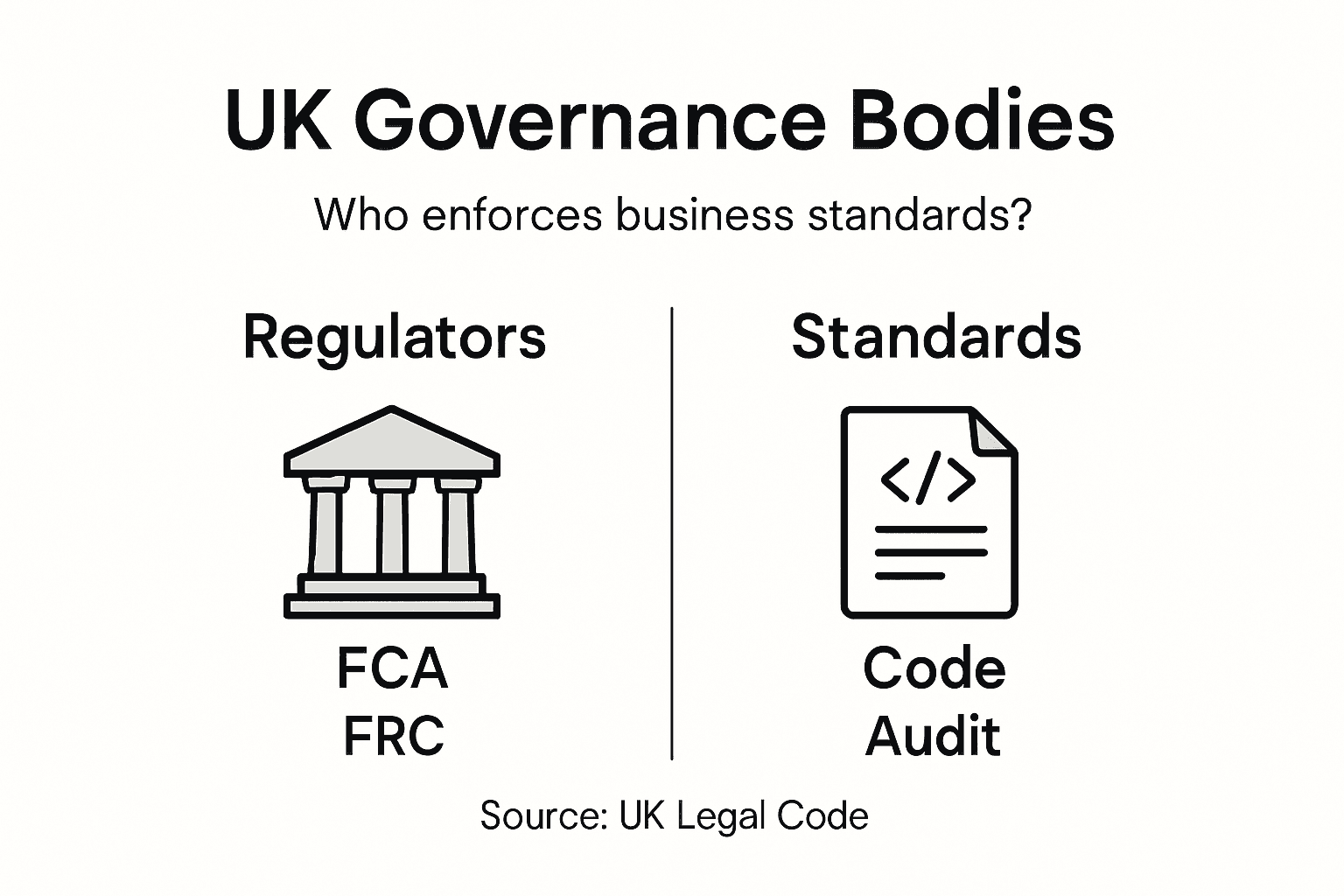
Pro tip: Conduct regular internal governance audits to proactively identify and address potential compliance gaps before regulatory inspections.
The UK Corporate Governance Code’s Provision 29 establishes comprehensive guidelines for managing organisational risks and reporting duties. This critical provision mandates that boards proactively identify, assess, and transparently communicate potential risks affecting business operations and stakeholder interests.
Key risk management and reporting responsibilities include:
Types of Organisational Risks
Businesses face multifaceted risks that demand sophisticated management approaches:
Director Accountability
Directors bear significant legal responsibilities for risk management and reporting. They must demonstrate active oversight of internal control systems, provide annual declarations about control effectiveness, and ensure comprehensive documentation of risk management processes. Failure to meet these obligations can result in substantial legal and financial consequences.
Pro tip: Implement a quarterly risk assessment review process to maintain proactive and dynamic risk management strategies.
Navigating the complexities of corporate governance in the United Kingdom requires clear understanding of board responsibilities, risk management, and compliance with evolving legal frameworks. Whether you face challenges related to implementing the UK Corporate Governance Code or need to ensure robust internal controls that protect shareholders and stakeholders alike Ali Legal is here to help. Our expertise in corporate and commercial law means we provide straightforward advice tailored to your organisation’s unique needs ensuring transparency accountability and sustainable growth.
Take control of your corporate governance framework today by consulting with our dedicated legal team. Benefit from our fixed fees and personalised service that values long-term client relationships. Contact us now to receive fast clear communication and strategic legal solutions that keep your business compliant and competitive. Reach out through our contact page and explore how Ali Legal can guide you in building trust and integrity within your corporate structure.
Corporate governance refers to the principles, practices, and processes by which businesses are directed and controlled, ensuring an alignment of interests between stakeholders such as shareholders, management, customers, and the community.
Effective corporate governance is crucial as it promotes transparency, accountability, and ethical practices within an organisation, ultimately fostering trust with stakeholders and contributing to long-term business success.
The main principles include establishing clear board responsibilities, maintaining financial integrity, implementing effective risk management, promoting transparency, engaging stakeholders, and developing robust internal control mechanisms.
The ‘comply or explain’ principle allows companies flexibility in adhering to governance standards. Organisations must comply with established guidelines or explain any deviations from them, ensuring transparency in their governance practices.
Many British families face unnecessary uncertainty about who will inherit their assets because of common misunderstandings about wills. Some believe wills are only needed for the wealthy or that unmarried partners will automatically inherit, yet these assumptions can leave loved ones exposed to financial risk. By understanding what a will truly is and addressing critical planning misconceptions, you can ensure your wealth is protected and your family’s future is secure.
A will is a powerful legal document that provides clear instructions about how your assets, property, and personal possessions should be distributed after your death. Far from being a complex legal instrument reserved only for the wealthy, a will is a critical planning tool for individuals across different financial backgrounds.

Many people hold significant misconceptions about wills. For example, some believe that only wealthy individuals need a will, or that their assets will automatically pass to their preferred beneficiaries without legal documentation. These myths can lead to serious financial complications for surviving family members.
Key aspects of understanding a will include:
Without a properly constructed will, your estate falls under intestacy rules, which means government regulations determine how your assets are distributed. This can result in unintended consequences, potentially leaving loved ones in financially vulnerable positions.
A will is not just about distributing wealth, but about providing care and protection for those you love most.
Professional legal advice is recommended when creating a will, as complex probate processes can arise from improperly drafted documents. While it’s possible to draft a basic will independently, solicitors can help navigate potential legal complexities and ensure your final wishes are precisely documented.
Pro tip: Review and update your will every three to five years, or after significant life events like marriage, divorce, or the birth of children to ensure it remains current and reflects your current wishes.
Understanding the nuanced landscape of wills is crucial for effective estate planning. Different types of wills exist to accommodate varying personal circumstances, family structures, and financial complexities. Legal variations in testaments mean individuals have multiple options for documenting their final wishes.
The primary categories of wills include:
Each will type serves distinct purposes and carries unique legal implications. Solicitor guidance becomes critical when navigating these complex legal instruments, particularly for estates with multiple assets or intricate family dynamics.
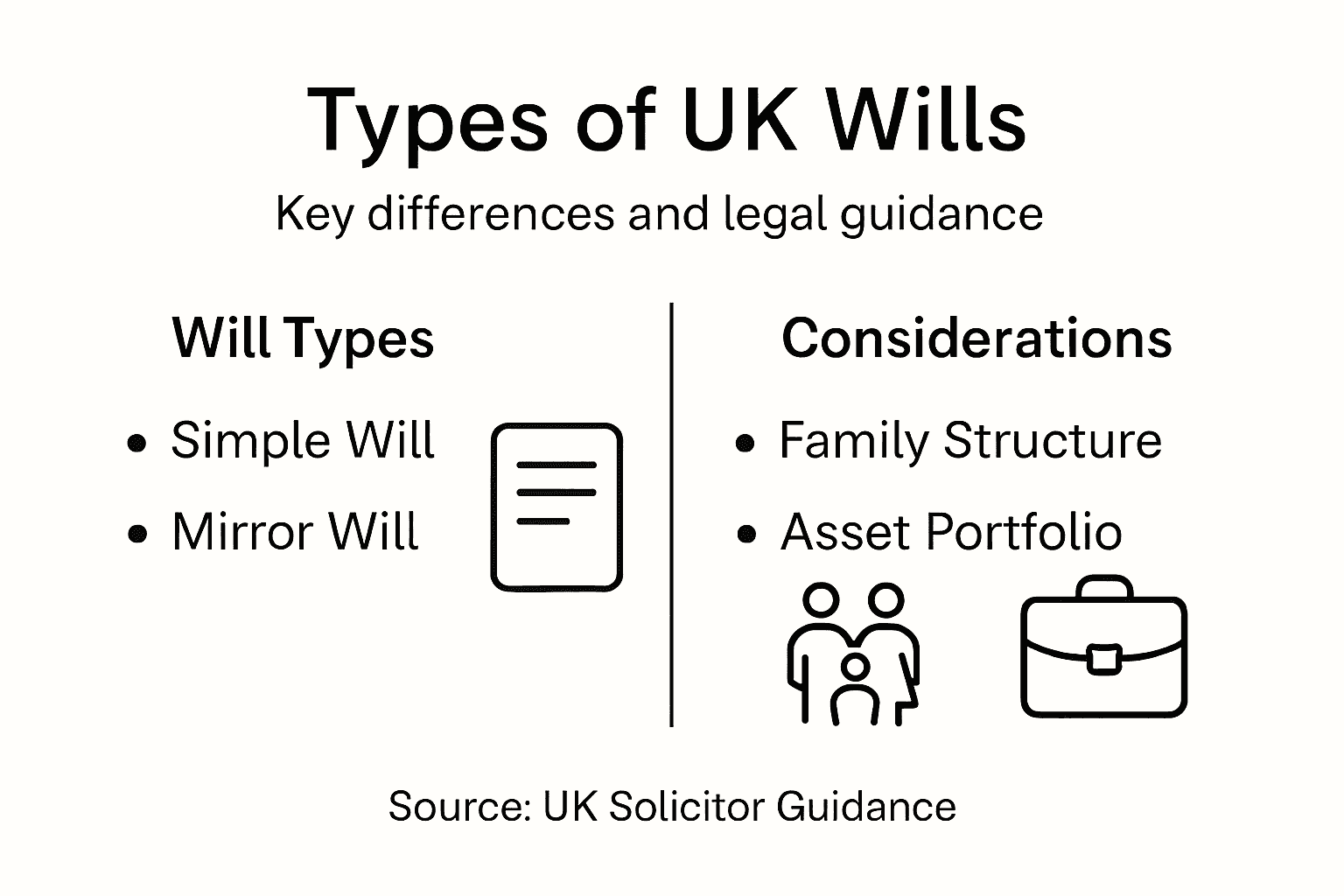
Here’s a comparison of different will types and when they might be appropriate:
| Will Type | Who It Suits | Main Benefit | Drawback |
|---|---|---|---|
| Simple Will | Single, uncomplicated estates | Quick and straightforward to set up | Limited flexibility |
| Complex Will | Large or intricate estates | Allows for trusts and detailed provisions | May require a solicitor |
| Living Will | Anyone wishing to address healthcare decisions | States medical preferences | Does not cover assets |
| Joint Will | Married couples | Unified planning for both partners | Inflexible post-death |
| Holographic Will | Individuals without solicitor access | Can be written by hand without legal assistance | Not always legally valid |
Not all wills are created equal: The right will can protect your legacy and provide clarity for your loved ones.
The selection of an appropriate will depends on multiple factors, including family structure, asset portfolio, potential tax implications, and specific inheritance goals. Professional legal consultation can help determine the most suitable approach for individual circumstances.
Pro tip: Consider consulting a specialist solicitor who can assess your specific circumstances and recommend the most appropriate will type for your unique situation.
Creating a legally binding will in the United Kingdom requires strict adherence to specific legal formalities and requirements. These precise guidelines ensure that an individual’s final wishes are recognised and legally enforceable, protecting the interests of both the testator and potential beneficiaries.
The fundamental legal requirements for a valid will in the UK include:
Mental capacity is a critical component of will validity. The testator must fully understand the implications of their document, comprehend the extent of their assets, and recognise the potential beneficiaries. Legal guidelines emphasise the importance of testamentary capacity to prevent potential challenges to the will’s legitimacy.
A properly constructed will is more than a legal document—it’s a final expression of your intentions and care for your loved ones.
Professional legal guidance can help navigate these complex requirements, ensuring that your will meets all necessary legal standards. Errors in drafting can render the entire document invalid, potentially leaving your estate vulnerable to intestacy laws.
Pro tip: Always have a solicitor review your will to confirm it meets all legal requirements and accurately reflects your precise intentions.
Dying without a valid will, known as dying intestate, can create significant complications for your loved ones. Intestacy rules create unexpected inheritance challenges that may dramatically differ from your intended wishes, potentially leaving your family in financial and emotional distress.
The consequences of dying without a will include:
Under intestacy regulations, legal administrators determine estate distribution, which may not reflect your personal relationships or family dynamics. The default legal hierarchy typically prioritises married partners and blood relatives, potentially leaving long-term partners, stepchildren, and close friends without any inheritance.
Intestacy transforms your final wishes into a bureaucratic lottery, where legal strangers decide your legacy.
The government’s strict intestacy rules can result in unintended and potentially devastating financial consequences. Without a clear will, your estate might be divided in ways that contradict your personal values and relationships, causing unnecessary stress and potential conflict among surviving family members.
The table below outlines some key differences between dying with and without a valid will in the UK:
| Scenario | Control Over Assets | Speed of Estate Settlement | Who Inherits |
|---|---|---|---|
| Valid Will | Full, based on your wishes | Typically quicker | Named beneficiaries |
| No Will (Intestacy) | Limited, determined by law | Often slower, more complex | Set by statutory hierarchy |
Pro tip: Consult a legal professional to draft a comprehensive will that explicitly captures your precise wishes and protects your loved ones’ financial interests.
Creating a comprehensive will goes far beyond simple asset distribution, serving as a strategic financial planning tool that can significantly impact your family’s long-term financial security. Careful will planning helps reduce inheritance tax liabilities and provides critical protection for your loved ones during challenging transitional periods.
Key financial and family considerations include:
Professional will planning allows for nuanced strategies such as establishing specific gifts and charitable donations, which can offer both personal satisfaction and potential tax advantages. By carefully documenting your wishes, you can create a robust framework that addresses complex family dynamics and financial objectives.
A meticulously crafted will is more than a legal document—it’s a final act of love and responsibility towards your family.
Executors play a crucial role in implementing your wishes, managing estate distribution, settling outstanding debts, and ensuring your final instructions are carried out precisely. Selecting trustworthy and competent executors is fundamental to smooth estate administration and minimising potential legal complications.
Pro tip: Consult a specialist tax and legal professional who can provide personalised advice tailored to your specific family and financial circumstances.
Crafting a legally sound will requires meticulous attention to detail and understanding of complex legal requirements. Common will-making errors can invalidate your entire document, potentially leaving your loved ones in a precarious financial situation.
Frequent mistakes that can compromise your will include:
Legal professionals recommend careful document preparation to prevent these critical errors. Subtle mistakes in will drafting can lead to prolonged legal disputes, potentially draining estate resources and causing emotional distress for your family.
A single overlooked detail can transform your carefully planned legacy into a legal battleground.
Professional legal guidance becomes crucial in navigating the intricate landscape of will creation. Solicitors can help identify potential pitfalls, ensure precise language, and create a comprehensive document that accurately reflects your final wishes while meeting all legal requirements.
Pro tip: Review and update your will every three to five years, or immediately after significant life events such as marriage, divorce, birth of children, or substantial changes in financial circumstances.
Understanding the critical importance of a legally valid will is the first step in protecting your family and assets from the costly consequences of dying intestate. This article highlights common will-making pitfalls, the complexity of legal requirements, and the emotional strain caused by unclear or outdated documents. If you want to ensure your final wishes are honoured and avoid unnecessary family disputes or tax burdens, professional support is essential.
Ali Legal offers transparent and straightforward legal advice tailored to your unique situation. Our experienced solicitors specialise in helping clients across the UK create comprehensive, valid wills that accurately reflect their intentions. With a client-centred approach, we guide you through every detail, so you gain peace of mind knowing your will meets all necessary legal standards. Don’t leave your legacy to chance. Contact us today at Ali Legal Contact to discuss how we can help you protect your loved ones and secure your estate for the future.
A will is a legal document that specifies how your assets and possessions will be distributed after your death. It is important because it allows you to control your estate distribution, name guardians for minor children, and potentially reduce inheritance tax liabilities.
Dying without a will, known as intestate, means your estate will be distributed according to statutory rules. This can lead to unintended inheritance outcomes, such as unmarried partners receiving nothing and lengthy legal procedures for your family.
A clearly written will reduces ambiguity regarding asset distribution, thus providing explicit instructions for your beneficiaries. This clarity helps prevent misunderstandings and potential conflicts among family members after your passing.
To be legally valid, a will must be in writing, signed by the testator, and witnessed by two independent adult witnesses who also sign in the presence of the testator. The testator must have mental capacity and make the will voluntarily without pressure.
Buying your first home in the United Kingdom often brings excitement mixed with uncertainty. Every step matters as the legal transfer of property involves detailed checks, careful documentation and financial decisions. For first-time buyers, understanding the conveyancing process is essential to avoid stressful complications and financial surprises. This guide explains how professional conveyancers navigate each stage, ensuring a secure and transparent property purchase from the initial offer through to receiving the keys.
Conveyancing is the critical legal process of transferring property ownership in the United Kingdom. When buying or selling a residential property, this specialised legal procedure ensures that the transaction is conducted professionally and securely. The Conveyancing Protocol established by the Law Society provides a structured framework for solicitors to follow during property transfers.
At its core, conveyancing involves several key stages that protect both buyers and sellers:
The process officially begins when an offer on a property is accepted and concludes when the keys are handed over and ownership is legally transferred. Property ownership transfer involves complex legal procedures that require professional expertise to navigate successfully.
Professional conveyancers play a crucial role in managing the intricate legal documentation, ensuring that all necessary checks are completed, and handling the financial aspects of property transactions. They conduct essential searches including local authority checks, environmental assessments, and title investigations to protect the buyer’s interests.
Conveyancing is not just a legal formality, but a critical process that safeguards your most significant investment.
Pro tip: Always engage a qualified conveyancer early in your property transaction to prevent potential legal complications and ensure a smooth ownership transfer.
The conveyancing process involves a comprehensive series of legal steps designed to protect both buyers and sellers during property transactions. Understanding these stages is crucial for navigating the complexities of property ownership transfer in the United Kingdom. Residential conveyancing transactions follow a structured approach that ensures legal compliance and protects the interests of all parties involved.
The key stages of the conveyancing process typically include:
Professional conveyancers play a critical role in managing these intricate legal procedures. They act as intermediaries between buyers, sellers, estate agents, and mortgage lenders, ensuring that every legal requirement is meticulously fulfilled. The Conveyancing Protocol established by the Law Society provides a comprehensive framework that guides solicitors through each transaction stage.
Successful property transactions depend on thorough preparation, expert legal guidance, and precise documentation.
Pro tip: Request a detailed breakdown of all potential fees and disbursements from your conveyancer before commencing the property transaction to avoid unexpected financial surprises.
In the United Kingdom, property ownership is primarily categorised into two distinct types: freehold and leasehold. These classifications significantly impact the legal rights, responsibilities, and financial obligations of property owners. Property ownership structures play a crucial role in determining how individuals interact with their real estate investments.

Key characteristics of each ownership type include:
Freehold Property:
Leasehold Property:
The primary differences between freehold and leasehold ownership extend beyond mere legal terminology. Freehold owners have absolute ownership, meaning they own the land and building outright, whereas leaseholders essentially purchase the right to occupy a property for a predetermined period. Leasehold property details typically range from 90 to 999 years, with specific terms and conditions outlined in the lease agreement.
Understanding these distinctions is critical for potential property buyers, as they directly impact long-term financial planning, property value, and ownership rights. Leasehold properties, in particular, require careful consideration of remaining lease length, potential extension costs, and ongoing financial obligations to the freeholder.

The following table highlights key differences between freehold and leasehold property ownership in the UK for quick reference:
| Ownership Aspect | Freehold Property | Leasehold Property |
|---|---|---|
| Ownership Duration | Unlimited, perpetual | Fixed term, usually 90–999 years |
| Control Over Property | Full decision-making rights | Subject to lease restrictions |
| Regular Payments | No ground rent or fees | Ground rent and service charges |
| Common Property Type | Detached or semi-detached houses | Flats or apartments |
| End of Ownership | Retained indefinitely | Reverts to freeholder at lease end |
Property ownership is not just about having a home, but understanding the legal framework that defines your rights and responsibilities.
Pro tip: Always request a comprehensive lease review and investigate the remaining lease term before purchasing a leasehold property to avoid unexpected future complications.
In the intricate world of property transactions, the relationship between buyers and solicitors is governed by a complex set of legal responsibilities and professional obligations. Professional conveyancing duties require both parties to work collaboratively to ensure a smooth and legally compliant property transfer.
Key responsibilities of the solicitor include:
Buyer’s primary responsibilities encompass:
Professional solicitors must navigate potential conflicts of interest with utmost transparency and ethical consideration. This means maintaining clear communication, documenting decision-making processes, and ensuring they consistently act in their client’s best interests throughout the property transaction.
Effective conveyancing is a partnership built on trust, communication, and mutual understanding between the buyer and their legal representative.
Pro tip: Maintain open and regular communication with your solicitor, promptly providing all requested documentation to expedite the conveyancing process and minimise potential delays.
Property transactions in the United Kingdom are fraught with potential complications that can derail even the most well-intentioned purchase. Conveyancing risk management requires buyers and solicitors to be vigilant and proactive in identifying and addressing potential issues before they escalate.
Common conveyancing pitfalls include:
Potential strategies for avoiding these challenges involve:
Research indicates that residential conveyancing challenges frequently stem from poor communication and inadequate client guidance. Successful property transactions depend on maintaining transparent, detailed, and proactive interactions between buyers, solicitors, and other involved professionals.
Prevention is always more cost-effective than resolving complications after they emerge.
Pro tip: Invest in a comprehensive property survey and request detailed written explanations of any complex legal or financial terms to prevent future misunderstandings.
Understanding the financial landscape of property transactions is crucial for UK buyers. Conveyancing cost breakdown reveals a complex array of expenses that potential homeowners must carefully consider before embarking on their property purchase.
Typical conveyancing expenses include:
Fee ranges for different transaction types:
Key factors influencing conveyancing costs include property location, value, ownership type, and transaction complexity. Home buying legal expenses require meticulous budgeting and understanding of potential additional charges that can significantly impact overall purchase expenses.
Here is a summary of typical conveyancing expenses and what they cover in a UK property transaction:
| Expense Type | Typical Cost Range | Purpose |
|---|---|---|
| Legal Fees | £400 – £1,500 | Professional solicitor or conveyancer advice |
| Search Fees | £200 – £450 | Legal, local authority and environmental checks |
| Land Registry Fees | £40 – £910 | Official new owner registration |
| Stamp Duty/LBTT | Rate-based, variable | Government tax based on property price |
| Leasehold Extras | Approx. £300 | Additional leasehold documentation |
Financial preparedness is the cornerstone of a smooth property transaction.
Pro tip: Request detailed, itemised quotes from multiple conveyancers and factor in potential additional disbursements to create an accurate budget for your property purchase.
Navigating the complex legal steps of conveyancing as highlighted in our Uncategorized | Ali Legal articles can feel overwhelming. Common challenges like understanding leasehold versus freehold, managing financial transactions, and avoiding costly pitfalls require clear advice and professional guidance. Ali Legal understands these concerns and offers transparent, fixed-fee legal services that ensure every stage of your property transfer is handled swiftly and thoroughly.
Take control of your property purchase today by consulting with our experienced solicitors. We prioritise clear communication and strategic solutions tailored to your needs. Avoid delays and legal uncertainties with Ali Legal’s trusted conveyancing expertise. Contact us now at https://alilegal.co.uk/contact-us to start your seamless property journey.
Conveyancing is the legal process of transferring property ownership, involving various stages such as contract preparation, property searches, and the registration of the new owner.
Conveyancing is crucial for ensuring a secure and orderly transfer of property, protecting the interests of buyers and sellers by managing legal documentation and financial transactions.
The key stages include initial instruction and property searches, contract preparation and review, financial arrangements, and the exchange and completion of contracts.
Freehold properties involve full ownership of both the property and land, whereas leasehold properties grant ownership for a specific period, often with ongoing ground rent and service charge obligations.
Complex family finances or substantial business interests often prompt the need for more robust asset protection. Understanding the structure and strategic benefits of a trust empowers British high-net-worth individuals to safeguard wealth and enable efficient succession. Trust law offers tailored solutions, from managing inheritance to controlling capital for dependants. This article explains trust definitions, key roles, types, practical operations and critical legal duties, releasing clarity for those seeking professional guidance in the United Kingdom.
A trust represents a sophisticated legal mechanism for asset management in the United Kingdom, offering individuals strategic options for protecting and transferring wealth. Trusts provide a structured approach to managing financial resources with precision and legal protection.
At its core, a trust involves three fundamental roles:
Trusts serve multiple strategic purposes for high-net-worth individuals and families. Government guidelines highlight their utility in managing complex financial scenarios, including:
The legal structure of a trust is typically defined through a comprehensive trust deed, which outlines the specific terms, conditions, and intentions of the settlor. This document serves as a critical roadmap for trustees, ensuring they manage assets precisely as intended.
Pro tip: Always consult a qualified legal professional to design a trust structure tailored to your specific financial circumstances and long-term objectives.
The United Kingdom offers a diverse range of trust structures designed to meet various financial planning and asset protection needs. Government guidelines outline several distinct trust types, each with unique characteristics and legal implications for wealth management.
Key trust types in the UK include:
Each trust type serves specific strategic purposes. Legal professionals recommend selecting a trust structure based on individual financial goals, family circumstances, and potential tax implications.

Specific considerations for choosing a trust include inheritance planning, asset protection, tax efficiency, and the specific needs of beneficiaries. Trustees must carefully navigate complex legal requirements and potential tax consequences associated with different trust structures.
The following table compares key UK trust types based on control, flexibility, and typical use cases:
| Trust Type | Trustee Control Level | Beneficiary Access | Typical Use Case |
|---|---|---|---|
| Bare Trust | Minimal (set at outset) | Immediate and absolute | Simple wealth transfer to minors |
| Discretionary Trust | High (broad discretion) | On trustee decision | Flexible family asset management |
| Interest in Possession | Moderate | Right to income only | Ongoing income for dependants |
| Accumulation Trust | High (retain income) | Limited until set event | Saving for future costs or education |
| Mixed Trust | Varies (hybrid structure) | Mixed or conditional | Combining multiple planning strategies |
Pro tip: Consult a specialised trust lawyer to determine the most appropriate trust structure for your unique financial circumstances and long-term objectives.
Legal mechanisms for trust management involve a sophisticated process of asset transfer and strategic administration. The fundamental operational framework requires three primary parties: the settlor, trustees, and beneficiaries, each playing a critical role in the trust’s functionality.
The operational process of a trust typically involves several key stages:
Government tax guidelines emphasise that trustees bear significant legal responsibilities, including:
Trust operation requires meticulous attention to legal and financial details. Trustees must navigate complex regulatory environments, balance investment strategies, and maintain transparent communication with beneficiaries while protecting the long-term interests of the trust.
Pro tip: Engage a professional trust administrator to ensure comprehensive compliance and strategic asset management.
Trustee responsibilities in UK law represent a complex framework of legal obligations designed to protect beneficiary interests. Trustees bear significant fiduciary duties that extend far beyond simple asset management, requiring professional diligence and ethical conduct.
Key trustee duties include:
Legal guidelines outline critical beneficiary rights, which provide essential protections:
Trustees must navigate a delicate balance between protecting trust assets and meeting beneficiary expectations. Their role demands exceptional financial acumen, legal understanding, and ethical judgment. Failure to meet these stringent standards can result in legal consequences and potential removal from their fiduciary position.
Pro tip: Maintain comprehensive documentation and seek professional legal advice to ensure full compliance with trustee responsibilities.
Trust taxation in the United Kingdom involves a complex framework of financial obligations that trustees must carefully navigate. The intricate tax landscape encompasses multiple levy types, including Capital Gains Tax, Income Tax, and Inheritance Tax, each with unique implications for trust management.
Key tax considerations for trusts include:
Trust Registration Service regulations mandate comprehensive documentation for most trust arrangements. Trustees must provide detailed information about:
The administrative and legal costs associated with trust establishment and maintenance can be substantial. Potential expenses include initial legal consultation fees, ongoing management costs, tax preparation charges, and potential registration penalties for non-compliance.
Pro tip: Engage a specialised tax professional to ensure precise compliance and minimise potential financial penalties in trust management.
Trust management complexities present significant challenges for high-net-worth individuals seeking comprehensive asset protection strategies. The intricate legal landscape demands meticulous planning and sophisticated understanding of potential financial risks.
Primary risks associated with trust structures include:
Common alternatives to traditional trust arrangements provide different approaches to asset management:
Each alternative carries distinct advantages and limitations. Direct ownership offers simplicity but reduces asset protection, while lifetime gifts can trigger immediate tax consequences. Sophisticated investors must carefully evaluate these options against their specific financial objectives and risk tolerance.
Here is a summary of key risks of trusts versus popular alternatives:
| Approach | Main Risks | Asset Protection Level | Complexity Level |
|---|---|---|---|
| Trust Structure | Tax changes, admin burdens | High if compliant | Complex |
| Direct Asset Ownership | Exposure to liabilities | Low | Simple |
| Lifetime Gifting | Immediate tax impact | Low | Simple |
| Corporate Ownership | Governance issues | Medium to high | Moderate |
| Family Investment Company | Regulation, admin burden | High for substantial assets | Complex |
Pro tip: Conduct a comprehensive financial review with a professional advisor before selecting your asset management strategy.
Navigating the complexities of trust law in the United Kingdom can be challenging. Whether you are concerned about protecting family assets, ensuring tax efficiency, or managing fiduciary duties, Ali Legal offers clear and strategic advice tailored to your unique circumstances. Trusts require careful legal structure and ongoing management to avoid pitfalls such as unexpected tax liabilities or administrative burdens. Our experienced solicitors understand these challenges and can help you select the right trust type, draft robust trust deeds, and ensure full compliance with UK regulations.
Explore comprehensive insights and legal solutions on our All | Ali Legal page. Take control of your asset protection strategy today by contacting us. Our client-centric approach ensures transparent communication, fixed fees, and swift, effective legal support. Do not leave your financial future to chance. Visit Ali Legal Contact now for personalised assistance and make secure wealth management your priority.
A trust is a legal mechanism that allows individuals to manage and protect assets by transferring ownership to trustees, who manage these assets for the benefit of designated beneficiaries.
The three primary parties in a trust are the settlor (who creates the trust), the trustees (who manage the assets), and the beneficiaries (who receive the benefits from the trust).
The UK has various trust types, including bare trusts, discretionary trusts, interest in possession trusts, accumulation trusts, and mixed trusts, each serving different financial planning and asset protection needs.
Trusts may face multiple tax obligations, including Capital Gains Tax, Income Tax, and Inheritance Tax. Trustees must comply with reporting requirements to HMRC and keep accurate financial records.
Hiring international talent or managing sponsored employees in the United Kingdom can feel like a maze for even the most experienced employers. With changing regulations and strict government requirements, keeping your business compliant is rarely straightforward. A single misstep could mean costly legal trouble and operational disruption.
This practical guide lays out the key steps every UK company needs to confidently manage immigration compliance. From choosing the right visa to keeping up with essential record-keeping and right to work checks, you will learn actionable solutions that protect your organisation and support your international staff.
Get ready to discover clear, hands-on strategies that make complicated immigration rules much easier to handle. Stay ahead of regulatory demands and turn complex requirements into manageable steps for your business.
Navigating the United Kingdom’s immigration landscape requires a comprehensive understanding of the various visa categories available for international workers. Companies must be well-versed in the nuanced requirements to successfully recruit and retain global talent.
The UK offers several critical visa categories that businesses frequently utilise:
Understanding these categories is crucial because each visa type has specific eligibility criteria, application processes, and sponsorship requirements. Official UK government visa guidance provides comprehensive details on these intricate regulations.
Companies must develop a strategic approach to immigration compliance. This involves:
Successful immigration management requires proactive planning and meticulous attention to regulatory details.
Pro tip: Establish a dedicated immigration compliance team or consultant to streamline visa application processes and minimise potential legal complications.
Legal compliance begins with meticulous right to work checks. These critical verifications protect your organisation from potential legal penalties and ensure you are employing individuals with legitimate working permissions in the United Kingdom.
Employers must systematically validate an employee’s legal right to work through comprehensive document verification. Official UK government guidelines outline the precise procedures for conducting these essential checks.
Key elements of accurate right to work verification include:
The verification process involves several critical steps:
Employers bear full legal responsibility for ensuring workers have appropriate permissions to work in the United Kingdom.
Discrimination must be absolutely avoided during these checks. Every candidate must be treated equally regardless of nationality ethnic background or perceived immigration status.
Pro tip: Implement a standardised digital tracking system to manage right to work documentation and set automatic reminders for follow-up checks on time-limited visas.
Effective immigration compliance hinges on maintaining meticulous and organised employee documentation. Your record-keeping practices serve as the critical foundation for demonstrating legal adherence and protecting your organisation from potential regulatory challenges.
Sponsor record-keeping guidelines outline the comprehensive documentation requirements for UK employers. These records are not merely administrative tasks but essential legal safeguards.
Critical documents that must be systematically maintained include:
Key principles for effective record management:
Comprehensive record-keeping is your organisational shield against potential immigration compliance investigations.
Employers must ensure that electronic and physical records are equally robust. This means implementing secure digital storage solutions with appropriate encryption and backup mechanisms.
The retention period for these documents typically spans the entire employment duration plus a recommended additional two years after an employee’s departure.
Pro tip: Develop a standardised digital record management system with automated reminder alerts for document renewals and periodic compliance reviews.
Sponsorship in UK immigration is not a static responsibility but a dynamic commitment that requires constant vigilance and proactive management. Companies must remain agile and informed to maintain their sponsor licence effectively.
Sponsorship guidance for employers provides comprehensive insights into the evolving landscape of immigration compliance.
Key sponsorship duties encompass:
Critical reporting requirements include:
Sponsorship compliance is an ongoing process that demands continuous attention and meticulous documentation.
The consequences of non-compliance can be severe. Your organisation could face licence suspension or revocation if you fail to meet these stringent requirements.
Regular training for HR personnel and establishing robust internal monitoring systems are essential strategies for maintaining sponsorship obligations.
Pro tip: Implement a quarterly compliance review process with automated tracking systems to ensure no sponsorship reporting deadlines are missed.
Visa management is a critical responsibility that demands proactive and systematic tracking to prevent potential legal complications for your organisation. Failing to monitor critical immigration dates can result in unintended breaches of sponsorship obligations.
HR software solutions play a pivotal role in streamlining visa tracking and management processes.
Critical aspects of effective visa monitoring include:
Recommended monitoring strategies:
Consistent and meticulous visa tracking is the foundation of robust immigration compliance management.
Potential risks of inadequate monitoring include unexpected workforce disruptions unexpected legal penalties and potential damage to your organisation’s reputation.
Additionally companies must establish clear communication channels with sponsored employees to ensure timely information exchange about visa status and renewal requirements.
Pro tip: Develop a standardised visa monitoring workflow with automated digital alerts and assign a dedicated team member to oversee immigration document management.
Effective communication is the cornerstone of successful immigration compliance in modern workplaces. Understanding and transparently sharing immigration requirements helps create a supportive environment for international workers.
Employee communication strategies play a crucial role in maintaining organisational transparency and legal adherence.
Key communication principles include:
Practical communication approaches:
Transparent communication transforms complex immigration requirements into understandable processes for employees.
Effective communication techniques involve using multiple communication channels such as email newsletters team meetings individual consultations and digital resource platforms.
Employers must recognise that clear communication reduces anxiety builds trust and ensures smoother navigation of immigration complexities for sponsored workers.
Pro tip: Develop a centralised digital resource hub with regularly updated immigration guidance and create a dedicated point of contact for immigration-related queries.
Navigation of UK immigration law requires specialised knowledge that extends beyond general understanding. Complex regulatory landscapes demand professional guidance to mitigate potential legal risks and ensure comprehensive compliance.
Registered immigration adviser resources provide critical support for companies managing international workforce challenges.
Key reasons to seek expert legal advice include:
Strategic consultation approaches:
Professional legal guidance transforms potential immigration challenges into manageable strategic opportunities.
Qualified legal professionals can provide nuanced insights that internal teams might overlook. These specialists understand the intricate details of immigration regulations and can offer tailored advice specific to your organisational context.
Careful selection of independent legal advice ensures objective and comprehensive support for your immigration compliance strategies.
Pro tip: Establish a retainer relationship with an immigration law specialist to ensure immediate access to expert guidance when complex scenarios arise.
Below is a comprehensive table summarising the main points, strategies, and actions for managing immigration compliance as discussed in the article.
| Key Aspect | Description | Practical Steps |
|---|---|---|
| Key Visa Categories | Summary of visa types for employment in the UK including Skilled Worker and Global Talent visas. | Match candidates’ profiles to respective visa requirements; review the Home Office guidelines. |
| Right to Work Compliance | Importance of verifying employees’ right to work in the UK. | Inspect original documents prior to employment; store records securely; avoid discrimination. |
| Record-Keeping for Immigration | Importance and method of maintaining employee records for compliance. | Digitise documents, employ proper filing systems, monitor visa statuses actively, and update as needed. |
| Sponsorship Duties | Employer responsibilities for maintaining sponsor licences. | Track employee statuses, report changes within required timelines, maintain accurate records. |
| Visa Monitoring and Renewals | Process of tracking visa expiry and renewal dates effectively. | Use automated reminders; engage with employees timely; monitor policy changes. |
| Staff Communication | Facilitating clear communication about immigration matters. | Host briefings, provide written guides, and maintain supportive and open dialogue opportunities. |
| Expert Legal Consultation | Seeking professional legal advice for complex or high-stakes situations. | Retain experienced legal advisers, perform regular compliance checks, and document consultation outcomes. |
Implementing these strategies ensures robust immigration compliance management while minimising potential risks.
Struggling with complex immigration rules like sponsorship obligations or visa monitoring can put your business at risk. This article highlights vital challenges such as maintaining comprehensive employee records, conducting right to work checks accurately and staying updated with sponsorship duties. Understanding these key areas is the first step to protecting your organisation from costly legal consequences.
At Ali Legal, we provide clear legal guidance tailored to these specific immigration compliance needs. Our client-centred approach emphasises straightforward advice and transparency to help you navigate the UK’s immigration landscape with confidence. Whether you require assistance with visa categories, legal compliance reviews or staff communication strategies, our team is ready to support your business every step of the way.
Discover how our expert legal services can remove uncertainty from your immigration process in our Uncategorized | Ali Legal section.
Take action now to safeguard your company against immigration pitfalls. Contact Ali Legal today for professional advice and fast, transparent legal solutions at https://alilegal.co.uk/contact-us. Ensure your organisation stays fully compliant and focused on growth.
Understanding the key visa categories such as the Skilled Worker Visa, Global Talent Visa, and Health and Care Worker Visa is essential for companies recruiting international talent. Review each category’s specific requirements and ensure your team’s familiarity with them to streamline the hiring process.
To conduct accurate right to work checks, thoroughly examine original documentation and verify their authenticity before employment begins. Establish a standardised process for document verification to ensure compliance and reduce the risk of penalties.
Maintain comprehensive records including original right to work documents, visa copies, and employment contracts. Use a consistent filing system and update records regularly to safeguard your organisation against potential compliance investigations.
To stay updated with sponsorship duties, implement a quarterly review process to ensure compliance with reporting obligations to the Home Office. Set up automated reminders for key deadlines to maintain your sponsor licence effectively.
Create a centralised tracking system to monitor visa expirations and set calendar reminders for renewal six months in advance. Regularly communicate with employees about their visa status to ensure timely preparation for renewals.
Seek expert legal advice when dealing with complex immigration cases, significant policy changes, or potential compliance issues. Establish relationships with professional advisers to have immediate access to guidance and mitigate legal risks.


