
Globalisation is not merely the free flow of goods across borders. It represents a complex web of multinational legal frameworks, regulatory compliance requirements, and strategic cross-border transactions that demand sophisticated legal expertise. Law firms serve as the essential architects enabling international business operations, navigating intricate treaty obligations, mergers and acquisitions, and evolving geopolitical landscapes. This article explores how law firms facilitate global commerce through strategic networks, contrasting expansion methodologies, and adaptive responses to shifting international dynamics.
| Point | Details |
|---|---|
| Cross border expertise | Law firms provide cross border expertise enabling multinational operations across multiple jurisdictions. |
| Strategic alliance networks | International networks and alliances are key strategies for global law firms to coordinate cross border projects. |
| Mergers and acquisitions | Chinese firms pursue mergers and acquisitions while Western firms prefer organic growth to expand abroad. |
| Transnational mindset shift | Firms must adapt rapidly to shifting geopolitical regionalisation by adopting a transnational mindset that prioritises compliant global operations. |
Law firms provide the essential infrastructure for multinational corporations to operate across jurisdictions. Law firms provide cross-border legal expertise enabling multinational operations through advice on international treaties, mergers and acquisitions, project finance, and regulatory navigation. Without this specialised counsel, businesses would struggle to interpret conflicting legal regimes, manage compliance obligations, or structure transactions that span multiple countries.
Consider project finance for large infrastructure developments. Law firms advise on complex financing arrangements involving multiple lenders, governmental entities, and regulatory bodies across different jurisdictions. The Qatar LNG project exemplifies this, where legal teams coordinated financing structures complying with Qatari law, international banking regulations, and investor protection frameworks simultaneously. Such transactions require deep knowledge of international financial law, contractual drafting expertise, and the ability to negotiate terms acceptable to parties operating under diverse legal traditions.
Global mergers and acquisitions present another domain where law firms prove indispensable. Cross-border M&A legal structuring demands coordination across multiple regulatory approval processes, tax optimisation strategies, and cultural due diligence considerations. Law firms manage these multifaceted transactions by assembling teams with jurisdiction-specific knowledge whilst maintaining strategic oversight of the entire deal structure.
Regulatory compliance in multiple jurisdictions represents perhaps the most consistent demand on law firms supporting globalisation. Multinational corporations face overlapping and sometimes contradictory regulatory requirements across markets. Law firms develop practical frameworks to navigate this complexity:
The value of hiring international lawyers becomes evident when businesses expand beyond domestic markets. These specialists bring not only technical legal knowledge but also cultural intelligence and relationship networks that smooth cross-border transactions. They understand how legal concepts translate across different legal traditions, whether common law, civil law, or hybrid systems, and can anticipate potential friction points before they escalate into costly disputes.
Law firms also play a crucial advisory role in treaty interpretation and application. International trade agreements, bilateral investment treaties, and multilateral conventions create rights and obligations that businesses must navigate carefully. Legal counsel helps clients leverage treaty benefits, such as preferential tariff treatment or investor protection mechanisms, whilst ensuring compliance with treaty obligations that might restrict certain business practices.
Law firms adopt various structural models to deliver global services, each with distinct advantages and trade-offs. International alliances and networks range from informal referral arrangements to highly coordinated multi-jurisdictional practices operating under unified brand identities. Research shows informal alliances with strong communication interfaces yield higher effectiveness than either purely formal structures or loosely connected networks.
The effectiveness of alliance structures depends significantly on how firms balance autonomy with coordination. Empirical studies examining law firm alliances reveal that moderate formalisation combined with robust communication channels produces optimal client outcomes. Too much formalisation creates bureaucratic friction, whilst insufficient structure leads to inconsistent service quality and coordination failures.
| Model type | Structure | Advantages | Disadvantages |
|---|---|---|---|
| Informal alliance | Loose referral network | Maximum firm autonomy, low overhead | Inconsistent service quality, weak coordination |
| Formal alliance | Coordinated network with shared standards | Balanced autonomy and consistency | Requires significant management investment |
| Merger | Full integration under single entity | Unified culture and systems | Loss of local identity, integration challenges |
| One firm model | Globally coordinated practice groups | Seamless client service, knowledge sharing | Complex governance, potential conflicts |
The ‘one firm’ model represents the most integrated approach, where law firms operate as a single global entity with coordinated practice groups spanning multiple jurisdictions. This model facilitates seamless client service, as teams can mobilise resources across offices without navigating inter-firm politics or conflicting billing arrangements. However, it requires sophisticated governance structures to manage diverse partnership interests and maintain cultural cohesion across geographically dispersed offices.

Mergers offer another path to global coverage, though they present significant integration challenges. When law firms merge across borders, they must reconcile different partnership structures, compensation systems, and professional cultures. Successful mergers require years of careful integration work to realise the promised synergies of combined expertise and market reach.
Choosing international law firms requires understanding these structural differences. Clients should evaluate not only the firm’s geographic footprint but also how effectively its offices collaborate on cross-border matters. A firm with offices in 50 countries delivers little value if those offices operate as independent silos unable to coordinate complex transactions.
Pro Tip: When selecting a global law firm, request examples of recent cross-border matters and speak with lawyers from multiple offices involved in the same transaction. This reveals the quality of internal coordination and communication systems that directly impact service delivery.
Alliance effectiveness hinges on several factors beyond formal structure. Trust between member firms, compatible professional standards, and aligned economic incentives all contribute to successful collaboration. The most effective alliances invest in relationship building through regular partner meetings, joint training programmes, and secondment opportunities that build personal connections across member firms.
The globalisation strategies of law firms vary significantly between established Western practices and rapidly expanding Chinese firms. Chinese law firms pursue rapid global growth mainly through mergers and acquisitions, whilst Western firms focus on organic expansion and building local expertise over extended timeframes. These contrasting approaches reflect different market dynamics, regulatory environments, and strategic priorities.
Chinese firms have pursued aggressive international expansion to support Chinese corporations investing abroad under Belt and Road Initiative projects and other outbound investment programmes. King & Wood Mallesons exemplifies this approach, having expanded through strategic mergers to establish presence across Asia, Europe, and the Middle East. Dacheng Dentons, formed through merger, now operates 125 offices globally, demonstrating the scale achievable through acquisition-driven growth.
Western firms traditionally favour organic expansion, opening new offices through lateral partner hires or deploying existing partners to establish local presence. This methodology prioritises cultural integration and quality control, ensuring new offices align with the firm’s established standards and client service philosophy. Organic growth proceeds more slowly but typically produces more cohesive firm cultures and consistent service delivery.
| Metric | Chinese firms | Western firms |
|---|---|---|
| Primary expansion method | Mergers and acquisitions | Organic growth and lateral hires |
| Overseas offices growth (2018-2024) | 47.5% increase | 12% increase |
| Average integration timeline | 1-2 years | 3-5 years |
| Client driver | Outbound Chinese investment | Established multinational relationships |
Global 100 law firms surpassed £150bn revenue in 2024, demonstrating the substantial economic scale of international legal services. Chinese firms have expanded overseas offices by 47.5% since 2018, far outpacing Western competitors. This rapid expansion creates both opportunities and challenges, as firms must quickly integrate diverse legal cultures and maintain quality standards across newly acquired practices.

The differing expansion strategies also reflect regulatory environments. Chinese firms operate within a legal market that has only recently opened to international competition and still maintains restrictions on foreign firm activities. This creates strong incentives for Chinese firms to establish overseas presence through acquisition rather than attempting to build relationships and reputation from scratch in unfamiliar markets.
Western firms benefit from decades of established international relationships and brand recognition that facilitate organic expansion. When a prominent London or New York firm opens a new office, it often brings existing client relationships that provide immediate revenue whilst the office builds local market presence. Chinese firms typically lack these pre-existing relationships in foreign markets, making acquisition of established local firms a more viable entry strategy.
Pro Tip: Businesses evaluating law firms should consider expansion methodology as an indicator of service consistency. Firms that grow organically often maintain more uniform quality standards, whilst those expanding through acquisition may exhibit greater variation between offices during integration periods.
The international business law guide landscape increasingly features both Western and Chinese firms competing for multinational client mandates. This competition benefits clients through expanded service options and competitive pricing, though it also requires more careful due diligence to ensure selected firms possess genuine cross-border capabilities rather than merely geographic presence.
Geopolitical fragmentation and regionalisation trends present profound challenges for law firms supporting global commerce. Geopolitical shifts require law firms to adapt to sanctions, supply chains, and environmental, social, and governance issues that increasingly dominate cross-border transactions. The relatively stable post-Cold War globalisation era has given way to a more fractured international landscape characterised by strategic competition, technology restrictions, and supply chain reconfigurations.
Sanctions compliance has evolved from a specialised niche into a core competency for any firm advising multinational clients. Western sanctions targeting Russia, China, Iran, and other jurisdictions create complex compliance matrices that businesses must navigate. Law firms develop sophisticated sanctions screening systems, advise on permissible transaction structures, and help clients assess risks of secondary sanctions that might apply to non-sanctioned parties dealing with sanctioned entities.
Supply chain legal risks have intensified as companies diversify sourcing away from concentrated manufacturing bases. This ‘friendshoring’ trend requires legal counsel on establishing operations in new jurisdictions, navigating unfamiliar regulatory environments, and managing contractual relationships across more complex supplier networks. Law firms help clients balance efficiency gains from concentrated supply chains against resilience benefits of geographic diversification.
Environmental, social, and governance obligations increasingly shape international transactions. Investors demand ESG due diligence, regulators impose disclosure requirements, and stakeholders scrutinise corporate environmental and social impacts. Law firms advise on ESG compliance frameworks, disclosure obligations, and risk mitigation strategies that satisfy multiple stakeholder constituencies.
Key adaptation strategies for law firms navigating this shifting environment include:
“The distinction between domestic and international law has blurred considerably. Law firms must shift from local to transnational mindsets, leveraging global networks amid blurred domestic-international law lines. What appears as a purely domestic transaction often implicates international regulatory regimes, whilst ostensibly international matters may trigger domestic compliance obligations.”
This transnational mindset requires lawyers to think beyond their home jurisdiction’s legal framework and consider how multiple regulatory regimes interact. A European company acquiring a US business must consider not only European merger control and US antitrust review but also potential Chinese regulatory approval if the target has significant Chinese operations or technology with national security implications.
The international law role UK business continues evolving as the United Kingdom establishes its post-Brexit international legal framework. UK firms advise clients on navigating the changed relationship with European Union law whilst capitalising on new treaty relationships and regulatory autonomy. This transition illustrates how geopolitical shifts create both challenges and opportunities for legal practitioners.
Leveraging global networks becomes essential for managing overlapping regulatory regimes. No single lawyer can maintain current expertise across all relevant jurisdictions, but well-coordinated networks enable firms to mobilise specialist knowledge as needed. The most effective firms invest in knowledge management systems that capture expertise across their networks and facilitate rapid information sharing when novel legal issues arise.
Regionalisation trends may partially reverse decades of globalisation, but they do not eliminate the need for cross-border legal services. Instead, they create more complex regional regulatory frameworks that require equally sophisticated legal navigation. Law firms that successfully adapt to this environment will combine deep regional expertise with the ability to coordinate across regions when client needs demand it.
Navigating the complexities of international business law requires experienced counsel who understand both legal technicalities and commercial realities. Ali Legal offers comprehensive support for businesses and professionals managing cross-border legal challenges, combining deep expertise with practical, client-focused service delivery.

Our civil litigation services extend to complex international disputes requiring coordination across multiple jurisdictions. When conflicts arise in cross-border transactions, our team brings strategic litigation expertise that protects your interests whilst managing the procedural complexities of multi-jurisdictional disputes. We understand how to leverage international legal frameworks to achieve favourable outcomes for clients facing global legal challenges.
For businesses navigating commercial disagreements with international dimensions, our commercial litigation solutions provide strategy-led dispute resolution when stakes are high. We advise on enforcement of international arbitration awards, recognition of foreign judgements, and resolution of conflicts involving parties across multiple countries.
Our international business law services support UK businesses expanding globally and international clients establishing UK operations. From contract negotiation to regulatory compliance, we provide the legal foundation for successful international commerce.
Law firms face regulatory complexity across multiple jurisdictions, requiring coordination of diverse legal requirements that may conflict. Geopolitical risks including sanctions and trade restrictions demand constant monitoring and adaptive strategies. Cross-border coordination challenges arise from time zones, language barriers, and differing professional cultures that can impede seamless service delivery.
Firms leverage transnational legal networks to access jurisdiction-specific expertise when conflicts arise between legal regimes. They develop compliance frameworks that identify applicable laws and establish protocols for managing contradictions. Expert legal counsel advises clients on jurisdictional risks, helping them structure transactions to minimise exposure to conflicting requirements whilst maintaining commercial viability.
Alliances provide multi-jurisdictional coverage without the complexity and cost of full mergers, increasing organisational agility. Member firms retain local market knowledge and relationships whilst accessing broader geographic reach through alliance partners. Clients benefit from consistent service standards across jurisdictions and coordinated advice that considers implications across multiple markets simultaneously.
Firms develop specialised teams focused on sanctions compliance, supply chain restructuring, and ESG obligations that dominate current cross-border transactions. They establish regional expertise centres to capitalise on supply chain diversification creating opportunities in emerging markets. Enhanced regulatory monitoring systems track geopolitical developments that might impact client operations, enabling proactive rather than reactive legal strategies.
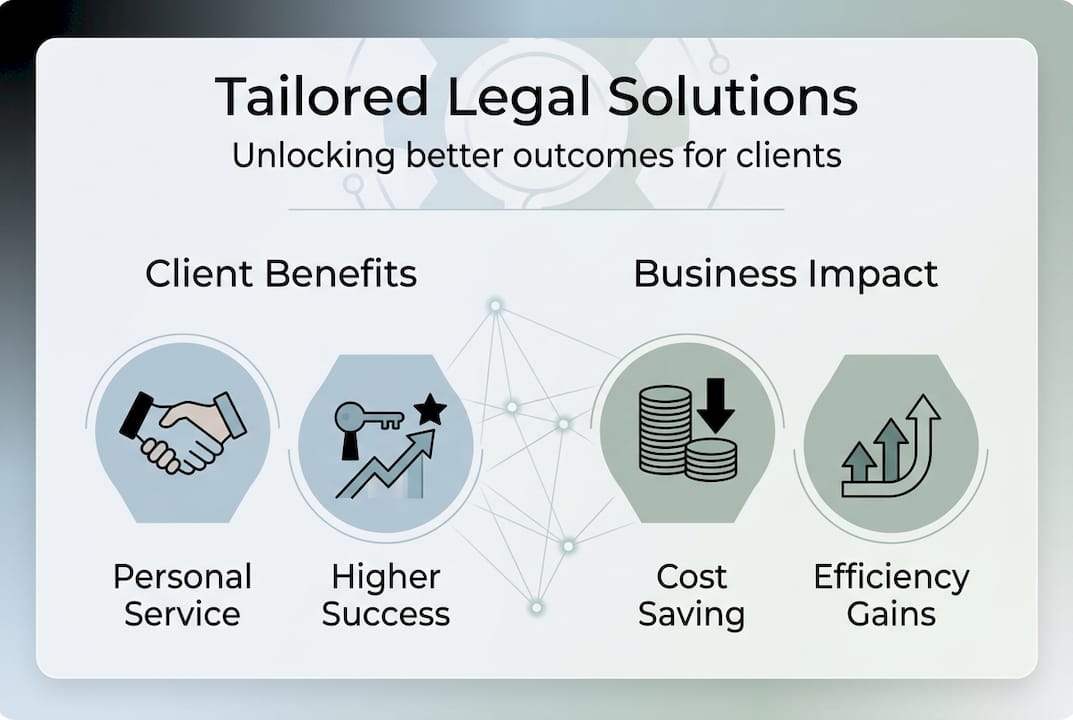
Many individuals and businesses assume that generic legal services suffice for their needs. This widespread belief overlooks how personalised legal solutions address unique risks, values, and compliance requirements far more effectively. Tailored legal services transform client satisfaction, operational efficiency, and strategic outcomes across civil litigation, family law, corporate matters, and regulatory compliance. This guide explores how customised legal support delivers superior results compared to standardised approaches, helping you understand when bespoke solutions provide the greatest value for your specific circumstances.
| Point | Details |
|---|---|
| Tailored client focus | Tailored legal solutions enhance satisfaction and loyalty by addressing each client’s unique needs and preferences. |
| Flexible communication and fees | Personalised services accommodate preferred communication styles and flexible fee arrangements to fit budgets and schedules. |
| Improved retention and trust | Client centred solutions lead to higher retention and fewer disputes as guidance reflects individual risk tolerances. |
| Tech driven efficiency | Customised AI and contract lifecycle management deliver substantial efficiency gains and cost savings compared with generic tools. |
Generic legal services treat all clients identically, ignoring individual circumstances and preferences. Client centred legal services enhance satisfaction, loyalty, and retention by addressing unique needs, values, and risk tolerances that standardised approaches overlook. When solicitors customise their advice and delivery methods to match your specific situation, you receive precisely what your matter requires rather than cookie cutter templates.
Personalisation begins with understanding your priorities. Some clients prioritise speed and efficiency, whilst others value detailed explanations and regular updates. Tailored services accommodate these preferences through flexible communication channels, whether you prefer email updates, video calls, or face to face meetings. This adaptability builds stronger solicitor client partnerships founded on mutual understanding rather than rigid procedures.
Flexible fee arrangements represent another dimension of personalisation. Fixed fees suit clients who value budget certainty, whilst hourly billing may benefit those with unpredictable legal needs. Tailored pricing models align costs with your specific matter complexity and risk profile, eliminating the frustration of paying for unnecessary services or receiving inadequate support.
Pro Tip: Request an initial consultation to discuss your preferred communication style and fee structure before engaging a solicitor. This conversation establishes expectations and ensures the partnership fits your working preferences from the outset.
The measurable impact of personalisation appears in retention data. Firms offering customised services report significantly higher client loyalty rates because clients feel understood and valued. Reduced miscommunications lower the risk of disputes and improve case outcomes, as solicitors grasp the nuances of your situation rather than applying generic solutions. When you receive clear legal advice tailored to your circumstances, you make better informed decisions that align with your goals.
“Personalised legal services transform the client experience from transactional to relational, building trust that extends beyond individual matters.”
Key benefits of client centred tailored services include:
Legal technology revolutionises service delivery, but generic tools often create as many problems as they solve. Customised AI and contract lifecycle management solutions yield 55% improvement in key value metrics compared to generic alternatives. This dramatic difference stems from bespoke systems designed for specific legal workflows rather than attempting to serve every possible use case.
Generic AI tools raise significant accuracy concerns, with 40% of legal professionals worried about errors in standardised artificial intelligence applications. Custom AI solutions address these concerns by training on your specific documents, terminology, and legal requirements. When AI understands your particular context, it generates more accurate contract clauses, identifies relevant precedents, and flags potential issues with greater precision.
Contract lifecycle management systems tailored to your organisation reduce legal involvement in routine contracting from 76% to just 39%. This efficiency gain frees solicitors to focus on complex strategic matters whilst automated workflows handle standard agreements. The time savings translate directly into cost reductions and faster business operations, as contracts move through approval processes without unnecessary bottlenecks.

| Metric | Generic Solutions | Tailored Solutions | Improvement |
|---|---|---|---|
| Revenue growth | Baseline | 20% higher | +20% |
| Client retention | Baseline | 30% higher | +30% |
| Operational efficiency | Baseline | Up to 30% gains | +30% |
| Key value metrics | Baseline | 55% improvement | +55% |
Firms using tailored legal software report 20% higher revenue growth and 30% higher retention rates alongside efficiency gains reaching 30% compared to off the shelf alternatives. These improvements compound over time, as custom systems evolve with your changing needs rather than forcing you to adapt to rigid software limitations.
Implementing tailored legal technology follows these strategic steps:
Pro Tip: Prioritise customisation investments in areas with highest transaction volumes or greatest compliance risks. These domains deliver fastest return on investment whilst reducing exposure to costly errors.
Strategic insourcing combined with tailored technology optimises legal spend. By handling routine matters internally with custom tools whilst engaging external solicitors for complex issues, organisations achieve significant cost reductions. This hybrid approach maintains quality whilst eliminating unnecessary external fees for work that customised systems handle efficiently. Proper regulatory compliance becomes more manageable when technology monitors obligations specific to your industry and jurisdiction.
“Custom legal technology transforms solicitors from document processors into strategic advisers, elevating the value they deliver to clients.”
Not every legal matter requires bespoke treatment. Standardisation suits routine tasks, but tailored solutions excel for complex, client specific needs as generic programmes may hinder growth and risk management. Understanding this distinction helps you allocate resources effectively, using standardised approaches where appropriate whilst investing in customisation for matters demanding individualised attention.
Routine legal work benefits from standardisation because consistency improves efficiency and reduces costs. Standard employment contracts, basic non disclosure agreements, and simple property transactions follow predictable patterns where templates serve adequately. These matters involve minimal unique risk factors and well established legal frameworks, making customisation unnecessary and potentially wasteful.
Complex matters demand tailored solutions because generic approaches miss critical nuances. Commercial disputes, regulatory investigations, international transactions, and strategic corporate restructuring involve unique fact patterns, competing interests, and significant financial or reputational stakes. Standardised advice in these contexts proves inadequate and potentially dangerous, as overlooked details create vulnerabilities.
| Scenario | Standardised Approach | Tailored Approach | Recommended |
|---|---|---|---|
| Basic employment contracts | Suitable | Unnecessary | Standardised |
| Complex commercial litigation | Inadequate | Essential | Tailored |
| Routine property conveyancing | Efficient | Excessive | Standardised |
| Multi jurisdictional compliance | Risky | Critical | Tailored |
| Simple NDAs | Appropriate | Overkill | Standardised |
| Strategic M&A transactions | Dangerous | Necessary | Tailored |
Confidentiality considerations further complicate technology choices. Tailored AI use must ensure confidentiality to avoid privilege waiver as public tools may disclose sensitive data, compromising legal protections. Generic AI platforms often process inputs through shared infrastructure, potentially exposing confidential information to unauthorised access or inadvertent disclosure.
Private, customised AI systems mitigate these risks by processing data within controlled environments. When handling privileged communications or sensitive commercial information, invest in bespoke technology maintaining confidentiality rather than risking exposure through public tools. The cost of custom solutions pales compared to potential damages from privilege waiver or data breaches.
Key factors determining when tailored solutions provide superior value:
Understanding the role of legal counsel helps you recognise when generic advice proves insufficient. Solicitors adding genuine value through tailored analysis justify their fees by preventing costly mistakes and identifying opportunities standardised approaches miss.
Personalised legal services deliver practical benefits across diverse practice areas, helping individuals and businesses maintain compliance whilst gaining competitive advantages. Strategic insourcing of high cost legal work leads to significant legal spend reductions when combined with tailored external support for specialised matters. This hybrid approach optimises resource allocation whilst maintaining quality.
Complex regulatory frameworks demand customised compliance strategies. Generic compliance programmes overlook industry specific requirements and jurisdictional nuances that create exposure. Tailored legal advice helps you navigate these complexities by identifying obligations specific to your operations, implementing monitoring systems aligned with your risk profile, and responding to regulatory changes affecting your sector.
Commercial litigation benefits enormously from personalised strategies. Each dispute involves unique relationships, evidence, and business objectives that standardised approaches cannot address effectively. Customised litigation strategies consider your risk tolerance, budget constraints, and desired outcomes, whether that means aggressive pursuit of claims or pragmatic settlement. Understanding your business context allows solicitors to recommend tactics serving your broader interests rather than simply following generic playbooks.
Family law matters inherently require tailored approaches because every family situation differs. Cookie cutter divorce settlements or custody arrangements ignore the specific needs of children, financial circumstances of parties, and cultural considerations affecting families. Personalised family law services account for these unique factors, producing agreements that work for your specific situation rather than forcing you into standardised templates.
Corporate and commercial transactions demand bespoke structuring to optimise tax positions, allocate risks appropriately, and protect strategic interests. Generic transaction documents miss opportunities for value creation and leave vulnerabilities that sophisticated counterparties exploit. Tailored commercial advice identifies these issues and structures deals advancing your objectives.
Practical applications of tailored legal solutions include:
Engaging with commercial litigation specialists ensures your dispute strategy serves broader business goals rather than simply pursuing legal victories. Similarly, comprehensive legal compliance services tailored to your industry and jurisdiction reduce regulatory risks whilst avoiding unnecessary compliance burdens.
Better risk management emerges from personalised legal advice because solicitors understanding your business identify vulnerabilities generic reviews miss. This proactive approach prevents problems rather than simply reacting to crises, supporting sustainable business growth through sound legal foundations.
Having explored how tailored legal solutions deliver superior outcomes, you may wonder how to access these benefits for your specific needs. Ali Legal offers customised legal support designed around your unique circumstances, whether you require assistance with commercial disputes, regulatory compliance, or strategic business matters.
Our commercial litigation services provide strategy led dispute resolution when stakes are high, combining deep sector knowledge with personalised tactics serving your business objectives. We recognise that effective litigation requires understanding your commercial context, not just legal principles. Our regulatory compliance solutions keep your operations sharp and compliant through tailored programmes addressing your specific industry requirements and risk profile. Rather than generic checklists, we develop compliance frameworks fitting your operational realities.
Engaging with specialist solicitors who take time to understand your situation optimises legal outcomes whilst controlling costs. Fixed fee arrangements provide budget certainty, whilst our transparent communication keeps you informed without overwhelming you with unnecessary detail. Contact Ali Legal today to discuss how personalised legal services can address your specific needs and support your goals.
Tailored legal solutions deliver higher client satisfaction through services addressing your unique needs and risk tolerance. They provide significant cost savings and efficiency gains, with custom technology improving key metrics by 55% compared to generic alternatives. Personalised approaches also enable better risk management and regulatory compliance across all practice areas.
Choose tailored services for complex matters involving significant financial stakes, strategic business importance, or confidentiality requirements. Standardised approaches suit routine transactions like basic contracts or simple property conveyancing. If your matter involves unique circumstances, multiple jurisdictions, or potential disputes, personalised legal advice proves essential.
Customised legal technology reduces errors by training on your specific documents and terminology, addressing the 40% accuracy concerns associated with generic AI tools. It decreases legal involvement in routine contracting from 76% to 39%, freeing solicitors for strategic work. Tailored systems also maintain confidentiality better than public tools, protecting privileged information.
Yes, personalised legal services often reduce total costs despite potentially higher hourly rates. Strategic insourcing of routine work combined with tailored external support for complex matters cuts legal spend significantly. Custom technology automates repetitive tasks, whilst personalised advice prevents costly mistakes that generic approaches miss, delivering better value overall.
Assess your matter complexity, strategic importance, and potential consequences. If standardised templates adequately address your situation with minimal unique risk factors, customisation may prove unnecessary. However, if your matter involves significant stakes, unusual circumstances, regulatory complexity, or confidential information, tailored legal solutions provide superior protection and outcomes.
Choosing legal representation often feels like navigating a maze blindfolded. Nearly 80% of law firm clients feel uncared for, revealing a profound disconnect between traditional legal practices and client expectations. Relationship-based legal services flip this script entirely. They prioritise transparent communication, genuine client partnerships, and personalised attention across family law, personal injury, and corporate matters. When solicitors treat you as a strategic partner rather than just another case file, outcomes improve dramatically. This approach transforms legal services from transactional encounters into collaborative relationships built on trust, clarity, and shared goals.
| Point | Details |
|---|---|
| Transparent communication | Clients receive regular updates in plain language so they understand every decision and the associated costs. |
| Client as partner | When treated as strategic partners, solicitors focus on long term outcomes and collaborative problem solving rather than single file results. |
| Personalised attention | Personalised attention enables tailored strategies across family law, personal injury, and corporate matters. |
| Cost clarity | Fixed fees and upfront cost discussions remove surprises and help clients plan their recovery and finances. |
Relationship-based legal services represent a fundamental shift in how solicitors engage with clients. Rather than viewing legal matters as isolated transactions, this approach builds ongoing partnerships centred on understanding your unique needs, circumstances, and goals. The foundation rests on three pillars: transparent communication, genuine empathy, and collaborative problem-solving.
Transparent communication means you receive regular updates without having to chase your solicitor. Your legal team explains complex concepts in plain language, ensuring you understand every decision point. This clarity extends to billing practices, with fixed fees and upfront cost discussions eliminating unpleasant surprises.
Building trust requires more than professional competence. It demands solicitors who listen actively, acknowledge your concerns, and adapt their approach to your communication preferences. Some clients prefer detailed written updates, whilst others value quick phone calls. Relationship-focused firms accommodate these differences naturally.
Practitioners benefit from treating clients as strategic assets for sustainable growth, creating mutual value that extends beyond individual cases. This partnership mindset transforms how legal services function. Your solicitor becomes invested in your long-term success, not just closing the current file.
Pro Tip: Request a feedback session within the first two weeks of engagement. This early checkpoint prevents misunderstandings and establishes clear communication patterns that serve you throughout your legal matter.
When solicitors view you as a partner, they proactively identify opportunities and risks you might not recognise. They anticipate your questions and provide context that helps you make informed decisions. This collaborative dynamic proves especially valuable in complex family disputes, personal injury negotiations, and corporate transactions where outcomes hinge on understanding nuanced details. The importance of clear legal advice becomes evident when you experience genuine partnership versus transactional service.
Personal attention translates directly into better legal strategies. When your solicitor invests time understanding your specific situation, they craft approaches tailored to your circumstances rather than applying generic templates. Family law matters benefit enormously from this personalisation. Divorce proceedings, child custody arrangements, and financial settlements require sensitivity to emotional dynamics alongside legal expertise.
Transparency reduces stress significantly during challenging legal processes. Knowing exactly where your case stands, what steps come next, and how costs accumulate provides peace of mind. Personal injury clients particularly value this clarity whilst recovering from accidents. Regular updates about claim progress, settlement negotiations, and expected timelines help you plan your recovery and financial future with confidence.

Relationship-focused firms empower you to make better-informed decisions. Rather than simply presenting options, they explain the practical implications of each choice. What does accepting this settlement mean for your long-term financial security? How might different custody arrangements affect your children’s wellbeing? These conversations go beyond legal technicalities to address real-world consequences.
Nearly 80% of clients feel uncared for but those treated as strategic assets see better results, demonstrating the measurable impact of relationship-based approaches. Client satisfaction surveys consistently show higher ratings for firms prioritising ongoing engagement and personalised service.
“The difference between feeling like a case number and feeling truly heard cannot be overstated. When your solicitor knows your name, remembers your concerns, and proactively addresses your needs, the entire legal experience transforms from intimidating to manageable.”
Specialised support in family and divorce legal care exemplifies how relationship-based services improve outcomes during life’s most difficult transitions. Similarly, comprehensive personal injury litigation guidance demonstrates how sustained client relationships lead to more favourable settlements and smoother claims processes.
The benefits extend beyond individual cases. Clients who establish strong relationships with their legal teams gain a trusted adviser for future needs. Business clients particularly value this continuity, as their solicitor develops deep understanding of their operations, industry challenges, and strategic objectives over time.
Traditional legal services often operate on a transactional model. You contact a solicitor when problems arise, they address the immediate issue, and the relationship ends when the matter concludes. Communication typically occurs when you initiate contact or when critical deadlines approach. This reactive approach leaves many clients feeling disconnected and uncertain about their case status.
Relationship-based services flip this dynamic. Your solicitor maintains regular contact throughout your matter, providing proactive updates and anticipating your questions. Communication flows naturally in both directions, with your legal team actively seeking your input and feedback.
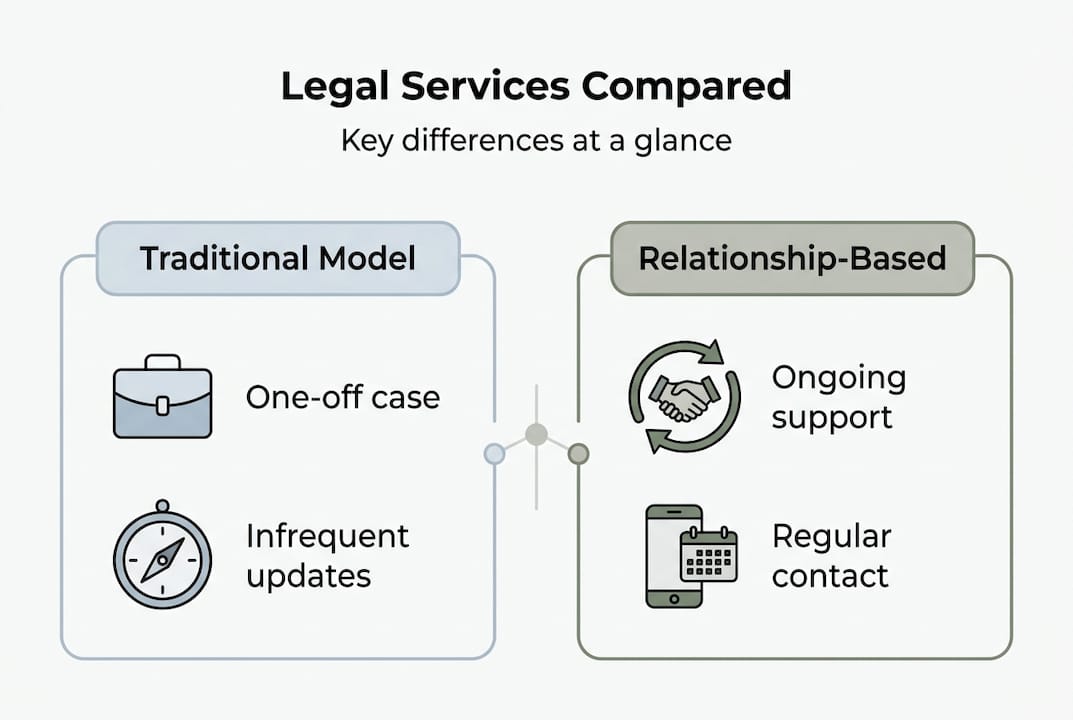
| Feature | Traditional legal services | Relationship-based legal services |
|---|---|---|
| Communication frequency | Client-initiated or deadline-driven | Regular proactive updates and check-ins |
| Fee transparency | Often hourly billing with unpredictable costs | Fixed fees with upfront cost discussions |
| Client focus | Case-centric approach | Person-centric partnership approach |
| Engagement duration | Ends when matter concludes | Ongoing advisory relationship |
| Feedback mechanisms | Limited or non-existent | Regular satisfaction checks and adjustments |
Fee transparency distinguishes these approaches significantly. Traditional firms frequently bill by the hour, making final costs difficult to predict. Relationship-based practices typically offer fixed fees or clear pricing structures, allowing you to budget confidently. This transparency extends to explaining why certain actions cost more and identifying opportunities to reduce expenses without compromising outcomes.
The philosophical difference runs deeper than communication patterns. Traditional services focus on resolving the immediate legal problem efficiently. Relationship-based services consider your broader circumstances and long-term wellbeing. How does this divorce settlement affect your retirement plans? Will this corporate structure support your business growth over the next decade?
Pro Tip: When interviewing potential solicitors, ask specific questions about their client engagement process. How frequently will they update you? What communication channels do they offer? How do they gather and respond to client feedback? Their answers reveal whether they genuinely prioritise relationships or simply claim to.
Feedback mechanisms prove crucial for service quality. Relationship-focused firms actively solicit your input throughout your matter, adjusting their approach based on your preferences and concerns. This responsiveness creates a collaborative environment where you feel heard and valued. Understanding the role of legal counsel in business and exploring legal retainers for UK businesses illustrates how ongoing relationships deliver superior value compared to one-off engagements.
Family law demands exceptional sensitivity and personalised attention. Divorce, child custody disputes, and financial settlements involve deeply personal matters where emotional support matters as much as legal expertise. Relationship-based solicitors recognise that family law clients need someone who understands their unique family dynamics, not just statutory requirements.
These solicitors invest time learning about your children’s needs, your financial circumstances, and your hopes for post-divorce life. They explain options in context, helping you understand how different arrangements might work practically. This personalised guidance proves invaluable when making decisions that affect your family’s future.
Personal injury litigation benefits enormously from sustained client relationships. Recovery from serious accidents takes time, and your legal needs evolve throughout the process. Relationship-focused solicitors maintain regular contact, adjusting their approach as your medical situation and financial needs change. They coordinate with medical professionals, insurers, and other parties whilst keeping you informed every step of the way.
Corporate law clients gain strategic partners who understand their business inside and out. Rather than calling a solicitor only when problems arise, you have an adviser who knows your industry, competitive challenges, and growth objectives. This deep understanding enables proactive guidance on contracts, compliance, risk management, and strategic transactions.
| Practice area | Client satisfaction rating | Average case duration | Communication frequency |
|---|---|---|---|
| Family law | 4.7/5.0 | 8-14 months | Weekly updates |
| Personal injury | 4.8/5.0 | 10-18 months | Fortnightly updates |
| Corporate law | 4.6/5.0 | Ongoing advisory | Monthly reviews |
Seeking relationship-based legal counsel requires a deliberate approach:
Pro Tip: Prioritise firms with proven track records in your specific legal area that explicitly commit to regular communication and transparent billing. Check online reviews and testimonials for consistent mentions of responsiveness and client care.
Exploring essential family law tips provides valuable context for relationship-based family legal services. Similarly, comprehensive guides on personal injury claims and corporate law in the UK demonstrate how specialised expertise combines with client-focused approaches to deliver superior outcomes across diverse legal matters.
Navigating complex legal matters becomes significantly easier when you partner with solicitors who genuinely prioritise your needs and goals. Ali Legal specialises in relationship-based legal services that transform how you experience legal support. We focus on transparent communication, personalised strategies, and long-term client partnerships across our core practice areas.
Our family and divorce legal care provides compassionate guidance during life’s most challenging transitions. We combine legal expertise with genuine understanding of your family’s unique circumstances. For personal injury matters, our comprehensive litigation support ensures you receive the compensation you deserve whilst maintaining clear communication throughout your recovery. Business clients benefit from our strategic corporate law services that support sustainable growth through proactive legal guidance and transparent advice. Contact Ali Legal today to experience legal services built on trust, clarity, and genuine partnership.
Relationship-based legal services prioritise ongoing client partnerships over transactional interactions. Solicitors invest time understanding your unique circumstances, maintain regular communication, and provide personalised strategies tailored to your specific needs. This approach treats you as a strategic partner rather than just another case file.
Transparent communication and consistent engagement build trust naturally over time. When solicitors proactively update you, explain complex concepts clearly, and demonstrate genuine interest in your wellbeing, you feel valued and confident in their guidance. Regular feedback opportunities ensure your concerns are heard and addressed promptly, strengthening the partnership.
Not necessarily. Many relationship-focused firms offer fixed fees and transparent pricing structures that provide better value than unpredictable hourly billing. The personalised attention and proactive guidance often prevent costly mistakes and delays, ultimately saving money. Understanding the importance of clear legal advice helps you recognise the long-term value of transparent, relationship-based services.
Ask specific questions during initial consultations about communication frequency, feedback mechanisms, and how they tailor strategies to individual circumstances. Request client references and check testimonials for consistent mentions of responsiveness and personalised service. Establish clear expectations early about how often you’ll receive updates and through which channels.
Absolutely. Corporate clients benefit significantly from solicitors who understand their business operations, industry challenges, and strategic objectives. Ongoing advisory relationships through legal retainers for UK businesses provide proactive guidance on contracts, compliance, and growth opportunities. This deep understanding enables solicitors to anticipate needs and provide strategic counsel that supports long-term success.
Many people believe asset protection is simply about hiding wealth from creditors or avoiding legitimate obligations. That misunderstanding can lead to poor decisions and legal trouble. True asset protection involves legally structuring your finances and holdings to shield them from genuine risks like lawsuits, business failures, and unforeseen liabilities. This guide clarifies what asset protection actually means, explores proven strategies including trusts and business structures, and explains how UK legal frameworks support these methods. You’ll learn practical steps to evaluate your risks, select appropriate protection tools, and implement them correctly. Whether you’re a business owner or an individual with assets to preserve, understanding these principles helps you make informed decisions and avoid costly mistakes.
| Point | Details |
|---|---|
| Legal protection | Asset protection uses lawful strategies to safeguard personal and business holdings from creditors, lawsuits, and liabilities. |
| Multiple tools | Effective protection combines trusts, insurance policies, and appropriate business structures tailored to individual circumstances. |
| UK compliance | Success requires understanding and following UK legal frameworks to ensure strategies remain valid and enforceable. |
| Professional guidance | Expert legal advice prevents common pitfalls and ensures asset protection plans align with current regulations. |
| Regular reviews | Updating protection measures as circumstances change maintains their effectiveness over time. |
Asset protection refers to strategies that legally protect assets from creditors and liabilities. It’s not about evading legitimate debts or hiding wealth from authorities. Instead, it involves structuring your holdings in ways that make them less vulnerable to claims whilst remaining fully compliant with the law.
The purpose is straightforward: preserve what you’ve worked to build. Business owners face risks from commercial disputes, professional negligence claims, and contract breaches. Individuals encounter threats from divorce proceedings, personal injury claims, and unexpected financial crises. Without proper protection, a single lawsuit or business failure can wipe out savings, property, and investments accumulated over decades.
Several misconceptions cloud understanding of this field. Some think asset protection only matters for the wealthy, but anyone with property, savings, or business interests benefits from appropriate safeguards. Others assume it involves offshore accounts or complex schemes, when often the most effective tools are domestic trusts and properly structured business entities. The key is matching strategies to your specific situation and risk profile.
Key risks that asset protection addresses include:
Understanding legal risk management forms the foundation for effective asset protection. UK law provides various frameworks, from trust legislation to company structures, that enable legitimate protection when used correctly. The challenge lies in selecting appropriate tools and implementing them before problems arise, because courts view protection measures established after a claim surfaces with considerable scepticism.
Several proven methods help safeguard assets, each with distinct advantages depending on your circumstances. The most effective approach typically combines multiple strategies rather than relying on a single tool.
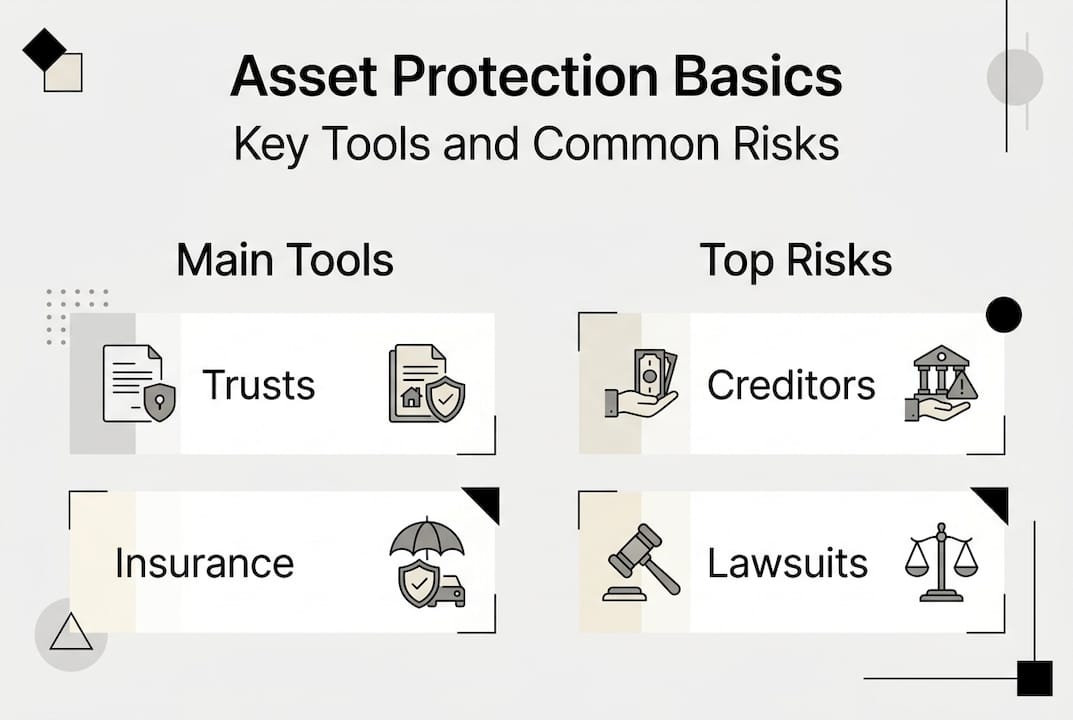
Trusts are a popular legal mechanism used to isolate assets from personal liabilities in the UK. When you place assets into a properly structured trust, they’re owned by the trust itself rather than you personally. This separation means creditors pursuing claims against you cannot easily access trust property. Discretionary trusts offer particular flexibility, allowing trustees to distribute income and capital among beneficiaries as circumstances change.

Insurance provides another essential layer of protection. Professional indemnity insurance shields business owners from negligence claims, whilst liability insurance covers accidents and injuries. These policies transfer risk to insurers, preventing claims from directly threatening your personal wealth. The key is maintaining adequate coverage limits that reflect your actual exposure.
Business structures significantly impact asset protection. Operating as a limited company creates legal separation between business debts and personal assets. If the company faces financial difficulty, creditors generally cannot pursue directors’ personal property beyond their investment in the company. This contrasts sharply with sole traders, whose personal assets remain fully exposed to business liabilities.
| Strategy | Primary benefit | Main limitation |
| — | — |
| Discretionary trusts | Strong creditor protection through legal separation | Requires professional setup and ongoing management |
| Limited companies | Shields personal assets from business debts | Directors may face personal liability for wrongful trading |
| Insurance policies | Transfers risk to insurers with defined coverage | Only protects against insured risks up to policy limits |
| Pension schemes | Protected from most creditors under UK law | Funds locked until retirement age |
UK legal frameworks support these strategies through established trust law, company legislation, and insurance regulations. However, certain limitations apply. Courts can set aside transfers made to defraud creditors, and some debts like personal guarantees pierce corporate protection. Understanding these boundaries prevents wasted effort on ineffective measures.
Practical implementation tips include:
Pro Tip: Many people focus solely on property law when protecting real estate, but combining property ownership structures with insurance and trusts creates far stronger protection than any single method alone.
The most robust protection comes from layering strategies. A business owner might operate through a limited company, maintain comprehensive insurance, place investment property in a trust, and maximise pension contributions. Each layer addresses different risks, and together they create defence in depth that’s difficult for creditors to penetrate. Professional advice ensures these elements work together effectively rather than creating conflicts or gaps.
Successful asset protection depends on understanding and complying with UK legal frameworks to avoid challenges. Several key areas of law shape what’s permissible and what crosses into problematic territory.
Trust law provides the foundation for one of the most powerful protection tools. The Trustee Act 2000 and various case law principles govern how trusts must be established and administered. Trusts created for legitimate purposes like estate planning or protecting vulnerable beneficiaries receive full legal recognition. However, trusts established solely to frustrate creditors may be set aside under the Insolvency Act 1986.
Property law affects how you can structure ownership of real estate and physical assets. Joint tenancy versus tenancy in common creates different inheritance and creditor exposure profiles. Placing property into trusts or companies changes the legal ownership and associated protections. Each structure carries specific implications for tax, succession, and creditor access.
Company law determines how business structures protect personal assets. The Companies Act 2006 establishes limited liability for shareholders, but directors face personal liability for wrongful trading if they continue operating whilst insolvent. Understanding these boundaries helps you maintain protection whilst avoiding personal exposure.
Ensuring legal compliance requires several steps:
The timing of protective measures matters enormously. Courts scrutinise transfers made shortly before or after claims arise, often viewing them as attempts to defraud creditors. Establishing protection during stable periods, as part of normal financial planning, carries far less risk of challenge.
Common legal pitfalls include:
Professional legal advice significantly improves outcomes in securing assets effectively. Attempting to implement complex structures without expert guidance often creates vulnerabilities rather than protection.
Documented professional consultation serves two purposes. First, it ensures your strategies actually work as intended under current law. Second, it demonstrates good faith if anyone later questions your actions. Courts view individuals who sought and followed professional advice more favourably than those who attempted DIY protection schemes.
Estate planning integrates closely with asset protection. Wills, trusts, and succession planning all affect how assets are protected during your lifetime and after death. Coordinating these elements prevents gaps where assets become vulnerable during transitions.
Regular legal reviews keep protection current as laws change. Tax legislation, insolvency rules, and trust law all evolve. What worked five years ago might now create unexpected exposure. Annual reviews with your legal adviser identify needed updates before problems arise.
Implementing effective protection requires systematic evaluation of your situation followed by targeted action. Start by assessing your specific risks and assets, then select appropriate strategies.
Step by step risk evaluation and strategy selection:
Personal finance scenarios demonstrate how protection works in practice. Consider a medical professional facing potential negligence claims. Professional indemnity insurance provides the first line of defence, covering most claims up to policy limits. Placing the family home and investment property into a trust adds another layer, separating personal assets from professional liabilities. Maximising pension contributions moves additional wealth into protected vehicles.
Business contexts require different approaches. A company director might establish a limited company to separate business debts from personal wealth. Key person insurance protects against financial impact if crucial team members become unable to work. Maintaining proper corporate formalities, separate bank accounts, and clear documentation preserves the limited liability protection.
Insurance and liability coverage form essential components of any protection plan. Professional indemnity, public liability, and directors’ and officers’ insurance address different risk categories. The key is matching coverage to actual exposure. Under insurance leaves gaps, whilst excessive coverage wastes money better spent elsewhere.
Planning and regular reviews are key to keeping asset protection measures effective over time. Life changes constantly. You acquire new assets, start businesses, face different risks, and encounter evolving legal frameworks. Annual reviews ensure your protection adapts accordingly.
Pro Tip: The most common implementation mistake is waiting until problems appear before establishing protection. Courts view last minute transfers with extreme scepticism and often set them aside. Effective protection requires planning during calm periods, not crisis response.
Practical implementation considerations include:
Real world application often combines multiple tools. A business owner might operate through a limited company with comprehensive insurance, place investment property in a family trust, maximise pension contributions, and maintain emergency reserves in protected accounts. Each element addresses specific risks whilst together creating robust overall protection.
Common mistakes to avoid during implementation:
The most effective protection balances security with practicality. Overly complex schemes become difficult to maintain and may not survive legal challenge. Simple, well documented structures implemented for clear purposes tend to prove most durable. Focus on legitimate business and family planning objectives, with asset protection as a natural consequence rather than the sole purpose.
Protecting your assets requires more than understanding general principles. You need strategies tailored to your specific situation, implemented correctly within UK legal frameworks. That’s where expert guidance makes the difference between effective protection and wasted effort.
Ali Legal provides experienced civil litigation support when disputes threaten your interests. Our team understands how asset protection intersects with litigation, helping you safeguard holdings whilst resolving conflicts effectively. We’ve guided countless clients through complex situations where proper planning prevented devastating losses.
Our commercial litigation expertise extends to protecting business interests during high stakes disputes. Whether you’re facing contract breaches, partnership disagreements, or creditor claims, we develop strategies that defend your position whilst preserving what you’ve built.
Accessible consultations let us understand your unique circumstances and tailor protection strategies accordingly. We explain options clearly, outline costs transparently, and help you make informed decisions about safeguarding your wealth. Contact Ali Legal today to discuss how we can help secure your financial future with expert legal guidance and proven asset protection strategies.
Asset protection encompasses legal strategies that shield your wealth from creditors, lawsuits, and other financial threats. It matters because unexpected claims, business failures, or legal disputes can eliminate assets you’ve spent years building. Proper protection preserves your financial security whilst remaining fully compliant with UK law.
Trusts create legal separation by transferring ownership to the trust itself, removing assets from your personal estate. This differs from insurance, which transfers risk to insurers, and company structures, which separate business from personal liabilities. Trusts offer particular strength against personal creditors but require proper setup and ongoing administration to remain effective.
Courts can set aside transfers made to defraud creditors under insolvency law, potentially reversing your protection efforts. You might face accusations of fraudulent conveyance if timing or documentation appears suspicious. Improperly structured protection can also trigger unexpected tax liabilities or fail to provide intended benefits, wasting time and money.
Costs vary significantly based on complexity. Simple measures like adequate insurance might cost hundreds annually, whilst establishing trusts typically requires several thousand pounds in legal fees plus ongoing administration costs. Limited company formation costs less than trusts but requires annual compliance expenses. Professional advice helps identify cost effective options for your situation.
Seek advice before problems arise, ideally as part of regular financial planning. Once claims surface or financial difficulty looms, options become limited and courts scrutinise any protective measures closely. Early consultation during stable periods provides maximum flexibility and ensures strategies withstand potential challenges whilst serving legitimate purposes.
Many people believe compensation claims are straightforward processes that guarantee financial recovery after an injury or property damage. The reality proves far more nuanced, involving complex legal requirements, damage calculations, and strategic considerations that significantly impact outcomes. Understanding what compensation claims truly entail, how damages are assessed, and which legal hurdles you might face can transform your approach to seeking restitution. This guide clarifies the fundamentals of compensation claims, explains calculation methods, explores key legal challenges, and outlines the practical steps for filing your claim in 2026.
| Point | Details |
|---|---|
| Definition and scope | Compensation claims seek financial restitution for economic losses like medical bills and non-economic damages such as pain and suffering resulting from negligence. |
| Calculation methods | Economic damages use receipts and bills whilst non-economic damages rely on per diem or multiplier methods to estimate value. |
| Legal proof required | Claimants must establish duty, breach, causation, and harm whilst navigating comparative fault rules that can reduce awards. |
| Settlement likelihood | Approximately 95% of claims settle before trial, making negotiation skills and documentation more critical than courtroom performance. |
| No win no fee considerations | Conditional fee agreements provide access to justice but involve success fees that reduce net payouts and potential disbursement liabilities. |
A compensation claim is a legal demand for financial restitution covering economic and non-economic damages caused by another party’s negligence. These claims arise when someone suffers personal injury or property damage due to actions or failures of an individual, business, or organisation that owed them a duty of care. The fundamental premise requires proving that negligence directly caused measurable losses, creating a legal right to seek monetary compensation.
Compensation claims encompass two primary damage categories. Economic damages represent quantifiable financial losses such as medical expenses, rehabilitation costs, lost wages, property repair bills, and replacement costs for damaged possessions. Non-economic damages address intangible losses including pain, suffering, emotional distress, loss of enjoyment of life, and permanent disability or disfigurement. The personal injury claims process requires documenting both categories thoroughly to maximise recovery.
Typical compensation claims involve diverse scenarios:
The basic legal conditions for pursuing a claim require establishing that the defendant owed you a duty of care, breached that duty through action or inaction, and directly caused losses you can demonstrate through evidence. For instance, a property owner who fails to repair a broken staircase breaches their duty to visitors, and if someone falls and breaks their leg, they can claim medical expenses, lost earnings during recovery, and compensation for pain and suffering.

Understanding these fundamentals helps you recognise when you have grounds for a claim and what evidence you need to gather. The personal injury litigation guide provides additional context on building strong cases that withstand scrutiny during negotiations or trial.
Understanding what compensation claims cover naturally leads to grasping how damages are calculated to know what you can realistically expect to claim. Calculation methods differ significantly between economic and non-economic damages, requiring distinct approaches to valuation and documentation.
Economic damages are calculated via bills and receipts that provide concrete evidence of financial losses. Medical expenses include hospital bills, prescription costs, physiotherapy sessions, and future treatment needs projected by medical professionals. Lost wages calculations use pay slips, tax returns, and employer statements to establish pre-injury earnings and multiply by time off work. Property damage claims total repair estimates from qualified assessors or replacement costs for items beyond economical repair, minus any applicable insurance deductible.

Non-economic damages prove more subjective, relying on two primary methods. The per diem approach assigns a daily rate to pain and suffering, multiplying it by recovery days. The multiplier method takes total economic damages and applies a factor between 1.5 and 5 based on injury severity, with catastrophic injuries commanding higher multipliers. Courts and insurers consider injury permanence, treatment duration, impact on daily activities, and psychological effects when determining appropriate multipliers.
Property damage claims follow straightforward valuation. Assessors inspect damage, obtain repair quotes from licensed contractors, and compare against pre-damage market value. If repair costs exceed replacement value, insurers typically offer replacement minus depreciation. Deductibles specified in insurance policies reduce final payouts, creating out-of-pocket expenses claimants can pursue from at-fault parties.
| Damage type | Calculation method | Example |
|---|---|---|
| Economic | Actual bills and receipts | £15,000 medical costs plus £8,000 lost wages |
| Non-economic | Per diem or multiplier | £23,000 economic damages × 3 multiplier = £69,000 |
| Property | Repair or replacement cost minus deductible | £4,500 repair estimate minus £500 deductible = £4,000 |
Pro Tip: Begin documenting every expense immediately after an incident, photographing damage, retaining all receipts, and maintaining detailed journals of pain levels and activity limitations. This contemporaneous evidence proves far more persuasive than reconstructed records months later, significantly strengthening your economic and non-economic damage claims. The personal injury law guide explores additional damages calculation methods that courts apply in complex cases.
With damage calculation understood, it becomes vital to recognise the legal hurdles and strategies that influence your compensation claim’s success. Even strong claims face obstacles that can reduce awards or derail cases entirely without proper preparation and representation.
Proving negligence requires showing duty, breach, causation, and harm. First, establish the defendant owed you a duty of care, which exists in most everyday situations like driving safely or maintaining safe premises. Second, demonstrate they breached that duty through action or inaction falling below reasonable standards. Third, prove causation linking the breach directly to your injuries, excluding pre-existing conditions or intervening factors. Fourth, show actual harm occurred, whether physical injury, property damage, or financial loss. Missing any element defeats your claim regardless of how sympathetic your situation appears.
Comparative fault systems complicate claims significantly. Comparative fault and damage caps affect compensation amounts when claimants share responsibility for incidents. Pure comparative fault jurisdictions reduce awards proportionally, so 30% claimant fault in a £100,000 claim yields £70,000. Modified comparative fault bars recovery if claimant fault exceeds 50% or 51%, depending on jurisdiction. Insurers aggressively argue plaintiff fault to reduce payouts, scrutinising every action before and during incidents.
Damage caps limit non-economic awards in some jurisdictions, particularly for medical negligence claims. These legislative limits can drastically reduce compensation for severe injuries causing permanent disability or disfigurement. Understanding applicable caps helps set realistic expectations and influences whether pursuing litigation proves worthwhile compared to settlement offers.
Insurers employ multiple tactics to minimise payouts:
Most claims settle pre-trial, with approximately 95% resolving through negotiation rather than courtroom battles. Strong documentation and legal representation prove crucial for achieving optimal outcomes. Represented claimants navigate complex procedures, counter insurer tactics effectively, and leverage litigation threats to secure fair settlement agreements.
Represented plaintiffs receive 3.5 times higher settlements than unrepresented claimants, demonstrating the substantial value professional advocacy brings to compensation claims.
Pro Tip: Consult a solicitor immediately after an incident, before providing recorded statements to insurers or accepting any settlement offers. Early legal advice prevents common mistakes like admitting fault, accepting inadequate compensation, or missing critical evidence preservation steps. Understanding comparative fault rules in your jurisdiction helps you assess realistic claim values and negotiation strategies.
Finally, we examine how to practically initiate and navigate your compensation claim in 2026, including what to expect and smart approaches that maximise success. Understanding the process demystifies what might seem overwhelming and helps you prepare effectively.
The typical claim process follows these stages:
Approximately 95% of claims settle before trial, making negotiation skills more valuable than courtroom prowess. Average settlement amounts vary dramatically by injury type, ranging from £2,000 for minor soft tissue injuries to £250,000 for severe permanent disabilities. Timelines span three months for straightforward cases to three years for complex litigation, with most settlements occurring within 12 to 18 months.
| Aspect | Settlement | Trial |
|---|---|---|
| Likelihood | 95% of cases | 5% of cases |
| Timeline | 6 to 18 months | 18 to 36 months |
| Control | Parties negotiate terms | Judge or jury decides |
| Costs | Lower legal fees | Substantial litigation expenses |
| Certainty | Guaranteed outcome | Unpredictable verdict risk |
| Privacy | Confidential agreements | Public court records |
No win no fee agreements, formally called conditional fee arrangements, allow claimants to pursue cases without upfront legal costs. Solicitors receive payment only upon successful settlement or verdict, taking their fee as a percentage of recovered damages plus a success fee. No win no fee risks include reduced net payout and potential liability for disbursements like expert witness fees or court costs if unsuccessful, though many solicitors offer insurance against such expenses.
Benefits include access to justice for those unable to afford hourly legal fees and solicitor motivation to maximise recovery since their payment depends on success. Drawbacks involve success fees reducing your net compensation by 25% to 40% and potential pressure to settle prematurely to secure payment. The personal injury claims guide explores these arrangements comprehensively.
Pro Tip: When choosing solicitors, compare success fee percentages, clarify whether you face disbursement liability if unsuccessful, and verify their track record in cases similar to yours. Prepare for your legal consultation by organising all evidence, listing questions, and understanding realistic timelines. Review personal injury law statistics and the no win no fee scheme details before committing to representation agreements.
Having understood the process and challenges, here is how Ali Legal can help you confidently pursue your compensation claim. Navigating compensation claims requires expertise in civil litigation and deep knowledge of personal injury law that transforms complex procedures into manageable steps.
Ali Legal offers expert support throughout the personal injury claims process, from initial case evaluation through settlement negotiation or trial representation. Our solicitors understand the tactics insurers employ to minimise payouts and counter them effectively with thorough evidence preparation, strategic negotiation, and litigation readiness when necessary. We provide transparent fixed fee structures and clear communication, ensuring you understand each development and decision point.
Professional legal representation significantly increases your compensation and navigates complex procedures that overwhelm unrepresented claimants. Our tailored advice addresses your specific circumstances, calculating realistic claim values, identifying all liable parties, and building compelling cases that withstand scrutiny. Discover how strategic case handling can maximise your claim’s success in 2026 by consulting with our experienced team.
A compensation claim qualifies when you suffer personal injury or property damage due to another party’s negligence, breach of duty, or intentional wrongdoing. You must demonstrate measurable losses, whether economic damages like medical bills or non-economic damages such as pain and suffering. The personal injury claims guide details specific qualifying scenarios.
Most compensation claims settle within 12 to 18 months, though straightforward cases may resolve in three to six months whilst complex litigation can extend beyond three years. Timeline factors include injury severity, liability disputes, negotiation willingness, and court scheduling if trial becomes necessary. Early legal consultation and thorough evidence gathering accelerate the process.
Success depends on proving negligence, demonstrating causation, and documenting damages convincingly. Approximately 95% of claims settle successfully before trial, though settlement amounts vary based on evidence strength and representation quality. Represented claimants achieve substantially higher recoveries than those proceeding alone, with professional advocacy increasing settlements by 3.5 times on average.
No win no fee arrangements provide access to justice without upfront costs, making them worthwhile for claimants unable to afford hourly legal fees. However, success fees reduce net compensation by 25% to 40%, and some agreements carry disbursement liability risks. Compare solicitor terms carefully, verify track records, and understand all potential costs before committing to conditional fee arrangements.
Proving negligence requires establishing four elements: the defendant owed you a duty of care, breached that duty through substandard actions or omissions, directly caused your injuries through that breach, and you suffered actual damages as a result. Gather evidence including accident reports, witness statements, photographs, medical records, and expert opinions that document each element convincingly.
Joint ventures promise growth and innovation, yet 50% fail within five years-The-strategic-edge-for-transformative-transactions.html). The difference between success and failure often lies in a single document: the joint venture agreement. Without clear terms governing roles, finances, and decision making, even well intentioned partnerships crumble under misaligned expectations. This guide clarifies what a joint venture agreement is, its essential components, and how to structure one that protects your interests whilst maximising collaborative value. You will discover practical strategies to reduce risk and build partnerships that deliver results.
| Point | Details |
|---|---|
| Foundational contract | A joint venture agreement defines scope, governance, capital contributions, and profit sharing for collaborative projects |
| Risk management | Clear exit strategies, dispute resolution clauses, and fiduciary duties prevent conflicts and reduce the 50% failure rate |
| Structural flexibility | Joint ventures retain separate legal identities with limited liability, unlike partnerships or mergers |
| Strategic alignment | Success requires complementary partners, detailed customised agreements, and open communication beyond legal clauses |
A joint venture agreement is the foundational legal contract governing a JV, where two or more parties collaborate on a specific project by pooling resources whilst retaining separate identities. This distinction separates joint ventures from partnerships, where parties merge operations completely, or mergers, which integrate businesses permanently. The JV structure allows companies to pursue opportunities requiring complementary expertise or capital without surrendering independence.
Joint ventures typically focus on defined projects with clear timelines. One party might contribute technology whilst another provides market access or manufacturing capacity. The agreement establishes how decisions get made, profits get distributed, and disputes get resolved. Without this contractual foundation, partners risk misunderstandings about authority, financial obligations, and exit rights.
The project specific nature of joint ventures offers strategic advantages. Companies can test new markets, share development costs, or access restricted sectors without full commitment. Limited liability protects each party’s broader business interests if the venture underperforms. However, this flexibility demands precise contractual terms.
“The joint venture agreement transforms vague intentions into enforceable obligations, creating accountability and clarity that verbal agreements cannot provide.”
Key differences from other structures include:
These distinctions matter when structuring deals. A poorly drafted agreement that blurs these boundaries can create unintended tax consequences, liability exposure, or governance conflicts. Business leaders must understand these fundamentals before negotiating terms.
Every effective joint venture agreement addresses core structural elements that define how the partnership operates. Key mechanics include scope and purpose, capital contributions dictating ownership, governance structures, profit and loss allocation, and exit strategies like deadlock or buy-sell agreements. These components work together to create a functional framework that anticipates challenges and allocates risk fairly.
The scope and purpose clause defines exactly what the joint venture will accomplish. Vague objectives invite disputes about whether specific activities fall within the partnership’s remit. Precise language about deliverables, timelines, and territorial boundaries prevents mission creep and keeps partners aligned.
Capital contributions determine ownership stakes and influence. Partners may contribute cash, physical assets, intellectual property, or expertise. The agreement must specify:
Governance mechanisms establish decision making authority. Most joint ventures create management committees with representatives from each partner. The agreement should define voting thresholds for routine decisions versus major actions like asset sales or additional borrowing. Quorum requirements prevent one party from acting unilaterally.

Profit and loss sharing follows ownership percentages or negotiated ratios. Some agreements link distributions to performance milestones rather than fixed percentages. Tax implications vary significantly based on structure, so legal and accounting advice proves essential during drafting.
Exit strategies protect partners when relationships deteriorate or objectives change. Buy sell clauses allow one party to trigger a purchase at fair value. Deadlock resolution mechanisms like the Texas Shootout method force decisive action when partners cannot agree. One party names a price, and the other chooses whether to buy or sell at that price.
| Component | Purpose | Key considerations |
|---|---|---|
| Scope definition | Limits venture activities | Specificity prevents disputes |
| Capital terms | Establishes ownership stakes | Include valuation methods |
| Governance rules | Defines decision authority | Set clear voting thresholds |
| Profit sharing | Allocates financial returns | Align with contributions or milestones |
| Exit provisions | Enables partnership dissolution | Include deadlock resolution |
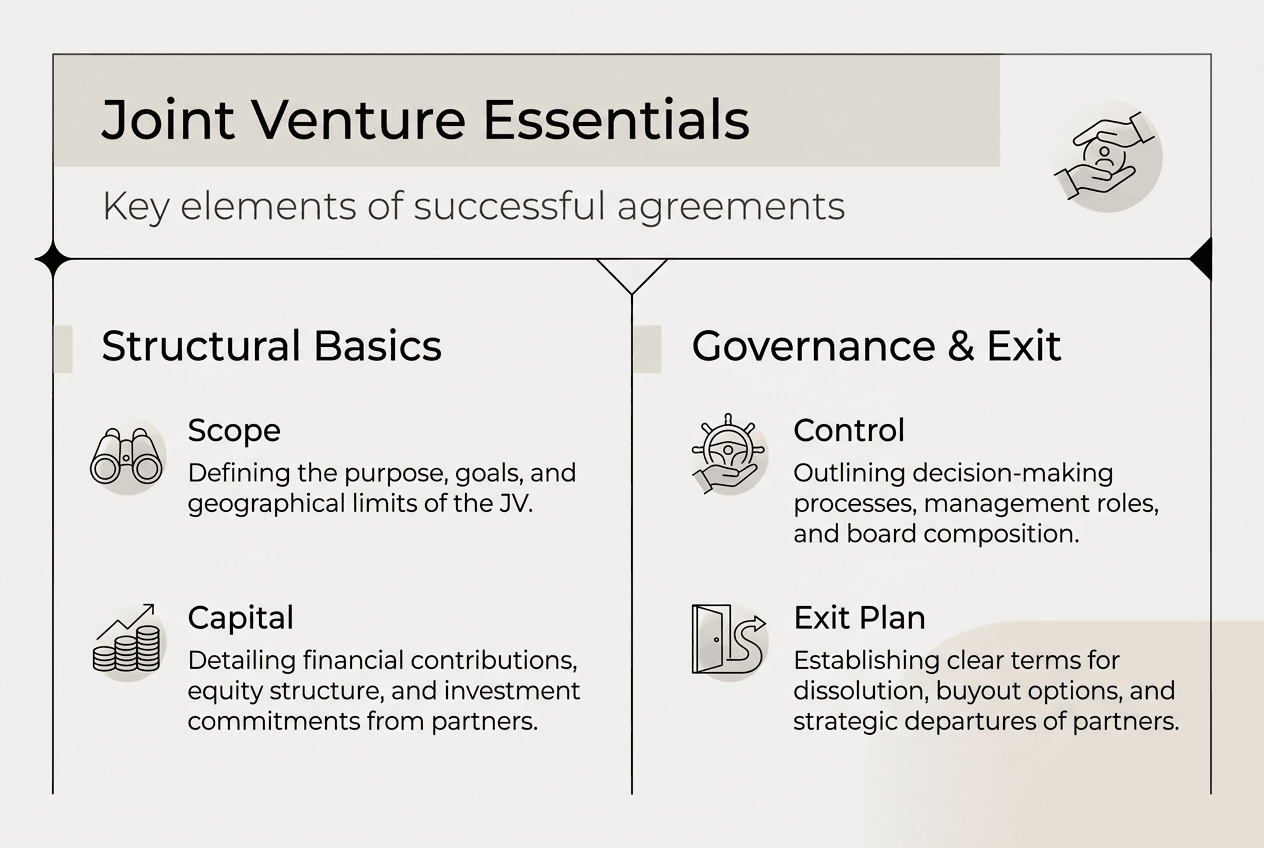
Pro Tip: Draft exit clauses when relationships are strong. Partners negotiate more fairly before conflicts arise, creating mechanisms both sides trust.
These structural elements interact dynamically. Governance rights often correlate with capital contributions, whilst profit sharing might reward operational performance differently than financial investment. Understanding how corporate governance in joint ventures balances these interests helps you negotiate terms that protect your position whilst maintaining partnership viability.
Joint ventures create inherent tension between loyalty to the partnership and loyalty to parent companies. Fiduciary duties require loyalty and care to the JV itself, often codified in the agreement with conflict disclosure and non compete covenants to manage inherent conflicts. These duties prevent partners from exploiting the venture for individual gain at the partnership’s expense.
The duty of loyalty prohibits partners from competing with the joint venture or diverting corporate opportunities that belong to the partnership. The duty of care requires partners to act with reasonable diligence in managing venture affairs. Many agreements explicitly define these duties to avoid ambiguity about acceptable conduct.
Conflict of interest provisions address dual loyalties. Partners naturally prioritise their parent companies’ interests, which may diverge from optimal JV strategy. Non compete clauses restrict partners from pursuing similar projects independently during the venture’s term. Disclosure requirements force partners to reveal potential conflicts before they cause harm.
Disputes often arise from deadlocks, unilateral actions, or differing interpretations of authority, which require clear procedures within the JVA to address. Common triggers include:
Effective agreements establish tiered dispute resolution processes. Initial disputes go to senior executives for negotiation. If negotiation fails, mediation provides a structured forum with a neutral facilitator. Arbitration offers binding resolution without public court proceedings. This progression reduces costs and preserves relationships by resolving issues at the lowest effective level.
Clear conflict resolution clauses reduce litigation risks significantly. Specify timelines for each escalation stage, selection processes for mediators or arbitrators, and governing law. Some agreements require parties to continue performing obligations during disputes to prevent operational paralysis.
Pro Tip: Include a mandatory cooling off period before arbitration. Requiring 30 days of good faith negotiation often resolves disputes without formal proceedings.
Understanding contract dispute resolution methods and dispute resolution methods in joint ventures helps you structure clauses that match your risk tolerance and relationship dynamics. International ventures face additional complexity from differing legal systems and cultural approaches to conflict.
Business leaders often confuse joint ventures with partnerships or mergers, yet these structures differ fundamentally in liability, permanence, and control. Joint ventures are project specific with limited liability and retained independence compared to ongoing partnerships or full mergers that integrate operations completely.
Joint ventures create separate legal entities for specific projects whilst parent companies maintain independence. Each partner contributes defined resources and shares specified risks. The venture exists for a predetermined purpose or duration, after which it dissolves or transitions.
Partnerships establish ongoing business relationships where partners share profits, losses, and unlimited personal liability. Partners typically participate in day to day management and bear joint responsibility for partnership debts. This structure suits professional services or long term operational collaboration.
Mergers combine two entities into one, eliminating separate identities. Shareholders of acquired companies receive shares or cash, and operations integrate fully. Mergers suit situations requiring complete alignment and unified control.
| Feature | Joint venture | Partnership | Merger |
|---|---|---|---|
| Legal identity | Separate entities maintained | Shared partnership entity | Single combined entity |
| Liability | Limited to venture assets | Unlimited personal liability | Assumed by surviving entity |
| Duration | Project specific term | Ongoing indefinitely | Permanent integration |
| Independence | Partners retain autonomy | Shared management control | Complete operational merger |
| Exit flexibility | Defined exit mechanisms | Partner buyout or dissolution | Requires sale or liquidation |
Equity joint ventures prove preferable when:
Partnerships work better for ongoing professional collaboration where partners contribute similar expertise and share management equally. Mergers suit situations where synergies require full integration and separate operations create inefficiency.
These distinctions influence contract drafting significantly. Joint venture agreements focus on project deliverables and exit strategies. Partnership agreements emphasise profit sharing and management authority. Merger agreements address valuation, integration timelines, and employee transitions.
Understanding these differences helps you select appropriate structures and negotiate terms that match your strategic objectives. Misclassifying arrangements creates legal and tax complications that undermine partnership value.
Successful joint ventures require more than solid legal agreements. Executives should prioritise defining a clear business strategy and success criteria before legal structure; use detailed JVAs with tailored governance and exit clauses to mitigate failure risks-The-strategic-edge-for-transformative-transactions.html). These strategic considerations separate thriving partnerships from expensive failures.
Assess partner complementarity rigorously before committing. Successful ventures combine partners with different strengths that create value neither could achieve alone. Evaluate cultural fit, risk tolerance, and strategic alignment beyond financial projections.
Draft customised detailed agreements avoiding generic templates. Every joint venture faces unique challenges based on industry, geography, and partner dynamics. Template agreements miss crucial protections and create ambiguity about critical terms.
Build comprehensive governance frameworks with clear authority limits. Define which decisions require unanimous consent versus majority vote. Specify approval thresholds for capital expenditures, hiring, and strategic pivots.
Include tiered dispute resolution to reduce costly litigation. Structure escalation from negotiation through mediation to arbitration. Most disputes resolve at early stages when procedures encourage dialogue.
Plan for institutional and cultural differences in international ventures. Social mechanisms like trust and communication outperform purely structural clauses for improving international joint venture performance. Regular face to face meetings, transparent reporting, and relationship building complement legal protections.
Establish clear performance metrics and review cycles. Define success criteria beyond financial returns. Regular strategic reviews allow partners to adjust course before problems escalate.
Address intellectual property ownership explicitly. Specify who owns developments created during the venture and usage rights after dissolution. Ambiguity about IP creates costly disputes.
Pro Tip: Create a partnership charter separate from the legal agreement. This document captures shared vision, operating principles, and cultural commitments that legal contracts cannot enforce but relationships require.
Open communication proves as important as contractual protections. Partners who share information freely, acknowledge challenges early, and collaborate on solutions outperform those who rely solely on legal remedies. Trust develops through consistent behaviour over time, not contract clauses.
Understanding corporate law duties in joint ventures helps you balance legal obligations with practical relationship management. The most successful ventures combine rigorous contracts with genuine partnership spirit.
Navigating joint venture agreements requires expertise that protects your interests whilst preserving partnership potential. Poorly drafted terms create expensive disputes, whilst overly aggressive positions poison relationships before ventures launch. You need legal advisers who understand both commercial realities and contractual protections.
Ali Legal offers specialised support for joint venture contract drafting, review, and dispute resolution. Our commercial litigation strategy and dispute resolution services protect your business interests when partnerships face challenges. We provide civil litigation dispute support tailored to your specific circumstances, whether you need aggressive advocacy or collaborative resolution.
Our approach combines technical legal excellence with commercial awareness. We help you structure agreements that reduce risk whilst maintaining flexibility for partnership evolution. Contact us for professional legal advice that safeguards your venture from conception through completion.
A comprehensive joint venture agreement includes the venture’s purpose and scope, capital contribution requirements, governance structures with voting mechanisms, profit and loss allocation formulas, intellectual property ownership terms, dispute resolution procedures, and exit strategies including buy sell provisions. These clauses work together to define partner responsibilities, manage conflicts, and provide clear paths for dissolution when objectives change or relationships deteriorate.
Joint venture agreements govern project specific collaborations with defined timelines whilst maintaining separate legal identities for each partner, creating limited liability exposure. Partnership agreements establish ongoing business relationships with shared unlimited liability where partners typically participate in day to day management. JVAs focus on discrete objectives and exit mechanisms, whereas partnership agreements emphasise long term profit sharing and management authority without predetermined end dates.
Effective dispute resolution clauses establish tiered approaches starting with direct negotiation between senior executives, escalating to mediation with neutral facilitators, and finally binding arbitration if earlier stages fail. Include specific timelines for each stage, selection processes for mediators or arbitrators, and governing law provisions. Clear authority limits and escalation procedures reduce deadlock risks by defining which decisions require unanimous consent versus majority approval. Consider dispute resolution options that match your partnership dynamics and risk tolerance.
Yes, well drafted agreements include multiple exit mechanisms to protect partner interests when circumstances change. Buy sell clauses allow one party to purchase the other’s interest at fair market value determined through agreed valuation methods. Deadlock resolution provisions like the Texas Shootout method force decisive action when partners cannot agree on major decisions. Change of control provisions, material breach clauses, and predetermined dissolution dates provide additional exit triggers that prevent partners from remaining trapped in unproductive relationships.
Many people mistakenly believe residency by investment and citizenship by investment are interchangeable terms, but they represent fundamentally different legal statuses with distinct rights and obligations. Residency by investment grants you the right to live in a foreign country through a qualifying financial contribution, without conferring citizenship or passport privileges. This guide clarifies the legal framework, application process, and strategic considerations for individuals exploring residency by investment programmes in 2026, helping you navigate this increasingly regulated landscape with confidence and avoid costly missteps.
| Point | Details |
|---|---|
| Investment pathways | Residency by investment typically requires contributions through real estate purchases, government bonds, or business investments in the host country. |
| Programme diversity | Requirements vary dramatically across 44 countries offering schemes, from €150,000 to over €2 million minimum investments. |
| Due diligence matters | Background checks and source of funds verification are mandatory steps that determine application success or rejection. |
| Family inclusion | Most programmes allow spouses and dependent children to gain residency status alongside the primary applicant. |
| Legal complexity | Professional guidance minimises risks around compliance, tax implications, and documentation requirements that commonly derail applications. |
Residency by investment programmes offer a pathway to residency in a foreign country through a significant financial contribution, typically in the form of investment in real estate, government bonds, or a local business. Unlike citizenship schemes, RBI does not grant you a passport or voting rights. You receive a residence permit that allows you to live, work, and often travel within certain regions whilst maintaining your original nationality.
The qualifying investment types vary by jurisdiction but generally fall into several categories. Real estate purchases remain the most popular route, requiring you to buy property meeting minimum value thresholds set by the host country. Government bonds or approved funds represent another common pathway, where you commit capital for a fixed period. Business investments involving job creation or economic contribution also qualify in many schemes. Each investment type carries different liquidity profiles, risk levels, and potential returns beyond the residency benefit itself.
Residency programmes differ fundamentally from citizenship by investment in several critical ways. Residency grants you legal permission to reside but not full citizenship rights. You cannot vote, hold certain public offices, or automatically pass nationality to children born after obtaining residency. However, residency often serves as a stepping stone, with many countries offering pathways to naturalisation after maintaining residence for specified periods, typically five to ten years.
The landscape of RBI programmes has evolved considerably since the 2000s, becoming more regulated and diverse. Countries now impose stricter due diligence requirements, enhanced compliance frameworks, and clearer investment criteria. This professionalisation protects both host nations and legitimate investors whilst weeding out questionable applications. The basic process involves selecting a qualifying investment, completing due diligence checks, submitting your application with supporting documents, and awaiting approval before receiving your residence permit.
Understanding these fundamentals helps you evaluate whether residency by investment aligns with your relocation and immigration objectives before committing substantial capital. The right programme depends on your specific circumstances, family situation, tax considerations, and long-term goals rather than simply choosing the cheapest option available.
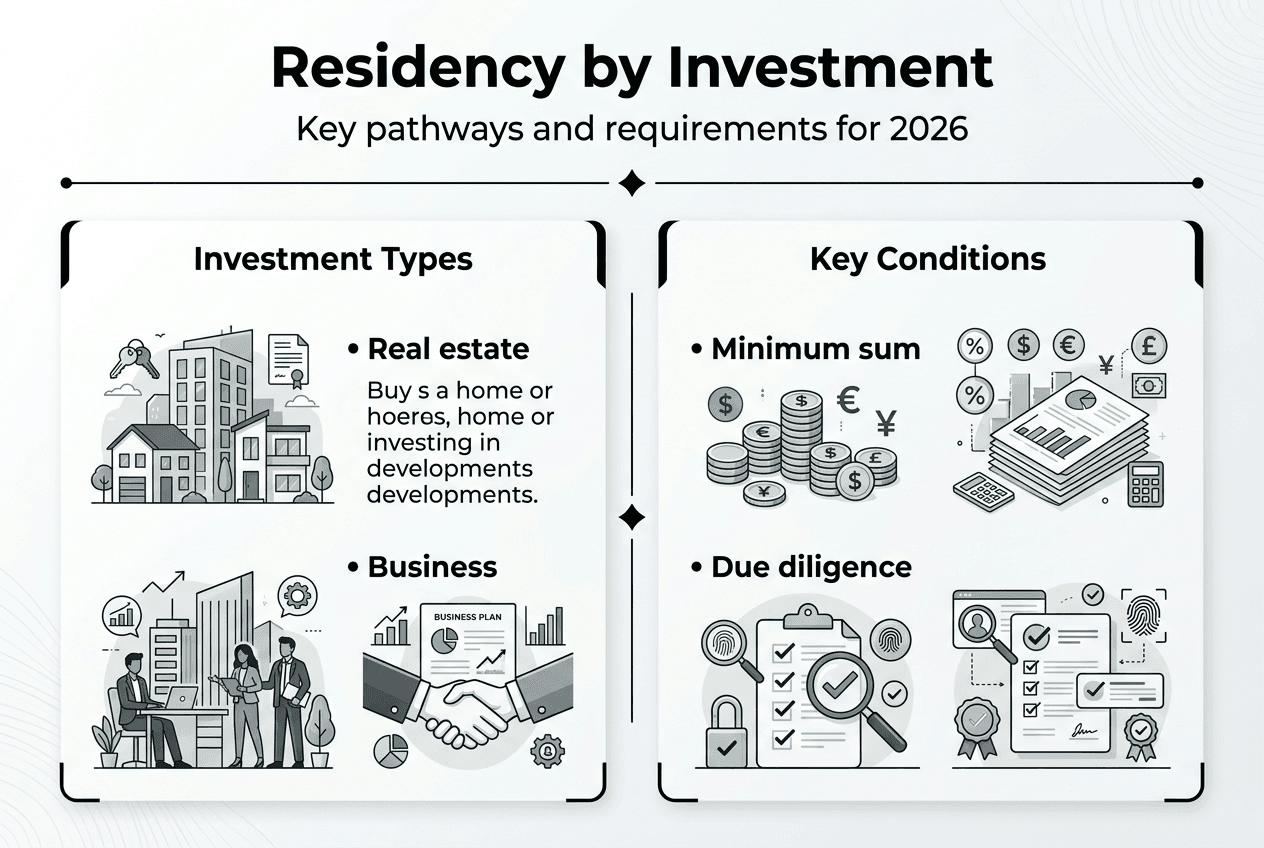
The application journey for residency by investment follows a structured multi-stage process that demands meticulous preparation and patience. Understanding each phase helps you anticipate requirements, avoid common pitfalls, and maintain realistic timeline expectations throughout your application.
Due diligence represents a critical gatekeeping step where authorities assess your background and source of funds to prevent money laundering, security risks, and fraudulent applications. You must demonstrate that your investment capital originates from legitimate sources through comprehensive financial documentation spanning several years. Tax returns, business ownership records, employment history, and asset sale documentation all contribute to building a credible financial profile.
Timelines for residency approval vary dramatically by country and programme complexity. Fast-track schemes in some jurisdictions deliver residence permits within three to six months, whilst others require twelve to eighteen months for complete processing. Complex cases involving multiple family members, intricate financial structures, or additional scrutiny can extend timelines further. Processing speeds also fluctuate based on application volumes, government efficiency, and seasonal backlogs.
Common rejection reasons include incomplete documentation, unexplained gaps in financial history, minor criminal records not disclosed upfront, and investments that fail to meet precise programme criteria. Non-compliance with ongoing residency conditions after initial approval can also jeopardise your status. Some applicants underestimate the documentation burden, submitting applications before gathering all required certificates, translations, and verifications.
Pro Tip: Prepare complete, verified paperwork upfront to avoid delays or refusals. Engage professional legal support early to audit your documentation, identify potential red flags, and address compliance gaps before submission rather than responding to deficiency notices that extend timelines and raise examiner scrutiny.
Several countries offer RBI programs with widely varying requirements and benefits, making systematic comparison essential before committing capital. The global landscape includes European schemes offering Schengen access, Caribbean programmes emphasising tax efficiency, and Asian options providing business connectivity. Each jurisdiction designs programmes around distinct economic objectives, whether attracting real estate investment, boosting development funds, or importing entrepreneurial talent.
Evaluating programmes requires examining multiple criteria beyond headline investment amounts. Minimum investment thresholds represent just one factor in a complex decision matrix. Consider these critical comparison dimensions:
Investment thresholds demonstrate the wide spectrum of options available. Portugal’s golden visa historically required €500,000 for real estate investments, though recent reforms have shifted focus toward funds and business investments in less developed regions. Greece offers residency for €250,000 property purchases in certain areas. Costa Rica provides options around $150,000 USD for approved investments. Malta’s programme demands over €600,000 in combined contributions and real estate commitments. These figures exclude additional costs like legal fees, due diligence charges, and government processing fees that typically add 10-20% to total outlay.

The growth of RBI programmes from about a dozen in the 2000s to 44 countries in 2022 reflects increasing global competition for investment capital and mobile talent. This expansion gives you more choices but also demands more careful evaluation to match programme characteristics with your specific needs.
Family coverage represents a crucial differentiator between schemes. Most programmes include spouses and dependent children under 18 or 21 automatically. Some extend coverage to dependent parents, adult children pursuing education, or siblings with disabilities. Generous family provisions deliver significantly more value when you need to relocate entire households rather than just the primary applicant.
Long-term residency rights vary considerably in how they convert temporary permits into permanent status. Some countries grant immediate permanent residency upon investment, whilst others issue renewable temporary permits requiring periodic renewal and compliance verification. Understanding the pathway to permanent residency or eventual citizenship helps you assess whether a programme offers genuine long-term security or merely temporary access requiring ongoing investment maintenance.
Pro Tip: Assess residency rights and family benefits carefully, not just investment cost. A programme with higher upfront investment but superior residency privileges, family inclusion, and tax efficiency may deliver better value than cheaper options with restrictive conditions and limited long-term prospects.
Your immigration strategy should align programme selection with your broader relocation objectives, considering where you want to establish business operations, educate children, and eventually retire rather than simply acquiring a residence permit as a status symbol.
Navigating the legal complexities of RBI programmes requires understanding requirements that extend far beyond writing a cheque for the minimum investment. Each jurisdiction imposes specific compliance obligations, documentation standards, and ongoing conditions that successful applicants must maintain throughout their residency period.
Legal complexities around meeting all programme requirements often surprise applicants accustomed to straightforward transactions. You must satisfy eligibility criteria covering age, health, criminal records, and financial standing simultaneously. Missing any single requirement, even seemingly minor documentation deficiencies, can trigger rejection or lengthy requests for additional information. Some programmes impose restrictions on applicants from certain countries, whilst others exclude individuals with specific criminal convictions regardless of how minor or dated.
Thorough due diligence on both your investment vehicle and personal documents prevents costly mistakes. For real estate investments, you must verify that properties qualify under programme rules, confirm clear title, and ensure purchase prices meet minimum thresholds including all fees. Government bond investments require using approved financial institutions and maintaining funds for specified holding periods. Business investments demand detailed business plans, job creation commitments, and ongoing operational reporting. Your personal documentation must prove identity, financial history, and clean background through original certificates, notarised translations, and official verifications that meet host country standards.
Tax implications represent a critical financial consideration that many applicants underestimate during initial programme evaluation. Residency status can trigger tax obligations in your new country of residence, potentially creating dual tax exposure if your home country also taxes worldwide income. Some jurisdictions offer low or zero income tax, capital gains tax, or inheritance tax, enabling more efficient wealth preservation and growth. However, you must understand how tax treaties between countries prevent double taxation and whether your residency triggers reporting obligations even if actual tax liability remains minimal.
Common tax considerations include:
Risks of programme non-compliance extend beyond initial application rejection to include revocation of granted residency status. Most programmes impose ongoing conditions such as maintaining your qualifying investment for minimum periods, typically five to seven years. Selling real estate prematurely, withdrawing bond investments early, or failing to sustain business operations can void your residency permit. Some schemes require minimum physical presence, whilst others demand you avoid extended absences that suggest you are not genuinely residing in the country.
Expert legal consultation proves invaluable for navigating these complexities successfully. Immigration lawyers specialising in investment migration understand programme nuances, common pitfalls, and strategies for structuring investments tax efficiently. They audit your documentation before submission, coordinate with local advisers in the host country, and manage communications with immigration authorities. Professional guidance becomes especially critical when programmes change rules mid-process, requiring rapid strategic adjustments to protect your application.
Property law compliance matters significantly for real estate based RBI programmes, where you must satisfy both immigration requirements and local property regulations simultaneously. Conveyancing procedures, title verification, and registration formalities vary by jurisdiction, creating additional complexity beyond the residency application itself.
The investment required for residency by investment programmes represents substantial capital commitment, making thorough legal and financial planning essential rather than optional. Cutting corners on professional advice to save modest fees risks far larger losses through rejected applications, tax inefficiencies, or compliance failures that jeopardise your residency status after approval.
Navigating residency by investment requires specialised expertise that bridges immigration law, international tax planning, and cross-border compliance. The stakes are high, with substantial capital at risk and your family’s future mobility depending on getting every detail right. Ali Legal offers expert guidance on residency by investment and immigration pathways tailored for high net worth individuals and investor clients seeking global relocation solutions.
Professional legal advice minimises risks throughout the due diligence and compliance process, from initial programme selection through final approval and beyond. Our immigration law services help you evaluate programme options against your specific circumstances, structure investments tax efficiently, and prepare bulletproof applications that withstand scrutiny. We coordinate with local counsel in host jurisdictions, manage complex documentation requirements, and provide ongoing compliance support to protect your residency status long term. Understanding the role lawyers play in immigration matters helps you appreciate how expert guidance transforms a daunting process into a manageable strategic initiative with clear milestones and realistic expectations.
Residency grants you legal permission to live in a country whilst maintaining your original nationality, without conferring voting rights or a passport. Citizenship provides full national status including a passport, voting privileges, and the ability to pass nationality to children, representing a fundamentally different legal status with broader rights and obligations.
Processing timelines range from three months for fast track programmes to eighteen months for complex applications requiring extensive due diligence. Variables affecting duration include application completeness, background check complexity, government processing capacity, and whether you need to address deficiency notices during review.
Most programmes automatically include spouses and dependent children under age limits ranging from 18 to 26 years. Many schemes extend coverage to dependent parents, adult children pursuing education, or disabled siblings, though specific family inclusion provisions vary significantly by jurisdiction and require careful evaluation during programme selection.
Yes, virtually all programmes impose maintenance requirements such as retaining your qualifying investment for minimum periods of five to seven years, meeting annual physical presence thresholds, and avoiding criminal convictions. Violating these conditions can result in residency revocation even after initial approval, making ongoing compliance essential.
Frequent errors include submitting incomplete documentation, failing to properly verify source of funds, choosing investments that do not precisely meet programme criteria, and underestimating processing timelines. Many applicants also neglect tax planning implications or assume residency automatically leads to citizenship, creating unrealistic expectations that lead to disappointment.
Obtaining residency can trigger tax obligations in your new country of residence, potentially creating dual exposure if your home country also taxes worldwide income. Tax implications vary dramatically by jurisdiction, with some offering territorial taxation or low rates whilst others impose comprehensive tax on global earnings, making professional business immigration and tax advice essential before committing to any programme.
Property transactions involve significant financial and legal commitments, yet many deals collapse or result in disputes because critical legal steps are overlooked. Whether you’re buying your first home, expanding a commercial portfolio, or managing rental properties, navigating property law without a comprehensive checklist can expose you to hidden liabilities, invalid contracts, and costly disputes. In 2026, regulatory requirements continue to evolve, making it essential to understand the legal framework that protects your interests. This article provides homeowners, investors, and property managers with a detailed property law checklist to ensure compliance, safeguard ownership rights, and prevent common pitfalls throughout the transaction process.
| Point | Details |
|---|---|
| Compliance protection | A property law checklist ensures you meet all legal requirements and protects your ownership rights throughout the transaction. |
| Due diligence priority | Thorough legal due diligence and conveyancing must occur early to identify potential issues before commitment. |
| Documentation verification | All legal documents, restrictions, and encumbrances must be verified before finalising any property purchase. |
| Dispute awareness | Understanding dispute resolution mechanisms in advance helps you respond effectively if conflicts arise. |
| Professional guidance | Engaging qualified solicitors is essential to navigate complex legal requirements and protect your investment. |
Before you commit to any property transaction, you must understand the legal criteria that form the foundation of a sound purchase or sale. Legal due diligence represents the first essential step in this process, allowing you to verify ownership, identify liabilities, and assess risks before proceeding.
The core elements of legal due diligence include verifying the ownership title to confirm the seller has the legal right to transfer the property. You need to check for outstanding charges, mortgages, or liens that could affect your ownership. Property boundaries must be clearly defined and match the Land Registry records to prevent future boundary disputes with neighbours. Any discrepancies at this stage can lead to significant legal complications after completion.
Planning permissions and local authority restrictions require careful scrutiny. You should verify that any extensions, conversions, or structural changes have proper planning consent and building regulation approval. Local authorities may impose restrictions on property use, conservation area requirements, or future development plans that could affect your intended use. Environmental factors such as flood risk, contamination, or protected species habitats can also impact property value and usability.
Key legal terms you must understand include freehold versus leasehold ownership, easements that grant rights over your property to others, restrictive covenants that limit how you can use the property, and chancel repair liability that could require you to contribute to church repairs. Understanding these concepts prevents surprises after purchase.
Common legal pitfalls include:
A comprehensive checklist mitigates these risks by ensuring every critical legal aspect receives proper attention before you exchange contracts. This systematic approach protects you from inheriting problems that previous owners created or concealed.
Your property law checklist must include several critical components that work together to ensure legal compliance and protect your interests. The property conveyancing process sits at the heart of this framework, providing the legal mechanism for transferring ownership.
Conveyancing in 2026 typically progresses through distinct stages. The initial stage involves instructing a solicitor and conducting preliminary searches including local authority, environmental, water and drainage, and chancel repair searches. Your solicitor reviews the draft contract and raises enquiries about any concerns. The exchange stage occurs when both parties sign contracts and you pay a deposit, creating a legally binding agreement. Completion follows when the balance is paid, keys are transferred, and ownership officially changes hands. Post completion activities include registering the property with the Land Registry and paying Stamp Duty Land Tax.

Essential contract terms require careful scrutiny to ensure they protect your position. You must verify the purchase price, completion date, and any conditions precedent that must be satisfied before completion. The contract should clearly specify what fixtures and fittings are included in the sale. Special conditions relating to boundaries, access rights, or ongoing disputes need explicit documentation. Any indemnity insurance policies covering defects or missing documentation should be properly detailed.
Statutory requirements in 2026 include mandatory registration with the Land Registry for all property transactions. You must complete this within the priority period to protect your legal interest. Failure to register within the specified timeframe can result in losing priority to other parties who register first.
Checking for restrictive covenants and easements is crucial because these legal obligations bind future owners. Restrictive covenants might prohibit commercial use, restrict building heights, or require maintenance contributions. Easements grant others rights to cross your land, use shared driveways, or access utilities. Understanding these restrictions before purchase allows you to assess whether the property suits your intended use.
Tax obligations represent another critical checklist component. Stamp Duty Land Tax applies to most property purchases above specified thresholds, with rates varying based on property value and whether you’re a first-time buyer. Additional surcharges apply to second homes and buy-to-let properties. You must calculate and pay these taxes within 14 days of completion to avoid penalties. Understanding your tax position early helps you budget accurately and prevents compliance issues.
For comprehensive guidance on these fundamental aspects, review property law basics for owners to ensure you understand your rights and obligations throughout the transaction.
Different property types present distinct legal considerations that require tailored checklist applications. Understanding these variations helps you focus on the most relevant risks and protections for your specific transaction.
| Transaction type | Primary legal risks | Key protections | Specialist requirements |
|---|---|---|---|
| Residential purchase | Title defects, undisclosed tenancies, building regulation breaches | Full title investigation, local searches, building surveys | Standard conveyancing solicitor |
| Commercial property | Complex lease terms, business rates liability, planning use restrictions | Detailed lease review, commercial searches, environmental assessments | Commercial property specialist |
| Investment portfolio | Multiple completions, financing conditions, tenant rights | Coordinated conveyancing, investment structure advice, landlord compliance | Property investment solicitor |
| Leasehold flat | Service charge disputes, lease length issues, management company problems | Lease extension analysis, management pack review, commonhold investigation | Leasehold specialist |
Residential transactions typically involve straightforward ownership transfers but can hide problems like unpermitted extensions, boundary disputes, or defective title. Your checklist should emphasise thorough searches, building surveys, and verification of any alterations against planning records. Protection comes from comprehensive title insurance and warranties from sellers about the property’s condition.
Commercial property transactions involve more complex contractual obligations than residential deals, particularly regarding lease terms, repairing obligations, and break clauses. Business tenants may have statutory rights to renew leases that affect your investment plans. Planning use classes determine what business activities are permitted, and changes may require formal applications. Commercial properties also face different valuation methods, business rates assessments, and environmental compliance requirements.
Investment property purchases require coordinated legal work across multiple transactions, sophisticated financing arrangements, and detailed understanding of landlord obligations. You must verify that rental income matches claimed figures, check tenant agreements for onerous terms, and ensure properties meet current safety standards including electrical safety, gas safety, and energy performance requirements. Protection comes from thorough due diligence on rental yields, tenant quality, and property condition.
Leasehold properties present unique challenges around lease length, service charges, and ground rent obligations. Leases below 80 years become difficult to mortgage and expensive to extend. Service charges can escalate unpredictably if not properly controlled by lease terms. You should investigate the management company’s financial health and any ongoing disputes with residents.
Pro Tip: Engage solicitors who specialise in your specific transaction type when dealing with commercial properties, large portfolios, or complex leasehold arrangements. Their focused expertise identifies risks that general practitioners might miss and ensures your checklist addresses sector-specific legal requirements.
Applying your property law checklist requires a structured approach that ensures nothing falls through the cracks while keeping your transaction moving forward efficiently. This framework helps you make confident, compliant decisions throughout the property acquisition process.
Follow this step-by-step process:
Know when to escalate issues to legal professionals rather than attempting to resolve them yourself. Any title defects, missing documentation, or unclear ownership should receive immediate solicitor attention. Disputes with sellers about contract terms or property condition require professional negotiation. Complex planning or building regulation issues need specialist advice to assess risk and potential solutions. If searches reveal unexpected problems like mining risks, contamination, or proposed developments, your solicitor should advise on implications and protections.
Track compliance and deadlines effectively using a spreadsheet or project management tool that lists every checklist item, responsible party, deadline, and status. Set reminders for critical dates like search validity periods, mortgage offer expiry, and exchange deadlines. Document all communications with sellers, estate agents, and solicitors to create an audit trail. This systematic tracking prevents missed deadlines that could delay completion or void your mortgage offer.
Common red flags that demand immediate attention include sellers refusing to answer reasonable enquiries, missing or incomplete documentation that should exist, significant discrepancies between property descriptions and actual condition, ongoing disputes with neighbours or authorities, and unusual contract terms that shift risk unfairly to you. Any of these warning signs justifies pausing the transaction until satisfactory resolution occurs.
Pro Tip: Create a dedicated folder, physical or digital, for all property transaction documents including contracts, searches, surveys, correspondence, and certificates. Maintain this documentation permanently as it provides essential evidence of your legal position if disputes arise years later. Future buyers will also require this information when you eventually sell, making the process smoother and faster.
For detailed property law guidance for owners, ensure you understand not just the transaction process but your ongoing legal obligations after completion.
Navigating property law checklists and ensuring full compliance requires expert legal guidance tailored to your specific transaction. Ali Legal’s specialist property and conveyancing services combine technical expertise with a client-focused approach that keeps you informed throughout the process.
Our conveyancing team handles residential, commercial, and investment property transactions with equal proficiency, ensuring every checklist item receives proper attention. We conduct thorough due diligence, identify potential issues early, and negotiate solutions that protect your interests. When property disputes arise, our civil litigation solutions provide strategic representation to resolve conflicts efficiently. For business property matters, our commercial litigation services deliver results-focused advocacy when stakes are high. With transparent fixed fees and clear communication, Ali Legal ensures you understand your legal position and options at every stage, giving you confidence to proceed with property transactions that protect your investment for years to come.
A property law checklist is a comprehensive framework covering all legal steps required to complete a property transaction safely and compliantly. It ensures you verify ownership, check for encumbrances, satisfy statutory requirements, and protect your interests before committing financially. Using this systematic approach prevents costly mistakes, reduces dispute risks, and gives you confidence that your purchase is legally sound.
Conveyancing verifies the seller holds valid title and has the legal right to transfer ownership to you. It checks for encumbrances like mortgages, charges, or restrictions that could affect your use of the property. The process legally transfers ownership through proper documentation and Land Registry registration, creating an official record of your rights. This reduces dispute risks and ensures you don’t inherit hidden liabilities from previous owners.
Beware of undisclosed charges or mortgages that remain attached to the property after purchase. Improper title documentation can leave gaps in the ownership chain that create future problems. Invalid contracts missing essential terms or signed without proper authority may be unenforceable. Unpermitted alterations without planning consent or building regulation approval can affect property value and mortgage availability. Thorough legal checks prevent these costly problems from surfacing after you complete.
Consult a solicitor immediately after agreeing terms, before signing any documents or paying deposits. Early involvement allows proper due diligence and contract review before you commit legally. Seek advice whenever legal complexities arise, including title defects, unusual contract terms, or disputes with sellers. Professional guidance ensures you understand your rights and obligations, satisfy all legal requirements, and protect your investment throughout the transaction process and beyond.
Many people wrongly believe mediators decide who wins or loses in legal disputes, when in reality their function is fundamentally different. This misconception can undermine the entire mediation process and lead to frustration for all parties involved. Misunderstanding the mediator’s role as a judge or decision-maker is a common pitfall that affects outcomes. This article clarifies the mediator’s true role as a neutral facilitator, explores how they influence dispute resolution, and provides practical guidance for engaging effectively with mediators to achieve the best possible results in your legal matter.
| Point | Details |
|---|---|
| Mediators facilitate, not decide | They guide dialogue and process without imposing judgements or rulings on parties. |
| Mediation styles are flexible | Most mediators blend evaluative and facilitative techniques rather than adhering to rigid categories. |
| Success depends on preparation | Parties who share information openly and manage expectations realistically achieve better outcomes. |
| Common mistakes harm results | Misusing the mediator, being overly cautious, or holding unrealistic expectations blocks resolution. |
| Statistical evidence supports effectiveness | Mediation yields substantial monetary benefits and resolution rates above 64% in documented cases. |
A mediator serves as a neutral facilitator who guides parties through structured dialogue without making decisions about the outcome. Unlike judges who impose rulings or arbitrators who deliver binding decisions, mediators create space for parties to explore solutions collaboratively. This distinction matters enormously because it places control firmly in the hands of the disputing parties themselves.
The traditional framing of mediation styles as purely evaluative versus facilitative is misleading. Most mediators use a range of evaluative techniques tailored to each situation rather than adhering rigidly to one approach. This flexibility allows them to respond dynamically to the unique characteristics of each dispute and the personalities involved.
Historically, early mediation models emphasised facilitative techniques, but the approach has shifted towards greater efficiency in complex litigation. Modern mediators blend methods strategically to improve settlement chances whilst respecting party autonomy. This evolution reflects practical lessons learned from thousands of mediations across diverse legal contexts.
Mediators assist parties to see issues clearly by reframing positions, identifying underlying interests, and highlighting areas of potential agreement. They manage the emotional temperature of discussions, prevent unproductive escalation, and ensure each party feels heard. This mediator impact in legal processes extends beyond simple communication management to strategic guidance that unlocks previously hidden settlement opportunities.
Core mediator functions include:
“The mediator’s role is to help parties navigate complexity and emotion to reach outcomes they can live with, not to judge who is right or wrong.”
This neutral stance allows mediators to build trust with all parties simultaneously. When parties believe the mediator understands their perspective without favouring the opposition, they become more willing to explore compromise and share sensitive information that might unlock resolution.
Mediation yields substantial monetary benefits across documented cases. EEOC mediation monetary benefits ranged from $58.6 million to $170 million between fiscal year 1999 and fiscal year 2020, demonstrating the tangible financial value mediation delivers to parties. These figures represent actual settlements achieved through mediated negotiations rather than protracted litigation.
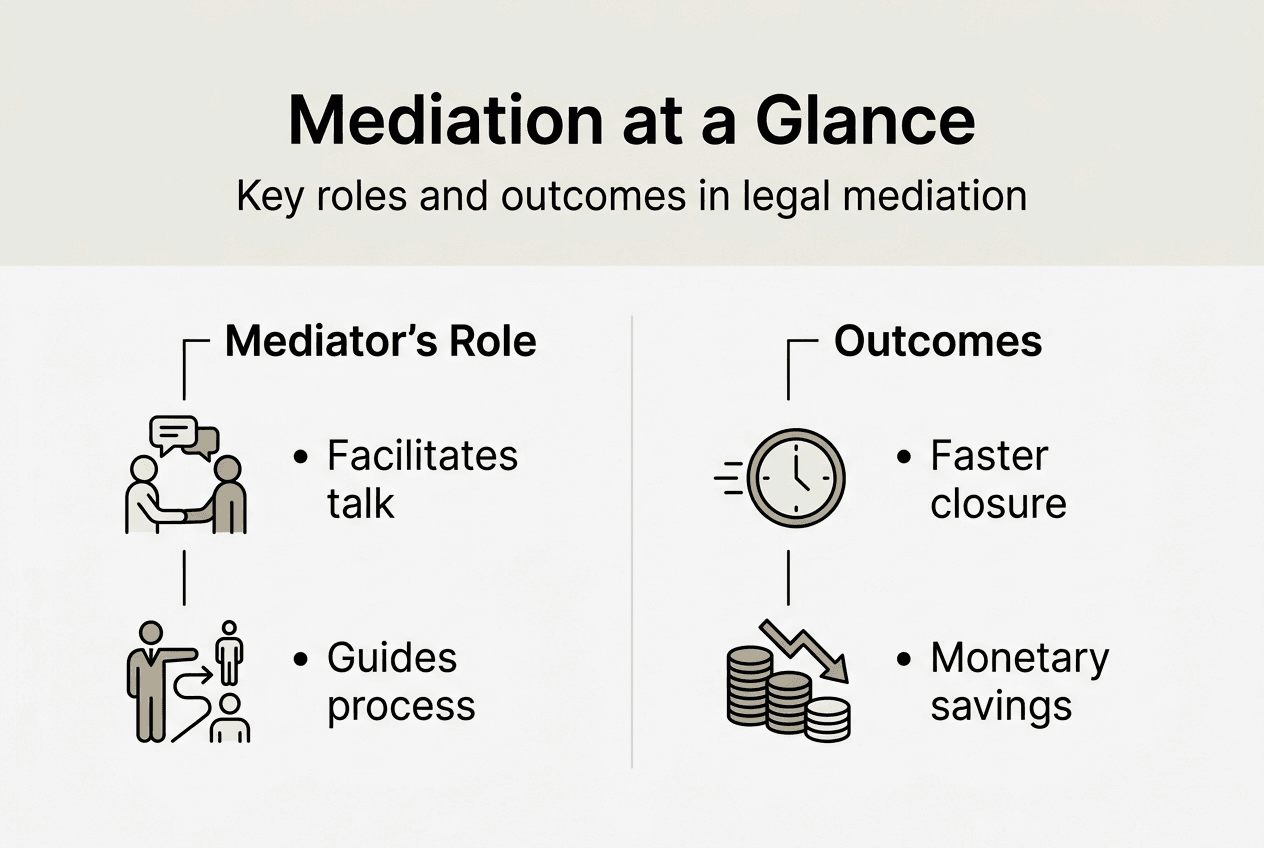
Resolution rates fluctuated between 64.80% and 77.90% over the same period, indicating that roughly two thirds to three quarters of mediated disputes reach settlement. Whilst these rates vary based on case type, complexity, and party willingness, they consistently exceed the settlement rates achieved through traditional litigation pathways.
The average closure time varied from 81 to 147 days between fiscal year 1999 and fiscal year 2020, significantly faster than court proceedings. This speed advantage reduces legal costs, minimises business disruption, and allows parties to move forward more quickly. Time savings alone often justify choosing mediation over litigation.
| Fiscal Year Range | Monetary Benefits | Resolution Rate | Average Days to Close |
|---|---|---|---|
| FY1999-FY2005 | $58.6M-$95.2M | 69.1%-72.1% | 81-97 days |
| FY2006-FY2012 | $103.8M-$145.7M | 70.4%-72.6% | 89-102 days |
| FY2013-FY2020 | $144.6M-$170M | 64.8%-77.9% | 94-147 days |
Pro Tip: Resolution rates and timelines depend heavily on mediator skill, case complexity, and how well parties prepare. Investing time in thorough preparation and selecting an experienced mediator appropriate for your dispute type dramatically improves your chances of success.
Several variables affect mediation success beyond the mediator’s capabilities:
Understanding these dispute resolution methods for businesses helps parties approach mediation strategically. When parties recognise mediation as a distinct process requiring specific preparation and mindset, they position themselves to capitalise on the statistical advantages mediation offers.
The data reveals that mediation consistently delivers value across thousands of cases, but success is not automatic. Parties who understand how mediators work and engage constructively with the process achieve significantly better outcomes than those who treat mediation as a procedural formality.
Managing client expectations is central to effective mediation because unrealistic expectations cause entrenchment and stall resolution. When parties enter mediation believing they will achieve everything they want without compromise, they inevitably feel disappointed and resist reasonable settlement proposals. This psychological barrier often proves more difficult to overcome than the substantive legal issues.
Mediation requires parties to accept uncertainty and trade the possibility of a complete victory at trial for the certainty of a negotiated outcome. Parties who cannot make this mental shift struggle throughout the process. They interpret the mediator’s reality testing as bias, view reasonable compromise suggestions as weakness, and ultimately waste the opportunity mediation presents.
Common mistakes parties make include fundamentally misunderstanding the mediator’s role, being overly cautious about sharing information, or adopting an excessively assertive stance that alienates the other side. Ineffective use of mediator diminishes a party’s position and persuasiveness, turning a potential advantage into a missed opportunity.

Mediators employ specific strategies to counteract these pitfalls. Many conduct early calls with counsel to align expectations, understand party dynamics, and identify potential obstacles before the formal session. Some prefer starting in caucus rather than joint session to control emotional escalation and build trust individually with each party before bringing them together.
The five most damaging mistakes parties make:
Pro Tip: Use the mediator early and openly for best results. Share your concerns, constraints, and priorities candidly in private caucus. The mediator cannot help you effectively if they lack crucial information about your true interests and limitations.
Successful mediation preparation techniques involve more than assembling documents. Parties must psychologically prepare to compromise, identify their genuine interests beyond stated positions, and develop a realistic assessment of their alternatives to settlement. This mental preparation often determines success more than legal arguments.
When parties understand that mediators work differently from judges, they can leverage the mediator’s unique capabilities. Rather than presenting a case to be judged, parties should view mediation as collaborative problem solving with expert facilitation. This shift in perspective transforms how parties engage and dramatically improves outcomes.
Openness and trust with your mediator forms the foundation of effective engagement. Overly cautious parties fail to share crucial information, limiting mediator effectiveness and reducing settlement chances. Whilst maintaining appropriate confidentiality with the opposing party makes sense, withholding key facts from the mediator in private caucus undermines the entire process.
Mediator confidentiality protections mean you can share sensitive information without it being disclosed to the other side. This allows the mediator to understand the complete picture, identify creative solutions, and reality test proposals based on full knowledge of constraints and priorities. Sharing information empowers the mediator to assist better rather than weakening your position.
| Effective Behaviour | Ineffective Behaviour |
|---|---|
| Sharing interests and constraints openly with mediator | Withholding key information or treating mediator with suspicion |
| Listening actively to other party’s perspective | Interrupting, dismissing, or refusing to acknowledge valid points |
| Exploring creative options beyond initial positions | Rigidly adhering to opening demands without flexibility |
| Reality testing proposals against litigation alternatives | Maintaining unrealistic expectations despite evidence |
| Bringing decision-making authority to sessions | Requiring approval from absent parties for every move |
| Preparing thoroughly with legal advice beforehand | Arriving unprepared or without necessary documentation |
Practical tips for engaging constructively:
Pro Tip: Clarify your goals and be realistic about compromise from the outset. Mediation rewards parties who understand their priorities, recognise their alternatives, and approach settlement pragmatically rather than emotionally.
Effective engagement means viewing the mediator as a resource to be utilised fully rather than an obstacle to be managed. When parties ask the mediator for feedback, test settlement ideas confidentially, and genuinely consider the mediator’s observations, they position themselves to achieve optimal outcomes. This collaborative approach with the mediator, combined with appropriate assertiveness regarding your interests, creates the conditions for successful resolution.
Working with mediators and solicitors requires understanding how these professionals complement each other. Your solicitor advocates for your interests and provides legal advice, whilst the mediator facilitates dialogue and helps generate solutions. Using both effectively means being appropriately assertive with the opposing party whilst being open and collaborative with the mediator.
The parties who achieve the best mediation outcomes are those who prepare thoroughly, engage authentically, and maintain realistic expectations throughout. They use the mediator as a strategic resource, share information appropriately, and focus relentlessly on reaching workable solutions rather than winning arguments.
Navigating mediation effectively requires understanding both the process and how to leverage professional support strategically. Ali Legal provides comprehensive support in civil litigation and commercial disputes, helping clients prepare for mediation, understand mediator roles, and develop realistic settlement strategies. Our solicitors bring extensive experience to strengthen your negotiation position and improve settlement outcomes.
We recognise that effective dispute resolution requires more than legal knowledge. Our team helps you assess your alternatives, identify your genuine interests, and develop a pragmatic approach that maximises your chances of achieving a favourable resolution. Whether you face a commercial disagreement, civil claim, or complex multi-party dispute, our strategic guidance positions you to engage effectively with mediators and opposing parties.
Our transparent fee structures and client-focused approach mean you receive clear advice about your options, realistic assessments of likely outcomes, and practical support throughout the mediation process. We help you avoid common pitfalls, prepare thoroughly, and use mediation as a strategic tool rather than a procedural formality.
A mediator facilitates dialogue and guides the process without deciding the outcome or imposing judgements on parties. They help clarify issues, manage expectations, and create space for parties to explore solutions collaboratively whilst maintaining strict neutrality throughout.
Mediation is collaborative and confidential, unlike binding arbitration or court rulings where a third party imposes a decision. Parties control the outcome and can withdraw at any time, whereas arbitration and litigation result in binding decisions that parties must accept regardless of satisfaction.
Misusing the mediator or expecting them to decide the case undermines the process fundamentally. Being too cautious or aggressive, failing to share key information with the mediator, and holding unrealistic expectations that block reasonable compromise all damage settlement chances significantly.
Identify clear objectives and desired outcomes before the session begins. Engage legal advice to understand the process, your rights, and realistic settlement ranges. Prepare thoroughly by gathering documentation and share relevant information openly with the mediator to assist their facilitation effectively.
Settlement agreements resolve over 90% of civil disputes before trial, yet many individuals and businesses remain unclear about how they work. These voluntary arrangements offer a transparent, efficient alternative to lengthy litigation, saving time and money whilst giving parties control over outcomes. This guide explains what settlement agreements are, their benefits, essential components, and modern execution methods to help you navigate dispute resolution confidently.
| Point | Details |
|---|---|
| Settlement agreements provide voluntary resolution | Parties negotiate mutually beneficial terms without court intervention, maintaining control over outcomes. |
| Significant cost and time savings compared to litigation | Disputes resolve in weeks or months rather than years, with reduced legal fees and stress. |
| Enforceability requires clear terms and signatures | Valid agreements need written documentation, signed consent, and unambiguous scope of claims covered. |
| Digital methods accelerate distribution | Modern platforms reduce payment timelines from months to days with real-time tracking capabilities. |
| Legal encouragement from courts and agencies | Judicial systems actively promote settlement attempts to reduce court backlog and litigation expenses. |
A settlement agreement represents a voluntary and mutually beneficial resolution that ends legal disputes without proceeding to trial. These contracts allow parties to negotiate terms that suit their specific circumstances, avoiding the uncertainty and expense of courtroom litigation. Rather than waiting months or years for a judge’s decision, individuals and businesses craft solutions that address their unique needs whilst preserving relationships.
The parties typically involved include the complainant, respondent, their respective legal representatives, and sometimes authorised managers or mediators. Understanding the role of solicitors in dispute resolution helps ensure agreements protect your interests whilst meeting legal standards. Solicitors draft clear terms, verify compliance with statutory requirements, and ensure both parties understand their obligations before signing.
Settlement agreements commonly include these essential elements:
Parties may negotiate various outcomes beyond monetary compensation. Employees might secure positive references, reinstatement to previous positions, or agreements about what employers disclose to future references. Businesses often include non-compete clauses, intellectual property rights transfers, or operational adjustments. The flexibility of settlement terms means solutions can address practical concerns that courts cannot mandate.
Civil trials impose substantial financial burdens, with litigation costs often exceeding £50,000 for straightforward cases and reaching hundreds of thousands for complex disputes. Settlement eliminates these expenses by resolving matters through negotiation rather than protracted court proceedings. Legal fees, expert witness costs, and administrative expenses diminish dramatically when parties reach agreement early.

Time savings prove equally significant. Court backlogs mean trials may not commence for 12 to 24 months after filing, with proceedings then lasting months or years. Settlement discussions conclude within weeks or months, allowing individuals and businesses to move forward without prolonged uncertainty. This efficiency matters particularly for businesses needing to allocate resources and plan operations without pending litigation concerns.
Courts and regulatory agencies actively encourage settlement efforts. The EEOC guide emphasises that settlement ends costly litigation processes benefiting all parties. Judges frequently order mediation sessions and settlement conferences, recognising that negotiated resolutions often produce better outcomes than imposed judgements. This institutional support reflects decades of evidence showing settlements reduce court congestion whilst satisfying disputants more effectively.
Key advantages of settlement include:
Exploring alternatives to litigation for small businesses reveals additional methods for resolving disputes efficiently. Mediation, arbitration, and negotiated settlements offer flexible frameworks suited to different conflict types and business relationships.
Pro Tip: Initiate settlement discussions early, ideally before formal litigation begins. Early negotiations prevent escalating legal costs and preserve working relationships that adversarial court proceedings often irreparably damage.
Legally enforceable settlements require specific elements that distinguish binding contracts from preliminary discussions. Courts examine whether parties reached genuine agreement on essential terms before enforcing settlements. Understanding these requirements prevents disputes about whether valid agreements exist.
Essential components for enforceable settlements include:
An unsigned settlement proves unenforceable when parties disagree about which claims they intended to resolve. Courts focus on the parties’ actual intent and whether they reached mutual understanding on essential terms. Ambiguity about claim scope, compensation amounts, or performance obligations undermines enforceability, allowing parties to withdraw from purported agreements.
Special compliance rules govern certain settlement types. Settlements involving age discrimination must satisfy the Older Workers Benefits Protection Act, requiring specific disclosures and consideration periods. These statutory protections ensure vulnerable parties make informed decisions without pressure.
Legal limitations affect waivers within settlements. Agreements can release past violation claims but typically cannot waive rights to challenge future discrimination or statutory violations. Parties retain abilities to file new complaints about conduct occurring after settlement execution. Understanding contract dispute resolution in the UK helps navigate these nuanced requirements.
| Factor | Enforceable Agreement | Unenforceable Agreement |
|---|---|---|
| Documentation | Written, signed by all parties | Oral discussions or unsigned drafts |
| Claim scope | Specifically identified claims with clear boundaries | Vague references to “all disputes” without details |
| Terms clarity | Precise compensation and obligations | Ambiguous language requiring interpretation |
| Mutual consent | Voluntary agreement with full understanding | Coercion, fraud, or material misrepresentation |
| Statutory compliance | Meets legal requirements for claim type | Violates mandatory statutory protections |
Pro Tip: Insist on written settlement agreements with precisely defined terms before making any payments or performing obligations. Verbal understandings and email exchanges often prove insufficient for enforcement when disputes arise about agreement scope.
Traditional settlement distribution relied on cheque-based systems requiring manual processing, postal delivery, and bank clearing periods. Claimants often waited months or years to receive compensation after agreements finalised. Class action settlements particularly suffered from inefficient notice campaigns producing response rates below 5%, meaning substantial settlement funds remained undistributed.
Digital payment platforms have transformed this landscape dramatically. Modern distribution methods reduce timelines from months to days through automated processing and multiple disbursement channels. Claimants receive payments via bank transfers, digital wallets, or prepaid cards based on their preferences. Real-time tracking provides transparency about payment status, eliminating uncertainty about when compensation arrives.
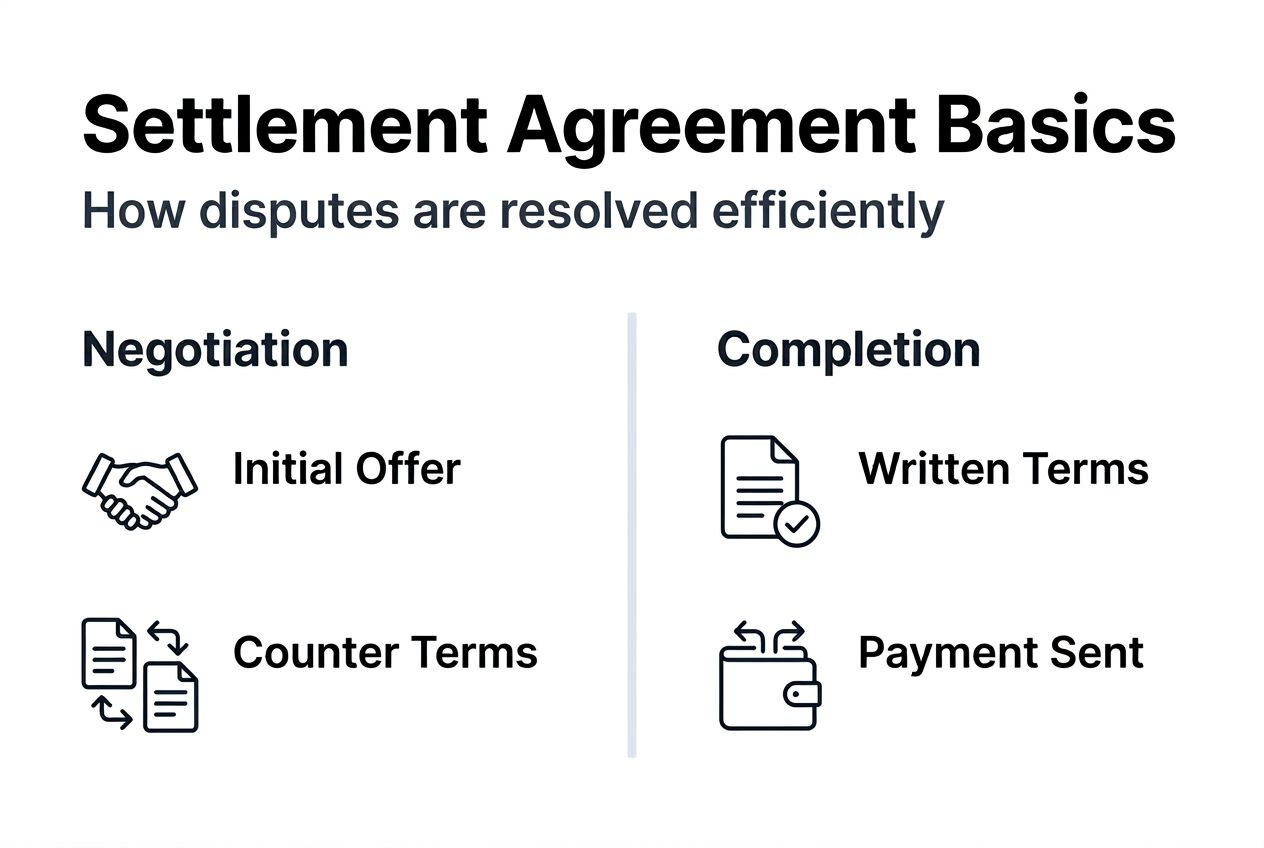
These technological advances benefit all parties involved in settlements. Administrators reduce processing costs by 40 to 60% compared to traditional methods. Claimants access funds faster without cheque cashing fees or bank holds. Defendants achieve final resolution more quickly, closing matters without prolonged distribution periods. The efficiency gains encourage settlement by reducing the friction between agreement and actual compensation.
| Distribution Method | Average Timeline | Typical Claim Rate | Cost per Claimant |
|---|---|---|---|
| Traditional cheques | 6 to 18 months | 3% to 8% | £15 to £25 |
| Digital platforms | 3 to 14 days | 12% to 22% | £3 to £8 |
| Hybrid approach | 2 to 8 weeks | 8% to 15% | £8 to £15 |
Modern settlement execution faces these key considerations:
Understanding civil litigation services helps parties navigate both traditional and modern settlement processes. Professional legal guidance ensures agreements incorporate appropriate payment mechanisms whilst protecting parties’ interests throughout distribution.
Navigating settlement agreements requires legal expertise to protect your interests whilst achieving efficient resolution. Ali Legal specialises in civil litigation with extensive experience crafting settlement agreements that deliver results for individuals and businesses. Our solicitors understand how to structure terms that satisfy all parties whilst ensuring enforceability and compliance with UK legal requirements.
We offer comprehensive support throughout dispute resolution, from initial negotiations through final agreement execution. Our expertise in alternative dispute resolution means we help clients explore mediation, arbitration, and settlement options before committing to costly litigation. When disputes involve commercial matters, our commercial litigation services provide strategy-led approaches that prioritise your business interests whilst pursuing efficient resolution.
Contact Ali Legal today to discuss how settlement agreements can resolve your dispute transparently and efficiently. Our client-focused approach emphasises clear communication, fixed fees, and long-term relationships that extend beyond individual matters.
All signatory parties to the agreement can typically enforce its terms through court proceedings if another party breaches obligations. Courts may intervene when disputes arise about interpretation or performance, examining the original agreement terms and parties’ intent. Non-parties generally cannot enforce settlements unless specifically granted rights within the agreement.
Settlement agreements result from voluntary negotiation between parties, whilst court judgements represent imposed decisions by judges after trial. Settlements offer flexibility to craft customised solutions addressing specific concerns, whereas judgements apply legal standards to determine liability and remedies. Parties control settlement outcomes but have no influence over judicial decisions beyond presenting evidence.
Timelines vary based on dispute complexity, ranging from several weeks for straightforward matters to several months for complicated commercial disputes. Initial negotiations often conclude within 30 to 60 days, with additional time needed for drafting, review, and execution. Digital payment methods significantly reduce distribution timelines, delivering compensation within days after finalising agreements.
Many agreements include confidentiality provisions preventing parties from disclosing terms or underlying dispute facts. These clauses protect sensitive business information and personal matters whilst encouraging candid settlement discussions. However, confidentiality is contractual rather than automatic, so parties must specifically negotiate these terms. Certain regulatory settlements may require public disclosure despite parties’ preferences.
Challenges may succeed if parties demonstrate fraud, duress, material misrepresentation, or fundamental disagreement about essential terms. Courts examine whether parties genuinely consented to agreement terms and shared mutual understanding about claim scope. Ambiguous language or unsigned documents provide grounds for disputing enforceability. Once properly executed with clear terms, settlements generally bind parties permanently, preventing relitigation of resolved claims.
Many people believe judicial review allows courts to overturn any government decision they dislike. This misunderstands a crucial legal principle that protects constitutional limits whilst respecting democratic processes. Judicial review empowers courts to examine whether government actions comply with the law, not to substitute their judgement for elected officials. Understanding this distinction matters for individuals and businesses navigating regulatory frameworks, challenging administrative decisions, or protecting their rights against unlawful government conduct.
| Point | Details |
|---|---|
| Definition | Judicial review allows courts to assess whether government actions comply with constitutional and statutory law |
| Court powers | Courts can set aside unlawful agency decisions and compel compliance with legal requirements |
| Legal limits | Standing, ripeness and mootness doctrines restrict which cases courts can hear |
| Business impact | Judicial review shapes regulatory compliance, contract enforcement and administrative obligations |
| Procedural requirements | Claimants must show direct harm, timely disputes and proper jurisdiction to obtain review |
Judicial review represents the power of courts to examine actions taken by other government branches and declare them invalid if they violate constitutional or statutory provisions. This fundamental principle emerged from Marbury v. Madison, an 1803 case establishing that courts could invalidate laws contradicting the U.S. Constitution. Whilst originating in American jurisprudence, similar principles operate in British law through different mechanisms.
Judicial review serves several critical functions in modern legal systems. Courts use this power to maintain constitutional limits on government authority, ensuring no branch exceeds its lawful powers. This creates accountability for administrative agencies and elected bodies whose decisions affect millions.
The practical significance extends beyond abstract constitutional theory:
“The Constitution is law, and courts must interpret it as such. When government actions conflict with constitutional provisions, courts have the duty to declare those actions void.”
This principle doesn’t grant courts unlimited power. They cannot review purely political decisions or substitute their policy preferences for those of elected officials. Judicial review focuses narrowly on legal compliance, asking whether government actors followed proper procedures and stayed within their lawful authority.
Federal agencies operate under statutory frameworks that authorise judicial review of their actions. The Administrative Procedure Act (APA) provides the foundation for challenging agency decisions in many jurisdictions. This statute establishes when and how courts can examine administrative actions.
Courts review final agency action not precluded by statute or committed to agency discretion. This means several conditions must exist before judicial intervention occurs. The agency must have completed its decision, the statute must permit review, and the matter cannot fall within the agency’s unreviewable discretion.
When reviewing agency actions, courts can:
The review process involves specific legal standards. Courts examine whether agencies followed proper procedures, considered relevant factors, and reached conclusions supported by evidence. They don’t substitute their judgement for the agency’s expertise but ensure decisions rest on rational foundations.

Several limitations constrain judicial review. Statutes may explicitly preclude review of certain agency actions. Standing requirements demand that claimants show direct injury. Ripeness doctrine prevents premature challenges before disputes fully develop. The role of compliance officer UK becomes crucial here, as businesses need expertise identifying when agency actions create reviewable harm.
| Review type | Standard applied | Court action available |
|---|---|---|
| Procedural | Did agency follow required steps? | Remand for proper procedure |
| Substantive | Is decision supported by evidence? | Set aside arbitrary action |
| Jurisdictional | Did agency exceed authority? | Invalidate ultra vires action |
| Constitutional | Does action violate rights? | Declare unconstitutional |
Pro Tip: Document all interactions with administrative agencies meticulously. Courts reviewing agency decisions examine the administrative record, making contemporaneous documentation essential for successful challenges.
The Administrative Procedure Act creates presumptions favouring reviewability whilst respecting agency expertise. This balance acknowledges that agencies possess technical knowledge courts lack whilst ensuring legal accountability.
Three justiciability doctrines determine whether courts can hear cases challenging government action. These principles prevent courts from deciding abstract disputes or issuing advisory opinions, maintaining proper separation of powers.
Standing requires plaintiffs to demonstrate a personal stake in the dispute. Courts demand concrete injury, causation linking that injury to the challenged action, and likelihood that a favourable decision would redress the harm. Generalised grievances shared by all citizens don’t suffice. You must show specific harm affecting you differently than the general public.
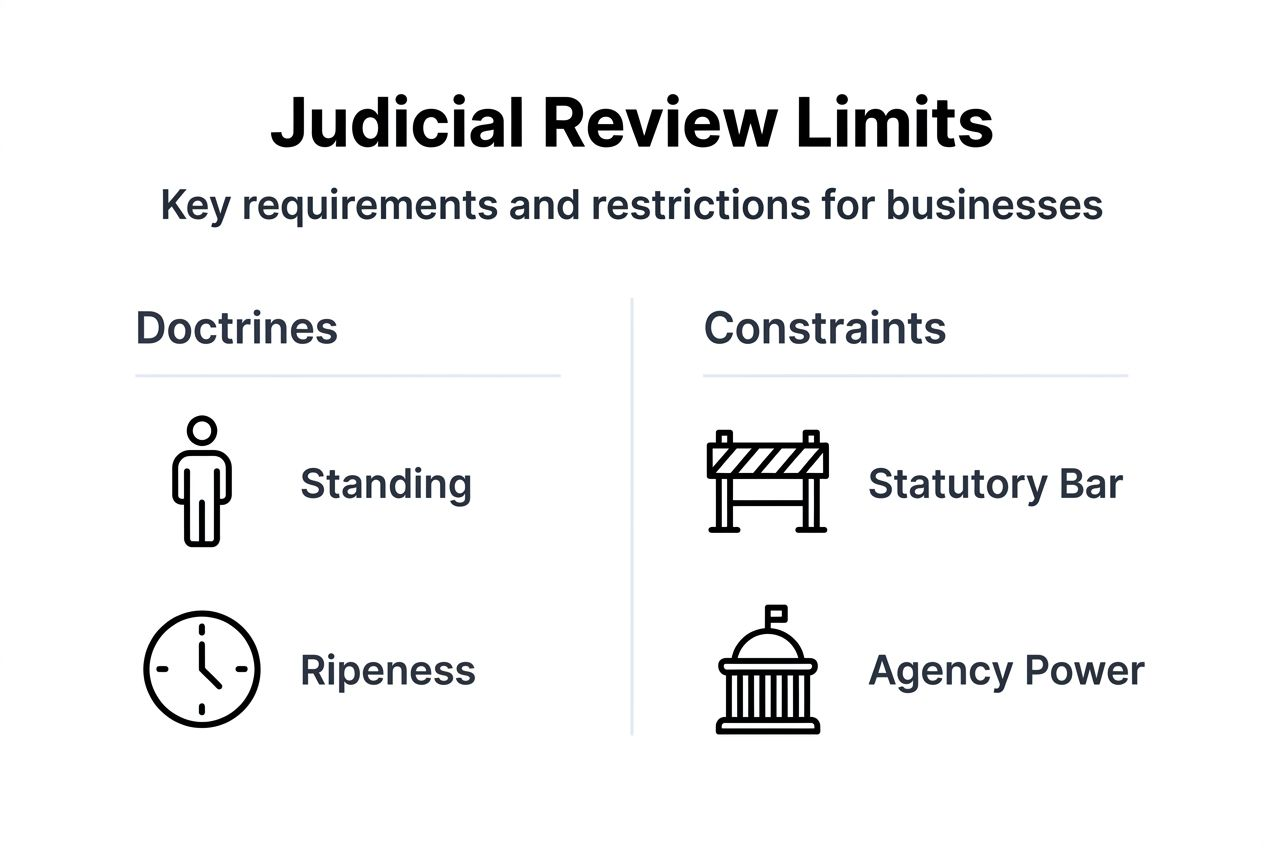
Ripeness addresses timing. Cases must be ready for judicial decision, balancing issue fitness for review against hardship from delayed consideration. Courts evaluate whether the dispute has crystallised sufficiently and whether withholding review would impose undue hardship. This doctrine prevents premature challenges whilst allowing intervention when administrative positions harden.
Mootness operates at the opposite end. Courts refuse hearing disputes where changed circumstances eliminate live controversy. If the challenged action ends or the plaintiff’s situation changes, making relief impossible or unnecessary, courts dismiss as moot. Exceptions exist for disputes capable of repetition yet evading review due to their brief duration.
These doctrines serve vital functions:
Businesses must understand statutory limitation UK principles when planning challenges. Timing matters enormously. File too early and courts dismiss for lack of ripeness. Wait too long and mootness or limitation periods bar review.
Pro Tip: Consult legal counsel immediately when government actions threaten your interests. Justiciability doctrines create narrow windows for effective challenges, and procedural missteps can permanently foreclose judicial review.
Some disputes escape these limits. Class actions allow individual plaintiffs to raise claims benefiting many. Voluntary cessation of challenged conduct doesn’t moot cases if defendants might resume. These nuances require expert legal analysis.
Judicial review profoundly affects regulatory compliance, shaping how businesses operate under administrative rules. When agencies promulgate regulations, affected parties can challenge those rules in court, potentially invalidating requirements imposing substantial costs. This creates both opportunities and uncertainties for commercial operations.
Businesses face several scenarios where judicial review matters:
Recent cases demonstrate judicial review’s tangible impact. Courts struck down agency merger notification rules, eliminating compliance burdens businesses faced. Such decisions can save millions in compliance costs whilst reshaping competitive landscapes. They also create uncertainty, as rules businesses relied upon may suddenly disappear.
For individuals, judicial review provides recourse against adverse administrative decisions. Immigration denials, benefit terminations, professional licensing disputes and tax assessments all potentially involve reviewable agency action. Success requires meeting jurisdictional requirements and demonstrating legal error.
| Stakeholder | Typical review scenario | Potential outcome |
|---|---|---|
| Businesses | Challenge to new regulation | Rule invalidated, compliance costs avoided |
| Individuals | Immigration decision appeal | Visa denial reversed, rights restored |
| Competitors | Licensing granted to rival | Competitor’s licence revoked |
| Public interest groups | Environmental permit challenge | Permit vacated, project halted |
Navigating these processes demands expertise. The regulatory & compliance landscape grows increasingly complex, with judicial review adding another layer. Businesses need strategies addressing both compliance with existing rules and potential challenges to those rules.
The role of legal counsel business UK becomes essential when government actions threaten commercial interests. Counsel can assess whether administrative decisions meet legal standards, identify grounds for challenge, and navigate procedural requirements. Early involvement maximises chances of successful judicial review.
Successful challenges require demonstrating that agencies acted arbitrarily, exceeded authority, or failed to follow proper procedures. Courts won’t overturn decisions merely because different policy choices might seem preferable. The focus remains on legal compliance, not policy wisdom.
Navigating judicial review requires specialised legal expertise combining administrative law knowledge with strategic litigation skills. Whether you’re challenging government decisions or defending against claims, professional guidance proves essential for protecting your interests.
Ali Legal brings extensive experience to commercial litigation involving regulatory disputes and administrative challenges. We understand how judicial review intersects with business operations, helping clients assess when government actions exceed lawful authority and how to mount effective challenges.
Our civil litigation services extend to judicial review proceedings, where we guide clients through complex procedural requirements whilst developing compelling legal arguments. We handle matters from initial assessment through final resolution, ensuring your rights receive vigorous protection.
For businesses facing regulatory challenges, our regulatory compliance services provide comprehensive support. We help you understand obligations, identify potential grounds for challenging unlawful requirements, and develop strategies minimising legal risk whilst protecting commercial interests.
Judicial review allows courts to examine whether government actions comply with legal requirements. Courts can invalidate decisions that exceed statutory authority, violate constitutional provisions, or fail to follow proper procedures. This creates accountability for administrative agencies and elected bodies.
Anyone suffering direct, concrete harm from government action can potentially request judicial review. You must demonstrate standing by showing the challenged action injured you specifically, not just the general public. Businesses, individuals and organisations can all seek review if they meet jurisdictional requirements.
Courts review final agency actions not precluded by statute or committed to agency discretion. This includes regulations, licensing decisions, benefit determinations and enforcement actions. Political decisions and matters within executive discretion typically escape review. The action must be complete and ripe for judicial consideration.
Standing requires showing you suffered concrete injury from the challenged action, that injury was caused by the defendant’s conduct, and a favourable court decision would likely redress your harm. Generalised grievances shared by everyone don’t create standing. You need personal, particularised injury distinguishing you from the general public.
Judicial review shapes regulatory compliance by allowing businesses to challenge unlawful rules. Courts can invalidate regulations imposing unjustified costs or exceeding agency authority. This creates opportunities to contest burdensome requirements whilst introducing uncertainty about rule stability. Businesses need legal counsel to navigate these dynamics effectively.
Many UK business owners believe due diligence is only necessary for large corporations during complex mergers. This misconception leaves small and medium enterprises vulnerable to hidden liabilities that could derail their transactions. Due diligence is a critical process for all UK businesses and individuals involved in significant transactions, whether you’re purchasing property, acquiring a company, or entering a major investment. This guide explains what due diligence is, why it matters in UK legal contexts, and how it helps you make safer business and investment decisions.
| Point | Details |
|---|---|
| Risk identification | Due diligence uncovers legal, financial, and operational risks before transactions complete. |
| Multiple types | It involves legal, financial, operational, reputational, and compliance checks tailored to each transaction. |
| Ongoing process | The process is multi-stage and continuous, not a one-time task. |
| Negotiation power | Thorough due diligence improves your negotiation position and reduces deal risks. |
| Common mistakes | Misconceptions about due diligence can cause costly errors if ignored. |
Due diligence is a thorough investigation and verification process conducted before major transactions to uncover financial, legal, and operational risks. It protects individuals, small businesses, and large corporations alike from entering agreements that could lead to unexpected liabilities or disputes. The purpose is straightforward: gather and analyse all relevant information about a transaction to make informed decisions and negotiate from a position of strength.
This process applies to various scenarios. When purchasing commercial property, due diligence reveals title defects, planning restrictions, or environmental issues. During corporate acquisitions, it exposes hidden debts, pending litigation, or intellectual property problems. For investment decisions, it assesses the target’s compliance with regulations and operational sustainability.
Skipping or rushing due diligence can lead to unforeseen financial obligations, hidden liabilities, litigation risk, and deal collapse. UK data shows that SMEs often underestimate due diligence necessity, increasing their vulnerability to these risks. The financial impact can be devastating, with businesses facing claims that exceed the transaction value itself.
The types of risks uncovered through due diligence include:
“Due diligence is not optional for UK businesses. It’s a fundamental requirement that protects your investment and ensures compliance with legal obligations before committing to any significant transaction.”
Understanding these fundamentals helps you approach transactions with appropriate caution and preparation. The UK due diligence legal requirement extends across multiple transaction types, making it essential knowledge for any business owner or investor.
Different transactions require specific types of due diligence. Understanding each category helps you allocate resources effectively and engage the right experts for your situation.
Legal due diligence focuses on contracts, litigation exposure, intellectual property rights, and regulatory compliance. Legal due diligence involves detailed review of contracts, litigation exposure, intellectual property, and regulatory compliance before mergers or property purchases. This type is critical for corporate acquisitions and property transactions where legal risks could derail the deal.
Financial due diligence examines accounting records, tax returns, revenue streams, debts, and financial projections. It verifies that financial statements accurately represent the business’s health and identifies any hidden liabilities or overvalued assets.
Operational due diligence assesses business processes, technology systems, supply chains, and key personnel. It reveals inefficiencies or dependencies that could affect post-transaction performance.
Reputational due diligence investigates the target’s market standing, customer satisfaction, and any negative publicity. This matters particularly when brand value is significant to the transaction.
Compliance due diligence verifies adherence to industry regulations, employment law, data protection requirements, and environmental standards. Understanding the compliance officer role UK businesses must fulfil helps structure this aspect correctly.
| Type | Focus Area | Key Activities | Application Scenarios |
|---|---|---|---|
| Legal | Contracts, litigation, IP | Document review, title searches, litigation checks | Mergers, property purchases, investments |
| Financial | Accounts, tax, debts | Financial statement analysis, tax review, asset valuation | All transactions involving monetary exchange |
| Operational | Processes, systems, personnel | Site visits, process mapping, technology audits | Acquisitions where business continuity matters |
| Reputational | Brand, customer relations | Market research, media analysis, customer surveys | High-profile acquisitions, brand-sensitive deals |
| Compliance | Regulations, standards | Regulatory review, policy audits, certification checks | Regulated industries, cross-border transactions |
Examples of when each type proves critical:
Pro Tip: Engage specialists in each due diligence area rather than relying on generalists. A corporate lawyer, forensic accountant, and operational consultant working together provide comprehensive coverage that a single adviser cannot match.
The solicitor role in acquisitions often coordinates these different due diligence streams, ensuring nothing falls through the cracks. Understanding 2025 rules legal due diligence helps you stay compliant with current requirements.
Due diligence follows a structured yet adaptable process. Due diligence is not a one-time check but an ongoing process including investigation, verification, reporting, and monitoring. Each stage builds on the previous one, creating a comprehensive understanding of the transaction’s risks and opportunities.
The typical process includes these stages:
Typical documents required include articles of association, shareholder agreements, employment contracts, customer contracts, supplier agreements, financial statements for three years, tax returns, property titles, lease agreements, intellectual property registrations, litigation records, insurance policies, and regulatory licences.
Stakeholders typically involved are solicitors handling legal review, accountants conducting financial analysis, technical experts assessing operational matters, company directors providing information, and external advisers offering specialist expertise.
Pro Tip: Balance thoroughness with transaction timelines by prioritising high-risk areas first. If time is limited, focus on financial records, major contracts, and litigation exposure before expanding to secondary concerns.
The corporate law checklist steps provides a framework for organising this process. Remember that due diligence adapts as new information emerges. Discovering one issue often reveals others, requiring additional investigation before proceeding.
Real estate and corporate transactions each require tailored due diligence approaches reflecting their unique risk profiles.

Real estate due diligence focuses on physical and legal property aspects. Investigations include structural surveys to identify defects, title searches confirming ownership and revealing restrictions, environmental assessments checking contamination, planning permission verification for intended use, lease reviews identifying tenant obligations, and local authority searches revealing planned developments affecting value.
Legal due diligence includes property inspections, ownership verification, contracts, litigation, and intellectual property reviews in these transactions. Common risks uncovered include title defects preventing clear ownership transfer, restrictive covenants limiting property use, undisclosed structural problems requiring expensive repairs, planning violations risking enforcement action, and environmental contamination creating cleanup liability.
Corporate due diligence examines the business entity comprehensively. Key activities include contract review identifying unfavourable terms or automatic termination clauses, litigation searches revealing pending claims, intellectual property audits confirming ownership and protection, regulatory compliance checks ensuring all licences remain valid, and financial analysis verifying profitability and identifying hidden liabilities.
Risks frequently discovered in corporate transactions:
Due diligence findings directly affect negotiation strategies. Discovering structural defects in property transactions typically leads to price reductions or seller-funded repairs. In corporate deals, uncovered litigation might require indemnities protecting the buyer from losses, or escrow arrangements holding back purchase price until resolution.
The solicitor role acquisitions involves managing these complex investigations. Understanding merger and acquisition UK processes helps you navigate corporate transactions effectively. Properly drafting commercial contracts following due diligence findings protects your interests long term.
Several misconceptions prevent businesses from conducting effective due diligence. Recognising these errors helps you avoid costly mistakes.
Misconception 1: Only large corporations need due diligence. Many believe due diligence is only for large corporations; actually, it reduces but does not remove all risks and is vital for all business sizes. Small business transactions carry proportionally greater risk because owners typically have more personal exposure. A single undiscovered liability could threaten their entire financial security.
Misconception 2: Due diligence guarantees no risks remain. Due diligence significantly reduces risk but cannot eliminate it entirely. Some issues remain hidden despite thorough investigation. The process identifies material risks allowing informed decisions, not perfect certainty.
Misconception 3: It’s a one-time check. Effective due diligence continues after transaction completion. Circumstances change. Representations made during negotiations may prove inaccurate. Ongoing monitoring catches emerging issues before they become serious problems.
Misconception 4: Due diligence is purely defensive. While risk identification is important, due diligence also reveals opportunities. It might uncover undervalued assets, identify operational improvements, or highlight market advantages not initially apparent.
Misconception 5: You can conduct it yourself without professional help. Complex transactions require specialist expertise. Legal, financial, and technical issues demand professional analysis. Attempting DIY due diligence often misses critical problems that experts would immediately recognise.
Myths versus facts:
Correcting these misconceptions improves your approach to transactions. Understanding due diligence misconceptions helps you avoid the costly errors that derail deals or create post-completion problems.
Due diligence findings directly influence transaction terms and outcomes. The information discovered provides powerful negotiation leverage and informs critical decisions.
Price adjustments are the most common outcome. Discovering undisclosed liabilities justifies reducing the purchase price pound for pound. Finding overvalued assets supports similar reductions. In property transactions, structural defects often lead to price negotiations reflecting repair costs plus a discount for inconvenience.
Warranty and indemnity negotiations protect buyers against discovered risks. If due diligence reveals potential litigation, you might require specific indemnities covering all losses from those claims. For tax issues, warranties confirming accurate tax returns with indemnities for any assessments provide protection.
Conditions precedent might be added to the contract. You could make completion conditional on resolving identified regulatory violations, obtaining necessary consents, or key employees signing new contracts.
Deal structure modifications address discovered issues. Finding pension deficits might lead to excluding the pension scheme from the transaction. Intellectual property problems could result in licensing arrangements rather than outright purchase.
Go or no-go decisions ultimately rest on due diligence findings. Some issues prove too significant to overcome through price adjustments or indemnities. Walking away from a bad deal is often the wisest outcome.
Negotiation leverage points derived from due diligence:
Pro Tip: Engage legal counsel early in the due diligence process, not after discovering problems. Lawyers experienced in commercial contracts drafting can immediately assess the significance of findings and advise on appropriate responses, maximising your negotiation outcomes.
The quality of your due diligence directly correlates with your negotiation success. Thorough investigation supported by expert analysis gives you confidence to either proceed with appropriate protections or withdraw before committing resources to a problematic transaction.
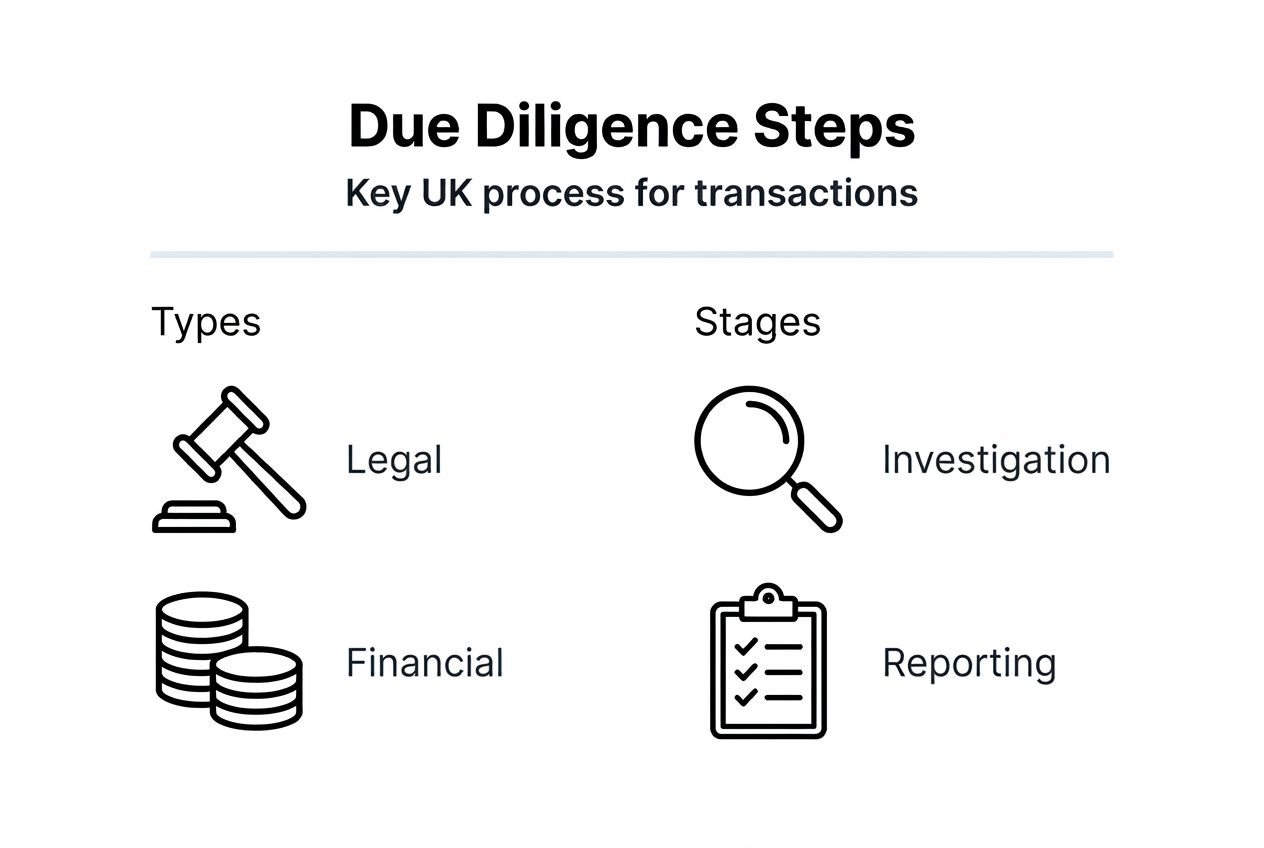
Conducting effective due diligence requires systematic preparation and execution. These practical steps help individuals and business owners manage the process confidently.
Pro Tip: Don’t overlook continuous monitoring after the initial process. Circumstances change between agreement and completion. What was accurate initially may no longer be true. Regular updates protect you from surprises at completion.
Balancing thoroughness with deal timelines requires prioritisation. Focus first on areas most likely to contain material issues. For corporate transactions, that typically means financial records, major contracts, and litigation exposure. Expand to secondary areas as time permits.
The solicitor role in acquisitions includes coordinating these various due diligence streams. Professional guidance ensures you don’t miss critical steps while maintaining momentum towards completion.
Due diligence protects UK businesses and individuals from entering transactions with hidden risks that could prove financially devastating. It’s a multi-stage, ongoing process requiring systematic investigation across legal, financial, operational, reputational, and compliance areas. While it cannot guarantee perfect outcomes, thorough due diligence significantly reduces risk and provides the foundation for confident decision-making.
The process applies to all transaction sizes and types. Small businesses benefit as much as large corporations. Property purchases require the same rigour as corporate acquisitions. The investment in proper due diligence pays dividends through better negotiated terms, avoided problems, and successful transaction outcomes.
Early engagement with legal and financial experts improves results dramatically. Professionals spot issues that inexperienced reviewers miss. They know where problems typically hide and how to verify representations effectively.
Next actionable steps to start due diligence effectively:
Approaching transactions with this structured due diligence mindset transforms how you evaluate opportunities. You’ll negotiate from strength, avoid costly mistakes, and build a sustainable business through informed decision-making.
Navigating due diligence requires experienced legal guidance to protect your interests and maximise transaction outcomes. Ali Legal offers comprehensive support throughout the entire process, from initial planning through to post-completion monitoring.
Our team has extensive experience conducting due diligence for property transactions, corporate acquisitions, and investment decisions across diverse industries. We understand UK legal requirements and identify risks that could derail your transaction or create future liabilities. When disputes arise from undiscovered issues, our civil litigation services provide robust representation to protect your position.
For corporate transactions, our specialised solicitors guide you through complex merger and acquisition insights while conducting thorough investigations into target companies. We understand the solicitor role in acquisitions and coordinate all aspects of your due diligence efficiently.
Key services include legal due diligence reviews covering contracts, litigation, and compliance, financial analysis coordination with accountant partners, negotiation support to secure favourable terms, contract drafting reflecting due diligence findings, and ongoing monitoring arrangements protecting your interests post-completion.
Contact Ali Legal early in your transaction planning. Early engagement allows us to shape your due diligence strategy appropriately and prevent costly mistakes. Our transparent fixed-fee arrangements mean you’ll know costs upfront, allowing confident budgeting for professional support that genuinely strengthens your position.
Due diligence is a thorough investigation and assessment process before major transactions to identify risks and ensure informed decisions. It covers legal, financial, and operational checks relevant to UK businesses and individuals. The process verifies that what you’re being told about a property, business, or investment is accurate and complete.
Typically the buyer or investor leads due diligence to safeguard their interests before committing funds. It should be conducted early during negotiations to allow risk identification before deals progress too far. Starting due diligence after agreeing terms often reveals problems when you’ve lost negotiation leverage.
Skipping due diligence exposes you to unexpected financial liabilities, hidden debts, and legal disputes that could exceed the transaction value. You face potential deal collapse or costly renegotiations when problems surface later. Without proper investigation, you lose negotiation leverage and make decisions based on incomplete or inaccurate information, often with devastating financial consequences.
Due diligence significantly reduces risks but cannot guarantee complete elimination of all potential problems. Some issues remain hidden despite thorough investigation, and circumstances can change between agreement and completion. That’s why ongoing monitoring after the initial process remains essential for catching emerging issues before they become serious problems.


