
Menu
Get Expert Legal Support Today
Securing business legal support that truly spans cross border company formation, employment compliance and ongoing workplace disputes often means facing advisers who only cover one side or hide fees behind consultations. Many law firms do not publish fixed fees, limit support to narrow domestic issues or lack the in house experience needed for international expansion projects. This comparison outlines how three leading corporate and employment law solicitors differ on jurisdiction coverage, billing transparency and language capability so you can match the right adviser to your organisation’s scope and risk profile.

Ali Legal advertises a clear UK and UAE practice focus, positioning itself to help companies set up in the UAE while managing UK commercial and real estate matters. The firm markets a client centric approach that emphasises speed, clarity and long term advisory relationships.
UAE business setup with practical support for company formation, licences and local structuring aimed at international expansion.
International dispute resolution and commercial litigation support across jurisdictions with attention to cross border enforcement issues.
Dedicated corporate and real estate teams that combine legal drafting, regulatory advice and transaction management for commercial projects.
Client communications routed through clear contact points and supported by technology for document handling and streamlined correspondence.
Ali Legal frames its work as a partnership rather than transactional instruction, combining specialist legal knowhow with commercial judgement to shape long term outcomes. That collaborative stance is most visible in engagements that span company formation through to ongoing advisory and dispute prevention.
The vendor advertises high client satisfaction with positive Google reviews which provides a quick reputational signal when you are selecting counsel.
Deep experience across UK and UAE matters gives practical value when a single adviser must manage both jurisdictions during a market entry project.
The team offers cross discipline coverage for corporate, property and dispute work, reducing the need to coordinate multiple law firms when matters overlap.
Client communications emphasise clear timelines and direct contact points so you see progress notes and next steps without long email chains.
Tech enabled document handling makes contract templates and file exchanges simpler for busy in house teams.
Business owners, in house legal teams and entrepreneurs planning UK to UAE expansion who need a single adviser to manage company formation, contracts and cross border disputes. Best suited to teams that have executive bandwidth for a retained legal relationship.
A single firm that explicitly combines UK commercial practice with hands on UAE company setup work. That configuration reduces handovers and shortens the time from strategic decision to operational entity, which matters when you must move quickly on licences, leases or commercial contracts.
A UK based founding team engages Ali Legal to form a UAE subsidiary, draft distribution and services agreements, and apply for local licences. The firm then provides ongoing advisory cover so contracts and employment matters are handled without re onboarding new counsel.
The vendor does not publish fees. The website highlights transparent contact channels and a client focused briefing process but specific retainer brackets or fixed fee packages are not listed so you should expect a bespoke proposal after an initial consultation.
Website: https://alilegal.co.uk

Employee-owned and focused solely on workplace law, Doyle Clayton operates from London, Bristol and Reading and concentrates on employment, education, immigration and dispute resolution for employers and individuals.
The firm emphasises clear, commercially minded guidance and a practice model that ties staff accountability to ownership.
The defining feature is the employee ownership model which the firm cites as central to its culture. That structure promotes staff involvement in decision making and is intended to make senior advisers directly accountable for client outcomes.
This is the practical difference you notice in meetings and fee discussions rather than a marketing line on a website.
Professional presentation of the team. Meetings and written advice read like the work of experienced employment lawyers.
Good training provision. The firm offers structured training for in-house HR teams and school staff in the education sector.
Strong sector focus. Narrow specialism in employment and workplace disputes means depth on contracts, grievances and tribunal work.
Multiple service routes. The practice represents both businesses and individuals which helps when a matter touches both sides of an employer relationship.
Regional presence. Offices in London, Bristol and Reading make face to face meetings practical across southern England.
Mixed client feedback. Some user reviews cite poor responsiveness and gaps in accountability after matters close which suggests variability in follow up.
Occasional rushed delivery. A number of complaints refer to work that felt hurried or supported by inadequate equipment.
Service inconsistency. The pattern of mixed reviews points to uneven experience across teams and cases.
If you need a low cost rapid answer for straightforward employment queries the firm may not be the best fit. The reported variability in post-service support means it is not ideal where predictable cheap advice and instant turnaround are the priority.
If your matter is highly transactional and requires a fixed quick fee, look at smaller specialists or an alternative panel that publishes standard fees.
Employers, HR professionals and employees facing complex workplace disputes, discrimination claims or regulatory investigations will find the firm relevant. Schools and universities seeking tailored education sector support are a natural fit.
A mid-sized employer with a contractual dispute and potential tribunal claim can instruct Doyle Clayton for case assessment, settlement negotiation and tribunal representation. The firm can also provide concurrent HR training to reduce repeat exposures.
Not applicable. The firm does not publish standard fees in the source information and typically handles charging through case specific proposals and fee arrangements.
Website: https://doyleclayton.co.uk

3CS’s marketing materials state it serves over 600 international clients, including more than 50 Fortune Global 500 organisations. That client figure explains why the firm combines fixed fees for immigration and property work with hourly rates for litigation and employment advice.
The firm operates from offices in London and Tokyo and markets a multilingual bench with Japanese, Chinese and Korean legal specialists to support inward investment and UK expansion from Asia Pacific.
The firm’s practical edge is its Asia Pacific focus combined with in‑country capability. For companies coming from that region the bilingual teams and a Tokyo office reduce onboarding time and lower the need for external counsel to bridge cultural or language gaps.
This positioning is narrower than many London full service firms. 3CS trades breadth of local boutique relationships for a smoother path for Asia Pacific clients entering the UK.
If you are an individual seeking personal legal services or a small domestic-only matter, 3CS is not the natural match. The firm is optimised for corporate clients and cross border mandates rather than local, one off personal disputes.
International companies, startups and multinational organisations expanding into the UK, especially those with Asia Pacific ties. Legal operations and HR leaders who need advisers able to work in English and East Asian languages will find value here.
A Japanese tech startup engages 3CS to set up a UK subsidiary, draft employment contracts and manage skilled worker visas. The multilingual team handles sponsor licence applications and coordinates lease review under a fixed fee for the immigration and property pieces.
Pricing varies by service. The firm advertises fixed fees for immigration and property transactions and hourly rates for litigation, employment and dispute resolution. Estimates are provided after an initial consultation and scope review.
Website: https://3cslondon.com
Understanding which specific qualities can address your legal needs streamlines the selection process when considering these solicitors.
| Solicitor | Core Offering | Key Differentiator | Best For | Notable Limitation |
|---|---|---|---|---|
| Ali Legal | UAE company setup, cross-border disputes, and integrated commercial transactions | Partnership-based consultancy blending legal expertise with industry insight. | Businesses needing UK-UAE legal solutions for expansion projects. | Lack of published pricing details complicates initial budgeting for smaller firms. |
| Doyle Clayton | Employment law, HR guidance, and sector-specific training services | Employee ownership structure ensuring client-focused accountability. | Employers needing HR training or workplaces facing legal disputes. | Reported inconsistencies in follow-up and service satisfaction. |
| 3CS Corporate Solicitors | Multilingual corporate and immigration law support tailored for Asia Pacific clients | Expertise in East Asian languages facilitating smoother UK business entry. | Asia Pacific companies expanding their presence into the UK market. | Less focused assistance for smaller or purely local legal issues. |
Navigating the complexities of corporate and employment law can feel daunting, especially when your business spans multiple jurisdictions like the UK and UAE. Alilegal understands the need for clear communication, strategic advice, and long-term legal partnership that makes setting up and managing your operations straightforward. Their client-centric approach focuses on speed, transparency and reliable support across company formation, contracts, and dispute resolution.

Take control of your legal challenges with Alilegal’s specialist teams who blend practical legal expertise with commercial judgement to deliver actionable outcomes. Whether you are expanding internationally or managing employment disputes, get clear timelines, direct contact points, and tech-enabled document handling all designed to reduce complexity. Visit All | Ali Legal to learn more and start your enquiry today by contacting them directly through Alilegal Contact. Secure your comprehensive legal solution built just for your corporate and employment needs.
Alilegal offers dedicated UAE business setup services, which include practical support for company formation, licences, and local structuring aimed at international expansion. This is highlighted by their focus on a client-centric approach that emphasizes speed and clarity. Businesses looking to enter the UAE market can expect tailored advice and support through Alilegal’s extensive expertise in both jurisdictions.
Doyle Clayton is well-regarded for its clear and commercially minded legal guidance strictly within workplace law matters, making it suitable for employers and individuals facing employment disputes. In contrast, Alilegal excels in managing cross-border corporate and employment issues, especially for businesses expanding from the UK to the UAE. This makes Alilegal a more suitable choice for clients needing comprehensive support across two jurisdictions rather than a singular focus on employment law.
Alilegal does not publish fixed pricing, which suggests a premium model tailored to specific client needs, particularly for companies looking for bespoke proposals after an initial consultation. This may make budgeting challenging for smaller firms or startups, who should prepare for variable costs based on their unique requirements.
Yes, Alilegal offers ongoing advisory cover, ensuring that contracts and employment matters are handled without needing to onboard new counsel. This feature provides continuity for businesses that require long-term legal support as they grow and evolve in the UAE and UK markets.
Alilegal emphasises clear communications routed through dedicated contact points, supported by technology for document handling and streamlined correspondence. This structure allows clients to stay informed about progress with clear timelines and next steps, reducing confusion and lengthy email chains. Clients seeking efficient and transparent interactions will find this approach beneficial.
Securing commercial property and business law advice that blends sector expertise with practical deal support is often hindered by solicitors who limit scope, provide scant pricing clarity, or lack direct senior involvement in client matters. Many legal providers only offer generic services or restrict fee transparency to post-instruction quotes, making it hard to plan budgets and timelines up front. This comparison gives you clarity on senior oversight, specialisation and pricing approach across four firms so you can select the solicitor whose advisory model aligns with your portfolio and transaction needs.

Ali Legal’s marketing materials highlight end-to-end support from company setup to ongoing compliance in the UAE, a practical capability for firms expanding to Gulf markets. The team is regulated by the Solicitors Regulation Authority, and the firm positions itself on clarity, speed and long-term client relationships.
Ali Legal emphasises long-term relationships and pragmatic communication rather than one-off, transaction-only engagements. That focus changes how they structure instructions, pushing for retained advisory roles and continuity across deals and compliance cycles.
Deep local knowledge of UK and UAE law, which helps when drafting cross-jurisdictional sale agreements or lease arrangements for property investors.
Proactive advisory style that flags regulatory risks early, reducing the chance of last-minute hurdles in completions and financings.
Broad service coverage from startup formation to complex transactions, so you can keep a single adviser through growth phases and disputes.
Multilingual team and established contacts in key markets, useful when you need translations, filings, or direct follow up with local regulators.
Businesses, investors and entrepreneurs planning UK–UAE activity who want a solicitor team that blends local regulatory experience with ongoing commercial counsel. Suits founders who prefer a retained adviser rather than a transactional, ad hoc solicitor.
A stated willingness to work on fixed fees and to keep clients over multiple transactions changes the economics of legal support. Paying a predictable fee for retained advisory work reduces line-item surprises when you need rapid contract checks, company filings or dispute triage.
A UK startup partnering with a UAE distributor uses Ali Legal to register a UAE company, draft a distribution agreement aligned to both jurisdictions, and manage annual compliance filings. The same team then handles a cross-border transfer of IP and associated warranties.
No standard tiers published. Pricing is handled on a bespoke basis and the firm appears to offer fixed-fee scoping for discrete pieces of work alongside retained advisory arrangements. Contact Alilegal for a quote and scope.
Website: https://alilegal.co.uk

Maples Teesdale traces its origins to 1782 and operates purely within commercial real estate law. The firm is B Corporation certified and emphasises partner-led teams across development, leasing, investment, planning, and disputes.
Partner involvement is the constant. Every matter receives senior oversight rather than partner sign-off after junior handling.
The narrow sector focus sets Maples Teesdale apart. Where full-service firms spread resources across general corporate and personal law, this practice concentrates legal capability solely on commercial property with senior lawyers front and centre.
That specialism gives transactional and development clients direct access to partners who speak the market language and understand deal levers at a granular level.
Maples Teesdale is a poor match if you require a one-stop legal house that covers corporate transactions, tax planning, or employment law alongside property work. If your portfolio mixes residential and commercial mandates the specialised scope will fragment your adviser list.
Real estate developers, institutional investors, property managers, and corporate occupiers who need rigorous, partner-led legal counsel on commercial property matters will get most value here.
A developer commissioning a new office complex engages Maples Teesdale for planning approvals, lease structuring for incoming tenants, and investment finance documentation. The partner team co-ordinates with planners and fund counsel to close the scheme on a tight timetable.
The firm does not publish standard rates. Pricing is matter-specific and typically provided after an initial briefing, reflecting partner involvement and the technical complexity of commercial property work.
Website: https://maplesteesdale.co.uk

The firm reports a team of over 75 senior lawyers and more than 25 years’ focus on property law, a scale most specialist practices do not quote publicly. That firm-level claim frames how it staffs large developments and institutional transactions.
Davitt Jones Bould advertises itself as the UK’s largest specialist real estate law firm, and that team size and experience claim explains its appetite for multi-party developments and institutional mandates. This depth lets them field senior lawyers across parallel workstreams without drawing on generalist resource pools.
Deep sector knowledge. The practice focus means lawyers speak construction, planning, and landlord and tenant language in one meeting.
Trusted by leading clients. The firm markets long-standing relationships with institutional investors and developers, which helps in tightly timed transactions.
Responsive commercial advice. Feedback from market users highlights clear, commercially focused drafting suited to large-scale deals.
Senior-led resourcing. The ability to allocate experienced fee earners to different strands reduces escalation time when complex issues emerge.
Pricing is not published. The firm provides limited public detail on fees or packaged retainer options which makes early budget planning harder.
Limited transparency on technical tooling. There is little public information about client portals or automated matter tracking for handover clarity.
Not a generalist firm. If your need sits outside property law you will likely find a full service firm more convenient for cross-practice matters.
If you are a small occupier or an early stage investor seeking fixed-fee disclosure before instructing, the lack of published pricing will slow decision making. If your brief requires in-house technology for self-serve matter updates that detail is scarce publicly. For non-property legal work look elsewhere.
Large real estate developers, institutional investors, occupiers with complex portfolios, and legal advisers needing specialist property law input in the UK. The firm suits transactions where multiple senior lawyers must be available concurrently.
A London developer engages the firm for legal due diligence and contract drafting on a mixed use scheme. Davitt Jones Bould deploys a deal partner, a planning specialist, and a construction disputes lawyer to run parallel reviews and close conditional contracts on time.
Pricing is not listed publicly. The firm requires direct contact to discuss fee structures and retainer models for each matter, so expect bespoke quotes tied to scale and complexity.
Website: https://djblaw.co.uk

Founded in 1998, Land Law combines a boutique commercial property practice with a stated emphasis on using technology to speed transactions and improve client communication. The firm serves clients across England and Wales and highlights sector updates on energy and property fraud.
The firm stresses the use of technology to make routine processes quicker and to give clients clearer visibility of progress. That technology focus is positioned as a way to reduce transaction overhead and speed closing times while keeping legal oversight in experienced hands.
If your requirements are residential conveyancing or multi‑jurisdictional deals outside England and Wales this firm is not appropriate. Also, if you need published fixed fees before a first call, the lack of pricing transparency will be a mismatch.
Commercial property investors, developers, landlords and tenants operating in England and Wales who want a specialist, partner-led firm that applies technology to speed routine tasks while retaining legal scrutiny. Best for businesses that prioritise sector expertise over one-stop legal shops.
A company acquiring a light industrial unit in England instructs Land Law for legal due diligence, title searches, lease negotiation and completion. The firm manages transaction documents, liaises with the lender and registers interests at the Land Registry to deliver a market-ready purchase.
No public pricing is published. The product data lists pricing as not applicable and the firm appears to handle fees on a matter by matter basis. Expect bespoke quotes after an initial instruction or scoping conversation.
Website: https://land.law
**Competitor eligibility:**
- Excluded products (discontinued / inaccessible / under construction): none
- Usable competitors remaining: Maples Teesdale, Davitt Jones Bould, Land Law
Intro pre-write:
Competitor win pre-write:
Best Fit uniqueness check:
Our Pick pre-write:
{“text”:"## Comparative Analysis of Solicitors for Commercial Property and Business Law
Selecting the right commercial property and business law solicitor involves diverse offerings across tailored legal services, expert advice, and operational efficiencies. Below is an analysis of the highlighted firms, showcasing their strengths and differentiators.
Ali Legal uniquely offers specialised services for businesses operating across the UK and UAE, providing support in company formation, compliance, and cross-jurisdictional transactions. In contrast, Maples Teesdale, while renowned in the real estate sector, operates strictly within the UK, focusing on commercial property transactions. Businesses navigating international markets may find Ali Legal’s services indispensable.
A distinguishing feature of Land Law is its commitment to technological tools that expedite transaction processing. These innovations aim to reduce administrative timelines, which is essential for clients prioritising speed and transparency in legal workflows. However, while Ali Legal provides an expansive scope of services, its bespoke pricing and absence of published fee schedules may necessitate direct client consultations to plan budgets. For operations emphasising digital process management, Land Law becomes a highly favourable choice.
Ali Legal presents itself as a choice for companies managing UK-UAE cross-border transactions, especially those seeking a single legal advisor across an evolving business lifecycle. However, for strictly property-focused initiatives, competitors like Maples Teesdale or technology-driven firms such as Land Law might provide narrower but highly specialised benefits based on unique client needs."}
Choosing the right legal consultant for commercial property and business in the UK requires an understanding of both the firm’s focus and the quality of its services.
| Solicitor Firm | Core Feature or Specialisation | Best For | Pricing | Notable Limitation |
|---|---|---|---|---|
| Alilegal | UK and UAE business law, multilingual | Firms needing cross-border compliance services | Not disclosed | Pricing is bespoke, requiring tailored quotes before engagement. |
| Maples Teesdale | Commercial real estate, B Corporation | Large-scale property developments | Not disclosed | Limited solely to commercial property legal sectors with narrow non-property scope. |
| Davitt Jones Bould | Specialist real estate and senior lawyers | Institutional-scale property transactions | Not disclosed | Lack of transparency in pricing and detail on technological tooling for clients. |
| Land Law | Technology-enhanced commercial property | UK developers needing tech-integrated approach | Not disclosed | Excludes residential or non-property legal services. |
Selecting the right solicitors for commercial property and business law can feel daunting, especially when your transactions cross jurisdictions or require ongoing compliance. Common challenges include navigating complex contracts, anticipating regulatory risks, and securing a long-term legal partner rather than one-off advice. Ali Legal offers a clear solution by combining local expertise in UK and UAE law with a proactive, fixed-fee approach focused on sustained client relationships.
Explore how Ali Legal’s client-centric services at All | Ali Legal can support your commercial property and business law needs with straightforward advice and transparent fees. Don’t let legal uncertainty delay your next deal — contact Ali Legal today for a tailored consultation and secure expert guidance across your transactions.
Alilegal provides end-to-end company formation and ongoing compliance assistance for UAE entities, including documentation and regulatory liaison. This aligns with their expertise in reducing delays in commercial transactions through proactive risk spotting. You can expect consistent support as your business navigates the complexities of regulations in the UAE.
Maples Teesdale operates purely within commercial real estate law, emphasising partner-led teams across development and investment, while Alilegal focuses on both business and property law across the UK and UAE contexts. If you’re a business looking for broader legal support including immigration and international transactions, Alilegal may be a better fit for your needs.
Alilegal has a stated willingness to work on fixed fees for retained advisory roles, which can reduce line-item surprises when you need rapid contract checks or company filings. This unique value proposition offers predictability in legal costs, allowing you to budget for ongoing support effectively. However, the firm does not publish standard pricing, so a tailored quote will be needed based on your specific needs.
Davitt Jones Bould focuses solely on real estate legal services, making them unsuitable for broader corporate or employment law needs. Unlike Alilegal, which supports a wider range of business law areas, Davitt Jones Bould is best for those needing in-depth expertise specifically in property law.
Alilegal is well-suited for startups, offering tailored support for company setup, drafting agreements, and compliance in the UAE. Their proactive advisory style can help mitigate regulatory risks that startups often face when entering a new market. You can contact them to discuss your specific requirements."
Choosing an employment law solicitor for complex disputes, high-value settlements or urgent workplace issues is complicated by limited transparency around fees, niche expertise and unpredictable outcomes. Many firms require an initial consultation just to obtain case-specific pricing or are focused so narrowly they do not fit clients outside their specialism. This comparison covers fixed fees, litigation track record and employee versus employer focus across leading London agencies so you can select a solicitor whose service and approach suit your workplace matter before you commit.

Ali Legal advertises a transparent fixed fee approach and a client-centric model that emphasises clarity and speed. The firm is London based and presents itself as able to handle both local matters and cross-border issues, from commercial agreements to immigration.
Ali Legal lists core practice areas on its site including civil litigation, family law, personal injury, immigration, property, corporate and commercial law, international disputes, and maritime law.
The firm says it delivers tailored legal support for business and international matters, with a focus on commercial contracts, litigation and dispute resolution. The team mixes solicitors, legal experts and support staff to keep communications direct.
What the firm claims sets it apart is the combination of deep legal expertise with practical commercial understanding and a human, relationship-focused approach. That positioning is aimed at clients who need legal advice that aligns with broader business goals rather than isolated legal opinion.
Clear, plain language communication that reduces ambiguity in instructions and fee discussions, which helps in fast-moving negotiations.
Fast legal support with a strategic focus for commercial contracts and dispute work, useful when a response is needed within days rather than weeks.
A long-term relationship approach: the team emphasises retainers and repeat engagement, which suits clients wanting continuity of advice across deals.
Expertise that spans UK and international law, so you can use the same firm for domestic corporate governance and cross-border transactions.
Transparent fixed fee messaging makes budgeting easier for in-house teams and entrepreneurs who need predictable legal spend.
Small and medium-sized businesses, entrepreneurs and high-net-worth individuals in the UK who require strategic legal support across both domestic and international matters. Particularly useful if you prefer a single counsel relationship rather than swapping advisers per case.
A fixed-fee stance plus a partnership model changes how legal work is scopped and budgeted. For companies that run multiple commercial contracts or cross-border deals a single firm that blends commercial sense with dispute capability reduces procurement cycles and handovers.
A London tech startup hired Ali Legal to draft supplier contracts, advise on corporate governance and manage an overseas dispute. The same team handled contract drafting and the dispute brief, keeping instructions consolidated and reducing the need to re-explain commercial context.
The site frames pricing as fixed fees but does not list specific tiers or packages. Expect to receive a scoped quote after an initial call or written briefing rather than a public rate card.
Website: https://alilegal.co.uk
A specialist in high value employment disputes, BDBF focuses on cases against major corporations and financial institutions. The firm claims a strong record of success in such litigation and combines courtroom experience with sector knowledge to handle complex, high stakes matters.
BDBF’s angle is its narrow focus on high value, complex employment disputes and large employer defendants. That success claim above is central to their approach and shapes how they staff teams and prioritise resources in every engagement.
If you are an individual with a straightforward pay dispute or an SME seeking low cost fixed fee advice, BDBF’s model is likely disproportionate. Similarly, for rapid low value settlements where a fixed price adviser will do, this firm’s resource heavy approach will feel slow and costly.
Senior executives, HR leaders and in house legal teams facing large scale or high value disputes benefit most. The firm also suits high net worth individuals whose disputes involve complex contracts or substantial commercial risk.
A senior executive instructs BDBF after an employer alleges gross misconduct and seeks recovery under restrictive covenants. The team runs parallel settlement negotiations and prepared litigation, securing a negotiated exit that protects the executive’s reputation and contractual entitlements.
BDBF does not publish standard rates. Fees are bespoke and scale with case complexity, the level of counsel required and the anticipated litigation risk. Expect premium billing for high value tribunal and court work.
Website: https://bdbf.co.uk

Landau Law concentrates exclusively on representing employees, senior executives and high-profile individuals across the UK. Landau Law’s marketing materials state a high success rate in securing favourable settlements and tribunal outcomes, paired with an extensive legal resource website and regular media commentary.
The firm’s exclusive focus on individual employees, rather than employers, shapes its reputation and public profile. Combined with a steady media presence and an information-rich website, Landau Law positions itself as a go-to adviser for clients requiring both high-profile representation and practical self-help materials.
If you represent an employer, run HR for a business, or need outsourced employment law support for company-wide policy design, look elsewhere. The firm is deliberately structured for individuals and does not provide employer-side services.
Employees, senior executives and high-profile individuals in the UK who want specialist employment law advice, discreet representation and access to published legal resources. Particularly suitable when reputational risk or complex settlement negotiations are present.
An employee who believes they have been unfairly dismissed uses the free consultation to assess prospects. Landau Law then negotiates a settlement on their behalf or proceeds to an Employment Tribunal claim with a contingency style fee where appropriate.
No fixed public fee schedule. Pricing is case dependent but the firm advertises a free initial consultation and flexible no win, no fee arrangements for qualifying claims. Expect costs and funding options to be discussed after the first meeting.
Website: https://landaulaw.co.uk
Selecting a legal service is a critical decision, particularly when it involves complex matters such as employment disputes or corporate legal strategy. Below, we delve into the offerings and unique features of Ali Legal, BDBF (Brahams Dutt Badrick French LLP), and Landau Law, analysing how they cater to different needs and highlight notable strengths and considerations for each.
Ali Legal stands out for its wide range of legal expertise that spans beyond standard employment law to include family law and immigration services. This multidisciplinary approach benefits organisations and individuals seeking integrated advice across various legal domains. In contrast, BDBF and Landau Law focus on employment law exclusively. BDBF provides exceptional service for high stakes disputes, particularly in sectors such as financial services and technology. Meanwhile, Landau Law specialises in representing employees and individuals, offering free initial consultations and educational resources to empower clients prior to engagement in formal legal processes.
For clients whose needs pertain specifically to employment law, BDBF and Landau Law provide finely tuned services. BDBF’s focus on employer-side legal support for complex cases, coupled with their proven litigation expertise, makes them for senior-level disputes. On the other hand, Landau Law exclusively supports employees and executives, including options like no-win-no-fee arrangements for increased financial flexibility. While Ali Legal’s ability to address both employers and individual clients is commendable, those in need of niche employment litigation services may find the dedicated expertise of BDBF or Landau Law compelling.
In terms of service delivery, Ali Legal focuses on transparent communication and a nurturing partnership model, appealing to clients requiring consistent advisory support. However, stakeholders valuing an assertive and results-oriented approach in specific employment matters might prefer BDBF, which leverages its industry-specialist knowledge to navigate negotiations and tribunal cases effectively. Similarly, Landau Law’s heavy investment in public legal education means clients benefit from early-stage dispute readiness through access to preparatory guidance documents.
Ali Legal merits recognition for its ability to address both broad and specific client needs, especially for those balancing domestic and international legal work. However, clients focused solely on complex employment disputes might find BDBF or Landau Law better suited to their specialisations.
Understanding the unique strengths of these firms can aid in determining the best fit for your specific legal needs.
| Firm Name | Core Practice Areas | Key Differentiator | Best Suited For | Pricing | Limitations |
|---|---|---|---|---|---|
| Ali Legal | Civil litigation, family law, immigration | Transparent fixed fees and tailored international expertise | SMEs, entrepreneurs, and cross-border legal matters | Not disclosed | No detailed pricing disclosed on the website |
| BDBF | High value employment disputes | Specialisation in cases against corporations and institutions | Executives and HR leaders with high-stakes conflict | Not disclosed | Premium fees due to case complexity |
| Landau Law | Employment law for individuals | Exclusive focus on employees and high-profile representation | Employees requiring expert negotiation and tribunal aid | Not disclosed | Limited to individual employment law; no corporate services |
When searching for trusted employment law solicitors London businesses and individuals trust, finding clear communication and fixed fees can be a challenge. Ali Legal addresses these concerns by offering transparent, client-focused services that align legal advice with your commercial goals. Whether you face complex workplace disputes or need reliable contract support, Ali Legal combines legal expertise with a practical approach designed for fast and strategic resolution.
Explore Ali Legal’s full range of services in All | Ali Legal to see how their transparent fixed fee model and long-term client partnerships can simplify your legal matters. Don’t let uncertainty slow you down. Visit Ali Legal Contact Us to book your initial consultation and take control of your employment law concerns today.
Ali Legal provides fast legal support with a focus on commercial contracts and dispute work. Their transparent fixed fee approach and emphasis on clarity help clients manage fast-moving negotiations effectively, as highlighted by their client-centric model that emphasises clear communication and rapid response times.
BDBF typically charges bespoke fees that scale with case complexity and can be resource-intensive, while Ali Legal explicitly offers a fixed-fee structure. This makes Ali Legal a suitable choice for clients seeking predictable legal expenses without the surprise of escalating costs.
Landau Law exclusively represents employees and does not provide services to employers, whereas Ali Legal serves both domestic and international clients, making it a better fit for small and medium-sized businesses requiring comprehensive support across various legal issues. This means if you need holistic legal advice covering multiple aspects, Ali Legal would be more appropriate.
Ali Legal specialises in handling a wide range of issues, including civil litigation, family law, and corporate matters. Their emphasis on fast legal support makes them particularly beneficial for businesses that need swift resolutions to contractual disputes or compliance challenges.
Ali Legal does not publish specific pricing tiers on their website and requires a consultation to provide scoped quotes. This might necessitate an initial consultation for clarity on costs, which some clients may find less convenient than firms that list fixed prices upfront.
Finding a commercial contract solicitor who balances transparent pricing, ongoing business partnership and sector-specific legal expertise is unnecessarily complicated in London. Most firms with recognised credentials either hide fee structures, limit public reviews or lack fixed retainer options for predictable budgeting. This guide lets you assess six agencies on pricing, engagement model and practical business support so you can match a solicitor to your company’s contract and compliance needs without wasted procurement cycles.

Regulated by the Solicitors Regulation Authority, Ali Legal Ltd specialises in UK and UAE business setup, banking and immigration work while positioning itself as a long-term legal partner for international clients. The firm promotes transparent communication and highlights fixed fees and straightforward advice on its site.
Ali Legal offers full-service legal support across commercial, civil and international matters tailored to client goals.
The firm combines commercial legal expertise with practical business awareness and deliberately cultivates ongoing client relationships rather than one-off transactions. That pairing means advice is framed by commercial outcomes as well as statutory correctness.
Deep UK and UAE subject matter knowledge. Clients operating between those jurisdictions get joined-up advice on formation, compliance and banking matters.
Ongoing partnership model. The team focuses on long-term relationships so handovers are smoother and context is retained across subsequent mandates.
Clear, approachable communication. Lawyers explain options in plain language and set realistic timescales at the start of engagements.
Broad service coverage. From immigration and individual matters to commercial contracts and international disputes, you can keep multiple streams of work under one retained advisor.
Regulated practice. Being SRA regulated adds an obvious professional assurance layer for corporate clients and entrepreneurs.
Growth-oriented founders, international entrepreneurs and corporate clients with cross-border exposure between the UK and UAE who prefer a solicitor willing to sit alongside commercial teams and provide ongoing legal support.
Alilegal advertises a client-centric model that bundles legal setup, negotiation and compliance under sustained advisory relationships rather than single projects. For expanding businesses that move repeatedly between the UK and UAE, that model reduces time lost to repeated onboarding and context rebuilding.
A UK startup founder engages Ali Legal Ltd to register a UK subsidiary, draft employment contracts, and secure work visas for two senior hires relocating from abroad. The firm handles company formation, immigration filings and prepares the commercial contracts package before handover to the in-house operations lead.
Specific pricing is not listed on the public site; Alilegal’s materials emphasise transparent, fixed-fee options and clear communication, but you must contact the firm to obtain a tailored quote and scope of work.
Website: https://alilegal.co.uk

The firm’s marketing materials state the London office has over 150 lawyers, anchored in multidisciplinary practices that support both UK and international clients. The office opened in 2009 and trades on partner-led teams backed by a global platform.
Partner-led teams across Corporate and Mergers and Acquisitions, Private Equity, Real Estate, Funds, Banking and Finance, Capital Markets, Restructuring and Insolvency, and Dispute Resolution.
A dedicated London Sustainability Desk provides advice on sustainability-related legal issues alongside regulatory, tax, competition and data protection work.
The office is listed in Chambers UK, Chambers Europe, Chambers Global and The Legal 500 UK, reflecting market recognition for particular practice areas and diversity work.
Greenberg Traurig London positions itself on partner-led personalised advice supported by an international network of offices. That combination aims to give multinational clients in-depth local knowledge with cross-border resourcing when a matter requires specialists in multiple jurisdictions.
Well established multidisciplinary practice. The mix of corporate, finance and disputes lawyers means transaction and contentious issues can be coordinated without frequent external referrals.
Global resourcing at hand. Where cross-border steps are needed the office draws on colleagues across the firm to assemble teams for complex, multijurisdictional mandates.
Recognised in major directories. Presence in Chambers and The Legal 500 gives a market signal you can quote in procurement conversations.
Emphasis on client relationships and inclusive culture. The firm highlights long-term engagement and diversity as part of its client service model.
Pricing transparency is limited. The office does not publish fee structures, and the public materials list no standard retainer brackets.
Sparse public client feedback. Major review forums show little visible commentary, which leaves prospective buyers relying on references or directory notes.
Implementation work may require external teams. For very hands-on delivery across multiple disciplines clients may need to coordinate additional vendors alongside the firm.
Legal departments at multinational corporations, private equity funds, financial institutions and major real estate investors seeking partner-level counsel on high-value transactions, regulatory work or cross-border disputes.
A financial institution assembling an acquisition across the UK and Continental Europe would use the London office for deal structuring, financing advice and regulatory clearance while tapping the global platform for local counsel in target jurisdictions.
Pricing is not published; the offering is informational only. Expect engagement models typical to large international firms: partner-rate retainers, matter-specific fee estimates and bespoke project fee arrangements following an initial proposal.
Website: https://gtlaw.com/locations/london
Radiant Law operates on a fixed-price model with no hourly billing or timesheets, aimed at high-volume contracting and repeatable workflows. The firm pairs lawyers with proprietary technology and an AI layer to speed review, negotiation and contract management.
Radiant Law combines senior legal judgment with a bespoke AI stack to produce repeatable outputs rather than ad hoc review notes. That focus on deterministic workflows means playbooks, templates and technology are designed to reduce variance across high-volume contract streams.
If your workload is low volume but legally complex, a tech-first, playbook-driven service will add unnecessary overhead. Radiant Law is optimised for repeatability, not single bespoke matters that need bespoke legal strategy.
If your legal team resists process change or cannot commit to standardising templates, the efficiency gains from their platform will be limited and adoption slow.
Legal teams at medium to large organisations handling routine contracts at scale. Particularly suitable for procurement, vendor onboarding and recurring supplier agreements where predictable turnaround and budget certainty matter.
The company describes a multinational using Radiant Law to process hundreds of supplier agreements weekly, freeing the in-house team to concentrate on complex negotiations and strategic projects. The combination of playbooks, dashboards and AI reduced manual review time and shortened cycle times in that account.
Radiant Law works on a fixed fee basis. Specific fees depend on scope and volume of work; the model avoids hourly billing and timesheets and prices engagements to reflect throughput and repeatability rather than time spent.
Website: https://radiantlaw.com

Alston Asquith emphasises innovation-driven legal strategies across commercial and technology law while operating primarily in London and Hertfordshire. The firm presents a broad advisory remit covering corporate work, dispute resolution, data protection and intellectual property for businesses and organisations.
The firm’s stated focus is on blending technology law with commercial practice to advise on complex transactions and regulatory issues. Compared with Alilegal, which highlights fixed fees and a client portal approach, Alston Asquith reads as a more traditional advisory practice that positions innovation and technical legal depth as its selling point.
If you require an online client portal, subscription legal products or clearly published fixed fees, this firm may not match your procurement process. Likewise, businesses that prioritise vendor selection by visible client ratings or prepublished price lists should look elsewhere.
UK businesses and organisations confronted with complex commercial or technology law questions. It suits lawyers in-house seeking external counsel for significant transactions or disputes and founders needing specialist advice on IP and data protection.
A UK startup engages Alston Asquith to draft shareholder agreements and map data protection obligations before a Series A raise. The firm coordinates corporate documentation and privacy advice so the company presents clean legal work to prospective investors.
The website does not publish pricing or fixed service packages. Prospective clients must contact the firm for fee estimates, retainers or bespoke proposals aligned to the scope of work.
Website: https://alstonasquith.com

Joined Hugh James in April 2026, a move that immediately broadened the firm’s bench strength while preserving its London headquarters at 160 Fleet Street. The practice combines corporate, commercial and employment law with workshops and legal healthchecks aimed at business clients.
The practice pairs dispute and transactional experience with a preventive service mix of workshops and healthchecks tailored to business needs. That blend moves the dial from reactive dispute handling to risk reduction through training and focused legal audit work.
If you require an ongoing retainer with fixed monthly fees for continuous high-volume transactional work this practice may not be the right match. The firm focuses on consultancy and litigation engagements rather than prepriced long-term retainers.
Small and medium sized business owners, corporate directors and HR professionals who want proactive counsel that mixes dispute resolution with practical prevention work. It suits organisations willing to engage in targeted projects or training rather than an indefinite retainer.
A founder facing a supplier contract dispute engages Howat Avraam for a legal healthcheck and targeted litigation strategy. The team runs a two session workshop for the executive team and then negotiates settlement terms while preparing litigation papers if talks fail.
Fees are consultative or project specific and not listed publicly. Prospects should expect an initial scoping meeting to define scope and fee basis, with bespoke quotes for litigation, transactional work or workshops.
Website: https://howatavraamsolicitors.co.uk
Every engagement is personally led by Rory O’Keeffe, not handed to juniors. RMOK Legal pairs partner-level attention with fixed fees and scoped retainers so conversations start on scope rather than price. The model targets scaling teams that need senior legal oversight without hiring a full-time general counsel.
RMOK Legal’s principal distinction is that Rory personally leads every engagement. That single-lawyer continuity reduces handover friction and keeps precedent and tone consistent across contracts, compliance work and deal negotiations. For teams that value one senior contact throughout a project, this is the structural advantage.
Not suitable for pre-revenue startups that only need one-off deliverables and want minimal monthly outlay. If you need a large in-house bench doing day-to-day contract volume, a retained senior partner model may be more costly than hiring. Also expect to request references if you require public case studies.
Ambitious growth-stage companies, overstretched in-house legal teams, founders and CEOs who want senior legal counsel without the commitment of a full-time general counsel. Particularly suited to tech firms facing AI regulation, commercial negotiations and recurring contract work.
A scaling technology business adopts the Growth Retainer to avoid hiring a full-time GC. Rory reviews commercial terms, updates core supplier agreements, and provides fortnightly strategic check-ins. The leadership team reduces contracting bottlenecks while keeping legal spend predictable.
RMOK Legal’s marketing materials state prices start from £2,500 +VAT per month for ongoing retainers, with fixed fees for transactions and discrete projects. Fees are presented as starting points; bespoke scoping follows a short intake to set the final SoW.
Website: https://rmoklegal.com/fractional-general-counsel
Selecting the right commercial contract solicitor for your needs involves aligning firm capabilities, service models, and specialisations with your legal requirements. Here, we compare leading options across distinct aspects of their service delivery to facilitate informed decision-making.
When evaluating transparency, Radiant Law stands out with a clear commitment to fixed pricing across their services, making budgeting straightforward for high-volume contract management tasks. In comparison, Ali Legal Ltd emphasises transparent communication regarding deliverables and realistic timelines, although specific pricing is formulated post-consultation. This approach ensures custom-fit service scopes, yet it can introduce an additional pre-engagement process to determine fees. For large firms or organisations favouring pre-defined contracts over individual negotiations, Radiant Law offers clear predictability for budget planning.
For organisations seeking technology-driven solutions for commercial contracting, Radiant Law is the choice with proprietary tools, such as their AI-powered drafting and negotiation platform. These tools enhance efficiency and ensure consistency across contract portfolios, benefiting clients with enterprise systems in place. On the other hand, Ali Legal focuses on human expertise coupled with business awareness, providing tailored advice where technology alone cannot suffice.
Explore the key features, specialties, and client focus of leading London-based commercial contract solicitors to determine which aligns best with your business needs.
| Solicitor | Key Services | Specialisation | Best For | Limitation |
|---|---|---|---|---|
| Alilegal Ltd | UK and UAE business formation, immigration, contracts | Long-term client partnerships combining commercial and legal expertise | Entrepreneurs and corporations with cross-border activity | Pricing requires contacting for a tailored quote |
| Greenberg Traurig London | Corporate law including M&A and regulatory advice | Partner-led, multidisciplinary teams with global office network | Multinationals pursuing high-value transactions | Limited pricing transparency in their materials |
| Radiant Law | High-volume contracting assisted by AI technology | AI-enhanced legal workflows for improved contract management and agility | Large organisations handling extensive procurement or supplier contracts | Mixed feedback on value perception and approach |
| Alston Asquith | Commercial, corporate, and technology legal advisory | Innovation-focused strategies for technology and intellectual property law | Startups and organisations navigating technology-related transactions | Lacks visible client testimonials or reviews |
| RMOK Legal | Retained partner-led legal services | Specialised in AI contracting and technology regulatory frameworks | Scaling businesses needing seasoned legal oversight without in-house GCs | Initial costs higher compared to hiring in-house |
Securing clear and reliable legal support for commercial contracts can feel challenging when you face complex negotiations and cross-border issues. Alilegal specialises in providing transparent, fixed-fee legal advice tailored to business owners and international entrepreneurs who need practical outcomes without hidden costs. Their client-focused approach ensures you receive straightforward guidance and long-term partnership rather than one-off transactions.
Explore the full range of commercial legal services at All | Ali Legal and reach out via Ali Legal Contact Page to discuss your specific contract needs. Take decisive action now with Alilegal and receive professional, no-nonsense legal support that helps you protect your business interests and move forward with confidence.
Alilegal offers legal setup and company formation in the UK and UAE, including regulatory compliance and due diligence. Their focus on transparent communication and straightforward advice is reinforced by the firm’s emphasis on fixed fees, which allows clients to budget effectively. Businesses seeking reliable commercial contract support can reach out to Alilegal for tailored assistance.
Greenberg Traurig London is noted for its multidisciplinary practices that provide partner-led personalised advice, which is especially beneficial for legal departments handling complex transactions. In contrast, Alilegal excels in offering ongoing legal partnerships aimed at growth-oriented companies needing consistent support across border matters. Companies can choose Alilegal for a more collaborative approach to their legal needs.
Yes, Alilegal has a focus on fixed-fee options, making budgeting straightforward for clients. The firm emphasises clear communication regarding costs, alleviating concerns about unpredictable billing compared to other firms that do not disclose pricing. Clients can expect an upfront discussion about fee structures, aiding in financial planning for legal engagements.
Alilegal provides immigration and visa support specifically tailored for founders, employees, and families of businesses navigating cross-border moves. Their experience in handling immigration alongside commercial contract work makes them a suitable choice for clients needing integrated legal support. Engaging with Alilegal can streamline both commercial and immigration processes for businesses operating internationally.
Alilegal’s approach includes ongoing partnerships that allow for proactive legal advice tailored to complex commercial needs. Their commitment to cultivating long-term client relationships ensures that they address potential legal risks before they escalate, which can be critical for companies involved in intricate transactions. Businesses should consider Alilegal for a practical and preventative legal strategy.
TL;DR:
- While not legally required, hiring a solicitor is practically essential to navigate complex contracts, liabilities, and licences when buying a business. They perform due diligence, review documents, negotiate terms, and protect buyers from costly hidden risks that can cause deal failure. Skipping legal advice often leads to significant financial exposure, faulty agreements, and post-completion problems that can outweigh the cost of professional support.
There is a widespread assumption that buying a business must involve a solicitor by law. It does not. In the UK, no legal requirement compels you to hire one. But the moment you look at what is actually at stake — contracts, liabilities, employee obligations, licences, leases, and warranties — the question shifts from “do I need a solicitor to buy a business?” to “can I really afford not to?” This article walks you through what solicitors do, when their involvement matters most, when it might be less critical, what fees look like, and how to make the right call for your situation.
Legally speaking, no. Practically speaking, the answer is almost always yes. The complexity that sits beneath even a modest acquisition is the kind of thing that trips up experienced buyers, not just first-timers.
When you hire a solicitor for a business purchase, you are not just paying for someone to read paperwork. You are paying for someone to know what to look for, what to push back on, and what could cost you far more than their fee if left unchecked.
A solicitor’s work in a typical acquisition covers a lot of ground:
Solicitors identify red flags in contracts, employee agreements, and licences that directly affect whether a business is worth buying at all. They also handle the post-completion transition, including asset transfers and regulatory updates that buyers often underestimate until they are standing in the middle of them.
One area buyers consistently overlook is legal due diligence on licences, leases, and liabilities. A lease that cannot be transferred, a licence that lapses on change of ownership, or a lien against business assets can each independently unravel a deal after you have already committed funds.

Pro Tip: Ask your solicitor to specifically confirm the transferability of every key licence and commercial lease before you proceed past heads of terms. This single check has saved buyers from committing to businesses they could not legally operate.
The importance of legal help in business acquisitions becomes clearest when you realise that warranties and indemnities in the sale agreement are your primary recourse if the seller has misrepresented the business. Without a solicitor drafting and scrutinising those clauses, you may have little legal protection after completion.
This is where the numbers start to tell a story. Approximately 30% of business deals fail due to hidden liabilities, financing issues, or poorly structured terms. That is not a small margin of error. That is almost one in three transactions going wrong, often after significant time and money have already been spent.
Buying a business without a solicitor leaves you exposed on several fronts:
Then there is the psychological dimension. Solicitors provide an emotional buffer in negotiations, preventing buyers from signing bad deals out of excitement or pressure. This phenomenon, sometimes called “deal fever,” is more common than buyers admit. When you have spent months finding the right business, negotiating terms, and imagining the future, your objectivity is compromised. A solicitor has no emotional stake in the deal closing. That detachment is worth a great deal.
The honest comparison is this: solicitor fees for buying a business will typically run into the thousands. Cleaning up a deal gone wrong can run into the hundreds of thousands. The cost-benefit calculation is not complicated.
There are circumstances where the complexity is genuinely low enough that some buyers choose to proceed without formal legal support. These are the exception, not the rule, and they require a clear-eyed assessment of what you are actually dealing with.
Even relatively simple acquisitions still carry risks, but a transaction might be lower risk when:
Even in these cases, risks remain. Verbal agreements, informal arrangements with suppliers, and undisclosed personal tax liabilities of the previous owner can all create problems. Business brokers can handle some of the process in simpler transactions, but their role is commercial rather than legal. They can facilitate a deal; they cannot protect you from its legal consequences.
The honest measure is this: if you are unsure whether your transaction is simple enough to proceed without legal advice, it probably is not. Complexity has a way of hiding until the wrong moment.
Not all solicitors are equally suited to business acquisitions. Choosing the right one matters as much as choosing to hire one at all. You want someone who specialises in business acquisitions, understands your sector, and communicates clearly without drowning you in legalese.
Look for these qualities when making your selection:
Pro Tip: Before instructing a solicitor, ask specifically what is and is not included in their quoted fee. Post-completion work, TUPE advice, and lease assignment negotiations are often billed separately, and those extras can add up quickly.
When comparing solicitors, a good due diligence template can help you understand the scope of what needs to be reviewed. It also gives you a useful basis for assessing whether the solicitor you are speaking to is covering the full picture or only part of it.
Here is a direct comparison to help you weigh the decision:
| Factor | With a solicitor | Without a solicitor |
|---|---|---|
| Hidden liabilities | Identified and addressed in contract | Risk transferred to buyer |
| Contract terms | Negotiated and legally sound | Potentially one-sided or unenforceable |
| Licence and lease checks | Confirmed transferable before completion | May only be discovered post-completion |
| Emotional detachment | Professional buffer during negotiations | Buyer’s judgement can be compromised |
| Post-completion compliance | Managed and documented | Buyer’s sole responsibility |
| Upfront cost | Solicitor fees (typically £1,500 to £5,000+) | Lower upfront spend |
| Risk-adjusted cost | Generally lower over time | Potentially very high if problems arise |
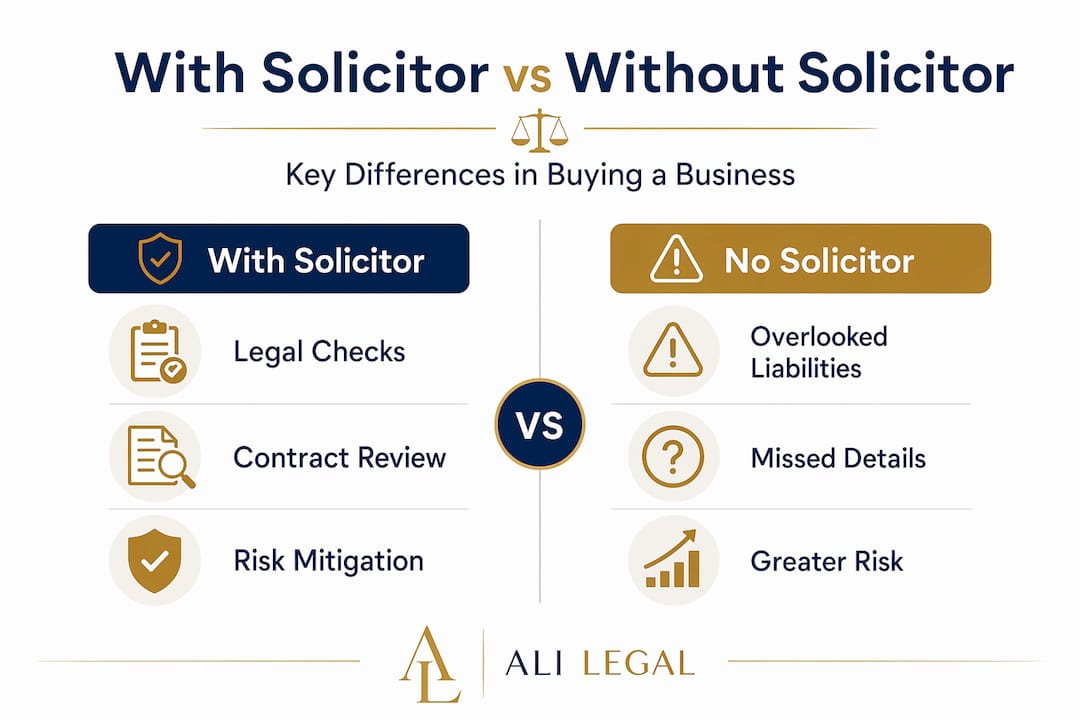
The intangible benefits of having a solicitor are harder to put in a table but no less real. Professional detachment, negotiation leverage, and the confidence of knowing someone is protecting your position are not abstract concepts. They affect the quality of the deal you end up with.
I’ve seen entrepreneurs make this mistake more than once, and it almost always follows the same pattern. The business looks straightforward, the seller seems trustworthy, and the buyer convinces themselves that paying solicitor fees is an unnecessary expense on a deal they have already mentally closed. Then something surfaces post-completion. A tax liability. A lease that cannot be transferred. An employee dispute that predates the sale but lands squarely on the new owner.
What I’ve learned is that “buying a business without a solicitor” is rarely a rational financial decision. It is usually an emotional one dressed up as pragmatism. The excitement of acquisition clouds the judgement, and the cost of legal advice feels like friction rather than protection.
In my experience, the buyers who regret involving a solicitor are almost none. The buyers who regret not involving one are far too many. That asymmetry should tell you something. If you are weighing up whether to seek legal advice for a business purchase, the complexity of the transaction is almost certainly higher than it appears from the outside.
Engage a solicitor early. Not after heads of terms are signed and you have already committed emotionally and financially. Before you even approach that stage, so that they can shape the process from the start rather than fix problems after the fact.
— Panagiotis
Whether you are buying your first business or your fifth, having the right legal team changes the outcome. Alilegal works with entrepreneurs at every stage of the acquisition process, from initial due diligence through to post-completion compliance. If a dispute arises after purchase, the commercial litigation team at Alilegal is built for exactly that kind of complex, high-stakes challenge.
For buyers who want expert support from solicitors who specialise in business acquisitions, transparent fixed-fee arrangements, and clear communication throughout, Alilegal offers the legal services you need without the jargon. Get in touch directly for a personalised consultation and a clear fee estimate before you commit to anything.
No. There is no statutory obligation in the UK to hire a solicitor when buying a business. However, the legal complexity of most acquisitions means that proceeding without one carries significant financial and contractual risk.
A solicitor handles due diligence, contract drafting and review, licence and lease checks, negotiation support, and post-completion regulatory transfers. Their role is to protect the buyer from hidden liabilities and ensure the deal is legally sound.
Solicitor fees vary based on the complexity of the transaction, the solicitor’s experience, and the billing structure. Fixed-fee arrangements typically range from £1,500 to £5,000 or more for straightforward acquisitions, with complex deals costing considerably higher.
No. A business broker facilitates the commercial transaction but cannot provide legal advice, draft enforceable contracts, or protect you from legal liabilities. Their role and a solicitor’s role are complementary, not interchangeable.
The primary risks include inheriting hidden liabilities, signing unfavourable or unenforceable contracts, failing to confirm licence and lease transferability, and having no legal recourse if the seller has misrepresented the business. An objective legal perspective often separates a profitable acquisition from a costly failure.
TL;DR:
- Many companies underestimate their litigation exposure despite rising dispute risks worldwide.
- Strategic management of corporate litigation involves understanding processes, choosing appropriate mechanisms, and integrating legal risk into business planning.
Most business leaders think of litigation as something that happens to other companies. The numbers suggest otherwise. Nearly a quarter of organisations faced class action litigation in the prior twelve months alone, and more than half of corporate counsel expect litigation volumes to increase further due to geopolitical instability, regulatory pressure, and economic uncertainty. Understanding what is corporate litigation, how it works, and what it means for your business is no longer a matter of legal curiosity. It is a strategic necessity.
Corporate litigation refers to formal legal disputes that involve a company as either a claimant or a defendant. Those disputes may arise internally, between shareholders, directors, or officers, or externally, with counterparties, regulators, employees, or third parties. What unifies them is that the corporation itself is a party to the proceedings.
A common source of confusion is the difference between corporate litigation and commercial litigation. Commercial litigation typically describes disputes arising from contracts and business transactions between parties, such as a supplier suing a customer for unpaid invoices or a contractor disputing the terms of a service agreement. Corporate litigation, by contrast, tends to concern the governance, structure, or operation of the company itself.
Examples that fall squarely within corporate litigation include:
Both categories sit under the broader umbrella of civil litigation, which encompasses all non-criminal dispute proceedings. Understanding where corporate legal issues fit within that wider framework helps business leaders make better decisions when disputes arise.
The types of corporate litigation your business encounters will depend on your sector, size, and exposure to evolving regulatory regimes. That said, certain categories appear with striking consistency across industries.
| Type of dispute | Common triggers | Business impact |
|---|---|---|
| Employment and labour | Wrongful dismissal, discrimination, whistleblowing | Reputational damage, operational disruption |
| Cybersecurity and data privacy | Data breaches, GDPR non-compliance | Regulatory fines, class actions |
| Banking and finance | Loan disputes, mis-selling, covenant breaches | Liquidity risk, credit relationships |
| Antitrust and competition | Price-fixing allegations, market abuse | Criminal and civil exposure |
| ESG-related claims | Greenwashing, supply chain failures | Investor and regulatory scrutiny |
Banking and finance disputes doubled in 2024, with one in five respondents reporting proceedings in that area. Employment and cybersecurity claims remain the most prevalent categories year on year, driven by technology integration, remote working, and the expanding reach of data protection law.
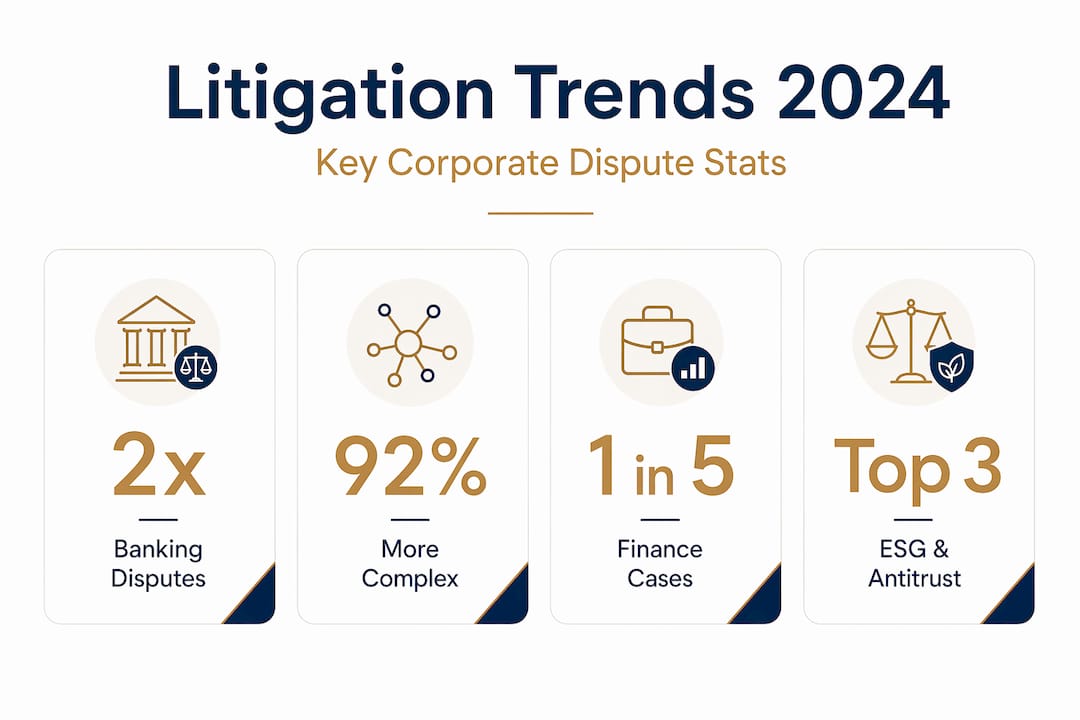
ESG and antitrust claims are now firmly among the top litigation concerns for sectors including healthcare, financial services, and manufacturing. Regulatory expectations in these areas continue to shift, and companies that have not stress-tested their compliance frameworks are at meaningful risk.

The broader picture is not encouraging for those hoping disputes will become easier to resolve. 92% of companies say that settling before court is important, yet 82% report it is becoming harder, citing higher settlement demands, rising legal costs, and more aggressive plaintiff behaviour.
Pro Tip: Keep a litigation register that tracks not just active claims but near-miss incidents, regulatory enquiries, and employee grievances. Identifying patterns early gives your legal team time to act before a dispute crystallises.
Understanding how corporate litigation works removes much of the uncertainty that makes disputes so disruptive. The process has recognisable stages, even if the specifics vary by jurisdiction, contract terms, and the nature of the claim.
Clarity in dispute resolution clauses is one of the most frequently underestimated factors in managing this process. English courts have repeatedly found that ambiguous clauses lead to expensive satellite litigation about jurisdiction and procedure before the substantive dispute is even heard. A poorly drafted clause can cost more to untangle than the original dispute.
Pro Tip: Review dispute resolution clauses in all material contracts at least annually. Check that they specify the governing law, the chosen forum, the number of arbitrators or judges, and any mandatory pre-action steps. Vagueness here is a liability.
The most sophisticated companies no longer treat corporate dispute resolution as a binary choice between going to court or settling. They use an integrated system of mechanisms, selecting the right tool for each dispute and often combining several within a single strategy.
Courts, arbitration, and mediation increasingly function as a coordinated ecosystem rather than competing alternatives. The risks of treating them in isolation are real: parallel proceedings, conflicting interim orders, and enforcement gaps can all arise when companies allow disputes to drift between forums without a clear strategy.
The key mechanisms available to you are:
The integration of these mechanisms into a coherent dispute strategy is what separates reactive companies from those that manage legal risk as a business function.
Corporate legal issues do not stay in the legal department. They affect cash flow, leadership bandwidth, investor confidence, and operational focus. Treating litigation as a problem to hand off to outside counsel and ignore until trial is a strategy that consistently produces poor outcomes.
The most important shift in thinking is this: litigation is increasingly a financial and strategic asset, not merely a cost. A well-founded claim against a counterparty that has caused you significant loss has genuine economic value. So does a robust defence strategy that discourages speculative claims. Approaching disputes with this mindset changes the decisions you make from the outset.
Practical steps that directly reduce your exposure include:
Pro Tip: When engaging outside counsel, agree on regular litigation budget reviews and ask them to distinguish between costs that are legally necessary and costs that are tactical. You will often find that the most expensive steps are not always the most strategically valuable.
I have seen a clear shift in how the most effective business leaders think about litigation. Ten years ago, the instinct was to contain it: keep it away from the board, settle quickly, move on. That instinct is understandable, but it has become expensive.
The companies I see managing litigation well in 2026 treat it as they would any other significant business risk. They quantify it, they resource it appropriately, and they make deliberate decisions about how to deploy their legal assets. They use legal finance not because they cannot afford litigation, but because it makes capital sense. They draft dispute resolution clauses with the same care they give to payment terms.
What strikes me most is how many disputes escalate unnecessarily because nobody reviewed the resolution clause in the original contract. A clause that specifies the wrong forum, or that fails to address what happens when related contracts have conflicting terms, can generate years of satellite litigation. The fix costs almost nothing at contract stage.
My honest view is that the legal department cannot solve this alone. Litigation strategy needs to sit at the intersection of legal, finance, and operations. The businesses that will manage disputes most effectively are those that build that conversation now, before the next claim arrives.
— Panagiotis
Corporate disputes rarely arrive with advance notice, and the decisions made in the first days frequently determine the outcome months later. Ali Legal works with business clients to provide strategy-led legal support from the earliest signs of a dispute through to resolution, whether that means negotiation, arbitration, or full court proceedings.
Our commercial litigation services are built for high-stakes disputes where getting the strategy right from the start matters. We advise on dispute resolution clause drafting, jurisdictional choices, arbitration proceedings, and the use of legal finance to protect your liquidity while pursuing or defending claims. If you are dealing with a dispute now, or want to review your exposure before one arises, speak with a solicitor at Ali Legal. Transparent advice, clear fees, and direct access to experienced practitioners are what we offer from the first conversation. Contact us to arrange a consultation.
Corporate litigation refers to formal legal proceedings in which a company is a party, either as claimant or defendant. It covers disputes involving shareholders, directors, mergers, regulatory enforcement, and other matters relating to the governance or operation of a business.
Employment and labour disputes, cybersecurity and data privacy claims, banking and finance disagreements, and antitrust matters are among the most frequent. Banking and finance disputes doubled in 2024, and ESG-related claims are a growing category.
Timelines vary significantly depending on the complexity of the dispute, the forum chosen, and whether parties settle early. Expedited arbitration under the 2026 ICC rules aims to deliver a final award within six months for eligible disputes, making it one of the faster options available.
Legal finance involves a third party funding the costs of litigation or arbitration in exchange for a share of any recovery. It allows companies to pursue or defend claims without using operating capital, and is now used by large companies as a tool for capital optimisation rather than a last resort.
Conduct regular legal risk audits, draft clear and specific dispute resolution clauses in all material contracts, and integrate litigation risk into board reporting. Ambiguous dispute resolution clauses are among the most common and avoidable causes of escalating litigation costs.
TL;DR:
- Business law governs how businesses are created, operated, and protected, affecting companies of all sizes.
- Understanding legal frameworks helps prevent risks like unpaid contracts, wrongful dismissals, and exposure to debts.
- Entrepreneurs should prioritize understanding contract law and business structure early to build long-term, durable businesses.
Most business owners encounter legal trouble not because they ignored the law, but because they never understood what business law actually covers. It is easy to assume that legal matters only affect large corporations with in-house legal teams. The reality is quite different. Business law governs how every commercial enterprise is formed, operated, and protected, regardless of size. From the contracts you sign with suppliers to the way you classify your employees, the rules governing business touch almost every decision you make. This guide breaks down the core areas, explains what does business law entail in practical terms, and gives you the knowledge to act with confidence.
Business law is the body of rules that governs how companies are created, how they operate, and how they are held accountable. It sits at the intersection of private agreements and public regulation, which is why it affects everything from a simple service contract to how you structure your shareholding. Legal frameworks are critical engines for economic development, not bureaucratic obstacles.
Understanding the importance of business law becomes clearer when you look at what it prevents. Without enforceable contracts, a client can walk away without paying. Without proper employment law compliance, a wrongful dismissal claim can cost you tens of thousands of pounds. Without the correct corporate structure, your personal assets sit exposed to business debts. Business law is the framework that keeps those risks manageable.
Here is an overview of the five core areas every business owner should know:
Pro Tip: If you are starting out, do not try to learn all five areas simultaneously. Prioritise contract law and your business structure first. These two areas form the foundation everything else builds upon.
Your choice of legal structure is one of the most consequential decisions you will make as an entrepreneur. It determines your personal liability, how you are taxed, and whether investors will take you seriously. Many business owners pick a structure based on what is easiest to set up, rather than what serves their long-term interests. That is a costly mistake.
Here is how the three main structures compare:
| Structure | Liability protection | Tax treatment | Best suited for |
|---|---|---|---|
| Sole proprietorship | None. Personal assets at risk | Income taxed as personal earnings | Freelancers, single-person trades |
| Limited liability company (LLC) or Ltd | Separates personal and business assets | Profits taxed at corporation rate | Small to medium businesses seeking growth |
| Corporation (PLC or Ltd with shareholders) | Full separation of assets | Corporation tax applies; dividends taxed separately | High-growth businesses seeking investment |
Sole proprietorships offer no liability protection and are generally suited for freelancers, while corporations suit businesses that need investor backing. The middle ground, a private limited company, is where most UK entrepreneurs land. It gives you liability protection without the administrative weight of a public company.

One detail many business owners overlook: lenders almost universally require a written business plan before approving financing. Your legal structure directly affects how that plan is received. A sole trader applying for a significant business loan faces far more scrutiny than a limited company with proper governance in place.
Pro Tip: Register as a limited company earlier than you think you need to. The liability protection alone is worth the administrative effort, even if you are still in early trading. You can always find guidance on the essential legal documents you will need from the outset.
Compliance is where many businesses stumble. Not because the rules are impossible to follow, but because owners underestimate how many regulations apply to them. Every business operating in the UK needs, at minimum, the correct licences for its sector, a registered address, a tax identification number with HMRC, and an understanding of its reporting obligations.
The regulatory picture has grown more complex in recent years. A notable development is the treatment of environmental claims. Greenwashing is now a competition law liability in several jurisdictions, with significant financial penalties for misleading environmental marketing. If your business makes sustainability claims, those claims now carry legal weight and must be substantiable.
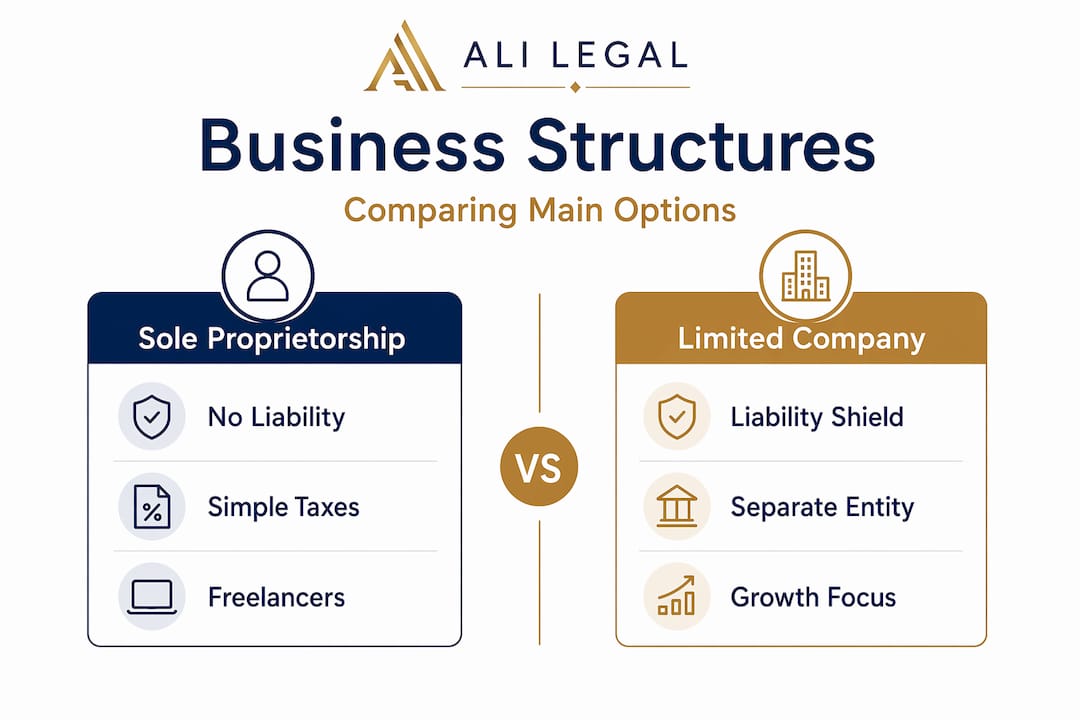
Beyond day-to-day compliance, there is the question of limitation periods. Many business owners do not realise that their right to pursue a legal claim has an expiry date. Commercial disputes are often barred after five years, while certain civil claims can extend to fifteen years. Acting early on a dispute is not just tactically smart. It protects your legal rights.
Here are the core compliance areas to keep in mind:
One often-overlooked compliance factor is the role of local commercial customs. Local commercial codes can override general legal principles, affecting how disputes are evaluated and what outcomes are possible. If you trade internationally or operate in a specialised sector, those customs may shape your legal position in ways that standard contract templates simply do not address.
Disputes are a normal part of running a business. The question is not whether you will ever face one, but whether you are prepared when it happens. Understanding how business law works in the context of conflict is just as important as understanding how it works in normal operations.
The most common disputes business owners face tend to follow a predictable pattern:
When a dispute does arise, your contract clauses matter enormously. A well-drafted dispute resolution clause can require the parties to attempt mediation before going to court, saving both time and money. Arbitration is another route, offering a private, binding resolution without the exposure of public proceedings. Business law stabilises operations precisely because it provides a defined framework for resolving these conflicts rather than leaving them to ad hoc negotiation.
If a dispute does escalate to litigation, understanding the difference between civil and commercial proceedings is useful. Commercial courts deal with business-to-business matters and tend to move faster and with greater procedural sophistication than general civil courts.
I have worked with enough business owners to know that the most damaging legal problems are rarely dramatic. They are quiet failures, a contract signed without reading it properly, a staff member dismissed without following the correct procedure, a limitation period missed because the dispute felt like it could wait.
What I find consistently true is that entrepreneurs who treat legal compliance as a foundation rather than an afterthought tend to build more durable businesses. Not because they are risk-averse, but because they understand that integrity and long-term thinking build more commercial value than clever shortcuts.
The most common misunderstanding I encounter is the belief that a verbal agreement or a handshake is sufficient between people who trust each other. Trust is not a legal concept. Circumstances change, memories differ, and relationships break down. A written agreement is not a sign of distrust. It is what makes trust scalable across time and pressure.
My practical advice is this: do not wait until a dispute arises to understand your legal position. Know your structure, know your contracts, and know the compliance obligations that apply to your sector. Legal knowledge is not a burden you carry. It is a tool you use.
— Panagiotis
Understanding business law basics is the right starting point. Acting on that understanding with proper legal support is what keeps your business protected when it counts.
Alilegal works with businesses at every stage, from structuring a new company to resolving complex commercial disputes. Whether you are facing a contract breach, an employment claim, or a regulatory challenge, the team brings the same approach: clear advice, defined strategy, and no unnecessary delay. For businesses already in conflict, Alilegal’s commercial litigation service provides strategy-led dispute resolution when the stakes are high. For those who need support in court, the civil litigation practice brings real strength to the table. The earlier you engage legal support, the more options you have. Contact Alilegal today to discuss your situation.
Business law covers the rules governing how businesses are formed, operated, and dissolved, including contract law, corporate governance, employment obligations, intellectual property, and tax compliance.
Business law protects small businesses by providing enforceable rights in contracts, limiting personal liability through the correct legal structure, and establishing clear obligations to employees and regulators. Without it, small businesses are uniquely exposed.
Civil litigation covers disputes between individuals or organisations under general law, while commercial litigation specifically addresses business-to-business disputes and tends to involve more complex contractual and regulatory considerations.
Limitation periods vary by claim type. Commercial claims are often barred after five years, while some civil claims may remain actionable for up to fifteen years. Acting promptly protects your legal options.
Yes. Verbal agreements are difficult to enforce and prone to interpretation disputes. A written contract that clearly states the terms, obligations, and dispute resolution process is the single most reliable protection any business has.
TL;DR:
- Tax efficiency involves legally structuring finances to pay only the required taxes and avoid unnecessary charges.
- Consistent execution of simple strategies like asset location, pension maximization, and tax-loss harvesting can significantly increase long-term wealth.
Most people assume that keeping more of their money means finding clever loopholes or operating in a legal grey area. That assumption is wrong, and it costs people real money. Understanding what is tax efficiency means recognising that it is the legal, strategic practice of structuring your finances so that unnecessary tax drag is minimised and more of your wealth stays working for you. For individuals and small business owners alike, the difference between a tax-aware strategy and an ad-hoc one compounds dramatically over time. This guide breaks down the definition, the strategies, and the practical steps you can act on now.
The definition of tax efficiency is straightforward: it is the practice of arranging your financial affairs so you pay no more tax than the law requires. Not less than required. Exactly what is required, and not a penny more. This is a critical distinction because tax efficiency sits entirely within the law, while tax evasion does not.
From an economic standpoint, tax efficiency reduces distortions and deadweight loss in a market. When taxes create unnecessary friction, resources shift away from their most productive use. A tax-efficient system, whether at the policy level or the personal finance level, minimises those distortions. For individuals, this translates to more wealth compounding over time.
One of the most underappreciated concepts here is tax drag. Tax drag can reduce annual returns by 1 to 2% or more, which sounds modest until you run the numbers over twenty years. On a £500,000 portfolio, losing 1.5% annually to avoidable taxes means forfeiting over £200,000 in compounded growth across two decades. Tax drag affects you differently depending on the type of income:
Understanding these categories is the first step. The next is knowing the tools available to reduce their impact: tax-advantaged accounts (such as ISAs in the UK or 401(k)s in the US), asset location strategies, and tax-loss harvesting. Each is covered in depth below.
Asset location is the single most underused strategy by ordinary investors. The concept is straightforward: different types of assets generate different types of taxable income, so you place each asset type in the account where it faces the lowest tax rate.
Tax-inefficient assets such as bonds, REITs, and high-dividend equities generate income that is taxed immediately and at higher rates. These belong inside tax-deferred or tax-sheltered accounts. Tax-efficient assets such as index funds, growth stocks held long-term, and ETFs generate little taxable income annually and benefit from lower capital gains rates. These are better suited to taxable accounts.

The table below illustrates how this placement strategy works in practice:
| Asset type | Best account | Reason |
|---|---|---|
| Bonds and fixed income | Tax-deferred (SIPP, 401k) | Interest taxed as ordinary income |
| REITs | Tax-deferred account | High dividend distributions |
| High-dividend equities | Tax-advantaged wrapper | Frequent taxable income |
| Index funds (equity) | Taxable account | Low turnover, deferred gains |
| Growth stocks (long-term) | Taxable account | Capital gains taxed at lower rates |
| Roth / ISA equivalent | Tax-free account | Best for highest-growth assets |
Proper asset location can boost after-tax returns by 0.14% to 0.41% annually. For a retired couple with a £2 million portfolio, that translates to between £2,800 and £8,200 saved every year without changing a single underlying investment.

Pro Tip: Review your asset location at least once a year. Tax law changes, and so does your portfolio mix. What was optimally placed three years ago may no longer be, particularly after significant market moves.
Asset location also requires continual review and rebalancing as portfolios grow and legislation shifts. A practical approach is to use new cash contributions and dividend reinvestments to rebalance rather than selling assets, which triggers a taxable event. This keeps your allocation on track while minimising the tax consequences of adjustments.
Small business owners face a different set of opportunities compared to individual investors, and year-round tax planning can retain 28% more portfolio growth over twenty years compared to doing it reactively at year-end. The potential annual savings from stacked strategies range from £40,000 to £80,000 for small businesses. That is not speculation. That is what consistent execution produces.
The highest-impact strategies for small business owners are well known. The failure is almost never in the knowing. It is in the doing.
The most impactful strategies are legal and simple, yet consistently underused because business owners fail to execute them properly or maintain the records required to defend them. This is where professional guidance pays for itself.
Pro Tip: Do not treat your accountant as someone you speak to in April. Monthly or quarterly conversations about your income trajectory allow strategies to be deployed when they are still available, not after the tax year has closed.
Once the fundamentals are in place, there are several advanced approaches worth understanding. None of them require exotic structures or offshore accounts. They simply require discipline and forward thinking.
Tax-loss harvesting year-round. Most investors only consider realising losses in December. But tax-loss harvesting is most effective as a year-round discipline. Markets are volatile, and volatility creates opportunities to crystallise losses that can offset gains elsewhere in your portfolio. The key is having pre-approved replacement securities ready so you avoid wash sale rules and do not make emotional decisions under pressure.
Strategic withdrawal sequencing in retirement. The order in which you draw down different accounts in retirement has a profound impact on your lifetime tax bill. Retirement withdrawal sequencing can save hundreds of thousands in lifetime taxes. Drawing from taxable accounts first, then tax-deferred accounts, then tax-free accounts (like a Roth or ISA) is a common framework, but the optimal sequence depends on your current tax bracket, expected future rates, and estate planning goals.
Roth conversions and ISA top-ups in low-income years. If your income drops in a given year, whether through a career change, business downturn, or early retirement, that is the ideal moment to convert tax-deferred savings to a tax-free account. You pay tax now at a lower rate to avoid paying it later at a higher one.
Step-up in basis for estate planning. Assets inherited receive a stepped-up cost basis, which means capital gains accumulated during the original owner’s lifetime are wiped out at death. For families holding appreciated assets, a deliberate hold-to-pass strategy combined with charitable giving of highly appreciated stock can eliminate capital gains entirely.
Charitable giving with appreciated assets. Rather than donating cash, donating an asset that has risen significantly in value allows you to claim the full current value as a charitable deduction without paying capital gains tax on the appreciation. You give the same amount, but the tax outcome is substantially better.
Understanding asset protection frameworks can also play a meaningful role here, particularly when structuring wealth across generations or protecting business assets from future liability.
I have watched individuals spend months researching tax efficiency strategies only to implement none of them. I have also seen small business owners pay tens of thousands in unnecessary tax for years, not because the solutions were complicated, but because no one made them a priority.
What I have learned is this: continuous execution separates success from failure in tax planning. The person who reviews their asset location once a year, maxes out their pension contribution in October rather than March, and harvests a loss in June rather than December will always outperform the person who reviews nothing and scrambles in April.
The compounding effect of small annual tax savings is genuinely staggering. Saving £5,000 per year in tax, invested at a 7% annual return, becomes over £200,000 across twenty years. That is not a complex strategy. That is discipline applied consistently.
My view is that most people would benefit far more from executing three simple strategies well than from chasing one sophisticated scheme. Tax-efficient investing is not about being clever. It is about being consistent.
— Panagiotis
Tax efficiency is not purely an accounting matter. Structuring a business correctly, managing assets across entities, or navigating a dispute with HMRC all carry legal dimensions that go beyond what a spreadsheet can solve.
At Alilegal, we work with individuals and small business owners who need clear, practical guidance on the legal frameworks that underpin financial decision-making. Whether you are managing a commercial dispute that has tax implications, seeking to structure a business for long-term compliance, or exploring your options around business compliance obligations, our team provides fixed-fee advice without the ambiguity. Speak to a solicitor today and make certain that your financial structure is working as hard as your business does.
Tax efficiency is the legal practice of structuring financial affairs to minimise unnecessary tax liability while maximising after-tax returns. It operates entirely within the law and is distinct from tax avoidance schemes or evasion.
Tax efficiency uses legitimate structures and allowances, such as ISAs, pension contributions, and asset location, to reduce tax within the rules. Tax avoidance typically involves artificial arrangements designed to exploit loopholes, which may be challenged or closed by authorities.
The primary factors are the type of income generated (dividends, interest, or capital gains), the accounts in which assets are held, and the timing of sales and withdrawals. Tax drag can reduce returns by 1 to 2% annually if these factors are not managed deliberately.
The most impactful steps are year-round planning, maximising pension contributions, implementing accountable expense plans, and reviewing business structure. Consistent execution of these straightforward strategies can yield significant annual savings.
Tax-loss harvesting is the practice of selling investments at a loss to offset capital gains elsewhere in a portfolio, reducing the overall tax owed. It is most effective when practised throughout the year rather than only at year end.
| Key takeaway | Detail |
|---|---|
| Tax efficiency is legal | It minimises tax within the law. It is not tax evasion or avoidance through artificial schemes. |
| Tax drag costs real money | Losing 1 to 2% annually to avoidable taxes can forfeit hundreds of thousands in compounded growth. |
| Asset location boosts returns | Placing the right assets in the right account types can save thousands each year without changing your investments. |
| Small businesses benefit most from execution | The strategies are well known. Consistent implementation is what produces results. |
| Advanced tactics compound over time | Withdrawal sequencing, step-up in basis, and year-round harvesting deliver the biggest gains over decades. |
TL;DR:
- Many believe a force majeure clause automatically cancels contracts during disruptions, but it actually requires meeting specific conditions. It is a contractual provision, not a legal right, and applies only when certain criteria are satisfied, such as unforeseeability, external control, and direct impact on performance. Proper drafting, notice, and mitigation are essential; otherwise, claims risk failure despite the occurrence of a qualifying event.
Most people assume a force majeure clause is a get-out-of-jail-free card that cancels a contract the moment something goes wrong. It is not. Understanding what is force majeure correctly is the difference between protecting your business and finding yourself in breach. Force majeure is a contractual provision, not an automatic legal right, and it operates only when specific conditions are met. This guide walks you through the force majeure definition, what triggers it, what it actually does to your obligations, and what the courts look for when disputes arise.
The phrase itself is French, meaning “superior force.” It entered commercial contract law through civil law traditions, particularly French and continental European legal systems, before becoming common in English commercial contracts over the past century. That origin matters, because in English law, force majeure has no default standing. Unlike civil law jurisdictions where courts may imply it, English common law requires you to include it explicitly in the contract for it to apply at all.

This is one of the most misunderstood points in contract law. Force majeure is fundamentally different from common law doctrines such as frustration or impossibility. Those doctrines can apply even without a written clause, but they are narrow, difficult to establish, and unpredictable in outcome. A well-drafted force majeure clause in a contract gives parties far more control, certainty, and flexibility than relying on common law alone.
So what qualifies as a force majeure event? The clause itself defines this, and that definition varies from contract to contract. However, a standard force majeure events list typically includes:
The common thread is that these are extraordinary events, outside anyone’s reasonable control, that were not foreseeable when the contract was signed.
Knowing that a force majeure clause exists in your contract is only the starting point. Whether it actually protects you depends on satisfying several distinct conditions. Courts look at each of these carefully when a dispute reaches litigation or arbitration.
The event must be unforeseeable. If a risk was known or reasonably anticipated at the time of contracting, it generally will not qualify. A construction company signing a contract during a publicly announced storm season would struggle to argue that a storm was unforeseeable.
The event must be beyond the affected party’s control. This is not merely inconvenience. The party cannot have caused or contributed to the event, and it must be genuinely outside their ability to prevent or manage.
The event must make performance impossible or impracticable. Critically, it is not enough that performance has become more expensive or commercially unattractive. Increased costs alone do not meet the threshold unless the contract specifically includes commercial hardship as a qualifying trigger. This distinction catches many businesses off guard.
The event must directly prevent performance. There must be a clear causal link between the event and the failure to perform. A party cannot claim force majeure because an event disrupted their business generally if their specific contractual obligations were still performable.
The affected party must have attempted to mitigate. Courts and arbitrators require that reasonable mitigation efforts be made. Stopping performance and waiting for the event to pass, without exploring alternatives, will typically sink a force majeure claim.
Notice must be served correctly and on time. This is where many otherwise valid claims fail. Missing notice deadlines or serving notice in the wrong format, to the wrong person, or outside the contractual timeframe can invalidate the claim entirely, regardless of how genuine the force majeure event was.
Pro Tip: Read your force majeure clause carefully before an event occurs, not after. Check the notice period, the required format (written, email, registered post), and who must receive it. Being prepared in advance is the only way to avoid a procedural error under pressure.
Not all force majeure clauses are created equal. Many businesses sign contracts containing boilerplate language copied from templates, and then discover, when it actually matters, that the clause does not cover the very risk that has materialised. Generic boilerplate clauses frequently omit industry-specific risks or lack the procedural detail needed to enforce them.
Bespoke drafting is the standard to aim for. A shipping company should have clauses addressing port closures, sanctions, and rerouting obligations. A technology firm should consider data centre failures, cyberattacks, and regulatory shutdowns. A retailer should think about supply chain disruptions, customs delays, and import restrictions. The clause should reflect the actual risk profile of the contract, not a generic list written for a theoretical industry.
When reviewing or negotiating a force majeure clause, pay close attention to these elements:
A practical point on mitigation language: the UK Supreme Court ruling in RTI Ltd v MUR Shipping BV in 2024 confirmed that reasonable endeavours provisions do not require a party to accept non-contractual performance. In that case, the affected party was not obliged to accept payment in a different currency simply because it would have resolved the disruption. The original contractual terms stand.
Pro Tip: When negotiating contracts, push for a defined list of qualifying events that reflects your industry, a clear notice mechanism, and a specified escalation period after which either party can terminate. Vagueness in any of these areas creates risk for both sides.
Invoking a force majeure clause is not the end of the contractual relationship. The force majeure clause meaning in most commercial contracts is that it manages obligations during disruption, rather than ending them outright. Force majeure typically suspends obligations temporarily while the qualifying event persists.
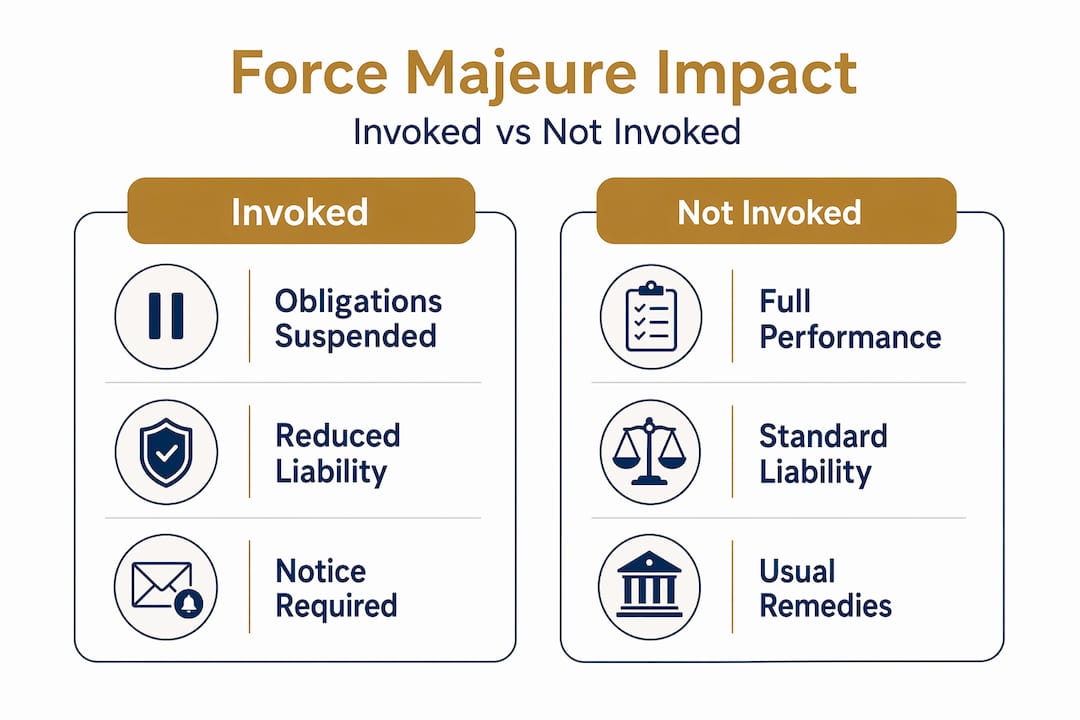
The table below summarises the main consequences depending on what the clause provides:
| Scenario | Effect on contract | Effect on liability |
|---|---|---|
| Valid force majeure invoked | Obligations suspended for duration of event | Party excused from breach during event |
| Force majeure persists beyond agreed period | Termination right may arise | Neither party liable for non-performance |
| Procedural requirements not met | Clause cannot be relied upon | Party may be in breach |
| Event does not meet qualifying criteria | Clause does not apply | Normal liability for breach resumes |
| Mitigation not demonstrated | Claim likely to fail | Party may face damages claim |
The key distinction from common law frustration is control and predictability. Frustration discharges the contract entirely and can have unpredictable consequences for payments already made, work already done, and future obligations. A force majeure clause, by contrast, operates according to its own terms. That predictability is exactly why well-drafted contractual clauses offer better protection than relying on common law doctrines.
Understanding the force majeure clause meaning in the abstract only goes so far. Seeing it applied to real scenarios is more instructive.
Consider a UK-based importer with a supply contract for goods manufactured in a country that becomes subject to sudden government sanctions. If the contract contains a force majeure clause listing government actions as qualifying events, and the importer serves valid notice within the required timeframe while demonstrating attempts to source alternative supply, the clause should operate to suspend obligations. Without the clause, they may face a breach claim.
Now consider a hotel group that cancelled all bookings during the COVID-19 pandemic. Many contracts contained force majeure clauses; others relied on common law frustration. The outcomes differed significantly depending on precise clause wording, notice compliance, and whether the clause listed pandemics or government restrictions as qualifying events.
Typical scenarios where force majeure clauses come into play include:
The 2024 UK Supreme Court ruling in RTI Ltd v MUR Shipping BV reinforced a critical principle. The court confirmed that parties are not required to accept creative workarounds that deviate from the original contract terms. This protects contractual certainty, but it also underscores why the original clause must be drafted with precision, because the court will apply it strictly as written.
I have seen businesses spend months drafting detailed commercial contracts and then accept a standard force majeure clause without a second thought. It is the most common and costly oversight in contract negotiation, and it happens because force majeure feels like a theoretical problem until it suddenly is not.
In my experience, the clauses that fail most often are not failing because of what they say. They fail because of what they omit. No industry-specific qualifying events. No clear notice mechanism. No defined mitigation obligation. No escalation period leading to termination. When a genuine crisis hits, the clause cannot do the work the business assumed it would.
Procedural compliance is where I see the most damage done. A business experiences a legitimate force majeure event, their lawyers confirm the clause applies, and then it emerges that no one served notice within the contractual deadline. The claim collapses not on the merits but on a missed administrative step. Strict adherence to notice requirements is not optional, even when the force majeure event itself is undisputed.
The RTI v MUR decision in 2024 was a useful reminder that English courts will hold parties to the precise terms they agreed. That is both a protection and a warning. Your clause will be enforced as written. If it is vague, narrow, or procedurally incomplete, you will bear the consequences. The answer is not to rely on judicial sympathy. The answer is to draft commercial contracts with the same rigour you would apply to payment terms or liability caps.
— Panagiotis
Force majeure disputes move quickly. Whether you need to invoke a clause, respond to a counterparty’s invocation, or challenge whether a qualifying event actually occurred, the legal and procedural stakes are high from day one. Alilegal’s team brings deep expertise in commercial contract disputes, including force majeure claims at every stage from initial advice through to litigation or arbitration.
If you are dealing with a contract dispute involving performance obligations, civil litigation support from a team that understands both the legal principles and the commercial realities makes a material difference to outcomes. Alilegal also advises on bespoke contract drafting and clause negotiation to protect your position before a crisis arises. Fixed fees. Straight answers. Contact Alilegal today for a consultation.
Force majeure is a contractual provision that excuses or suspends a party’s performance obligations when an extraordinary, unforeseeable event beyond their control makes performance impossible or impracticable. It has no default existence under English law and must be expressly included in the contract.
A force majeure event is triggered when a qualifying event occurs, such as a natural disaster, war, or government action, that was unforeseeable at the time of contracting and directly prevents performance. The affected party must also comply with notice requirements and demonstrate mitigation efforts.
No. Force majeure typically suspends obligations during the qualifying event rather than cancelling the contract outright. Termination rights may arise only if the clause expressly provides for them and the event persists beyond a defined period.
Generally no. Increased costs or commercial hardship do not meet the threshold for force majeure unless the contract specifically includes them as qualifying triggers. The standard test requires that performance be impossible or impracticable, not merely more expensive.
Failing to serve notice correctly and on time can invalidate a force majeure claim even where the event itself would otherwise qualify. Courts treat procedural compliance as a condition of relying on the clause, not as an administrative formality.
TL;DR:
- An injunction is a court order that prevents or compels actions before or during harm, acting as an equitable remedy.
- Obtaining an injunction requires satisfying criteria like likelihood of success, irreparable harm, and public interest, and involves strict procedural steps.
If you are facing a dispute and need urgent legal protection, understanding what is an injunction could make the difference between preserving your rights and suffering irreversible harm. An injunction is a court order that either compels someone to do something or, more commonly, stops them from doing it. Unlike monetary damages, which compensate you after harm has already occurred, injunctions act before or during harm to prevent it. This guide explains how injunctions work, the different types available, and what you need to do to obtain one.
At its most fundamental level, an injunction is an equitable remedy granted by a court when monetary compensation would be inadequate to address the harm caused. The term “equitable” simply means the court is applying principles of fairness rather than following a rigid formula. This distinction matters enormously in practice. If your neighbour is about to demolish a protected building on your boundary, no amount of money after the fact restores what has been lost. An injunction stops the act before it happens.
Courts do not grant injunctions automatically. Courts exercise significant discretion, weighing the good faith of the parties, their prior conduct, and the overall balance of harms before making any order. This is quite different from a damages claim, where the court’s role is largely to calculate a figure.
Understanding the legal injunction meaning also requires knowing the consequences of ignoring one. Violating an injunction can result in contempt of court, which carries the possibility of fines or even imprisonment. This is what gives injunctions their teeth. They are not suggestions; they are binding court orders with real penalties attached.
A few key points help clarify the scope of injunctions:
Understanding the types of injunctions available is where many people get confused, so it helps to look at each category clearly.
An injunction may require a party to do something or stop doing something, and many orders contain both components. The two broadest categories are prohibitory injunctions, which restrain a party from acting, and mandatory injunctions, which compel a party to take a specific action. Mandatory injunctions tend to be harder to obtain because courts are cautious about ordering positive acts.
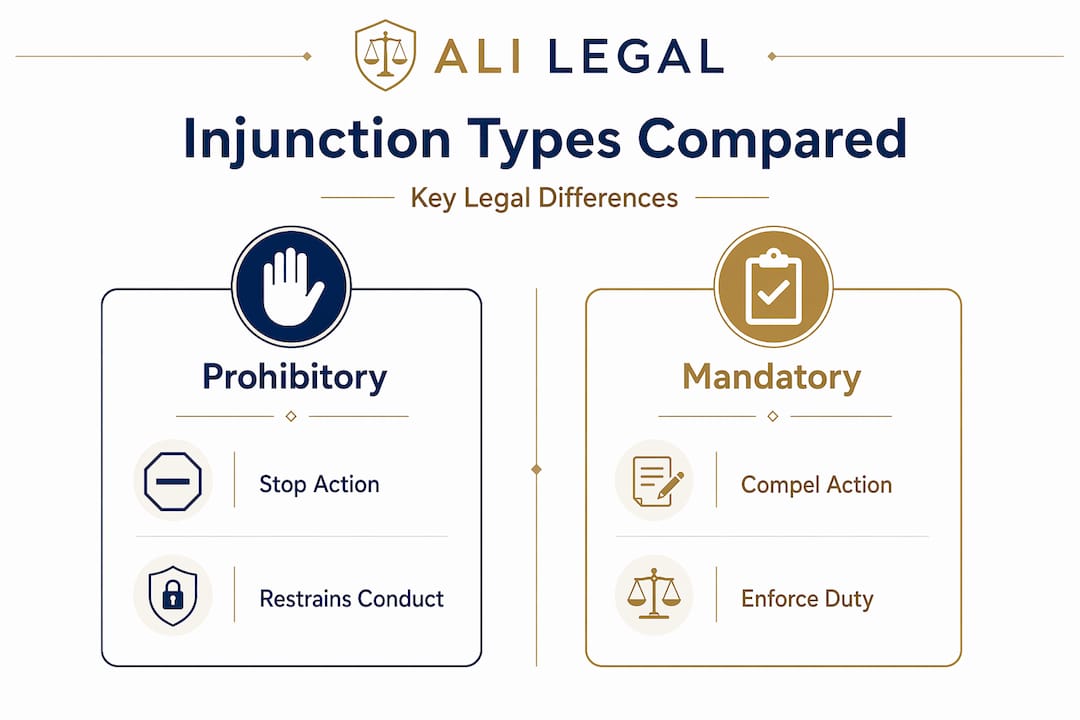
Beyond these broad categories, injunctions are also classified by duration and urgency:
| Type | Duration | Key feature | Common example |
|---|---|---|---|
| Temporary restraining order (TRO) | Days to weeks | Issued without notice in emergencies | Stopping imminent asset disposal |
| Preliminary injunction | Pending full trial | Requires notice to the other side | Freezing business activities during litigation |
| Permanent injunction | Indefinite | Granted after full trial | Prohibiting ongoing trade secret misuse |
Temporary restraining orders are short-term injunctions that can be issued without the other party being present, making them the fastest form of emergency relief available. However, they are typically subject to an early review hearing and are often not immediately appealable. A preliminary injunction lasts throughout the litigation process, while a permanent injunction is the final outcome of a successful trial.
Pro Tip: If you believe you need emergency legal protection, ask your solicitor specifically about a TRO or interim injunction application. Waiting until a full hearing could mean the harm you are trying to prevent has already occurred.
Obtaining an injunction is not straightforward, and courts do not award them lightly. To succeed in a preliminary injunction application, you must satisfy a four-factor test. Each factor carries real weight, and weakness in any one area can defeat your application.
The four factors are:
The process for seeking an injunction broadly follows these steps:
On that last point: courts may require applicants to post a monetary bond as security to compensate the defendant if the injunction later turns out to have been wrongfully obtained. The amount depends on the likely financial impact on the defendant. This is a strategic consideration many applicants overlook entirely.
Pro Tip: Never approach an injunction application without legal representation. The procedural requirements are strict, and a poorly drafted application can be refused even if your underlying case is strong. Engaging a solicitor who understands the civil litigation process will significantly improve your prospects.
Once an injunction is in place, the question becomes how it is enforced and what happens if circumstances change.
Enforcement is the responsibility of the party who holds the order. If the respondent breaches it, you must return to court and apply to have them held in contempt. Courts often modify or dissolve injunctions if evidence shows that circumstances have materially changed since the original order was made. For example, if a business injunction was based on an ongoing contract that has since expired, the rationale for the order may no longer exist.
Key points about enforcement and breach include:
The dynamic nature of equitable remedies means injunctions are rarely “set and forget” orders. Active monitoring and willingness to return to court are part of effective injunction management.
Injunctions appear across a remarkably broad range of disputes. Injunctions cover business disputes, family law matters, and property issues, and the variety of situations where they apply is wider than most people realise.

In family law, injunctions are frequently used to protect individuals from harassment or domestic abuse. These are sometimes called non-molestation orders or occupation orders in England and Wales, and they function as a form of injunction tailored to the family context. The injunction vs restraining order distinction is worth noting here: in England and Wales, a restraining order is typically a criminal court order imposed on a convicted defendant, while an injunction is a civil remedy sought by the affected party.
In business disputes, injunctions are used to prevent a departing employee from joining a competitor in breach of restrictive covenants, to stop the misuse of trade secrets, or to restrain a party from terminating a contract unlawfully. Franchise legal disputes are one specific area where injunctions frequently arise, particularly around territory rights and brand compliance obligations.
In property disputes, injunctions are used to stop illegal building works, prevent trespass, or compel a party to remove an unlawful structure from land.
There are also broader controversies worth knowing about. Nationwide injunctions have generated significant constitutional debate, particularly in US federal courts, where critics argue they represent judicial overreach. While less common in the UK context, the debate illustrates how powerful and contested injunctions can become when applied at scale.
I have seen many clients arrive convinced that obtaining an injunction is simply a matter of filing the right paperwork. It rarely is. Courts treat injunction applications seriously, and they scrutinise the applicant’s conduct just as closely as the respondent’s. Judges are alert to cases where the real purpose of the application is commercial pressure rather than genuine protection from harm.
What I find most misunderstood is the irreversible harm threshold. Many clients believe that any ongoing wrong qualifies. In practice, courts ask a tougher question: could compensation put you back where you were? If the honest answer is yes, the injunction application faces an uphill battle.
My advice is always to engage a solicitor the moment you suspect injunctive relief may be needed. The earlier you act, the stronger the urgency argument tends to be. Delay is frequently used by respondents to argue that the harm cannot have been that serious. Speed and preparation, combined with a realistic assessment of your case’s strengths, are the foundations of a successful injunction application.
— Panagiotis
When the stakes are high and time is short, having the right legal team matters. Alilegal’s civil litigation team works with individuals and businesses at every stage of the injunction process, from urgent emergency applications to full contested hearings. For business-critical disputes, the commercial litigation team brings focused strategic thinking to injunction cases where the outcome can define the future of your company.
Alilegal operates with fixed fees, clear timelines, and direct communication. If you are considering an injunction or facing one brought against you, contact the team today for a no-obligation consultation.
An injunction is a court order requiring a person or organisation to either do something or stop doing something. Courts grant them as equitable remedies when monetary compensation would not adequately address the harm.
A temporary restraining order is a short-term emergency measure issued quickly, sometimes without notifying the other party, while a preliminary injunction lasts throughout litigation and requires a fuller court hearing with both sides present.
You can generally appeal a preliminary or permanent injunction, though temporary restraining orders are often not immediately appealable due to their short duration and emergency nature.
Breaching an injunction is treated as contempt of court, which can result in fines or imprisonment depending on the severity and persistence of the breach.
In England and Wales, an injunction is a civil remedy that a claimant applies for through civil proceedings, while a restraining order is typically imposed by a criminal court upon conviction of an offence such as harassment.
TL;DR:
- Exequatur is a formal authorization allowing foreign consuls to perform official functions or enabling foreign court judgments to be enforced domestically. It involves granting legal recognition or permission in both diplomatic and judicial contexts, with procedures varying across jurisdictions. Proper preparation, understanding treaty frameworks, and legal counsel are essential for successful enforcement or authorization efforts.
Few legal terms carry as much weight across as many different contexts as exequatur. If you have encountered it in the context of international litigation, consular law, or the enforcement of a foreign court judgment, you may have found the existing explanations either too narrow or too technical to be genuinely useful. What is exequatur, exactly? The short answer is that it is a formal authorisation with dual purpose in international law: it either permits a foreign consul to perform official functions in a host country, or it allows a foreign court judgment to be enforced as if it were a domestic one. Both meanings matter, and confusing them leads to costly mistakes.
The word exequatur comes from Latin, meaning “let it be executed.” That etymology tells you almost everything about its function. Whether you are dealing with a diplomat seeking to open a consulate or a creditor trying to recover money under a foreign court order, the procedure is ultimately about granting official permission for something foreign to carry legal force on domestic soil.
In diplomatic practice, exequatur is the document issued by a host state to authorise a foreign consul to begin exercising their functions. Without it, a consul appointed by their government has no formal standing in the receiving country. The Vienna Convention on Consular Relations, adopted in 1963, governs this process internationally. It sets out the conditions under which exequatur is granted, what happens when it is refused, and crucially, how it can be withdrawn.
Withdrawal is not a theoretical concern. If a receiving state decides that a consul has acted in a way incompatible with their role, it can revoke the exequatur, and the consul must cease functions and may be recalled entirely. This mechanism gives the host state real leverage in diplomatic relations without resorting to more dramatic measures.
The judicial meaning of exequatur is the one most relevant to individuals and legal professionals dealing with cross-border disputes. Here, it refers to a court procedure by which a domestic court examines a foreign judgment and, if satisfied that it meets the required conditions, declares it enforceable within its own jurisdiction.
Key features of this judicial meaning include:
Understanding this distinction between consular and judicial exequatur is the foundation for everything that follows.
For most individuals and legal professionals reading this, the judicial exequatur process is the practical priority. The question is not merely theoretical. It arises whenever someone has won a court case in one country and needs to enforce that judgment against assets or parties located in another.
The procedure varies by jurisdiction, but the general framework follows a recognisable pattern.
One misconception that causes real problems in practice is the assumption that ex parte foreign judgments cannot be enforced abroad. In 2026, the Telangana High Court confirmed that ex parte judgments are enforceable provided they were decided on the merits and proper procedural requirements were met. The court’s reasoning was clear: what matters is whether evidence was genuinely considered, not simply whether the defendant was present.
Pro Tip: If you are seeking to enforce a foreign judgment and the debtor argues it was obtained ex parte, do not assume enforcement is impossible. The substantive quality of the original proceedings, including evidence considered and merits assessed, is what courts will scrutinise.

The exequatur process is not uniform. It operates very differently depending on whether you are in a civil law country, a common law country, or a jurisdiction governed by a specific treaty framework. Understanding these differences is not an academic exercise. It directly affects strategy, timelines, and the likelihood of success.
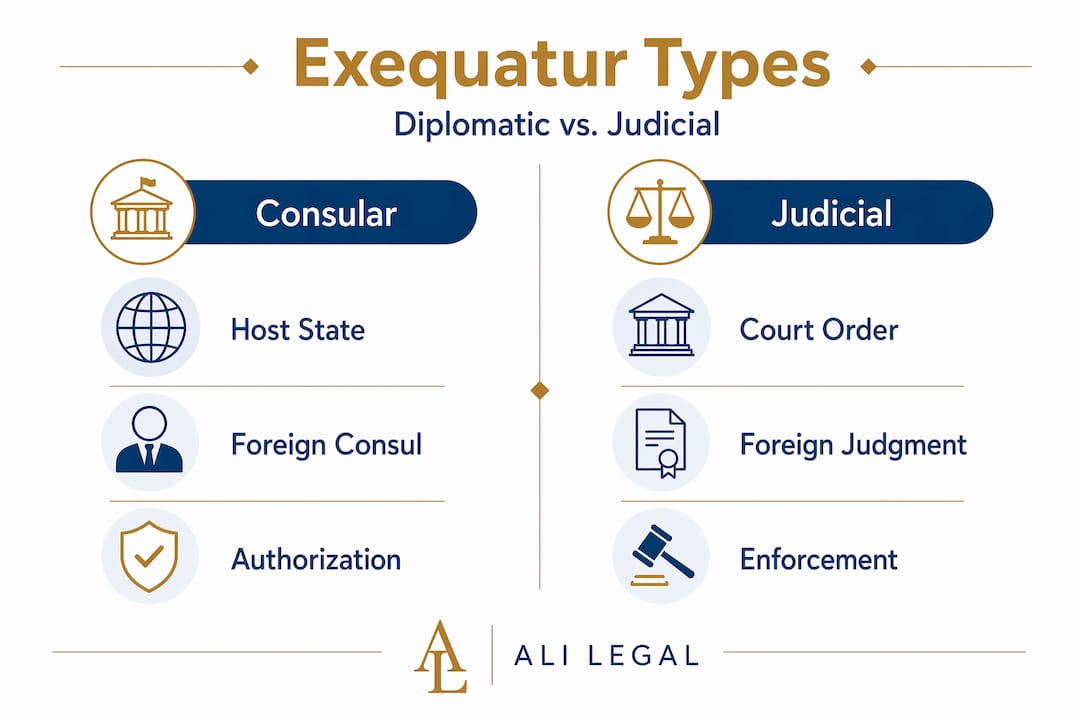
| Jurisdiction | Exequatur mechanism | Key requirements | Treaty basis |
|---|---|---|---|
| France | Formal exequatur proceedings before the Tribunal judiciaire | International jurisdiction of foreign court; no conflict with French public policy; no pending domestic proceedings | Bilateral treaties where applicable |
| Spain | Exequatur before the Supreme Court (or lower courts under EU rules) | Proper service on defendant; reciprocity or treaty; no public policy violation | EU Regulation 1215/2012 within EU context |
| Brazil | Superior Tribunal de Justiça (STJ) issues exequatur | Certified translation; apostille; compliance with Brazilian public order | Bilateral treaties or reciprocity |
| Romania | Recognition proceedings before domestic courts | Foreign court jurisdiction; final judgment; procedural regularity | EU rules and bilateral agreements |
| Puerto Rico | Domestic exequatur for US civil court orders | US civil orders validated domestically; compliance with Puerto Rico procedural rules | Federal framework |
| United Kingdom | No formal exequatur; common law recognition or statutory regimes | Service of process; jurisdiction; public policy | Various treaties and reciprocal arrangements |
The United Kingdom’s position deserves a specific note. English law does not use the term exequatur in a formalised sense for judgment enforcement. Instead, foreign judgments may be enforced through the common law action on a judgment, or under specific statutory regimes. This makes it all the more important to take specialist advice on cross-border litigation rather than assuming the procedure you are familiar with from one jurisdiction applies elsewhere.
Reciprocity and treaty frameworks are also significant. Several jurisdictions require either a formal agreement or a reciprocal arrangement before they will recognise a foreign judgment at all. In the absence of such a framework, the applicant faces a considerably harder task.
Knowing the theory is one thing. Approaching an actual exequatur process without proper preparation is another matter entirely. Whether you are a business trying to enforce a commercial judgment abroad or an individual pursuing a family law order across borders, the following steps and considerations apply broadly.
The starting point is always the judgment itself. You will need:
Pro Tip: Before instructing local counsel in the enforcement jurisdiction, obtain a written assessment of the reciprocity position and any treaty framework that applies. This single step can save months of misdirected effort.
The role of legal representation cannot be overstated. Exequatur proceedings involve procedural requirements that differ not just between countries but sometimes between regions within the same country. Working with a solicitor who understands both the originating and receiving jurisdictions is not a luxury. It is a practical necessity for cases with meaningful sums at stake. For context on how conflict of laws principles affect enforcement strategy in the UK, the interaction between treaty regimes and domestic court discretion is genuinely complex.
For disputes requiring multi-jurisdictional resolution, understanding the procedural landscape early makes an enormous difference. A guide to resolving cross-border disputes with clarity can help frame the options before you commit to a course of action.
I have worked with clients on international enforcement matters where the word “exequatur” was either completely unknown to them or understood only in one of its two senses. That gap in understanding consistently causes the same problem: people either underestimate the complexity of what they are trying to do, or they give up prematurely because someone told them an ex parte judgment or a judgment from a particular jurisdiction could never be enforced.
What I have learned is that exequatur cases turn on preparation and jurisdiction-specific knowledge far more than on the underlying merits of the original judgment. A creditor with a technically sound foreign judgment can still fail if the procedural steps are mishandled. Equally, what looks like a hopeless enforcement situation can often be resolved once you properly map the treaty framework and identify which court has the most favourable approach.
The dual nature of the concept matters too. I have seen consular exequatur issues affect commercial arrangements in ways that clients did not anticipate. When a consul’s authorisation is revoked, the downstream effects on commercial and legal relationships in that jurisdiction can be significant and swift.
My honest view is that exequatur will become more, not less, significant as cross-border commerce and litigation grow. The legal world has not kept pace with the speed at which judgments, assets, and people now cross borders. Practitioners who understand exequatur in both its diplomatic and judicial dimensions will be considerably better placed to serve clients who face this increasingly common challenge.
— Panagiotis
Exequatur proceedings demand precise legal knowledge, and the consequences of procedural errors are expensive. Alilegal’s team has extensive experience in civil and commercial litigation with an international dimension, advising businesses and individuals who need to enforce foreign judgments or defend against enforcement actions brought against them.
Whether you are dealing with a commercial debt judgment issued abroad, a consular authorisation matter, or a complex multi-jurisdictional dispute, Alilegal offers fixed-fee consultations and straightforward advice from solicitors who understand both the domestic and international dimensions. Our civil litigation service covers enforcement proceedings from initial assessment through to execution, and our commercial litigation practice handles high-stakes international disputes where speed and strategy both matter. Contact Alilegal today for a clear assessment of your enforcement options.
Exequatur is a formal legal authorisation that either permits a foreign consul to carry out official functions in a host state, or allows a foreign court judgment to be enforced within another country’s domestic legal system.
The UK does not operate a formal exequatur regime. Instead, foreign judgments are enforced through common law actions or specific statutory mechanisms, depending on the country of origin and any applicable treaty.
Yes. Courts in several jurisdictions, including India’s Telangana High Court in 2026, have confirmed that ex parte judgments can be enforced provided they were decided on the merits and proper procedural standards were met.
Requirements commonly include a certified copy of the final judgment, an official translation, proof of proper service on the defendant, absence of a public policy conflict, and in many jurisdictions, a treaty or reciprocal arrangement between the two countries.
Timelines vary considerably by jurisdiction. In some civil law countries with established procedures, the process can take several months. In jurisdictions without a formal exequatur regime or where public policy objections arise, proceedings can extend significantly longer.
TL;DR:
- Many contracts include clauses with different purposes that are often misunderstood or overlooked.
- Classifying these clauses into protective, operational, and financial categories helps identify gaps and manage risks effectively.
- Focusing on clear, precise drafting of each clause category reduces disputes and ensures contractual clarity and enforceability.
Most people sign contracts without truly understanding what each section does. That is not ignorance. It is a genuine structural problem: contracts bundle together dozens of examples of contract clauses with different purposes, different risks, and very different consequences, and rarely explain which is which. If you are drafting a new agreement or reviewing one before you sign, knowing your way around the main clause categories gives you real power. This article breaks those clauses into three practical groups, protective, operational, and financial, and works through concrete examples of each so you leave with a clear framework rather than a longer list of questions.
Before you can assess a specific clause, you need a map of the territory. Clause sets can be understood as three functional buckets — protective, operational, and financial — which helps drafters avoid gaps and ensures reviewers know exactly where to look for problems.
Protective clauses manage and allocate risk. They are the parts of a contract that decide who bears the cost if something goes wrong.
Operational clauses govern how the contract actually runs. They cover timelines, responsibilities, what happens during unexpected events, and how the relationship ends.
Financial clauses lock down the money. They define when payments are due, what happens if they are late, and under what conditions money is returned.
This three-part model matters because contracts fail most often not due to bad intentions but due to gaps. A well-drafted services agreement might have excellent payment terms but no force majeure provision. A supplier contract might cover liability carefully but say nothing about what triggers termination. Working through all three categories against your specific agreement is the most reliable way to spot what is missing. For a broader grounding in how English law treats agreements, our contract law overview covers the foundational principles you need before you start reading any specific clause.
The contract clause definitions within each category follow predictable patterns, which means once you learn one clause type well, recognising its variants in future contracts becomes straightforward.
Protective clauses are where the risk management lives. Common examples include non-disclosure, indemnification, and limitation of liability clauses that allocate risk and protect confidential information. Here is what each one actually does in practice.

Non-disclosure clauses (sometimes the entire agreement is called an NDA) prevent a party from sharing confidential information with third parties. In a business acquisition context, for example, both sides exchange commercially sensitive financials during due diligence. The NDA defines what counts as confidential, how long the restriction lasts, and what remedies apply if there is a breach. Our confidentiality clauses resource explains how these are structured under English law.
Indemnification clauses go further than simple liability. A well-drafted indemnification clause uses explicit “indemnify, defend, and hold harmless” language and includes attorneys’ fees to clarify obligations. In plain terms, this means one party agrees to compensate the other not just for direct losses but also for the legal costs of defending any third-party claim. A software provider, for instance, might indemnify its client against claims that the software infringes another company’s intellectual property.
Limitation of liability clauses set a ceiling on how much one party can recover. Limitation of liability often “caps” financial exposure and should be coordinated with indemnification clauses to avoid ambiguity. A common structure caps liability at the total contract value paid in the preceding 12 months. The critical drafting issue here is that if your indemnification clause promises unlimited cover but your liability cap limits all claims, the two clauses directly contradict each other. That contradiction will be resolved by a court, not by the contract itself, which is never where you want to end up.
Pro Tip: When reviewing any contract, read the indemnification clause and the limitation of liability clause side by side. If the indemnity is broader than the liability cap, or if one excludes categories of loss the other includes, you have a drafting conflict that needs resolving before signature. Our contract drafting best practices guide explains how to approach this reconciliation in detail.
The contractual liability details for UK businesses are worth understanding particularly if your contract involves services, because the scope of what counts as a loss varies significantly between commercial and consumer contexts.
Protective clauses handle the “what if it goes wrong” question. Operational clauses handle everything that comes before that: how the contract works day to day, what excuses non-performance, and how the relationship ends cleanly. These are the types of contract clauses that business people often overlook because they focus on price and risk, but operational gaps are frequently what cause disputes.
Force majeure clauses suspend or excuse performance during events that neither party can control or predict. Force majeure clauses suspend performance during extreme, unavoidable events without penalising either party. Qualifying events typically include natural disasters, wars, pandemics, and government-imposed restrictions. The pandemic period taught many businesses that the drafting quality of their force majeure clause mattered enormously: vague language led to litigation, while precise language gave clear answers quickly. A well-drafted clause will name specific event categories, set a notice period (often five to seven business days), and specify whether obligations are suspended or permanently discharged.
Termination clauses define the exit rights of each party. Termination clauses specify how and when a contract can be ended legally, including notice periods. There are two key variants: termination for cause (where a party breaches a material obligation) and termination for convenience (where a party exits without fault, typically on written notice). Failing to include a termination for convenience clause in a long-term services agreement can trap a party in a relationship that has simply stopped working, with no exit route short of claiming breach.
Dispute resolution clauses set out the process parties must follow before they can litigate. Most well-drafted commercial contracts require a period of negotiation, then mediation, and only then arbitration or litigation. This staged approach saves considerable cost. Our arbitration clauses overview covers why choosing arbitration over litigation matters in commercial and international contexts.
Pro Tip: Always check whether your dispute resolution clause specifies a governing law and jurisdiction. If it does not, and the other party is in a different country, determining which court has authority becomes an expensive preliminary fight before the main dispute even starts. Our drafting operational clauses resource covers this in detail.
Financial clauses are the ones clients read most carefully and still most often get wrong. The problem is usually not that the payment amount is disputed, it is that the mechanics of when, how, and under what conditions payment is due are left vague.
Payment terms specify billing cycles, payment methods, and due dates like “Net 30/60/90,” including late payment consequences. “Net 30” means the invoice is due 30 days after the invoice date. Sounds simple. But without specifying when invoices are issued, what triggers an invoice, and how disputes about invoice amounts are handled, Net 30 clauses routinely produce payment disagreements that damage working relationships.
Late payment penalty clauses give teeth to payment terms. Under the Late Payment of Commercial Debts (Interest) Act 1998, UK businesses already have a statutory right to claim interest on overdue invoices, but contracting for a higher rate or a fixed penalty can be more effective in practice. Well-crafted payment provisions include invoicing schedules and late fees to avoid friction. A typical commercial clause might charge 4% above the Bank of England base rate per annum on overdue amounts.
Refund clauses set out the conditions under which a party receives money back. In a services context, refunds are rarely straightforward: a client may dispute delivery quality while the provider argues the service was delivered as agreed. A clear refund clause defines what constitutes non-delivery, what the notice and claim period is, and whether refunds are full or partial. Without it, every refund request becomes a negotiation with no agreed starting point.
Clear financial clauses in your contract drafting tips checklist directly reduce the time between invoicing and being paid. Our financial clauses drafting guide gives specific language for common commercial payment structures.
Seeing the clause categories side by side makes selection much more intuitive. The table below is designed as a quick-reference when you are either reviewing an existing contract or building one from scratch. Understanding business contract types helps you identify which categories apply most urgently to your specific agreement.
| Category | Clause example | Core purpose | Key drafting requirement |
|---|---|---|---|
| Protective | Non-disclosure | Keeps confidential information private | Define “confidential information” precisely |
| Protective | Indemnification | Shifts third-party claim costs | Include legal fees and “hold harmless” language |
| Protective | Limitation of liability | Caps financial exposure | Coordinate with indemnity clause to prevent conflict |
| Operational | Force majeure | Excuses unforeseeable non-performance | List qualifying events; specify notice period |
| Operational | Termination | Governs how the contract ends | Include both “for cause” and “for convenience” |
| Operational | Dispute resolution | Manages how disagreements are resolved | Specify governing law, jurisdiction, and staged process |
| Financial | Payment terms | Fixes when and how money is paid | State invoice trigger, due date, and acceptable methods |
| Financial | Late payment penalty | Penalises overdue payments | Specify rate, calculation basis, and accrual date |
| Financial | Refund provisions | Sets conditions for returned payments | Define qualifying non-performance and claim period |
This table covers the most common contract clause examples that appear in commercial, services, and real estate contract clauses. The goal is not to use every one in every agreement; it is to consciously decide which apply and draft them with enough precision that they are unambiguous.
Every experienced solicitor has seen the same pattern. A client spends significant time and effort negotiating price and deliverables, then signs off on boilerplate operational and protective clauses without reading them. Months or years later, a dispute arises and the outcome turns entirely on the clause nobody bothered to negotiate.
The limitation of liability clause is the most common example. Clients see it as standard and assume it is balanced. But a well-advised counterparty may have quietly drafted a cap set at one month’s fees on a multi-year contract. That is not balanced. That is a trap disguised as standard language.
The same applies to force majeure clauses. Before 2020, most people treated them as theoretical. They are not theoretical. They are the clauses that determine whether your business absorbs the entire cost of disruption or whether that cost is shared equitably.
Our view is that every clause you accept without scrutiny is a risk you have accepted without pricing. You may be comfortable with that risk, but it should be a conscious decision, not an accidental one. The framework in this article gives you a starting structure. A solicitor gives you the specific analysis your agreement actually needs.
Contracts protect your business, your relationships, and your money, but only if they are drafted and reviewed properly.
At Ali Legal, we work with businesses, entrepreneurs, and individuals on contract drafting, review, and disputes across commercial, property, and international agreements. We offer fixed fees and straightforward advice with no jargon and no surprises. Whether you need a single clause reviewed or an entire agreement built from scratch, our solicitors are ready to help. Contact us today for a consultation and find out exactly where your contract stands.
A clause is the numbered section of a contract, while a provision is the specific rule or obligation stated within that clause. In practice, many people use the terms interchangeably, but understanding the distinction helps when reviewing complex agreements with nested obligations.
Indemnification clauses allocate responsibility for third-party claims and include legal fees, which means the indemnifying party covers your defence costs and any resulting liability rather than leaving you to absorb them alone.
Failing to reconcile indemnity and liability caps is a common drafting mistake that creates ambiguity about who pays what costs, often leaving the question to be resolved by a court rather than the contract itself.
Force majeure clauses must state qualifying events, notice requirements, and the precise effect on performance obligations, including whether they are suspended temporarily or discharged entirely.
Clear payment provisions avoid friction by specifying invoicing schedules, acceptable payment methods, due dates, and late payment consequences, giving both parties a shared reference point that prevents misunderstandings before they escalate.


