
Menu
Get Expert Legal Support Today
TL;DR:
- Client-centric law firms prioritize transparency, personalized advice, and long-term relationships.
- Technology enhances efficiency and communication but must be balanced with empathy and ongoing feedback.
- Key indicators of a client-centric firm include clear pricing, proactive updates, and tailored solutions.
Most people assume that hiring a solicitor is hiring a solicitor. The firm you choose, the fees you pay, the updates you receive — surely these are minor details? In reality, 52% of legal clients prefer flat fees and value transparency above almost everything else. The legal industry is changing fast, and the firms that put your goals at the centre of everything they do are producing measurably better outcomes. This guide explains exactly what a client-centric law firm looks like, why it matters for your case or business, and how to identify one before you sign anything.
| Point | Details |
|---|---|
| Transparency builds trust | Client-centric firms use open communication and clear fees to create lasting trust with clients. |
| Tech powers efficiency | Modern tools speed up processes and improve updates, saving you time and reducing stress. |
| Personalisation secures outcomes | Tailored legal strategies and real empathy deliver better long-term results for individuals and businesses. |
| Right selection avoids pitfalls | Knowing what to look for helps you choose a law firm that prioritises your real needs. |
The phrase “client-centric” gets used a great deal, but it deserves a precise definition. A client-centric law firm is one that organises its entire practice around your goals, your experience, and your outcomes — not around its own internal processes or billing targets. Every decision, from how a solicitor communicates to how invoices are structured, flows from the question: what serves this client best?
In practical terms, client-centric firms prioritise transparency in billing and processes, offering fixed fees and itemised invoices so you always know where your money is going. They provide regular, proactive updates rather than waiting for you to chase them. They adopt technology that makes your experience smoother. And they offer tailored legal solutions rather than recycling template advice.
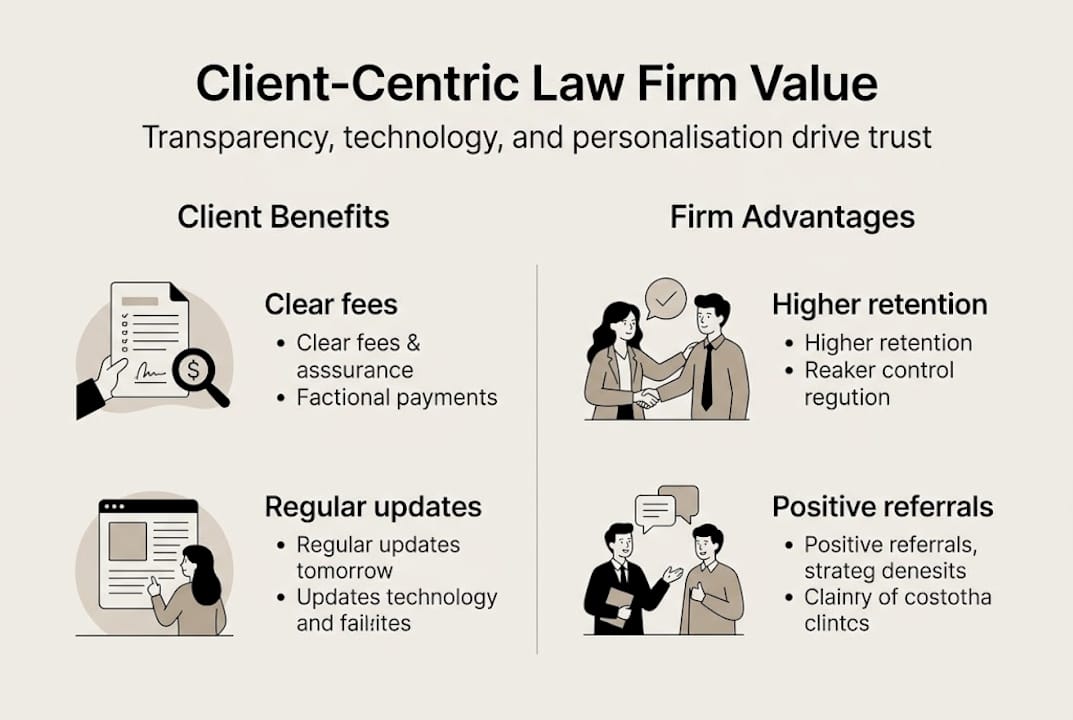
Contrast this with the traditional model. Many established firms remain process-driven, prioritising precedent and internal workflow over personalised service. Billing is often opaque, with hourly rates that can spiral unpredictably. Communication tends to be reactive. Client-centric firms are more responsive, innovative, and deliver better satisfaction than their traditional counterparts, and the gap is widening.
Here is a direct comparison:
| Feature | Client-centric firm | Traditional firm |
|---|---|---|
| Billing model | Fixed fees, itemised invoices | Hourly rates, variable costs |
| Communication | Proactive, regular updates | Reactive, client-initiated |
| Technology | Client portals, digital tools | Largely paper-based or email |
| Advice style | Personalised to your goals | Template-driven |
| Relationship | Long-term, ongoing | Transactional, case-by-case |
The key traits that define a genuinely client-centric firm include:
Firms built around relationship-based outcomes understand that a satisfied client is not just a closed case — it is a long-term partnership.
Trust is not given freely, especially when legal matters are involved. You are sharing sensitive information, making significant financial decisions, and relying on expert guidance at some of the most stressful moments in your life or business. Transparency is the foundation on which that trust is built.
Client-centric firms use fixed fees, itemised invoices, and real-time updates to eliminate the anxiety that comes with traditional billing. You know the cost upfront. You receive a clear breakdown of what work has been done. You are not left wondering whether a brief phone call will add another charge to your bill.
Beyond billing, transparency extends to process. The best firms keep you informed at every stage — not just when something significant happens, but with regular touchpoints that confirm your matter is progressing. Client portals allow you to log in, review documents, and send messages securely at any time.
“Transparency is not just a nice-to-have in legal services — it is the single most powerful driver of client loyalty and long-term value.”
The numbers support this firmly. A 5% increase in client retention boosts profit by 25 to 95%, which means that firms investing in transparent, trust-building practices are not just doing right by clients — they are building more sustainable businesses.
| Transparency practice | Client benefit | Business benefit |
|---|---|---|
| Fixed fees | Budget certainty | Fewer billing disputes |
| Real-time updates | Reduced anxiety | Higher satisfaction scores |
| Itemised invoices | Full visibility | Increased trust and referrals |
| Client portals | 24/7 access | Reduced admin queries |
Pro Tip: Before instructing any firm, ask for a written fee estimate and a clear explanation of what triggers additional costs. A firm that hesitates to provide this is worth reconsidering. Clear legal advice from the outset sets the tone for the entire relationship.
Beyond transparency, efficiency powered by modern tools is transforming the legal landscape. The stereotype of law firms buried in paper files and slow correspondence is, thankfully, becoming outdated. Client-centric firms are embracing technology not as a gimmick, but as a genuine service improvement.
Efficiency is achieved through client portals, AI for routine tasks, and automation, which frees solicitors to focus on the complex, human-centred work that actually requires their expertise. Routine document review, appointment scheduling, and standard correspondence can all be handled faster and more accurately with the right tools.
For you as a client, this translates into:
Technology also enables firms to serve a broader range of clients more effectively. International clients, businesses with complex multi-jurisdictional needs, and individuals with busy schedules all benefit from firms that can operate efficiently across digital channels. Understanding the value for clients and businesses that technology-enabled legal services deliver is increasingly important in 2026.
Pro Tip: When evaluating a firm, ask for a demonstration of their client portal or digital communication tools. A firm that cannot show you how it manages your case digitally may struggle to keep pace with your expectations.
For businesses in particular, having access to legal counsel for business that operates efficiently and digitally can make a genuine difference to how quickly commercial decisions are made and risks are managed.
With process and technology covered, it is time to address the human factor. Personalisation is what separates a genuinely client-centric firm from one that has simply updated its website and installed a portal.

Long-term relationships are fostered by personalisation, empathy, ongoing feedback, and proactive needs anticipation. This means your solicitor understands your business model, your risk appetite, your family circumstances, or your commercial ambitions — and shapes their advice accordingly. It is not about sending a birthday card. It is about knowing that a change in your industry might affect your contracts before you even realise it.
Consider what genuine personalisation looks like in practice:
“The most valuable legal relationships are built over years, not cases. A solicitor who knows your business is worth far more than one who simply knows the law.”
Personalisation also drives referrals. Clients who feel genuinely understood and well-served become advocates. They recommend their solicitor to colleagues, family members, and business partners. Firms that boost outcomes with lasting relationships consistently outperform those focused solely on case volume.
After exploring the advantages, let’s turn theory into actionable steps for your law firm search. Knowing what a client-centric firm looks like in principle is one thing. Identifying one in practice requires a sharper eye.
Here is what to look for:
And here are the red flags to watch for:
Client-centric firms attract talent, improve efficiency, and enable premium pricing, while traditional firms that ignore client expectations face growing obsolescence. The market is rewarding firms that invest in client experience, and that investment ultimately benefits you.
Pro Tip: Use your first consultation as a test. Ask about their fee structure, how they communicate progress, and what happens if your matter becomes more complex. Their answers will tell you everything. Good legal consultation preparation makes this process far more productive.
Here is something the legal industry rarely admits openly: most firms want to be client-centric but find the transition genuinely difficult. The barrier is not always willingness. It is legacy infrastructure, entrenched billing habits, and a professional culture that historically rewarded technical expertise over client experience.
Technology helps, but it is not the whole answer. Tech must be balanced with empathy, ongoing training, and client consent for data use — and many firms invest in the former while neglecting the latter. A slick portal means nothing if the solicitor on the other end does not listen.
Feedback loops are another overlooked element. Annual client surveys are not enough. Genuine client-centricity requires ongoing, informal feedback — conversations that happen mid-matter, not just at the end. This is where most firms fall short, and it is exactly where the best ones pull ahead.
We believe the firms that will lead in the next decade are those that treat tailored solutions not as a marketing message but as an operational commitment. That means training, culture, and measurement — not just technology.
If you have read this far, you understand what genuinely client-centric legal service looks like. At Ali Legal, this is not an aspiration — it is how we operate every day across commercial, civil, and personal matters.

From commercial litigation to civil litigation, we bring fixed fees, proactive communication, and strategies shaped around your specific goals. We do not recycle template advice or leave you guessing about costs. We build relationships that last beyond the immediate matter, because we know that is where real value lies. If you are ready to work with a firm that puts your needs first, speak to our team today and take the first step towards legal support that actually works for you.
Key markers are transparency, proactive updates, and tailored advice. Look for clear upfront pricing, regular communication without you having to chase, and personalised solutions shaped around your specific goals.
It leads to more efficient outcomes, stronger ongoing relationships, and better protection for evolving business needs. Long-term relationships and client-centricity boost retention and profitability in ways that transactional legal service simply cannot match.
Used well, technology improves access and speeds up communication considerably. Tech must be balanced with empathy and ongoing feedback to ensure the human element is never lost in the process.
Not necessarily. 52% of clients prefer flat fees, and client-centric firms often use fixed-fee structures that deliver more clarity and value than unpredictable hourly billing.
Failing to assess the firm’s transparency and communication style early on. Opaque billing and slow responses are reliable warning signs that a firm’s priorities do not align with yours.
TL;DR:
- Strategic legal decisions, not just legal strength, determine dispute outcomes and business impact.
- Choosing between ADR and litigation depends on speed, cost, relationship, and enforceability considerations.
- Early evidence preservation, clear planning, and expert guidance are crucial for successful dispute resolution.
Most business owners enter a dispute believing the strongest case wins. It rarely works that way. The outcome of a legal dispute is shaped far more by the quality of your strategic decisions than by the raw merits of your position. Poor timing, the wrong resolution path, or a reactive negotiation stance can erode even the most compelling claim. Equally, a well-structured legal strategy can resolve a difficult dispute faster, cheaper, and with less damage to your business relationships. This guide explains how strategic legal thinking drives better dispute outcomes, and what you need to consider at every stage.
| Point | Details |
|---|---|
| Legal strategy shapes results | Outcomes rely on smart choices as much as facts and rights. |
| ADR often means speed and savings | Choosing mediation or arbitration can resolve disputes up to 10 times faster. |
| Evidence and timing are crucial | Preserving vital evidence and acting quickly can make or break a case. |
| Negotiation approach matters | Interest-based negotiation preserves relationships, while power-based may secure rights at a cost. |
| Legal and business goals align | Strategic legal planning should reflect broader business aims for true success. |
Legal strategy is not simply receiving advice about your rights. It is a structured plan that maps out your dispute from start to finish, accounting for risk, cost, timing, and the most likely paths to resolution. Many business owners confuse the two, assuming that once they understand their legal position, the rest will follow naturally. That assumption is costly.
A proper legal strategy includes several interconnected elements:
The role of a solicitor in this context goes well beyond drafting letters. An experienced solicitor helps you see the dispute as a whole, not just the immediate flashpoint.
One of the most important insights in dispute resolution is that over 90% of civil disputes settle before they reach trial. That statistic is not a coincidence. It reflects the fact that well-advised parties on both sides eventually recognise the cost and uncertainty of litigation and find common ground. The earlier your strategy anticipates this reality, the sooner you can reach a favourable settlement on your terms.
“The goal of legal strategy is not to win in court. It is to achieve your business objective at the lowest possible cost and risk.”
Setting the strategic tone early matters enormously. Parties who engage solicitors reactively, after the dispute has already escalated, often find themselves in a weaker position, having missed opportunities to preserve evidence, establish goodwill, or signal credible resolve.
With the concept of legal strategy clarified, it is vital to see how the pathway you choose can dictate outcomes. Alternative dispute resolution (ADR) and litigation are not simply different procedures. They represent fundamentally different philosophies about how disputes should be resolved.
| Factor | ADR (mediation/arbitration) | Litigation |
|---|---|---|
| Speed | Weeks to months | Months to years |
| Cost | Generally lower | Often substantial |
| Privacy | Confidential | Public record |
| Relationship impact | Preserves relationships | Often adversarial |
| Outcome control | Parties retain control | Judge or jury decides |
| Enforceability | Arbitration awards are binding | Court judgments enforceable |
ADR such as mediation and arbitration consistently resolves disputes faster and at lower cost than traditional litigation. AAA arbitration averages 2.3 months for large business-to-business claims, compared with two or more years for equivalent litigation. For most commercial disputes, that difference is decisive.
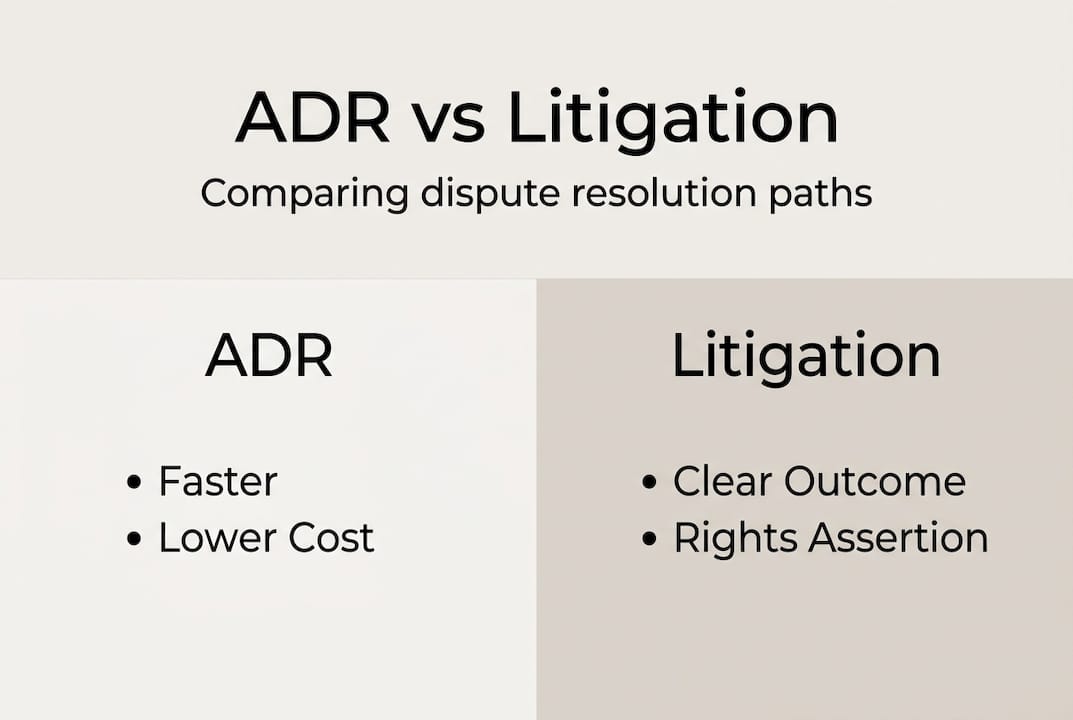
However, ADR is not always the right answer. Litigation for binary outcomes and rights assertion remains necessary when one party needs a clear, enforceable court order, when the other side is acting in bad faith, or when a public precedent matters to your business. Understanding alternatives to litigation is not about avoiding court at all costs. It is about choosing the right tool for the specific dispute.
The inclusion of arbitration clauses in contracts is one of the most powerful pre-dispute strategic decisions a business can make. These clauses lock in a faster, private resolution process before any dispute arises, removing uncertainty and protecting ongoing business relationships.
Pro Tip: Before any dispute escalates, review your existing contracts for dispute resolution clauses. If they are absent or vague, update them now. The best time to agree on a resolution process is before you need one.
Having considered the resolution path, the next step is ensuring your strategy is grounded in facts, not just legal interpretations. Evidence is the foundation of any dispute, and how you gather, preserve, and present it can determine whether your strategy succeeds or fails.

The legal profession is increasingly data-driven. Outcome-based models for evaluating law firm performance now outperform traditional prestige rankings in predicting dispute success, which means that choosing representation based on track record and data, rather than reputation alone, gives you a measurable advantage.
Here are the key steps to building an evidence-led strategy:
The steps for resolving commercial disputes always begin with fact-gathering. Skipping this stage in favour of immediate legal action is one of the most common and expensive mistakes businesses make.
The data and timing matter greatly, but ultimately, how you negotiate can tilt the dispute in your favour. Negotiation is not a single approach. It is a spectrum, and choosing where to position yourself requires careful strategic thinking.
Power-based negotiation relies on leverage. You assert your legal rights, signal your willingness to litigate, and use the cost and risk of proceedings to pressure the other party into settlement. This approach works well when your legal position is strong, when the relationship with the other party is not a priority, or when you need a clear, enforceable outcome.
Interest-based negotiation focuses on the underlying needs of both parties, not just their stated positions. Rather than asking “what do you want?”, it asks “why do you want it?”. This approach, which underpins most mediation processes, often produces creative solutions that neither party could achieve through litigation.
Power-based versus interest-based negotiation is not a binary choice. Many successful dispute resolutions blend both, using the credible threat of litigation to bring parties to the table, then shifting to interest-based dialogue once negotiations begin.
Key considerations when choosing your negotiation approach:
Understanding the types of dispute resolution available, and when each is appropriate, is essential before entering any negotiation. Whether you are resolving contract disputes or navigating a complex commercial breakdown, the role of a mediator in facilitating interest-based dialogue is frequently underestimated.
Pro Tip: Before entering negotiations, write down your best alternative to a negotiated agreement (BATNA). Knowing your walk-away point in advance prevents you from making concessions under pressure that you later regret.
Here is a perspective that most legal guides will not offer you: a dispute is not an interruption to your business. It is a moment that reveals your business’s priorities, risk tolerance, and long-term thinking.
The decisions you make during a dispute, whether to litigate or mediate, how aggressively to negotiate, when to settle, all carry consequences that extend well beyond the immediate outcome. They affect your reputation with suppliers, customers, and investors. They signal to future counterparties how you behave under pressure. And they shape your internal culture around risk and accountability.
We have seen businesses win disputes on paper and lose strategically, damaging key relationships, spending disproportionate management time, and creating precedents that invited further claims. We have also seen businesses achieve favourable settlements that strengthened partnerships and improved contract terms for years afterwards.
The civil litigation best practices that produce the best long-term results are those aligned with business objectives, not just legal ones. Risk tolerance, stakeholder relationships, and commercial priorities must shape your legal tactics from the outset. If your solicitor is not asking about your business goals, they are not giving you a strategy. They are giving you legal advice, and that is not the same thing.
Applying these strategic principles is straightforward in theory. In practice, disputes move quickly, emotions run high, and the pressure to react rather than plan is constant. That is where experienced legal guidance makes a measurable difference.
At Ali Legal, our commercial litigation strategy is built around your business objectives, not just the legal merits of your claim. We assess your dispute from every angle, identify the most cost-effective resolution path, and adapt your strategy as circumstances change. Whether you are at the earliest stage of a dispute or already in proceedings, our approach is grounded in the civil litigation best practices that consistently produce better outcomes. If you are ready to take a strategic approach to your dispute, contact Ali Legal today for a direct, transparent conversation about your options.
A legal strategy involves evaluating all dispute options, risks, and objectives in alignment with your business goals, while legal advice simply explains what is legally possible or permitted in a given situation.
Over 90% of civil disputes settle before trial because settlement is typically less costly and time-consuming than a full hearing, particularly when both parties receive effective early legal advice.
Litigation is preferable when a clear, enforceable outcome is essential or when rights assertion requires a court order, while ADR is better suited to disputes where preserving the business relationship matters.
Preserve critical evidence within the first 72 hours of escalation, seek specialist legal input without delay, and establish both your short-term response and your long-term resolution objective from the outset.
TL;DR:
- Property law governs ownership, use, transfer, and disputes over real and personal property.
- Fixtures are items attached to property that may cause disputes depending on intent and attachment.
- Understanding rights, restrictions, and proper legal procedures helps prevent costly property transaction errors.
Property law is one of those subjects most people assume they’ll never need to understand until they suddenly do. Whether you’re buying your first home, signing a commercial lease, inheriting a family estate, or simply renting a flat, property law shapes every step of the process. Yet the terminology alone is enough to make most people’s eyes glaze over. This guide cuts through that confusion. We’ll explain the core concepts in plain language, show you how they apply to real situations, and help you spot the issues that catch people off guard. By the end, you’ll have a clear framework for making more confident, informed decisions.
| Point | Details |
|---|---|
| Property law basics | Understanding real and personal property avoids common transaction mistakes. |
| Fixtures impact disputes | Clarifying fixtures can prevent legal challenges during sales or divorces. |
| Rights can be split | Property rights may be divided, leased, or sold, complicating agreements. |
| Watch for encumbrances | Liens, easements, and covenants often limit your rights and should be checked early. |
| Expert advice matters | Complex scenarios benefit from specialist legal guidance for best outcomes. |
Property law is the body of rules that governs how people own, use, transfer, and dispute rights over property. As jurisdiction variations show, it operates primarily under local law, which means the rules can differ significantly depending on where you are. In England and Wales, for example, property law is shaped by a combination of statute and case law, covering everything from residential conveyancing to commercial leases and boundary disputes.
At its core, property law has three key objectives: to establish who owns what, to define what owners can and cannot do with their property, and to provide a framework for resolving disputes when things go wrong. Understanding property law fundamentals is not just useful for homeowners. Business owners leasing office space, landlords managing rental portfolios, and developers acquiring land all operate within this legal framework every single day.
One of the first distinctions you need to understand is the difference between real property and personal property.
| Type | Definition | Examples |
|---|---|---|
| Real property | Land and anything permanently attached to it | Houses, commercial buildings, farmland |
| Personal property | Movable assets not permanently fixed to land | Furniture, vehicles, equipment |
Real property is sometimes called “immovable property” in legal contexts. Personal property, by contrast, can be physically moved or transferred without altering the land itself.
Why does this distinction matter? Because the legal rules that apply to each category are quite different. Buying a house involves a formal conveyancing process, title registration, and stamp duty. Buying a car does not. Mixing up these categories, or failing to identify which applies, can lead to costly errors.
Here are some of the most common situations where property law affects individuals and businesses:
Following property law compliance steps from the outset of any transaction significantly reduces the risk of disputes arising later. The same applies to businesses: understanding commercial property basics before signing a commercial lease can save considerable time, money, and stress.
Once you’ve grasped property law’s purpose, it’s important to know what types of property it covers and where confusion often arises. The distinction between real and personal property seems straightforward until you encounter what lawyers call a fixture.
A fixture is an item that was once personal property but has become so attached to real property that it is now legally considered part of it. As fixture disputes illustrate, real property includes land and attached fixtures, while personal property covers movable assets, and fixtures transition based on the intent behind their annexation.

| Category | Legal status | Example |
|---|---|---|
| Real property | Immovable, transfers with land | Built-in kitchen units |
| Personal property | Movable, does not transfer automatically | Freestanding fridge |
| Fixture | Originally personal, now real | Fitted bathroom suite |
Fixtures cause a surprising number of disputes in property transactions. Consider a common scenario: a seller installs an expensive chandelier in the dining room. The buyer assumes it’s included in the sale. The seller removes it before completion. Who is right? The answer depends on how the item was attached and what the parties intended.
Courts typically consider several factors when classifying a fixture:
Fixture disputes also arise in divorce proceedings, where one party may argue that an item is personal property (and therefore theirs) while the other insists it forms part of the matrimonial home. The same logic applies to commercial tenants who install equipment or shopfitting in leased premises.
Pro Tip: Always ask your solicitor to include a specific fixtures and fittings list in any property sale contract. This removes ambiguity and prevents disputes before they start. You can also explore resolving contract disputes if you’re already facing a disagreement, or review examples of property disputes to understand how similar cases have been handled.
Understanding what counts as property sets up the next big issue: how rights are shared and passed on. Property law does not treat ownership as a single, indivisible thing. Instead, it recognises what is known as a bundle of rights, a collection of distinct legal entitlements that can be held, split, or transferred separately.
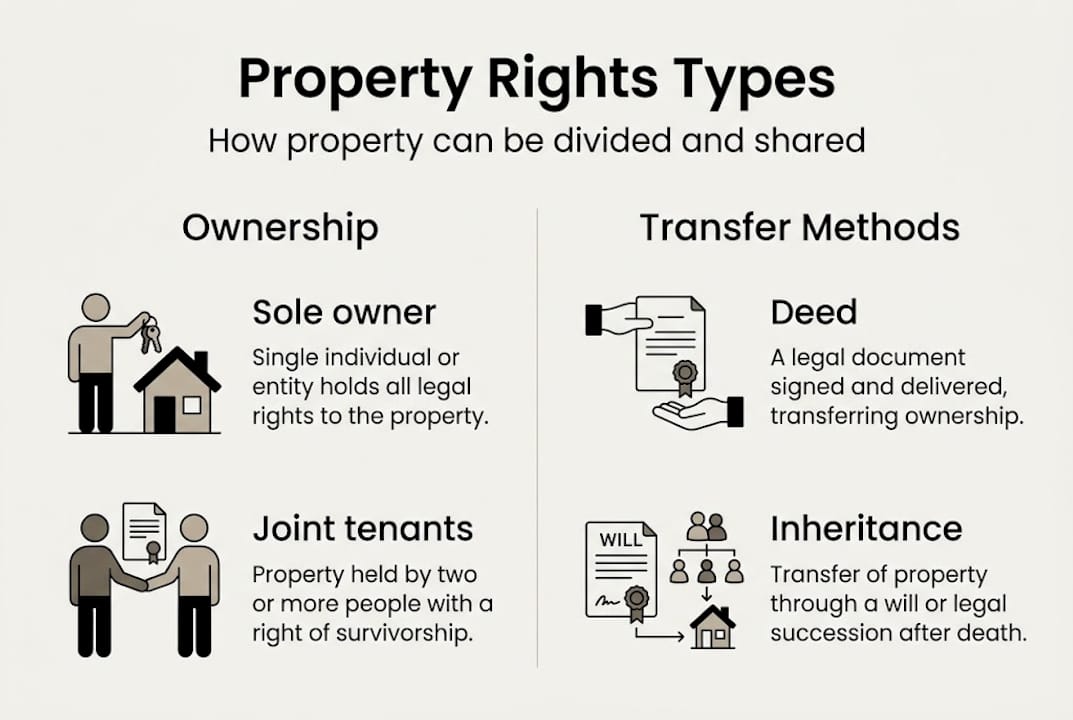
As the bundle of rights concept explains, this approach allows splitting, such as leasing possession while retaining ownership, or selling mineral rights while keeping the surface land. This flexibility enables complex transactions but also increases legal complexity.
The bundle typically includes the rights to:
A business owner, for instance, might lease a commercial unit from a landlord. The landlord retains ownership but transfers the right of possession to the tenant for the lease term. Meanwhile, the landlord may also grant a mortgage over the property to a bank, transferring certain security rights. Three parties, one property, multiple rights operating simultaneously.
When it comes to formally transferring ownership, the legal instrument used is a deed. As property deeds and transfers confirm, warranty deeds guarantee clear title to the buyer, while quitclaim deeds transfer whatever interest the seller holds with no guarantees whatsoever.
A warranty deed is the gold standard in property transfers. It tells the buyer: “I own this property, I have the right to sell it, and I will defend your title if anyone challenges it.”
Recording a deed in the appropriate land registry is equally important. In England and Wales, registration at HM Land Registry provides legal protection against third-party claims. Without registration, your ownership interest may be vulnerable.
Pro Tip: Before completing any property transaction, verify the type of deed being used and confirm that the title has been properly registered. Your solicitor should check for any unregistered interests that could affect your rights. If you’re a tenant, understanding tenant rights explained will help you know exactly where you stand.
Knowing how rights are transferred naturally leads to questions about limitations and hidden surprises that may come with property. These are known as encumbrances, legal burdens or restrictions that affect the use or transfer of a property without necessarily transferring ownership.
As encumbrance overviews confirm, encumbrances such as liens, easements, and covenants limit property rights, and easements in particular grant use without ownership, sometimes arising from long-standing use rather than any written agreement.
Here are the main types of encumbrance you may encounter:
| Type | What it means | Common example |
|---|---|---|
| Lien | A financial claim against the property | Unpaid mortgage or council tax debt |
| Easement | A right for others to use part of the property | Right of way across a neighbour’s land |
| Covenant | A binding obligation affecting use | Restriction on building extensions |
| Charge | Security interest held by a lender | Bank charge registered against title |
Encumbrances are discovered through a property search, which your solicitor carries out before exchange of contracts. This search reveals registered charges, local authority notices, and any rights of way or restrictions attached to the title.
Real-world scenarios where encumbrances cause problems include:
Encumbrances do not disappear when a property changes hands. Many bind the land itself, not just the current owner, meaning they transfer automatically to the new buyer.
This is why checking for encumbrances before committing to any purchase is not optional. It is one of the most important steps in the entire transaction.
Most people underestimate property law because it looks manageable on the surface. You read a template contract, sign it, and assume everything is covered. In our experience, that assumption is where things start to go wrong.
The cases that cause the most grief are rarely the obvious ones. They are the edge cases: a fixture that was never listed in the contract, an easement that was never disclosed, a deed that was never properly registered. These are not exotic legal problems. They are everyday oversights that carry serious financial consequences.
What we consistently observe is that people treat property transactions as administrative processes rather than legal ones. They focus on price, completion dates, and moving logistics. The legal substance gets delegated without proper oversight.
Our honest advice is this: do not rely on precedent documents or assumptions, especially in emotionally charged situations like divorce, inheritance, or business dissolution. These are precisely the contexts where property law becomes most contested and most consequential. Getting property law ownership insights from a qualified solicitor before you commit, not after a problem arises, is almost always the more cost-effective choice.
Understanding property law in theory is genuinely useful. But when you are facing a real transaction, a dispute, or an urgent deadline, theory is rarely enough.
At Ali Legal, we work with individuals and business owners who need clear, practical legal support on property matters. Whether you are dealing with a contested transaction, a boundary dispute, or a commercial lease negotiation, our team provides straightforward advice with fixed fees and no unnecessary delays. For those already in dispute, our civil litigation support and commercial litigation solutions are designed to protect your position effectively. If you want to talk through your situation, speak to our team today.
Real property covers land and any structures permanently attached to it, while personal property refers to movable items that are not fixed to the land. The distinction determines which legal rules and processes apply in a transaction.
Your solicitor will carry out a title search and property searches to uncover registered liens, easements, covenants or other restrictions before you exchange contracts. Never skip this step, even in straightforward transactions.
Fixture disputes arise when buyers and sellers disagree about whether an item is part of the real property or remains personal property, often because the sale contract did not include a clear fixtures and fittings list.
The two principal types are warranty deeds, which provide a guarantee of clear title, and quitclaim deeds, which transfer only whatever interest the seller actually holds with no title guarantee. Always confirm which type applies before proceeding.
TL;DR:
- Legal advocacy extends beyond courtroom appearances to negotiation, written submissions, and strategic planning.
- Quality legal advocacy provides significant economic and social returns, improving case outcomes and reducing harm.
- Trauma-informed, adaptable approaches combined with traditional advocacy skills are essential for effective client support.
Most people picture legal advocacy as a solicitor standing up in court, making arguments before a judge. That picture is incomplete. Effective legal advocacy spans negotiation rooms, written submissions, strategic planning sessions, and trauma-sensitive client interviews, long before a courtroom is ever entered. Research confirms that quality legal advocacy delivers measurable economic and social returns for individuals and organisations alike. This guide explains what genuine advocacy involves, who benefits most, and how the field is evolving to meet the demands of 2026 and beyond.
| Point | Details |
|---|---|
| Beyond the courtroom | Legal advocacy supports clients through strategy, negotiation, and relationship-building, not just in court. |
| Empirical benefits | Evidence shows high ROI, better outcomes, and increased satisfaction from quality advocacy. |
| Holistic approaches | Trauma-informed and client-centred advocacy models improve both wellbeing and case results. |
| Adaptability is crucial | Modern advocacy combines tradition, trauma awareness, and digital skills to handle complex cases. |
Legal advocacy is the professional practice of advancing a client’s interests through a combination of representation, strategic advice, negotiation, and sustained relationship management. It is not limited to appearing in court. A skilled advocate works across every stage of a legal matter, from initial fact-gathering to settlement discussions to, where necessary, contested hearings.
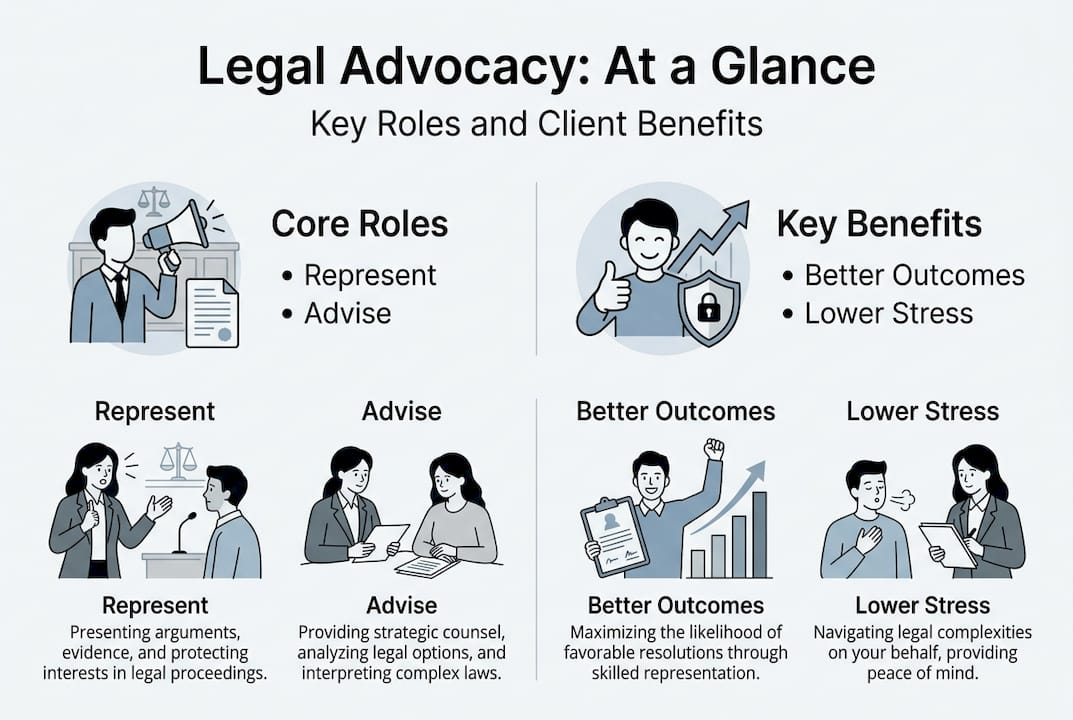
Legal advocacy involves representing clients’ interests through zealous representation, strategic counselling, and client-centred approaches across civil, criminal, family, and immigration law. Understanding the meaning of legal representation helps clarify why this breadth matters: representation is not a single act but an ongoing commitment to a client’s position.
The table below summarises how advocacy actions differ across common practice areas:
| Practice area | Key advocacy actions |
|---|---|
| Civil litigation | Evidence gathering, pleadings, negotiation, trial representation |
| Family law | Mediation support, financial disclosure, child arrangements |
| Immigration | Appeals, asylum submissions, removal challenges |
| Criminal law | Bail applications, plea negotiations, trial defence |
| Corporate and commercial | Contract disputes, regulatory advice, arbitration |
Across all of these areas, certain skills remain constant. Strong advocates share a recognisable set of core competencies:
These skills are not innate. They are developed through training, experience, and a genuine commitment to client outcomes rather than process for its own sake.
The case for investing in quality legal advocacy is not just intuitive. It is backed by data. Legal aid and advocacy yield a median return on investment of £6.77 for every £1 spent, improving representation and reducing harmful outcomes for clients across multiple legal areas.

The numbers are equally striking in immigration matters. Legal representation increases successful case representation by 4.6 percentage points and reduces wrongful immigration removals by 6.4 percentage points. These are not marginal gains. They represent real people keeping their homes, their families, and their futures intact.
The table below illustrates the contrast between cases handled with and without professional advocacy:
| Outcome measure | With advocacy | Without advocacy |
|---|---|---|
| Favourable resolution rate | Significantly higher | Markedly lower |
| Client understanding of process | High | Often poor |
| Financial cost over time | Lower (fewer appeals) | Higher (errors and delays) |
| Emotional impact on client | Managed and supported | Often severe |
| Risk of wrongful outcome | Reduced | Elevated |
For businesses, the return is equally compelling. Commercial disputes left unmanaged escalate quickly. Contracts misread or poorly negotiated lead to costly litigation. Proactive relationship-based legal services reduce that risk by keeping legal strategy aligned with business goals from the outset.
Advocacy delivers the most measurable value in these situations:
Understanding legal aid benefits is also important for individuals who may qualify for funded support, as access to advocacy should not be determined solely by financial means.
Data tells part of the story. How advocacy is delivered tells the rest. For many clients, particularly those involved in family proceedings, asylum claims, or domestic abuse cases, the legal process itself can be deeply distressing. A technically correct approach that ignores the human dimension often fails in practice.
Trauma-informed advocacy addresses trust, safety, somatic awareness, and restorative needs to avoid re-traumatisation and genuinely support vulnerable clients through the legal process. This is not a soft add-on. It is a core competency for any advocate working in sensitive areas.
The four foundational pillars of trauma-informed practice are:
Pro Tip: In sensitive interviews, avoid rapid-fire questioning. Pause after difficult disclosures, use open-ended questions, and never express surprise or disbelief at a client’s account. These habits protect the integrity of the evidence and the wellbeing of the client simultaneously.
The importance of clear communication in advocacy cannot be overstated in trauma-sensitive contexts. Clients who understand what is happening and why are far more likely to engage effectively with their own case. For family law matters in particular, holistic advocacy that accounts for emotional as well as legal needs consistently produces better outcomes for all parties involved.
Even experienced advocates encounter situations where the standard playbook does not apply. These edge cases reveal the true depth of legal skill required in modern practice.
“Try the case you have, not the one you wish you had.” This principle is central to effective advocacy. It means working honestly with the evidence available, however imperfect, rather than building a strategy around an idealised version of events that the facts cannot support.
Modern advocacy faces challenges from trauma-affected memory, doctrinal ambiguity, AI-era credibility questions, and structural power imbalances in court. Each of these demands a specific, nuanced response.
Key challenges in complex and edge-case advocacy include:
Choosing an advocate with modern, nuanced skills means asking the right questions. Do they understand digital evidence? Can they explain how they would approach a case where the facts are genuinely ambiguous? Understanding the role of mediators in resolving complex disputes is also valuable, as skilled advocates know when litigation is the right path and when alternative resolution serves the client better. Good preparation for consultation helps you assess this from your very first meeting.
There is a temptation in legal practice to treat tradition and innovation as opposites. We do not see it that way. The core of effective advocacy, zealous representation, rigorous preparation, and honest client communication, has not changed. What has changed is the environment in which those principles must operate.
Clients today face AI-generated evidence, cross-border disputes, and legal processes that move faster than ever. An advocate who relies solely on traditional courtroom instincts will miss critical details. Equally, an advocate who chases every technological trend without grounding it in sound legal principle will lack the credibility that courts and opposing parties respect.
The most effective advocates we see are those who combine both. They apply proactive legal strategies that anticipate problems before they escalate, while remaining genuinely responsive to the human realities their clients face. Assuming one style fits every client and every case is, in our view, the single biggest mistake an advocate can make. The law is not a formula. Neither are the people it affects.
Understanding what quality advocacy looks like is the first step. Finding a team that actually delivers it is the next.
At Ali Legal, we apply strategic, trauma-informed, and technology-aware advocacy across civil litigation, family and divorce matters, and immigration cases. Our clients benefit from transparent processes, evidence-based strategy, and empathetic support at every stage. We offer fixed fees and straightforward advice, so you always know where you stand. If you are ready to discuss your situation with a solicitor who will listen and act, contact Ali Legal today.
Legal advocates represent, advise, negotiate, and support clients across legal settings, working both in and out of court to secure the best possible outcomes for their clients.
Trauma-informed practice ensures clients feel safe and understood throughout proceedings, significantly reducing the risk of additional distress, particularly in sensitive family or immigration matters.
Studies confirm that legal advocacy delivers a strong return on investment, improves representation rates, and reduces harmful outcomes such as wrongful removals or failed claims.
AI and digital processes are reshaping how evidence is gathered and assessed, making credibility, technical literacy, and strategic expertise more important than ever for effective advocates.
TL;DR:
- Marine insurance law is a specialized legal framework governing maritime risks like storms and piracy.
- Core principles include utmost good faith, insurable interest, and proximate cause, affecting claim validity.
- Businesses must regularly review and adapt policies due to evolving risks and legal nuances in international waters.
Many shipowners and cargo operators assume their standard commercial policy covers everything that can go wrong at sea. It does not. A single cargo loss in international waters, an uninsured hull collision, or a missed warranty clause can expose a business to millions in unrecovered losses. Marine insurance law is a distinct legal framework built specifically around the perils of maritime commerce, and understanding it is not optional for businesses that operate ships, move cargo, or manage freight. This guide covers what marine insurance law is, the principles that govern it, the policy types available, current market trends, and how to apply it all in practice.
| Point | Details |
|---|---|
| Covers maritime risks | Marine insurance law specifically covers losses from perils at sea, not just general business risks. |
| Principles govern claims | Utmost good faith, indemnity, and other principles decide how claims succeed and when they can fail. |
| Policy choice is critical | Selecting the right type of marine policy is essential for full protection—standard business insurance is not enough. |
| Law is globally influential | UK marine insurance principles shape laws worldwide but local legal details must always be checked. |
| Legal advice avoids pitfalls | Consulting marine legal experts minimises compliance issues and claim disputes. |
Marine insurance law is not simply a subset of general insurance. It is a specialised body of law that governs contracts where an insurer agrees to indemnify the insured against losses arising from maritime perils. As the Marine Insurance Act 1906 establishes, these contracts cover ships, cargo, freight, and liabilities arising during marine adventures. The Act, passed in the United Kingdom, remains one of the most influential pieces of insurance legislation ever written, and its principles have been adopted across dozens of jurisdictions worldwide, including through instruments such as Canadian marine insurance law.
“Marine insurance law governs contracts where an insurer indemnifies the insured against losses from maritime perils during marine adventures, including ship, cargo, freight, and liabilities.”
The parties involved are straightforward: the insured (shipowner, cargo owner, or freight operator), the insurer (underwriter or mutual club), and sometimes a broker acting as intermediary. The subject matter can be a vessel, a consignment of goods, the expected freight income, or third-party liabilities. What makes this framework unique is how it defines a “maritime peril.” This includes storms, fire, collision, piracy, jettison, and barratry, among others. General commercial policies rarely contemplate these risks with the same precision.
A common misconception is that any business insurance policy will respond to a cargo loss at sea. In reality, without a specific marine policy aligned with the maritime law framework, a claim may be declined on the basis that the peril is not covered. Businesses operating internationally must treat marine insurance law as a foundational compliance requirement, not an optional add-on.
Key parties and their interests at a glance:
The legal principles underpinning marine insurance are not abstract theory. They directly determine whether a claim succeeds or fails. The core concepts in maritime insurance include utmost good faith, insurable interest, indemnity, proximate cause, subrogation, contribution, warranties, and sue and labour. Each one carries practical weight.
Businesses often stumble on disclosure and warranties. Under the Insurance Act 2015, which reformed the MIA 1906 for commercial policyholders, the duty of fair presentation replaced the older harsh disclosure rules. However, the Indian marine insurance framework and others still carry stricter requirements. If you trade internationally, navigating maritime legal requirements across jurisdictions is essential, and the principles of UK contract law apply to how these marine contracts are interpreted.

Pro Tip: Always document your vessel’s condition, cargo specifications, and voyage details before inception of cover. Gaps in disclosure are the single most common reason marine claims are disputed.
Choosing the right type of marine insurance is as important as understanding the law behind it. Policy mechanics and coverage types confirm that every policy must specify the assured, the subject matter, the risks covered, the sum insured, and the period of cover. Missing any of these elements creates ambiguity that insurers will exploit at the claims stage.
The four primary categories are:
| Coverage type | What it protects | Key feature |
|---|---|---|
| Hull and Machinery | The vessel and equipment | Physical damage, total loss |
| Cargo (ICC A/B/C) | Goods in transit | Broad to narrow named perils |
| Freight | Expected freight income | Income protection on loss |
| P&I | Third-party liabilities | Mutual club, broader liability |
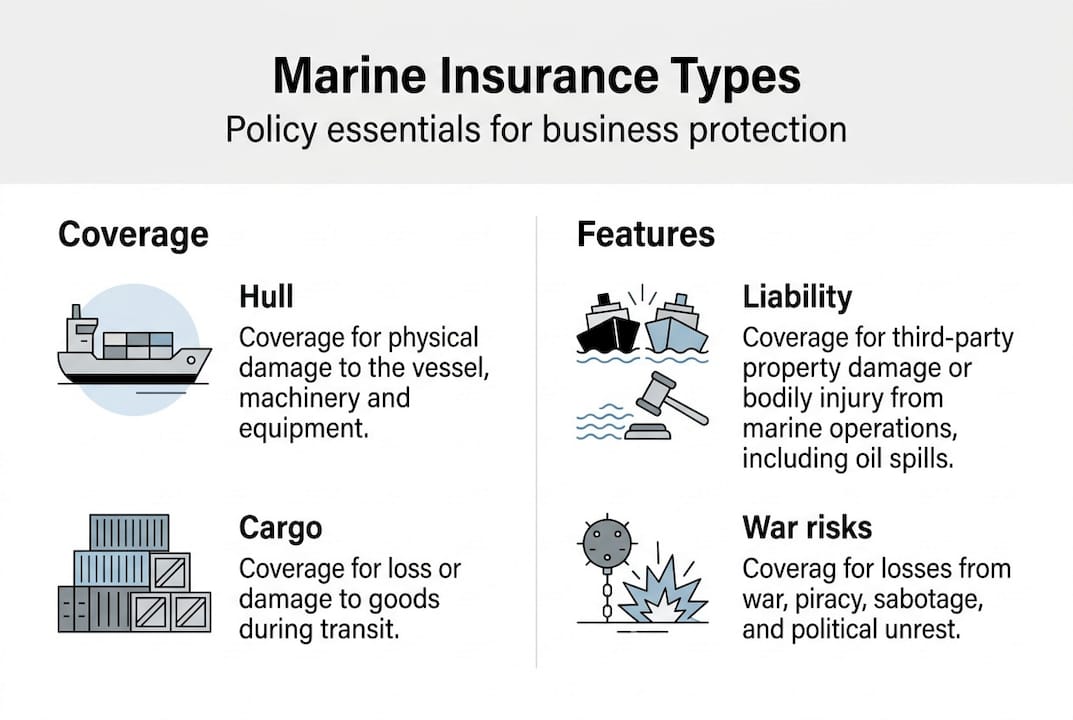
P&I clubs deserve special mention. They are mutual associations, not commercial insurers, and they cover liabilities that standard H&M policies exclude. For businesses facing a shipping dispute insurance scenario, P&I cover is often the critical layer. Ambiguous policy wording and gaps between H&M and P&I cover are among the most expensive mistakes businesses make. Review marine insurance key concepts carefully before placing cover.
The marine insurance market is not static. Global marine premiums reached USD 39.92 billion in 2024, reflecting sustained growth driven by geopolitical disruption, rising asset values, and increasing cargo volumes. The Red Sea crisis, sanctions exposure, and climate-related losses have all pushed underwriters to reassess risk appetites.
“The global marine insurance market continues to grow, but loss ratios are stabilising as underwriters apply stricter risk selection and pricing discipline.”
| Region | Premium share (2024) | Key risk driver |
|---|---|---|
| Europe | ~45% | Geopolitical, sanctions |
| Asia Pacific | ~30% | Cargo volume, natural catastrophe |
| Americas | ~15% | Gulf weather, piracy |
| Rest of world | ~10% | Emerging trade routes |
On the legal front, the pay first clause ruling in MS Amlin v King Trader confirmed that pay first clauses in marine policies are enforceable even in insolvency situations. This has significant implications for businesses relying on P&I cover when counterparties become insolvent. General average cases continue to generate disputes, particularly where cargo interests contest contributions. The fortuity principle, which requires that a loss be accidental rather than intentional, has also been tested in recent cases involving deliberate scuttling.
For businesses with cross-border exposure, UK international business law and cross-border contract law intersect directly with how marine insurance disputes are resolved. Jurisdiction clauses in policies matter enormously when a claim arises in a foreign port.
Knowing the law is one thing. Applying it consistently within your business operations is another. Geopolitical risks including the Red Sea and sanctions regimes are actively reshaping premium structures in 2026, and businesses that fail to update their cover accordingly will find gaps at the worst possible time.
Here is a practical five-step compliance checklist:
The top mistakes businesses make include assuming renewal terms are identical to the previous year, failing to notify insurers of route changes, and neglecting to read exclusions carefully. Understanding business liability essentials is a useful complement to your marine insurance review. The Marine Insurance Act 1906 remains the bedrock text, and familiarity with its provisions is non-negotiable for any business operating in this space.
Pro Tip: Request a policy gap analysis from your broker or legal adviser every time your trading patterns change. What was adequate cover last year may be dangerously inadequate today.
Most articles on marine insurance law stop at the principles and policy types. The harder truth is that the greatest risk for businesses is not ignorance of the law. It is the assumption that a policy placed last year still fits the risks you carry today.
Marine commerce is not static. Sanctions lists change overnight. New trading routes open through previously uncharted waters. Climate events alter the frequency and severity of losses in ways that insurers are still pricing into their models. A policy that was perfectly adequate for a fixed trade route in 2024 may carry silent gaps in 2026 if the vessel now transits a sanctioned region.
We have seen businesses invest significant effort in understanding the legal framework, only to rely entirely on their broker’s annual renewal without independent scrutiny. Brokers are valuable, but they are not your legal advisers. The distinction matters when a claim is disputed. Regular independent review, legal due diligence on policy wording, and a genuine readiness to challenge insurer interpretations are what separate businesses that recover from losses from those that do not. Navigating maritime complexities requires ongoing legal engagement, not a one-time policy placement.
Understanding marine insurance law is the foundation, but applying it correctly under commercial pressure is where businesses most often need support. Legal counsel adds value at every stage: selecting the right policy structure, reviewing contract terms before placement, managing claims disputes, and responding to enforcement actions.
At Ali Legal, our maritime law services are designed for businesses that need clear, strategic advice on high-value maritime risks. Whether you are dealing with a cargo dispute, a hull claim, or a P&I liability, our team brings both legal precision and commercial understanding to the table. We also offer commercial dispute support for businesses where insurance disputes escalate into litigation. If you want to ensure your marine insurance arrangements are legally sound and commercially robust, speak to our legal team today.
It covers losses related to ships, cargo, freight, and liabilities from maritime perils such as storms, collisions, fire, and piracy. The framework is built around indemnifying the insured for financial losses arising during marine adventures.
The key principles are utmost good faith, insurable interest, indemnity, proximate cause, subrogation, contribution, warranties, and sue and labour. Each principle affects whether a claim is valid and how much is recoverable.
Policies must specify the assured, the subject matter, the risks covered, the sum insured, and the period of cover. The type of policy, whether hull, cargo, freight, or P&I, determines the scope of protection.
A P&I club is a mutual insurer that covers third-party maritime liabilities excluded from standard hull and machinery policies, including environmental damage, crew injury, and cargo claims from third parties.
Most jurisdictions follow the principles of the UK Marine Insurance Act 1906, but local statutes and case law introduce variations. Businesses trading internationally must check the specific rules that apply in each relevant jurisdiction.
TL;DR:
- Accurate and complete forms are essential to avoid RFEs and denials in immigration cases.
- Missing deadlines or court dates can lead to harsh consequences like removal orders in absentia.
- Transparency and early legal advice significantly reduce preventable mistakes and improve case outcomes.
A missed court date. A single blank field on a form. A piece of history you hoped nobody would ask about. These are not dramatic failures — they are the everyday errors that derail real immigration cases and separate families. U.S. immigration law is unforgiving, and the system moves quickly regardless of whether you are ready. Understanding where applicants most commonly go wrong is the first step to protecting your family’s future. This guide breaks down the most frequent pitfalls and gives you practical, straightforward steps to avoid them.
| Point | Details |
|---|---|
| Check all paperwork | Carefully review every form for accuracy to avoid costly delays or denials. |
| Meet all deadlines | Missing immigration deadlines or court dates can result in removal proceedings. |
| Be completely honest | Always disclose your full history as non-disclosure often causes more harm. |
| Get expert advice | Consulting a qualified immigration lawyer early on prevents most errors. |
Paperwork is the foundation of every immigration case, and it is also where most cases begin to unravel. Forms such as the I-130 (Petition for Alien Relative) and the I-485 (Application to Register Permanent Residence) require precise, complete answers. A single omission, a mismatched date, or an unsigned page can trigger a Request for Evidence (RFE) or result in an outright denial. As noted in guidance on family-based immigration pitfalls, submitting incomplete or inaccurate forms such as the I-130 or I-485 leads directly to RFEs or denials.
The most common form errors include:
These mistakes are not signs of dishonesty. They are signs of haste. USCIS adjudicators do not have the discretion to fill in gaps for you — they issue an RFE or deny the application based on what is in front of them.
To keep your submission clean, always double-check applications against the official USCIS instructions before posting anything. Download the form directly from the USCIS website on the day you complete it, not weeks earlier, because versions change. Keep at least two copies of everything you submit, including the envelope and postage receipt.
Pro Tip: Before submitting, ask someone unfamiliar with your case to read through the form. Fresh eyes catch errors that familiarity hides.
For a broader understanding of how immigration law works and what each stage involves, our immigration law overview explains the process from start to finish. If you are unsure whether you need professional support, the role of immigration lawyers is worth reading before you decide to file alone.
Beyond paperwork errors, timing is equally critical in immigration matters. The U.S. immigration system operates on strict schedules, and missing a single appointment or deadline can have consequences that take years to reverse.
The key dates you must never miss include:
The consequences of missing a court date are severe. In FY2024, 47% of immigration court decisions were removal orders, and 72% of those were issued in absentia, meaning the person was not even present. An in absentia removal order is issued when someone fails to appear at a scheduled hearing. It can be extremely difficult to reopen a case after one has been issued.

The USCIS case volume data confirms how many people move through the system each year, which means the courts and agencies have little tolerance for no-shows.
Pro Tip: Enrol for text or email alerts through your USCIS online account (MyUSCIS). Set calendar reminders at 30 days, 7 days, and 24 hours before every appointment.
If you have an interview approaching, preparing for interviews in advance makes a measurable difference to how confidently you present your case.
Managing deadlines is one hurdle, but honesty and transparency are foundational in immigration law. USCIS and immigration judges have access to a wide range of databases, including criminal records, travel history, prior immigration filings, and tax records. Attempting to conceal information rarely works — and the consequences when it is discovered are far worse than the original issue.
Information you must always disclose truthfully includes:
The consequences of misrepresentation are severe. A finding of wilful misrepresentation can result in a permanent bar from re-entry to the United States. It can also permanently disqualify you from naturalisation, even if you later obtain lawful status through another route.
“Disclose all history upfront — nondisclosure is often worse than the violations themselves.”
This is not just legal advice — it is a practical reality. Immigration judges and USCIS officers are experienced at identifying inconsistencies. A past offence that might have been manageable with proper legal preparation becomes a far larger problem once it appears that you tried to hide it.
Before you disclose anything complex, consult a lawyer. There are legal strategies for presenting difficult history in the most favourable way, and understanding the value of legal advice before you file is one of the most important steps you can take. An attorney can help you protect your rights while ensuring your application is fully transparent.
Understanding disclosure rules naturally leads to the next common pitfall: going it alone without professional help. Many applicants assume that immigration forms are straightforward enough to complete without a lawyer. Some cases are relatively simple, but even routine applications can contain complexities that are not obvious to someone without legal training.
The risks of DIY applications and unregulated advisors include:
As licensed immigration attorneys consistently advise, consulting a qualified lawyer early prevents most pitfalls, and DIY approaches carry a real risk of misrepresentation, even unintentionally.
| Factor | Self-filing | Attorney-led process |
|---|---|---|
| Form accuracy | Relies on your own review | Professionally verified |
| Knowledge of waivers | Limited | Comprehensive |
| RFE response quality | Variable | Structured and evidenced |
| Risk of misrepresentation | Higher | Significantly lower |
| Appeal capability | Difficult without guidance | Managed with strategy |
A lawyer’s input matters most in complex cases: those involving prior removals, criminal history, waivers of inadmissibility, or appeals. For straightforward renewals with clean histories, self-filing may be manageable, but even then, a single review appointment can catch errors before they become problems.
Pro Tip: Before your first legal consultation, gather your passport, prior immigration documents, any court records, and a timeline of your travel and residence history. The more organised you are, the more useful that first meeting will be.
For tailored support with your specific situation, personal immigration help is available for individuals and families at every stage of the process.
Having outlined the most common mistakes, here is a perspective that most articles overlook: the majority of immigration errors are not caused by legal complexity. They are caused by fear and avoidance.
Applicants rush forms because the process feels overwhelming. They miss hearings because opening official letters feels too stressful. They stay silent about past history because they hope the problem will simply disappear. None of these responses are irrational — immigration is genuinely stressful — but they all lead to the same outcome: avoidable mistakes.
The mindset shift that makes the biggest difference is treating your immigration case with the same discipline you would apply to a work deadline or a financial audit. Keep every document in a dedicated folder. Treat every court date like a non-negotiable meeting. When in doubt, ask a lawyer or use official resources — never guess.
Simple habits, applied consistently, prevent nearly every error on this list. If you are unsure where to start, reviewing consultation preparation steps before speaking to a lawyer helps you make the most of that conversation from the outset.
If you are ready to avoid costly mistakes, professional support is available.
At Ali Legal, we provide tailored guidance for individuals and families at every stage of the U.S. immigration journey. From reviewing your forms before submission to representing you at interviews and appeals, our one-to-one support is designed to prevent the filing errors, missed deadlines, and non-disclosures that derail cases. Our complete immigration law guide is a strong starting point, and our team can explain exactly what immigration lawyers do at each stage. Whether you are beginning a new application or navigating a complex situation, explore our global immigration pathways or contact us directly to speak with an expert.
The most frequent reason is submitting incomplete or inaccurate forms, which leads to requests for more evidence or outright denials. Incomplete forms such as the I-130 or I-485 are a leading cause of RFEs and rejections.
Missing a required court date can result in a removal order being issued in your absence. In FY2024, 72% of removal orders were issued in absentia, making this one of the most consequential errors an applicant can make.
Yes, consulting a licensed immigration attorney early reduces errors and significantly increases your chances of approval. Early legal advice is particularly valuable in complex cases involving waivers, appeals, or prior immigration violations.
Always disclose all history. As immigration guidance consistently confirms, nondisclosure consequences are typically far worse than the original violation, and USCIS has extensive tools to identify inconsistencies in your record.
TL;DR:
- Poor contract management costs businesses up to 9.2% of annual revenue annually.
- Effective contracts protect cash flow, reduce disputes by up to 65%, and safeguard assets.
- Managing the full contract lifecycle and fostering a collaborative, responsible culture is crucial.
Poor contract management costs businesses 9.2% of annual revenue each year, globally. That is not a rounding error; it is a structural leak hiding in plain sight. Many business owners and corporate managers still treat contracts as a legal formality, something to sign and file away. That misconception is expensive. Contracts are, in truth, one of the most powerful tools you have for protecting your cash flow, managing risk, and keeping operations running smoothly. This guide walks through the legal foundations of contracts, how they reduce disputes, how to manage them across their full lifecycle, and what practical steps you can take right now.
| Point | Details |
|---|---|
| Contracts cut disputes | Robust contracts can reduce business disputes by up to 65% through clear expectations. |
| Six elements for validity | Every business contract needs offer, acceptance, consideration, capacity, legality, and mutual intent. |
| Prevent revenue loss | Ineffective contract management can cost you over 9% of annual revenue but is recoverable with best practices. |
| Lifecycle stages matter | Managing each contract stage carefully and using technology boosts compliance and cuts admin costs. |
| Integrated approach is key | Bridging legal and commercial goals maximises contract value, not just compliance. |
Contracts are not just documents that lawyers insist upon. They are the backbone of every reliable business relationship you build. When you agree terms in writing, you create a shared reference point that both parties can return to if things go wrong. That clarity alone changes how people behave.
Businesses that invest in robust contract practices see measurable results. Research shows that disputes fall by up to 65% for companies with well-structured contracts in place. That figure is significant because disputes are not just stressful; they consume management time, legal budget, and commercial goodwill.
Beyond dispute reduction, contracts protect several critical business assets:
Informal agreements carry real risk. A verbal understanding between directors may feel sufficient in the moment, but memory is unreliable and intentions shift. When a supplier delivers late, a client refuses to pay, or a partner walks away, the absence of a written contract leaves you with very little to stand on.
“Contracts safeguard business interests by clarifying expectations, reducing disputes, protecting cash flow and intellectual property, and providing legal recourse for breaches.” This is not a legal nicety; it is a commercial necessity.
Understanding what commercial contracts actually are is the first step towards using them as the strategic tools they are designed to be.
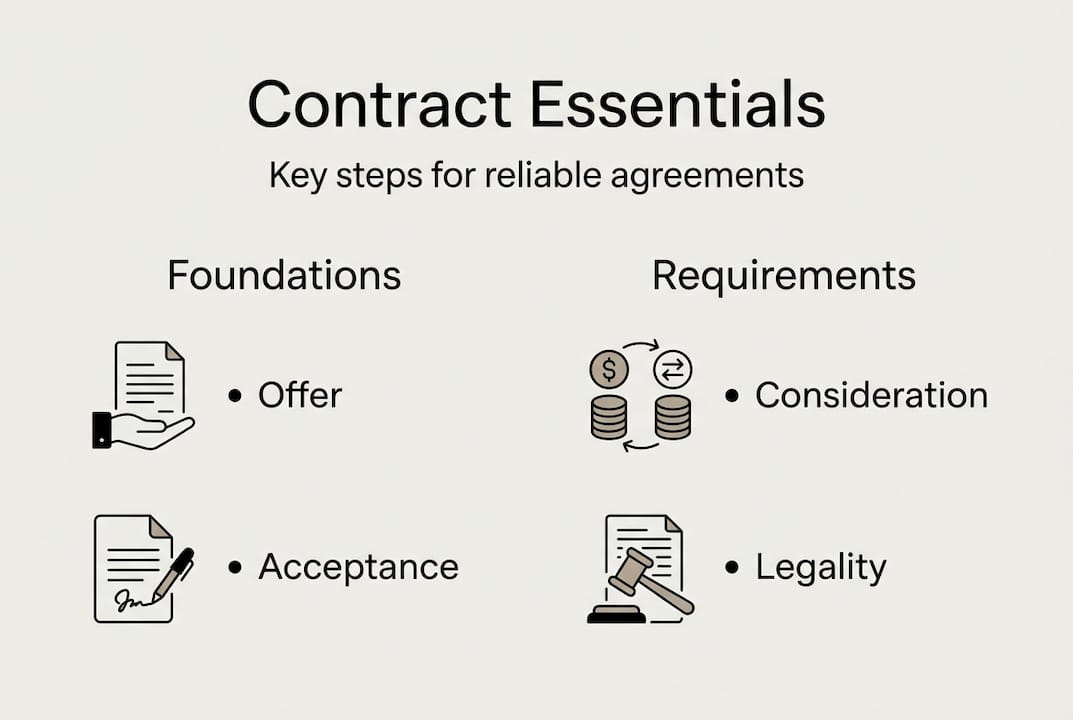
Not every written agreement is legally enforceable. A contract must satisfy six essential elements to hold up in court. Miss even one, and the entire agreement may be void or unenforceable when you need it most.
Legally binding contracts require the following six components:
Here is how these elements can break down in practice:
| Element | Common weakness in real contracts |
|---|---|
| Offer | Vague scope of work or ambiguous deliverables |
| Acceptance | Counter-offers made verbally without written confirmation |
| Consideration | No stated payment terms or unclear value exchange |
| Capacity | Signing authority not verified for corporate entities |
| Legality | Clauses that inadvertently breach competition law |
| Mutual intent | Informal emails treated as binding without clear intent |
The essentials of sound business contracts go beyond ticking boxes. Each element must be clearly evidenced in the document itself. Courts do not fill in gaps generously; they interpret what is written.
Pro Tip: Always use written contracts with a consistent template across your business. Standardised templates reduce the chance of missing a core element and make it far easier to train staff on contract expectations. Review your templates against UK contract law principles at least once a year.
The financial case for good contract management is compelling. Organisations worldwide lose 9.2% of annual revenue through poor contract practices. Of that, up to 5.4% is recoverable with better processes. For a business turning over £5 million, that is potentially £270,000 sitting in poorly managed agreements.

The same research reveals that 80% of businesses lack clear accountability for contract performance. Nobody owns the obligation to check whether milestones are met, payments are received, or renewal dates are approaching. That gap is where value quietly disappears.
Compare the outcomes of good and poor contract management:
| Practice area | Good contract management | Poor contract management |
|---|---|---|
| Cost control | Predictable spend, fixed fee structures | Budget overruns, unclaimed penalties |
| Compliance | Regular reviews, audit trails | Missed obligations, regulatory risk |
| Dispute rate | Low, with clear resolution pathways | High, with costly litigation exposure |
| Renewal management | Proactive, value-optimised | Auto-renewals on unfavourable terms |
Businesses that treat contracts as live commercial tools rather than archived paperwork benefit in several concrete ways:
Understanding how contractual liability affects your business is essential before signing any significant agreement. The risk is not always obvious at the drafting stage, but it becomes very obvious when something goes wrong.
A contract does not end when it is signed. That is actually when the real work begins. Contract lifecycle management (CLM) covers six distinct stages, and each one carries its own risks and opportunities.
CLM software can reduce administrative costs by 25 to 30% and boost compliance by up to 55%. That is a meaningful operational gain, particularly for businesses managing large volumes of supplier or client contracts.
Special clauses deserve particular attention. Force majeure provisions, which excuse a party from performance due to extraordinary events, require precise drafting because courts interpret them strictly and narrowly. A broadly worded clause may offer no protection at all when tested. Similarly, boilerplate clauses such as entire agreement, severability, and governing law should never be copied without review; they carry real legal weight.
Knowing how to handle a contract breach when one arises, and whether your contract includes an arbitration clause for resolving disputes outside court, can save significant time and cost.
Pro Tip: Assign a named individual within your business to own each significant contract. That person should be responsible for monitoring obligations, flagging renewal dates, and escalating performance issues. Financial oversight embedded from day one prevents the silent revenue leakage that affects so many organisations.
Here is something most contract guides will not tell you: the problem is rarely the contract itself. It is the way leadership treats contracts after they are signed.
Legal teams focus on risk avoidance. Finance teams focus on value capture and revenue recovery. These two priorities rarely sit in the same room. The result is a governance gap where contracts are filed, forgotten, and quietly haemorrhage value.
Digital CLM tools are helpful, but they are not a solution on their own. We have seen businesses invest heavily in contract software while maintaining the same siloed behaviours that caused the problem in the first place. Technology surfaces the data; leadership must act on it.
The businesses that genuinely recover lost contract value are those that treat contracts as a cross-functional responsibility. Legal, finance, and operations must share accountability for what is agreed and whether it is being delivered. Exploring effective contract negotiation strategies is part of this, but the bigger shift is cultural. Contracts are not compliance documents. They are revenue instruments. Treat them accordingly.
If reading this has prompted you to question whether your current contracts are doing enough to protect your business, that instinct is worth acting on. Many businesses operate on outdated templates, informal arrangements, or agreements that have never been reviewed by a qualified solicitor.
At Ali Legal, we work with business owners and corporate managers to review, draft, and strengthen commercial contracts across a wide range of sectors. Whether you need support with commercial litigation following a contract dispute or want to understand civil litigation best practices before a matter escalates, our team offers straightforward, fixed-fee advice. Contact us today to arrange a consultation and start turning your contracts into genuine business assets.
A business contract must contain an offer, acceptance, consideration, capacity, legality, and mutual intent to be legally enforceable. If any one of these elements is absent, the agreement may not hold up in court.
Well-crafted contracts set out obligations clearly, and businesses using them see disputes fall by up to 65%. Clarity on expectations removes the ambiguity that most disputes feed on.
CLM covers every stage of a contract’s life from preparation through to renewal or termination, and CLM software reduces administrative costs by up to 30%. It ensures obligations are tracked and value is not lost after signing.
Oral agreements are difficult to prove in court because there is no written record of what was actually agreed. Without documented terms, resolving a dispute fairly becomes a matter of one person’s word against another’s.
Yes, but only if they are drafted precisely. Courts interpret these clauses strictly, so vague wording can render them useless when you need them most.
Running a business without the right legal documents is a bit like building on sand. One missed contract or absent compliance filing and you could face disputes, fines, or even forced closure. 68% of small businesses lack proper contracts, leading to costly and entirely avoidable legal battles. This guide is written for small business owners and entrepreneurs who want to get their documentation right from the start. We will walk through every category of essential legal document, from formation and governance to compliance and contracts, so you can protect your business and operate with confidence.
| Point | Details |
|---|---|
| Prevention is cheaper than remedy | Having key legal documents in place early prevents costly disputes and protects your business interests. |
| Compliance is non-negotiable | Staying up to date with licences, tax filings, and privacy policies avoids penalties and protects your ability to operate. |
| Customise for your business | Not all documents are needed for every business—assess your structure and risk profile before deciding. |
| Review and update often | Annual reviews ensure all documents remain compliant and aligned with business growth or changes. |
| Solid contracts reduce risk | A well-drafted contract or operating agreement drastically lowers the chance of expensive legal battles. |
Not every business needs the same set of documents. A sole trader running a small consultancy has very different requirements from a limited company with multiple shareholders and employees. The right starting point is understanding your own business structure, location, and industry before deciding which documents to prioritise.
Core formation documents and compliance obligations vary significantly by structure and jurisdiction. A limited liability company (LLC) needs an Operating Agreement, while a corporation requires Bylaws and Articles of Incorporation. A partnership needs a Partnership Agreement. These are not interchangeable.
When assessing your documentation needs, consider these key decision points:
Using a legal consultation checklist at the outset helps you map these factors systematically. You can also cross-reference the IRS business checklist if you operate across borders. For a broader overview of what UK businesses must address, the commercial law essentials resource is a solid reference.
Pro Tip: Review your legal documents annually or whenever you make a significant change, such as taking on a new partner, entering a new market, or hiring your first employee. Missing even one critical document can expose you to financial and legal consequences that far outweigh the cost of getting it right.
The first group of must-have documents is what establishes your business in the eyes of the law. Without these, you cannot open a business bank account, file taxes correctly, or enter into enforceable contracts as a legal entity.
Core formation documents include Articles of Incorporation, Articles of Organisation, and an Employer Identification Number (EIN). Here is what each one does:
Formation costs are often lower than people expect. Most UK business registrations through Companies House cost under £50, and even more complex structures typically remain under £250 to £300 when handled efficiently. You can find step-by-step guidance in the business registration guide.
| Entity type | Required formation documents |
|---|---|
| Sole trader | HMRC registration, UTR |
| Partnership | Partnership Agreement, UTR |
| Limited company | Articles of Association, Companies House registration |
| LLC (US) | Articles of Organisation, EIN |
| Corporation (US) | Articles of Incorporation, EIN, Bylaws |
Understanding business liability is closely tied to your formation choice. A limited company separates your personal assets from business debts. A sole trader does not. That distinction alone makes formation documents one of the most consequential decisions you will make.

After formation documents come the rules by which your business actually operates and resolves internal disagreements. These are the documents most new owners overlook, and that oversight can be catastrophic.
Operating Agreements and Corporate Bylaws define internal rules, management structure, and can override inflexible state or jurisdiction defaults. Without them, disputes between co-founders or shareholders are resolved by default rules that may not reflect your actual intentions.
“The most expensive legal disputes we see are not with customers or regulators. They are between business partners who never wrote down what they agreed.”
Even if not legally required in your jurisdiction, having these documents is strongly recommended. A well-drafted Operating Agreement or set of Bylaws should cover:
For businesses entering collaborative arrangements, a joint venture agreement guide provides a useful framework for structuring shared ventures with clear governance from the outset.
Pro Tip: Draft your Operating Agreement or Bylaws before you need them. Trying to agree on exit terms or profit splits during a dispute is far harder and far more expensive than doing it at the start.
Once your business is set up and internally governed, day-to-day operations depend on clear, enforceable contracts. These are the documents that protect your relationships with employees, contractors, clients, and suppliers.
Employment Agreements, NDAs, and Customer/Vendor Agreements are fundamental to business operations. Each serves a distinct protective function:
The financial stakes are real. Businesses without written contracts face average dispute costs of £9,500 to £12,000 per incident. You can find detailed NDA guidance and advice on navigating commercial contracts to ensure your agreements hold up. For a broader view of what contracts your business may need, the guide on types of business contracts is worth reviewing.
Pro Tip: Build a template library for your most frequently used contracts. Adjust each template for specific deals rather than drafting from scratch every time. This saves money and reduces the risk of missing key clauses.
Beyond operational contracts, robust businesses must meet recurring compliance requirements to remain fully protected. These obligations are not optional, and missing them can trigger fines, investigations, or loss of trading rights.
Required compliance documentation includes business licences, permits, tax registrations, and privacy and data protection policies. Here is how to stay on top of them:
| Business type | Key compliance documents |
|---|---|
| Retail | Trading licence, VAT registration, consumer rights policy |
| Professional services | Professional indemnity insurance, FCA/SRA registration (if applicable) |
| Online only | GDPR privacy policy, cookie consent, e-commerce regulations |
| Food and hospitality | Food hygiene certificate, premises licence, allergen policy |
Effective legal risk management means treating compliance as an ongoing process, not a one-time task. Set calendar reminders for renewal dates and filing deadlines to avoid penalties that can range from £100 to tens of thousands of pounds.
Having explored each document’s specifics, let us review how these tools stack up in terms of risk reduction and business impact.
Operating Agreements and contracts demonstrably prevent disputes and protect assets. The table below gives you a clear-eyed view of which documents deliver the most value across three key dimensions.
| Document | Legally required? | Risk coverage | Most often overlooked? |
|---|---|---|---|
| Articles of Incorporation/Organisation | Yes | Entity status, liability protection | Rarely |
| Operating Agreement / Bylaws | Recommended | Internal disputes, governance | Very often |
| Employment Agreement | Yes (for employees) | IP, role clarity, tax compliance | Sometimes |
| NDA | No | Confidentiality, trade secrets | Often |
| Service/Sales Agreement | No | Payment disputes, scope creep | Often |
| Compliance licences and permits | Yes | Regulatory penalties, trading rights | Sometimes |
| Privacy policy (GDPR) | Yes | Data breach liability, ICO fines | Very often |
For most UK small businesses, the highest-priority documents are Articles of Association, an Operating Agreement or Shareholders’ Agreement, Employment Contracts, and a GDPR-compliant privacy policy. Understanding contractual liability risks helps you prioritise which gaps to close first based on your specific exposure.
After seeing which documents carry the most legal weight, it is worth considering why so many business owners still delay getting them in place. The honest answer is that legal documentation feels abstract until something goes wrong.
We regularly see businesses where a co-founder dispute, a client refusing to pay, or a data complaint could have been resolved in hours with the right document in place. Instead, without understanding liability and having clear agreements, these situations drag on for months and cost multiples of what prevention would have.
The common mistake is treating legal documents as a cost rather than an investment. A well-drafted Operating Agreement might cost £500 to £800 to prepare. A co-founder dispute without one can cost £30,000 or more in legal fees and lost productivity. The maths is straightforward.
Our advice: do not wait until you are growing fast or facing a dispute to get your documents in order. The earlier you build your legal foundation, the more confidently you can scale, hire, and partner without fear of what you have left unprotected.
Understanding which legal documents your business needs is the first step. Acting on that knowledge is what actually protects you.
At Ali Legal, we work with small businesses and entrepreneurs to put the right documentation in place from the start. Whether you need guidance on your corporate law obligations, want to work through a corporate law checklist tailored to your structure, or need support with commercial litigation services when a dispute arises, we offer fixed fees, straightforward advice, and a genuine commitment to your long-term interests. Contact us today to speak with a solicitor who understands your business.
Not every business needs every document, but skipping core compliance or contracts increases your risk of disputes and fines. Core requirements depend on your entity type, industry, and jurisdiction.
They are not always mandatory, but strongly recommended to prevent disputes and clarify management responsibilities before a problem arises.
You should review legal documents annually or after major changes to your business structure, staffing, or applicable regulations. Regular reviews ensure ongoing compliance and relevance.
Without written contracts, resolving disputes becomes far more difficult and costly, with average losses reaching up to £12,000 per incident.
Yes, missing deadlines for licences or tax returns can result in financial penalties and, in serious cases, loss of your legal right to operate.
Most business owners assume that licensing is straightforward paperwork anyone can handle alone. That assumption costs some of them everything. Operating without the correct licence, or submitting a flawed application, can result in prosecution, forced closure, and lasting reputational damage. Premises licence applications under the Licensing Act 2003 require careful preparation, local authority knowledge, and the ability to navigate objections. Whether you run a restaurant, a late-night venue, or a retail operation selling alcohol, understanding the solicitor’s role in this process is not optional. It is essential.
| Point | Details |
|---|---|
| Licensing errors are costly | Missing compliance or deadlines can lead to fines, lost revenue, or business closure. |
| Solicitors streamline complex cases | Expert legal help is essential for contested or high-risk applications. |
| Ongoing compliance needs support | Solicitors help maintain licence conditions, manage renewals, and respond to enforcement. |
| Broader regulatory value | Legal advisers offer wider compliance benefits beyond just licensing applications. |
Licensing is not a formality. It is a legal framework that governs how and whether your business can operate. Get it wrong, and the consequences are severe. Get it right, and you have a stable, enforceable foundation for growth.
Licensable activities include the sale of alcohol, regulated entertainment, and late-night refreshment. If your business falls into any of these categories, you need a premises licence before you open your doors. Operating without one is a criminal offence.
The sectors most commonly affected include:
The risks of getting licensing wrong are significant. Fines for unlicensed activity can run into thousands of pounds. Licences can be revoked following a single serious incident. Beyond the financial penalties, a failed or refused application can delay your launch by months, damaging investor confidence and commercial relationships.
This is where legal counsel in business becomes genuinely valuable. A solicitor does not just fill in forms. They understand the local authority landscape, anticipate objections before they arise, and ensure your application reflects the licensing objectives the council expects to see. For any business owner unfamiliar with UK SME commercial law essentials, the licensing process can feel opaque. A solicitor makes it transparent. With the stakes established, let’s look at where solicitors fit in the process.
A solicitor’s involvement begins well before any paperwork is submitted. The pre-application stage is often where the most important work happens, and it is where inexperienced applicants make the most costly errors.
Here is how a solicitor typically guides you through the process:
Solicitors handle operating schedules, site plans, DPS nomination, consultations, and objections or hearings. Each of these steps carries risk if handled incorrectly. A poorly drafted operating schedule, for example, can lock your business into unnecessarily restrictive conditions that are difficult and expensive to change later.

Pro Tip: Before instructing a solicitor, use a legal consultation checklist to document your business activities, proposed hours, and any known local sensitivities. This saves time and reduces costs.
| Approach | DIY application | Solicitor-led application |
|---|---|---|
| Operating schedule quality | Often generic, may restrict future activity | Tailored, flexible, and future-proofed |
| Objection handling | Reactive, often ineffective | Proactive, strategic, and well-evidenced |
| Hearing representation | Unrepresented, high risk | Professionally argued, better outcomes |
| Timeline | Prone to delays and resubmissions | Managed efficiently from the outset |
| Cost of errors | Potentially thousands in lost revenue | Minimised through expert preparation |
Many solicitors now offer fixed fee structures for standard applications, making costs predictable. When preparing for a legal consultation, bring your floor plans, proposed trading hours, and any correspondence with the local authority.
While most applications follow a familiar template, certain situations demand a level of legal expertise that goes far beyond form-filling. These are the scenarios where a solicitor moves from helpful to essential.
Cumulative Impact Zones (CIZs) are designated areas where licensing authorities have determined that the concentration of licensed premises is already causing problems. Applying for a new licence in a CIZ is significantly harder. Exceptional handling is required for CIZ applications; solicitors are expert in the consultation and hearing processes these cases demand. Without specialist knowledge, applications in these zones are routinely refused.
Other complex scenarios include:
“A solicitor brings not just legal knowledge but local authority relationships and hearing experience that no online guide can replicate. In complex cases, that difference is the difference between trading and not trading.”
| Scenario | Standard process | Complex process |
|---|---|---|
| New application, no objections | 4 to 8 weeks | N/A |
| Application in a CIZ | Not straightforward | Specialist hearing required |
| Contested application | Hearing likely | Legal representation critical |
| Variation or transfer | Shorter process | Depends on objections |
| Appeal against refusal | Magistrates’ Court | Solicitor essential |
Understanding legal representation in the UK is important here. Solicitors are SRA authorised professionals with regulated obligations to act in your best interests, which matters enormously when your licence is under threat.
After securing a licence, compliance and maintenance determines long-term success. Many business owners treat their premises licence as a one-time achievement. It is not. It is an ongoing legal obligation with conditions that must be met every single day.
Solicitors help ensure adherence to licence conditions, DPS requirements, and handle renewals, revocations, and enforcement actions. Here is what ongoing solicitor support typically covers:
Pro Tip: Set a calendar reminder to review your licence conditions every January. Changes to local licensing policy or responsible authority priorities can affect your compliance position even if nothing in your business has changed. This connects directly to navigating commercial contracts and broader risk management across your operations.
For premises subject to lease arrangements, it is also worth checking EPC compliance for lease renewals as part of your broader property obligations.
Licensing is only one area where solicitors add value. Their regulatory role is much broader, and for growing businesses, that wider perspective is often where the greatest return on legal investment is found.
Solicitors advise on business regulatory compliance beyond licensing, covering areas such as anti-money laundering obligations, data protection, and employment regulation. For businesses operating across multiple sectors or jurisdictions, this breadth of knowledge is invaluable.
The areas where solicitors most commonly provide ongoing regulatory support include:
Maintaining regular contact with your solicitor, rather than calling only in a crisis, pays genuine dividends. A solicitor who knows your business can spot regulatory risks before they become enforcement actions. For businesses with international dimensions, international business law guidance adds another layer of protection when operating across borders.
Think of your solicitor less as a problem-solver and more as a business partner who happens to understand the law.
Here is an uncomfortable truth that many business owners discover too late: the cost of not using a solicitor is almost always higher than the cost of using one.
The assumption that going it alone saves money is understandable. Legal fees feel like an overhead. But a refused application, a contested hearing, or a revoked licence costs far more in lost revenue, reapplication fees, and damaged relationships with local authorities than any solicitor’s invoice.
While not legally required to use a solicitor, experts advise one for complex or contested applications to draft flexible licences that protect your business long-term. That flexibility matters. A licence drafted without expert input often contains conditions that feel manageable at the start but become serious operational constraints as your business grows.
What solicitors bring that no online guide can replicate is local authority insight. They know which responsible authorities are likely to object, what language licensing committees respond to, and how to frame an operating schedule that achieves approval without unnecessary restriction. That knowledge comes from experience, not from reading the Licensing Act.
The role of a solicitor in acquisitions mirrors this principle. Whether buying a business or securing a licence, the investment in expert advice at the outset protects everything that follows.
For business owners ready to secure safe, robust compliance, expert support is one step away.
At Ali Legal, we work with businesses across the UK to navigate licensing applications, manage compliance obligations, and respond to enforcement actions with clarity and confidence. Our team brings practical regulatory knowledge and a straightforward approach to advice, so you always know where you stand. Whether you are applying for your first premises licence, dealing with a contested application, or managing an ongoing compliance programme, we provide bespoke support tailored to your specific situation. Our commercial litigation support is also available when disputes escalate. Contact our team today to discuss your licensing and regulatory needs.
No, but solicitors are advised for complex or contested applications to avoid costly delays and ensure your licence is drafted with appropriate flexibility from the outset.
The DPS is legally responsible for authorising alcohol sales and ensuring daily compliance with licence conditions. No DPS means no alcohol sales can legally take place on the premises.
The process typically takes between 4 and 12 weeks, depending on the complexity of the application and whether any objections are received during the consultation period.
Licences are refused or reviewed when licensing objectives are not met, including failures around crime prevention, public safety, or persistent noise complaints from neighbouring properties.
Yes, licences can be transferred when a business changes hands. A solicitor can manage the transfer process and ensure all regulatory requirements are met without interruption to trading.
Contracts govern nearly every business relationship and major personal transaction, yet poor contract management leads to 8.6-9.2% average contract value erosion globally. That’s not just a theoretical risk. It represents real money, lost opportunities, and avoidable disputes. Whether you’re signing a commercial lease, entering a supplier agreement, or renewing a service contract, the terms you overlook today can become tomorrow’s legal headache. This article breaks down why contract reviews matter, what they should cover, and how to avoid the traps that catch even experienced professionals.
| Point | Details |
|---|---|
| Contract reviews stop losses | Failing to review contracts can lead to nearly 9% of contract value being lost. |
| Critical clauses demand focus | Key areas like indemnity, liability, and termination often hide costly risks if unchecked. |
| Hybrid review works best | Combining expert oversight with AI tools delivers the safest, most efficient contract analysis. |
| Structured process minimises risk | Following a standard review process or checklist dramatically cuts error rates and disputes. |
When contracts aren’t properly reviewed, value doesn’t just stagnate. It actively erodes. Research shows that organisations lose between 8.6% and 9.2% of their contract value through poor management practices, whilst top performers actually recover value through disciplined processes. The financial impact extends beyond direct losses. Disputes cost $870B globally per year, draining resources that could drive growth.
“Poor contract processes don’t just cost money. They cost time, relationships, and strategic opportunities that never return.”
The erosion happens through multiple channels: missed renewal deadlines, unfavourable payment terms that weren’t negotiated, liability exposures that weren’t capped, and compliance failures that trigger penalties. Each oversight compounds. A supplier contract with an auto-renewal clause you didn’t spot locks you into another year of unfavourable terms. An indemnity provision you didn’t challenge exposes you to unlimited liability for events outside your control.
Contract value impact comparison
| Metric | Poor processes | Industry average | Top performers |
|---|---|---|---|
| Value erosion | 9.2% loss | 8.6% loss | 5.4% recovery |
| Annual dispute costs | High exposure | $870B globally | Minimised risk |
| Revenue impact | 9% leakage | Variable loss | Positive gains |
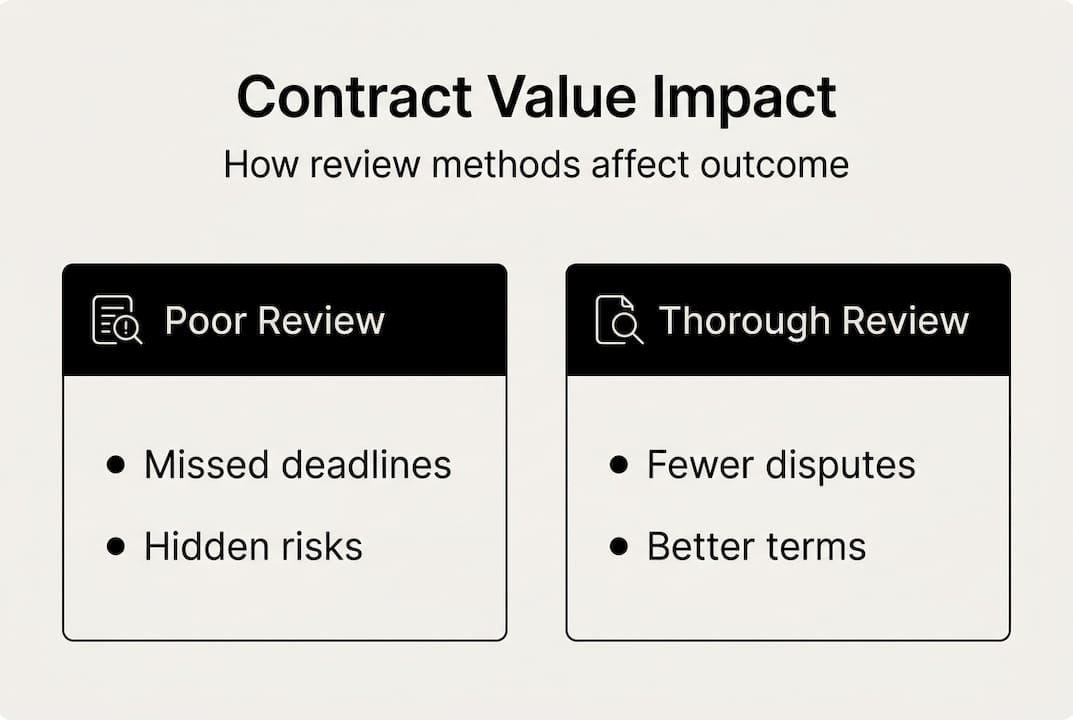
These aren’t abstract figures. They represent real consequences for businesses and individuals who sign without adequate review. The costs manifest as disputes requiring resolving contract disputes through litigation, wasted management time, damaged commercial relationships, and opportunities lost to competitors with better terms.
A thorough contract review examines structure, substance, and compliance across multiple dimensions. At its core, the process verifies that all parties are correctly identified, dates and deadlines are clear, the scope of work or services is precisely defined, payment terms are fair and enforceable, and regulatory requirements are met. Contract review checklists include basics, scope/financials, compliance, and exit terms to ensure nothing critical is missed.
Detailed review versus basic check
| Review element | Basic check | Detailed review |
|---|---|---|
| Party identification | Names present | Legal entities verified, authority confirmed |
| Financial terms | Amounts stated | Payment schedules, escalation clauses, penalties analysed |
| Liability provisions | Mentioned | Caps quantified, indemnities balanced, insurance requirements checked |
| Termination rights | Clause exists | Notice periods, grounds, consequences, and survival terms mapped |
| Compliance | Assumed | Regulatory requirements verified, licences confirmed |
Essential clauses that demand careful attention include:
Pro Tip: Match your review depth to the contract’s value and risk profile. A £50,000 supplier agreement with potential liability exposure deserves more scrutiny than a £500 software licence, but both need checking against your standard requirements.
The review process should also verify that navigating commercial contracts aligns with your business strategy, that property law compliance requirements are met for real estate transactions, and that employment contract risks are properly managed. External resources like the Lexology contract checklist provide additional frameworks for comprehensive review.

Even experienced reviewers overlook critical errors. Defined term inconsistencies occur at a 68% rate, whilst auto-renewal clauses and mismatched notice periods create frequent traps. These aren’t exotic edge cases. They’re everyday mistakes that cost real money.
Common errors that slip through include:
These errors persist because reviewers suffer from fatigue, work under time pressure, or rely on templates without checking how terms interact. A liability cap might look reasonable until you notice it excludes the exact risks your contract creates. An indemnity might seem standard until you realise it covers the other party’s negligence but not yours.
Pro Tip: Develop a standard checklist tailored to your common contract types, and always have a fresh pair of eyes review important agreements. The person who drafted or negotiated the contract often misses errors that a new reviewer spots immediately.
Digital tools can help, but they miss context. An AI system might flag a missing comma but overlook that your termination rights are practically unenforceable due to conflicting notice requirements. Understanding contract drafting pitfalls helps you spot these issues before they become problems. The red flag review guide offers additional warning signs to watch for.
Contract review methods range from purely manual processes to AI-assisted workflows, each with distinct advantages. Manual review offers deep contextual understanding and nuanced judgement but suffers from human limitations. Reviewers tire, miss details, and average 92 minutes per contract. AI reduces review time by up to 80% but requires human input for context and complex risk assessment.
Key insight: AI tools excel at speed and consistency but lack the judgement to assess whether a term is commercially sensible for your specific situation. A hybrid approach combines both strengths.
The hybrid review process works through these steps:
This approach delivers speed without sacrificing quality. The AI handles repetitive checks, freeing experts to focus on judgement calls that actually matter. For high-value or complex agreements, the hybrid model provides the best protection.
Expert consensus supports this balanced approach. Whilst technology accelerates routine tasks, important contracts still need human oversight to catch risks that algorithms miss. Your contract review strategies should reflect this reality, using tools to enhance rather than replace professional judgement. Industry data from contract review technology stats confirms that organisations combining automation with expert review achieve the best outcomes.
Implementing a reliable contract review process requires planning, structure, and discipline. Contract review checklists and process improvements directly reduce risk and value loss when applied consistently.
Follow these steps for comprehensive review:
This systematic approach ensures consistency whilst allowing flexibility for different contract types. A simple purchase order might skip steps four and five, whilst a major partnership agreement requires all nine steps plus additional due diligence.
Your legal consultation checklist should integrate with your contract review process, and understanding commercial law essentials helps you identify when specialist advice is needed. The contract review legal steps framework provides additional guidance for complex agreements.
Contract review protects your interests, but some terms demand experienced legal analysis that goes beyond checklists and technology. Professional support ensures full compliance, minimises risk, and positions you for efficient dispute resolution if conflicts arise.
When contracts involve significant value, complex liability structures, or unfamiliar legal territory, expert guidance makes the difference between a protected position and an exposed one. Ali Legal’s specialist team brings deep experience across commercial agreements, helping clients identify risks that standard reviews miss and negotiate terms that actually protect their interests. Whether you’re entering a major supplier relationship, reviewing property contracts, or managing international agreements, professional review ensures you understand exactly what you’re signing and why it matters.
Our commercial litigation expertise means we review contracts with an eye toward enforceability and dispute prevention, whilst our civil litigation support provides the backing you need if disagreements arise. For bespoke contract reviews and guidance tailored to your specific situation, contact Ali Legal’s team to discuss how we can help protect your interests.
The main reason is to catch errors and unfavourable terms that could lead to significant financial or legal loss, as poor contract management leads to 8.6-9.2% value erosion on average.
Look for complex terms like auto-renewals, mismatched notice periods, or vague indemnity clauses, and seek legal advice when unsure, as auto-renewal traps and defined term inconsistencies are common.
No. Whilst AI reduces review time by up to 80%, it still needs expert oversight because context and complex risk assessment require human judgement.
Focus on parties, payment terms, indemnity and liability caps, and termination provisions for greatest protection against common risks.
Choosing the right solicitor is one of the most consequential decisions you can make, whether you are navigating a family dispute, setting up a business, or dealing with an international legal matter. The UK legal market is vast, with thousands of firms competing for your attention, and the wrong choice can cost you time, money, and peace of mind. A structured checklist cuts through the noise. It keeps you focused on what genuinely matters: verified expertise, transparent fees, clear communication, and a solicitor who is properly regulated and suited to your specific needs.
| Point | Details |
|---|---|
| Accredited sources matter | Always shortlist solicitors from official directories or law centres for trusted expertise. |
| Transparent fees prevent disputes | Request written client care letters and full quotes to understand costs and terms before committing. |
| Client reviews reveal service quality | Independent feedback helps you gauge communication, efficiency, and overall reliability. |
| Preparation is essential | Bringing documents and questions to your first meeting ensures productive discussions and clarity. |
| Match expertise to your needs | Tailor your selection checklist according to whether you need personal, business, or international legal support. |
The first step is knowing where to look. Not all directories are equal, and many online listings are driven by advertising spend rather than genuine quality. Starting with authoritative sources protects you from the outset.
Use the Law Society’s Find a Solicitor tool, which lets you search by location and specialism, filtering by legal issue, accreditations, legal aid availability, languages spoken, and accessibility features. This is the most reliable starting point available to the public.
Beyond directories, personal recommendations from family, friends, local Law Centres, or Citizens Advice Bureau carry real weight, particularly when the person recommending has faced a similar legal situation. Word of mouth still reveals what no website can: how a solicitor actually treats their clients.
When building your shortlist, prioritise:
For a fuller breakdown of the selection process, the step-by-step solicitor selection guide at Ali Legal walks through each stage in detail. If you are still weighing up whether you need legal help at all, the why hire a solicitor resource is a useful starting point.
Pro Tip: Avoid relying solely on Google search results for solicitor recommendations. SEO rankings reflect marketing budgets, not legal quality. Always cross-reference with the Law Society’s accredited directory.
Once you have a shortlist, the next step is verifying that each solicitor is properly qualified and regulated. This is non-negotiable.

Every practising solicitor in England and Wales must be regulated by the Solicitors Regulation Authority (SRA). You can check their status directly on the SRA register. Beyond basic regulation, look for specialist accreditations, which signal that a solicitor has met additional standards in both technical skills and client care. The Law Society’s accredited directory lists solicitors who hold recognised specialist status in areas such as family law, personal injury, and immigration.
For higher-value or complex matters, check rankings from Legal 500 or Chambers, which assess firms based on peer reviews and client feedback. These rankings are researched independently and carry genuine credibility.
Key checks to make at this stage:
A useful benchmark: solicitors with 50 or more independent reviews averaging 4 stars or above tend to demonstrate consistent service quality. Volume matters as much as rating, since a handful of five-star reviews can be misleading.
Understanding the role of solicitors in different contexts helps you ask sharper questions at this stage. If your matter involves a dispute, the dispute resolution solicitor page explains what specialist expertise looks like in practice.
Legal fees are one of the most common sources of client dissatisfaction, usually because expectations were not set clearly at the start. Getting this right early saves significant stress later.
The three main fee models you will encounter are:
Always request a full written quote before instructing anyone. A client care letter is a legal requirement and must detail the solicitor’s qualifications, the fee agreement, a cost estimate, and the firm’s complaints process. If a solicitor is reluctant to provide one, walk away.
When comparing quotes, do not focus on price alone. Consider the scope of advice included, the seniority of the person handling your matter, and whether the estimate is realistic given the complexity of your case. A lower quote that excludes key steps can end up costing more.
For businesses considering ongoing legal support, the legal retainer guide and retainer agreements pages explain how to structure cost-effective long-term arrangements. If you are unsure what to expect from an initial meeting, legal consultation explained sets out the process clearly.
Pro Tip: Always obtain a client care letter before any work begins. It is your primary protection if fees escalate or a dispute arises about what was agreed.
A solicitor’s technical ability matters enormously, but so does how they communicate with you. Poor communication is one of the leading causes of complaints to the Legal Ombudsman, and it is entirely avoidable with the right checks upfront.
“Consistent independent reviews signal trustworthiness, not just price. Look for patterns across platforms, not isolated praise.”
When reviewing a solicitor’s client feedback, check multiple review platforms for patterns in communication, efficiency, and responsiveness. A single glowing testimonial on a firm’s own website tells you very little. Repeated comments about prompt responses, clear explanations, and respectful treatment tell you a great deal.
Key communication standards to assess:
| Assessment area | What to look for | Red flag |
|---|---|---|
| Responsiveness | Replies within 24 to 48 hours | Slow or vague responses |
| Clarity | Plain language explanations | Excessive legal jargon |
| Transparency | Written fee agreements | Verbal-only cost estimates |
| Conflict checks | Proactive disclosure | No mention of conflicts |
| Reviews | Consistent patterns across platforms | Only firm-hosted testimonials |
Compare at least two or three solicitors before making a final decision. Rapport is not a soft consideration; it directly affects how well you can work together under pressure. The preparation for legal consultation guide helps you structure these early conversations effectively.
A well-prepared first meeting sets the tone for the entire relationship. Solicitors work more efficiently when clients arrive organised, and you will get far more value from the time.
Bring the following to your initial consultation:
Questions worth asking include: Who will handle my matter day to day? What is the likely timeline? How will you keep me updated? What are the next steps after this meeting? What happens if costs exceed the estimate?
The meeting preparation guide recommends preparing questions on expected standards including respect, objectivity, clear communication, and confidentiality. These are not optional extras; they are the baseline you should expect from any regulated solicitor.
Pro Tip: Write your questions down before the meeting. It signals that you are an engaged client, and it ensures you do not leave without the answers you need. Solicitors respond well to prepared clients.
The consultation preparation resource at Ali Legal provides a detailed framework for getting the most from your first meeting.
Different legal situations demand different expertise. A solicitor who excels in residential conveyancing may not be the right choice for a complex commercial dispute. Tailoring your checklist to your specific circumstances is essential.
For individuals, focus on:
For businesses, prioritise:
For international clients, check:
In all cases, run a conflict check before instructing. Ask directly whether the firm has acted for any party connected to your matter. A reputable solicitor will raise this proactively.
“If you are unhappy with your solicitor’s service, switching is possible. The Legal Ombudsman handles complaints and can assist with unresolved disputes about service standards.”
The matching solicitor expertise guide provides further detail on aligning your legal needs with the right specialist.
Use this table as a quick reference when working through your shortlist.
| Checklist step | Individuals | Businesses | International clients |
|---|---|---|---|
| Search official directories | Essential | Essential | Essential |
| Verify SRA registration | Essential | Essential | Essential |
| Check specialist accreditations | Recommended | Essential | Essential |
| Request written fee quote | Essential | Essential | Essential |
| Obtain client care letter | Essential | Essential | Essential |
| Review independent client feedback | Recommended | Recommended | Recommended |
| Confirm conflict of interest check | Recommended | Essential | Essential |
| Assess communication and rapport | Essential | Essential | Essential |
| Check data security protocols | Optional | Essential | Essential |
| Compare at least 2 to 3 solicitors | Recommended | Recommended | Recommended |
Working through this checklist gives you a clear, structured path to finding a solicitor who is qualified, transparent, and genuinely suited to your needs. The next step is acting on it.
At Ali Legal, we work with individuals, businesses, and international clients across a wide range of legal matters. Whether you need support with civil litigation solutions, guidance on family and divorce expertise, or specialist immigration law advice, our team offers fixed fees, clear communication, and straightforward advice from the first conversation. We believe legal support should feel accessible, not intimidating. Get in touch to book an initial consultation and find out how we can help with your specific situation.
Check the solicitor’s registration on the SRA register and review any specialist accreditations through the Law Society’s directory. Both checks take only a few minutes and confirm that the solicitor is authorised to practise.
Bring valid photo ID, any relevant contracts or correspondence, a written timeline of events, and a list of questions covering fees and process. Being organised helps the solicitor advise you more accurately from the outset.
Request a full written quote and client care letter from each solicitor, then compare scope of advice, seniority of the fee earner, and the complaints process, not just the headline price.
Yes. You can change solicitors at any point, and if your concerns relate to service standards, the Legal Ombudsman can investigate complaints and help resolve disputes.
No. Price alone is a poor indicator of quality. Solicitors with consistent independent reviews of 4 stars or above across 50 or more responses are a far more reliable signal of dependable service than a low hourly rate.
Commercial contracts sit at the heart of every serious business relationship, yet ICC arbitration cases registered 841 disputes in 2024 with a combined value exceeding $102 billion. That figure does not include the estimated $1 trillion SMEs write off annually in unresolved low-value claims. The uncomfortable question is not whether disputes happen, but whether your contracts are genuinely protecting you or quietly exposing you to losses you cannot afford.
| Point | Details |
|---|---|
| Enforceability matters most | A contract is only as protective as its enforceable terms and clarity. |
| Mistakes cost billions | Poorly drafted contracts can trigger disputes, write-offs, and headline losses. |
| Key clauses prevent risk | Indemnity, liability, and tailored dispute resolution are vital for business safety. |
| Fine print hides traps | Standard terms can contain pitfalls; legal review is essential before signing. |
| Invest in proactive strategy | Treat contracts as business tools—bring in legal expertise to align with your goals. |
A commercial contract is a legally binding agreement between two or more parties engaged in business activity. It differs from a casual arrangement or handshake deal because it creates enforceable obligations that courts and arbitrators can uphold. Understanding defining commercial contracts is the first step towards using them as genuine business tools rather than administrative formalities.
Every valid commercial contract rests on a few core elements:
Without these, what looks like a contract may be worthless in court. As one commercial law principle puts it:
“A contract is only as strong as the clarity of its terms and the certainty of its obligations.”
Commercial contracts also carry specific clauses that ordinary agreements lack: indemnity provisions, liability caps, termination rights, and dispute resolution mechanisms. These are not boilerplate. They are the machinery that determines who bears the cost when something goes wrong. Getting drafting legal certainty right from the outset saves significant time and money later.
A well-drafted contract does several things simultaneously. It tells both parties exactly what is expected, when payment is due, what standard of performance is required, and what happens if either side falls short. Commercial contracts provide legal enforceability and clarity on obligations, payment, timelines, and remedies for breach.
Here is how that protection works in practice:
Pro Tip: Before signing any contract, map out your three biggest risks in that relationship. Check whether the contract addresses each one explicitly. If it does not, negotiate an amendment before you sign.
The financial stakes are stark. SMEs write off $1 trillion annually in unresolved low-value disputes. Many of those losses stem from agreements that were vague, informal, or simply not reviewed by a solicitor. Navigating commercial contracts proactively is far cheaper than resolving disputes reactively. When your interests are protected in every clause, you operate with confidence rather than anxiety.
Abstract warnings are easy to ignore. Concrete examples are not. Consider what poor or absent contracts have cost real organisations.
| Incident | Root cause | Financial impact |
|---|---|---|
| Swiss-Austrian train deal | Invalid e-signature voided €3bn contract | Entire deal collapsed |
| McLaren contract dispute | Breach of commercial agreement | $12M awarded in damages |
| AOL-Time Warner merger | Misaligned contractual obligations | $99B+ in losses |
The €3bn train deal voided due to an invalid e-signature is particularly instructive. The underlying commercial intent was sound. The failure was purely technical: an execution error that a competent legal review would have caught. McLaren’s $12M award and the AOL-Time Warner collapse illustrate that contract failures scale with the size of the deal.
“The most expensive contract is the one you thought was fine until it wasn’t.”
For smaller businesses, the impact is less dramatic but equally damaging. Unresolved disputes drain management time, delay growth, and erode supplier and client relationships. Understanding types of business litigation helps you recognise when a contract weakness is about to become a courtroom problem. Reviewing civil dispute examples shows how quickly ordinary commercial disagreements escalate without clear contractual terms.

Knowing what a protective contract looks like is half the battle. Key mechanics include clear definitions, payment terms, liability limits, indemnity provisions, termination clauses, and dispute resolution procedures.
Here is a breakdown of the essential components:
| Clause | Primary function | Most commonly negotiated? |
|---|---|---|
| Indemnity | Allocates liability for losses | Yes |
| Liability cap | Limits financial exposure | Yes |
| Termination | Controls exit rights | Yes |
| Payment terms | Ensures cash flow certainty | Often |
| Dispute resolution | Determines resolution path | Sometimes |
The three most negotiated clauses are indemnity, liability, and termination. This is not coincidence. These are the provisions that determine who pays when things go wrong. Investing time in drafting for certainty on these clauses is where legal expertise delivers the greatest return. Ensuring protective clauses are tailored to your specific deal is non-negotiable.
Pro Tip: Never accept a liability cap that is lower than the realistic value of what you stand to lose in the relationship. If the other party insists on a low cap, treat it as a signal about how much risk they expect to create.
Even experienced business owners are caught out by contract provisions that appear standard but carry significant risk. Termination clauses are not boilerplate: they can grant unexpected rights to the other party, override your assumed protections, and trigger consequences you did not anticipate.
The most common pitfalls include:
“The clause you skimmed over is usually the one that costs you.”
The lesson is straightforward: never assume a clause is harmless because it looks familiar. Navigating key terms carefully before signing is the single most effective way to avoid these traps. A solicitor reviewing a contract for two hours costs a fraction of what a single dispute will.
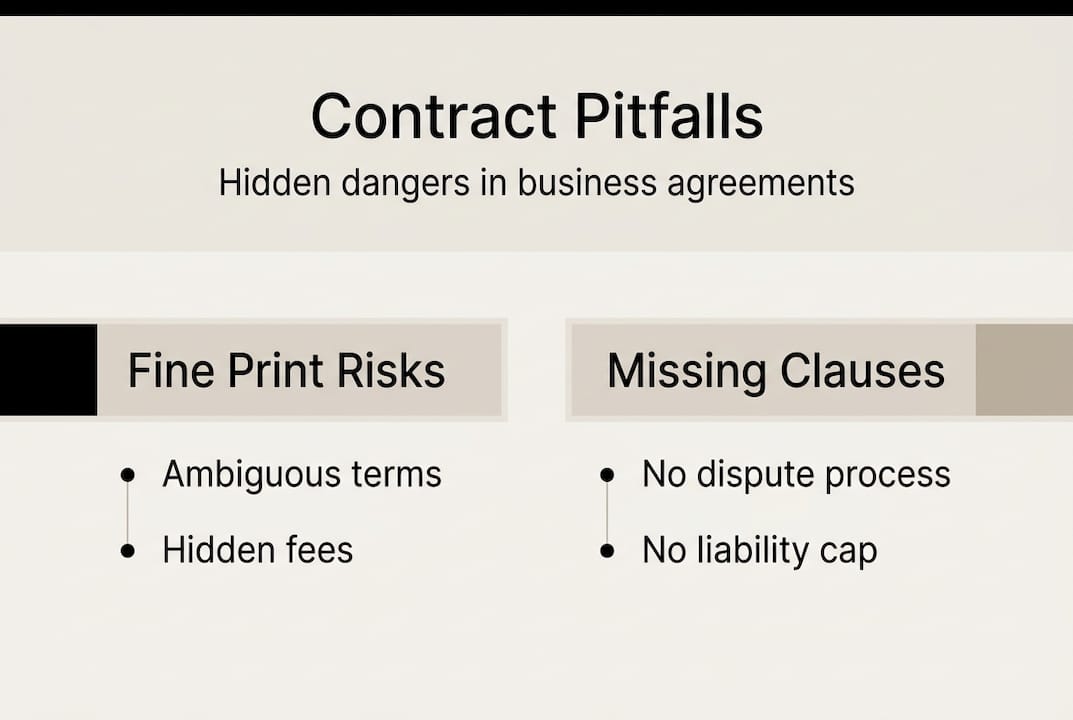
The most commercially sophisticated businesses treat contracts as operational assets, not administrative burdens. Involving legal expertise early to align agreements with business goals, using playbooks for consistency, and viewing contracts as investments yields smoother operations and fewer disputes.
Pro Tip: Build a simple contract playbook for your most common deal types. It should list your non-negotiable positions, your preferred fallback positions, and the clauses where you have flexibility. This saves time in every negotiation and ensures consistency across your team.
Practical steps for strategic contracting:
Understanding the value of legal counsel at the strategic level, rather than only in a crisis, is what separates businesses that grow confidently from those that lurch from one dispute to the next.
Enforceability is not just a legal concept. It is a commercial advantage. When both parties know that terms are clear and binding, the incentive to perform is stronger and the temptation to exploit ambiguity disappears. Disputes average 2.3 months for arbitration resolution, but unresolved low-value claims drag on far longer and suppress SME growth.
Well-drafted contracts reduce dispute frequency in several ways:
When disputes do arise, efficient dispute resolution mechanisms built into the contract keep costs manageable. Knowing the steps for resolving disputes swiftly means you spend less time in conflict and more time running your business.
Pro Tip: Always include a tiered dispute resolution clause: negotiation first, then mediation, then arbitration or litigation. This structure encourages resolution at the cheapest level and reserves court action as a genuine last resort.
Every insight in this article points to the same conclusion: the quality of your contracts directly determines the quality of your commercial relationships and your financial security. Reactive legal support after a dispute has started is always more expensive than proactive contract drafting before one begins.
At Ali Legal, we specialise in drafting, reviewing, and negotiating commercial contracts that protect your interests in every clause. Whether you need contract drafting expertise for a new deal or commercial litigation support when a relationship breaks down, our team provides clear, fixed-fee advice with no surprises. We work quickly, communicate plainly, and focus on outcomes that matter to your business. Contact us today to arrange a consultation and make your contracts work as hard as you do.
Poorly drafted contracts risk being unenforceable, creating costly disputes, or resulting in severe financial losses. High-profile failures such as the voided €3bn train deal show how a single drafting error can collapse an entire agreement.
Templates carry real risk if not tailored to your specific deal. Standard termination clauses can grant unexpected rights or create loopholes that lead to costly disputes.
Indemnity, liability caps, and dispute resolution clauses are the most pivotal. These provisions are the most heavily negotiated because they determine who bears the financial consequences when something goes wrong.
Use clear, tailored clauses and include tiered dispute resolution mechanisms such as mediation and arbitration. Unresolved low-value claims suppress SME growth, making accessible resolution mechanisms essential.
Engage legal expertise whenever an agreement affects key revenue, involves significant risk, or deviates from your standard terms. Involving legal counsel early aligns contracts with your business goals and prevents costly reactive disputes.


