
Nearly half of British small business owners underestimate how complex negligence laws can be, leaving their companies exposed to costly mistakes. Legal misunderstandings often lead to unnecessary civil claims and stressful litigation. Knowing what truly counts as negligence, and how courts approach business risks, empowers owners to make smarter decisions and put the right protections in place.
Negligence represents a complex legal concept within tort law that extends far beyond casual misconceptions. At its core, negligence involves a failure to exercise reasonable care, potentially resulting in harm or financial loss. Historical legal developments demonstrate how the understanding of negligence has evolved significantly over decades, establishing critical principles for determining legal responsibility.
To legally establish negligence, four fundamental elements must be proven: duty of care, breach of that duty, causation, and actual damage. This means business owners are not automatically liable for every incident, but must have failed to meet a reasonable standard of care that directly contributed to someone’s harm. The landmark case of Donoghue v Stevenson established the modern interpretation, highlighting that organisations have a responsibility to prevent foreseeable risks.
Common myths about negligence often misrepresent legal standards. Many business owners incorrectly believe that any accident automatically constitutes negligence or that they can be held responsible for completely unforeseeable circumstances. In reality, courts examine specific contextual details, assessing whether a reasonable person in similar circumstances would have taken different precautions. The legal standard is not perfection, but a demonstrable commitment to managing reasonable risks.
Pro tip: Maintain comprehensive documentation of risk assessments, safety protocols, and employee training to demonstrate proactive management of potential negligence risks.
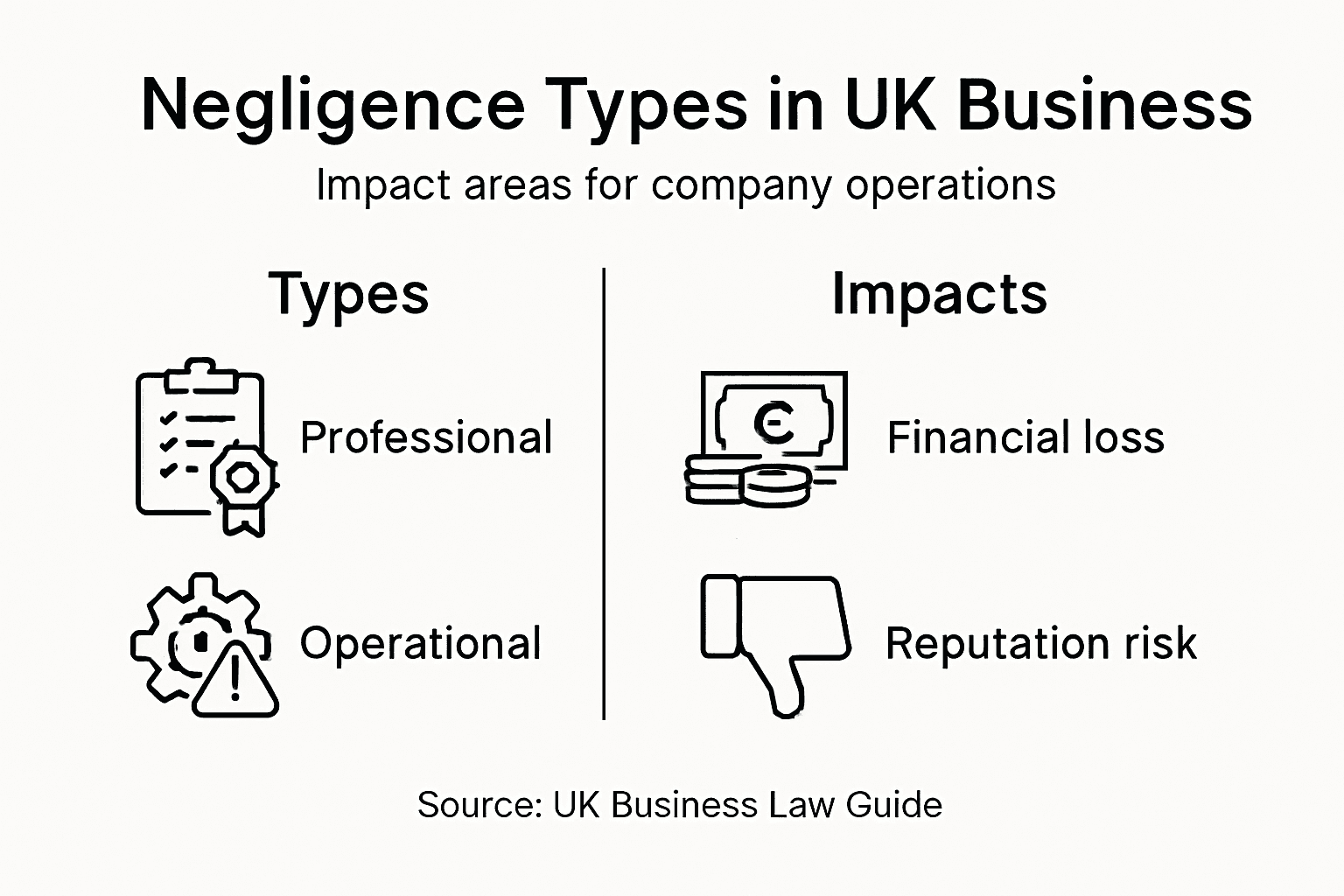
Negligence in law encompasses several distinct categories that business owners must understand to protect their interests. Professional negligence occurs when a professional fails to meet the standard of care expected in their specific field, such as a solicitor providing incorrect legal advice or an accountant making significant financial errors. Personal injury litigation frequently involves these professional negligence claims, highlighting the potential financial and reputational risks for businesses.
Another critical type is medical negligence, which involves healthcare professionals providing substandard care that causes patient harm. This can range from surgical mistakes to misdiagnosis or improper treatment. In the business context, companies in healthcare, insurance, and related sectors must be particularly vigilant about maintaining rigorous professional standards and comprehensive documentation to mitigate potential negligence risks.
Operational negligence represents a broader category affecting businesses across multiple sectors. This includes scenarios where a company fails to implement reasonable safety protocols, maintain equipment, or train staff adequately. For instance, a manufacturing company not providing proper safety equipment, a retail business with inadequate slip prevention measures, or a construction firm neglecting site safety regulations could all face significant legal consequences if their actions directly contribute to workplace injuries or property damage.
Pro tip: Conduct regular risk assessments, maintain comprehensive staff training records, and develop robust safety protocols to demonstrate proactive management and reduce potential negligence exposure.
This table summarises the major types of negligence relevant to UK businesses and highlights their typical business impacts.
| Type of Negligence | Description | Common Business Impact |
|---|---|---|
| Professional | Failure to meet sector standards | Financial loss and loss of reputation |
| Medical | Substandard care by health professionals | Regulatory investigation, patient harm |
| Operational | Poor safety protocols or training | Increased injury claims, legal penalties |
The legal framework for negligence hinges on four critical elements that must be systematically proven. Detailed legal tests reveal the intricate process of establishing negligence, with each component playing a crucial role in determining legal liability. Duty of care represents the first fundamental element, requiring businesses to demonstrate a reasonable obligation to prevent foreseeable harm to others, whether employees, customers, or the general public.

The breach of duty test examines whether a reasonable person in similar circumstances would have acted differently. Courts assess the standard of care expected, considering factors like professional expertise, industry standards, and potential risks. This evaluation is not about perfect prevention but about demonstrating a responsible approach to risk management. For instance, a construction company must provide appropriate safety equipment and training, while a medical practice must follow established professional protocols.
The final two elements - causation and damage - are equally critical. Causation requires proving that the breach directly resulted in the harm, using the ‘but for’ test to establish a clear link between negligent action and consequential damage. Businesses must show that the harm would not have occurred without their specific negligent behaviour. Damage must be real and quantifiable, ranging from physical injury to financial loss, ensuring that the legal claim represents a genuine and substantive impact.
Pro tip: Implement comprehensive documentation systems that record risk assessments, safety protocols, and training records to provide robust evidence of proactive risk management in potential negligence scenarios.
UK businesses operate within a complex legal landscape that demands comprehensive understanding of their duty of care obligations. Legal negligence principles demonstrate that organisations must proactively protect stakeholders from foreseeable harm. This duty extends beyond simple risk avoidance, requiring businesses to anticipate potential dangers and implement robust preventative measures across all operational domains.
The scope of business liability encompasses multiple stakeholder groups, including employees, customers, suppliers, and the broader public. Different sectors face unique risk profiles that demand tailored approaches to managing potential negligence. A retail business might focus on physical safety and premises maintenance, while a professional services firm must prioritise accuracy of advice and confidentiality. Critical considerations include workplace safety protocols, equipment maintenance, staff training, professional standards, and comprehensive insurance coverage that protects against potential legal claims.
Financial risks associated with negligence can be substantial, potentially threatening a business’s entire operational sustainability. Legal claims may result in direct compensation payments, legal fees, regulatory penalties, and significant reputational damage. Small and medium enterprises are particularly vulnerable, as they often lack the financial reserves to absorb extensive legal costs. Successful risk management involves systematic documentation, regular risk assessments, ongoing staff training, and maintaining transparent communication channels that demonstrate a genuine commitment to stakeholder protection.
Pro tip: Develop a comprehensive risk management strategy that includes regular legal audits, staff training programmes, and transparent incident reporting mechanisms to proactively mitigate potential negligence risks.
Defending against potential negligence claims requires a strategic and proactive approach to legal risk management. Business litigation strategies play a critical role in minimising potential legal vulnerabilities. UK businesses must develop comprehensive documentation practices that demonstrate reasonable care and systematic risk mitigation, creating a robust defence against potential negligence allegations.
The primary defence strategies involve thorough record-keeping, implementing rigorous safety protocols, and maintaining clear evidence of due diligence. This includes detailed training records, risk assessment documentation, maintenance logs, and standard operating procedures that showcase the organisation’s commitment to preventing foreseeable harm. Professional indemnity insurance provides an additional layer of protection, offering financial support and legal representation in the event of a negligence claim.
Successful negligence defence relies on presenting compelling evidence that challenges the four fundamental elements of a negligence claim: duty of care, breach of duty, causation, and damage. Businesses must be prepared to demonstrate that they exercised reasonable care, that any alleged breach was not directly responsible for the claimed harm, or that the damage was not a foreseeable or direct consequence of their actions. This requires meticulous documentation, expert testimony, and a comprehensive understanding of legal standards specific to their industry.
Pro tip: Develop a comprehensive incident reporting system that captures immediate details of any potential risk events, ensuring immediate documentation and creating a robust evidence trail for potential future legal challenges.
The following table compares key strategies for defending against negligence claims, helping businesses proactively reduce legal risk.
| Defence Strategy | Main Focus | Typical Benefit |
|---|---|---|
| Record-keeping | Document actions and policies | Provides clear evidence |
| Safety protocols | Prevent workplace accidents | Reduces incident likelihood |
| Staff training | Improve employee awareness | Minimises careless acts |
| Professional indemnity | Financial cover for claims | Lowers business exposure |
Understanding the complexities of negligence law is vital for UK business owners seeking to safeguard their operations and reputation. This article highlights key challenges such as proving duty of care, breach, causation, and actual damage — important elements that can have serious financial and legal consequences if mishandled. Businesses face ongoing risks from professional, medical, and operational negligence, making it essential to adopt proactive risk management strategies and rigorous documentation.
At Ali Legal, we specialise in helping businesses navigate these demanding legal landscapes with clear, straightforward advice tailored to your unique needs. Our client-centric approach ensures you receive transparent support focused on reducing liability and defending against negligence claims effectively. Whether you need guidance on staff training compliance or robust safety protocols, our expertise in civil litigation and corporate law helps you act fast and decisively.

Don’t leave your business vulnerable to costly negligence claims. Contact us today for a personalised consultation and discover how our fixed-fee, transparent legal services can protect your interests and build long-term resilience. Take the first step now by reaching out via Ali Legal Contact. Learn more about how to approach personal injury litigation or discuss tailored solutions with our experienced solicitors. Your business deserves the best defence—get in touch with Ali Legal immediately.
Negligence in law refers to a failure to exercise reasonable care that results in harm or financial loss to another party. It is a key principle in tort law and requires the establishment of four elements: duty of care, breach of that duty, causation, and actual damage.
UK business owners can defend against negligence claims by maintaining thorough records, implementing rigorous safety protocols, conducting regular staff training, and obtaining professional indemnity insurance to provide financial support in case of a claim.
The main types of negligence affecting businesses include professional negligence, which occurs when professionals fail to meet industry standards; medical negligence involving healthcare professionals providing substandard care; and operational negligence, which pertains to inadequate safety protocols or training within a business.
To manage duty of care obligations, businesses should conduct regular risk assessments, implement robust safety protocols, maintain comprehensive training records, and ensure transparency in communication to protect stakeholders from foreseeable harm.
Most british families and property owners face pivotal moments where expert legal representation can mean the difference between successful outcomes and costly mistakes. In the United Kingdom, over 60 percent of high-value disputes hinge on highly skilled advocacy and strategic legal support. When assets or family interests are at stake, understanding who truly protects your rights within the british legal framework is essential. This overview reveals what sets professional legal representation apart, helping you make focused decisions with genuine confidence.
Legal representation in the United Kingdom represents a sophisticated framework of professional advocacy and legal support. At its core, legal representation involves acting on behalf of clients within complex judicial and administrative systems. Solicitors, barristers, and legal professionals serve as authorised agents who protect individual and organisational legal interests through expert guidance and strategic intervention.
The scope of legal representation extends far beyond simple courtroom advocacy. It encompasses a comprehensive range of services including providing strategic legal advice, negotiating settlements, preparing critical legal documentation, and representing clients’ interests across various legal domains. Authorised legal agents protect client rights through precise understanding of statutory regulations, procedural requirements, and nuanced interpretational strategies.
Understanding legal representation involves recognising its multifaceted nature. Different legal scenarios demand specific representation approaches - from civil litigation and family law disputes to corporate negotiations and criminal defence proceedings. Professional legal representatives analyse individual case circumstances, develop tailored strategies, and provide robust advocacy that navigates the intricate British legal landscape.
Pro tip: When seeking legal representation, always verify a solicitor’s specialisation and professional credentials to ensure they possess specific expertise relevant to your unique legal challenge.
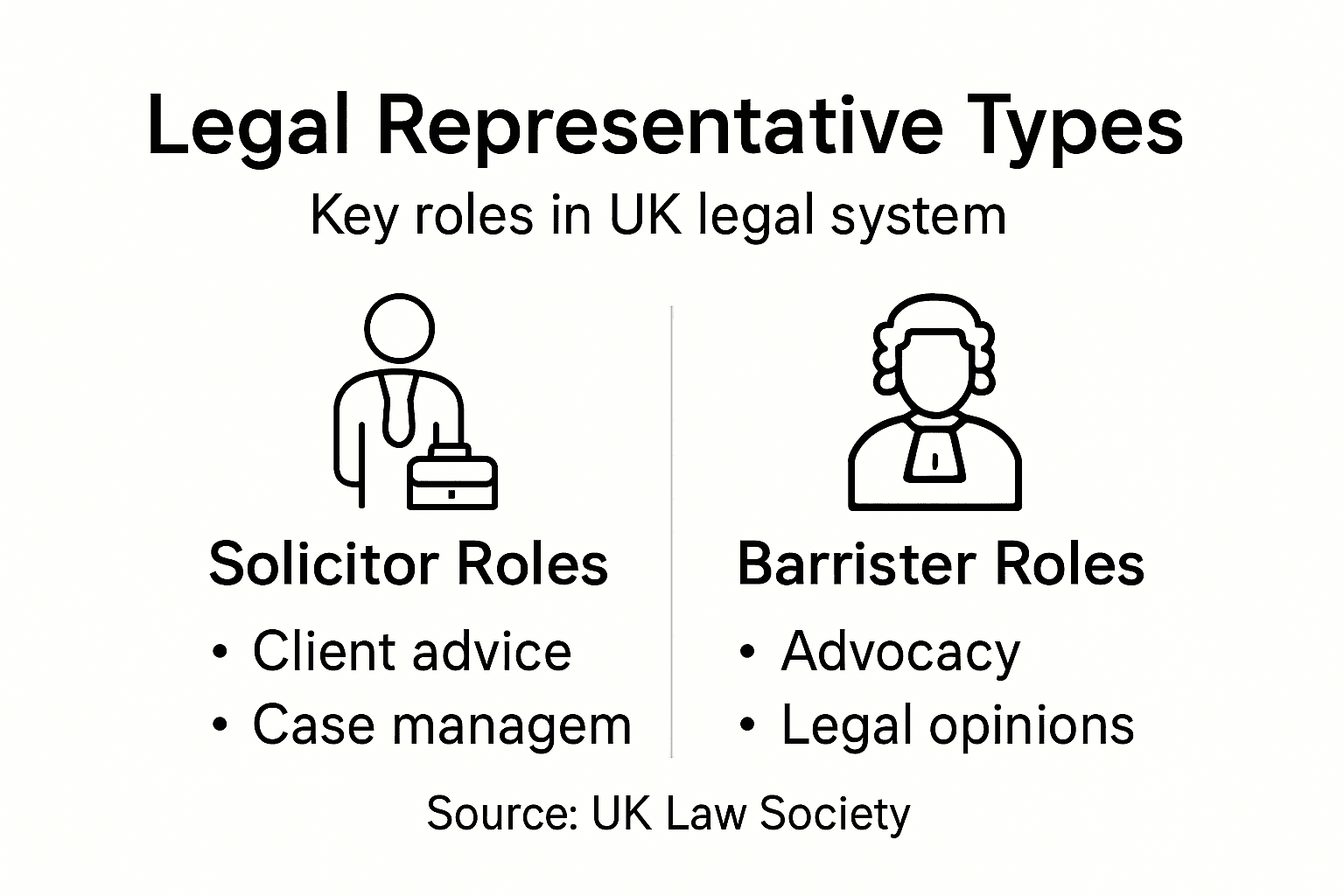
The United Kingdom’s legal profession comprises several distinct categories of legal representatives, each playing a crucial role in delivering comprehensive legal services. Solicitors remain the primary legal professionals who provide direct client advice, prepare legal documentation, and manage case preparations across numerous practice areas. These versatile legal practitioners serve as initial points of contact for individuals and organisations seeking professional legal guidance.
Barristers constitute another essential category of legal representatives, specialising in courtroom advocacy and complex litigation strategies. While solicitors typically handle initial case management, barristers offer specialist expertise in presenting arguments, interpreting legal precedents, and representing clients during court proceedings. Their advanced training enables them to provide sophisticated legal analysis and represent clients in higher courts with exceptional skill.
Chartered Legal Executives represent a specialist category within the legal profession. These professionals often focus on specific legal domains, offering deep expertise in areas such as property law, litigation, or family law. Working closely alongside solicitors, Chartered Legal Executives bring specialised knowledge and can undertake reserved legal activities under professional supervision, providing clients with targeted and cost-effective legal support.
Pro tip: When selecting a legal representative, carefully assess their specific qualifications, specialisation, and professional regulatory status to ensure they precisely match your legal requirements.
Here is a summary of the main types of legal representatives in the UK and their core areas of expertise:
| Legal Representative Type | Primary Functions | Typical Areas of Expertise |
|---|---|---|
| Solicitor | Client advice, documentation, case management | Conveyancing, family law, probate |
| Barrister | Court advocacy, litigation strategy | Criminal defence, civil litigation |
| Chartered Legal Executive | Specialist legal services, reserved activities under supervision | Property law, family law, litigation |
Legal rights in the United Kingdom represent a comprehensive framework designed to protect individuals’ interests and ensure fair treatment within the judicial system. These fundamental rights guarantee access to legal representation, enabling citizens to seek professional guidance and support across various legal domains. The Legal Services Act plays a critical role in regulating how legal representation is provided, ensuring transparency, fairness, and professional standards are consistently maintained.

The legal framework extends beyond courtroom representation to encompass broader decision-making protections. Statutory provisions for legal representation include mechanisms such as powers of attorney and guardianship, which allow appointed individuals to make decisions on behalf of those who lack legal capacity. These frameworks provide crucial safeguards, ensuring vulnerable individuals receive appropriate legal support and protection of their personal and financial interests.
Key legal rights in the United Kingdom are anchored in principles of individual autonomy and procedural justice. This includes the right to a fair hearing, the ability to challenge legal decisions, and access to independent legal advice. The intricate balance between individual rights and systemic protections ensures that legal representation serves not just as a procedural mechanism, but as a fundamental instrument of social justice and personal empowerment.
Pro tip: Always request detailed documentation outlining the specific legal rights and representation scope before engaging with any legal professional to ensure complete understanding of your legal protections.
Legal representatives in the United Kingdom operate under a comprehensive set of professional responsibilities that extend far beyond simple legal advice. Their core function involves providing strategic guidance, protecting client interests, and ensuring comprehensive representation across complex legal landscapes. These professionals are obligated to maintain the highest standards of professional conduct, which includes delivering clear, accurate advice and representing clients with unwavering commitment and ethical integrity.
The duty of care represents a fundamental responsibility for legal representatives. Professional legal conduct mandates strict adherence to confidentiality, ethical standards, and client-focused communication. This involves meticulously navigating legal processes, interpreting complex regulations, and providing transparent guidance that empowers clients to make informed decisions. Legal representatives must balance technical legal expertise with compassionate understanding of individual client needs.
Beyond individual case management, legal representatives play a crucial role in facilitating access to justice. Their responsibilities include interpreting legal frameworks, negotiating on behalf of clients, preparing comprehensive legal documentation, and representing clients in courts and tribunals. This multifaceted role requires exceptional communication skills, deep legal knowledge, and the ability to strategically advocate for client interests across various legal domains.
Pro tip: Request a clear engagement letter from your legal representative that explicitly outlines their specific responsibilities, communication protocols, and expected outcomes to ensure complete transparency.
Legal representation costs in the United Kingdom vary significantly depending on case complexity, legal domain, and the specific services required. While traditional hourly billing remains common, many legal practices now offer fixed fee arrangements to provide greater financial predictability for clients. These structured pricing models help individuals and businesses understand their potential financial commitments upfront, reducing uncertainty and potential financial stress.
Understanding the potential pitfalls is crucial for managing legal expenses effectively. Legal service funding options range from traditional payment methods to specialised schemes like legal aid, which can provide support for those with limited financial resources. Common challenges include unexpected additional charges, unclear fee structures, and misunderstandings about the scope of legal services. Clients must carefully review engagement letters, request detailed cost breakdowns, and seek clarification on potential extra expenses before committing to legal representation.
To mitigate financial risks, individuals should adopt a proactive approach to managing legal costs. This involves requesting comprehensive written estimates, understanding different fee arrangements (hourly rates, fixed fees, conditional fees), and discussing potential additional expenses. Some legal representatives offer initial consultation sessions that can help clients assess potential costs and develop a clear understanding of the financial implications of their legal matter.
Below is an overview of common legal fee structures and their potential advantages and drawbacks:
| Fee Structure | Description | Potential Benefits | Possible Drawbacks |
|---|---|---|---|
| Hourly Rate | Charged per hour of work | Flexible, pays as needed | Costs can escalate |
| Fixed Fee | Set total cost for services | Predictable budgeting | Limited scope |
| Conditional Fee | Pay only if successful | Reduces upfront costs | May include higher percent charges |
Pro tip: Always request a detailed, written breakdown of potential legal costs and ask for a written estimate with clear explanations of what services are included and what might incur additional charges.
Navigating legal matters in the United Kingdom requires knowledgeable guidance and trusted representation. This article highlights the complexity of legal representation, including the vital roles of solicitors, barristers, and Charter Legal Executives, alongside understanding your rights and costs involved. If you face challenges understanding these legal frameworks or require clear, strategic advice with transparent fees, you are not alone. At Ali Legal, we understand that clarity and trust in legal representation are essential to protect your rights and interests effectively.
Discover how our client-focused services in areas such as civil litigation, family law, and more can provide the expert advice and support you need. For tailored insights please explore our Uncategorized | Ali Legal resources.
Take control of your legal journey now by consulting with our dedicated team. Benefit from fixed fees, straightforward advice, and a commitment to building long-term relationships. Start by getting in touch today through our contact page and get expert legal representation that puts you first.
Legal representation in the UK involves acting on behalf of clients within judicial and administrative systems, providing various services such as strategic legal advice, negotiation, and court advocacy through qualified legal professionals like solicitors and barristers.
The primary types of legal representatives include solicitors, who manage client cases and provide advice; barristers, who specialise in courtroom advocacy and litigation; and Chartered Legal Executives, who focus on specific legal areas under professional supervision.
Legal rights associated with representation include access to legal guidance, the right to a fair hearing, and mechanisms to challenge legal decisions, all ensuring individuals receive appropriate support and protection in the justice system.
Cost management for legal representation can be done through understanding the various fee structures available, such as hourly rates or fixed fees, requesting detailed written estimates, and discussing potential additional costs upfront with the legal representative.
Most british SMEs face legal challenges that can quickly escalate if contracts and compliance are not handled with care. For corporate legal managers, understanding commercial law is vital to prevent disputes, financial losses, and reputational damage. This guide unpacks the practical essentials of british business contracts, risk management, and shifting regulations so you can make informed decisions while confidently protecting your company’s interests. More than 60 percent of UK SMEs report encountering legal issues every year, underscoring the value of proactive legal knowledge.
Every UK small business must master the art of understanding commercial contracts to protect their interests and establish clear legal boundaries. Contracts are not just paperwork they are fundamental legal instruments that define business relationships, obligations, and potential risks.
At its core, a contract represents a legally binding agreement between two or more parties that creates mutual obligations. When drafting or reviewing contracts, you need to pay close attention to key clauses that can significantly impact your business’s legal standing. Contract law in the UK provides a comprehensive framework for understanding these essential legal documents.
The most critical contract clauses typically include:
Scope of Work: Clearly defines the specific services or products to be delivered, including precise descriptions, timelines, and performance expectations.
Payment Terms: Outlines payment schedules, methods, amounts, and conditions. This clause protects both parties by establishing clear financial expectations and preventing payment disputes.
Termination Conditions: Specifies circumstances under which either party can end the contract, including notice periods, grounds for termination, and potential penalties.
Confidentiality Provisions: Protects sensitive business information by restricting the sharing of proprietary data, trade secrets, or strategic insights.
Dispute Resolution: Establishes the mechanism for resolving potential conflicts, whether through mediation, arbitration, or legal proceedings.
By understanding these fundamental clauses, you can construct robust contracts that safeguard your business interests and minimise potential legal complications.
Top tip: Always have a qualified legal professional review your contracts before signing to ensure comprehensive protection and clarity.
Every UK small business must navigate a complex landscape of legal requirements to operate successfully and avoid potential regulatory pitfalls. Understanding these statutory obligations is not just a legal necessity but a fundamental aspect of responsible business management.
Legal requirements encompass multiple dimensions of business operations. Navigating commercial contracts demands comprehensive knowledge of regulatory frameworks that govern business transactions across different sectors.
Key Legal Requirements Include:
Company Registration and Compliance
Every business must register with appropriate authorities and maintain accurate documentation. This includes registering with Companies House, obtaining necessary business licences, and fulfilling annual reporting obligations.
Tax and Financial Regulations
Accurate financial record keeping is mandatory. Businesses must comply with tax laws, submit timely returns to HM Revenue and Customs, and maintain transparent accounting practices.
Employment Law Obligations
Employers must adhere to statutory requirements covering employment contracts, minimum wage regulations, workplace safety standards, and employee rights. This includes proper documentation, fair treatment, and compliance with discrimination legislation.
Consumer Protection Standards
Businesses must ensure product safety, transparent pricing, accurate product descriptions, and fair trading practices. This protects consumer interests and maintains business reputation.
Data Protection Requirements
Compliance with the UK General Data Protection Regulation (GDPR) is critical. Businesses must secure personal data, obtain proper consent, and implement robust data management processes.
Top tip: Consult a legal professional annually to review your business practices and ensure ongoing regulatory compliance.
In the complex world of business transactions, understanding and preventing contract breaches is crucial for protecting your company’s financial and legal interests. A contract breach can result in significant financial losses, damaged business relationships, and potential legal disputes.
Resolving contract disputes requires strategic planning and proactive risk management. Understanding potential breach scenarios helps SMEs develop robust protective strategies.
Key Risk Mitigation Strategies:
Comprehensive Contract Documentation
Ensure all contract terms are clearly defined, specific, and unambiguous. Detailed documentation reduces the likelihood of misunderstandings that could lead to potential breaches.
Performance Monitoring
Implement systematic processes to track contractual obligations. Regular monitoring allows early identification of potential performance issues before they escalate into significant breaches.
Clear Communication Channels
Establish transparent communication protocols with contract partners. Open dialogue helps address potential issues quickly and professionally, minimising the risk of formal dispute escalation.
Robust Termination Clauses
Draft comprehensive termination provisions that outline specific conditions under which either party can exit the contract. These clauses should include notice periods, compensation mechanisms, and specific breach definitions.
Legal Contingency Planning
Develop a predefined strategy for managing potential contract breaches. This includes identifying potential legal resources, understanding dispute resolution mechanisms, and maintaining detailed contract documentation.
Top tip: Consider investing in professional legal review of all significant contracts to identify potential vulnerabilities before signing.
Intellectual property represents one of the most valuable yet often overlooked assets for UK small businesses. Protecting your innovative ideas, brand identity, and creative works can provide significant competitive advantages and potential revenue streams.
Intellectual property guidance from official sources offers comprehensive strategies for SMEs to safeguard their unique business assets.
Key IP Protection Strategies:
Comprehensive IP Audit
Conduct a thorough assessment of all intellectual property within your business. Identify trade marks, potential patents, design rights, and copyright materials that represent your company’s unique innovations and brand elements.
Strategic Registration
Register critical intellectual property assets with the appropriate UK authorities. This includes trade mark registration for brand names and logos, patent applications for unique inventions, and copyright protection for original creative works.
Confidentiality Management
Implement robust confidentiality agreements for employees, contractors, and business partners. These legal instruments prevent unauthorised disclosure of sensitive intellectual property and protect your competitive advantages.
Regular Market Monitoring
Develop a systematic approach to monitoring the marketplace for potential intellectual property infringements. Proactive surveillance helps identify and address potential violations quickly and effectively.
Commercialisation Planning
Create clear strategies for monetising your intellectual property. This might include licensing agreements, strategic partnerships, or developing additional revenue streams based on your unique IP assets.
Top tip: Consider consulting an intellectual property specialist to develop a comprehensive protection strategy tailored to your specific business needs.
Data protection represents a critical legal responsibility for every UK small business handling personal information. Understanding and implementing robust data protection practices is no longer optional but a fundamental legal requirement.
Regulatory compliance strategies are essential for managing legal risks and maintaining customer trust.
Key Data Protection Requirements:
Comprehensive Data Audit
Conduct a thorough assessment of all personal data your business collects, processes, and stores. Identify what data you collect, why you collect it, and how long you retain it.
Transparent Privacy Policies
Develop clear, accessible privacy policies that explain how your business handles personal data. These documents must outline data collection purposes, storage methods, and individual rights.
Consent Management
Ensure you obtain explicit, informed consent before collecting or processing personal data. Implement clear mechanisms for individuals to provide, modify, or withdraw their consent easily.
Data Security Protocols
Establish robust technical and organisational measures to protect personal data. This includes encryption, secure storage, restricted access, and regular security assessments.
Staff Training Programme
Develop comprehensive training for all employees about data protection principles, handling personal information, and recognising potential security risks.
Top tip: Regularly review and update your data protection practices to ensure ongoing compliance with evolving UK GDPR regulations.
Business disputes are an unavoidable reality that can significantly impact your company’s financial health and reputation. Understanding how to manage and resolve conflicts effectively is crucial for maintaining business stability and protecting your interests.
Dispute resolution strategies play a vital role in managing potential legal challenges before they escalate into costly litigation.
Key Dispute Management Approaches:
Early Intervention
Address potential conflicts proactively by establishing clear communication channels and identifying issues before they become complex legal disputes. Prompt and professional communication can often prevent escalation.
Documentation Management
Maintain comprehensive and accurate records of all business interactions, communications, and agreements. Detailed documentation provides critical evidence if disputes arise and supports your position during resolution processes.
Alternative Dispute Resolution
Explore mediation and arbitration as cost effective alternatives to traditional court litigation. These methods offer faster resolution, lower expenses, and greater flexibility in finding mutually acceptable solutions.
Legal Consultation
Seek professional legal advice early when potential disputes emerge. Experienced legal professionals can provide strategic guidance and help you navigate complex resolution processes.
Settlement Negotiation
Develop negotiation skills that focus on finding compromise and maintaining professional relationships. Effective negotiation can help resolve conflicts while preserving business partnerships and minimising financial impact.
Top tip: Always consult a legal professional before signing any dispute resolution agreements to ensure your business interests are fully protected.
Regulatory landscapes evolve continuously, presenting both challenges and opportunities for UK small businesses. Staying informed about legal and regulatory shifts is not just a compliance requirement but a strategic imperative for sustainable business growth.
Regulatory changes for SMEs demand proactive and systematic approaches to maintain business resilience.
Strategic Regulatory Monitoring Techniques:
Professional Network Engagement
Connect with industry associations, professional bodies, and legal networks that provide timely updates on regulatory developments. These connections offer valuable insights and early warnings about potential changes affecting your business sector.
Digital Information Channels
Subscribe to official government websites, regulatory body newsletters, and reputable business law publications. Create a structured system for regularly reviewing and assessing incoming regulatory information.
Annual Compliance Audit
Conduct comprehensive annual reviews of your business practices against current regulatory requirements. This proactive approach helps identify potential compliance gaps and allows time for necessary adjustments.
Technology Integration
Leverage digital compliance management tools and software that can help track regulatory changes, automate reporting processes, and provide real time updates relevant to your specific business domain.
Professional Consultation
Maintain relationships with legal professionals who specialise in your industry. Regular consultations can provide nuanced interpretations of complex regulatory changes and their practical implications.
Top tip: Allocate dedicated time each quarter to review and update your understanding of current regulatory requirements to prevent unexpected compliance challenges.
| Section | Details | Significance |
|---|---|---|
| Understanding Contracts | Review key clauses such as scope of work, payment terms, and termination conditions. | Ensures clear obligations and protections. |
| Legal Requirements | Comply with mandatory regulations like registration, tax laws, and employment obligations. | Maintains legitimacy and avoids penalties. |
| Breach of Contract Risks | Identify and mitigate risks through clear terms, monitoring, and legal contingency planning. | Minimises disputes and ensures compliance. |
| Intellectual Property | Protect unique assets through audits, registration, and confidentiality agreements. | Secures competitive advantage and monetisation opportunities. |
| Data Protection | Implement proper consent, security measures, and staff training to comply with GDPR. | Safeguards personal data and maintains trust. |
| Dispute Resolution | Manage conflicts using early intervention, documentation, and alternative resolutions. | Avoids costly legal battles and preserves relationships. |
| Regulatory Updates | Stay informed through professional networks, audits, and digital tools. | Prepares businesses for compliance with changing laws. |
Navigating the complex landscape of commercial law essentials outlined in this article demands clarity and precision. From understanding critical contract clauses to managing dispute resolution and staying compliant with evolving regulations, your business deserves legal guidance that simplifies challenges and protects your interests. Many SMEs face uncertainty around areas like breach of contract risks or intellectual property management and require trustworthy advice tailored to their specific needs.
Ali Legal offers comprehensive legal solutions designed with your business goals in mind. Our client-centric approach guarantees transparent communication, fixed fees, and straightforward advice to help you build strong commercial foundations. Explore our diverse service offerings in the All | Ali Legal section for insights that cover everything from corporate law to regulatory compliance.
Don’t leave your commercial legal matters to chance. Contact Ali Legal today at https://alilegal.co.uk/contact-us and take the first step toward securing your business’s legal health and long-term success. For additional resources and case studies, visit our Uncategorized | Ali Legal page and stay informed about crucial legal developments that could impact your SME.
To protect your business, focus on essential clauses like Scope of Work, Payment Terms, Termination Conditions, Confidentiality Provisions, and Dispute Resolution. Review these clauses carefully when drafting or reviewing contracts to ensure they align with your business needs.
Ensure compliance by conducting a comprehensive data audit to understand what personal data you collect and how it is processed. Develop transparent privacy policies and obtain explicit consent from individuals for data collection.
To minimise breach of contract risks, document all contract terms clearly, monitor performance regularly, and maintain open communication with contract partners. This proactive approach helps identify potential issues early and address them before they escalate into disputes.
If disputes arise, employ early intervention strategies by maintaining clear communication and documenting all interactions. Consider alternative dispute resolution methods such as mediation or arbitration to achieve a quicker and less costly resolution.
An effective intellectual property protection strategy should include conducting an IP audit, registering key assets, and implementing confidentiality agreements. Regularly monitor the market for potential infringements to protect your unique business assets effectively.
Engage with professional networks and subscribe to regulatory updates to stay informed of changes that may impact your business. Conduct an annual compliance audit to identify gaps and adjust practices accordingly.
More than 350,000 British families encounter estate management issues every year, often finding themselves confused by probate myths and expensive legal advice. Facing an inheritance dispute or managing a loved one’s assets can feel overwhelming in the United Kingdom, especially when misinformation clouds the process. This guide delivers straightforward answers and practical solutions, so you gain real confidence making decisions about probate without unnecessary stress or cost.
Probate represents the legal process of administering a deceased person’s estate, managing asset distribution, and settling financial obligations. This crucial mechanism ensures systematic and lawful transfer of property after someone passes away.
Understanding probate involves recognising its core functions. Legal processes for estate management require executors to follow specific steps: obtaining a grant of probate, valuing the deceased’s assets, paying potential inheritance taxes, and distributing remaining property to designated beneficiaries.
Common myths frequently create unnecessary confusion about probate. Many individuals mistakenly believe probate is always complex or expensive, or that it is required for every estate. In reality, some small estates may not require full probate proceedings, with certain banks willing to release funds under specific value thresholds. Estate settlement procedures vary depending on estate size, will complexity, and individual financial circumstances.
The probate process becomes mandatory when an estate includes significant assets, property ownership, or complex financial arrangements. Executors must validate the will, pay outstanding debts, and ensure legal transfer of assets to rightful inheritors. Without proper probate, potential legal complications could arise, potentially delaying inheritance and creating financial uncertainties.
Expert tip: Always consult a legal professional to understand your specific probate requirements and streamline the estate management process.
In the United Kingdom, probate law recognises two primary legal mechanisms for managing a deceased person’s estate: the grant of probate and letters of administration. Probate legal procedures distinguish between these approaches based on whether a valid will exists.
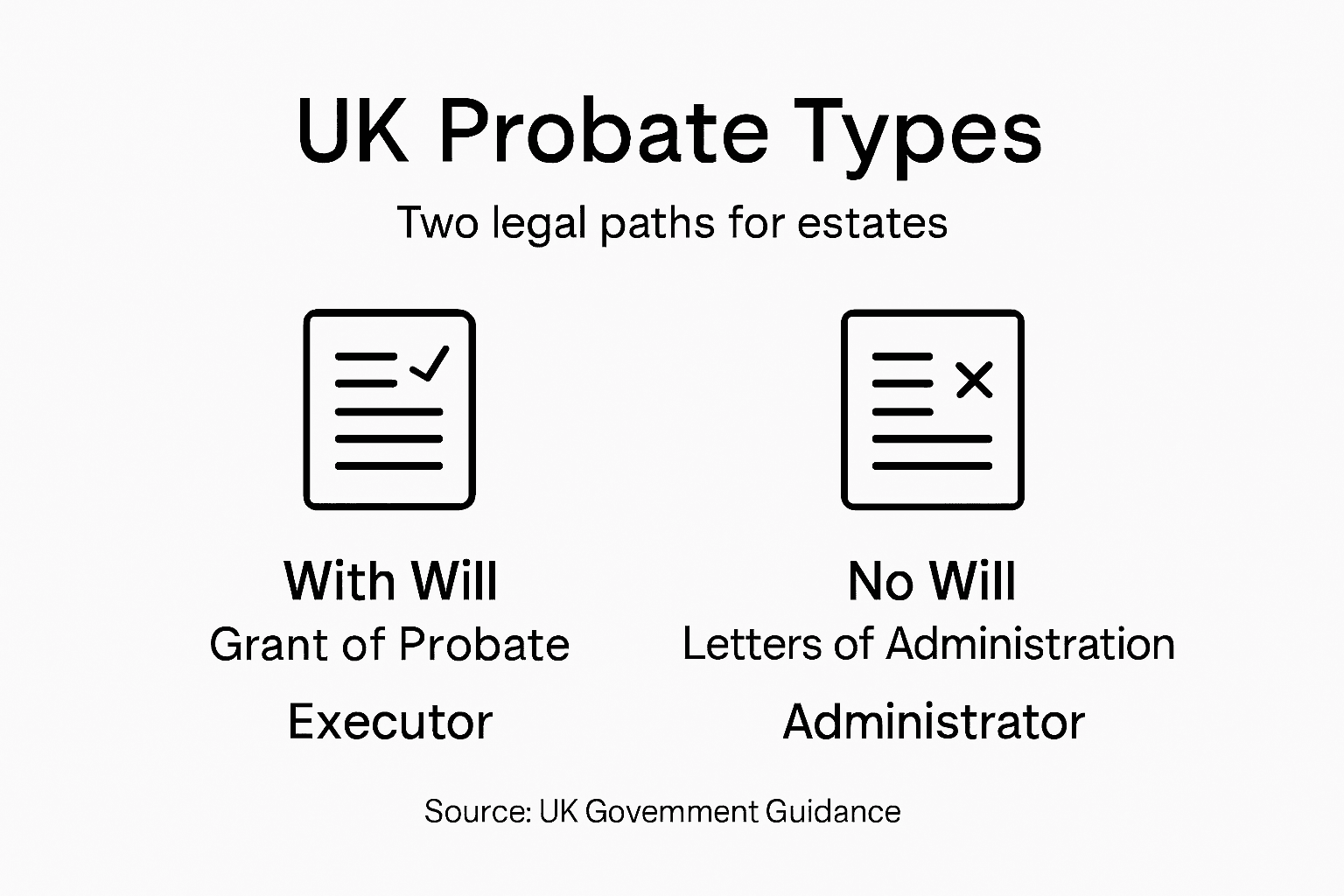
When a deceased individual leaves a valid will, executors named in the document can apply for a grant of probate. This legal document provides official authorisation to manage and distribute the estate according to the deceased’s wishes. Estate administration processes become more complex when no will is present, requiring an alternative legal route.
In cases without a will, close relatives must apply for letters of administration. This legal mechanism appoints an administrator, typically a spouse or next of kin, who gains legal authority to manage the estate according to intestacy laws. The administrator assumes responsibilities similar to an executor, including asset valuation, debt settlement, and asset distribution among legal heirs.
The key distinctions between these probate types involve legal authority, documentation requirements, and inheritance distribution procedures. Grant of probate follows explicit will instructions, while letters of administration rely on statutory inheritance guidelines. Both mechanisms serve to ensure transparent, lawful estate settlement, protecting the interests of beneficiaries and maintaining legal integrity.
Here’s a summary comparing probate options depending on the presence of a will:
| Probate Type | When Used | Who Manages Estate | Asset Distribution Basis |
|---|---|---|---|
| Grant of Probate | Will present | Named executor | According to the deceased’s wishes |
| Letters of Administration | No valid will | Appointed administrator | As defined by intestacy laws |
Expert tip: Consult a legal professional to determine which probate process best suits your specific estate circumstances and familial situation.
The probate process in the United Kingdom is a structured legal procedure designed to manage and distribute a deceased person’s estate. Probate application procedures begin immediately after an individual’s death, requiring executors to navigate several critical stages of estate management.
Initially, the executor must comprehensively value the deceased’s estate, which involves cataloguing all assets, properties, investments, and personal belongings. This valuation is crucial for determining potential inheritance tax liabilities. The executor then submits necessary documentation to the Probate Registry, including the original will, death certificate, and detailed estate valuation. Estate settlement steps typically involve completing official application forms, either online or through postal submission, and paying the requisite probate fees.

Once the grant of probate or letters of administration are obtained, executors gain legal authority to manage the estate. This includes settling any outstanding debts, closing financial accounts, and preparing to distribute assets to beneficiaries. The process requires meticulous record-keeping and adherence to legal requirements, ensuring that the deceased’s wishes are respected and all financial obligations are fulfilled.
Complexity can arise when estates involve multiple properties, international assets, or complicated family circumstances. Executors must navigate potential inheritance tax calculations, resolve any potential disputes among beneficiaries, and ensure transparent and equitable distribution of the estate according to the will or intestacy laws.
Expert tip: Maintain detailed documentation and consider professional legal guidance to navigate the intricate probate process effectively.
Executors and administrators bear significant legal responsibilities when managing a deceased person’s estate. Executor duties and obligations encompass a comprehensive range of critical tasks that demand meticulous attention and professional diligence.
The primary responsibilities include securing and valuing the deceased’s property, collecting all assets, and preparing a detailed inventory of the estate. Estate management processes require executors to locate and compile all financial documents, notify relevant financial institutions, and open a dedicated estate account. They must also calculate and settle any outstanding debts, including potential inheritance tax liabilities, before distributing remaining assets to beneficiaries.
Legal obligations extend beyond mere administrative tasks. Executors hold a fiduciary duty, which means they must act in the best interests of the estate and its beneficiaries. This includes making impartial decisions, maintaining transparent financial records, and protecting the estate’s value. Multiple executors must work collaboratively, and they have the option to seek professional assistance to ensure accurate and lawful estate management.
The role involves significant personal responsibility, with potential legal consequences for errors or negligence. Executors can be held personally liable for mistakes in estate administration, emphasising the importance of careful, methodical approach to managing the deceased’s final financial affairs.
Expert tip: Consider seeking professional legal advice to understand the full scope of your responsibilities and protect yourself from potential legal complications.
Probate administration involves significant financial and legal risks that can potentially expose executors to substantial personal liability. Probate administration risks encompass complex challenges that require meticulous attention to financial and legal details.
Tax obligations represent a critical area of potential risk, with executors responsible for accurately calculating and paying inheritance tax. Miscalculations or failures to disclose assets can result in severe financial penalties, including potential retrospective tax assessments and legal sanctions. Executors must comprehensively identify all assets, including property, investments, and personal possessions, ensuring complete transparency in estate valuation.
Legal compliance challenges extend beyond tax considerations, involving strict adherence to regulatory requirements. Potential risks include breaches of fiduciary duty, improper asset management, and failure to comply with anti-money laundering regulations. Executors can face personal financial consequences for administrative errors, including potential legal claims from beneficiaries or regulatory bodies.
The complexity of probate administration demands exceptional attention to detail and a comprehensive understanding of legal and financial frameworks. Executors must maintain precise documentation, manage potential beneficiary disputes, and navigate intricate legal requirements while protecting the estate’s financial interests.
For quick reference, here are common risks faced during probate and their possible consequences:
| Risk Type | Example Scenario | Possible Consequence |
|---|---|---|
| Tax miscalculation | Incomplete asset disclosure | Financial penalties from HMRC |
| Fiduciary breach | Favouring one beneficiary unfairly | Legal action by heirs |
| Regulatory non-compliance | Failing to meet anti-money laundering rules | Personal liability and fines |
Expert tip: Maintain comprehensive documentation and consider professional legal guidance to mitigate potential risks and ensure full compliance throughout the probate process.
Individuals seeking to reduce probate complexities and associated expenses have several strategic alternatives available. Probate cost reduction strategies include innovative approaches that can significantly simplify estate management and minimise financial burdens.
One primary method involves structuring asset ownership to bypass formal probate proceedings. Joint property ownership allows assets to transfer directly to surviving owners, eliminating the need for complex legal processes. Establishing living trusts represents another effective strategy, enabling asset distribution without mandatory probate intervention. Lifetime gifting can additionally reduce potential inheritance tax liabilities and simplify future estate administration.
Probate service options vary in complexity and cost, with executors having multiple approaches to managing estate settlement. For straightforward estates, self-administration can significantly reduce professional fees. Alternatively, some legal firms offer targeted services like grant of probate only, allowing executors to handle remaining administrative tasks independently and control overall expenses.
Careful estate planning is crucial in minimising probate costs. This involves creating clear, comprehensive wills, maintaining updated asset documentation, and understanding potential tax implications. Executors should compare professional service fees, consider partial legal assistance, and explore cost-effective application methods such as online platforms.
Expert tip: Consult a legal professional to design a personalised estate planning strategy that balances cost efficiency with comprehensive asset protection.
Navigating probate law in the United Kingdom can feel overwhelming, especially when dealing with complex estates and important responsibilities like managing assets, paying inheritance tax, and ensuring clear asset distribution. This article highlights crucial challenges you might face such as understanding the differences between grants of probate and letters of administration, fulfilling your fiduciary duties, and avoiding costly mistakes that delay your estate’s future.
If you want to remove uncertainty and protect your interests, Ali Legal offers transparent and strategic legal solutions tailored to your probate needs. Explore our comprehensive range of services in All | Ali Legal designed to support you every step of the way.
Don’t wait until complications arise. Contact our experienced solicitors today for straightforward advice, fixed fees, and fast action that secures your estate’s future without unnecessary stress. Visit our contact page to schedule your consultation now and take control of the probate process with trusted professionals at your side.
Probate is the legal process of administering a deceased person’s estate, ensuring the lawful transfer of property, settling financial obligations, and managing asset distribution according to the will or intestacy laws. It is important to ensure the estate is managed properly and beneficiaries receive their inheritance without legal complications.
Executors are responsible for securing and valuing the deceased’s estate, collecting all assets, paying outstanding debts, filing tax returns, and distributing the remaining assets to beneficiaries according to the will or intestacy laws. They must act in the best interests of the estate and keep detailed records.
If a person dies without a will, known as dying intestate, close relatives must apply for letters of administration. An administrator is appointed to manage the estate according to intestacy laws, which dictate how assets are distributed among the deceased’s legal heirs.
Costs associated with probate can be minimised by structuring asset ownership to bypass probate processes, such as joint ownership or living trusts. Comprehensive estate planning, including clear wills and up-to-date documentation, can also help reduce complications and associated costs.
Over 60 percent of British small businesses report unexpected legal costs each year. For busy business owners, unpredictable legal issues disrupt growth and drain valuable resources. Understanding legal retainers helps British companies plan ahead, maintain financial control, and build a steady relationship with legal experts. This guide offers clarity on how legal retainers work, their core benefits, and practical strategies for choosing the right arrangement.
A legal retainer represents a strategic ongoing arrangement where businesses secure continuous legal support through predictable financial agreements. In the United Kingdom, these arrangements enable companies to access professional legal counsel proactively, transforming traditional reactive legal services into a more dynamic and efficient model.
Under a legal retainer, businesses typically pay a law firm a regular monthly fee for predetermined legal service access. This approach allows organisations to manage legal risks more effectively by having immediate access to expert advice without incurring substantial per-hour consultation charges. The most common retainer structures include fixed monthly payments, prepaid hour packages, and hybrid models that provide flexibility based on each business’s unique requirements.
The primary advantages of legal retainers for UK businesses centre around predictability, cost management, and strategic risk mitigation. Instead of waiting for legal issues to emerge, companies can proactively engage legal professionals who understand their specific operational context. This ongoing relationship means lawyers become familiar with the organisation’s challenges, enabling more nuanced and contextually appropriate legal guidance.
Pro tip: Before selecting a legal retainer, carefully review the specific services included and ensure they align precisely with your business’s anticipated legal requirements.
Legal retainers in the United Kingdom demonstrate remarkable flexibility, offering businesses multiple structured approaches to securing ongoing legal support. Distinct retainer models provide organisations with tailored strategies for managing their legal service requirements, each designed to address specific operational needs and budgetary constraints.
Three primary retainer types dominate the UK legal landscape. Access retainers prioritise immediate lawyer availability, ensuring businesses can rapidly obtain professional guidance during critical moments. Prepaid hourly retainers offer clients predetermined legal service blocks, allowing precise tracking and management of legal expenditure. Outcome-based retainers represent a more specialised model, focusing on delivering specific legal deliverables at a fixed price, which provides enhanced predictability for complex projects.
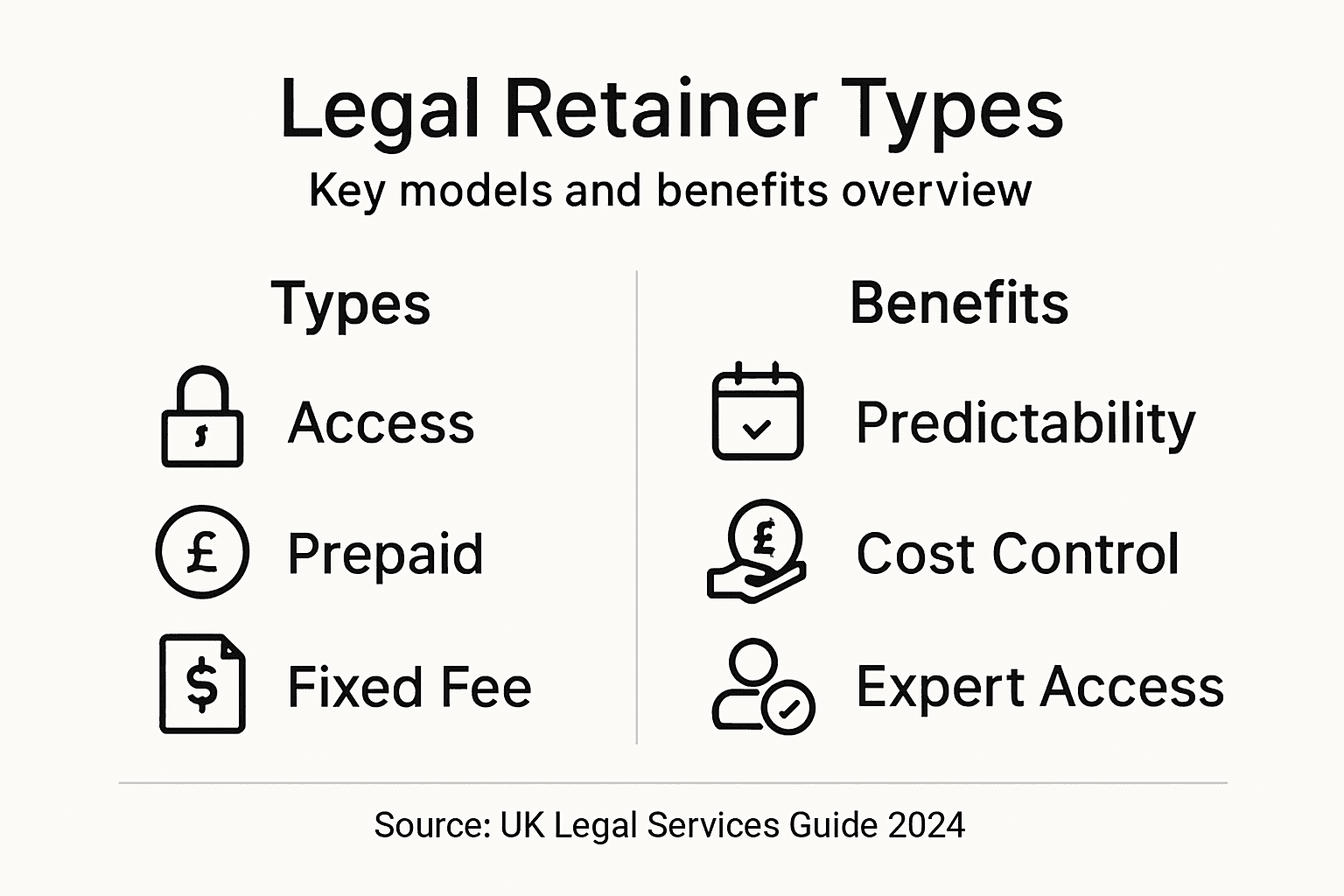
The nuanced differences between these retainer models extend beyond simple pricing structures. Access retainers emphasise responsiveness, prepaid retainers concentrate on usage tracking, and outcome-based retainers prioritise precise deliverable achievement. Organisations must carefully evaluate their specific legal support requirements, considering factors such as anticipated legal complexity, budget limitations, and the desired depth of ongoing legal counsel.
Here is a comparison of the main legal retainer types available to UK businesses:
| Retainer Type | Key Feature | Typical Use Case | Main Benefit |
|---|---|---|---|
| Access Retainer | Immediate legal access | Rapid guidance for urgent issues | Ensures fast response times |
| Prepaid Hourly | Fixed block of service hours | Organisations with fluctuating legal use | Accurate control of legal costs |
| Outcome-Based | Specific results for set fee | Project-based or complex legal matters | Clear deliverables, no surprises |
Pro tip: Conduct a comprehensive internal audit of your organisation’s legal needs before selecting a retainer model to ensure optimal alignment between service provision and operational requirements.
Legal retainer agreements represent sophisticated contractual frameworks designed to establish clear expectations between businesses and their legal service providers. Role of legal counsel becomes critically important in defining the precise parameters of these professional relationships, ensuring both parties understand their responsibilities and limitations.
A typical legal retainer agreement comprises several fundamental components. These include clearly defined service scope, specific fee structures, response time expectations, and comprehensive communication protocols. Businesses must negotiate detailed terms such as the number of consultation hours, types of legal services covered, hourly rates for additional work, and explicit boundaries of the retainer’s coverage. This meticulous approach prevents misunderstandings and provides businesses with predictable legal support mechanisms.

The practical implementation of retainer agreements involves ongoing collaboration and periodic review. Organisations should establish regular check-in meetings to assess the effectiveness of their legal support, evaluate emerging business needs, and adjust the retainer agreement accordingly. Successful retainer relationships depend on transparent communication, mutual understanding of business objectives, and the legal team’s ability to provide proactive, strategic guidance tailored to the specific industry and operational context of the client.
Pro tip: Document all interactions and maintain a comprehensive record of services rendered to ensure transparency and facilitate future contract negotiations.
Clients entering legal retainer agreements must understand their comprehensive set of obligations and responsibilities. Contract law principles dictate that businesses have critical duties beyond simply paying legal fees, encompassing transparent communication, timely information sharing, and active engagement with their legal representatives.
Under UK legal frameworks, clients bear specific responsibilities that extend throughout the retainer relationship. These include providing complete and accurate information, maintaining confidentiality, responding promptly to legal communication, and adhering to agreed payment terms. Businesses must proactively disclose all relevant details pertaining to potential legal matters, ensuring their solicitors have comprehensive context to provide effective strategic advice. Failure to meet these fundamental obligations can compromise the effectiveness of legal representation and potentially expose the organisation to additional legal risks.
The retainer agreement itself serves as a binding document that explicitly outlines mutual expectations and responsibilities. Clients should meticulously review the document, understanding key provisions such as fee structures, service scope, communication protocols, and potential additional charges. This careful approach helps prevent misunderstandings, establishes clear performance benchmarks, and creates a transparent framework for ongoing legal support. Professional solicitors will typically guide clients through these complex contractual nuances, ensuring both parties comprehend their respective roles and commitments.
Below is an at-a-glance summary of typical client obligations within a legal retainer arrangement:
| Obligation | Description | Business Impact |
|---|---|---|
| Provide Accurate Information | Share all relevant facts with legal counsel | Enables informed legal guidance |
| Respond Promptly | Timely replies to requests from law firm | Prevents delays in legal matters |
| Maintain Confidentiality | Protect both legal and business information | Reduces risk of data breaches |
| Adhere to Agreements | Follow fee and service terms faithfully | Avoids disputes and added charges |
Pro tip: Maintain a dedicated file containing all correspondence, agreements, and communications related to your legal retainer to facilitate smooth future interactions and potential dispute resolution.
Navigating legal retainer agreements requires a strategic approach to managing potential financial and operational risks. Retainer fee considerations demand meticulous attention to prevent unexpected financial burdens and ensure transparent legal partnerships.
Businesses frequently encounter several critical mistakes when establishing legal retainers. These include signing agreements without comprehensive understanding, overlooking refund policies for unused funds, and failing to clarify potential additional charges. Hidden costs can emerge through ambiguous service definitions, unexpected billable hours, or complex fee structures that were not thoroughly examined during initial negotiations. Organisations must scrutinise every clause, understanding precisely what services are included, the mechanisms for drawing down retained funds, and the exact circumstances under which supplementary charges might apply.
Risk mitigation in legal retainer agreements demands a proactive and comprehensive approach. Businesses should develop a systematic process for reviewing proposed agreements, which includes consulting with financial advisors, requesting detailed breakdowns of potential costs, and establishing clear communication channels with legal representatives. Implementing robust internal protocols for tracking legal expenses, maintaining detailed documentation, and regularly reassessing the retainer’s alignment with organisational needs can significantly reduce financial and operational vulnerabilities.
Pro tip: Create a comprehensive checklist of key financial and service terms to review systematically before signing any legal retainer agreement.
Managing ongoing legal needs can feel overwhelming without clear agreements or transparent costs. This article highlights how legal retainers empower UK businesses like yours with predictable fees, immediate access to expert advice, and strategic guidance tailored to your specific challenges. Avoid common pitfalls such as unclear service scopes or unexpected charges by partnering with legal professionals who prioritise transparency and a client-focused approach.
If you want to experience a streamlined legal retainer service that aligns perfectly with your business goals, explore our insights and client advice in the Uncategorized | Ali Legal section.
Take control of your company’s legal future today with Ali Legal’s fixed fee structures and straightforward advice. Contact our dedicated legal team now at https://alilegal.co.uk/contact-us to create a tailored retainer agreement that ensures swift, ongoing support and protects your business interests. Don’t wait for legal issues to arise—get proactive guidance designed for long-term success.
A legal retainer is a continuous arrangement between a business and a law firm that allows the business to access ongoing legal support for a regular predetermined fee. This proactive model helps companies manage legal risks effectively without incurring significant per-hour consultation charges.
There are three primary types of legal retainers: access retainers, which provide immediate lawyer availability; prepaid hourly retainers, which allow clients to purchase predetermined legal service blocks; and outcome-based retainers, which focus on delivering specific legal results at a fixed price.
To choose the right legal retainer, assess your business’s specific legal needs, considering the complexity of legal issues, budget constraints, and the desired level of ongoing counsel. Conducting an internal audit of legal requirements can significantly aid in this decision-making process.
Clients have key responsibilities, including providing accurate and complete information to their legal counsel, responding promptly to communications, maintaining confidentiality, and adhering to the terms of the retainer agreement to ensure effective legal representation.
International law shapes how British companies manage cross-border risks and regulatory obligations. Global disputes now impact over 60 percent of corporate transactions involving United Kingdom businesses. For corporate lawyers and business owners, a clear understanding of international rules is crucial in protecting commercial interests and maintaining compliance. This guide reveals how strategic use of global legal frameworks gives British organisations more control over international disputes, contractual challenges, and compliance requirements.
International law represents a sophisticated legal framework governing interactions between nations, organisations, and global entities. At its core, international law establishes rules and principles that facilitate diplomatic relations, economic cooperation, and conflict resolution across borders. Public international law serves as a critical mechanism for maintaining global order and resolving complex transnational challenges.
The scope of international law extends far beyond traditional diplomatic negotiations. It encompasses diverse domains including human rights, trade regulations, environmental protections, maritime interactions, and security protocols. By creating standardised guidelines, international law enables businesses to operate with greater predictability and reduces potential risks associated with cross-border transactions. Treaties, customary practices, and decisions from international judicial bodies collectively form the foundational structure of this complex legal system.
For United Kingdom businesses, understanding international law becomes paramount in navigating global markets. The legal framework provides essential guidelines for conducting international trade, protecting intellectual property rights, managing cross-border disputes, and ensuring compliance with multinational regulatory standards. International business law offers strategic insights into managing legal complexities that arise when operating beyond domestic boundaries.
Pro tip: When expanding internationally, consult legal experts specialising in international business law to develop comprehensive compliance strategies and mitigate potential legal risks.
International law for businesses encompasses several critical categories designed to regulate complex global interactions. International business law comprises multiple specialised legal domains that provide frameworks for multinational commercial activities. These legal types include international commercial law, trade law, corporate governance regulations, competition law, and arbitration mechanisms.
Public international law represents one fundamental category, governing relationships between states and international organisations. This domain influences business operations by establishing rules around trade agreements, environmental obligations, digital privacy standards, and human rights compliance. Private international law, alternatively, focuses on resolving legal conflicts between private entities operating across different jurisdictions, addressing challenges such as contractual disputes, intellectual property protection, and cross-border transaction regulations.
Another significant category involves supranational law, which creates binding regulations that transcend individual national legal systems. These frameworks are particularly crucial for businesses operating within economic unions or integrated market regions. By establishing uniform standards, supranational law reduces legal uncertainties and provides predictable guidelines for international commercial interactions. Cross-border dispute resolution mechanisms form an essential component of these legal frameworks, enabling businesses to manage potential conflicts efficiently and strategically.
Here’s a comparison of major types of international law relevant to business:
| Law Category | Main Focus | Typical Business Impact |
|---|---|---|
| Public International | State relations, treaties | Trade agreements, compliance |
| Private International | Private cross-border disputes | Contract resolution, IP protection |
| Supranational | Above national laws, unions | Predictable standards, simplified rules |
Pro tip: When expanding internationally, develop a comprehensive understanding of different international law types to strategically navigate complex regulatory landscapes and minimise potential legal risks.
Cross-border commercial activities are fundamentally shaped by intricate legal frameworks that provide essential guidelines for international business interactions. Cross-border civil judicial cooperation represents a critical mechanism for maintaining legal predictability and mutual trust between jurisdictions. These frameworks establish comprehensive rules governing jurisdiction, conflict resolution, judgment recognition, and enforcement across different national legal systems.

The United Kingdom’s approach to cross-border legal frameworks emphasises creating robust mechanisms for managing international commercial disputes. Key elements include bilateral treaties, multilateral conventions, and sophisticated institutional arrangements that provide clear pathways for resolving complex transnational legal challenges. Cross-border litigation requires businesses to navigate nuanced legal territories, understanding how different jurisdictions interpret and apply international commercial regulations.
British businesses must carefully consider multiple legal dimensions when operating internationally. These dimensions include understanding jurisdiction selection clauses, recognising potential conflicts between different national legal systems, and developing strategies for managing potential disputes. Specific areas of focus involve intellectual property protection, contract enforcement, trade compliance, and mechanisms for resolving disagreements that transcend national boundaries. By comprehensively understanding these legal frameworks, organisations can significantly reduce operational risks and create more stable international business relationships.
Pro tip: Invest in comprehensive legal mapping of target international markets to anticipate potential regulatory challenges and develop proactive compliance strategies.
UK companies operate within a complex regulatory landscape that demands rigorous adherence to multiple compliance requirements. UK company compliance involves comprehensive statutory obligations that extend far beyond basic registration procedures. These requirements encompass critical areas such as corporate governance, financial reporting, tax regulations, employment standards, and ongoing legal documentation.
The fundamental compliance obligations for businesses include maintaining accurate statutory registers, appointing qualified directors, submitting annual confirmation statements, and ensuring transparent financial reporting. Foreign entities and non-resident businesses face additional scrutiny, with specific requirements mandating a registered UK office, proper director appointments, and meticulous record-keeping. Corporate law compliance demands proactive management to prevent potential legal complications that could result in substantial financial penalties or even company dissolution.
British regulatory frameworks emphasise robust governance mechanisms that protect stakeholder interests and maintain market integrity. Key compliance dimensions include data protection regulations, health and safety standards, environmental reporting requirements, and sector-specific legal obligations. Companies must develop comprehensive internal compliance programmes that systematically track and address evolving regulatory landscapes. This approach involves regular audits, staff training, and establishing clear accountability mechanisms to ensure consistent adherence to statutory requirements.
Pro tip: Implement a centralised compliance management system that provides real-time tracking of regulatory changes and automates documentation processes to reduce administrative burdens.
International business operations inevitably expose organisations to complex legal risks that demand sophisticated management strategies. International dispute resolution centres provide critical mechanisms for mitigating potential legal challenges by offering neutral arbitration and mediation services that help businesses navigate cross-border commercial conflicts efficiently.
UK businesses face multifaceted legal exposures ranging from contractual disputes and regulatory compliance challenges to intellectual property conflicts and potential transnational litigation risks. These exposures require comprehensive risk management approaches that include robust contract drafting, strategic dispute resolution mechanisms, and proactive legal compliance strategies. Cross-border dispute resolution plays a pivotal role in managing potential legal uncertainties and preserving critical commercial relationships.
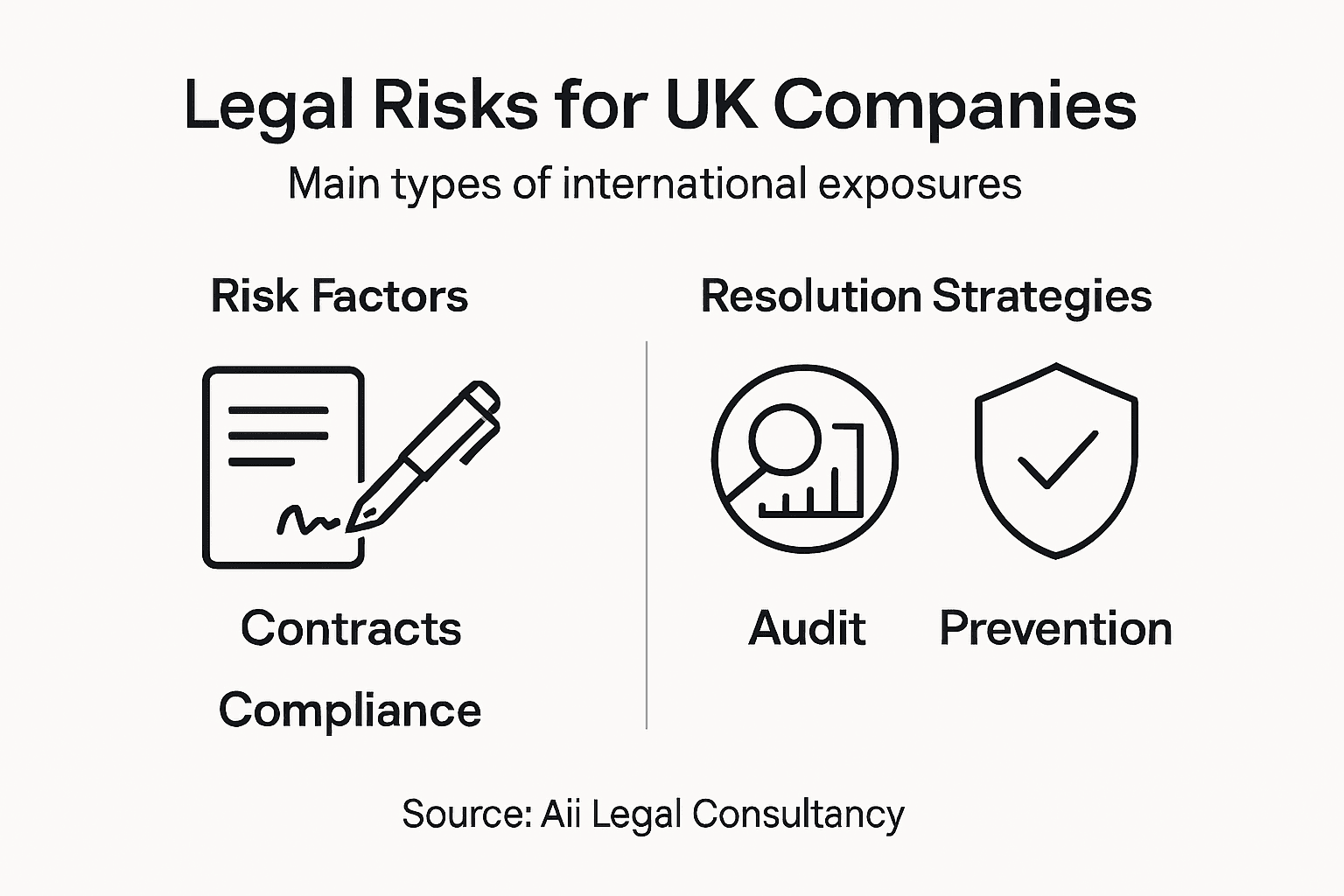
Effective legal risk management involves developing nuanced strategies that anticipate potential conflicts and establish clear protocols for resolution. Key considerations include selecting appropriate jurisdictional frameworks, implementing precise contractual dispute resolution clauses, understanding international arbitration rules, and maintaining comprehensive documentation. British companies must cultivate a proactive approach to legal risk, recognising that prevention and strategic preparation are significantly more cost-effective than reactive litigation strategies.
Key risk management factors in international business law at a glance:
| Risk Factor | Business Strategy | Expected Benefit |
|---|---|---|
| Jurisdiction Selection | Choose favourable forum | Lower litigation risk |
| Contract Precision | Include clear dispute clauses | Faster dispute resolution |
| Regulatory Monitoring | Track global legal changes | Improved compliance, fewer fines |
| Arbitration Preparation | Understand rules and protocols | Reduce time and costs |
Pro tip: Develop a comprehensive international legal risk assessment framework that includes regular legal audits, scenario planning, and continuous monitoring of regulatory changes across target markets.
Navigating the complexities of international law is critical for UK businesses aiming to thrive in global markets. The article highlights key challenges such as understanding public international law, managing cross-border disputes, and meeting rigorous compliance obligations. If you are confronted with legal uncertainties concerning international trade, regulatory compliance, or dispute resolution, Ali Legal offers clear, strategic solutions designed to protect and empower your business.
Why choose Ali Legal
Take control of your international legal risks today. Consult with Ali Legal’s specialist team to develop a robust compliance strategy and dispute resolution plan that aligns with your business goals. Reach out now via our Contact Us page to start your journey towards confident global expansion. Discover more about our expertise in International Dispute Legal Risks and Cross-Border Litigation UK Guide to give your business the legal edge it deserves.
International law provides UK businesses with essential guidelines for conducting international trade, protecting intellectual property rights, managing cross-border disputes, and ensuring compliance with multinational regulatory standards.
International law establishes rules and principles that facilitate economic cooperation and reduce potential risks associated with cross-border transactions, making it easier for businesses to operate in multiple jurisdictions.
UK businesses should be aware of public international law, private international law, and supranational law, as these frameworks govern state relations, private disputes, and binding regulations beyond national laws.
UK companies can improve compliance by developing comprehensive internal compliance programmes, conducting regular audits, and implementing centralised systems to track regulatory changes and automate documentation processes.
Most british investors and homeowners discover property law is anything but straightforward. With over one million property transactions completed in the United Kingdom each year, even minor oversights can spark expensive disputes or threaten your investment security. Understanding the core principles of property ownership, transfer, and rights is vital for anyone navigating the intricate british property market. This clear overview highlights the essentials you need to protect your interests, streamline transactions, and avoid common legal pitfalls.
Property law represents a fundamental legal framework governing how individuals and entities interact with real estate and tangible assets in the United Kingdom. At its core, this specialised legal discipline addresses the complex relationships between property ownership, transfer, and rights. Property law scholars explore critical questions about what constitutes property rights and how these rights function within society.
The scope of property law encompasses multiple critical domains, including residential and commercial property transactions, tenancies, mortgages, and dispute resolution. It touches virtually every aspect of property interaction, whether you are a homeowner, investor, landlord, or tenant. Real estate law deals with transactions involving residential and commercial properties, covering specialised areas such as property finance, mortgage lending, and social housing.
Property law in the UK distinguishes itself through intricate regulations that protect both property owners and potential buyers. These legal provisions manage critical aspects like ownership transfer, boundary disputes, easements, and adverse possession. The framework ensures transparent mechanisms for property transactions, providing legal safeguards that prevent potential conflicts and establish clear guidelines for property-related interactions.
Pro tip: Always conduct thorough property searches and obtain comprehensive legal advice before completing any property transaction to protect your investment and understand potential legal implications.
Property ownership in the United Kingdom presents a complex landscape with multiple distinct legal structures that significantly impact property rights and responsibilities. Property ownership types primarily encompass three fundamental categories: freehold, leasehold, and share of freehold, each offering unique advantages and constraints for property holders.

In the realm of personal ownership, British law recognises several key models. Ownership titles include sole ownership, where a single individual holds complete property rights, and joint ownership structures such as joint tenancy and tenancy in common. Joint tenancy ensures equal ownership with survivorship rights, meaning if one owner passes away, their share automatically transfers to the remaining owner. Conversely, tenancy in common allows owners to hold unequal shares that can be independently inherited or sold.
Freehold ownership represents the most comprehensive property rights, typically associated with detached houses where the owner possesses both the building and underlying land. Leasehold arrangements, common in flats and apartments, involve owning the property for a specified lease period without owning the land itself. Share of freehold offers a hybrid model where leaseholders collectively purchase the freehold, providing greater control over property maintenance and lease extensions.
Pro tip: Before purchasing property, carefully evaluate the ownership structure and consult a legal professional to understand the specific rights, responsibilities, and potential long-term implications of each ownership type.
Here is a summary of the main types of property ownership in the UK and their distinct features:
| Ownership Type | Who Holds Rights | Key Advantages | Main Limitations |
|---|---|---|---|
| Freehold | Single or joint owners | Complete land and building control | Higher purchase cost |
| Leasehold | Leaseholder | Lower upfront cost for property | Lease expiry and restrictions |
| Share of Freehold | Group of leaseholders | Greater control over management | Requires cooperation among owners |
| Joint Tenancy | Multiple owners equally | Automatic survivorship transfer | Shares cannot be left by will |
| Tenancy in Common | Multiple owners, shares | Flexible share allocation and bequest | Complex inheritance arrangements |
Property law in the United Kingdom represents a sophisticated legal framework built upon foundational legislative acts and evolving judicial interpretations. Real estate law primarily governs property interactions through critical statutes like the Law of Property Act 1925 and the Land Registration Act 2002, which consolidated and modernised fundamental property rights and ownership regulations.

The legal landscape encompasses multiple layers of regulation, with statutory legislation working alongside common law principles. Key legislative frameworks address critical aspects such as land ownership, property transfers, leasehold arrangements, and statutory formalities. Property law principles provide a comprehensive understanding of how legal mechanisms protect property interests, define ownership boundaries, and establish rights for individual and institutional property holders.
Complex legal principles underpin property transactions, with courts continuously interpreting and refining property rights through case law. These principles address nuanced situations involving third-party interests, inheritance considerations, and potential disputes. The legal system ensures that property rights remain adaptable to changing societal needs while maintaining robust protections for property owners and potential stakeholders.
Pro tip: Consult a specialised property law solicitor to navigate the intricate legal landscape and understand the specific implications of property ownership in your unique circumstances.
The following table compares key UK property law legislation and their practical significance:
| Legislation | Year | Core Focus | Impact on Property Rights |
|---|---|---|---|
| Law of Property Act | 1925 | Consolidation of ownership | Simplified property transfer process |
| Land Registration Act | 2002 | Formal registration system | Legal proof and protection of title |
| Leasehold Reform Act | 1967 | Leasehold enfranchisement | Enabled leaseholders to buy freehold |
| Trusts of Land Act | 1996 | Management of trust assets | Clarified rights of beneficiaries |
Property transfers in the United Kingdom represent a complex legal procedure requiring meticulous documentation and strict adherence to regulatory frameworks. Land registration practices encompass a comprehensive system designed to protect property interests and ensure transparent ownership records, governed primarily by the Land Registration Act 2002.
The registration process involves multiple critical stages, beginning with the submission of formal documentation to the Land Registry. Property owners must provide detailed evidence of ownership, including precise property descriptions, existing encumbrances, and transfer mechanisms. Each transaction requires careful verification to prevent potential disputes and establish clear legal title. Accurate record-keeping ensures that property rights are formally recognised, with official documentation serving as definitive proof of ownership and interest.
Complex compliance requirements mandate thorough investigation of property histories, potential third-party interests, and any existing legal restrictions. Solicitors play a crucial role in navigating these intricate processes, conducting comprehensive searches to identify potential legal complications before finalising property transfers. The system protects both buyers and sellers by creating a transparent, legally binding record of property transactions that can be referenced and verified through official channels.
Pro tip: Engage a qualified solicitor to conduct exhaustive property searches and verify all legal documentation before completing any property transfer to mitigate potential risks and ensure comprehensive legal compliance.
Property ownership in the United Kingdom encompasses a complex framework of legal entitlements and responsibilities that extend far beyond simple possession. Property owners possess specific rights that include exclusive use, transfer capabilities, and the fundamental ability to enjoy their property, balanced against a corresponding set of critical obligations designed to protect broader societal interests.
These rights and obligations create a nuanced legal landscape where property owners must navigate multiple regulatory requirements. Land law governs intricate ownership frameworks that balance individual property interests with community standards. Owners must comply with planning regulations, environmental protection guidelines, and respect established third-party interests such as easements and restrictive covenants. Potential risks include boundary disputes, adverse possession claims, and potential liability for improper property maintenance or usage.
The legal system provides robust mechanisms for resolving property-related conflicts, ensuring that owners understand their responsibilities while protecting their fundamental property rights. Complex interactions between statutory regulations and common law principles create a dynamic environment where property owners must remain vigilant about their legal standing. Potential risks can emerge from unexpected sources, including historical land usage, unresolved boundary issues, or unexpected third-party claims that may challenge existing property interests.
Pro tip: Conduct comprehensive property searches, maintain detailed documentation, and consult a specialised property law solicitor to proactively identify and mitigate potential legal risks associated with property ownership.
Navigating the complexities of property law in the United Kingdom can be daunting. Whether you are examining freehold versus leasehold ownership, managing transfers and registrations, or facing challenges related to property disputes and compliance, understanding your rights and responsibilities is essential. Key terms like “land registration,” “leasehold enfranchisement,” and “easements” can feel overwhelming without professional advice. At Ali Legal, we specialise in helping property owners confidently manage these intricate legal matters while protecting your investment and peace of mind.
Explore our All | Ali Legal services to find tailored legal solutions that prioritise transparency, speed, and clear communication. Do not wait until risks become problems. Contact us today at https://alilegal.co.uk/contact-us to consult with a property law expert who will guide you through every step with fixed fees and straightforward advice. Secure your property rights with trusted advice now.
The main types of property ownership in the UK are freehold, leasehold, and share of freehold. Freehold gives complete control of both the property and the land, leasehold allows ownership for a set period without owning the land, and share of freehold combines aspects of both by allowing leaseholders to collectively own the freehold.
Transferring property ownership in the UK involves submitting formal documentation to the Land Registry. This includes evidence of ownership, property descriptions, and any encumbrances. It’s essential to have accurate records to establish clear legal title and compliance with regulatory frameworks.
Property owners have several legal obligations, including compliance with planning regulations, maintaining the property, and respecting third-party interests such as easements and restrictive covenants. Failure to uphold these obligations can lead to disputes or liabilities.
Property owners can mitigate legal risks by conducting comprehensive property searches, maintaining detailed documentation of their property, and consulting a specialised property law solicitor to identify potential legal complications before undertaking transactions.
Most British companies discover that even minor legal missteps during acquisitions can lead to costly regulatory setbacks. In the fast-moving world of corporate transactions, a single overlooked detail may put company interests at risk or delay a strategic deal. This guide gives corporate managers and CFOs the clarity they need about a solicitor’s true role, translating complex legal duties into practical insights for every stage of the british acquisition process.
Solicitors play a crucial strategic role in corporate acquisitions, serving as legal guardians who protect businesses through expert guidance and comprehensive legal management. These legal professionals bring specialised knowledge to complex transactions, ensuring that every aspect of the acquisition process adheres to regulatory standards and safeguards the client’s interests.
In corporate acquisitions, solicitors perform multiple critical functions. They conduct comprehensive legal investigations to assess potential risks and opportunities, meticulously reviewing company documents, contracts, intellectual property rights, employment agreements, and potential litigation histories. Their due diligence helps clients make informed decisions by identifying potential legal obstacles or financial vulnerabilities that might impact the transaction’s success.
The solicitor’s role extends beyond document review to active negotiation and strategic advice. They draft and negotiate complex legal agreements, ensuring that contract terms protect their client’s interests while facilitating a smooth transaction. This involves coordinating with multiple stakeholders, including corporate executives, financial advisers, and regulatory bodies, to navigate the intricate legal landscape of business acquisitions.
Pro tip: Always engage a solicitor with specific experience in your industry sector to ensure nuanced understanding of sector-specific legal complexities during acquisition processes.
Corporate acquisitions in the United Kingdom encompass multiple legal structures, each with distinct implications for businesses. The primary acquisition types include share purchases and asset purchases, which differ significantly in their legal and financial consequences. Notifiable acquisitions present additional regulatory complexities that businesses must carefully navigate to ensure compliance with national security regulations.
In a share purchase, the acquiring company buys the entire shareholding of the target company, effectively acquiring all assets, liabilities, and ongoing contracts. Conversely, an asset purchase allows the buyer to select specific assets while potentially leaving behind unwanted liabilities. This approach provides more flexibility but requires more complex legal documentation to transfer individual assets and contracts.

Beyond traditional purchases, the UK legal landscape recognises additional acquisition variants. These include management buy-outs, where internal management purchases the company, ‘acquihires’ focused on acquiring talent, distressed sales in challenging financial circumstances, and minority investments that involve purchasing a partial stake. Each acquisition type requires meticulous legal structuring to protect the interests of all parties involved and comply with relevant regulatory frameworks.
Here’s how the main acquisition types differ:
| Acquisition Type | What is Acquired | Key Legal Complexity | Impact on Liabilities |
|---|---|---|---|
| Share Purchase | Entire shareholding and company | Inherits all contracts/assets | Takes on all existing debts |
| Asset Purchase | Selected assets/business units | Individual asset transfer | Unwanted liabilities excluded |
| Management Buy-Out | Control by internal managers | Restructuring ownership terms | Shared with previous owners |
| Acquihire | Personnel and expertise | Negotiation of employment terms | Liabilities often negotiated |
| Distressed Sale | Assets from financially weak firm | Rapid due diligence required | Hidden risks may exist |
| Minority Investment | Partial company stake | Shareholder rights clarified | Limited liability exposure |
Pro tip: Consult a specialist solicitor who can provide tailored advice on the most appropriate acquisition strategy for your specific business context and objectives.
The legal landscape governing acquisitions in the United Kingdom is a complex and multifaceted framework designed to ensure transparency, fairness, and protection for all stakeholders. Primary legislation such as the Companies Act 2006 and the Takeover Code form the cornerstone of regulatory oversight, establishing comprehensive guidelines for how corporate acquisitions must be conducted.

Critical regulatory bodies play pivotal roles in monitoring and controlling acquisition processes. The Competition and Markets Authority examines potential market impacts, while the Financial Conduct Authority ensures proper disclosure and shareholder protection. The National Security and Investment Act 2021 introduces an additional layer of scrutiny, enabling government intervention in acquisitions that might pose potential national security risks, thereby adding a strategic dimension to corporate transactions.
Beyond statutory regulations, the UK acquisition framework encompasses industry-specific compliance requirements. Different sectors such as financial services, technology, and infrastructure have unique regulatory nuances that businesses must navigate carefully. This means solicitors must possess not just legal expertise, but also deep understanding of sector-specific regulations to guide clients through complex acquisition landscapes effectively.
Pro tip: Always conduct a comprehensive regulatory pre-assessment with a specialist solicitor to identify potential compliance challenges before initiating any acquisition process.
In corporate acquisitions, solicitors shoulder critical responsibilities that are fundamental to protecting their clients’ interests throughout the transaction process. Due diligence represents the initial and most comprehensive stage, where solicitors meticulously investigate every aspect of the target company. Comprehensive legal investigations involve scrutinising financial records, examining contractual obligations, identifying potential litigation risks, and assessing intellectual property assets.
The negotiation phase demands exceptional strategic skills from solicitors, who must balance legal protection with commercial pragmatism. They draft and refine acquisition agreements, ensuring precise language that mitigates potential future disputes. This involves negotiating complex terms related to purchase price, warranties, indemnities, and representations. Solicitors must anticipate potential scenarios and design contractual safeguards that protect their client’s financial and operational interests while maintaining a constructive dialogue with the counterparty.
Beyond technical legal work, solicitors must manage the intricate human dynamics of acquisitions. They coordinate communications between various stakeholders, including corporate executives, financial advisers, and regulatory bodies. This requires exceptional interpersonal skills, the ability to interpret nuanced communication, and a deep understanding of both legal frameworks and commercial objectives. Effective solicitors transform complex legal challenges into strategic opportunities, guiding clients through potentially high-stakes negotiations with clarity and confidence.
Pro tip: Always request a comprehensive due diligence report that includes not just financial and legal assessments, but also potential cultural and operational integration challenges.
Solicitors play a pivotal role in managing complex legal risks during corporate acquisitions, acting as strategic guardians who anticipate and mitigate potential challenges. Comprehensive regulatory compliance frameworks require meticulous attention to detail, with solicitors systematically identifying and addressing potential legal vulnerabilities that could compromise the transaction’s integrity.
Risk management involves a multilayered approach that extends beyond traditional legal documentation. Solicitors must conduct thorough assessments of potential financial, operational, and reputational risks associated with the acquisition. This includes evaluating historical litigation records, examining contractual obligations, assessing potential regulatory infractions, and understanding the target company’s compliance history. By constructing detailed risk profiles, solicitors enable clients to make informed decisions and develop robust mitigation strategies.
Liability protection represents another critical dimension of a solicitor’s responsibilities. They craft intricate contractual clauses that allocate risks between parties, design comprehensive indemnification mechanisms, and establish clear frameworks for potential dispute resolution. This requires not just legal expertise, but a nuanced understanding of commercial dynamics and the specific industry context in which the acquisition is taking place. Effective solicitors transform potential legal vulnerabilities into carefully negotiated safeguards that protect their clients’ strategic interests.
Pro tip: Implement a comprehensive risk assessment protocol that includes scenario planning and stress testing potential legal and financial vulnerabilities before finalising any acquisition agreement.
Corporate acquisitions involve substantial financial complexities that can significantly impact a business’s bottom line if not managed strategically. Legal fees, due diligence expenses, and potential hidden liabilities represent critical cost considerations that solicitors help clients navigate. Ongoing legal support services play a crucial role in managing these financial risks by providing proactive guidance and comprehensive risk assessment.
Common pitfalls in acquisitions often stem from inadequate financial scrutiny and overlooked legal nuances. These can include underestimating integration costs, failing to identify contingent liabilities, misinterpreting tax implications, and neglecting potential regulatory penalties. Solicitors mitigate these risks by conducting exhaustive financial investigations, examining historical financial statements, assessing potential tax consequences, and identifying potential regulatory compliance challenges that could result in unexpected financial burdens.
Transparency and comprehensive documentation represent key strategies for managing acquisition costs effectively. Solicitors develop detailed financial models that project potential expenses, create robust contractual mechanisms for cost allocation, and design comprehensive indemnification clauses that protect clients from unforeseen financial risks. This involves not just legal expertise, but a deep understanding of financial structures, industry-specific economic dynamics, and potential future scenarios that might impact the transaction’s financial performance.
The following table summarises typical cost risks and mitigation methods in acquisitions:
| Cost Risk | Potential Cause | Mitigation Strategy |
|---|---|---|
| Hidden liabilities | Inadequate due diligence | Conduct thorough investigations |
| Unexpected tax exposure | Misinterpreted tax rules | Seek expert tax advice pre-acquisition |
| Unplanned integration costs | Poor post-deal planning | Develop detailed integration budgets |
| Regulatory fines | Overlooked compliance issues | Review industry-specific regulations |
| Ongoing disputes | Ambiguous contract clauses | Draft clear legal documentation |
Pro tip: Allocate a contingency budget of 15-20% above estimated acquisition costs to provide financial flexibility and protect against unexpected expenses during the transaction process.
Navigating the complex role of solicitors in UK corporate acquisitions requires specialised knowledge and strategic insight. This article highlights crucial challenges such as due diligence, risk management, and compliance with evolving regulations. If you want to avoid common pitfalls like hidden liabilities or regulatory fines, reliance on experienced legal guidance is essential. At Ali Legal, we understand these challenges and provide clear, straightforward advice tailored to your specific acquisition needs.
Take control of your acquisition journey today with Ali Legal’s trusted solicitors. Benefit from transparent fees, timely communication, and a client-centred approach designed to protect your interests at every step. Do not wait until risks turn into costly problems. Visit our contact page now to schedule a consultation and secure the legal expertise your business deserves.
Solicitors play a vital role in corporate acquisitions by providing legal guidance, conducting due diligence, negotiating terms, and ensuring compliance with relevant regulations to protect their clients’ interests.
Solicitors handle various types of acquisitions, including share purchases, asset purchases, management buy-outs, acquihires, distressed sales, and minority investments, each with specific legal implications.
Due diligence involves a comprehensive investigation of the target company’s legal, financial, and operational aspects. Solicitors review contracts, assess potential liabilities, and identify risks to inform their clients’ decision-making processes.
Common pitfalls include inadequate financial scrutiny, overlooked legal nuances, underestimated integration costs, and failing to identify contingent liabilities. Engaging a solicitor can help mitigate these risks through thorough investigations and clear legal documentation.
Nearly half of all British companies face significant legal hurdles when operating beyond United Kingdom borders. For corporate executives, staying compliant and protecting interests in global markets is no longer just a concern—it is a crucial necessity. This article highlights the expertise of international lawyers, explores key cross-border legal challenges, and offers clear guidance to help British businesses manage risks and strengthen their global position.
International lawyers play a pivotal role in guiding UK businesses through complex global legal landscapes. These legal professionals specialise in navigating intricate cross-border legal challenges by interpreting and applying laws that extend beyond national boundaries. International lawyers operate within sophisticated global legal frameworks that encompass both public and private international legal domains.
Their expertise covers multiple critical areas including international trade regulations, cross-border commercial disputes, treaty interpretations, and compliance with international legal standards. International lawyers help UK businesses understand and mitigate risks associated with operating in different jurisdictional environments. They provide strategic guidance on complex matters such as international contract negotiations, corporate structuring across jurisdictions, and resolving disputes that involve multiple legal systems.
Specifically, these legal professionals manage two primary domains of international law. Public international law governs relationships between states, handling diplomatic interactions, human rights issues, and international conflict resolution. Private international law focuses on commercial transactions, addressing cross-border trade agreements, arbitration processes, and corporate legal interactions. The legal profession in England and Wales supports business growth through extensive international legal expertise, making international lawyers critical assets for businesses expanding globally.
Professional Tip: When selecting an international lawyer, prioritise professionals with demonstrable experience in your specific target markets and proven track records of successfully navigating complex cross-border legal challenges.
Cross-border transactions present a complex web of legal challenges that require sophisticated understanding and strategic navigation. UK businesses engaging in international commerce must be acutely aware of the multifaceted legal considerations that can significantly impact their operational success. Cross-border dispute resolution strategies become critical when operating across different legal jurisdictions, as each country maintains unique regulatory frameworks and compliance requirements.
Key legal issues in international transactions encompass several critical domains. Contractual challenges top the list, with businesses needing to address potential discrepancies in contract interpretation across different legal systems. Intellectual property protection represents another complex arena, where regulations and enforcement mechanisms vary dramatically between countries. Additionally, businesses must navigate intricate tax implications, understanding how different jurisdictions assess and levy taxes on cross-border transactions, which can substantially affect financial outcomes.
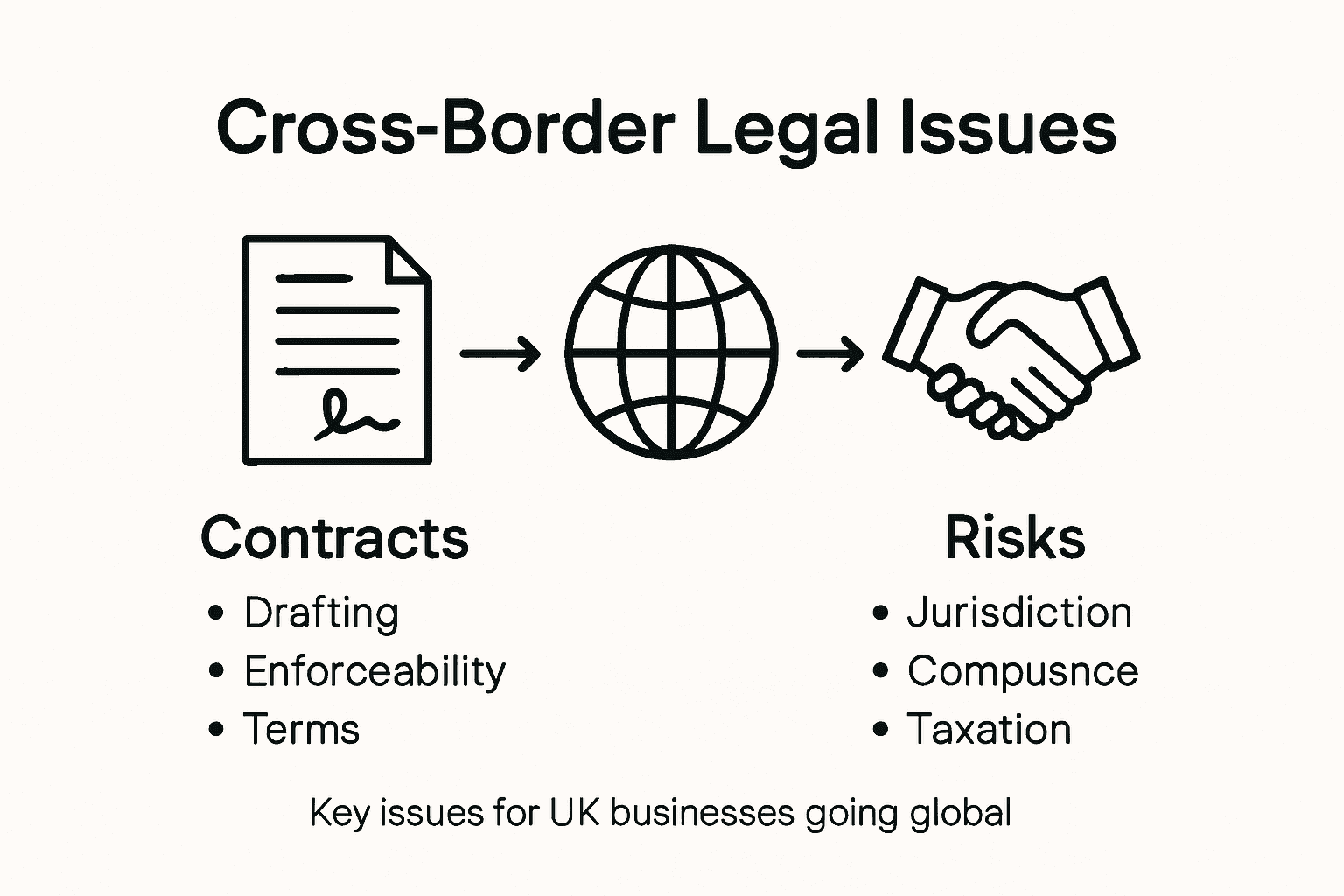
Understanding jurisdictional risks is paramount for UK enterprises expanding internationally. This involves comprehending potential legal conflicts, recognising differences in contract enforcement, and anticipating potential dispute resolution mechanisms. International business law guidance becomes essential in mitigating risks associated with regulatory compliance, employment laws, and potential litigation scenarios that could arise from cross-border business interactions.
Professional Tip: Invest in comprehensive legal due diligence and engage specialised international legal counsel who can provide nuanced insights into the specific regulatory landscape of your target markets.
International compliance represents a critical strategic capability for UK businesses operating across global markets. Navigating the intricate landscape of international regulations demands specialised legal expertise that goes far beyond basic legal understanding. Business regulation guidance highlights the complexity of maintaining legal conformity across different jurisdictional environments, encompassing areas such as product safety, border controls, and industry-specific regulatory requirements.

Comprehensive international compliance involves multiple sophisticated domains. Businesses must address critical areas including anti-money laundering protocols, data protection regulations, export control restrictions, and trade sanctions. Each of these domains requires deep understanding of both UK legal frameworks and international regulatory standards. Multinational corporations face particularly challenging compliance landscapes, where nuanced interpretations of legal requirements can mean the difference between successful international expansion and potentially devastating regulatory penalties.
Professional international lawyers bring transformative insights into regulatory compliance strategies. Professional compliance training programs underscore the complexity of managing international legal requirements, highlighting the need for specialised knowledge in risk management and regulatory adherence. These legal professionals help organisations develop robust compliance frameworks that not only meet current regulatory standards but also anticipate potential future regulatory shifts across different global jurisdictions.
Professional Tip: Conduct regular compliance audits with international legal experts to proactively identify and mitigate potential regulatory risks before they become significant operational challenges.
Resolving international legal disputes demands sophisticated strategic approaches that transcend traditional litigation methods. UK businesses engaging in global commerce must develop nuanced dispute resolution capabilities that address the complex challenges of cross-border legal interactions. Specialised cross-border dispute resolution training emphasises the critical importance of understanding substantive and procedural variations across different legal jurisdictions.
International dispute resolution encompasses multiple sophisticated mechanisms beyond conventional courtroom litigation. Arbitration emerges as a particularly effective strategy, offering businesses a neutral forum for resolving conflicts without being constrained by singular national legal systems. Mediation provides another strategic alternative, enabling parties to negotiate mutually acceptable resolutions with greater flexibility and potentially lower financial and reputational costs compared to protracted legal battles.
Successful cross-border dispute management requires comprehensive understanding of international legal frameworks. Professional international lawyers bring crucial expertise in navigating jurisdictional complexities, interpreting multinational legal standards, and developing strategic approaches tailored to specific cross-border contexts. These legal professionals help organisations anticipate potential disputes, design preemptive contractual protections, and implement robust mechanisms for efficient conflict resolution that minimise financial and operational disruptions.
Here is a summary of dispute resolution mechanisms available for cross-border legal matters:
| Mechanism | Key Benefit | Typical Use Case |
|---|---|---|
| Arbitration | Neutral and private process | International commercial disputes |
| Mediation | Flexible and collaborative | Preserving business relationships |
| Litigation | Enforceable national judgement | Where binding precedent is needed |
Professional Tip: Develop comprehensive international dispute resolution protocols that include clear jurisdiction clauses, alternative dispute resolution mechanisms, and predefined escalation procedures to mitigate potential legal uncertainties.
International legal expertise represents a complex strategic decision for UK businesses navigating global markets. The growing importance of in-house legal roles highlights the nuanced challenges organisations face when determining their legal support strategy. In-house teams offer immediate alignment with company objectives, providing consistent legal guidance closely integrated with internal business processes, while international experts bring specialised cross-jurisdictional knowledge that can transcend organisational boundaries.
In-house legal teams typically excel at understanding organisational culture and immediate business contexts. However, they frequently encounter significant limitations when addressing complex international legal challenges. Cross-border expansion introduces multifaceted regulatory complexities that may overwhelm internal legal resources, particularly when navigating diverse international legal frameworks, compliance requirements, and rapidly evolving regulatory environments.
International legal experts provide transformative capabilities that complement or extend in-house legal functions. These professionals bring deep, specialised knowledge of multiple legal systems, enabling businesses to develop sophisticated strategies for global market engagement. They offer flexible, scalable expertise that can be deployed precisely when needed, without the ongoing overhead associated with maintaining extensive in-house international legal capabilities. By providing nuanced insights into jurisdictional variations, international legal experts help organisations mitigate risks, ensure regulatory compliance, and develop robust cross-border legal strategies.
The following table contrasts in-house legal teams with international legal experts, outlining their strategic strengths and limitations for UK businesses:
| Attribute | In-House Legal Team | International Legal Experts |
|---|---|---|
| Organisational Alignment | Deep integration with business | External, objective perspective |
| Coverage of Legal Systems | Strong domestic expertise | Multi-jurisdictional expertise |
| Cost Model | Fixed overhead salary costs | Flexible, project-based fees |
| Response to Complex Global Issues | May lack specialisation | Advanced cross-border knowledge |
Professional Tip: Consider a hybrid approach that combines in-house legal knowledge with strategic international legal expertise to create a comprehensive, adaptable legal support framework.
Navigating the complexities of international law and cross-border transactions can feel overwhelming. UK businesses face critical challenges such as compliance risks, jurisdictional uncertainties and dispute resolution complications. Understanding terms like “public international law” and “cross-border dispute resolution” is essential to avoid costly setbacks and protect long-term growth. Ali Legal’s client-centred legal services provide clear advice and fixed fees to help you tackle these pain points with confidence and speed.
Explore our comprehensive insights in the Uncategorized | Ali Legal section and empower your business with strategic international legal expertise. Do not delay addressing these urgent legal challenges. Contact Ali Legal today through our dedicated page to receive straightforward, transparent counsel tailored to your global expansion needs. Trust Ali Legal to guide you through complex international legal frameworks and keep your business secure.
International lawyers provide expertise in navigating complex global legal landscapes, helping businesses address cross-border legal challenges, manage international compliance, and mitigate risks associated with operating in multiple jurisdictions.
International lawyers specialise in various critical areas such as international trade regulations, cross-border commercial disputes, treaty interpretations, and compliance with international legal standards, which are essential for businesses engaging in global commerce.
International lawyers employ sophisticated dispute resolution mechanisms such as arbitration and mediation, which allow businesses to address conflicts internationally without being limited by a single national legal system, thus minimising financial and operational disruptions.
In-house legal teams offer deep integration with a business’s operations, while international legal experts bring specialised knowledge of multiple legal systems, providing flexible, scalable expertise that can enhance a business’s ability to navigate complex international legal challenges.
Nearly one in three British high-net-worth individuals report confusion when approaching estate planning or family law consultations. Navigating complex legal frameworks in the United Kingdom can be daunting, especially when privacy and clarity are paramount. This overview breaks down what defines a legal consultation, highlighting what to expect, fee transparency, and the critical confidentiality protections that matter most to those seeking trustworthy, professional guidance.
A legal consultation represents a strategic meeting between a client and a legal professional designed to provide expert guidance, assess legal challenges, and develop tailored solutions. In the United Kingdom, this process involves a comprehensive review of an individual’s or organisation’s specific legal circumstances, enabling clear communication and informed decision-making.
Legal consultations typically encompass several critical components. These include an initial assessment of the client’s situation, identification of potential legal implications, exploration of available strategies, and professional recommendations. Solicitors approach these meetings with a structured methodology, carefully listening to client concerns while offering objective professional insights. The consultation serves as an essential first step in understanding complex legal landscapes and determining appropriate courses of action.
The scope of legal consultations can vary significantly depending on the specific area of law. Whether addressing employment disputes, property transactions, family law matters, or corporate challenges, each consultation requires a nuanced approach. Professionals aim to provide clarity, establish realistic expectations, and outline potential legal pathways. By offering transparent advice and professional expertise, solicitors help clients navigate intricate legal frameworks with confidence and precision.
Professional Tip: Always prepare comprehensive documentation and a clear list of questions before your legal consultation to maximise the effectiveness of your meeting and ensure you address all critical concerns.
Legal consultations in the United Kingdom encompass a diverse range of specialised services designed to address complex legal challenges across various domains. Different consultation types reflect the nuanced approach to legal problem-solving, ensuring clients receive targeted and comprehensive professional guidance.
Typical categories of legal consultations include:
Each consultation type requires a specialised approach, with solicitors adapting their methodology to meet specific client needs. Professionals carefully analyse individual circumstances, providing tailored advice that balances legal requirements with practical considerations. The goal remains consistent: empowering clients with clear, actionable insights that support informed decision-making and effective legal resolution.
Here is a summary of legal consultation types and their primary purpose:
| Consultation Type | Typical Purpose | Common Client Profile |
|---|---|---|
| Personal Legal | Resolve individual legal issues | Private individuals |
| Business Legal | Address commercial legal matters | Companies and organisations |
| Litigation Preparation | Prepare for court proceedings | Individuals or businesses |
| Regulatory Compliance | Ensure adherence to regulations | Regulated organisations |
Professional Tip: Research and select a solicitor with demonstrated expertise in your specific legal domain to ensure the most relevant and precise consultation possible.
A legal consultation represents a structured professional interaction designed to provide comprehensive insights into your specific legal situation. The initial meeting typically unfolds through a carefully planned sequence of professional interactions, enabling both the client and solicitor to establish a clear understanding of the legal challenges at hand.
During the consultation, clients can anticipate the following key components:
The consultation process requires active participation from both parties. Clients should prepare comprehensive documentation, articulate their concerns precisely, and be prepared to discuss sensitive or complex details openly. Solicitors, meanwhile, will listen attentively, ask clarifying questions, and provide objective professional guidance tailored to the individual’s unique circumstances.

Professional Tip: Bring all relevant documentation, prepare a concise summary of your legal issue, and compile a list of specific questions to maximise the efficiency and effectiveness of your consultation.
Legal fee transparency remains a critical aspect of professional legal services, ensuring clients understand financial commitments before engaging legal support. Solicitors in the United Kingdom are professionally obligated to provide clear, upfront information about potential costs, enabling clients to make informed decisions about their legal representation.
Common fee structures in legal consultations include:
Professional solicitors will typically provide a detailed breakdown of potential expenses during the initial consultation. This documentation should outline exact charges, potential additional costs, and payment expectations. Clients should feel empowered to discuss financial arrangements openly, asking detailed questions about billing methods, potential disbursements, and any potential variables that might impact the overall legal fees.
Compare how different legal fee structures affect budgeting and predictability:
| Fee Structure | Cost Predictability | Suitability For |
|---|---|---|
| Fixed Fee | High | Routine, defined matters |
| Hourly Rate | Variable | Complex or ongoing cases |
| Conditional (‘No win, no fee’) | Low risk upfront | Personal injury claims |
| Retainer | Ongoing budget control | Continuous legal support |
Professional Tip: Request a comprehensive written quote detailing all potential costs and ask about alternative fee arrangements to ensure financial clarity before proceeding with legal services.
Professional legal confidentiality represents a fundamental cornerstone of the solicitor-client relationship, ensuring complete protection of sensitive personal and legal information. This principle guarantees that all communications between clients and their legal representatives remain strictly private, creating a safe environment for open and honest dialogue.
Clients possess several critical rights during legal consultations:
Legal professionals are bound by stringent ethical and professional obligations that extend far beyond the immediate consultation. These responsibilities include maintaining absolute discretion, protecting client data through secure systems, and ensuring that confidential information is never disclosed without explicit consent. The legal framework surrounding client confidentiality is robust, with potential disciplinary actions for professionals who breach these fundamental trust principles.
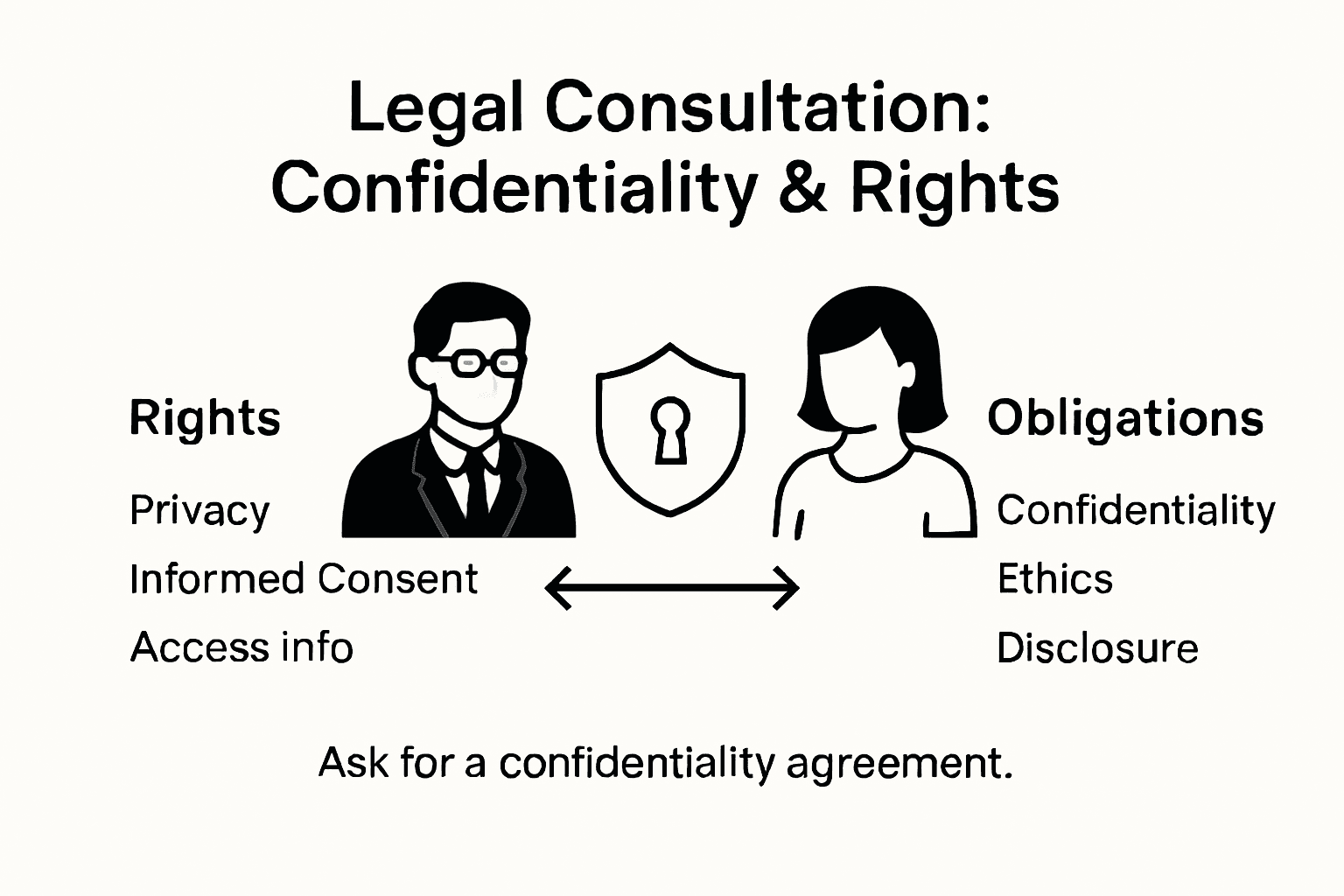
Professional Tip: Always request a formal confidentiality agreement and understand your rights to information privacy before discussing sensitive legal matters with any professional.
Navigating UK legal challenges often feels overwhelming when facing complex terminology, unclear strategies, and uncertain fee structures. Whether you require help with personal legal matters or business issues, Ali Legal understands your need for transparent communication and straightforward advice. Our approach addresses your core concerns by offering fixed fees, precise guidance, and a commitment to long-term client relationships that build trust and deliver clear solutions.
Explore more insights on legal consultation through our All | Ali Legal section where we simplify legal concepts for you.
Take the next step with confidence today. Contact Ali Legal for a professional legal consultation tailored to your unique situation. Benefit from strategic advice delivered quickly and transparently by experts dedicated to your success. Reach out now via our Contact Us page and start resolving your legal issues with clarity and certainty. For more relevant information, visit our Uncategorized | Ali Legal page.
A legal consultation is a structured meeting between a client and a legal professional that provides expert guidance, assesses legal challenges, and develops tailored solutions based on the client’s specific circumstances.
Legal consultations can be categorised into personal legal consultations, business legal consultations, litigation preparation consultations, and regulatory compliance consultations, each tailored to address specific legal needs.
During a legal consultation, you can expect an initial assessment of your circumstances, detailed questioning about your legal issue, professional evaluation of potential strategies, and transparent communication about potential outcomes and next steps.
Legal consultation fees can be structured as fixed fees, hourly rates, conditional fee agreements (no win, no fee), or retainer agreements, with each structure offering varying levels of predictability and suitability for different legal matters.
Legal disputes can drain resources and disrupt the momentum of any British small business. With over 65 percent of UK business owners reporting that traditional litigation is too slow and costly, finding alternatives is crucial for survival and growth. Exploring modern conflict resolution methods empowers British entrepreneurs to resolve issues efficiently, preserve valuable relationships, and avoid the financial strain of prolonged court cases.
For small businesses seeking an efficient dispute resolution method, mediation offers a powerful alternative to costly litigation. Civil mediation provides a flexible, confidential pathway for resolving conflicts without the stress and expense of traditional court proceedings.
Mediation works by introducing an impartial third party who facilitates constructive dialogue between disputing parties. Unlike court judgments, this process empowers participants to craft their own mutually acceptable solutions. The mediator does not impose decisions but guides conversations, helping businesses explore creative compromises that preserve professional relationships.
Small business owners can leverage mediation in various scenarios such as contract disputes, partnership disagreements, or workplace conflicts. The process typically involves joint sessions and private consultations, allowing each party to express concerns candidly while working towards resolution. Because mediation is voluntary, both sides remain in control of the outcome.
The financial benefits are significant. Civil mediation research indicates that mediated disputes often cost substantially less than court litigation and can be resolved much faster typically within weeks rather than months or years. Many businesses report saving thousands of pounds in legal fees and reducing organisational stress.
Expert Tip: Schedule an initial consultation with a professional mediator to understand how the process could specifically benefit your business dispute before committing to lengthy legal proceedings.
Arbitration provides small businesses with a strategic alternative to traditional court litigation, offering a faster and more confidential method of resolving commercial disputes. This private resolution process empowers businesses to address conflicts efficiently while maintaining professional relationships.
Under arbitration, both parties agree to appoint an independent arbitrator who will hear their case and deliver a legally binding decision. Unlike court proceedings, arbitration offers businesses greater flexibility in dispute resolution, allowing them to select an expert with specific industry knowledge who understands the nuanced challenges of their sector.
The process typically involves written submissions, document exchanges, and potentially oral hearings where each party presents their perspective. Arbitrators can make decisions based on commercial practicalities rather than strict legal technicalities, which often results in more pragmatic outcomes for businesses. Most importantly, arbitration proceedings remain private, protecting companies from potential reputational damage associated with public court battles.
Businesses can benefit from arbitration across various scenarios including contract disputes, partnership disagreements, and commercial conflicts. The Centre for Effective Dispute Resolution highlights that arbitration can be significantly faster and more cost-effective than traditional litigation, with most cases resolving within months rather than years.
Expert Tip: Select an arbitrator with specific expertise in your industry and negotiate clear terms of reference to ensure the most efficient and targeted dispute resolution process.
Negotiation represents the most straightforward approach for small businesses seeking to resolve disputes quickly and effectively. This direct communication strategy allows parties to address conflicts collaboratively without involving expensive legal procedures.
Negotiation is fundamentally about finding mutually acceptable solutions through open and honest dialogue. Unlike more formal dispute resolution methods, negotiation empowers businesses to maintain control over the outcome while preserving professional relationships. The process typically involves direct conversations where each party articulates their concerns, explores potential compromises, and works towards a shared understanding.
Successful negotiation requires careful preparation and strategic communication. Businesses should approach discussions with clear objectives, a comprehensive understanding of their position, and a willingness to listen and adapt. The UK legal framework actively encourages negotiation as a primary dispute resolution method, recognising its potential to prevent costly and time consuming legal proceedings.
Practical implementation involves setting clear communication parameters, documenting discussions, and being prepared to make reasonable concessions. Small business owners should focus on understanding the underlying interests of all parties rather than becoming entrenched in rigid positions. This approach increases the likelihood of reaching a satisfactory resolution that addresses the core concerns of everyone involved.
Expert Tip: Prepare a structured negotiation strategy beforehand, including your key objectives, potential compromise points, and a clear understanding of your bottom line.
Early Neutral Evaluation offers small businesses a strategic opportunity to gain objective insights into potential disputes before they escalate. This innovative approach provides a professional assessment that can prevent costly and time consuming litigation.
Early Neutral Evaluation is a confidential process where an independent expert reviews the dispute and provides an impartial assessment of its strengths and weaknesses. Unlike traditional legal proceedings, this method focuses on understanding the core issues and potential outcomes quickly and efficiently.
The evaluation typically involves both parties presenting their perspectives to a neutral expert who has significant experience in the relevant industry or legal domain. This approach helps businesses gain a realistic view of their dispute and understand potential risks and opportunities for resolution. The neutral evaluator provides an informed perspective that can help parties make more strategic decisions about how to proceed.
Small business owners can benefit from Early Neutral Evaluation by obtaining a professional assessment that illuminates potential legal challenges, identifies potential settlement opportunities, and provides a clear roadmap for potential resolution. The process is particularly valuable in complex commercial disputes where technical expertise or industry specific knowledge is crucial to understanding the nuanced aspects of the conflict.
Expert Tip: Prepare comprehensive documentation and be prepared to present a clear, concise narrative of your dispute to maximise the value of the early neutral evaluation process.
Expert Determination provides small businesses with a powerful mechanism for resolving complex technical disputes efficiently and definitively. This specialised alternative dispute resolution method offers a targeted approach for addressing intricate professional disagreements.
Expert Determination is designed to provide rapid resolution by appointing an independent expert with specific technical knowledge relevant to the dispute. Unlike traditional litigation, this approach allows businesses to access specialist insight that can quickly cut through complicated technical arguments.
The process involves selecting an expert with demonstrable expertise in the specific field of dispute who will review evidence, examine technical details, and render a binding decision. This alternative dispute resolution method offers businesses a confidential and expedited path to resolution that can be significantly faster and more cost effective than pursuing court proceedings.
Typical scenarios where Expert Determination proves valuable include construction contract disagreements, engineering specification disputes, property valuation conflicts, and technical performance assessment challenges. Small business owners benefit from obtaining a definitive resolution from a genuine expert who understands the nuanced technical dimensions of their specific issue.
Expert Tip: Carefully document all technical specifications and gather comprehensive evidence before initiating the expert determination process to support a clear and compelling presentation of your dispute.
Collaborative Law represents a revolutionary approach to dispute resolution that prioritises mutual problem solving and preserving professional relationships. Unlike traditional adversarial legal processes, this method transforms conflict resolution into a cooperative negotiation.
Resolving business disputes through collaborative strategies involves both parties committing to finding solutions without resorting to court proceedings. Each participant retains their own solicitor trained specifically in collaborative law techniques, but everyone agrees to work transparently towards a mutually beneficial outcome.
The process typically involves structured negotiation meetings where all parties and their legal representatives commit to open communication. Participants sign a formal agreement stipulating that if negotiations fail, both solicitors must withdraw and the parties will need to seek alternative representation. This unique approach creates a powerful incentive for genuine collaboration and creative problem solving.
Collaborative Law proves especially effective for small businesses facing complex disputes where maintaining ongoing relationships matters more than winning at all costs. The method allows for more nuanced solutions that traditional litigation cannot provide, enabling businesses to address underlying issues while protecting their long term professional interests.
Expert Tip: Select a solicitor specifically trained in collaborative law techniques and prepare a clear list of your core objectives before entering negotiations.
Settlement agreements represent the ultimate strategic tool for small businesses seeking to resolve conflicts swiftly and definitively. These legally binding documents offer a comprehensive pathway to ending disputes without protracted legal proceedings.
A settlement agreement functions as a formal contract that outlines the precise terms under which conflicting parties will resolve their differences. Resolving contract disputes efficiently requires careful negotiation and clear documentation of all agreed terms, ensuring both parties understand their obligations and potential consequences.
The process involves detailed discussions where each party identifies their core interests and works towards a mutually acceptable resolution. Unlike court judgments, settlement agreements allow businesses to craft bespoke solutions that address specific commercial needs. These agreements can cover a wide range of issues including financial compensation, future business interactions, confidentiality provisions, and specific performance requirements.
Small business owners benefit from settlement agreements by avoiding lengthy and expensive litigation, maintaining professional relationships, and gaining certainty about dispute outcomes. The agreements provide a clean break from conflict while preserving each party’s commercial reputation and minimising potential financial and emotional stress associated with prolonged legal battles.
Expert Tip: Engage a solicitor to review your settlement agreement draft to ensure all legal nuances are correctly captured and your business interests are comprehensively protected.
Below is a comprehensive table summarising key alternative dispute resolution methods discussed in the article for small businesses.
| Method | Description | Benefits |
|---|---|---|
| Mediation | Utilises an impartial facilitator to help disputing parties craft solutions. | Cost-effective, preserves relationships. |
| Arbitration | Involves appointment of a knowledgeable arbitrator to render binding decisions. | Fast resolution, confidentiality. |
| Negotiation | Direct dialogue between parties focused on reaching mutual agreements. | Simplifies process, retains party control. |
| Early Neutral Evaluation | Independent expert provides objective assessment of the dispute’s strengths. | Offers strategic insights and guidance. |
| Expert Determination | An expert adjudicates complex technical disagreements definitively. | Rapid and authoritative resolutions. |
| Collaborative Law | Solicitor-assisted cooperative negotiations to tackle disputes transparently. | Promotes transparency, preserves relations. |
| Settlement Agreements | Formal agreements outlining terms of resolution signed by all parties involved. | Ensures clarity and prevent future disputes. |
Navigating disputes without the heavy burdens of court litigation can transform the future of your small business. This article highlights practical and cost-effective alternatives such as mediation, arbitration, and collaborative law that help protect your professional relationships while resolving conflicts swiftly. If you want clarity on these options and how they can be tailored to your specific challenges, Ali Legal’s expertise offers the transparent and strategic guidance you need.
Explore our Uncategorized | Ali Legal resources to deepen your understanding of dispute resolution methods. When you are ready to take control of your dispute resolution strategy, contact us directly at Ali Legal Contact. Act now to secure fixed fee advice and a clear, efficient path forward that safeguards your business interests and reduces stress.
Mediation provides a confidential and cost-effective way for small businesses to resolve disputes. Engage a professional mediator early in the process to help facilitate constructive discussions, which can often lead to resolutions within weeks rather than months.
Arbitration is typically faster and more private than traditional litigation, offering businesses a flexible way to resolve disputes through an appointed arbitrator. Consider initiating arbitration to prevent lengthy court battles and aim for a resolution within a few months.
Yes, negotiation allows you to maintain control over the outcome without involving legal proceedings. Prepare a structured negotiation plan and aim to reach an agreement that addresses your core interests and those of the other party before any formal disputes escalate.
A settlement agreement should detail the terms of the resolution, such as financial compensation and any future obligations. Draft a clear document that outlines each party’s responsibilities to ensure the agreement is comprehensive and effective in avoiding further conflict.
Consider Early Neutral Evaluation if your dispute is complex and could benefit from an impartial expert’s insight before escalation. Request an evaluation early in the process to gain a clearer understanding of potential outcomes and settlement opportunities, which can save time and resources.
More than 60 percent of British small and medium-sized businesses encounter contract disputes within their first three years of trading. Entering the world of commercial contracts can feel daunting if you are a new business owner, yet clarity at each stage is vital to build strong supplier and client relationships. This guide breaks down every contract management step, so you can approach agreements with confidence and protect your British business from unnecessary risks.
Successfully navigating commercial contracts begins with thoroughly understanding your business needs and aligning contract terms precisely with your strategic objectives. This critical first step ensures you protect your interests while creating a robust framework for your commercial relationships.
Start by conducting a comprehensive internal review of your business goals, operational constraints, and potential risks. Contract management principles outlined by the UK government emphasise the importance of strategic oversight and clear accountability. Your assessment should cover financial implications, performance expectations, delivery timelines, and potential contingencies that might impact your business operations.
During this process, scrutinise every contractual element through the lens of your specific business requirements. The UK Small Business Commissioner advises businesses to meticulously define roles, risks, and expected outcomes to prevent future misunderstandings. Pay particular attention to payment terms, dispute resolution mechanisms, and performance indicators that will objectively measure contract success.
Business Insight: Invest time upfront mapping your exact business requirements to prevent costly contract revisions later.
Here is a comparison of proactive versus reactive contract management approaches:
| Approach | Typical Actions | Long-Term Results |
|---|---|---|
| Proactive | Early review, risk analysis | Fewer disputes, cost savings |
| Reactive | Address issues as they arise | Increased risk, possible delays |
Gathering comprehensive documentation is a critical phase in preparing for commercial contract negotiations. This step involves systematically collecting and organizing all necessary materials that will support your contractual objectives and provide a robust foundation for your business agreement.

The Local Government Association emphasises the importance of defining and documenting business requirements by engaging with key stakeholders and thoroughly analyzing relevant data. Begin by compiling essential documents such as business plans, financial statements, previous contract records, operational guidelines, and performance metrics. Ensure you include detailed information about your company’s current capabilities, anticipated growth trajectories, and specific operational constraints that might impact contract terms.
Proceed methodically through your documentation gathering process. The UK Government Project Delivery guide recommends early identification and precise documentation of procurement needs to support effective contract management. Create a comprehensive checklist of required documents, which might include tax records, registration certificates, compliance documentation, intellectual property details, and any previous contractual agreements that could inform your current negotiations.
Strategic Recommendation: Create a dedicated digital folder with all relevant documentation to ensure quick and organised access during contract discussions.
Crafting precise and thorough contract terms forms the cornerstone of successful business agreements. This critical stage requires meticulous attention to detail to ensure your commercial interests are comprehensively protected and all potential scenarios are anticipated.
UK Business Advisors recommend a systematic approach to contract drafting that involves collaborative review and comprehensive risk assessment. Begin by clearly defining the scope of work, specifying exact deliverables, performance metrics, payment structures, and timelines. Each clause should be unambiguous, leaving no room for misinterpretation. Address potential contingencies such as breach scenarios, termination conditions, dispute resolution mechanisms, and intellectual property protections.
Ensure your contract language is both precise and adaptable. Use clear, straightforward terminology that avoids legal jargon while still maintaining legal rigour. Include specific performance indicators, key milestone definitions, and explicit expectations for both parties. Consider potential future scenarios and build in flexibility through carefully worded provisions that allow for reasonable adjustments without compromising the core agreement.
Strategic Insight: Have an independent legal professional review your draft to identify potential ambiguities or overlooked risks before finalising the contract.
Ensuring legal compliance and minimising potential risks represents a critical phase in contract management that demands meticulous attention and strategic thinking. Your comprehensive review will serve as a protective shield for your business interests and prevent potential future complications.
Regulatory compliance requires a systematic approach to identifying and addressing potential legal vulnerabilities across multiple dimensions of your commercial agreement. Begin by conducting a detailed line by line examination of your draft contract, scrutinising each clause for potential legal ambiguities, unintended consequences, or regulatory inconsistencies. Pay particular attention to areas such as intellectual property rights, liability limitations, confidentiality provisions, termination conditions, and dispute resolution mechanisms.
Focus on verifying that your contract aligns with current UK legal standards and industry specific regulations. Cross reference your draft against relevant legislation, sector specific guidelines, and best practice frameworks. Consider potential scenarios that might expose your business to financial or legal risks, and ensure your contract includes robust protective clauses that mitigate these potential challenges. Consulting with a legal professional can provide an additional layer of scrutiny and help identify nuanced risks that might not be immediately apparent.
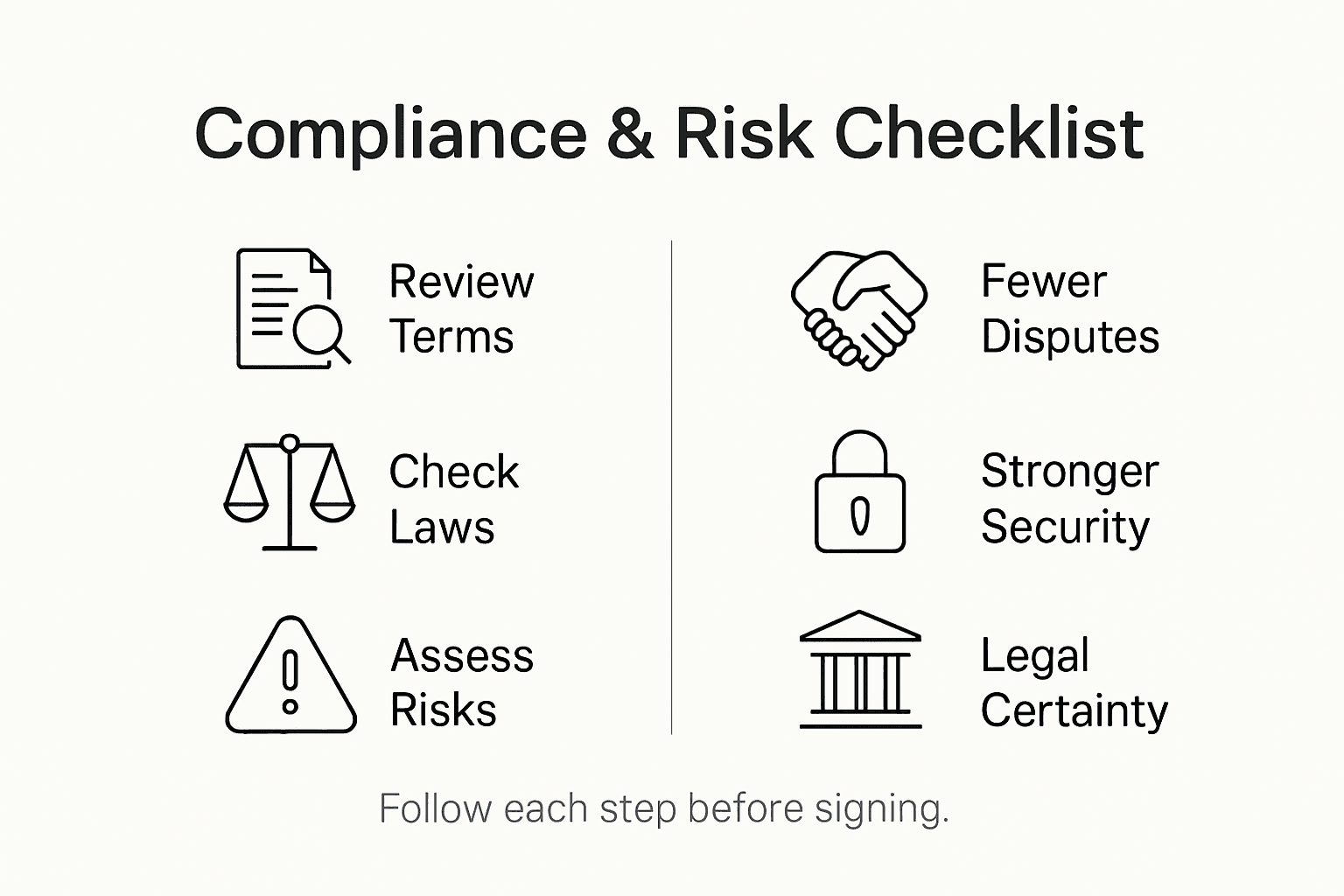
Strategic Safeguard: Create a comprehensive risk assessment checklist to systematically evaluate each contract clause against potential legal and operational vulnerabilities.
The final verification stage represents your ultimate opportunity to safeguard your business interests and ensure complete contractual precision. This critical review demands a methodical and comprehensive approach to eliminate any potential errors or misunderstandings that could compromise your agreement.
Audits and governance protocols demand meticulous examination of contractual documentation to prevent future legal complications. Initiate a systematic cross reference process by comparing the draft contract against your original business requirements, meeting notes, preliminary discussions, and negotiation outcomes. Verify that every agreed term is accurately reflected with precise language that leaves no room for misinterpretation. Check numerical details such as payment amounts, percentages, timelines, and quantifiable deliverables with extreme precision.
Adopt a forensic approach to your final review. Read each clause multiple times from different perspectives. Consider how each provision might be interpreted by a third party or potentially challenged in a legal setting. Confirm that all party names are spelled correctly, contact details are current, and legal entity information is accurate. Validate that all appendices, schedules, and supporting documents are included and consistent with the main contract text. Where complex technical or financial terms are involved, consider having specialist professionals review those specific sections to ensure absolute accuracy.
Strategic Verification: Create a systematic checklist with multiple review passes to catch subtle discrepancies that might escape initial scrutiny.
The following table summarises each stage of commercial contract management and its business impact:
| Stage | Main Focus | Key Business Impact |
|---|---|---|
| Assess Requirements | Align contract with strategy | Prevents future disputes |
| Gather Documentation | Compile essential records | Supports strong negotiation position |
| Draft Contract Terms | Specify deliverables and risks | Safeguards interests |
| Review Compliance & Risk | Ensure legal and regulatory fitness | Minimises liability exposure |
| Verify Before Signing | Check accuracy and completeness | Avoids costly errors |
Navigating the complex landscape of commercial contracts can feel overwhelming, especially when aligning detailed contract terms with your business objectives and managing risks. This article highlights key challenges such as drafting clear contract terms, ensuring legal compliance, and verifying accuracy before signing. At Ali Legal, we understand these pain points and are committed to offering transparent, fast, and strategic legal solutions to safeguard your business interests.
Discover practical advice and real case insights in our Uncategorized | Ali Legal articles that complement your contract management journey.
Ready to protect your business with expertly tailored contracts? Contact Ali Legal today for fixed fee, straightforward advice and build a lasting partnership with solicitors who prioritise your success. Begin your journey now by visiting our contact page or explore more essential legal insights in the All | Ali Legal section.
Before drafting a commercial contract, evaluate your business needs, operational constraints, and potential risks. Conduct an internal review of your goals and ensure the contract aligns with your strategic objectives, aiming to identify financial implications and performance expectations.
Gather all essential documents, including business plans, financial statements, and previous contracts, to support your negotiations. Create a checklist of necessary materials to ensure nothing is overlooked, allowing for a thorough assessment of your current capabilities.
Draft clear terms that define the scope of work, performance metrics, and payment structures. Use precise language, addressing contingencies such as breach scenarios and dispute resolution, ensuring that both parties have a mutual understanding of expectations.
Conduct a detailed review of your draft contract to identify any legal ambiguities or regulatory inconsistencies. Focus on areas such as liability limitations and confidentiality provisions, and consider consulting a legal professional for an expert opinion to safeguard your interests.
Conduct a comprehensive final review, cross-referencing the contract against your original requirements and negotiation notes. Validate all details, such as payment amounts and timelines, and create a checklist to systematically examine every clause for potential discrepancies.


