
Hiring international talent or managing sponsored employees in the United Kingdom can feel like a maze for even the most experienced employers. With changing regulations and strict government requirements, keeping your business compliant is rarely straightforward. A single misstep could mean costly legal trouble and operational disruption.
This practical guide lays out the key steps every UK company needs to confidently manage immigration compliance. From choosing the right visa to keeping up with essential record-keeping and right to work checks, you will learn actionable solutions that protect your organisation and support your international staff.
Get ready to discover clear, hands-on strategies that make complicated immigration rules much easier to handle. Stay ahead of regulatory demands and turn complex requirements into manageable steps for your business.
Navigating the United Kingdom’s immigration landscape requires a comprehensive understanding of the various visa categories available for international workers. Companies must be well-versed in the nuanced requirements to successfully recruit and retain global talent.
The UK offers several critical visa categories that businesses frequently utilise:
Understanding these categories is crucial because each visa type has specific eligibility criteria, application processes, and sponsorship requirements. Official UK government visa guidance provides comprehensive details on these intricate regulations.
Companies must develop a strategic approach to immigration compliance. This involves:
Successful immigration management requires proactive planning and meticulous attention to regulatory details.
Pro tip: Establish a dedicated immigration compliance team or consultant to streamline visa application processes and minimise potential legal complications.
Legal compliance begins with meticulous right to work checks. These critical verifications protect your organisation from potential legal penalties and ensure you are employing individuals with legitimate working permissions in the United Kingdom.
Employers must systematically validate an employee’s legal right to work through comprehensive document verification. Official UK government guidelines outline the precise procedures for conducting these essential checks.
Key elements of accurate right to work verification include:
The verification process involves several critical steps:
Employers bear full legal responsibility for ensuring workers have appropriate permissions to work in the United Kingdom.
Discrimination must be absolutely avoided during these checks. Every candidate must be treated equally regardless of nationality ethnic background or perceived immigration status.
Pro tip: Implement a standardised digital tracking system to manage right to work documentation and set automatic reminders for follow-up checks on time-limited visas.
Effective immigration compliance hinges on maintaining meticulous and organised employee documentation. Your record-keeping practices serve as the critical foundation for demonstrating legal adherence and protecting your organisation from potential regulatory challenges.
Sponsor record-keeping guidelines outline the comprehensive documentation requirements for UK employers. These records are not merely administrative tasks but essential legal safeguards.
Critical documents that must be systematically maintained include:
Key principles for effective record management:
Comprehensive record-keeping is your organisational shield against potential immigration compliance investigations.
Employers must ensure that electronic and physical records are equally robust. This means implementing secure digital storage solutions with appropriate encryption and backup mechanisms.
The retention period for these documents typically spans the entire employment duration plus a recommended additional two years after an employee’s departure.
Pro tip: Develop a standardised digital record management system with automated reminder alerts for document renewals and periodic compliance reviews.
Sponsorship in UK immigration is not a static responsibility but a dynamic commitment that requires constant vigilance and proactive management. Companies must remain agile and informed to maintain their sponsor licence effectively.
Sponsorship guidance for employers provides comprehensive insights into the evolving landscape of immigration compliance.
Key sponsorship duties encompass:
Critical reporting requirements include:
Sponsorship compliance is an ongoing process that demands continuous attention and meticulous documentation.
The consequences of non-compliance can be severe. Your organisation could face licence suspension or revocation if you fail to meet these stringent requirements.
Regular training for HR personnel and establishing robust internal monitoring systems are essential strategies for maintaining sponsorship obligations.
Pro tip: Implement a quarterly compliance review process with automated tracking systems to ensure no sponsorship reporting deadlines are missed.
Visa management is a critical responsibility that demands proactive and systematic tracking to prevent potential legal complications for your organisation. Failing to monitor critical immigration dates can result in unintended breaches of sponsorship obligations.
HR software solutions play a pivotal role in streamlining visa tracking and management processes.
Critical aspects of effective visa monitoring include:
Recommended monitoring strategies:
Consistent and meticulous visa tracking is the foundation of robust immigration compliance management.
Potential risks of inadequate monitoring include unexpected workforce disruptions unexpected legal penalties and potential damage to your organisation’s reputation.
Additionally companies must establish clear communication channels with sponsored employees to ensure timely information exchange about visa status and renewal requirements.
Pro tip: Develop a standardised visa monitoring workflow with automated digital alerts and assign a dedicated team member to oversee immigration document management.
Effective communication is the cornerstone of successful immigration compliance in modern workplaces. Understanding and transparently sharing immigration requirements helps create a supportive environment for international workers.
Employee communication strategies play a crucial role in maintaining organisational transparency and legal adherence.
Key communication principles include:
Practical communication approaches:
Transparent communication transforms complex immigration requirements into understandable processes for employees.
Effective communication techniques involve using multiple communication channels such as email newsletters team meetings individual consultations and digital resource platforms.
Employers must recognise that clear communication reduces anxiety builds trust and ensures smoother navigation of immigration complexities for sponsored workers.
Pro tip: Develop a centralised digital resource hub with regularly updated immigration guidance and create a dedicated point of contact for immigration-related queries.
Navigation of UK immigration law requires specialised knowledge that extends beyond general understanding. Complex regulatory landscapes demand professional guidance to mitigate potential legal risks and ensure comprehensive compliance.
Registered immigration adviser resources provide critical support for companies managing international workforce challenges.
Key reasons to seek expert legal advice include:
Strategic consultation approaches:
Professional legal guidance transforms potential immigration challenges into manageable strategic opportunities.
Qualified legal professionals can provide nuanced insights that internal teams might overlook. These specialists understand the intricate details of immigration regulations and can offer tailored advice specific to your organisational context.
Careful selection of independent legal advice ensures objective and comprehensive support for your immigration compliance strategies.
Pro tip: Establish a retainer relationship with an immigration law specialist to ensure immediate access to expert guidance when complex scenarios arise.
Below is a comprehensive table summarising the main points, strategies, and actions for managing immigration compliance as discussed in the article.
| Key Aspect | Description | Practical Steps |
|---|---|---|
| Key Visa Categories | Summary of visa types for employment in the UK including Skilled Worker and Global Talent visas. | Match candidates’ profiles to respective visa requirements; review the Home Office guidelines. |
| Right to Work Compliance | Importance of verifying employees’ right to work in the UK. | Inspect original documents prior to employment; store records securely; avoid discrimination. |
| Record-Keeping for Immigration | Importance and method of maintaining employee records for compliance. | Digitise documents, employ proper filing systems, monitor visa statuses actively, and update as needed. |
| Sponsorship Duties | Employer responsibilities for maintaining sponsor licences. | Track employee statuses, report changes within required timelines, maintain accurate records. |
| Visa Monitoring and Renewals | Process of tracking visa expiry and renewal dates effectively. | Use automated reminders; engage with employees timely; monitor policy changes. |
| Staff Communication | Facilitating clear communication about immigration matters. | Host briefings, provide written guides, and maintain supportive and open dialogue opportunities. |
| Expert Legal Consultation | Seeking professional legal advice for complex or high-stakes situations. | Retain experienced legal advisers, perform regular compliance checks, and document consultation outcomes. |
Implementing these strategies ensures robust immigration compliance management while minimising potential risks.
Struggling with complex immigration rules like sponsorship obligations or visa monitoring can put your business at risk. This article highlights vital challenges such as maintaining comprehensive employee records, conducting right to work checks accurately and staying updated with sponsorship duties. Understanding these key areas is the first step to protecting your organisation from costly legal consequences.
At Ali Legal, we provide clear legal guidance tailored to these specific immigration compliance needs. Our client-centred approach emphasises straightforward advice and transparency to help you navigate the UK’s immigration landscape with confidence. Whether you require assistance with visa categories, legal compliance reviews or staff communication strategies, our team is ready to support your business every step of the way.
Discover how our expert legal services can remove uncertainty from your immigration process in our Uncategorized | Ali Legal section.

Take action now to safeguard your company against immigration pitfalls. Contact Ali Legal today for professional advice and fast, transparent legal solutions at https://alilegal.co.uk/contact-us. Ensure your organisation stays fully compliant and focused on growth.
Understanding the key visa categories such as the Skilled Worker Visa, Global Talent Visa, and Health and Care Worker Visa is essential for companies recruiting international talent. Review each category’s specific requirements and ensure your team’s familiarity with them to streamline the hiring process.
To conduct accurate right to work checks, thoroughly examine original documentation and verify their authenticity before employment begins. Establish a standardised process for document verification to ensure compliance and reduce the risk of penalties.
Maintain comprehensive records including original right to work documents, visa copies, and employment contracts. Use a consistent filing system and update records regularly to safeguard your organisation against potential compliance investigations.
To stay updated with sponsorship duties, implement a quarterly review process to ensure compliance with reporting obligations to the Home Office. Set up automated reminders for key deadlines to maintain your sponsor licence effectively.
Create a centralised tracking system to monitor visa expirations and set calendar reminders for renewal six months in advance. Regularly communicate with employees about their visa status to ensure timely preparation for renewals.
Seek expert legal advice when dealing with complex immigration cases, significant policy changes, or potential compliance issues. Establish relationships with professional advisers to have immediate access to guidance and mitigate legal risks.
Legal disputes and regulatory investigations can quickly disrupt business operations in the United Kingdom, leaving owners uncertain about what should remain confidential. For many, understanding the scope of legal professional privilege is the difference between protecting sensitive strategy and risking unwanted disclosure. This overview unpacks the principles, common pitfalls, and practical protections that help British businesses safeguard their legal communications and defend their corporate interests.
Legal professional privilege (LPP) represents a fundamental legal protection that safeguards confidential communications between businesses and their legal advisers. This critical legal concept ensures that organisations can seek candid legal guidance without risking subsequent disclosure of sensitive information. Legal professional privilege principles protect the confidentiality of communications in both corporate and legal contexts.
In the United Kingdom, LPP is divided into two primary categories: legal advice privilege (LAP) and litigation privilege (LP). Legal advice privilege covers communications between a lawyer and client specifically aimed at obtaining or providing legal counsel. This protection extends to in-house legal teams, ensuring that internal legal discussions remain confidential. Litigation privilege offers broader protection, encompassing communications created for the dominant purpose of contemplating or conducting legal proceedings.
Businesses must understand the nuanced requirements for maintaining legal professional privilege. Key considerations include:
Legal privilege serves as a critical mechanism for protecting businesses’ strategic interests. Compliance with UK legal principles ensures that organisations can candidly discuss legal matters without fear of mandatory disclosure.
Pro Tip: Always consult with a qualified legal professional to confirm the specific applications of legal professional privilege in your unique business context.
The United Kingdom’s legal professional privilege (LPP) framework comprises two distinct yet critically important categories that protect confidential business communications. Legal professional privilege principles provide essential safeguards for organisations seeking candid legal guidance while maintaining strategic confidentiality.
Legal advice privilege represents the first primary type of legal protection. This category specifically covers confidential communications between a lawyer and their client that are explicitly aimed at obtaining or providing legal counsel. The protection extends to both external legal firms and in-house legal departments, ensuring that strategic discussions remain entirely privileged. The key requirement is that the communication must be genuinely focused on seeking or delivering legal advice.
The second category, litigation privilege, offers a broader protective scope. This type of privilege encompasses communications between lawyers, clients, and potentially third parties when the dominant purpose is preparing for actual or anticipated legal proceedings. Critical aspects of litigation privilege include:
UK legal frameworks recognise these privilege types with nuanced exemptions. Businesses must understand that privilege can be lost if confidentiality is compromised or if communications involve criminal or fraudulent activities.
The following table compares the key features of legal advice privilege and litigation privilege:
| Aspect | Legal Advice Privilege | Litigation Privilege |
|---|---|---|
| Purpose | Seeking legal advice | Preparing for litigation |
| Parties Involved | Lawyer and client | Lawyer, client, third parties |
| Scope | Communications for legal counsel | Documents and communications for litigation |
| Business Impact | Safeguards confidential strategy | Protects litigation preparation |
Pro Tip: Maintain meticulous documentation and consistently seek professional legal guidance to ensure your communications qualify for legal professional privilege protection.
Legal professional privilege mechanisms operate through a sophisticated framework of confidentiality and trust between legal professionals and their clients. In practical terms, this means that businesses can communicate openly and candidly with their legal advisers, knowing that these communications will remain protected from mandatory disclosure.

Confidential communication forms the cornerstone of legal privilege in practice. When a business seeks legal advice, every communication must be deliberately structured to maintain privileged status. This requires careful consideration of several key factors: the nature of the communication, the intention behind it, and the specific individuals involved. Dominant purpose becomes a critical test – the communication must be primarily about seeking or providing legal advice, not merely incidental to other business discussions.
The practical application of legal privilege involves several critical considerations:
In-house legal teams must be particularly vigilant in preserving privilege. This means meticulously reviewing communications, avoiding mixed communications that might compromise privileged status, and understanding the nuanced boundaries of legal advice. Privilege can be inadvertently waived through careless sharing or by mixing privileged content with non-privileged material.
Pro Tip: Create a robust internal protocol for identifying, managing, and protecting privileged communications to prevent unintentional loss of legal privilege.
Legal professional privilege regulations in the United Kingdom establish a comprehensive framework that protects confidential business communications. This legal structure is rooted in common law and statutory provisions, providing businesses with clear guidelines for maintaining privileged communications.
The qualifying criteria for legal privilege are precise and multifaceted. To establish legal privilege, communications must satisfy several critical requirements. Confidentiality stands as the primary foundation, meaning the communication must be inherently private and not disclosed to unintended parties. The communication must also originate between a client and a qualified legal adviser, with a clear and demonstrable legal purpose.
Key qualifying elements for legal privilege include:
Legal Services Act provisions outline important exceptions to privilege. Notably, the iniquity exception prevents privilege from applying when legal advice is sought for criminal purposes. This ensures that legal privilege cannot be used as a shield for unlawful activities, maintaining the integrity of legal professional communications.
Pro Tip: Develop a rigorous internal review process to ensure all communications meet the strict qualifying criteria for legal professional privilege.
Risks to legal privilege present complex challenges for businesses seeking to maintain confidential communications. Understanding these potential pitfalls is crucial for preserving the integrity of privileged information and preventing unintentional disclosure.
The most significant risks of losing privilege stem from inadvertent actions that compromise confidentiality. These include sharing privileged documents with unauthorized parties, mixing privileged and non-privileged content, or failing to maintain a clear legal purpose in communications. Waiver of privilege can occur through seemingly minor oversights, such as discussing confidential legal matters in non-secure environments or including unnecessary parties in communications.
Key risks that can lead to loss of legal privilege include:
Legal best practices emphasize proactive management of privileged communications. This involves creating clear internal guidelines, training staff on privilege preservation, and implementing robust document management systems. Businesses must develop a systematic approach to identifying, protecting, and segregating privileged communications from standard business correspondence.
Pro Tip: Implement a comprehensive internal training programme that educates all staff about the critical importance of maintaining legal privilege and the specific protocols for protecting confidential communications.
Obligations for maintaining legal privilege require meticulous attention to detail and comprehensive understanding of confidentiality principles. Businesses must develop a strategic approach to protecting sensitive legal communications, recognising that even minor oversights can compromise privileged status.
The core obligations for preserving legal privilege centre on maintaining strict confidentiality and ensuring communications serve a genuine legal purpose. Identifying the client correctly becomes paramount, as misunderstandings about the precise legal relationship can inadvertently expose communications to potential disclosure. This requires clear documentation, precise communication protocols, and a disciplined approach to managing legal interactions.
Common mistakes that can compromise legal privilege include:
Legal best practices emphasise establishing comprehensive training programmes and creating robust internal guidelines. Businesses must develop systematic approaches to identifying privileged communications, implementing secure document management systems, and educating all relevant staff about the critical boundaries of legal privilege.
Here is a summary of common mistakes and best practices in preserving legal professional privilege:
| Common Mistake | Business Impact | Recommended Best Practice |
|---|---|---|
| Mixing legal and non-legal content | Loss of privilege status | Keep communications separate |
| Sharing documents with unauthorised staff | Unintentional disclosure | Limit access to essentials |
| Poor document management | Increased risk of breaches | Implement secure systems |
| Inconsistent protocol application | Vulnerable communications | Conduct regular staff training |
Pro Tip: Create a detailed internal protocol manual specifically designed to guide employees in recognising, protecting, and maintaining the confidentiality of legal communications.
Understanding and preserving legal professional privilege is vital for UK businesses that need to safeguard confidential communications with their legal advisers. This article highlights crucial challenges such as maintaining strict confidentiality, recognising when privilege applies, and avoiding accidental waiver. If you want clear strategies to protect your organisation’s sensitive legal communications and navigate complex legal privilege rules, Ali Legal offers expert guidance tailored to your needs.
Explore our Uncategorized | Ali Legal articles for practical insights or contact us directly to discuss how we can help secure your privileged communications. With a client-centred approach that values transparency and speed, Ali Legal ensures your legal strategy stays protected. Take the next step now by reaching out through our contact page for straightforward advice and fixed fees that give you confidence in your legal safeguards.
Legal professional privilege (LPP) is a legal protection that ensures confidential communications between businesses and their legal advisers remain undisclosed, allowing organisations to seek legal guidance without fear of exposure.
The two main types of legal privilege are legal advice privilege (LAP), which covers communications aimed at obtaining legal advice, and litigation privilege (LP), which protects communications created for the purpose of preparing for legal proceedings.
A business can maintain legal privilege by ensuring all legal communications are confidential, limiting document access, keeping legal and non-legal communications separate, and clearly documenting the legal purpose of each interaction.
Risks that could lead to the loss of legal privilege include accidental disclosure to third parties, mixing privileged communications with non-privileged content, and failing to uphold confidentiality protocols.
Selecting the right expert witness often shapes the outcome of challenging cases in English and Welsh courts. Civil litigation practitioners know that expert witnesses must deliver independent, impartial opinions, placing their duty to the court above client interests by law. Understanding the qualifications, procedural rules and risks involved helps solicitors secure persuasive expert evidence, supporting fair and credible decisions in complex disputes.
In the complex landscape of legal proceedings, expert witnesses play a pivotal role in providing specialised insights that assist courts in understanding technical or specialised matters. Expert witnesses contribute objective perspectives beyond the ordinary understanding of legal professionals, offering critical analysis and professional interpretation of complex evidence.
Under UK legal frameworks, expert witnesses are distinguished by several key characteristics:
The legal system recognises expert witnesses as professionals who bridge the knowledge gap between technical complexity and judicial understanding. Independent specialists help courts make fair decisions by presenting evidence-based analysis on matters requiring specialised expertise.

Qualifications and Professional Standards
To serve as an expert witness, professionals must demonstrate:
Pro tip: Prospective expert witnesses should maintain meticulous documentation and remain committed to objectivity, as their credibility directly impacts judicial proceedings.
Expert witnesses serve diverse roles across multiple legal domains, bringing specialised knowledge to judicial proceedings. Different professional backgrounds contribute unique perspectives to legal investigations, ensuring comprehensive understanding of complex cases.
The primary categories of expert witnesses include:
Healthcare professionals play a crucial role in providing specialised testimony. Unlike professional witnesses who testify about observed facts, expert witnesses offer professional interpretations and analytical insights that help courts understand complex technical or medical issues.
Here is a summary of the main types of expert witnesses and the unique value each brings to court proceedings:
| Expert Type | Area of Expertise | Distinct Value to Courts |
|---|---|---|
| Medical Expert | Clinical and healthcare | Assesses injury, treatment, causation |
| Technical Expert | Engineering and forensics | Clarifies technical failures, processes |
| Financial Expert | Accounting or economics | Offers financial analysis and valuation |
| Psychological Expert | Mental health assessment | Evaluates competency, intent, motives |
| Scientific Expert | Laboratory and research work | Validates scientific evidence and tests |
Specific Functions of Expert Witnesses
Each type of expert witness performs critical functions:
Pro tip: When selecting an expert witness, prioritise professionals with recent, relevant experience and demonstrable expertise in the specific domain of your legal proceedings.
Expert witness evidence plays a critical role in legal proceedings, with stringent standards governing its admissibility. Comprehensive legal frameworks regulate expert testimony to ensure courts receive reliable, objective, and professionally validated information.
The key admissibility criteria encompass several fundamental requirements:
Civil Procedure Rules govern expert witness standards with particular emphasis on ensuring the reliability and objectivity of professional testimony. Courts maintain strict discretion in evaluating whether submitted expert evidence meets the necessary benchmarks for admissibility, focusing on the quality, methodology, and professional integrity of the expert’s analysis.
Procedural Requirements
Experts must adhere to specific procedural standards:
Expert witnesses must prioritise their duty to the court above any allegiance to the instructing party.
Pro tip: Meticulously document your professional credentials, methodological approach, and potential limitations to enhance the credibility and admissibility of your expert testimony.
Expert witnesses shoulder significant legal and ethical responsibilities that extend far beyond traditional professional obligations. Core duties prioritise court assistance through transparent, impartial, and professionally rigorous testimony.
The fundamental responsibilities of expert witnesses include:
Professional ethics guide expert witness conduct through comprehensive guidelines that emphasise transparency and judicial integrity. Expert witnesses must navigate intricate procedural requirements while preserving their professional reputation and commitment to justice.
Specific Court Responsibilities
Experts must fulfil critical court-related duties:
An expert witness’s paramount duty is to the court, not to the party instructing them.
Pro tip: Develop a structured approach to documenting your professional reasoning, ensuring each opinion can be traced back to credible scientific or professional methodologies.
Expert witness testimony carries significant professional and legal risks that demand meticulous preparation and understanding. Potential risks can lead to serious judicial consequences when professionals fail to adhere to strict procedural and ethical standards.
Common risks and pitfalls include:
Expert witnesses face substantial professional challenges that can compromise their credibility and potentially result in legal repercussions. Financial implications are significant, with expert fees ranging from initial report preparation to court appearance costs.
The following table contrasts common pitfalls for expert witnesses with strategies to avoid them:
| Common Pitfall | Potential Consequence | Recommended Avoidance Strategy |
|---|---|---|
| Overstepping expertise | Damaged credibility | Clearly state scope of expertise |
| Insufficient report documentation | Court rejects evidence | Maintain thorough, transparent records |
| Inadequate preparation | Poor cross-examination outcome | Diligently prepare for court appearances |
| Unclear communication | Misunderstanding by court | Use plain language and clear examples |
Financial and Professional Consequences
Experts must carefully navigate potential risks:
Misunderstandings or errors can irreparably damage an expert witness’s professional reputation.
Pro tip: Develop a rigorous personal quality control process that critically evaluates your expert testimony before submission, ensuring every statement can withstand intense legal scrutiny.
Navigating the complexities of Expert Witness roles in UK litigation requires more than just understanding legal jargon and procedural rules. The challenges of ensuring impartial, clear, and professionally robust testimony can make or break your case. At Ali Legal, we recognise the importance of reliable expert evidence and offer tailored legal support to help you manage these critical aspects with confidence. Our client-focused approach prioritises transparency, speed, and straightforward advice to guide you through every step.
Don’t leave your litigation to chance when expert witness credibility and adherence to strict legal standards are at stake. Contact our skilled solicitors today for efficient and strategic assistance. Whether you need guidance on selecting qualified experts, preparing for cross-examination, or ensuring compliance with Civil Procedure Rules, our team is ready to deliver clear solutions that protect your interests. Start securing your success now by reaching out through Ali Legal Contact Us. Let us help you turn complex expert testimony into a winning advantage.
Expert witnesses provide specialised knowledge and independent opinions to assist the court in understanding complex technical or specialised matters. Their primary duty is to the court, not to the instructing party.
To qualify as an expert witness, professionals must have extensive credentials in their field, a proven track record of expertise, and the ability to communicate complex concepts clearly while adhering to legal obligations and ethical standards.
Expert witnesses primarily come from various fields including medical, technical, financial, psychological, and scientific backgrounds, providing unique perspectives and specialised knowledge to the court.
Common risks include overstepping personal expertise, inadequate preparation for cross-examination, and potential misrepresentation of evidence. Experts must maintain professional objectivity and document their reasoning thoroughly to avoid these pitfalls.
Separating from a partner or going through a divorce can make family law feel confusing and overwhelming. You might worry about your rights as a parent, your financial security, and how decisions will affect your children. Every choice can feel high-stakes when your family’s future is at the centre.
This guide gives you clear, practical information on the rights you have during separation or divorce in the United Kingdom. You will learn how parental responsibility works, what to expect when making child arrangements, and the steps you can take if agreement is hard to reach.
With each key point, you’ll uncover proven strategies and legal facts that can help you protect your relationship with your children and secure your financial wellbeing. Understanding parental responsibility and contact rights is the first step. The insights that follow will help you feel more confident and prepared for what comes next.
Parental responsibility represents the legal framework that defines a parent’s fundamental rights and obligations towards their child. In the United Kingdom, this concept goes far beyond mere biological connection and establishes a comprehensive set of legal duties designed to protect and support a child’s welfare.
Under the Children Act 1989, parental responsibility encompasses critical aspects of a child’s upbringing. This includes making significant decisions about their education, healthcare, religious upbringing, and overall life trajectory. Mothers automatically receive parental responsibility upon a child’s birth, while fathers acquire this status through marriage, birth registration, or a court order.
Practically, this means you have the legal authority and duty to provide a stable home, protect your child’s physical and emotional wellbeing, and make crucial decisions that shape their future. Unlike common misconceptions, parental responsibility does not automatically guarantee contact or visitation rights but mandates active involvement in key life choices.
For unmarried fathers, acquiring parental responsibility requires proactive steps. This can be achieved by jointly registering the birth with the mother, entering a formal parental responsibility agreement, or obtaining a court order. Each pathway ensures legal recognition of your parental role and associated responsibilities.
Pro tip: If you are an unmarried father, consult a family law solicitor to understand the precise steps for securing parental responsibility and protecting your child’s legal interests.
Child custody and residence represent complex legal territories that determine where children live and how parents share time and responsibilities following separation. Understanding these rights is crucial for maintaining healthy family dynamics and ensuring your children’s emotional wellbeing.
In the United Kingdom, parents are encouraged to reach child arrangements through mutual agreement whenever possible. This collaborative approach allows families to design flexible solutions that prioritise the children’s best interests. The court views these arrangements as preferable to formal legal interventions, which can be emotionally and financially demanding.
When creating child residence arrangements, multiple factors come into consideration. These include each parent’s work schedule, the children’s schooling, travel logistics, and crucially, the children’s own preferences and emotional needs. Courts will always place the child’s welfare as the paramount consideration, ensuring decisions support their psychological and developmental requirements.
Should parents struggle to reach an agreement, mediation provides a structured pathway for negotiation. Professional mediators can help facilitate discussions, explore compromise, and develop practical solutions that respect both parents’ relationships with their children. This approach often proves less adversarial and more constructive than immediate court proceedings.
Pro tip: Document all child arrangement agreements in writing and maintain open, respectful communication with your co-parent to ensure smooth implementation and minimal disruption to your children’s lives.
Contact and access rights represent the legal framework that allows parents to maintain meaningful relationships with their children following separation. Understanding these rights is crucial for preserving family connections and ensuring your children’s emotional wellbeing during challenging transitions.
Under UK law, divorce proceedings prioritise the child’s best interests when determining contact arrangements. This means that both parents typically retain the right to spend time with their children, regardless of relationship status or living arrangements. The specific contact schedule can be negotiated through private agreement, mediation, or court intervention if necessary.
Practical contact arrangements might include alternating weekends, shared holidays, midweek visits, or more flexible schedules tailored to the family’s unique circumstances. Courts encourage parents to develop collaborative approaches that minimise disruption to the children’s lives and maintain stable emotional connections with both parents.
Importantly, contact rights are distinct from parental responsibility. While contact determines time spent with children, parental responsibility focuses on making significant decisions about their upbringing. Parents without primary residence can still participate in crucial life choices regarding education, healthcare, and overall welfare.
Pro tip: Document all contact agreements in writing and maintain a consistent, respectful communication channel with your co-parent to ensure smooth implementation and minimise potential conflicts.
Child maintenance represents the financial cornerstone of ensuring your children’s wellbeing after separation. Understanding how to secure fair support is crucial for maintaining your child’s quality of life and standard of living during challenging family transitions.
The Child Maintenance Service provides a structured framework for calculating and managing financial support. Parents can choose between private arrangements or formal government assisted mechanisms. Typically, maintenance continues until the child reaches 16 years of age, or extended to 20 if they remain in approved educational training programmes.
Calculations consider multiple factors including the non resident parent’s gross annual income, number of children, and frequency of overnight stays. The standard calculation involves a percentage based system where income determines the maintenance amount. For instance, a parent earning £200 per week might be required to pay between 12 to 19 percent of their income depending on the number of children requiring support.
Should the paying parent fail to meet their obligations, the Child Maintenance Service can enforce collection through various legal mechanisms. These include direct earnings attachments, court proceedings, and potential seizure of assets. This ensures children receive consistent financial support regardless of parental cooperation.
Pro tip: Maintain transparent financial records and communicate clearly about maintenance arrangements to minimise potential conflicts and ensure your children’s financial stability.
Financial rights during divorce represent a critical aspect of legal separation that can significantly impact your long term economic stability. Understanding these rights helps ensure fair and equitable distribution of assets and financial resources.
Family law in England and Wales provides a comprehensive framework for addressing financial provisions during divorce. Courts approach financial settlements through three fundamental principles: needs, compensation, and fair sharing of marital assets. This means that the division is not simply about mathematical calculation but about creating a just outcome that considers both parties circumstances.
The financial settlement typically encompasses multiple dimensions including property division, pension sharing, savings, investments, and potential spousal maintenance. Courts evaluate factors such as each spouse’s earning capacity, age, duration of marriage, and most critically the welfare of any children involved. This holistic approach ensures that the most vulnerable family members receive appropriate protection.
Practically, spouses have several options for reaching financial agreements. Voluntary negotiations, mediation, and collaborative law processes offer opportunities to design mutually acceptable arrangements without lengthy court proceedings. If an agreement cannot be reached, the court can issue a binding financial order that determines the precise division of assets.
Pro tip: Collect comprehensive financial documentation early and consider professional legal advice to understand the full scope of your financial rights during divorce proceedings.
Domestic abuse transcends physical violence and encompasses psychological manipulation, coercive control, and systematic emotional degradation. Understanding your legal protections is crucial for safeguarding yourself and your children from harmful environments.
The United Kingdom has developed robust legal mechanisms to protect victims of domestic abuse. Domestic Abuse Protection Notices and Orders provide comprehensive safeguards that extend beyond traditional restraining measures. These legal instruments can be issued by police and courts, with no fixed duration, offering flexible protection tailored to individual circumstances.
Legal protections cover multiple forms of abuse including physical violence, psychological intimidation, financial control, stalking, and coercive behaviours. Critically, these orders can be applied for by victims, police, or third parties, reducing direct confrontation and potential risk. Breaching these protection orders constitutes a criminal offence, providing meaningful consequences for potential abusers.
Practical steps for seeking protection include documenting incidents, consulting local support services, and understanding your legal rights. Police and specialised domestic violence organisations can provide confidential guidance on creating safety plans and accessing legal remedies.
Pro tip: Maintain a confidential record of incidents and seek support from trusted professionals who can help navigate legal protections while ensuring your immediate safety.
Court orders in family law represent legally binding agreements that outline parental responsibilities and child arrangements. When one party fails to comply, understanding the enforcement mechanisms becomes crucial for protecting your rights and ensuring your children’s welfare.
The legal system provides multiple pathways for enforcing child arrangement orders when agreements are not followed. Initial approaches prioritise amicable resolution through mediation and communication. However, persistent non compliance can trigger more formal enforcement actions.
Courts possess a range of enforcement mechanisms designed to secure compliance. These can include varying existing orders, issuing enforcement orders, imposing financial compensation, mandating unpaid work, applying fines, or in extreme cases, considering imprisonment. Each intervention is carefully considered with the child’s best interests as the paramount consideration.
The official process involves submitting specific legal documentation, such as Form C79, which provides a structured approach for applicants seeking order enforcement. Professional bodies like Cafcass may also conduct investigations to assess the impact of non compliance and recommend appropriate interventions.
Pro tip: Document all instances of order violations meticulously and seek legal advice early to understand the most appropriate enforcement strategy for your specific situation.
Below is a comprehensive table summarising the key points discussed throughout the article concerning family law topics and parental responsibilities.
| Aspect | Explanation | Key Considerations |
|---|---|---|
| Parental Responsibility | Legal framework outlining parents’ duties towards their child. | Includes decisions on education, healthcare, and welfare. Parents must actively engage in their child’s life but contact rights are separate. |
| Unmarried Fathers’ Rights | Methods to acquire parental responsibility. | Requires joint registration, agreements, or court orders. Consulting legal advisers is recommended. |
| Child Custody and Residence | Agreements on children’s living arrangements post-separation. | Focus is on mutual agreements or mediation prioritising children’s welfare and preferences. |
| Contact and Access Rights | Maintaining parent-child relationships post-divorce. | Separate from parental responsibility; involves negotiating visitation schedules. |
| Child Maintenance | Financial support framework for children’s welfare. | Determined by income and children’s needs. Non-compliance may invoke legal interventions. |
| Spousal Financial Rights | Distribution of assets during divorce. | Based on needs, compensation, and fair sharing supported by negotiation or court orders. |
| Protection from Domestic Abuse | Legal measures for safeguarding against abuse. | Includes flexible protection orders covering various abusive behaviours. |
| Enforcing Court Orders | Mechanisms to address non-compliance with legal agreements. | Utilises mediation, legal enforcement orders, and investigations by authorities like Cafcass. |
Navigating complex family law rights such as parental responsibility, child custody, contact arrangements, and financial settlements can feel overwhelming. Whether you are facing challenges in enforcing court orders, securing fair child maintenance, or protecting yourself from domestic abuse, Ali Legal is here to provide clear and strategic legal guidance tailored to your unique circumstances. Understanding your rights is the first step but having a dedicated legal partner ensures those rights are protected with transparency and speed.
Explore how our experts effectively handle critical family law matters by visiting our All | Ali Legal page. Do not wait until confusion or conflict escalates—take control now by contacting us directly through Ali Legal Contact. Get straightforward advice on parental responsibility, safeguarding your children’s welfare, and securing your financial rights with professionals committed to lasting client relationships.
Parental responsibility is the legal authority and duty a parent has towards their child, which includes making important decisions about their upbringing. To obtain it as an unmarried father, you can register the child’s birth together with the mother or seek a court order.
To establish child custody and residence arrangements, parents should aim to reach mutual agreements whenever possible, focusing on the child’s best interests. If an agreement cannot be reached, consider mediation to help facilitate the negotiation process.
After a divorce, both parents typically retain the right to spend time with their children, with contact arrangements tailored to suit individual family circumstances. It is important to document all agreements and maintain respectful communication with your co-parent to ensure smooth visitation.
Child maintenance is calculated based on the non-residential parent’s income and the number of children requiring support, typically continuing until the child turns 16 or up to 20 if they are in approved training. To enforce maintenance, ensure clear communication about the arrangements and keep records to support potential actions should payment not be made.
Financial rights during divorce include the fair division of marital assets, pensions, and potential spousal maintenance based on factors like earning capacity and the welfare of any children. Begin by gathering comprehensive financial documentation to clarify your position and consider seeking legal advice.
To protect yourself and your children from domestic abuse, document incidents and seek legal protections such as Domestic Abuse Protection Notices or Orders. Connect with support services and create a safety plan to ensure your immediate well-being and access to needed resources.
Facing an international business dispute can leave you uncertain about where to turn next. Each choice you make impacts not only costs, privacy, and speed but also your chances of a successful outcome. With cross-border conflict, the stakes rise—different legal systems, complex enforcement rules, and reputation risks all come into play.
You need clear, practical strategies to address these challenges and protect your company’s interests. This list shows you effective ways UK corporates resolve global disputes, drawing on proven methods like party-controlled arbitration, confidential mediation, and flexible digital solutions that save time and money.
Get ready to discover the advantages of each approach, learn how top companies reduce stress and legal expenses, and find actionable tips to secure enforceable, timely results wherever your dispute arises.
Cross-border arbitration has become the preferred mechanism for resolving international commercial disputes involving UK corporates. Unlike traditional court litigation, what is international arbitration provides you with a flexible, private alternative that adapts to your specific business needs and dispute complexity.
One of the most compelling advantages is party autonomy. You and your counterparty can shape the entire process to suit your dispute, from selecting arbitrators with industry expertise to choosing the procedural rules and even the language of proceedings. This level of control simply isn’t available in court litigation, where judges apply rigid procedural requirements regardless of your business context.
Arbitration awards carry real teeth internationally. Under the New York Convention, over 170 countries recognise and enforce arbitration awards, making it far simpler to recover money from a defaulting counterparty abroad. Court judgements, by contrast, often require expensive secondary enforcement actions in multiple jurisdictions.
Confidentiality is another significant benefit. Your commercial disputes remain private rather than becoming public court records. This protects sensitive business information, trade secrets, and your corporate reputation. Many international businesses specifically choose arbitration for this reason alone.
Speed matters in business. Arbitration typically resolves disputes in 2-3 years compared to 5-7 years for court litigation. Recent reforms through the Arbitration Act 2025 aim to further streamline procedures, reduce costs, and reinforce London’s position as a leading international arbitration seat, making it even more attractive for your global commercial activities.
The finality of arbitration awards also appeals to corporates managing risk. With limited grounds for appeal, you gain certainty about dispute outcomes rather than facing prolonged legal uncertainty through multiple court appeals.
Pro tip: Document your arbitration preferences and jurisdiction selection in your commercial contracts now, before disputes arise, to ensure you can access these benefits when you need them most.
Mediation offers UK corporates a pragmatic alternative to prolonged litigation when facing international disputes. Rather than battling through courts or arbitration tribunals, you engage a neutral third party to help both sides reach an agreement that works for everyone involved.
The speed advantage is substantial. Mediation typically resolves disputes in weeks or months, whereas court proceedings drag on for years. This matters enormously when your business needs closure quickly to move forward. You control the timeline and pace, scheduling sessions around your operational needs rather than court calendars.
One critical advantage is relationship preservation. Unlike adversarial litigation that leaves parties as enemies, mediation maintains working relationships during dispute resolution. This proves invaluable when you anticipate future dealings with the other party or operate within interconnected business networks where reputation matters.
Mediation is remarkably cost effective. No lengthy discovery phases, no expensive expert witnesses for every aspect, no multiple court appearances. Professional mediators help structure discussions efficiently, reducing your legal fees substantially compared to traditional dispute resolution.
The confidentiality aspect deserves emphasis. Everything discussed during mediation remains private and cannot be used against you later. This creates psychological safety for genuine negotiation. Parties often share information and explore creative solutions they’d never attempt in public court proceedings.
Success rates prove the method’s effectiveness. Professional mediation services report success rates exceeding 90 per cent in commercial disputes, demonstrating that structured, impartial guidance genuinely helps parties find common ground. Your mediator doesn’t impose solutions but facilitates conversations that lead to mutually acceptable outcomes.
Professional tip: Enter mediation with clear settlement authority and realistic expectations about what your business can live with, allowing your negotiators genuine flexibility to find workable solutions.
Expert determination represents a distinctly different approach to dispute resolution, one that shines when your conflict centres on a narrow technical or specialist issue rather than broader commercial disagreements. This method brings in an independent expert who assesses the dispute and makes a binding decision based on their professional knowledge.
Unlike arbitration or litigation, expert determination focuses laser-sharp on single issues. You might use it for valuation disputes, completion accounts in merger transactions, or technical compliance questions. The expert evaluates facts within their specialism and delivers a binding determination without the formality or procedural complexity of other dispute mechanisms.
Speed is a genuine advantage here. Because the process is streamlined and the expert’s scope is narrowly defined, resolutions typically occur within weeks rather than months or years. Your business gets certainty quickly without extended proceedings dragging down your operations.
Cost efficiency matters significantly. Expert determination processes are substantially cheaper than arbitration or court litigation. You avoid lengthy discovery phases, multiple expert witnesses, and lengthy hearing schedules. Instead, you work with one specialist who understands your technical issue intimately.
Procedural flexibility sets this apart from rigid court systems. You and the other party agree how the expert operates, what evidence they receive, and how they reach their decision. This customisation means the process fits your dispute rather than forcing your dispute into a predetermined template.
Consider expert determination when you face disputes around property valuations, engineering assessments, accounting disagreements, or technical performance questions. The expert’s binding decision provides finality without needing formal appeal mechanisms, allowing your business to move forward with confidence.
Professional tip: Select an expert with explicit cross-border experience in your specific technical area, as international expertise ensures they understand both the technical complexities and applicable legal frameworks across jurisdictions.
Sometimes your international dispute demands courtroom action. Foreign court litigation offers a direct path to resolution when contractual breaches or cross-border violations require formal judicial determination and enforceable judgments backed by state authority.
Foreign courts provide binding authority that arbitration cannot match in certain jurisdictions. When you need enforcement through a government’s legal apparatus or face opponents unlikely to comply with private determinations, courts become your strategic option. The judgment carries inherent legitimacy and enforcement power within that nation’s territory.
However, cross-border litigation complexity demands serious preparation. Each foreign legal system operates under distinct procedural rules, evidence standards, and cost structures that differ dramatically from UK courts. What works in English proceedings often fails elsewhere. You might face delays, unfamiliar court hierarchies, and unexpected expenses that dwarf your initial budget estimates.
Local counsel becomes absolutely essential. Engaging qualified lawyers in the jurisdiction where you’re litigating isn’t optional, it’s mandatory. They navigate substantive law, procedural requirements, and local court practices that foreign firms cannot replicate. This adds cost but prevents costly missteps that could derail your entire case.
Risk assessment matters intensely before committing to foreign litigation. Consider whether the defendant has assets in that jurisdiction, whether you can enforce a judgment practically, and whether parallel proceedings elsewhere might complicate resolution. Cultural differences and legal framework variations sometimes make litigation far less efficient than alternative dispute mechanisms.
Use foreign litigation strategically when you need state authority backing, cannot achieve settlement through negotiation, or face opponents with substantial assets in specific jurisdictions. But recognise this option typically costs more and takes longer than other dispute mechanisms available to you.
Professional tip: Conduct thorough jurisdictional research before filing, including enforcement precedents and local court backlogs, ensuring the forum you choose can actually deliver timely outcomes worth the investment required.
Winning a case is only half the battle. Enforcing your judgment across different countries demands a strategic approach because a judgment from one jurisdiction doesn’t automatically carry force elsewhere. You need concrete enforcement strategies to actually recover money or compel performance.
The New York Convention on the Recognition and Enforcement of Foreign Arbitral Awards creates a powerful framework for arbitration awards. Over 170 countries recognise and enforce these awards relatively straightforwardly, making arbitration judgments far easier to execute internationally than court judgments. This enforcement reliability is one reason many corporates prefer arbitration for cross-border disputes.
Court judgments face different challenges. When you obtain a judgment from a UK court, enforcing it in another jurisdiction requires separate proceedings in that country’s courts. Different nations apply varying standards for recognising foreign judgments, and some countries scrutinise them heavily before agreeing to enforce them locally.
Asset location is critical to your enforcement strategy. Before pursuing litigation or arbitration, identify where your opponent holds assets. A judgment against someone with no enforceable assets in relevant jurisdictions becomes worthless regardless of how thoroughly you won your case. This asset mapping should happen early in your dispute strategy.
Reciprocal enforcement agreements between countries affect your options significantly. The UK maintains various bilateral agreements and statutory arrangements for judgment recognition and enforcement. Understanding conflict of laws principles helps you navigate which jurisdictions will recognise your judgment and how enforcement mechanisms operate there.
Multiple enforcement options exist depending on your circumstances. You might pursue direct enforcement through local court recognition, engage local counsel to file enforcement proceedings, or use bilateral treaty mechanisms if available. Some jurisdictions allow attachment of assets before obtaining formal enforcement orders, giving you leverage during negotiations.
Time matters considerably. Enforcement proceedings can take months or years depending on the jurisdiction. Building enforcement timelines into your dispute strategy from the outset prevents surprises and helps you decide which dispute resolution mechanism best suits your situation.
Professional tip: Map asset locations and enforcement mechanisms before initiating proceedings, ensuring your chosen dispute forum can actually deliver enforceable outcomes in jurisdictions where your opponent holds recoverable assets.
Online Dispute Resolution platforms represent the modern frontier in resolving international conflicts efficiently. These digital systems harness technology to streamline negotiation, mediation, and arbitration, allowing your teams to participate from anywhere without travelling to physical hearing locations.
Speed and cost savings drive adoption among forward-thinking corporates. ODR platforms compress dispute timelines from months into weeks by eliminating scheduling complexities and logistical delays inherent in traditional proceedings. Your legal spend reduces substantially through automated processes and virtual hearings rather than expensive international travel and extended hearing schedules.
Accessibility transforms how disputes unfold. Global parties participate simultaneously regardless of time zones or geographic location. A dispute involving parties across London, Singapore, and New York becomes straightforward rather than logistically nightmarish. Virtual environments democratise dispute resolution, making it viable for smaller value disputes previously too expensive to pursue formally.
Transparency matters significantly in ODR platforms. Digital systems create clear audit trails, automate document exchanges, and provide real-time visibility into proceedings. This transparency builds confidence between parties and reduces suspicion about procedural fairness that sometimes plagues traditional dispute mechanisms.
When evaluating alternative dispute resolution options, assess whether specific ODR platforms suit your dispute type and complexity level. Simpler commercial disagreements work brilliantly on digital platforms. More nuanced disputes requiring extensive cross examination might still benefit from human mediators or arbitrators despite ODR efficiencies.
Legal compliance varies by platform and jurisdiction. Ensure your chosen platform meets enforceability standards in relevant countries, particularly regarding arbitration awards. Some platforms explicitly comply with the New York Convention, guaranteeing international recognition. Others operate within more limited jurisdictional frameworks requiring careful vetting.
Confidentiality and data security become paramount with digital systems. Ensure the platform uses encryption, maintains confidentiality protocols, and complies with data protection regulations like the United Kingdom General Data Protection Regulation. Your sensitive commercial information deserves equivalent protection whether proceedings happen digitally or physically.
Professional tip: Test platform functionality before committing fully by using pilot cases on lower value disputes, allowing your team to become comfortable with digital processes whilst minimising risk exposure.
Your choice of legal partner fundamentally shapes your international dispute outcome. The right firm brings expertise, connections, and strategic insight that can mean the difference between favourable resolution and costly failure. This decision deserves careful evaluation before crisis strikes.
Specialised international experience matters tremendously. You need legal advisors who understand cross-border arbitration, mediation frameworks, and foreign court procedures. A firm skilled only in domestic UK litigation will struggle with international complexities involving different legal systems, procedural rules, and enforcement mechanisms across multiple jurisdictions.
Network depth proves invaluable when disputes span continents. Strong firms maintain relationships with quality local counsel in key jurisdictions worldwide. Rather than scrambling to find appropriate lawyers when disputes arise, established international practices already have trusted partners positioned to support your case effectively across borders.
Sector expertise provides crucial context. International legal expertise in your specific industry ensures your advisors understand both the technical commercial issues and applicable legal frameworks. A dispute about software licensing demands different expertise than one involving construction contracts or manufacturing agreements. Match your partner’s sector knowledge to your business realities.
Proven track records in dispute resolution methods matter significantly. Some firms excel at arbitration while others specialise in mediation or litigation strategy. Evaluate whether your potential partners have successfully managed disputes using your preferred resolution mechanisms and understand the nuances of each approach.
Transparency and cost clarity protect you long-term. Quality international firms explain fee structures upfront, estimate likely costs, and maintain honest communication about strategy and likely outcomes. Avoid partners who promise certainty or keep you uninformed about proceedings affecting your interests.
Personal rapport shouldn’t drive your decision, but effective communication certainly should. Your legal team must explain complex international legal concepts clearly, respond promptly to queries, and collaborate genuinely with your internal teams. Regular communication and accessibility matter more in international disputes where time differences and complexity create natural challenges.
Check references thoroughly. Speak with other corporates who’ve used potential partners in comparable disputes. Ask specifically about cost management, communication quality, and whether the firm delivered promised expertise. Real client experiences reveal more than marketing materials ever will.
Professional tip: Engage your legal partner early during contract drafting phase, allowing them to influence dispute resolution clauses that will govern your proceedings if conflicts later emerge.
Below is a comprehensive table summarising the key concepts, benefits, and strategies discussed throughout the article on cross-border arbitration benefits and alternative dispute resolution methods for UK corporates.
| Topic | Description | Key Benefits |
|---|---|---|
| Cross-Border Arbitration | A flexible and private method for resolving international commercial disputes, offering autonomy over procedural rules and arbitrator selection. | International enforceability, confidentiality, and efficiency compared to litigation. |
| International Mediation | A process guided by a neutral third party to amicably resolve disputes while preserving business relationships. | Cost-efficiency, speed, and high success rates in achieving mutual resolutions. |
| Expert Determination | A method using a technical specialist to render a binding decision on specific issues. | Speed, cost-efficiency, and focus on technical specialisation. |
| Foreign Court Litigation | Suitable for disputes requiring formal judicial authority and enforcement mechanisms. | Provides binding authority backed by state power, essential in specific jurisdictions. |
| Online Dispute Resolution | Digital platforms for efficient, location-independent dispute resolution processes. | Speed, cost savings, accessibility, and transparency. |
| Selecting Legal Partners | Choosing the right legal advisors with international expertise and sector-specific knowledge. | Expertise, network depth, and strategic insight critical for efficient dispute resolution. |
Navigating complex cross-border disputes demands a legal partner who understands the specific challenges UK corporates face. Whether you need expert arbitration advice, mediation strategies to preserve valuable relationships, or guidance on foreign court litigation and enforcement, Ali Legal offers a strategic, transparent approach tailored to your needs. Don’t let uncertainty or procedural complexity hold your business back from effective resolution.
Key benefits of choosing Ali Legal include:
Take control of your international dispute resolution today. Speak with Ali Legal’s experts to implement dispute mechanisms that protect your assets and business reputation effectively. Start now by contacting us via our contact page and discover how our client-centric solutions empower your global legal challenges. Ready for fast, transparent, and results-driven support? Visit Ali Legal to get started.
Cross-border arbitration offers party autonomy, confidentiality, and recognition under the New York Convention, which enhances the enforceability of awards in over 170 countries. To leverage these benefits, document your arbitration preferences in contracts early on to ensure a smoother process if conflicts arise.
International mediation involves a neutral facilitator helping parties reach a mutually acceptable solution, while arbitration results in a binding decision from an arbitrator. For quicker resolutions, consider engaging in mediation, which typically resolves disputes in weeks or months compared to the years often required for arbitration.
Expert determination is ideal for narrow, technical issues, such as valuation disputes or compliance questions, and typically resolves matters quickly within weeks. If your dispute centres on a specific expert knowledge area, select an expert with relevant experience to ensure an efficient resolution.
Consider foreign court litigation when you need a legally binding judgment that is enforceable through the local legal system, especially against opponents with significant assets. Prepare for potential complexities by engaging local counsel to navigate procedural differences effectively.
Enforcing a judgment in a different jurisdiction requires understanding local laws and often involves separate proceedings to have the judgment recognised. Map out your opponent’s asset locations before initiating proceedings to ensure that enforcement strategies are viable in relevant jurisdictions.
Evaluate an online dispute resolution (ODR) platform based on its compliance with local enforceability standards, ease of use, and data security measures. Conduct a pilot test on a lower-value dispute to assess its functionality and become comfortable with the digital process.
Cross-border contracts often lead to tough questions about whose legal rules will apply when a dispute arises. For UK-based corporate legal teams, choosing between English law or a foreign system can affect everything from cost control to the ability to enforce judgments abroad. In this context, conflict of laws is more than a technical term. It sets the framework for how jurisdiction, applicable law, and enforcement are resolved when your agreements span multiple countries, giving your company valuable strategic clarity.
Conflict of laws sounds like a legal term designed to confuse, but it actually addresses a straightforward problem: when contracts cross borders, whose laws apply? A dispute between a London-based company and a German supplier raises an immediate question. Should English law govern the agreement, German law, or some combination? That question sits at the heart of conflict of laws. In the UK context, conflict of laws refers to the set of principles and rules that determine which country’s legal system will apply to disputes involving cross-border transactions, and where those disputes can be resolved. It is not about contradictory rules within a single jurisdiction, but rather about choosing between different national legal systems when contracts involve multiple countries.
The UK legal framework for conflict of laws rests on specific statutory foundations and long-established common law principles. The Civil Jurisdiction and Judgments Act 1982 provides the primary statutory framework governing how UK courts determine their jurisdiction in cross-border disputes and recognise foreign judgments. Beyond this legislation, UK courts rely on foundational principles documented in authoritative sources like Dicey, Morris and Collins on the conflict of laws, which comprehensively addresses jurisdiction, applicable law, and enforcement in cross-border cases. These sources combine statutory law, international conventions, and common law doctrine to create a coherent system for managing legal conflicts that arise when your contract involves parties or assets in different countries.
For UK-based corporate legal teams, understanding conflict of laws is not academic curiosity. It directly affects your ability to enforce contracts, manage disputes, and control litigation costs. When you sign a contract with an international supplier, the choice of law clause determines whether disputes will be governed by English law, foreign law, or some hybrid approach. The choice of jurisdiction clause determines where any dispute will be heard—in English courts, foreign courts, or through arbitration. These decisions have tangible consequences. A contract governed by English law and subject to English courts gives your team home advantage: familiarity with judges, established procedural rules, and enforcement mechanisms. A contract governed by foreign law requires you to hire specialists in that jurisdiction, understand unfamiliar legal principles, and navigate different court systems. The stakes extend beyond legal fees. Different legal systems produce different outcomes. A contractual indemnity clause might be enforceable under English law but unenforceable under the law of another country. A damages claim worth £500,000 under English law might be worth significantly more or less under another system.
Conflict of laws also determines whether a judgment from an English court will be enforceable abroad. Obtain a judgment in the High Court in London, but if your debtor’s assets sit in France, you need the French courts to recognise that English judgment. The framework governing recognition and enforcement differs depending on whether the debtor is in a European Union member state, a signatory to international conventions, or in a jurisdiction with no formal enforcement arrangements with the UK. This is where understanding conflict of laws principles becomes essential. Your corporate legal team needs to grasp how courts determine jurisdiction, which law applies, and how judgments are enforced across borders. These principles shape every cross-border contract your company enters.
Pro tip: When negotiating a contract with an international party, always agree explicitly on the governing law and dispute resolution mechanism before signing, as this prevents costly disputes about which legal system applies when conflicts arise.
Three fundamental principles underpin conflict of laws in the UK: jurisdiction, applicable law, and enforcement. These are not abstract concepts. They determine which court will hear your dispute, which country’s rules will govern the contract’s interpretation, and whether you can actually collect money if you win. Understanding how they work together is critical for any corporate legal team managing international contracts.
Jurisdiction answers the first procedural question: which court has the right to hear the dispute? This is not the same as applicable law. A dispute might be heard in an English court but governed by German law, or vice versa. UK courts determine jurisdiction based on where the defendant is located, where the contract was performed, where the damage occurred, or where the parties agreed disputes would be resolved. The common law framework, supplemented by statutory provisions, guides these determinations. When you include a jurisdiction clause in your contract stating that disputes will be heard in England and Wales, you are exercising control over this principle. Without such a clause, a foreign party could potentially sue you in their home court, forcing you to defend yourself in an unfamiliar legal system with unfamiliar procedural rules. Jurisdiction determinations in England and Wales rest on established principles concerning where substantial elements of a dispute occur and how extraterritorial reach applies in certain circumstances.
Applicable law determines which country’s substantive legal rules will govern the contract’s interpretation and enforcement. This is where choice of law clauses matter most. If your contract states it is governed by English law, English courts will apply English contract law principles to interpret what the parties meant, whether either party breached, what remedies apply, and whether certain clauses are enforceable. If the contract is governed by French law, French contract law principles apply instead. The differences can be significant. Some legal systems recognise concepts English law does not. Some restrict what parties can agree to. A limitation of liability clause permissible under English law might be unenforceable under another country’s mandatory consumer protection rules. The parties are generally free to choose the governing law, but that choice is only effective if it is explicit and legally valid under the laws of the relevant jurisdictions.
Enforcement is where many companies discover their hard-won legal victories mean little. You win a judgment in the High Court in London, but your debtor’s assets sit in Belgium. You need the Belgian courts to recognise and enforce that English judgment. The enforcement framework depends on whether the debtor is in a European Union country (different rules apply post-Brexit), a country signatory to international conventions, or a jurisdiction with no formal enforcement arrangements with the UK. The Civil Procedure Rules Part 74 governs the procedures for registering and enforcing foreign judgments within England and Wales, setting out specific registration requirements and enforcement mechanisms for cross-border commercial disputes. Without understanding these enforcement rules, you might secure a judgment that proves impossible to execute against foreign assets. This is why choice of jurisdiction clauses are sometimes more important than choice of law clauses. A judgment obtained in a jurisdiction where the defendant has assets, or where enforcement arrangements are strong, is worth far more than a judgment obtained in a distant court with no enforcement infrastructure.
These three principles interact constantly. You might litigate in an English court (jurisdiction) applying German law (applicable law) and then enforce the judgment in Germany (enforcement). Each step involves different rules, different procedures, and different strategic considerations. Corporate legal teams must think through all three when negotiating cross-border contracts.
The following table compares the core principles of conflict of laws in the UK and highlights their strategic importance:
| Principle | Main Focus | Key Business Impact |
|---|---|---|
| Jurisdiction | Which court will hear case | Influences legal costs and predictability |
| Applicable Law | Which country’s law applies | Affects interpretation and remedies |
| Enforcement | Making judgment effective | Determines ability to collect damages |
Pro tip: Always include both a choice of law clause naming English law and a choice of jurisdiction clause naming English courts in your international contracts, as this gives you maximum control over disputes and ensures enforcement in a jurisdiction where you can identify assets.
Conflict of laws does not operate uniformly across all legal disputes. The rules that determine which country’s law applies to a contractual dispute differ fundamentally from the rules governing tortious claims, property disputes, or employment matters. Your corporate legal team needs to recognise these distinctions because they directly affect strategy, costs, and outcomes. A contractual claim and a tortious claim arising from the same incident may be governed by entirely different legal systems.
Contractual conflicts occur when parties dispute the meaning, performance, or enforceability of a contract involving cross-border elements. These are the disputes most corporate teams encounter regularly. The legal framework governing contractual conflicts is codified in the Law Applicable to Contractual Obligations Regulations 2009, which establishes clear principles for determining which country’s law applies to contractual obligations in cross-border disputes. The primary rule is straightforward: the parties can choose the law governing their contract. If your contract includes a choice of law clause selecting English law, English law will apply regardless of where the parties are located or where the contract was performed. If the parties did not explicitly choose a governing law, the regulations establish default rules. The law of the country with which the contract has its closest connection typically applies. This might be the country where the party performing the characteristic obligation is located. For a supply contract, this is usually the seller’s location. The regulations provide detailed guidance on these connecting factors, and they significantly reduce uncertainty compared to older common law approaches.

Tortious conflicts involve claims for damages based on wrongful conduct rather than breach of contract. These include negligence claims, defamation, product liability, and professional negligence. A manufacturer in Germany sells a defective product to a UK customer, causing injury. The customer sues for negligence. Which law applies? The legal framework for tortious conflicts is set out in the Law Applicable to Non-Contractual Obligations Regulations 2008, which establish rules for cross-border tortious claims and other non-contractual disputes including unjust enrichment and restitution. The default principle is that the law of the country where the damage occurred applies. In the scenario above, the UK law would apply because the injury occurred in the UK. However, the regulations permit parties to agree on applicable law in writing after the damage has occurred, and they contain exceptions for unfair competition, restrictive practices, and environmental damage. The regulations do not permit parties to choose the law before the harm occurs, unlike contractual disputes. This fundamental difference reflects the policy that tort law should apply where the harm materialises, protecting victims rather than accommodating party autonomy.
Other conflict types extend beyond contracts and torts. Property disputes involving foreign land are governed by the law of the country where the property is located. Employment disputes are governed by the law with which the employment has its closest connection, often the employee’s habitual workplace. Family law matters follow separate rules altogether. Intellectual property disputes may be governed by the law of each country where intellectual property rights are claimed. Probate and succession matters are governed by the law of the deceased’s domicile. Each category operates under distinct conflict of laws principles, creating complexity when disputes span multiple categories. A claim arising from a cross-border business relationship might involve contractual elements (breach of contract), tortious elements (negligent misrepresentation), and perhaps even property elements (disputes over title to goods). Your legal team must analyse which elements predominate because this determines which conflict of laws regime applies and therefore which country’s substantive law governs.
Pro tip: When drafting cross-border contracts, include explicit choice of law and choice of jurisdiction clauses that specify English law and English courts, as this ensures contractual claims follow predictable rules rather than defaulting to less favourable connecting factors.
International commercial contracts operate within a legal framework shaped by statutory rules, trade agreements, and common law principles. Understanding the key rules governing these contracts is essential because they determine how disputes are resolved, which laws apply, and how enforceable your agreement truly is across borders. The framework has evolved significantly, particularly since the UK’s exit from the European Union, creating both challenges and opportunities for corporate legal teams managing cross-border transactions.
The Contracts (Applicable Law) Act 1990 provides the statutory foundation for determining the proper law of contracts in cases involving conflicting legal systems. This Act incorporates Rome Convention principles, enabling UK courts to apply uniform rules for contractual obligations across borders. The framework operates on a clear hierarchy. First, the parties can explicitly choose which country’s law will govern their contract. This choice must be expressed clearly in writing or be reliably established by the parties’ conduct. An English court will respect this choice almost invariably, even if the chosen law has minimal connection to the contract. This principle of party autonomy is central to international commercial contracting because it provides certainty. Both parties know in advance which legal system will interpret their obligations, what remedies are available, and how disputes will be resolved. Second, if the parties have not chosen a governing law, the courts will determine the law with which the contract has its closest connection. This might be the place of performance, the place where the contract was concluded, the habitual residence of the party responsible for the characteristic performance, or other connecting factors. The statutory framework provides detailed guidance on these connecting factors, reducing the unpredictability of common law approaches.
Beyond statutory rules, international commercial contracts are shaped by trade agreements the UK has entered into with external countries and regions. These UK trade agreements include provisions affecting commercial contracts, such as rules on tariffs, trade facilitation, and dispute resolution mechanisms. Some agreements establish preferential treatment for goods and services originating from signatory countries. Others create frameworks for resolving commercial disputes between parties from different signatory nations. Understanding which trade agreements apply to your contract can significantly affect costs and dispute resolution outcomes. A contract involving goods imported from a country with which the UK has a comprehensive free trade agreement might benefit from preferential tariff treatment, reducing costs and affecting contract pricing. A dispute involving a party from a country with which the UK has an investment protection agreement might be subject to international arbitration rather than domestic court proceedings.
Practical implementation of these rules requires three critical steps. First, always include an explicit choice of law clause naming English law. Do not rely on connecting factors to determine governing law, as this creates uncertainty and potential disputes about which law applies. Second, include a choice of jurisdiction clause specifying either English courts or international arbitration seated in England, as this gives you control over dispute resolution and ensures enforcement mechanisms are available. Third, review whether any relevant trade agreements apply to your contract, as these may create mandatory dispute resolution mechanisms or impose specific contractual requirements you must satisfy. Corporate teams often overlook trade agreement obligations when drafting international contracts, resulting in agreements that fail to satisfy treaty requirements or miss opportunities for preferential treatment.
Pro tip: Always insert both a governing law clause selecting English law and a jurisdiction clause naming English courts or London arbitration in your international commercial contracts, as this prevents disputes over which legal system applies and ensures you can enforce judgements in familiar forums.
Cross-border contracts introduce risks that domestic contracts simply do not present. These risks span legal uncertainty, enforcement challenges, cultural misunderstandings, currency fluctuations, and regulatory compliance across multiple jurisdictions. Your corporate legal team cannot eliminate these risks entirely, but you can identify them early and allocate them strategically through careful contract drafting and dispute resolution planning. The difference between a contract that survives a dispute and one that collapses often comes down to how risks were distributed between the parties before any problem arose.
The primary risks in cross-border contracts fall into distinct categories. Legal uncertainty occurs when the parties have not clearly specified which country’s law applies or where disputes will be resolved. This creates expensive disputes about jurisdiction and applicable law before you can even address the substantive merits. Enforcement risks arise when you win a judgment but cannot collect because the debtor’s assets sit in a country with no formal enforcement arrangements with the UK. Regulatory risks emerge when regulations in the debtor’s country prevent payment or restrict enforcement. A contract with a German supplier might be governed by English law, but if the German courts refuse to recognise the English judgment, your legal victory is worthless. Currency risks occur when exchange rates move significantly between the contract date and payment date, affecting the real value exchanged. Performance risks arise from different commercial expectations and cultural approaches to contract performance. What constitutes timely performance in one culture might be considered tardy in another. Risk allocation and pricing approaches should assign each commercial risk to the party best positioned to manage it, preventing situations where inappropriate risk sharing leads to poor value and contract failures.
Here is a summary of primary risk types in cross-border contracts and common mitigation strategies:
| Risk Category | Description | Mitigation Strategy |
|---|---|---|
| Legal Uncertainty | Ambiguity over applicable law or courts | Explicit contract clauses |
| Enforcement Risk | Difficulty collecting judgement overseas | Research and secure guarantees |
| Currency Fluctuation | Value changes due to exchange rates | Indexing or fixing contract currency |
| Regulatory Compliance | Foreign rules hinder payment or performance | Due diligence and local advice |
Mitigation strategies must address these risks systematically. Start with contract drafting that leaves no ambiguity about governing law, jurisdiction, and dispute resolution mechanisms. Specify English law and English courts or London arbitration. Include detailed force majeure clauses that define what events excuse performance and what notice procedures apply. Create escalation procedures that require senior executives to attempt resolution before litigation commences. Build in interim remedies such as injunctions or specific performance clauses that allow you to obtain urgent court orders if disputes arise. Consider requiring dispute resolution through staged processes: first negotiation between senior executives, then mediation, then arbitration. This staged approach often resolves disputes faster and cheaper than immediate litigation. Preparing for cross-border disputes requires careful contract drafting, choice of law clauses, and pre-dispute planning that anticipates potential conflicts.
Second, address enforcement risks by researching the debtor’s jurisdiction before signing. Which courts would enforce your judgment? Which international conventions apply? Does the debtor’s country recognise UK judgments? If enforcement looks problematic, consider requiring security upfront, such as letters of credit or guarantees from parent companies. Third, allocate currency risks explicitly. Specify which party bears exchange rate fluctuations or agree to currency indexing mechanisms. Fourth, conduct regulatory due diligence in the debtor’s jurisdiction. Are there restrictions on payments abroad? Export controls? Sanctions that might prevent performance? Fifth, allocate performance risks clearly. Define what constitutes timely performance, what quality standards apply, and what remedies apply if standards are not met.
Your responsibilities as a corporate legal team extend beyond drafting. You must communicate these risks to business stakeholders who negotiate the commercial terms. Often, commercial teams overlook legal risks when pursuing attractive pricing or terms. Your responsibility is to quantify what happens if disputes arise and the debtor cannot be enforced against. You must also stay informed about the debtor’s jurisdiction. Legal frameworks change. Trade agreements shift. Political instability can suddenly make enforcement impossible. Regular review of active contracts, particularly those with significant exposure, allows you to identify emerging risks and adjust your strategies.
Pro tip: Before signing any cross-border contract, conduct enforcement due diligence by researching the debtor’s jurisdiction, identifying which courts would enforce your judgment, and confirming that enforcement mechanisms exist in the debtor’s country.
Cross-border contracts introduce complex issues around conflict of laws, including jurisdiction, applicable law, and enforcement risks. When disputes arise involving multiple countries, uncertainty around which courts and legal systems apply can jeopardise your business outcomes. Whether you need clarity on governing law clauses, help with enforcement strategies, or guidance on mitigating international legal risks, Ali Legal offers strategic legal solutions tailored for UK-based companies operating globally.
Do not leave your international contracts to chance. Benefit from straightforward advice, fixed fees, and a client-focused approach that puts your business first. Explore our full range of legal services at All | Ali Legal and secure your legal certainty today. To discuss how to protect your interests and navigate cross-border disputes effectively, contact our expert solicitors now at Ali Legal Contact. Act promptly to gain the home advantage in your international agreements.
Conflict of laws refers to principles that determine which country’s legal system applies to disputes involving contracts across borders. It addresses issues such as jurisdiction, applicable law, and enforcement when parties from different countries are involved in legal agreements.
A choice of law clause is crucial as it specifies which country’s laws will govern the contract. This clause provides certainty to the parties, reduces potential disputes about applicable laws, and can significantly impact the remedies and interpretations if disputes arise.
Jurisdiction determines which court has the authority to hear a dispute. A clear jurisdiction clause helps control where disputes will be resolved, thus preventing foreign parties from suing in unfamiliar or less favourable legal systems.
Corporate legal teams should ensure explicit contract clauses about governing law and jurisdiction, conduct thorough due diligence on enforcement mechanisms in the debtor’s jurisdiction, and address potential risks such as currency fluctuation and regulatory compliance to enhance successful contract execution.
Running a small business in the UK means facing unexpected situations that could lead to costly claims and legal headaches. Understanding business liability is crucial because it determines whether your company or even you personally are held responsible when things go wrong. From workplace injuries to faulty products, these risks shape your daily operations and long-term survival. This guide explains the key liability types, how UK law protects or exposes your assets, and practical steps to keep your business compliant and financially secure.
Business liability refers to the legal responsibility your company bears when it causes harm to someone else. This harm can take many forms: a customer slips in your shop and breaks their leg, a faulty product injures a user, an employee gets hurt at work, or your professional advice leads to financial loss for a client. In each scenario, the injured party can claim compensation from your business, and that’s where liability becomes a real financial and operational concern.
For UK firms, understanding liability is not optional. The law distinguishes between different types of liability based on how the harm occurred and who was affected. Liability insurance in the UK covers business owners against compensation claims due to negligence, protecting against costs for personal injury, property damage, and legal obligations. Employers’ liability insurance is legally mandatory if you have staff, covering injury or illness claims from employees. Public liability covers claims from customers or members of the public, product liability protects against defective goods, professional indemnity shields professional service providers, and directors’ liability covers claims against company directors personally.
One critical distinction in UK law is the concept of limited liability. When you operate as a limited company structure, your personal assets remain separate from the business. This means shareholders and directors are only responsible for company debts up to the value of their shares. A limited company is a separate legal entity responsible for its own finances, assets, and liabilities, which provides substantial financial protection. By contrast, sole traders and partnerships face unlimited liability, meaning creditors can pursue personal assets if the business cannot pay its debts. This structural difference fundamentally changes your exposure to risk and how contractual liability arrangements should be managed.
Business liability also extends to negligence claims, which occur when your business fails to exercise reasonable care and causes loss or injury as a result. This might involve poor maintenance of premises, inadequate staff training, or failure to follow industry standards. The courts assess whether a reasonable business in your position would have taken the same actions, making negligence claims both common and costly. Understanding these definitions helps you identify which types of liability pose the greatest risk to your specific business, and therefore which insurance coverage and contractual protections you genuinely need.
Professional tip Document all safety procedures, maintenance records, and staff training from day one, as these demonstrate you took reasonable care and significantly strengthen your position if a liability claim arises.
Business liability is not a single concept but rather a collection of different legal exposures, each arising from distinct situations and each requiring different protections. Understanding these separate categories helps you identify which risks matter most to your operation and where insurance gaps might exist. The main types reflect the different ways your business can cause harm: through injuries to people, damage to property, faulty products, or inadequate professional services.
Employers’ Liability stands out because it is mandatory for most UK businesses. This covers compensation claims from your employees if they suffer injury or illness at work. Employers’ liability insurance is compulsory for virtually all UK employers and must cover permanent, contract, casual employees, and certain temporary workers. It protects your business if an employee claims you failed to provide safe working conditions, inadequate training, or defective equipment. Without it, you face both legal penalties and the prospect of personally funding compensation awards that could reach hundreds of thousands of pounds. A broken arm from a slippery floor, repetitive strain injury, or occupational illness all fall under this category.
Public Liability covers the opposite situation: claims from customers, visitors, or members of the public who are injured or suffer property damage because of your business activities. A customer slips in your shop, a delivery driver damages someone’s fence, or a window from your building falls onto a parked car. These claims happen regularly, and the costs can be substantial. Product liability is related but distinct, protecting your business if someone is injured by a faulty product your company supplies or manufactures. If you sell clothing that catches fire easily, food that causes allergic reactions, or tools that fail and injure the user, product liability covers the resulting claims.
Professional Indemnity applies if your business provides advice or services to clients. Accountants, surveyors, solicitors, consultants, and similar professionals face claims if their professional advice causes financial loss to clients. A surveyor misses structural problems in a property survey, an accountant’s poor tax advice leads to unexpected bills, or a consultant’s recommendations damage a business’s operations. This type of liability differs fundamentally because it stems not from physical injury or property damage but from professional failure. Directors’ and Officers’ Liability is another important category, protecting company directors personally from claims arising from alleged wrongful acts in their management duties. This covers claims that directors breached their duties, made negligent decisions, or acted dishonestly in running the company. Unlike other liabilities that fall on the company itself, this protects the individuals in charge.
Your specific business type determines which of these matters most. A manufacturing company needs strong product liability cover. A professional services firm cannot operate without professional indemnity. A retail shop requires public liability as much as employers’ liability. The cost of each type varies considerably based on your industry, number of employees, turnover, and claims history. Getting this mix right protects your business from financial catastrophe, but getting it wrong can leave serious gaps in coverage. Understanding negligence claims helps clarify which situations fall under which liability type and therefore which insurance you need.
The following table clarifies the main types of business liability in the UK and their typical claim examples:
| Liability Type | Who Brings Claims | Common Triggers | Typical Example |
|---|---|---|---|
| Employers’ Liability | Employees | Workplace accidents/illnesses | Slip causing broken arm |
| Public Liability | Customers/public | Injuries on premises, property damage | Customer injured by falling object |
| Product Liability | Product users/customers | Faulty/unsafe goods | Food allergy from product |
| Professional Indemnity | Clients | Negligent advice/services | Incorrect tax advice |
| Directors’ & Officers’ | Company/shareholders/creditors | Breach of director duties | Negligent company decision |
Professional tip Contact your insurance broker with details of your exact business operations, not just your job title, as this helps them recommend cover that actually matches your real exposures rather than generic industry defaults.
UK business liability does not exist in isolation. It sits within a comprehensive legal and regulatory framework that dictates what your business must do, how you must operate, and what happens if you fail to comply. These obligations come from multiple sources: Acts of Parliament, regulatory bodies, common law, and contractual agreements. Understanding this framework helps you grasp not just what liability is, but where it comes from and why it matters to your specific operation.
At the core sits the Companies Act 2006, which establishes the legal foundation for UK companies. This legislation defines company formation, registration requirements, and most importantly, the duties of directors. Directors must act within company powers, promote the company’s success, and avoid conflicts of interest. These are not suggestions but legal obligations with real consequences. If a director breaches these duties, they can face personal liability claims from the company itself, from shareholders, or from creditors if the company becomes insolvent. This creates a direct link between governance and liability. Poor decision making, failure to keep proper records, or negligent management can expose directors to claims that pierce the company’s limited liability protection. The Companies Act essentially codifies that running a company responsibly is not optional.
Compliance with filing requirements creates another layer of liability exposure that many business owners underestimate. UK companies must file annual accounts and reports with Companies House within prescribed deadlines, and failure to file on time results in automatic penalties that escalate with the length of delay. A company filing accounts three months late faces a fine of £750 for private companies, but filing six months late increases that to £1,500. Directors are personally responsible for timely filing, which means the burden falls on you. These are not negotiable obligations. Regulators view late filing seriously because financial transparency is fundamental to the UK’s corporate system. Beyond the financial penalties, late filing can damage your business reputation, alert creditors to potential problems, and create evidence that you are not managing the company properly. This matters for liability because regulatory compliance itself becomes a measure of whether you exercised reasonable care in managing the business.
Different industries face additional regulatory requirements that directly shape liability exposure. Employment law imposes strict obligations on employers regarding health and safety, working time, discrimination, and data protection. Consumer protection law creates liability if your business sells products or services that harm customers. Data protection law under the UK General Data Protection Regulation creates liability if you mishandle customer information. Environmental regulations create liability if your business pollutes. Financial services regulations create liability if you provide financial advice. The specific industry you operate in determines which regulatory frameworks apply to you and therefore which additional liability risks you face. A small hairdressing salon has different regulatory obligations than a software company providing services to corporate clients.
The relationship between regulation and liability is not coincidental. Regulations establish standards of conduct. When you breach those standards, you create evidence of negligence or breach of duty, which strengthens any liability claim against you. Courts use regulatory breaches as evidence that you failed to exercise reasonable care. If employment law requires you to conduct risk assessments for health and safety but you do not, and an employee is then injured, that failure to comply strengthens their claim against you. Regulation provides the baseline for what constitutes responsible business conduct.
Professional tip Create a compliance calendar marking key deadlines for your industry, assign responsibility to specific individuals, and set internal reminders one month before filing deadlines to avoid automatic penalties that cost money and damage your liability profile.
Business liability risks are not theoretical abstractions. They materialise as real claims, real costs, and real damage to your business. Understanding which risks pose the greatest threat to your operation helps you prioritise both insurance coverage and internal risk management. The consequences of poor liability management extend far beyond the immediate financial hit. A single claim can damage your reputation, distract management from running the business, trigger regulatory investigations, and make it harder to secure future contracts or borrowing.
Workplace injuries and illnesses represent the most frequent source of liability claims. An employee slips on a wet floor and fractures their wrist. A warehouse worker develops repetitive strain injury from poor ergonomic practices. A cleaner inhales fumes from inadequate ventilation. Employers’ liability claims address work-related injuries seeking compensation for pain, treatment costs, lost earnings, and related expenses. The financial impact varies enormously based on injury severity. A minor sprain might cost £5,000 in compensation and medical fees. A permanent disability claim could reach £500,000 or more. Beyond compensation payments, you face legal costs, management time spent on the claim, potential regulatory investigation from the Health and Safety Executive, and reputational damage if word spreads that your workplace is unsafe. Failure to manage workplace risks properly exposes your business to significant legal and financial consequences that extend well beyond the compensation payment itself.

Public liability claims arise when customers, visitors, or members of the public are injured or suffer property damage during your business operations. A customer slips in your shop and breaks their leg. A delivery lorry from your company damages a parked car. A window falls from your building onto a pedestrian. These incidents happen regularly across UK businesses. The costs depend entirely on the injury severity and property damage value. A minor injury might settle for £1,000 to £5,000. A serious injury requiring surgery and ongoing care could reach £50,000 to £200,000. Property damage claims vary but can be substantial if a vehicle or building is damaged. What makes these claims particularly damaging is their visibility. Customers talk about accidents. Word spreads through social media. Your business gets a reputation for being unsafe or poorly maintained, which affects customer confidence and revenue.
Product liability claims emerge when someone is injured by a product your business supplied or manufactured. A food product causes allergic reactions. Clothing material catches fire more easily than advertised. A tool fails and causes injury. The financial consequences can be severe because product liability claims often involve multiple claimants. If your product causes harm to hundreds of customers, you face hundreds of claims simultaneously. Common risks businesses face include selling defective or harmful products, which can lead to expensive claims, large compensation payments, legal fees, and reputational damage that can critically affect a business’s financial health. A product recall can cost millions. Compensation claims can reach millions more. The reputational damage can destroy a brand entirely.
Professional indemnity claims affect businesses that provide advice or services. An accountant’s tax advice proves incorrect, leaving the client with unexpected tax bills. A surveyor misses structural problems, and the buyer later discovers defects. A solicitor fails to register a charge, and the client loses security over a property. These claims typically involve significant financial loss to the client, which translates into substantial compensation demands. A professional making a mistake on a property transaction worth £500,000 might face a claim for £100,000 or more if their negligence caused the client loss.
The cumulative financial impact extends beyond direct compensation. Legal costs to defend claims can equal or exceed the compensation amount itself. Regulatory sanctions might follow, particularly if your breach involved breach of safety law or financial services regulation. Insurance excess payments fall on you. Increased insurance premiums in future years follow claims. Business interruption during investigation and legal proceedings costs money. Loss of client confidence costs revenue. The reputational damage is often the most costly consequence, particularly for service businesses reliant on trust and recommendation.
Here is a side-by-side view of common liability risks and their potential financial impact on UK businesses:
| Risk Type | Potential Costs | Broader Consequences |
|---|---|---|
| Workplace Injury | £5,000–£500,000+ | Legal fees, regulatory action |
| Public Liability Claim | £1,000–£200,000 | Reputation damage, lost customers |
| Product Liability Claim | Tens of thousands to millions | Product recalls, brand destruction |
| Professional Negligence | £10,000–£100,000+ | Loss of client trust, higher premiums |
Professional tip Maintain detailed records of all safety procedures, maintenance, staff training, and incident reports, as these documents demonstrate reasonable care and significantly reduce both claim likelihood and settlement amounts if a claim does arise.
Minimising legal exposure requires a strategic, layered approach that combines proper documentation, contractual protections, insurance coverage, and ongoing operational discipline. You cannot eliminate liability entirely because it is built into operating a business, but you can substantially reduce both the likelihood of claims arising and the financial impact if they do. This section outlines practical steps that have proven effective for UK businesses across different sectors and sizes.
Start with your contracts. Every significant business relationship should be governed by a properly drafted written agreement that clearly allocates risk and responsibility between parties. Indemnity clauses, exclusion clauses, and limitation of liability caps in contracts protect your business by shifting certain risks to the other party or capping your financial exposure at a defined amount. An indemnity clause requires one party to cover losses incurred by the other party for specified events. An exclusion clause removes liability for certain types of loss. A limitation clause caps liability at a specific amount, such as the contract value or an annual turnover figure. These protections only work if they are properly drafted and clearly communicated to the other party. A vague or buried exclusion clause will likely be disregarded by courts. A limitation clause must be reasonable relative to the contract value and the nature of the relationship. Working with a solicitor to draft these clauses correctly costs money upfront but prevents far more costly disputes later.
Second, obtain the right insurance coverage in appropriate amounts. UK businesses are advised to obtain appropriate types and levels of liability insurance including employers’ liability, public liability, product liability, and professional indemnity insurance where relevant. Insurance does not prevent claims from arising, but it shields your business from financial catastrophe when they do. A £1 million public liability claim can destroy a small business without insurance. With insurance, the insurer handles the claim and pays compensation within the policy limit. The key is matching your insurance to your actual risks. A hairdressing salon does not need product liability insurance but does need public liability. A software consultant needs professional indemnity but not product liability. An online retailer selling physical products needs both product liability and public liability. Underinsuring is a common mistake that creates a false sense of security until a major claim arrives.
Third, implement proactive operational practices that reduce claim likelihood in the first place. Regular risk assessments identify hazards before they cause injury or damage. Health and safety compliance means following regulations, not just understanding them theoretically. Staff training ensures employees understand procedures and can spot hazards. A manufacturing business might conduct annual risk assessments, invest in equipment maintenance, and train workers on safe procedures. A professional services firm might conduct file reviews to ensure compliance with regulatory requirements, train staff on client communication, and maintain professional development standards. The investment in these practices is far lower than the cost of defending a single claim.
Fourth, document everything. Poor documentation makes it impossible to demonstrate that you exercised reasonable care. Good documentation proves you did. A workplace injury claim becomes far easier to defend if you have records showing that you conducted risk assessments, identified the hazard, and implemented controls. A professional negligence claim becomes easier to defend if you have contemporaneous file notes showing you provided appropriate advice. A product liability claim becomes easier to defend if you have quality control records and testing documentation. Courts assess negligence partly by looking at whether you followed standard industry practices and kept appropriate records. The documents do not need to be elaborate, but they must be contemporaneous and sufficiently detailed to demonstrate reasonable care.
Fifth, maintain appropriate governance structures. Directors should ensure they understand their duties, keep proper board minutes, follow company procedures, and make decisions transparently. Poorly documented board decisions or ignored procedures create evidence of negligent management. Regular director training on their legal duties helps prevent breaches. Proper segregation of duties and internal controls reduce the risk of fraud or error that could create liability.
Professional tip Conduct an annual liability risk review with your insurance broker and solicitor to ensure your insurance coverage reflects your current business activities, that your contracts appropriately allocate risk, and that your operational practices remain compliant with current regulations.
Understanding business liability in the UK means recognising your exposure to risks such as employers’ liability, public liability, product liability and professional indemnity. If you want to avoid costly claims triggered by workplace injury or negligence, you need more than just insurance. You need legal guidance that helps you navigate complex responsibilities, regulatory frameworks and contractual protections with confidence. At Ali Legal, we specialise in offering straightforward advice and fixed fee services tailored to your unique business situation.
Explore insights and solutions in our Uncategorized | Ali Legal section or reach out directly to ensure your business complies with legal obligations while minimising financial exposure. Time-sensitive compliance issues like timely Companies House filings and contract risk allocation demand swift action. Contact us today at https://alilegal.co.uk/contact-us to secure expert legal backing. Protect your company, your directors and your peace of mind with Ali Legal’s strategic and transparent legal support.
Business liability refers to the legal responsibilities a company has when it causes harm to another party, such as through personal injury, property damage, or financial loss due to professional negligence.
UK firms should consider several types of liability insurance, including employers’ liability insurance, public liability insurance, product liability insurance, and professional indemnity insurance, each covering specific risks associated with their operations.
Limited liability protects the personal assets of shareholders and directors, meaning they are only responsible for business debts up to the value of their shares. In contrast, unlimited liability means sole traders and partners can be pursued for business debts using their personal assets.
Workplace injury claims can vary significantly in cost, ranging from a few thousand pounds for minor injuries to hundreds of thousands for severe injuries, including legal fees and potential regulatory investigations.
Facing a dispute can feel daunting for small to medium-sized businesses in the United Kingdom, especially when lengthy court battles threaten cash flow and resources. The reality is that courts now actively encourage Alternative Dispute Resolution, often imposing financial penalties on those who refuse it without good reason. With structured methods like mediation and arbitration now embedded in everyday business contracts, understanding ADR helps you avoid costly mistakes and unlock practical solutions tailored to your business needs.
Alternative Dispute Resolution, or ADR, refers to any structured process for resolving disputes outside of traditional court litigation. Yet calling it “alternative” feels misleading these days. These methods are increasingly mainstream in the UK business landscape. In fact, courts now actively encourage ADR participation, sometimes imposing financial penalties on businesses that unreasonably refuse to engage with these processes before heading to court.
The core ADR methods available to UK businesses include mediation, arbitration, early neutral evaluation, and expert determination. Mediation involves a neutral third party helping both sides communicate and find common ground without making binding decisions. Arbitration, by contrast, uses an independent arbitrator who hears evidence and issues a binding decision outside the court system. Early neutral evaluation brings in a neutral expert who provides an assessment of the dispute’s merits, helping parties understand their positions more clearly. Expert determination works similarly but relies on someone with specific technical or professional expertise to resolve narrow, defined issues. These aren’t exotic alternatives anymore. Thousands of UK businesses use them annually because they work.
Several myths surround ADR that discourage businesses from using these methods. The first misconception is that ADR is just “litigation lite” or a weak alternative when serious disputes arise. The opposite is true. Many commercial contracts now include arbitration clauses specifying mandatory ADR because organisations value the control, confidentiality, and efficiency these processes provide. Another myth suggests ADR only works for friendly disputes where both parties want to cooperate. Reality tells a different story. Mediation succeeds in highly contested disagreements regularly. A second false belief holds that choosing ADR means accepting lower compensation or weaker outcomes. In practice, many ADR settlements match or exceed what parties might win in court, without the extended timeframes and mounting legal bills. The most damaging myth? That ADR is cheaper only because you settle for less. Wrong. You save money through faster resolution, reduced solicitor time, lower expert witness costs, and elimination of court fees.
What changed the perception of ADR in the UK? The Woolf Reforms of 1999 shifted the entire civil justice system. Courts now embed a continuous duty for litigants to consider ADR throughout their dispute, not just at the outset. This represents a fundamental change in how justice works here. Judges actively support ADR proposals. Parties who refuse reasonable ADR attempts without solid justification face cost sanctions, meaning they pay extra legal fees as punishment. This legal framework transformed ADR from an obscure option into a standard expectation.
Understanding what ADR actually is matters because businesses often dismiss options they don’t fully comprehend. These aren’t inferior replacements for litigation. They’re purpose-built dispute resolution systems designed to serve different needs. Some disputes genuinely require court proceedings. Others resolve faster, cheaper, and better through ADR methods. Understanding which applies to your situation separates smart business decisions from expensive mistakes.
Pro tip: Before any dispute escalates, review your commercial contracts to identify existing ADR clauses, then familiarise yourself with how each method works so you can quickly select the most appropriate approach when disagreements arise.
When a business dispute lands on your desk, you need to know which ADR method fits your situation. Each approach works differently, costs differently, and produces different outcomes. The UK recognises several core types that have become standard in commercial practice.
Mediation remains the most flexible and accessible option for many UK businesses. A neutral mediator does not make decisions but instead helps both parties communicate more effectively and identify common ground. Think of a mediator as a skilled translator who bridges the gap between two positions. The beauty of mediation lies in its informality. You can structure it however you need. Sessions typically happen in a matter of weeks, not months. Costs are generally split between parties or paid by whoever initiates the process. Mediation works brilliantly when relationships matter. If you need to continue working with the other party after the dispute resolves, mediation preserves that relationship far better than adversarial litigation. Small to medium businesses often prefer mediation first because it keeps things manageable and relatively inexpensive.

Arbitration operates as a more formal court-like process, but outside the courtroom. An independent arbitrator (or sometimes a panel of three) hears evidence and arguments from both sides, then issues a binding decision called an award. Unlike mediation, arbitration produces a definitive outcome. You get a winner and a loser. The arbitrator’s decision is final and enforceable in court, which gives the process real teeth. Arbitration clauses in commercial contracts are increasingly common because businesses value the confidentiality and expertise arbitrators bring. Since arbitrators are typically specialists in their field, you get someone who actually understands your industry. Arbitration costs more than mediation but less than full litigation, especially for complex technical disputes where specialist knowledge matters.
Conciliation sits somewhere between mediation and arbitration. The conciliator takes a more active role than a mediator, sometimes offering suggestions and proposed solutions. This approach works particularly well in employment disputes where relationships have deteriorated significantly but parties still want some guidance toward resolution. Early neutral evaluation involves a neutral expert (often a retired judge or specialist lawyer) assessing the case and offering an opinion on its merits. This helps parties understand their actual position rather than relying on optimistic assessments. When both sides hear an objective third party say “your case is weak,” it often opens the door to settlement. Expert determination focuses on narrow technical questions. If two businesses disagree on whether equipment meets contractual specifications, an expert determination uses a qualified engineer to decide that specific point. It is faster and cheaper than any other method for technical-only disputes.
Ombudsman schemes exist primarily for consumer complaints within specific sectors, though some businesses use them too. These independent bodies investigate complaints and can require organisations to provide compensation or remedies.
Choosing the right method depends on several factors. Do you need a binding decision or just movement toward settlement? How much confidentiality matters? How quickly do you need resolution? Can the relationship survive the process? Are there technical questions requiring specialist knowledge? Mediation suits situations where flexibility and relationship preservation matter. Arbitration works when you need a definitive answer and confidentiality is crucial. Conciliation helps when emotions run high. Early neutral evaluation clarifies positions before full resolution attempts. Expert determination solves technical disagreements efficiently.
Here is a comparison of key ADR methods for business disputes:
| Method | Typical Timescale | Outcome Binding? | Best Used For |
|---|---|---|---|
| Mediation | 1-3 weeks or sessions | Only if settlement agreed | Preserving relationships |
| Arbitration | 4-8 months | Yes, legally enforceable | Technical, high-value, private disputes |
| Conciliation | Few weeks | If parties accept terms | Emotionally charged employment matters |
| Early Neutral Eval. | 2-4 weeks | No, advisory only | Assessing strengths/weaknesses early |
| Expert Determination | 2-4 weeks | Usually binding | Narrow technical issues |
| Ombudsman Scheme | Varies (weeks-months) | On businesses, not always on consumers | Sectoral consumer complaints |
Pro tip: When setting up commercial contracts, include an ADR clause specifying your preferred method and process requirements, as this prevents disputes about which resolution route to use when disagreements actually arise.
Understanding how each ADR process actually unfolds helps you prepare effectively and know what to expect when you enter one. The mechanics differ significantly between methods, and knowing these details separates businesses that handle ADR smoothly from those that stumble through it.
Mediation typically begins with a joint session where both parties meet with the mediator present. The mediator opens by explaining the process, confidentiality rules, and ground rules for respectful communication. Each side then presents their position without interruption. What happens next distinguishes skilled mediation from amateur attempts. The mediator meets separately with each party in private sessions called “caucuses.” These confidential conversations let each side speak honestly without the other party hearing. The mediator shares information between parties strategically, never revealing what was said in confidence without permission. This back and forth continues until parties find common ground or agree they cannot settle. The entire process typically takes between one and three sessions, sometimes stretched over several weeks. One critical point: mediation only succeeds if both parties genuinely want resolution. If one side is purely interested in delay or posturing, mediation stalls.
Arbitration follows a more structured pathway resembling court proceedings but with important differences. Both parties submit detailed written statements outlining their case. Discovery (exchanging relevant documents and information) happens but is usually limited compared to litigation. An arbitration hearing is scheduled where both sides present evidence and arguments. Witnesses may testify, experts submit reports, and lawyers cross examine claims. The arbitrator listens, takes notes, and asks clarifying questions. Unlike judges, arbitrators often have deep expertise in the specific industry or dispute type, meaning they grasp technical details quickly without lengthy explanation. After the hearing closes, the arbitrator reviews everything and issues a written award explaining their decision and reasoning. This award is binding and enforceable in court. The entire process typically takes four to eight months from start to award, considerably faster than litigation which often stretches beyond two years. Costs depend on the arbitrator’s fees, hearing venue, and lawyer representation, but usually run 40 to 60 percent less than court litigation.
Conciliation operates similarly to mediation but the conciliator takes a more directive role. Rather than simply facilitating communication, the conciliator actively suggests solutions and pushes parties toward compromise. This works particularly well when emotions have escalated and parties need firm guidance. The process follows a similar pattern to mediation with joint and private sessions, but the conciliator makes recommendations rather than remaining neutral. Early neutral evaluation works entirely differently. Both parties submit written summaries of their case and the key issues. A neutral evaluator (usually a senior lawyer or retired judge) reviews these submissions. Parties then attend a joint meeting where the evaluator gives their professional opinion on case strengths, weaknesses, and likely outcomes. This reality check often proves decisive. When respected third parties say your position is weak, settlement discussions suddenly become serious. The entire process takes just a few weeks and costs only a few thousand pounds.
Expert determination is the simplest process. The expert receives written submissions describing the disputed technical matter. They review relevant documents and may request clarification from either party. The expert then issues a determination deciding the technical question. This process is quick, typically concluded within two to four weeks. Ombudsman schemes work through complaint investigation. A complainant submits details of their complaint. The ombudsman service investigates independently, gathering information from both parties. They assess the complaint against relevant regulations and good practice standards. The ombudsman then issues a decision that can include compensation orders or mandatory remedies. This process is free for complainants but binding on the organisation complained against.
What ties all these together is structure. Each method creates a defined pathway with clear stages, roles, and outcomes. Knowing where you are in that pathway and what happens next removes uncertainty and helps your business prepare appropriately.
Pro tip: Request detailed procedural rules from your chosen ADR provider before engaging, as understanding timelines, evidence submission deadlines, and hearing formats lets you prepare documentation efficiently and avoid costly delays.
The legal system in the United Kingdom does not treat ADR as a soft option or a secondary choice. Instead, the framework actively pushes businesses toward ADR, sometimes mandating it. This shift reflects a deliberate policy decision that ADR serves justice better than overcrowded courts in many circumstances. Understanding this legal landscape matters because it affects your rights, obligations, and what happens if you ignore ADR opportunities.
The Civil Procedure Rules (CPR) form the backbone of this framework. These rules govern how civil disputes proceed through English courts, and they contain explicit requirements around ADR. Since the Woolf Reforms reshaped civil justice in 1999, courts have imposed a continuing duty on litigants to consider ADR throughout disputes, not just at the beginning. This is not merely encouragement. Courts now have explicit authority to compel parties to engage in ADR, following the Court of Appeal ruling in Churchill v Merthyr Tydfil Borough Council. Judges can order mediation directly and consider your refusal to attempt ADR when awarding costs at the end of a case. Refuse ADR without reasonable justification, and you may find yourself paying the other party’s legal fees as punishment, even if you win the underlying dispute. This creates real financial incentive to engage seriously with ADR rather than charging straight to court.
Certain regulated sectors face mandatory ADR participation requirements. Consumer disputes in financial services, energy, postal services, and telecommunications all require ADR attempts before court proceedings commence. These requirements exist because policymakers recognised that courts become unnecessarily clogged with disputes that ADR could resolve more efficiently. Professional regulators also build ADR expectations into their codes of conduct. Solicitors and barristers must encourage clients to consider ADR proportionate to the dispute value and complexity. Ignoring this advice exposes practitioners to complaints about failing to act in clients’ best interests.
The recent amendments to the Civil Procedure Rules in October 2024 formalised these powers further. Courts gained explicit authority to stay proceedings (pause litigation temporarily) to enable ADR attempts. This happens frequently now. A judge may look at your case and say, “This dispute would benefit from mediation. I am staying proceedings for eight weeks. Both of you attempt mediation in that time.” You cannot simply refuse. The stay remains in place until you genuinely attempt ADR or the court decides continuation is appropriate. This approach acknowledges reality. Many disputes that start adversarially settle through mediation once parties actually communicate with neutral facilitation.
What does this mean for your business practically? First, contracts matter. Include ADR clauses specifying your preferred dispute resolution method and process requirements. Courts respect contractual ADR provisions and will enforce them. Second, when disputes arise, engage with ADR requests seriously. Unreasonable refusal damages your position regardless of the merits. Third, timing is crucial. Initiating ADR early, before positions harden and legal costs escalate, produces better outcomes. The legal framework now institutionalises this expectation. Courts assume reasonable parties attempt ADR before spending six figures on litigation.
International disputes introduce additional complexity. The UK applies international arbitration principles when cross-border disputes require ADR, governed by the Arbitration Act 1996 and international conventions. This framework enables UK businesses to resolve disputes with international counterparts using arbitration recognised across multiple jurisdictions, a significant advantage when relationships span countries.
One misconception deserves correction. Some businesses think the legal framework making ADR mandatory means they lose control. Actually, the opposite occurs. ADR gives you more control than litigation. You choose the process, the decision-maker, the timescale, and often the confidentiality level. Courts impose timescales, rules, and publicity you cannot control. The legal framework pushes you toward ADR precisely because it offers more autonomy, not less.
Pro tip: Before litigation begins, request the other party engage in mediation in writing, keeping evidence of your proposal, since courts later consider who reasonably attempted ADR and who refused, potentially affecting cost awards in your favour.
ADR offers genuine advantages that explain why thousands of UK businesses use it annually. Yet it is not a magic solution. Understanding both the strengths and weaknesses helps you make realistic decisions about when ADR works and when it does not.
Cost savings represent the most tangible advantage. Litigation routinely costs £50,000 to £150,000 for straightforward commercial disputes, often climbing much higher for complex cases. ADR typically costs 30 to 50 percent less. You avoid court fees, reduce solicitor time dramatically, and eliminate expensive court appearances. A three day arbitration hearing with a specialist arbitrator still costs less than equivalent court litigation. Mediation costs even less, often just a few thousand pounds for the entire process. For small to medium businesses operating on tight margins, this difference is transformative.
Speed matters equally. Litigation stretches across two to three years routinely. ADR concludes in months or sometimes weeks. Mediation can happen within weeks. Arbitration typically takes four to eight months. Early neutral evaluation takes just weeks. This speed advantage compounds when you consider cash flow. Getting disputes resolved quickly means you stop tying up management time, resources, and mental energy on unresolved problems. Your business moves forward instead of remaining stuck in dispute mode.
Confidentiality is a third major benefit. Court proceedings are public. Everything said in court becomes part of the public record. Journalists can attend. Competitors can observe. Your commercial secrets, customer lists, pricing strategies, and negotiating positions become discoverable. ADR keeps disputes private. What is said in mediation stays confidential. Arbitration hearings are private. This matters enormously for businesses protecting sensitive information or reputation.
Flexibility rounds out the key benefits. You choose the process, the decision-maker, the timescale, the venue, and often the rules. Courts impose standard procedures you cannot change. ADR processes bend to your needs. Need resolution before Christmas? ADR can accommodate that. Need a decision-maker with specific industry expertise? You select them. Need flexible payment terms as part of the settlement? Mediation supports creative solutions.
Not every situation suits ADR. Unequal bargaining power between parties presents a genuine problem. If one party has vastly more resources, information, or sophistication, mediation may produce unfair outcomes. The stronger party can simply outlast the weaker party during negotiations. Arbitration helps somewhat because decision-making authority rests with the arbitrator, not bargaining strength. But mediation depends on genuine dialogue, which unequal power undermines.
Lack of binding outcomes (in mediation and early neutral evaluation) is another limitation. These processes produce agreements only if both parties consent. If one party refuses settlement, you are back to litigation. This uncertainty frustrates some businesses wanting definitive answers. Arbitration solves this by producing binding awards, but arbitration costs more.
Inadequate solutions emerge when parties refuse genuine cooperation. If one side attends ADR purely for show, pretending to engage whilst having no intention to settle, the process stalls. Similarly, if parties hold such unrealistic expectations about outcomes that compromise becomes impossible, ADR fails. Some disputes genuinely need court decisions because the legal question is novel or one party needs judicial determination of their rights regardless of costs.
Engaging in ADR without genuine intent to settle wastes time and money. If your business enters mediation planning to use it as a discovery tool or delay tactic, you undermine the process. Courts penalise this behaviour through cost awards.
Misleading expectations destroy ADR processes. If your solicitor promises you will walk away with 90 percent of your claim value, realistic settlement becomes impossible. Prepare realistic scenarios with your legal team before ADR begins.
Inadequate preparation is perhaps the most common pitfall. Some businesses send junior staff to mediation without decision making authority. You need someone present who can actually agree to settlement. Similarly, arriving without organised documents, clear objectives, and defined settlement parameters invites chaos. Spend time preparing your case, understanding your BATNA (best alternative to negotiated agreement), and identifying your realistic range of acceptable outcomes.
Failing to understand ADR processes before engaging creates avoidable problems. Each method works differently. Misunderstanding how arbitration differs from mediation leads to disappointed expectations.
These are typical pitfalls for businesses using ADR:
| Pitfall | Typical Impact on Outcome | How to Avoid |
|---|---|---|
| Inadequate preparation | Delays, weak negotiation position | Organise evidence, objectives |
| No decision-making authority | No settlement possible | Attend with senior executive |
| Using ADR as a stalling tactic | Risk of court penalties, lost time | Engage with genuine intent |
| Overestimating claim value | Stalemate, settlement failure | Set realistic expectation |
| Misunderstanding ADR procedure | Frustration, missed deadlines | Study process beforehand |
ADR works brilliantly for businesses that approach it realistically, prepare properly, and engage genuinely. It fails for businesses that treat it cynically or expect unrealistic outcomes. The key is matching the right process to your specific dispute, preparing thoroughly, and understanding what success actually looks like for your situation.
Pro tip: Before entering ADR, work with your solicitor to define your walk-away threshold and best alternative outcome, then brief everyone on your negotiation team so you maintain clear decision-making authority throughout the process.
Managing business disputes efficiently is critical to protecting your organisation’s resources and reputation. This article highlights the growing importance of Alternative Dispute Resolution (ADR) methods such as mediation and arbitration, emphasising how they offer faster, more confidential, and cost-effective outcomes compared to traditional litigation. If you want to avoid lengthy court battles and excessive legal fees while maintaining control over the process ADR provides, expert legal guidance is essential.
Ali Legal specialises in delivering transparent and strategic ADR solutions tailored to UK businesses of all sizes. Our fixed fees and clear communication mean no surprises while empowering you to select the most suitable dispute resolution path. Whether your commercial contracts already include arbitration clauses or you need support understanding mediation, our team is ready to help you navigate the options and secure the best possible outcome. Don’t wait until costs escalate or relationships deteriorate. Contact us today to explore how our expertise can turn your dispute into a strategic advantage at Get in Touch with Ali Legal. For resources and legal insight, visit our Contact Page and take the first step toward resolution.
Alternative Dispute Resolution (ADR) refers to various structured processes for resolving disputes outside of traditional court litigation, such as mediation, arbitration, and expert determination.
The main types of ADR include mediation, arbitration, conciliation, early neutral evaluation, expert determination, and ombudsman schemes, each suited for different scenarios and needs in resolving disputes.
Yes, ADR typically costs 30 to 50 percent less than court litigation because it avoids court fees, reduces solicitor time, and leads to faster resolutions, allowing businesses to save money.
Yes, some ADR methods, like arbitration, produce binding decisions that are enforceable in court, while others, like mediation, result in agreements only if both parties consent.
Exporting products from the UK to markets like Australia or Japan can feel daunting once you realise how many rules shape each shipment. Understanding trade law is more than just knowing about tariffs—it covers everything from customs paperwork and product standards to contracts and dispute procedures. Post-Brexit changes mean every UK business now faces a unique set of requirements and risks. This guide breaks down those challenges, clears up common trade law misconceptions, and outlines practical ways to spot compliance gaps before they turn into costly problems.
Trade law is fundamentally the set of legal rules that governs how goods, services, and intellectual property move across national borders. For UK businesses, this matters because these rules determine whether you can sell abroad, what paperwork you need, what taxes you’ll pay, and whether your supply chain stays compliant. Trade law covers everything from tariffs and customs procedures to product standards and trade agreements between countries. It sounds abstract, but it directly affects your bottom line. A single missed compliance requirement can halt a shipment, cost you thousands in penalties, or damage relationships with international partners.
The landscape shifted dramatically for UK businesses after 31 December 2020. The UK transitioned from operating within European Union frameworks to becoming an independent trading nation with its own trade policy. This meant establishing new legal structures entirely. The UK now operates under the UK’s Trade and Cooperation Agreement with the European Union, maintains membership in the World Trade Organization (WTO), and has negotiated its own free trade agreements with countries worldwide. Understanding independent trade arrangements is now essential for any UK business engaged in cross-border commerce.
Misconceptions about trade law often cause expensive mistakes. Many business owners believe trade law is purely about tariffs and import duties. The reality is far broader. Trade law encompasses customs clearance procedures, product compliance standards, rules of origin documentation, export controls, sanctions compliance, intellectual property protection, and dispute resolution mechanisms. Another common misconception is that if you use a freight forwarder or customs broker, you’re no longer responsible for compliance. Wrong. You remain legally accountable for the accuracy of customs declarations and adherence to trade regulations, regardless of who handles the paperwork. Some businesses also assume that because they sell through an online platform, they’re exempt from trade law requirements. Platforms like Amazon or eBay don’t shield you from regulatory obligations when shipping internationally. Additionally, many assume Brexit solved all complexity by creating a simple binary relationship with the EU. In fact, the current framework creates nuanced distinctions between EU and non-EU trade, requiring careful attention to origin rules and regulatory alignment requirements.
Pro tip: Review your current supply chain documentation and identify which countries you export to, then cross-reference those destinations against UK trade agreements and tariff schedules to spot compliance gaps before they become costly problems.
Trade law in the UK operates across multiple legal frameworks, each serving a distinct purpose in regulating cross-border commerce. Understanding these different types helps you identify which rules apply to your business and where compliance gaps might exist. The UK’s trade law architecture consists of international agreements, domestic legislation, and regulatory regimes that work together to control what enters and leaves the country, how it’s taxed, and whether it meets safety and quality standards.
At the highest level, the UK operates within the World Trade Organization (WTO) framework, which establishes baseline rules that apply to trade with most nations globally. On top of this, the UK has negotiated bilateral and multilateral trade agreements tailored to specific partners. The UK’s Trade and Cooperation Agreement with the European Union sets the terms for trade with the UK’s largest trading partner, covering goods, services, and regulatory cooperation. Beyond this, the UK has established what the government calls “continuity agreements,” which essentially rolled over existing EU trade deals into standalone UK agreements with countries like Japan, South Korea, and Canada. Additionally, the UK has negotiated entirely new free trade agreements (FTAs) with partners such as Australia and is pursuing further agreements with other nations. Each agreement contains different rules about tariffs, rules of origin, product standards, and dispute resolution procedures.
Domestically, UK trade law includes several key legislative instruments. The Trade Act 2022 provides the legal framework for the UK to negotiate and implement trade agreements independently. The Taxation (Cross-border Trade) Act 2018 establishes the customs regime, setting out how import duties are calculated, collected, and enforced. This legislation also covers VAT and excise duty arrangements for imported goods. Beyond tariffs, the UK operates anti-dumping and countervailing duty regimes that protect domestic industries from unfair foreign competition. These regimes allow the UK to impose additional duties on goods sold below fair value or subsidised by foreign governments. Product-specific regulations also fall under trade law. For example, if you import food, chemicals, electrical equipment, or textiles, you must comply with UK product standards that mirror or exceed those previously applied under EU law. International law frameworks increasingly influence how these domestic regimes operate, particularly regarding intellectual property protection and dispute settlement mechanisms.
The practical reality is that these different types of trade law interact constantly. When you export a product, you need to confirm it meets the rules of origin requirements in the relevant trade agreement, calculate the correct tariff classification under UK law, ensure it complies with product standards, and navigate any customs procedures or documentation requirements. A breach in any one of these areas can halt your shipment or result in penalties. What makes this complex is that each trade agreement has slightly different rules, and those rules change as new agreements come into force or existing ones are renegotiated.
Here is a summary of the primary UK trade law frameworks and their unique roles:
| Framework Type | Main Role in Trade | Example Regulations |
|---|---|---|
| International | Sets baseline rules | WTO rules, bilateral agreements |
| Domestic Legislation | Governs UK procedures | Trade Act 2022, Taxation Act 2018 |
| Regulatory Regimes | Enforces compliance | Product standards, customs policies |
Pro tip: Map out which trade agreements apply to your top five export destinations, then request a customs broker or trade consultant to provide a one-page summary of the specific tariff codes, rules of origin, and compliance requirements for your products under each agreement.
The UK’s trade law operates within a carefully structured legal framework built on multilateral agreements, domestic legislation, and established governing principles that shape how businesses conduct cross-border commerce. This framework did not emerge randomly. It reflects decades of international negotiation, WTO commitments, and post-Brexit political choices about how the UK positions itself in global trade. For your business, understanding this framework means knowing which rules are fixed, which have flexibility, and which are likely to change. The foundation rests on three pillars: international obligations, domestic law, and regulatory bodies that enforce both.
At the international level, the UK remains bound by its membership in the World Trade Organization (WTO), which established multilateral trading rules that apply to most nations globally. The core WTO principle is non-discrimination, meaning the UK cannot treat one trading partner better than another unless a specific trade agreement justifies the difference. This principle underpins tariff scheduling, where the UK committed to maximum tariff rates on imports from WTO members. Alongside WTO membership, the UK operates under bilateral and multilateral trade agreements, most prominently the UK-EU Trade and Cooperation Agreement, which sets preferential terms for trade with European partners. Each agreement contains its own legal framework, establishing rules of origin (which determine product nationality), tariff classifications, and dispute resolution mechanisms. Domestically, the Trade Act 2022 and the Taxation (Cross-border Trade) Act 2018 form the legislative backbone, granting the UK government power to negotiate trade agreements, set customs procedures, and enforce trade remedies.
The governing principles that shape UK trade law reflect a commitment to what the government describes as “free and fair trade.” Free trade means minimising barriers to commerce and avoiding protectionism wherever possible. Fair trade means the UK can respond when other nations act unfairly, such as dumping goods at below-cost prices or subsidising exports excessively. To manage this balance, the UK established the Trade Remedies Authority (TRA), an independent body that investigates alleged unfair trading practices and recommends whether anti-dumping duties, countervailing duties, or safeguard measures should be applied. Another governing principle is legal transparency. The UK publishes its tariff schedules, rules of origin requirements, and trade agreement terms publicly, so businesses can understand their obligations without requiring specialist knowledge. Regulatory continuity forms another principle. Where possible, the UK maintained alignment with product standards and technical regulations that existed under EU law, reducing compliance burdens for businesses. However, the UK reserved the right to diverge from those standards where it serves British interests, creating opportunities and risks for importers and exporters alike.
What ties these elements together is rules-based governance. Unlike some trading systems built on ad-hoc negotiations or political favour, the UK’s approach emphasises predetermined rules applied consistently. When you import goods, the tariff applied depends on technical classification criteria, not negotiation with a customs official. When you export, your eligibility for preferential tariffs under a trade agreement depends on objective rules of origin criteria. When unfair trading occurs, the TRA follows a defined investigative process. This approach reduces corruption and creates predictability, though it also means your business must invest in understanding and complying with those rules. International dispute mechanisms increasingly shape how these principles are applied, particularly when disagreements arise between the UK and trading partners over whether obligations have been met.
Pro tip: Request a summary from your customs broker detailing which specific WTO tariff commitments and trade agreement rules apply to your primary product categories, then cross-reference those against your current pricing and supply chain to identify whether you are currently optimising tariff classifications or missing preferential rate opportunities.
Trade contracts and international agreements form the backbone of cross-border commerce. These are not abstract legal documents filed away in government offices. They directly determine what you can sell, where you can sell it, how much duty you will pay, and what happens if disputes arise. For a UK business, understanding these contracts means knowing which agreements apply to your specific trading partners and what competitive advantages or obligations they create.
International trade agreements operate at two levels. At the macro level, they establish the rules that govern trade between nations. These are binding legal instruments negotiated between governments, often taking years to finalise. The UK currently maintains 40 trade agreements with 74 countries and territories, covering everything from goods to services to intellectual property protection. These agreements fall into two categories. Continuity agreements are those the UK rolled over directly from existing EU arrangements with countries like Japan, South Korea, and Canada. New bespoke agreements are those negotiated by the UK independently post-Brexit, such as the agreements with Australia and New Zealand. Each agreement has different tariff schedules, rules of origin requirements, and dispute resolution procedures. At the micro level, you enter into trade contracts with your business partners. These are commercial agreements between your company and foreign suppliers, distributors, or customers. These contracts reference and operate within the framework of international agreements. For instance, you might offer your Australian distributor a price calculated on the assumption that goods entering Australia qualify for preferential tariff treatment under the UK-Australia Free Trade Agreement.
What makes international agreements particularly important is the concept of rules of origin. This phrase refers to the legal criteria used to determine the nationality of a product. Many trade agreements offer reduced tariffs only if the goods originate from one of the partner countries. The problem is that modern products often contain components from multiple nations. A garment assembled in Vietnam might use British fabric and Chinese buttons. Under most UK trade agreements, the garment qualifies as Vietnamese origin if Vietnam adds sufficient value or processes it enough. This determination affects the tariff dramatically. Without qualifying origin, your product enters the destination market at standard WTO tariff rates. With qualifying origin, it enters at preferential rates, sometimes duty-free. Your commercial contracts need to account for this. If you sell goods to a partner and promise them preferential tariff treatment that they later cannot claim, you create a liability.
Another critical aspect of trade contracts involves dispute resolution clauses. When something goes wrong in international trade, you need a clear process for resolution. Unlike domestic disputes, which rely on UK courts, international trade disputes often require arbitration or negotiation under the terms of relevant trade agreements. Some agreements establish specialised dispute panels. For example, the UK-EU Trade and Cooperation Agreement includes a dispute settlement mechanism where disagreements can be escalated to a Trade Partnership Committee and, if unresolved, to an arbitration panel. Your commercial contracts should specify which legal jurisdiction applies, which law governs interpretation, and what arbitration process you will use. Many UK businesses overlook this detail, only to discover mid-dispute that they lack clarity on where and how to resolve the matter. When negotiating with international partners, clarifying these contractual elements upfront prevents expensive confusion later. International business agreements require careful attention to legal terms that protect your rights across different legal systems.
Implementation of international agreements also matters operationally. Once the UK and a trading partner sign an agreement, both parties must translate it into domestic law and practical procedures. This involves customs procedures, product standard alignment, and regulatory recognition. For instance, when the UK-Japan agreement came into force, UK businesses selling electrical equipment to Japan had to verify that their products met Japanese product standards, not just UK standards. Similarly, Japanese businesses selling to the UK needed to ensure compliance with UK product standards. These implementation details determine whether your international agreements actually translate into business opportunities or create unforeseen barriers.
Pro tip: Before entering a significant trade contract with an international partner, confirm which trade agreement applies to that destination, obtain a copy of the relevant tariff schedule and rules of origin requirements from the UK Trade Tariff, and have your legal advisor draft contract clauses that explicitly address tariff classification, origin qualification, and dispute resolution procedures.
Compliance with trade law is not optional for UK businesses engaged in cross-border commerce. You are legally bound to follow specific obligations, and failure to do so creates genuine financial and reputational consequences. The challenge is that trade law obligations span multiple areas, from customs procedures to product standards to sanctions compliance. Missing just one can derail your entire operation. Understanding your obligations, recognising the risks associated with non-compliance, and building systems to ensure ongoing compliance forms the foundation of sustainable international business.

Your primary obligations depend on whether you are importing or exporting. If you import goods, you must ensure accurate customs declarations, pay the correct duties and taxes, and comply with all import controls and product standards. You are responsible for tariff classification, even if you use a customs broker or freight forwarder to handle the paperwork. If that classification is wrong, you remain liable for underpaid duties plus penalties. Product compliance obligations are equally critical. Food products must meet UK food safety standards. Electrical equipment must carry CE marking and meet electromagnetic compatibility requirements. Textiles must comply with labelling regulations. Many businesses underestimate these product obligations, believing that if a product is legal in the country of origin, it is automatically legal in the UK. Wrong. The UK sets its own product standards, and you cannot import goods that fail to meet them. If you export, you must comply with export controls for certain items, maintain proper documentation proving rules of origin compliance, and ensure your goods meet the destination country’s standards. Additionally, trade obligations include sanctions compliance and contractual liability, which means you cannot trade with restricted parties or breach terms that could expose you to legal claims.
The risks of non-compliance are substantial and multifaceted. At the operational level, customs authorities can seize your shipments, leaving you without goods and without payment. At the financial level, you face duty arrears, penalties for misclassification, and potential interest charges that compound over time. A single undervalued shipment could result in back duties on all similar shipments made within a specified period, running into thousands of pounds. At the legal level, if you breach product standards or export controls, you can face criminal prosecution, not just civil penalties. Directors can be held personally liable for serious breaches. At the reputational level, compliance failures damage customer relationships and can result in loss of preferred supplier status. A major retailer will drop a supplier whose shipments are repeatedly delayed by customs issues. At the contractual level, if you promise a customer preferential tariff treatment that your goods cannot actually claim due to rules of origin failure, you breach your commercial contract and face liability for the customer’s losses.
Building effective compliance requires three elements. First, you need clear systems for documenting your products, their components, their origin, and their compliance status. Second, you need trained personnel who understand which obligations apply to which products and destinations. Third, you need regular audits to catch gaps before authorities do. Many small to medium sized businesses assume they cannot afford compliance infrastructure, but the cost of a single serious breach far exceeds the cost of preventative systems. Practically speaking, this means maintaining product specification sheets, tariff classification decisions documented with supporting evidence, rules of origin calculations with supplier declarations, customs declarations with supporting invoices, and proof of compliance testing for regulated products. You should also conduct periodic internal audits, perhaps quarterly, reviewing a sample of recent shipments to verify that documentation is complete and classifications are current. Trade law changes regularly, particularly as new trade agreements come into force or regulations evolve. What was compliant last year might not be compliant this year. Annual training for your team ensures they stay current with these changes.
Below is a comparison of major compliance risks UK firms face and their business consequences:
| Compliance Risk | Typical Cause | Business Consequence |
|---|---|---|
| Incorrect tariff code | Misclassifying goods | Financial penalties, delays |
| Missing origin proof | No supplier documentation | Lost preferential tariffs |
| Outdated regulations | Not tracking legal changes | Shipments blocked, liability |
| Poor contract drafting | Unclear legal jurisdiction | Costly disputes, litigation |
| Incomplete product docs | Ignoring UK product standards | Goods seized, criminal risk |
Pro tip: Create a compliance checklist specific to your products and top five destination countries, including tariff codes, rules of origin requirements, product standard certifications, and documentation deadlines, then assign one team member responsibility for reviewing this checklist quarterly and updating it as trade agreements or regulations change.
UK businesses operating internationally stumble over the same pitfalls repeatedly. These are not exotic legal problems reserved for multinational corporations. Small and medium-sized enterprises encounter these issues constantly, often learning about them only after costly mistakes occur. Understanding these pitfalls in advance allows you to avoid them. The most dangerous pitfall is assuming that trade law compliance is someone else’s responsibility. Your customs broker handles customs matters. Your freight forwarder handles shipping. Your partner in the destination country handles local rules. This assumption is catastrophic. You remain legally responsible for every aspect of your trade transactions, regardless of who executes each step. When customs authorities discover a misclassified shipment, they pursue you, not your broker. When product standards are breached, regulatory agencies hold your company accountable, not your foreign partner. Delegating tasks is sensible. Delegating responsibility is not.
A second major pitfall involves misunderstanding rules of origin and tariff classification. Many businesses assume that if they can produce goods cheaply in one location, they automatically qualify for preferential tariff treatment under the relevant trade agreement. This is incorrect. Rules of origin are technical, often requiring specific levels of local value-added or processing performed in the correct countries. A garment assembled in Bangladesh from Chinese fabric does not qualify as Bangladeshi origin under most trade agreements. Similarly, many firms classify products based on what they think a product is, rather than what the tariff code legally defines it as. A product you consider a “component” might be classified as a “finished good” under the UK Trade Tariff, resulting in completely different duty rates. These misclassifications often go undetected for months until customs audits reveal discrepancies across multiple shipments. Another related pitfall is failing to update tariff classifications when trade agreements change. When a new free trade agreement comes into force, preferential tariff rates change. What attracted zero duty yesterday now attracts 5 per cent duty tomorrow. Businesses that do not update their systems continue claiming the old rate, accumulating back duties and penalties.
A third pitfall arises from inadequate contract drafting. Unclear or ambiguous contract terms concerning governing law and dispute resolution create costly confusion when disagreements arise. Many UK businesses sign international trade contracts without specifying which country’s law applies, which courts have jurisdiction, or how disputes will be resolved. When a payment dispute emerges with a supplier in Vietnam, you discover your contract is silent on these issues. You face a choice between expensive litigation in a foreign court or accepting a loss. Equally problematic is failing to specify tariff allocation in contracts. If you promise a customer preferential tariff treatment but your goods fail to qualify due to rules of origin issues, you create contractual liability. You owe the customer compensation for the duty they unexpectedly had to pay. Many firms also overlook regulatory compliance clauses. Your contract should specify that goods comply with all destination country product standards, with clear responsibility for testing and certification. Without this clarity, disputes about product compliance become disputes about who bears the cost of remediation.
A fourth pitfall involves underestimating regulatory changes and compliance drift. Trade law evolves constantly. New product safety standards are introduced. Trade agreements are amended. Tariff rates change. Import prohibitions emerge (particularly around sanctions regimes targeting specific countries or entities). Firms that do not actively monitor these changes gradually fall out of compliance. A product legal to import today becomes restricted next year when new safety standards take effect. A sanctioned entity you were not trading with becomes relevant when the UK extends sanctions to additional parties. The most successful trading firms establish compliance calendars, assign responsibility for monitoring regulatory changes, and conduct quarterly reviews of their tariff classifications and rules of origin procedures. Less organised firms simply hope nothing changes.
A fifth pitfall concerns insufficient documentation. Customs authorities, tax authorities, and product safety regulators all rely on documentation to verify compliance. If you cannot produce documentation proving that goods meet product standards, you face penalties regardless of whether they actually do. If you cannot produce supplier declarations proving rules of origin compliance, you lose eligibility for preferential tariff treatment. Many businesses treat documentation as bureaucratic burden rather than evidence of compliance. They file it away haphazardly or discard it after a year. This creates vulnerability. Keep documentation systematically and retain it for at least six years, the standard period for customs audits in the UK.
Pro tip: Conduct an internal audit of your last 20 trade transactions, checking whether each has documented tariff classification, rules of origin proof, product compliance evidence, and a clear governing law clause in the underlying commercial contract, then identify gaps and resolve them before authorities identify them for you.
Navigating UK trade law complexities can feel overwhelming, especially with evolving rules on tariffs, rules of origin, and compliance obligations affecting your exports and imports. Avoid costly mistakes like misclassification, missing documentation, or unclear contract terms by partnering with a legal team experienced in international trade regulations and dispute resolution. Ali Legal offers tailored support focused on transparency, speed, and clear communication to keep your business compliant and prepared for changes.
Take control of your international trade compliance today by consulting with a solicitor who understands the intricate legal framework governing UK trade. Whether you need help drafting robust commercial contracts or ensuring customs compliance in line with the UK’s trade agreements, Ali Legal is here to help you minimise risks and safeguard your business. Reach out now through our contact page to get straightforward advice and fixed-fee solutions designed for your needs.
Learn more about how we can support your compliance and international transactions by visiting Ali Legal Contact Us and securing your path to sustainable trade success.
Trade law is the set of legal rules governing how goods, services, and intellectual property are exchanged across borders. It is crucial for UK businesses as it determines export eligibility, necessary paperwork, tax obligations, and compliance within supply chains, directly impacting profitability.
UK trade law operates through multiple frameworks, including international agreements set by the World Trade Organization (WTO), bilateral and multilateral agreements with specific partners, and domestic legislation like the Trade Act 2022 and the Taxation (Cross-border Trade) Act 2018.
Rules of origin are legal criteria that determine a product’s nationality for tariff purposes. If products do not meet the specified criteria of a trade agreement, they may not qualify for preferential tariffs and could be subject to higher standard rates, significantly affecting costs.
Non-compliance can lead to severe consequences, including shipment seizures, financial penalties for misclassification, legal liabilities, and reputational damage. Ensuring compliance with customs declarations, product standards, and contractual obligations is essential to mitigate these risks.
Securing the right contract terms can be the difference between lasting growth and unexpected setbacks for UK small business owners. Every clause, negotiation tactic, and agreement has the potential to shape your financial stability and prevent expensive legal battles. With strategic negotiation frameworks and a clear understanding of legal protections, you gain the confidence to approach business deals on stronger ground, ready to build safer, more profitable partnerships.
Contract negotiation represents a strategic dialogue where two or more parties interact to establish mutually agreeable terms within a business relationship. At its core, this process involves carefully discussing, proposing, and refining contractual conditions that protect each party’s interests while creating a foundation for successful collaboration. Structured negotiation frameworks help businesses navigate complex discussions with precision and professionalism.
Business contract negotiations encompass multiple critical elements, including financial terms, performance expectations, risk allocation, and legal protections. Small and medium enterprises (SMEs) must approach these discussions with thorough preparation, understanding that every clause can significantly impact their operational and financial landscape. Effective negotiators analyse potential scenarios, anticipate counterparty positions, and develop flexible strategies that balance assertiveness with collaborative problem-solving.
Successful contract negotiations require a blend of strategic thinking, emotional intelligence, and technical understanding. Small business owners must research market standards, understand their negotiation leverage, and communicate their requirements clearly and professionally. This involves preparing comprehensive documentation, setting realistic objectives, and maintaining a professional demeanour throughout discussions. The goal is not to win at all costs, but to create an agreement that provides sustainable value for all parties involved.
Pro tip: Before entering contract negotiations, create a comprehensive checklist of your non-negotiable terms and potential compromise areas to maintain clarity and focus during discussions.
Business negotiations are complex interactions that can be broadly categorised into different types, each requiring unique approaches and strategies. Negotiation strategies typically fall into two primary frameworks: distributive and integrative negotiations. Distributive negotiation represents a competitive approach where parties view the negotiation as a fixed-value scenario, often resulting in a win-lose outcome where one party’s gain is another’s loss.
Integrative negotiations, by contrast, represent a more collaborative model focused on creating mutual value. In this approach, small and medium enterprises can explore multiple dimensions of an agreement, seeking solutions that satisfy broader interests beyond simple financial transactions. These negotiations require advanced communication skills, creativity, and a willingness to understand the underlying needs and motivations of all parties involved. Team negotiations add another layer of complexity, involving multiple stakeholders and requiring sophisticated coordination and consensus-building techniques.
Here is a comparison of typical negotiation approaches in business contracts:
| Approach | Main Objective | Typical Outcome | Business Scenario |
|---|---|---|---|
| Distributive | Maximise individual gain | Win-lose, fixed value | One-time transactions |
| Integrative | Create mutual benefit | Win-win, expanded value | Ongoing partnerships |
| Team Negotiation | Build consensus | Coordinated agreement | Multi-stakeholder deals |
The negotiation process generally follows a structured progression of stages. Preparation is crucial, involving comprehensive research, setting clear objectives, and understanding potential negotiation scenarios. The information exchange stage allows parties to communicate their initial positions and requirements. Bargaining involves active discussion, proposal, and counterproposal, where negotiators seek to find common ground. Closing represents the critical moment of agreement, while execution ensures the negotiated terms are implemented effectively. Throughout these stages, successful negotiators must balance assertiveness with flexibility, maintaining professional composure while pursuing their organisation’s strategic interests.
Pro tip: Always develop a comprehensive negotiation playbook that outlines your organisation’s core objectives, potential compromise zones, and non-negotiable terms before entering any business discussion.
The United Kingdom’s contract law provides a comprehensive legal framework that governs business interactions, balancing protection for all parties while maintaining flexibility for commercial negotiations. UK contract negotiation strategies are rooted in a complex system combining statutory legislation and common law principles. This intricate framework establishes fundamental requirements such as offer, acceptance, consideration, and the intention to create legally binding relationships, providing small and medium enterprises with essential guidelines for robust contractual agreements.
Key legislative instruments play a crucial role in protecting business interests and ensuring fair negotiations. The Unfair Contract Terms Act 1977 and Consumer Rights Act 2015 are particularly significant, offering mechanisms to prevent exploitative contractual clauses and safeguard organisational interests. These regulations mandate transparency, prohibit unreasonable terms, and provide legal recourse for businesses encountering potentially damaging contractual conditions. For small and medium enterprises, understanding these legislative protections is paramount in developing strategies that mitigate potential legal risks and establish equitable negotiation frameworks.
Public sector procurement represents another critical dimension of the United Kingdom’s legal landscape for contract negotiations. Recent legislative developments, such as the Procurement Act 2023, have transformed how government contracts are awarded, emphasising principles of transparency, equal treatment, and demonstrable value for money. These regulations create structured pathways for businesses, particularly SMEs, to engage in public sector tendering processes. By establishing clear pre-market engagement protocols, standardised tendering procedures, and comprehensive post-award management guidelines, the framework aims to level the playing field and provide smaller organisations with meaningful opportunities to compete for government contracts.
The table below summarises key UK legal instruments impacting contract negotiation:
| Legal Instrument | Primary Focus | Business Protection Offered |
|---|---|---|
| Unfair Contract Terms Act | Limits unfair terms | Prevents exploitative clauses |
| Consumer Rights Act | Safeguards consumer contracts | Ensures transparency and fairness |
| Procurement Act 2023 | Government contract process | Standardises public sector tenders |
Pro tip: Consult a legal professional to conduct a comprehensive review of your standard contract templates, ensuring alignment with current UK legislative requirements and protecting your organisation’s interests.
Small and medium enterprises can significantly improve their contract negotiation outcomes by adopting strategic approaches that prioritise thorough preparation and clear communication. SME contract negotiation strategies emphasise the importance of understanding both your own organisational objectives and the potential constraints and needs of the counterparty. This requires comprehensive research, detailed market analysis, and a nuanced approach to identifying potential areas of mutual benefit beyond simple financial considerations.
Developing a robust internal framework for contract negotiations involves multiple critical components. Small businesses must establish clear internal roles and responsibilities, ensuring that team members understand their specific contributions to the negotiation process. This includes designating lead negotiators, subject matter experts, and support personnel who can provide rapid insights during discussions. Practical preparation involves creating comprehensive bid documentation, gathering evidence-based value propositions, and developing flexible negotiation strategies that can adapt to changing circumstances while maintaining core organisational objectives.
Successful negotiations also demand exceptional relationship management skills. Small and medium enterprises should focus on building long-term collaborative partnerships rather than viewing each contract as a transactional encounter. This approach requires demonstrating reliability, transparency, and a genuine commitment to delivering value. By leveraging their inherent strengths such as agility, personalised customer service, and innovative problem-solving capabilities, SMEs can differentiate themselves from larger, more bureaucratic competitors. Understanding market conditions, researching potential counterparties, and presenting clear, compelling value propositions are crucial elements in securing favourable contract terms.
Pro tip: Create a standardised internal negotiation playbook that documents your organisation’s negotiation principles, acceptable compromise ranges, and non-negotiable terms to ensure consistent and strategic approach across all contract discussions.
Contract negotiations present numerous potential risks for small and medium enterprises, with improper risk allocation representing a significant operational hazard. Risk allocation strategies are crucial in preventing contract failures and minimising financial exposure. The most common pitfalls emerge from inadequate risk assessment, where businesses either accept disproportionate contractual risks or fail to identify potential areas of vulnerability that could compromise their operational integrity.

Key risk areas for SMEs include unclear performance specifications, ambiguous liability clauses, and inappropriate financial mechanisms that transfer excessive risk to the smaller party. Businesses must develop robust risk assessment frameworks that meticulously analyse potential contractual vulnerabilities. This involves conducting comprehensive due diligence on counterparties, understanding detailed specification requirements, and establishing clear performance metrics. Critically, SMEs should prioritise transparent communication, ensuring all contractual terms are explicitly defined and potential contingencies are thoroughly explored before finalising agreements.
Mitigating contractual risks requires a strategic and proactive approach. Small businesses should implement rigorous internal review processes that involve legal professionals, financial experts, and operational managers in contract evaluation. This multidisciplinary approach helps identify potential risks across different organisational dimensions. Effective risk management also involves continuous monitoring of contract performance, maintaining flexibility to adjust terms when circumstances change, and developing comprehensive exit strategies. By anticipating potential challenges and building appropriate safeguards into contractual frameworks, SMEs can significantly reduce their exposure to financial and operational risks associated with complex business negotiations.
Pro tip: Develop a standardised risk assessment checklist that systematically evaluates potential contractual vulnerabilities across financial, legal, operational, and strategic dimensions before entering any negotiation.
Contract negotiation can be challenging for small and medium enterprises facing complex legal frameworks and risk allocation concerns. If you find yourself navigating unclear contractual terms or seeking to create agreements that truly protect your business interests, Ali Legal offers tailored solutions designed to bring clarity, speed, and confidence to your negotiations. Our client-centred approach ensures you receive straightforward advice on topics like risk assessment, legislative compliance, and collaborative negotiation strategies that align with your organisational goals.
Don’t leave your contract terms to chance. Connect with our experienced team for transparent legal guidance that helps you avoid common pitfalls and secure favourable, sustainable agreements. Visit Contact Ali Legal today to schedule a consultation. Discover how our fixed fees and long-term client focus can empower your SME to negotiate from a position of strength and build lasting partnerships. Make your next negotiation your best yet by contacting Ali Legal now.
Contract negotiation involves a strategic dialogue between two or more parties to establish mutually agreeable terms within a business relationship, protecting each party’s interests for successful collaboration.
The two main types of negotiation approaches are distributive negotiations, which are competitive and result in a win-lose outcome, and integrative negotiations, which are collaborative and focus on creating mutual value for all parties involved.
SMEs can improve their negotiation outcomes by conducting thorough preparation, understanding both their own objectives and the needs of the counterparty, and fostering long-term relationships rather than treating contracts as one-off transactions.
SMEs should be cautious of unclear performance specifications, ambiguous liability clauses, and inappropriate financial mechanisms. Developing a robust risk assessment framework and maintaining clear communication can help mitigate these risks.
Unclear or incomplete employment contracts can leave United Kingdom SMEs exposed to costly disputes and compliance headaches. For British HR managers, defining every detail of an employment contract—including verbal and implied agreements recognised by law—is more than just a formality. This guide unpacks the legal complexities, highlights mandatory clauses, and clarifies misconceptions about what truly constitutes a binding employment contract, giving you practical confidence in managing staff relationships and avoiding legal pitfalls.
An employment contract represents a legally binding agreement between an employer and employee that establishes the fundamental parameters of their professional relationship. Contrary to common misconceptions, such contracts are not exclusively written documents but can also be verbal agreements recognised by law.
The core purpose of an employment contract is to define critical aspects of the working relationship, including job responsibilities, compensation, working hours, and mutual expectations. These agreements can be comprehensive documents or simple verbal understandings that outline the essential terms of employment. Key elements typically include specific job roles, salary structures, performance expectations, and the rights and obligations of both parties.
Many professionals mistakenly believe that only formal, signed documents constitute employment contracts. However, employment law recognises that contracts can be established through actions, communications, and mutual understanding. A verbal offer accepted by an employee, followed by commencing work, can create a legally binding contract with implied terms and conditions. This flexibility means employers must be cautious about their communications and actions, as they could inadvertently establish contractual obligations.
Pro tip: Always obtain a written employment contract that clearly outlines all key terms to prevent potential misunderstandings and legal disputes.
The United Kingdom recognises several distinct employment contract types that provide varying levels of workplace flexibility and legal protection. Understanding these contract variations is crucial for both employers and employees to ensure appropriate rights, responsibilities, and working conditions are established from the outset.
Primary employment contract types include full-time contracts, which typically involve 35-40 hours per week with consistent schedules and comprehensive employment benefits. Part-time contracts offer similar protections but with reduced hours, allowing employees greater work-life balance. Fixed-term contracts are designed for specific project durations or temporary replacements, with predetermined start and end dates that provide clear employment boundaries.
Moreover, the UK labour market includes more nuanced contract arrangements such as zero-hours contracts, which provide no guaranteed work hours, and agency worker contracts, where individuals are employed through recruitment agencies. Freelance and consultancy contracts offer maximum flexibility, allowing professionals to work independently with multiple clients while maintaining distinct legal status from traditional employment.
Pro tip: Always carefully review the specific terms and conditions of your employment contract, paying close attention to working hours, pay structure, and termination clauses to protect your professional interests.
The following table compares common UK employment contract types and their typical characteristics:
| Contract Type | Typical Hours | Job Security Level | Suitability |
|---|---|---|---|
| Full-time | 35-40 per week | High | Long-term, stable employment |
| Part-time | Under 35 per week | Medium | Work-life balance needs |
| Fixed-term | Varies, project-based | Medium | Temporary or specific projects |
| Zero-hours | No guaranteed hours | Low | Irregular or on-demand work |
| Agency worker | Varies by assignment | Variable | Short notice or sectoral flexibility |
| Freelance/Consultancy | Self-determined | None (self-employed) | Multiple clients or independent work |
Every employment contract must include specific mandatory elements that establish clear expectations and legal protections for both employers and employees. These fundamental clauses form the backbone of the working relationship, ensuring transparency and mutual understanding from the outset of employment.

The core mandatory clauses typically encompass critical information such as employee details, job title, start date, salary, and working hours. Additional essential components include holiday entitlement, notice periods, and explicit disciplinary procedures. Employers are legally required to provide a written statement of employment particulars within two months of an employee’s start date, which outlines these fundamental terms and conditions.
Beyond the standard mandatory elements, contracts often incorporate supplementary clauses that protect both parties’ interests. These may include confidentiality agreements, intellectual property provisions, flexibility clauses, and performance expectations. Some contracts also integrate implied terms that establish a fundamental duty of mutual trust and confidence between the employer and employee, which goes beyond the explicitly written provisions.
Pro tip: Request a comprehensive written contract that clearly articulates all terms, ensuring you thoroughly understand each clause before signing and seek legal advice if any provisions seem unclear or ambiguous.
The United Kingdom’s employment law landscape is set to undergo significant transformations, with substantial legal framework updates planned for 2026. These anticipated changes aim to strengthen worker protections, clarify employment status definitions, and provide more robust mechanisms for ensuring fair treatment across various contract types.
Key legislative modifications will primarily focus on refining the distinctions between employees, workers, and contractors. The upcoming regulations will introduce more comprehensive definitions that address the complexities of modern working arrangements, particularly in sectors with flexible and remote work models. Employers will be required to provide clearer contract terms, with enhanced scrutiny on zero-hours contracts and provisions that potentially exploit worker vulnerabilities.
The 2026 legal amendments represent a significant shift towards greater workplace transparency and employee rights. Employers will need to conduct thorough reviews of existing contract templates, ensuring compliance with new statutory requirements. This will likely involve more detailed written statements, expanded notice periods, and stricter guidelines around contract flexibility, redundancy processes, and worker classification.
Pro tip: Proactively review and update your employment contracts well before the 2026 legislative changes take effect, consulting with legal professionals to ensure full compliance and minimise potential legal risks.
Employment relationships in the United Kingdom are governed by a complex set of mutual legal responsibilities that define the expectations and conduct of both employers and employees. These obligations extend far beyond simple transactional interactions and represent a comprehensive framework of rights, duties, and ethical standards.
Employers bear significant statutory obligations, including providing safe working environments, paying agreed wages, respecting minimum wage regulations, and ensuring fair treatment. Key employer responsibilities encompass offering clear contract terms, maintaining workplace health and safety standards, providing statutory benefits like holiday entitlements, and implementing transparent disciplinary and grievance procedures. These obligations are not merely administrative requirements but fundamental commitments to worker welfare and professional dignity.
Conversely, employees have corresponding duties that include performing assigned tasks with diligence, maintaining professional conduct, protecting confidential company information, and adhering to workplace policies. Employees must act in good faith, follow reasonable instructions, and represent their organisation’s interests responsibly. The reciprocal nature of these obligations creates a balanced framework where both parties have clearly defined expectations and potential consequences for non-compliance.
Pro tip: Regularly review your employment contract and workplace policies to ensure you fully understand your rights and responsibilities, creating a proactive approach to maintaining a positive and legally compliant working relationship.
Here is a summary of key employer and employee obligations under UK law:
| Obligation Aspect | Employer Requirement | Employee Responsibility |
|---|---|---|
| Safe environment | Maintain health and safety standards | Follow safety procedures |
| Pay | Provide agreed and timely wages | Accurately record hours worked |
| Confidentiality | Protect company/private information | Do not disclose sensitive data |
| Conduct/Performance | Clearly state expectations | Meet performance expectations |
| Contract compliance | Honour agreed contract terms | Abide by contract and policies |
Employment contract risks are multifaceted challenges that can emerge at various stages of the working relationship, with potential legal implications requiring careful navigation. These risks span from initial contract drafting through to potential termination, encompassing areas of potential misunderstanding, disagreement, and potential litigation.
Common risk scenarios include unclear contract terms, non-compliance with statutory rights, and potential breaches of employment regulations. Disputes frequently arise around critical issues such as pay structures, working hours, performance expectations, and contractual obligations. Employers must be particularly vigilant about maintaining transparent communication, documenting performance concerns, and following precise legal procedures when addressing potential conflicts or considering employee termination.
Exit scenarios in UK employment law are complex and require meticulous attention to legal requirements. Termination pathways include resignation, dismissal with notice, redundancy, and termination for cause, each carrying distinct legal procedural requirements. Employers must ensure they follow proper protocols, provide appropriate notice periods, and comply with statutory redundancy provisions to mitigate potential legal challenges and financial penalties.
Pro tip: Maintain comprehensive documentation of all employment interactions and contract-related communications to protect yourself legally and provide clear evidence in potential dispute scenarios.
Understanding the complexities of UK employment contracts is essential to avoid costly compliance risks and workplace disputes. The article highlights key challenges such as unclear contract terms, varying contract types, and upcoming legal changes in 2026 that could affect your organisation’s obligations. Whether you are an employer seeking to draft watertight contracts or an employee wanting to fully understand your rights, recognising important concepts like notice periods, zero-hours contracts, and employer responsibilities is vital for peace of mind.
Do not wait for disputes or misunderstandings to arise. Ali Legal offers strategic, clear, and transparent legal support specifically tailored to employment contract issues in the United Kingdom. Our approach emphasises fast, practical advice with fixed fees to help you navigate mandatory clauses and new legislation confidently.
Need tailored guidance on contract compliance, risk management, or exit scenarios?
Act now to safeguard your professional relationships. Contact Ali Legal today to discuss your employment contract concerns with experienced solicitors who put your interests first. Visit contact us to get started and explore how our dedicated legal services in civil litigation and corporate law can support your employment matters. Partner with Ali Legal for clear communication and long-term peace of mind.
An employment contract is a legally binding agreement between an employer and employee that outlines the terms of their working relationship, including job responsibilities, compensation, and working hours.
Yes, employment contracts can be oral agreements recognised by law. A verbal offer accepted by an employee can create a legally binding contract, with implied terms and conditions.
Mandatory clauses typically include employee details, job title, start date, salary, working hours, holiday entitlement, notice periods, and disciplinary procedures.
Risks include unclear contract terms, non-compliance with statutory rights, and potential disputes over pay structures, working hours, or performance expectations. Proper communication and documentation can help mitigate these risks.
Contract disputes cost British businesses millions every year, often resulting from unclear or misunderstood contract terms. For small and medium business owners, the challenge goes far beyond paperwork—it is about protecting hard-earned assets and reputation. If you want to cut through confusion about contractual liability and confidently manage business agreements, this guide provides practical insight on where risks arise and how to address them.
Contractual liability represents a fundamental legal concept that establishes the obligations and potential financial responsibilities businesses face when entering into agreements. In the United Kingdom, contractual liability is a strict legal framework that determines when and how a party can be held responsible for breaching the terms of a contract. Theoretical analysis of contract law suggests this framework is grounded in the core principle that contracts are legally binding promises between parties.
At its essence, contractual liability means that when one party fails to fulfil their agreed obligations, they may be legally required to compensate the other party for any resulting losses or damages. This liability extends beyond simple monetary transactions and can include various forms of performance, delivery of goods or services, or adherence to specific contractual conditions. English contract law emphasises that these obligations are enforceable through court mechanisms, providing businesses with clear recourse when agreements are not honoured.
The scope of contractual liability is broad and encompasses multiple scenarios. Businesses can be held liable for direct breaches such as non-delivery of products, failure to complete services as specified, or violations of agreed payment terms. Additionally, liability can extend to indirect consequences arising from contractual failures, including financial losses, reputational damage, and potential legal costs associated with resolving disputes. Understanding these potential risks is crucial for UK businesses seeking to protect their interests and maintain robust commercial relationships.
Pro tip: Always consult a legal professional and thoroughly review contract terms before signing to understand the full extent of potential contractual liabilities and negotiate clauses that provide appropriate protections for your business.
Contractual liability in the United Kingdom encompasses several distinct types that businesses must understand to effectively manage their legal risks. Distinct liability frameworks reveal that these types are not uniform but vary based on the specific nature of contractual agreements and potential breaches. The primary categories include express liability, implied liability, and assumed liability, each with unique characteristics and legal implications.
Express liability represents the most straightforward type, emerging directly from explicit terms written into a contract. These are clear, predetermined obligations that a party agrees to fulfil, such as delivering specific goods, completing defined services, or making precise financial payments. In contrast, implied liability arises from legal principles or industry standards not explicitly stated in the contract but understood to be part of the agreement. These can include expectations of reasonable performance, professional standards, or obligations derived from established business practices.
Contractual liability from an underwriting perspective highlights another crucial category: assumed liability. This occurs when a business voluntarily accepts responsibility for risks or potential damages that would not typically be their legal obligation. For instance, a contractor might assume liability for potential workplace accidents or equipment damage beyond their original contractual scope. Understanding these nuanced differences is critical for UK businesses to accurately assess their potential legal exposures and implement appropriate risk management strategies.
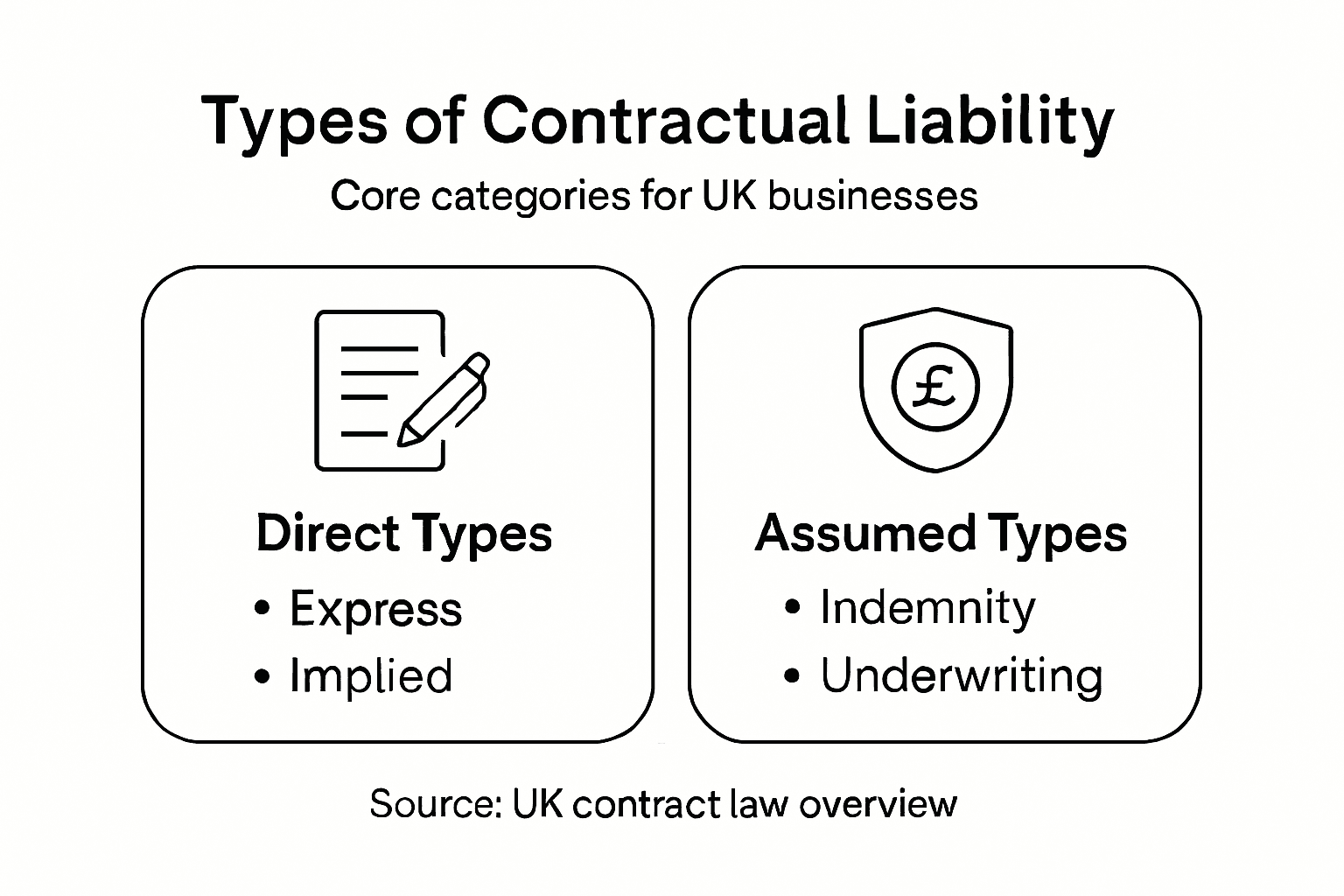
Pro tip: Consult with a legal professional to conduct a comprehensive review of your contractual documents, ensuring you fully understand the different liability types and potential risks embedded in your business agreements.
Here is a summary of the main types of contractual liability and how they differ in business contexts:
| Liability Type | Origin | Typical Example | Legal Implication |
|---|---|---|---|
| Express | Written contractual terms | Delivery date specified in contract | Direct and clearly enforceable |
| Implied | Law or standard business practices | Reasonable care expected from a supplier | Applied even if unwritten |
| Assumed | Voluntary addition by a party | Contractor takes on extra safety risks | May exceed normal obligations |
UK business contracts operate under a complex legal framework that governs contractual obligations and liability. Exclusion and limitation clauses play a critical role in defining the extent of potential legal responsibilities. The primary legislative instrument controlling these provisions is the Unfair Contract Terms Act 1977, which establishes crucial guidelines for how businesses can structure their contractual protections and limitations.
The key legislative framework encompasses several fundamental statutes that regulate contractual relationships. The Contracts (Rights of Third Parties) Act 1999 provides mechanisms for third parties to enforce contract terms, while the Sale of Goods Act 1979 and the Supply of Goods and Services Act 1982 establish baseline standards for commercial transactions. These laws collectively create a robust system that balances commercial flexibility with consumer and business protections, ensuring that contractual agreements maintain fairness and legal integrity.
Liability limitation provisions represent a critical aspect of UK contract law, allowing businesses to manage potential financial risks. Typical clauses include liability caps, which limit the maximum financial exposure in case of breach, and indemnity provisions that allocate specific risks between contracting parties. Courts carefully scrutinise these clauses to ensure they are reasonable, transparent, and do not unfairly disadvantage one party. Businesses must craft these provisions with precision, understanding that overly restrictive clauses may be deemed unenforceable if they contravene principles of fairness and reasonableness.
Pro tip: Engage a qualified legal professional to review your contract clauses, ensuring they comply with UK legislation and provide appropriate protection without creating undue legal vulnerabilities.
The following table outlines key legislative acts relevant to contractual liability in the UK:
| Legislation | Main Purpose | Typical Impact on Contracts |
|---|---|---|
| Unfair Contract Terms Act 1977 | Limits unfair contract exclusions | Protects against extreme liability limits |
| Sale of Goods Act 1979 | Sets standards for sale of goods | Ensures goods match description |
| Supply of Goods and Services Act 1982 | Regulates supply of services and goods | Guarantees reasonable care and skill |
| Contracts (Rights of Third Parties) Act 1999 | Grants rights to third parties | Allows non-signatories to enforce terms |
Businesses in the United Kingdom face complex legal obligations that directly influence their contractual risk exposure. Risk allocation strategies demonstrate that understanding and managing potential liabilities is crucial for maintaining financial stability and legal compliance. These obligations extend beyond simple contractual performance, encompassing broader responsibilities that can significantly impact a company’s operational and financial health.

The nature of business obligations varies depending on the specific type of contract and industry sector. Fundamental obligations include delivering agreed services or products, maintaining professional standards, ensuring workplace safety, and providing accurate representations of capabilities and potential outcomes. Companies must carefully assess their ability to fulfil contractual terms, as failure to meet these obligations can result in substantial financial penalties, legal disputes, and potential reputational damage. Contract law fundamentals emphasise the importance of clear, precise contractual language that explicitly defines these obligations and potential consequences of non-performance.
Risk exposure is particularly nuanced for UK businesses, with potential liabilities extending across multiple dimensions. Financial risks include direct contractual breach penalties, potential compensation claims, and indirect costs associated with dispute resolution. Legal risks involve potential litigation, regulatory penalties, and loss of business credibility. Businesses must develop comprehensive risk management strategies that include thorough contract reviews, appropriate insurance coverage, robust internal compliance mechanisms, and proactive legal consultation to mitigate these potential exposures.
Pro tip: Conduct regular internal audits of your contractual obligations and maintain comprehensive documentation to demonstrate your commitment to contractual performance and risk management.
Managing contractual liability is a critical strategic process for UK businesses seeking to protect their financial and legal interests. Liability limitation strategies provide essential frameworks for understanding and mitigating potential risks inherent in commercial agreements. These strategies involve carefully crafting contract terms that define and restrict potential financial exposure while maintaining fair and reasonable obligations between parties.
Businesses can implement several key approaches to minimise contractual liability risks. Risk allocation techniques involve precisely defining each party’s responsibilities, setting clear performance expectations, and establishing well-defined consequences for potential breaches. Appropriate contract selection plays a crucial role in this process, requiring businesses to thoroughly assess potential risks before finalising contractual agreements. This might include negotiating liability caps, implementing robust indemnification clauses, and ensuring comprehensive insurance coverage that aligns with potential contractual risks.
Effective risk management also demands proactive monitoring and periodic contract reviews. Businesses should develop internal processes for continuously evaluating their contractual obligations, identifying potential vulnerabilities, and updating agreements to reflect changing operational circumstances. This approach involves maintaining detailed documentation, conducting regular risk assessments, and seeking professional legal advice to ensure contractual terms remain protective and compliant with current legal standards.
Pro tip: Develop a comprehensive contract management system that includes regular legal reviews, risk assessments, and clear escalation procedures for potential contractual challenges.
Understanding contractual liability is essential for UK businesses aiming to minimise financial exposure and legal risks. Whether it involves managing express, implied, or assumed liabilities, the challenge lies in navigating complex obligations and ensuring contracts include effective limitation clauses that comply with UK legislation. Without expert guidance, businesses risk costly disputes, potential penalties, and damage to their reputation.
Ali Legal’s dedicated team offers practical solutions tailored to your needs. With a focus on clear communication, fixed fees, and long-term advising, we help you craft robust contracts and manage risk confidently. Explore our insights in our Uncategorized | Ali Legal section and see how strategic legal advice can safeguard your interests.
Don’t leave your business vulnerable to contractual pitfalls. Contact Ali Legal today and get fast, transparent, and strategic support to understand your liabilities and protect your commercial relationships. Reach out now through our contact page and take control of your contractual obligations.
Contractual liability is the legal responsibility of a party to fulfil the obligations defined in a contract. If a business fails to meet these obligations, it may be required to compensate the other party for any resulting losses or damages.
The primary types of contractual liability include express liability, which arises from explicitly stated terms in a contract; implied liability, which is derived from legal principles or established business practices; and assumed liability, where a party voluntarily takes on additional responsibilities beyond their original obligations.
Companies can manage their contractual liability risks by clearly defining each party’s responsibilities in contracts, negotiating liability caps and indemnification clauses, conducting regular contract reviews, and ensuring appropriate insurance coverage.
The consequences of breaching a contract can include financial penalties, claims for compensation, legal disputes, reputational damage, and potential regulatory penalties, depending on the nature of the breach and the applicable contractual terms.


