
Menu
Get Expert Legal Support Today

TL;DR:
- Mediation has a success rate of over 70% and is faster and cheaper than litigation.
- It involves a neutral mediator facilitating confidential, voluntary, and non-binding discussions for dispute resolution.
- Effectiveness depends on parties’ genuine readiness to settle and proper preparation; poor conditions can cause failure.
Over 70% of mediations succeed across sectors where court cases routinely drag on for years and cost many times more to resolve. If you have ever faced a family dispute, a contract disagreement, or a commercial falling-out, you will know the dread of litigation: the expense, the waiting, the loss of control. Mediation offers a fundamentally different path. It is faster, far less adversarial, and statistically far more likely to produce an outcome both parties can live with. This guide breaks down exactly how the mediation process works, what happens at each stage, which style of mediation suits which situation, and how to judge whether it is right for your dispute.
| Point | Details |
|---|---|
| Mediation is confidential and flexible | You control the outcome and everything remains private, unlike court. |
| Most cases settle quickly | Success rates are 70-85%, with disputes resolved in weeks instead of years. |
| Cheaper than litigation | Mediation typically costs a fraction of formal legal proceedings. |
| Not always suitable | Mediation can fail if parties lack willingness or if power imbalances exist. |
| Expert guidance helps | Having the right support and preparation increases your mediation success. |
Mediation is a structured process in which a neutral third party, the mediator, helps disputing parties communicate, understand each other’s positions, and work towards a mutually acceptable solution. It is not arbitration, where someone decides the outcome for you, and it is not litigation, where a judge imposes a verdict. As Harvard’s Programme on Negotiation explains, mediation is confidential, consensual, and non-binding, meaning the mediator facilitates discussion but does not decide outcomes.
Three principles sit at the heart of every mediation:
Mediation works in a surprisingly wide range of contexts. Family law disputes, including divorce, financial settlements, and child arrangements, are among the most common. Commercial disputes, such as types of dispute resolution involving contract breaches, partnership breakdowns, or supplier conflicts, are equally well-suited. Workplace conflicts, boundary disagreements between neighbours, and even multi-party international disputes benefit from mediation’s structured but flexible environment.
For individuals, the appeal is preserving relationships and avoiding the emotional toll of court. For businesses, the appeal is speed and confidentiality. Sensitive commercial matters stay out of the public record, which means reputations and trading relationships remain intact even when things get difficult.
“Mediation puts the parties in charge of the outcome. A judge gives you a verdict; a mediator gives you a conversation.”
Understanding the role of a mediator is critical before entering the process, because the quality and approach of your mediator shapes almost everything that follows.
Most people imagine mediation as a single meeting in a room. In practice, it is a structured sequence of stages, each with a distinct purpose. The typical mediation process consists of five to seven stages: planning and preparation, mediator introduction and ground rules, opening statements, joint discussion, private caucuses, negotiation and proposal generation, and agreement drafting.
Here is how each stage unfolds in practice:
| Factor | Mediation | Litigation |
|---|---|---|
| Typical duration | Days to a few months | One to three years |
| Approximate cost | £1,000 to £8,000 | £15,000 to £100,000+ |
| Decision maker | The parties themselves | A judge |
| Privacy | Fully confidential | Public record |
| Relationship impact | Generally preserves relationships | Often adversarial and damaging |
For contract dispute resolution stages, mediation often slots in before formal proceedings even begin, saving enormous legal costs. For cross-border matters, understanding the cross-border mediation process adds an extra layer of procedural awareness that can make or break a negotiation.
Pro Tip: Always ensure the person attending mediation on behalf of a business has actual authority to settle. Sending someone who must “check with the board” breaks momentum and can collapse an otherwise productive session.
Not all mediators work the same way. The methodology a mediator uses fundamentally shapes the experience and often determines the outcome. Common methodologies include facilitative, evaluative, and hybrid approaches, each with a distinct philosophy.
| Style | Primary focus | Best suited to |
|---|---|---|
| Facilitative | Communication and underlying interests | Family disputes, ongoing relationships |
| Evaluative | Legal risk assessment and likely court outcome | Commercial and contract disputes |
| Hybrid | Combination of both techniques | Complex multi-issue cases |
A facilitative mediator does not offer opinions on the merits of either party’s case. Instead, they ask questions, reflect back what they hear, and help parties discover solutions themselves. This style works well in family disputes where the relationship between parties continues after settlement, for example where co-parenting is involved.

An evaluative mediator is more direct. They will assess the strengths and weaknesses of each party’s legal position, point out what a court is likely to decide, and help parties reach a realistic settlement based on risk. Commercial solicitors often prefer this approach because it keeps negotiations grounded in legal reality rather than emotion.
A hybrid approach blends both. An experienced mediator will typically begin facilitatively and shift to evaluative techniques when the conversation stalls. Understanding which style your mediator uses, and whether it fits your case, is something a knowledgeable solicitor can help you assess before you commit. For insight into the mediator’s techniques and how a solicitor in mediation can support you, it pays to seek advice early.
Pro Tip: If you are entering a commercial mediation, ask your solicitor to prepare a brief risk analysis beforehand. Knowing the realistic litigation outcome gives you a far stronger negotiating position at the table.
Success rates of 70 to 85% across family, commercial, and court-referred cases make mediation one of the most consistently effective dispute resolution tools available. That figure is not a marketing claim; it reflects decades of data across multiple jurisdictions and dispute types.
The cost comparison alone is striking. Mediation costs typically range from £1,000 to £8,000, compared to £15,000 to £100,000 or more for full litigation, and resolves in days, weeks, or months rather than the one to three years a contested court case demands. For a small business facing a supplier dispute, that difference can mean survival.
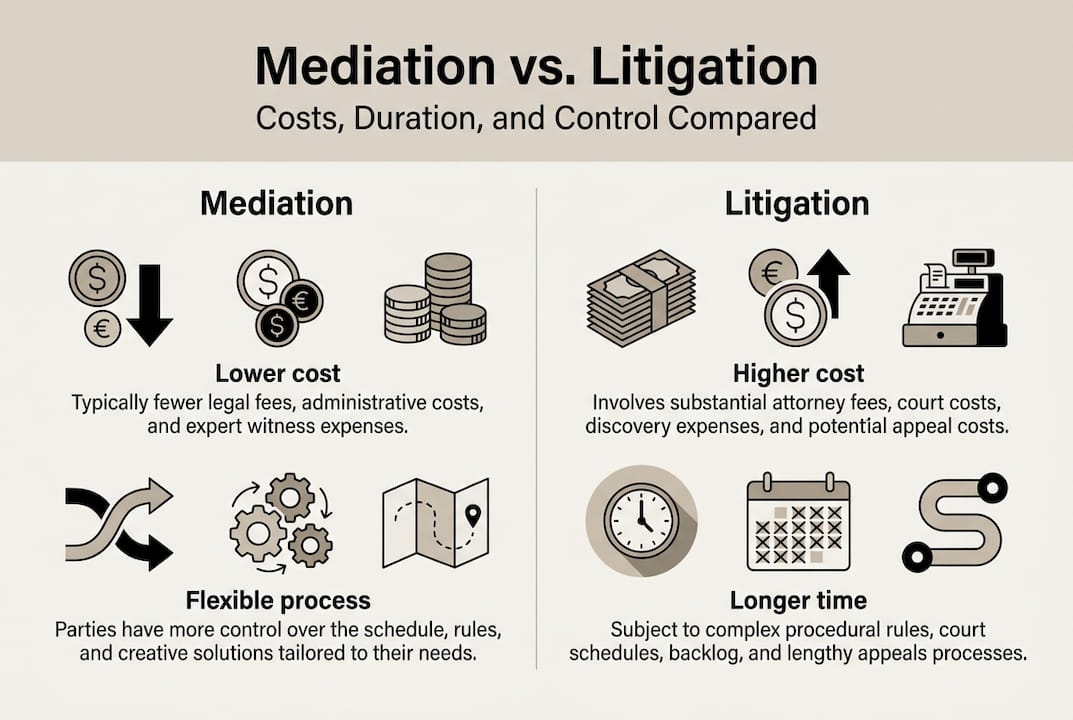
Beyond cost, mediation offers something litigation structurally cannot: control. Parties shape their own agreement rather than having a decision imposed upon them. This tends to produce outcomes that both sides actually follow, reducing the risk of post-settlement non-compliance that plagues court orders.
Mediation is also a powerful tool for preserving working relationships. Where litigation turns adversaries into enemies, mediation can allow two parties to resolve a dispute and continue doing business, or co-parenting, afterwards. For families especially, the emotional dividend is significant.
That said, mediation is not a universal remedy. Cases where mediation fails account for roughly 20 to 30% of sessions, and the causes are usually non-legal: significant power imbalances between parties, situations involving domestic violence, one party lacking authority to settle, poor timing, entrenched positions, or an outright refusal to compromise.
“The process cannot fix what the people are not ready to resolve.”
If mediation does break down, your options include alternatives to litigation such as arbitration, or you can return to the table with refined positions. The alternative dispute resolution landscape offers several routes between mediation and full litigation. A clear-headed assessment of success in mediation often comes down to how well both parties were prepared, not just how skilled the mediator was.
Most articles on mediation celebrate the process. Fewer acknowledge that the process is only as good as the people in it. Failures often trace back to non-legal factors: one party attending just to comply with a court direction rather than to settle, emotional volatility overwhelming rational discussion, or a fundamental imbalance in resources making genuine negotiation impossible.
In family cases particularly, there is a growing conversation about whether mediation is appropriately screened for domestic abuse and power dynamics. Sending two parties with an imbalanced history into a room and calling it “voluntary” can be misleading.
What we have observed, across a broad range of cases, is that the most successful mediations share one common trait: both parties came in genuinely prepared to settle, not just to be seen trying. Emotional readiness matters as much as legal preparation. A forward-thinking dispute strategy accounts for both dimensions before you ever enter the room. Mediation is evolving quickly, with online and hybrid formats now available, but the fundamentals of human willingness remain unchanged.
If you are considering mediation for your dispute, trusted legal advice is your best first step. Mediation is powerful, but entering it without preparation or an understanding of your legal position can leave you at a real disadvantage.

At Ali Legal, we advise individuals and businesses at every stage of the mediation journey, from assessing whether it is the right route, to preparing you thoroughly before the session, to advising on any agreement reached. Whether you need commercial dispute resolution support or are looking for family mediation support, our team provides straightforward, fixed-fee advice tailored to your specific circumstances. Contact us today for an honest assessment of your options.
Most mediations resolve within days or weeks, making it far quicker than the one to three years a typical court case demands.
Mediation is non-binding by nature, but any agreement reached can be made legally enforceable once both parties sign a formal settlement or consent order.
If mediation breaks down, post-failure options include returning to mediation with revised positions, escalating to arbitration, or pursuing the matter through traditional court litigation.
Generally, both parties share the mediator’s fee equally, though this arrangement can be negotiated and agreed upon before the process begins.
Yes. Everything discussed in mediation is confidential and consensual, meaning it cannot be introduced as evidence in court unless both parties explicitly agree.


