
Menu
Get Expert Legal Support Today

TL;DR:
- Clear legal documentation saves costs by reducing disputes, fines, and litigation risks.
- Legal clarity improves operational efficiency and attracts investment through predictable legal outcomes.
- Building legal clarity into daily processes fosters faster decisions and stronger business resilience.
Most businesses assume that more legal documentation means better protection. It does not. In fact, ambiguous contracts and poorly structured legal processes cost firms far more than most realise, through disputes, regulatory fines, and wasted operational time. Proactive legal risk management through clear processes leads to measurable cost savings by preventing fines, reducing legal fees, and avoiding litigation entirely. The real competitive advantage does not sit in the volume of legal paperwork you hold. It sits in how clearly that paperwork communicates intent, allocates responsibility, and guides decisions. This article breaks down exactly how legal clarity, not complexity, drives operational efficiency, attracts investment, and protects your business from avoidable harm.
| Point | Details |
|---|---|
| Clarity cuts legal costs | Clear legal processes and contracts prevent costly mistakes and reduce fees. |
| Boosts investor confidence | Legal certainty attracts more investment with lower risk premiums. |
| Drives operational efficiency | Transparent rules and permits lead to quicker decisions and faster growth. |
| Enables risk prevention | Clarity in legal systems minimises unforeseen liabilities and disruptions. |
| Actionable for any business | Simple process checks and language reviews help organisations of all sizes benefit. |
Legal clarity is often misunderstood. Many business owners treat it as synonymous with having detailed contracts or extensive policy documents. But length is not the same as clarity. A fifty-page contract riddled with ambiguous terms offers far less protection than a well-drafted, concise agreement that leaves no room for interpretation.
At its core, legal clarity means that every contract, policy, and communication is written so that all parties understand their rights, obligations, and consequences without needing further explanation. It prioritises precision over volume, which is a critical distinction in an environment where AI-assisted tools are increasingly used to manage legal processes. Clear language and well-defined procedures are essential for these tools to function correctly. Without them, automation can introduce new risks rather than reduce existing ones.
The impacts of clear legal advice on business outcomes are significant, yet frequently underestimated. Ambiguity in a contract does not stay neutral. It actively creates risk, because different parties interpret vague terms differently, and those interpretations collide under pressure. That collision often ends in litigation, which is expensive and disruptive for everyone involved.
Here is what genuine legal clarity looks like in practice:
As legal risk management guidance makes clear, clarity must integrate into your broader enterprise risk management (ERM) strategy, not exist as a separate legal function. When legal clarity is treated as a standalone concern rather than a business-wide discipline, gaps inevitably emerge between what the law requires and what operations actually deliver.
“Clarity prioritises precision over volume. Integrating it into ERM is not optional; it is the foundation on which every other risk control depends.”
Once you understand what legal clarity means, the business case for it becomes impossible to ignore. The link between clear legal processes and reduced operational risk is empirical, not theoretical.
Proactive legal risk management consistently produces cost savings across four key areas: prevention of regulatory fines, reduction in legal fees, avoidance of litigation, and maintenance of business continuity. Each of these outcomes flows directly from clarity. When contracts are unambiguous and compliance obligations are well-documented, there is simply less to argue about.
Data from quantitative research on insourcing legal work shows that organisations which bring targeted legal functions in-house, supported by clear internal processes, achieve substantial cost reductions. The savings come not from eliminating external legal support but from removing the inefficiency created by unclear internal processes that require constant external interpretation.
| Scenario | Typical outcome |
|---|---|
| Ambiguous contract terms | Disputes, negotiation delays, litigation risk |
| Clear contractual obligations | Faster execution, fewer disputes, lower legal spend |
| Vague compliance policies | Regulatory exposure, fines, reputational damage |
| Documented compliance procedures | Predictable audits, reduced penalties, staff confidence |
Pro Tip: Review your three highest-value contracts right now. If you cannot explain the core obligations and consequences to a non-lawyer in under two minutes, those contracts carry hidden risk.
Strong business contract clarity is not a luxury reserved for large corporates. Every business, regardless of size, faces the same basic exposure when agreements are poorly worded. The difference is that smaller businesses often have less financial resilience to absorb the consequences.

Building legal risk strategies that incorporate clarity at every stage, from contract drafting to compliance monitoring, is the foundation of sustainable operations. And proactive legal advice taken before problems arise will always cost less than reactive legal support after they do.
Legal clarity at the operational level and legal certainty at the strategic level are closely related but distinct concepts. Legal certainty refers to the predictability of legal outcomes within a framework, whether a jurisdiction, a regulatory system, or a set of contracts. For investors, that predictability is not a nice-to-have. It is a prerequisite.
Legal certainty attracts investment by lowering perceived risk, reducing the cost of capital, and signalling that a business or jurisdiction operates within a rules-based system. The implications for businesses are direct. When your internal legal framework is clear and predictable, you become a more attractive proposition for investors, lenders, and partners.
Research on legal stability and expectations confirms that businesses operating in legally certain environments experience lower borrowing costs and faster dispute resolution. For international businesses and those engaging in cross-border transactions, this is particularly significant. Uncertainty in legal arrangements is routinely priced into deal structures, often to the detriment of the business seeking capital.
The benefits of legal certainty extend across both domestic and international operations:
Understanding the role of international law in shaping investment decisions is particularly important for businesses operating across multiple jurisdictions. The standards applied by international arbitration bodies and foreign investors reward clarity in documentation and process.
The connection between legal clarity and operational efficiency is sometimes overlooked because it plays out gradually rather than in a single dramatic event. But the evidence is striking. Streamlined regulatory processes via clearer permitting frameworks have been shown to produce a fourfold increase in investment and a 61% rise in council revenue, with approval times cut from 36 months to between 10 and 14 months.
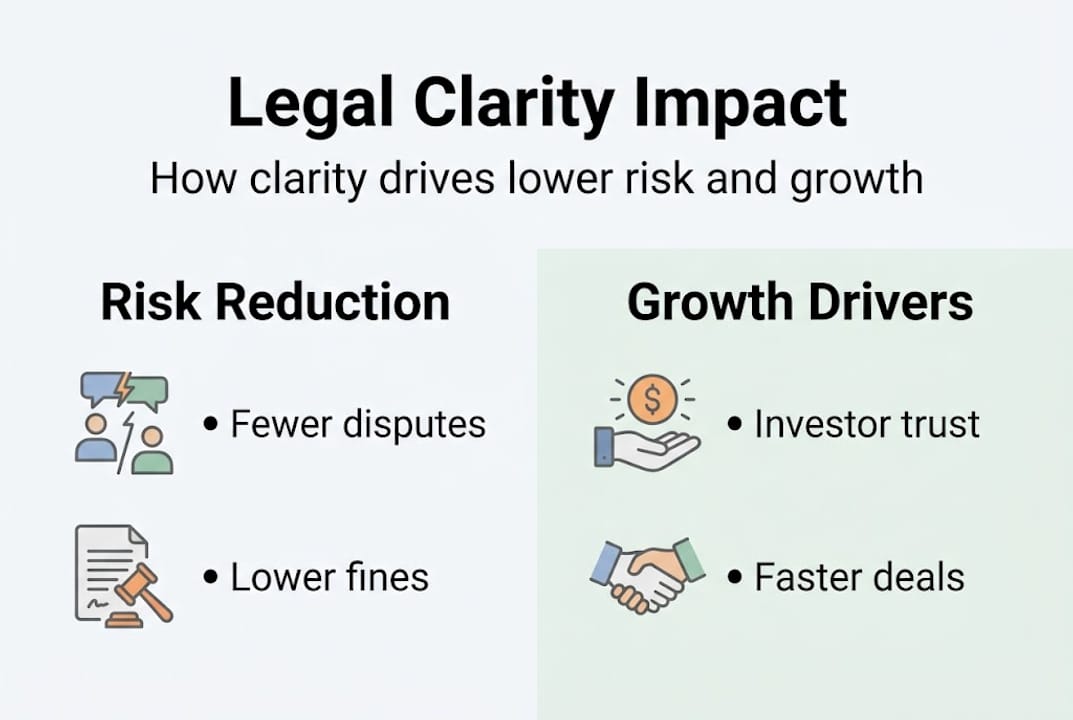
That is the power of removing ambiguity from process. When stakeholders know exactly what is required, timelines compress, resources are deployed more efficiently, and results improve across the board.
Here is a practical numbered approach for embedding clarity into your operational processes:
Pro Tip: Build a business legal document checklist into your onboarding process for new contracts and suppliers. Catching clarity gaps at the start costs a fraction of resolving them after work has begun.
Understanding the role of compliance in efficiency is often the missing link for businesses that feel legally exposed despite having reasonable processes in place. Compliance and clarity reinforce each other. One without the other leaves gaps.
Knowing the value of legal clarity is one thing. Building it into your daily operations requires a deliberate, structured approach. Here is how to start.
Step-by-step approach to building clarity:
Common pitfalls to avoid:
Pro Tip: A structured legal risk management review every six months keeps your processes aligned with regulatory changes and protects you from exposure that builds gradually.
Working with professionals who offer tailored legal solutions for your specific sector and size means that clarity is built into your agreements from the outset, not retrofitted after problems emerge.
Here is something few legal advisers say openly: excessively complex legal frameworks do not protect businesses. They slow them down, create interpretation errors, and leave organisations unable to adapt when markets or regulations shift.
The instinct to document everything exhaustively is understandable. It feels thorough. But legal stability and expectations research makes clear that legal certainty must balance with public policy adaptability. Absolute rigidity is not a strength. It is a liability in a fast-moving regulatory environment.
Businesses that build their legal culture around clarity rather than volume move faster. Their teams make better decisions independently because the legal framework they operate within is legible to them. They adapt more easily to regulatory change because their processes are not buried under layers of over-engineered documentation.
The firms with the strongest winning legal strategy are those that treat legal clarity as a cultural value, not just a compliance task. Open dialogue between legal advisers and operational teams, simplified language in all agreements, and a genuine commitment to transparent communication are the habits that protect businesses long term.
For business owners ready to move from theory to action, professional legal support makes legal clarity both achievable and scalable across your operations.

At Ali Legal, we work with businesses to build legal clarity directly into contracts, risk frameworks, and compliance processes. Whether you need strategic support through commercial litigation solutions, practical corporate law guidance on structuring your agreements, or a clear-eyed review of your current legal exposure, our team delivers straightforward advice without unnecessary complexity. Fixed fees, transparent communication, and genuine expertise in what matters to your business. Speak to our legal experts today and take the first step towards a legally resilient business.
Legal clarity reduces costs by preventing misunderstandings, fines, and litigation, resulting in fewer disputes and lower legal fees overall. Clear processes protect business continuity and reduce the need for reactive legal intervention.
Legal certainty lowers perceived risk for investors, reduces the cost of capital, and signals that a business operates within a predictable, rules-based environment.
Review contracts, processes, and compliance training to ensure clear, unambiguous language and procedures throughout your organisation. Proactive management of legal risk is far more effective than reactive responses.
Legal clarity protects businesses of every size by reducing avoidable risks and enabling confident decision-making. Insourcing legal work with clear processes delivers cost savings whether you are a sole trader or a large enterprise.


