
Menu
Get Expert Legal Support Today

TL;DR:
- A corporate lawyer advises businesses on transactions, governance, and compliance to prevent legal issues proactively. They handle contract drafting, mergers, governance advice, and risk management, focusing on enabling business growth. Building sector knowledge and commercial awareness is key to long-term success in this demanding legal role.
A corporate lawyer is defined as a legal professional who advises businesses on transactional matters, governance, and regulatory compliance rather than representing clients in court. The corporate lawyer role sits at the heart of commercial life, covering everything from drafting contracts and structuring mergers to guiding boards on their legal obligations. Unlike litigators, who resolve disputes after they arise, corporate lawyers work proactively to keep businesses on the right side of the law. If you are considering this career, understanding the full scope of corporate law duties will help you decide whether it is the right path for you.
Corporate lawyers focus primarily on transactional work: drafting and negotiating contracts, managing mergers and acquisitions, and advising on governance and securities compliance. That description covers a wide range of daily tasks, and the variety is one of the role’s defining features.
The core responsibilities of a corporate lawyer include:
The distinction between transactional and litigation work is worth understanding early. A corporate lawyer’s job is to prevent disputes from arising. A litigation lawyer steps in when they do. You can read more about how corporate and litigation roles differ to see where the two disciplines meet and diverge.
Pro Tip: When you shadow or intern at a law firm, ask to sit in on a contract negotiation as well as a client governance meeting. Seeing both contexts early will sharpen your understanding of what the role actually demands.

The path into corporate law follows a clear sequence, though the timeline varies by country and firm size.
Specialisation adds significant value at the mid-career stage. Lawyers who develop expertise in a specific sector, such as technology M&A, energy regulation, or financial services compliance, become considerably more marketable. Certifications in areas like competition law or data protection also strengthen a corporate law job description on a CV.
Pro Tip: Clerkships and vacation schemes at commercial firms are not just CV lines. They are your chance to demonstrate commercial awareness, which hiring partners consistently rank above raw academic grades.
Technical legal knowledge is the foundation, but the lawyers who advance fastest combine legal expertise with genuine business judgement. The key skills for corporate lawyers include contract drafting, M&A execution, corporate governance, negotiation, and due diligence. Practical experience in each of these areas directly improves employability.
The full skill set breaks down as follows:
Adaptability also matters. Corporate law moves quickly. Regulatory frameworks change, new deal structures emerge, and clients expect lawyers to keep pace. The lawyers who thrive are those who treat continuous learning as part of the job, not an occasional obligation.
Pro Tip: Read the financial press regularly. The Financial Times and The Economist will build your commercial awareness faster than any textbook, and partners will notice when you can discuss a client’s sector with genuine understanding.
Corporate lawyers are described as “handmaidens of the deal,” focusing on cooperative transactions that support mutual business growth rather than adversarial disputes. That framing captures something important: the corporate legal advisor role is fundamentally about enabling commerce, not obstructing it.
The table below contrasts the corporate lawyer’s transactional focus with the litigation lawyer’s dispute-resolution focus.
| Area | Corporate lawyer | Litigation lawyer |
|---|---|---|
| Primary focus | Transactions and compliance | Disputes and court proceedings |
| Timing | Proactive, before problems arise | Reactive, after a dispute emerges |
| Key tasks | Drafting contracts, M&A, governance | Pleadings, evidence, advocacy |
| Client interaction | Ongoing advisory relationship | Case-by-case instruction |
| Outcome goal | Deal completion, legal compliance | Winning or settling a dispute |
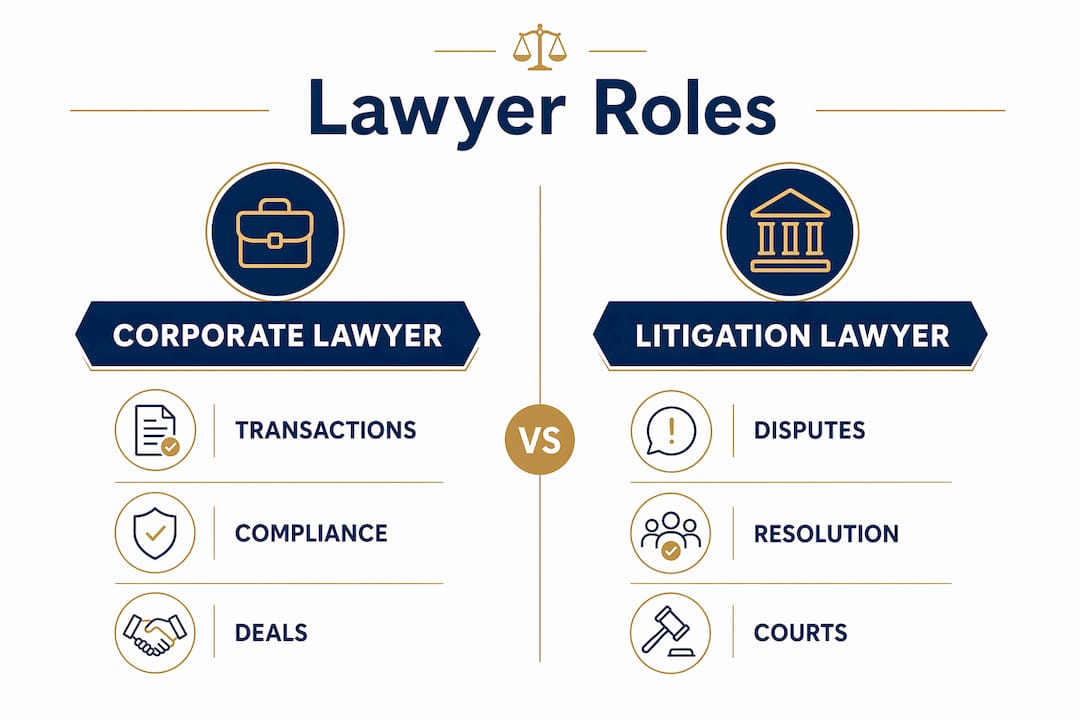
In practice, a corporate lawyer supports business growth in several concrete ways. When a company pursues an acquisition, the lawyer structures the deal to protect the buyer’s interests and manage post-completion risk. When a business expands internationally, the lawyer advises on cross-border regulatory requirements and contract enforceability across jurisdictions. When a company prepares for an IPO, the lawyer coordinates the prospectus, manages regulatory submissions, and advises the board on its new obligations as a listed entity.
Corporate lawyers also help businesses with compliance, risk management, and strategic deals, and this transactional focus is what separates them from litigation-focused colleagues. The goal is always to structure arrangements so that disputes never reach a courtroom. When they do, a separate team takes over.
Understanding corporate governance principles is central to this advisory work. Boards rely on their corporate lawyers to flag governance failures before regulators or shareholders do. That early warning function is one of the most valuable things a corporate legal advisor provides.
The most common misconception I encounter among aspiring lawyers is that corporate law is purely about technical mastery. It is not. The lawyers who reach partnership are the ones who understand their clients’ businesses well enough to anticipate problems before they are asked.
Early in a corporate law career, the temptation is to focus entirely on getting the legal analysis right. That matters, but it is the baseline expectation, not the differentiator. What separates a good associate from a great one is the ability to walk into a room with a chief executive and speak in terms of commercial consequence rather than legal theory.
Networking and mentorship are underrated at the student stage. The relationships you build during a vacation scheme or training contract will shape your career for years. Ask senior lawyers how they developed their sector knowledge. Ask them what they wish they had known at your stage. Most will tell you that business acumen took longer to develop than legal skill, and that they wish they had started earlier.
The corporate lawyer role is also more varied than outsiders expect. One week you might be reviewing a joint venture agreement for a technology company; the next you are advising a client on the governance implications of a board restructure. That variety is demanding, but it is also what makes the work genuinely engaging over a long career.
My honest advice: build your legal skills rigorously, but invest equal effort in understanding how businesses actually work. Read deal announcements. Follow regulatory changes in the sectors you want to work in. The lawyers who combine both will always be in demand.
— Panagiotis
When corporate disputes do arise despite the best preventive work, having experienced legal support makes a material difference to the outcome.

Alilegal advises businesses on a wide range of corporate and commercial legal matters, from governance questions to complex disputes requiring commercial litigation expertise. The team combines clear, direct advice with transparent fixed fees, so clients understand their position and their costs from the outset. Whether you are a business facing a contractual dispute or a professional seeking guidance on corporate legal responsibilities, Alilegal offers straightforward support without unnecessary delay. Contact Alilegal to discuss your situation with a solicitor who understands the commercial context behind every legal question.
A corporate lawyer is a legal professional who advises businesses on transactional matters, including contracts, mergers, governance, and regulatory compliance. The role is proactive rather than court-focused, aiming to prevent legal problems before they arise.
You need an undergraduate degree, a postgraduate legal qualification such as the SQE in England and Wales, and two years of qualifying work experience before admission as a solicitor. Strong commercial awareness and sector knowledge significantly improve career prospects.
A corporate lawyer focuses on transactions and compliance, working proactively to structure deals and advise on governance. A litigation lawyer resolves disputes after they arise, typically through court proceedings or negotiated settlements.
Key skills include contract drafting, M&A execution, corporate governance, negotiation, and due diligence. The ability to explain legal risk clearly to non-lawyer executives is equally critical at senior levels.
Entry-level corporate lawyers in North American markets earn between $100,000 and $200,000 annually. UK City firm salaries for newly qualified solicitors are broadly comparable, reflecting the technical demands of the role from the outset.


