
Menu
Get Expert Legal Support Today

TL;DR:
- GDPR fines have exceeded €7.1 billion since 2018, emphasizing ongoing compliance importance.
- Compliance involves adhering to seven core principles, including lawfulness, purpose limitation, and accountability.
- Continuous management, documentation, and proactive risk mitigation are essential for ongoing GDPR compliance.
Since 2018, cumulative GDPR fines have exceeded €7.1 billion across more than 2,500 enforcement actions. That number alone should dispel any notion that GDPR is a bureaucratic formality to be filed away and forgotten. For EU businesses and organisations handling personal data, compliance is a living, breathing legal obligation that evolves alongside your operations, your technologies, and the regulators watching closely. This article breaks down what GDPR compliance actually means in practice, the seven core principles you must build your processes around, the practical steps to implement them, and the real financial consequences of getting it wrong.
| Point | Details |
|---|---|
| GDPR applies globally | Any organisation processing EU/EEA personal data must comply, regardless of their location. |
| Seven GDPR principles | Lawfulness, fairness, transparency, purpose limitation, minimisation, accuracy, storage limitation, integrity, and accountability are the backbone of compliance. |
| Ongoing compliance | GDPR is not a one-off task; it requires continuous documentation, audits, and process improvements. |
| High fines for violations | Organisations face severe financial penalties for non-compliance, with enforcement targeting both SMEs and large firms. |
| Practical application matters | Pitfalls like misclassification and improper anonymisation are common, so clarity and precision are essential throughout compliance programmes. |
GDPR compliance means adhering to the EU’s General Data Protection Regulation, a legal framework governing how personal data is collected, stored, processed, and shared. It is not simply about having a privacy policy on your website. It requires documented processes, lawful justifications for every data activity, and demonstrable accountability across your entire organisation.
Under GDPR, your organisation will fall into one or both of two categories. A data controller determines the purpose and means of processing personal data. A data processor acts on behalf of a controller, handling data according to the controller’s instructions. Both carry distinct legal obligations, and ignorance of the distinction is not a defence.
One of the most widely misunderstood aspects of GDPR is its territorial scope. GDPR applies globally to any organisation that targets or monitors EU and EEA residents, regardless of where that organisation is physically located. A business in Singapore selling goods to German consumers must comply. A US-based SaaS firm offering services to French companies must comply. Geography does not create an exemption.
Common obligations for data controllers include:
Understanding where your organisation’s responsibilities begin and end is essential. For many businesses, this starts with the compliance officer role, a function increasingly critical to managing ongoing legal obligations. Embedding legal risk management into daily operations, rather than treating it as an annual review exercise, is what separates organisations that pass audits from those that do not.
“Compliance is not a destination. It is an operational discipline that requires consistent attention, not periodic panic.”
Pro Tip: Start with a thorough review of your legal document checklist to identify gaps in your existing data processing records before attempting a full GDPR audit. When deploying AI tools within your systems, also review AI compliance best practices to ensure those technologies align with your GDPR framework.
Article 5 of GDPR sets out seven core principles that govern all personal data processing. These are not aspirational guidelines. They are legally binding obligations that shape every data-related decision in your organisation.
| Principle | What it requires in practice |
|---|---|
| Lawfulness, fairness, transparency | A valid legal basis for processing; clear communication to data subjects |
| Purpose limitation | Data collected for one purpose must not be reused for unrelated purposes |
| Data minimisation | Collect only what is strictly necessary |
| Accuracy | Personal data must be kept up to date and corrected when inaccurate |
| Storage limitation | Data must not be retained longer than necessary |
| Integrity and confidentiality | Appropriate security measures to prevent unauthorised access or loss |
| Accountability | Organisations must demonstrate compliance, not just claim it |
The lawfulness, fairness, and transparency principle is where most organisations stumble first. Identifying a valid legal basis, whether consent, contract, legal obligation, vital interest, public task, or legitimate interest, requires genuine analysis. Ticking a box labelled “legitimate interest” without conducting a balancing test is a common and costly error.
Data minimisation often conflicts with the instinct to collect as much information as possible “just in case.” The principle demands you actively question whether each data field is necessary. If you cannot justify it, you should not collect it.
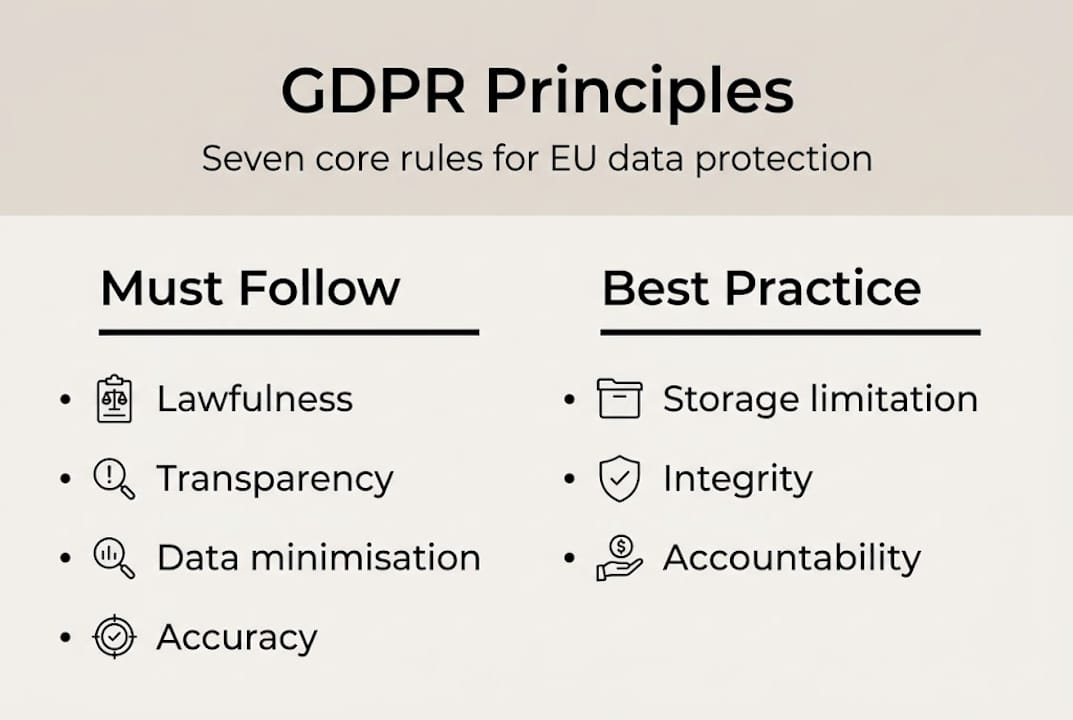
Accountability is perhaps the most demanding principle in practical terms. It requires organisations to proactively document their compliance posture, including data protection policies, training records, DPIAs, and processing records. The GDPR overview from iubenda provides a useful reference for understanding what accountability documentation looks like in practice.

Pro Tip: Map each of your processing activities to a specific principle and a specific lawful basis. This exercise, best aligned with your commercial law essentials, will surface inconsistencies before regulators find them.
Organisations in regulated sectors should also cross-reference these principles against their sector-specific duties. The corporate law dos and don’ts for SMEs, for instance, often intersect directly with GDPR accountability obligations, particularly around director responsibilities for data governance.
“The accountability principle is the backbone of GDPR. It means you cannot simply comply — you must prove that you comply.”
Principles provide the framework, but practical implementation is where compliance is won or lost. The following structured approach is drawn from established key methodologies for GDPR compliance programmes.
The full GDPR regulation text is a valuable reference when designing these internal processes. For a structured overview of each implementation stage, the corporate law checklist offers a helpful parallel framework.
Pro Tip: Treat your ROPA as a live document, not a one-off spreadsheet. Review it quarterly and whenever a new system, supplier, or data category is introduced.
GDPR implementation is not always clear-cut. Several nuanced distinctions routinely catch organisations off guard, leading to regulatory exposure that could have been avoided.
Anonymisation versus pseudonymisation is one of the most misunderstood areas. True anonymisation under Recital 26 places data entirely outside GDPR’s scope, but only if re-identification is genuinely irreversible. Pseudonymisation, which replaces identifiers with codes while retaining the ability to reverse the process, still falls within GDPR’s reach. Regulators have issued fines up to €20 million for organisations that mislabelled pseudonymised data as anonymous.
Artificial intelligence creates additional friction. AI and GDPR interact in complex ways: Article 22 imposes strict human oversight requirements on automated decision-making, and data minimisation obligations under Article 5 directly conflict with the large training datasets AI systems require. The AI Act adds further layers, but does not override GDPR. Both frameworks apply simultaneously.
Other common pitfalls include:
For a structured approach to identifying your data categories, the data classification guide is a practical starting point. Organisations should also involve their role of compliance officer in periodic reviews to catch classification errors before they escalate.
Pro Tip: When using AI tools for data processing, document your human oversight procedures explicitly. Article 22 requires this, and supervisory authorities have flagged its absence as a standalone infringement.
The enforcement numbers are significant. Cumulative GDPR fines exceeded €7.1 billion since 2018, with approximately €1.2 billion in fines issued during 2025 alone. An average of 443 data breach notifications were filed daily in 2025, a 22% increase year on year. These are not figures limited to multinationals.
Penalties under GDPR Article 83 are structured in two tiers:
The most frequently cited violation by supervisory authorities is insufficient legal basis under Article 6 — in other words, processing personal data without a valid, documented reason. Spain’s AEPD leads in volume of enforcement actions. Ireland’s Data Protection Commission handles the largest individual fines due to its role overseeing major tech firms.
“The question is not whether your organisation will be scrutinised. It is whether you will be ready when it is.”
SMEs are increasingly in scope. Enforcement trends documented in the GDPR fines tracker for 2026 show a clear shift towards smaller organisations, particularly in sectors handling health data, financial records, and customer profiles. A broader overview of regulatory expectations for businesses is also covered in resources simplifying GDPR for business. Your breach reporting obligations are a foundational part of managing this exposure.
Here is an uncomfortable truth that formal GDPR guidance rarely states plainly: most organisations that fail audits did not fail because of bad intentions. They failed because they treated compliance as a project rather than a process.
Structured compliance programmes, including maintained ROPA, completed DPIAs, and regular internal audits, reduce audit failures by a factor of three compared to ad hoc approaches. Yet many businesses invest heavily in a one-off compliance exercise, then allow the documentation to go stale while their data activities evolve.
Data minimisation is where this becomes a genuine business dilemma. Organisations are often reluctant to delete data because it feels like destroying value. In reality, retaining data beyond its lawful purpose is itself a liability. The commercial rationale for keeping old records must be weighed against the regulatory risk of holding them.
Over-classifying data as sensitive also wastes resources and distorts priorities. The best compliance programmes are calibrated, not maximal. An experienced ongoing compliance officer will continuously right-size your programme, ensuring effort is directed where real risk exists rather than where the paperwork is easiest to produce.
Understanding the rules is one thing. Applying them when a regulatory investigation begins or a data-related dispute escalates is another matter entirely.

At Ali Legal, our commercial litigation services cover GDPR-related disputes, including enforcement actions, third-party data breaches, and contractual disagreements arising from data processing failures. We also support businesses in appointing and structuring the role of a business compliance officer to manage ongoing obligations with confidence. Whether you are building a compliance framework from scratch or responding to a regulatory notice, our team provides clear, fixed-fee advice tailored to your circumstances. Contact our legal experts to discuss your situation directly.
Any organisation that processes personal data of EU or EEA residents must comply with GDPR, regardless of where the organisation is based. GDPR applies globally to any entity targeting or monitoring EU residents.
Penalties range from €10 million or 2% of global turnover for administrative breaches, up to €20 million or 4% of turnover for violations of core principles and rights under GDPR Article 83.
In 2025, an average of 443 daily breach notifications were filed with supervisory authorities, representing a 22% year-on-year increase from 2024.
True anonymisation removes data entirely from GDPR’s scope if re-identification is irreversible. Pseudonymisation retains the possibility of reversal and therefore remains within scope under GDPR rules.
No. Compliance is ongoing and requires regular audits, updated records, and continuous review of processing activities to remain protected and avoid enforcement action.


