
Menu
Get Expert Legal Support Today

TL;DR:
- Legal advice is essential from the start of business expansion to prevent costly mistakes.
- Integrating legal strategies early improves risk management, compliance, and investor confidence.
- Focused legal planning across contracts, employment, and international law supports sustainable growth.
Legal advice is not a last resort for when things go wrong. For small and medium-sized businesses ready to scale, it is the strategic foundation that separates confident, sustainable growth from costly, avoidable mistakes. Yet many SME owners still treat solicitors as a reactive resource, only picking up the phone when a dispute has already erupted or a contract has already been signed poorly. This article maps out why legal advice belongs at the centre of your expansion plan, from your very first new market entry to your most complex international deal, and how getting it right early can protect your investment, attract partners, and accelerate your growth.
| Point | Details |
|---|---|
| Early legal advice prevents risk | Pre-expansion consultation minimises costly disputes and compliance failures. |
| Legal planning scales growth | Integrated counsel supports faster, safer, and more confident expansion. |
| International expansion needs expertise | Jurisdiction-specific legal advice is vital for cross-border success. |
| Investor confidence rises with legal input | Proactive legal steps signal robust governance to stakeholders. |
Growth feels exciting. New markets, new revenue streams, new opportunities. But every expansion decision carries legal weight, and the businesses that scale sustainably are the ones that recognise this early. Legal advice shapes your earliest decisions, from how you structure your entity to how you draft your supplier agreements, preventing pitfalls that can otherwise take years and significant money to resolve.
Consider what is actually involved in a typical expansion:
As strategic legal advice covering all these domains demonstrates, legal counsel is not a single-use tool. It is a continuous strategic resource that protects your business at every stage of growth.
“The businesses that scale successfully are not those that avoid legal costs. They are those that invest in legal clarity before the pressure arrives.”
Cost concerns are real. Research shows 87% of SMEs cite cost as a primary barrier to professional advisory services. But here is the uncomfortable truth: the cost of a well-drafted contract is a fraction of the cost of litigating a poorly written one. Proactive legal advice does not just reduce risk; it actively builds investor confidence by demonstrating that your business is well-governed and dispute-resilient. For businesses focused on protecting UK SMEs through growth phases, this kind of structured legal support is fundamental.
Knowing that legal advice matters is one thing. Knowing when and how to integrate it into your planning is quite another. The most effective approach is to treat legal counsel the same way you treat financial forecasting: as a core input to your growth plan, not an afterthought.
Here is a practical sequence for embedding legal advice into your expansion roadmap:
Proactive legal planning integrated early into growth strategies enables risk-calibrated decisions, accelerated execution, and scalable compliance frameworks. The contrast with reactive legal engagement is significant, and the table below makes this clear.
| Approach | Timing | Cost profile | Risk level | Outcome |
|---|---|---|---|---|
| Reactive | After problems arise | High (dispute-driven) | Very high | Damage limitation |
| Proactive | Before expansion begins | Lower (planning-driven) | Managed | Sustainable growth |
The time and money savings from early legal input are well documented. So too is the value of a thorough due diligence guide when assessing new markets or acquisition targets.
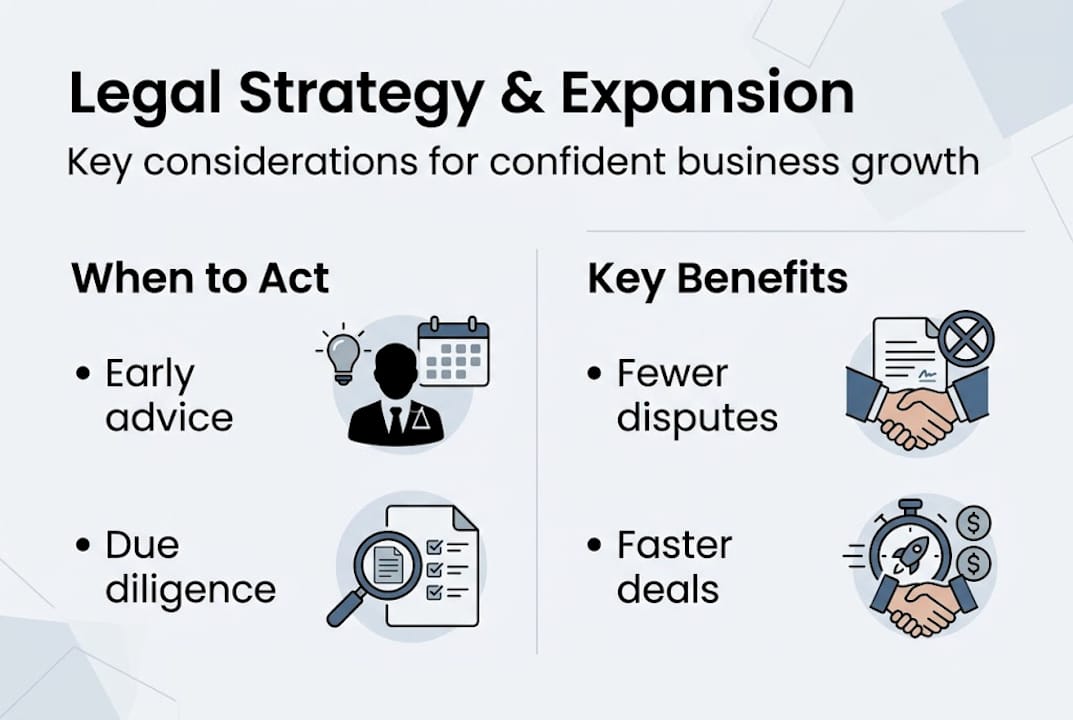
Pro Tip: Bring your solicitor into your expansion planning meeting, not just your completion meeting. The earlier they understand your goals, the more strategically they can protect them.
With legal strategy embedded into your planning, it is worth understanding the specific domains where expert legal input delivers the greatest impact during expansion. Each one carries its own risks, and each one rewards early attention.
| Legal domain | Key activity | Risk if neglected |
|---|---|---|
| Contracts | Drafting, reviewing, enforcing agreements | Disputes, unenforceable terms, financial loss |
| Employment law | Hiring, HR policies, worker classification | Tribunal claims, penalties, reputational damage |
| Regulatory compliance | Permits, licences, sector standards | Fines, trading restrictions, criminal liability |
| Due diligence | Risk assessment before market entry or acquisition | Hidden liabilities, deal failures, losses |
Strategic legal advice for SMB expansion covering contracts, due diligence, employment, and regulatory licensing is not optional. It is the baseline for responsible growth.
Here is what each domain demands in practice:
Understanding the role of contracts in safeguarding operations is particularly vital for growing businesses, where the volume and complexity of agreements increases rapidly.

Pro Tip: Before entering any new market or signing a new partnership, have a solicitor review every contract and compliance obligation together. What looks straightforward on the surface often contains significant legal exposure.
Expanding across borders is one of the most rewarding moves a growing business can make. It is also one of the most legally complex. Each jurisdiction brings its own rules on entity structures, employment contracts, tax obligations, and regulatory licences. What works legally in the UK may be non-compliant, or even illegal, in another country.
International expansion requires jurisdiction-specific compliance, including entity structures, employment laws, licensing, taxes, and cross-border complexities. Navigating this without expert guidance is not ambitious, it is unnecessary risk.
The key legal challenges in international expansion include:
Consider a practical example. A UK-based professional services firm expanding into the Middle East found that the ownership structure it intended to use was not permitted under local law. Early input from an international business law specialist avoided a costly restructure. Similarly, understanding the complexities of cross-border legal structuring before entering merger or acquisition discussions overseas protects your position from the outset.
For businesses managing assets abroad, understanding asset protection structures and efficient corporate account setup forms a critical part of the broader legal and financial framework.
Pro Tip: Before entering any new overseas market, commission a jurisdiction-specific legal review. The cost of this advice is negligible compared to the cost of regulatory non-compliance or structural errors once operations begin.
Here is the perspective that most articles on this topic avoid. Legal advice is not an overhead to be minimised. It is an investment with a measurable return, and the businesses that understand this grow faster and more securely than those that do not.
The most common mistake we see is treating legal fees as a cost centre rather than a value driver. When a dispute arises from a poorly drafted contract, or when an acquisition unravels because due diligence was skimped, the financial damage far exceeds any legal fees that could have prevented it. High-growth SMEs invest pre-expansion in professional advisory services, and this is not coincidental.
The real return on proactive legal advice shows up in three places: disputes that never happen, deals that close faster because documentation is clean, and investors who commit because governance is demonstrably sound. These returns do not appear on an invoice, which is exactly why so many business owners underestimate them. The businesses that scale well are not lucky. They are legally prepared.
If you are serious about expanding your business confidently and avoiding the legal pitfalls that derail so many growth plans, expert legal support is not optional.

Ali Legal provides tailored legal support across every stage of business expansion, from contract drafting and employment compliance to regulatory guidance and international structuring. Whether you are dealing with a dispute or planning your next market entry, our commercial litigation services and proactive legal help are designed to protect your interests and accelerate your goals. Fixed fees, clear advice, and long-term partnership. Consult Ali Legal today and take the first step towards legally sound, strategically confident growth.
Engage legal counsel as early as possible, ideally during the planning phase, to prevent disputes and build scalable compliance frameworks from the outset rather than retrofitting them later.
Contract disputes, employment tribunal claims, and failures to meet jurisdiction-specific compliance requirements are among the most damaging risks businesses face without proper legal guidance.
Yes. Proactive advice boosts investor confidence by demonstrating that your business is well-governed, dispute-resilient, and operating with clean documentation and sound governance structures.
Legal advice is critical for navigating foreign regulations and structures, ensuring your entity is correctly set up, your employment obligations are met, and your cross-border compliance is watertight from day one.


