
Menu
Get Expert Legal Support Today

Many people believe compensation claims are straightforward processes that guarantee financial recovery after an injury or property damage. The reality proves far more nuanced, involving complex legal requirements, damage calculations, and strategic considerations that significantly impact outcomes. Understanding what compensation claims truly entail, how damages are assessed, and which legal hurdles you might face can transform your approach to seeking restitution. This guide clarifies the fundamentals of compensation claims, explains calculation methods, explores key legal challenges, and outlines the practical steps for filing your claim in 2026.
| Point | Details |
|---|---|
| Definition and scope | Compensation claims seek financial restitution for economic losses like medical bills and non-economic damages such as pain and suffering resulting from negligence. |
| Calculation methods | Economic damages use receipts and bills whilst non-economic damages rely on per diem or multiplier methods to estimate value. |
| Legal proof required | Claimants must establish duty, breach, causation, and harm whilst navigating comparative fault rules that can reduce awards. |
| Settlement likelihood | Approximately 95% of claims settle before trial, making negotiation skills and documentation more critical than courtroom performance. |
| No win no fee considerations | Conditional fee agreements provide access to justice but involve success fees that reduce net payouts and potential disbursement liabilities. |
A compensation claim is a legal demand for financial restitution covering economic and non-economic damages caused by another party’s negligence. These claims arise when someone suffers personal injury or property damage due to actions or failures of an individual, business, or organisation that owed them a duty of care. The fundamental premise requires proving that negligence directly caused measurable losses, creating a legal right to seek monetary compensation.
Compensation claims encompass two primary damage categories. Economic damages represent quantifiable financial losses such as medical expenses, rehabilitation costs, lost wages, property repair bills, and replacement costs for damaged possessions. Non-economic damages address intangible losses including pain, suffering, emotional distress, loss of enjoyment of life, and permanent disability or disfigurement. The personal injury claims process requires documenting both categories thoroughly to maximise recovery.
Typical compensation claims involve diverse scenarios:
The basic legal conditions for pursuing a claim require establishing that the defendant owed you a duty of care, breached that duty through action or inaction, and directly caused losses you can demonstrate through evidence. For instance, a property owner who fails to repair a broken staircase breaches their duty to visitors, and if someone falls and breaks their leg, they can claim medical expenses, lost earnings during recovery, and compensation for pain and suffering.
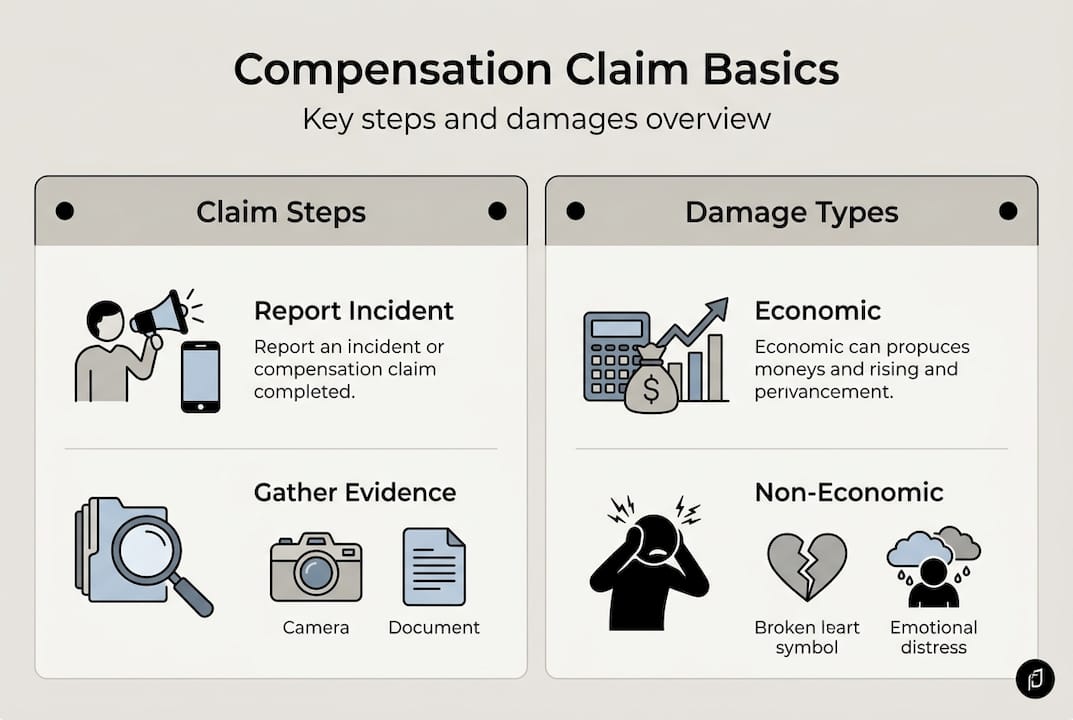
Understanding these fundamentals helps you recognise when you have grounds for a claim and what evidence you need to gather. The personal injury litigation guide provides additional context on building strong cases that withstand scrutiny during negotiations or trial.
Understanding what compensation claims cover naturally leads to grasping how damages are calculated to know what you can realistically expect to claim. Calculation methods differ significantly between economic and non-economic damages, requiring distinct approaches to valuation and documentation.
Economic damages are calculated via bills and receipts that provide concrete evidence of financial losses. Medical expenses include hospital bills, prescription costs, physiotherapy sessions, and future treatment needs projected by medical professionals. Lost wages calculations use pay slips, tax returns, and employer statements to establish pre-injury earnings and multiply by time off work. Property damage claims total repair estimates from qualified assessors or replacement costs for items beyond economical repair, minus any applicable insurance deductible.

Non-economic damages prove more subjective, relying on two primary methods. The per diem approach assigns a daily rate to pain and suffering, multiplying it by recovery days. The multiplier method takes total economic damages and applies a factor between 1.5 and 5 based on injury severity, with catastrophic injuries commanding higher multipliers. Courts and insurers consider injury permanence, treatment duration, impact on daily activities, and psychological effects when determining appropriate multipliers.
Property damage claims follow straightforward valuation. Assessors inspect damage, obtain repair quotes from licensed contractors, and compare against pre-damage market value. If repair costs exceed replacement value, insurers typically offer replacement minus depreciation. Deductibles specified in insurance policies reduce final payouts, creating out-of-pocket expenses claimants can pursue from at-fault parties.
| Damage type | Calculation method | Example |
|---|---|---|
| Economic | Actual bills and receipts | £15,000 medical costs plus £8,000 lost wages |
| Non-economic | Per diem or multiplier | £23,000 economic damages × 3 multiplier = £69,000 |
| Property | Repair or replacement cost minus deductible | £4,500 repair estimate minus £500 deductible = £4,000 |
Pro Tip: Begin documenting every expense immediately after an incident, photographing damage, retaining all receipts, and maintaining detailed journals of pain levels and activity limitations. This contemporaneous evidence proves far more persuasive than reconstructed records months later, significantly strengthening your economic and non-economic damage claims. The personal injury law guide explores additional damages calculation methods that courts apply in complex cases.
With damage calculation understood, it becomes vital to recognise the legal hurdles and strategies that influence your compensation claim’s success. Even strong claims face obstacles that can reduce awards or derail cases entirely without proper preparation and representation.
Proving negligence requires showing duty, breach, causation, and harm. First, establish the defendant owed you a duty of care, which exists in most everyday situations like driving safely or maintaining safe premises. Second, demonstrate they breached that duty through action or inaction falling below reasonable standards. Third, prove causation linking the breach directly to your injuries, excluding pre-existing conditions or intervening factors. Fourth, show actual harm occurred, whether physical injury, property damage, or financial loss. Missing any element defeats your claim regardless of how sympathetic your situation appears.
Comparative fault systems complicate claims significantly. Comparative fault and damage caps affect compensation amounts when claimants share responsibility for incidents. Pure comparative fault jurisdictions reduce awards proportionally, so 30% claimant fault in a £100,000 claim yields £70,000. Modified comparative fault bars recovery if claimant fault exceeds 50% or 51%, depending on jurisdiction. Insurers aggressively argue plaintiff fault to reduce payouts, scrutinising every action before and during incidents.
Damage caps limit non-economic awards in some jurisdictions, particularly for medical negligence claims. These legislative limits can drastically reduce compensation for severe injuries causing permanent disability or disfigurement. Understanding applicable caps helps set realistic expectations and influences whether pursuing litigation proves worthwhile compared to settlement offers.
Insurers employ multiple tactics to minimise payouts:
Most claims settle pre-trial, with approximately 95% resolving through negotiation rather than courtroom battles. Strong documentation and legal representation prove crucial for achieving optimal outcomes. Represented claimants navigate complex procedures, counter insurer tactics effectively, and leverage litigation threats to secure fair settlement agreements.
Represented plaintiffs receive 3.5 times higher settlements than unrepresented claimants, demonstrating the substantial value professional advocacy brings to compensation claims.
Pro Tip: Consult a solicitor immediately after an incident, before providing recorded statements to insurers or accepting any settlement offers. Early legal advice prevents common mistakes like admitting fault, accepting inadequate compensation, or missing critical evidence preservation steps. Understanding comparative fault rules in your jurisdiction helps you assess realistic claim values and negotiation strategies.
Finally, we examine how to practically initiate and navigate your compensation claim in 2026, including what to expect and smart approaches that maximise success. Understanding the process demystifies what might seem overwhelming and helps you prepare effectively.
The typical claim process follows these stages:
Approximately 95% of claims settle before trial, making negotiation skills more valuable than courtroom prowess. Average settlement amounts vary dramatically by injury type, ranging from £2,000 for minor soft tissue injuries to £250,000 for severe permanent disabilities. Timelines span three months for straightforward cases to three years for complex litigation, with most settlements occurring within 12 to 18 months.
| Aspect | Settlement | Trial |
|---|---|---|
| Likelihood | 95% of cases | 5% of cases |
| Timeline | 6 to 18 months | 18 to 36 months |
| Control | Parties negotiate terms | Judge or jury decides |
| Costs | Lower legal fees | Substantial litigation expenses |
| Certainty | Guaranteed outcome | Unpredictable verdict risk |
| Privacy | Confidential agreements | Public court records |
No win no fee agreements, formally called conditional fee arrangements, allow claimants to pursue cases without upfront legal costs. Solicitors receive payment only upon successful settlement or verdict, taking their fee as a percentage of recovered damages plus a success fee. No win no fee risks include reduced net payout and potential liability for disbursements like expert witness fees or court costs if unsuccessful, though many solicitors offer insurance against such expenses.
Benefits include access to justice for those unable to afford hourly legal fees and solicitor motivation to maximise recovery since their payment depends on success. Drawbacks involve success fees reducing your net compensation by 25% to 40% and potential pressure to settle prematurely to secure payment. The personal injury claims guide explores these arrangements comprehensively.
Pro Tip: When choosing solicitors, compare success fee percentages, clarify whether you face disbursement liability if unsuccessful, and verify their track record in cases similar to yours. Prepare for your legal consultation by organising all evidence, listing questions, and understanding realistic timelines. Review personal injury law statistics and the no win no fee scheme details before committing to representation agreements.
Having understood the process and challenges, here is how Ali Legal can help you confidently pursue your compensation claim. Navigating compensation claims requires expertise in civil litigation and deep knowledge of personal injury law that transforms complex procedures into manageable steps.

Ali Legal offers expert support throughout the personal injury claims process, from initial case evaluation through settlement negotiation or trial representation. Our solicitors understand the tactics insurers employ to minimise payouts and counter them effectively with thorough evidence preparation, strategic negotiation, and litigation readiness when necessary. We provide transparent fixed fee structures and clear communication, ensuring you understand each development and decision point.
Professional legal representation significantly increases your compensation and navigates complex procedures that overwhelm unrepresented claimants. Our tailored advice addresses your specific circumstances, calculating realistic claim values, identifying all liable parties, and building compelling cases that withstand scrutiny. Discover how strategic case handling can maximise your claim’s success in 2026 by consulting with our experienced team.
A compensation claim qualifies when you suffer personal injury or property damage due to another party’s negligence, breach of duty, or intentional wrongdoing. You must demonstrate measurable losses, whether economic damages like medical bills or non-economic damages such as pain and suffering. The personal injury claims guide details specific qualifying scenarios.
Most compensation claims settle within 12 to 18 months, though straightforward cases may resolve in three to six months whilst complex litigation can extend beyond three years. Timeline factors include injury severity, liability disputes, negotiation willingness, and court scheduling if trial becomes necessary. Early legal consultation and thorough evidence gathering accelerate the process.
Success depends on proving negligence, demonstrating causation, and documenting damages convincingly. Approximately 95% of claims settle successfully before trial, though settlement amounts vary based on evidence strength and representation quality. Represented claimants achieve substantially higher recoveries than those proceeding alone, with professional advocacy increasing settlements by 3.5 times on average.
No win no fee arrangements provide access to justice without upfront costs, making them worthwhile for claimants unable to afford hourly legal fees. However, success fees reduce net compensation by 25% to 40%, and some agreements carry disbursement liability risks. Compare solicitor terms carefully, verify track records, and understand all potential costs before committing to conditional fee arrangements.
Proving negligence requires establishing four elements: the defendant owed you a duty of care, breached that duty through substandard actions or omissions, directly caused your injuries through that breach, and you suffered actual damages as a result. Gather evidence including accident reports, witness statements, photographs, medical records, and expert opinions that document each element convincingly.


