
Menu
Get Expert Legal Support Today

TL;DR:
- Data protection regulation governs how organizations handle personal data to protect individual rights and ensure lawful processing. Almost any business collecting personal information must comply, applying core principles like transparency, data minimization, and accountability to maintain trust and avoid hefty fines. Embedding a culture of ongoing compliance and understanding lawful bases, especially in AI and cross-jurisdictional operations, is essential for sustainable data management.
Data protection regulation sits at the heart of almost every modern business operation, yet most organisations treat it as an afterthought reserved for tech giants and multinational corporations. That assumption is wrong and, increasingly, costly. Whether you run an independent dental practice, a small e-commerce shop, or a medium-sized recruitment agency, the moment you collect a customer’s name and email address, you are processing personal data under the law. This guide breaks down what data protection regulation genuinely means, explains the principles that drive it, and shows you what real compliance looks like in practice.
| Point | Details |
|---|---|
| Applies to everyone | Data protection rules are relevant to nearly all businesses and individuals, not just large companies. |
| Principles guide action | Core principles like minimisation and accountability guide real-world compliance decisions. |
| Practical compliance steps | Meeting requirements means understanding data flows and choosing a lawful basis for every use. |
| New challenges with AI | AI and analytics introduce unique compliance risks demanding careful mapping of purposes and legal bases. |
| Legal support is valuable | Expert advice helps avoid costly mistakes and strengthens compliance frameworks. |
Data protection regulation refers to the body of rules and laws that govern how organisations collect, store, use, share, and delete personal data. These rules exist to protect individuals from misuse of their private information. The underlying idea is straightforward: people should have control over data that relates to them.
The urgency around this topic is not arbitrary. The rapid growth of digital commerce, cloud storage, and online communication has created an environment where vast quantities of personal data flow between systems every second. High-profile breaches at major organisations have repeatedly shown what happens when that data is poorly managed. Millions of people’s financial details, health records, and private communications have been exposed, often causing genuine, lasting harm.
GDPR compliance steps became a significant focus for businesses from 2018 onwards, when the General Data Protection Regulation came into force across the European Union. As the GDPR establishes, this regulation created a unified framework for processing personal data and strengthening individuals’ control and rights. But GDPR is not the only framework that matters. Similar legislation exists across the globe, including the UK GDPR (adopted post-Brexit), Canada’s PIPEDA, Australia’s Privacy Act, and California’s CCPA in the United States. The regulatory landscape is genuinely global.
“The GDPR aims to give individuals control over their personal data and to simplify the regulatory environment for international business by unifying the regulation within the EU.” The regulation came into full effect on 25 May 2018.
Who actually needs to comply? The answer might surprise you. Almost any organisation that handles personal data falls within scope. Here are some practical examples:
The common thread is personal data. If you handle it, regulation applies to you.
Most major data protection frameworks share a common foundation of principles. Understanding these principles is far more useful than memorising individual rules, because the principles are what regulators look at when something goes wrong. GDPR-style compliance is built around seven core principles that shape every data-related decision an organisation makes.
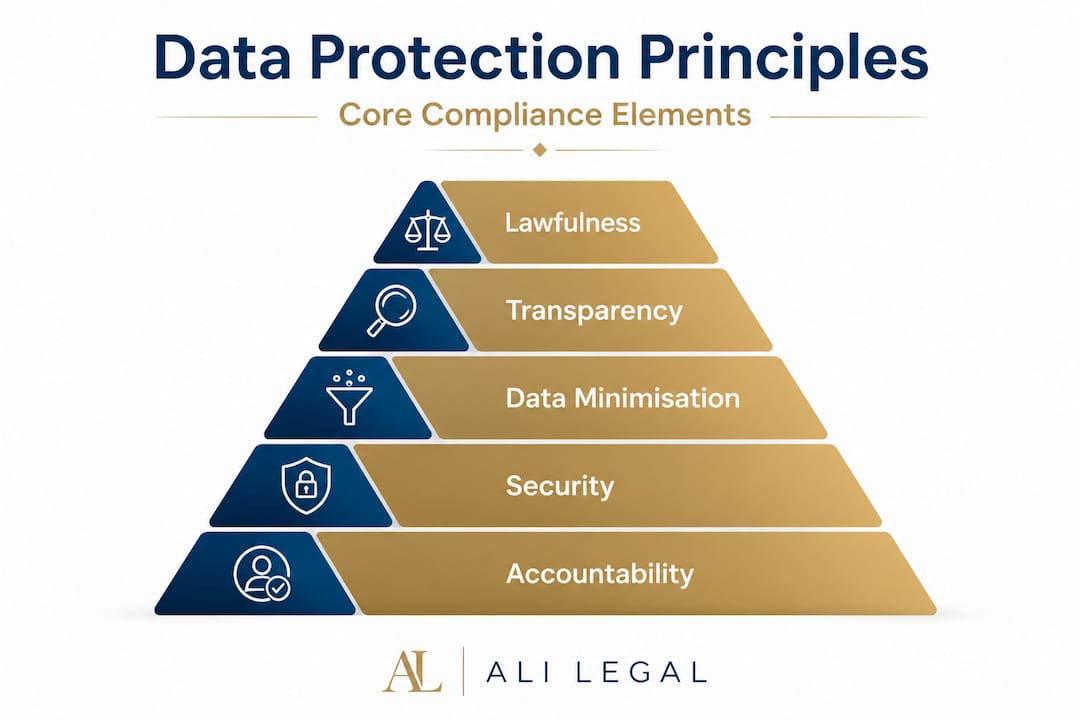
| Principle | What it means in plain English |
|---|---|
| Lawfulness, fairness and transparency | You must have a legal reason to process data and be open about how you use it |
| Purpose limitation | Collect data for a specific reason and do not use it for anything else |
| Data minimisation | Only collect what you genuinely need |
| Accuracy | Keep data correct and up to date |
| Storage limitation | Do not keep data longer than necessary |
| Integrity and confidentiality | Protect data from unauthorised access or loss |
| Accountability | Demonstrate that you follow the rules, not just claim that you do |
These principles are not abstract ideals. They translate into very specific daily obligations. Here is how they might look in a real business context:
The data minimisation principle deserves particular attention. It is one of the most frequently breached requirements, and it is deceptively simple. The ICO data minimisation requirement states that personal data must be adequate, relevant, and limited to what is necessary. Many businesses collect far more information than they need, often because it feels useful to have it available “just in case.” That instinct is legally risky.
Understanding the role of compliance officer within your organisation is also essential. Accountability requires someone to own these decisions, track obligations, and lead on responses when things go wrong.
Pro Tip: Treat accountability as an ongoing operational responsibility rather than a box-ticking exercise done once a year. Accountability means being able to show, at any point, that you understand what data you hold, why you hold it, and how you protect it.
Knowing the principles is one thing. Putting them into practice is another matter entirely. Here is a straightforward comparison of compliant versus non-compliant behaviours that illustrates the difference clearly:
| Scenario | Compliant behaviour | Non-compliant behaviour |
|---|---|---|
| Collecting customer data online | Providing a clear privacy notice and requesting only necessary information | Gathering extensive personal details without explanation |
| Email marketing | Sending campaigns only to those who opted in | Adding all past customers to a mailing list without consent |
| Employee records | Retaining only current, relevant HR data | Keeping ex-employee records indefinitely with no review |
| Data breach | Notifying the ICO within 72 hours and affected individuals promptly | Concealing or delaying notification of a significant breach |
| Third-party suppliers | Signing data processing agreements with all vendors | Sharing data with suppliers informally without contracts |
Getting this wrong carries serious consequences. The Information Commissioner’s Office (ICO) in the UK has authority to issue fines of up to £17.5 million or 4% of global annual turnover, whichever is higher. Beyond fines, reputational damage can be devastating. A single publicised breach can erode years of trust built with customers and partners.

The statutory limitations guide is equally relevant here, because organisations sometimes fail to appreciate that individuals have time-limited rights to bring complaints, and how limitation periods interact with data retention decisions.
Here are the key steps most organisations need to take to implement genuine compliance:
One of the most common mistakes we see is over-collection. Businesses gather data because storage is cheap and “it might be useful one day.” UK ICO guidance is direct on this point: personal data must be adequate, relevant, and limited to what is necessary. The comfort of having data available does not override the legal requirement to only hold what you need.
Knowing how to avoid legal pitfalls in this context means building compliance into your standard operating procedures from the start rather than retrofitting it after a problem occurs.
Beyond the general principles, every processing activity must have a specific legal justification. This is called the lawful basis for processing. Without identifying and documenting a lawful basis, processing personal data is unlawful, regardless of how responsibly you handle it otherwise.
The six lawful bases under UK GDPR are:
Choosing the wrong lawful basis is a common error. For instance, many organisations default to consent when legitimate interests would actually be more appropriate and more sustainable. Consent can be withdrawn at any time, which creates operational difficulties if it is relied upon unnecessarily.
The growing use of artificial intelligence and large-scale data analytics introduces an entirely new layer of complexity. AI systems typically process enormous volumes of personal data to identify patterns, make predictions, or automate decisions. Regulators expect organisations to map each processing purpose to an appropriate lawful basis and consider impacts on individuals’ rights and freedoms, rather than treating AI use as a single activity.
This matters enormously for businesses deploying automated hiring tools, credit scoring systems, or personalisation engines. Each distinct use of data within those systems may require its own lawful basis. A blanket consent form does not cover all of it.
Employment contracts compliance is a closely related area where lawful basis questions arise frequently, particularly when employers use monitoring tools or analytics systems that process employee data.
Pro Tip: For every AI-driven or analytics-based use of personal data, document the specific purpose, the lawful basis selected, and a brief explanation of why that basis is appropriate. If you cannot articulate the rationale clearly, the processing should be paused and reviewed.
Most articles on this subject focus on checklists. Update your privacy policy. Sign your data processing agreements. Register with the ICO. These steps matter, but they miss the deeper point entirely.
Lasting compliance does not come from a checklist. It comes from embedding data protection thinking into the culture of your organisation. When a sales manager instinctively asks “do we actually need this field?” before adding it to a CRM, that is culture at work. When a customer service team automatically follows the subject access request process without needing to be reminded, that is culture at work.
The tendency to treat compliance as a project with a start and end date is one of the most persistent mistakes we see. Regulation changes. Technology changes. Your data processing activities change. Each of these shifts can open new compliance gaps. A privacy notice that was accurate two years ago may be completely inaccurate today if you have added new services or changed your supplier relationships.
“The biggest risk is not always what’s listed in regulation. It is what happens when accountability does not shape every decision made about personal data.”
There is also a genuine competitive advantage available to organisations that take this seriously. When customers trust that you handle their data with care and transparency, they are more willing to share it, engage with your services, and stay loyal. That trust is not built by a cookie banner. It is built by consistent, honest behaviour over time.
Reviewing GDPR compliance steps periodically, as part of a regular business review cycle rather than in response to a crisis, is one of the most practical habits an organisation can develop.
The organisations that struggle most with data protection regulation are those that see it exclusively as a burden. The organisations that handle it well tend to recognise that respecting individuals’ rights over their own data is simply good business practice.
Navigating data protection obligations can be genuinely complex, particularly when your business is growing, adopting new technology, or operating across multiple jurisdictions. Understanding the principles is a strong foundation, but applying them accurately to your specific situation often requires tailored legal advice.

At Ali Legal, we support businesses and individuals in interpreting their data protection obligations clearly and practically. Whether you need to review your compliance framework, respond to a regulatory inquiry, or understand your GDPR compliance guidance requirements in detail, our team provides straightforward, expert support without unnecessary complexity. We offer fixed fees and transparent communication from the first consultation, so you always know where you stand. If data protection concerns are keeping you or your business from operating with confidence, speak to one of our solicitors today.
Any entity handling personal data, from small sole traders to large enterprises, falls under these regulations. The GDPR applies to all organisations processing personal data of individuals within the EU or UK, regardless of the organisation’s size or location.
Protected data includes any information linked to an identified or identifiable individual, such as names, emails, IP addresses, or location data. GDPR establishes broad definitions of personal data, meaning that even indirect identifiers can bring information within the law’s scope.
Check whether your business follows core principles consistently, including minimising data collected, being transparent with individuals, and responding to rights requests on time. GDPR-style compliance relies on clear principles applied consistently across all processing activities, not just a completed registration form.
A lawful basis is the legal justification that permits you to process personal data, such as consent, a contractual necessity, or a legitimate interest. Mapping each processing purpose to an appropriate lawful basis is essential for compliance and must be documented clearly in your records of processing activities.


