
Contract disputes test the patience of even the most diligent british business owners and professionals. With over one third of United Kingdom businesses reporting legal disagreements every year, a poorly managed contract issue can rapidly snowball into costly delays and reputational risks. Knowing how to assess the situation, gather your evidence and follow a clear step-by-step approach gives you a powerful advantage and helps protect your interests from the very start.
Understanding the nuances of a contract dispute requires methodical investigation and strategic evidence collection. When a disagreement emerges, your first objective is to comprehensively evaluate the situation and compile a robust documentation trail that supports your position.
Begin by meticulously reviewing the original contract, examining every clause and performance requirement with precision. The UK government’s guidance on contract management emphasises establishing clear key performance indicators, which become critical reference points during dispute assessment. Collect all relevant communication records, including emails, meeting minutes, correspondence, and formal notices that document the progression of events leading to the dispute. Systematically organise these documents chronologically and categorise them by topic to create a clear narrative.
Your evidence gathering should include both documentary proof and witness statements if applicable. Pay special attention to contractual performance metrics and procedural guidelines that might substantiate your position. Photograph physical evidence, preserve digital records, and ensure all documentation remains untampered and authentic.
Advanced tip: Compile a comprehensive evidence index that cross references each document with specific contractual clauses, making it easier for legal professionals to understand your documented dispute trajectory.
Navigating a contract dispute requires strategic communication and a measured approach to resolving differences. Your primary goal in this stage is to open constructive dialogue with the other party and explore potential resolution pathways before escalating to formal legal proceedings.
Solving problems out of court involves creating an environment of mutual understanding and collaborative problem solving. Begin by scheduling a meeting or requesting a formal discussion where both parties can openly address their concerns. During this initial dialogue, focus on articulating your perspective clearly and professionally, using specific examples from your evidence gathering to support your position. Dispute resolution techniques emphasise the importance of active listening and maintaining a cooperative tone throughout these conversations.
Approach the negotiation with specific objectives while remaining flexible. Prepare a list of potential compromise solutions and be ready to discuss reasonable alternatives that could satisfy both parties interests. Document all discussions and proposed solutions in writing, ensuring transparency and creating a clear record of attempted resolution efforts.
Advanced tip: Prepare a written summary of discussion points after each negotiation meeting, sending a copy to the other party to confirm mutual understanding and create an official record of your collaborative attempts to resolve the dispute.
When contract disputes escalate beyond initial negotiations, securing professional legal representation becomes a critical strategic decision. Your objective is to find a legal expert who can provide specialist guidance and potentially transform the trajectory of your dispute resolution process.

The UK government recommends seeking independent legal advice to navigate complex dispute scenarios effectively. When selecting a solicitor, prioritise professionals with specific expertise in contract law and dispute resolution. Look for legal practitioners who demonstrate a nuanced understanding of your specific industry and the contractual complexities involved. Prepare a comprehensive briefing document that outlines the dispute’s background, including all gathered evidence, communication records, and your desired outcomes.
During initial consultations, be prepared to discuss potential resolution strategies, associated legal costs, and realistic expectations. Ask detailed questions about their experience with similar cases, their proposed approach to your specific dispute, and potential alternative dispute resolution methods. Legal professional training programmes emphasise the importance of strategic problem solving, so seek a solicitor who can offer both legal expertise and pragmatic negotiation skills.
Advanced tip: Schedule initial consultations with multiple solicitors to compare their approaches, ensuring you select a legal representative who not only understands your case but also aligns with your communication style and strategic objectives.
Reaching this stage indicates that previous negotiation attempts have been unsuccessful, and you must now pursue more structured legal mechanisms to resolve your contract dispute. Your primary objective is to initiate a formal process that provides a legally binding resolution while minimising potential financial and reputational risks.
The UK government recommends civil mediation as a structured dispute resolution approach, which offers a more collaborative alternative to traditional court proceedings. Begin by preparing a comprehensive documentation package that includes all previous communication, evidence, and attempted resolution attempts. Your solicitor will help you select the most appropriate dispute resolution method based on your specific circumstances.
Dispute resolution strategies in professional sectors emphasise the importance of selecting the right procedural approach. This might involve statutory adjudication, arbitration, or mediation depending on your contract type and industry standards. Carefully review your original contract for any prescribed dispute resolution clauses that mandate specific procedures. During this process, maintain professional communication and be prepared to demonstrate your reasonable attempts to resolve the conflict constructively.
Here is a summary comparing common formal dispute resolution methods in contract disputes:
| Method | Typical Use Case | Advantages | Key Considerations |
|---|---|---|---|
| Mediation | Early dispute stages | Preserves business relations | Not legally binding unless agreed |
| Arbitration | Technical or complex contracts | Quicker than court, private | Can be costly; binding outcome |
| Statutory Adjudication | Construction disputes | Fast interim decisions | Only applies in certain sectors |
| Litigation | Unresolvable or severe disputes | Legally enforceable outcome | Slow and expensive process |
Advanced tip: Request a detailed timeline and potential cost breakdown from your legal representative before commencing formal procedures, ensuring you understand the financial and temporal implications of each potential resolution pathway.
After successfully navigating complex dispute resolution procedures, your focus shifts to meticulously reviewing and implementing the negotiated settlement. This critical stage demands careful attention to ensure that all agreed terms are precisely documented and systematically executed.
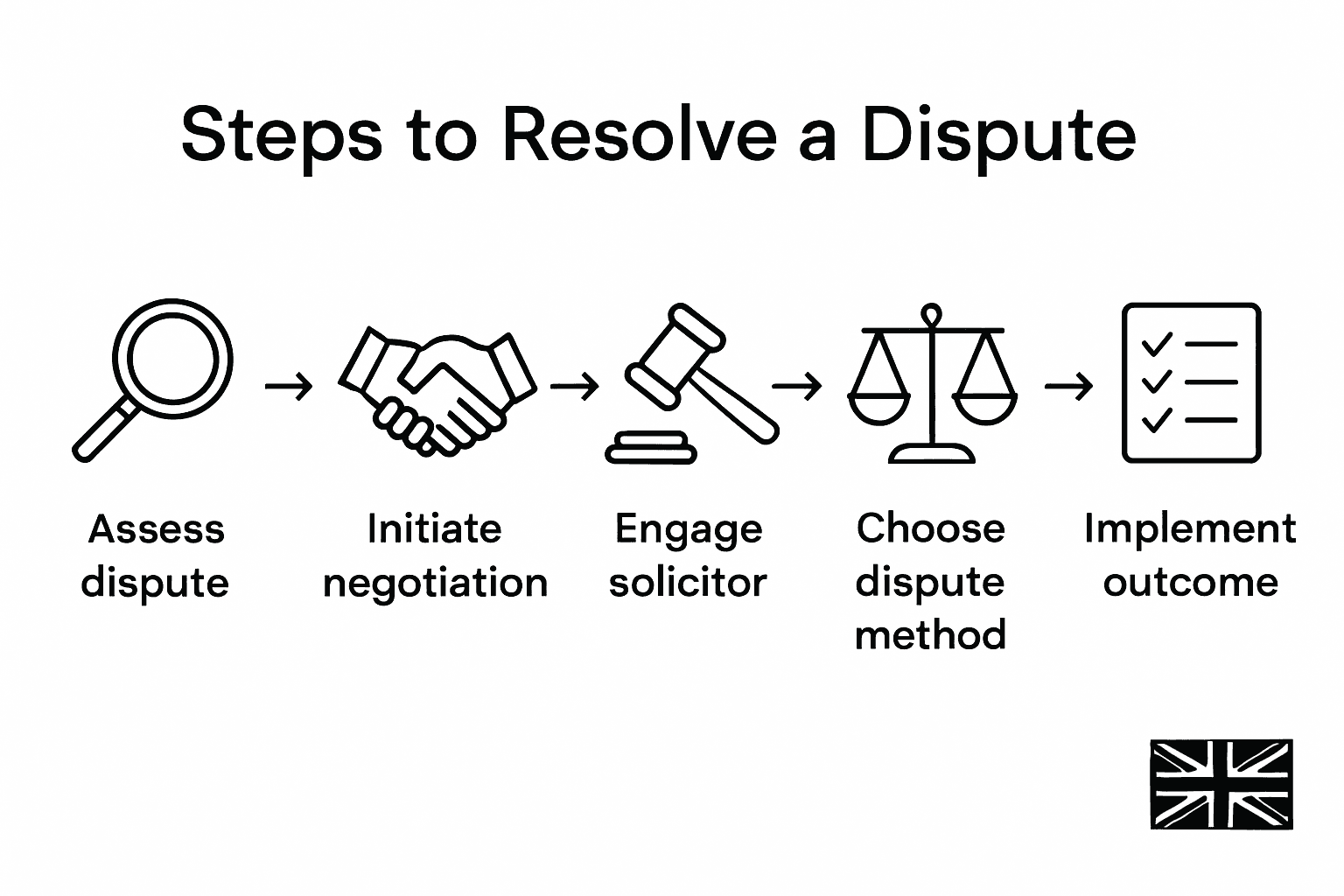
Managing contract dispute resolutions requires involving an independent third party to validate the settlement terms and confirm that both parties fully understand their respective obligations. Carefully review the settlement document line by line, verifying that every negotiated point accurately reflects the discussions and agreements reached during the dispute resolution process. Pay particular attention to specific performance requirements, financial settlements, timelines, and any remedial actions.
Contract dispute resolution guidance emphasises the importance of creating a clear implementation plan that outlines exactly how each settlement term will be executed. Work closely with your legal representative to develop a structured approach for fulfilling your obligations, establishing clear milestones and accountability mechanisms. Document every step of the implementation process and maintain open communication channels with the other party to ensure smooth execution.
To support a comprehensive settlement, consider these key implementation factors:
| Factor | Description | Impact if Mismanaged |
|---|---|---|
| Performance Deadlines | Specific dates for obligations | Delays could void agreement |
| Milestone Tracking | Monitoring progress checkpoints | Missed milestones may trigger penalties |
| Third-Party Verification | Independent oversight of compliance | Lack of oversight risks disputes recurring |
| Documentation | Written record of actions taken | Poor records can cause enforcement issues |
Advanced tip: Create a detailed compliance checklist that tracks each settlement term, including specific deadlines and responsible parties, to provide a systematic approach for verifying complete and accurate implementation of the negotiated resolution.
Contract disputes can bring uncertainty and stress, especially when facing challenges like evidence collection, negotiation deadlocks, and deciding on the right formal resolution path. This article highlights the critical steps from gathering detailed proof to verifying settlement terms, emphasising the importance of strategic legal support and clear communication.
At Ali Legal, we understand how complex contract disputes can impact your business or personal interests. Our expert solicitors specialise in providing fast, transparent, and tailored legal advice to guide you through every stage of the dispute resolution process. Whether you need help initiating negotiations or require professional representation for mediation or litigation, we prioritise your goals with fixed fees and straightforward guidance.
Explore how Ali Legal can support you today and benefit from:
Contact Ali Legal now to secure your peace of mind and take control of your contract dispute resolution process.
Start your trusted legal journey here

Begin by reviewing the original contract thoroughly, focusing on each clause and performance requirement. Gather and organise all relevant communication records and evidence to establish a clear narrative.
Initiate a dialogue by scheduling a meeting to discuss concerns openly. Clearly articulate your perspective, supported by evidence, and be prepared to propose potential compromise solutions that can satisfy both parties’ interests.
If initial negotiations fail, it’s advisable to seek professional legal representation. Look for a solicitor with expertise in contract law who can provide tailored guidance based on your specific dispute circumstances.
Common methods include mediation, arbitration, and statutory adjudication. Each method serves different situations, so assess your contract and industry standards to choose the most suitable process.
Carefully review the settlement document to ensure all terms are clearly outlined and understood by both parties. Create a structured implementation plan with specific deadlines and responsibilities to ensure compliance with the agreement.
Include performance deadlines, milestone tracking, third-party verification, and thorough documentation. These factors will help track obligations and prevent future disputes from arising.
Many British businesses rely on commercial contracts to keep operations running smoothly, yet over 60 percent of contract disputes in the United Kingdom arise from unclear terms or obligations. For any organisation, a single poorly drafted agreement can threaten financial stability and reputation. This guide takes a closer look at what makes a contract truly commercial, revealing the essential elements and legal safeguards every British business should understand.
A commercial contract represents a legally binding agreement between parties engaged in business transactions, designed to facilitate economic exchanges and protect organisational interests. These contracts go beyond simple interpersonal agreements by establishing specific parameters for professional interactions. Commercial agreements establish crucial frameworks that define expectations, risks, and obligations within business relationships.

The fundamental characteristics of commercial contracts distinguish them from other legal arrangements. Key elements typically include clear commercial purposes, measurable economic value, professional intent, and documented terms governing business interactions. Unlike personal contracts, commercial agreements require precise language addressing specific business scenarios such as service delivery, product sales, partnership arrangements, or financial transactions.
Commercial contracts must demonstrate several critical components to be considered legally valid. These include explicit identification of contracting parties, defined scope of work or transaction, precise payment terms, performance expectations, potential remedies for breach, and comprehensive dispute resolution mechanisms. Corporate contractual theories highlight the complex nature of these agreements, recognising them as more than simple transactional documents.
Pro Business Tip: Always consult a legal professional when drafting commercial contracts to ensure comprehensive protection of your business interests and alignment with current regulatory requirements.
Commercial contracts encompass a diverse range of legal agreements that facilitate business transactions across various industries. These contracts serve critical functions in protecting organisational interests and establishing clear operational frameworks. Commercial agreements are essential for establishing and regulating business transactions, ensuring legal compliance and mutual understanding between parties.
Several key types of commercial contracts are prevalent in the United Kingdom. These include:
Each contract type requires meticulous drafting to address specific business needs and potential legal complexities. Contemporary corporate theories underscore the intricate nature of these agreements, recognising them as sophisticated instruments of business governance beyond mere transactional documents.
For a clearer understanding, here is a summary of how key types of commercial contracts serve UK businesses:
| Contract Type | Main Function | Typical Business Impact |
|---|---|---|
| Service Contract | Governs delivery of professional services | Ensures clarity and accountability |
| Supply Agreement | Manages goods procurement and delivery | Secures smooth supply chain |
| NDA | Safeguards confidential information | Protects intellectual property |
| Partnership Contract | Defines terms of business collaboration | Sets boundaries and expectations |
| Employment Contract | Sets worker roles and responsibilities | Minimises HR-related disputes |
| Lease Agreement | Controls terms for business premises | Provides stability in operations |
Pro Business Tip: Customise contract templates to reflect your specific business context, and always seek professional legal review to ensure comprehensive protection and clarity in your commercial agreements.
Commercial contracts require a sophisticated blend of legal elements to ensure their validity and enforceability. Offer and acceptance are fundamental requirements for contract formation, alongside other critical components that establish a legally binding agreement. Understanding these core elements is essential for businesses seeking to protect their interests and create robust legal frameworks.
The primary elements of a valid commercial contract include:
The intention to create legal relations is a critical conversion point that transforms a mere agreement into a legally enforceable contract. This nuanced requirement ensures that the parties genuinely intend to be bound by the contractual terms, distinguishing casual discussions from serious legal commitments. Professional legal drafting becomes crucial in explicitly demonstrating this intention through precise language and comprehensive clauses.
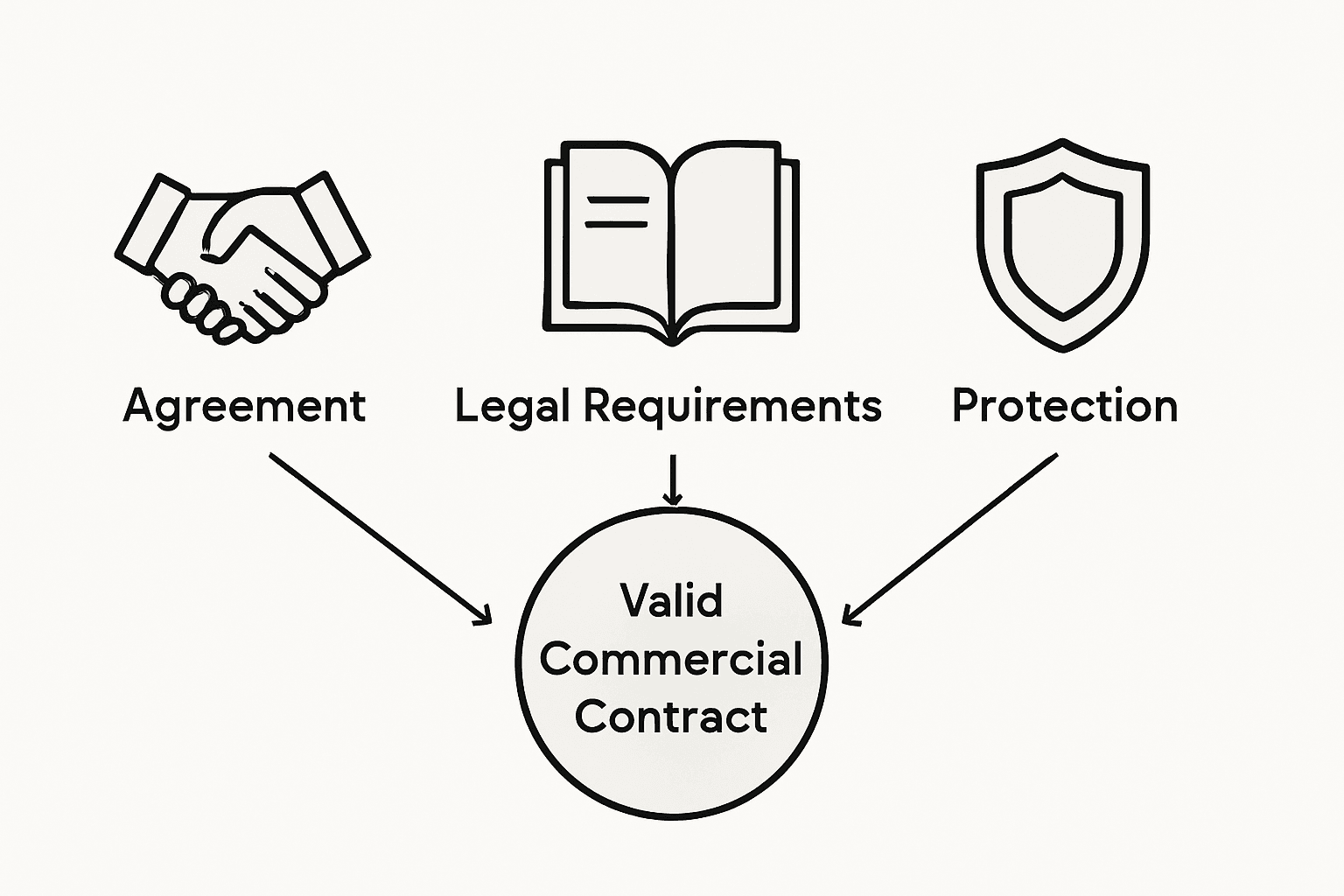
Pro Business Tip: Conduct thorough due diligence on all contracting parties and meticulously document every aspect of the agreement to strengthen the contract’s legal standing and minimise potential disputes.
Commercial contract law in the United Kingdom represents a sophisticated system of legal principles designed to regulate business interactions and protect organisational interests. Certainty in English law provides fundamental rules for judicial interpretation, ensuring consistent and predictable resolution of contractual disputes across various business scenarios.
The primary legal principles governing commercial contracts in the UK include:
Agency law forms a critical component of UK commercial legal frameworks, establishing essential rules that facilitate smooth business operations. This legal principle addresses the complex relationships between principals and their representatives, defining rights, responsibilities, and potential liabilities. Understanding these intricate legal mechanisms becomes crucial for businesses seeking to navigate the complex landscape of commercial interactions and minimise potential legal risks.
The table below compares key legal principles regulating UK commercial contracts:
| Legal Principle | Definition | Influence on Contracts |
|---|---|---|
| Common Law | Judge-made precedents | Guides contract interpretation |
| Statutory Regulation | Laws passed by Parliament | Imposes specific obligations |
| Duty of Good Faith | Requirement for honest dealings | Fosters trust and ethical conduct |
| Risk Allocation | Mechanism to share possible losses | Reduces legal and financial shocks |
| Remedies & Enforcement | Legal options after breaches | Enables rights protection and redress |
Pro Business Tip: Engage specialised legal counsel to conduct comprehensive contract reviews, ensuring alignment with current regulatory standards and identifying potential legal vulnerabilities before finalising any commercial agreements.
Commercial contracts establish a complex landscape of legal obligations and potential vulnerabilities for businesses operating in the United Kingdom. Good faith principles represent a critical examination of contractual interactions, demanding ethical conduct and transparent communication between parties.
Key rights and duties in commercial contracts encompass several fundamental aspects:
Contemporary commercial contract developments highlight evolving legal frameworks that increasingly recognise the nuanced nature of business relationships. Legal risks can emerge from various sources, including misrepresentation, breach of contract, negligence, and unintentional non-compliance with regulatory standards. Understanding these potential vulnerabilities becomes crucial for businesses seeking to mitigate legal exposure and maintain robust commercial relationships.
Pro Business Tip: Regularly conduct comprehensive contract audits to identify potential legal risks, ensuring proactive management of contractual obligations and minimising unexpected legal complications.
Navigating the complexities of commercial contracts is essential to safeguard your business interests in the United Kingdom. This article highlights crucial challenges such as ensuring lawful purpose, defining performance obligations, and managing legal risks like breach or misrepresentation. Clear contractual terms and expert handling of elements like offer, acceptance, and consideration are vital for securing enforceable agreements. At Ali Legal, we understand how these core elements underpin successful business operations and the importance of customised, precise contracts to prevent costly disputes.
Do not leave your commercial agreements to chance. Benefit from Ali Legal’s transparent and swift legal services that deliver straightforward advice tailored to your unique business needs. Our specialists are ready to guide you through drafting, reviewing, and negotiating your contracts to ensure every obligation and right is clearly articulated. Take the proactive step today. Contact us via our dedicated consultation page and protect your business with confidence. For comprehensive legal assistance across corporate, commercial law, and dispute resolution, see how Ali Legal can help you build stronger business relationships now.
The key elements of a commercial contract include offer and acceptance, consideration, legal capacity, genuine consent, lawful purpose, and certainty of terms.
Businesses can ensure the validity of their commercial contracts by clearly defining the terms, providing mutual consideration, and ensuring that all parties have the capacity to enter into the agreement.
Common types of commercial contracts include service contracts, supply agreements, non-disclosure agreements (NDAs), partnership contracts, employment contracts, and lease agreements.
Consulting a legal professional is essential to ensure comprehensive protection of business interests, alignment with regulatory requirements, and to navigate any complex legal language involved in contract drafting.
More than half of British businesses face legal disputes each year, yet many remain confused about what litigation lawyers actually do. Understanding their core role is crucial for any company navigating the high-stakes world of commercial conflict and risk. This guide breaks down the strategic expertise litigation lawyers provide, highlights common myths, and shows how their skills can make a decisive difference in protecting your business interests.
Litigation lawyers play a critical strategic role in resolving legal disputes for businesses, providing comprehensive legal representation and expert guidance through complex legal challenges. Litigation, known as dispute resolution, involves assisting with civil disputes that emerge from commercial transactions between companies or individuals, requiring specialised legal expertise.
At its core, a litigation lawyer’s primary responsibility is to represent and defend their client’s legal interests across various legal proceedings. Unlike transactional lawyers who focus on preventing legal issues, litigation lawyers are specialised legal professionals who step in when conflicts arise, developing strategic approaches to resolve disputes through negotiation, mediation, or courtroom proceedings. These legal professionals must possess exceptional analytical skills, comprehensive legal knowledge, and the ability to construct compelling arguments that protect their client’s interests.
Common misconceptions about litigation lawyers often centre around their perceived confrontational nature. While they are prepared to engage in courtroom battles, most skilled litigation lawyers prioritise efficient, cost-effective dispute resolution. A solicitor is a qualified legal professional who provides specialist advice and representation, which means their goal is not necessarily to escalate conflicts but to achieve the most advantageous outcome for their client through strategic legal manoeuvring.
Pro Expert Tip: Always select a litigation lawyer with proven experience in your specific industry and type of legal dispute, as sector-specific knowledge can significantly impact the effectiveness of legal representation and potential case outcomes.
The table below contrasts litigation lawyers and transactional lawyers, highlighting their distinct functions and business impact:
| Aspect | Litigation Lawyers | Transactional Lawyers |
|---|---|---|
| Main Focus | Dispute resolution after issues arise | Preventing disputes through agreements |
| Typical Activities | Negotiation, mediation, court representation | Drafting contracts, legal compliance advice |
| Business Impact | Mitigates losses and risk during conflicts | Facilitates deals and reduces future risk |
| Required Skills | Advocacy, analytical thinking, strategic argumentation | Attention to detail, forecasting, negotiation |
Litigation encompasses a wide range of legal disputes across various sectors, with businesses encountering multiple potential conflict scenarios that require strategic legal intervention. Civil cases are primarily handled through county courts, typically addressing critical commercial issues such as debt recovery, property repossession, personal injury claims, goods return, and insolvency proceedings.
In the United Kingdom, business litigation can be categorised into several key types, each requiring specialised legal expertise. Commercial disputes often emerge from contract breaches, partnership disagreements, intellectual property conflicts, and shareholder tensions. Competition law litigation presents two distinct action types: follow-on cases, where a competition authority has already identified an infringement, and stand-alone cases, which initiate proceedings without prior official determination.
Additionally, businesses may encounter litigation in areas such as employment law, where disputes can arise from wrongful termination, discrimination claims, contractual disagreements, or regulatory compliance challenges. Intellectual property litigation represents another significant domain, protecting companies’ innovative assets through trademark, patent, and copyright enforcement actions. Cross-border disputes are increasingly complex, involving international commercial transactions that require nuanced legal strategies and understanding of multi-jurisdictional regulations.
Pro Expert Tip: Proactively document all business interactions, communications, and agreements to build a robust evidence trail that can significantly strengthen your position in potential litigation scenarios.
Litigation lawyers manage a comprehensive range of responsibilities that extend across the entire legal process, requiring meticulous attention to detail and strategic planning. These legal professionals are responsible for guiding clients through complex legal challenges, from initial consultation to potential post-trial proceedings, with each stage demanding specific expertise and tactical approach.

The litigation process involves several critical stages where legal professionals play pivotal roles. Initially, lawyers conduct extensive preliminary investigations, gathering evidence, interviewing witnesses, and assessing the potential strengths and weaknesses of a case. Litigation attorneys are tasked with representing clients in court proceedings and negotiations, which requires exceptional communication skills, deep legal knowledge, and the ability to construct persuasive arguments. They must draft comprehensive legal documents, conduct rigorous legal research, and develop nuanced strategies that anticipate potential counterarguments.
As cases progress, litigation lawyers manage increasingly complex responsibilities. This includes managing extensive documentation, coordinating expert witness testimonies, preparing detailed legal briefs, and representing clients during mediation, arbitration, or court hearings. They must continuously analyse emerging evidence, adapt legal strategies in real-time, and provide clients with clear, realistic assessments of potential outcomes. Advanced litigation lawyers also handle post-trial procedures, such as filing appeals, negotiating settlements, or enforcing judgments, demonstrating their comprehensive role beyond the courtroom.
Pro Expert Tip: Maintain a comprehensive and organised digital case file with all communications, evidence, and legal documents to enable swift, efficient responses and strategic decision-making throughout the litigation process.
Lawyers are a critical part of a social system designed to deliver collective trust and confidence in legality, operating within a complex framework of legal and ethical responsibilities. These professionals serve as guardians of justice, challenging inappropriate uses of power and protecting citizens’ legal rights through rigorous adherence to professional standards and regulatory guidelines.
The legal framework governing litigation lawyers encompasses multiple layers of professional conduct and regulatory compliance. Solicitors must navigate intricate ethical boundaries, maintaining absolute confidentiality, avoiding conflicts of interest, and prioritising their clients’ best interests while simultaneously upholding the broader principles of justice. Expert witnesses must provide independent, objective assistance to the Court, rendering unbiased professional opinions even when financially instructed by a specific party. This requirement underscores the fundamental ethical obligation of maintaining professional integrity regardless of financial arrangements.
Legal professionals are bound by strict codes of conduct that extend beyond mere technical compliance. They must demonstrate unwavering commitment to professional ethics, which includes transparent communication, maintaining client confidentiality, managing potential conflicts of interest, and ensuring their actions consistently reflect the highest standards of professional behaviour. These ethical obligations require constant vigilance, professional judgment, and a commitment to preserving the integrity of the legal system, balancing individual client needs with broader societal responsibilities.
Pro Expert Tip: Regularly review and update your understanding of professional conduct rules, attending continuous professional development sessions to stay current with evolving ethical standards and legal expectations.
Civil litigation cases primarily handled by county courts encompass substantial financial and strategic risks that businesses must carefully navigate. Litigation represents a complex landscape where potential expenses extend far beyond immediate legal fees, potentially impacting a company’s financial stability, reputation, and long-term strategic objectives.
Businesses engaging in litigation face multifaceted financial challenges that require comprehensive risk assessment. Direct costs include legal representation fees, court expenses, expert witness testimonies, and potential settlement payments. Indirect costs are equally significant, involving potential business disruption, management time allocation, potential reputational damage, and opportunity costs associated with prolonged legal proceedings. Some litigation risks can be mitigated through strategic preparation, thorough documentation, and proactive legal counsel, but companies must remain aware that no legal strategy guarantees absolute protection.
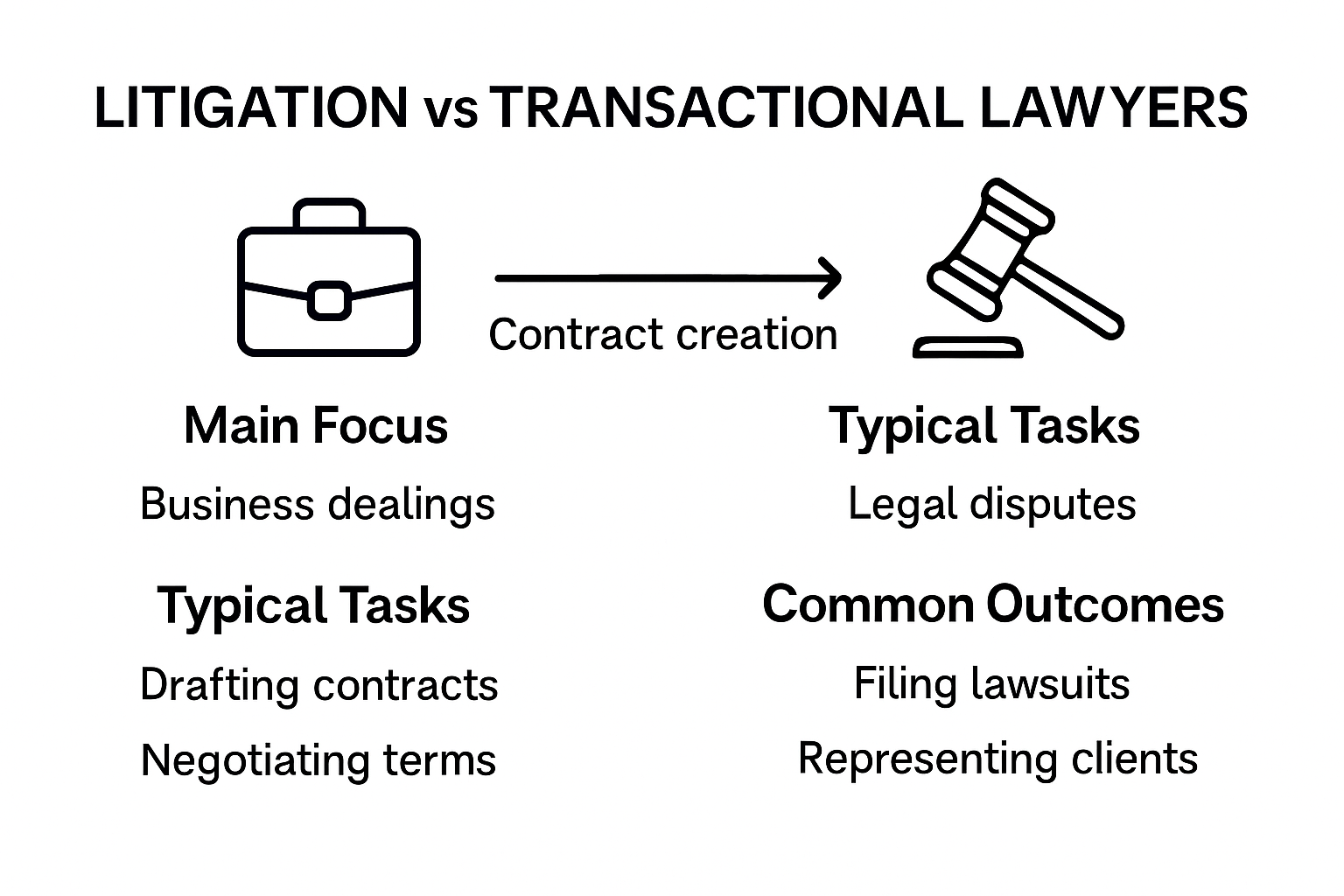
Here is a summary of common risks and costs associated with business litigation:
| Risk/Cost Type | Description | Potential Impact |
|---|---|---|
| Direct Costs | Legal fees, court charges, expert witnesses | Immediate financial outlay |
| Indirect Costs | Management time, business disruption | Reduced productivity, delayed projects |
| Reputational Risk | Public legal disputes may harm brand | Loss of client trust or market standing |
| Long-term Consequences | Unfavourable rulings, future liability | Lasting financial or operational setbacks |
Common pitfalls in litigation frequently emerge from inadequate preparation, poor documentation, and reactive rather than strategic approaches. Legal guidance should be considered informative but not definitive professional advice, highlighting the importance of obtaining specialised legal counsel tailored to specific circumstances. Businesses often underestimate the complexity of legal proceedings, failing to anticipate potential counterarguments, overlooking critical evidence, or miscalculating the potential long-term implications of their legal disputes. Successful litigation management requires a holistic approach that balances legal strategy, financial considerations, and potential reputational impacts.
Pro Expert Tip: Develop a comprehensive litigation risk management strategy that includes maintaining meticulous records, conducting regular internal audits, and establishing clear communication protocols with your legal representatives to minimise potential vulnerabilities.
Navigating complex legal disputes demands strategic guidance from experienced litigation lawyers who understand your industry and legal challenges. This article highlights the crucial role of litigation solicitors in resolving conflicts effectively while mitigating financial and reputational risks. If you seek clear, transparent advice combined with fast, strategic solutions to protect your business interests, Ali Legal provides trusted support every step of the way. Our client-centric approach ensures your case is handled with meticulous care and professionalism.
Discover how Ali Legal’s expert team can help you manage litigation risks with confidence. Explore essential insights and updates on legal disputes in our Uncategorized | Ali Legal section. When you are ready to take decisive action, reach out directly via our contact page for straightforward advice and fixed fees. Protect your business today with trusted legal representation from Ali Legal, where lasting client relationships and transparent communication come first. Learn more about our comprehensive services in the All | Ali Legal portfolio and start resolving your legal challenges now.
The primary role of a litigation lawyer is to represent and defend their client’s legal interests in various legal proceedings, developing strategic approaches to resolve disputes through negotiation, mediation, or courtroom actions.
Litigation lawyers focus on dispute resolution after issues arise, while transactional lawyers work to prevent disputes through drafting agreements and legal compliance advice.
Litigation lawyers handle a wide range of cases, including commercial disputes, employment law issues, intellectual property conflicts, and cross-border disputes, each requiring specialised legal expertise.
Common risks and costs include direct legal fees, court charges, management time allocation, reputational damage, and potential long-term consequences from unfavourable rulings, requiring thorough preparation and documentation.
Every british legal scholar knows international disputes are rarely straightforward. With over 190 nations and countless global organizations, cross-border legal conflicts are an everyday reality and their impact can be far-reaching. Understanding why these disputes erupt and how they are managed matters for anyone dealing with international law. This guide explains the core elements, types, and legal principles involved in international disputes so you can grasp the essentials without getting overwhelmed.
International disputes represent complex legal interactions between states, organisations, and entities operating across national boundaries. These conflicts emerge from diverse scenarios ranging from diplomatic disagreements to complex commercial controversies. Understanding their fundamental nature requires examining their structural components and potential manifestations.
At its core, an international dispute involves a disagreement between two or more parties from different sovereign jurisdictions. International incidents can arise from unexpected actions involving citizens, government officials, or armed units, highlighting the unpredictable nature of cross-border tensions. Such disputes may originate from commercial transactions, territorial claims, human rights violations, trade disagreements, or diplomatic misunderstandings.
Legal frameworks governing international disputes are intricate and multifaceted. The Max Planck Encyclopedia of Public International Law provides comprehensive insights into the legal principles that define how such conflicts are understood, managed, and potentially resolved. These frameworks typically involve multiple mechanisms including diplomatic negotiations, international arbitration, mediation, and potentially judicial proceedings through specialised international courts.
Key characteristics of international disputes include their potential for escalation, the complexity of jurisdictional challenges, and the need for nuanced diplomatic engagement. Parties must navigate intricate legal landscapes, considering factors such as sovereign immunity, international treaties, bilateral agreements, and established conventions that govern inter-state interactions. Successful resolution often requires strategic communication, comprehensive legal expertise, and a sophisticated understanding of international legal principles.

International disputes encompass a broad spectrum of conflicts that transcend national boundaries, challenging diplomatic relations and legal frameworks. International incidents can emerge from unexpected actions involving citizens, government officials, or armed units, demonstrating the complex and multifaceted nature of cross-border tensions.
Several primary categories of international disputes characterise global interactions. Territorial disputes represent significant challenges, often involving contested land or maritime boundaries between nations. These conflicts can escalate rapidly, potentially threatening regional stability and requiring intricate diplomatic negotiations. Commercial disputes constitute another critical category, arising from international trade disagreements, contract breaches, or investment conflicts that demand sophisticated legal resolution mechanisms.
The Max Planck Encyclopedia of Public International Law provides comprehensive insights into various dispute typologies, highlighting additional critical dispute categories. Diplomatic disputes frequently emerge from political disagreements, human rights concerns, or perceived violations of international protocols. Maritime disputes represent another complex domain, involving competing maritime claims, fishing rights, and naval territorial interpretations. Economic sanctions and trade-related conflicts also constitute significant international dispute categories, often reflecting broader geopolitical tensions.
Understanding these dispute categories requires recognising their interconnected and dynamic nature. While each type presents unique challenges, they share common characteristics: potential for escalation, complex jurisdictional considerations, and the necessity for nuanced, strategic resolution approaches. Successful management demands comprehensive legal expertise, diplomatic finesse, and a deep understanding of international legal frameworks.
International legal frameworks represent intricate systems designed to manage and resolve complex cross-border interactions. Dicey, Morris & Collins on the Conflict of Laws provides comprehensive insight into the fundamental principles governing international legal disputes, illuminating the sophisticated mechanisms that underpin global legal interactions.
Key governing principles in international dispute resolution encompass several critical domains. Jurisdictional rules determine which legal system has authority to hear a specific dispute, considering factors such as the location of parties, contract terms, and the nature of the conflict. Sovereign immunity represents another fundamental principle, protecting states from being sued in foreign courts without their consent. These principles ensure a structured approach to resolving international legal challenges, balancing the rights and responsibilities of different legal entities.
The British Yearbook of International Law offers scholarly analyses of evolving international legal norms, highlighting the dynamic nature of global legal frameworks. Critical governing principles include the doctrine of international comity, which promotes mutual respect between legal systems, and choice of law mechanisms that determine which national legal system will apply in cross-border disputes. Additional foundational principles encompass treaty interpretation, diplomatic resolution methods, and established international conventions that provide standardised approaches to conflict resolution.
Navigating these legal frameworks requires sophisticated understanding and strategic approach. Successful resolution of international disputes demands comprehensive knowledge of multiple legal systems, an appreciation of cultural and jurisdictional nuances, and the ability to interpret complex international legal instruments. Practitioners must demonstrate flexibility, diplomatic sensitivity, and a deep understanding of the intricate principles that govern cross-border legal interactions.
International dispute resolution involves a sophisticated array of methods designed to address complex cross-border conflicts efficiently and diplomatically. The Journal of International Dispute Settlement provides comprehensive insights into the theoretical and practical approaches of resolving international disputes, highlighting the nuanced strategies employed in global legal interactions.
Three primary dispute resolution mechanisms dominate international legal practice: arbitration, mediation, and litigation. Arbitration offers a structured, confidential process where neutral third-party arbitrators make binding decisions, allowing parties to resolve conflicts outside traditional court systems. Mediation provides a more collaborative approach, enabling parties to negotiate with the assistance of a neutral facilitator who helps identify mutually acceptable solutions. Litigation represents the most formal mechanism, involving judicial proceedings in national or international courts with legally enforceable judgments.
The Cambridge International Law Journal offers critical perspectives on emerging dispute resolution trends, revealing the evolving landscape of international conflict management. Additional sophisticated mechanisms include negotiation, conciliation, and hybrid dispute resolution approaches that combine multiple strategies. These methods often involve complex protocols, including standing tribunals, ad hoc tribunals, and specialised international courts such as the International Court of Justice and the Permanent Court of Arbitration.
Successful dispute resolution requires strategic selection of appropriate mechanisms, considering factors such as relationship preservation, cost-effectiveness, confidentiality requirements, and potential long-term implications. Practitioners must demonstrate deep understanding of cultural nuances, legal frameworks, and diplomatic sensitivities to navigate these intricate resolution pathways effectively.
International disputes present a complex landscape of multifaceted risks that extend far beyond immediate legal confrontations. The phenomenon of ‘disaggregation’ in international litigation reveals intricate challenges in managing cross-border legal interactions, demonstrating the nuanced nature of global legal conflicts.
Key risk categories in international disputes encompass financial, reputational, operational, and strategic dimensions. Financial risks include potential monetary losses from legal proceedings, arbitration costs, compensation payments, and potential business interruptions. Reputational risks involve potential damage to organisational or national standing, which can have long-lasting consequences in international business and diplomatic relations. Operational risks emerge from potential disruptions to business activities, supply chains, and international collaborations triggered by unresolved legal challenges.

International law contexts highlight the critical importance of understanding dispute implications across different scenarios, revealing the dynamic nature of legal liability. Strategic risks involve potential geopolitical consequences, including trade restrictions, diplomatic tensions, and broader economic impacts. Liability frameworks must consider multiple jurisdictional complexities, including sovereign immunity, transnational enforcement challenges, and varying legal interpretations across different national systems.
Navigating these risks demands sophisticated legal strategies, comprehensive risk assessment, and proactive management approaches. Successful organisations and legal practitioners must develop adaptive frameworks that anticipate potential challenges, implement robust mitigation strategies, and maintain flexibility in addressing the unpredictable nature of international legal disputes.
International disputes bring complex challenges such as jurisdictional issues, sovereign immunity, and the risk of costly financial and reputational consequences. If you are facing these uncertainties or seeking clarity on dispute resolution methods like arbitration or mediation, Ali Legal offers straightforward and strategic advice tailored to your unique situation. We understand the importance of clear communication and swift action when managing cross-border conflicts that impact your business or personal interests.
Let our experienced solicitors guide you through the intricate legal frameworks and help mitigate risks effectively. Benefit from our client-focused approach that emphasises transparency, fixed fees, and long-term relationship building to ensure peace of mind.
Take the next step today by consulting with our specialists who are well-versed in international legal disputes. Contact us to secure your interests with practical solutions delivered promptly and professionally. Visit Ali Legal Contact Us to begin your journey towards resolution. Discover how our services in International Disputes and broader Corporate and Commercial Law can support your needs with clarity and confidence.
International disputes in law are complex legal interactions that arise between parties, such as states and organisations, across national borders. They can stem from various issues, including territorial claims, commercial disagreements, and diplomatic misunderstandings.
Common types of international disputes include territorial disputes, commercial disputes, diplomatic disputes, maritime disputes, and conflicts arising from economic sanctions or trade disagreements. Each category poses unique challenges and requires tailored resolution approaches.
Legal frameworks for international disputes involve intricate systems that include jurisdictional rules, principles of sovereign immunity, and international treaties. These frameworks facilitate the resolution of disputes through mechanisms such as arbitration, mediation, and litigation.
Risks associated with international disputes encompass financial risks, reputational damage, operational disruptions, and strategic geopolitical challenges. Organisations must understand these risks to effectively manage and mitigate potential impacts on their operations and relations.
Most british businesses underestimate the complexity hidden in commercial contracts, yet a single overlooked clause can trigger severe legal and financial headaches. Understanding these agreements is crucial to protect your company’s interests and avoid costly disputes. This step-by-step guide lays out clear, practical actions that any british organisation can follow to improve contract quality, reduce risks, and build trust with partners.
Crafting successful commercial contracts begins with a comprehensive understanding of each party’s fundamental needs and strategic objectives. This crucial first stage requires meticulous communication and analytical thinking to establish a solid foundation for your legal agreement.
Start by scheduling comprehensive discovery meetings with all involved parties. During these discussions, aim to uncover not just surface level requirements but deeper strategic motivations. You’ll want to systematically document each party’s core business goals, performance expectations, potential constraints, and anticipated outcomes. Understanding business needs through pre-market engagement allows you to create more precise and mutually beneficial contractual frameworks.
To ensure clarity and precision, develop a structured approach to capturing objectives. Use the SMART framework (Specific, Measurable, Achievable, Relevant, Time-bound) to crystallise each party’s expectations. This methodology helps translate abstract aspirations into concrete contractual terms that provide legal certainty and operational clarity. Identifying objective-driven outcomes requires careful documentation and mutual agreement.
Warning: Rushing this initial assessment phase can lead to misunderstandings and potential disputes later. Take sufficient time to listen, probe, and validate each party’s perspectives before drafting any contractual language.
With a comprehensive understanding of needs and objectives established, you are now prepared to move into the next critical stage of contract drafting.
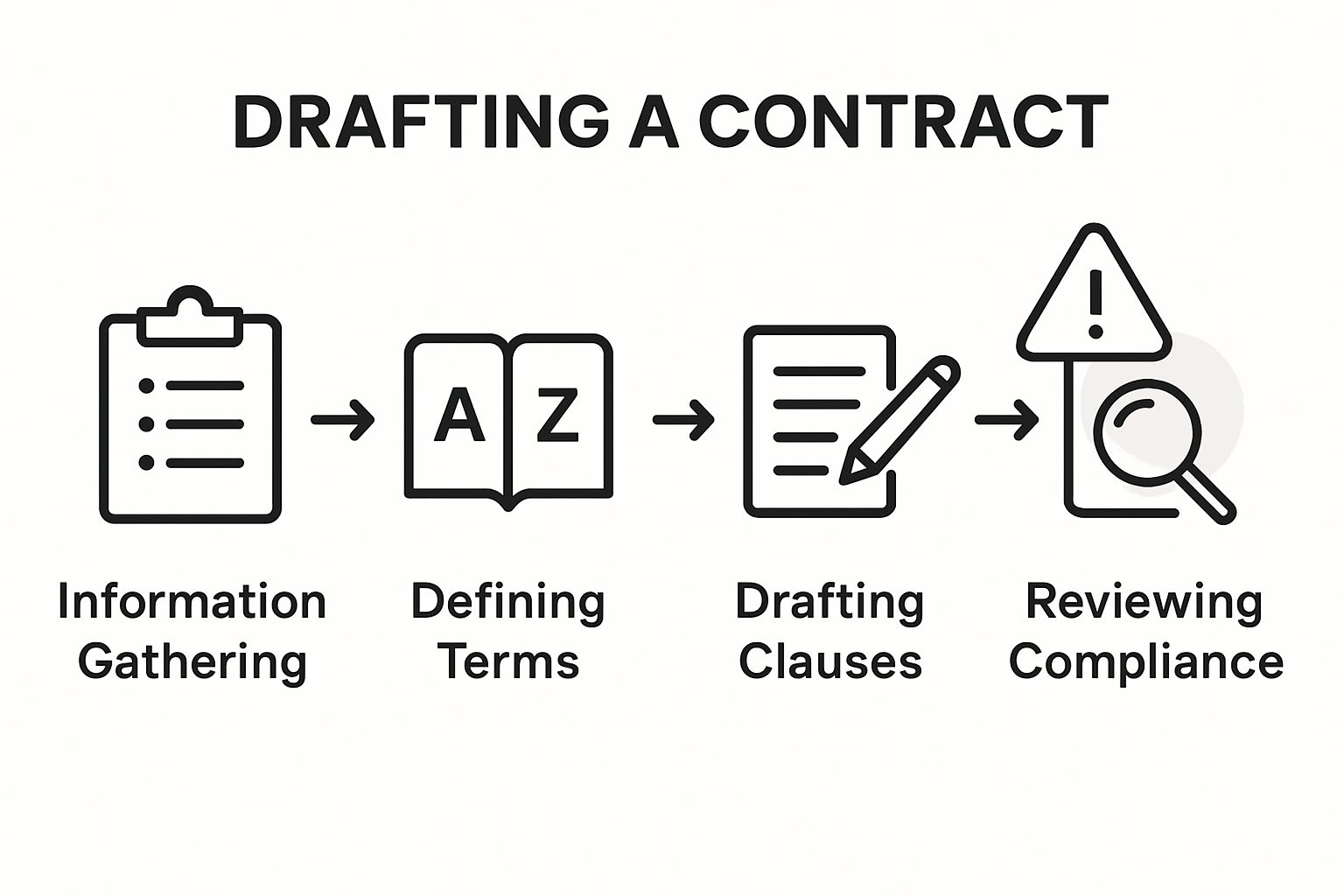
With an understanding of each party’s objectives, you now enter the critical phase of collecting comprehensive information and establishing precise contractual terminology. This stage transforms abstract discussions into concrete legal documentation that protects all parties’ interests.
Commence by creating an exhaustive information gathering checklist that covers all potential contractual dimensions. Request detailed documentation such as company registration papers, financial statements, operational capabilities, and relevant historical performance data. Writing fair contract terms requires transparency and clear communication about each party’s capabilities and limitations. Pay special attention to capturing specifics like delivery timelines, payment structures, quality standards, and performance metrics.
Next, focus on defining key contractual terms with surgical precision. Each term must be unambiguous and leave no room for misinterpretation. Drafting contracts that clearly define agreed terms is fundamental to creating legally enforceable agreements. Consider creating a dedicated glossary section within the contract that provides explicit definitions for technical terminology, industry specific language, and any potentially complex phrases.
Warning: Ambiguity is the enemy of good contracts. If a term could be interpreted multiple ways, rewrite it until its meaning is crystal clear.
With essential information gathered and key terms meticulously defined, you are prepared to progress towards structuring the formal contract framework.
With foundational information collected, you are now ready to transform your contractual blueprint into a robust legal document. This critical stage involves constructing precise clauses that define each party’s rights, responsibilities, and potential consequences for non performance.

Begin by systematically addressing fundamental contractual elements. Drafting key legal clauses for commercial contracts requires meticulous attention to specific components like warranties, indemnities, and limitation of liability provisions. Your clauses must comprehensively outline expected performance standards, delivery mechanisms, payment terms, and remedial actions in case of potential breaches. Consider creating separate sections for core obligations, ensuring each party understands their exact commitments and potential risks.
Next, focus on crafting nuanced obligation specifications that leave no room for ambiguity. Understanding the anatomy of contractual terms involves distinguishing between absolute and conditional obligations. Clearly delineate which actions are mandatory, which are discretionary, and what specific performance metrics constitute satisfactory fulfilment. Pay particular attention to creating realistic yet stringent language that protects your interests without appearing unnecessarily restrictive.
Warning: Generic boilerplate language can create significant legal vulnerabilities. Every clause must be tailored to your specific contractual context and potential scenarios.
With core clauses and obligations precisely articulated, you are prepared to review and refine the emerging contractual framework.
With your core contractual framework established, you now enter the critical phase of comprehensive legal risk assessment. This stage involves forensically examining every clause to ensure regulatory compliance, potential liability exposure, and alignment with broader legal standards.
Interpreting commercial contract terms requires a systematic approach to identifying potential legal vulnerabilities. Conduct a meticulous line by line review focusing on potential ambiguities, jurisdictional considerations, and potential scenarios where contractual interpretations might create unexpected legal consequences. Scrutinise each clause for potential misalignments with current regulatory frameworks, paying special attention to industry specific legal requirements that might not be immediately apparent.
Ensure that your contract meets fair contract term standards by evaluating the clarity, transparency, and accessibility of all provisions. This means assessing whether an independent third party could reasonably understand the obligations, rights, and potential consequences outlined in the document. Consider potential power imbalances between parties and ensure that the language does not inadvertently create unfair contractual conditions that could be challenged in legal proceedings.
Warning: A single overlooked clause can potentially expose your organisation to significant legal and financial risks. Always involve legal professionals in your final review process.
With your comprehensive legal compliance review completed, you are now prepared to refine and finalise the contractual documentation.
You have now reached the culmination of your contractual drafting journey where precision and strategic implementation will transform your carefully crafted document into a legally binding agreement. This final stage requires methodical attention to execution details and long term contract management.
Preparing comprehensive contract management arrangements involves more than simply obtaining signatures. Schedule a formal contract review meeting where all parties can collaboratively validate the final document, ensuring mutual understanding of every clause and commitment. Confirm that authorised signatories with appropriate legal standing are present and prepared to execute the contract. Create a detailed signing protocol that includes witnessing procedures, date and location specifications, and a systematic approach to document authentication.
Establish a robust contract governance framework that includes clear mechanisms for ongoing monitoring, performance tracking, and potential amendment processes. Develop a comprehensive storage and retrieval system for the executed contract that ensures secure preservation of original documents and enables quick access for authorised personnel. Create digital and physical backup copies, implement strict access controls, and maintain a detailed version control log to track any future modifications.
Warning: Contracts are living documents. Treat them as dynamic instruments that require periodic review and potential refinement based on changing business circumstances.
With the contract successfully executed and safeguarded, you have completed a comprehensive process of commercial contract drafting designed to protect your organisation’s interests.
Drafting commercial contracts that protect your business while ensuring legal certainty requires detailed attention to every clause and obligation. If you have faced challenges in defining clear terms, assessing risks, or ensuring full compliance, you are not alone. Many organisations struggle with ambiguity and potential legal vulnerabilities that can have costly consequences. Ali Legal specialises in transforming complex contract needs into straightforward, transparent agreements tailored to your specific goals and risk profile.
Explore our resourceful Uncategorized | Ali Legal section for insights into legal best practices and how to avoid common pitfalls.
Take control of your commercial contracts today by consulting with our dedicated legal experts. Benefit from fixed fees, clear advice, and long-term support that prioritises your business interests at every step. Visit Ali Legal Contact Us to connect directly with solicitors who understand your need for precision and certainty in contract drafting. Secure your peace of mind with professional guidance now.
Start by scheduling comprehensive discovery meetings with each party to understand their core business goals and performance expectations. Document each party’s needs carefully to ensure clarity in contractual agreements.
The SMART framework helps you establish Specific, Measurable, Achievable, Relevant, and Time-bound objectives for each party’s expectations. Use this framework to translate abstract goals into precise contractual terms that can be easily understood and enforced.
Define crucial terms such as payment structures, delivery timelines, and quality standards to eliminate ambiguity. Consider creating a glossary section within the contract to clarify any technical or industry-specific terminology for all parties involved.
Reviewing legal compliance and potential risk factors ensures that your contract aligns with applicable regulations and protects against legal vulnerabilities. Conduct a line-by-line assessment to identify potential ambiguities and ensure clarity in every clause before finalisation.
To ensure proper execution, hold a formal contract review meeting with all parties to validate the document before obtaining signatures. Develop a comprehensive contract governance framework for ongoing monitoring and secure storage to facilitate quick access and future amendments.
Avoid misunderstandings by drafting terms with surgical precision and using simple, unambiguous language. Review every term to ensure it cannot be interpreted in multiple ways, revising as needed until its meaning is crystal clear.
Nearly one in three British homeowners faces a boundary dispute at some point, highlighting how property lines can quickly turn simple neighbourly chats into complex legal headaches. For anyone living in the United Kingdom, these conflicts are more than a minor inconvenience since they can impact property values, relationships, and peace of mind. This guide sheds light on what drives these disagreements and reveals practical steps to protect your interests.
Neighbourhood boundary conflicts represent one of the most common yet complex legal challenges homeowners encounter. These disputes can transform friendly residential relationships into lengthy and expensive legal battles, often arising from unclear property lines or misunderstandings about land ownership.
Boundary disputes typically emerge when neighbours disagree about the precise location of property demarcation lines, which can involve fences, hedges, walls, or land usage rights. The UK Government provides critical guidance on boundary agreements to help property owners understand their legal standing and potential resolution pathways.
What Makes Boundary Disputes Complex
Property boundaries are rarely straightforward. Historic land records, incomplete documentation, and generations of informal agreements can create significant confusion. Surveyors often become crucial in these situations, meticulously measuring and documenting exact property lines using precise geographical measurements and legal land records.
Key Resolution Strategies
Before escalating to costly legal proceedings, consider these practical approaches:
The Civil Justice Council emphasises alternative dispute resolution methods as a cost-effective way to resolve conflicts without protracted court battles.
Preventative Measures
To minimise potential boundary disputes, maintain clear property documentation, respect existing boundary markers, and communicate openly with neighbours about any potential land use concerns. Proactive communication can prevent minor misunderstandings from escalating into significant legal challenges.
Remember that boundary disputes are rarely about winning but finding a mutually acceptable resolution that preserves neighbourly relationships and property rights.
A breach of contract represents a serious legal challenge where one party fails to fulfil their contractual obligations, potentially causing significant financial and operational disruptions for businesses. Understanding the nuances of contract breaches is crucial for protecting your commercial interests.
Understanding Contract Breach
Contract breaches occur when one party does not perform their promised duties as outlined in a legally binding agreement. These failures can range from minor technical violations to substantial omissions that fundamentally undermine the contract’s purpose. Commercial contract provisions help protect business interests by establishing clear expectations and potential remedies.
Types of Contract Breaches
Businesses encounter several distinct types of contract breaches:
The landmark case of Dickinson v Dodds (1876) demonstrates how contract law interprets offer and acceptance, establishing important precedents for understanding contractual obligations.
Practical Strategies for Prevention
To mitigate contract breach risks:
In complex commercial disputes, understanding legal frameworks becomes paramount. The St Albans City case highlights the importance of reasonable exclusion clauses in protecting business interests.
Resolution Approaches
When a breach occurs, businesses typically have three primary resolution pathways:
Successful contract management requires proactive monitoring, clear communication, and swift action when potential breaches emerge. Understanding your contractual rights and obligations is the first step in protecting your business interests.
Divorce and child custody disputes represent emotionally charged legal challenges that fundamentally reshape family dynamics and individual lives. These complex proceedings require careful navigation of legal frameworks while prioritising the welfare and emotional wellbeing of children involved.
Understanding Legal Complexities
Child custody cases extend far beyond simple legal determinations. They involve intricate assessments of parental capabilities, children’s psychological needs, and long term familial relationships. Comprehensive divorce law processes provide structured approaches to resolving these sensitive matters.
Key Considerations in Custody Determinations
Courts evaluate multiple critical factors when determining child custody arrangements:
UK Government guidance on divorce proceedings emphasises the paramount importance of children’s interests throughout legal processes.
Practical Strategies for Parents
To minimise emotional trauma and legal complications, parents should:
Resolution Pathways
Cafcass provides specialised support for families navigating separation, offering resources to help parents manage complex emotional landscapes during challenging transitions.
Successful custody arrangements emerge from collaborative approaches that centre children’s holistic development and maintain constructive parental relationships. Professional legal guidance can transform potentially adversarial processes into opportunities for cooperative co-parenting.
Personal injury claims represent a critical legal pathway for individuals seeking justice and financial recovery after experiencing harm caused by another party’s negligence or intentional actions. These claims serve as a fundamental mechanism for addressing physical, emotional, and financial damages sustained through accidents or misconduct.
Understanding Personal Injury Claims
Personal injury litigation encompasses a wide range of scenarios where individuals suffer harm due to external circumstances. Comprehensive personal injury claims processes provide structured approaches for seeking appropriate compensation and legal recourse.
Types of Personal Injury Claims
Individuals may pursue compensation across various domains:
Key Considerations in Compensation Claims
Successful personal injury claims require demonstrating several critical elements:
Practical Guidance for Claimants
To maximise potential compensation, injured parties should:
Personal injury litigation strategies provide essential frameworks for understanding complex legal processes and potential compensation pathways.
Compensation claims represent more than financial recovery. They embody a systematic approach to addressing personal harm, holding responsible parties accountable, and supporting individuals through challenging recovery periods.
Landlord and tenant disputes represent complex legal interactions that frequently emerge from misunderstandings, contractual ambiguities, and conflicting expectations about property occupation and maintenance. These conflicts can escalate quickly without proper understanding of respective rights and responsibilities.
Common Sources of Disputes
Tension between landlords and tenants typically arises from several key areas:
Tenants facing challenges with property repairs require clear strategies for addressing potential legal conflicts.
Legal Rights and Protections
Both parties possess specific legal protections:
Tenants have rights to:
Landlords can:
Dispute Resolution Strategies
Effective conflict management involves:
Commercial property law principles provide crucial frameworks for understanding complex rental relationships.
Successful landlord tenant interactions rely on mutual respect, clear communication, and a comprehensive understanding of legal obligations. Proactive management and transparent dialogue can prevent most potential disputes before they escalate into formal legal challenges.
Consumer rights represent a critical legal framework protecting individuals from substandard or defective product purchases. These protections ensure customers receive goods that meet reasonable quality, functionality, and durability standards expected at the point of sale.
Understanding Consumer Protection
Customers are legally entitled to products that:
Comprehensive guidance on addressing faulty goods provides essential strategies for consumers seeking resolution.
Consumer Rights Under UK Law
When purchasing goods, consumers have three primary remedies:
Practical Steps for Resolving Disputes
To effectively address faulty goods issues:
Successful consumer rights enforcement requires systematic documentation, clear communication, and understanding of legal protections. Consumers must act promptly and professionally when confronting product deficiencies to secure appropriate resolution.
Inheritance disputes represent emotionally charged legal challenges that can fracture family relationships and create complex financial complications. These conflicts typically emerge when estate distributions deviate from expected or intended outcomes.
Understanding Inheritance Complexities
UK Government rules of intestacy provide critical guidance for estate distributions when no formal will exists. Without proper legal documentation, families face significant uncertainty and potential conflict.
Common Inheritance Challenges
Disputes frequently arise from:
Legal Grounds for Challenging Inheritance
Individuals may contest inheritance through several legal mechanisms:
Proactive Estate Planning Strategies
To minimise potential disputes:
Comprehensive wills and probate planning can significantly reduce the likelihood of future legal challenges.
Successful inheritance management requires thoughtful preparation, open communication, and a comprehensive understanding of legal frameworks governing estate distributions.
Below is a comprehensive table summarizing various legal disputes and their resolution strategies discussed in the article.
| Topic | Description | Resolution Strategies |
|---|---|---|
| Boundary Disputes | Disagreements over property lines and demarcation involving fences, hedges, or land usage rights. | Communication, professional survey, mediation, legal consultation. |
| Breach of Contract | Legal challenge where a party fails to fulfil contractual obligations, causing financial disruption. | Detailed agreements, performance metrics, negotiation, mediation. |
| Divorce and Child Custody | Complex legal proceedings reshaping family dynamics, focusing on children’s welfare. | Respectful communication, mediation, prioritising child’s wellbeing. |
| Personal Injury Claims | Legal pathway for compensation due to harm from negligence or intentional actions. | Immediate medical assessment, documentation, legal consultation. |
| Landlord-Tenant Disputes | Conflicts from misunderstandings in property occupation and maintenance responsibilities. | Documenting communications, understanding agreements, mediation. |
| Consumer Rights | Legal framework ensuring product quality, functionality, and durability. | Document defects, retain receipts, written communication, mediation. |
| Inheritance Challenges | Disputes over estate distributions, often due to contested wills or unequal asset distribution. | Clear will, regular updates, family communication, professional mediation. |
Facing civil disputes like boundary disagreements, contract breaches or personal injury claims can be overwhelming and emotionally draining. This article highlights common challenges such as unclear property lines, contractual obligations not met, or the complexities of family law and compensation claims. These situations often require clear legal guidance to prevent costly delays and preserve valuable relationships.
Experience strategic support tailored to your needs:
Secure your peace of mind by exploring our Uncategorized | Ali Legal page for more insights.
Do not let confusion or delays compromise your legal rights. Contact Ali Legal today for straightforward advice and reliable solutions. Take the first step now by visiting our contact page to schedule a consultation and protect your interests effectively.
Civil disputes can arise from various situations, including boundary disputes between neighbours, breach of contract issues in business deals, and disagreements over child custody in divorce cases. Identify the type of dispute you are facing to better understand your rights and options for resolution.
Start by communicating directly with your neighbour to discuss the issue and seek a mutual understanding. If this does not resolve the matter, consider hiring a professional surveyor to clearly define property lines.
If you suspect a breach of contract, first review the agreement to confirm the specifics of the obligations. Then, attempt to negotiate a resolution with the other party before considering legal action, which can be more complex and costly.
To minimise conflict, communicate respectably with your co-parent and focus on the children’s best interests. Prioritise mediation to settle differences amicably before resorting to court proceedings, which can be emotionally taxing for all parties involved.
Seek medical attention immediately for your injuries and document the incident thoroughly, including photographs and witness statements. Then, consult with a legal professional to explore your options for pursuing a compensation claim within the appropriate timeframe.
Document the defects and maintain your original purchase receipt when addressing issues with faulty products. Communicate your complaints formally to the seller and request an appropriate remedy, such as a repair or refund, to protect your consumer rights.
Most british clients underestimate the sheer amount of paperwork required for a single legal consultation. Missing even one vital document can slow progress and weaken your case. Whether you are dealing with family law, contracts, or criminal matters in the United Kingdom, being thoroughly prepared allows your solicitor to deliver precise advice and strategy from day one. This guide shows you how to gather, organise, and present exactly what is needed for a strong legal start.
Preparing the right documentation is crucial for a successful legal consultation. Your solicitor will need comprehensive evidence to evaluate and strategise your case effectively. The goal is to compile a clear, organised collection of documents that tell your complete legal story.
Start by collecting all relevant paperwork systematically. This includes official court records and legal documentation that directly relate to your specific legal matter. Personal identification documents, contracts, correspondence, financial statements, medical records, police reports or incident logs are typically essential. Arrange these chronologically and make copies to ensure your originals remain intact.
A critical tip is maintaining absolute document integrity. Ensure all papers are legible, undamaged and properly authenticated. If certain documents are challenging to obtain, consult your solicitor about proper acquisition methods. Your thorough preparation demonstrates professionalism and helps your legal representative build a robust case strategy from the outset.
In the next step, you will learn how to review and organise these gathered documents for maximum legal effectiveness.
Successful legal strategies begin with a precise understanding of your case’s core challenges. Your objective in this stage is to distil complex circumstances into clear, actionable legal issues that will guide your solicitor’s approach.
Carefully analyse your collected documents to establish consultation objectives and prevent information duplication. Identify the primary legal questions at the heart of your situation. These might involve contractual disputes, personal injury claims, property disagreements, or potential legal breaches. Examining legal precedents and case citations can help you understand how similar legal scenarios have been resolved historically.
A strategic approach involves ranking these issues by their potential impact and urgency. Consider which problems could have the most significant legal or financial consequences. Some matters may require immediate attention while others can be addressed more incrementally. By presenting a clear hierarchy of issues to your solicitor, you enable more focused and efficient legal representation.
With your key issues now identified and prioritised, you will next prepare a concise summary to discuss during your initial legal consultation.
Creating a strategic list of questions is crucial for maximising the effectiveness of your initial legal consultation. Your goal is to communicate your legal concerns clearly and efficiently, ensuring your solicitor comprehends the nuances of your situation.

Providing relevant information to inform legal discussions requires thoughtful preparation. Structure your questions to address specific legal aspects of your case. Begin by drafting clear open ended inquiries that explore potential legal strategies, potential outcomes, probable timelines, and estimated costs. Focus on extracting practical insights rather than overwhelming your solicitor with excessive details. Legal research platforms can help refine your understanding of potential questions before your consultation.
A critical tip is to prioritise your questions by importance and complexity. Start with fundamental legal issues and progress to more nuanced concerns. Write your questions concisely using straightforward language avoiding legal jargon. Consider grouping related questions together to facilitate a more organised discussion. By presenting a well structured set of queries, you demonstrate professionalism and help your solicitor provide more targeted advice.
With your questions prepared, you are now ready to schedule and attend your initial legal consultation with confidence.
Compiling a comprehensive and well structured portfolio of personal and financial documents is essential for supporting your legal case. Your objective is to create a clear and accessible record that provides your solicitor with a complete picture of your circumstances.
National archival resources offer guidance on maintaining important personal records. Gather critical documents including bank statements, tax returns, payslips, property deeds, insurance policies, identification documents, and any correspondence relevant to your legal matter. Arrange these chronologically and create both digital and physical copies. Ensure sensitive documents are secured and password protected when digitised.
Legal precedent collections can help you understand the type of documentation required for different legal scenarios. Group your documents into logical categories such as financial evidence, personal identification, communication records, and case specific materials. Use clear folder labels or digital file names to make retrieval straightforward. Include a brief summary or index to help your solicitor quickly navigate through the information.
With your documents meticulously organised, you are now prepared to present a comprehensive overview during your initial legal consultation.
The final stage of preparation involves a systematic and thorough review of all documents and information you have gathered. This critical step ensures that your legal consultation will be as productive and efficient as possible.
Consultation preparation requires comprehensive evaluation of your materials to guarantee completeness and accuracy. Methodically go through each document checking for legibility, relevance, and comprehensiveness. Verify that all personal details are current and correctly spelled. Remove any outdated or irrelevant documents that might confuse your solicitor. Create a clear table of contents or index to help your legal representative quickly navigate your materials.
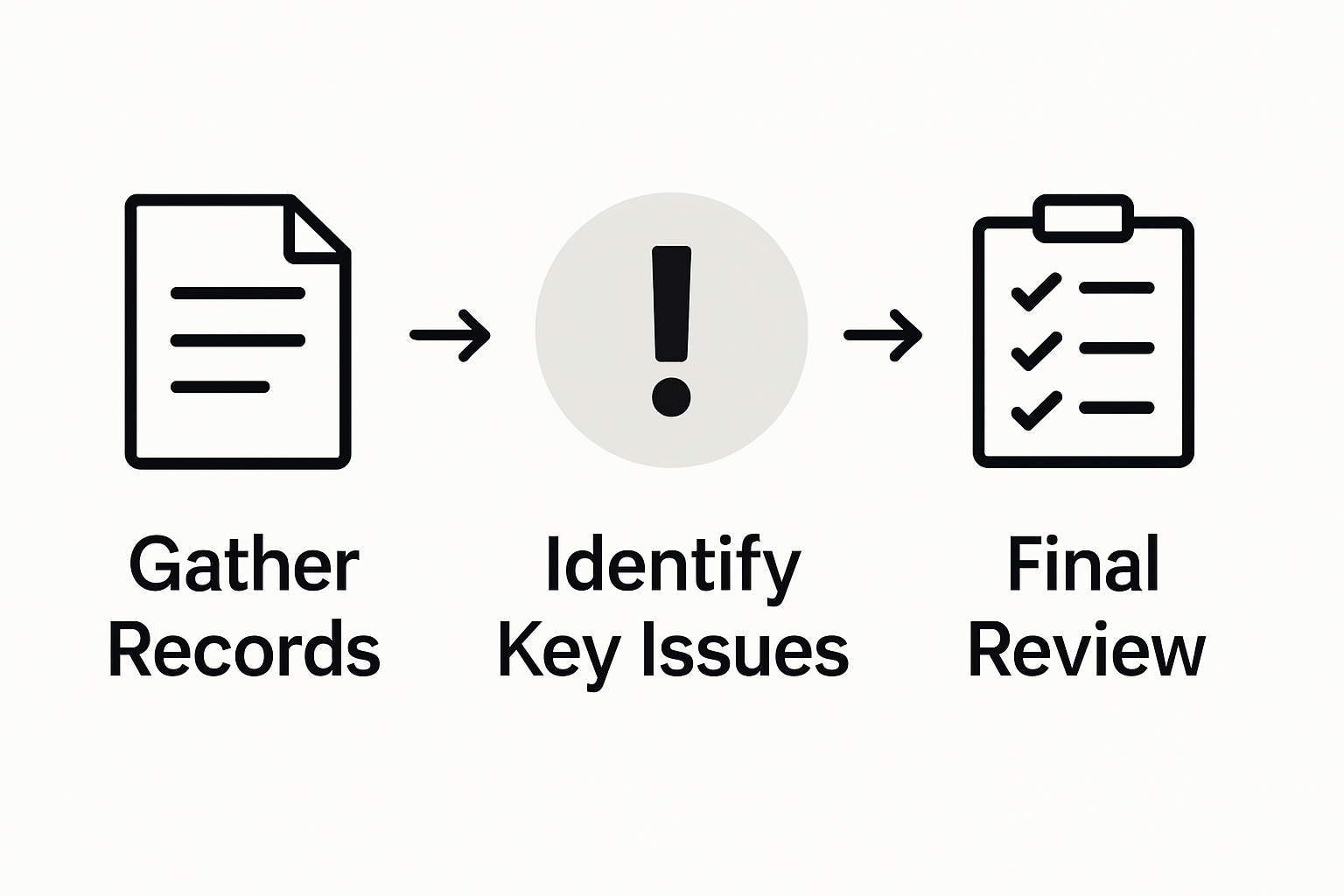
Digital research tools can assist in verifying the accuracy of legal documentation. Cross reference your documents with any original sources and ensure all copies are clear and readable. Make digital backups of your physical documents and consider password protecting sensitive files. Check that you have included all relevant financial statements, identification documents, correspondence, and case specific materials. A final review from an objective perspective can help identify any potential gaps or areas that require additional information.
With your materials thoroughly reviewed and confirmed, you are now fully prepared to engage in a productive legal consultation.
Navigating the complexities of legal consultation preparation requires precision and clear organisation, as outlined in our Legal Consultation Preparation Guide for Successful Outcomes. Key challenges such as gathering essential documents, prioritising legal issues and structuring concise questions can be overwhelming. Ali Legal understands these pain points and offers a client-centred approach that emphasises straightforward advice, fixed fees and transparent communication. Whether you are facing civil litigation, property disputes or international matters, our experienced solicitors help turn your thorough preparation into a strategic advantage.
Take control of your legal journey today by consulting with Ali Legal. Benefit from targeted expertise designed to expedite your case and clarify complex legal processes. Do not let uncertainty delay your progress. Contact us now to schedule your consultation and access tailored legal solutions supported by clear guidance and long-term commitment at Contact Ali Legal. Explore more insights and resources relevant to your needs at our All Articles page.
To gather essential documents, compile all relevant paperwork such as court records, identification, contracts, and any evidence related to your case. Organise these documents chronologically and ensure you have clear copies for your solicitor.
Before your consultation, identify the primary legal issues related to your case, such as contractual disputes or personal injury claims. Prioritise these issues by their urgency and potential impact to facilitate focused discussions with your solicitor.
Prepare concise, open-ended questions that address your legal concerns, potential strategies, and likely outcomes. Start with fundamental questions before advancing to more complex ones, using straightforward language to communicate your needs effectively.
Organise your financial and personal information by gathering relevant documents such as bank statements, tax returns, and correspondence related to your legal matter. Create logical categories and label them clearly to help your solicitor navigate through your materials easily.
Review your prepared materials by checking each document for legibility, relevance, and completeness. Ensure all personal details are current and create a clear index to facilitate easy access during your consultation.
To ensure productivity, thoroughly prepare by gathering all necessary documentation, identifying key issues, and crafting strategic questions for your solicitor. Present your organised materials clearly to allow for a focused discussion on your legal matters.
A surprising 44 percent of British clients admit they have felt confused by unclear legal advice at some point. This confusion can lead to costly mistakes or missed opportunities when navigating the legal system. Understanding what sets clear, strategic legal guidance apart helps both individuals and businesses make smarter decisions, avoid disputes, and feel confident in their legal partnerships. Discover why clarity in legal communication remains a cornerstone of successful outcomes for every British client.
Legal advice represents far more than a simple transaction between a solicitor and client. It is a strategic communication process designed to guide individuals and businesses through complex legal landscapes with precision and clarity. Precise language and communication standards form the foundation of effective legal counsel, enabling clients to understand their rights, potential risks, and recommended courses of action.
Clear legal advice fundamentally involves demystifying intricate legal processes by transforming complex legal terminology into accessible language. Solicitors who excel in this domain break down sophisticated legal concepts into straightforward explanations, ensuring clients comprehend the nuances of their specific situation. Consumer research consistently demonstrates that transparency in legal communication directly correlates with client satisfaction and successful outcomes.
The value of clear legal advice extends beyond mere comprehension. It serves multiple critical functions that protect clients’ interests:
Ultimately, clear legal advice transforms a potentially intimidating legal experience into a collaborative, empowering process that respects the client’s need for understanding and strategic support.
Legal advice encompasses a diverse range of specialisations, each designed to address specific client needs and legal challenges. Regulated legal advisers in England and Wales offer distinct services tailored to complex and nuanced legal requirements, ensuring clients receive targeted professional support across various domains.
The landscape of legal professionals is rich and multifaceted. Professionals such as solicitors, barristers, mediators, and arbitrators each bring unique expertise to legal consultations. Solicitors typically provide comprehensive legal advice and representation, handling everything from property transactions to civil litigation. Barristers specialise in courtroom advocacy and offer expert opinions on complex legal matters, while mediators focus on resolving disputes through negotiation and alternative dispute resolution techniques.
Key types of legal advice include:
Understanding these diverse legal advice categories empowers clients to seek precisely targeted professional support, ensuring their specific legal needs are comprehensively addressed with expert precision.
Legal clarity is not merely a communication technique, but a fundamental strategy that directly influences case resolution and client success. Precise language and grammatical precision in legal documentation serve as critical tools for preventing potential disputes and ensuring mutual understanding between parties.

Communication transparency fundamentally transforms legal proceedings by reducing ambiguity and potential misinterpretation. Consumer research consistently demonstrates that clients who receive clear, straightforward explanations experience higher satisfaction rates and more positive legal outcomes. This clarity empowers clients to make informed decisions, understand potential risks, and actively participate in their legal journey.
Key mechanisms through which clarity shapes legal outcomes include:
Ultimately, clarity acts as a strategic instrument that transforms complex legal challenges into navigable pathways, enabling more efficient, predictable, and satisfactory resolution of legal matters.
Professional responsibilities in legal practice create a sophisticated ecosystem of mutual expectations and ethical obligations. Solicitors bear significant professional responsibilities that extend far beyond simple legal representation, requiring comprehensive commitment to client interests, ethical conduct, and high-quality legal service delivery.
Clients and solicitors share a collaborative relationship with distinct yet interconnected responsibilities. Regulated legal advisers operate under strict professional guidelines that mandate transparent communication, competent service, and adherence to ethical standards. While solicitors must provide expert guidance, clients simultaneously bear responsibility for providing accurate information, maintaining open communication, and actively participating in their legal proceedings.
Key responsibilities for each party include:
Solicitor Responsibilities:
Client Responsibilities:
Successful legal outcomes emerge from a partnership of mutual respect, transparent communication, and shared commitment to achieving the client’s legal objectives.
Ambiguous legal language in contract drafting represents a significant risk that can transform routine legal matters into complex and costly disputes. Imprecise terminology, unclear clauses, and vague language create potential legal vulnerabilities that can undermine the entire foundation of legal agreements, exposing clients to unexpected financial and legal consequences.
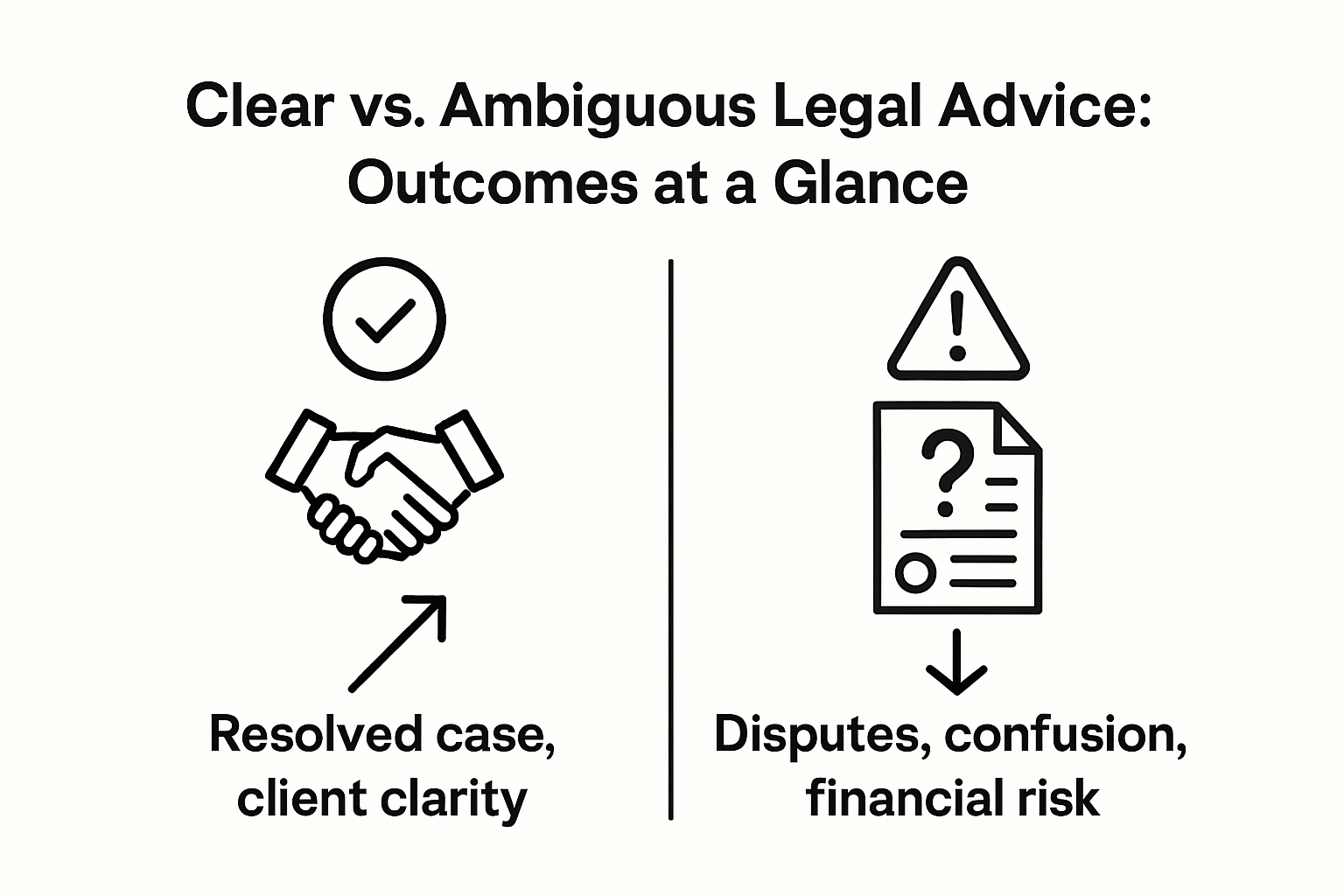
Consumer research consistently demonstrates that unclear legal advice generates substantial client dissatisfaction and increases the probability of adverse outcomes. Ambiguity introduces multiple potential risks, including misinterpretation of legal obligations, unintended contractual consequences, and heightened potential for litigation.
Key risks associated with ambiguous legal advice include:
Navigating legal complexities requires precision, clarity, and a commitment to transparent communication that eliminates potential sources of misunderstanding and protects clients’ fundamental interests.
Struggling with ambiguous legal advice and unclear communication can lead to costly disputes and frustration. This article highlights how clarity and precise language directly impact legal outcomes by reducing risk and empowering you to make informed decisions. At Ali Legal, we understand how vital transparent communication is to protecting your interests whether you face civil litigation, property issues, or immigration matters. Our client-focused approach offers straightforward advice, fixed fees, and prompt responses tailored to your unique needs.
Discover a legal service that values clear communication and strategic support. Explore insights and solutions at Uncategorized | Ali Legal and browse our comprehensive resources in All | Ali Legal to learn more. When you are ready, take the next step and reach out to us through Ali Legal Contact. Secure your peace of mind by engaging solicitors who put clarity and your legal success first.
Clear legal advice is crucial as it helps clients understand their rights, potential risks, and the legal processes they are navigating. It fosters informed decision-making and can prevent costly misunderstandings or disputes.
Effective communication ensures that legal concepts are clearly understood, reducing ambiguity. This transparency can lead to higher client satisfaction and more favourable legal outcomes by empowering clients to make informed choices.
Solicitors have a duty to provide competent and professional legal advice, maintain confidentiality, communicate clearly, and protect their clients’ interests while avoiding conflicts of interest.
Ambiguous legal advice can lead to significant risks, including financial exposure, legal uncertainty, reputational damage, compliance challenges, and reduced ability to make informed decisions. Such ambiguity can transform straightforward legal matters into complex disputes.
Most british businesses now turn to arbitration instead of lengthy court battles, with studies showing that over 80 percent of major commercial disputes in the United Kingdom are handled this way. This growing trend reflects a wider shift in how legal conflicts are handled, prioritizing privacy, efficiency, and flexibility over traditional litigation. Understanding arbitration’s true nature and the misconceptions surrounding it helps parties protect their interests in a system where clear rules and expert decision-makers set the standard.
Arbitration represents a sophisticated alternative dispute resolution mechanism where conflicting parties agree to resolve legal disagreements outside traditional court systems. Unlike litigation, which follows rigid judicial processes, arbitration offers a more flexible, private approach to conflict resolution.

Many individuals misunderstand arbitration’s fundamental characteristics. Contrary to popular belief, arbitration is not simply an informal negotiation, but a structured legal process with specific procedural rules. Understanding arbitration’s nuanced framework requires recognising several key distinctions from standard court proceedings.
Arbitration typically involves three primary components: an impartial arbitrator, a mutually agreed legal framework, and a binding decision. Parties select a neutral third-party professional with expertise relevant to their specific dispute, who then evaluates evidence and renders a decision. This approach provides several strategic advantages:
Common misconceptions about arbitration often stem from limited understanding of its legal mechanics. Some individuals erroneously believe arbitration decisions lack enforceability or are merely suggestions. In reality, arbitration outcomes are legally binding and can be implemented through court systems, providing robust mechanisms for dispute resolution that protect both parties’ interests.
Arbitration in the United Kingdom encompasses several sophisticated dispute resolution approaches, each designed to address specific legal contexts and industry requirements. Specialist arbitration forms play a crucial role in providing targeted resolution mechanisms across diverse sectors.
Two primary classifications dominate the arbitration landscape: institutional arbitration and ad hoc arbitration. Institutional arbitration involves predefined procedural rules established by recognised bodies, such as the London Court of International Arbitration (LCIA). These structured frameworks provide comprehensive guidelines for dispute resolution, ensuring consistency and professional management.
Key types of arbitration in the UK include:
Ad hoc arbitration offers greater flexibility, allowing parties to design custom procedural rules tailored to their specific dispute. This approach enables more personalised resolution strategies, particularly useful in complex or unique legal scenarios where standard institutional frameworks might prove restrictive. Parties can negotiate every aspect of the arbitration process, from selecting arbitrators to determining procedural timelines, making it an attractive option for sophisticated legal practitioners seeking bespoke dispute resolution mechanisms.
Comprehensive arbitration procedures follow a structured approach that transforms complex legal conflicts into manageable resolution pathways. The process begins with mutual agreement, where conflicting parties voluntarily commit to resolving their dispute through arbitration instead of traditional court litigation.
The initial stage involves critical preparatory steps. Parties must first draft a detailed arbitration agreement specifying the scope of their dispute, selecting an appropriate arbitrator with relevant expertise. Financial institutions and legal practitioners carefully navigate these procedural considerations to ensure a fair and efficient resolution mechanism.
The arbitration process typically unfolds through these sequential stages:
Initial Agreement Preparation
Preliminary Hearing
Evidence Presentation
Arbitration Hearing
Award Deliberation
The final arbitration award represents a legally binding resolution that can be enforced through court systems. This approach offers parties a confidential, efficient alternative to traditional litigation, providing a structured yet flexible mechanism for dispute resolution that preserves professional relationships and minimises unnecessary legal confrontations.
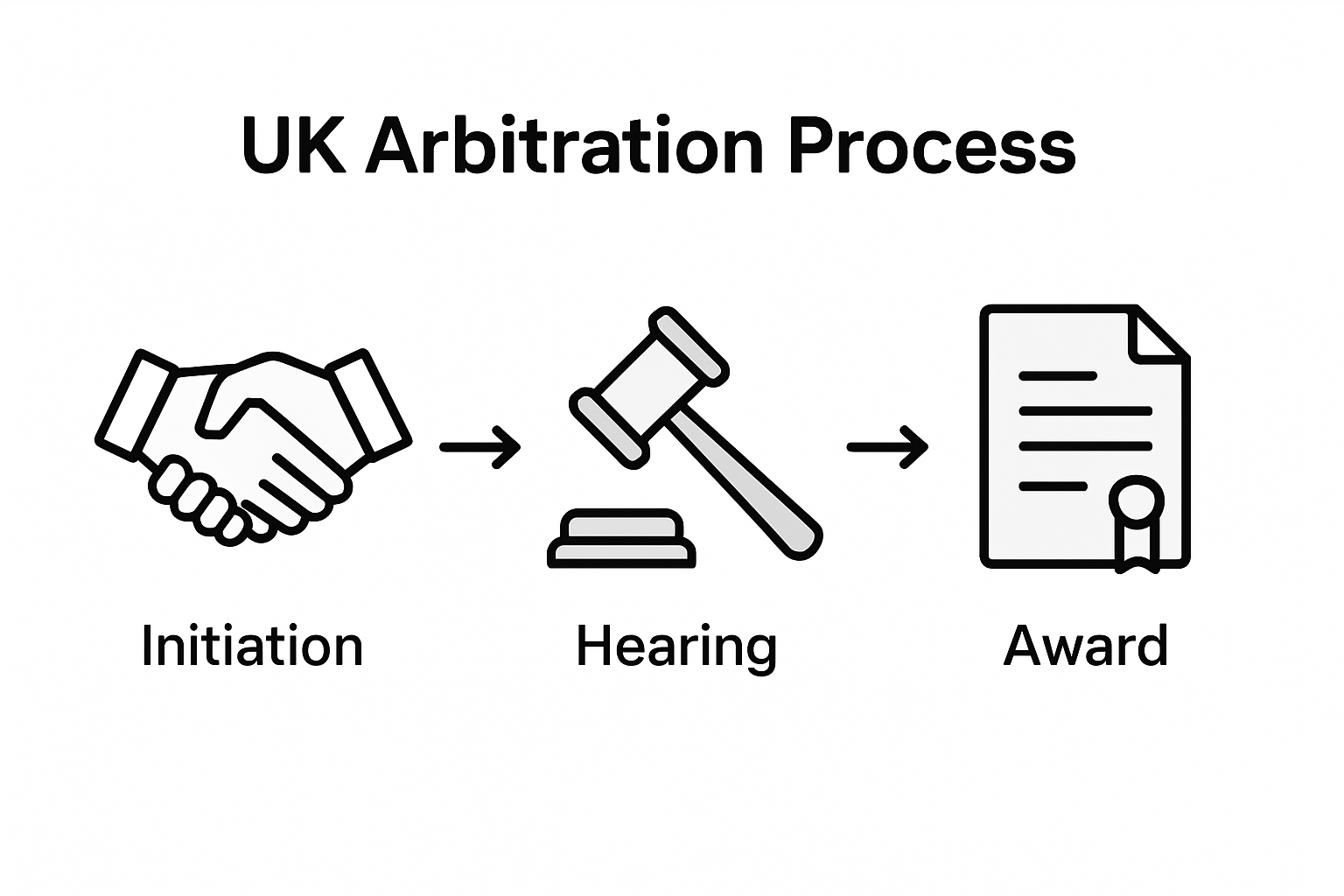
International commercial arbitration jurisdictional frameworks in the United Kingdom represent a sophisticated legal ecosystem designed to provide robust dispute resolution mechanisms. The primary legislative foundation is the Arbitration Act 1996, which establishes comprehensive guidelines for conducting arbitration proceedings and ensuring fair, efficient dispute resolution across various sectors.
The legal principles governing arbitration in the UK are built upon several fundamental pillars: party autonomy, procedural fairness, and judicial non-interference. Party autonomy allows disputants significant flexibility in designing their arbitration process, enabling them to select arbitrators, determine procedural rules, and choose applicable legal standards. This principle ensures that parties retain substantial control over their dispute resolution strategy.
Key governing principles of UK arbitration include:
The UK legal system supports arbitration through a supportive judicial framework that respects arbitral tribunal decisions while maintaining oversight to prevent potential procedural misconduct. Courts may intervene only in limited circumstances, such as addressing serious legal errors or protecting fundamental procedural rights. This balanced approach reinforces the UK’s reputation as a premier global destination for international dispute resolution, offering businesses a reliable, sophisticated mechanism for resolving complex legal challenges efficiently and professionally.
Financial institutions carefully analyse arbitration risks and benefits before engaging in dispute resolution processes. Understanding the intricate balance between potential rights, inherent risks, and financial implications is crucial for making informed decisions about pursuing arbitration.
Parties entering arbitration retain fundamental procedural rights that protect their interests throughout the resolution process. These rights include selecting impartial arbitrators, presenting comprehensive evidence, challenging potential conflicts of interest, and requesting reasoned decisions. The ability to choose specialised arbitrators with industry-specific expertise provides a significant advantage over traditional court proceedings, enabling more nuanced and technically informed dispute resolution.
Key financial and procedural considerations include:
Direct Cost Implications
Potential Financial Risks
Strategic Rights
While arbitration often proves more cost-effective than prolonged litigation, parties must carefully assess potential financial exposures. Comprehensive risk assessment involves evaluating potential award sizes, understanding potential enforcement limitations, and calculating comprehensive cost structures. Sophisticated parties typically conduct detailed cost-benefit analyses, considering not just immediate financial implications but also long-term strategic outcomes and potential reputational impacts of different dispute resolution approaches.
Understanding arbitration in the United Kingdom can feel complex, especially when faced with critical decisions about binding awards, procedural fairness, and selecting skilled arbitrators. The challenges include managing costs, ensuring confidentiality, and enforcing awards while protecting your legal rights. Whether you are involved in commercial, maritime, or international arbitration, having clear, straightforward legal advice is essential to protect your interests and achieve swift resolution.
Ali Legal specialises in guiding individuals and businesses through these nuanced arbitration processes. With expertise in corporate and commercial law and international dispute resolution, we provide transparent, fixed-fee services that clarify your options and reduce uncertainty.
Take control of your arbitration journey today. Contact Ali Legal to receive strategic, speedy, and transparent legal solutions tailored to your case. Don’t let arbitration risks or complexity hold you back. Start with a trusted partner by reaching out here Contact Us and secure expert guidance now.
Arbitration is a formal alternative dispute resolution process where parties agree to resolve legal disputes outside traditional court systems, often with the help of a neutral third-party arbitrator.
The arbitration process typically involves preparing an agreement, conducting a preliminary hearing, exchanging evidence, holding an arbitration hearing, and finally receiving a binding arbitration award from the arbitrator.
Arbitration offers several advantages, including faster resolution times, greater confidentiality, lower costs, flexibility in decision-making, and the ability to choose experts for specific disputes.
Yes, arbitration outcomes are legally binding and enforceable through court systems, ensuring that the decisions made by arbitrators have significant legal weight.
Most people in the United Kingdom admit that choosing a british solicitor can feel confusing, especially when facing a stressful legal situation. The right legal support makes a difference whether you need guidance on property, family matters, or business disputes. With more than 145,000 solicitors practicing across England and Wales, understanding how to find the best match for your specific needs will help you move forward with greater confidence and clarity.
Choosing the right solicitor begins with understanding your specific legal requirements. This initial step involves carefully assessing the precise legal challenge you are facing and clarifying your desired outcomes.
Start by identifying the exact nature of your legal issue. Solicitors offer services across a wide range of legal areas, which means pinpointing your specific need is crucial. Are you dealing with a property transaction, seeking a divorce, requiring business advice, or needing representation for a court matter? Each legal scenario demands specialised expertise.
To effectively define your objectives, break down your legal challenge into clear, actionable goals. For instance, if you are buying a property, your objectives might include completing the purchase smoothly, ensuring all legal documentation is correct, and protecting your financial interests. If pursuing a business matter, you might want to clarify contract terms, resolve a dispute, or obtain strategic legal guidance.
Practical tip: Write down your legal needs in specific, measurable terms. This documentation will help you communicate precisely with potential solicitors and ensure you find a professional with the exact skills and experience your situation requires.
By thoroughly understanding your legal needs, you set the foundation for selecting the most appropriate solicitor who can deliver targeted, effective legal support.
Researching the right solicitor is a critical step in resolving your legal challenge effectively. This process involves carefully investigating potential legal professionals who possess the specific skills and knowledge required for your unique situation.

Start by using the Law Society’s comprehensive ‘Find a Solicitor’ resource, which provides detailed information about solicitors across England and Wales. This invaluable tool allows you to search professionals based on their specialisation, location, and areas of expertise. Look for solicitors who have demonstrable experience in the specific legal area relevant to your needs.
Carefully examine each potential solicitor’s professional credentials. The Solicitors Regulation Authority provides guidance on understanding different legal advisors and can help you verify a solicitor’s professional standing. Review their qualifications, years of practice, professional memberships, and any additional certifications that demonstrate their expertise in your particular legal domain.
Practical tip: Beyond online research, consider requesting initial consultations with two or three solicitors. These meetings will help you assess their communication style, understanding of your specific legal challenge, and potential approach to resolving your issue.
Thorough research ensures you select a solicitor who not only meets your legal requirements but also provides the confidence and expertise necessary to navigate your legal journey effectively.
Choosing the right solicitor involves more than just legal expertise. Understanding their communication approach and financial transparency is crucial to establishing a successful professional relationship.
Your solicitor should provide clear information about costs from the very first appointment, explaining how they will charge for their services and what expenses you can anticipate. Request a detailed breakdown of potential fees, including hourly rates, fixed costs, and any additional charges that might arise during your legal process.
Effective communication is essential in establishing a productive working relationship, so pay attention to how potential solicitors interact with you during initial consultations. Assess their ability to explain complex legal concepts clearly, their responsiveness to your queries, and their willingness to provide regular updates about your case.
Practical tip: Always request a written fee agreement that outlines all potential costs, payment schedules, and the scope of services. This document protects both you and the solicitor by establishing clear expectations from the outset.
By carefully evaluating transparency and communication, you will select a solicitor who not only possesses the right legal skills but also demonstrates professionalism and client commitment.
Understanding a solicitor’s professional reputation goes beyond surface level research. This step involves carefully examining client experiences and professional standing to ensure you select a trustworthy legal representative.

Online reviews have become increasingly influential in evaluating professional services, providing valuable insights into a solicitor’s performance and client satisfaction. Look beyond simple star ratings and read detailed testimonials that describe specific experiences. Pay attention to how solicitors handle complex situations, communicate with clients, and resolve challenging legal matters.
Expand your research by checking professional credentials and seeking recommendations from trusted sources. Professional networks, legal directories, and referrals from colleagues or friends can offer nuanced perspectives on a solicitor’s reputation. Remember that you have the flexibility to speak with multiple solicitors before making a final decision, allowing you to compare their professional standing and client feedback.
Practical tip: Cross reference testimonials across multiple platforms including professional websites, independent review sites, and legal forums to get a comprehensive view of a solicitor’s reputation.
Thorough reputation assessment ensures you choose a solicitor who not only has impressive credentials but also consistently delivers high quality legal support to their clients.
An initial consultation represents your crucial opportunity to assess a solicitor’s compatibility with your specific legal requirements. This meeting will help you determine whether they possess the right expertise and communication style to handle your case effectively.
Before your appointment, prepare thoroughly by gathering relevant documents and compiling a comprehensive list of questions. During the consultation, pay close attention to how the solicitor listens and responds to your concerns. They should demonstrate a genuine interest in understanding the nuances of your legal situation and provide clear insights into potential approaches.
Your initial interaction should involve the solicitor gaining a comprehensive understanding of your legal matter and explaining the likely steps involved, allowing you to assess their professional approach and communication skills. Observe how they break down complex legal concepts, their level of transparency about potential challenges, and their ability to provide realistic expectations about your case.
Practical tip: Consider bringing a trusted friend or family member to the consultation who can offer an objective perspective and help you evaluate the solicitor’s professional demeanour and communication effectiveness.
The initial consultation is your opportunity to establish a foundation of trust and understanding that will be critical to successfully navigating your legal challenge.
Choosing the right solicitor means overcoming confusion around legal expertise, fees, and communication. If your goal is to secure a specialist who listens carefully, explains clearly, and charges fairly Ali Legal understands those concerns deeply. We help clients navigate complex legal needs with a client-focused approach that emphasises fixed fees, speedy responses, and straightforward advice.
Explore our wide range of expertise by visiting Uncategorized | Ali Legal and access practical resources at All | Ali Legal to empower your decisions. Don’t wait to clarify your legal path and build trust with a solicitor who values transparency and long-term relationships.
Take the first step now by booking your tailored consultation at Ali Legal Contact Us. Gain confidence knowing you have a dedicated legal partner ready to support your unique goals with clear communication every step of the way.
Start by clearly identifying the specific legal challenge you are facing, such as property transactions, divorce, or business disputes. Write down your objectives in concrete terms to help communicate your needs during consultations.
Look for solicitors who have expertise in the specific legal area relevant to your situation. Check their professional credentials, years of practice, and any memberships in legal organisations to ensure they have the necessary knowledge and experience.
Request detailed information about their fees during initial consultations, including hourly rates or any fixed costs. Ensure you ask for a written fee agreement that outlines all potential costs and payment schedules to avoid surprises later.
During the consultation, focus on questions that help clarify their understanding of your legal issue and potential strategies for resolving it. Pay attention to how they communicate complex legal concepts and their responsiveness to your specific concerns.
Research online reviews and client testimonials to gather insights into a solicitor’s performance and client satisfaction. Cross-reference opinions from different platforms to get a comprehensive view of their professional standing and reliability.
Yes, it is beneficial to meet with two or three solicitors to compare their communication styles, legal expertise, and fee structures. This will help you make an informed choice based on your specific legal needs and the solicitor’s proven abilities.
Every year, thousands of British residents find themselves facing unfamiliar legal issues, yet many are unsure what role a solicitor truly plays. From handling everything from family disputes to business contracts, solicitors are at the core of the United Kingdom’s legal system. Understanding what a solicitor does is crucial for anyone who wants to navigate legal matters with confidence and avoid the costly mistakes that can come from misunderstanding the process.
A solicitor is a legal professional who provides specialised advice and representation across numerous legal domains. They serve as critical advocates who navigate complex legal landscapes for individuals and organisations, offering expert guidance through intricate legal processes.
Solicitors perform multiple essential functions within the legal system. These include providing comprehensive legal advice, preparing critical legal documentation, representing clients in court proceedings, and negotiating settlements. Professional solicitors typically specialise in specific areas such as family law, commercial litigation, property transactions, or criminal defence, enabling them to develop deep expertise in particular legal domains.
The core responsibilities of a solicitor involve direct client interaction, comprehensive legal analysis, and strategic problem-solving. They meticulously examine legal challenges, research relevant legislation, and develop nuanced strategies tailored to each client’s unique circumstances. Whether managing complex corporate mergers or guiding individuals through personal legal matters like wills and divorces, solicitors act as trusted advisors who transform intricate legal challenges into manageable, strategic solutions.
From initial consultation to final resolution, a solicitor’s primary objective remains consistent: protecting their client’s legal interests with precision, professionalism, and unwavering commitment. Their role extends beyond mere legal representation, encompassing strategic counsel, emotional support, and practical guidance through potentially overwhelming legal landscapes.
Solicitors operate across diverse legal domains, offering specialised expertise that addresses complex legal challenges in various professional contexts. Legal services encompass multiple practice areas, enabling solicitors to develop profound understanding within specific legal disciplines and provide targeted support to clients.
Professional solicitors typically specialise in distinct legal practice areas, which may include:
Solicitors can work across various professional settings, including private practices, government departments, corporate legal teams, and specialised legal consultancies. Their ability to develop strategic dispute resolution approaches allows them to provide nuanced legal support tailored to individual client requirements.

The breadth of legal specialisms demonstrates the complexity and depth of modern legal practice. Clients benefit from solicitors’ focused expertise, which enables precise, informed legal guidance across an extensive range of personal and professional challenges. By selecting a solicitor with specific domain knowledge, individuals and organisations can access targeted legal support that addresses their unique circumstances with professional precision.
Solicitors deliver strategic legal support through comprehensive professional services that address complex legal challenges with precision and expertise. Commercial litigation strategies demonstrate how solicitors transform intricate legal problems into manageable, targeted solutions tailored to clients’ specific needs.
Their strategic approach encompasses several critical dimensions:
Solicitors provide targeted support by understanding each client’s unique circumstances and developing bespoke legal strategies. Their ability to navigate intricate legal landscapes enables them to offer informed guidance across personal and professional domains, ensuring clients receive sophisticated, tailored legal representation.
Ultimately, strategic legal support transcends mere technical assistance. Solicitors act as trusted advisors, transforming complex legal challenges into clear, actionable pathways. By combining deep legal knowledge with strategic thinking, they help clients make informed decisions, protect their interests, and navigate potentially challenging legal environments with confidence and clarity.
Legal challenges emerge across multiple dimensions of personal and professional life, necessitating expert guidance from solicitors who can navigate complex legal landscapes. Understanding various business litigation scenarios helps individuals and organisations recognise when professional legal support becomes crucial.
Common scenarios requiring professional legal advice include:
Professional solicitors provide critical support by offering strategic guidance tailored to each unique situation. Their expertise ensures clients understand their legal rights, potential risks, and optimal courses of action. Whether managing complex commercial transactions or resolving personal legal challenges, solicitors transform intricate legal problems into manageable, strategic solutions.
Ultimately, seeking professional legal advice is not about creating complications, but about protecting one’s interests with informed, precise intervention. By engaging a solicitor early in potential legal challenges, individuals and businesses can prevent minor issues from escalating into significant, costly disputes.
Navigating legal challenges without professional guidance exposes individuals and businesses to significant financial and procedural risks. Civil litigation strategies underscore the critical importance of expert legal representation in preventing potentially catastrophic legal missteps.
The potential risks of proceeding without professional legal support include:
Professional solicitors provide a critical layer of protection by offering strategic advice that anticipates and mitigates potential legal complications. Their expertise transforms complex legal landscapes from potential minefields into navigable pathways, ensuring clients’ interests remain safeguarded throughout challenging legal processes.
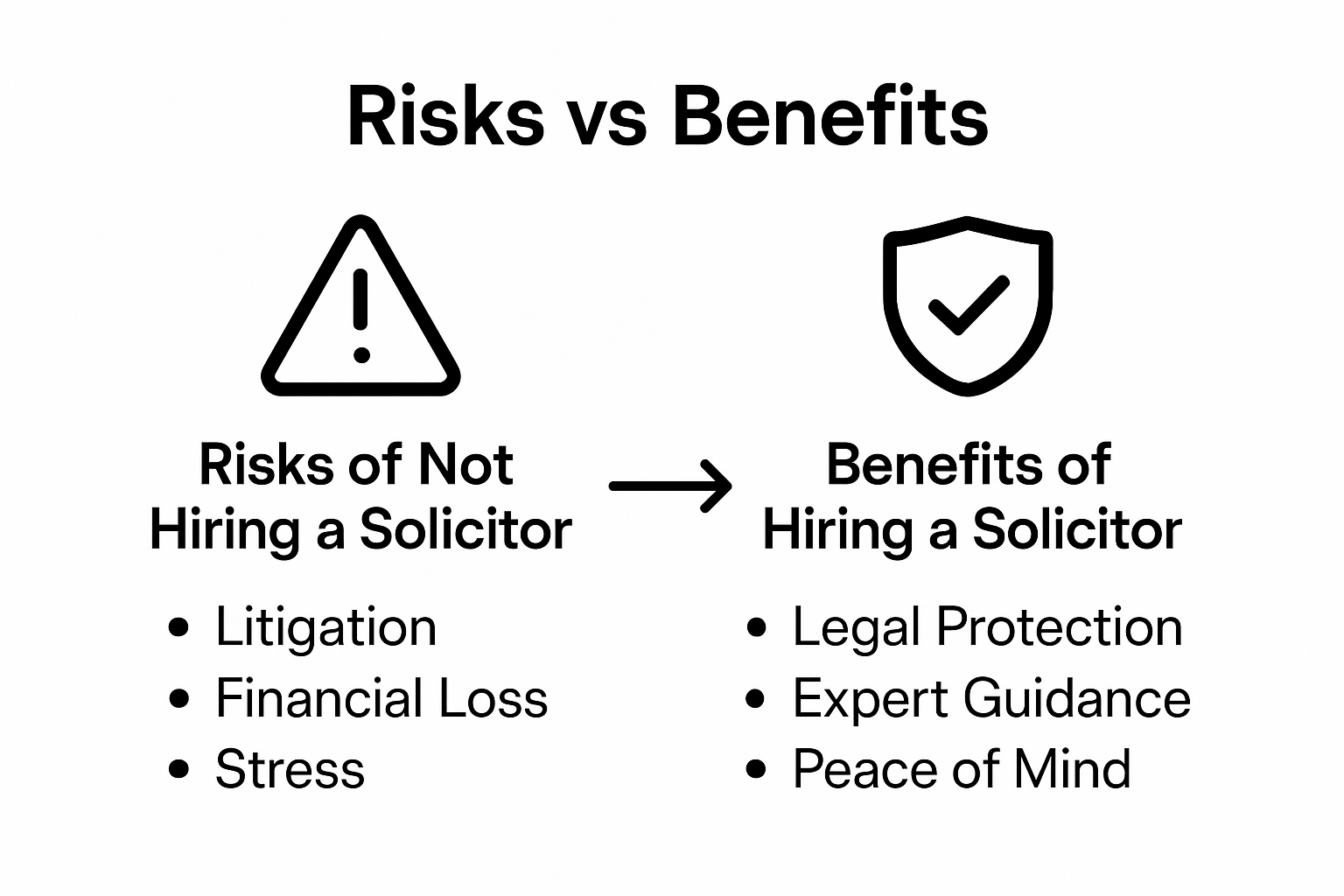
Ultimately, the cost of hiring a solicitor pales in comparison to the potential financial and personal consequences of legal missteps. Investing in professional legal guidance represents a proactive approach to risk management, offering peace of mind and strategic protection across personal and professional domains.
Facing complex legal challenges without professional guidance can feel overwhelming and risky. Whether you are dealing with property transactions, family law issues, or commercial disputes, understanding the critical importance of protecting your legal interests is essential. The article highlights the need for strategic legal support to avoid costly mistakes, procedural errors, and prolonged disputes. At Ali Legal we understand these challenges and offer clear, straightforward advice tailored to your unique situation with a client-centred approach.
Explore our broad range of expert services by visiting All | Ali Legal to find the specialised support you require. Don’t risk your future on uncertainty. Take the crucial step today and connect directly with one of our dedicated solicitors through our contact page to receive fast expert advice. For insights and updates on legal matters that matter to you, browse through our Uncategorized | Ali Legal articles. Protect your legal interests before it is too late with Ali Legal’s transparent fixed fee solutions and long-term client commitment.
Hiring a solicitor provides expert legal advice, ensures proper handling of legal documents, and offers representation in court, which helps protect your legal interests and navigate complex legal situations effectively.
Consider hiring a solicitor when dealing with legal matters such as property transactions, family disputes, business operations, or potential criminal charges where expert guidance is essential to protect your rights and interests.
A solicitor can assist with negotiating settlements, developing tailored strategies for conflict resolution, and representing you in court, ensuring that your case is handled with professional expertise.
Not hiring a solicitor can lead to financial losses due to incorrect legal interpretations, missed deadlines, non-compliance with regulations, and escalated disputes, potentially resulting in significant legal problems and liabilities.
Many british businesses and professionals underestimate just how complex international legal expertise has become. With over 75 percent of global companies facing challenges that stem from conflicting legal systems, understanding this topic is more crucial than ever. This article clears up the common myths and reveals why mastering cross-border law now involves cultural fluency, multilingual skills, and strategic negotiation—qualities that set true international experts apart.
International legal expertise represents a sophisticated realm of professional knowledge extending far beyond traditional legal practice. At its core, this specialised discipline involves understanding complex legal frameworks that operate across national boundaries, requiring profound comprehension of diverse legal systems, international treaties, and transnational regulatory environments.
The scholarly analysis from the Berkeley Journal of International Law illuminates that international legal expertise encompasses more than merely knowing multiple legal codes. It demands nuanced understanding of how different jurisdictions interact, interpret, and enforce legal principles. Professionals in this field must navigate intricate diplomatic channels, comprehend cultural variations in legal reasoning, and develop strategies that transcend singular national legal paradigms.
Contrary to popular misconception, international legal expertise is not a monolithic skill set. Comprehensive research from the Max Planck Encyclopedia of Public International Law reveals it involves multifaceted competencies: understanding comparative legal structures, managing cross-border disputes, interpreting international conventions, and developing adaptive legal strategies that respect multiple regulatory environments. These professionals are linguistic and cultural translators as much as legal practitioners, bridging complex systemic differences with precision and diplomatic acumen.
Key characteristics of genuine international legal expertise include:
Cross-border legal knowledge has become increasingly critical in our interconnected global economy, encompassing multiple complex domains that demand sophisticated legal understanding. These areas require professionals to navigate intricate legal landscapes that transcend traditional national boundaries, requiring deep expertise and strategic approach.
International contract law and trade regulations represent one primary arena where cross-border legal expertise proves essential. Businesses engaging in transnational commerce must understand nuanced contractual frameworks, reconcile divergent legal interpretations, and develop strategies that accommodate multiple regulatory environments. This involves intricate negotiations, comprehensive risk assessment, and the ability to draft agreements that maintain legal validity across different jurisdictions.
Data protection and international privacy management have emerged as another crucial domain requiring specialised cross-border legal knowledge. With increasing digital interconnectedness, legal professionals must comprehend complex international data transfer regulations, ensuring compliance with varied regional privacy standards. These challenges demand sophisticated understanding of evolving technological landscapes and their corresponding legal implications.
Key domains necessitating robust cross-border legal expertise include:
International legal practitioners function as sophisticated global navigators, bridging complex legal systems through intricate professional strategies that transcend traditional geographical boundaries. Their work demands exceptional adaptability, deep cultural intelligence, and a nuanced understanding of transnational legal frameworks.

Professional networks and collaborative methodologies form the cornerstone of international legal practice. These practitioners cultivate extensive global connections, enabling them to exchange critical insights, share emerging legal interpretations, and develop comprehensive strategies for managing cross-border legal challenges. By maintaining robust professional relationships across different jurisdictions, they create adaptive networks that facilitate rapid knowledge transfer and strategic problem-solving.
Analytical approaches and strategic research methodologies are fundamental to their operational effectiveness. International legal practitioners must continuously analyse complex legal landscapes, integrating comparative legal research, understanding subtle contextual variations, and developing flexible interpretative frameworks that can accommodate diverse regulatory environments. This requires not just legal expertise, but also sophisticated analytical skills, technological proficiency, and an ability to synthesise information from multiple legal traditions.
Key operational characteristics of international legal practitioners include:
Navigating global legal frameworks represents a complex and dynamic challenge that demands sophisticated understanding of diverse regulatory landscapes. Legal professionals must develop intricate strategies to comprehend, interpret, and effectively operate across multiple jurisdictional boundaries, each with its unique legal nuances and regulatory requirements.
Accessing legal information across different regulatory systems presents profound challenges for international legal practitioners. Understanding these systems requires more than superficial knowledge; it demands deep analytical skills, comprehensive research capabilities, and an ability to synthesise complex legal principles from varied cultural and legislative contexts. Practitioners must constantly adapt their interpretative frameworks to accommodate the subtle variations in legal approaches across different nations.
Harmonising regulatory frameworks and managing cross-border compliance represents another critical dimension of global legal navigation. This process involves not just understanding individual legal systems, but developing adaptive strategies that can reconcile seemingly contradictory regulatory requirements. Successful navigation requires a combination of technological proficiency, nuanced cultural intelligence, and sophisticated legal reasoning that can bridge regulatory gaps and create coherent legal solutions.
Key strategies for effectively navigating global legal frameworks include:
Inadequate international legal support represents a profound risk for businesses and individuals operating in an increasingly interconnected global environment. The consequences of insufficient legal expertise can extend far beyond simple miscommunication, potentially resulting in substantial financial losses, regulatory penalties, and long-term strategic complications.
Technological reliability and legal research challenges highlight significant risks associated with inadequate international legal support. Organisations relying on superficial or technologically unreliable legal research methodologies expose themselves to substantial misinformation risks. These challenges become particularly acute when navigating complex cross-jurisdictional legal landscapes, where nuanced understanding is critical for effective decision making and risk management.
Cross-jurisdictional legal complexities further underscore the potential dangers of insufficient international legal expertise. Different legal systems possess unique interpretative frameworks, procedural requirements, and fundamental philosophical approaches to resolving disputes. Failing to comprehend these intricate variations can lead to catastrophic misunderstandings, inappropriate legal strategies, and potentially devastating legal consequences for organisations operating across multiple regulatory environments.
Key risks of inadequate international legal support include:
The landscape of legal solutions has transformed dramatically, revealing profound differences between local and international legal approaches. While local legal systems remain anchored in specific national contexts, international legal solutions demand a more nuanced, adaptable, and globally integrated perspective that transcends traditional jurisdictional boundaries.
Cross-border regulatory cooperation illuminates the critical distinctions between local and international legal frameworks. Local legal solutions typically focus on specific national regulations, cultural contexts, and immediate jurisdictional concerns. In contrast, international legal solutions require comprehensive understanding of multiple regulatory environments, intricate diplomatic negotiations, and sophisticated mechanisms for reconciling divergent legal interpretations across different national systems.
Global crisis response and legal adaptability further demonstrates the fundamental differences between local and international legal approaches. While local legal systems often respond to challenges through established national protocols, international legal solutions demand more flexible, collaborative strategies that can rapidly adapt to unprecedented global developments. This requires not just legal expertise, but also advanced intercultural communication skills, technological proficiency, and the ability to synthesise complex legal principles from multiple jurisdictional perspectives.
Key comparative aspects of local versus international legal solutions include:
Navigating the complexities of international legal frameworks is a challenge no individual or business should face alone. This article highlights the critical pain points such as managing cross-border disputes, understanding comparative legal structures, and ensuring compliance with multifaceted regulatory environments. Without specialised international legal expertise, your organisation risks regulatory non-compliance, financial exposure, and strategic setbacks. Ali Legal understands these challenges and offers tailored solutions that combine swift communication, clear advice, and fixed fees to guide you confidently through global legal landscapes.
Explore how you can benefit from practical insights and dedicated support by visiting our Uncategorized Legal Resources. When international disputes or cross-border regulations demand clear strategic action, do not hesitate to reach out through our contact page for a direct consultation. Take control now and ensure your international legal matters are handled with precision and cultural intelligence by partnering with Ali Legal.
International legal expertise refers to the specialised knowledge required to navigate complex legal frameworks that exist across national boundaries. It involves understanding various legal systems, international treaties, and transnational regulations.
International legal expertise is crucial for businesses operating globally, as it helps them manage cross-border disputes, understand regulatory compliance, negotiate contracts, and protect their intellectual property in multiple jurisdictions.
Key areas requiring international legal expertise include international trade contracts, multinational corporate governance, data protection laws, and cross-border intellectual property rights protection.
Inadequate international legal support can lead to severe consequences for organisations, including regulatory non-compliance, increased vulnerability to legal disputes, financial exposure, and reputational damage in the global market.


