
Menu
Get Expert Legal Support Today
TL;DR:
- A notary public does much more than witness signatures; they verify identity, confirm voluntariness, and authenticate legal documents to prevent fraud. Proper notarisation involves careful procedural adherence, correct certificate wording, and thorough preparation to avoid rejection, liability, or legal risks. Early professional guidance and meticulous review are essential for reliable document authentication, especially in complex or cross-border transactions.
Most people assume a notary public simply watches you sign a document and stamps it. That assumption is wrong, and acting on it can cost you dearly. A notary public is a publicly commissioned official who serves as an impartial witness to the identity and voluntary signing of legal documents, helping prevent fraud and ensuring proper authentication. When notarisation goes wrong, documents get rejected, transactions collapse, and legal disputes follow. This guide cuts through the confusion so you can protect your interests, whether you are an individual managing a personal legal matter or a business handling high-stakes documentation.
| Point | Details |
|---|---|
| Identity protection | A notary public’s core task is to verify identity and confirm volitional signing, reducing fraud risk. |
| Compliance is crucial | Proper completion of the notarial certificate is vital—sloppy paperwork leads to rejections and potential liability. |
| Jurisdiction matters | Notary authority, procedures, and alternatives differ by region, so it’s essential to check local rules. |
| Digital change—with limits | Remote and digital notarisation continue but still require identity checks and compliance with notarial duties. |
| Preparation prevents problems | Check all certificates, require full documents, and engage notaries early for smooth, valid transactions. |
The role of a notary public is far more active than simply watching somebody write their name. A notary is an impartial, state-appointed official whose core responsibility is to verify identity, confirm that signing is voluntary and informed, and authenticate legal documents in a way courts and institutions can rely on.
According to the six main notarial acts recognised under the Revised Uniform Law on Notarial Acts (RULONA), notaries are authorised to perform acknowledgements, administer oaths and affirmations, execute verifications on oath, witness or attest signatures, certify copies of documents, and note protests of negotiable instruments. Each of these acts carries its own procedural requirements and legal effect.
Here is what typically happens during a proper notarisation:
The distinction between an acknowledgement and a jurat (a sworn statement) is worth noting here. In an acknowledgement, you confirm you signed the document freely. In a jurat, you swear under oath that the document’s contents are true. Using the wrong certificate type is one of the most common errors notaries and their clients make.
“Notarial acts can affect the legal rights of others. A notary must act with care, impartiality, and strict adherence to the required procedures.”
Pro Tip: Always bring valid photo identification and ensure every signer is present. Sending someone on your behalf will not work. The notary must personally verify each signer’s identity before proceeding.
Comparison of common notarial acts
| Act | What it confirms | Typical use |
|---|---|---|
| Acknowledgement | Signer freely executed the document | Deeds, powers of attorney |
| Jurat | Signer swears contents are true | Affidavits, sworn statements |
| Copy certification | Document is a true copy of the original | Passports, qualifications |
| Signature witnessing | Identity verified at time of signing | Wills, contracts |
Understanding contract law in the UK becomes much more straightforward once you appreciate how notarisation supports the enforceability of signed agreements. For more complex arrangements such as trusts, understanding asset protection for UK trusts often begins with properly notarised documentation.
Getting notarisation wrong is not a minor inconvenience. The consequences range from rejected applications and delayed transactions to fraud exposure and civil litigation. Improperly completed certificates are one of the most common reasons notarised documents are rejected, and missing, incorrect, or blank certificates create immediate practical problems and longer-term legal risk.
The specific risks fall into several categories:
Consider a practical example. A business owner preparing articles of incorporation for an overseas subsidiary needs notarised signatures on several company documents. If the notarial certificate omits the date or uses incorrect jurisdiction wording, the receiving authority abroad may refuse the entire package. Weeks of preparation collapse overnight, and the business faces resubmission costs, delays, and potential loss of the commercial opportunity.
Pro Tip: After every notarisation, review the completed certificate before leaving. Check the date, your name as it appears on your identification, the certificate type, and the notary’s seal. Spotting an error in the room takes seconds. Correcting it after the fact takes weeks.

For businesses, maintaining essential legal documents in good order and staying on top of a solid business incorporation process both depend heavily on reliable, accurate notarisation at the outset.
Notarial practice is not uniform. The authority a notary holds, the acts they can perform, and the legal effect those acts carry vary significantly by jurisdiction). A notarisation valid in England and Wales may need apostille certification to be accepted in another country. A notarial act performed in one US state may carry different weight in another. Assuming your notarisation is automatically portable is a costly mistake.
Comparison of notarisation approaches
| Approach | Who appears | Verification method | Key limitations |
|---|---|---|---|
| Standard in-person | Signer and notary | Government ID, direct questioning | Signer must be physically present |
| Subscribing witness | Witness appears, not signer | ID of witness, oath administered | Only permitted in specific jurisdictions |
| Remote/online notarisation | Signer via video link | Identity proofing technology | Core duties remain; rules vary widely |
When a signer genuinely cannot appear in person, some jurisdictions permit a subscribing witness procedure. In this arrangement, the witness (not the signer) appears before the notary, confirms they witnessed the signer execute the document, and swears to this under oath. The notary then notarises based on the witness’s sworn statement rather than direct contact with the signer. This is a strict, limited alternative. Most jurisdictions do not allow it, and misapplying it can render the entire document invalid.
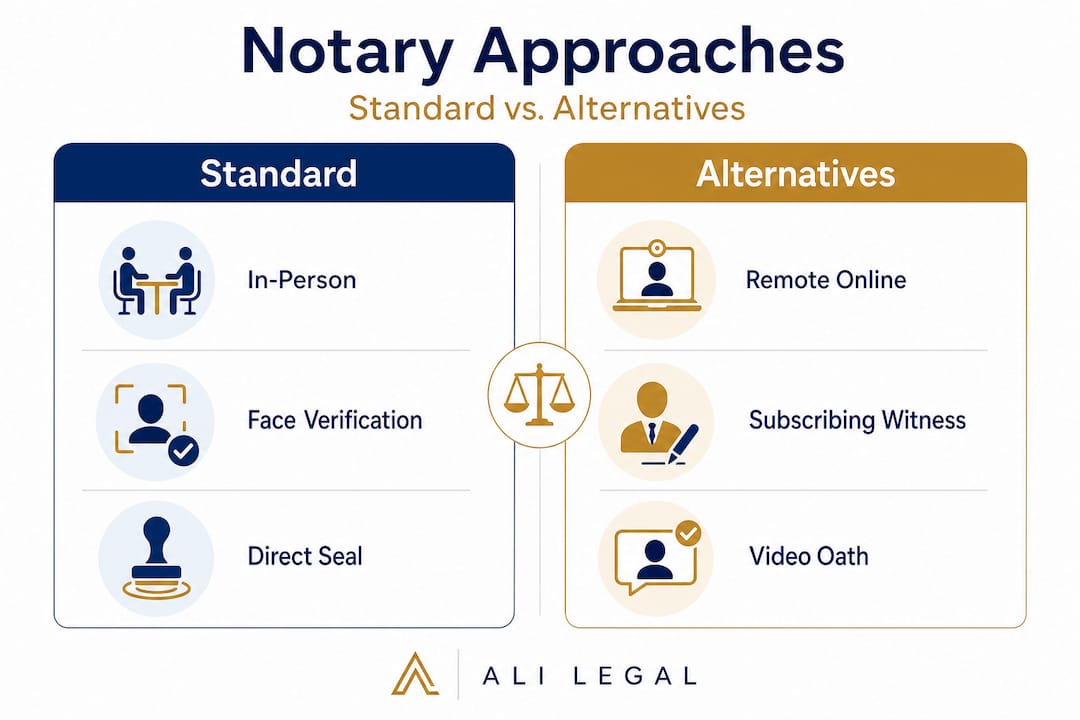
Remote and digital notarisation is expanding rapidly. Video-based platforms allow notaries to perform identity checks and witness signatures across distances. However, remote notarisation does not remove core duties. The notary must still carry out thorough identity verification, confirm voluntary consent, and complete the notarial certificate correctly. Where AI tools assist with scheduling or document preparation, the notary remains personally responsible for every act performed under their seal.
Steps for remote notarisation:
“Failing to confirm personal appearance, whether in person or via approved remote means, is one of the most common causes of notarisation-related lawsuits.”
Businesses managing multiple cross-border agreements should refer to a clear corporate law checklist to ensure that notarisation requirements are embedded into their compliance processes from the start, rather than addressed as an afterthought.
Preparation is the single most effective tool for avoiding notarisation problems. Whether you are handling a personal document or managing a high-volume business transaction, the following practices will reduce your risk significantly.
Before attending the notary:
During the notarisation:
After the notarisation:
Pro Tip: Never sign before seeing the notary, and always review the certificate wording before you leave the room. Certificate errors discovered later often require the entire process to restart. Reviewing everything at the point of signing costs nothing.
Having solid contracts in your business is inseparable from reliable notarisation. Applying contract drafting best practices from the outset means your documents arrive at the notary complete, clearly worded, and ready to withstand scrutiny.
Here is something we see regularly in practice: individuals and businesses treat notarisation as a box-ticking exercise. They assume the notary will catch every problem and manage every risk. They arrive underprepared, hand over a document they have not fully read, and walk away confident the stamp makes everything official. That confidence is misplaced.
The reality is that a notary’s duty is procedural. They confirm identity and verify voluntariness. They do not review the legal effectiveness of the underlying document, advise on whether you need a different type of notarisation, or guarantee the receiving institution will accept what they have certified. The preparation and strategic thinking must happen before you walk through the notary’s door.
The most avoidable mistakes we see:
Over-reliance on the notary’s role. Many clients believe the notary’s seal solves all problems. It does not. A correctly notarised but legally defective document is still legally defective. The notarisation authenticates the signing, not the substance.
Ignoring certificate wording. Certificate language is prescribed by law in most jurisdictions. Using generic or downloaded template wording without checking current local requirements is a persistent source of rejections. This matters especially in cross-border matters where receiving jurisdictions may have highly specific requirements.
Failing to plan for absent signers. Discovering that a key signatory is unavailable on the day of notarisation, without having made proper alternative arrangements, is an entirely preventable crisis. Explore subscribing witness options or remote notarisation routes well in advance, confirm they apply in your jurisdiction, and document your decision.
Treating digital tools as a shortcut. Automation can and does reduce coordination time and administrative burden. But digital tools working without strong human oversight create new risks, particularly around identity verification and certificate completion. The technology shifts the mechanics, not the responsibility.
What consistently works is engaging legal professionals early, particularly for complex or cross-border matters. Using a corporate law checklist to build notarisation into your compliance process from the outset, rather than retrofitting it, saves time and money over the long term. Notarisation done well is quiet and unremarkable. Notarisation done badly tends to announce itself at the worst possible moment.
When disputes arise over notarised documents, or when you need rigorous compliance support for complex transactions, you need more than a stamp on a page.

Ali Legal’s civil litigation team regularly handles disputes where documentation errors, including notarisation failures, have escalated into serious legal conflicts. Our commercial litigation specialists work with businesses facing high-stakes disputes over contracts and corporate documents where authenticity is challenged. And for personal matters where notarised documents underpin sensitive proceedings, our family and divorce legal team brings the same level of care and strategic thinking. Contact Ali Legal for straightforward guidance tailored to your situation.
Commonly notarised documents include powers of attorney, company resolutions, property transfers, affidavits, and international business documents. Requirements vary depending on the receiving institution and jurisdiction.
The document is likely to be rejected by the receiving authority, causing delay and potential legal risk, and missing certificates are one of the most common reasons notarised documents fail. The notary may also face professional liability if their error caused loss.
Many notarial acts can now be performed remotely, but core duties remain including identity verification, informed consent, and proper certificate completion. Remote notarisation is not permitted for all document types in all jurisdictions.
In some jurisdictions, a subscribing witness procedure permits a witness to appear before the notary and swear an oath confirming they saw the document signed. Rules are strict and vary considerably by location, so always confirm local requirements in advance.
Improperly completed or missing notarial certificates increase fraud risk and compliance failure and can invalidate entire transactions. Businesses should build notarisation checks into their standard compliance processes rather than treating them as an administrative afterthought.


