
Menu
Get Expert Legal Support Today

TL;DR:
- Guardianship is a court-appointed legal arrangement that removes certain rights from the ward.
- Establishing guardianship involves formal court petitions, medical evidence, and ongoing oversight.
- Alternatives like power of attorney and supported decision-making often better preserve autonomy.
Guardianship is one of those legal concepts that many families assume they understand until the moment it actually matters. The truth is, guardianship is neither automatic nor simple, and the process of obtaining it can involve court hearings, medical evidence, and ongoing legal obligations that catch most people completely off guard. Whether you are caring for an elderly parent with dementia, a child whose parents are unable to provide care, or a family member with a disability, understanding guardianship properly before a crisis hits is one of the most important steps you can take. This article covers the core definitions, the legal process, the rights and limits involved, and the alternatives that may serve your family better.
| Point | Details |
|---|---|
| Guardianship defined | A guardian is legally appointed to make decisions for someone unable to do so themselves. |
| Court involvement required | Establishing guardianship always involves a formal legal process and court oversight. |
| Duties and rights | Guardians act under strict limits and must support the ward’s independence wherever possible. |
| Alternatives available | Less restrictive options like powers of attorney and trusts should be considered first. |
| Expert advice matters | Legal guidance helps families pick the right solution with confidence and peace of mind. |
Before anything else, let us be clear about what guardianship actually is. Many people use the word loosely, confusing it with parental responsibility, power of attorney, or simply being a named carer. These are not the same thing.
Guardianship is a court-appointed arrangement where a surrogate decision-maker is designated to make personal and/or financial decisions for a minor or for an adult who cannot care for themselves. The key phrase here is court-appointed. Guardianship does not arise from a family agreement, a written note, or a GP’s recommendation. It is a formal legal status granted by a judge.
The person appointed is called the guardian. The person they are appointed to care for is called the ward. The guardian may be a family member, a close friend, or in some cases a professional or organisation appointed by the court.
Who does guardianship apply to?
Guardianship typically covers two main groups:
Types of guardianship
Not all guardianship is the same. Courts recognise several forms:
| Type | Scope | Duration |
|---|---|---|
| Full (plenary) guardianship | All personal and financial decisions | Permanent unless revoked |
| Limited guardianship | Specific decisions only | Permanent or time-limited |
| Temporary guardianship | Emergency or short-term decisions | Set period, typically weeks or months |
An important and often overlooked point is this: guardianship removes legal rights from the ward. Once a person is placed under guardianship, their legal autonomy in certain areas is transferred to the guardian. That is why courts treat this seriously and why it should never be pursued lightly.

To put this in perspective, estimates suggest that at least 1.3 to 1.5 million adults in the United States alone are currently under some form of guardianship, and comparable patterns exist in the UK and other common law countries. These are real people whose legal independence has been restricted, often for good reasons, but always with significant consequence.
Understanding these distinctions is foundational. Without them, families risk either pursuing guardianship when it is not necessary, or failing to pursue it when it genuinely is the only appropriate option.
Now that you know who may require guardianship, understanding the process is vital. Many families are surprised to discover how formal and procedurally rigorous it is.
Court procedure for establishing adult guardianship typically includes filing a petition, requiring evidence of incapacity, and having at least one court hearing. The court may appoint a guardian ad litem, and the appointed guardian must provide ongoing reports while the guardianship is in effect. This is not a once-and-done process. It requires sustained commitment.
Step-by-step: How guardianship is typically established
Adult vs minor guardianship: A quick comparison
| Stage | Adult guardianship | Minor guardianship |
|---|---|---|
| Evidence needed | Medical/psychiatric reports | Proof of parental incapacity or absence |
| Key investigation | Guardian ad litem report | Child welfare assessment |
| Court oversight | Ongoing reporting required | Periodic review until adulthood |
| Common scenarios | Dementia, brain injury, severe disability | Parental death, imprisonment, neglect |
Consider two common scenarios. In the first, an 80-year-old with advanced dementia can no longer manage her finances or medical decisions. Her daughter applies for guardianship, submits a consultant’s report confirming incapacity, and after a hearing, is appointed as limited guardian for financial matters. In the second, a child’s parents are both killed in an accident. The child’s aunt applies for guardianship, and after a welfare assessment confirming her suitability, the court grants a permanent order.
Understanding the associated probate and legal costs of these processes matters too, since court applications carry fees and ongoing legal obligations. Families who plan ahead and understand estate and probate procedures are far better placed to manage guardianship alongside broader estate arrangements.
Pro Tip: Gather comprehensive medical records, professional assessments, and any relevant legal documents as early as possible. Incomplete documentation is the single most common reason guardianship applications are delayed or refused.
Understanding the process leads naturally to the question of what guardians can legally do once appointed. The answer is nuanced, and getting it wrong can have serious legal consequences.
For adults, guardianship is created through a court process, and the court may grant full or limited authority. It is designed to give the ward as much independence as possible, even within the constraints of the order. This principle is fundamental: guardianship is not a blank cheque.
What a guardian may typically do:
What a guardian cannot do:
“Many jurisdictions demand that ‘least restrictive alternatives’ are considered before guardianship is granted, and guardians are expected to maximise the ward’s independence even after appointment.”
The ongoing oversight element is one that many applicants underestimate. Guardians must report regularly to the court, and failure to do so can result in removal from the role or legal sanctions. This is intentional. Courts do not hand over authority over a vulnerable person’s life without maintaining accountability.
Balancing authority with autonomy
A good guardian does not simply take over. They listen. If an elderly ward with limited dementia still has clear preferences about where they want to live or whom they want to see, those preferences must be taken seriously. Courts expect guardians to act in the ward’s best interests, which is not the same as acting on what the guardian personally believes is best.
Pro Tip: Keep a detailed log of all decisions made on the ward’s behalf, including the reasoning behind each one. This protects you legally and demonstrates to the court that you are fulfilling your responsibilities properly.
Because guardianship significantly restricts rights, it is crucial to know when less restrictive options are appropriate. In many situations, families pursue guardianship when other legal tools would be equally effective, less invasive, and far easier to establish.
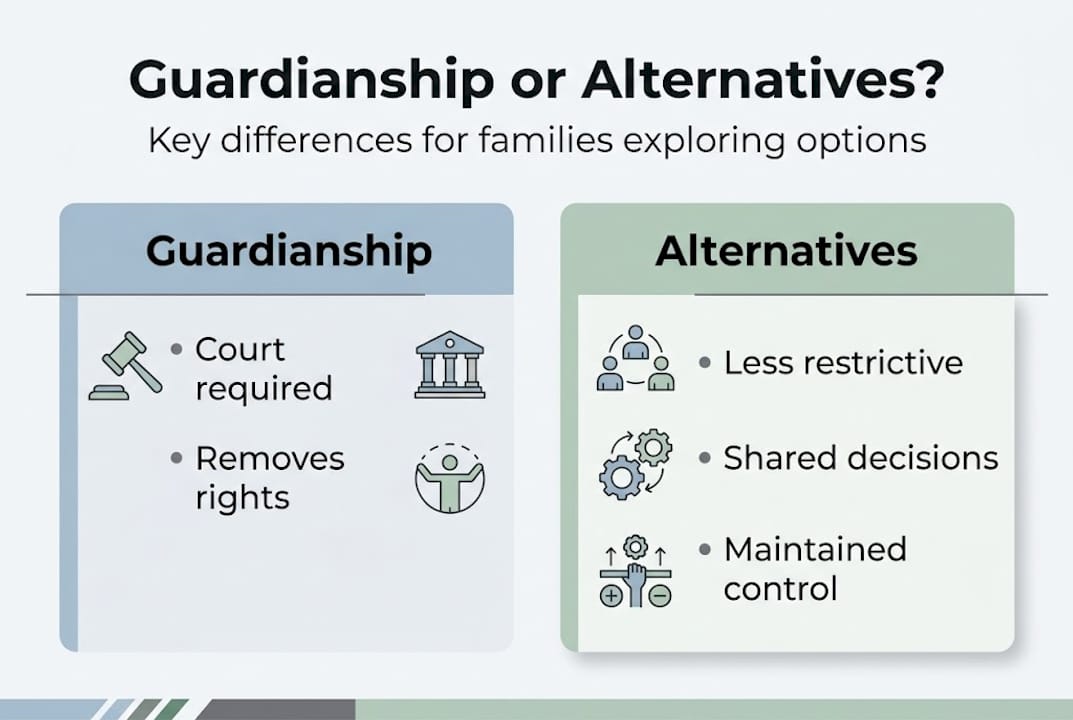
Many jurisdictions and courts emphasise guardianship as a serious, rights-restricting measure and require consideration of less restrictive alternatives when possible, rather than using full guardianship automatically. This is not just procedural caution. It reflects a genuine legal and ethical commitment to preserving individual autonomy wherever possible.
Key alternatives to guardianship:
Guardianship vs alternatives: A comparison
| Factor | Guardianship | Power of attorney | Supported decision-making |
|---|---|---|---|
| Court involvement | Required | Not required if pre-planned | Not required |
| Ward’s legal rights | Partially or fully removed | Retained | Fully retained |
| Flexibility | Lower | Higher | Highest |
| Ongoing oversight | Significant | Minimal | Informal |
| Best suited for | Severe incapacity, no prior planning | Planned future incapacity | Mild support needs |
The critical question families must ask is: does this person truly lack capacity across all relevant areas, or do they simply need assistance? If the answer points to assistance, guardianship is almost certainly not the right tool. Exploring probate arrangements and reviewing the asset protection guide can help families consider the full picture before committing to any single legal route.
Always consult a solicitor before assuming guardianship is necessary. The difference between getting this right and getting it wrong can mean the difference between preserving someone’s dignity and stripping it away unnecessarily.
In our experience working with families through guardianship matters, the most common mistake is not malicious. It is simply an underestimation of what the process genuinely involves, emotionally and legally.
Families often arrive believing guardianship is a formality. They expect to sign some forms, attend a brief hearing, and walk away with clarity. What they encounter instead is a process that can take months, involve contested hearings, require the cooperation of medical professionals and court-appointed investigators, and result in ongoing legal obligations that last years.
The emotional toll is equally underestimated. Watching a loved one have their legal autonomy formally removed by a court, even when it is clearly necessary, is a profound experience. It often triggers family disagreements about who should be appointed, what decisions should be made, and whether it was truly necessary in the first place.
The wisest families are those who engage with holistic estate planning well before any crisis emerges. Having lasting powers of attorney in place, clear advance directives, and family conversations about future care removes the need for guardianship in a surprising number of cases. When guardianship is genuinely necessary, early professional advice prevents the procedural mistakes and family rifts that make a difficult situation far worse.
If guardianship or its alternatives might apply to your situation, professional guidance makes a genuine difference at every stage.

At Ali Legal, we work with individuals and families navigating family and divorce legal support matters, including guardianship applications, alternatives, and long-term planning. Our solicitors provide clear, fixed-fee advice so you understand exactly what you are committing to before you proceed. Whether you need help with a court application, want to explore whether a power of attorney or trust is more appropriate, or simply need family law guidance to understand your options, we are here to assist. Contact us today to arrange a consultation and take the first step towards protecting the people who matter most.
Any adult with a genuine interest in the welfare of the proposed ward may apply, including family members, close friends, or suitably qualified professionals appointed by the court.
No; guardianship covers both minors and adults, including children whose caregivers are unable to provide care due to death, incapacity, or other serious circumstances.
Guardianship may be temporary or permanent, depending on the court’s assessment of the individual’s needs and whether the circumstances are expected to change over time.
Yes; any interested party, including the ward themselves in some circumstances, can apply to the court to review, modify, or discharge the guardianship order if circumstances have changed significantly.
National guardianship data is often incomplete, as many jurisdictions lack a centralised reporting system, meaning reliable figures on the total number of people under guardianship can only be estimated rather than confirmed.


